POLYGONS
POLYGONS

      a closed plane figure
  bounded by three or more
  straight sides that meet in
  pairs in the same number of
  vertices, and do not intersect
  other than at these vertices.
CLASSIFICATION OF POLYGONS

                  Polygons first fit into two general
             categories— convex and not convex
             (sometimes called concave).
             A polygon is concave if there are two
             points somewhere inside it for which a
             segment with these as its endpoints cuts at
             least 2 of the sides of the polygon.
             A polygon that is not concave is called
             convex
CLASSIFICATION OF POLYGONS


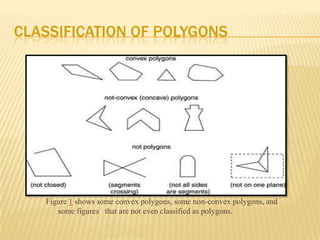
   Figure 1 shows some convex polygons, some non-convex polygons, and
      some figures that are not even classified as polygons.
CLASSIFICATION OF POLYGONS

 Polygons are also classified by how many sides (or angles) they have.
 The following lists the different types of polygons and the number of
 sides that they have:
 A triangle is a three-sided polygon
 A quadrilateral is a four-sided polygon.
 A pentagon is a five-sided polygon.
 A hexagon is a six-sided polygon.
 A septagon or heptagon is a seven-sided polygon.
 An octagon is an eight-sided polygon.
 A nonagon is a nine-sided polygon.
 A decagon is a ten-sided polygon
REGULAR POLYGONS
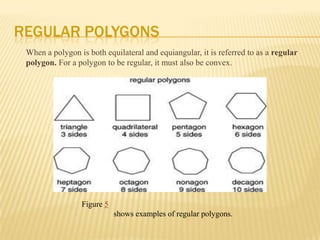
 When a polygon is both equilateral and equiangular, it is referred to as a regular
 polygon. For a polygon to be regular, it must also be convex.


                 Figure 5
                            shows examples of regular polygons.
PARTS OF A POLYGON
-   The endpoints of the sides of polygons are called vertices. When naming a polygon,
    its vertices are named in consecutive order either clockwise or counterclockwise.
-   Consecutive sides are two sides that have an endpoint in common. The four-sided
    polygon in Figure 2 could have been named ABCD, BCDA, or ADCB, for example.
    It does not matter with which letter you begin as long as the vertices are named
    consecutively. Sides AB and BC are examples of consecutive sides.


    Figure 2 There are four pairs of consecutive sides in this polygon.
PARTS OF A POLYGON
 A diagonal of a polygon is any segment that joins two nonconsecutive vertices.
 Figure 3 shows five-sided polygon QRSTU. Segments QS , SU , UR , RT and QT are
 the diagonals in this polygon.


                   Figure 3
                              Diagonals of a polygon.
SUM OF THE INTERIOR ANGLES OF A POLYGON
 An Interior Angle is an angle inside a shape.
TRIANGLES
The Interior Angles of a Triangle add up to 180


           90 + 60 + 30 = 180                     80 + 70 + 30 = 180
QUADRILATERALS
   A Quadrilateral is any shape with 4 sides


       90 + 90 + 90 + 90 = 360         80 + 100 + 90 + 90 = 360
         A Square adds up to 360


            The Interior Angles of a Quadrilateral add up to 360
Polygons
Polygons
Polygons

Polygons

  • 1.
  • 2.
    POLYGONS a closed plane figure bounded by three or more straight sides that meet in pairs in the same number of vertices, and do not intersect other than at these vertices.
  • 3.
    CLASSIFICATION OF POLYGONS Polygons first fit into two general categories— convex and not convex (sometimes called concave). A polygon is concave if there are two points somewhere inside it for which a segment with these as its endpoints cuts at least 2 of the sides of the polygon. A polygon that is not concave is called convex
  • 4.
    CLASSIFICATION OF POLYGONS Figure 1 shows some convex polygons, some non-convex polygons, and some figures that are not even classified as polygons.
  • 5.
    CLASSIFICATION OF POLYGONS Polygons are also classified by how many sides (or angles) they have. The following lists the different types of polygons and the number of sides that they have: A triangle is a three-sided polygon A quadrilateral is a four-sided polygon. A pentagon is a five-sided polygon. A hexagon is a six-sided polygon. A septagon or heptagon is a seven-sided polygon. An octagon is an eight-sided polygon. A nonagon is a nine-sided polygon. A decagon is a ten-sided polygon
  • 6.
    REGULAR POLYGONS Whena polygon is both equilateral and equiangular, it is referred to as a regular polygon. For a polygon to be regular, it must also be convex. Figure 5 shows examples of regular polygons.
  • 7.
    PARTS OF APOLYGON - The endpoints of the sides of polygons are called vertices. When naming a polygon, its vertices are named in consecutive order either clockwise or counterclockwise. - Consecutive sides are two sides that have an endpoint in common. The four-sided polygon in Figure 2 could have been named ABCD, BCDA, or ADCB, for example. It does not matter with which letter you begin as long as the vertices are named consecutively. Sides AB and BC are examples of consecutive sides. Figure 2 There are four pairs of consecutive sides in this polygon.
  • 8.
    PARTS OF APOLYGON A diagonal of a polygon is any segment that joins two nonconsecutive vertices. Figure 3 shows five-sided polygon QRSTU. Segments QS , SU , UR , RT and QT are the diagonals in this polygon. Figure 3 Diagonals of a polygon.
  • 9.
    SUM OF THEINTERIOR ANGLES OF A POLYGON An Interior Angle is an angle inside a shape.
  • 10.
    TRIANGLES The Interior Anglesof a Triangle add up to 180 90 + 60 + 30 = 180 80 + 70 + 30 = 180
  • 11.
    QUADRILATERALS A Quadrilateral is any shape with 4 sides 90 + 90 + 90 + 90 = 360 80 + 100 + 90 + 90 = 360 A Square adds up to 360 The Interior Angles of a Quadrilateral add up to 360