More about Polygons
•Made up of three or more
straight line segments
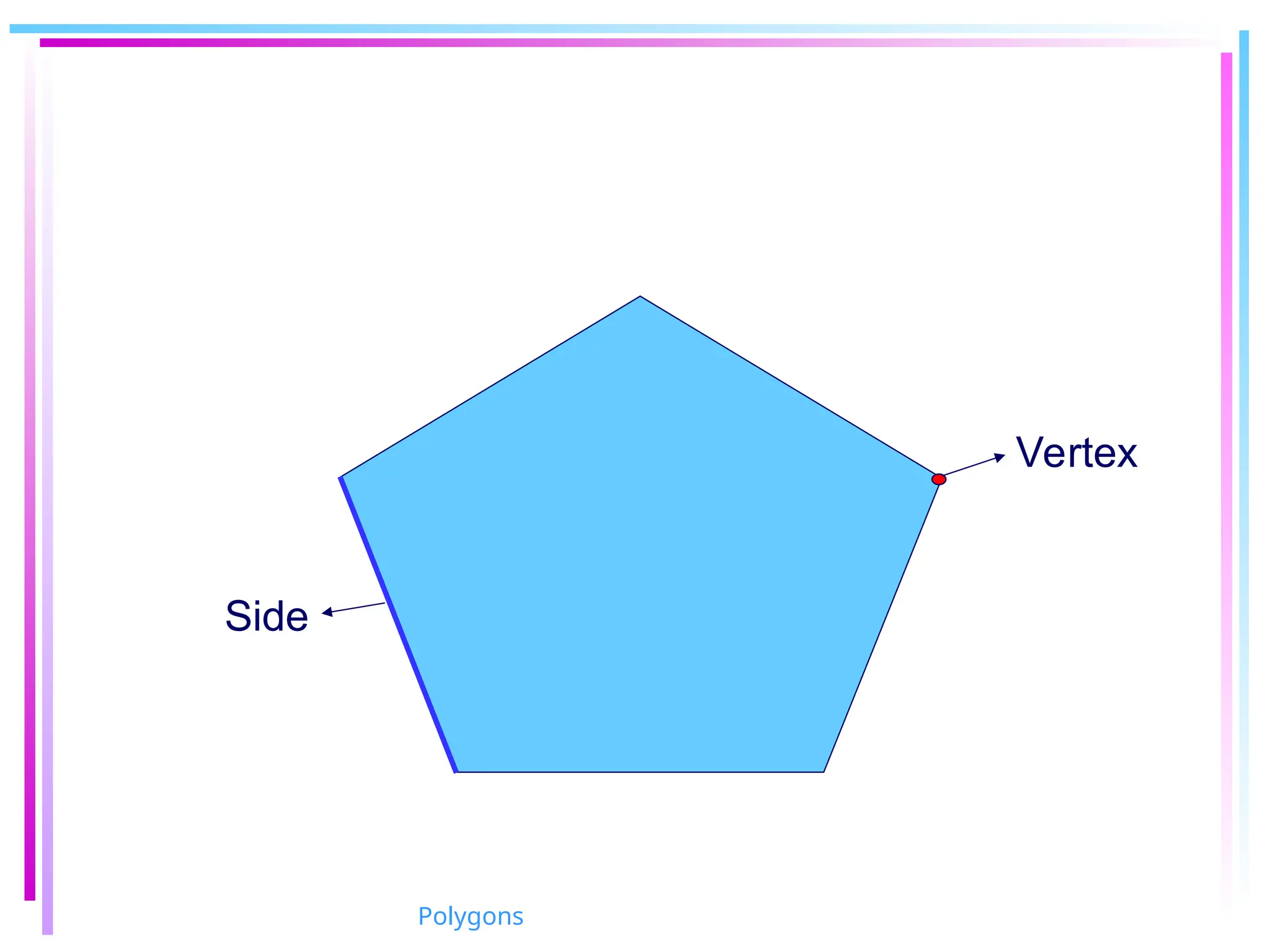
• There are exactly two sides that
meet at a vertex
• The sides do not cross each other
Polygons
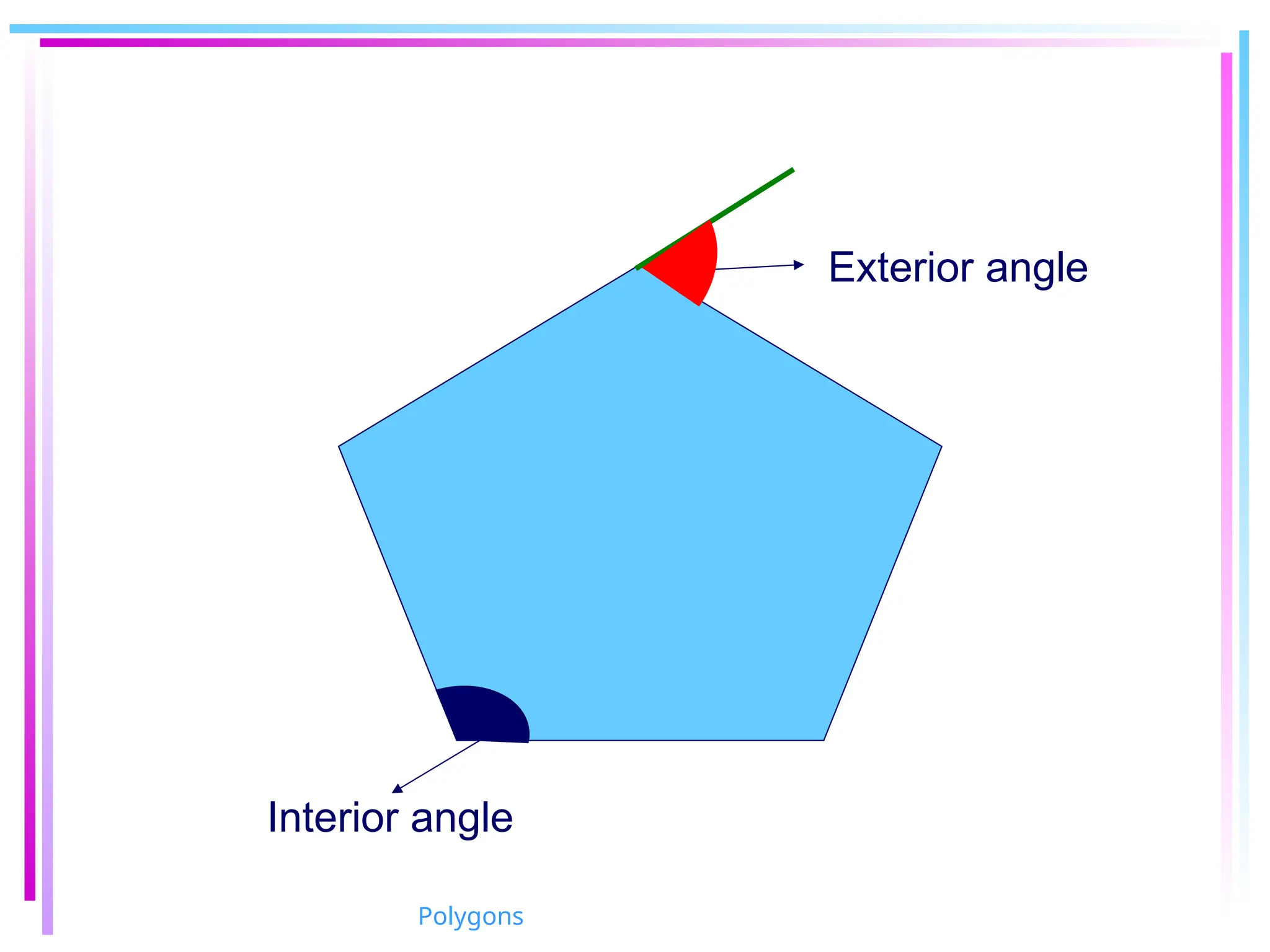
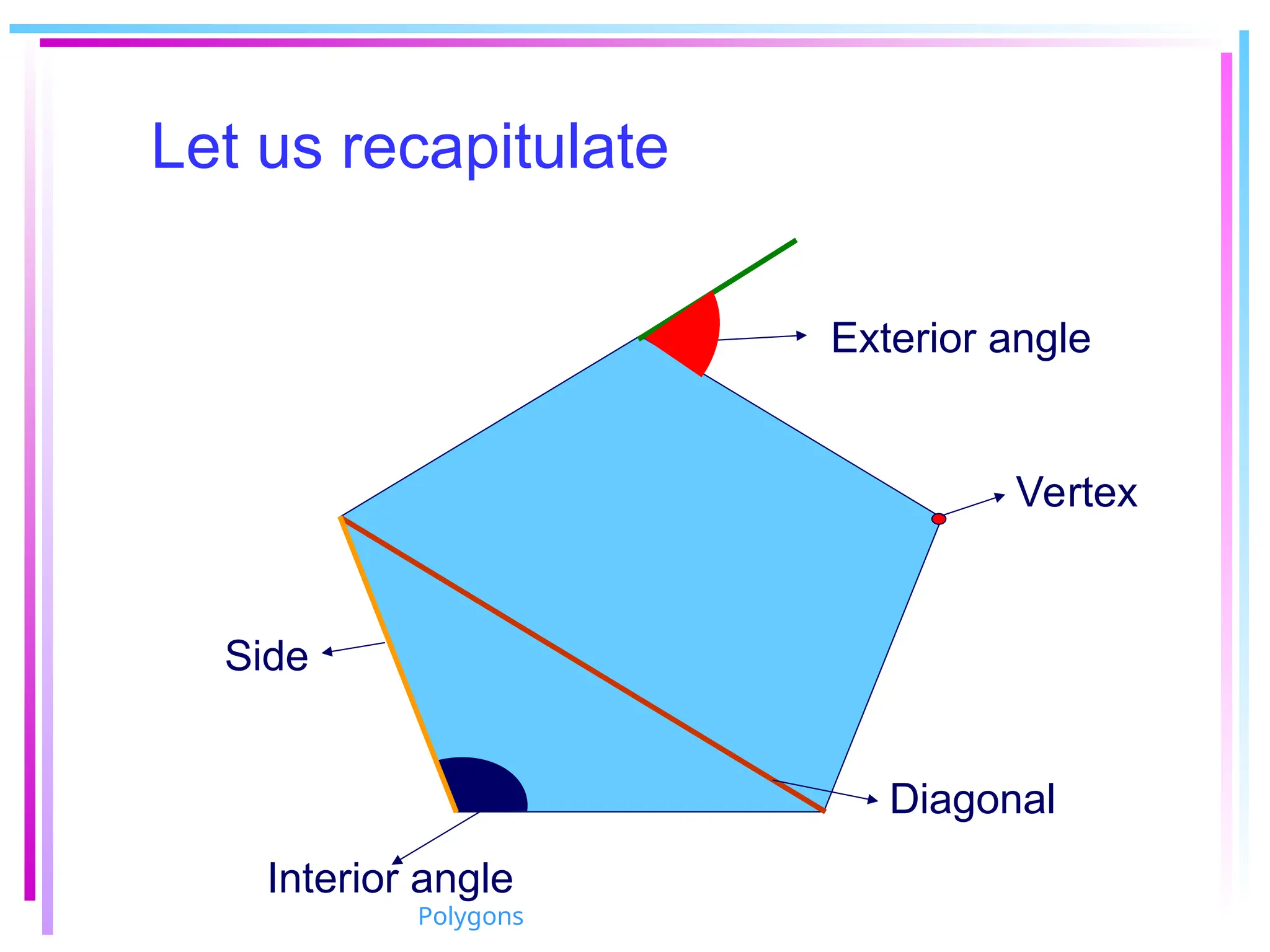
• Interior angle:An angle formed
by two adjacent sides inside the
polygon.
• Exterior angle: An angle formed
by two adjacent sides outside
the polygon.
Polygons
Types of Polygons
•Equiangular Polygon: a polygon
in which all of the angles are
equal
• Equilateral Polygon: a polygon
in which all of the sides are the
same length
Polygons
12.
• Regular Polygon:a polygon
where all the angles are
equal and all of the sides
are the same length. They
are both equilateral and
equiangular
Polygons
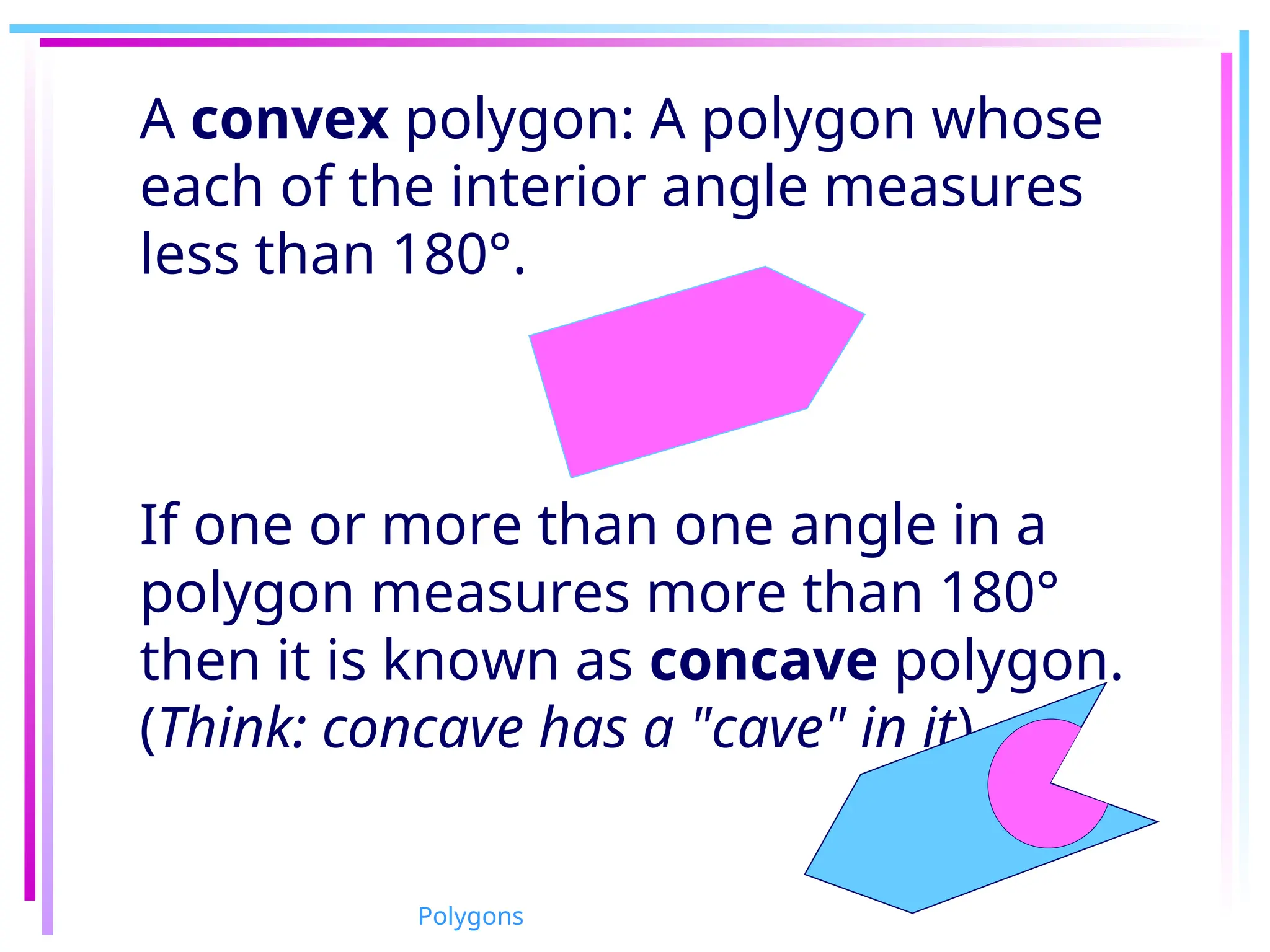
A convex polygon:A polygon whose
each of the interior angle measures
less than 180°.
If one or more than one angle in a
polygon measures more than 180°
then it is known as concave polygon.
(Think: concave has a "cave" in it)
Polygons
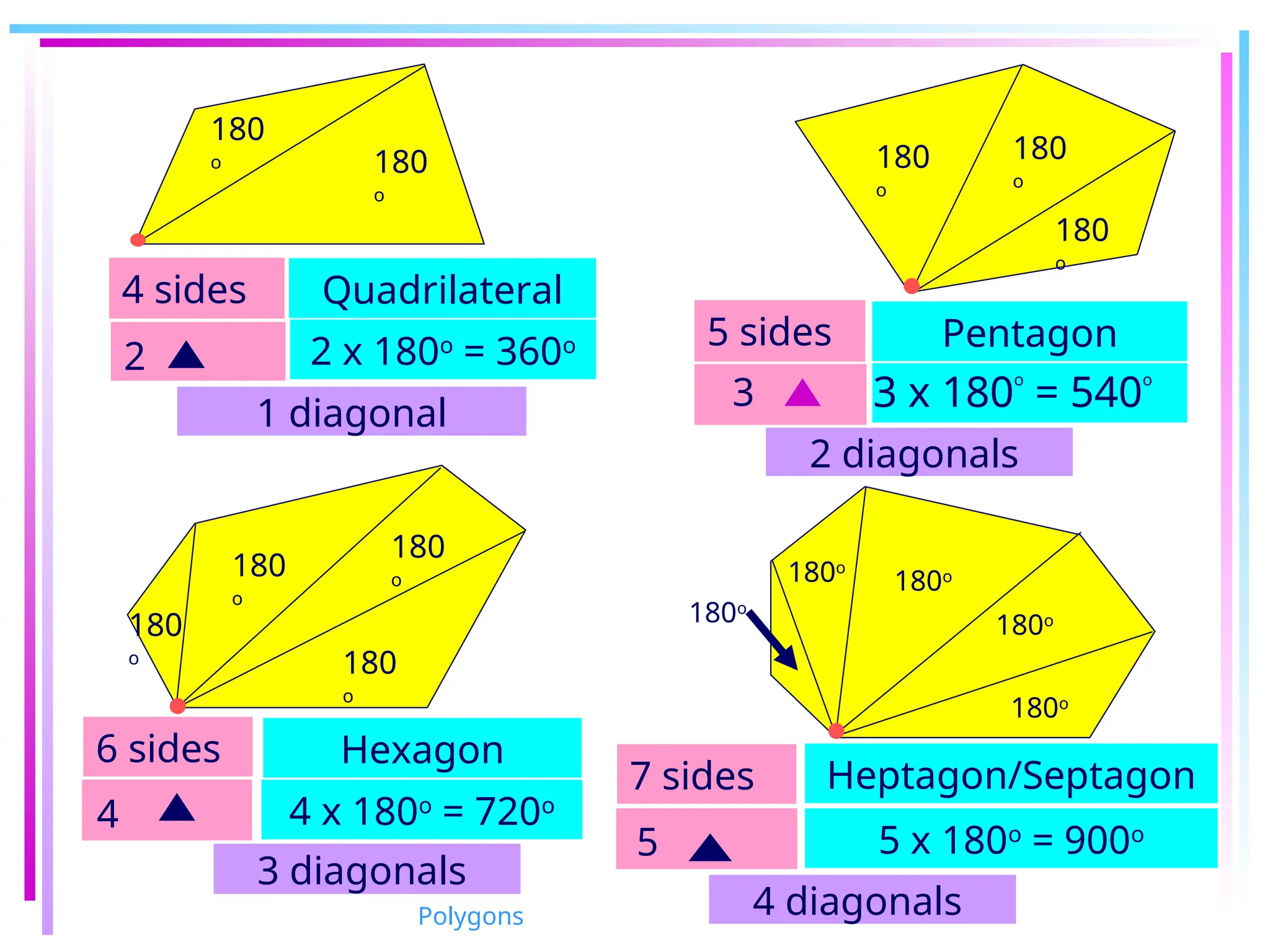
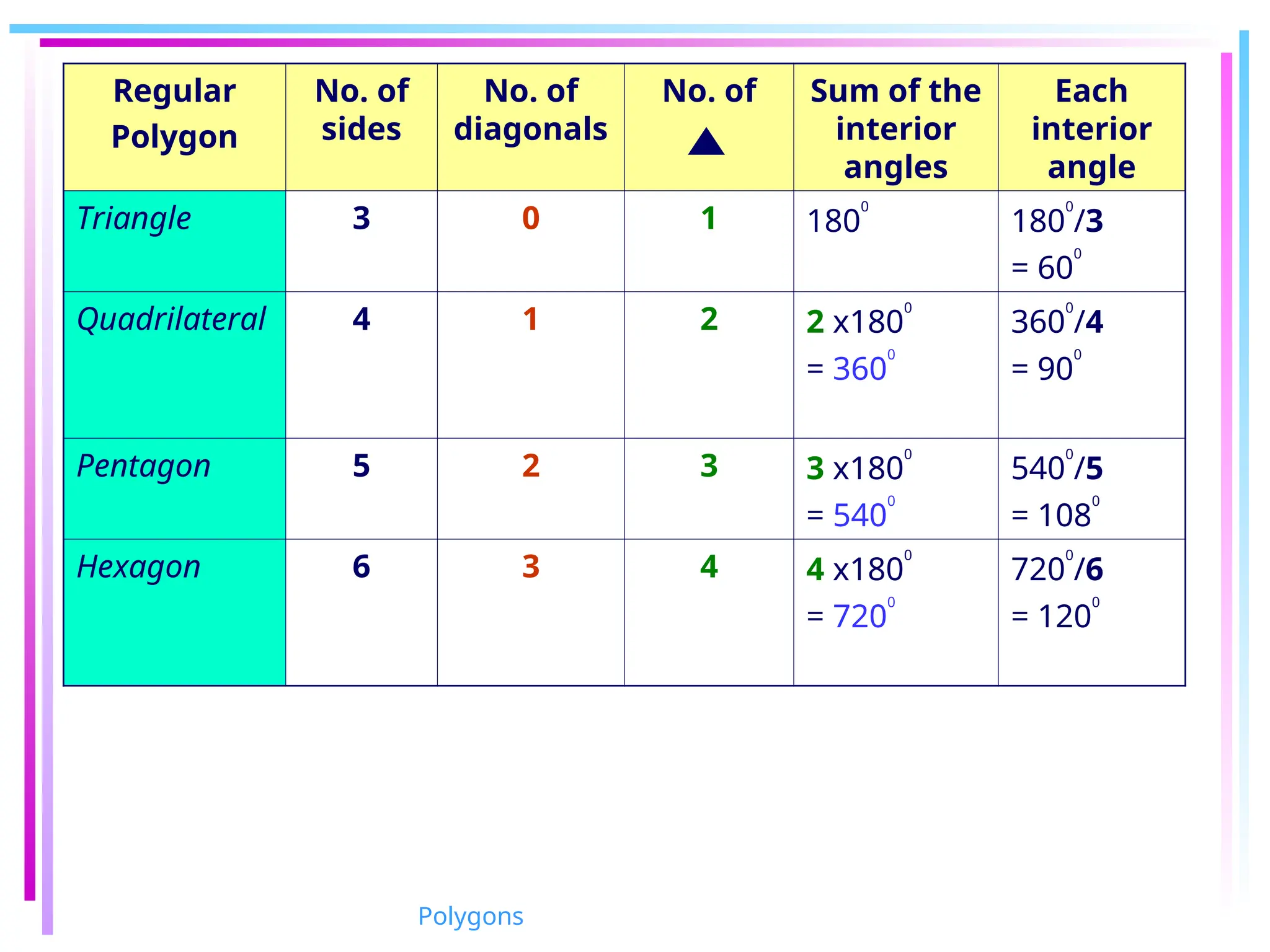
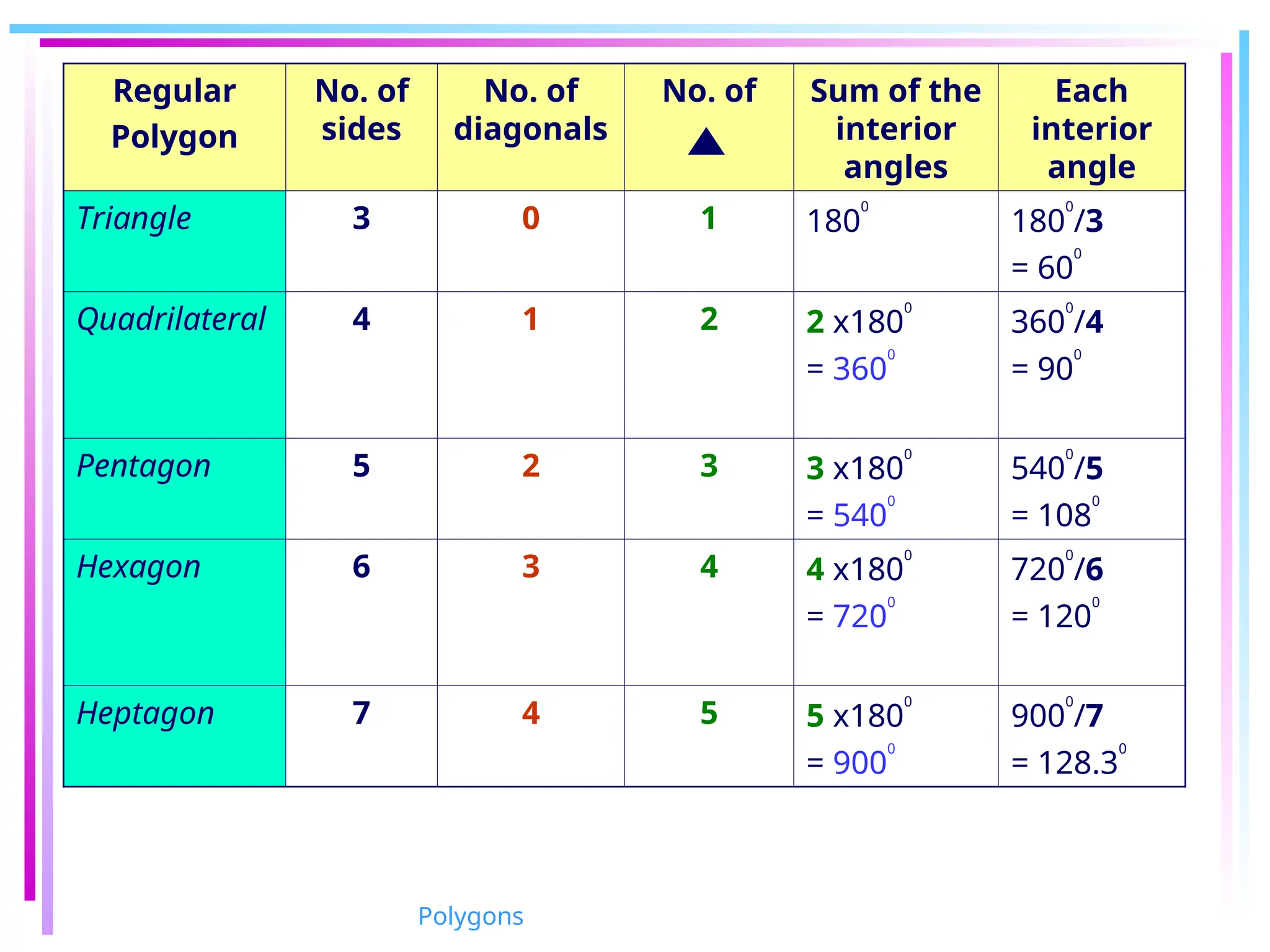
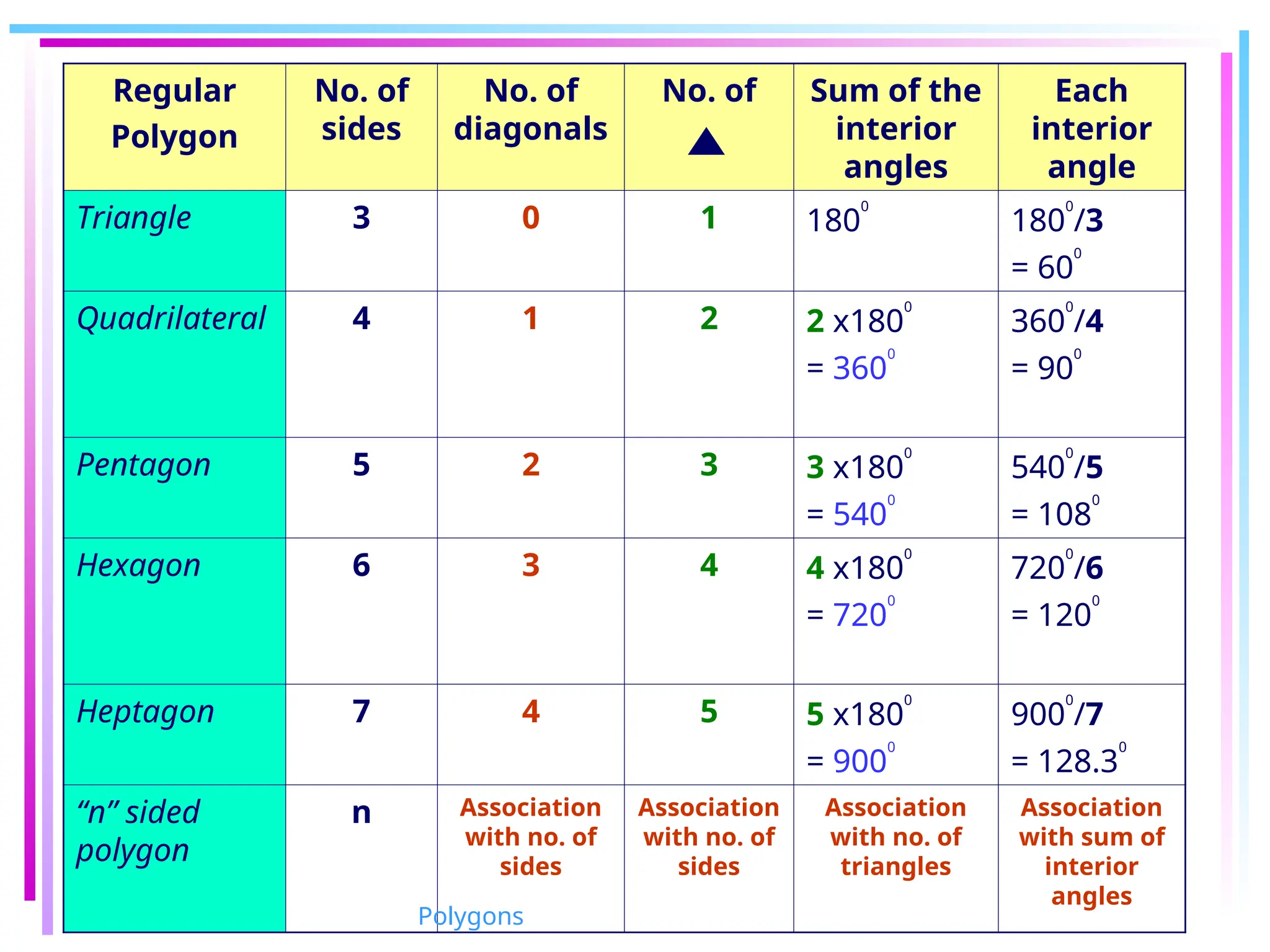
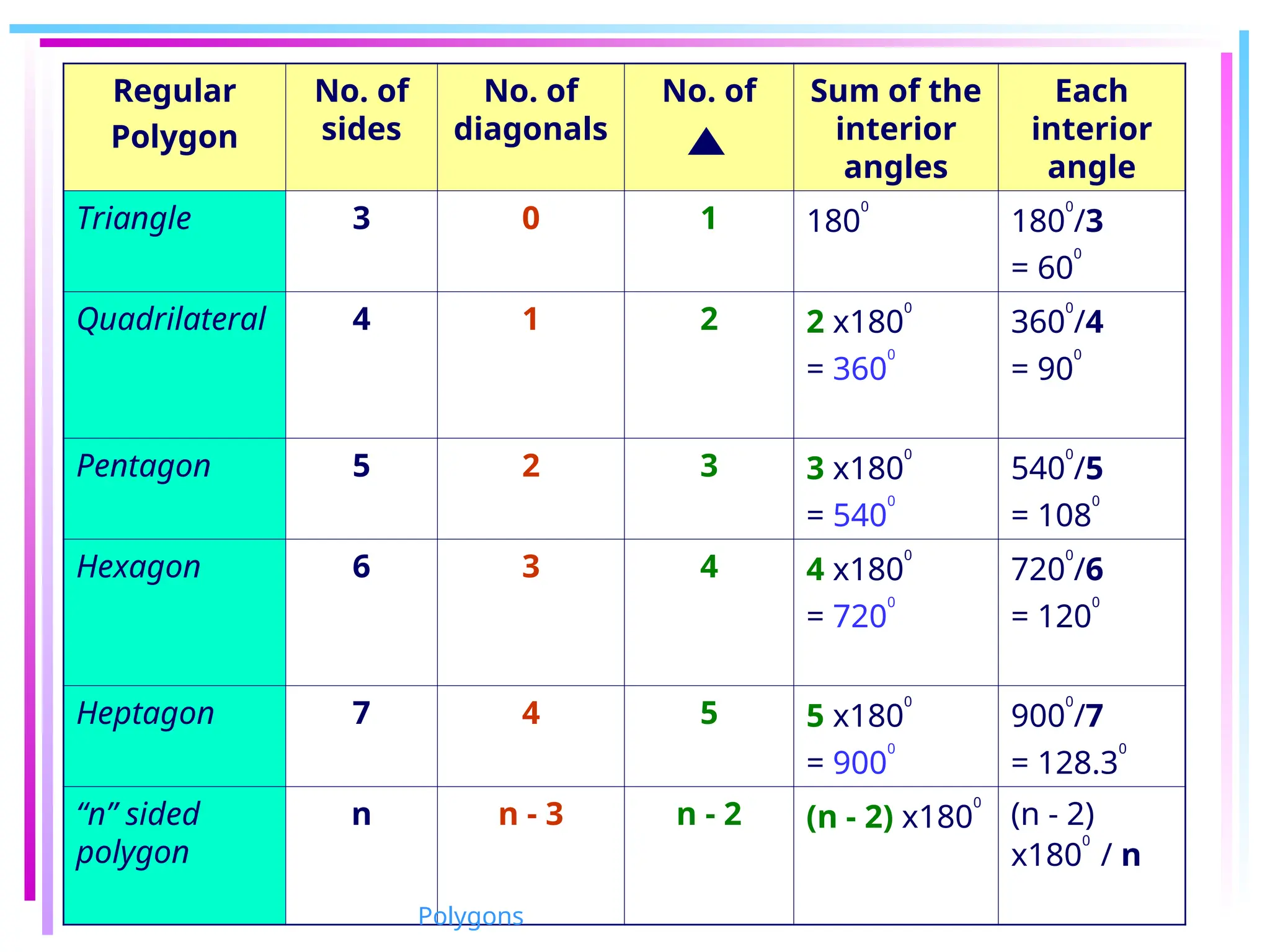
Let us findthe connection
between the number of
sides, number of diagonals
and the number of triangles
of a polygon.
Polygons
17.
Quadrilateral
Pentagon
180
o 180
o
180
o
180
o
180
o
2 x180o
= 360o
3
4 sides
5 sides
3 x 180
o
= 540
o
Hexagon
6 sides
180
o
180
o
180
o
180
o
4 x 180o
= 720o
4
Heptagon/Septagon
7 sides
180o
180o
180o
180o
180o
5 x 180o
= 900o
5
2
1 diagonal
2 diagonals
3 diagonals
4 diagonals
Polygons
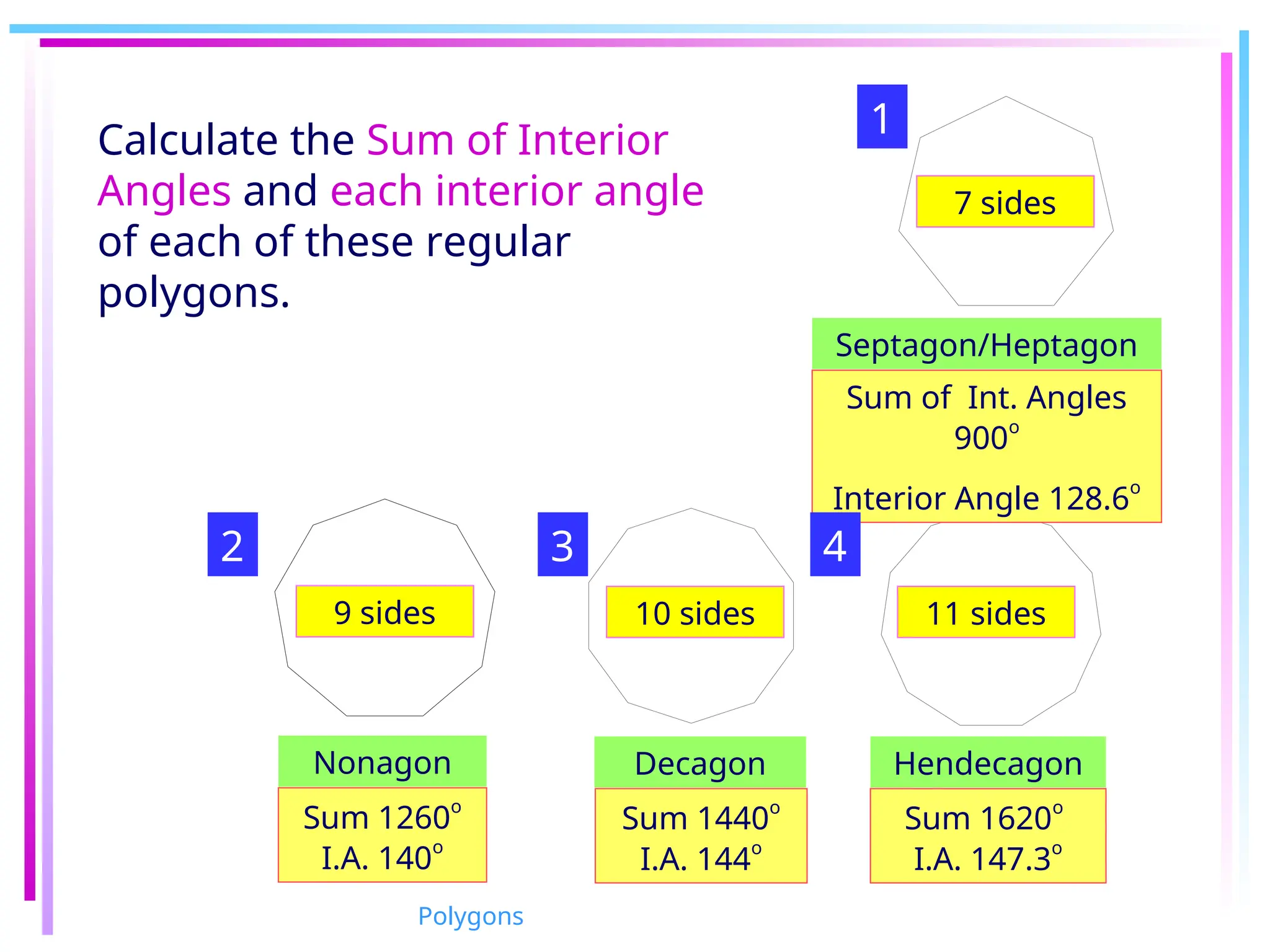
Septagon/Heptagon
Decagon Hendecagon
7 sides
10sides 11 sides
9 sides
Nonagon
Sum of Int. Angles
900o
Interior Angle 128.6o
Sum 1260
o
I.A. 140
o
Sum 1440o
I.A. 144
o
Sum 1620o
I.A. 147.3
o
Calculate the Sum of Interior
Angles and each interior angle
of each of these regular
polygons.
1
2 4
3
Polygons
26.
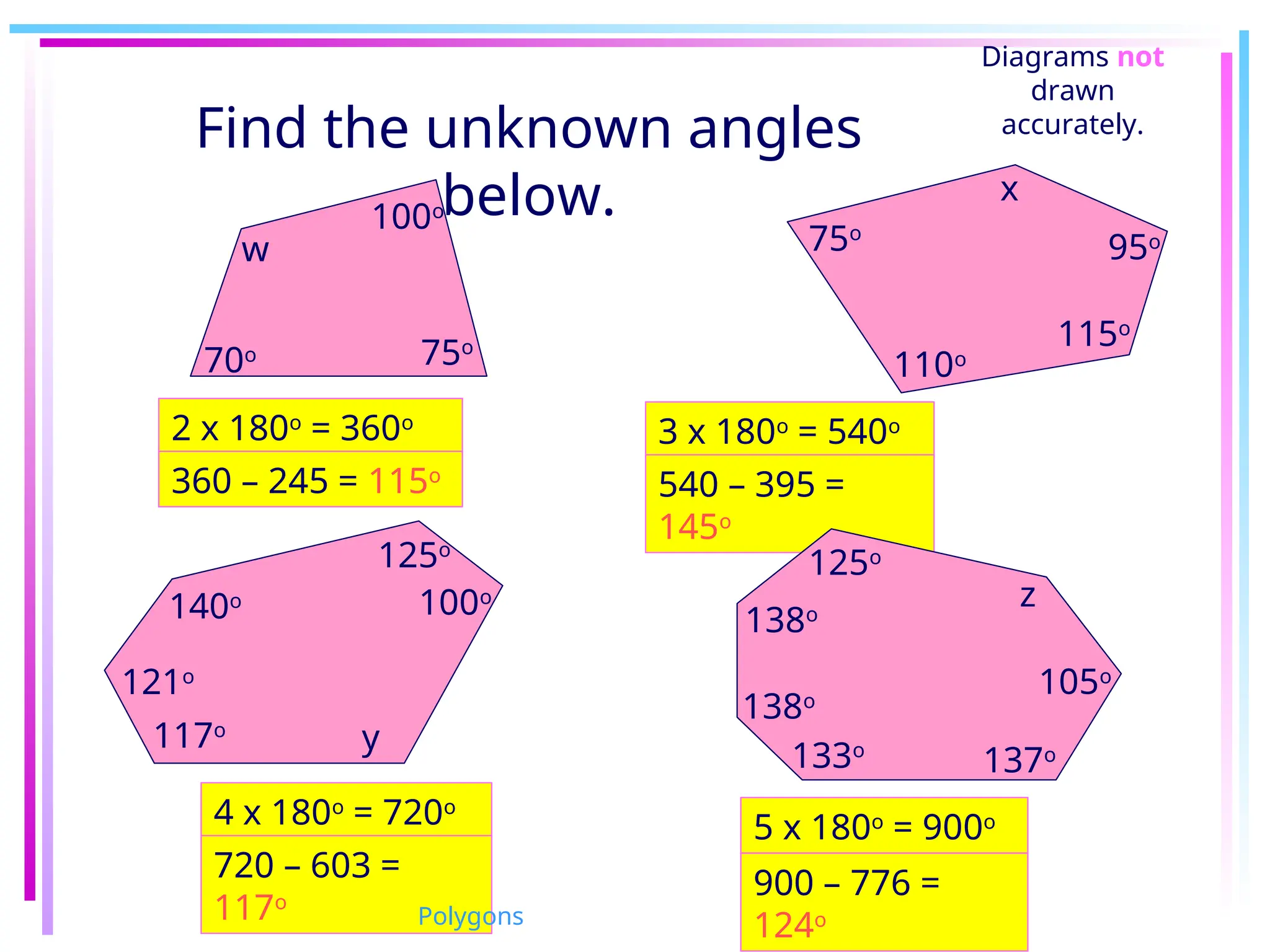
2 x 180o
=360o
360 – 245 = 115o
3 x 180o
= 540o
540 – 395 =
145o
y
117o
121o
100o
125o
140o z
133o
137o
138o
138o
125o
105o
Find the unknown angles
below.
Diagrams not
drawn
accurately.
75o
100o
70o
w
x
115o
110o
75o
95o
4 x 180o
= 720o
720 – 603 =
117o
5 x 180o
= 900o
900 – 776 =
124o
Polygons
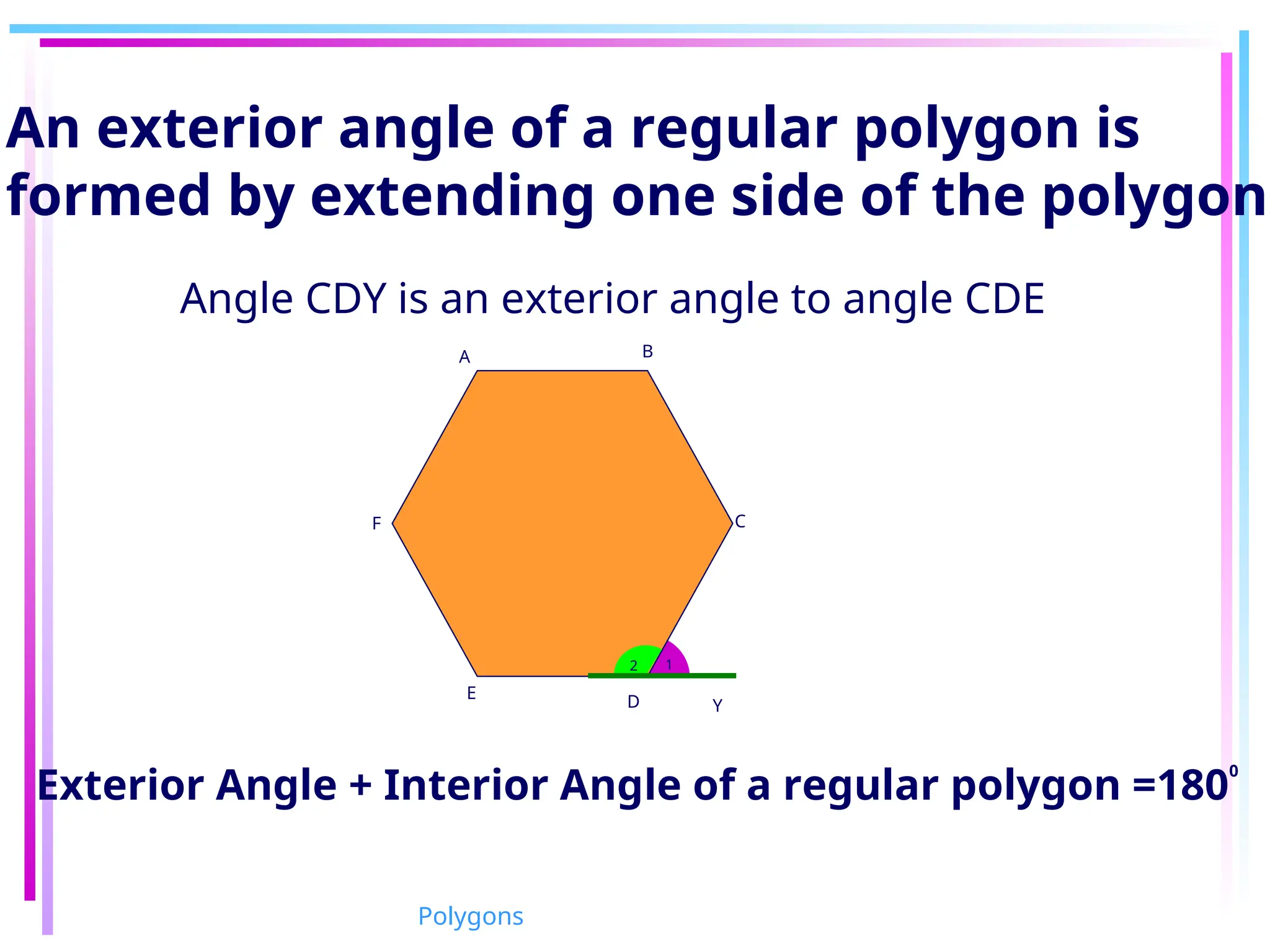
An exterior angleof a regular polygon is
formed by extending one side of the polygon.
Angle CDY is an exterior angle to angle CDE
Exterior Angle + Interior Angle of a regular polygon =180
0
D
E
Y
B
C
A
F
1
2
Polygons
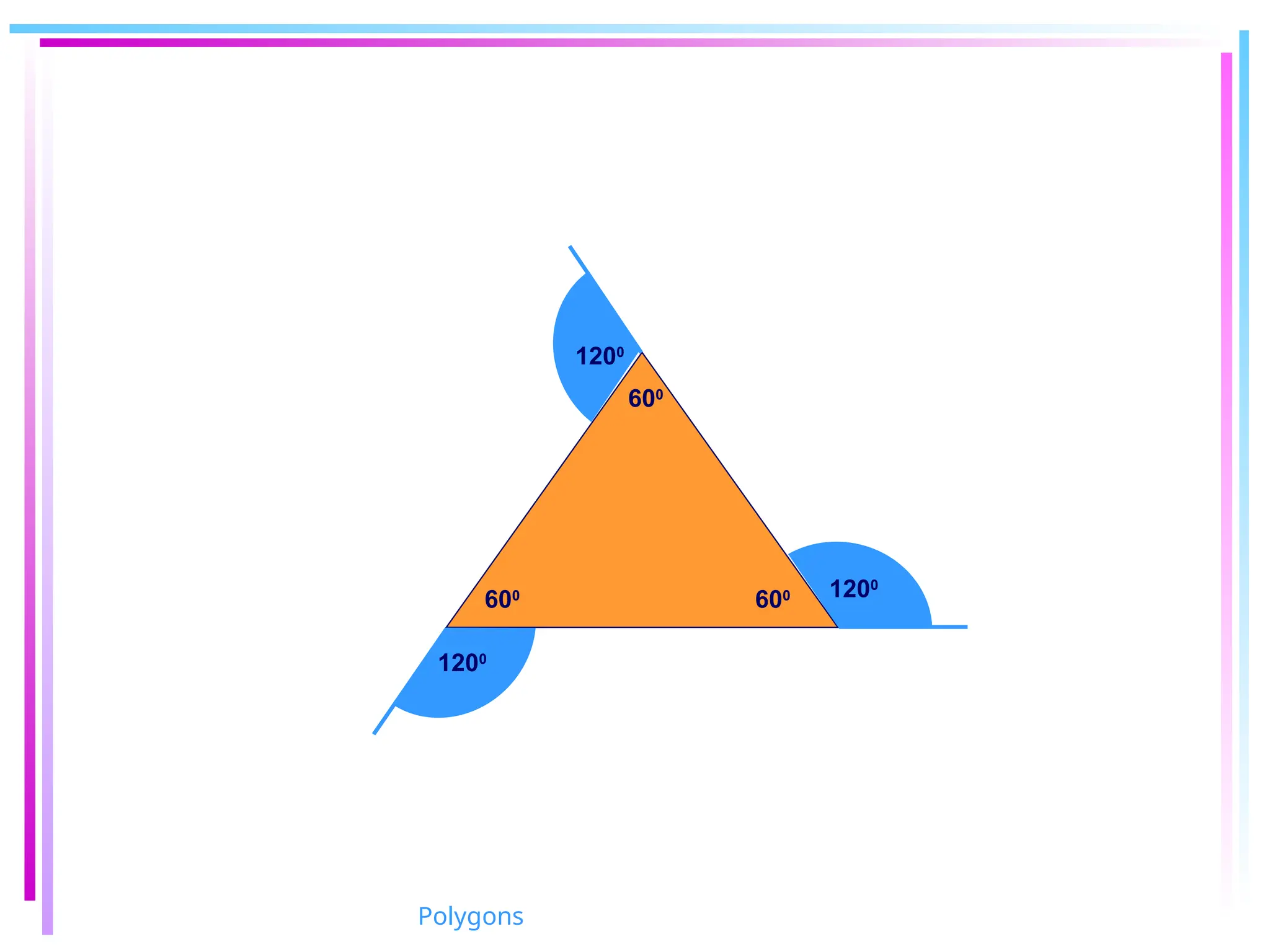
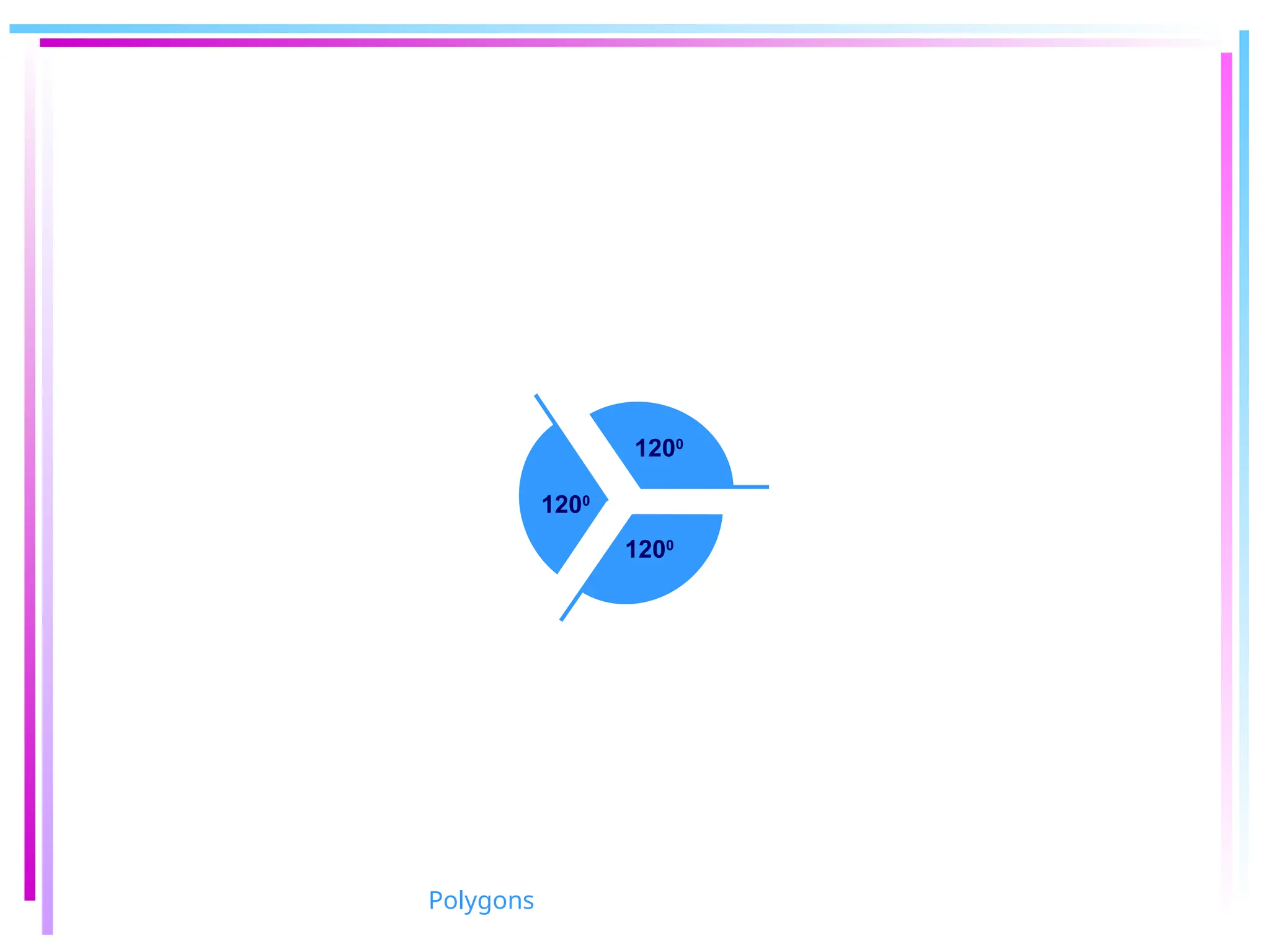
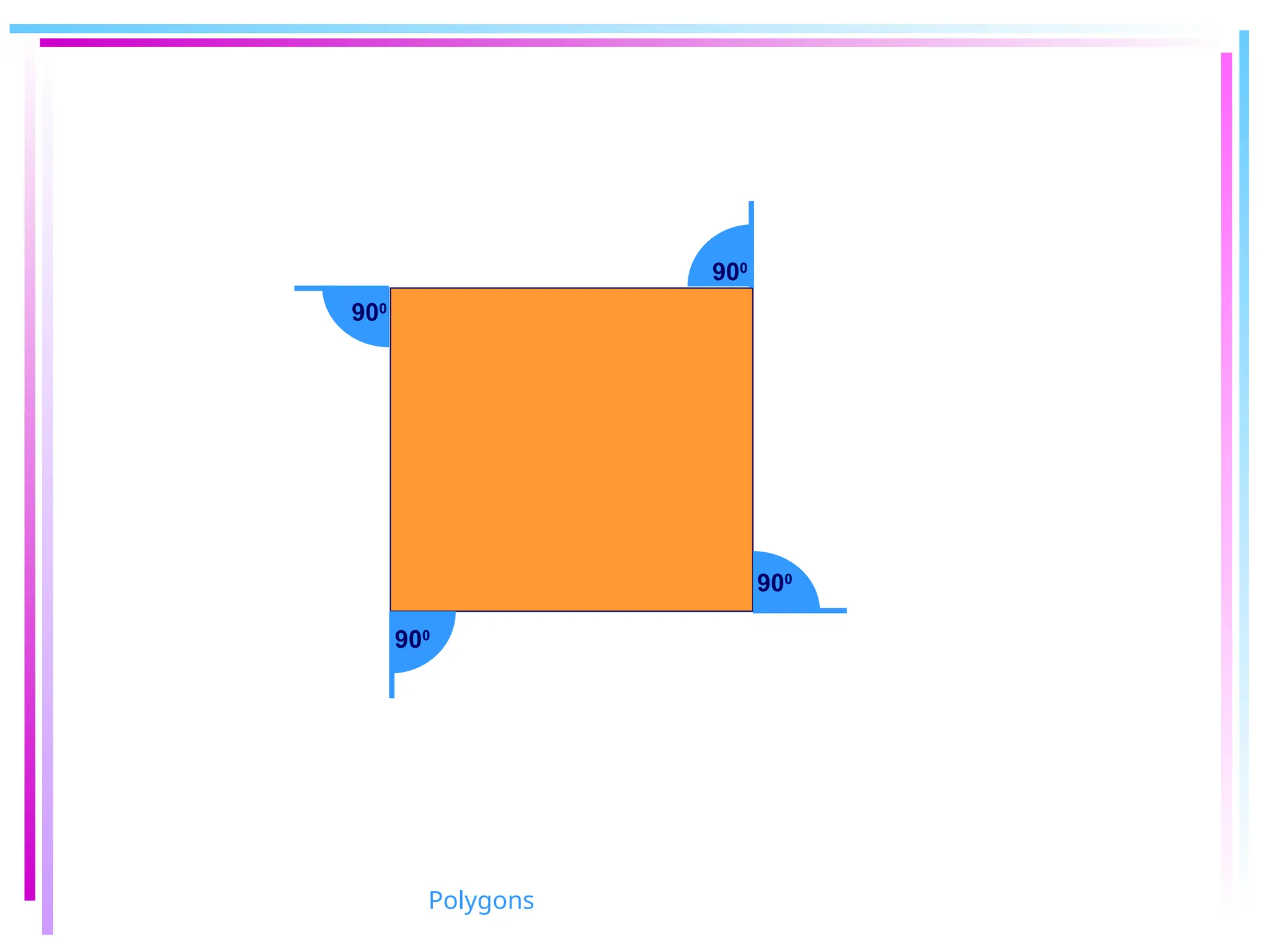
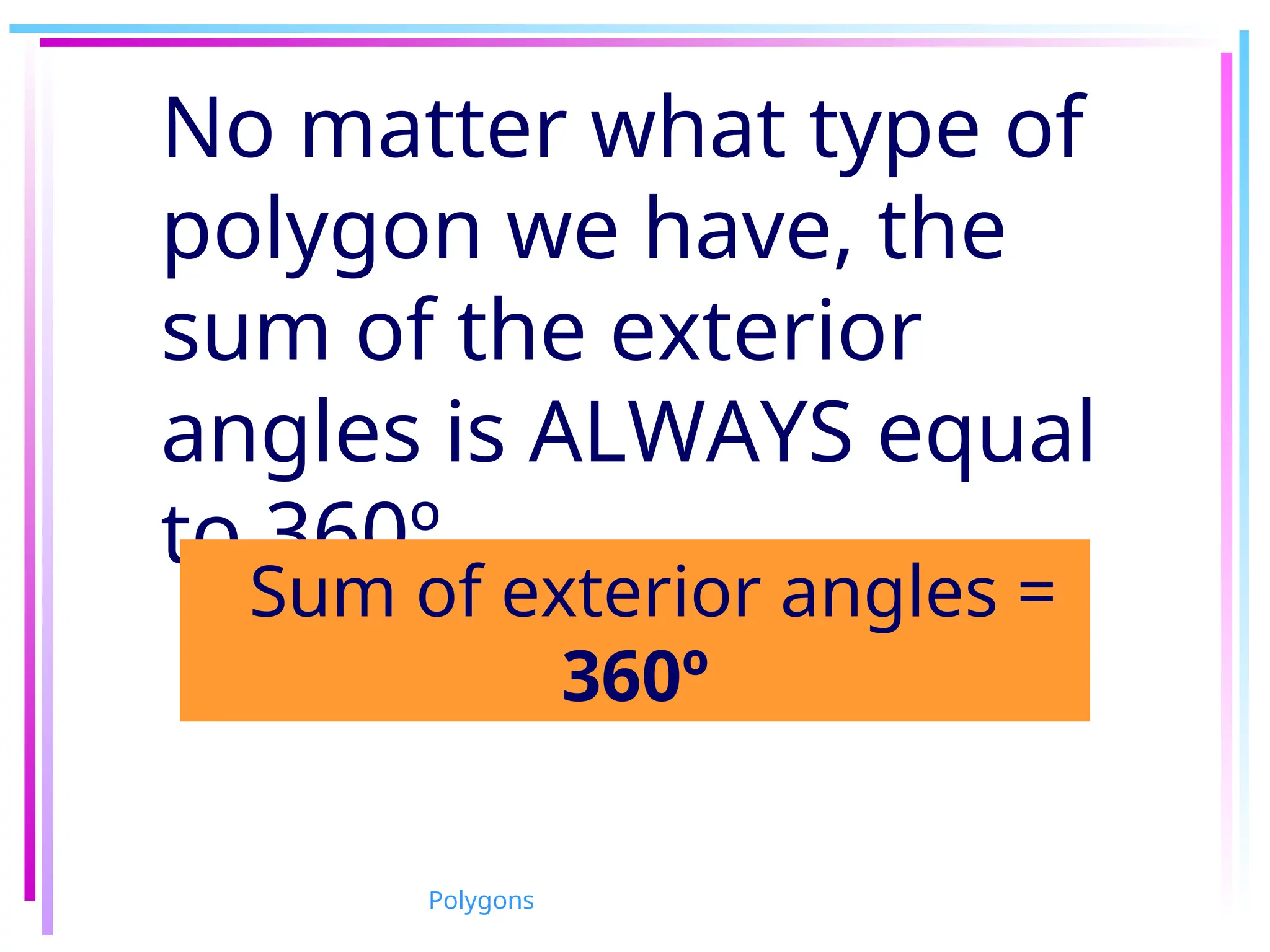
No matter whattype of
polygon we have, the
sum of the exterior
angles is ALWAYS equal
to 360º.
Sum of exterior angles =
360º
Polygons
43.
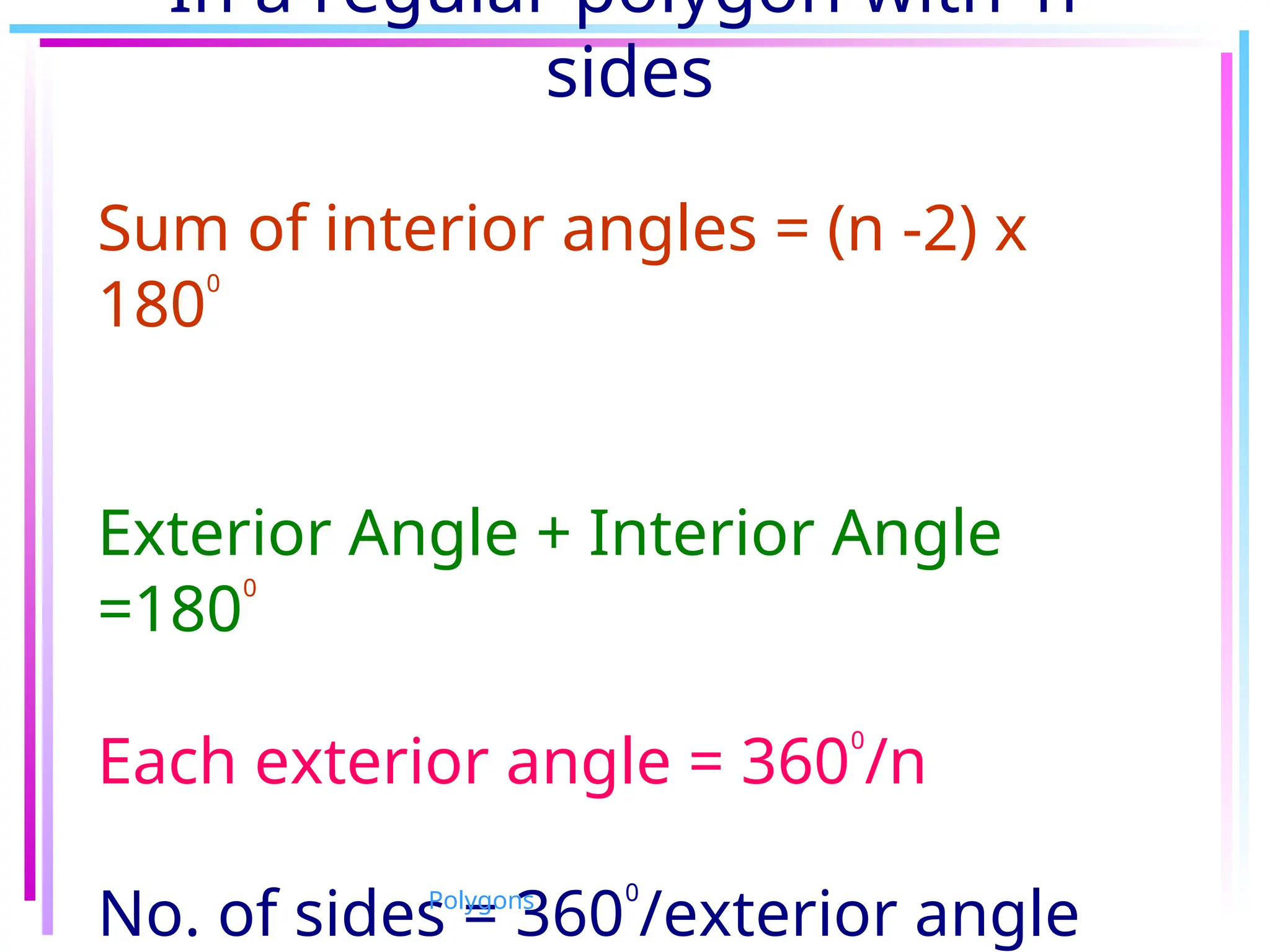
In a regularpolygon with ‘n’
sides
Sum of interior angles = (n -2) x
180
0
Exterior Angle + Interior Angle
=180
0
Each exterior angle = 360
0
/n
No. of sides = 360
0
/exterior angle
Polygons
44.
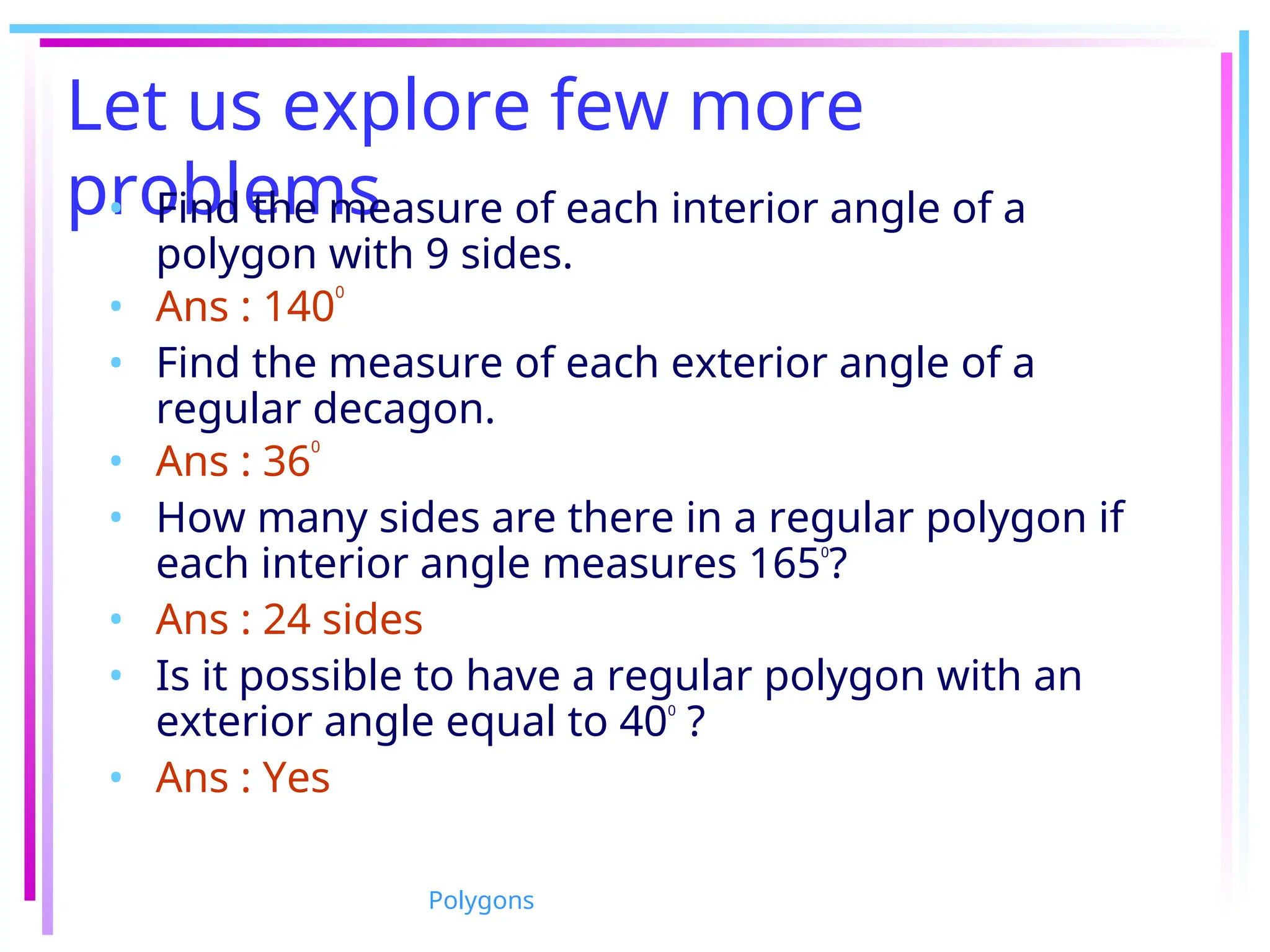
Let us explorefew more
problems
• Find the measure of each interior angle of a
polygon with 9 sides.
• Ans : 140
0
• Find the measure of each exterior angle of a
regular decagon.
• Ans : 36
0
• How many sides are there in a regular polygon if
each interior angle measures 1650
?
• Ans : 24 sides
• Is it possible to have a regular polygon with an
exterior angle equal to 400
?
• Ans : Yes
Polygons
This powerpoint waskindly donated to
www.worldofteaching.com
Home to well over a thousand
free powerpoint presentations submitted by
teachers. This a free site. Please visit and I
hope it will help in your teaching























![Chapter 2 polygons ii [compatibility mode]](https://cdn.slidesharecdn.com/ss_thumbnails/chapter2-polygonsiicompatibilitymode-141110083015-conversion-gate01-thumbnail.jpg?width=640&height=640&fit=bounds)


