A PRESENTATION ON:
                                1

  RECYLING OF POLYESTEReNG OF
              POLYESTER


Presented by-
Ashish Kumar Dua 2012TTF2406
2
POLYSTER & POLYESTER BOTTLES:
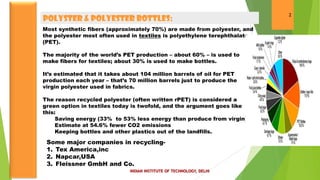
Most synthetic fibers (approximately 70%) are made from polyester, and
the polyester most often used in textiles is polyethylene terephthalate
(PET).

The majority of the world’s PET production – about 60% – is used to
make fibers for textiles; about 30% is used to make bottles.

It’s estimated that it takes about 104 million barrels of oil for PET
production each year – that’s 70 million barrels just to produce the
virgin polyester used in fabrics.

The reason recycled polyester (often written rPET) is considered a
green option in textiles today is twofold, and the argument goes like
this:
     Saving energy (33% to 53% less energy than produce from virgin)
     Estimate at 54.6% fewer CO2 emissions
     Keeping bottles and other plastics out of the landfills.

 Some major companies in recycling-
 1. Tex America,inc
 2. Napcar,USA
 3. Fleissner GmbH and Co.
                              INDIAN INSTITUTE OF TECHNOLOGY, DELHI
3
FUN FACTS ABOUT POLYSTER :
First PET bottle was recycled in 1977

FACTS about PET:
   Recycling 1 ton of PET bottles saves 7.4 cubic yards
   of landfill space
   It takes 5 recycled two-liter PET bottles to make one
   square foot of carpet.
   PET bottles and containers are actually a form of
   polyester, which is why it is so easy to recycle bottles
   into T-shirts, sweaters and socks.
   It takes 35 liter recycled PET bottles to make the soft
   filling inside a sleeping bag, called “fiberfill.”
   Plastic makes up 8% of our trash by weight, but is
   24% of the volume
4
Introduction:
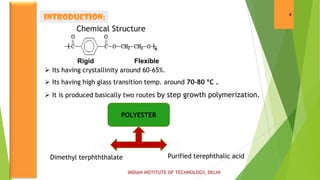
       Chemical Structure


           Rigid               Flexible
 Its having crystallinity around 60-65%.
 Its having high glass transition temp. around 70-80 ºC .
 It is produced basically two routes by step growth polymerization.

                         POLYESTER


                DMT                         PTA
 Dimethyl terphththalate                    Purified terephthalic acid
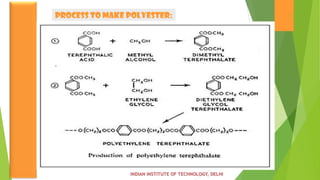
PROCESS TO MAKE POLYESTER:   5
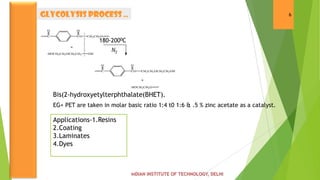
Glycolysis process ..                                                                     6


                    180-2000C
                         N2


   Bis(2-hydroxyetylterphthalate(BHET).
   EG+ PET are taken in molar basic ratio 1:4 t0 1:6 & .5 % zinc acetate as a catalyst.

   Applications-1.Resins
   2.Coating
   3.Laminates
   4.Dyes
7
        RECYLING OF POLYESTER BOTTLES.

 Common PET depolymerisation treatments for recycling.


Note- Current work aims at effective recycling of waste PET from soft drink bottles by
glycolysis method and thereby utilization of recycled product for coating application.

                                  INDIAN INSTITUTE OF TECHNOLOGY,DELHI
8
PET WASTE USING TO VARIOUS TEXTILE AUXILLARIES :
1.Softners-Conversion of BHET TO BHECL form.
  Fatty acid           BHET+thionyl chloride +.5% dimethyl formaldehyde in toluene as a
 dissolved in          catalyst after reaction excess toluene was collected via vacuum distillation.
toluene with
   stirring


                                                      BHECL

Add amine salt
 continuously
 to drop wise


  After that BHECL                    Amine
 added to flask(1:1)                derivatives
       for 3 hr
9
CONTINUED:

             Quaternarization of the amine derivative was carried out by adding dimethyl
             sulfate (1:1). Sodium carbonate was added as an acid quencher and the
             mixture was kept at 70 °C for 3 h. Upon distillation of toluene, the cationic
             softener product was obtained. Following were the fatty acids and amines tried.
             It gives the details of the reactants Since DETA reacted to BHECL has two free
             amine groups, whereas EDA reacted to BHECL has one free amine group and
             hence one mole of this amine combines with one mole of fatty acid.


                            S.R. Shukla et al. / Waste Management 28 (2008) 51–56
CONTINUED:   10
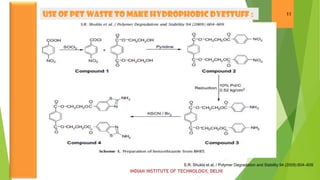
USE OF PET WASTE TO MAKE HYDROPHOBIC DYESTUFF :                                         11


                               S.R. Shukla et al. / Polymer Degradation and Stability 94 (2009) 604–609
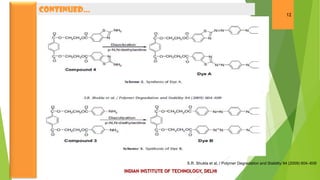
CONTINUED…
                                                                                             12


                                      S.R. Shukla et al. / Polymer Degradation and Stability 94 (2009) 604–609
             INDIAN INSTITUTE OF TECHNOLOGY, DELHI
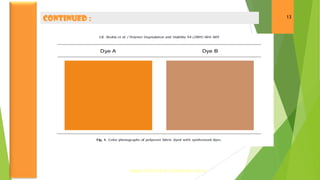
13
CONTINUED :
Alkyd resins derived from glycolized waste:   14
15
Contiuned…


                                          European Polymer Journal 41 (2005) 201–210
             INDIAN INSTITUTE OF TECHNOLOGY, DELHI
16
PREPARTION OF PET POLYOL :
Glycolzed product is used for synthesis for PE polyol.

  Adpic acid+pthallic
 anhydride +neopentyl                   BHET                    PE polyol
        glycol
                                      .5 % of P-toluene sulphonic acid+xylene,inert atm.


 Prepartaion of PE polyol coating
 It is used with different isocyanete curing agent ratio NCO:OH (1:1) OF 1:1 Dimetyl formamide is used
 as a solvent to system.


    Curing film applied at
   substrate for 1800c for 1
              hr.
17
CONTINUED…
.
CONTINUED…
             18


 .
RECYCLE PAPER TREATED WITH PET RESIN OR PET
                                                                                          19
 COATNG :
 1.The PET dispersion can be used with other wet strength resin,such as poly
 amide-epichlorohydrin.

 2. PET not only add additional dry & wet strength but not repulable wet
 strength resin repulable.


  .


Figure 1. Dry tensile strength of sheets treated with different polyesters.
                                                 Stephen A Fischer, Repulping wet-strength paper,
                                                 TAPPI Journal, 141-147, Vol. 80, No. 11
continued :                                                                20


 Figure 2. Wet tensile of the sheets treated with different polyesters
LSE-Low surface energy product
HSE-High surface energy product
HTG-High Tg product
Advantages-Its having the high potential to save a large amount of trees
and energy while limiting filling.
Recycled pet fibre in concrete –reinforcement
                                                                            21
fibre:


                                         Cement & Concrete Composites 29 (2007) 448–455
                   INDIAN INSTITUTE OF TECHNOLOGY, DELHI
22
conituned :
23
Development in process technology &process
chemistry:


                  INDIAN INSTITUTE OF TECHNOLOGY, DELHI
CONTINUED…
                                                       24


             T. Ochi et al. / Cement & Concrete Composites 29 (2007)
CONCLUSION:
                                                                                                   25
1.The water dispersible polymer used in coating recyclable paper can be used as a wet end
additive to improve paperdry dry & wet strength. We can make paper water respellent ,paper
stiff with good dry strength or both dry & wet strength good by treating with different resins.

2. Waste PET was depolymerized via glycolysis product was used for synthesis of new polyester
polygol. This was used for coating application having excellent mechanical properties like as
flexibility ,impact resistance ,scratch & hardness ,good chemical resistance.

3.To produce a new material from plastic waste, PET was oligomerized by a poly-functional
alcohol and mixed temp. The presence of oligomers enhanced thermal stability.

4. PET waste is used in useful textile finishing softeners. By the high purity of virtual manner
BHET ,it can further converted into quaternary compound which used as softeners in textile
finishing.
 5. Recycled PET does not adversely affect the resins properties based on recycled PET can
help decrease the cost of polymer end product & reduce environment pollution.
26


GO GREEN ..LIVE HAPPY!

Polyester recyling

  • 1.
    A PRESENTATION ON: 1 RECYLING OF POLYESTEReNG OF POLYESTER Presented by- Ashish Kumar Dua 2012TTF2406
  • 2.
    2 POLYSTER & POLYESTERBOTTLES: Most synthetic fibers (approximately 70%) are made from polyester, and the polyester most often used in textiles is polyethylene terephthalate (PET). The majority of the world’s PET production – about 60% – is used to make fibers for textiles; about 30% is used to make bottles. It’s estimated that it takes about 104 million barrels of oil for PET production each year – that’s 70 million barrels just to produce the virgin polyester used in fabrics. The reason recycled polyester (often written rPET) is considered a green option in textiles today is twofold, and the argument goes like this: Saving energy (33% to 53% less energy than produce from virgin) Estimate at 54.6% fewer CO2 emissions Keeping bottles and other plastics out of the landfills. Some major companies in recycling- 1. Tex America,inc 2. Napcar,USA 3. Fleissner GmbH and Co. INDIAN INSTITUTE OF TECHNOLOGY, DELHI
  • 3.
    3 FUN FACTS ABOUTPOLYSTER : First PET bottle was recycled in 1977 FACTS about PET: Recycling 1 ton of PET bottles saves 7.4 cubic yards of landfill space It takes 5 recycled two-liter PET bottles to make one square foot of carpet. PET bottles and containers are actually a form of polyester, which is why it is so easy to recycle bottles into T-shirts, sweaters and socks. It takes 35 liter recycled PET bottles to make the soft filling inside a sleeping bag, called “fiberfill.” Plastic makes up 8% of our trash by weight, but is 24% of the volume
  • 4.
    4 Introduction: Chemical Structure Rigid Flexible  Its having crystallinity around 60-65%.  Its having high glass transition temp. around 70-80 ºC .  It is produced basically two routes by step growth polymerization. POLYESTER DMT PTA Dimethyl terphththalate Purified terephthalic acid
  • 5.
    PROCESS TO MAKEPOLYESTER: 5
  • 6.
    Glycolysis process .. 6 180-2000C N2 Bis(2-hydroxyetylterphthalate(BHET). EG+ PET are taken in molar basic ratio 1:4 t0 1:6 & .5 % zinc acetate as a catalyst. Applications-1.Resins 2.Coating 3.Laminates 4.Dyes
  • 7.
    7 RECYLING OF POLYESTER BOTTLES.  Common PET depolymerisation treatments for recycling. Note- Current work aims at effective recycling of waste PET from soft drink bottles by glycolysis method and thereby utilization of recycled product for coating application. INDIAN INSTITUTE OF TECHNOLOGY,DELHI
  • 8.
    8 PET WASTE USINGTO VARIOUS TEXTILE AUXILLARIES : 1.Softners-Conversion of BHET TO BHECL form. Fatty acid BHET+thionyl chloride +.5% dimethyl formaldehyde in toluene as a dissolved in catalyst after reaction excess toluene was collected via vacuum distillation. toluene with stirring BHECL Add amine salt continuously to drop wise After that BHECL Amine added to flask(1:1) derivatives for 3 hr
  • 9.
    9 CONTINUED: Quaternarization of the amine derivative was carried out by adding dimethyl sulfate (1:1). Sodium carbonate was added as an acid quencher and the mixture was kept at 70 °C for 3 h. Upon distillation of toluene, the cationic softener product was obtained. Following were the fatty acids and amines tried. It gives the details of the reactants Since DETA reacted to BHECL has two free amine groups, whereas EDA reacted to BHECL has one free amine group and hence one mole of this amine combines with one mole of fatty acid. S.R. Shukla et al. / Waste Management 28 (2008) 51–56
  • 10.
  • 11.
    USE OF PETWASTE TO MAKE HYDROPHOBIC DYESTUFF : 11 S.R. Shukla et al. / Polymer Degradation and Stability 94 (2009) 604–609
  • 12.
    CONTINUED… 12 S.R. Shukla et al. / Polymer Degradation and Stability 94 (2009) 604–609 INDIAN INSTITUTE OF TECHNOLOGY, DELHI
  • 13.
  • 14.
    Alkyd resins derivedfrom glycolized waste: 14
  • 15.
    15 Contiuned… European Polymer Journal 41 (2005) 201–210 INDIAN INSTITUTE OF TECHNOLOGY, DELHI
  • 16.
    16 PREPARTION OF PETPOLYOL : Glycolzed product is used for synthesis for PE polyol. Adpic acid+pthallic anhydride +neopentyl BHET PE polyol glycol .5 % of P-toluene sulphonic acid+xylene,inert atm. Prepartaion of PE polyol coating It is used with different isocyanete curing agent ratio NCO:OH (1:1) OF 1:1 Dimetyl formamide is used as a solvent to system. Curing film applied at substrate for 1800c for 1 hr.
  • 17.
  • 18.
  • 19.
    RECYCLE PAPER TREATEDWITH PET RESIN OR PET 19 COATNG : 1.The PET dispersion can be used with other wet strength resin,such as poly amide-epichlorohydrin. 2. PET not only add additional dry & wet strength but not repulable wet strength resin repulable. . Figure 1. Dry tensile strength of sheets treated with different polyesters. Stephen A Fischer, Repulping wet-strength paper, TAPPI Journal, 141-147, Vol. 80, No. 11
  • 20.
    continued : 20 Figure 2. Wet tensile of the sheets treated with different polyesters LSE-Low surface energy product HSE-High surface energy product HTG-High Tg product Advantages-Its having the high potential to save a large amount of trees and energy while limiting filling.
  • 21.
    Recycled pet fibrein concrete –reinforcement 21 fibre: Cement & Concrete Composites 29 (2007) 448–455 INDIAN INSTITUTE OF TECHNOLOGY, DELHI
  • 22.
  • 23.
    23 Development in processtechnology &process chemistry: INDIAN INSTITUTE OF TECHNOLOGY, DELHI
  • 24.
    CONTINUED… 24 T. Ochi et al. / Cement & Concrete Composites 29 (2007)
  • 25.
    CONCLUSION: 25 1.The water dispersible polymer used in coating recyclable paper can be used as a wet end additive to improve paperdry dry & wet strength. We can make paper water respellent ,paper stiff with good dry strength or both dry & wet strength good by treating with different resins. 2. Waste PET was depolymerized via glycolysis product was used for synthesis of new polyester polygol. This was used for coating application having excellent mechanical properties like as flexibility ,impact resistance ,scratch & hardness ,good chemical resistance. 3.To produce a new material from plastic waste, PET was oligomerized by a poly-functional alcohol and mixed temp. The presence of oligomers enhanced thermal stability. 4. PET waste is used in useful textile finishing softeners. By the high purity of virtual manner BHET ,it can further converted into quaternary compound which used as softeners in textile finishing. 5. Recycled PET does not adversely affect the resins properties based on recycled PET can help decrease the cost of polymer end product & reduce environment pollution.
  • 26.