SPECIALITY OF
POLYMER
ARJUN SINGH
1508052
POLYMER SCIENCE 3rd year
TOPIC
CONTENTS
 INTRODUCTION
 SYNTHESIS
 POLYSULFONE PRODUCTION
 COMMERCIAL POLYSULFONE
 PROPERTIES
 ADVANTAGES
 LIMITATIONS
 APPLICATIONS
INTRODUCTION
 Polysulfones were introduced in 1965 by the Union Carbide.
 Polysulfone is an engineering thermoplastic polymers.
 These polymers are known for their toughness, stiffness and stability at high temperature.
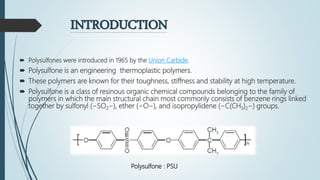
 Polysulfone is a class of resinous organic chemical compounds belonging to the family of
polymers in which the main structural chain most commonly consists of benzene rings linked
together by sulfonyl (−SO2−), ether (−O−), and isopropylidene (−C(CH3)2−) groups.
Polysulfone : PSU
 They are tough, strong, stiff, and resistant to decomposition by heat or chemical
attack. They retain their mechanical properties over a wide temperature range
(−70° to 150° C, or about −95° to 300° F) and are used as wire coatings, for
fabricoating household and plumbing items, and for automotive parts.
 It is resistant to degradation from hot water and steam.
 They may be processed by extrusion, injection molding and blow molding.
 Due to the high cost of raw materials and processing, polysulfones are used in
specialty applications and often are a superior replacement for polycarbonates.
SYNTHESIS
 There are two main routes to the preparation of polysulfones:
1) Polysulfonylation
2) Polyetherification
POLYSULFONYLATION
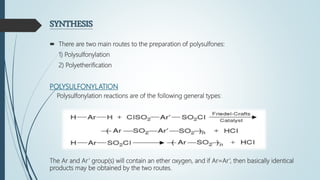
Polysulfonylation reactions are of the following general types:
The Ar and Ar’ group(s) will contain an ether oxygen, and if Ar=Ar’, then basically identical
products may be obtained by the two routes.
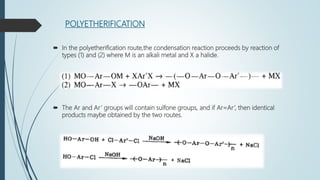
 In the polyetherification route,the condensation reaction proceeds by reaction of
types (1) and (2) where M is an alkali metal and X a halide.
 The Ar and Ar’ groups will contain sulfone groups, and if Ar=Ar’, then identical
products maybe obtained by the two routes.
POLYETHERIFICATION
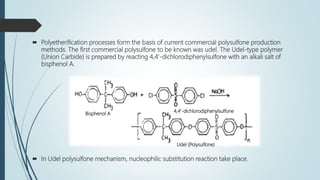
 Polyetherification processes form the basis of current commercial polysulfone production
methods. The first commercial polysulfone to be known was udel. The Udel-type polymer
(Union Carbide) is prepared by reacting 4,4’-dichlorodiphenylsulfone with an alkali salt of
bisphenol A.
 In Udel polysulfone mechanism, nucleophilic substitution reaction take place.
Bisphenol A
4,4’-dichlorodiphenylsulfone
Udel (Polysulfone)
POLYSULFONE PRODUCTION
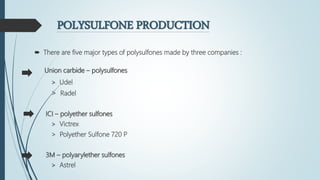
 There are five major types of polysulfones made by three companies :
Union carbide – polysulfones
> Udel
> Radel
ICI – polyether sulfones
> Victrex
> Polyether Sulfone 720 P
3M – polyarylether sulfones
> Astrel
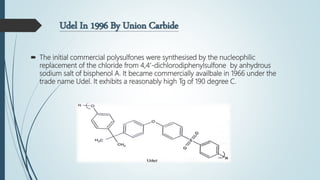
 The initial commercial polysulfones were synthesised by the nucleophilic
replacement of the chloride from 4,4’-dichlorodiphenylsulfone by anhydrous
sodium salt of bisphenol A. It became commercially availbale in 1966 under the
trade name Udel. It exhibits a reasonably high Tg of 190 degree C.
Udel In 1996 By Union Carbide
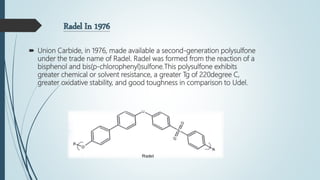
Radel In 1976
 Union Carbide, in 1976, made available a second-generation polysulfone
under the trade name of Radel. Radel was formed from the reaction of a
bisphenol and bis(p-chlorophenyl)sulfone.This polysulfone exhibits
greater chemical or solvent resistance, a greater Tg of 220degree C,
greater oxidative stability, and good toughness in comparison to Udel.
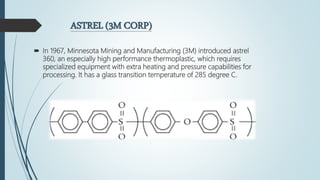
ASTREL (3M CORP)
 In 1967, Minnesota Mining and Manufacturing (3M) introduced astrel
360, an especially high performance thermoplastic, which requires
specialized equipment with extra heating and pressure capabilities for
processing. It has a glass transition temperature of 285 degree C.
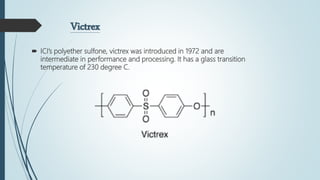
Victrex
 ICI’s polyether sulfone, victrex was introduced in 1972 and are
intermediate in performance and processing. It has a glass transition
temperature of 230 degree C.
POLYETHER SULFONE
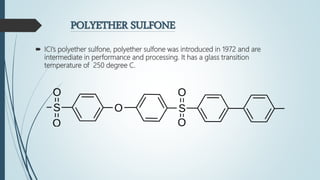
 ICI’s polyether sulfone, polyether sulfone was introduced in 1972 and are
intermediate in performance and processing. It has a glass transition
temperature of 250 degree C.
COMMERCIAL POLYSULFONES
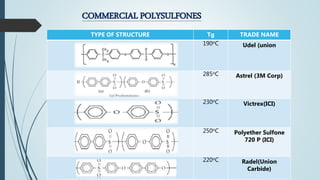
TYPE OF STRUCTURE Tg TRADE NAME
190oC Udel (union
285oC Astrel (3M Corp)
230oC Victrex(ICI)
250oC Polyether Sulfone
720 P (ICI)
220oC Radel(Union
Carbide)
PROPERTIES
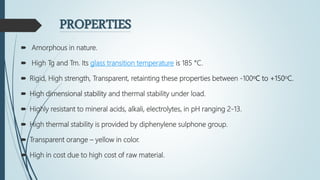
 Amorphous in nature.
 High Tg and Tm. Its glass transition temperature is 185 °C.
 Rigid, High strength, Transparent, retainting these properties between -100oC to +150oC.
 High dimensional stability and thermal stability under load.
 Highly resistant to mineral acids, alkali, electrolytes, in pH ranging 2-13.
 High thermal stability is provided by diphenylene sulphone group.
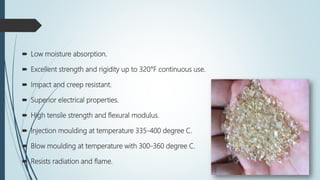
 Transparent orange – yellow in color.
 High in cost due to high cost of raw material.
 Low moisture absorption.
 Excellent strength and rigidity up to 320°F continuous use.
 Impact and creep resistant.
 Superior electrical properties.
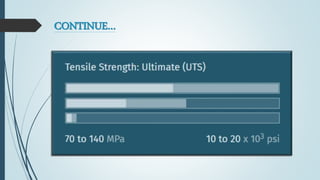
 High tensile strength and flexural modulus.
 Injection moulding at temperature 335-400 degree C.
 Blow moulding at temperature with 300-360 degree C.
 Resists radiation and flame.
 Amorphous in nature because high degree of chain stiffness makes crystallization difficult.
 High heat deformation resistance and chemical stability due to enhanced bond strength
arising from high degree of resonance in the structure.
 Less susceptible to oxidation as sulphur is in its highest oxidation state so electrons are
withdrawn from the benzene rings so that structure is less susceptible to oxidation.
 High Tg and Tm due to high chain aromaticity and high chain stiffness.
HIGH HEAT RESISTANCE
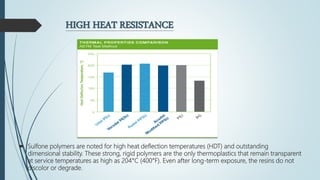
 Sulfone polymers are noted for high heat deflection temperatures (HDT) and outstanding
dimensional stability. These strong, rigid polymers are the only thermoplastics that remain transparent
at service temperatures as high as 204°C (400°F). Even after long-term exposure, the resins do not
discolor or degrade.
Toughness and Impact Strength
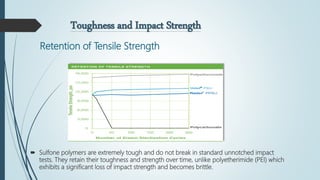
 Sulfone polymers are extremely tough and do not break in standard unnotched impact
tests. They retain their toughness and strength over time, unlike polyetherimide (PEI) which
exhibits a significant loss of impact strength and becomes brittle.
Retention of Tensile Strength
Retention of Impact Strength
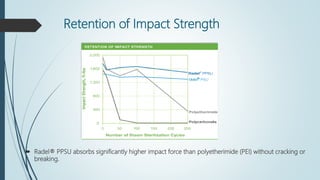
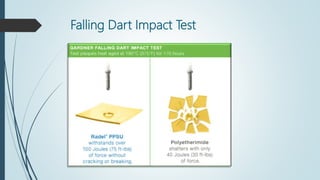
 Radel® PPSU absorbs significantly higher impact force than polyetherimide (PEI) without cracking or
breaking.
Falling Dart Impact Test
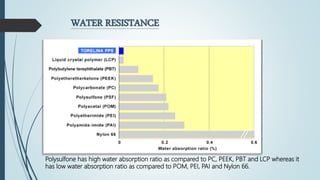
WATER RESISTANCE
Polysulfone has high water absorption ratio as compared to PC, PEEK, PBT and LCP whereas it
has low water absorption ratio as compared to POM, PEI, PAI and Nylon 66.
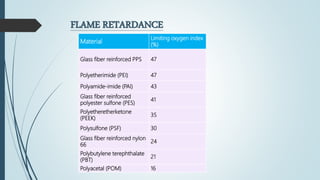
FLAME RETARDANCE
Material
Limiting oxygen index
(%)
Glass fiber reinforced PPS 47
Polyetherimide (PEI) 47
Polyamide-imide (PAI) 43
Glass fiber reinforced
polyester sulfone (PES)
41
Polyetheretherketone
(PEEK)
35
Polysulfone (PSF) 30
Glass fiber reinforced nylon
66
24
Polybutylene terephthalate
(PBT)
21
Polyacetal (POM) 16
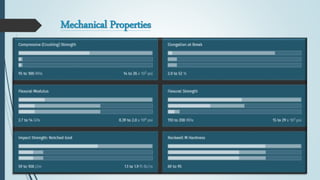
Mechanical Properties
CONTINUE…
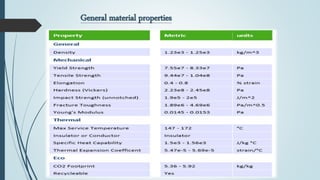
General material properties
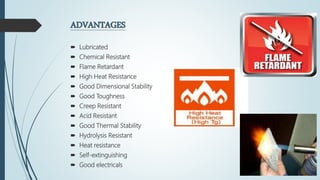
ADVANTAGES
 Lubricated
 Chemical Resistant
 Flame Retardant
 High Heat Resistance
 Good Dimensional Stability
 Good Toughness
 Creep Resistant
 Acid Resistant
 Good Thermal Stability
 Hydrolysis Resistant
 Heat resistance
 Self-extinguishing
 Good electricals
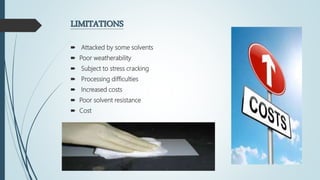
LIMITATIONS
 Attacked by some solvents
 Poor weatherability
 Subject to stress cracking
 Processing difficulties
 Increased costs
 Poor solvent resistance
 Cost
APPLICATIONS
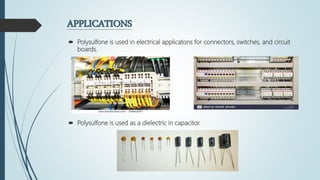
 Polysulfone is used in electrical applicatons for connectors, switches, and circuit
boards.
 Polysulfone is used as a dielectric in capacitor.
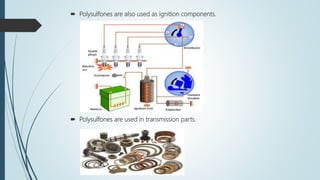
 Polysulfones are also used as ignition components.
 Polysulfones are used in transmission parts.
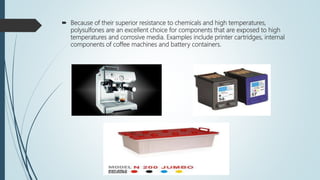
 Because of their superior resistance to chemicals and high temperatures,
polysulfones are an excellent choice for components that are exposed to high
temperatures and corrosive media. Examples include printer cartridges, internal
components of coffee machines and battery containers.
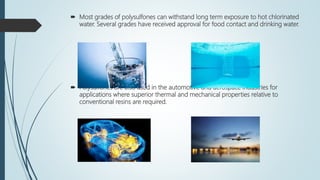
 Most grades of polysulfones can withstand long term exposure to hot chlorinated
water. Several grades have received approval for food contact and drinking water.
 Polysulfones are also used in the automotive and aerospace industries for
applications where superior thermal and mechanical properties relative to
conventional resins are required.
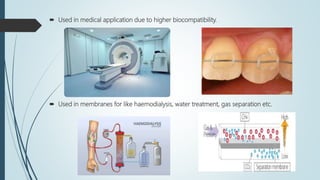
 Used in medical application due to higher biocompatibility.
 Used in membranes for like haemodialysis, water treatment, gas separation etc.
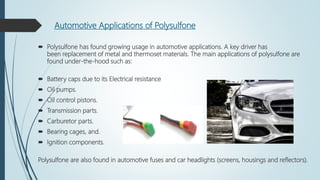
 Polysulfone has found growing usage in automotive applications. A key driver has
been replacement of metal and thermoset materials. The main applications of polysulfone are
found under-the-hood such as:
 Battery caps due to its Electrical resistance
 Oil pumps.
 Oil control pistons.
 Transmission parts.
 Carburetor parts.
 Bearing cages, and.
 Ignition components.
Polysulfone are also found in automotive fuses and car headlights (screens, housings and reflectors).
Automotive Applications of Polysulfone
THANK YOU

Polysulfone

  • 1.
  • 2.
    CONTENTS  INTRODUCTION  SYNTHESIS POLYSULFONE PRODUCTION  COMMERCIAL POLYSULFONE  PROPERTIES  ADVANTAGES  LIMITATIONS  APPLICATIONS
  • 3.
    INTRODUCTION  Polysulfones wereintroduced in 1965 by the Union Carbide.  Polysulfone is an engineering thermoplastic polymers.  These polymers are known for their toughness, stiffness and stability at high temperature.  Polysulfone is a class of resinous organic chemical compounds belonging to the family of polymers in which the main structural chain most commonly consists of benzene rings linked together by sulfonyl (−SO2−), ether (−O−), and isopropylidene (−C(CH3)2−) groups. Polysulfone : PSU
  • 4.
     They aretough, strong, stiff, and resistant to decomposition by heat or chemical attack. They retain their mechanical properties over a wide temperature range (−70° to 150° C, or about −95° to 300° F) and are used as wire coatings, for fabricoating household and plumbing items, and for automotive parts.  It is resistant to degradation from hot water and steam.  They may be processed by extrusion, injection molding and blow molding.  Due to the high cost of raw materials and processing, polysulfones are used in specialty applications and often are a superior replacement for polycarbonates.
  • 5.
    SYNTHESIS  There aretwo main routes to the preparation of polysulfones: 1) Polysulfonylation 2) Polyetherification POLYSULFONYLATION Polysulfonylation reactions are of the following general types: The Ar and Ar’ group(s) will contain an ether oxygen, and if Ar=Ar’, then basically identical products may be obtained by the two routes.
  • 6.
     In thepolyetherification route,the condensation reaction proceeds by reaction of types (1) and (2) where M is an alkali metal and X a halide.  The Ar and Ar’ groups will contain sulfone groups, and if Ar=Ar’, then identical products maybe obtained by the two routes. POLYETHERIFICATION
  • 7.
     Polyetherification processesform the basis of current commercial polysulfone production methods. The first commercial polysulfone to be known was udel. The Udel-type polymer (Union Carbide) is prepared by reacting 4,4’-dichlorodiphenylsulfone with an alkali salt of bisphenol A.  In Udel polysulfone mechanism, nucleophilic substitution reaction take place. Bisphenol A 4,4’-dichlorodiphenylsulfone Udel (Polysulfone)
  • 8.
    POLYSULFONE PRODUCTION  Thereare five major types of polysulfones made by three companies : Union carbide – polysulfones > Udel > Radel ICI – polyether sulfones > Victrex > Polyether Sulfone 720 P 3M – polyarylether sulfones > Astrel
  • 9.
     The initialcommercial polysulfones were synthesised by the nucleophilic replacement of the chloride from 4,4’-dichlorodiphenylsulfone by anhydrous sodium salt of bisphenol A. It became commercially availbale in 1966 under the trade name Udel. It exhibits a reasonably high Tg of 190 degree C. Udel In 1996 By Union Carbide
  • 10.
    Radel In 1976 Union Carbide, in 1976, made available a second-generation polysulfone under the trade name of Radel. Radel was formed from the reaction of a bisphenol and bis(p-chlorophenyl)sulfone.This polysulfone exhibits greater chemical or solvent resistance, a greater Tg of 220degree C, greater oxidative stability, and good toughness in comparison to Udel.
  • 11.
    ASTREL (3M CORP) In 1967, Minnesota Mining and Manufacturing (3M) introduced astrel 360, an especially high performance thermoplastic, which requires specialized equipment with extra heating and pressure capabilities for processing. It has a glass transition temperature of 285 degree C.
  • 12.
    Victrex  ICI’s polyethersulfone, victrex was introduced in 1972 and are intermediate in performance and processing. It has a glass transition temperature of 230 degree C.
  • 13.
    POLYETHER SULFONE  ICI’spolyether sulfone, polyether sulfone was introduced in 1972 and are intermediate in performance and processing. It has a glass transition temperature of 250 degree C.
  • 14.
    COMMERCIAL POLYSULFONES TYPE OFSTRUCTURE Tg TRADE NAME 190oC Udel (union 285oC Astrel (3M Corp) 230oC Victrex(ICI) 250oC Polyether Sulfone 720 P (ICI) 220oC Radel(Union Carbide)
  • 15.
    PROPERTIES  Amorphous innature.  High Tg and Tm. Its glass transition temperature is 185 °C.  Rigid, High strength, Transparent, retainting these properties between -100oC to +150oC.  High dimensional stability and thermal stability under load.  Highly resistant to mineral acids, alkali, electrolytes, in pH ranging 2-13.  High thermal stability is provided by diphenylene sulphone group.  Transparent orange – yellow in color.  High in cost due to high cost of raw material.
  • 16.
     Low moistureabsorption.  Excellent strength and rigidity up to 320°F continuous use.  Impact and creep resistant.  Superior electrical properties.  High tensile strength and flexural modulus.  Injection moulding at temperature 335-400 degree C.  Blow moulding at temperature with 300-360 degree C.  Resists radiation and flame.
  • 17.
     Amorphous innature because high degree of chain stiffness makes crystallization difficult.  High heat deformation resistance and chemical stability due to enhanced bond strength arising from high degree of resonance in the structure.  Less susceptible to oxidation as sulphur is in its highest oxidation state so electrons are withdrawn from the benzene rings so that structure is less susceptible to oxidation.  High Tg and Tm due to high chain aromaticity and high chain stiffness.
  • 18.
    HIGH HEAT RESISTANCE Sulfone polymers are noted for high heat deflection temperatures (HDT) and outstanding dimensional stability. These strong, rigid polymers are the only thermoplastics that remain transparent at service temperatures as high as 204°C (400°F). Even after long-term exposure, the resins do not discolor or degrade.
  • 19.
    Toughness and ImpactStrength  Sulfone polymers are extremely tough and do not break in standard unnotched impact tests. They retain their toughness and strength over time, unlike polyetherimide (PEI) which exhibits a significant loss of impact strength and becomes brittle. Retention of Tensile Strength
  • 20.
    Retention of ImpactStrength  Radel® PPSU absorbs significantly higher impact force than polyetherimide (PEI) without cracking or breaking.
  • 21.
  • 22.
    WATER RESISTANCE Polysulfone hashigh water absorption ratio as compared to PC, PEEK, PBT and LCP whereas it has low water absorption ratio as compared to POM, PEI, PAI and Nylon 66.
  • 23.
    FLAME RETARDANCE Material Limiting oxygenindex (%) Glass fiber reinforced PPS 47 Polyetherimide (PEI) 47 Polyamide-imide (PAI) 43 Glass fiber reinforced polyester sulfone (PES) 41 Polyetheretherketone (PEEK) 35 Polysulfone (PSF) 30 Glass fiber reinforced nylon 66 24 Polybutylene terephthalate (PBT) 21 Polyacetal (POM) 16
  • 24.
  • 25.
  • 26.
  • 27.
    ADVANTAGES  Lubricated  ChemicalResistant  Flame Retardant  High Heat Resistance  Good Dimensional Stability  Good Toughness  Creep Resistant  Acid Resistant  Good Thermal Stability  Hydrolysis Resistant  Heat resistance  Self-extinguishing  Good electricals
  • 28.
    LIMITATIONS  Attacked bysome solvents  Poor weatherability  Subject to stress cracking  Processing difficulties  Increased costs  Poor solvent resistance  Cost
  • 29.
    APPLICATIONS  Polysulfone isused in electrical applicatons for connectors, switches, and circuit boards.  Polysulfone is used as a dielectric in capacitor.
  • 30.
     Polysulfones arealso used as ignition components.  Polysulfones are used in transmission parts.
  • 31.
     Because oftheir superior resistance to chemicals and high temperatures, polysulfones are an excellent choice for components that are exposed to high temperatures and corrosive media. Examples include printer cartridges, internal components of coffee machines and battery containers.
  • 32.
     Most gradesof polysulfones can withstand long term exposure to hot chlorinated water. Several grades have received approval for food contact and drinking water.  Polysulfones are also used in the automotive and aerospace industries for applications where superior thermal and mechanical properties relative to conventional resins are required.
  • 33.
     Used inmedical application due to higher biocompatibility.  Used in membranes for like haemodialysis, water treatment, gas separation etc.
  • 34.
     Polysulfone hasfound growing usage in automotive applications. A key driver has been replacement of metal and thermoset materials. The main applications of polysulfone are found under-the-hood such as:  Battery caps due to its Electrical resistance  Oil pumps.  Oil control pistons.  Transmission parts.  Carburetor parts.  Bearing cages, and.  Ignition components. Polysulfone are also found in automotive fuses and car headlights (screens, housings and reflectors). Automotive Applications of Polysulfone
  • 35.