Policy formualtion, Implementation and
evaluation
 A policy is typically described as a principle
or rule to guide decisions and achieve
rational outcome/s.
 PHASE 1: INITIATION
 Step 1: Agenda-setting/issue (problem) identification
 Step 2: Policy instruments
 Step 3: Policy analysis
 Step 4: Stakeholder engagement, consultation and co-
ordination
 PHASE 2: GENERATION
 Step 5: Policy formulation, decision-making and policy
drafting
 PHASE 3: IMPLEMENTATION
 Step 6: Policy implementation
 PHASE 4: EVALUATION
 Step 7: Policy monitoring and evaluation
 Process of identifying policy issues/problems, which
require the attention of a policy maker.
 Process wherein the members of society identify their
needs, desires and demands and wherein a policy maker
decides to place these issues on the agenda for
deliberation
 The setting of the policy agenda allows a policy maker to
analyze the critical policy requirements that affect
society.
 Prioritization of issues
 Legislation and government policy and
priorities
 Taxation (the budget)
 Persuasion (and public pressure)
 inspection and audits
 Minutes of meetings
 Legislative records
 Provision of services
 Newsletter, media briefings and community
meetings
 Step-by-step way of unpacking and
understanding policy choices and comparing
possible outcomes
 Policy analysis is an attempt to determine the
costs and benefits of various alternatives or
to evaluate the validity of existing policies
 Identify the underlying values and aspirations
 Understand the problem in its context
 Identify the alternative courses of actions
 Decide which dimensions of the problem are
most important
 Predict the likely outcomes of different
courses of action
 Measure the chosen courses of action against
important values and aspirations
 It is the process of involving public and other
stakeholders in policy making process. Steps
involve in stakeholder engagement in policy
making are:
 Step 1: Identify stakeholders
 Step 2: Prioritize stakeholders
 Step 3: Get to know and understand
stakeholders
 4: Stakeholder relationship management
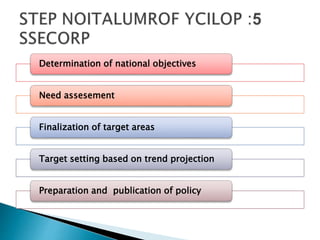
Determination of national objectives
Need assesement
Finalization of target areas
Target setting based on trend projection
Preparation and publication of policy
 Education policy usually design for national
objectives
 Educational policy is formed by Govt .Officials.
 Govt .Officials aware of political context and they
formulate policy according to socio-political
context.
 Educational policy formulated for the interest of
all members in society
 Educational policy always formed for betterment
of society .Policy is applied in society . So, its
based on social context.
 Firstly, policy makers identify the specific
need on which policy is formulated .This need
should fullfill the national objectives
 Policy makers use strategies for the
assessment of need on which policy is
formulated
 After, identifying the specific need according
to national objectives .
 Policy makers confront many themes
 Out of these themes ,policy makers finalise
the specific theme
 Finally, policy makers set the target of policy
formulation
 Policy makers choose the target area via this
target setting is implemented in coming years
or not.
 Policy makers set the target area in a way, it
is implented in future
 Policy makers check the reliability of the
policy for future times .Will policy continue to
play its part in future in same manner as it
did in past.
 It is the last process of policy formulation
process .In which the policy makers prepare
the policy that is ready for publication in
public.

Policy formulation, implementation and evaluation

  • 1.
  • 2.
     A policyis typically described as a principle or rule to guide decisions and achieve rational outcome/s.
  • 3.
     PHASE 1:INITIATION  Step 1: Agenda-setting/issue (problem) identification  Step 2: Policy instruments  Step 3: Policy analysis  Step 4: Stakeholder engagement, consultation and co- ordination  PHASE 2: GENERATION  Step 5: Policy formulation, decision-making and policy drafting  PHASE 3: IMPLEMENTATION  Step 6: Policy implementation  PHASE 4: EVALUATION  Step 7: Policy monitoring and evaluation
  • 4.
     Process ofidentifying policy issues/problems, which require the attention of a policy maker.  Process wherein the members of society identify their needs, desires and demands and wherein a policy maker decides to place these issues on the agenda for deliberation  The setting of the policy agenda allows a policy maker to analyze the critical policy requirements that affect society.  Prioritization of issues
  • 5.
     Legislation andgovernment policy and priorities  Taxation (the budget)  Persuasion (and public pressure)  inspection and audits  Minutes of meetings  Legislative records  Provision of services  Newsletter, media briefings and community meetings
  • 6.
     Step-by-step wayof unpacking and understanding policy choices and comparing possible outcomes  Policy analysis is an attempt to determine the costs and benefits of various alternatives or to evaluate the validity of existing policies
  • 7.
     Identify theunderlying values and aspirations  Understand the problem in its context  Identify the alternative courses of actions  Decide which dimensions of the problem are most important  Predict the likely outcomes of different courses of action  Measure the chosen courses of action against important values and aspirations
  • 8.
     It isthe process of involving public and other stakeholders in policy making process. Steps involve in stakeholder engagement in policy making are:  Step 1: Identify stakeholders  Step 2: Prioritize stakeholders  Step 3: Get to know and understand stakeholders  4: Stakeholder relationship management
  • 9.
    Determination of nationalobjectives Need assesement Finalization of target areas Target setting based on trend projection Preparation and publication of policy
  • 10.
     Education policyusually design for national objectives  Educational policy is formed by Govt .Officials.  Govt .Officials aware of political context and they formulate policy according to socio-political context.  Educational policy formulated for the interest of all members in society  Educational policy always formed for betterment of society .Policy is applied in society . So, its based on social context.
  • 11.
     Firstly, policymakers identify the specific need on which policy is formulated .This need should fullfill the national objectives  Policy makers use strategies for the assessment of need on which policy is formulated
  • 12.
     After, identifyingthe specific need according to national objectives .  Policy makers confront many themes  Out of these themes ,policy makers finalise the specific theme  Finally, policy makers set the target of policy formulation
  • 13.
     Policy makerschoose the target area via this target setting is implemented in coming years or not.  Policy makers set the target area in a way, it is implented in future  Policy makers check the reliability of the policy for future times .Will policy continue to play its part in future in same manner as it did in past.
  • 14.
     It isthe last process of policy formulation process .In which the policy makers prepare the policy that is ready for publication in public.