POLICY FORMULATION
Public Policy and Governance
(950701)
Chapter 3
INTRODUCTION
• D e f i n i t i o n
• P h a s e s i n p o l i c y
f o r m u l a t i o n
• C h a l l e n g e s i n p o l i c y
f o r m u l a t i o n
• S t r a t e g i e s t o i m p r o v e
p o l i c y f o r m u l a t i o n
• C o n c l u s i o n
2
DEFINITION
T h e p r o c e s s o f p o l i c y
f o r m u l a t i o n c a n b e
e i t h e r h i g h l y s t r u c t u r e d
‘ d e s i g n ’ o r e n t i r e l y
a d h o c a n d m e a n i n g l e s s
n o n - d e s i g n
( H o w l e t t & M u k h e r j e e 2 0 1 3 )
Add a Footer 3
DEFINITION
D e t e r m i n a n t s o f t h e c a p a c i t y
t o u n d e r t a k e r i g o r o u s p o l i c y
e v a l u a t i o n i n c l u d e
( H o w l e t t 2 0 0 9 ) :
o Availability of capable individual
analysts;
o Provisions for the collection and
dissemination of relevant information;
o Mechanism to ensure access by
agencies, nongovernmental
organizations and the public to thisAdd a Footer 4
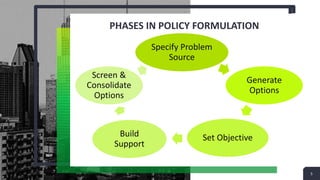
PHASES IN POLICY FORMULATION
5
Specify Problem
Source
Generate
Options
Set ObjectiveBuild
Support
Screen &
Consolidate
Options
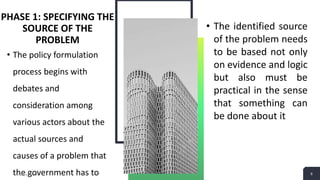
PHASE 1: SPECIFYING THE
SOURCE OF THE
PROBLEM
• The policy formulation
process begins with
debates and
consideration among
various actors about the
actual sources and
causes of a problem that
the government has toAdd a Footer 6
• The identified source
of the problem needs
to be based not only
on evidence and logic
but also must be
practical in the sense
that something can
be done about it
PHASE 2: GENERATING POLICY
OPTIONS
 It involves an assessment
of what tools for dealing
with a particular problem
are available for
deployment.
Add a Footer 7
 Policies are comprised of
a number of elements
that must be aligned if
they are to succeed
(Howlett 2009);
8
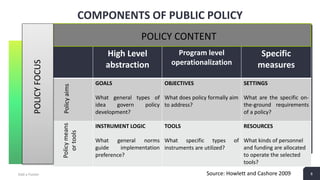
COMPONENTS OF PUBLIC POLICY
Add a Footer 8
High Level
abstraction
Program level
operationalization
Specific
measures
GOALS
What general types of
idea govern policy
development?
OBJECTIVES
What does policy formally aim
to address?
SETTINGS
What are the specific on-
the-ground requirements
of a policy?
INSTRUMENT LOGIC
What general norms
guide implementation
preference?
TOOLS
What specific types of
instruments are utilized?
RESOURCES
What kinds of personnel
and funding are allocated
to operate the selected
tools?
POLICYFOCUS POLICY CONTENT
PolicyaimsPolicymeans
ortools
Source: Howlett and Cashore 2009
9
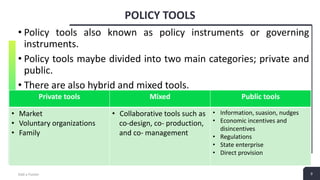
POLICY TOOLS
Add a Footer 9
• Policy tools also known as policy instruments or governing
instruments.
• Policy tools maybe divided into two main categories; private and
public.
• There are also hybrid and mixed tools.
Private tools Mixed Public tools
• Market
• Voluntary organizations
• Family
• Collaborative tools such as
co-design, co- production,
and co- management
• Information, suasion, nudges
• Economic incentives and
disincentives
• Regulations
• State enterprise
• Direct provision
10
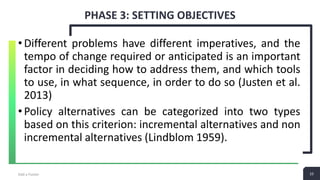
PHASE 3: SETTING OBJECTIVES
Add a Footer 10
•Different problems have different imperatives, and the
tempo of change required or anticipated is an important
factor in deciding how to address them, and which tools
to use, in what sequence, in order to do so (Justen et al.
2013)
•Policy alternatives can be categorized into two types
based on this criterion: incremental alternatives and non
incremental alternatives (Lindblom 1959).
11
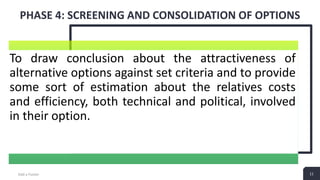
PHASE 4: SCREENING AND CONSOLIDATION OF OPTIONS
Add a Footer 11
To draw conclusion about the attractiveness of
alternative options against set criteria and to provide
some sort of estimation about the relatives costs
and efficiency, both technical and political, involved
in their option.
12
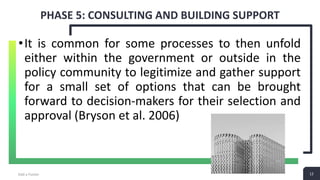
PHASE 5: CONSULTING AND BUILDING SUPPORT
Add a Footer 12
•It is common for some processes to then unfold
either within the government or outside in the
policy community to legitimize and gather support
for a small set of options that can be brought
forward to decision-makers for their selection and
approval (Bryson et al. 2006)
13
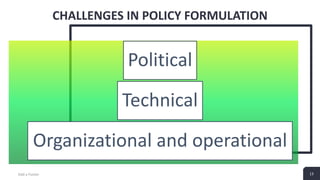
CHALLENGES IN POLICY FORMULATION
Add a Footer 13
Political
Technical
Organizational and operational
14
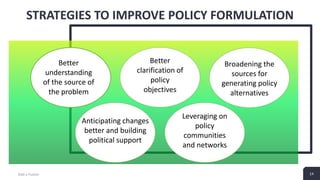
STRATEGIES TO IMPROVE POLICY FORMULATION
Add a Footer 14
Better
understanding
of the source of
the problem
Better
clarification of
policy
objectives
Broadening the
sources for
generating policy
alternatives
Anticipating changes
better and building
political support
Leveraging on
policy
communities
and networks
Add a Footer
CONCLUSION
15
Policy formulation is a key stage of policy-making and
one in which policy actors and advisors may find
their greatest opportunity to affect decision-making
and policy implementation.

Chapter 3 policy formulation

  • 1.
    POLICY FORMULATION Public Policyand Governance (950701) Chapter 3
  • 2.
    INTRODUCTION • D ef i n i t i o n • P h a s e s i n p o l i c y f o r m u l a t i o n • C h a l l e n g e s i n p o l i c y f o r m u l a t i o n • S t r a t e g i e s t o i m p r o v e p o l i c y f o r m u l a t i o n • C o n c l u s i o n 2
  • 3.
    DEFINITION T h ep r o c e s s o f p o l i c y f o r m u l a t i o n c a n b e e i t h e r h i g h l y s t r u c t u r e d ‘ d e s i g n ’ o r e n t i r e l y a d h o c a n d m e a n i n g l e s s n o n - d e s i g n ( H o w l e t t & M u k h e r j e e 2 0 1 3 ) Add a Footer 3
  • 4.
    DEFINITION D e te r m i n a n t s o f t h e c a p a c i t y t o u n d e r t a k e r i g o r o u s p o l i c y e v a l u a t i o n i n c l u d e ( H o w l e t t 2 0 0 9 ) : o Availability of capable individual analysts; o Provisions for the collection and dissemination of relevant information; o Mechanism to ensure access by agencies, nongovernmental organizations and the public to thisAdd a Footer 4
  • 5.
    PHASES IN POLICYFORMULATION 5 Specify Problem Source Generate Options Set ObjectiveBuild Support Screen & Consolidate Options
  • 6.
    PHASE 1: SPECIFYINGTHE SOURCE OF THE PROBLEM • The policy formulation process begins with debates and consideration among various actors about the actual sources and causes of a problem that the government has toAdd a Footer 6 • The identified source of the problem needs to be based not only on evidence and logic but also must be practical in the sense that something can be done about it
  • 7.
    PHASE 2: GENERATINGPOLICY OPTIONS  It involves an assessment of what tools for dealing with a particular problem are available for deployment. Add a Footer 7  Policies are comprised of a number of elements that must be aligned if they are to succeed (Howlett 2009);
  • 8.
    8 COMPONENTS OF PUBLICPOLICY Add a Footer 8 High Level abstraction Program level operationalization Specific measures GOALS What general types of idea govern policy development? OBJECTIVES What does policy formally aim to address? SETTINGS What are the specific on- the-ground requirements of a policy? INSTRUMENT LOGIC What general norms guide implementation preference? TOOLS What specific types of instruments are utilized? RESOURCES What kinds of personnel and funding are allocated to operate the selected tools? POLICYFOCUS POLICY CONTENT PolicyaimsPolicymeans ortools Source: Howlett and Cashore 2009
  • 9.
    9 POLICY TOOLS Add aFooter 9 • Policy tools also known as policy instruments or governing instruments. • Policy tools maybe divided into two main categories; private and public. • There are also hybrid and mixed tools. Private tools Mixed Public tools • Market • Voluntary organizations • Family • Collaborative tools such as co-design, co- production, and co- management • Information, suasion, nudges • Economic incentives and disincentives • Regulations • State enterprise • Direct provision
  • 10.
    10 PHASE 3: SETTINGOBJECTIVES Add a Footer 10 •Different problems have different imperatives, and the tempo of change required or anticipated is an important factor in deciding how to address them, and which tools to use, in what sequence, in order to do so (Justen et al. 2013) •Policy alternatives can be categorized into two types based on this criterion: incremental alternatives and non incremental alternatives (Lindblom 1959).
  • 11.
    11 PHASE 4: SCREENINGAND CONSOLIDATION OF OPTIONS Add a Footer 11 To draw conclusion about the attractiveness of alternative options against set criteria and to provide some sort of estimation about the relatives costs and efficiency, both technical and political, involved in their option.
  • 12.
    12 PHASE 5: CONSULTINGAND BUILDING SUPPORT Add a Footer 12 •It is common for some processes to then unfold either within the government or outside in the policy community to legitimize and gather support for a small set of options that can be brought forward to decision-makers for their selection and approval (Bryson et al. 2006)
  • 13.
    13 CHALLENGES IN POLICYFORMULATION Add a Footer 13 Political Technical Organizational and operational
  • 14.
    14 STRATEGIES TO IMPROVEPOLICY FORMULATION Add a Footer 14 Better understanding of the source of the problem Better clarification of policy objectives Broadening the sources for generating policy alternatives Anticipating changes better and building political support Leveraging on policy communities and networks
  • 15.
    Add a Footer CONCLUSION 15 Policyformulation is a key stage of policy-making and one in which policy actors and advisors may find their greatest opportunity to affect decision-making and policy implementation.