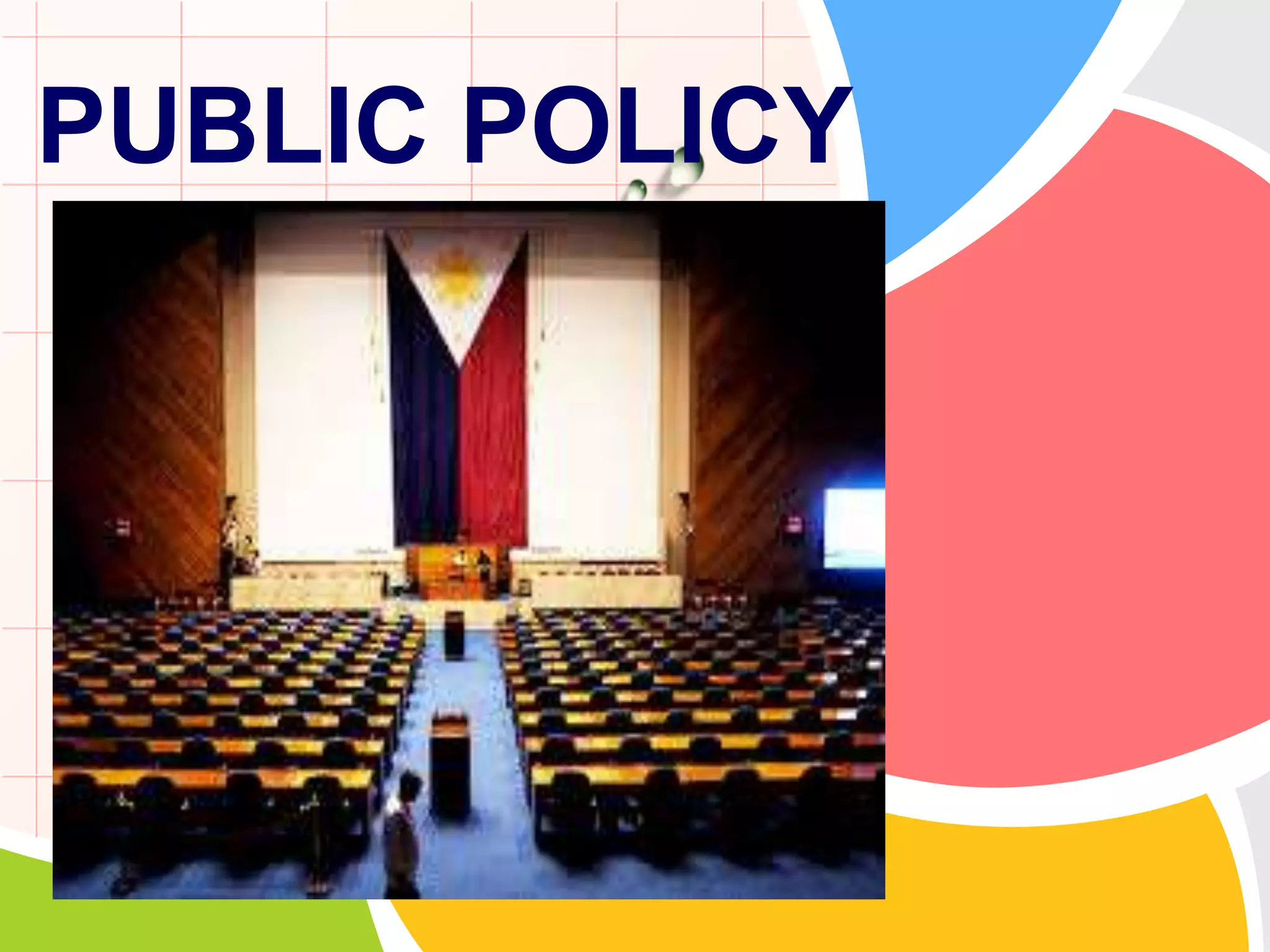
PUBLIC POLICY 
L/O/G/O
OBJECTIVE 
• To learn the definition and meaning of 
public policy 
• To learn the subfields of public policy. 
ANTHONY DUENAS MPA STUDENT
WE DEFINE PUBLIC AS 
• concerning the people as a whole. 
• accessible to or shared by all members of 
the community 
• relating to a government 
• relating to, or being in the service of the 
community or nation 
• relating to people in general
WE DEFINE POLICY AS 
• a course of action adopted and pursued by 
a government, ruler, political party 
• a document embodying a contract of 
insurance 
• a principle to guide decisions and achieve 
rational outcomes 
• a statement of intent, and is implemented 
as a procedure or protocol.
WE DEFINE PUBLIC POLICY AS
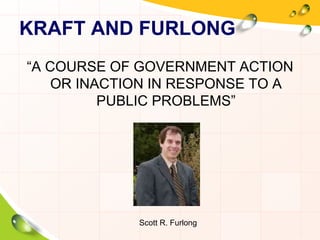
KRAFT AND FURLONG 
“A COURSE OF GOVERNMENT ACTION 
OR INACTION IN RESPONSE TO A 
PUBLIC PROBLEMS” 
Scott R. Furlong
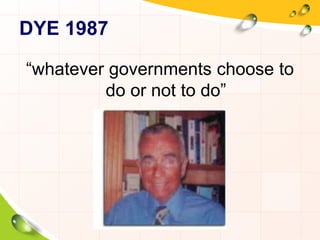
DYE 1987 
“whatever governments choose to 
do or not to do”
Eyestone 1971 
• “the relationship of governmental unit to its 
• environment”
James Anderson 1994 
“purposive course of action or inaction 
undertaken by an actor or set of actors in 
dealing witha problem or matter of 
concern”
WILSON 2006 
“The actions, objectives, and 
pronouncements of governments on 
particular matters, the steps they take (or 
fail to take) to implement them, and the 
explanations they give for what happen(or 
does not happen)”
IS THERE A EXACT DEFINITION? 
The bottom line is that there is no precise and universal 
definition of public policy, nor is it likely that such a 
definition will be conceived in the foreseeable future. 
Instead, there is general agreement that public policy 
includes the process of making choices and the 
outcomes or actions of particular decisions; that what 
makes public policy “public” is that these choices or 
actions are backed by the coercive powers of the state; 
and that at its core, public policy is a response to a 
perceived problem (Birkland 2001).
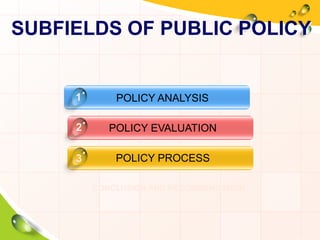
SUBFIELDS OF PUBLIC POLICY 
POLICY ANALYSIS 
POLICY EVALUATION 
POLICY PROCESS 
CONCLUSION AND RECOMMENDATION 
1 
2 
3
POLICY PROCESS 
• Research is focused on the how and why 
of policymaking. 
• Those who study policy process are 
interested in finding out why governments 
pay attention to some problems and not 
others (agenda setting), why policy 
changes or remains stable across time, 
and where policy comes from.
POLICY EVALUATION 
• “The consequences of what governments 
do and say” (Dubnick and Bardes 1983) 
• The fundamental question in policy 
evaluation is empirical: what have we 
done?
POLICY ANALYSIS 
• Policy analysis focuses on ex ante 
questions. The most fundamental of these 
is: what should we do? 
• To determine the best policy for public 
authorities to adopt to address a give 
problem or issue of concern. 
• The challenge in policy analysis judgment 
between effective and efficient
Difference of Policy and Law
Policy 
• Policies are only documents 
• A policy is that which outlines what a 
government is going to do and not to do 
• Policies can be called a set of rules that 
guide any government or any organization. 
• Policies are objectives that an organization 
or a government sets for itself to achieve 
in a given period of time
Law 
• Laws are the tools that help a government 
achieve there objectives 
• Laws are the standard rules and 
regulations that are compulsory and to be 
followed by all the people of the country 
• Laws are set of principles that guide 
people’s actions in various situations of life
References 
Public policy theory primer by Kevin B. 
Smith and Christopher W. Larimer 
Wikipedia.com
Thank You! 
L/O/G/O

Public policy

  • 1.
  • 2.
    OBJECTIVE • Tolearn the definition and meaning of public policy • To learn the subfields of public policy. ANTHONY DUENAS MPA STUDENT
  • 3.
    WE DEFINE PUBLICAS • concerning the people as a whole. • accessible to or shared by all members of the community • relating to a government • relating to, or being in the service of the community or nation • relating to people in general
  • 4.
    WE DEFINE POLICYAS • a course of action adopted and pursued by a government, ruler, political party • a document embodying a contract of insurance • a principle to guide decisions and achieve rational outcomes • a statement of intent, and is implemented as a procedure or protocol.
  • 5.
  • 6.
    KRAFT AND FURLONG “A COURSE OF GOVERNMENT ACTION OR INACTION IN RESPONSE TO A PUBLIC PROBLEMS” Scott R. Furlong
  • 7.
    DYE 1987 “whatevergovernments choose to do or not to do”
  • 8.
    Eyestone 1971 •“the relationship of governmental unit to its • environment”
  • 9.
    James Anderson 1994 “purposive course of action or inaction undertaken by an actor or set of actors in dealing witha problem or matter of concern”
  • 10.
    WILSON 2006 “Theactions, objectives, and pronouncements of governments on particular matters, the steps they take (or fail to take) to implement them, and the explanations they give for what happen(or does not happen)”
  • 11.
    IS THERE AEXACT DEFINITION? The bottom line is that there is no precise and universal definition of public policy, nor is it likely that such a definition will be conceived in the foreseeable future. Instead, there is general agreement that public policy includes the process of making choices and the outcomes or actions of particular decisions; that what makes public policy “public” is that these choices or actions are backed by the coercive powers of the state; and that at its core, public policy is a response to a perceived problem (Birkland 2001).
  • 12.
    SUBFIELDS OF PUBLICPOLICY POLICY ANALYSIS POLICY EVALUATION POLICY PROCESS CONCLUSION AND RECOMMENDATION 1 2 3
  • 13.
    POLICY PROCESS •Research is focused on the how and why of policymaking. • Those who study policy process are interested in finding out why governments pay attention to some problems and not others (agenda setting), why policy changes or remains stable across time, and where policy comes from.
  • 14.
    POLICY EVALUATION •“The consequences of what governments do and say” (Dubnick and Bardes 1983) • The fundamental question in policy evaluation is empirical: what have we done?
  • 15.
    POLICY ANALYSIS •Policy analysis focuses on ex ante questions. The most fundamental of these is: what should we do? • To determine the best policy for public authorities to adopt to address a give problem or issue of concern. • The challenge in policy analysis judgment between effective and efficient
  • 16.
  • 17.
    Policy • Policiesare only documents • A policy is that which outlines what a government is going to do and not to do • Policies can be called a set of rules that guide any government or any organization. • Policies are objectives that an organization or a government sets for itself to achieve in a given period of time
  • 18.
    Law • Lawsare the tools that help a government achieve there objectives • Laws are the standard rules and regulations that are compulsory and to be followed by all the people of the country • Laws are set of principles that guide people’s actions in various situations of life
  • 19.
    References Public policytheory primer by Kevin B. Smith and Christopher W. Larimer Wikipedia.com
  • 20.