PUBLIC
ADMINISTRATION
TOPIC: FORMULATION PROCESS OF
PUBLIC POLICY.
PA12-Public Policy
Taguig City University 3rd Year BPA-A31
Leader: Justin Santiago
Members:
Charmane Abaga
Ronnie Enaje
Roland Jugado
Christine Mhae Tacder
Maria Janine Melenia Vasquez
PUBLIC ADMINISTRATION
DEFINING THE FUNDAMENTAL CONCEPTS:
POLICY:
- A Policy is typically described as a principle or rule to guide
decisions and achieve rational outcome/s.
- A purposive course of action based on societal values , followed in
dealing with a matter or concern, and predicting the outcome
that would result from achievement of the purpose.
- Public policy:
- - Policy serving as the enabling and guiding framework for
government .
PUBLIC POLICY
• PUBLIC POLICY IS ALL ABOUT:
- The Intentions of the legislative authority
towards society.
- The Direction in which the legislator wants
to steer society.
- The Utilization of natural resources.
PUBLIC POLICY
FORMULATION PROCESS
• STEP 1: AGENDA SETTING / PROBLEM
IDENTIFICATION
• STEP 2: POLICY INSTRUMENTS/ SOURCES
• STEP 3:POLICY FORMULATION
• STEP 4. POLICY ANALYSIS
• STEP 5: POLICY IMPLEMENTATION
• STEP 6: POLICY EVALUATION
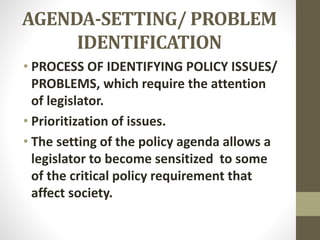
AGENDA-SETTING/ PROBLEM
IDENTIFICATION
• PROCESS OF IDENTIFYING POLICY ISSUES/
PROBLEMS, which require the attention
of legislator.
• Prioritization of issues.
• The setting of the policy agenda allows a
legislator to become sensitized to some
of the critical policy requirement that
affect society.
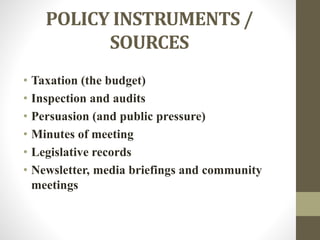
POLICY INSTRUMENTS /
SOURCES
• Taxation (the budget)
• Inspection and audits
• Persuasion (and public pressure)
• Minutes of meeting
• Legislative records
• Newsletter, media briefings and community
meetings
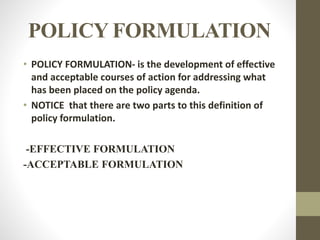
POLICY FORMULATION
• POLICY FORMULATION- is the development of effective
and acceptable courses of action for addressing what
has been placed on the policy agenda.
• NOTICE that there are two parts to this definition of
policy formulation.
-EFFECTIVE FORMULATION
-ACCEPTABLE FORMULATION
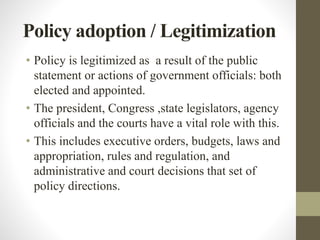
Policy adoption / Legitimization
• Policy is legitimized as a result of the public
statement or actions of government officials: both
elected and appointed.
• The president, Congress ,state legislators, agency
officials and the courts have a vital role with this.
• This includes executive orders, budgets, laws and
appropriation, rules and regulation, and
administrative and court decisions that set of
policy directions.
POLICYANALYSIS
• Step-by-step way of unpacking and understanding
policy choices and comparing possible outcomes.
• Policy analysis needs to explore as rationally and
honestly as possible the implications and possible
outcomes of adopting policy.
• The importance and value of continual policy analysis.
• Policy analysis is an attempt to determine the costs and
benefits of various alternatives or evaluate the validity
of existing policies.
POLICY IMPLEMENTATION
• Policy implementation includes all the
activities that result from the official
adaption of policy.
• Policy implementation is what happens
after a law is passed. We should never
assume that the passage of law is the end
of the policymaking process.
POLICY EVALUATION
• Policy evaluation applies evaluation
principles and methods to examine the
content, implementation or impact of a
policy. Evaluation is the activity through
which we develop an understanding of the
merit, worth, and utility of a policy.
Reference:
https://www.slideshare.net/mobile/CharlesCotter/
public-policy-formulation
https://www.google.com/url?sa=t&source=web&rct
=j&url=https%3A%2F%2Fww.cdc.gov%2Finjury%2
Fpdfs%2Fpolicy%2FBrief%25201-a.pdf&-
ved=2ahUKEwjq3dKVn7HvAhVCWEKHf3cBvEQFjA
BegQIARAG&usg=AOvVaw3no4YZAaLj9B4jr16Ej9ik

Public Policy Formulation Process

  • 1.
    PUBLIC ADMINISTRATION TOPIC: FORMULATION PROCESSOF PUBLIC POLICY. PA12-Public Policy Taguig City University 3rd Year BPA-A31 Leader: Justin Santiago Members: Charmane Abaga Ronnie Enaje Roland Jugado Christine Mhae Tacder Maria Janine Melenia Vasquez
  • 2.
    PUBLIC ADMINISTRATION DEFINING THEFUNDAMENTAL CONCEPTS: POLICY: - A Policy is typically described as a principle or rule to guide decisions and achieve rational outcome/s. - A purposive course of action based on societal values , followed in dealing with a matter or concern, and predicting the outcome that would result from achievement of the purpose. - Public policy: - - Policy serving as the enabling and guiding framework for government .
  • 3.
    PUBLIC POLICY • PUBLICPOLICY IS ALL ABOUT: - The Intentions of the legislative authority towards society. - The Direction in which the legislator wants to steer society. - The Utilization of natural resources.
  • 4.
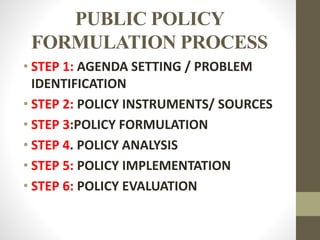
    PUBLIC POLICY FORMULATION PROCESS •STEP 1: AGENDA SETTING / PROBLEM IDENTIFICATION • STEP 2: POLICY INSTRUMENTS/ SOURCES • STEP 3:POLICY FORMULATION • STEP 4. POLICY ANALYSIS • STEP 5: POLICY IMPLEMENTATION • STEP 6: POLICY EVALUATION
  • 5.
    AGENDA-SETTING/ PROBLEM IDENTIFICATION • PROCESSOF IDENTIFYING POLICY ISSUES/ PROBLEMS, which require the attention of legislator. • Prioritization of issues. • The setting of the policy agenda allows a legislator to become sensitized to some of the critical policy requirement that affect society.
  • 6.
    POLICY INSTRUMENTS / SOURCES •Taxation (the budget) • Inspection and audits • Persuasion (and public pressure) • Minutes of meeting • Legislative records • Newsletter, media briefings and community meetings
  • 7.
    POLICY FORMULATION • POLICYFORMULATION- is the development of effective and acceptable courses of action for addressing what has been placed on the policy agenda. • NOTICE that there are two parts to this definition of policy formulation. -EFFECTIVE FORMULATION -ACCEPTABLE FORMULATION
  • 8.
    Policy adoption /Legitimization • Policy is legitimized as a result of the public statement or actions of government officials: both elected and appointed. • The president, Congress ,state legislators, agency officials and the courts have a vital role with this. • This includes executive orders, budgets, laws and appropriation, rules and regulation, and administrative and court decisions that set of policy directions.
  • 9.
    POLICYANALYSIS • Step-by-step wayof unpacking and understanding policy choices and comparing possible outcomes. • Policy analysis needs to explore as rationally and honestly as possible the implications and possible outcomes of adopting policy. • The importance and value of continual policy analysis. • Policy analysis is an attempt to determine the costs and benefits of various alternatives or evaluate the validity of existing policies.
  • 10.
    POLICY IMPLEMENTATION • Policyimplementation includes all the activities that result from the official adaption of policy. • Policy implementation is what happens after a law is passed. We should never assume that the passage of law is the end of the policymaking process.
  • 11.
    POLICY EVALUATION • Policyevaluation applies evaluation principles and methods to examine the content, implementation or impact of a policy. Evaluation is the activity through which we develop an understanding of the merit, worth, and utility of a policy.
  • 12.