Optimum Currency Areas Introduction to Economics Metropolitan University Prague Martin Kolmhofer 2011/2012
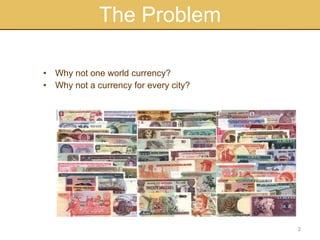
The Problem Why not one world currency? Why not a currency for every city?
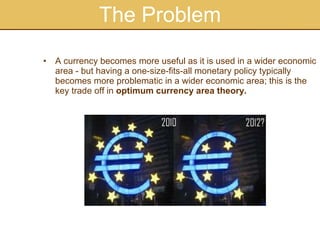
The Problem A currency becomes more useful as it is used in a wider economic area - but having a one-size-fits-all monetary policy typically becomes more problematic in a wider economic area; this is the key trade off in  optimum currency area theory.
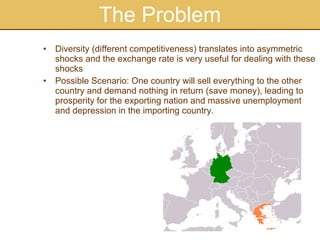
The Problem Diversity (different competitiveness) translates into asymmetric shocks and the exchange rate is very useful for dealing with these shocks Possible Scenario: One country will sell everything to the other country and demand nothing in return (save money), leading to prosperity for the exporting nation and massive unemployment and depression in the importing country.
Self Correcting Mechanism Normally trade deficits tend to be self-correcting: A country with a trade surplus, in that it sells more abroad than it buys, will create an international demand for its currency. (If you want its stuff, you need its currency). As a result, strong trading positions tend to strengthen a country’s currency. The opposite is true with countries with weak trading positions. If no one wants your stuff no one really needs your currency. But when a country’s currency rises, its products become more expensive. This gives a competitive opportunity to countries with weak currencies to start selling some of their products into that market. When they sell more demand for their currency rises This currency counterweight should keep runaway trade imbalances in check.
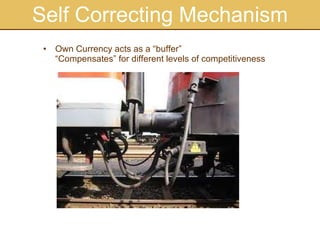
Self Correcting Mechanism Own Currency acts as a “buffer” “Compensates” for different levels of competitiveness
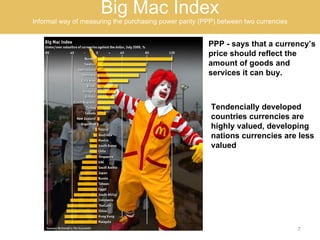
Big Mac Index Informal way of measuring the purchasing power parity (PPP) between two currencies PPP - says that a currency’s price should reflect the amount of goods and services it can buy. Tendencially developed countries currencies are highly valued, developing nations currencies are less valued
Big Mac Index Why/How can differences persist?  It takes time to adjust Tradable vs Non-tradable goods (even a Big Mac includes cost like real estate, local taxes…) PPP assumes free trade is in place (no tariffs, taxes, transportation costs, other restrictions…) Demand for currency is not only determined by trade of goods (also investment purposes: financial assets, real estate…)
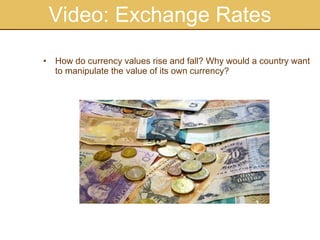
Video: Exchange Rates How do currency values rise and fall? Why would a country want to manipulate the value of its own currency?
Competitive Devaluation “ Keeping your currency cheap” When a country tries to devalue its currency to increase its international competitiveness. “Beggar thy neighbor” The idea is that by devaluing our currency, our exports become more competitive which reduces unemployment. Our devaluation is another country’s appreciation. This means we’re effectively just shipping our unemployment overseas. Other countries don’t like that, so they devalue their currency in turn. This leads to cycles of competitive devaluation. But: Devaluing also means defaulting on a portion of your debt.  (= no access to Debt Capital (Bond) Markets in the future.)  How to devalue a currency? Increasing the supply Increasing the demand for competing currency  (Example China – by buying US government debt / bonds)
What happens without exchange rate “buffer”? In the case of an overvalued currency: Competitiveness needs to be restored in other ways Prices (Wages) need to fall – but are sticky Unemployment  Government Debt Low demand – what to do?: Opinion 1:  "If consumers are not spending the best way to spur demand is to allow prices to fall to more affordable levels“  (Peter Schiff) Opinion 2: "If you believe that wages and prices are not perfectly flexible and there are many that are not, then the economy can get pushed away from full employment“  (Ben Bernanke)
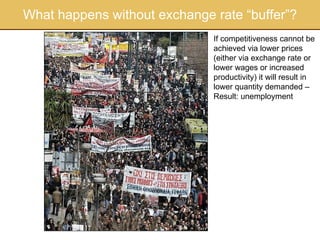
What happens without exchange rate “buffer”? If competitiveness cannot be achieved via lower prices (either via exchange rate or lower wages or increased productivity) it will result in lower quantity demanded – Result: unemployment
In a Nutshell The benefits: A currency becomes more useful as it is used in a wider economic area The costs: loss of monetary and exchange rate instruments matters in presence of: price and wage stickiness asymmetric shocks.( a recession which only affects some members of a group of trading countries)
Implications of Asymmetric Shocks Asymmetric shock = a recession which only affects some members of a group of trading countries Asymmetric shocks make it difficult for the central bank of a monetary union to conduct monetary policy  Questions: What reduces the incidence of asymmetric shocks? What makes it easier to cope with shocks when they occur. The analysis develops six OCA criteria.
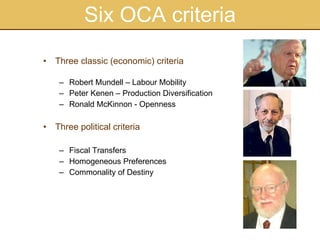
Six OCA criteria Three classic (economic) criteria Robert Mundell – Labour Mobility Peter Kenen – Production Diversification Ronald McKinnon - Openness Three political criteria Fiscal Transfers Homogeneous Preferences Commonality of Destiny
Criterion 1 (Mundell): Labour Mobility If workers are highly mobile between two nations, those nations are more likely to form an optimal currency area.  Labour mobility is easier within national borders (culture, language, legislation, welfare, etc.) See Chapter on Labour Markets and Migration ->  Conclusion:  Not enough labor mobility for an OCA
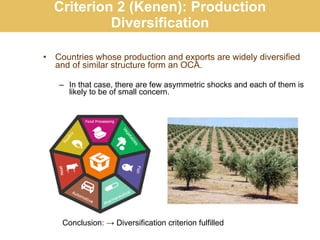
Criterion 2 (Kenen): Production Diversification Countries whose production and exports are widely diversified and of similar structure form an OCA. In that case, there are few asymmetric shocks and each of them is likely to be of small concern. Conclusion: -> Diversification criterion fulfilled
Criterion 3 (McKinnon): Openness Countries which are very open to trade and trade heavily with each other form an OCA. If all goods are traded, domestic good prices must be flexible and the exchange rate does not matter for competitiveness.
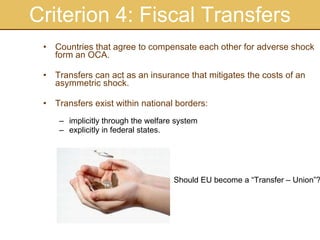
Criterion 4: Fiscal Transfers Countries that agree to compensate each other for adverse shock form an OCA. Transfers can act as an insurance that mitigates the costs of an asymmetric shock. Transfers exist within national borders: implicitly through the welfare system explicitly in federal states. Should EU become a “Transfer – Union”?
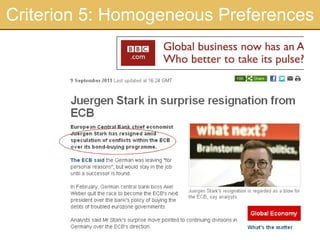
Criterion 5: Homogeneous Preferences Countries that share a wide consensus on the way to deal with shocks form an OCA. There is more than one way to tackle a given economic problem. The partners of an OCA need to be agreed on economic policy as a whole, such as whether to target inflation or unemployment, or whether to favor exporters or importers. If the currency area members do not share the same preferences over trade-offs, each of them will want the  common central bank to pursue different policies.
Criterion 5: Homogeneous Preferences
Criterion 6: Commonality of Destiny Countries that view themselves as sharing a common destiny better accept the costs of operating an OCA. A common currency will always face occasional asymmetric shocks that result in temporary conflicts of interests: this calls for accepting such economic costs in the name of a higher purpose. Solidarity is only easy in “golden years”
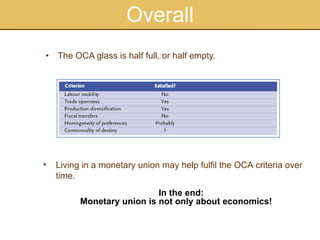
Overall The OCA glass is half full, or half empty. Living in a monetary union may help fulfil the OCA criteria over time. In the end:  Monetary union is not only about economics!

Optimum Currency Areas

  • 1.
    Optimum Currency AreasIntroduction to Economics Metropolitan University Prague Martin Kolmhofer 2011/2012
  • 2.
    The Problem Whynot one world currency? Why not a currency for every city?
  • 3.
    The Problem Acurrency becomes more useful as it is used in a wider economic area - but having a one-size-fits-all monetary policy typically becomes more problematic in a wider economic area; this is the key trade off in optimum currency area theory.
  • 4.
    The Problem Diversity(different competitiveness) translates into asymmetric shocks and the exchange rate is very useful for dealing with these shocks Possible Scenario: One country will sell everything to the other country and demand nothing in return (save money), leading to prosperity for the exporting nation and massive unemployment and depression in the importing country.
  • 5.
    Self Correcting MechanismNormally trade deficits tend to be self-correcting: A country with a trade surplus, in that it sells more abroad than it buys, will create an international demand for its currency. (If you want its stuff, you need its currency). As a result, strong trading positions tend to strengthen a country’s currency. The opposite is true with countries with weak trading positions. If no one wants your stuff no one really needs your currency. But when a country’s currency rises, its products become more expensive. This gives a competitive opportunity to countries with weak currencies to start selling some of their products into that market. When they sell more demand for their currency rises This currency counterweight should keep runaway trade imbalances in check.
  • 6.
    Self Correcting MechanismOwn Currency acts as a “buffer” “Compensates” for different levels of competitiveness
  • 7.
    Big Mac IndexInformal way of measuring the purchasing power parity (PPP) between two currencies PPP - says that a currency’s price should reflect the amount of goods and services it can buy. Tendencially developed countries currencies are highly valued, developing nations currencies are less valued
  • 8.
    Big Mac IndexWhy/How can differences persist? It takes time to adjust Tradable vs Non-tradable goods (even a Big Mac includes cost like real estate, local taxes…) PPP assumes free trade is in place (no tariffs, taxes, transportation costs, other restrictions…) Demand for currency is not only determined by trade of goods (also investment purposes: financial assets, real estate…)
  • 9.
    Video: Exchange RatesHow do currency values rise and fall? Why would a country want to manipulate the value of its own currency?
  • 10.
    Competitive Devaluation “Keeping your currency cheap” When a country tries to devalue its currency to increase its international competitiveness. “Beggar thy neighbor” The idea is that by devaluing our currency, our exports become more competitive which reduces unemployment. Our devaluation is another country’s appreciation. This means we’re effectively just shipping our unemployment overseas. Other countries don’t like that, so they devalue their currency in turn. This leads to cycles of competitive devaluation. But: Devaluing also means defaulting on a portion of your debt. (= no access to Debt Capital (Bond) Markets in the future.)  How to devalue a currency? Increasing the supply Increasing the demand for competing currency (Example China – by buying US government debt / bonds)
  • 11.
    What happens withoutexchange rate “buffer”? In the case of an overvalued currency: Competitiveness needs to be restored in other ways Prices (Wages) need to fall – but are sticky Unemployment Government Debt Low demand – what to do?: Opinion 1: "If consumers are not spending the best way to spur demand is to allow prices to fall to more affordable levels“ (Peter Schiff) Opinion 2: "If you believe that wages and prices are not perfectly flexible and there are many that are not, then the economy can get pushed away from full employment“ (Ben Bernanke)
  • 12.
    What happens withoutexchange rate “buffer”? If competitiveness cannot be achieved via lower prices (either via exchange rate or lower wages or increased productivity) it will result in lower quantity demanded – Result: unemployment
  • 13.
    In a NutshellThe benefits: A currency becomes more useful as it is used in a wider economic area The costs: loss of monetary and exchange rate instruments matters in presence of: price and wage stickiness asymmetric shocks.( a recession which only affects some members of a group of trading countries)
  • 14.
    Implications of AsymmetricShocks Asymmetric shock = a recession which only affects some members of a group of trading countries Asymmetric shocks make it difficult for the central bank of a monetary union to conduct monetary policy Questions: What reduces the incidence of asymmetric shocks? What makes it easier to cope with shocks when they occur. The analysis develops six OCA criteria.
  • 15.
    Six OCA criteriaThree classic (economic) criteria Robert Mundell – Labour Mobility Peter Kenen – Production Diversification Ronald McKinnon - Openness Three political criteria Fiscal Transfers Homogeneous Preferences Commonality of Destiny
  • 16.
    Criterion 1 (Mundell):Labour Mobility If workers are highly mobile between two nations, those nations are more likely to form an optimal currency area. Labour mobility is easier within national borders (culture, language, legislation, welfare, etc.) See Chapter on Labour Markets and Migration -> Conclusion: Not enough labor mobility for an OCA
  • 17.
    Criterion 2 (Kenen):Production Diversification Countries whose production and exports are widely diversified and of similar structure form an OCA. In that case, there are few asymmetric shocks and each of them is likely to be of small concern. Conclusion: -> Diversification criterion fulfilled
  • 18.
    Criterion 3 (McKinnon):Openness Countries which are very open to trade and trade heavily with each other form an OCA. If all goods are traded, domestic good prices must be flexible and the exchange rate does not matter for competitiveness.
  • 19.
    Criterion 4: FiscalTransfers Countries that agree to compensate each other for adverse shock form an OCA. Transfers can act as an insurance that mitigates the costs of an asymmetric shock. Transfers exist within national borders: implicitly through the welfare system explicitly in federal states. Should EU become a “Transfer – Union”?
  • 20.
    Criterion 5: HomogeneousPreferences Countries that share a wide consensus on the way to deal with shocks form an OCA. There is more than one way to tackle a given economic problem. The partners of an OCA need to be agreed on economic policy as a whole, such as whether to target inflation or unemployment, or whether to favor exporters or importers. If the currency area members do not share the same preferences over trade-offs, each of them will want the common central bank to pursue different policies.
  • 21.
  • 22.
    Criterion 6: Commonalityof Destiny Countries that view themselves as sharing a common destiny better accept the costs of operating an OCA. A common currency will always face occasional asymmetric shocks that result in temporary conflicts of interests: this calls for accepting such economic costs in the name of a higher purpose. Solidarity is only easy in “golden years”
  • 23.
    Overall The OCAglass is half full, or half empty. Living in a monetary union may help fulfil the OCA criteria over time. In the end: Monetary union is not only about economics!