What are the problems faced in
smart grid in general?
ResearchWork On Going
Presented By
Aimal Khan Achakzai
Supervised by Dr. Imtaiz Alam
Department of Electrical Power Engineering
Bahria University Islamabad
October 4, 2018
What is the Smart Grid?
An advanced, telecommunication / electric grid with sensors and
smart devices linking all aspects of the grid, from generator to
consumer, and delivering enhanced operational capabilities that:
 Provide CONSUMERS with the information and tools necessary to be
responsive to electricity grid conditions (including price and reliability)
through the use of electric devices and new services (from smart
thermostats to PHEV)
 Ensure EFFICIENT use of the electric grid (optimizing current assets
while integrating emerging technologies such as renewables and
storage devices)
 Enhance RELIABILITY (protecting the grid from cyber and natural
attacks, increasing power quality and promoting early detection and
self correcting grid “self-healing” )
2
Smart Grid …
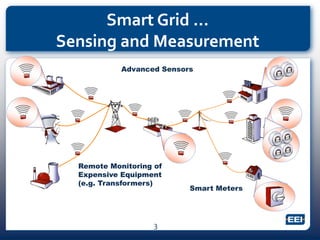
Sensing and Measurement
Advanced Sensors
Remote Monitoring of
Expensive Equipment
(e.g. Transformers)
Smart Meters
3
Smart Grid …
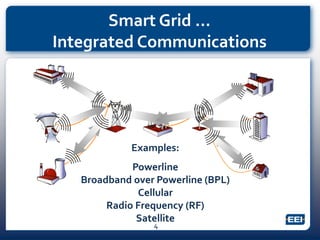
Integrated Communications
Examples:
Powerline
Broadband over Powerline (BPL)
Cellular
Radio Frequency (RF)
Satellite
4
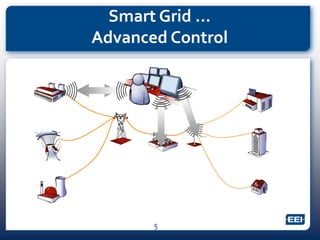
Smart Grid …
Advanced Control
5
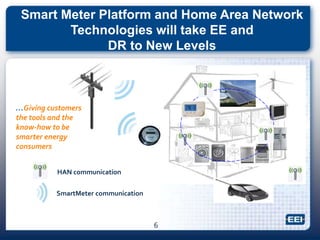
Smart Meter Platform and Home Area Network
Technologies will take EE and
DR to New Levels
HAN communication
SmartMeter communication
…Giving customers
the tools and the
know-how to be
smarter energy
consumers
6
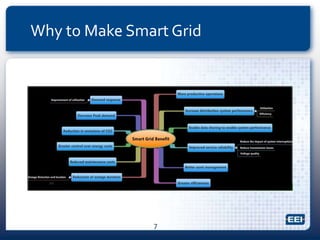
Why to Make Smart Grid
7
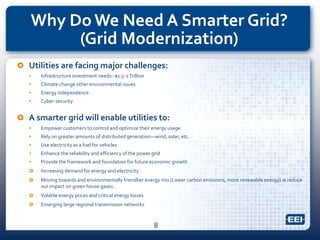
Why Do We Need A Smarter Grid?
(Grid Modernization)
 Utilities are facing major challenges:
 Infrastructure investment needs--$1.5-2Trillion
 Climate change other environmental issues
 Energy independence
 Cyber-security
 A smarter grid will enable utilities to:
 Empower customers to control and optimize their energy usage
 Rely on greater amounts of distributed generation—wind, solar, etc.
 Use electricity as a fuel for vehicles
 Enhance the reliability and efficiency of the power grid
 Provide the framework and foundation for future economic growth
 Increasing demand for energy and electricity
 Moving towards and environmentally friendlier energy mix (Lower carbon emissions, more renewable energy) ie reduce
our impact on green house gases.
 Volatile energy prices and critical energy losses
 Emerging large regional transmission networks
8
Transformational Technology
 Game ChangingTechnology that WillTransform
the Industry
 New Customer Relationships
 Greater and Better Customer Energy Control
 New Businesses / Strategic Partnerships
 New Market Participants
9
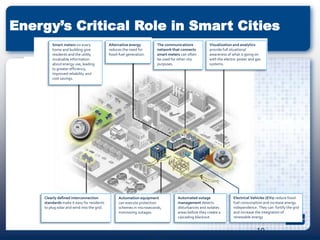
Energy’s Critical Role in Smart Cities
10
Clearly defined interconnection
standards make it easy for residents
to plug solar and wind into the grid.
Automation equipment
can execute protection
schemes in microseconds,
minimizing outages.
Automated outage
management detects
disturbances and isolates
areas before they create a
cascading blackout.
The communications
network that connects
smart meters can often
be used for other city
purposes.
Visualization and analytics
provide full situational
awareness of what is going on
with the electric power and gas
systems.
Smart meters on every
home and building give
residents and the utility
invaluable information
about energy use, leading
to greater efficiency,
improved reliability and
cost savings.
Alternative energy
reduces the need for
fossil-fuel generation.
Electrical Vehicles (EVs) reduce fossil
fuel consumption and increase energy
independence. They can fortify the grid
and increase the integration of
renewable energy
Slide
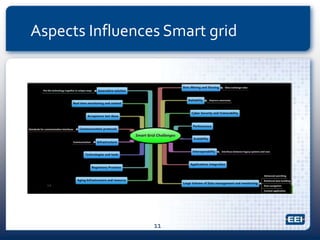
Aspects Influences Smart grid
11
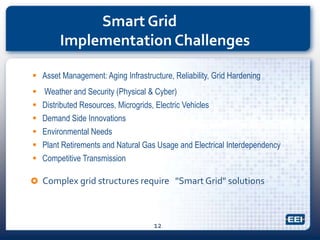
Smart Grid
Implementation Challenges
 Asset Management: Aging Infrastructure, Reliability, Grid Hardening
 Weather and Security (Physical & Cyber)
 Distributed Resources, Microgrids, Electric Vehicles
 Demand Side Innovations
 Environmental Needs
 Plant Retirements and Natural Gas Usage and Electrical Interdependency
 Competitive Transmission
 Complex grid structures require "Smart Grid" solutions
12
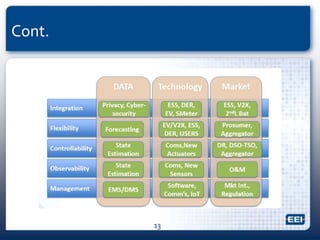
Cont.
13
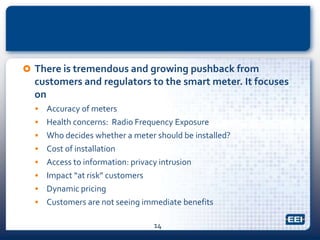
 There is tremendous and growing pushback from
customers and regulators to the smart meter. It focuses
on
 Accuracy of meters
 Health concerns: Radio Frequency Exposure
 Who decides whether a meter should be installed?
 Cost of installation
 Access to information: privacy intrusion
 Impact “at risk” customers
 Dynamic pricing
 Customers are not seeing immediate benefits
14
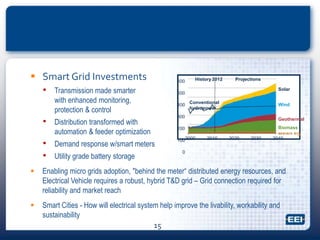
 Smart Grid Investments
• Transmission made smarter
with enhanced monitoring,
protection & control
• Distribution transformed with
automation & feeder optimization
• Demand response w/smart meters
• Utility grade battery storage
 Enabling micro grids adoption, "behind the meter“ distributed energy resources, and
Electrical Vehicle requires a robust, hybrid T&D grid – Grid connection required for
reliability and market reach
 Smart Cities - How will electrical system help improve the livability, workability and
sustainability
15
Geothermal
Biomass
MSW/LFG
Wind
Solar
Conventional
hydropower
2000 2010 2020 2030 2040
2012History Projections600
500
400
300
200
100
0
Security Concerns In Smart Grid
 Security of Power Grid and Smart Grid
 •Traditionally security to power system means – to
withstand unexpected disturbances • Such as short circuit •
Loss of a power system component such asTransmission line
• In today’s world security focus has expanded to include •
disturbances due to overloading or unexpected causes •
Physical attacks or • Cyber attack
16
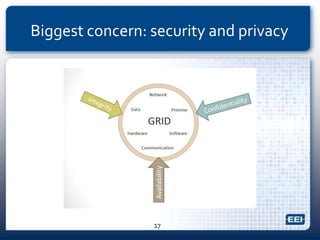
Biggest concern: security and privacy
17
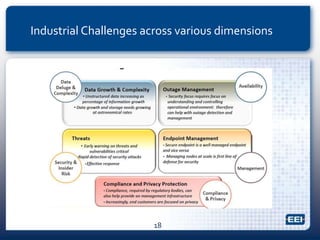
Industrial Challenges across various dimensions
18
 Smart Grid: use automated meters, two-way
communications: between a power consumer and provider
and advanced sensors
 Some types of meters can be hacked
 Hacker: gain control of thousands, even millions, of meters
increase or decrease the demand for power
19
Hacking Challenges
 Increasing demand for energy and electricity
 Its is estimated that Energy demand will grow by 55%
between 2005 and 2030
 Volatile energy prices and critical energy losses
 An inefficient energy with 2/3 of primary energy loss, mostly
due to power conversion
 Between 7% and 16% of the electricity generated is lost on
the networks
20
Electrical Demand Increases challenges in
Smart Grid
 Emerging large regional transmission networks
 Leading to difficulties in coping with increase network complexity
 Reliability and quality
 Ensure security of supply, reliability of the network and quality of
the electricity delivered
 Stability, Monitor oscillations and manage the network to prevent
blackouts and maximize availability of power
 Environmental concerns, Provide clean energy (CO2 free) and
reduce environmental impact
 Market efficiency 21
Some other challenges
 Lack of recognition or rewards on operational efficiency
 Customer concerns over privacy and transfer of data without
their knowledge,
 Fair distribution of electricity demand
 Social concerns over information abuses
 People are concerns on extra control of electricity that
government have
 Customers are concerns on computer security
 Malware and hacker threats
Some other challenges
 Utilities hard to justify for investment on smart grid • Problem over
intermittent RE source – e.g. weather • Outdate and old existing
electrical facilities
 Set up tools and processes to fully enable energy markets
 Enable customers / end-users dynamic participation
ThankYou
23
Some other challenges

Smart grid problems in general

  • 1.
    What are theproblems faced in smart grid in general? ResearchWork On Going Presented By Aimal Khan Achakzai Supervised by Dr. Imtaiz Alam Department of Electrical Power Engineering Bahria University Islamabad October 4, 2018
  • 2.
    What is theSmart Grid? An advanced, telecommunication / electric grid with sensors and smart devices linking all aspects of the grid, from generator to consumer, and delivering enhanced operational capabilities that:  Provide CONSUMERS with the information and tools necessary to be responsive to electricity grid conditions (including price and reliability) through the use of electric devices and new services (from smart thermostats to PHEV)  Ensure EFFICIENT use of the electric grid (optimizing current assets while integrating emerging technologies such as renewables and storage devices)  Enhance RELIABILITY (protecting the grid from cyber and natural attacks, increasing power quality and promoting early detection and self correcting grid “self-healing” ) 2
  • 3.
    Smart Grid … Sensingand Measurement Advanced Sensors Remote Monitoring of Expensive Equipment (e.g. Transformers) Smart Meters 3
  • 4.
    Smart Grid … IntegratedCommunications Examples: Powerline Broadband over Powerline (BPL) Cellular Radio Frequency (RF) Satellite 4
  • 5.
  • 6.
    Smart Meter Platformand Home Area Network Technologies will take EE and DR to New Levels HAN communication SmartMeter communication …Giving customers the tools and the know-how to be smarter energy consumers 6
  • 7.
    Why to MakeSmart Grid 7
  • 8.
    Why Do WeNeed A Smarter Grid? (Grid Modernization)  Utilities are facing major challenges:  Infrastructure investment needs--$1.5-2Trillion  Climate change other environmental issues  Energy independence  Cyber-security  A smarter grid will enable utilities to:  Empower customers to control and optimize their energy usage  Rely on greater amounts of distributed generation—wind, solar, etc.  Use electricity as a fuel for vehicles  Enhance the reliability and efficiency of the power grid  Provide the framework and foundation for future economic growth  Increasing demand for energy and electricity  Moving towards and environmentally friendlier energy mix (Lower carbon emissions, more renewable energy) ie reduce our impact on green house gases.  Volatile energy prices and critical energy losses  Emerging large regional transmission networks 8
  • 9.
    Transformational Technology  GameChangingTechnology that WillTransform the Industry  New Customer Relationships  Greater and Better Customer Energy Control  New Businesses / Strategic Partnerships  New Market Participants 9
  • 10.
    Energy’s Critical Rolein Smart Cities 10 Clearly defined interconnection standards make it easy for residents to plug solar and wind into the grid. Automation equipment can execute protection schemes in microseconds, minimizing outages. Automated outage management detects disturbances and isolates areas before they create a cascading blackout. The communications network that connects smart meters can often be used for other city purposes. Visualization and analytics provide full situational awareness of what is going on with the electric power and gas systems. Smart meters on every home and building give residents and the utility invaluable information about energy use, leading to greater efficiency, improved reliability and cost savings. Alternative energy reduces the need for fossil-fuel generation. Electrical Vehicles (EVs) reduce fossil fuel consumption and increase energy independence. They can fortify the grid and increase the integration of renewable energy Slide
  • 11.
  • 12.
    Smart Grid Implementation Challenges Asset Management: Aging Infrastructure, Reliability, Grid Hardening  Weather and Security (Physical & Cyber)  Distributed Resources, Microgrids, Electric Vehicles  Demand Side Innovations  Environmental Needs  Plant Retirements and Natural Gas Usage and Electrical Interdependency  Competitive Transmission  Complex grid structures require "Smart Grid" solutions 12
  • 13.
  • 14.
     There istremendous and growing pushback from customers and regulators to the smart meter. It focuses on  Accuracy of meters  Health concerns: Radio Frequency Exposure  Who decides whether a meter should be installed?  Cost of installation  Access to information: privacy intrusion  Impact “at risk” customers  Dynamic pricing  Customers are not seeing immediate benefits 14
  • 15.
     Smart GridInvestments • Transmission made smarter with enhanced monitoring, protection & control • Distribution transformed with automation & feeder optimization • Demand response w/smart meters • Utility grade battery storage  Enabling micro grids adoption, "behind the meter“ distributed energy resources, and Electrical Vehicle requires a robust, hybrid T&D grid – Grid connection required for reliability and market reach  Smart Cities - How will electrical system help improve the livability, workability and sustainability 15 Geothermal Biomass MSW/LFG Wind Solar Conventional hydropower 2000 2010 2020 2030 2040 2012History Projections600 500 400 300 200 100 0
  • 16.
    Security Concerns InSmart Grid  Security of Power Grid and Smart Grid  •Traditionally security to power system means – to withstand unexpected disturbances • Such as short circuit • Loss of a power system component such asTransmission line • In today’s world security focus has expanded to include • disturbances due to overloading or unexpected causes • Physical attacks or • Cyber attack 16
  • 17.
  • 18.
    Industrial Challenges acrossvarious dimensions 18
  • 19.
     Smart Grid:use automated meters, two-way communications: between a power consumer and provider and advanced sensors  Some types of meters can be hacked  Hacker: gain control of thousands, even millions, of meters increase or decrease the demand for power 19 Hacking Challenges
  • 20.
     Increasing demandfor energy and electricity  Its is estimated that Energy demand will grow by 55% between 2005 and 2030  Volatile energy prices and critical energy losses  An inefficient energy with 2/3 of primary energy loss, mostly due to power conversion  Between 7% and 16% of the electricity generated is lost on the networks 20 Electrical Demand Increases challenges in Smart Grid
  • 21.
     Emerging largeregional transmission networks  Leading to difficulties in coping with increase network complexity  Reliability and quality  Ensure security of supply, reliability of the network and quality of the electricity delivered  Stability, Monitor oscillations and manage the network to prevent blackouts and maximize availability of power  Environmental concerns, Provide clean energy (CO2 free) and reduce environmental impact  Market efficiency 21 Some other challenges
  • 22.
     Lack ofrecognition or rewards on operational efficiency  Customer concerns over privacy and transfer of data without their knowledge,  Fair distribution of electricity demand  Social concerns over information abuses  People are concerns on extra control of electricity that government have  Customers are concerns on computer security  Malware and hacker threats Some other challenges
  • 23.
     Utilities hardto justify for investment on smart grid • Problem over intermittent RE source – e.g. weather • Outdate and old existing electrical facilities  Set up tools and processes to fully enable energy markets  Enable customers / end-users dynamic participation ThankYou 23 Some other challenges