1
Chapter 8
RF/Microwave Measurements
Introduction
• At low frequencies
• parameters such as voltage, current, etc. can be measured.
• from these impedance, power factor and phase angle can be
calculated.
• At microwave frequencies
• It is more convenient to measure power instead of V and I.
• Properties of devices and circuits at microwave frequencies are
characterized by S-parameters, power, frequency and VSWR and
noise figure.
2
Power Measurement
Power is defined as the quantity of energy dissipated or stored per
unit time.
Microwave power is divided into three categories:
low power (less than 10mW),
medium power (from 10mW to 10W) and
high power (greater than 10W).
Average power concept is used in microwaves
PAvg = PPeak X Duty cycle
3
Power Measurement
The general measurement technique for average power is to attach a
properly calibrated sensor to the transmission line port at which the
unknown power is to be measured.
The output from the sensor is connected to an appropriate power
meter.
The RF power to the sensor is then turned off and the power meter
zeroed. This operation is often referred to as “zero setting” or “zeroing.”
Power is then turned on. The sensor, reacting to the new input level,
sends a signal to the power meter and the new meter reading is
observed.
4
Power Measurement
Sensors for the measurement of microwave power can be divided
into two categories:
 Devices whose resistance changes with applied power such as
Schottky diode detectors, bolometer, thermocouple, etc. (used for
low power measurements).
 Devices whose temperature changes with the applied power like
calorimeter (used for medium to high power measurement).
5
Power Measurement
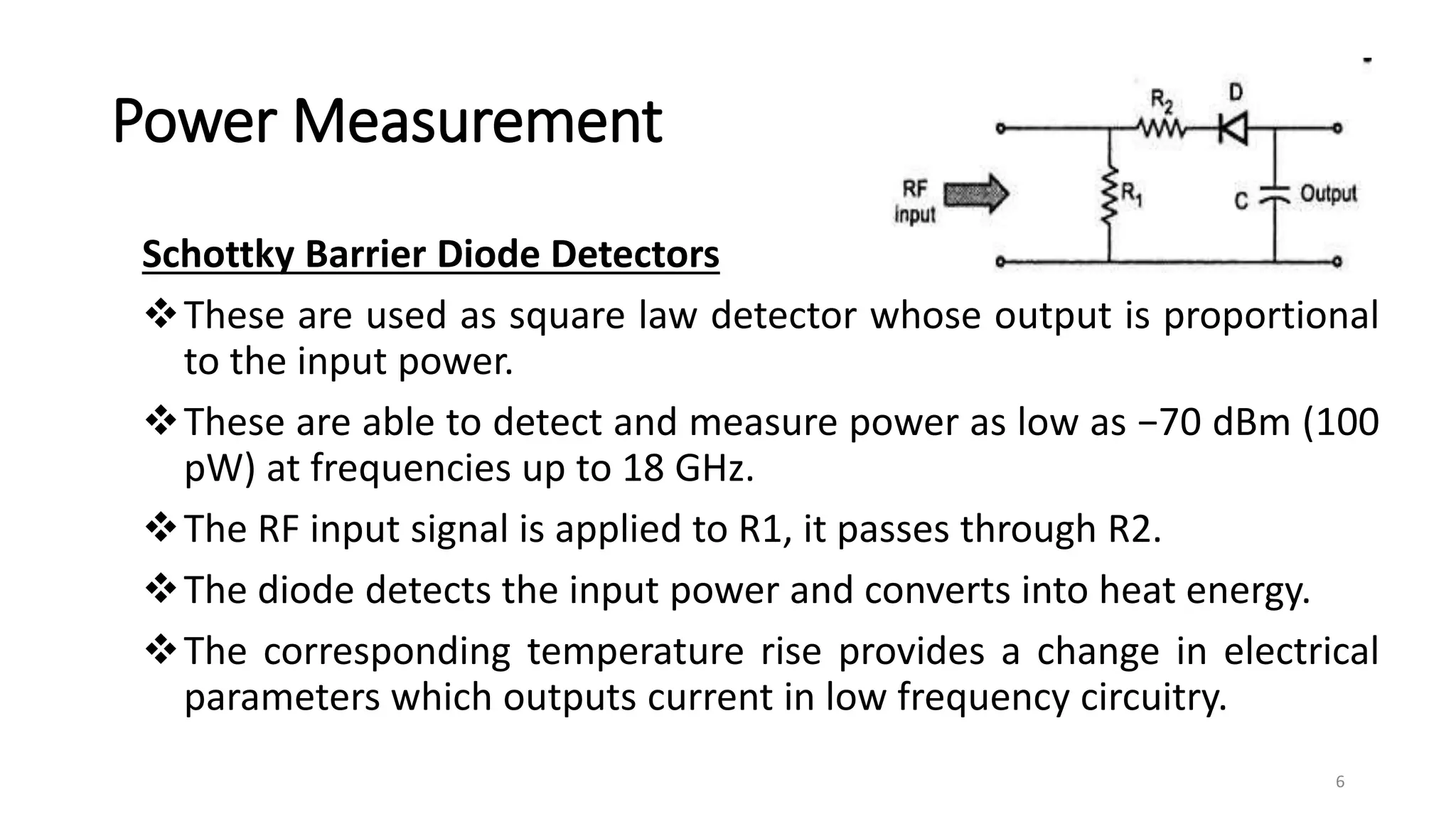
Schottky Barrier Diode Detectors
These are used as square law detector whose output is proportional
to the input power.
These are able to detect and measure power as low as −70 dBm (100
pW) at frequencies up to 18 GHz.
The RF input signal is applied to R1, it passes through R2.
The diode detects the input power and converts into heat energy.
The corresponding temperature rise provides a change in electrical
parameters which outputs current in low frequency circuitry.
6
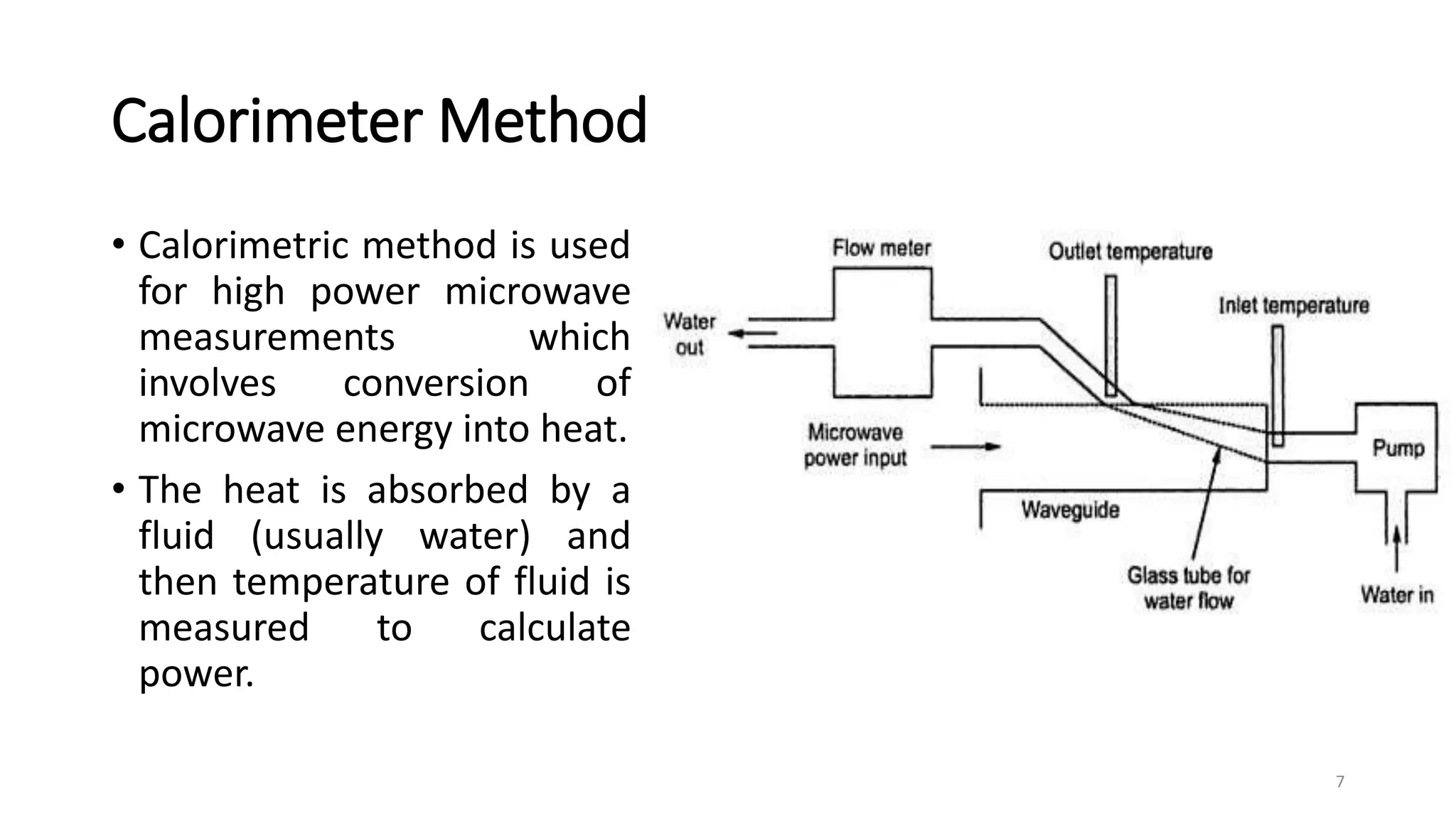
Calorimeter Method
• Calorimetric method is used
for high power microwave
measurements which
involves conversion of
microwave energy into heat.
• The heat is absorbed by a
fluid (usually water) and
then temperature of fluid is
measured to calculate
power.
7
Calorimeter Method
• There are two methods to measure the heat of the fluid:
• Direct heating method: The rate of production of heat is measured
by observing the rise in temperature of dissipating medium.
• Indirect heating method: In this method heat is transferred to
another medium before measurement.
• In both the methods static calorimeter and circular
calorimeter are used.
8
Static Calorimeter
• Static calorimeter consists of a 50 ohm coaxial cable which is filled by dielectric
load with a high hysteresis loss.
• The load has sufficient thermal isolation from surrounding.
• The load dissipates the microwave power.
• The average power input in watts is given by:
𝑃 =
4.187𝑚𝐶𝑝𝑇
𝑡
𝑊𝑎𝑡𝑡𝑠
where, m = mass of thermometric medium in grams.
Cp= Specific heat of medium in cal/grams
T = rise in temperature in degrees or Kelvin
t= time in seconds
9
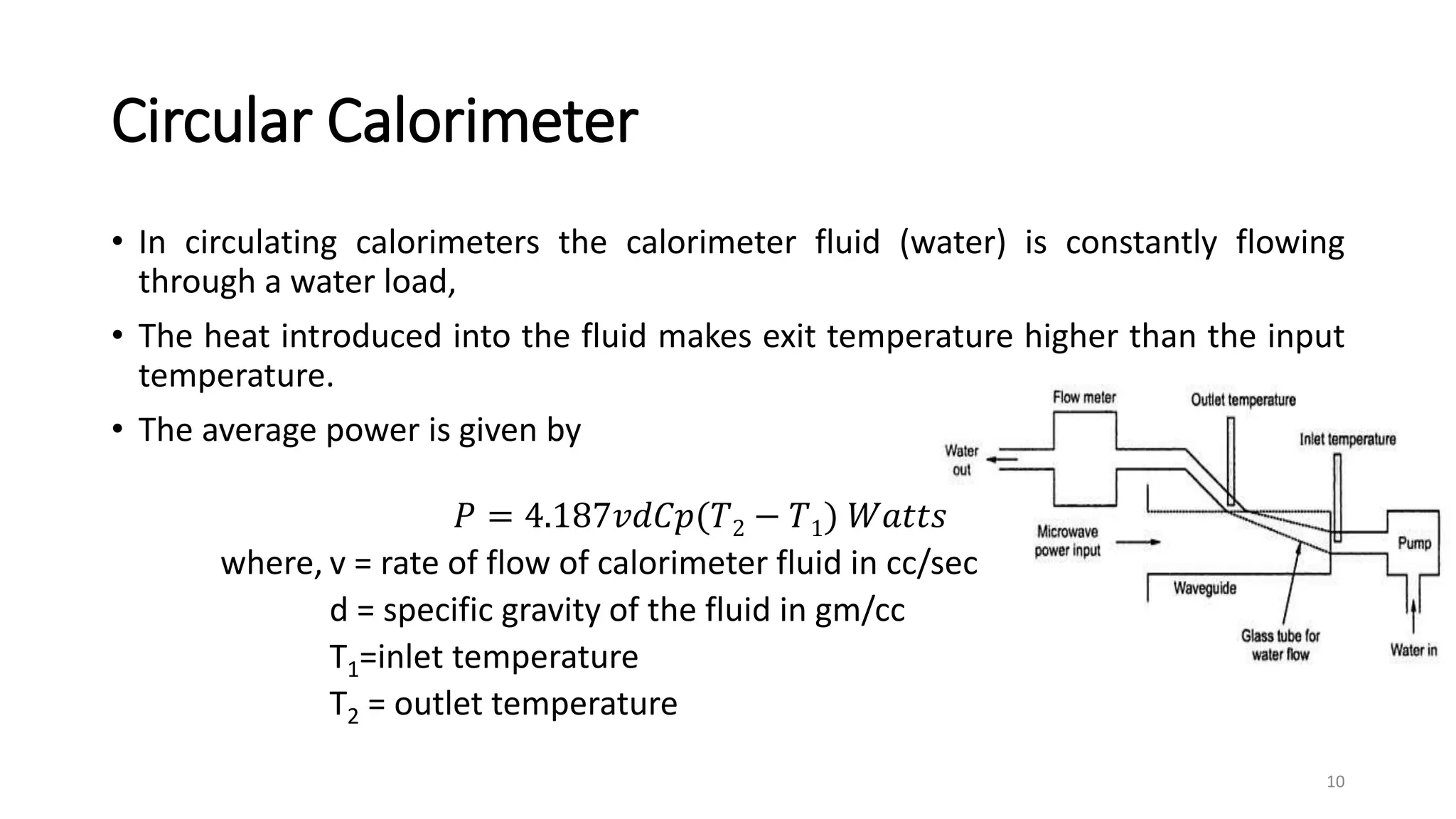
Circular Calorimeter
• In circulating calorimeters the calorimeter fluid (water) is constantly flowing
through a water load,
• The heat introduced into the fluid makes exit temperature higher than the input
temperature.
• The average power is given by
𝑃 = 4.187𝑣𝑑𝐶𝑝(𝑇2 − 𝑇1) 𝑊𝑎𝑡𝑡𝑠
where, v = rate of flow of calorimeter fluid in cc/sec
d = specific gravity of the fluid in gm/cc
T1=inlet temperature
T2 = outlet temperature
10
Calorimeter Wattmeter/Powermeter
• The unknown RF power is checked against a 1200-cps
(Hz/cycles per second) comparison power in the
bridge circuit.
• Two temperature-sensitive resistors serve as gauges.
• In operation, the unknown RF heats an input load
resistor.
• This resistor and one gauge are in close thermal
proximity so that heat generated in the input load
heats the gauge and unbalances the bridge.
• The unbalanced signal is amplified and applied to the
comparison load resistor which is in close proximity to
the second gauge, and rebalances the bridge.
11
Calorimeter Wattmeter/Powermeter
• The meter measures the power supplied
to the comparison load to rebalance the
bridge.
• Efficient heat transfer from the loads to
the temperature gauges is accomplished
by immersing the components in an oil
stream.
12
Power Measurement
Bolometer Bridge Method
Bolometers are power sensors that operate by changing
resistance due to a change in temperature.
The change in temperature results from converting RF or
microwave energy into heat within the bolometric element.
There are two principle types of bolometers, barretters and
thermistors.
13
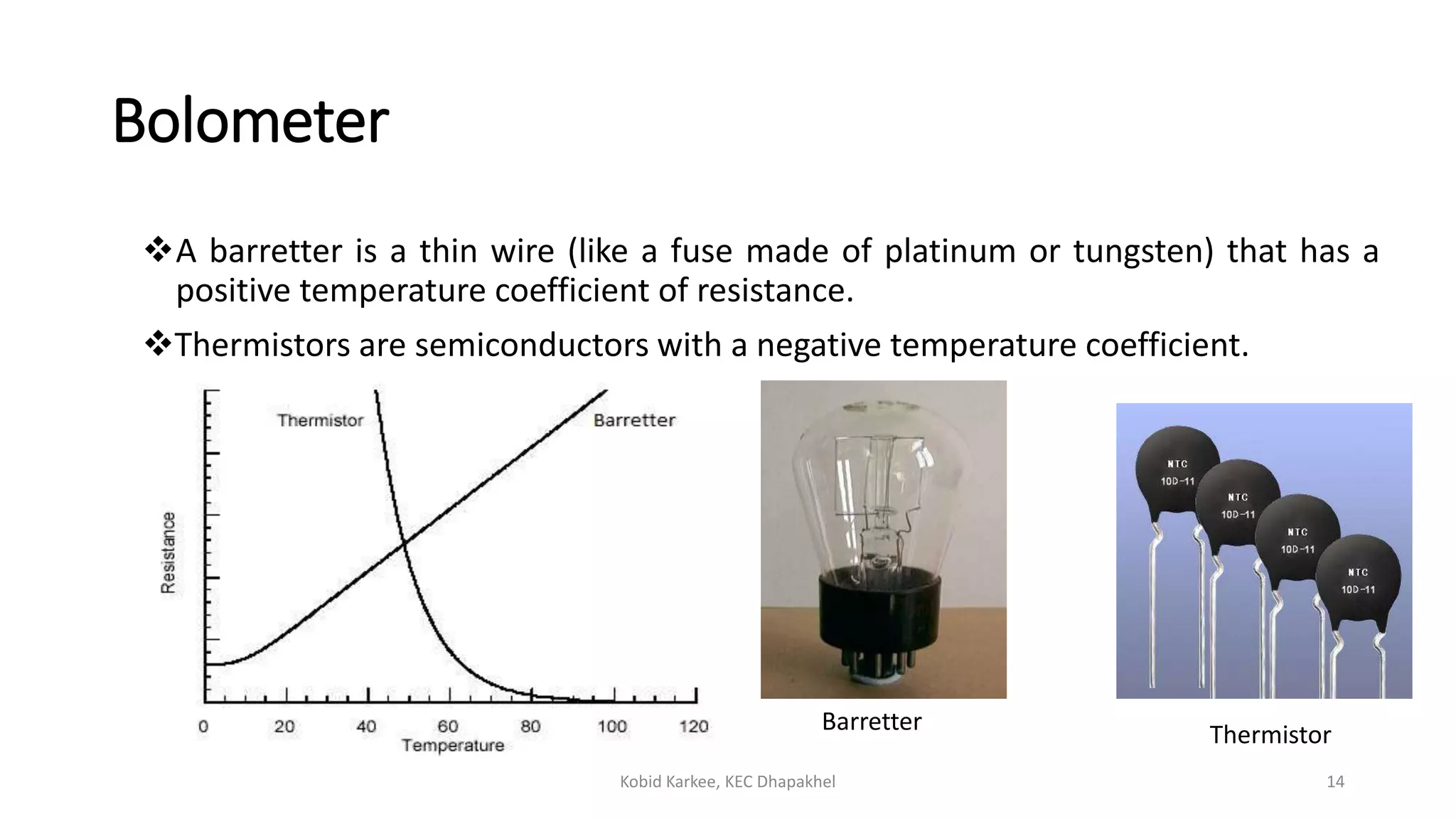
Bolometer
A barretter is a thin wire (like a fuse made of platinum or tungsten) that has a
positive temperature coefficient of resistance.
Thermistors are semiconductors with a negative temperature coefficient.
Kobid Karkee, KEC Dhapakhel 14
Barretter Thermistor
Power Measurement
Bolometers are usually operated in standard
Wheatstone bridge circuit.
A bolometer mounting is placed on one of the
arms of the bridge.
The microwave power incident on the
bolometer changes its resistance which
imbalances the bridge.
The change in the galvanometer current
measures the incident power.
Proportionate calibration of galvanometer can
be done to read the power.
15
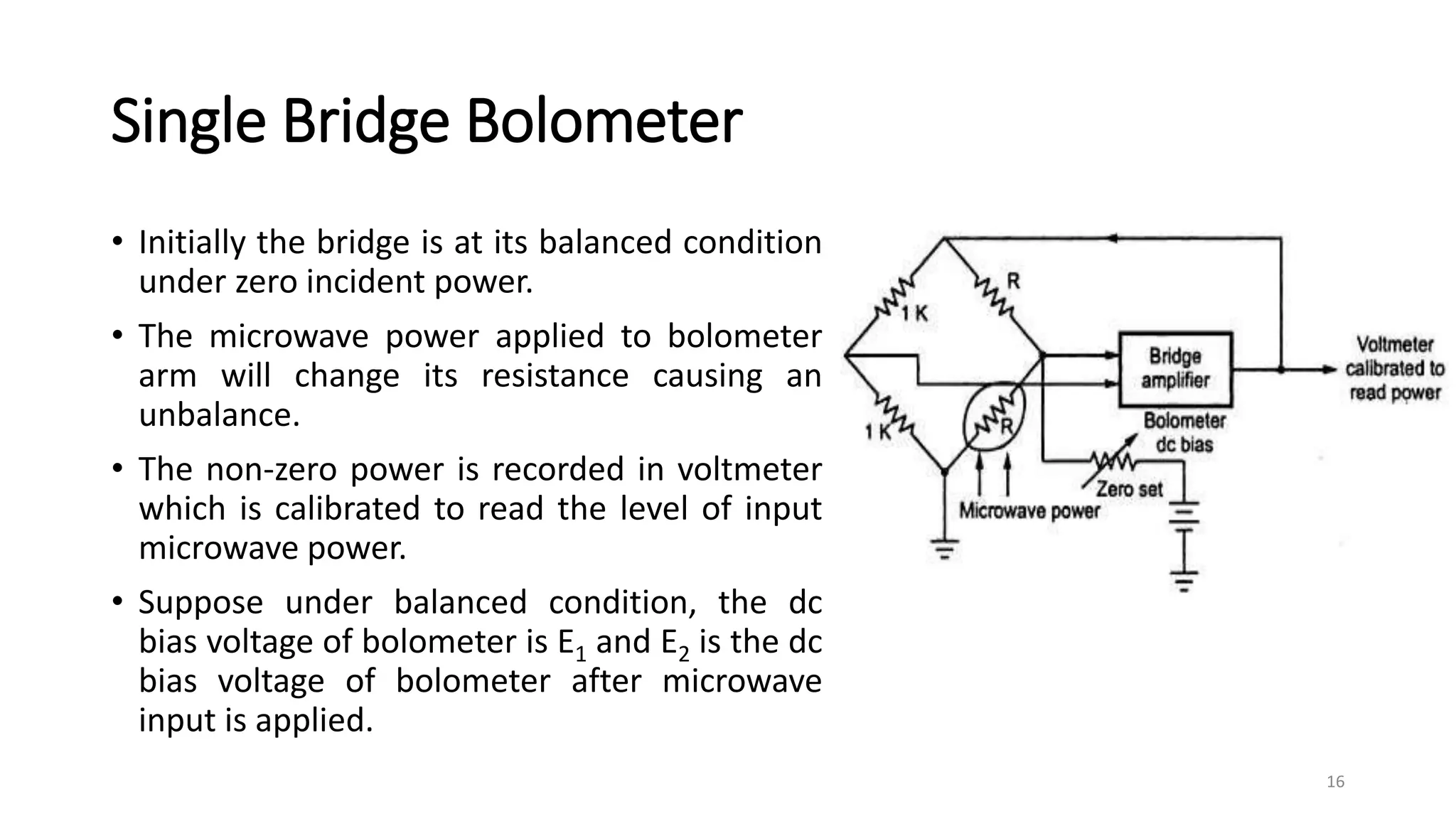
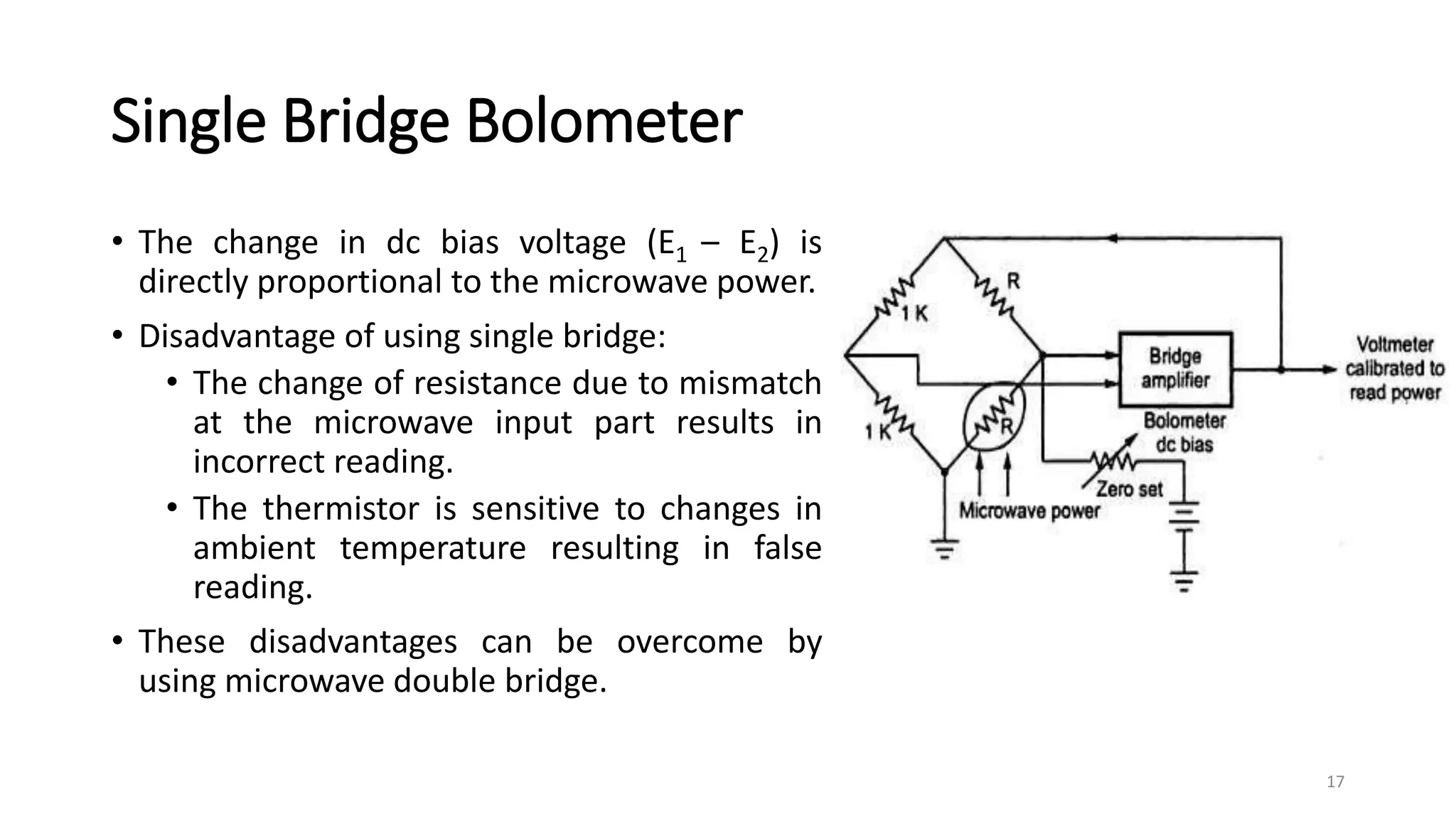
Single Bridge Bolometer
• Initially the bridge is at its balanced condition
under zero incident power.
• The microwave power applied to bolometer
arm will change its resistance causing an
unbalance.
• The non-zero power is recorded in voltmeter
which is calibrated to read the level of input
microwave power.
• Suppose under balanced condition, the dc
bias voltage of bolometer is E1 and E2 is the dc
bias voltage of bolometer after microwave
input is applied.
16
Single Bridge Bolometer
• The change in dc bias voltage (E1 – E2) is
directly proportional to the microwave power.
• Disadvantage of using single bridge:
• The change of resistance due to mismatch
at the microwave input part results in
incorrect reading.
• The thermistor is sensitive to changes in
ambient temperature resulting in false
reading.
• These disadvantages can be overcome by
using microwave double bridge.
17
Double Bridge Bolometer
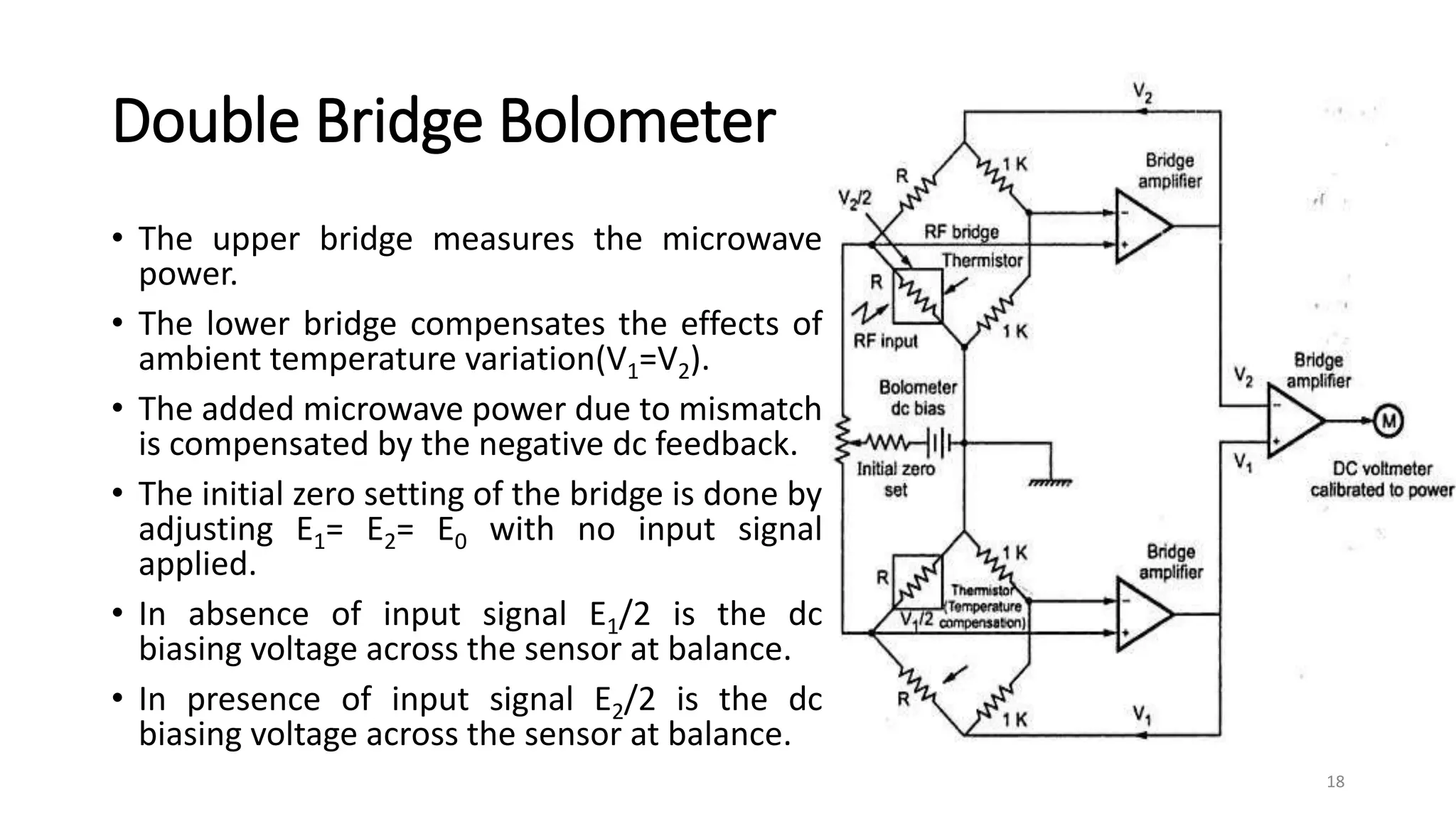
• The upper bridge measures the microwave
power.
• The lower bridge compensates the effects of
ambient temperature variation(V1=V2).
• The added microwave power due to mismatch
is compensated by the negative dc feedback.
• The initial zero setting of the bridge is done by
adjusting E1= E2= E0 with no input signal
applied.
• In absence of input signal E1/2 is the dc
biasing voltage across the sensor at balance.
• In presence of input signal E2/2 is the dc
biasing voltage across the sensor at balance.
18
Double Bridge Bolometer
• The average input Pav is equal to the change
in dc power:
• For any change in temperature if the voltage
change by ΔE, the change in RF power is given
by:
• Since V1+V2 >> ΔV , ΔP=0, so the second
equation can be used directly to calculate the
average power.
19
Thermocouple Sensors
• A thermocouple is a junction of two dissimilar
metals or semiconductors.
• The semiconductor used in thermocouple is n-type
Si.
• A thin film of titanium-nitride resistive load is
deposited on a Si substrate which forms one
electrode of thermocouple.
• The thermocouple generates an emf when two
ends are heated up differently by absorption of
microwaves in resistive loads.
• The emf is proportional to the incident microwave
power to be measured.
20
Thermocouple Sensors
• As shown in figure, C2 is the RF bypass capacitor
and C1 is the input coupling capacitor or dc block.
• The emf generated in the parallel thermocouples
are added to appear across C2.
• The output leads going to the dc voltmeter are at
RF ground so that the output meter reads pure dc
voltage proportional to the input microwave
power.
• For square wave modulated microwave signal peak
power can be calculated from average power as
Ppeak = (Pavg X T)/τ where T is time period
τ is pulse width
21
Slotted Line Carriages
• A slotted line carriage is a microwave instrument which is used to measure:
• Wavelength
• Voltage Standing Wave Ratio (VSWR) and standing wave pattern
• Impedance, reflection coefficient and return loss measurement
• It has a coaxial E-field probe which penetrates inside a rectangular waveguides
slotted in sections from the outer wall.
• The probe is able to transverse a longitudinal narrow slot and locate the
standing waves maxima(Vmax) and minima(Vmin) along the line giving VSWR.
22
VSWR Meter
• VSWR meter is a highly sensitive, high gain, low noise voltage amplifier tuned
normally at fixed frequency of 1KHZ square wave of which microwave signals
modulated.
• The modulated signal is then amplified and detected which then measured
with a calibrated voltmeter.
• This meter indicates calibrated VSWR reading for any loads.
23
Spectrum Analyser
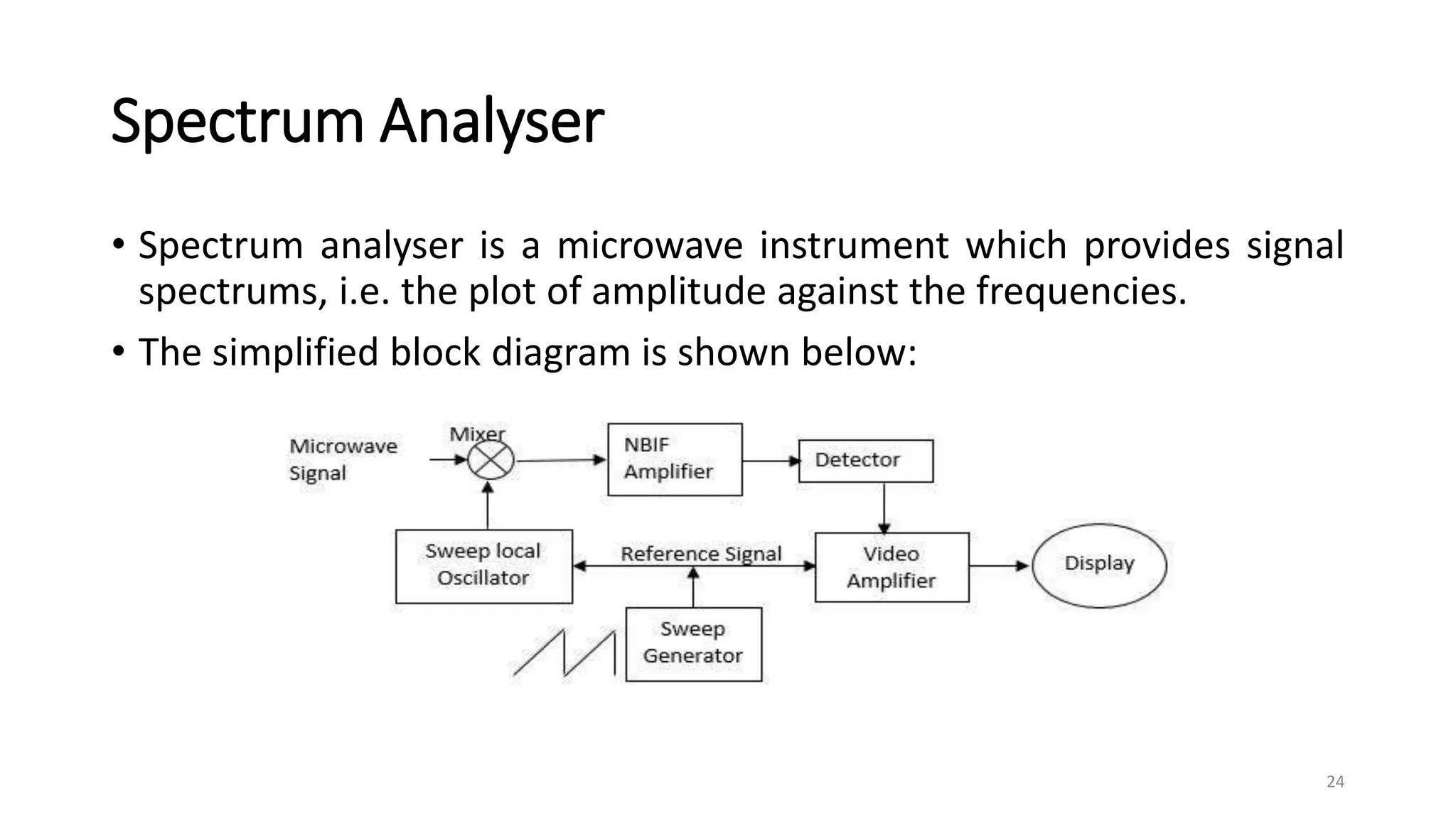
• Spectrum analyser is a microwave instrument which provides signal
spectrums, i.e. the plot of amplitude against the frequencies.
• The simplified block diagram is shown below:
24
Spectrum Analyser
• The microwave signal to be measured is superheterodyned with sweep
voltage produced by a sweep generator and oscillates with local oscillator.
• The mixed signal is then amplified by narrow bandwidth intermediate
frequency amplifier.
• The signal is then detected and video amplified for display in terms of
amplitude and frequency.
• The sweep voltage is sawtooth type signal.
• The zero flyback time of sweep voltage moves the spot on display
horizontally in synchronization with frequency sweep.
• This makes the horizontal position function of frequency and amplitude of
signal the vertical deflection of the signal.
25
Vector Network Analyser (VNA)
• VNA measures both amplitude
and phase over a wide range of
frequencies.
• When an RF signal is applied to
a network, such as a filter,
amplifier, or transmission line,
that signal is altered in
magnitude and phase.
• If the magnitude and phase of
the altered signal can be
compared to the magnitude
and phase of the originating RF
signal, the characteristics of
that network can be evaluated.
26
Vector Network Analyser (VNA)
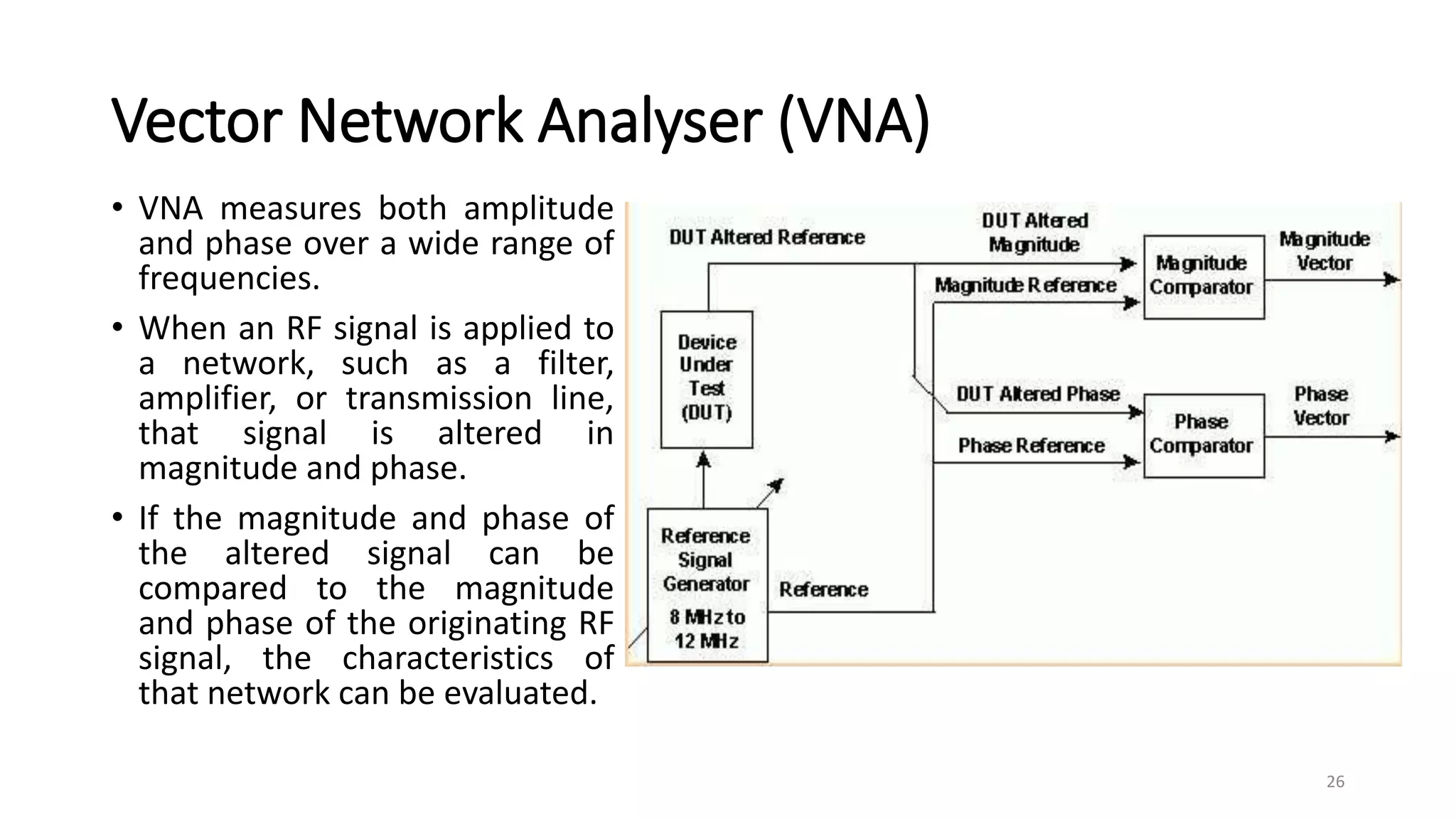
• The network, or component, being tested is called the Device Under Test
(DUT).
• The RF signal that is input to the DUT is the Reference signal.
• The DUT will alter the Reference signal's two components, Magnitude and
Phase.
• The DUT will change the magnitude component, due to it's resistive
natures.
• It will alter the phase component due to it's reactive natures.
• These two altered components of the Reference signal are measured by
the magnitude and phase comparators within the VNA with reference
signal.
27
Vector Network Analyser (VNA)
• The output of the Magnitude Comparator is some value that
represents the difference between the voltage, or power, of it's two
input signals.
• This value of differential magnitude is called the Magnitude Vector.
• The output of the Phase Comparator is some value that represents
the difference between the phase of it's two input signals.
• This value of differential phase is called the Phase Vector.
28

Microwave measurement

  • 1.
  • 2.
    Introduction • At lowfrequencies • parameters such as voltage, current, etc. can be measured. • from these impedance, power factor and phase angle can be calculated. • At microwave frequencies • It is more convenient to measure power instead of V and I. • Properties of devices and circuits at microwave frequencies are characterized by S-parameters, power, frequency and VSWR and noise figure. 2
  • 3.
    Power Measurement Power isdefined as the quantity of energy dissipated or stored per unit time. Microwave power is divided into three categories: low power (less than 10mW), medium power (from 10mW to 10W) and high power (greater than 10W). Average power concept is used in microwaves PAvg = PPeak X Duty cycle 3
  • 4.
    Power Measurement The generalmeasurement technique for average power is to attach a properly calibrated sensor to the transmission line port at which the unknown power is to be measured. The output from the sensor is connected to an appropriate power meter. The RF power to the sensor is then turned off and the power meter zeroed. This operation is often referred to as “zero setting” or “zeroing.” Power is then turned on. The sensor, reacting to the new input level, sends a signal to the power meter and the new meter reading is observed. 4
  • 5.
    Power Measurement Sensors forthe measurement of microwave power can be divided into two categories:  Devices whose resistance changes with applied power such as Schottky diode detectors, bolometer, thermocouple, etc. (used for low power measurements).  Devices whose temperature changes with the applied power like calorimeter (used for medium to high power measurement). 5
  • 6.
    Power Measurement Schottky BarrierDiode Detectors These are used as square law detector whose output is proportional to the input power. These are able to detect and measure power as low as −70 dBm (100 pW) at frequencies up to 18 GHz. The RF input signal is applied to R1, it passes through R2. The diode detects the input power and converts into heat energy. The corresponding temperature rise provides a change in electrical parameters which outputs current in low frequency circuitry. 6
  • 7.
    Calorimeter Method • Calorimetricmethod is used for high power microwave measurements which involves conversion of microwave energy into heat. • The heat is absorbed by a fluid (usually water) and then temperature of fluid is measured to calculate power. 7
  • 8.
    Calorimeter Method • Thereare two methods to measure the heat of the fluid: • Direct heating method: The rate of production of heat is measured by observing the rise in temperature of dissipating medium. • Indirect heating method: In this method heat is transferred to another medium before measurement. • In both the methods static calorimeter and circular calorimeter are used. 8
  • 9.
    Static Calorimeter • Staticcalorimeter consists of a 50 ohm coaxial cable which is filled by dielectric load with a high hysteresis loss. • The load has sufficient thermal isolation from surrounding. • The load dissipates the microwave power. • The average power input in watts is given by: 𝑃 = 4.187𝑚𝐶𝑝𝑇 𝑡 𝑊𝑎𝑡𝑡𝑠 where, m = mass of thermometric medium in grams. Cp= Specific heat of medium in cal/grams T = rise in temperature in degrees or Kelvin t= time in seconds 9
  • 10.
    Circular Calorimeter • Incirculating calorimeters the calorimeter fluid (water) is constantly flowing through a water load, • The heat introduced into the fluid makes exit temperature higher than the input temperature. • The average power is given by 𝑃 = 4.187𝑣𝑑𝐶𝑝(𝑇2 − 𝑇1) 𝑊𝑎𝑡𝑡𝑠 where, v = rate of flow of calorimeter fluid in cc/sec d = specific gravity of the fluid in gm/cc T1=inlet temperature T2 = outlet temperature 10
  • 11.
    Calorimeter Wattmeter/Powermeter • Theunknown RF power is checked against a 1200-cps (Hz/cycles per second) comparison power in the bridge circuit. • Two temperature-sensitive resistors serve as gauges. • In operation, the unknown RF heats an input load resistor. • This resistor and one gauge are in close thermal proximity so that heat generated in the input load heats the gauge and unbalances the bridge. • The unbalanced signal is amplified and applied to the comparison load resistor which is in close proximity to the second gauge, and rebalances the bridge. 11
  • 12.
    Calorimeter Wattmeter/Powermeter • Themeter measures the power supplied to the comparison load to rebalance the bridge. • Efficient heat transfer from the loads to the temperature gauges is accomplished by immersing the components in an oil stream. 12
  • 13.
    Power Measurement Bolometer BridgeMethod Bolometers are power sensors that operate by changing resistance due to a change in temperature. The change in temperature results from converting RF or microwave energy into heat within the bolometric element. There are two principle types of bolometers, barretters and thermistors. 13
  • 14.
    Bolometer A barretter isa thin wire (like a fuse made of platinum or tungsten) that has a positive temperature coefficient of resistance. Thermistors are semiconductors with a negative temperature coefficient. Kobid Karkee, KEC Dhapakhel 14 Barretter Thermistor
  • 15.
    Power Measurement Bolometers areusually operated in standard Wheatstone bridge circuit. A bolometer mounting is placed on one of the arms of the bridge. The microwave power incident on the bolometer changes its resistance which imbalances the bridge. The change in the galvanometer current measures the incident power. Proportionate calibration of galvanometer can be done to read the power. 15
  • 16.
    Single Bridge Bolometer •Initially the bridge is at its balanced condition under zero incident power. • The microwave power applied to bolometer arm will change its resistance causing an unbalance. • The non-zero power is recorded in voltmeter which is calibrated to read the level of input microwave power. • Suppose under balanced condition, the dc bias voltage of bolometer is E1 and E2 is the dc bias voltage of bolometer after microwave input is applied. 16
  • 17.
    Single Bridge Bolometer •The change in dc bias voltage (E1 – E2) is directly proportional to the microwave power. • Disadvantage of using single bridge: • The change of resistance due to mismatch at the microwave input part results in incorrect reading. • The thermistor is sensitive to changes in ambient temperature resulting in false reading. • These disadvantages can be overcome by using microwave double bridge. 17
  • 18.
    Double Bridge Bolometer •The upper bridge measures the microwave power. • The lower bridge compensates the effects of ambient temperature variation(V1=V2). • The added microwave power due to mismatch is compensated by the negative dc feedback. • The initial zero setting of the bridge is done by adjusting E1= E2= E0 with no input signal applied. • In absence of input signal E1/2 is the dc biasing voltage across the sensor at balance. • In presence of input signal E2/2 is the dc biasing voltage across the sensor at balance. 18
  • 19.
    Double Bridge Bolometer •The average input Pav is equal to the change in dc power: • For any change in temperature if the voltage change by ΔE, the change in RF power is given by: • Since V1+V2 >> ΔV , ΔP=0, so the second equation can be used directly to calculate the average power. 19
  • 20.
    Thermocouple Sensors • Athermocouple is a junction of two dissimilar metals or semiconductors. • The semiconductor used in thermocouple is n-type Si. • A thin film of titanium-nitride resistive load is deposited on a Si substrate which forms one electrode of thermocouple. • The thermocouple generates an emf when two ends are heated up differently by absorption of microwaves in resistive loads. • The emf is proportional to the incident microwave power to be measured. 20
  • 21.
    Thermocouple Sensors • Asshown in figure, C2 is the RF bypass capacitor and C1 is the input coupling capacitor or dc block. • The emf generated in the parallel thermocouples are added to appear across C2. • The output leads going to the dc voltmeter are at RF ground so that the output meter reads pure dc voltage proportional to the input microwave power. • For square wave modulated microwave signal peak power can be calculated from average power as Ppeak = (Pavg X T)/τ where T is time period τ is pulse width 21
  • 22.
    Slotted Line Carriages •A slotted line carriage is a microwave instrument which is used to measure: • Wavelength • Voltage Standing Wave Ratio (VSWR) and standing wave pattern • Impedance, reflection coefficient and return loss measurement • It has a coaxial E-field probe which penetrates inside a rectangular waveguides slotted in sections from the outer wall. • The probe is able to transverse a longitudinal narrow slot and locate the standing waves maxima(Vmax) and minima(Vmin) along the line giving VSWR. 22
  • 23.
    VSWR Meter • VSWRmeter is a highly sensitive, high gain, low noise voltage amplifier tuned normally at fixed frequency of 1KHZ square wave of which microwave signals modulated. • The modulated signal is then amplified and detected which then measured with a calibrated voltmeter. • This meter indicates calibrated VSWR reading for any loads. 23
  • 24.
    Spectrum Analyser • Spectrumanalyser is a microwave instrument which provides signal spectrums, i.e. the plot of amplitude against the frequencies. • The simplified block diagram is shown below: 24
  • 25.
    Spectrum Analyser • Themicrowave signal to be measured is superheterodyned with sweep voltage produced by a sweep generator and oscillates with local oscillator. • The mixed signal is then amplified by narrow bandwidth intermediate frequency amplifier. • The signal is then detected and video amplified for display in terms of amplitude and frequency. • The sweep voltage is sawtooth type signal. • The zero flyback time of sweep voltage moves the spot on display horizontally in synchronization with frequency sweep. • This makes the horizontal position function of frequency and amplitude of signal the vertical deflection of the signal. 25
  • 26.
    Vector Network Analyser(VNA) • VNA measures both amplitude and phase over a wide range of frequencies. • When an RF signal is applied to a network, such as a filter, amplifier, or transmission line, that signal is altered in magnitude and phase. • If the magnitude and phase of the altered signal can be compared to the magnitude and phase of the originating RF signal, the characteristics of that network can be evaluated. 26
  • 27.
    Vector Network Analyser(VNA) • The network, or component, being tested is called the Device Under Test (DUT). • The RF signal that is input to the DUT is the Reference signal. • The DUT will alter the Reference signal's two components, Magnitude and Phase. • The DUT will change the magnitude component, due to it's resistive natures. • It will alter the phase component due to it's reactive natures. • These two altered components of the Reference signal are measured by the magnitude and phase comparators within the VNA with reference signal. 27
  • 28.
    Vector Network Analyser(VNA) • The output of the Magnitude Comparator is some value that represents the difference between the voltage, or power, of it's two input signals. • This value of differential magnitude is called the Magnitude Vector. • The output of the Phase Comparator is some value that represents the difference between the phase of it's two input signals. • This value of differential phase is called the Phase Vector. 28