JSPM’s
Imperial College ofEngineering and
Research, Wagholi, Pune.
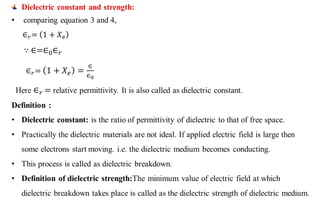
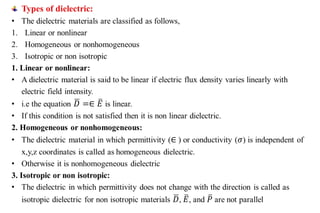
Unit III :Boundary conditions
By Anjali V. Nimkar
2.
• Electric fieldin free space:
• In unit I, we have studied electric field in the free space
• Broadly materials are classified as, Conductors and dielectrics or insulators.
• Electric field quantities in free space can be applied for conductors and dielectrics by
making few modifications.
• Dielectrics:
• Themajor difference between a dielectric and conducting medium is that the dielectric do not
contain free charges.
• The charges are tightly bound together to form atoms and molecules.
• When electric field is applied to the dielectric medium then the bound charges are separated from
each other by a significant distance.
• In this case these charges act like very small electric dipoles.
• These electric dipoles are composed of positive and negative charges.
• The centers of these charges do not coincide.
• Because of this electric dipole and induced field is produced.
• The induced field tries to oppose the applied electric field.
• This phenomenon of separation of bound charges by the application of electric field is called as
polarization.
• In this case the dielectric medium is said to be polarized.
• While before the application of electric field the dielectric medium is in unpolarized state.
8.
• Polarization indielectrics:
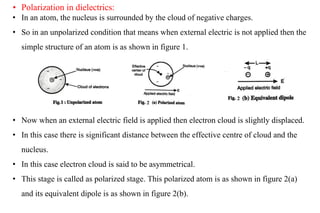
• In an atom, the nucleus is surrounded by the cloud of negative charges.
• So in an unpolarized condition that means when external electric is not applied then the
simple structure of an atom is as shown in figure 1.
• Now when an external electric field is applied then electron cloud is slightly displaced.
• In this case there is significant distance between the effective centre of cloud and the
nucleus.
• In this case electron cloud is said to be asymmetrical.
• This stage is called as polarized stage. This polarized atom is as shown in figure 2(a)
and its equivalent dipole is as shown in figure 2(b).
12.
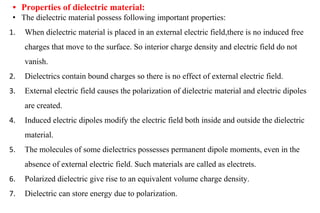
• Properties ofdielectric material:
• The dielectric material possess following important properties:
1. When dielectric material is placed in an external electric field,there is no induced free
charges that move to the surface. So interior charge density and electric field do not
vanish.
2. Dielectrics contain bound charges so there is no effect of external electric field.
3. External electric field causes the polarization of dielectric material and electric dipoles
are created.
4. Induced electric dipoles modify the electric field both inside and outside the dielectric
material.
5. The molecules of some dielectrics possesses permanent dipole moments, even in the
absence of external electric field. Such materials are called as electrets.
6. Polarized dielectric give rise to an equivalent volume charge density.
7. Dielectric can store energy due to polarization.
13.
• Boundary Conditions:
•Study of behavior of tangential and normal field components when they are crossing the
boundary of two medium.
14.
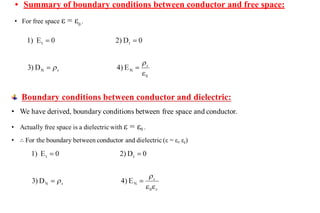
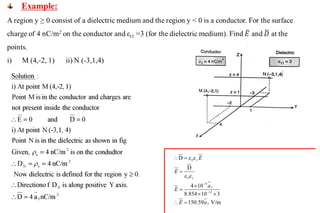
• Boundary conditionsbetween conductor and free space:
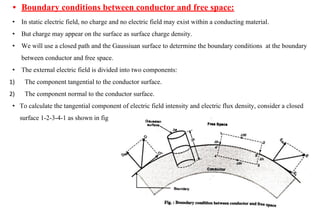
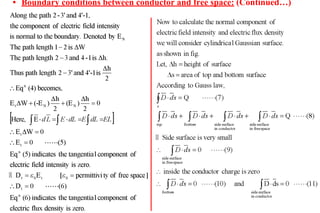
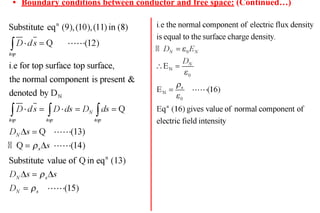
• In static electric field, no charge and no electric field may exist within a conducting material.
• But charge may appear on the surface as surface charge density.
• We will use a closed path and the Gaussiuan surface to determine the boundary conditions at the boundary
between conductor and free space.
• The external electric field is divided into two components:
1) The component tangential to the conductor surface.
2) The component normal to the conductor surface.
• To calculate the tangential component of electric field intensity and electric flux density, consider a closed
surface 1-2-3-4-1 as shown in fig
• Summary ofboundary conditions between conductor and free space:
• For free space ε = ε0
.
20.
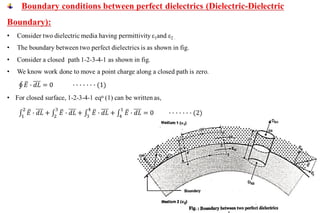
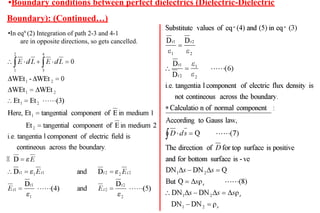
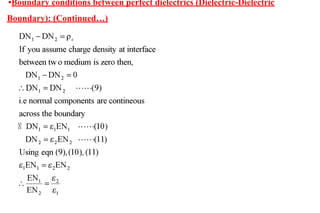
•Boundary conditions betweenperfect dielectrics (Dielectric-Dielectric
Boundary): (Continued…)
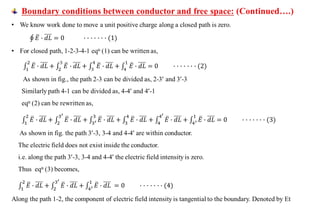
•In eqn
(2) Integration of path 2-3 and 4-1
are in opposite directions, so gets cancelled.
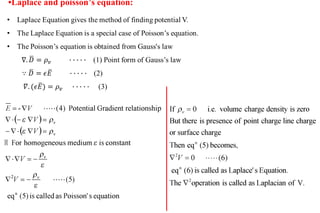
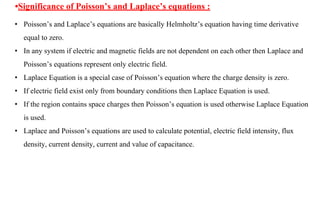
•Significance of Poisson’sand Laplace’s equations :
• Poisson’s and Laplace’s equations are basically Helmholtz’s equation having time derivative
equal to zero.
• In any system if electric and magnetic fields are not dependent on each other then Laplace and
Poisson’s equations represent only electric field.
• Laplace Equation is a special case of Poisson’s equation where the charge density is zero.
• If electric field exist only from boundary conditions then Laplace Equation is used.
• If the region contains space charges then Poisson’s equation is used otherwise Laplace Equation
is used.
• Laplace and Poisson’s equations are used to calculate potential, electric field intensity, flux
density, current density, current and value of capacitance.
26.
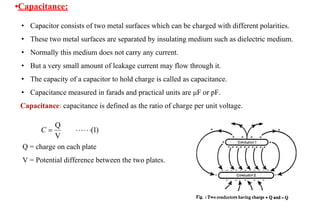
• Capacitor consistsof two metal surfaces which can be charged with different polarities.
• These two metal surfaces are separated by insulating medium such as dielectric medium.
• Normally this medium does not carry any current.
• But a very small amount of leakage current may flow through it.
• The capacity of a capacitor to hold charge is called as capacitance.
• Capacitance measured in farads and practical units are μF or pF.
Capacitance: capacitance is defined as the ratio of charge per unit voltage.
•Capacitance:
Q = charge on each plate
V = Potential difference between the two plates.
27.
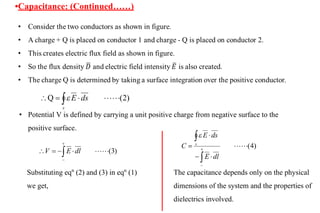
•Capacitance: (Continued……)
• PotentialV is defined by carrying a unit positive charge from negative surface to the
positive surface.
Substituting eqn
(2) and (3) in eqn
(1)
we get,
The capacitance depends only on the physical
dimensions of the system and the properties of
dielectrics involved.
28.
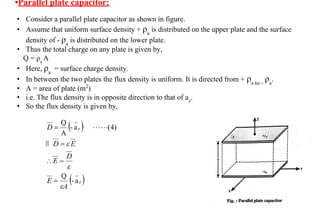
• Consider aparallel plate capacitor as shown in figure.
• Assume that uniform surface density + ρs
is distributed on the upper plate and the surface
density of - ρs
is distributed on the lower plate.
• Thus the total charge on any plate is given by,
Q = ρs
A
• Here, ρs
= surface charge density.
• In between the two plates the flux density is uniform. It is directed from + ρs to -
ρs
.
• A = area of plate (m2
)
• i.e. The flux density is in opposite direction to that of az
.
• So the flux density is given by,
•Parallel plate capacitor:
29.
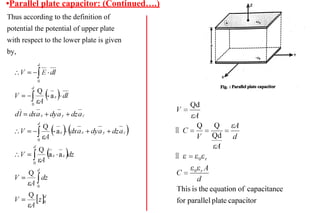
•Parallel plate capacitor:(Continued….)
Thus according to the definition of
potential the potential of upper plate
with respect to the lower plate is given
by,
30.
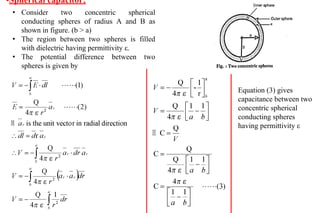
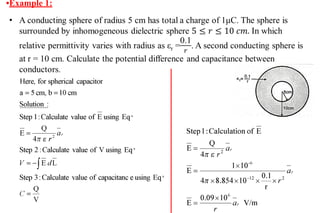
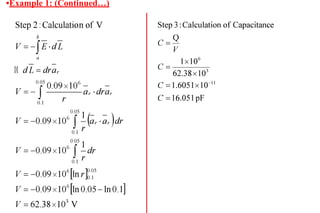
•Spherical capacitor:
• Considertwo concentric spherical
conducting spheres of radius A and B as
shown in figure. (b > a)
• The region between two spheres is filled
with dielectric having permittivity ε.
• The potential difference between two
spheres is given by
Equation (3) gives
capacitance between two
concentric spherical
conducting spheres
having permittivity ε
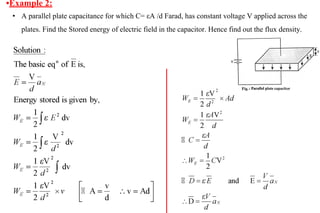
•Example 2:
• Aparallel plate capacitance for which C= εA /d Farad, has constant voltage V applied across the
plates. Find the Stored energy of electric field in the capacitor. Hence find out the flux density.
34.
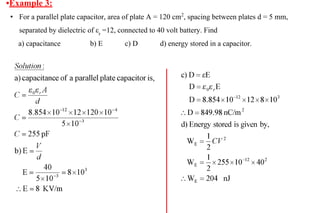
•Example 3:
• Fora parallel plate capacitor, area of plate A = 120 cm2
, spacing between plates d = 5 mm,
separated by dielectric of εr
=12, connected to 40 volt battery. Find
a) capacitance b) E c) D d) energy stored in a capacitor.
35.
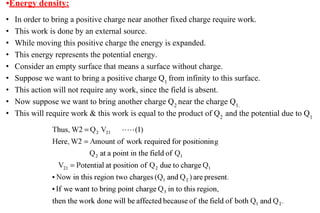
• In orderto bring a positive charge near another fixed charge require work.
• This work is done by an external source.
• While moving this positive charge the energy is expanded.
• This energy represents the potential energy.
• Consider an empty surface that means a surface without charge.
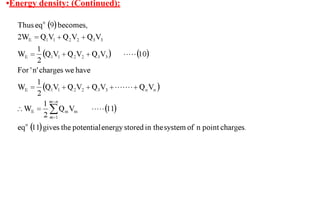
• Suppose we want to bring a positive charge Q1
from infinity to this surface.
• This action will not require any work, since the field is absent.
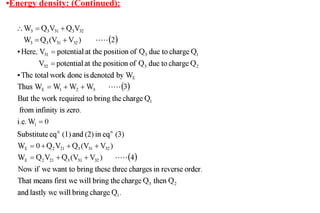
• Now suppose we want to bring another charge Q2
near the charge Q1.
• This will require work & this work is equal to the product of Q2
and the potential due to Q1
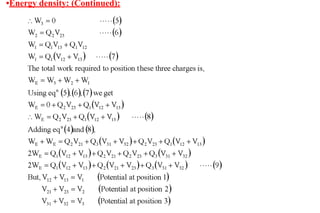
•Energy density:
•Potential Energy ina continuous charge distribution:
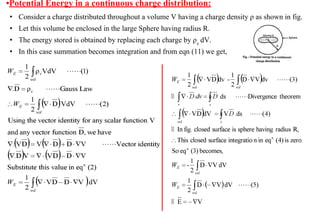
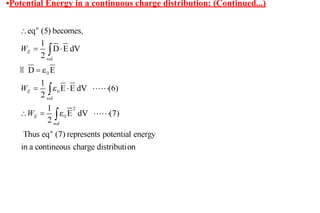
• Consider a charge distributed throughout a volume V having a charge density ρ as shown in fig.
• Let this volume be enclosed in the large Sphere having radius R.
• The energy stored is obtained by replacing each charge by ρv
dV.
• In this case summation becomes integration and from eqn (11) we get,




![3. Electric charge and electric fields [12hrs].pptx](https://cdn.slidesharecdn.com/ss_thumbnails/3-250325125403-64ebc3f7-thumbnail.jpg?width=640&height=640&fit=bounds)


