Buenos Aires, abril de 2016
Eduardo Poggi
http://www.shutterstock.com/
Concept Learning
 Definitions
 Search Space and General-Specific Ordering
 Concept learning as search
 FIND-S
 The Candidate Elimination Algorithm
 Inductive Bias
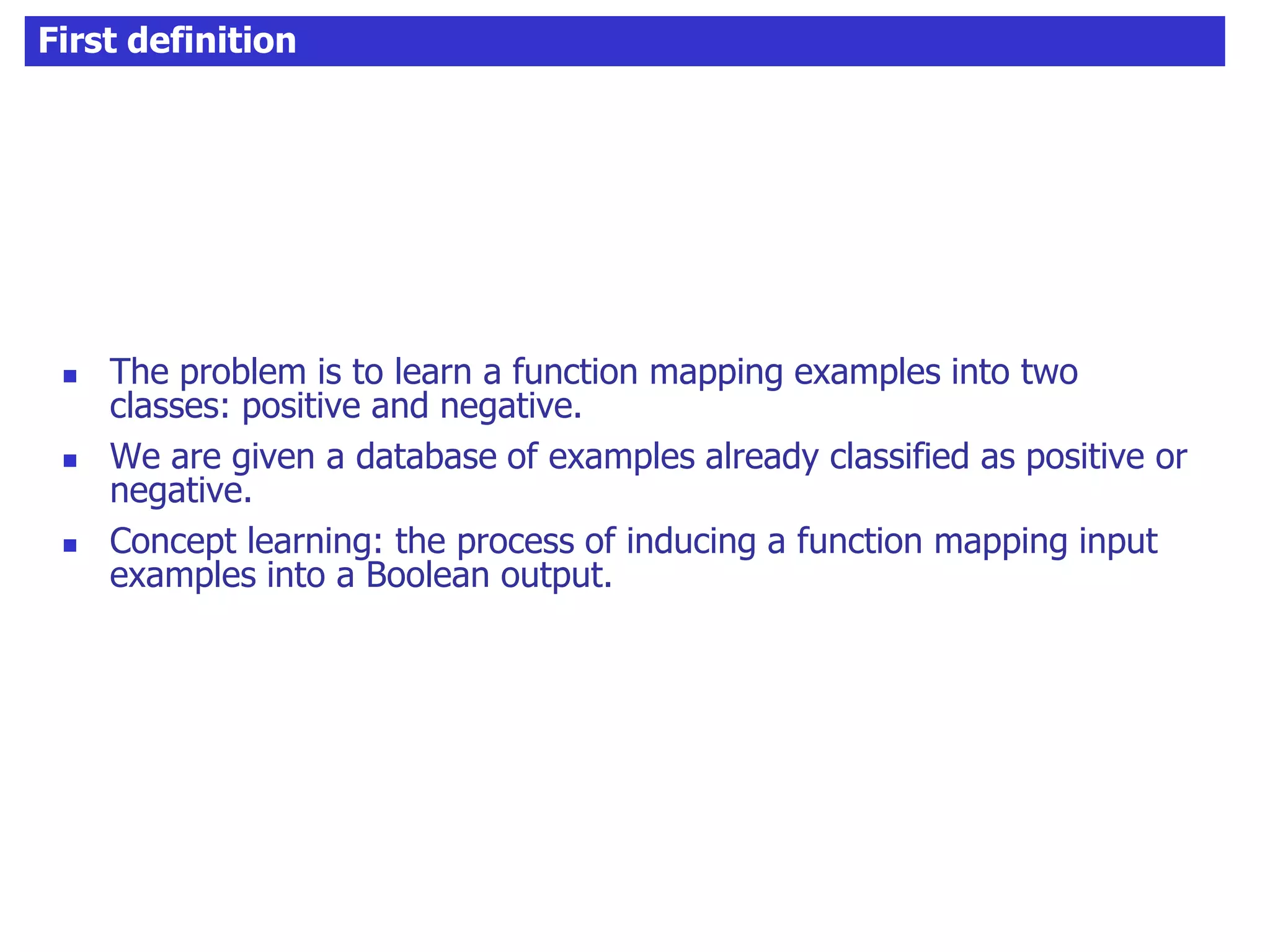
First definition
 The problem is to learn a function mapping examples into two
classes: positive and negative.
 We are given a database of examples already classified as positive or
negative.
 Concept learning: the process of inducing a function mapping input
examples into a Boolean output.
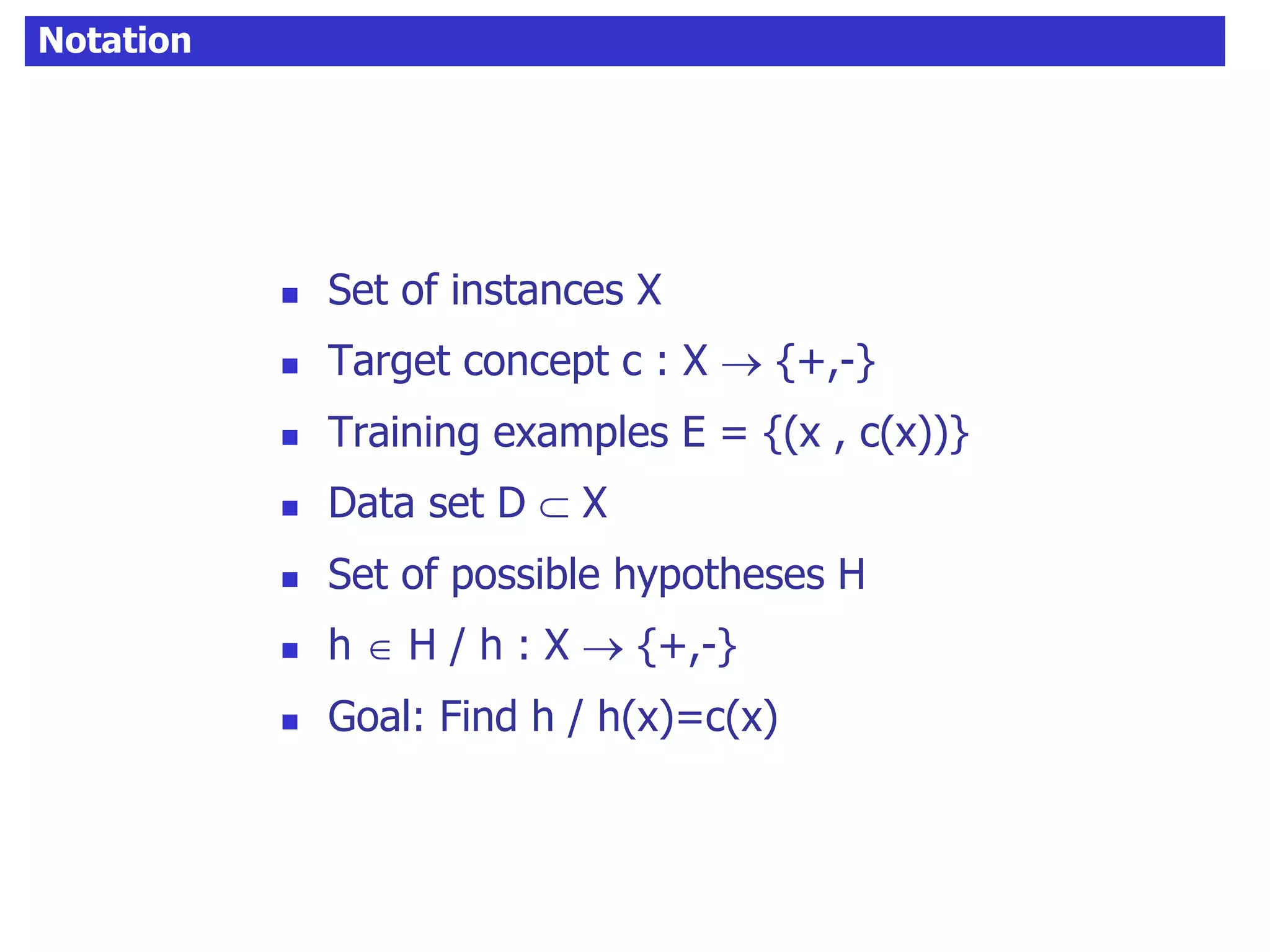
Notation
 Set of instances X
 Target concept c : X  {+,-}
 Training examples E = {(x , c(x))}
 Data set D  X
 Set of possible hypotheses H
 h  H / h : X  {+,-}
 Goal: Find h / h(x)=c(x)
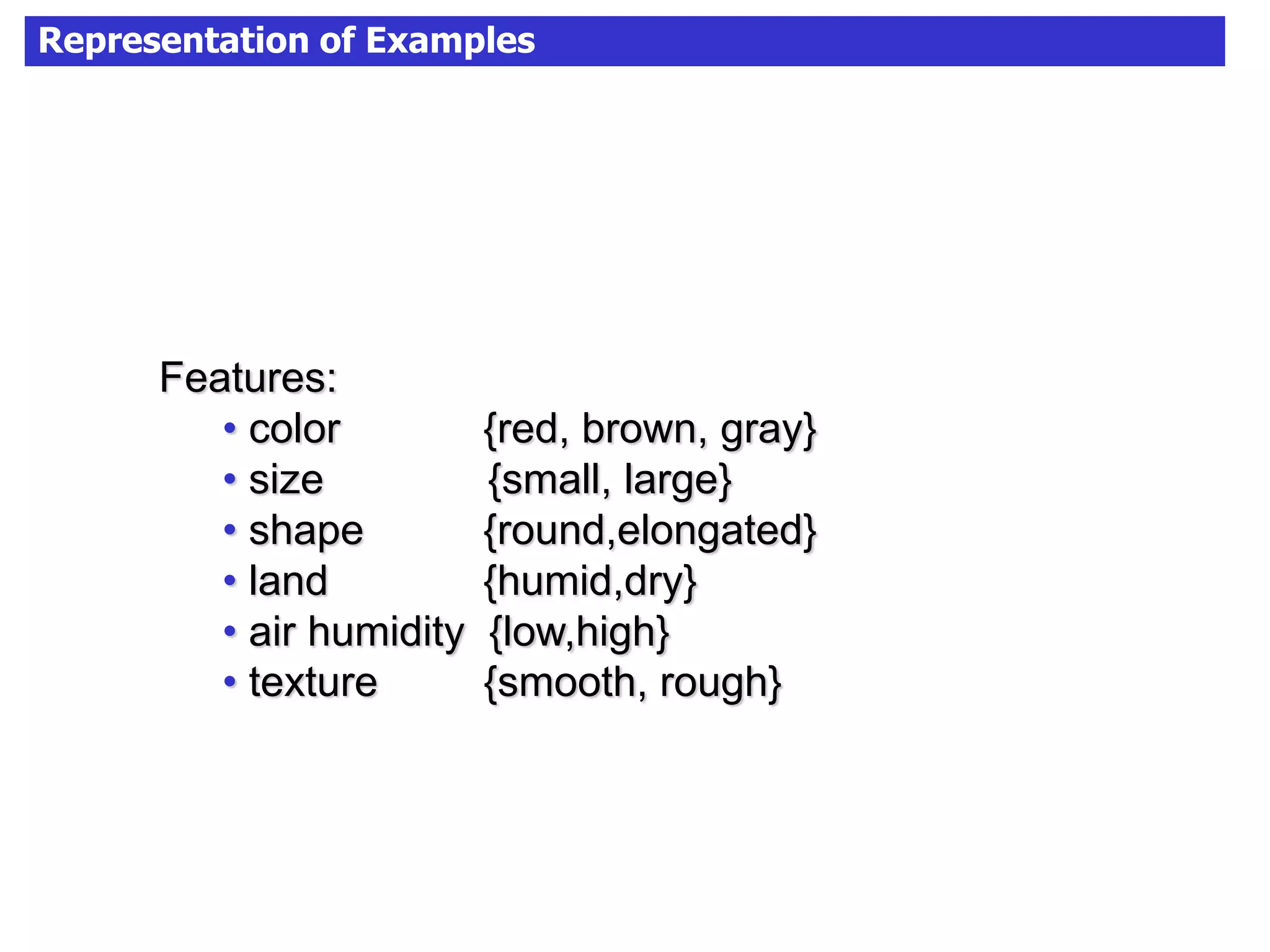
Representation of Examples
Features:
• color {red, brown, gray}
• size {small, large}
• shape {round,elongated}
• land {humid,dry}
• air humidity {low,high}
• texture {smooth, rough}
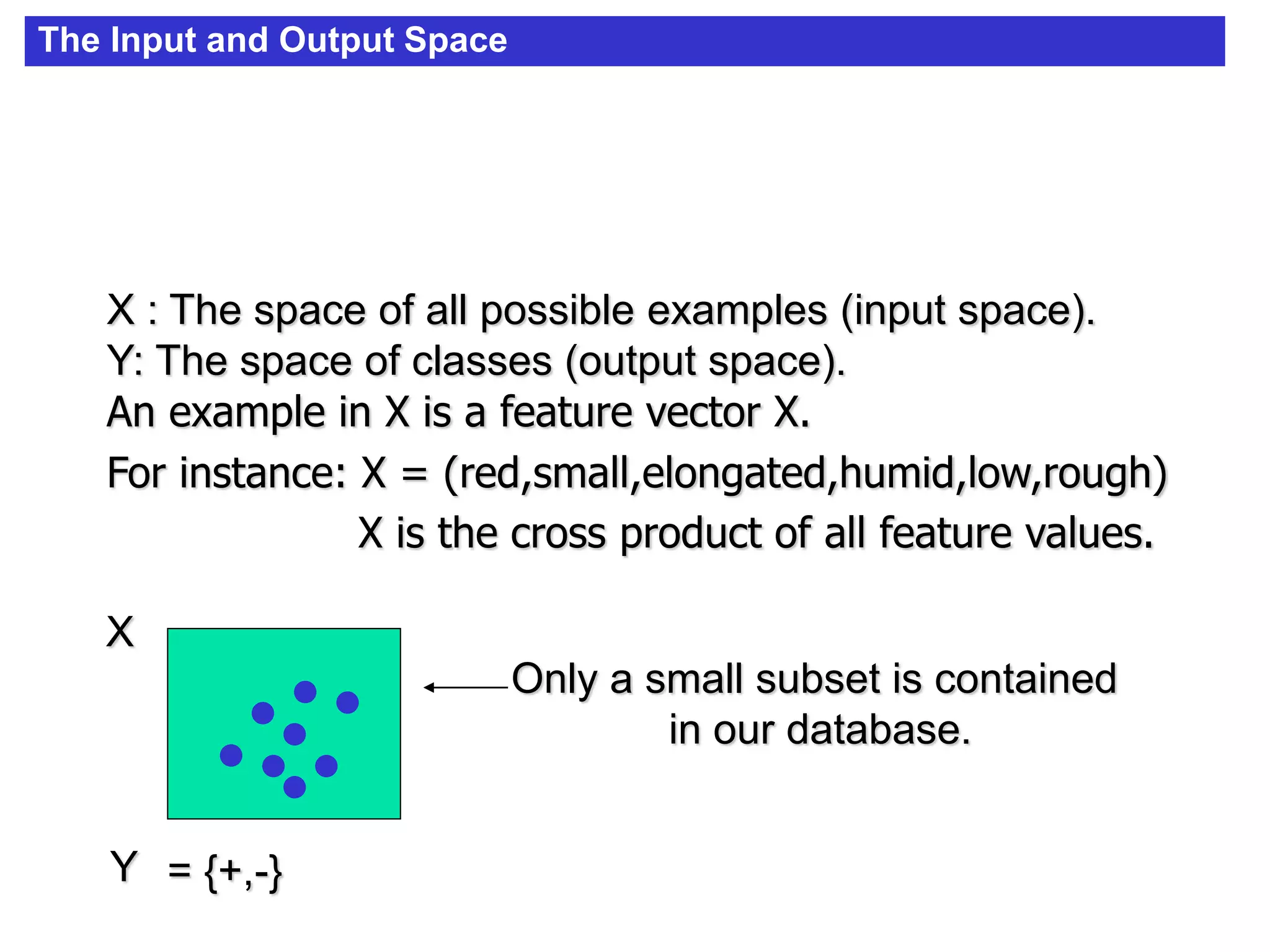
The Input and Output Space
X
Only a small subset is contained
in our database.
Y = {+,-}
X : The space of all possible examples (input space).
Y: The space of classes (output space).
An example in X is a feature vector X.
For instance: X = (red,small,elongated,humid,low,rough)
X is the cross product of all feature values.
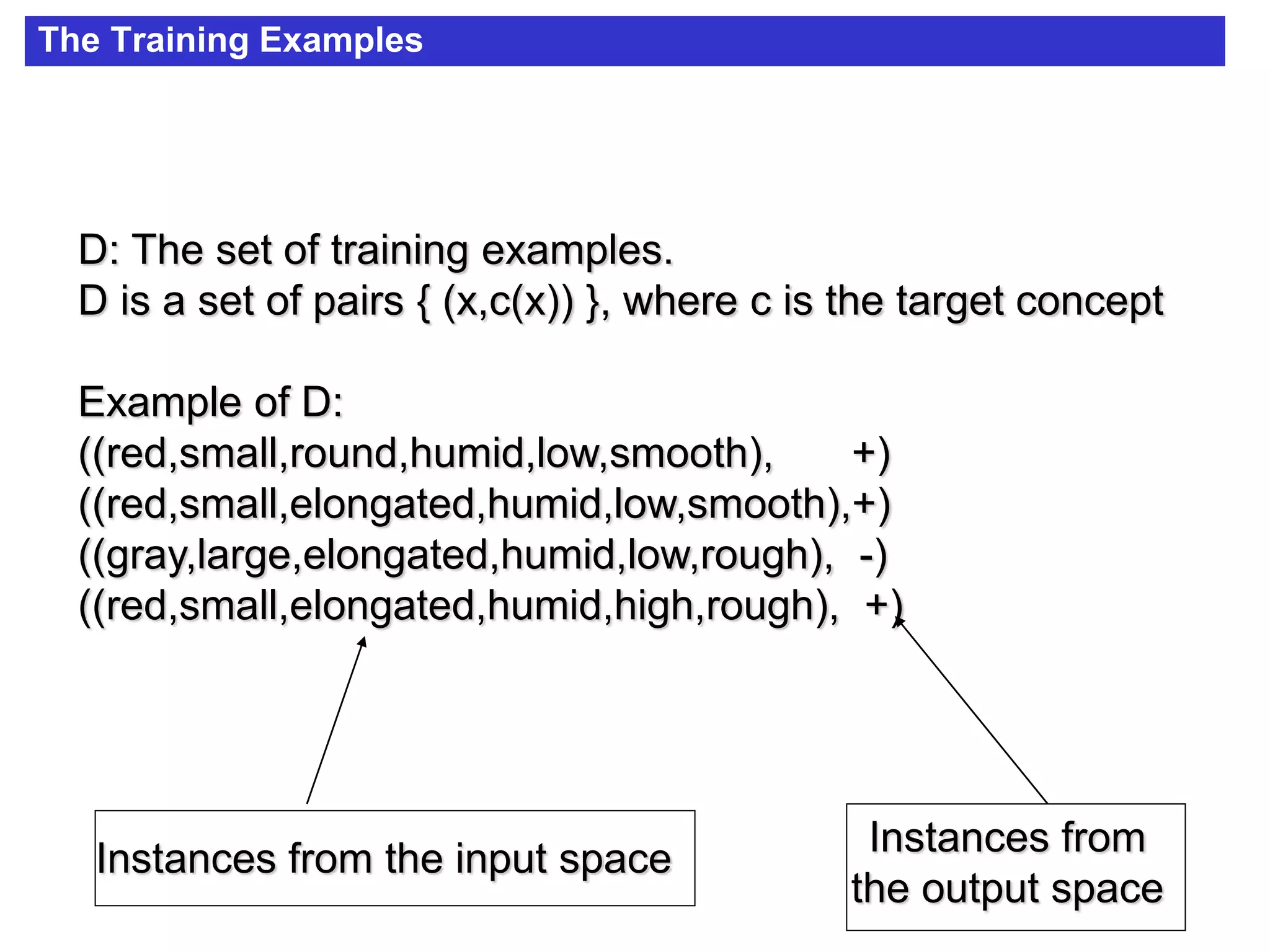
The Training Examples
D: The set of training examples.
D is a set of pairs { (x,c(x)) }, where c is the target concept
Example of D:
((red,small,round,humid,low,smooth), +)
((red,small,elongated,humid,low,smooth),+)
((gray,large,elongated,humid,low,rough), -)
((red,small,elongated,humid,high,rough), +)
Instances from the input space
Instances from
the output space
Hypothesis Representation
Consider the following hypotheses:
(*,*,*,*,*,*): all mushrooms are poisonous
(0,0,0,0,0,0): no mushroom is poisonous
Special symbols:
 * Any value is acceptable
 0 no value is acceptable
Any hypothesis h is a function from X to Y
h: X Y
We will explore the space of conjunctions.
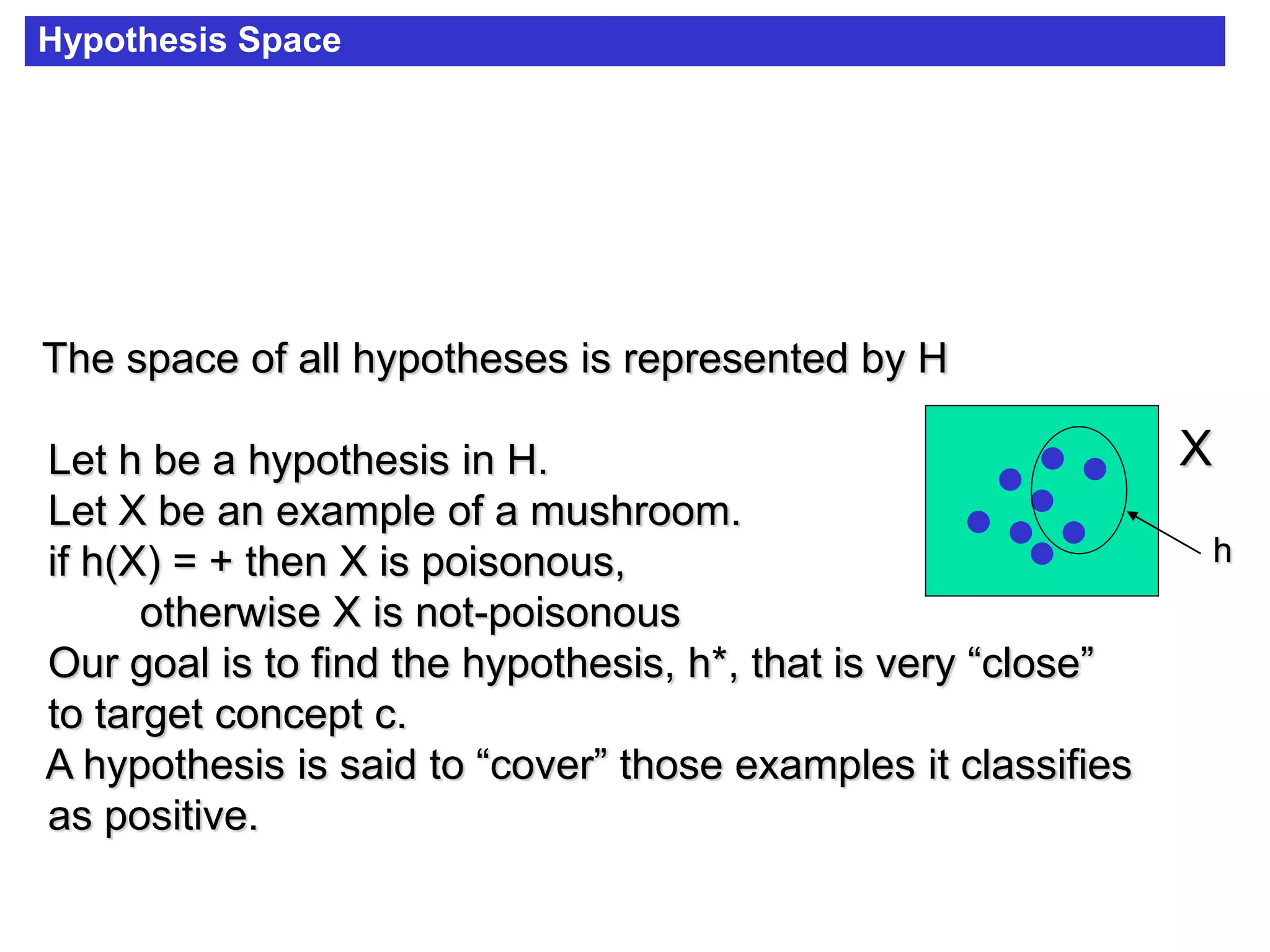
Hypothesis Space
The space of all hypotheses is represented by H
Let h be a hypothesis in H.
Let X be an example of a mushroom.
if h(X) = + then X is poisonous,
otherwise X is not-poisonous
Our goal is to find the hypothesis, h*, that is very “close”
to target concept c.
A hypothesis is said to “cover” those examples it classifies
as positive.
X
h
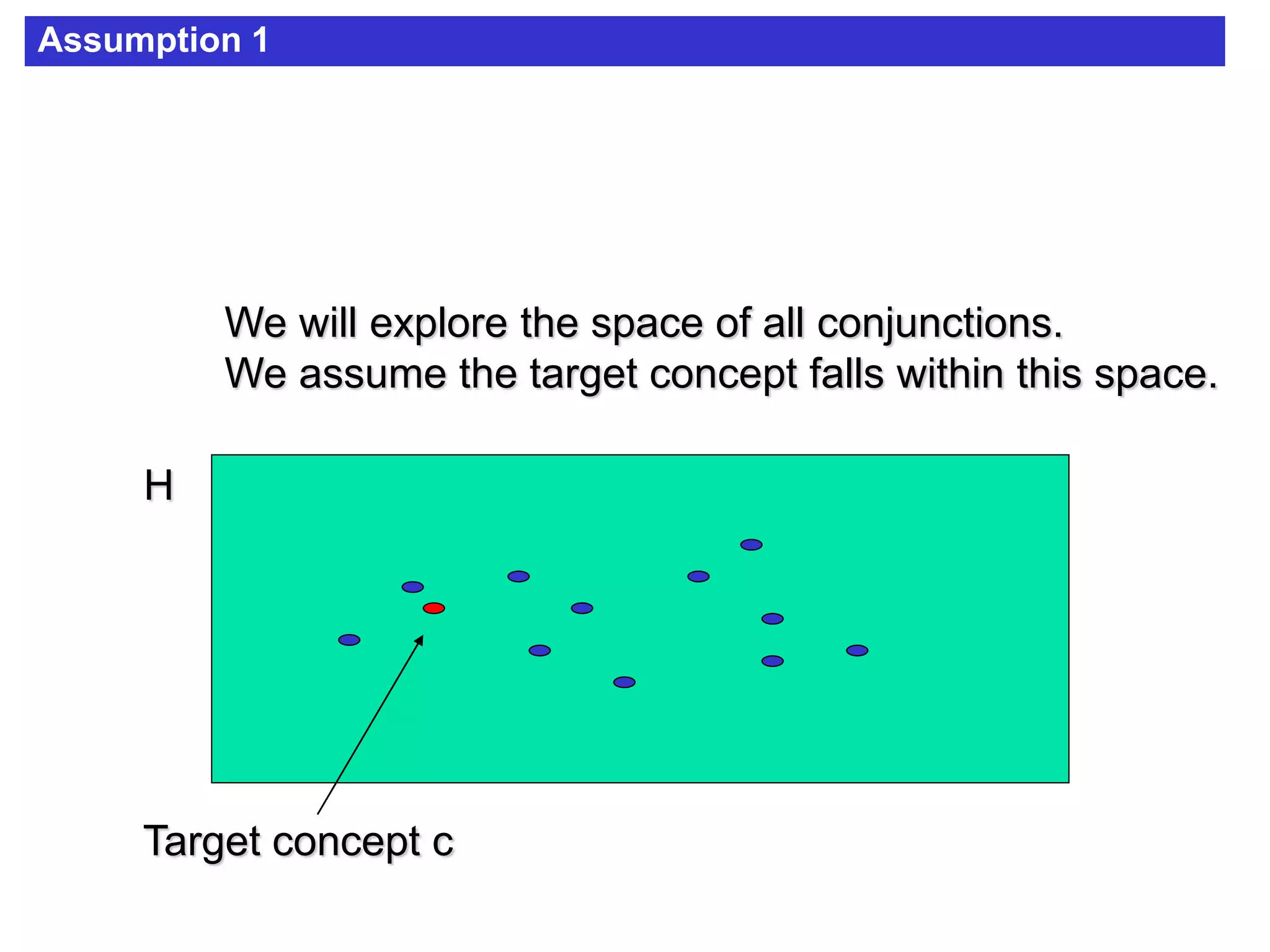
Assumption 1
We will explore the space of all conjunctions.
We assume the target concept falls within this space.
Target concept c
H
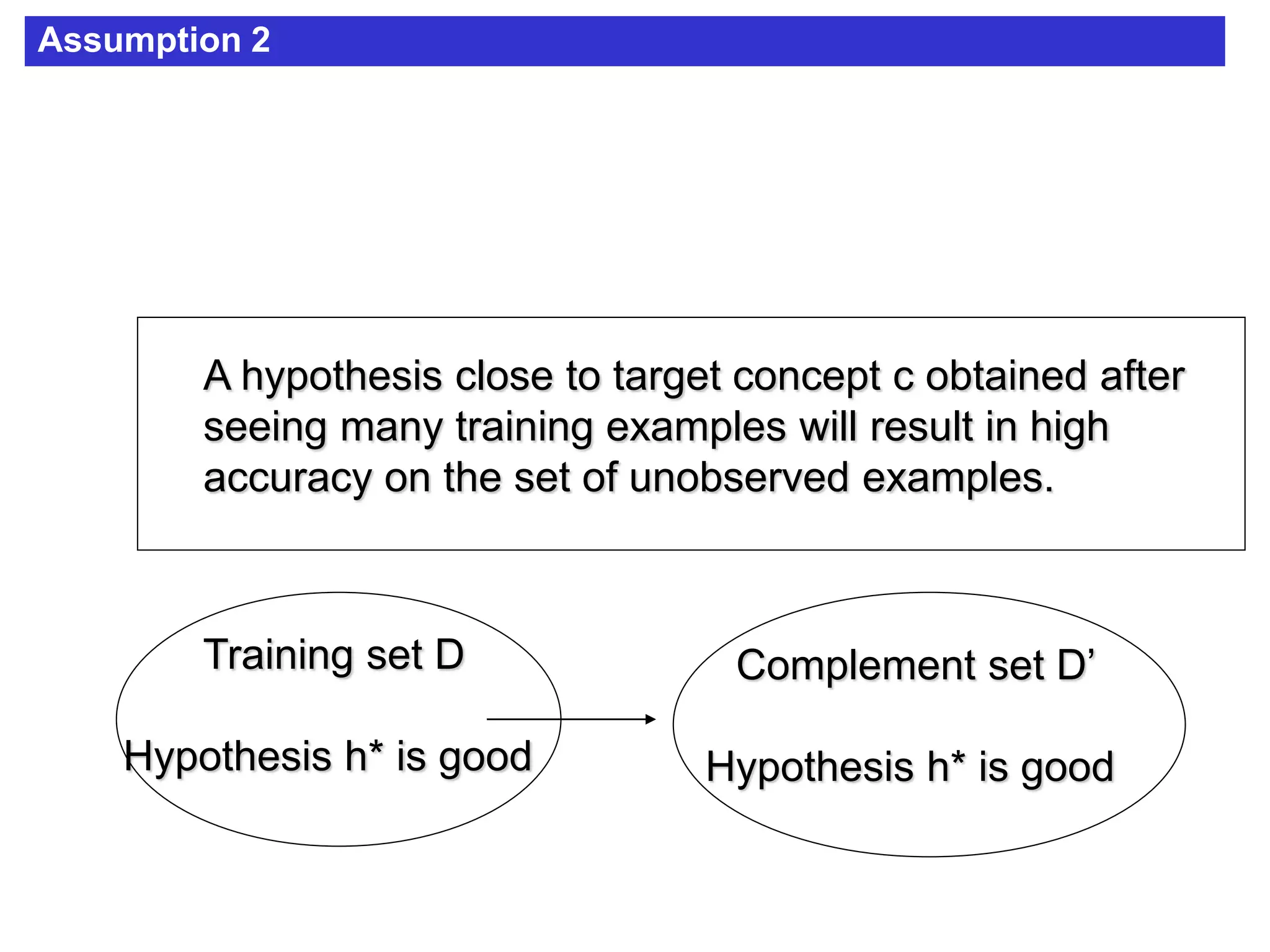
Assumption 2
A hypothesis close to target concept c obtained after
seeing many training examples will result in high
accuracy on the set of unobserved examples.
Training set D
Hypothesis h* is good
Complement set D’
Hypothesis h* is good
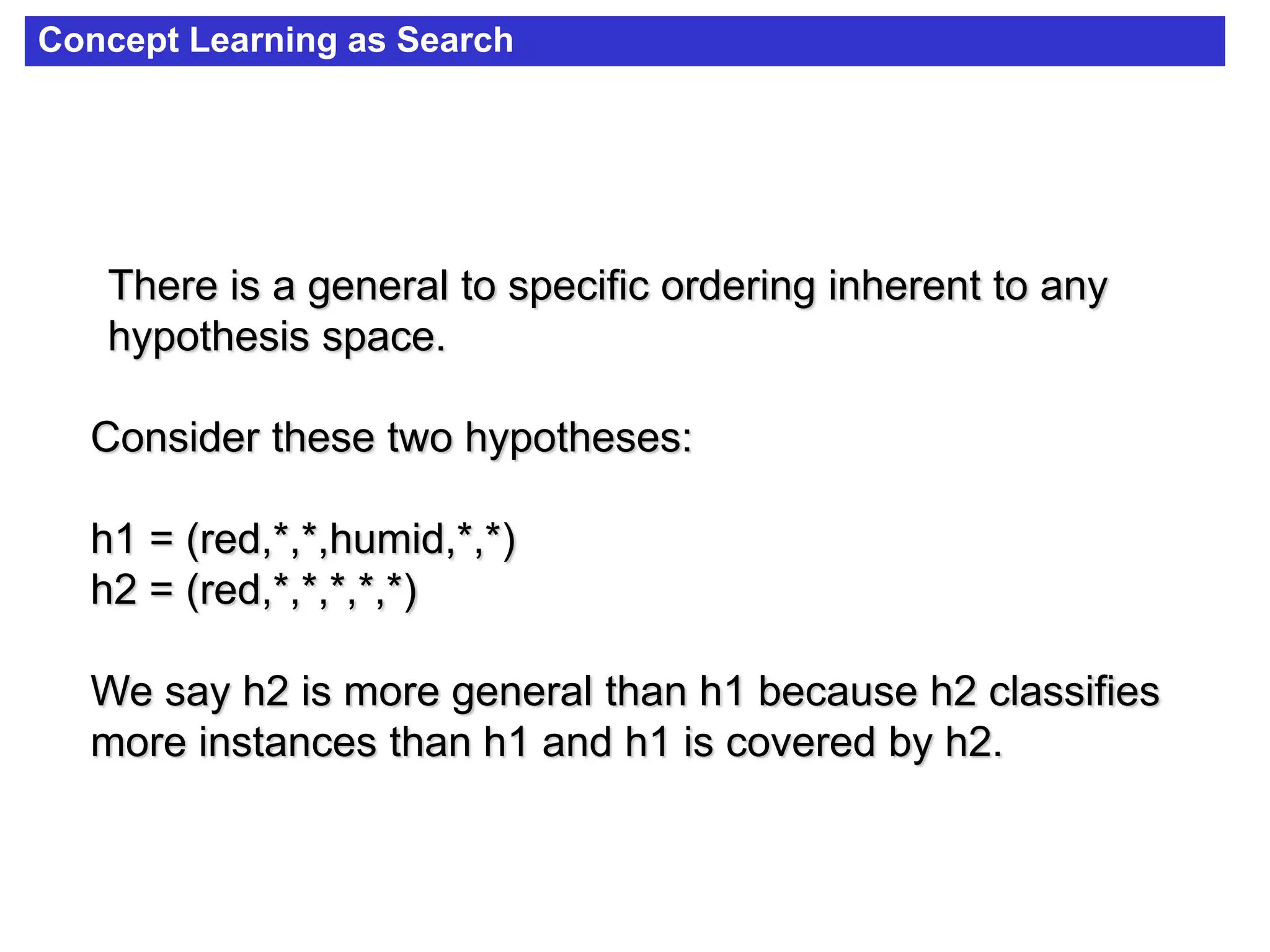
Concept Learning as Search
There is a general to specific ordering inherent to any
hypothesis space.
Consider these two hypotheses:
h1 = (red,*,*,humid,*,*)
h2 = (red,*,*,*,*,*)
We say h2 is more general than h1 because h2 classifies
more instances than h1 and h1 is covered by h2.
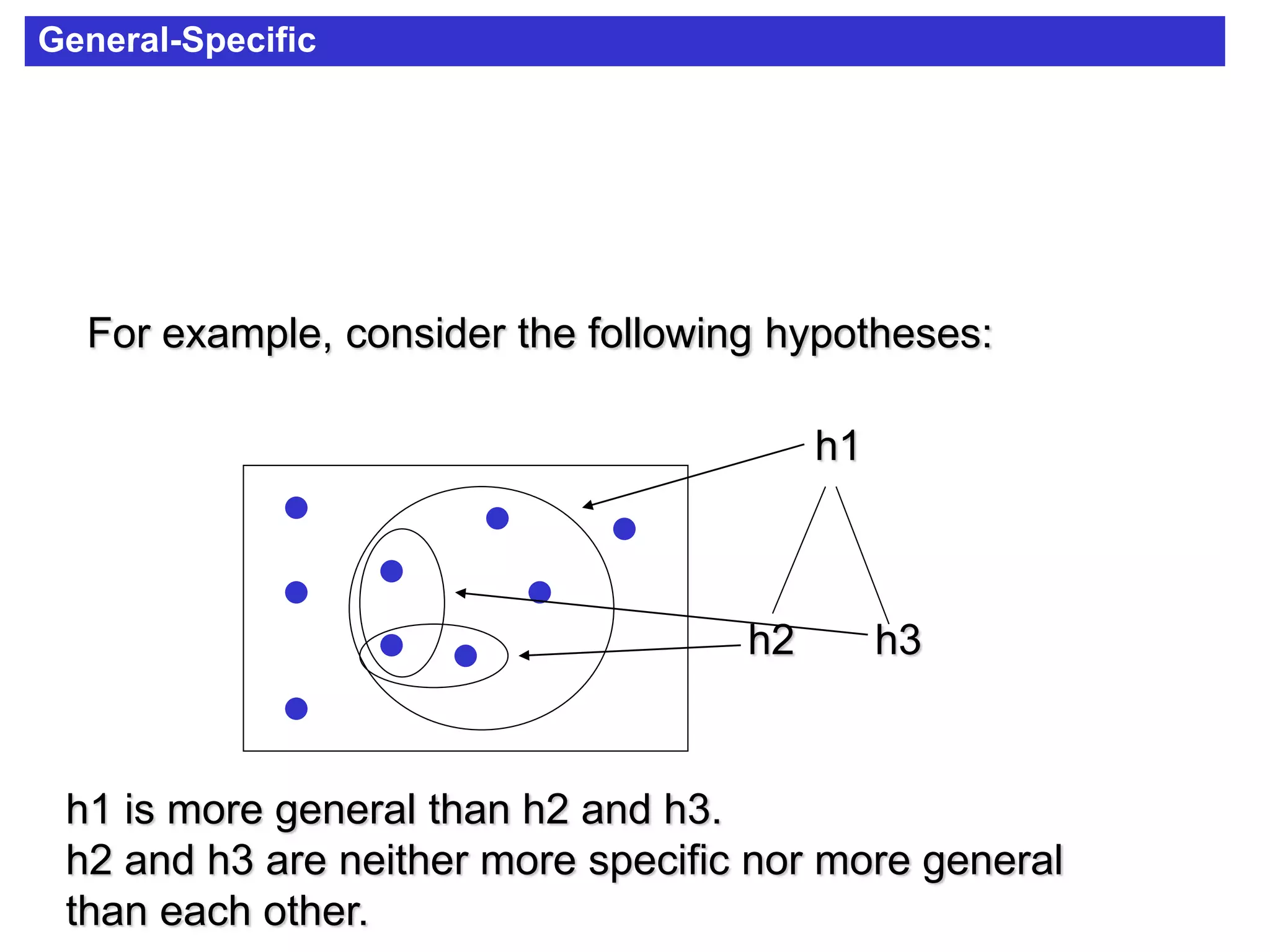
General-Specific
For example, consider the following hypotheses:
h1
h2 h3
h1 is more general than h2 and h3.
h2 and h3 are neither more specific nor more general
than each other.
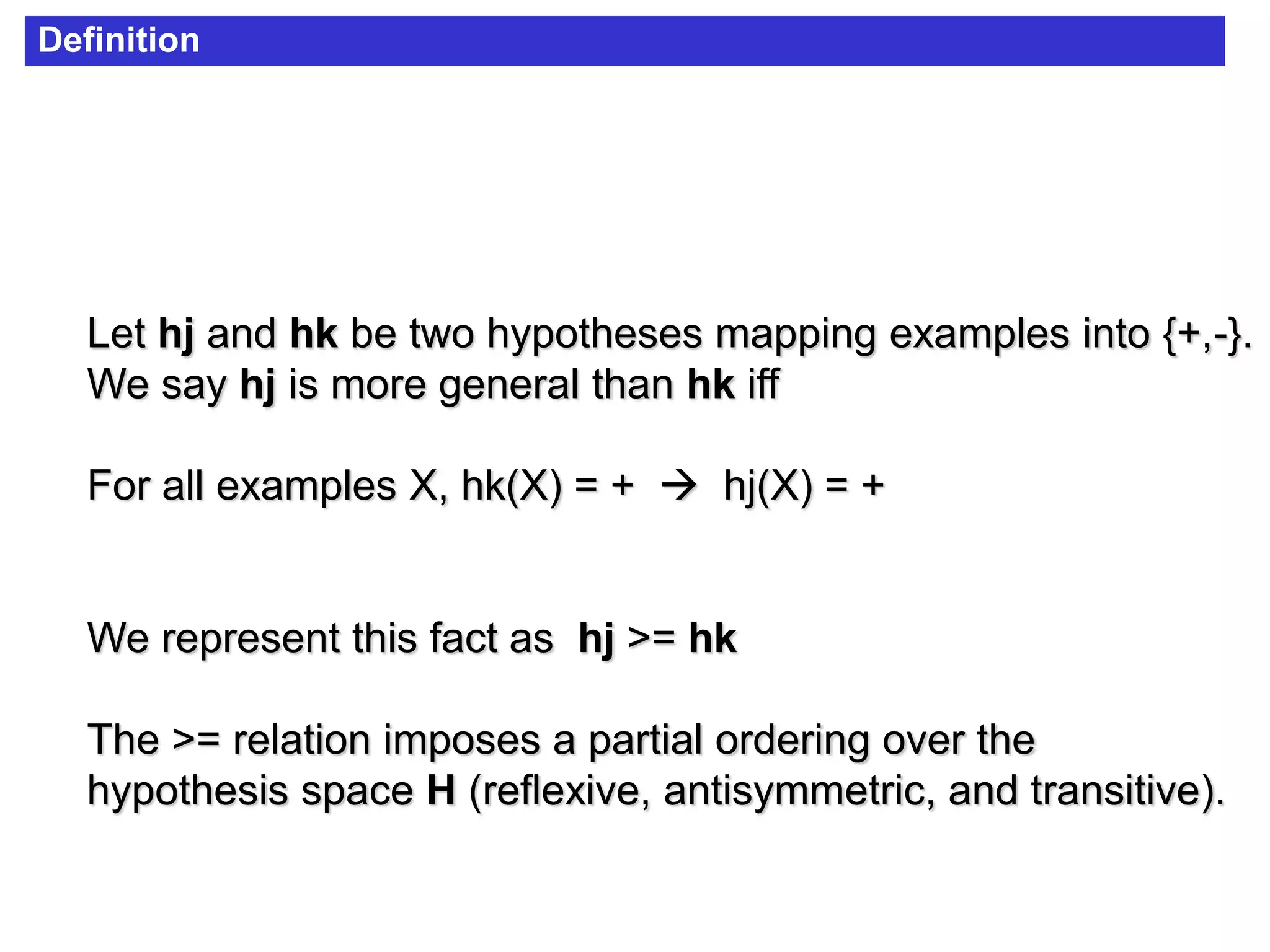
Let hj and hk be two hypotheses mapping examples into {+,-}.
We say hj is more general than hk iff
For all examples X, hk(X) = +  hj(X) = +
We represent this fact as hj >= hk
The >= relation imposes a partial ordering over the
hypothesis space H (reflexive, antisymmetric, and transitive).
Definition
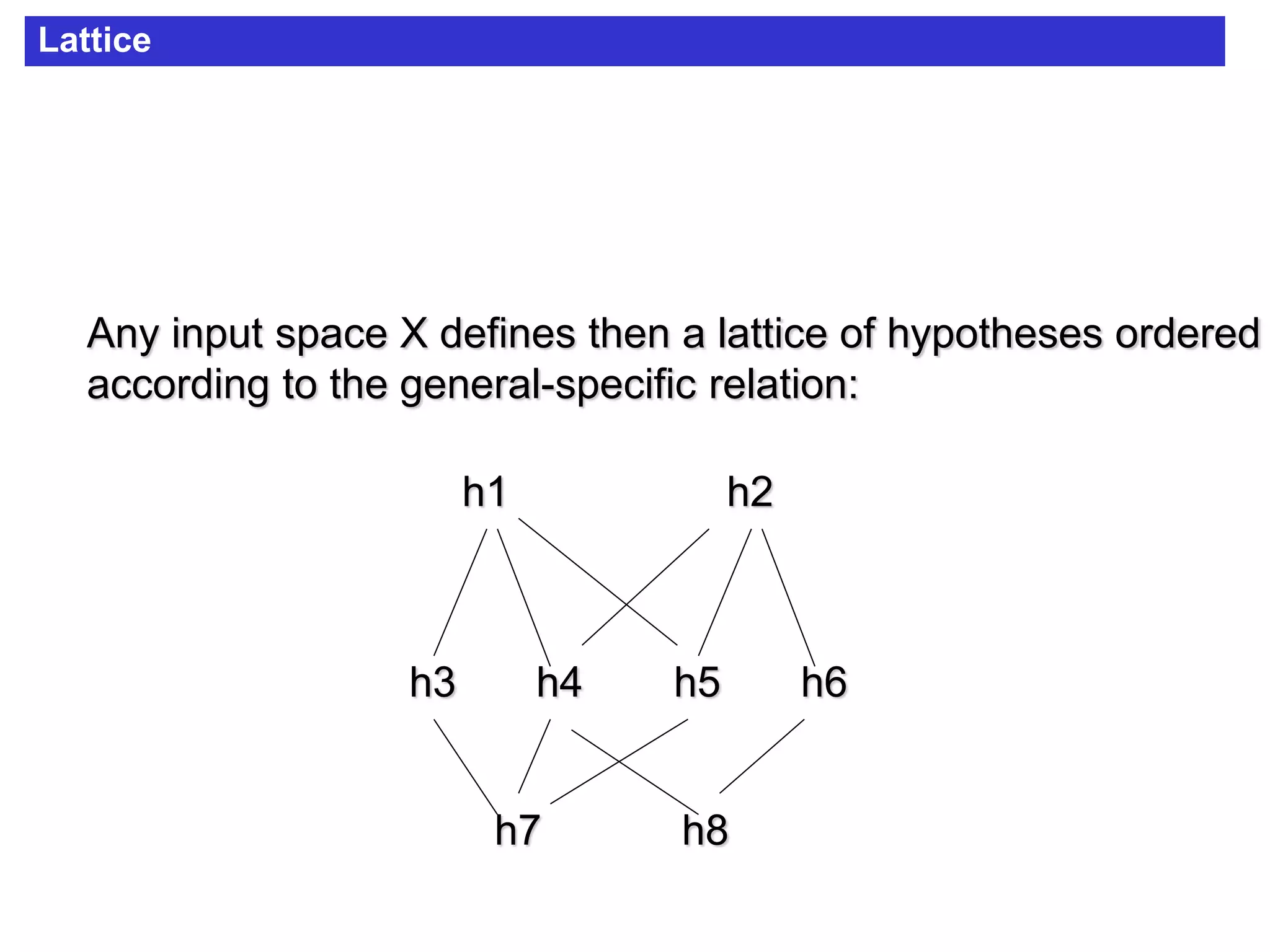
Lattice
Any input space X defines then a lattice of hypotheses ordered
according to the general-specific relation:
h1
h3 h4
h2
h5 h6
h7 h8
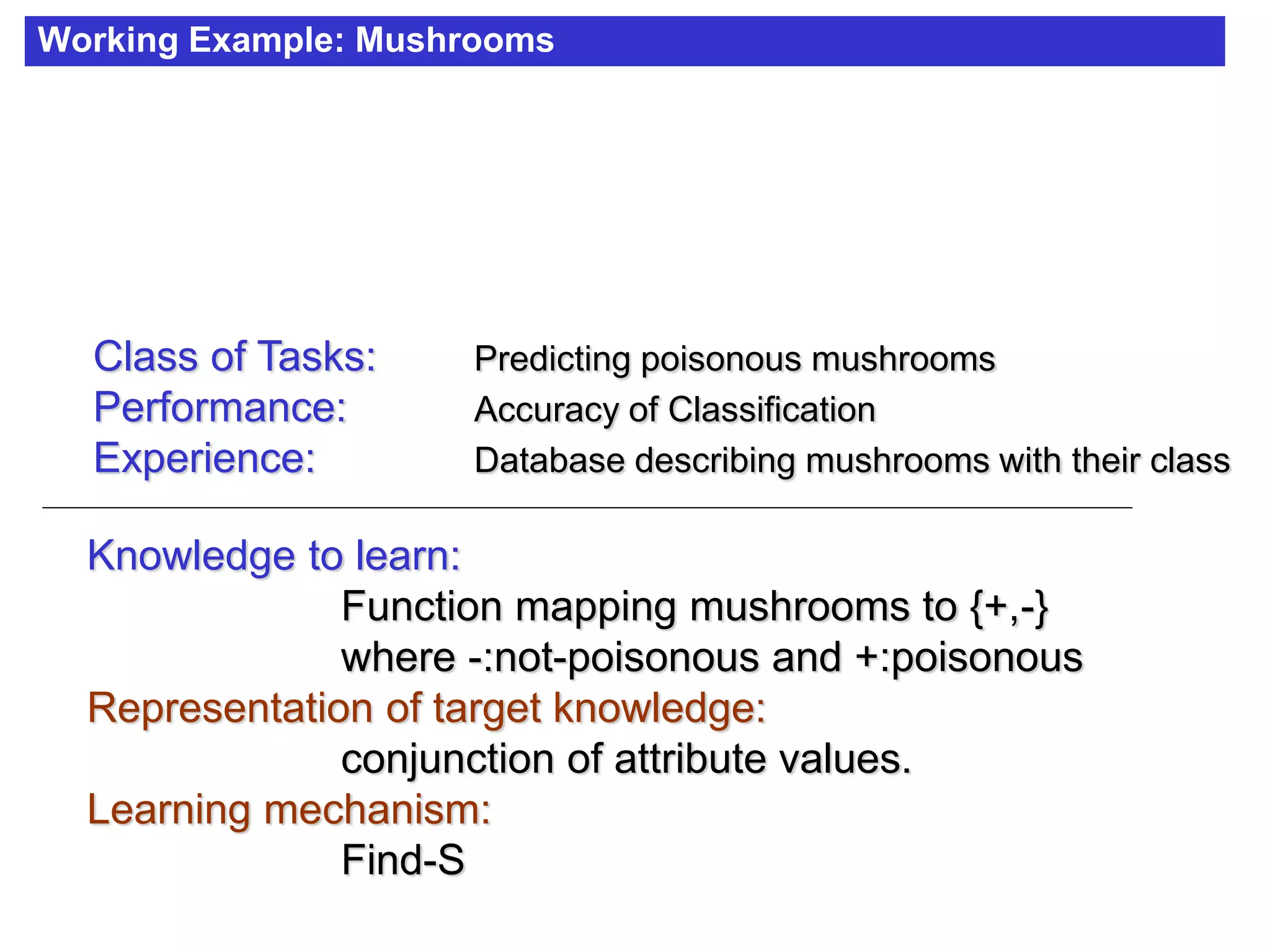
Working Example: Mushrooms
Class of Tasks: Predicting poisonous mushrooms
Performance: Accuracy of Classification
Experience: Database describing mushrooms with their class
Knowledge to learn:
Function mapping mushrooms to {+,-}
where -:not-poisonous and +:poisonous
Representation of target knowledge:
conjunction of attribute values.
Learning mechanism:
Find-S
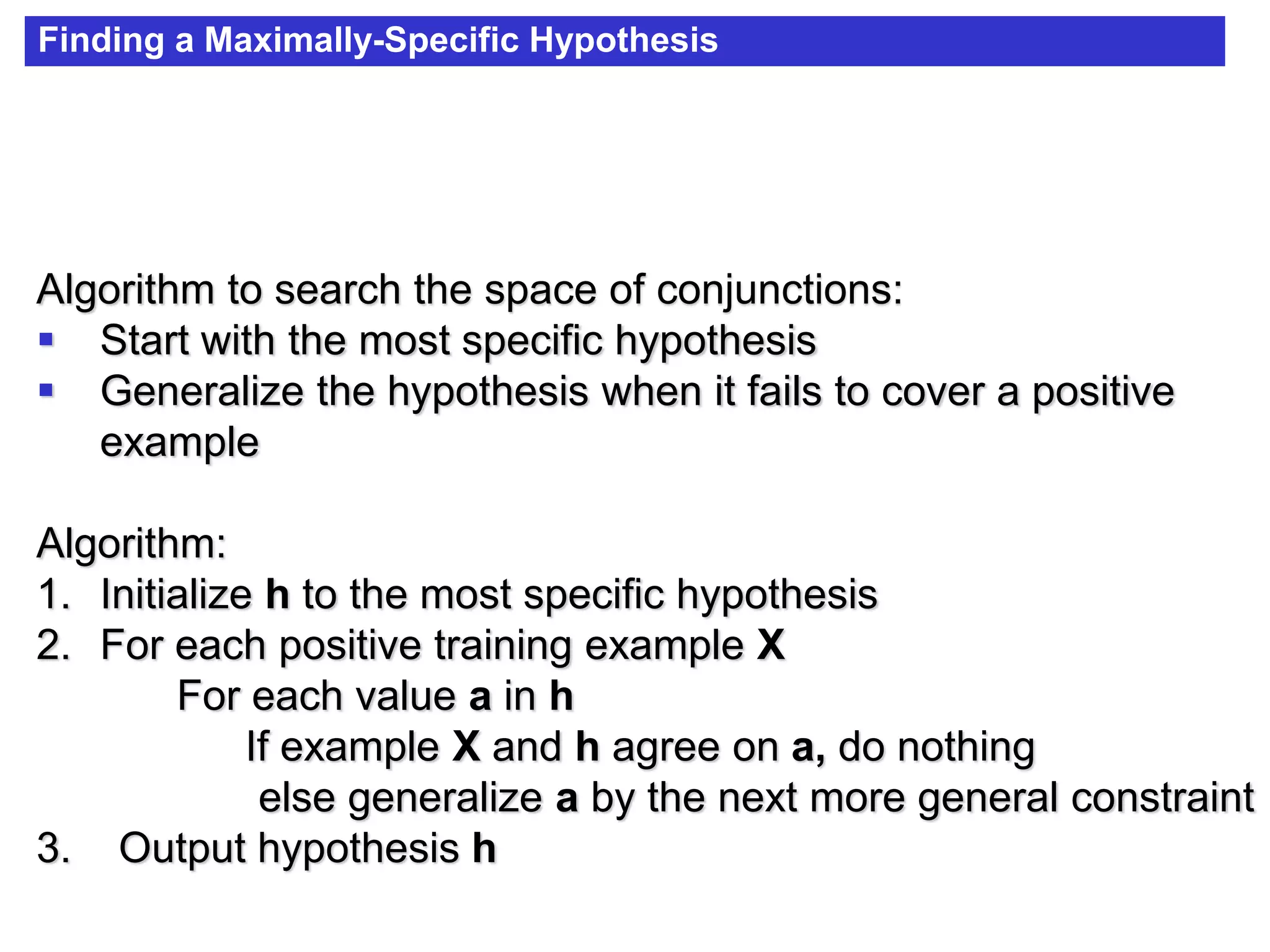
Finding a Maximally-Specific Hypothesis
Algorithm to search the space of conjunctions:
 Start with the most specific hypothesis
 Generalize the hypothesis when it fails to cover a positive
example
Algorithm:
1. Initialize h to the most specific hypothesis
2. For each positive training example X
For each value a in h
If example X and h agree on a, do nothing
else generalize a by the next more general constraint
3. Output hypothesis h
Example
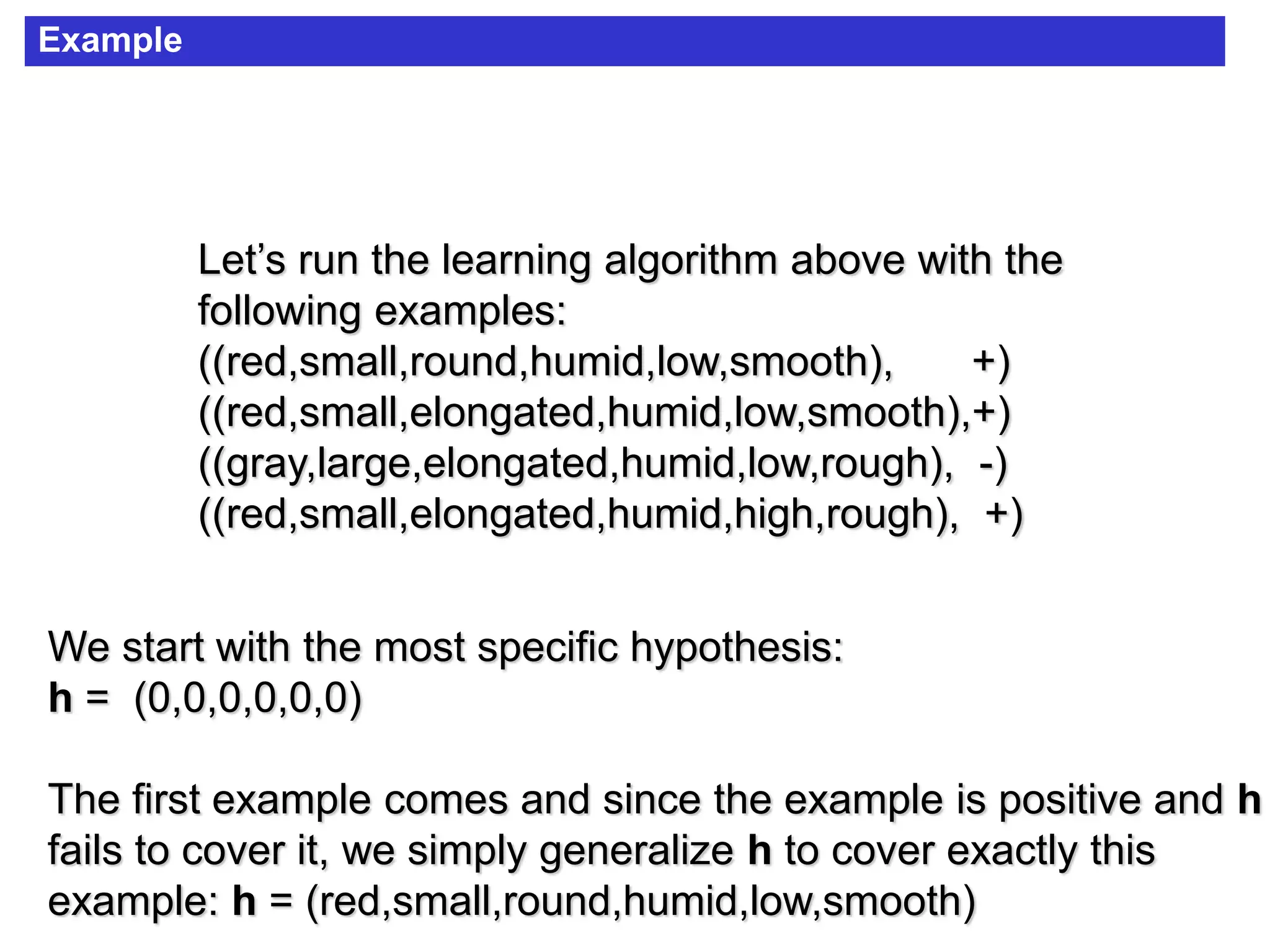
Let’s run the learning algorithm above with the
following examples:
((red,small,round,humid,low,smooth), +)
((red,small,elongated,humid,low,smooth),+)
((gray,large,elongated,humid,low,rough), -)
((red,small,elongated,humid,high,rough), +)
We start with the most specific hypothesis:
h = (0,0,0,0,0,0)
The first example comes and since the example is positive and h
fails to cover it, we simply generalize h to cover exactly this
example: h = (red,small,round,humid,low,smooth)
Example
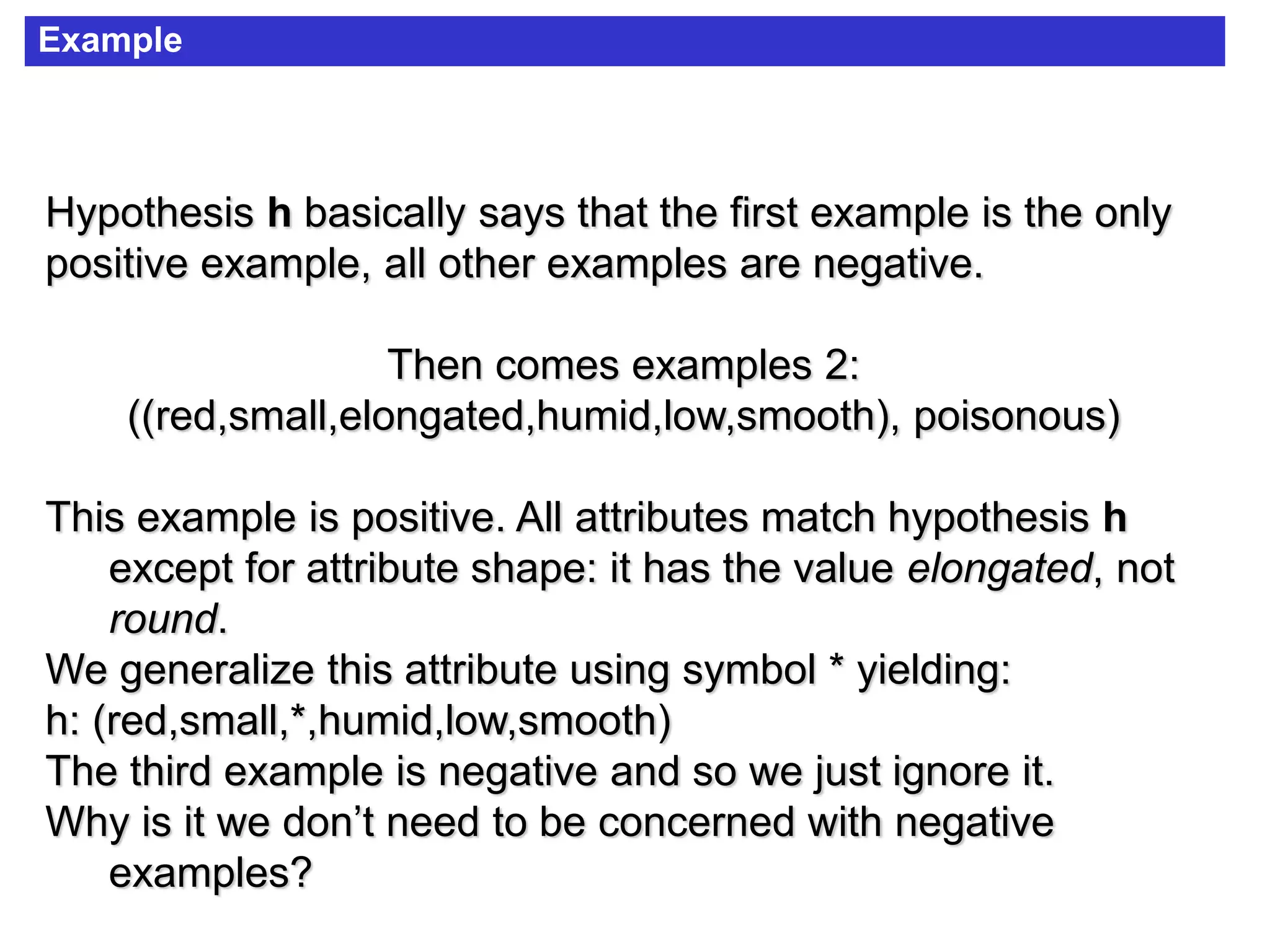
Hypothesis h basically says that the first example is the only
positive example, all other examples are negative.
Then comes examples 2:
((red,small,elongated,humid,low,smooth), poisonous)
This example is positive. All attributes match hypothesis h
except for attribute shape: it has the value elongated, not
round.
We generalize this attribute using symbol * yielding:
h: (red,small,*,humid,low,smooth)
The third example is negative and so we just ignore it.
Why is it we don’t need to be concerned with negative
examples?
Example
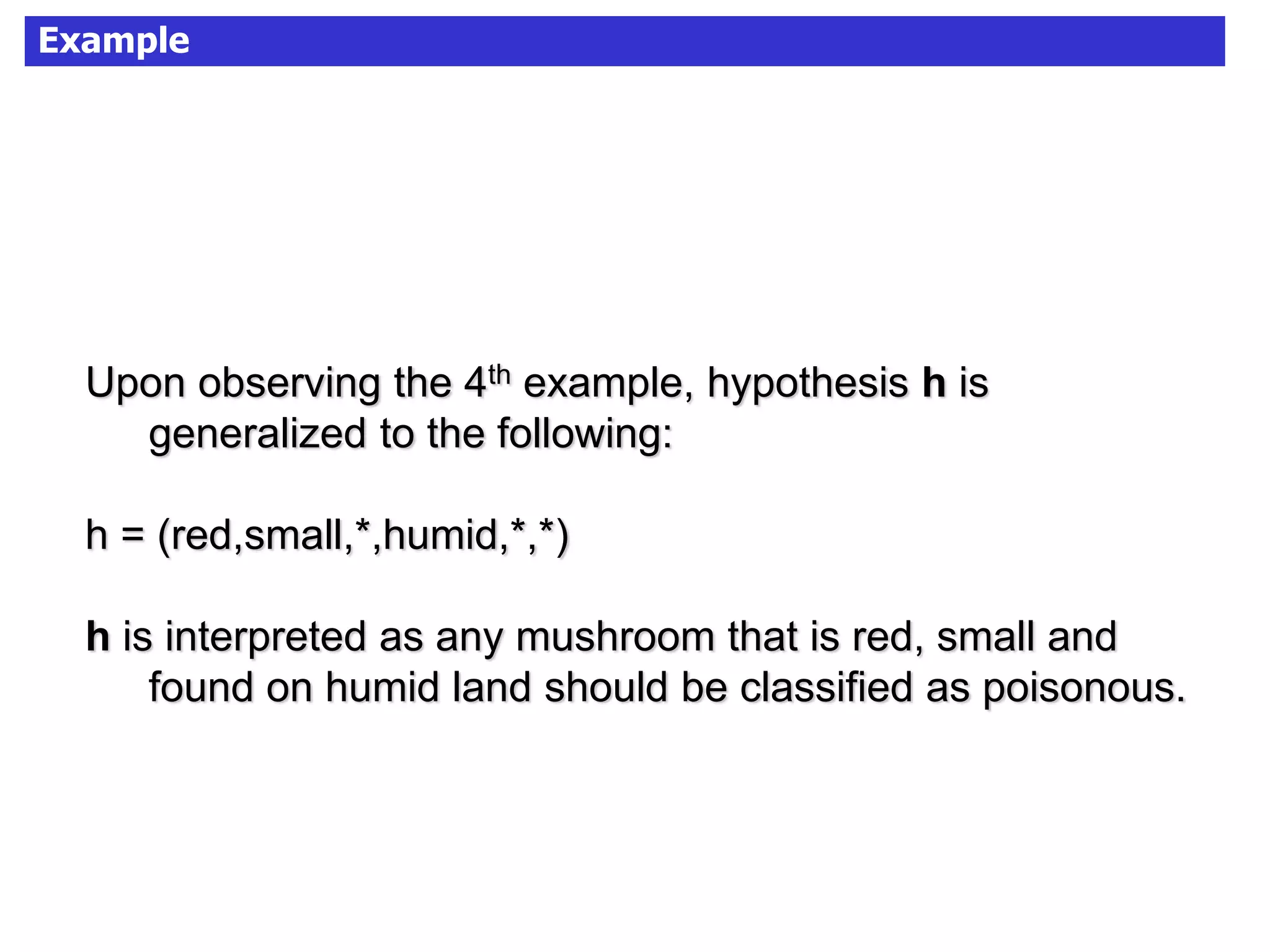
Upon observing the 4th example, hypothesis h is
generalized to the following:
h = (red,small,*,humid,*,*)
h is interpreted as any mushroom that is red, small and
found on humid land should be classified as poisonous.
Analyzing the Algorithm
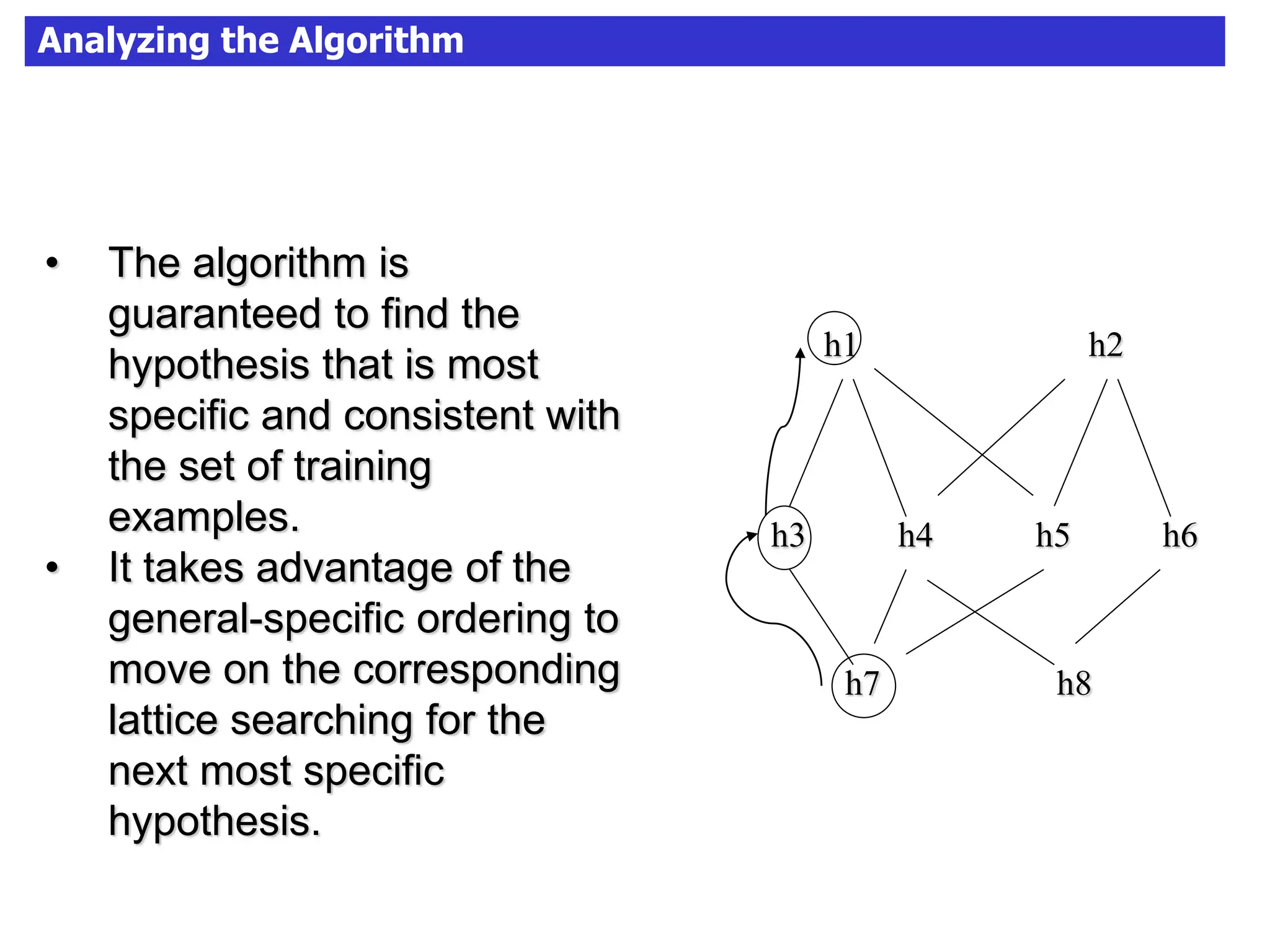
• The algorithm is
guaranteed to find the
hypothesis that is most
specific and consistent with
the set of training
examples.
• It takes advantage of the
general-specific ordering to
move on the corresponding
lattice searching for the
next most specific
hypothesis.
h1
h3 h4
h2
h5 h6
h7 h8
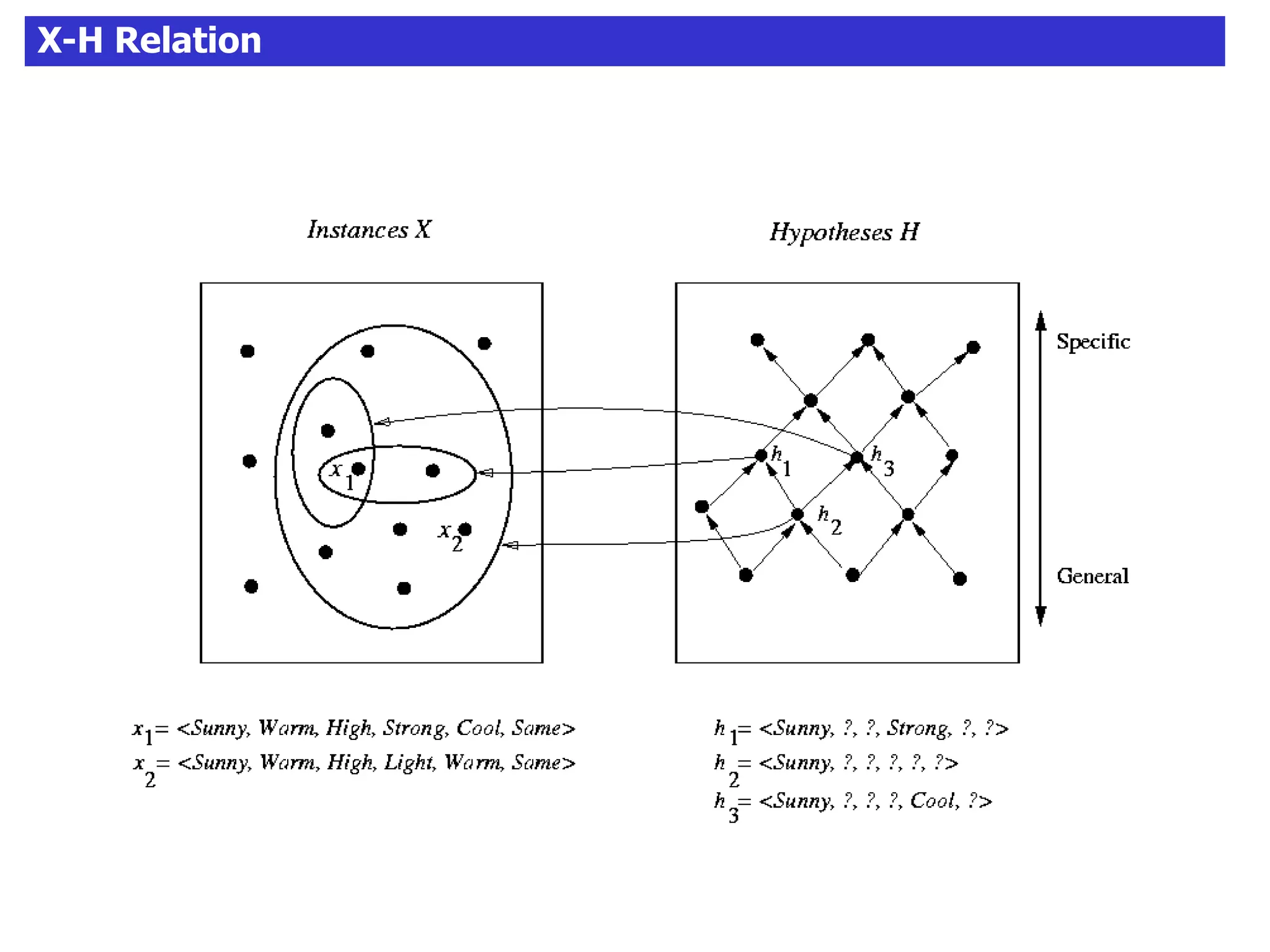
X-H Relation
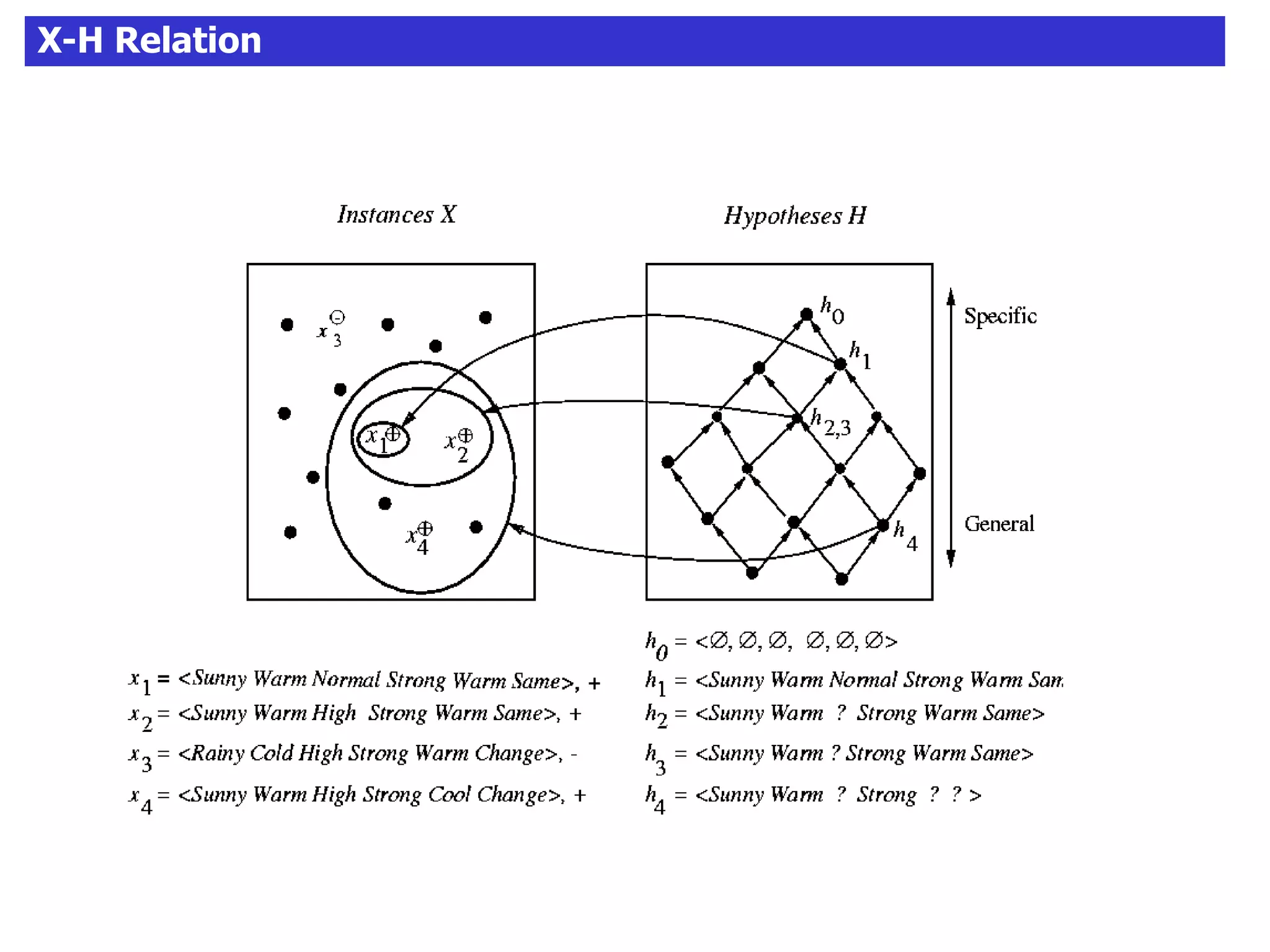
X-H Relation
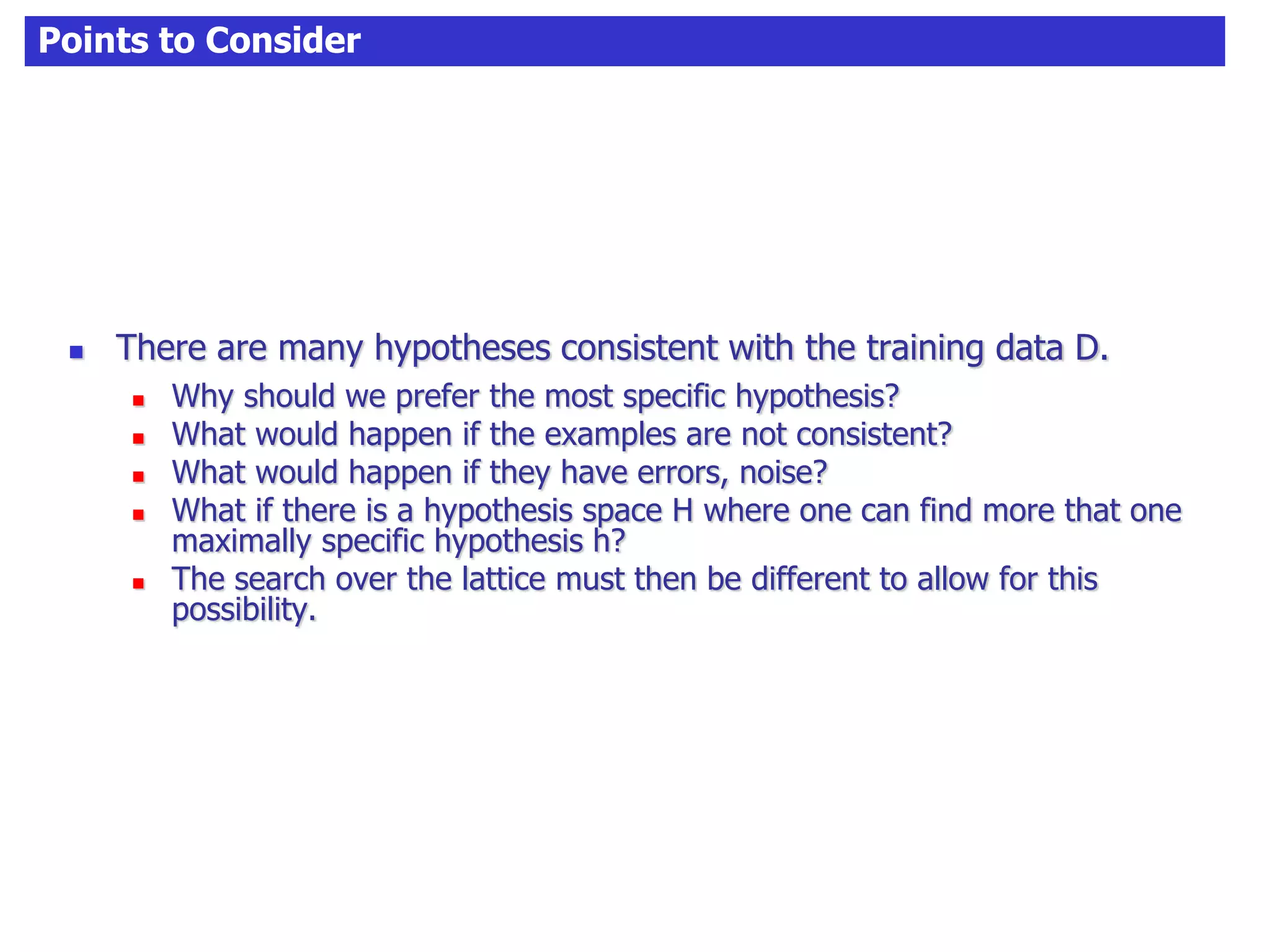
Points to Consider
 There are many hypotheses consistent with the training data D.
 Why should we prefer the most specific hypothesis?
 What would happen if the examples are not consistent?
 What would happen if they have errors, noise?
 What if there is a hypothesis space H where one can find more that one
maximally specific hypothesis h?
 The search over the lattice must then be different to allow for this
possibility.
Summary FIND-S
 The input space is the space of all examples; the output space is the
space of all classes.
 A hypothesis maps examples into classes.
 We want a hypothesis close to target concept c.
 The input space establishes a partial ordering over the hypothesis
space.
 One can exploit this ordering to move along the corresponding
lattice.
Working Example: Mushrooms
Class of Tasks: Predicting poisonous mushrooms
Performance: Accuracy of Classification
Experience: Database describing mushrooms with their class
Knowledge to learn:
Function mapping mushrooms to {+,-}
where -:not-poisonous and +:poisonous
Representation of target knowledge:
conjunction of attribute values.
Learning mechanism:
candidate-elimination
Candidate Elimination
 The algorithm that finds the maximally specific hypothesis
is limited in that it only finds one of many hypotheses
consistent with the training data.
 The Candidate Elimination Algorithm (CEA) finds ALL
hypotheses consistent with the training data.
 CEA does that without explicitly enumerating all
consistent hypotheses.
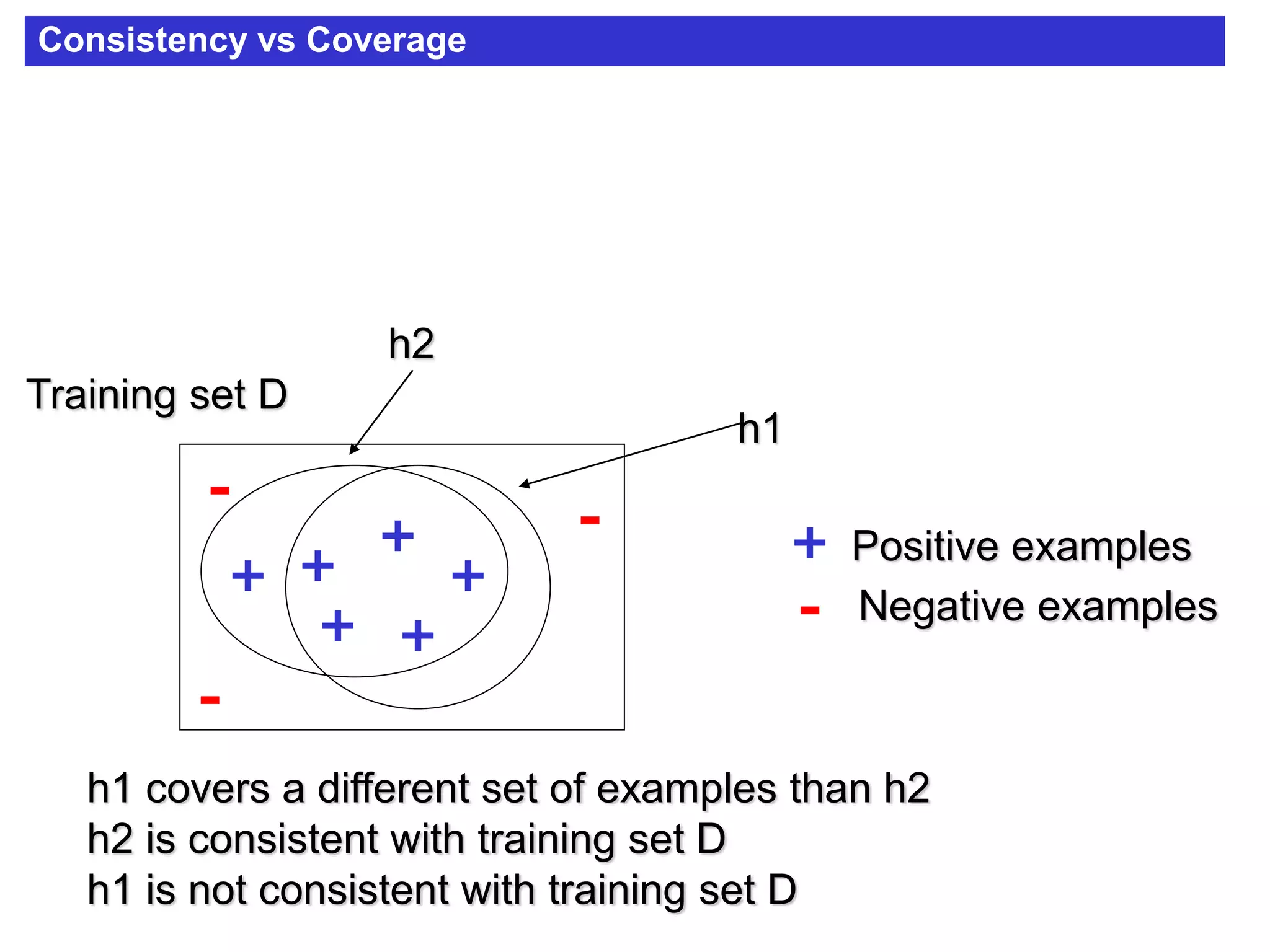
Consistency vs Coverage
h1
h2
h1 covers a different set of examples than h2
h2 is consistent with training set D
h1 is not consistent with training set D
Positive examples
Negative examples
Training set D
-
-
-
-
+
+
++
+
+
+
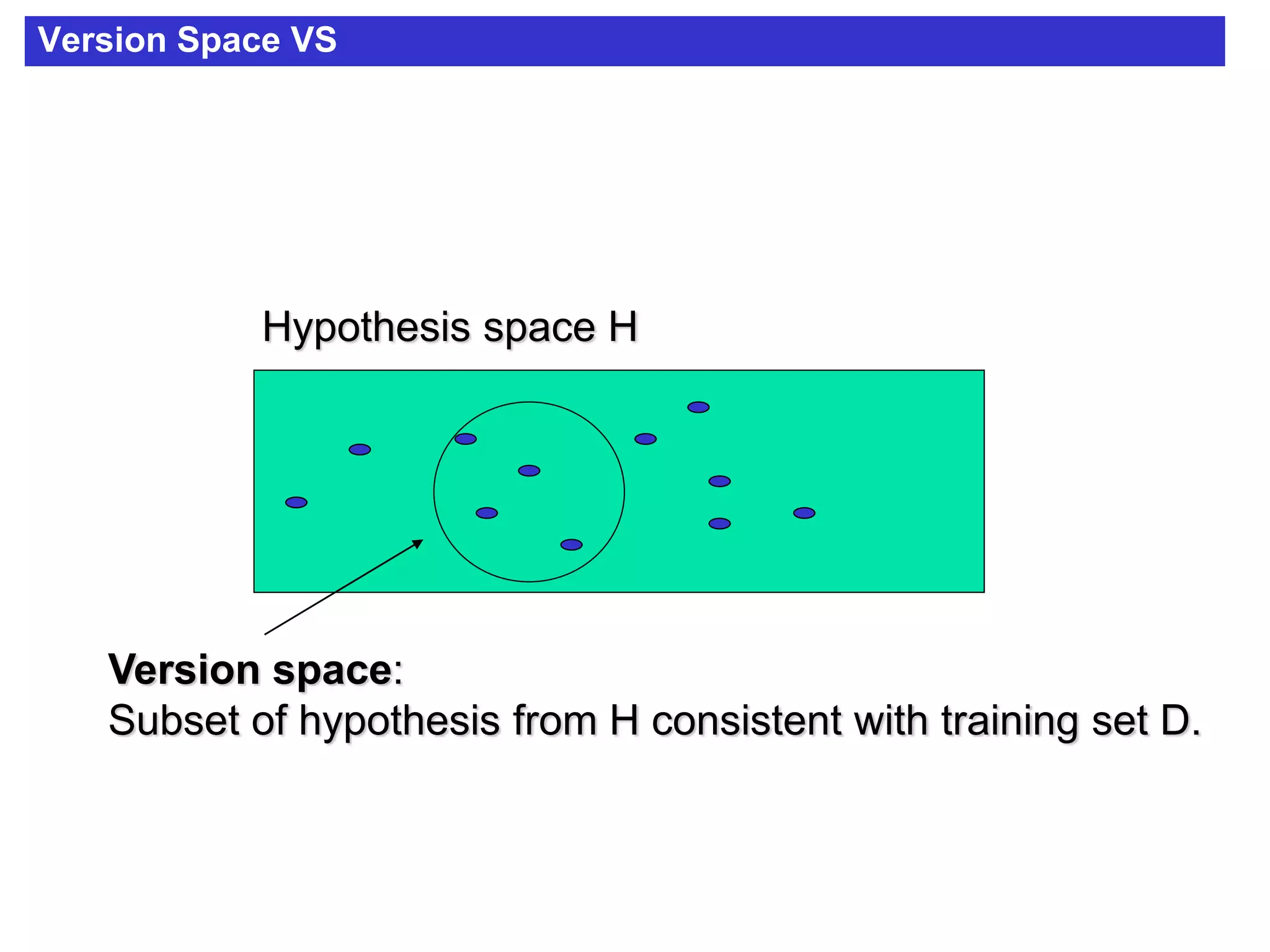
Version Space VS
Hypothesis space H
Version space:
Subset of hypothesis from H consistent with training set D.
List-Then-Eliminate Algorithm
Algorithm:
1. Version Space VS: All hypotheses in H
2. For each training example X
Remove every hypothesis h in H inconsistent
with X: h(x) = c(x)
3. Output the version space VS
Comments: This is unfeasible. The size of H is unmanageable.
Previous Exercise: Mushrooms
Let’s remember our exercise in which we tried to classify
mushrooms as poisonous (+) or not-poisonous (-).
Training set D:
((red,small,round,humid,low,smooth), +)
((red,small,elongated,humid,low,smooth), +)
((gray,large,elongated,humid,low,rough), -)
((red,small,elongated,humid,high,rough), +)
Consistent Hypotheses
Our first algorithm found only one out of six
consistent hypotheses:
(red,small,*,humid,*,*)
(*,small,*,humid,*,*)(red,*,*,humid,*,*) (red,small,*,*,*,*)
(red,*,*,*,*,*) (*,small,*,*,*,*)G:
S:
S: Most specific
G: Most general
Candidate-Elimination Algorithm
(red,small,*,humid,*,*)
(red,*,*,*,*,*)(*,small,*,*,*,*)G:
S:
The candidate elimination algorithm keeps two lists
of hypotheses consistent with the training data:
The list of most specific hypotheses S and
The list of most general hypotheses G
This is enough to derive the whole version space VS.
VS
Candidate-Elimination Algorithm
• Initialize G to the set of maximally general hypotheses in H
• Initialize S to the set of maximally specific hypotheses in H
• For each training example X do
• If X is positive: generalize S if necessary
• If X is negative: specialize G if necessary
• Output {G,S}
Candidate-Elimination Algorithm
 Initialize G to the set of maximally general hypotheses in H
 Initialize S to the set of maximally specific hypotheses in H
 For each training example d, do
 If d+
 Remove from G any hypothesis inconsistent with d
 For each hypothesis s in S that is not consistent with d
 Remove s from S
 Add to S all minimal generalizations h of s such that h is consistent with
d and some member of G is more general than h
 Remove from S any hipothesis that is more general than another
hypothesis in S
 If d-
 Remove from S any hypothesis inconsistent with d
 For each hypothesis g in G that is not consistent with d
 Remove g from G
 Add to G all minimal specializations h of g such that h is consistent with
d and some member of S is more general than h
 Remove from G any hipothesis that is less general than another
hypothesis in G
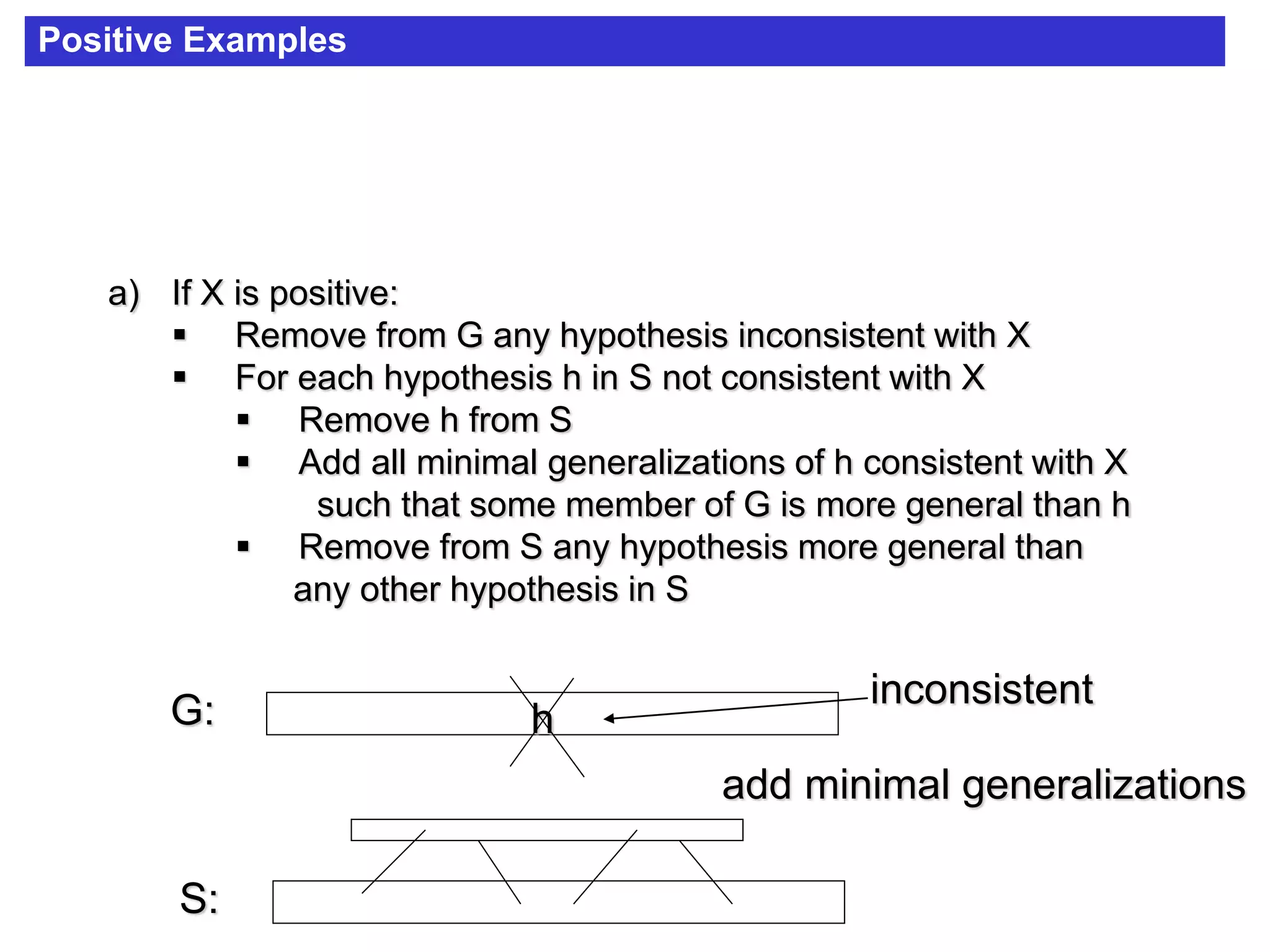
Positive Examples
a) If X is positive:
 Remove from G any hypothesis inconsistent with X
 For each hypothesis h in S not consistent with X
 Remove h from S
 Add all minimal generalizations of h consistent with X
such that some member of G is more general than h
 Remove from S any hypothesis more general than
any other hypothesis in S
G:
S:
h
inconsistent
add minimal generalizations
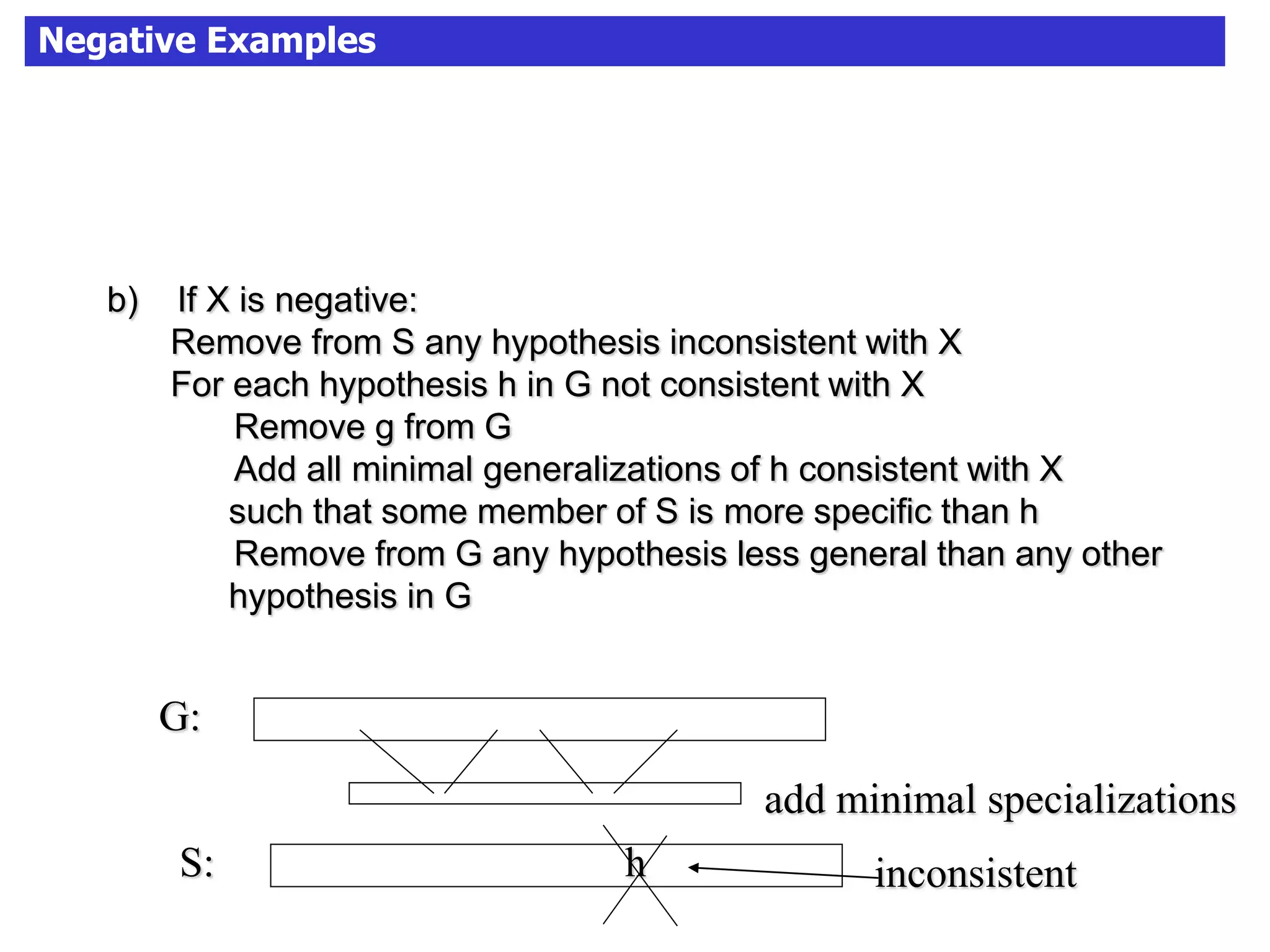
Negative Examples
b) If X is negative:
Remove from S any hypothesis inconsistent with X
For each hypothesis h in G not consistent with X
Remove g from G
Add all minimal generalizations of h consistent with X
such that some member of S is more specific than h
Remove from G any hypothesis less general than any other
hypothesis in G
G:
S: h inconsistent
add minimal specializations
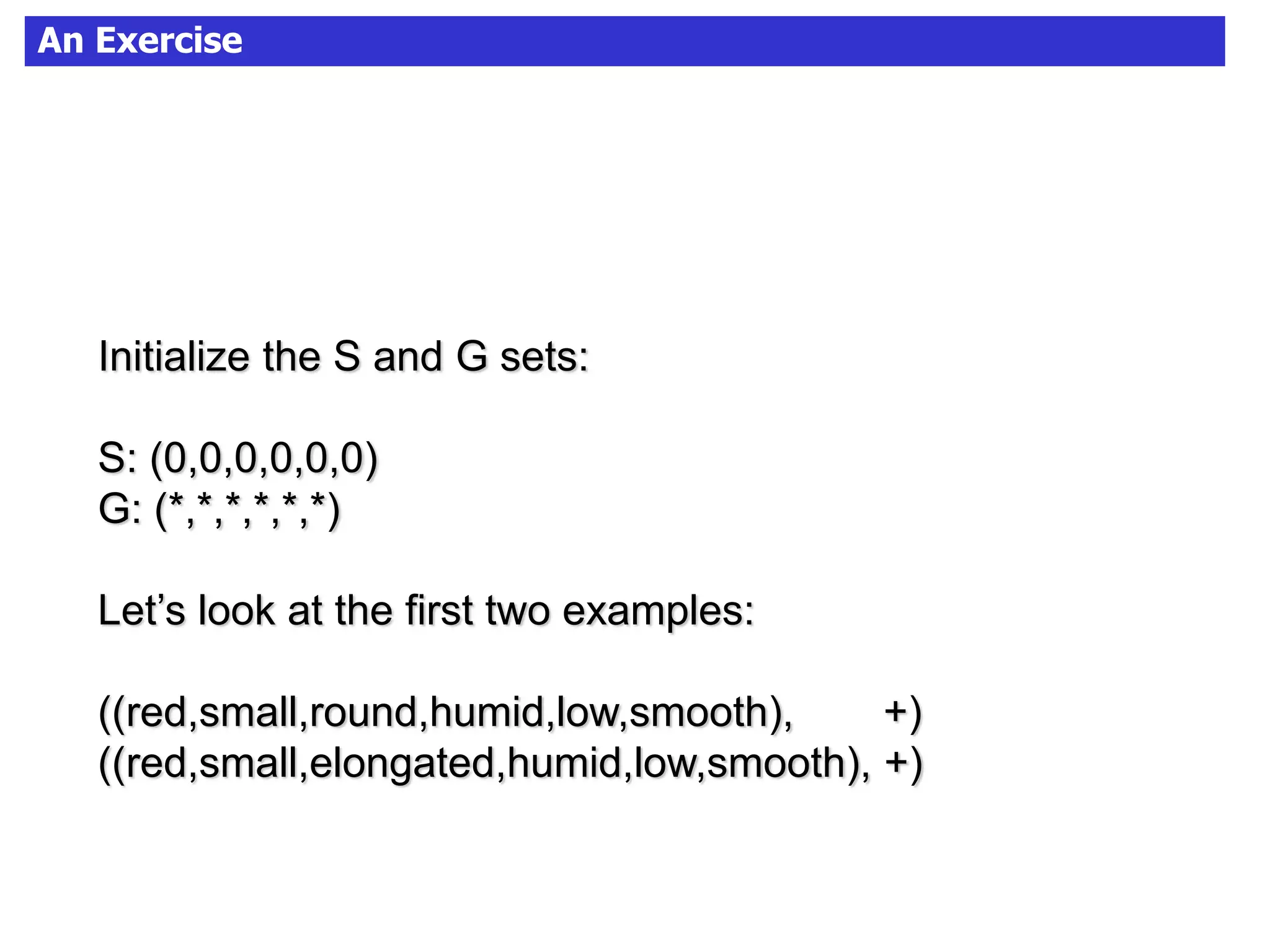
An Exercise
Initialize the S and G sets:
S: (0,0,0,0,0,0)
G: (*,*,*,*,*,*)
Let’s look at the first two examples:
((red,small,round,humid,low,smooth), +)
((red,small,elongated,humid,low,smooth), +)
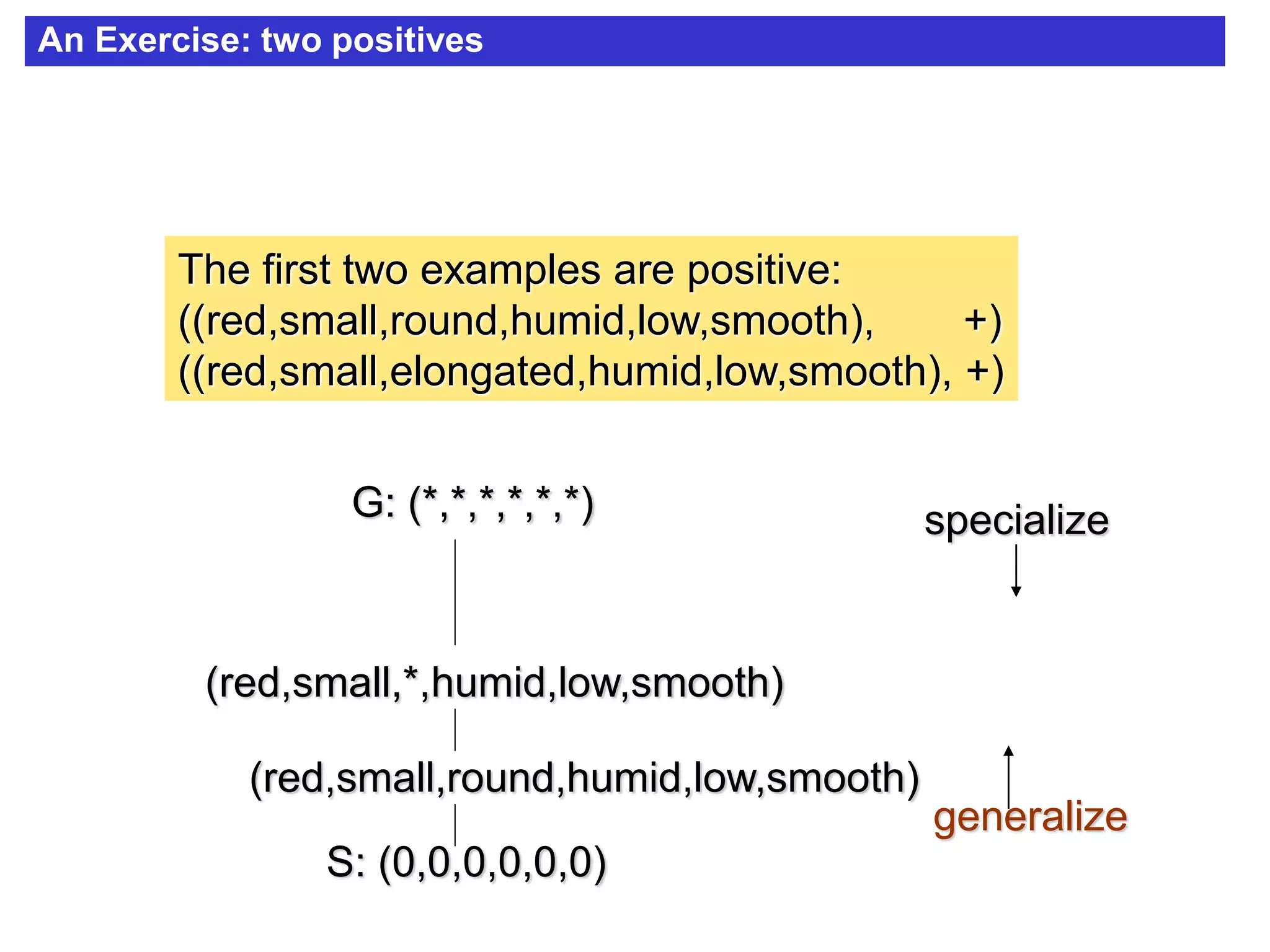
An Exercise: two positives
The first two examples are positive:
((red,small,round,humid,low,smooth), +)
((red,small,elongated,humid,low,smooth), +)
S: (0,0,0,0,0,0)
(red,small,round,humid,low,smooth)
(red,small,*,humid,low,smooth)
G: (*,*,*,*,*,*)
generalize
specialize
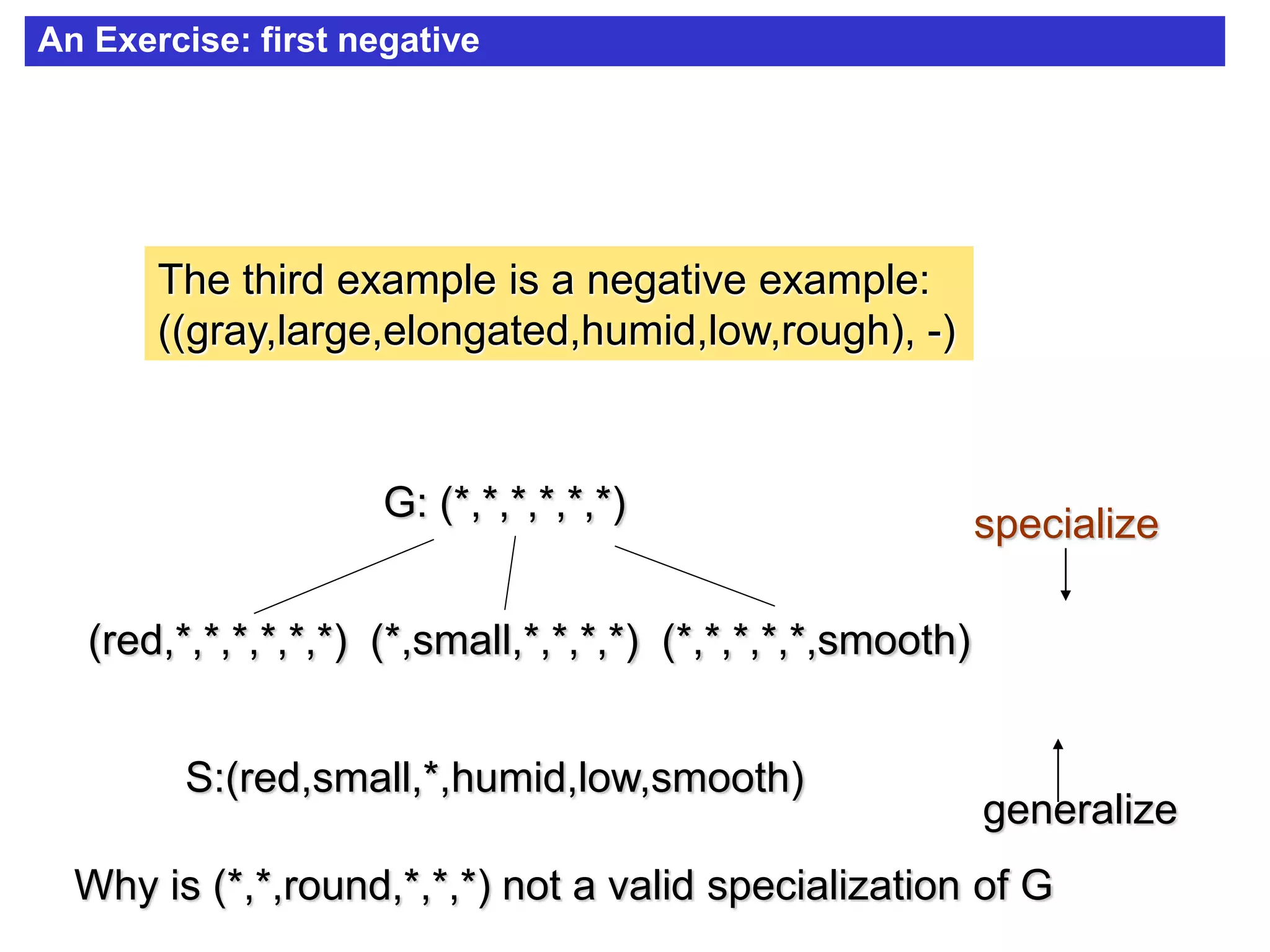
An Exercise: first negative
The third example is a negative example:
((gray,large,elongated,humid,low,rough), -)
S:(red,small,*,humid,low,smooth)
G: (*,*,*,*,*,*)
generalize
specialize
(red,*,*,*,*,*,*) (*,small,*,*,*,*) (*,*,*,*,*,smooth)
Why is (*,*,round,*,*,*) not a valid specialization of G
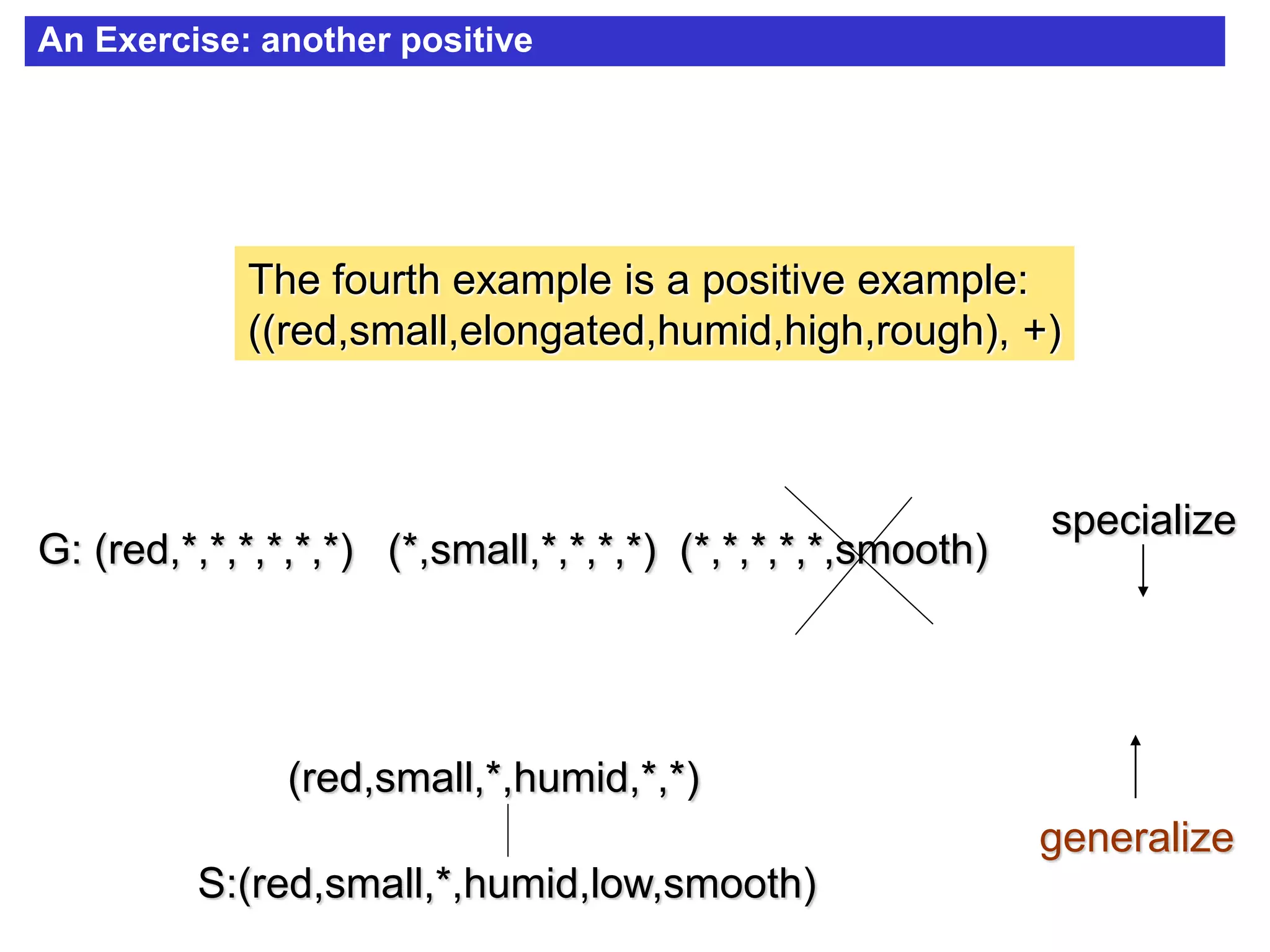
An Exercise: another positive
The fourth example is a positive example:
((red,small,elongated,humid,high,rough), +)
S:(red,small,*,humid,low,smooth)
generalize
specialize
G: (red,*,*,*,*,*,*) (*,small,*,*,*,*) (*,*,*,*,*,smooth)
(red,small,*,humid,*,*)
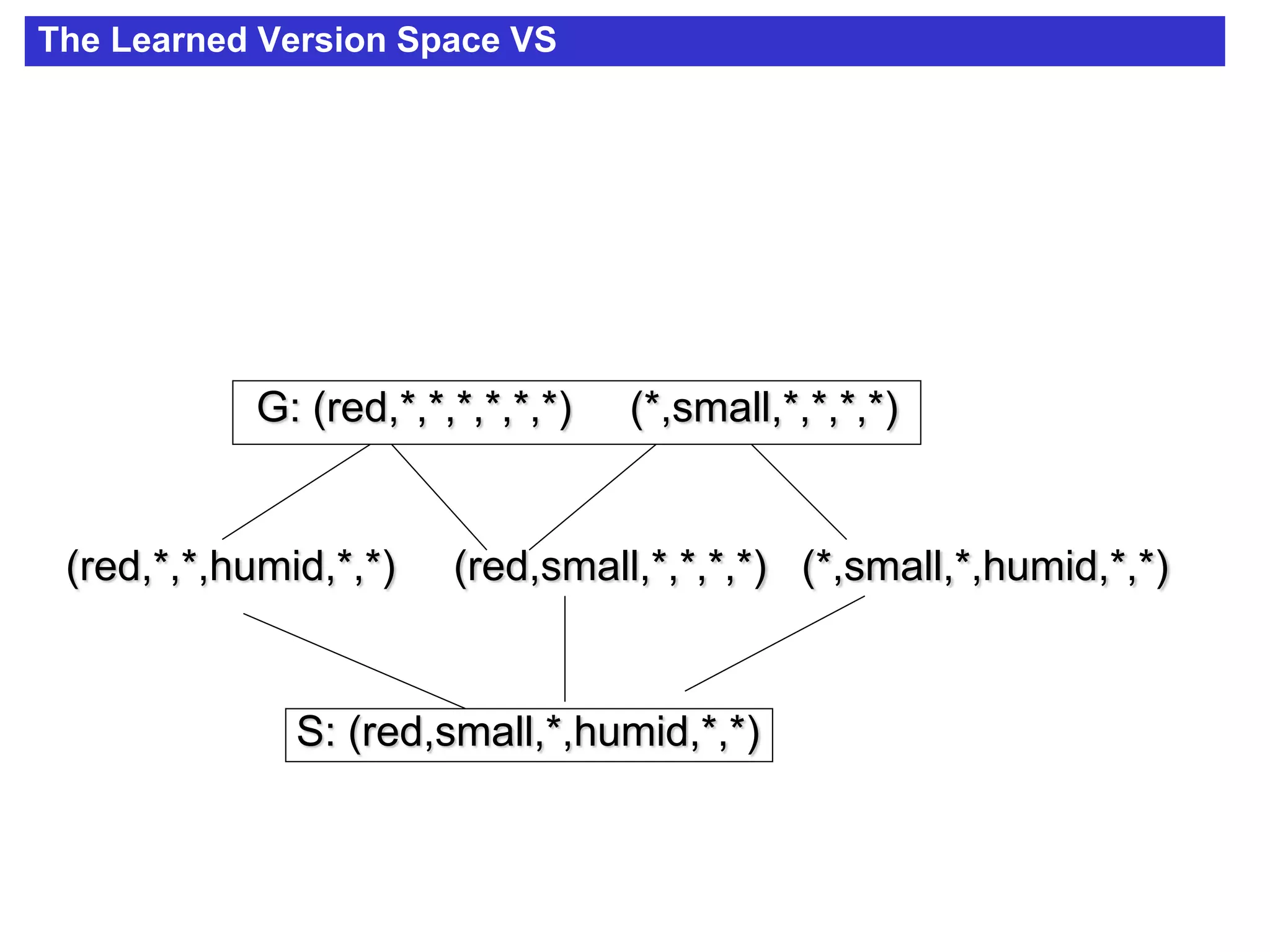
The Learned Version Space VS
G: (red,*,*,*,*,*,*) (*,small,*,*,*,*)
S: (red,small,*,humid,*,*)
(red,*,*,humid,*,*) (red,small,*,*,*,*) (*,small,*,humid,*,*)
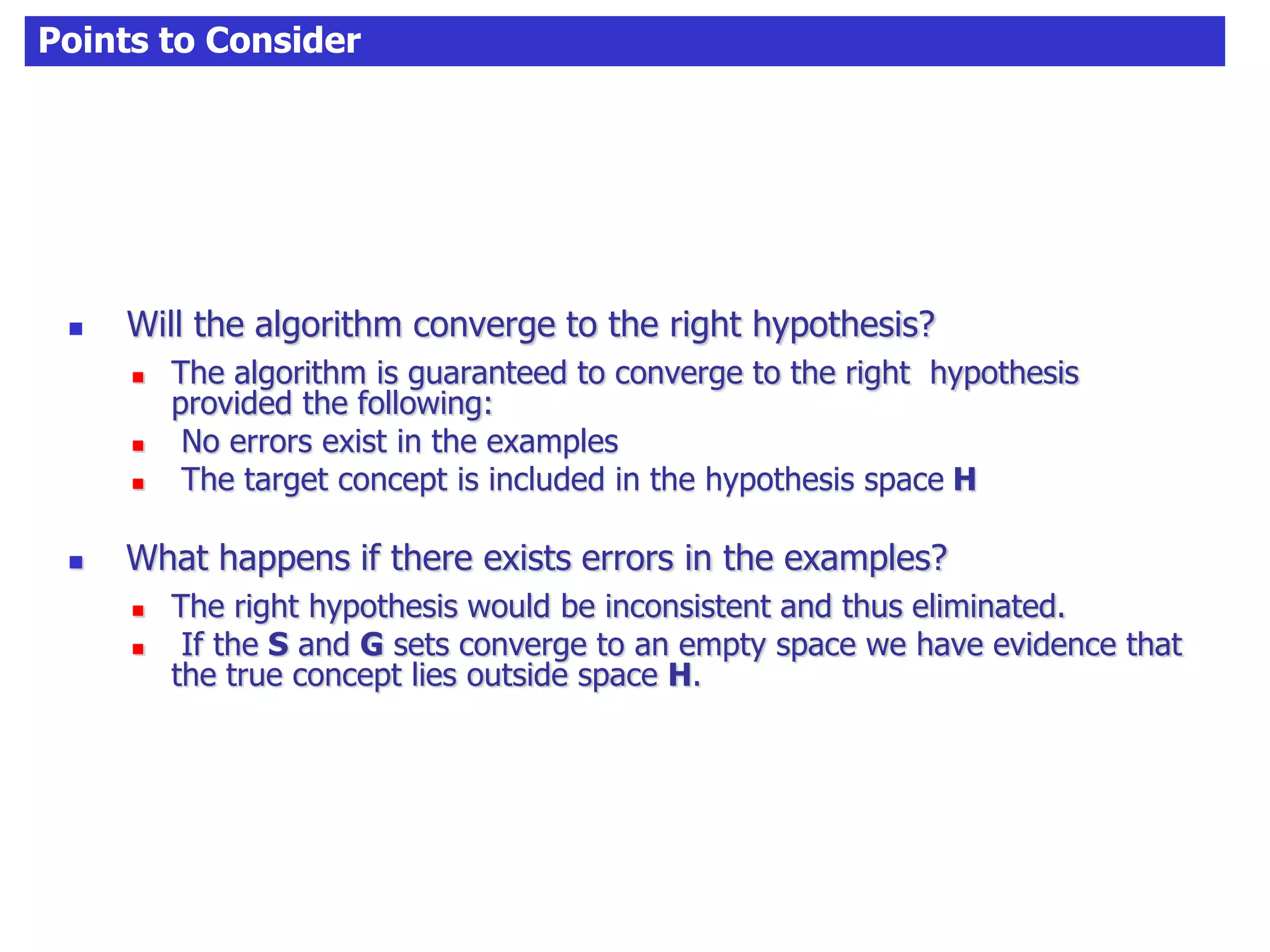
Points to Consider
 Will the algorithm converge to the right hypothesis?
 The algorithm is guaranteed to converge to the right hypothesis
provided the following:
 No errors exist in the examples
 The target concept is included in the hypothesis space H
 What happens if there exists errors in the examples?
 The right hypothesis would be inconsistent and thus eliminated.
 If the S and G sets converge to an empty space we have evidence that
the true concept lies outside space H.
Query Learning
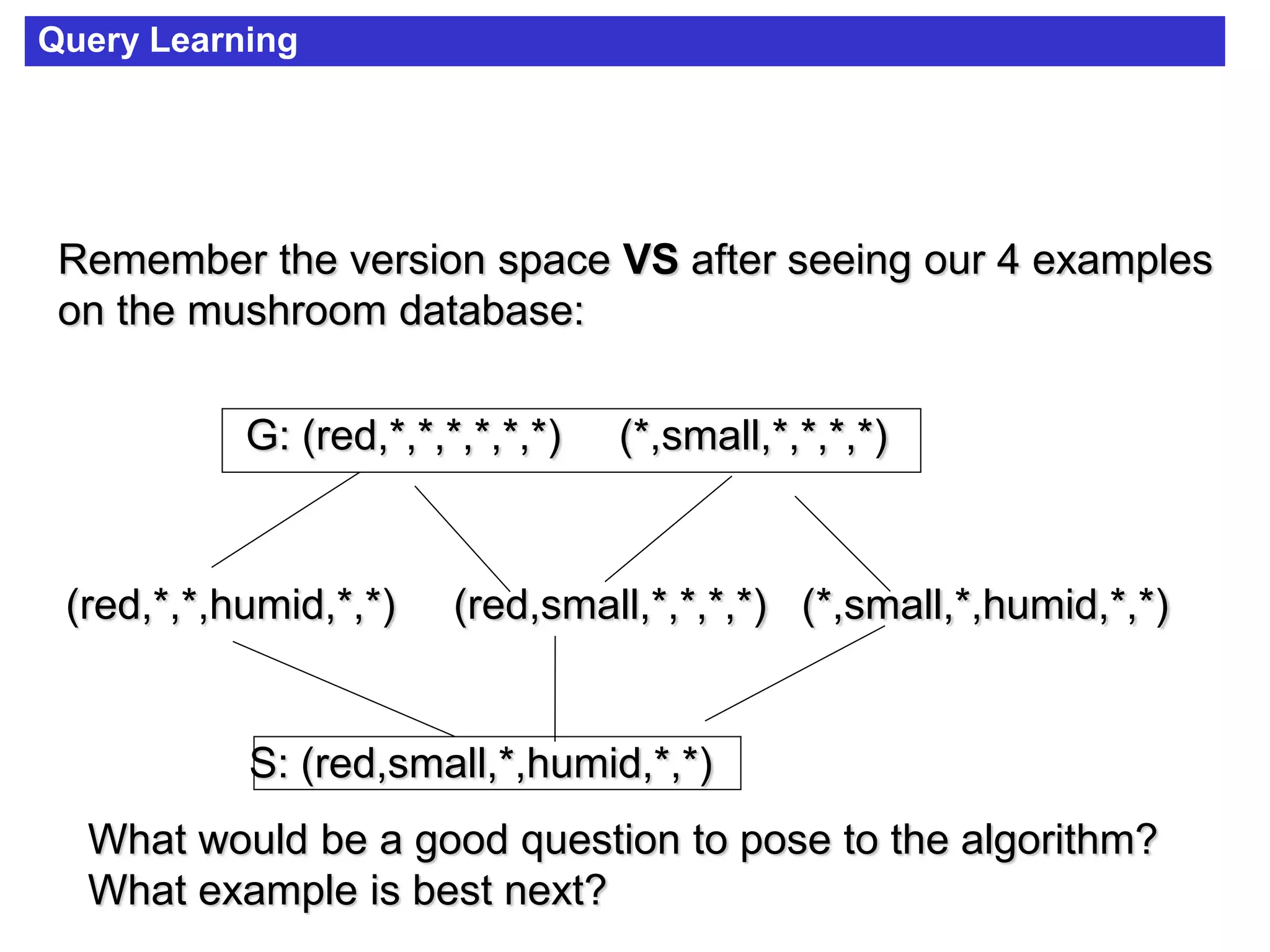
Remember the version space VS after seeing our 4 examples
on the mushroom database:
G: (red,*,*,*,*,*,*) (*,small,*,*,*,*)
S: (red,small,*,humid,*,*)
(red,*,*,humid,*,*) (red,small,*,*,*,*) (*,small,*,humid,*,*)
What would be a good question to pose to the algorithm?
What example is best next?
Query Learning
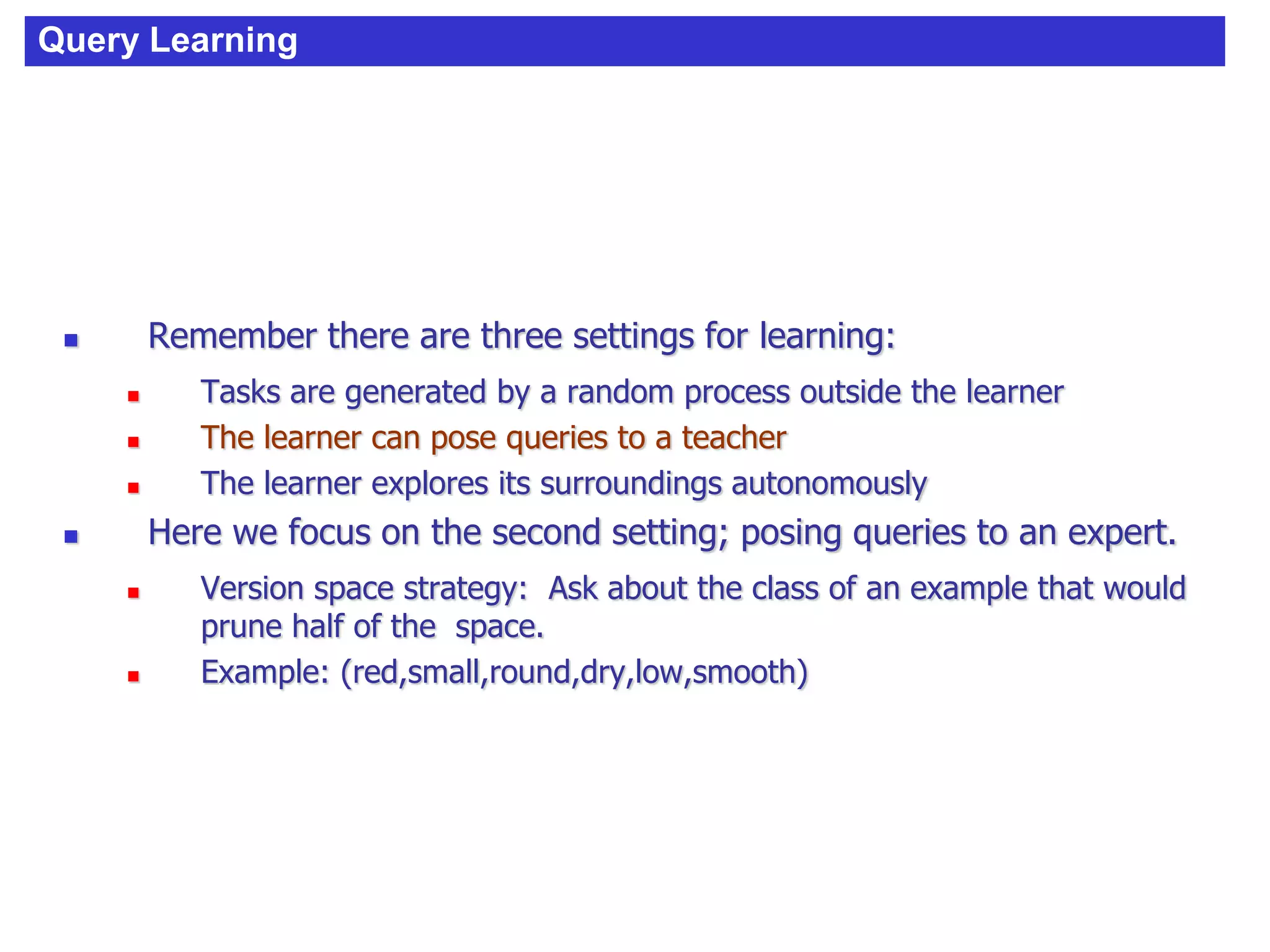
 Remember there are three settings for learning:
 Tasks are generated by a random process outside the learner
 The learner can pose queries to a teacher
 The learner explores its surroundings autonomously
 Here we focus on the second setting; posing queries to an expert.
 Version space strategy: Ask about the class of an example that would
prune half of the space.
 Example: (red,small,round,dry,low,smooth)
Query Learning
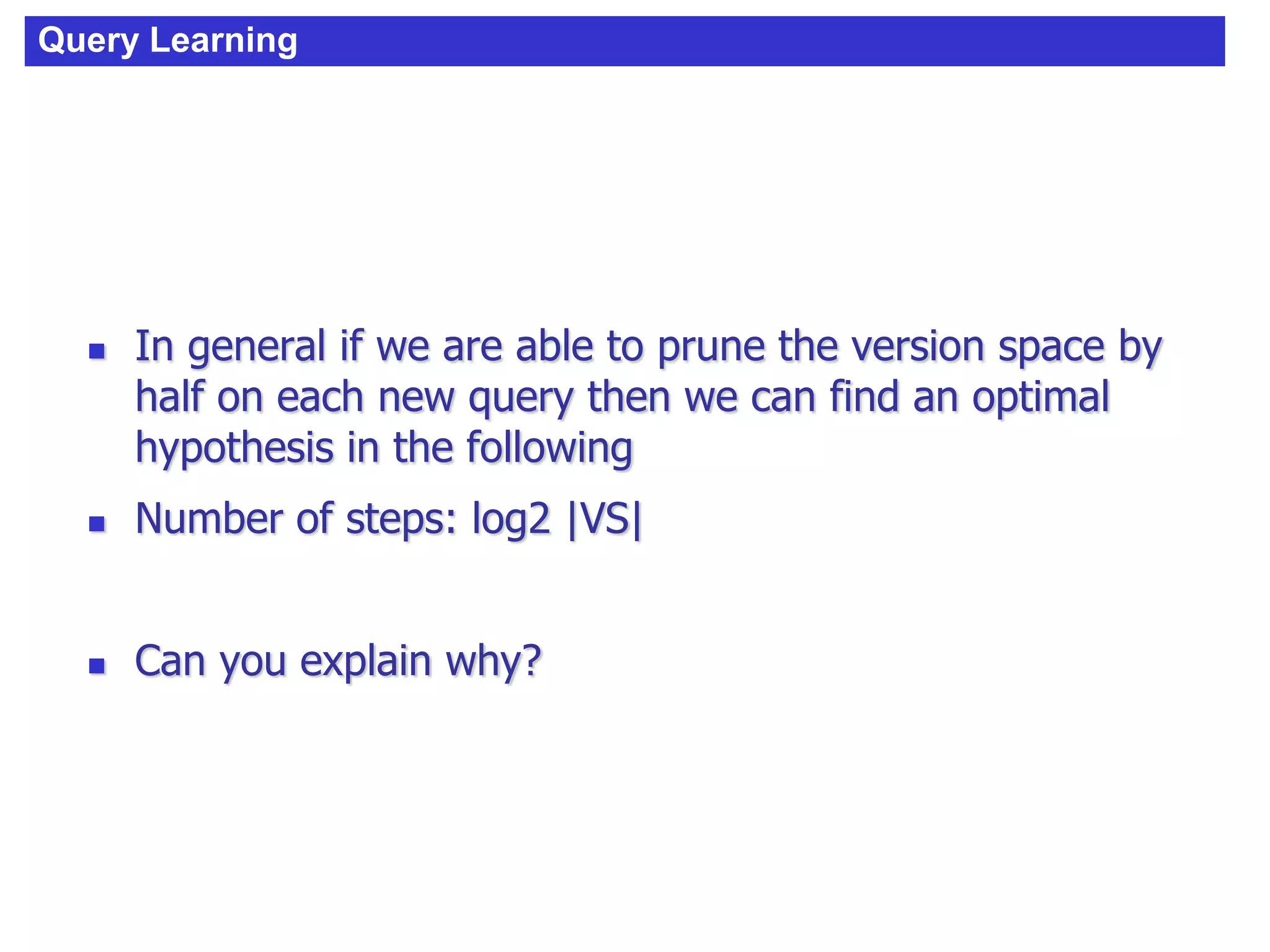
 In general if we are able to prune the version space by
half on each new query then we can find an optimal
hypothesis in the following
 Number of steps: log2 |VS|
 Can you explain why?
Classifying Examples
 What if the version space VS has not collapsed into a
single hypothesis and we are asked to classify a new
instance?
 Suppose all hypotheses in set S agree that the instance is
positive.
 Then we are sure that all hypotheses in VS agree the instance is
positive. Why?
 The same can be said if the instance is negative by all members
of set G. Why?
 In general one can vote over all hypotheses in VS if there
is no unanimous agreement.
Inductive Bias
 Inductive bias is the preference for a hypothesis space H
and a search mechanism over H.
 What would happen if we choose an H that contains all
possible hypotheses?
 What would the size of H be?
 |H| = Size of the power set of the input space X.
 Example:
 You have n Boolean features. |X| = 2n
 And the size of H is 2^2^n
Inductive Bias
In this case, the candidate elimination algorithm would simply
classify as positive the training examples it has seen. This is
because H is so large, every possible hypothesis is contained
within it.
A Property of any Inductive Algorithm:
It must have some embedded assumptions about the
nature of H.
Without assumptions learning is impossible.
Summary
 The candidate elimination algorithm exploits the general-specific
ordering of hypotheses to find all hypotheses consistent with the
training data.
 The version space contains all consistent hypotheses and is simply
represented by two lists: S and G.
 Candidate elimination algorithm is not robust to noise and assumes
the target concept is included in the hypothesis space.
 Any inductive algorithm needs some assumptions about the
hypothesis space, otherwise it would be impossible to perform
predictions.
eduardopoggi@yahoo.com.ar
eduardo-poggi
http://ar.linkedin.com/in/eduardoapoggi
https://www.facebook.com/eduardo.poggi
@eduardoapoggi
Bibliografía
 Capítulo 2 de Mitchell

Poggi analytics - concepts - 1a

  • 1.
    Buenos Aires, abrilde 2016 Eduardo Poggi http://www.shutterstock.com/
  • 2.
    Concept Learning  Definitions Search Space and General-Specific Ordering  Concept learning as search  FIND-S  The Candidate Elimination Algorithm  Inductive Bias
  • 3.
    First definition  Theproblem is to learn a function mapping examples into two classes: positive and negative.  We are given a database of examples already classified as positive or negative.  Concept learning: the process of inducing a function mapping input examples into a Boolean output.
  • 4.
    Notation  Set ofinstances X  Target concept c : X  {+,-}  Training examples E = {(x , c(x))}  Data set D  X  Set of possible hypotheses H  h  H / h : X  {+,-}  Goal: Find h / h(x)=c(x)
  • 5.
    Representation of Examples Features: •color {red, brown, gray} • size {small, large} • shape {round,elongated} • land {humid,dry} • air humidity {low,high} • texture {smooth, rough}
  • 6.
    The Input andOutput Space X Only a small subset is contained in our database. Y = {+,-} X : The space of all possible examples (input space). Y: The space of classes (output space). An example in X is a feature vector X. For instance: X = (red,small,elongated,humid,low,rough) X is the cross product of all feature values.
  • 7.
    The Training Examples D:The set of training examples. D is a set of pairs { (x,c(x)) }, where c is the target concept Example of D: ((red,small,round,humid,low,smooth), +) ((red,small,elongated,humid,low,smooth),+) ((gray,large,elongated,humid,low,rough), -) ((red,small,elongated,humid,high,rough), +) Instances from the input space Instances from the output space
  • 8.
    Hypothesis Representation Consider thefollowing hypotheses: (*,*,*,*,*,*): all mushrooms are poisonous (0,0,0,0,0,0): no mushroom is poisonous Special symbols:  * Any value is acceptable  0 no value is acceptable Any hypothesis h is a function from X to Y h: X Y We will explore the space of conjunctions.
  • 9.
    Hypothesis Space The spaceof all hypotheses is represented by H Let h be a hypothesis in H. Let X be an example of a mushroom. if h(X) = + then X is poisonous, otherwise X is not-poisonous Our goal is to find the hypothesis, h*, that is very “close” to target concept c. A hypothesis is said to “cover” those examples it classifies as positive. X h
  • 10.
    Assumption 1 We willexplore the space of all conjunctions. We assume the target concept falls within this space. Target concept c H
  • 11.
    Assumption 2 A hypothesisclose to target concept c obtained after seeing many training examples will result in high accuracy on the set of unobserved examples. Training set D Hypothesis h* is good Complement set D’ Hypothesis h* is good
  • 12.
    Concept Learning asSearch There is a general to specific ordering inherent to any hypothesis space. Consider these two hypotheses: h1 = (red,*,*,humid,*,*) h2 = (red,*,*,*,*,*) We say h2 is more general than h1 because h2 classifies more instances than h1 and h1 is covered by h2.
  • 13.
    General-Specific For example, considerthe following hypotheses: h1 h2 h3 h1 is more general than h2 and h3. h2 and h3 are neither more specific nor more general than each other.
  • 14.
    Let hj andhk be two hypotheses mapping examples into {+,-}. We say hj is more general than hk iff For all examples X, hk(X) = +  hj(X) = + We represent this fact as hj >= hk The >= relation imposes a partial ordering over the hypothesis space H (reflexive, antisymmetric, and transitive). Definition
  • 15.
    Lattice Any input spaceX defines then a lattice of hypotheses ordered according to the general-specific relation: h1 h3 h4 h2 h5 h6 h7 h8
  • 16.
    Working Example: Mushrooms Classof Tasks: Predicting poisonous mushrooms Performance: Accuracy of Classification Experience: Database describing mushrooms with their class Knowledge to learn: Function mapping mushrooms to {+,-} where -:not-poisonous and +:poisonous Representation of target knowledge: conjunction of attribute values. Learning mechanism: Find-S
  • 17.
    Finding a Maximally-SpecificHypothesis Algorithm to search the space of conjunctions:  Start with the most specific hypothesis  Generalize the hypothesis when it fails to cover a positive example Algorithm: 1. Initialize h to the most specific hypothesis 2. For each positive training example X For each value a in h If example X and h agree on a, do nothing else generalize a by the next more general constraint 3. Output hypothesis h
  • 18.
    Example Let’s run thelearning algorithm above with the following examples: ((red,small,round,humid,low,smooth), +) ((red,small,elongated,humid,low,smooth),+) ((gray,large,elongated,humid,low,rough), -) ((red,small,elongated,humid,high,rough), +) We start with the most specific hypothesis: h = (0,0,0,0,0,0) The first example comes and since the example is positive and h fails to cover it, we simply generalize h to cover exactly this example: h = (red,small,round,humid,low,smooth)
  • 19.
    Example Hypothesis h basicallysays that the first example is the only positive example, all other examples are negative. Then comes examples 2: ((red,small,elongated,humid,low,smooth), poisonous) This example is positive. All attributes match hypothesis h except for attribute shape: it has the value elongated, not round. We generalize this attribute using symbol * yielding: h: (red,small,*,humid,low,smooth) The third example is negative and so we just ignore it. Why is it we don’t need to be concerned with negative examples?
  • 20.
    Example Upon observing the4th example, hypothesis h is generalized to the following: h = (red,small,*,humid,*,*) h is interpreted as any mushroom that is red, small and found on humid land should be classified as poisonous.
  • 21.
    Analyzing the Algorithm •The algorithm is guaranteed to find the hypothesis that is most specific and consistent with the set of training examples. • It takes advantage of the general-specific ordering to move on the corresponding lattice searching for the next most specific hypothesis. h1 h3 h4 h2 h5 h6 h7 h8
  • 22.
  • 23.
  • 24.
    Points to Consider There are many hypotheses consistent with the training data D.  Why should we prefer the most specific hypothesis?  What would happen if the examples are not consistent?  What would happen if they have errors, noise?  What if there is a hypothesis space H where one can find more that one maximally specific hypothesis h?  The search over the lattice must then be different to allow for this possibility.
  • 25.
    Summary FIND-S  Theinput space is the space of all examples; the output space is the space of all classes.  A hypothesis maps examples into classes.  We want a hypothesis close to target concept c.  The input space establishes a partial ordering over the hypothesis space.  One can exploit this ordering to move along the corresponding lattice.
  • 26.
    Working Example: Mushrooms Classof Tasks: Predicting poisonous mushrooms Performance: Accuracy of Classification Experience: Database describing mushrooms with their class Knowledge to learn: Function mapping mushrooms to {+,-} where -:not-poisonous and +:poisonous Representation of target knowledge: conjunction of attribute values. Learning mechanism: candidate-elimination
  • 27.
    Candidate Elimination  Thealgorithm that finds the maximally specific hypothesis is limited in that it only finds one of many hypotheses consistent with the training data.  The Candidate Elimination Algorithm (CEA) finds ALL hypotheses consistent with the training data.  CEA does that without explicitly enumerating all consistent hypotheses.
  • 28.
    Consistency vs Coverage h1 h2 h1covers a different set of examples than h2 h2 is consistent with training set D h1 is not consistent with training set D Positive examples Negative examples Training set D - - - - + + ++ + + +
  • 29.
    Version Space VS Hypothesisspace H Version space: Subset of hypothesis from H consistent with training set D.
  • 30.
    List-Then-Eliminate Algorithm Algorithm: 1. VersionSpace VS: All hypotheses in H 2. For each training example X Remove every hypothesis h in H inconsistent with X: h(x) = c(x) 3. Output the version space VS Comments: This is unfeasible. The size of H is unmanageable.
  • 31.
    Previous Exercise: Mushrooms Let’sremember our exercise in which we tried to classify mushrooms as poisonous (+) or not-poisonous (-). Training set D: ((red,small,round,humid,low,smooth), +) ((red,small,elongated,humid,low,smooth), +) ((gray,large,elongated,humid,low,rough), -) ((red,small,elongated,humid,high,rough), +)
  • 32.
    Consistent Hypotheses Our firstalgorithm found only one out of six consistent hypotheses: (red,small,*,humid,*,*) (*,small,*,humid,*,*)(red,*,*,humid,*,*) (red,small,*,*,*,*) (red,*,*,*,*,*) (*,small,*,*,*,*)G: S: S: Most specific G: Most general
  • 33.
    Candidate-Elimination Algorithm (red,small,*,humid,*,*) (red,*,*,*,*,*)(*,small,*,*,*,*)G: S: The candidateelimination algorithm keeps two lists of hypotheses consistent with the training data: The list of most specific hypotheses S and The list of most general hypotheses G This is enough to derive the whole version space VS. VS
  • 34.
    Candidate-Elimination Algorithm • InitializeG to the set of maximally general hypotheses in H • Initialize S to the set of maximally specific hypotheses in H • For each training example X do • If X is positive: generalize S if necessary • If X is negative: specialize G if necessary • Output {G,S}
  • 35.
    Candidate-Elimination Algorithm  InitializeG to the set of maximally general hypotheses in H  Initialize S to the set of maximally specific hypotheses in H  For each training example d, do  If d+  Remove from G any hypothesis inconsistent with d  For each hypothesis s in S that is not consistent with d  Remove s from S  Add to S all minimal generalizations h of s such that h is consistent with d and some member of G is more general than h  Remove from S any hipothesis that is more general than another hypothesis in S  If d-  Remove from S any hypothesis inconsistent with d  For each hypothesis g in G that is not consistent with d  Remove g from G  Add to G all minimal specializations h of g such that h is consistent with d and some member of S is more general than h  Remove from G any hipothesis that is less general than another hypothesis in G
  • 36.
    Positive Examples a) IfX is positive:  Remove from G any hypothesis inconsistent with X  For each hypothesis h in S not consistent with X  Remove h from S  Add all minimal generalizations of h consistent with X such that some member of G is more general than h  Remove from S any hypothesis more general than any other hypothesis in S G: S: h inconsistent add minimal generalizations
  • 37.
    Negative Examples b) IfX is negative: Remove from S any hypothesis inconsistent with X For each hypothesis h in G not consistent with X Remove g from G Add all minimal generalizations of h consistent with X such that some member of S is more specific than h Remove from G any hypothesis less general than any other hypothesis in G G: S: h inconsistent add minimal specializations
  • 38.
    An Exercise Initialize theS and G sets: S: (0,0,0,0,0,0) G: (*,*,*,*,*,*) Let’s look at the first two examples: ((red,small,round,humid,low,smooth), +) ((red,small,elongated,humid,low,smooth), +)
  • 39.
    An Exercise: twopositives The first two examples are positive: ((red,small,round,humid,low,smooth), +) ((red,small,elongated,humid,low,smooth), +) S: (0,0,0,0,0,0) (red,small,round,humid,low,smooth) (red,small,*,humid,low,smooth) G: (*,*,*,*,*,*) generalize specialize
  • 40.
    An Exercise: firstnegative The third example is a negative example: ((gray,large,elongated,humid,low,rough), -) S:(red,small,*,humid,low,smooth) G: (*,*,*,*,*,*) generalize specialize (red,*,*,*,*,*,*) (*,small,*,*,*,*) (*,*,*,*,*,smooth) Why is (*,*,round,*,*,*) not a valid specialization of G
  • 41.
    An Exercise: anotherpositive The fourth example is a positive example: ((red,small,elongated,humid,high,rough), +) S:(red,small,*,humid,low,smooth) generalize specialize G: (red,*,*,*,*,*,*) (*,small,*,*,*,*) (*,*,*,*,*,smooth) (red,small,*,humid,*,*)
  • 42.
    The Learned VersionSpace VS G: (red,*,*,*,*,*,*) (*,small,*,*,*,*) S: (red,small,*,humid,*,*) (red,*,*,humid,*,*) (red,small,*,*,*,*) (*,small,*,humid,*,*)
  • 43.
    Points to Consider Will the algorithm converge to the right hypothesis?  The algorithm is guaranteed to converge to the right hypothesis provided the following:  No errors exist in the examples  The target concept is included in the hypothesis space H  What happens if there exists errors in the examples?  The right hypothesis would be inconsistent and thus eliminated.  If the S and G sets converge to an empty space we have evidence that the true concept lies outside space H.
  • 44.
    Query Learning Remember theversion space VS after seeing our 4 examples on the mushroom database: G: (red,*,*,*,*,*,*) (*,small,*,*,*,*) S: (red,small,*,humid,*,*) (red,*,*,humid,*,*) (red,small,*,*,*,*) (*,small,*,humid,*,*) What would be a good question to pose to the algorithm? What example is best next?
  • 45.
    Query Learning  Rememberthere are three settings for learning:  Tasks are generated by a random process outside the learner  The learner can pose queries to a teacher  The learner explores its surroundings autonomously  Here we focus on the second setting; posing queries to an expert.  Version space strategy: Ask about the class of an example that would prune half of the space.  Example: (red,small,round,dry,low,smooth)
  • 46.
    Query Learning  Ingeneral if we are able to prune the version space by half on each new query then we can find an optimal hypothesis in the following  Number of steps: log2 |VS|  Can you explain why?
  • 47.
    Classifying Examples  Whatif the version space VS has not collapsed into a single hypothesis and we are asked to classify a new instance?  Suppose all hypotheses in set S agree that the instance is positive.  Then we are sure that all hypotheses in VS agree the instance is positive. Why?  The same can be said if the instance is negative by all members of set G. Why?  In general one can vote over all hypotheses in VS if there is no unanimous agreement.
  • 48.
    Inductive Bias  Inductivebias is the preference for a hypothesis space H and a search mechanism over H.  What would happen if we choose an H that contains all possible hypotheses?  What would the size of H be?  |H| = Size of the power set of the input space X.  Example:  You have n Boolean features. |X| = 2n  And the size of H is 2^2^n
  • 49.
    Inductive Bias In thiscase, the candidate elimination algorithm would simply classify as positive the training examples it has seen. This is because H is so large, every possible hypothesis is contained within it. A Property of any Inductive Algorithm: It must have some embedded assumptions about the nature of H. Without assumptions learning is impossible.
  • 50.
    Summary  The candidateelimination algorithm exploits the general-specific ordering of hypotheses to find all hypotheses consistent with the training data.  The version space contains all consistent hypotheses and is simply represented by two lists: S and G.  Candidate elimination algorithm is not robust to noise and assumes the target concept is included in the hypothesis space.  Any inductive algorithm needs some assumptions about the hypothesis space, otherwise it would be impossible to perform predictions.
  • 51.
  • 52.

Editor's Notes

  • #3 What is machine learning*
  • #4 What is machine learning?
  • #6 What is machine learning?
  • #7 What is machine learning?
  • #8 What is machine learning?
  • #9 What is machine learning?
  • #10 What is machine learning?
  • #11 What is machine learning?
  • #12 What is machine learning?
  • #13 What is machine learning?
  • #14 What is machine learning?
  • #15 What is machine learning?
  • #16 What is machine learning?
  • #17 What is machine learning?
  • #18 What is machine learning?
  • #19 What is machine learning?
  • #20 What is machine learning?
  • #21 What is machine learning?
  • #22 What is machine learning?
  • #25 What is machine learning?
  • #26 What is machine learning?
  • #27 What is machine learning?
  • #28 What is machine learning*
  • #29 What is machine learning*
  • #30 What is machine learning*
  • #31 What is machine learning*
  • #32 What is machine learning*
  • #33 What is machine learning*
  • #34 What is machine learning*
  • #35 What is machine learning*
  • #37 What is machine learning*
  • #38 What is machine learning*
  • #39 What is machine learning*
  • #40 What is machine learning*
  • #41 What is machine learning*
  • #42 What is machine learning*
  • #43 What is machine learning*
  • #44 What is machine learning*
  • #45 What is machine learning*
  • #46 What is machine learning*
  • #47 What is machine learning*
  • #48 What is machine learning*
  • #49 What is machine learning*
  • #50 What is machine learning*
  • #51 What is machine learning*
  • #52 51