On the deductive closure of a partially ordered
propositional belief base
Claudette Cayrol Didier Dubois Fayçal Touazi
IRIT, University of Toulouse, France.
Juin 2014
JIAF
C. Cayrol, D. Dubois, F. Touazi (IRIT) 1 Juin 2014 1 / 34
Outline
1 Introduction
2 Background on Possibilistic logic
3 Semantics for partially ordered bases
4 A sound and complete approach to deduction with partially ordered
bases
5 Comparison with symbolic possibilistic approach
6 Related works
7 Conclusion
Outline
1 Introduction
2 Background on Possibilistic logic
3 Semantics for partially ordered bases
4 A sound and complete approach to deduction with partially ordered
bases
5 Comparison with symbolic possibilistic approach
6 Related works
7 Conclusion
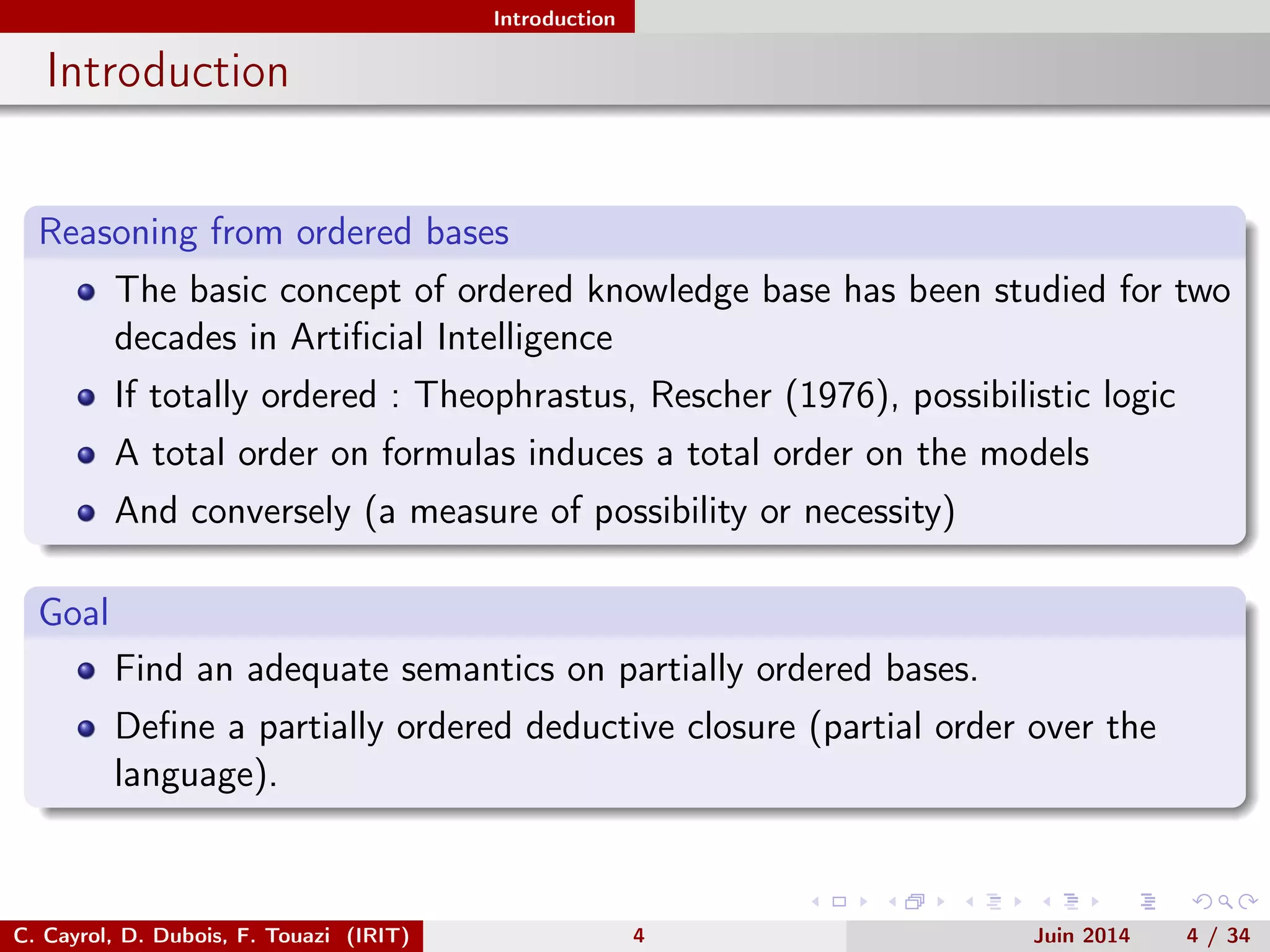
Introduction
Introduction
Reasoning from ordered bases
The basic concept of ordered knowledge base has been studied for two
decades in Artificial Intelligence
If totally ordered : Theophrastus, Rescher (1976), possibilistic logic
A total order on formulas induces a total order on the models
And conversely (a measure of possibility or necessity)
Goal
Find an adequate semantics on partially ordered bases.
Define a partially ordered deductive closure (partial order over the
language).
C. Cayrol, D. Dubois, F. Touazi (IRIT) 4 Juin 2014 4 / 34
Introduction
Motivating example
Example 1
We suppose this knowledge base :
φ1 = If Bernard comes to the meeting, Léa don’t come
φ2 = Bernard come to the meeting
φ3 = If CLoé comes, it is certain that the meeting will not be quiet
φ4 = Cloé should come
φ5 = If Philippe comes to the meeting and Léa don’t come, it is
almost certain that the meeting will not be quiet
φ6 = It is almost certain that Léa or Pierre come
φ7 = If Pierre come, it is certain that Philippe come
We know that φ1 > {φ3, φ6} > φ7,φ2 > {φ3, φ6} > φ7 and φ5 > φ7.
C. Cayrol, D. Dubois, F. Touazi (IRIT) 5 Juin 2014 5 / 34
Outline
1 Introduction
2 Background on Possibilistic logic
3 Semantics for partially ordered bases
4 A sound and complete approach to deduction with partially ordered
bases
5 Comparison with symbolic possibilistic approach
6 Related works
7 Conclusion
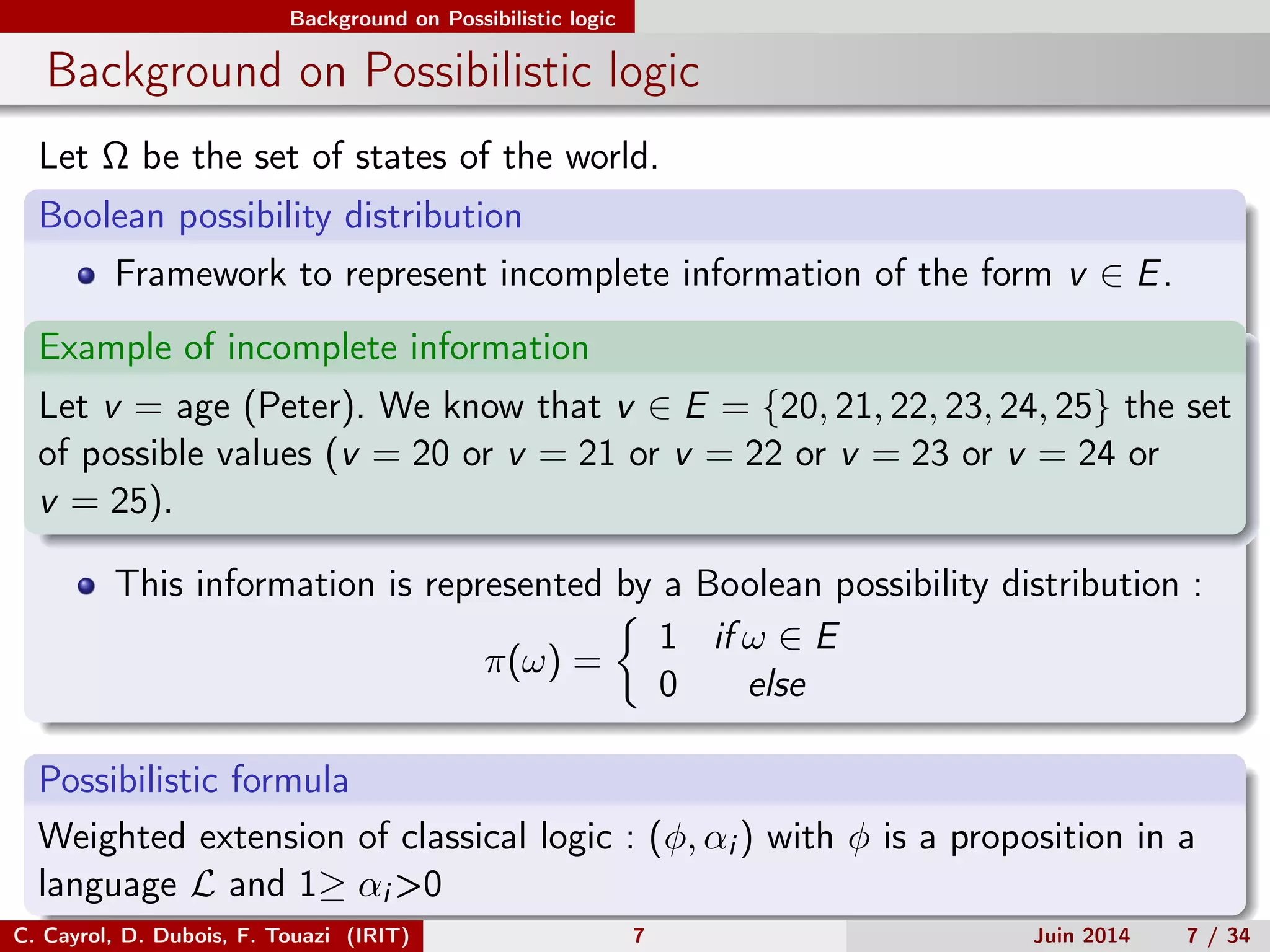
Background on Possibilistic logic
Let Ω be the set of states of the world.
Boolean possibility distribution
Framework to represent incomplete information of the form v ∈ E.
Example of incomplete information
Let v = age (Peter). We know that v ∈ E = {20, 21, 22, 23, 24, 25} the set
of possible values (v = 20 or v = 21 or v = 22 or v = 23 or v = 24 or
v = 25).
This information is represented by a Boolean possibility distribution :
π(ω) =
1 if ω ∈ E
0 else
Possibilistic formula
Weighted extension of classical logic : (φ, αi ) with φ is a proposition in a
language L and 1≥ αi >0
C. Cayrol, D. Dubois, F. Touazi (IRIT) 7 Juin 2014 7 / 34
Background on Possibilistic logic
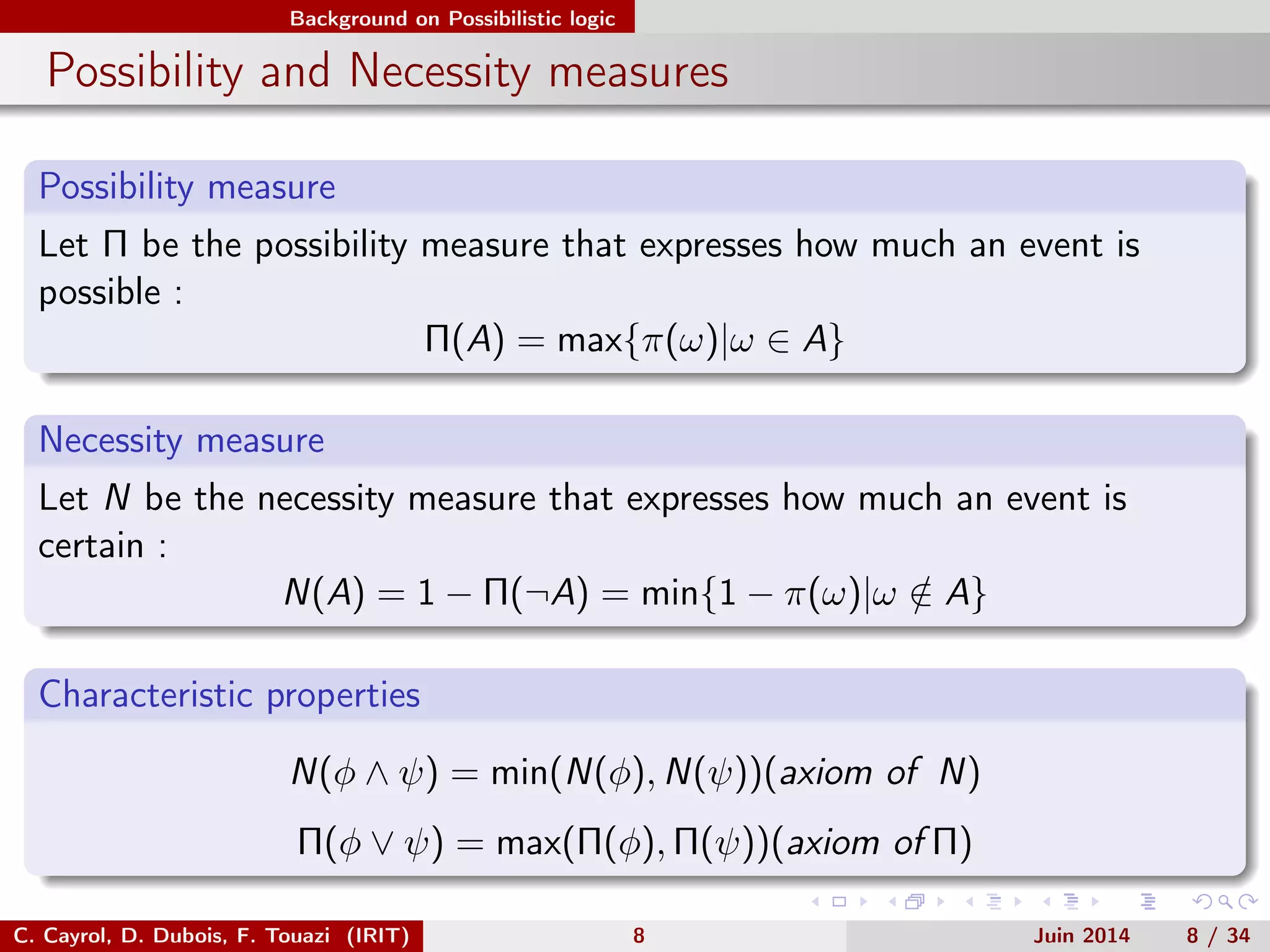
Possibility and Necessity measures
Possibility measure
Let Π be the possibility measure that expresses how much an event is
possible :
Π(A) = max{π(ω)|ω ∈ A}
Necessity measure
Let N be the necessity measure that expresses how much an event is
certain :
N(A) = 1 − Π(¬A) = min{1 − π(ω)|ω /∈ A}
Characteristic properties
N(φ ∧ ψ) = min(N(φ), N(ψ))(axiom of N)
Π(φ ∨ ψ) = max(Π(φ), Π(ψ))(axiom of Π)
C. Cayrol, D. Dubois, F. Touazi (IRIT) 8 Juin 2014 8 / 34
Background on Possibilistic logic
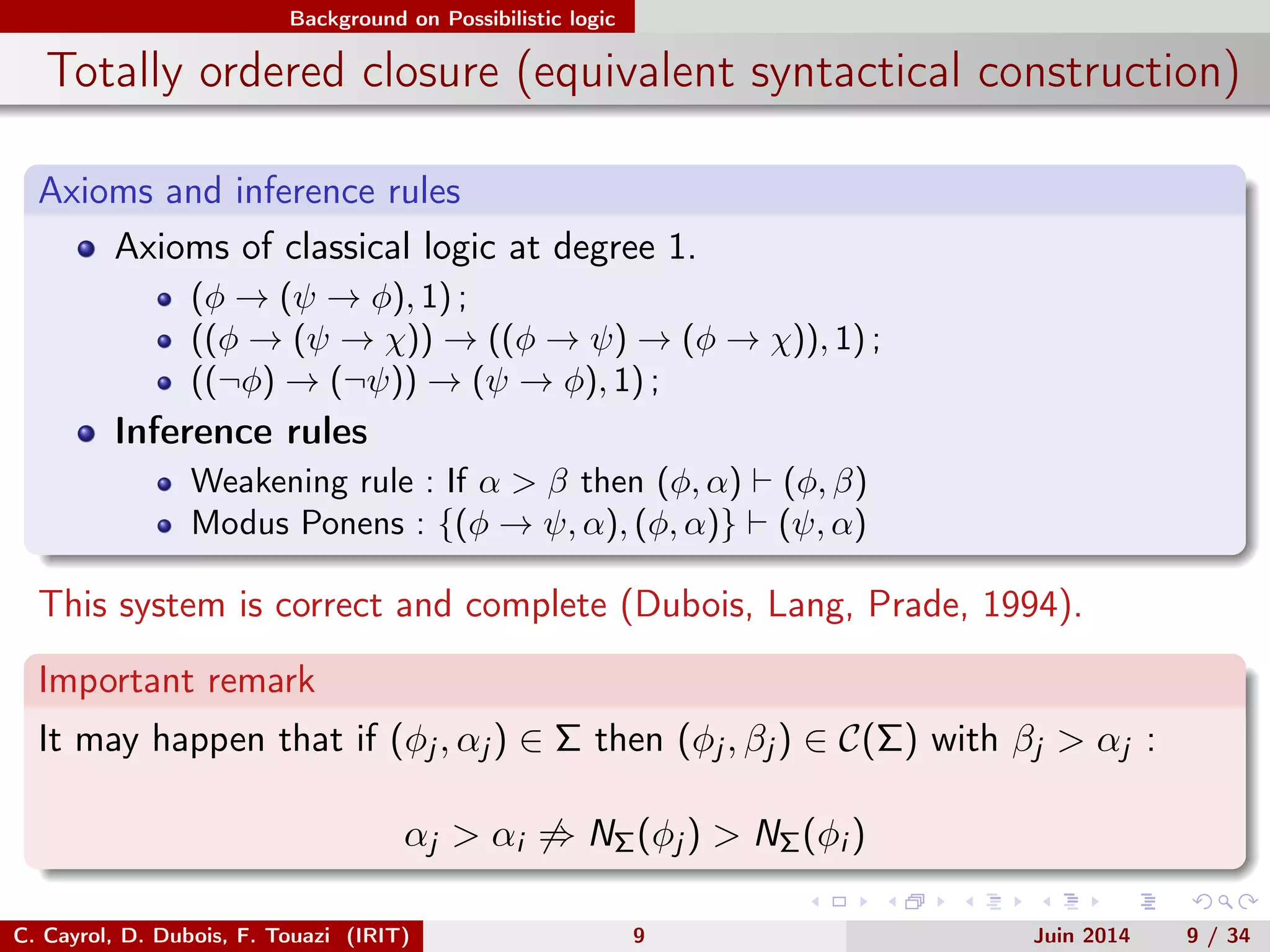
Totally ordered closure (equivalent syntactical construction)
Axioms and inference rules
Axioms of classical logic at degree 1.
(φ → (ψ → φ), 1) ;
((φ → (ψ → χ)) → ((φ → ψ) → (φ → χ)), 1) ;
((¬φ) → (¬ψ)) → (ψ → φ), 1) ;
Inference rules
Weakening rule : If α > β then (φ, α) (φ, β)
Modus Ponens : {(φ → ψ, α), (φ, α)} (ψ, α)
This system is correct and complete (Dubois, Lang, Prade, 1994).
Important remark
It may happen that if (φj , αj ) ∈ Σ then (φj , βj ) ∈ C(Σ) with βj > αj :
αj > αi ⇒ NΣ(φj ) > NΣ(φi )
C. Cayrol, D. Dubois, F. Touazi (IRIT) 9 Juin 2014 9 / 34
Outline
1 Introduction
2 Background on Possibilistic logic
3 Semantics for partially ordered bases
4 A sound and complete approach to deduction with partially ordered
bases
5 Comparison with symbolic possibilistic approach
6 Related works
7 Conclusion
Semantics for partially ordered bases
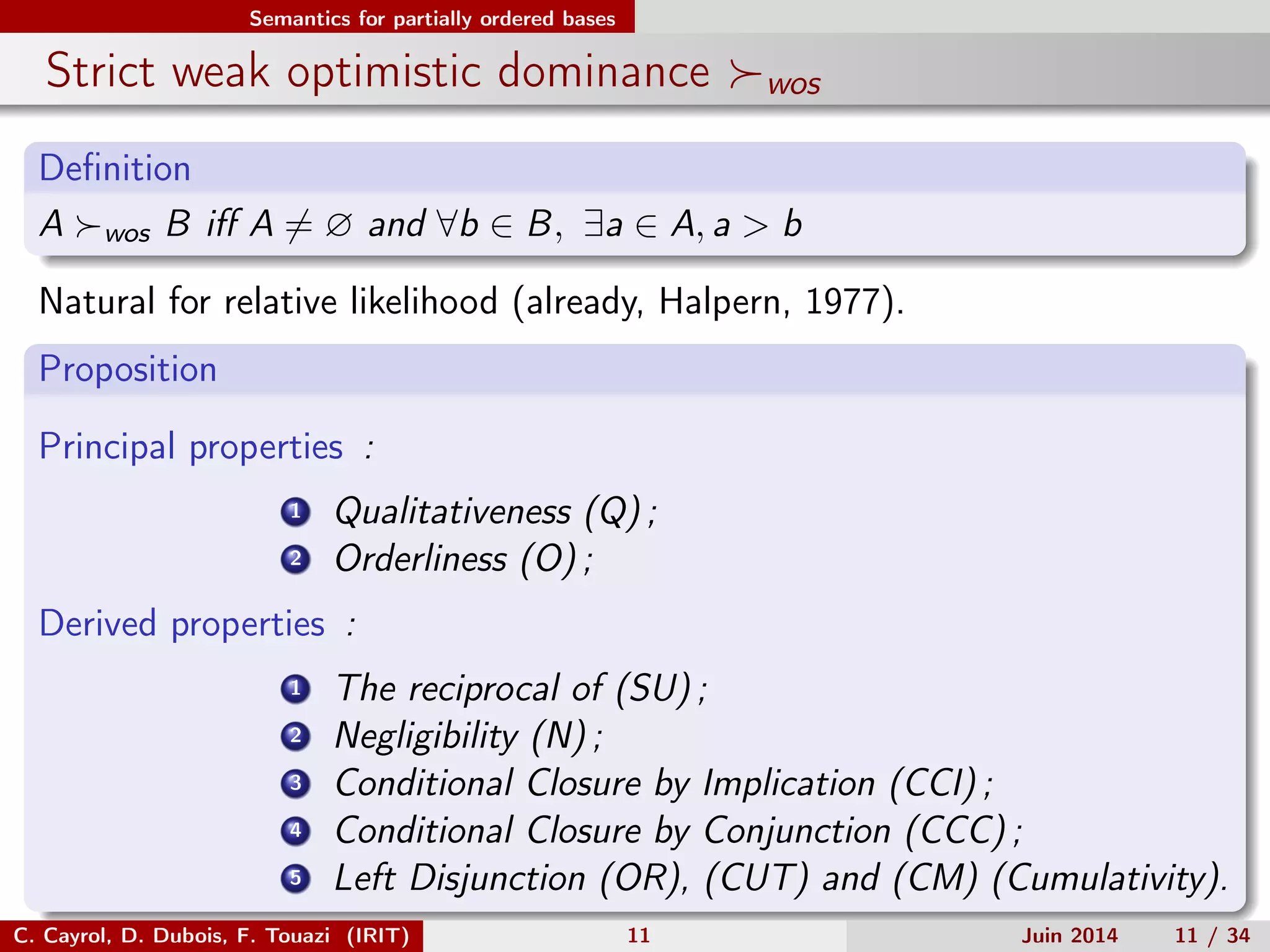
Strict weak optimistic dominance wos
Definition
A wos B iff A = ∅ and ∀b ∈ B, ∃a ∈ A, a > b
Natural for relative likelihood (already, Halpern, 1977).
Proposition
Principal properties :
1 Qualitativeness (Q) ;
2 Orderliness (O) ;
Derived properties :
1 The reciprocal of (SU) ;
2 Negligibility (N) ;
3 Conditional Closure by Implication (CCI) ;
4 Conditional Closure by Conjunction (CCC) ;
5 Left Disjunction (OR), (CUT) and (CM) (Cumulativity).
C. Cayrol, D. Dubois, F. Touazi (IRIT) 11 Juin 2014 11 / 34
Semantics for partially ordered bases
Syntax and notations
Let L be a propositional language, K ⊂ L a finite set of formulas equiped
with a partial order >.
(K, >) is a set of constraints of the form φ > ψ ;
If φ, ψ ∈ K, φ > ψ is interpreted as " φ is preferred to ψ " (more
certain, higher priority) ;
K(ω) denotes the subset of formulas in K satisfied by the
interpretation ω ∈ Ω ; hence K(ω) is the subset of propositions
falsified by ω ∈ Ω ;
[φ] denotes the set of the models of φ, a subset of Ω.
C. Cayrol, D. Dubois, F. Touazi (IRIT) 12 Juin 2014 12 / 34
Semantics for partially ordered bases
Deductive closure based on the optimistic relation
Definition
From (K, >) to (Ω, ) ∀ω, ω ∈ Ω, ω ω iff K(ω ) >wos K(ω) iff
∀ψ ∈ K(ω), ∃φ ∈ K(ω ), φ > ψ
From (Ω, ) to (L, N) ∀φ, ψ ∈ L, φ N ψ iff [ψ] wos [φ] iff
∀ω ∈ [φ], ∃ω ∈ [ψ], ω ω .
These definitions interpret (K, >) as a certainty ordering, in agreement
with possibilistic logic.
Deductive closure of a partially ordered base
The partially ordered deductive closure of (K, >) can be defined by
C(K, >) N
= {(φ, ψ) ∈ L2
: φ N ψ}.
And we denote (φ, ψ) ∈ C(K, >) N
by K |=wos φ N ψ.
C. Cayrol, D. Dubois, F. Touazi (IRIT) 13 Juin 2014 13 / 34
Semantics for partially ordered bases
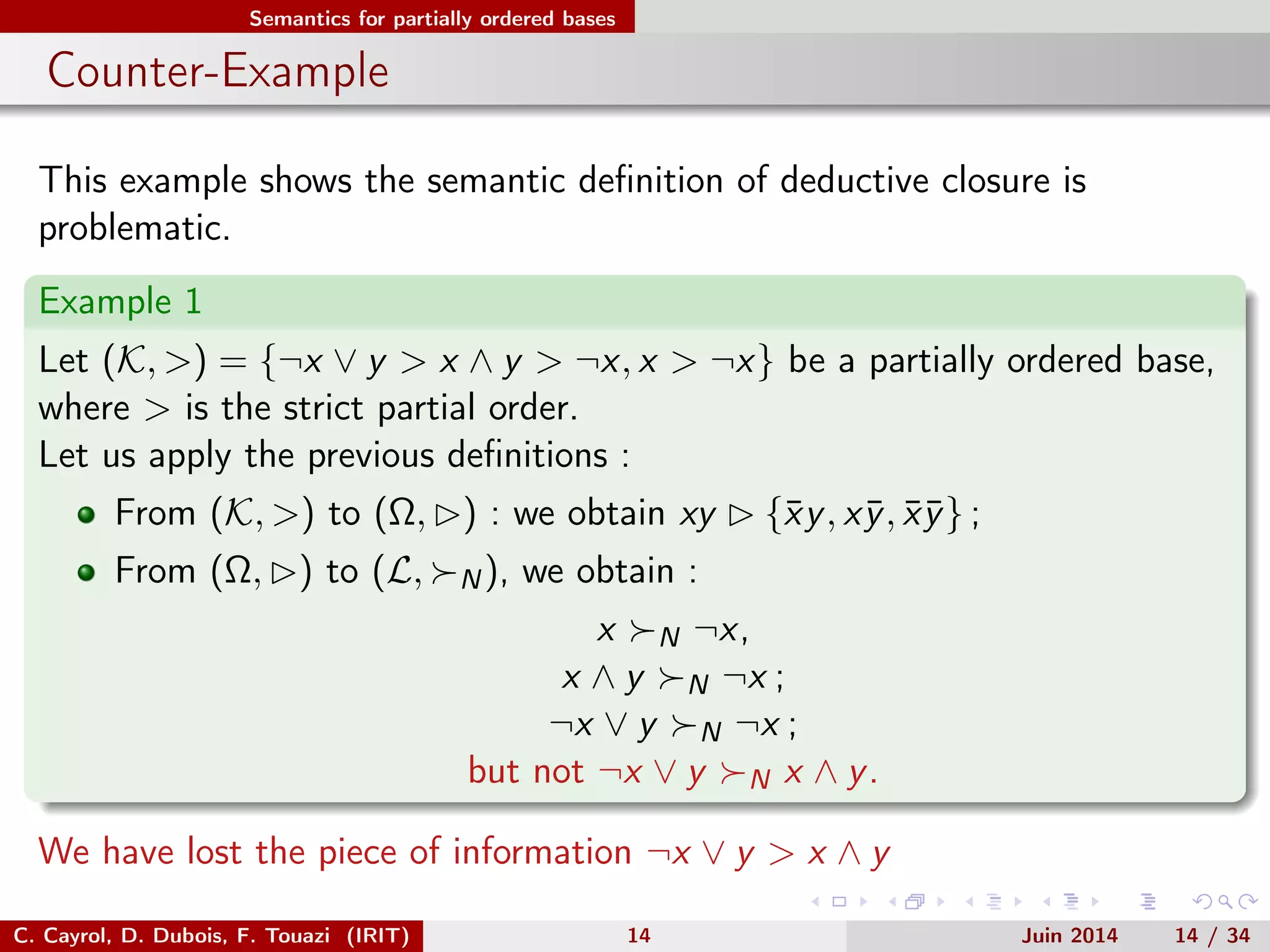
Counter-Example
This example shows the semantic definition of deductive closure is
problematic.
Example 1
Let (K, >) = {¬x ∨ y > x ∧ y > ¬x, x > ¬x} be a partially ordered base,
where > is the strict partial order.
Let us apply the previous definitions :
From (K, >) to (Ω, ) : we obtain xy {¯xy, x¯y, ¯x¯y} ;
From (Ω, ) to (L, N), we obtain :
x N ¬x,
x ∧ y N ¬x ;
¬x ∨ y N ¬x ;
but not ¬x ∨ y N x ∧ y.
We have lost the piece of information ¬x ∨ y > x ∧ y
C. Cayrol, D. Dubois, F. Touazi (IRIT) 14 Juin 2014 14 / 34
Semantics for partially ordered bases
What is wrong
Let us interpret the partial order of K as stemming from a partial order
on interpretations, via wos :
[x ∧ y] wos [¬x ∨ ¬y] ;
[¬x] wos [x ∧ y] ;
[¬x] wos [x].
It is easy to see that these constraints imply that :
xy {¯xy, x¯y, ¯x¯y}
(¯xy x¯y) ∨ (¯x¯y x¯y) (a disjunctive constraint)
Problem
More informative than the constraint on the partial order , but the
disjunction is not representable via a single partial order.
C. Cayrol, D. Dubois, F. Touazi (IRIT) 15 Juin 2014 15 / 34
Outline
1 Introduction
2 Background on Possibilistic logic
3 Semantics for partially ordered bases
4 A sound and complete approach to deduction with partially ordered
bases
5 Comparison with symbolic possibilistic approach
6 Related works
7 Conclusion
A sound and complete approach to deduction with partially
ordered bases
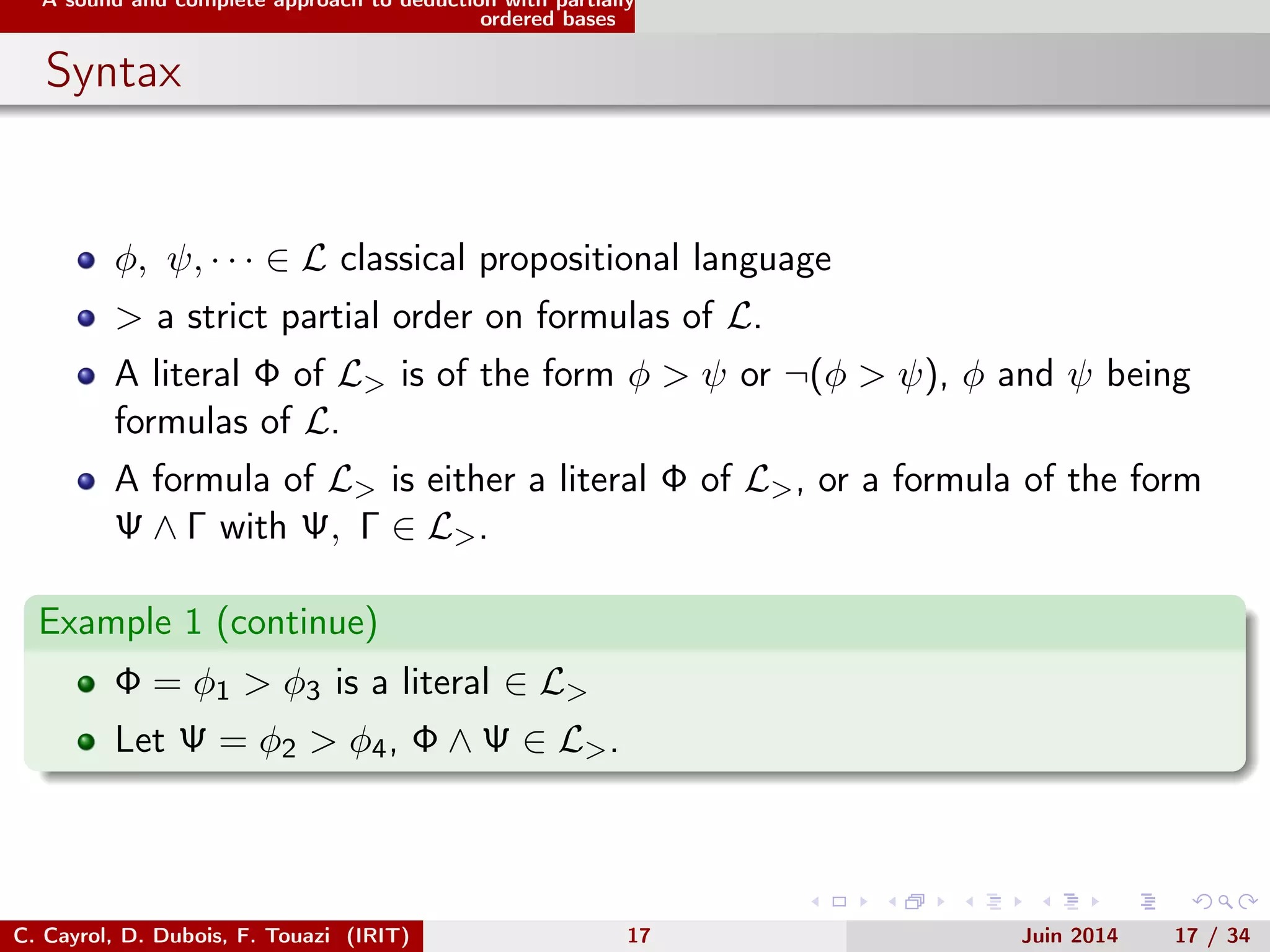
Syntax
φ, ψ, · · · ∈ L classical propositional language
> a strict partial order on formulas of L.
A literal Φ of L> is of the form φ > ψ or ¬(φ > ψ), φ and ψ being
formulas of L.
A formula of L> is either a literal Φ of L>, or a formula of the form
Ψ ∧ Γ with Ψ, Γ ∈ L>.
Example 1 (continue)
Φ = φ1 > φ3 is a literal ∈ L>
Let Ψ = φ2 > φ4, Φ ∧ Ψ ∈ L>.
C. Cayrol, D. Dubois, F. Touazi (IRIT) 17 Juin 2014 17 / 34
A sound and complete approach to deduction with partially
ordered bases
Axioms and inference rules
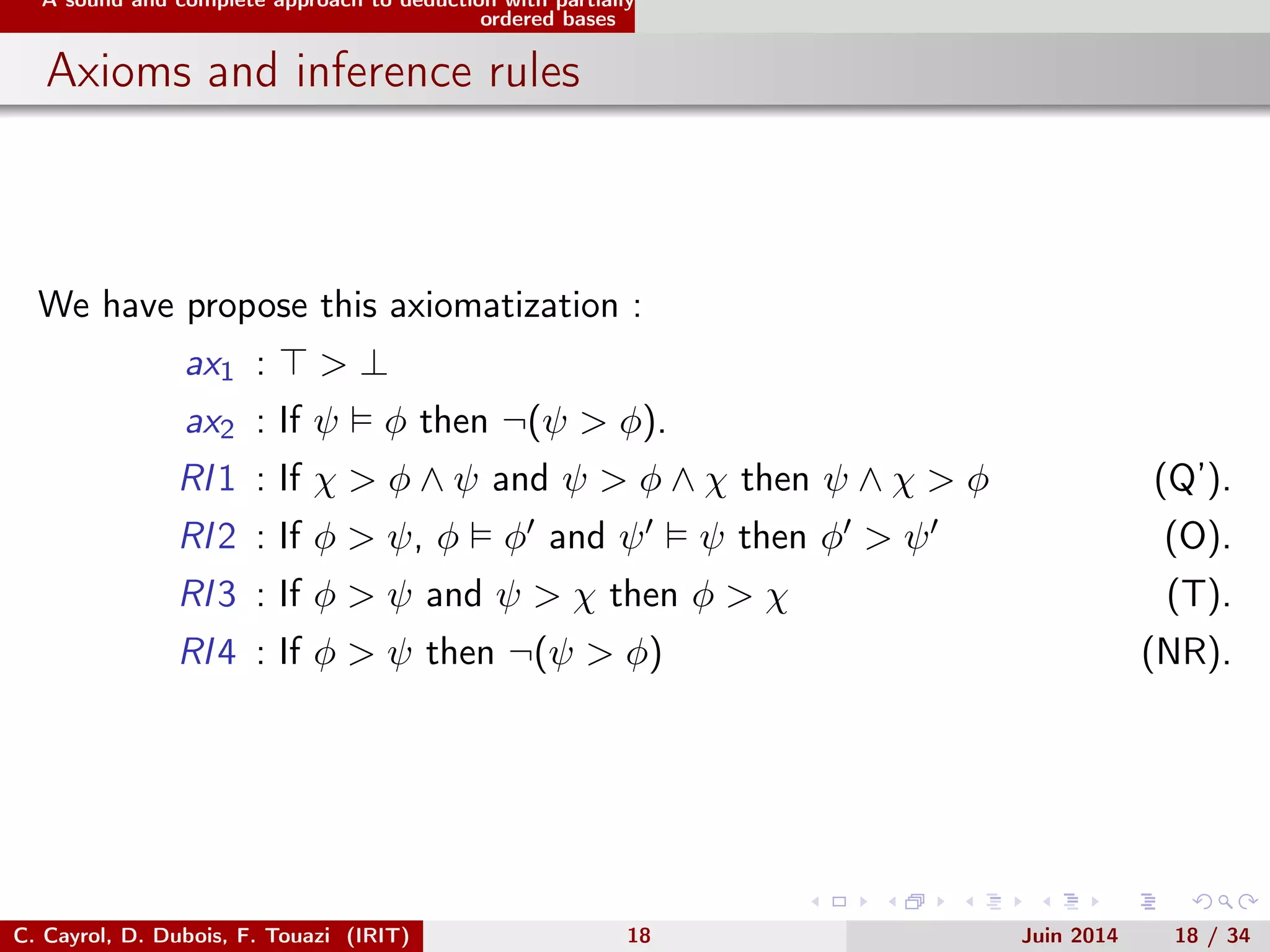
We have propose this axiomatization :
ax1 : > ⊥
ax2 : If ψ φ then ¬(ψ > φ).
RI1 : If χ > φ ∧ ψ and ψ > φ ∧ χ then ψ ∧ χ > φ (Q’).
RI2 : If φ > ψ, φ φ and ψ ψ then φ > ψ (O).
RI3 : If φ > ψ and ψ > χ then φ > χ (T).
RI4 : If φ > ψ then ¬(ψ > φ) (NR).
C. Cayrol, D. Dubois, F. Touazi (IRIT) 18 Juin 2014 18 / 34
A sound and complete approach to deduction with partially
ordered bases
Semantic
Definition (Semantic)
A model M is a structure (2Ω, ) where is a strict partial order on
2Ω satisfying the properties O and Q.
M S (φ > ψ) iff [ψ] [φ].
We have show that :
Proposition
Let (K, >) a partially ordered base
Soundness :
(K, >) S φ > ψ ⇒ (K, >) S φ > ψ
Completeness :
(K, >) S φ > ψ ⇒ (K, >) S φ > ψ
C. Cayrol, D. Dubois, F. Touazi (IRIT) 19 Juin 2014 19 / 34
A sound and complete approach to deduction with partially
ordered bases
Example 1 (continue)
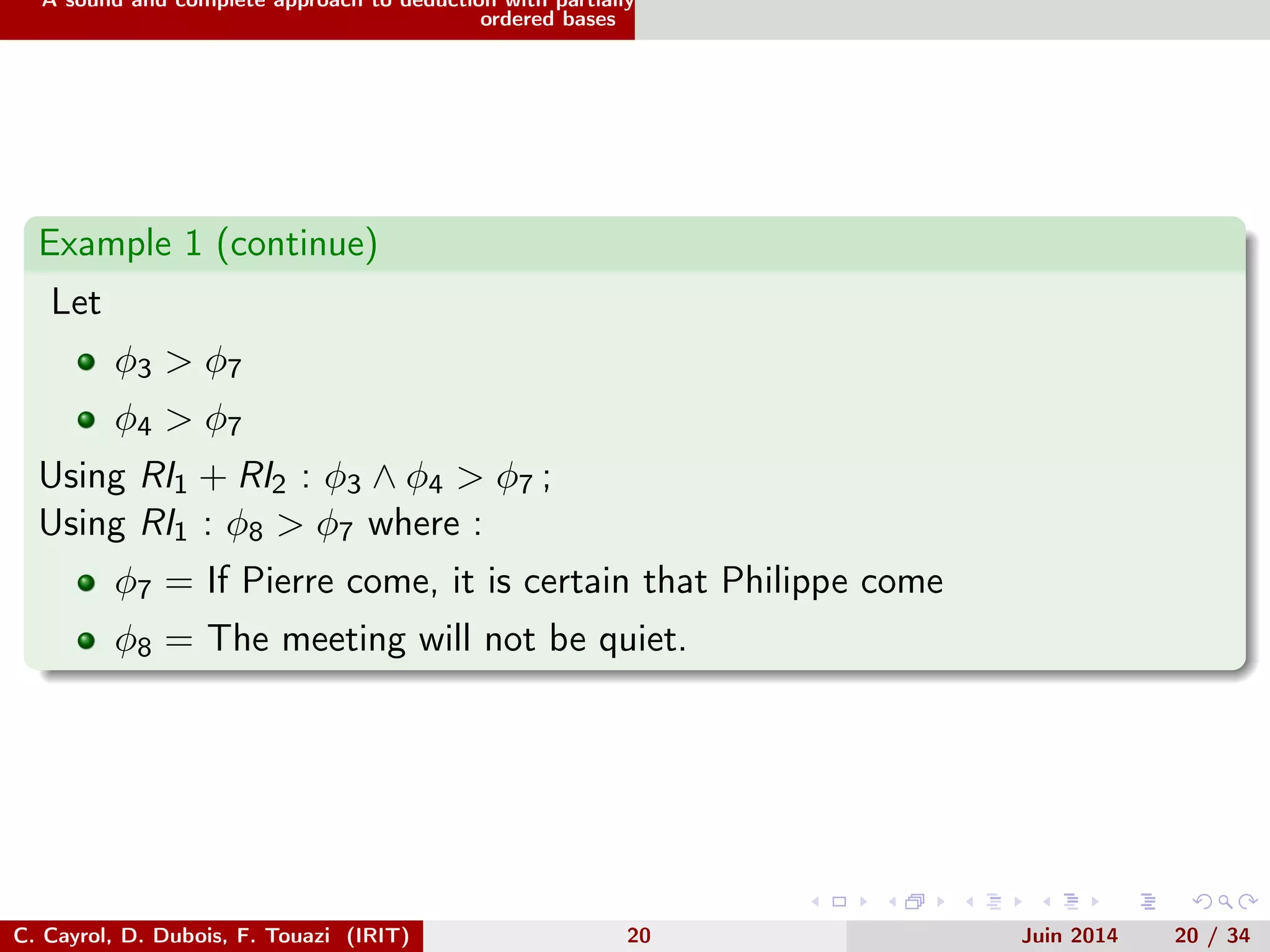
Let
φ3 > φ7
φ4 > φ7
Using RI1 + RI2 : φ3 ∧ φ4 > φ7 ;
Using RI1 : φ8 > φ7 where :
φ7 = If Pierre come, it is certain that Philippe come
φ8 = The meeting will not be quiet.
C. Cayrol, D. Dubois, F. Touazi (IRIT) 20 Juin 2014 20 / 34
A sound and complete approach to deduction with partially
ordered bases
Inference based on level cuts
Definition
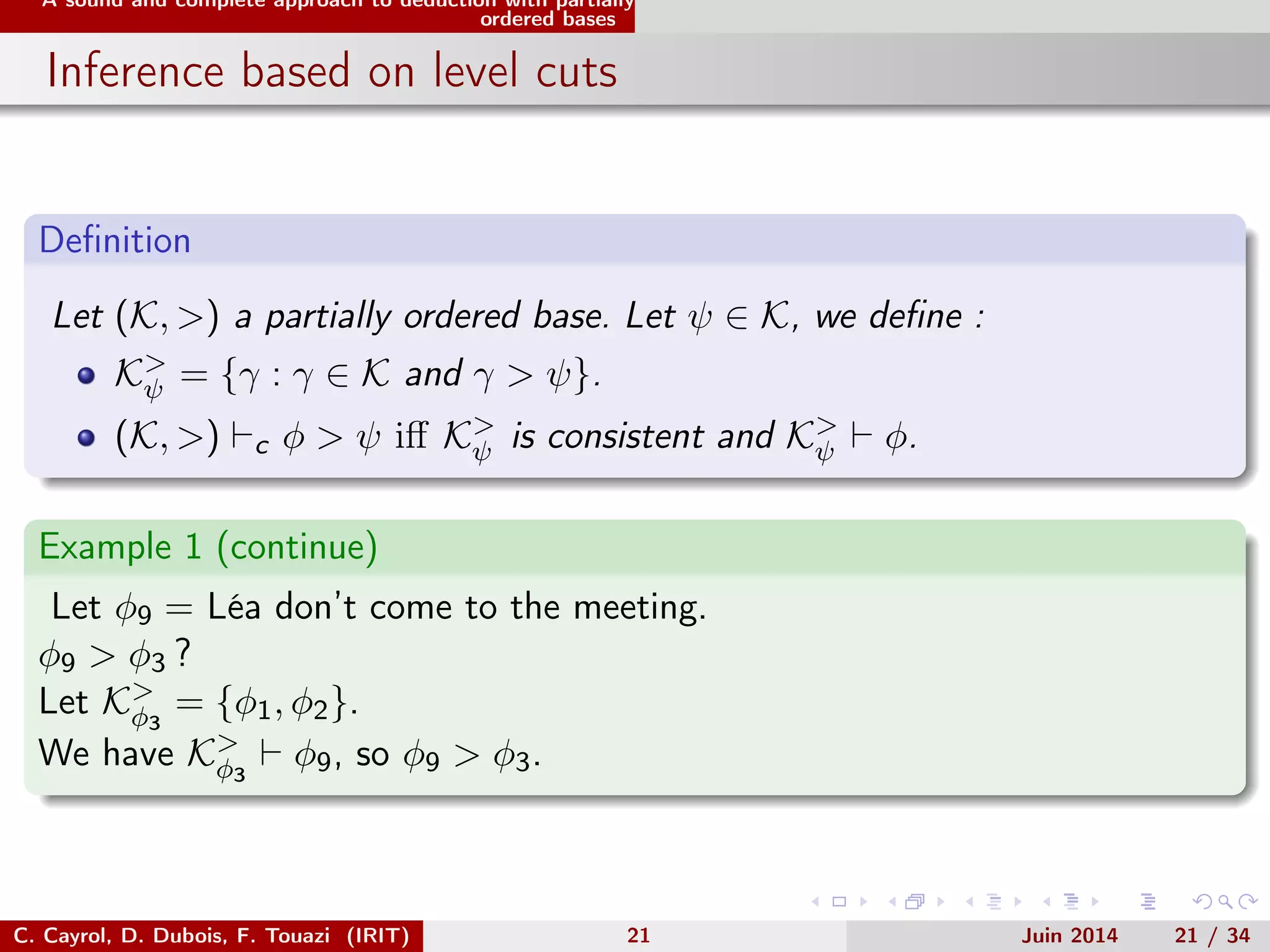
Let (K, >) a partially ordered base. Let ψ ∈ K, we define :
K>
ψ = {γ : γ ∈ K and γ > ψ}.
(K, >) c φ > ψ iff K>
ψ is consistent and K>
ψ φ.
Example 1 (continue)
Let φ9 = Léa don’t come to the meeting.
φ9 > φ3 ?
Let K>
φ3
= {φ1, φ2}.
We have K>
φ3
φ9, so φ9 > φ3.
C. Cayrol, D. Dubois, F. Touazi (IRIT) 21 Juin 2014 21 / 34
A sound and complete approach to deduction with partially
ordered bases
Comparison between S and Cuts
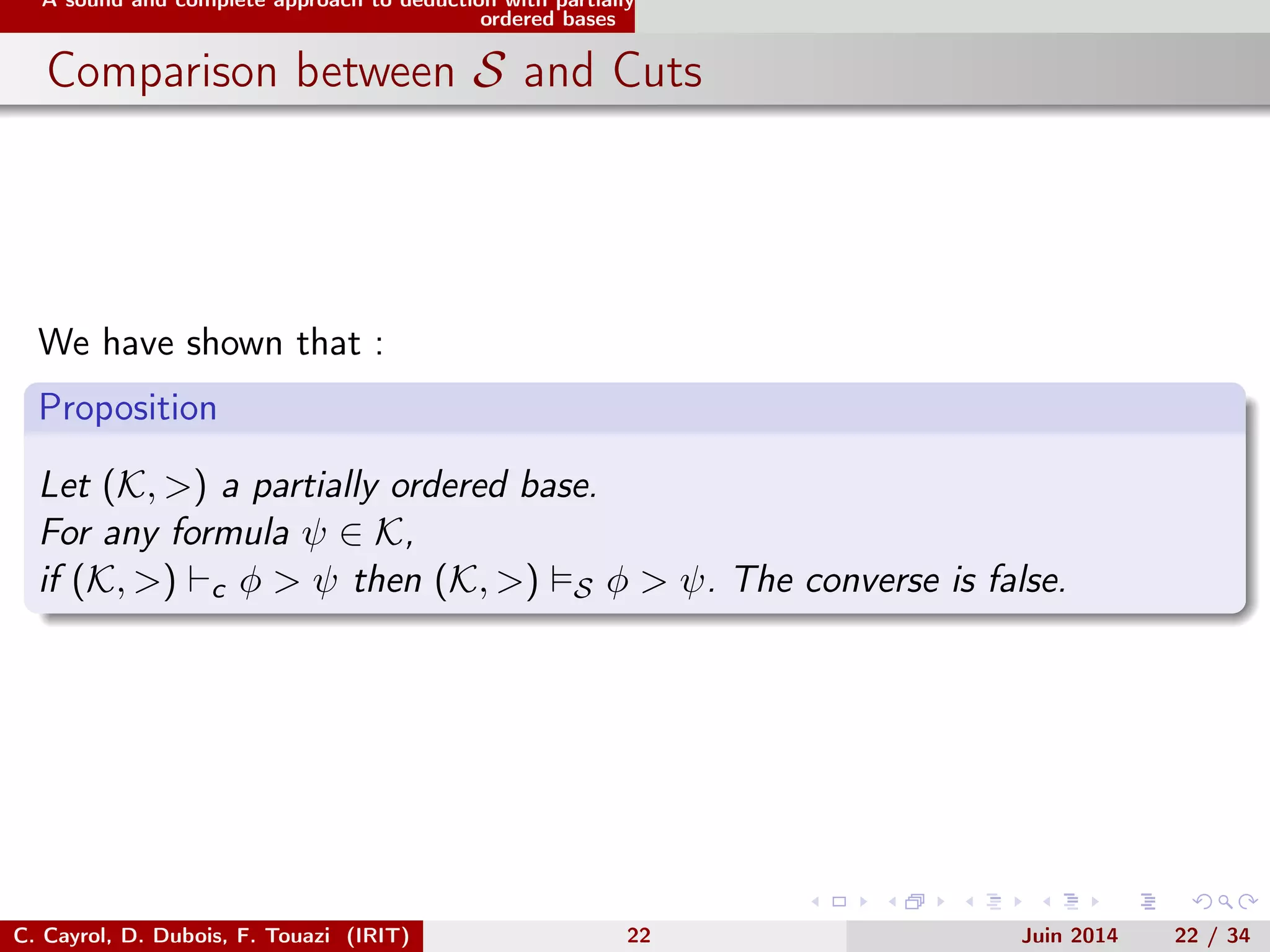
We have shown that :
Proposition
Let (K, >) a partially ordered base.
For any formula ψ ∈ K,
if (K, >) c φ > ψ then (K, >) S φ > ψ. The converse is false.
C. Cayrol, D. Dubois, F. Touazi (IRIT) 22 Juin 2014 22 / 34
Outline
1 Introduction
2 Background on Possibilistic logic
3 Semantics for partially ordered bases
4 A sound and complete approach to deduction with partially ordered
bases
5 Comparison with symbolic possibilistic approach
6 Related works
7 Conclusion
Comparison with symbolic possibilistic approach
Encoding a partially ordered base as a sym- bolic
possibilistic base
We start from a partially ordered base (K, >) :
Replace φ > ψ by (φ, ι(φ)) and (ψ, ι(ψ)) where ι(φ) is an ill-known
weight ∈ [0, 1], and ι(φ) > ι(ψ)
Definition
Let (K, >) a partially ordered base. (K, >) is encoded by
ΣK = {(φ, η(φ)), φ ∈ K}
C = {a > b/(φ, a), (ψ, b) ∈ ΣK and φ > ψ ∈ K}.
We can apply proof methods of possibilistic logic
Σ χ > ξ iff NΣ(χ) > NΣ(ξ)
We do get a partial order on the language
C. Cayrol, D. Dubois, F. Touazi (IRIT) 24 Juin 2014 24 / 34
Comparison with symbolic possibilistic approach
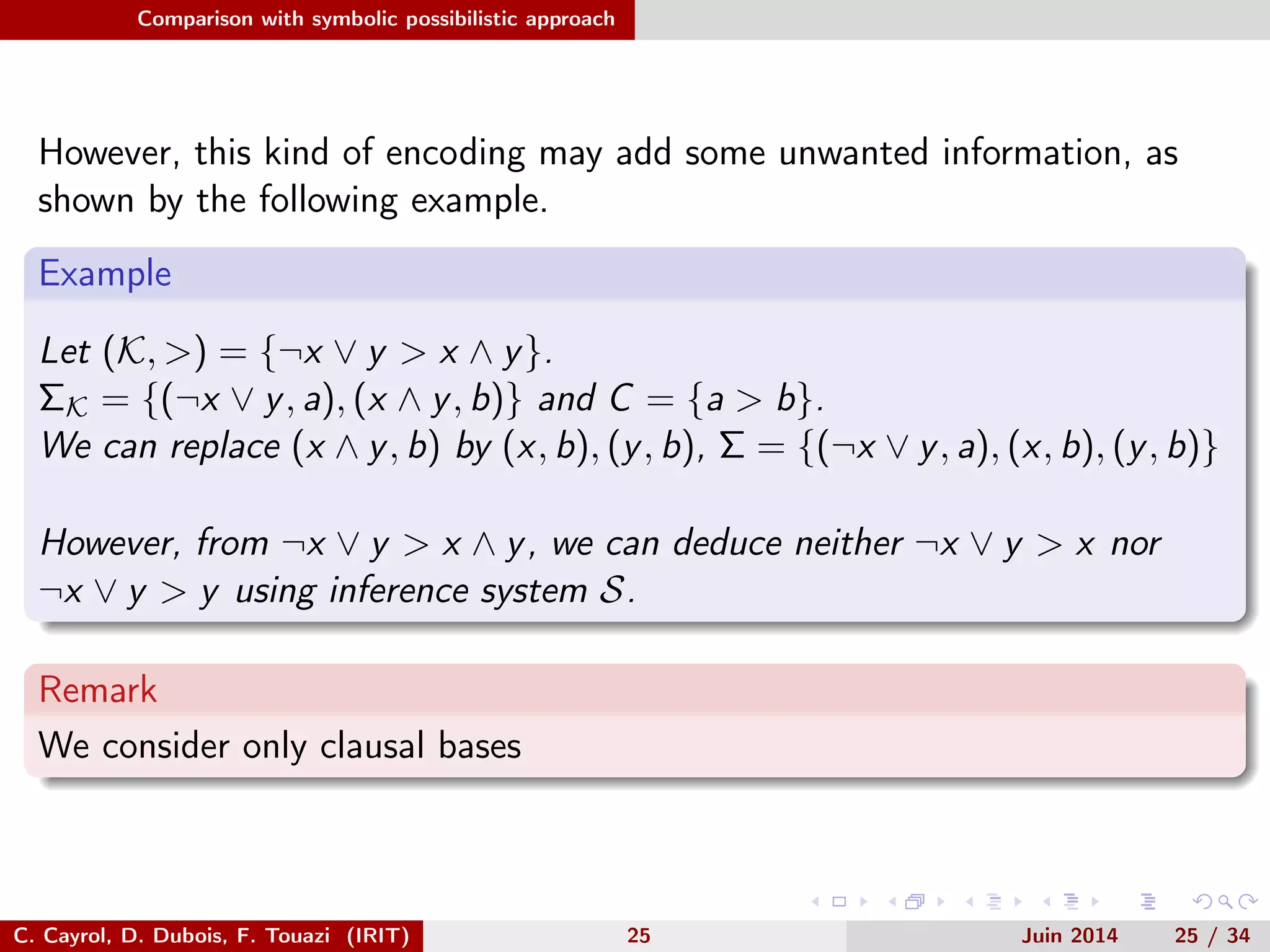
However, this kind of encoding may add some unwanted information, as
shown by the following example.
Example
Let (K, >) = {¬x ∨ y > x ∧ y}.
ΣK = {(¬x ∨ y, a), (x ∧ y, b)} and C = {a > b}.
We can replace (x ∧ y, b) by (x, b), (y, b), Σ = {(¬x ∨ y, a), (x, b), (y, b)}
However, from ¬x ∨ y > x ∧ y, we can deduce neither ¬x ∨ y > x nor
¬x ∨ y > y using inference system S.
Remark
We consider only clausal bases
C. Cayrol, D. Dubois, F. Touazi (IRIT) 25 Juin 2014 25 / 34
Comparison with symbolic possibilistic approach
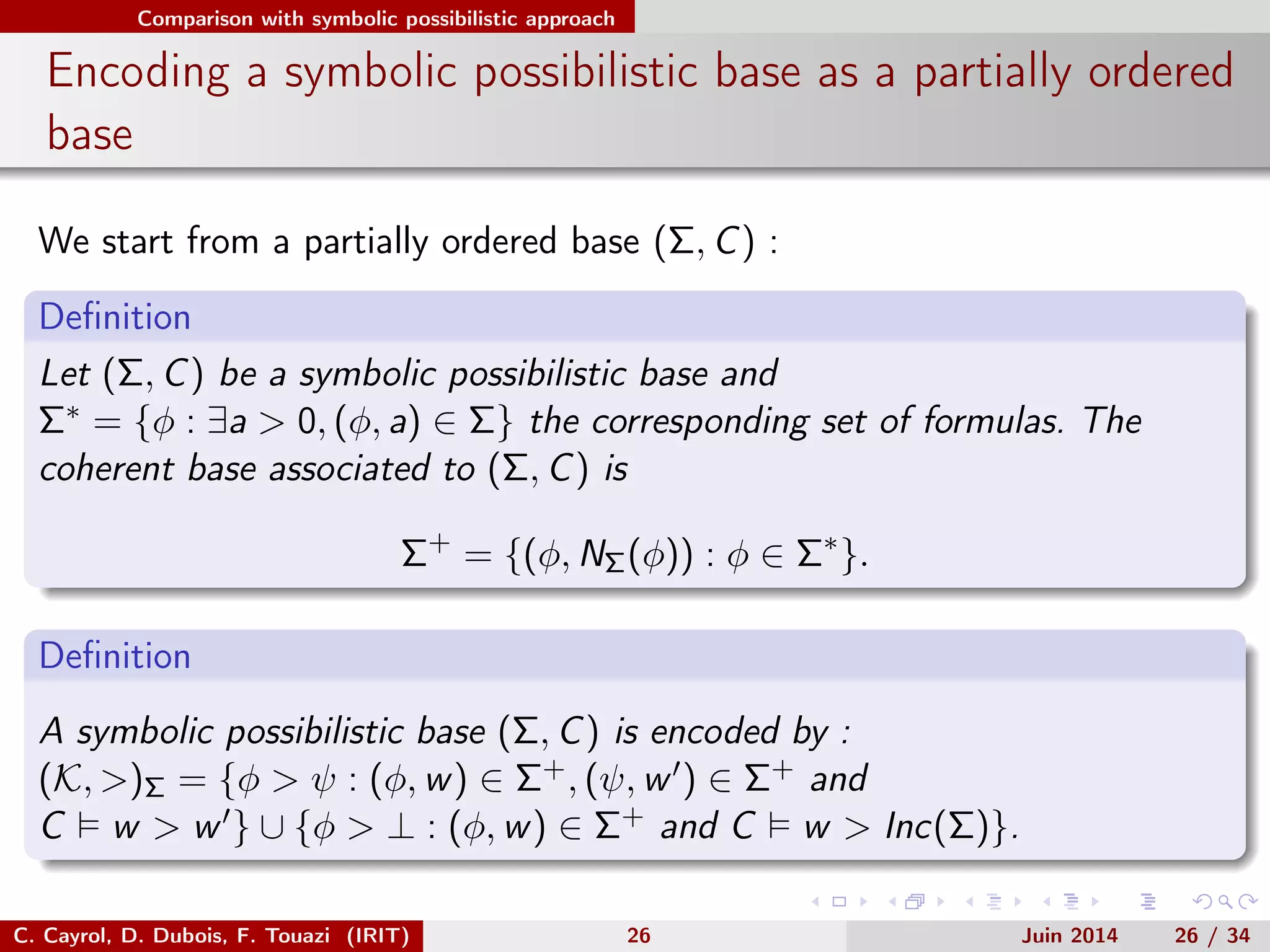
Encoding a symbolic possibilistic base as a partially ordered
base
We start from a partially ordered base (Σ, C) :
Definition
Let (Σ, C) be a symbolic possibilistic base and
Σ∗ = {φ : ∃a > 0, (φ, a) ∈ Σ} the corresponding set of formulas. The
coherent base associated to (Σ, C) is
Σ+
= {(φ, NΣ(φ)) : φ ∈ Σ∗
}.
Definition
A symbolic possibilistic base (Σ, C) is encoded by :
(K, >)Σ = {φ > ψ : (φ, w) ∈ Σ+, (ψ, w ) ∈ Σ+ and
C w > w } ∪ {φ > ⊥ : (φ, w) ∈ Σ+ and C w > Inc(Σ)}.
C. Cayrol, D. Dubois, F. Touazi (IRIT) 26 Juin 2014 26 / 34
Comparison with symbolic possibilistic approach
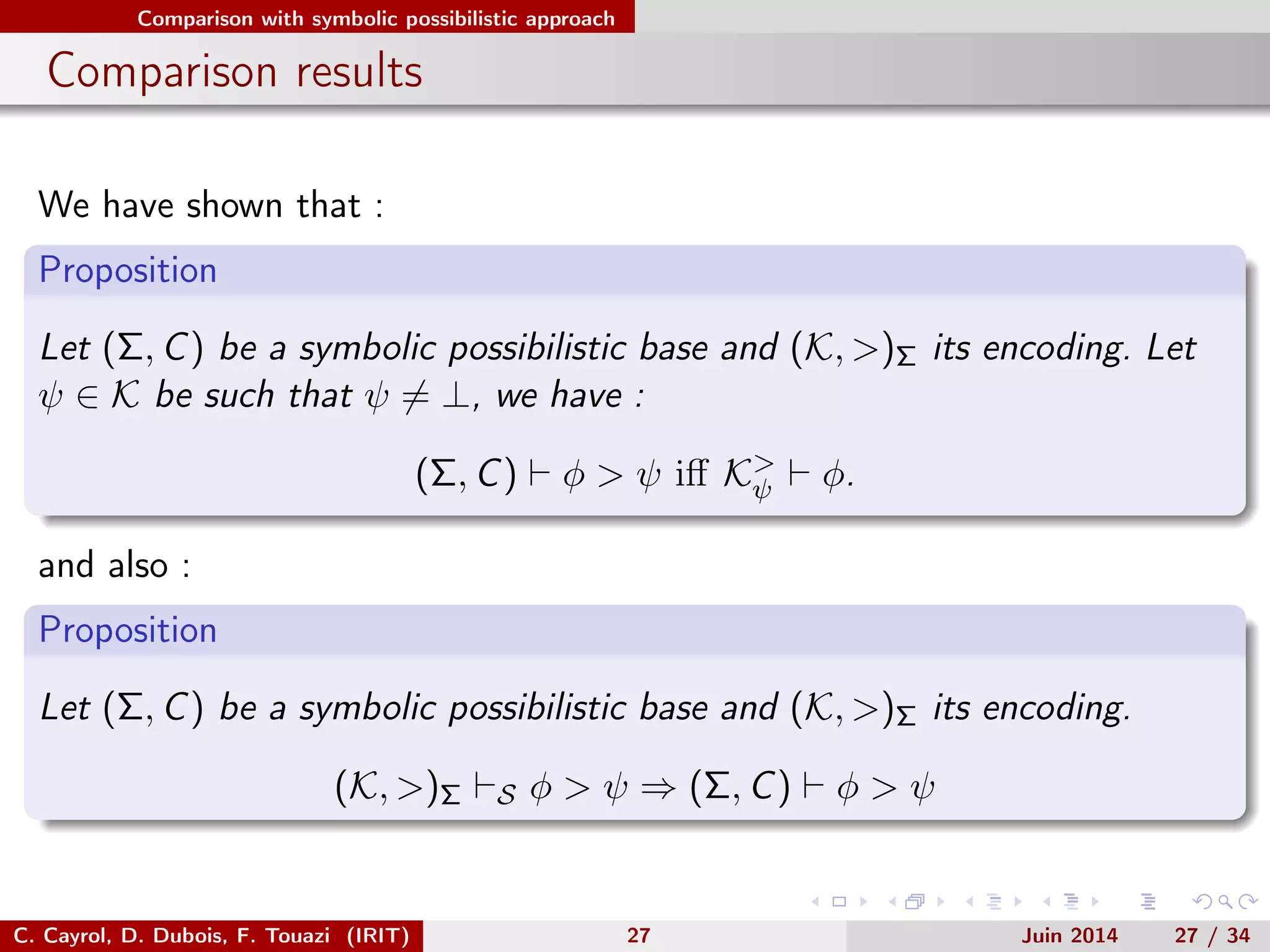
Comparison results
We have shown that :
Proposition
Let (Σ, C) be a symbolic possibilistic base and (K, >)Σ its encoding. Let
ψ ∈ K be such that ψ = ⊥, we have :
(Σ, C) φ > ψ iff K>
ψ φ.
and also :
Proposition
Let (Σ, C) be a symbolic possibilistic base and (K, >)Σ its encoding.
(K, >)Σ S φ > ψ ⇒ (Σ, C) φ > ψ
C. Cayrol, D. Dubois, F. Touazi (IRIT) 27 Juin 2014 27 / 34
Outline
1 Introduction
2 Background on Possibilistic logic
3 Semantics for partially ordered bases
4 A sound and complete approach to deduction with partially ordered
bases
5 Comparison with symbolic possibilistic approach
6 Related works
7 Conclusion
Related works Partial order as a family of total orders
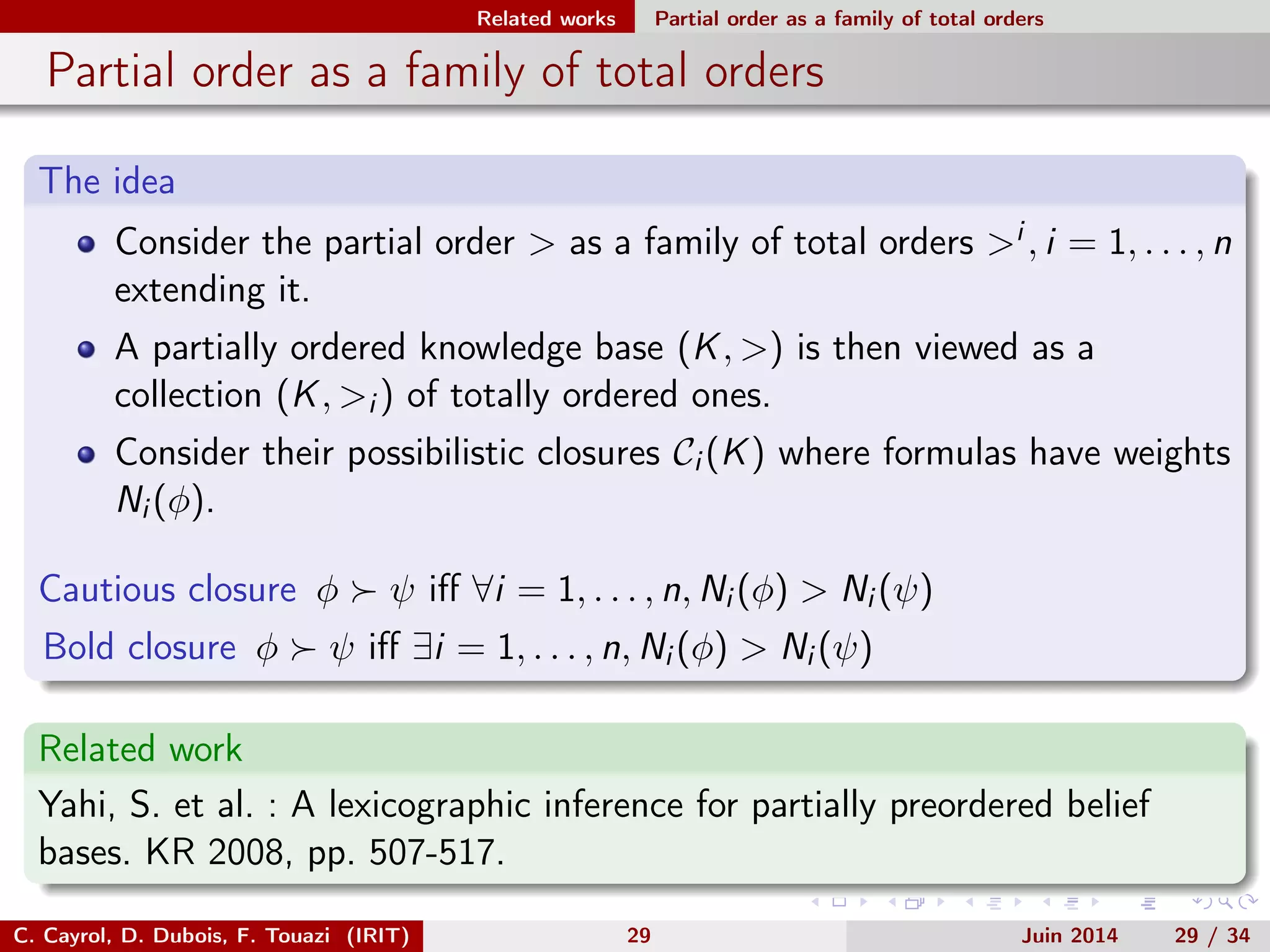
Partial order as a family of total orders
The idea
Consider the partial order > as a family of total orders >i , i = 1, . . . , n
extending it.
A partially ordered knowledge base (K, >) is then viewed as a
collection (K, >i ) of totally ordered ones.
Consider their possibilistic closures Ci (K) where formulas have weights
Ni (φ).
Cautious closure φ ψ iff ∀i = 1, . . . , n, Ni (φ) > Ni (ψ)
Bold closure φ ψ iff ∃i = 1, . . . , n, Ni (φ) > Ni (ψ)
Related work
Yahi, S. et al. : A lexicographic inference for partially preordered belief
bases. KR 2008, pp. 507-517.
C. Cayrol, D. Dubois, F. Touazi (IRIT) 29 Juin 2014 29 / 34
Related works Conditional logic approach
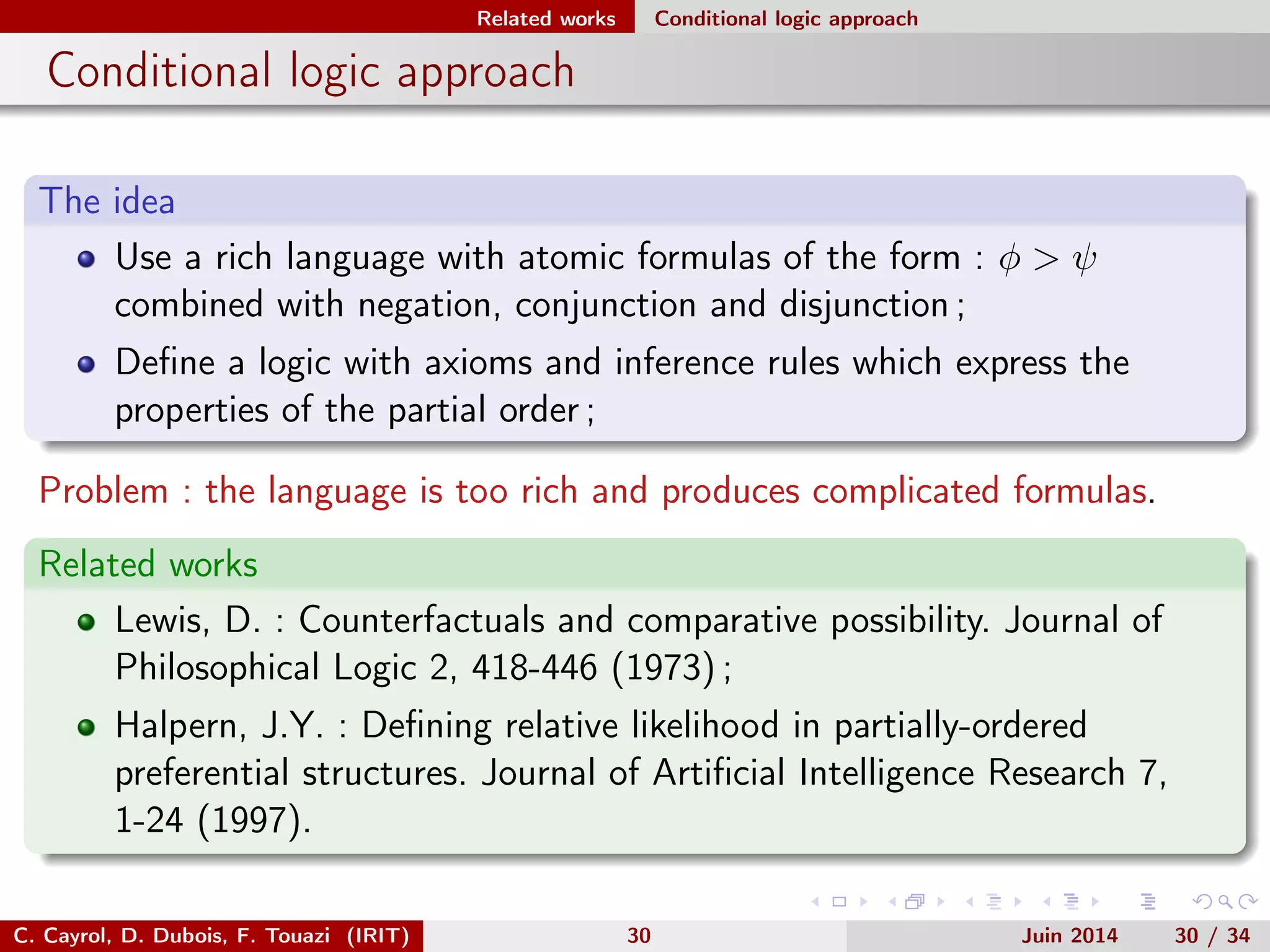
Conditional logic approach
The idea
Use a rich language with atomic formulas of the form : φ > ψ
combined with negation, conjunction and disjunction ;
Define a logic with axioms and inference rules which express the
properties of the partial order ;
Problem : the language is too rich and produces complicated formulas.
Related works
Lewis, D. : Counterfactuals and comparative possibility. Journal of
Philosophical Logic 2, 418-446 (1973) ;
Halpern, J.Y. : Defining relative likelihood in partially-ordered
preferential structures. Journal of Artificial Intelligence Research 7,
1-24 (1997).
C. Cayrol, D. Dubois, F. Touazi (IRIT) 30 Juin 2014 30 / 34
Related works Conditional logic approach
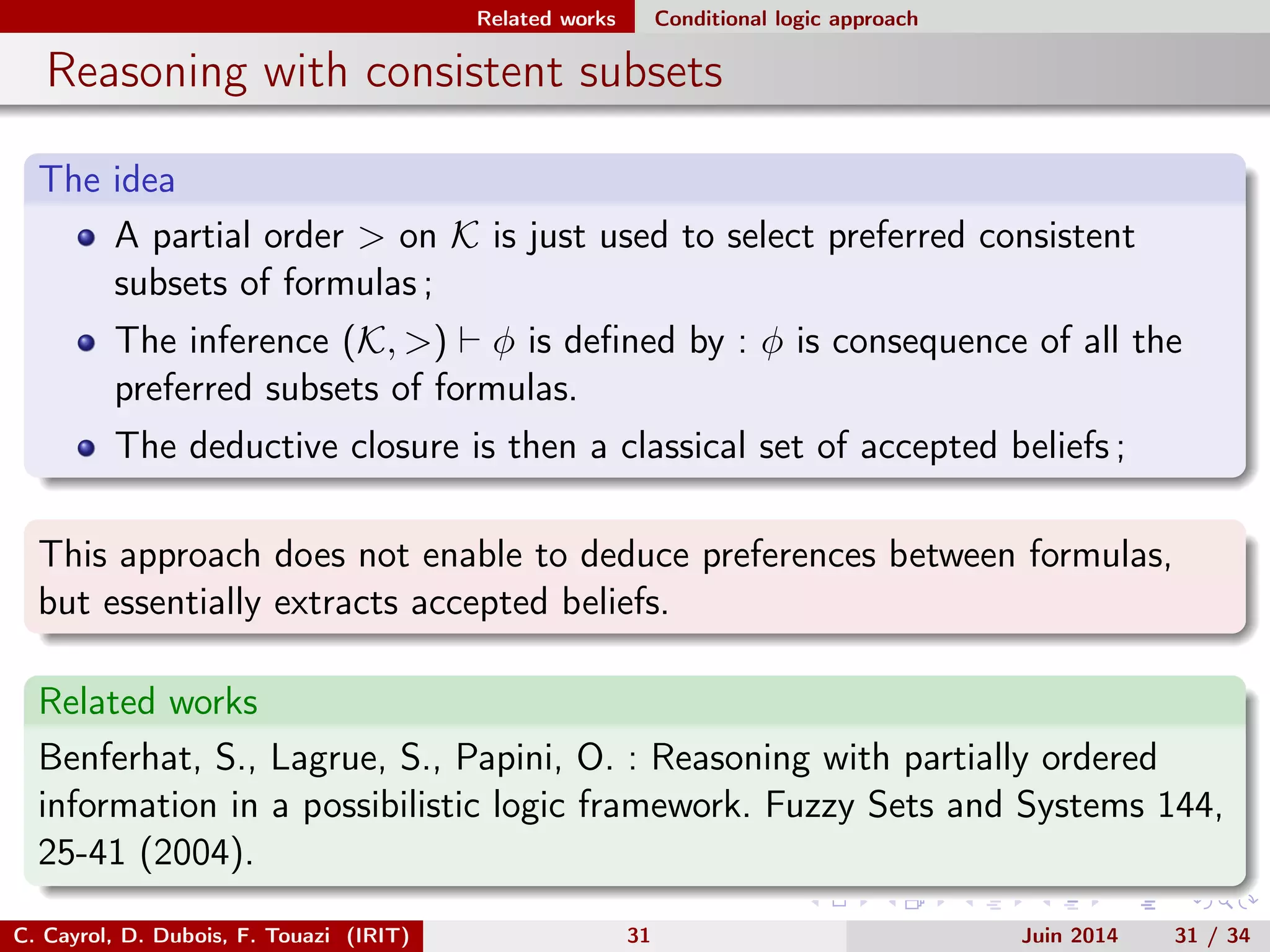
Reasoning with consistent subsets
The idea
A partial order > on K is just used to select preferred consistent
subsets of formulas ;
The inference (K, >) φ is defined by : φ is consequence of all the
preferred subsets of formulas.
The deductive closure is then a classical set of accepted beliefs ;
This approach does not enable to deduce preferences between formulas,
but essentially extracts accepted beliefs.
Related works
Benferhat, S., Lagrue, S., Papini, O. : Reasoning with partially ordered
information in a possibilistic logic framework. Fuzzy Sets and Systems 144,
25-41 (2004).
C. Cayrol, D. Dubois, F. Touazi (IRIT) 31 Juin 2014 31 / 34
Outline
1 Introduction
2 Background on Possibilistic logic
3 Semantics for partially ordered bases
4 A sound and complete approach to deduction with partially ordered
bases
5 Comparison with symbolic possibilistic approach
6 Related works
7 Conclusion
Conclusion
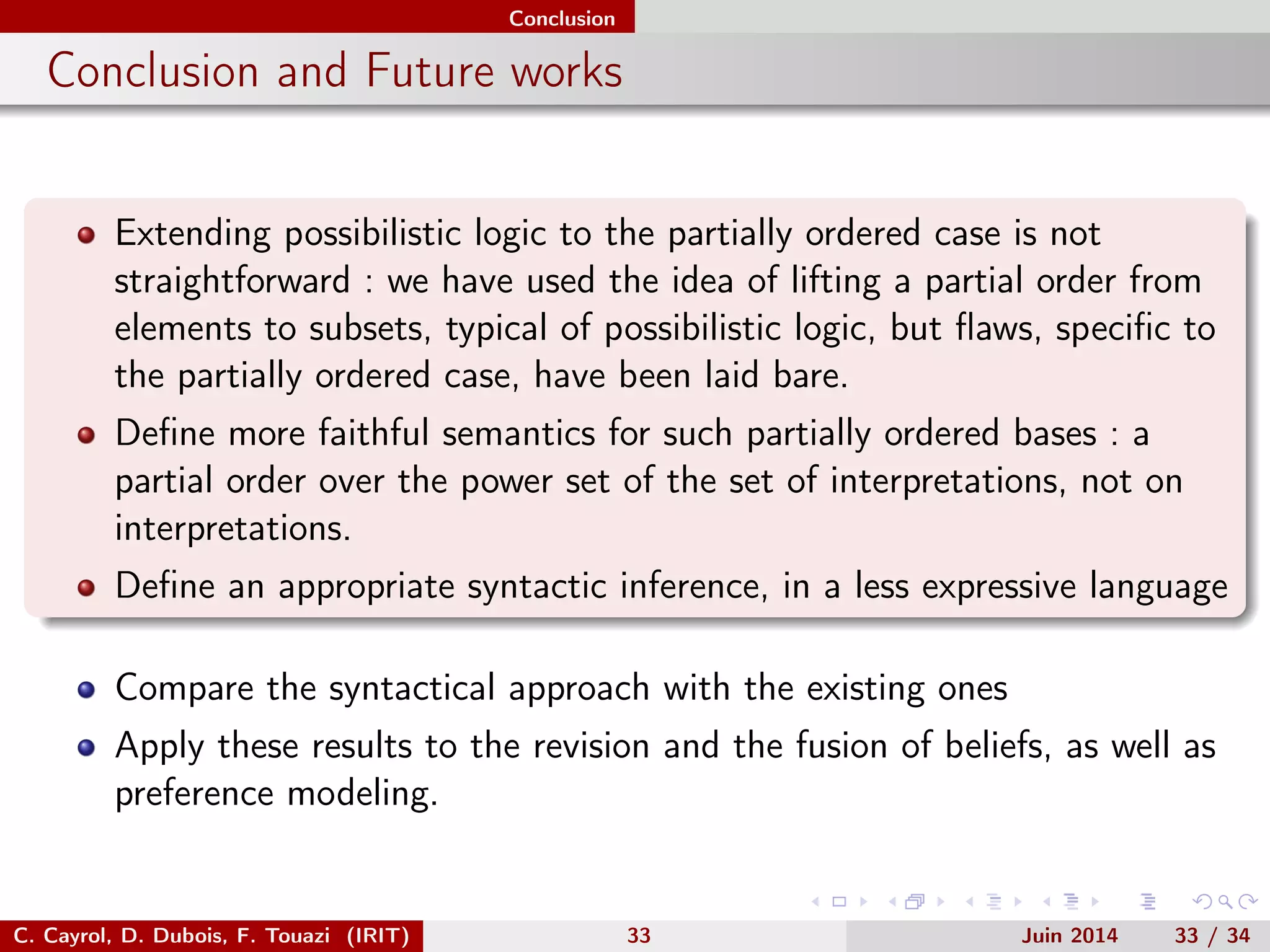
Conclusion and Future works
Extending possibilistic logic to the partially ordered case is not
straightforward : we have used the idea of lifting a partial order from
elements to subsets, typical of possibilistic logic, but flaws, specific to
the partially ordered case, have been laid bare.
Define more faithful semantics for such partially ordered bases : a
partial order over the power set of the set of interpretations, not on
interpretations.
Define an appropriate syntactic inference, in a less expressive language
Compare the syntactical approach with the existing ones
Apply these results to the revision and the fusion of beliefs, as well as
preference modeling.
C. Cayrol, D. Dubois, F. Touazi (IRIT) 33 Juin 2014 33 / 34
Conclusion
C. Cayrol, D. Dubois, F. Touazi (IRIT) 34 Juin 2014 34 / 34

Presentation iaf 2014 v1

  • 1.
    On the deductiveclosure of a partially ordered propositional belief base Claudette Cayrol Didier Dubois Fayçal Touazi IRIT, University of Toulouse, France. Juin 2014 JIAF C. Cayrol, D. Dubois, F. Touazi (IRIT) 1 Juin 2014 1 / 34
  • 2.
    Outline 1 Introduction 2 Backgroundon Possibilistic logic 3 Semantics for partially ordered bases 4 A sound and complete approach to deduction with partially ordered bases 5 Comparison with symbolic possibilistic approach 6 Related works 7 Conclusion
  • 3.
    Outline 1 Introduction 2 Backgroundon Possibilistic logic 3 Semantics for partially ordered bases 4 A sound and complete approach to deduction with partially ordered bases 5 Comparison with symbolic possibilistic approach 6 Related works 7 Conclusion
  • 4.
    Introduction Introduction Reasoning from orderedbases The basic concept of ordered knowledge base has been studied for two decades in Artificial Intelligence If totally ordered : Theophrastus, Rescher (1976), possibilistic logic A total order on formulas induces a total order on the models And conversely (a measure of possibility or necessity) Goal Find an adequate semantics on partially ordered bases. Define a partially ordered deductive closure (partial order over the language). C. Cayrol, D. Dubois, F. Touazi (IRIT) 4 Juin 2014 4 / 34
  • 5.
    Introduction Motivating example Example 1 Wesuppose this knowledge base : φ1 = If Bernard comes to the meeting, Léa don’t come φ2 = Bernard come to the meeting φ3 = If CLoé comes, it is certain that the meeting will not be quiet φ4 = Cloé should come φ5 = If Philippe comes to the meeting and Léa don’t come, it is almost certain that the meeting will not be quiet φ6 = It is almost certain that Léa or Pierre come φ7 = If Pierre come, it is certain that Philippe come We know that φ1 > {φ3, φ6} > φ7,φ2 > {φ3, φ6} > φ7 and φ5 > φ7. C. Cayrol, D. Dubois, F. Touazi (IRIT) 5 Juin 2014 5 / 34
  • 6.
    Outline 1 Introduction 2 Backgroundon Possibilistic logic 3 Semantics for partially ordered bases 4 A sound and complete approach to deduction with partially ordered bases 5 Comparison with symbolic possibilistic approach 6 Related works 7 Conclusion
  • 7.
    Background on Possibilisticlogic Background on Possibilistic logic Let Ω be the set of states of the world. Boolean possibility distribution Framework to represent incomplete information of the form v ∈ E. Example of incomplete information Let v = age (Peter). We know that v ∈ E = {20, 21, 22, 23, 24, 25} the set of possible values (v = 20 or v = 21 or v = 22 or v = 23 or v = 24 or v = 25). This information is represented by a Boolean possibility distribution : π(ω) = 1 if ω ∈ E 0 else Possibilistic formula Weighted extension of classical logic : (φ, αi ) with φ is a proposition in a language L and 1≥ αi >0 C. Cayrol, D. Dubois, F. Touazi (IRIT) 7 Juin 2014 7 / 34
  • 8.
    Background on Possibilisticlogic Possibility and Necessity measures Possibility measure Let Π be the possibility measure that expresses how much an event is possible : Π(A) = max{π(ω)|ω ∈ A} Necessity measure Let N be the necessity measure that expresses how much an event is certain : N(A) = 1 − Π(¬A) = min{1 − π(ω)|ω /∈ A} Characteristic properties N(φ ∧ ψ) = min(N(φ), N(ψ))(axiom of N) Π(φ ∨ ψ) = max(Π(φ), Π(ψ))(axiom of Π) C. Cayrol, D. Dubois, F. Touazi (IRIT) 8 Juin 2014 8 / 34
  • 9.
    Background on Possibilisticlogic Totally ordered closure (equivalent syntactical construction) Axioms and inference rules Axioms of classical logic at degree 1. (φ → (ψ → φ), 1) ; ((φ → (ψ → χ)) → ((φ → ψ) → (φ → χ)), 1) ; ((¬φ) → (¬ψ)) → (ψ → φ), 1) ; Inference rules Weakening rule : If α > β then (φ, α) (φ, β) Modus Ponens : {(φ → ψ, α), (φ, α)} (ψ, α) This system is correct and complete (Dubois, Lang, Prade, 1994). Important remark It may happen that if (φj , αj ) ∈ Σ then (φj , βj ) ∈ C(Σ) with βj > αj : αj > αi ⇒ NΣ(φj ) > NΣ(φi ) C. Cayrol, D. Dubois, F. Touazi (IRIT) 9 Juin 2014 9 / 34
  • 10.
    Outline 1 Introduction 2 Backgroundon Possibilistic logic 3 Semantics for partially ordered bases 4 A sound and complete approach to deduction with partially ordered bases 5 Comparison with symbolic possibilistic approach 6 Related works 7 Conclusion
  • 11.
    Semantics for partiallyordered bases Strict weak optimistic dominance wos Definition A wos B iff A = ∅ and ∀b ∈ B, ∃a ∈ A, a > b Natural for relative likelihood (already, Halpern, 1977). Proposition Principal properties : 1 Qualitativeness (Q) ; 2 Orderliness (O) ; Derived properties : 1 The reciprocal of (SU) ; 2 Negligibility (N) ; 3 Conditional Closure by Implication (CCI) ; 4 Conditional Closure by Conjunction (CCC) ; 5 Left Disjunction (OR), (CUT) and (CM) (Cumulativity). C. Cayrol, D. Dubois, F. Touazi (IRIT) 11 Juin 2014 11 / 34
  • 12.
    Semantics for partiallyordered bases Syntax and notations Let L be a propositional language, K ⊂ L a finite set of formulas equiped with a partial order >. (K, >) is a set of constraints of the form φ > ψ ; If φ, ψ ∈ K, φ > ψ is interpreted as " φ is preferred to ψ " (more certain, higher priority) ; K(ω) denotes the subset of formulas in K satisfied by the interpretation ω ∈ Ω ; hence K(ω) is the subset of propositions falsified by ω ∈ Ω ; [φ] denotes the set of the models of φ, a subset of Ω. C. Cayrol, D. Dubois, F. Touazi (IRIT) 12 Juin 2014 12 / 34
  • 13.
    Semantics for partiallyordered bases Deductive closure based on the optimistic relation Definition From (K, >) to (Ω, ) ∀ω, ω ∈ Ω, ω ω iff K(ω ) >wos K(ω) iff ∀ψ ∈ K(ω), ∃φ ∈ K(ω ), φ > ψ From (Ω, ) to (L, N) ∀φ, ψ ∈ L, φ N ψ iff [ψ] wos [φ] iff ∀ω ∈ [φ], ∃ω ∈ [ψ], ω ω . These definitions interpret (K, >) as a certainty ordering, in agreement with possibilistic logic. Deductive closure of a partially ordered base The partially ordered deductive closure of (K, >) can be defined by C(K, >) N = {(φ, ψ) ∈ L2 : φ N ψ}. And we denote (φ, ψ) ∈ C(K, >) N by K |=wos φ N ψ. C. Cayrol, D. Dubois, F. Touazi (IRIT) 13 Juin 2014 13 / 34
  • 14.
    Semantics for partiallyordered bases Counter-Example This example shows the semantic definition of deductive closure is problematic. Example 1 Let (K, >) = {¬x ∨ y > x ∧ y > ¬x, x > ¬x} be a partially ordered base, where > is the strict partial order. Let us apply the previous definitions : From (K, >) to (Ω, ) : we obtain xy {¯xy, x¯y, ¯x¯y} ; From (Ω, ) to (L, N), we obtain : x N ¬x, x ∧ y N ¬x ; ¬x ∨ y N ¬x ; but not ¬x ∨ y N x ∧ y. We have lost the piece of information ¬x ∨ y > x ∧ y C. Cayrol, D. Dubois, F. Touazi (IRIT) 14 Juin 2014 14 / 34
  • 15.
    Semantics for partiallyordered bases What is wrong Let us interpret the partial order of K as stemming from a partial order on interpretations, via wos : [x ∧ y] wos [¬x ∨ ¬y] ; [¬x] wos [x ∧ y] ; [¬x] wos [x]. It is easy to see that these constraints imply that : xy {¯xy, x¯y, ¯x¯y} (¯xy x¯y) ∨ (¯x¯y x¯y) (a disjunctive constraint) Problem More informative than the constraint on the partial order , but the disjunction is not representable via a single partial order. C. Cayrol, D. Dubois, F. Touazi (IRIT) 15 Juin 2014 15 / 34
  • 16.
    Outline 1 Introduction 2 Backgroundon Possibilistic logic 3 Semantics for partially ordered bases 4 A sound and complete approach to deduction with partially ordered bases 5 Comparison with symbolic possibilistic approach 6 Related works 7 Conclusion
  • 17.
    A sound andcomplete approach to deduction with partially ordered bases Syntax φ, ψ, · · · ∈ L classical propositional language > a strict partial order on formulas of L. A literal Φ of L> is of the form φ > ψ or ¬(φ > ψ), φ and ψ being formulas of L. A formula of L> is either a literal Φ of L>, or a formula of the form Ψ ∧ Γ with Ψ, Γ ∈ L>. Example 1 (continue) Φ = φ1 > φ3 is a literal ∈ L> Let Ψ = φ2 > φ4, Φ ∧ Ψ ∈ L>. C. Cayrol, D. Dubois, F. Touazi (IRIT) 17 Juin 2014 17 / 34
  • 18.
    A sound andcomplete approach to deduction with partially ordered bases Axioms and inference rules We have propose this axiomatization : ax1 : > ⊥ ax2 : If ψ φ then ¬(ψ > φ). RI1 : If χ > φ ∧ ψ and ψ > φ ∧ χ then ψ ∧ χ > φ (Q’). RI2 : If φ > ψ, φ φ and ψ ψ then φ > ψ (O). RI3 : If φ > ψ and ψ > χ then φ > χ (T). RI4 : If φ > ψ then ¬(ψ > φ) (NR). C. Cayrol, D. Dubois, F. Touazi (IRIT) 18 Juin 2014 18 / 34
  • 19.
    A sound andcomplete approach to deduction with partially ordered bases Semantic Definition (Semantic) A model M is a structure (2Ω, ) where is a strict partial order on 2Ω satisfying the properties O and Q. M S (φ > ψ) iff [ψ] [φ]. We have show that : Proposition Let (K, >) a partially ordered base Soundness : (K, >) S φ > ψ ⇒ (K, >) S φ > ψ Completeness : (K, >) S φ > ψ ⇒ (K, >) S φ > ψ C. Cayrol, D. Dubois, F. Touazi (IRIT) 19 Juin 2014 19 / 34
  • 20.
    A sound andcomplete approach to deduction with partially ordered bases Example 1 (continue) Let φ3 > φ7 φ4 > φ7 Using RI1 + RI2 : φ3 ∧ φ4 > φ7 ; Using RI1 : φ8 > φ7 where : φ7 = If Pierre come, it is certain that Philippe come φ8 = The meeting will not be quiet. C. Cayrol, D. Dubois, F. Touazi (IRIT) 20 Juin 2014 20 / 34
  • 21.
    A sound andcomplete approach to deduction with partially ordered bases Inference based on level cuts Definition Let (K, >) a partially ordered base. Let ψ ∈ K, we define : K> ψ = {γ : γ ∈ K and γ > ψ}. (K, >) c φ > ψ iff K> ψ is consistent and K> ψ φ. Example 1 (continue) Let φ9 = Léa don’t come to the meeting. φ9 > φ3 ? Let K> φ3 = {φ1, φ2}. We have K> φ3 φ9, so φ9 > φ3. C. Cayrol, D. Dubois, F. Touazi (IRIT) 21 Juin 2014 21 / 34
  • 22.
    A sound andcomplete approach to deduction with partially ordered bases Comparison between S and Cuts We have shown that : Proposition Let (K, >) a partially ordered base. For any formula ψ ∈ K, if (K, >) c φ > ψ then (K, >) S φ > ψ. The converse is false. C. Cayrol, D. Dubois, F. Touazi (IRIT) 22 Juin 2014 22 / 34
  • 23.
    Outline 1 Introduction 2 Backgroundon Possibilistic logic 3 Semantics for partially ordered bases 4 A sound and complete approach to deduction with partially ordered bases 5 Comparison with symbolic possibilistic approach 6 Related works 7 Conclusion
  • 24.
    Comparison with symbolicpossibilistic approach Encoding a partially ordered base as a sym- bolic possibilistic base We start from a partially ordered base (K, >) : Replace φ > ψ by (φ, ι(φ)) and (ψ, ι(ψ)) where ι(φ) is an ill-known weight ∈ [0, 1], and ι(φ) > ι(ψ) Definition Let (K, >) a partially ordered base. (K, >) is encoded by ΣK = {(φ, η(φ)), φ ∈ K} C = {a > b/(φ, a), (ψ, b) ∈ ΣK and φ > ψ ∈ K}. We can apply proof methods of possibilistic logic Σ χ > ξ iff NΣ(χ) > NΣ(ξ) We do get a partial order on the language C. Cayrol, D. Dubois, F. Touazi (IRIT) 24 Juin 2014 24 / 34
  • 25.
    Comparison with symbolicpossibilistic approach However, this kind of encoding may add some unwanted information, as shown by the following example. Example Let (K, >) = {¬x ∨ y > x ∧ y}. ΣK = {(¬x ∨ y, a), (x ∧ y, b)} and C = {a > b}. We can replace (x ∧ y, b) by (x, b), (y, b), Σ = {(¬x ∨ y, a), (x, b), (y, b)} However, from ¬x ∨ y > x ∧ y, we can deduce neither ¬x ∨ y > x nor ¬x ∨ y > y using inference system S. Remark We consider only clausal bases C. Cayrol, D. Dubois, F. Touazi (IRIT) 25 Juin 2014 25 / 34
  • 26.
    Comparison with symbolicpossibilistic approach Encoding a symbolic possibilistic base as a partially ordered base We start from a partially ordered base (Σ, C) : Definition Let (Σ, C) be a symbolic possibilistic base and Σ∗ = {φ : ∃a > 0, (φ, a) ∈ Σ} the corresponding set of formulas. The coherent base associated to (Σ, C) is Σ+ = {(φ, NΣ(φ)) : φ ∈ Σ∗ }. Definition A symbolic possibilistic base (Σ, C) is encoded by : (K, >)Σ = {φ > ψ : (φ, w) ∈ Σ+, (ψ, w ) ∈ Σ+ and C w > w } ∪ {φ > ⊥ : (φ, w) ∈ Σ+ and C w > Inc(Σ)}. C. Cayrol, D. Dubois, F. Touazi (IRIT) 26 Juin 2014 26 / 34
  • 27.
    Comparison with symbolicpossibilistic approach Comparison results We have shown that : Proposition Let (Σ, C) be a symbolic possibilistic base and (K, >)Σ its encoding. Let ψ ∈ K be such that ψ = ⊥, we have : (Σ, C) φ > ψ iff K> ψ φ. and also : Proposition Let (Σ, C) be a symbolic possibilistic base and (K, >)Σ its encoding. (K, >)Σ S φ > ψ ⇒ (Σ, C) φ > ψ C. Cayrol, D. Dubois, F. Touazi (IRIT) 27 Juin 2014 27 / 34
  • 28.
    Outline 1 Introduction 2 Backgroundon Possibilistic logic 3 Semantics for partially ordered bases 4 A sound and complete approach to deduction with partially ordered bases 5 Comparison with symbolic possibilistic approach 6 Related works 7 Conclusion
  • 29.
    Related works Partialorder as a family of total orders Partial order as a family of total orders The idea Consider the partial order > as a family of total orders >i , i = 1, . . . , n extending it. A partially ordered knowledge base (K, >) is then viewed as a collection (K, >i ) of totally ordered ones. Consider their possibilistic closures Ci (K) where formulas have weights Ni (φ). Cautious closure φ ψ iff ∀i = 1, . . . , n, Ni (φ) > Ni (ψ) Bold closure φ ψ iff ∃i = 1, . . . , n, Ni (φ) > Ni (ψ) Related work Yahi, S. et al. : A lexicographic inference for partially preordered belief bases. KR 2008, pp. 507-517. C. Cayrol, D. Dubois, F. Touazi (IRIT) 29 Juin 2014 29 / 34
  • 30.
    Related works Conditionallogic approach Conditional logic approach The idea Use a rich language with atomic formulas of the form : φ > ψ combined with negation, conjunction and disjunction ; Define a logic with axioms and inference rules which express the properties of the partial order ; Problem : the language is too rich and produces complicated formulas. Related works Lewis, D. : Counterfactuals and comparative possibility. Journal of Philosophical Logic 2, 418-446 (1973) ; Halpern, J.Y. : Defining relative likelihood in partially-ordered preferential structures. Journal of Artificial Intelligence Research 7, 1-24 (1997). C. Cayrol, D. Dubois, F. Touazi (IRIT) 30 Juin 2014 30 / 34
  • 31.
    Related works Conditionallogic approach Reasoning with consistent subsets The idea A partial order > on K is just used to select preferred consistent subsets of formulas ; The inference (K, >) φ is defined by : φ is consequence of all the preferred subsets of formulas. The deductive closure is then a classical set of accepted beliefs ; This approach does not enable to deduce preferences between formulas, but essentially extracts accepted beliefs. Related works Benferhat, S., Lagrue, S., Papini, O. : Reasoning with partially ordered information in a possibilistic logic framework. Fuzzy Sets and Systems 144, 25-41 (2004). C. Cayrol, D. Dubois, F. Touazi (IRIT) 31 Juin 2014 31 / 34
  • 32.
    Outline 1 Introduction 2 Backgroundon Possibilistic logic 3 Semantics for partially ordered bases 4 A sound and complete approach to deduction with partially ordered bases 5 Comparison with symbolic possibilistic approach 6 Related works 7 Conclusion
  • 33.
    Conclusion Conclusion and Futureworks Extending possibilistic logic to the partially ordered case is not straightforward : we have used the idea of lifting a partial order from elements to subsets, typical of possibilistic logic, but flaws, specific to the partially ordered case, have been laid bare. Define more faithful semantics for such partially ordered bases : a partial order over the power set of the set of interpretations, not on interpretations. Define an appropriate syntactic inference, in a less expressive language Compare the syntactical approach with the existing ones Apply these results to the revision and the fusion of beliefs, as well as preference modeling. C. Cayrol, D. Dubois, F. Touazi (IRIT) 33 Juin 2014 33 / 34
  • 34.
    Conclusion C. Cayrol, D.Dubois, F. Touazi (IRIT) 34 Juin 2014 34 / 34