Unit:5
Pneumatics
GAS LAWS:
1.Boyle’s Law:
Statement:
If a given mass of a gas is compressed or expanded
at a constant temperature, then the absolute pressure is inversely
proportional to the volume.
Charles law:
Statement: If a given mass of a gas is heated or cooled at a
constant pressure, then the volume is directly proportional to the
absolute temperature.
Gay-Lussac’s Law :
Statement:
At constant pressure, the absolute pressure of an ideal gas will vary
directly with the absolute temperature
Compressors can be classified in the following different ways.
(a)Based on principle of operation:
(i) Positive displacement compressor.
(ii) Non-positive displacement compressors.
Positive displacement compressors can be further classified based on
the type of mechanism used for compression. These can be
(i) Reciprocating type positive displacement compressors
(ii) Rotary type positive displacement compressors.
Rotary compressors of this type are available in the names as given
below;
(ii) Roots blower
(ii) Vane type compressors
RECIPROCATING COMPRESSORS
1.PISTON COMPRESSORS
A. SINGLE CYLINDER COMPRESSOR
Isothermal compression:
Compression of air takes place at constant
temperature
Adiabatic compression:
There is no flow of heat energy into or out of
the gas during expansion or compression.
Polytrophic compression:
This process lies between Isothermal and adiabatic. In pneumatics, most
compression/expansions are neither adiabatic (Very fast) nor isothermal (Very slow).
Efficiency of compressor :
In a reciprocating compressor the work is minimum when compression follows the isothermal
process. The ratio of isothermal work done to the actual work done is called isothermal
efficiency.
WORK DONE IN A SINGLE STAGE COMPRESSOR CONSIDERING CLEARANCE.
Volumetric efficiency
Control of compressors
Continuous capacity regulation:
•This method involves continuous control of drive motor or valve
according to variation in pressure.
•The result is normally a small pressure variations (0.1 to 0.5 bar),
depending on the regulation system‟s amplification and its speed.
Load/unload regulation:
•This method involves the acceptance of variation in pressure between
two values
•This takes place by completely stopping the flow at the higher pressure
(off loading) and resume the flow rate (loading) when the pressure has
dropped to the lowest valve.
•Pressure variation depend on the permitted number of load/unload
cycles per time unit, but normally lie within the range of 0.3 to 1 bar.
Regulation principles for displacement compressors
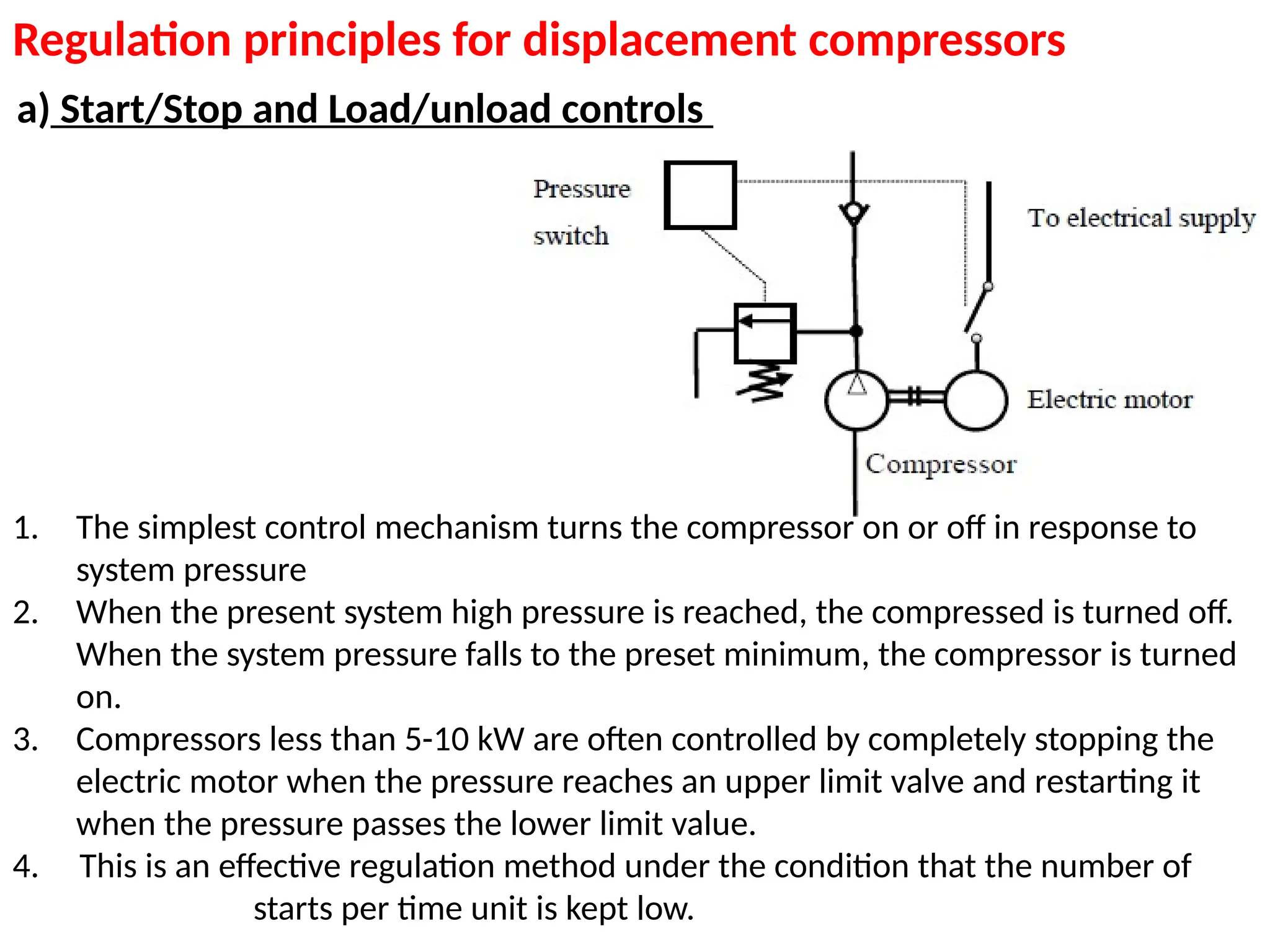
a) Start/Stop and Load/unload controls
1. The simplest control mechanism turns the compressor on or off in response to
system pressure
2. When the present system high pressure is reached, the compressed is turned off.
When the system pressure falls to the preset minimum, the compressor is turned
on.
3. Compressors less than 5-10 kW are often controlled by completely stopping the
electric motor when the pressure reaches an upper limit valve and restarting it
when the pressure passes the lower limit value.
4. This is an effective regulation method under the condition that the number of
starts per time unit is kept low.
b) Pressure Relief valve
This valve releases excess pressure into the atmosphere when
the preset pressure is reached. The preset pressure can be set
by adjusting the spring tension of the spring. Now
c)By pass regulation
In this method, pressure relieved air is cooled and returned to the
compressor intake. This method is often used on process compressors
where gas is unsuitable or too valuable to release into the atmosphere.
d) Throttling the intake
1. Throttling is an easy method to reduce the flow.
2. By increasing the pressure ratio across the compressor, depending
on the induced under pressure in the intake, the method is
however limited to a small regulation range.
3. Liquid injected compressors, which have a large permitted pressure
ratio, can however be regulated down to 10 % of the maximum
capacity. This method makes relatively high energy demands, due
to the high pressure ratio.
e) Pressure relief with throttled intake.
1. The most common regulation method currently used that unites a
maximum regulation range(0-100%) with low energy consumption,
only 15-20% of full load power with an off-loaded compressor (zero
flow).
2. The intake valve is closed, but with a small opening remaining, at the
same time as a blow off valve opens and relieves the outgoing air
from the compressor
f) Speed regulation
A combustion engine, turbine or frequency controlled electric motor
controls the compressor‟s speed and thereby the flow.
It is an efficient method to attain an equal outgoing pressure and low
energy consumption.
CONDITIONING AND DISTRIBUTION OF COMPRESSED
AIR :
The purpose of the fluid conditioners is to make the compressed air more
acceptable and suitable fluid medium for the pneumatic system as well
as the operating personal. The following five fluid conditioners are used
in pneumatic systems
1. Air Filters
2. Air Regulators
3. Air Lubricator
AIR FILTERS:
The purpose of the air filter is to clean the compressed air of all
impurities and any condensate it contains.
Function of air filters:
1. To remove all foreign matter and allow dry and clean air flow without
restriction to regulator and then to the lubricator
2. To condensate and remove water from the air
3. To arrest fine particles and all solid contaminants from air
Source of contamination.
1. The quality of air being drawn into the compressor
2. The type and operation of the air compressor
3. Compressed air storage devices and distribution systems
Factor affecting selection of filters
1. Size of particles to be filtered from
the system
2. Capacity of the filter
3. Accessibility and maintainability
4. Life of the filter
5. Ability to drain the condensate
Construction of typical cartridge type filter:
AIR REGULATOR:
Function:
The function of the air pressure regulator is to maintain working pressure virtually
constant regardless of fluctuations of the line pressure and air consumption.
When the pressure is too low, it results in poor efficiencies and when the pressure
is too high, energy is wasted and equipment’s performance decay faster.
Generally pressure is regulated in pneumatic system at two places.
1. At the receiver tank
2. In the load circuits
Types of Pressure regulator
1. Diaphragm type regulator
2. Piston type regulator
1.Diaphragm type regulator is commonly used in Industrial
pneumatic system. There are two types of diaphragm type
regulator
i) Non- reliving or non-venting type.
ii) Relieving or venting type
Relieving or Venting Type Pressure regulator
Non-Relieving or Non-Venting Type Pressure regulator
AIR LUBRICATOR:
Function: The function of air lubricator is to add a controlled
amount of oil with air to ensure proper lubrication of internal
moving parts of pneumatic components.
Lubricants are used to
1. To reduce the wear of the moving parts
2. Reduce the frictional losses
3. Protect the equipment form corrosion
Excessive lubrication is undesirable. Excessive lubrication
may results in
4. malfunctioning of components,
5. seizing and sticking of components after prolonged downtime
6. environmental pollution
Filter Regulator Lubricator Unit (FRL Unit) /Service Unit
PNEUMATICS ACTUATORS:
1. Pneumatic actuators are the devices used for converting pressure
energy of compressed air into the mechanical energy to perform
useful work.
2. Actuators are used to perform the task of exerting the required
force at the end of the stroke or used to create displacement by the
movement of the piston.
3. The pressurised air from the compressor is supplied to reservoir.
4. The pressurised air from storage is supplied to pneumatic actuator
to do work.
TYPES OF PNEUMATICS ACTUATORS
1. Linear Actuator or Pneumatic cylinders
2. Rotary Actuator or Air motors
3. Limited angle Actuators
Types of Pneumatic cylinders /Linear actuators
The different classification scheme of the pneumatic cylinders
are given below
1.Based on application for which air cylinders are used
i) Light duty air cylinders
ii) Medium duty air cylinders
iii) Heavy duty air cylinders
2. Based on the cylinder action
i) Single acting cylinder
ii) Double acting cylinder
a. Single rod type double acting cylinder
b. Double rod type double acting cylinder
3. Based on cylinder’s movement
i) Rotating type air cylinder
ii) Non rotating type air cylinder
4. Based on the cylinder’s design
1. Telescopic cylinder
2. Tandem cylinder
3. Rod less cylinder
I. Cable cylinder,
II. Sealing band Cylinder with slotted cylinder barrel
III. Cylinder with Magnetically Coupled Slide
4.Impact cylinder
5.Duplex cylinders
6.Cylinders with sensors
Based on the cylinder action
A) Single acting cylinders.
There are varying designs of single acting cylinders including:
1. Diaphragm cylinder
2. Rolling diaphragm cylinder
3. Gravity return single acting cylinder
4. Spring return single acting cylinder
Diaphragm cylinder:
piston is replaced by a diaphragm is replaced by a diaphragm of hard rubber,
plastic or metal clamped between the two halves of a metal casing expanded to
form a wide, flat enclosure
Rolling diaphragm cylinder :
They are similar to diaphragm cylinders.
They too contain a diaphragm instead of piston, which is this instance rolls out
along the inner walls of the cylinder when air pressure is applied to the device,
thereby causing the operating stem to move outwards.
Compared with the standard diaphragm type, a rolling diaphragm cylinder is
capable of executing appreciably longer operating strokes
(averaging from 50 mm to 800mm) .
Gravity Return Single Acting Cylinder
Spring Return Single Acting Cylinder
Double acting cylinders.
Telescopic Cylinder
Cable cylinder:
•It is used for very long strokes, up to 2000mm.
• It consists of nylon jacketed cable which enters the cylinder barrel and
is attached to one end of internal cylinder and exits through the gland
seal and enters into the other end of the internal cylinder through the
another gland seal.
• When compressed air enters the cylinder the piston moves from end-
to-end.
Cylinder with Magnetically Coupled Slide
The magnetic cylinders are available upto the size of about 40 mm diameter and
stroke lengths from 50mm to 4000 mm. They can operate at the speed of about
3000 mm/sec.
The major advantages of this type of cylinders are
i) There is no leakage
ii) There is no direct contact of moving elements therefore the wear is less
iii) The orientation of the carriage can be changed easily,
Position sensor for cylinders
Cylinder mountings.
VALVES
1. Direction control valve
2. Non return valves
3. Flow control valves
4. Pressure control valves
DIRECTION CONTROL VALVES
1. Based on construction
i) Poppet or seat valves
- Ball seat valve
- Disc seat valve
- Diaphragm Valves
ii) Sliding spool valves
- Longitudinal slide valve
-Suspended spool valves
-- Rotary spool valves
2. Based on the Number of ports
i) Two way valves
ii) Three way valves
iii) Four way valves
3. Based on methods of actuation
i) Mechanical
ii) Electrical
iii) Pneumatic
4. Based on Size of the port
5. Based on mounting styles
i) Sub base
ii) Manifold
iii) In-line
iv) Valve island
POPPET DIRECTION CONTROL VALVES
A.Ball seat valve.(a simple 2/2 normally closed valve. )
B. Disc seat poppet valve(disc type 3/2 way DCV )
Mechatronics - Pneumatics _ unit -5.pptx

Mechatronics - Pneumatics _ unit -5.pptx

  • 1.
  • 5.
    GAS LAWS: 1.Boyle’s Law: Statement: Ifa given mass of a gas is compressed or expanded at a constant temperature, then the absolute pressure is inversely proportional to the volume.
  • 6.
    Charles law: Statement: Ifa given mass of a gas is heated or cooled at a constant pressure, then the volume is directly proportional to the absolute temperature.
  • 7.
    Gay-Lussac’s Law : Statement: Atconstant pressure, the absolute pressure of an ideal gas will vary directly with the absolute temperature
  • 8.
    Compressors can beclassified in the following different ways. (a)Based on principle of operation: (i) Positive displacement compressor. (ii) Non-positive displacement compressors.
  • 9.
    Positive displacement compressorscan be further classified based on the type of mechanism used for compression. These can be (i) Reciprocating type positive displacement compressors (ii) Rotary type positive displacement compressors. Rotary compressors of this type are available in the names as given below; (ii) Roots blower (ii) Vane type compressors
  • 11.
  • 13.
    Isothermal compression: Compression ofair takes place at constant temperature Adiabatic compression: There is no flow of heat energy into or out of the gas during expansion or compression.
  • 14.
    Polytrophic compression: This processlies between Isothermal and adiabatic. In pneumatics, most compression/expansions are neither adiabatic (Very fast) nor isothermal (Very slow). Efficiency of compressor : In a reciprocating compressor the work is minimum when compression follows the isothermal process. The ratio of isothermal work done to the actual work done is called isothermal efficiency.
  • 15.
    WORK DONE INA SINGLE STAGE COMPRESSOR CONSIDERING CLEARANCE.
  • 16.
  • 18.
    Control of compressors Continuouscapacity regulation: •This method involves continuous control of drive motor or valve according to variation in pressure. •The result is normally a small pressure variations (0.1 to 0.5 bar), depending on the regulation system‟s amplification and its speed.
  • 19.
    Load/unload regulation: •This methodinvolves the acceptance of variation in pressure between two values •This takes place by completely stopping the flow at the higher pressure (off loading) and resume the flow rate (loading) when the pressure has dropped to the lowest valve. •Pressure variation depend on the permitted number of load/unload cycles per time unit, but normally lie within the range of 0.3 to 1 bar.
  • 20.
    Regulation principles fordisplacement compressors a) Start/Stop and Load/unload controls 1. The simplest control mechanism turns the compressor on or off in response to system pressure 2. When the present system high pressure is reached, the compressed is turned off. When the system pressure falls to the preset minimum, the compressor is turned on. 3. Compressors less than 5-10 kW are often controlled by completely stopping the electric motor when the pressure reaches an upper limit valve and restarting it when the pressure passes the lower limit value. 4. This is an effective regulation method under the condition that the number of starts per time unit is kept low.
  • 21.
    b) Pressure Reliefvalve This valve releases excess pressure into the atmosphere when the preset pressure is reached. The preset pressure can be set by adjusting the spring tension of the spring. Now
  • 22.
    c)By pass regulation Inthis method, pressure relieved air is cooled and returned to the compressor intake. This method is often used on process compressors where gas is unsuitable or too valuable to release into the atmosphere.
  • 23.
    d) Throttling theintake 1. Throttling is an easy method to reduce the flow. 2. By increasing the pressure ratio across the compressor, depending on the induced under pressure in the intake, the method is however limited to a small regulation range. 3. Liquid injected compressors, which have a large permitted pressure ratio, can however be regulated down to 10 % of the maximum capacity. This method makes relatively high energy demands, due to the high pressure ratio.
  • 24.
    e) Pressure reliefwith throttled intake. 1. The most common regulation method currently used that unites a maximum regulation range(0-100%) with low energy consumption, only 15-20% of full load power with an off-loaded compressor (zero flow). 2. The intake valve is closed, but with a small opening remaining, at the same time as a blow off valve opens and relieves the outgoing air from the compressor
  • 25.
    f) Speed regulation Acombustion engine, turbine or frequency controlled electric motor controls the compressor‟s speed and thereby the flow. It is an efficient method to attain an equal outgoing pressure and low energy consumption.
  • 26.
    CONDITIONING AND DISTRIBUTIONOF COMPRESSED AIR : The purpose of the fluid conditioners is to make the compressed air more acceptable and suitable fluid medium for the pneumatic system as well as the operating personal. The following five fluid conditioners are used in pneumatic systems 1. Air Filters 2. Air Regulators 3. Air Lubricator
  • 27.
    AIR FILTERS: The purposeof the air filter is to clean the compressed air of all impurities and any condensate it contains. Function of air filters: 1. To remove all foreign matter and allow dry and clean air flow without restriction to regulator and then to the lubricator 2. To condensate and remove water from the air 3. To arrest fine particles and all solid contaminants from air
  • 28.
    Source of contamination. 1.The quality of air being drawn into the compressor 2. The type and operation of the air compressor 3. Compressed air storage devices and distribution systems
  • 29.
    Factor affecting selectionof filters 1. Size of particles to be filtered from the system 2. Capacity of the filter 3. Accessibility and maintainability 4. Life of the filter 5. Ability to drain the condensate
  • 30.
    Construction of typicalcartridge type filter:
  • 31.
    AIR REGULATOR: Function: The functionof the air pressure regulator is to maintain working pressure virtually constant regardless of fluctuations of the line pressure and air consumption. When the pressure is too low, it results in poor efficiencies and when the pressure is too high, energy is wasted and equipment’s performance decay faster. Generally pressure is regulated in pneumatic system at two places. 1. At the receiver tank 2. In the load circuits
  • 32.
    Types of Pressureregulator 1. Diaphragm type regulator 2. Piston type regulator 1.Diaphragm type regulator is commonly used in Industrial pneumatic system. There are two types of diaphragm type regulator i) Non- reliving or non-venting type. ii) Relieving or venting type
  • 33.
    Relieving or VentingType Pressure regulator
  • 34.
    Non-Relieving or Non-VentingType Pressure regulator
  • 35.
    AIR LUBRICATOR: Function: Thefunction of air lubricator is to add a controlled amount of oil with air to ensure proper lubrication of internal moving parts of pneumatic components. Lubricants are used to 1. To reduce the wear of the moving parts 2. Reduce the frictional losses 3. Protect the equipment form corrosion Excessive lubrication is undesirable. Excessive lubrication may results in 4. malfunctioning of components, 5. seizing and sticking of components after prolonged downtime 6. environmental pollution
  • 37.
    Filter Regulator LubricatorUnit (FRL Unit) /Service Unit
  • 39.
    PNEUMATICS ACTUATORS: 1. Pneumaticactuators are the devices used for converting pressure energy of compressed air into the mechanical energy to perform useful work. 2. Actuators are used to perform the task of exerting the required force at the end of the stroke or used to create displacement by the movement of the piston. 3. The pressurised air from the compressor is supplied to reservoir. 4. The pressurised air from storage is supplied to pneumatic actuator to do work.
  • 40.
    TYPES OF PNEUMATICSACTUATORS 1. Linear Actuator or Pneumatic cylinders 2. Rotary Actuator or Air motors 3. Limited angle Actuators
  • 41.
    Types of Pneumaticcylinders /Linear actuators The different classification scheme of the pneumatic cylinders are given below 1.Based on application for which air cylinders are used i) Light duty air cylinders ii) Medium duty air cylinders iii) Heavy duty air cylinders
  • 42.
    2. Based onthe cylinder action i) Single acting cylinder ii) Double acting cylinder a. Single rod type double acting cylinder b. Double rod type double acting cylinder
  • 43.
    3. Based oncylinder’s movement i) Rotating type air cylinder ii) Non rotating type air cylinder 4. Based on the cylinder’s design 1. Telescopic cylinder 2. Tandem cylinder 3. Rod less cylinder I. Cable cylinder, II. Sealing band Cylinder with slotted cylinder barrel III. Cylinder with Magnetically Coupled Slide 4.Impact cylinder 5.Duplex cylinders 6.Cylinders with sensors
  • 44.
    Based on thecylinder action A) Single acting cylinders.
  • 45.
    There are varyingdesigns of single acting cylinders including: 1. Diaphragm cylinder 2. Rolling diaphragm cylinder 3. Gravity return single acting cylinder 4. Spring return single acting cylinder
  • 46.
    Diaphragm cylinder: piston isreplaced by a diaphragm is replaced by a diaphragm of hard rubber, plastic or metal clamped between the two halves of a metal casing expanded to form a wide, flat enclosure
  • 47.
    Rolling diaphragm cylinder: They are similar to diaphragm cylinders. They too contain a diaphragm instead of piston, which is this instance rolls out along the inner walls of the cylinder when air pressure is applied to the device, thereby causing the operating stem to move outwards. Compared with the standard diaphragm type, a rolling diaphragm cylinder is capable of executing appreciably longer operating strokes (averaging from 50 mm to 800mm) .
  • 48.
    Gravity Return SingleActing Cylinder
  • 49.
    Spring Return SingleActing Cylinder
  • 50.
  • 51.
  • 52.
    Cable cylinder: •It isused for very long strokes, up to 2000mm. • It consists of nylon jacketed cable which enters the cylinder barrel and is attached to one end of internal cylinder and exits through the gland seal and enters into the other end of the internal cylinder through the another gland seal. • When compressed air enters the cylinder the piston moves from end- to-end.
  • 53.
    Cylinder with MagneticallyCoupled Slide The magnetic cylinders are available upto the size of about 40 mm diameter and stroke lengths from 50mm to 4000 mm. They can operate at the speed of about 3000 mm/sec. The major advantages of this type of cylinders are i) There is no leakage ii) There is no direct contact of moving elements therefore the wear is less iii) The orientation of the carriage can be changed easily,
  • 54.
  • 55.
  • 56.
    VALVES 1. Direction controlvalve 2. Non return valves 3. Flow control valves 4. Pressure control valves
  • 57.
    DIRECTION CONTROL VALVES 1.Based on construction i) Poppet or seat valves - Ball seat valve - Disc seat valve - Diaphragm Valves ii) Sliding spool valves - Longitudinal slide valve -Suspended spool valves -- Rotary spool valves 2. Based on the Number of ports i) Two way valves ii) Three way valves iii) Four way valves
  • 58.
    3. Based onmethods of actuation i) Mechanical ii) Electrical iii) Pneumatic 4. Based on Size of the port 5. Based on mounting styles i) Sub base ii) Manifold iii) In-line iv) Valve island
  • 59.
    POPPET DIRECTION CONTROLVALVES A.Ball seat valve.(a simple 2/2 normally closed valve. )
  • 60.
    B. Disc seatpoppet valve(disc type 3/2 way DCV )