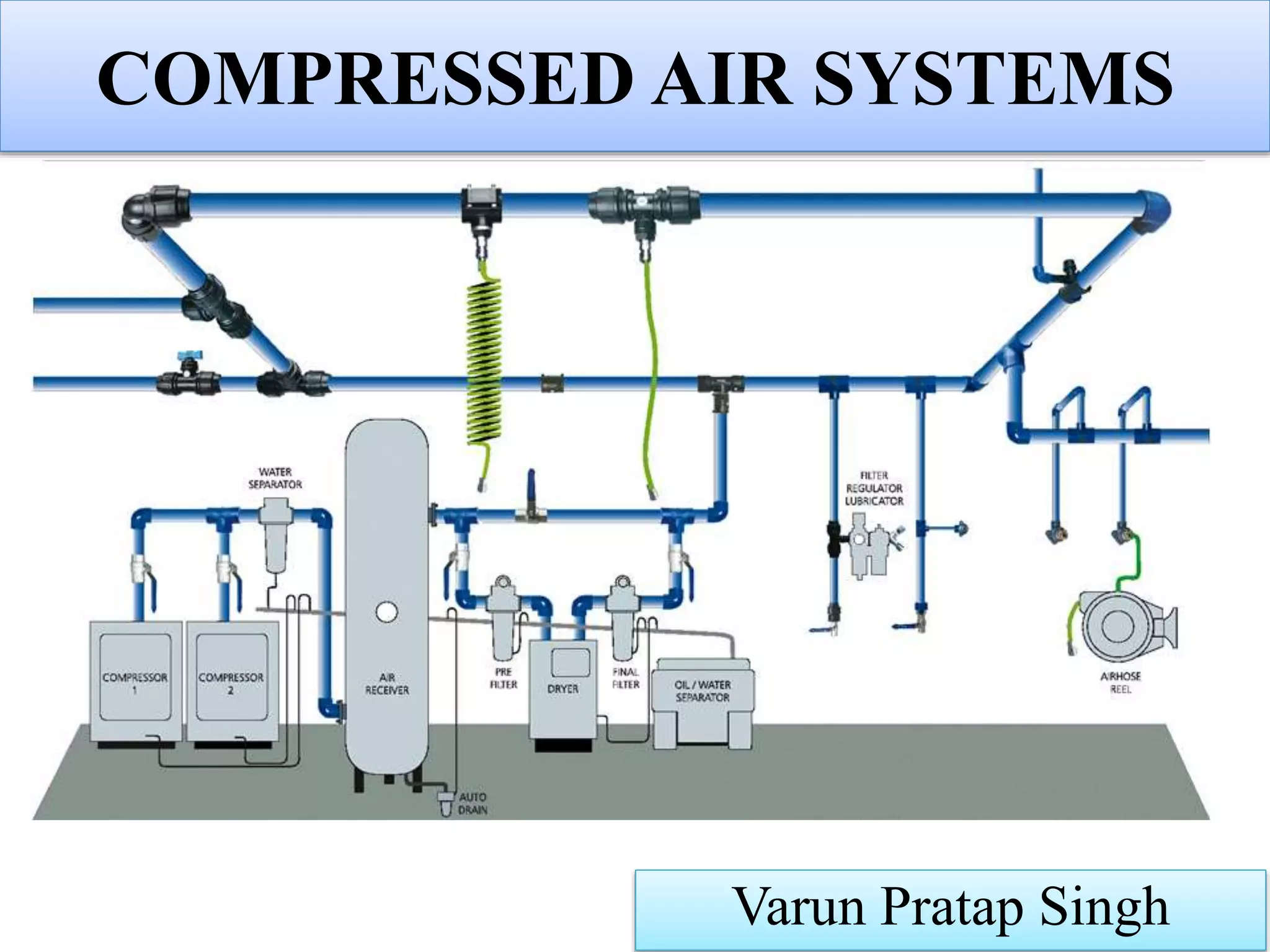
COMPRESSED AIR SYSTEMS
Varun Pratap Singh
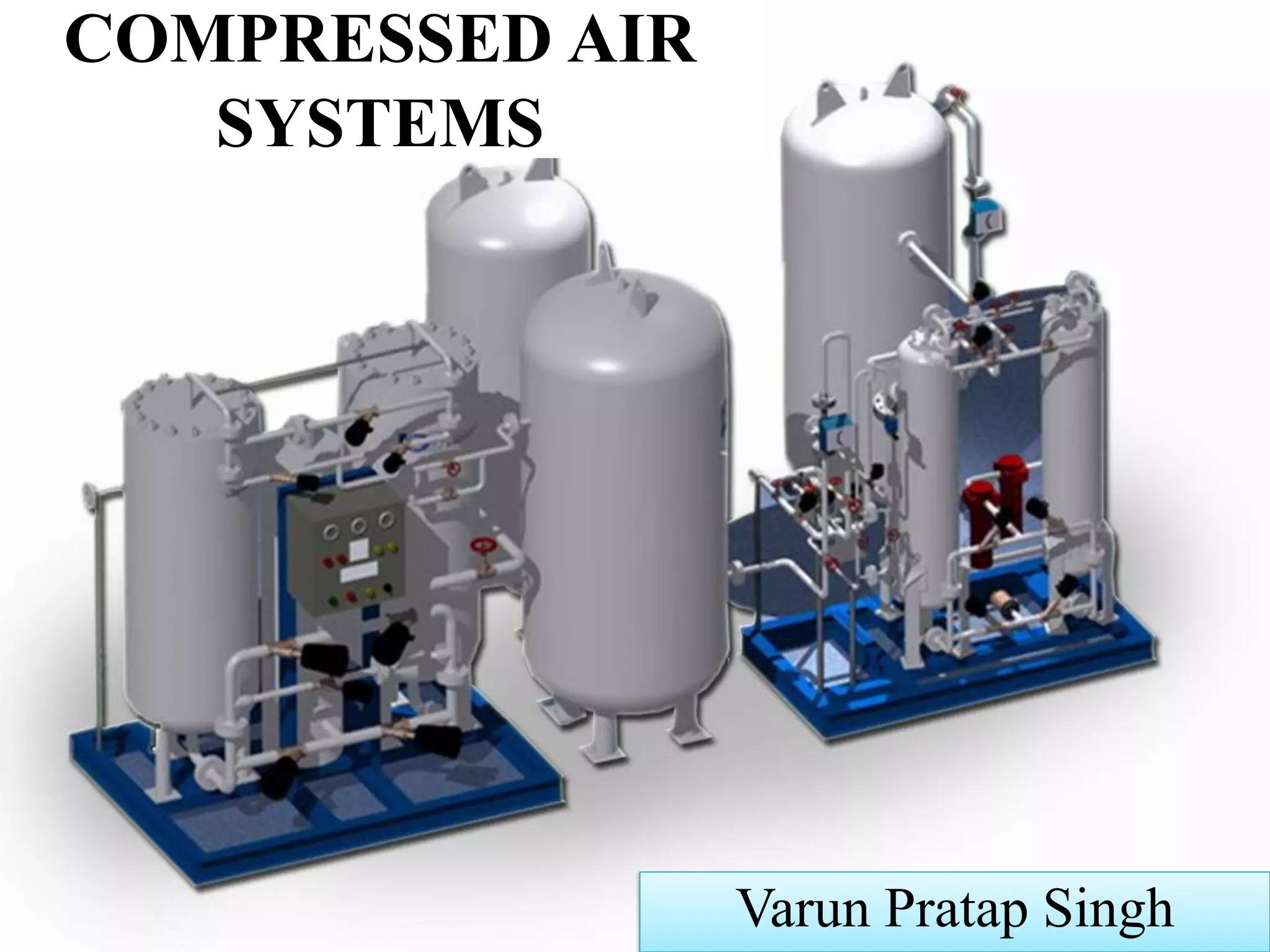
COMPRESSED AIR
SYSTEMS
Varun Pratap Singh
INTRODUCTION TO AIRCOMPRESSOR:
 Compressed air is one of the Key utilities across various industrial sectors including Oil
andGas.
 Atypical instrument air skid package contains multiple compressors with dryers and filtration
systems that provide high-quality, dry air for a range of applications from pneumatic controls
and actuation of critical valves,to buffer sealinggas.
 An air compressor is a mechanical device used to compress air from Low pressure to high
pressure.
 Compressed air is used in thousands of applications, like manufacturing/ assembly,
pharmaceuticals, Power Generation units, Processing units , to perform painting activities,
pneumatic pressure testing etc.
 It canpower rotary equipment.
 Itdrives reciprocating equipment.
 Itcan impact, and convey.
 It canatomize, spray,sandblast, agitate, and cool.
 It can operatecontrols.
 Theapplications areendless….
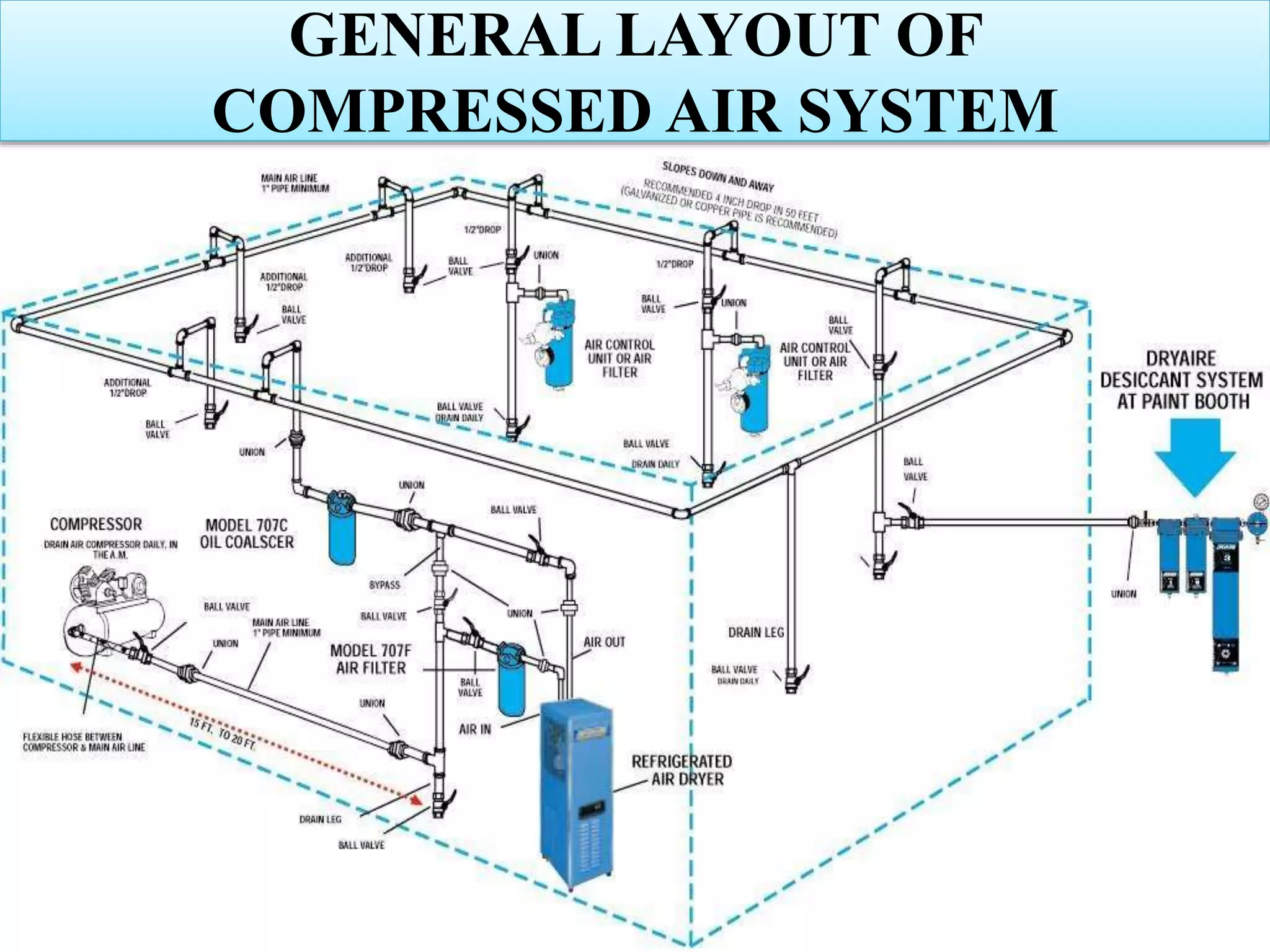
GENERAL LAYOUT OF
COMPRESSED AIR SYSTEM
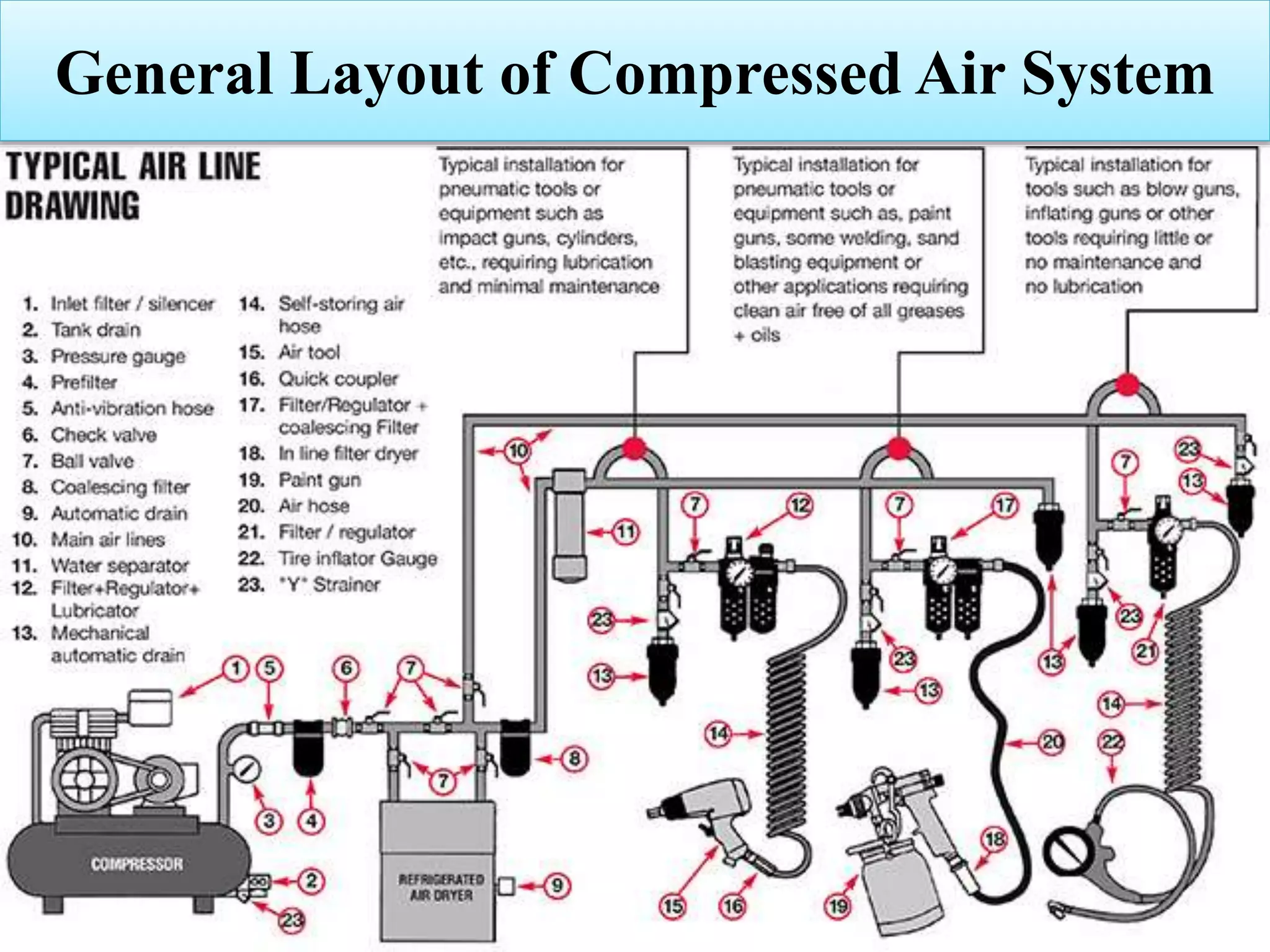
General Layout of Compressed Air System
GENERAL LAYOUT OF
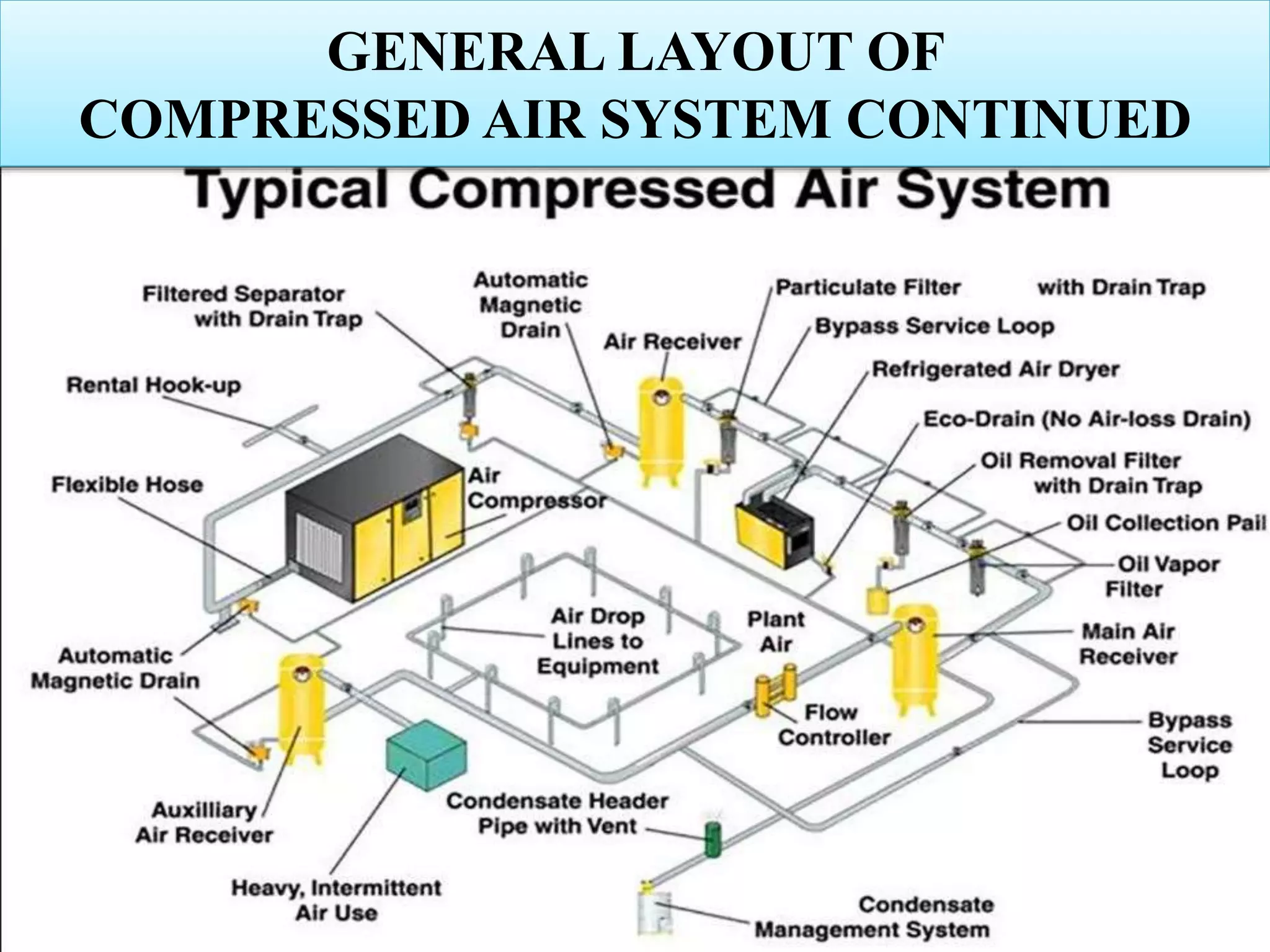
COMPRESSED AIR SYSTEM CONTINUED
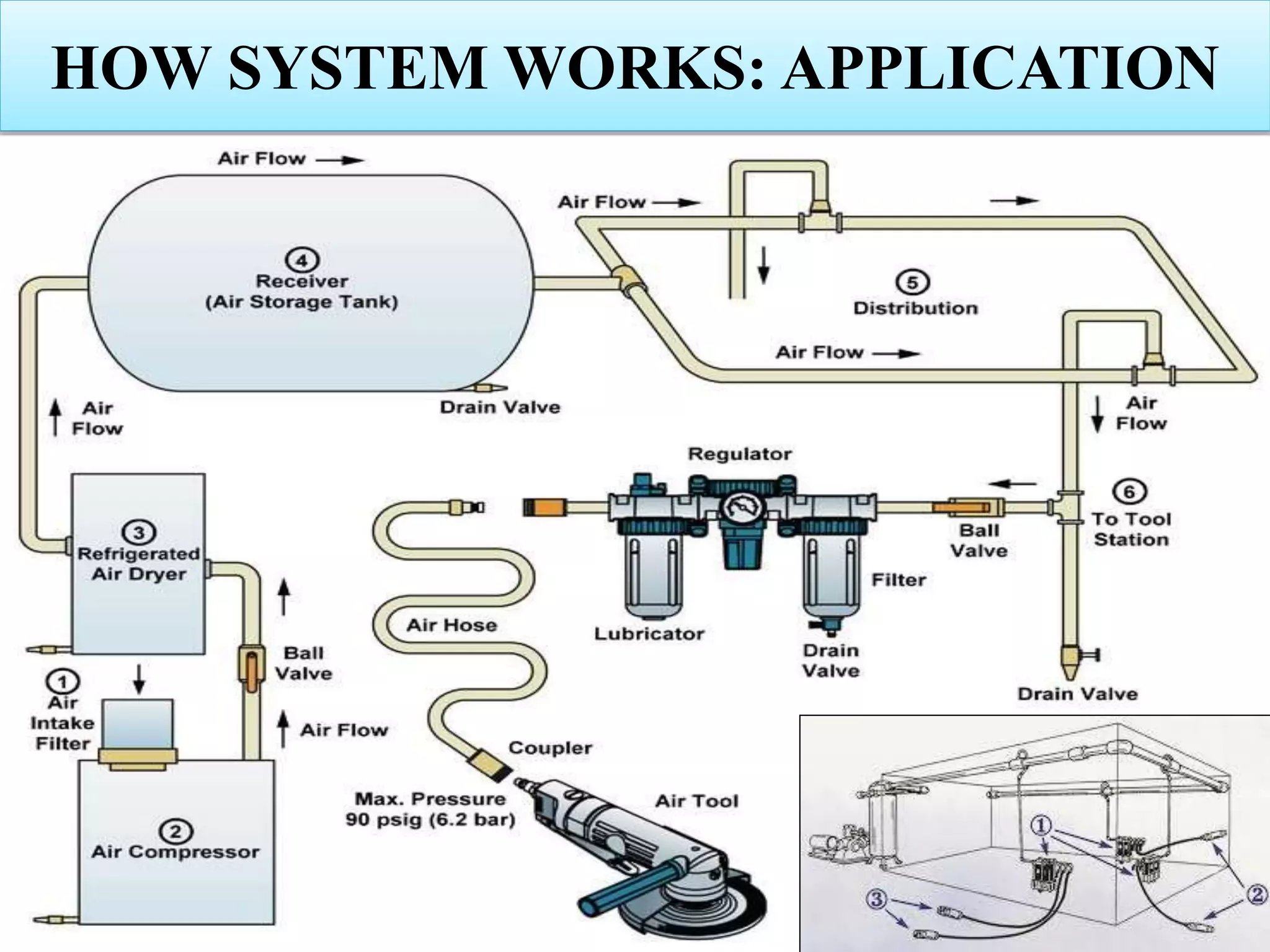
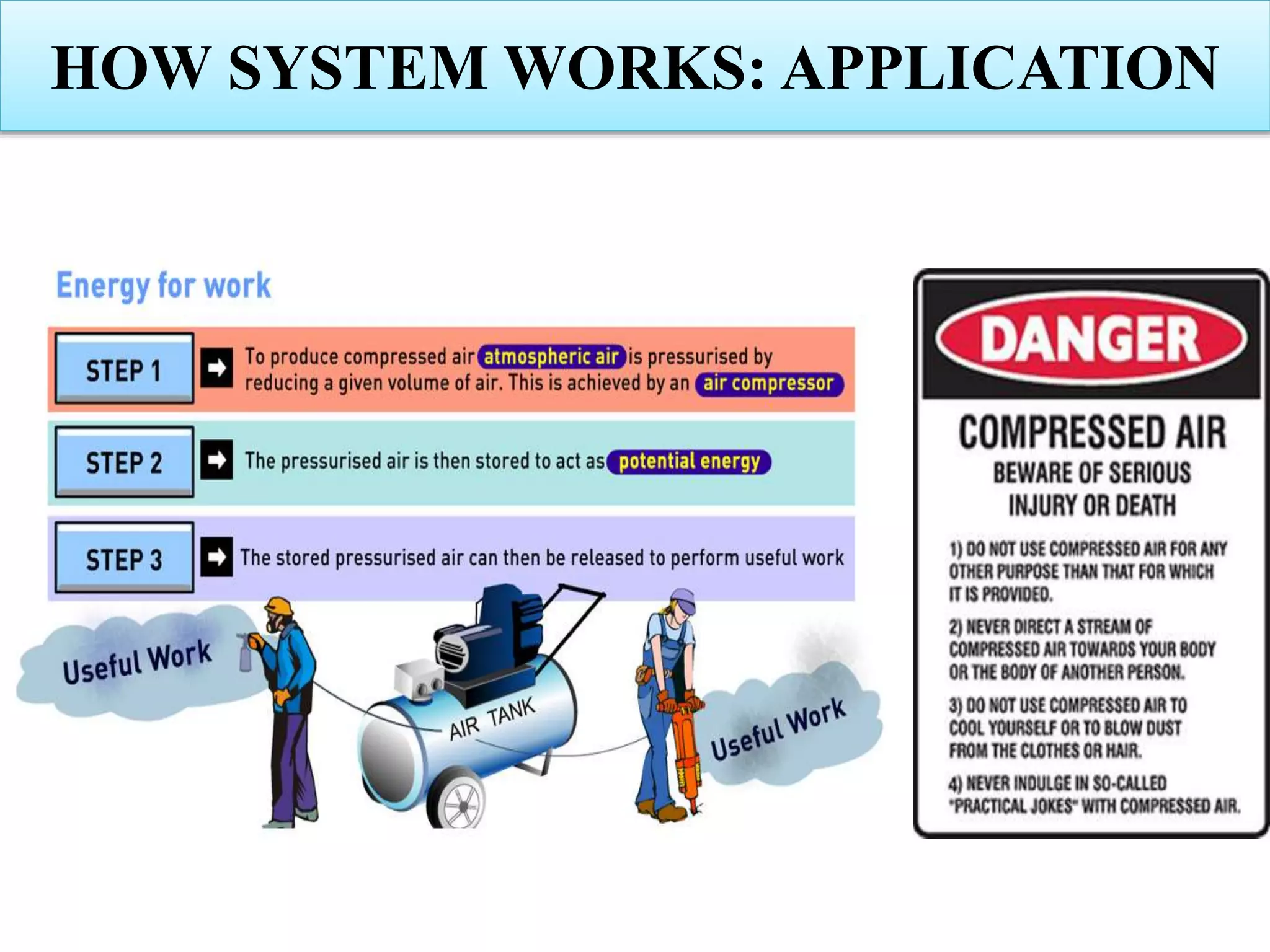
HOW SYSTEM WORKS: APPLICATION
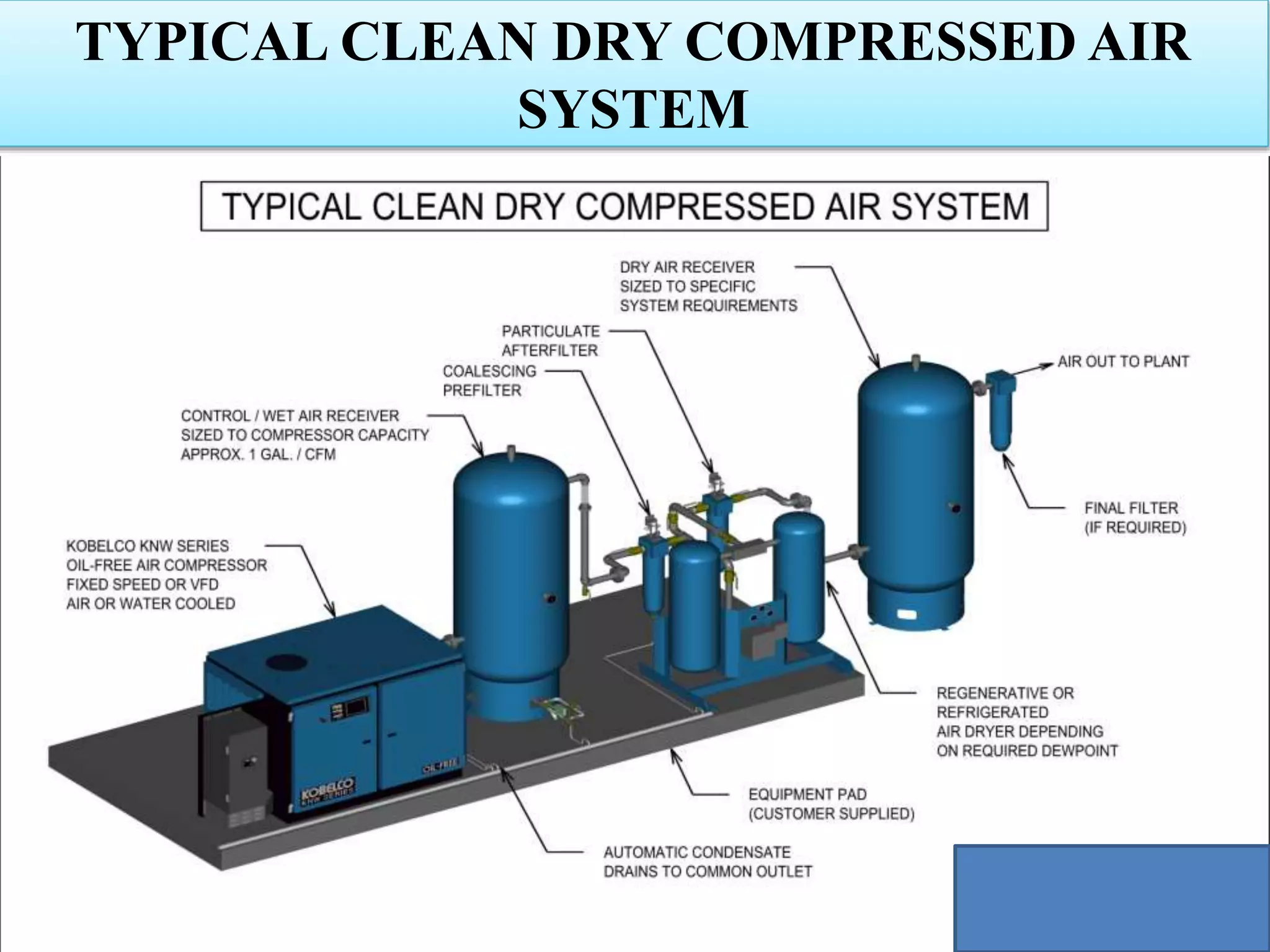
TYPICAL CLEAN DRY COMPRESSED AIR
SYSTEM
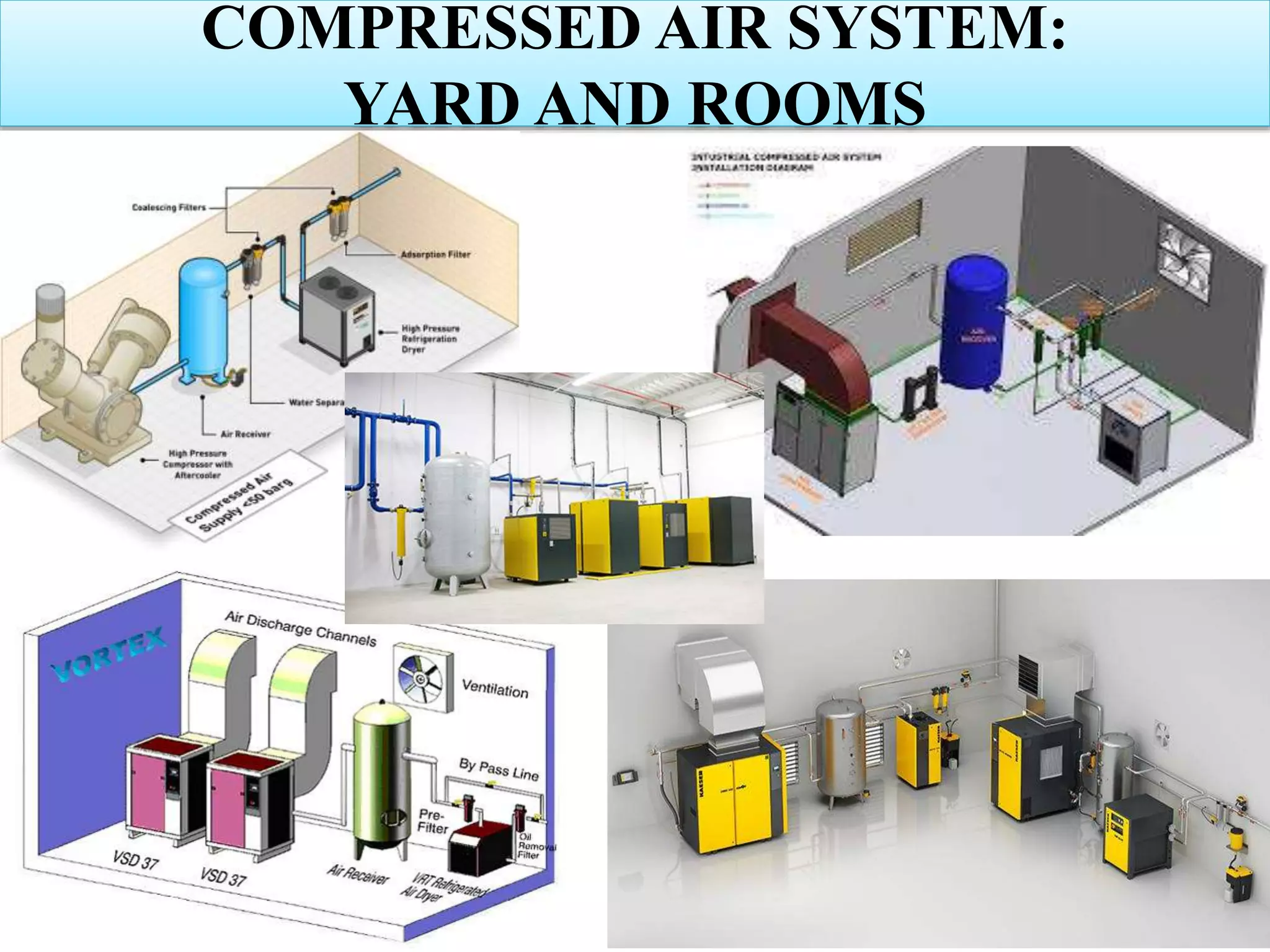
COMPRESSED AIR SYSTEM:
YARD AND ROOMS
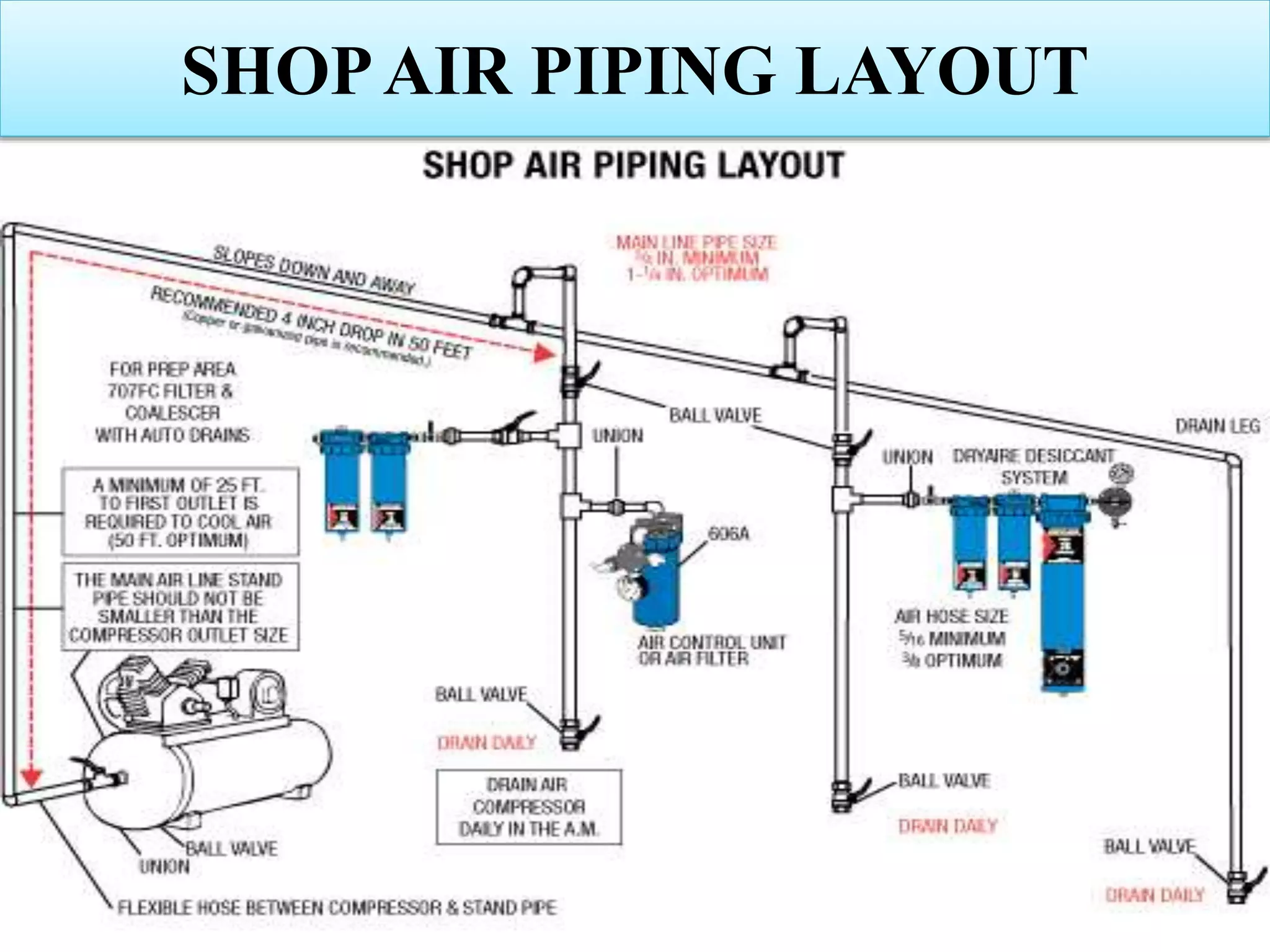
SHOPAIR PIPING LAYOUT
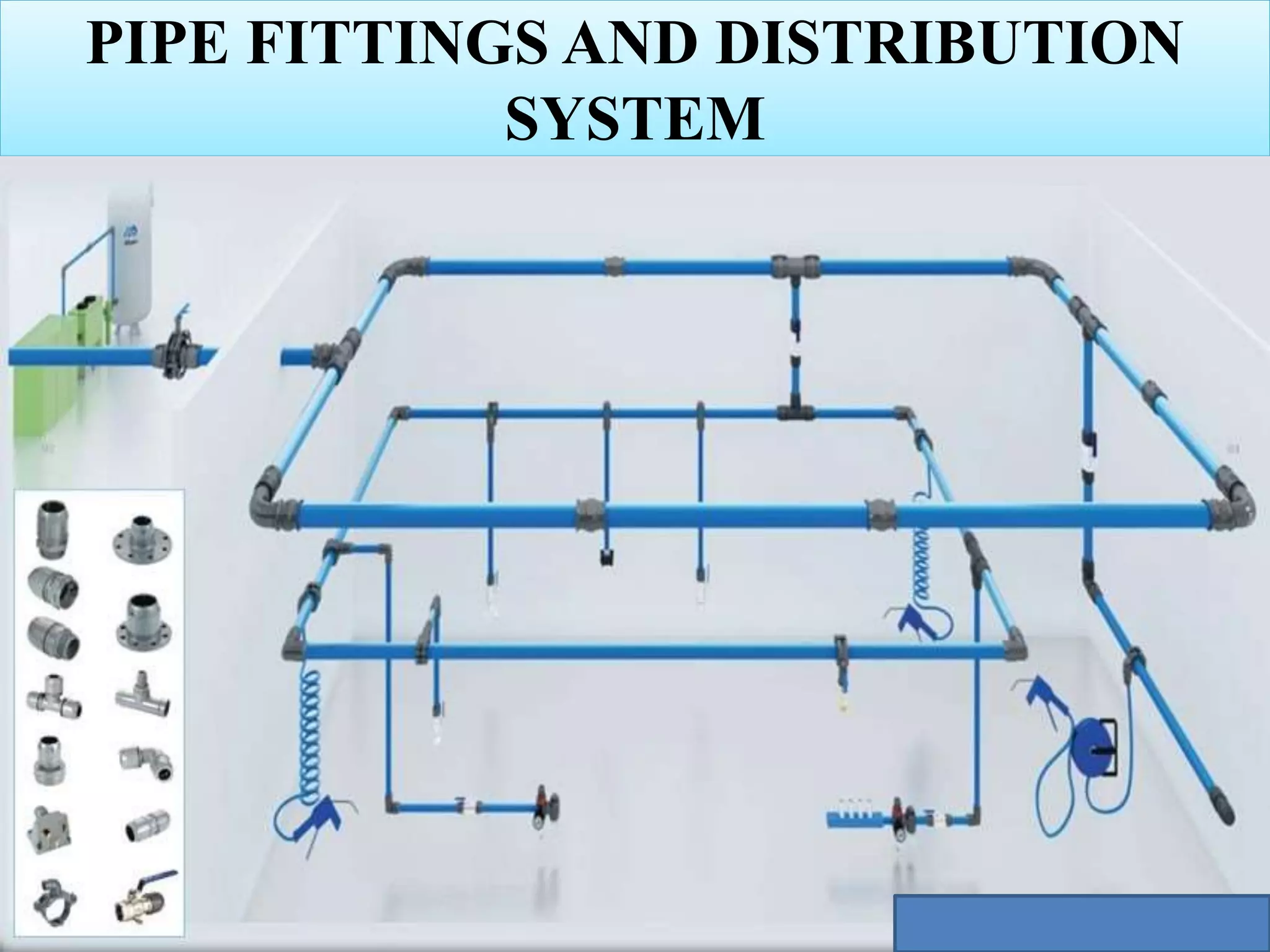
PIPE FITTINGS AND DISTRIBUTION
SYSTEM
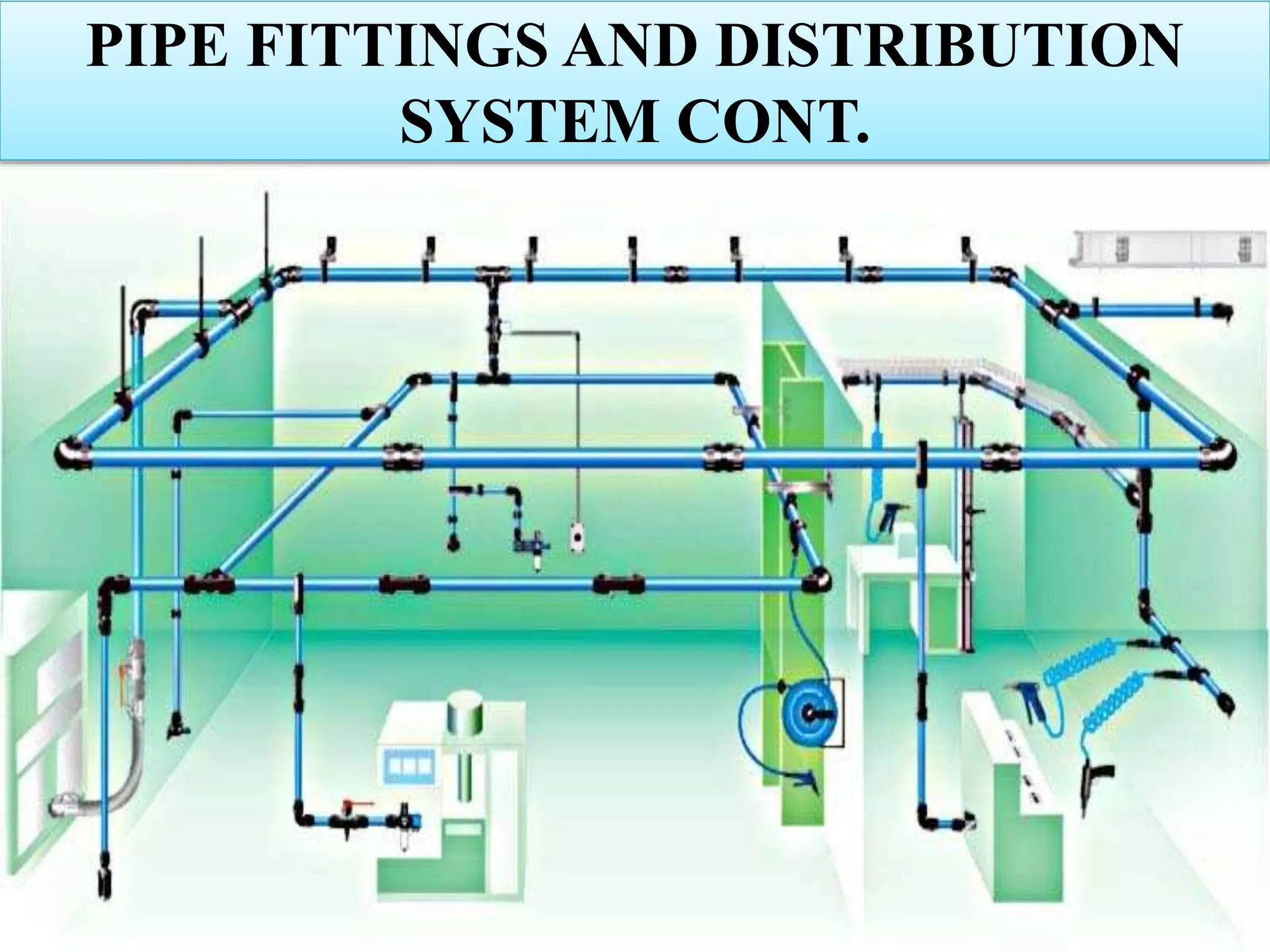
PIPE FITTINGS AND DISTRIBUTION
SYSTEM CONT.
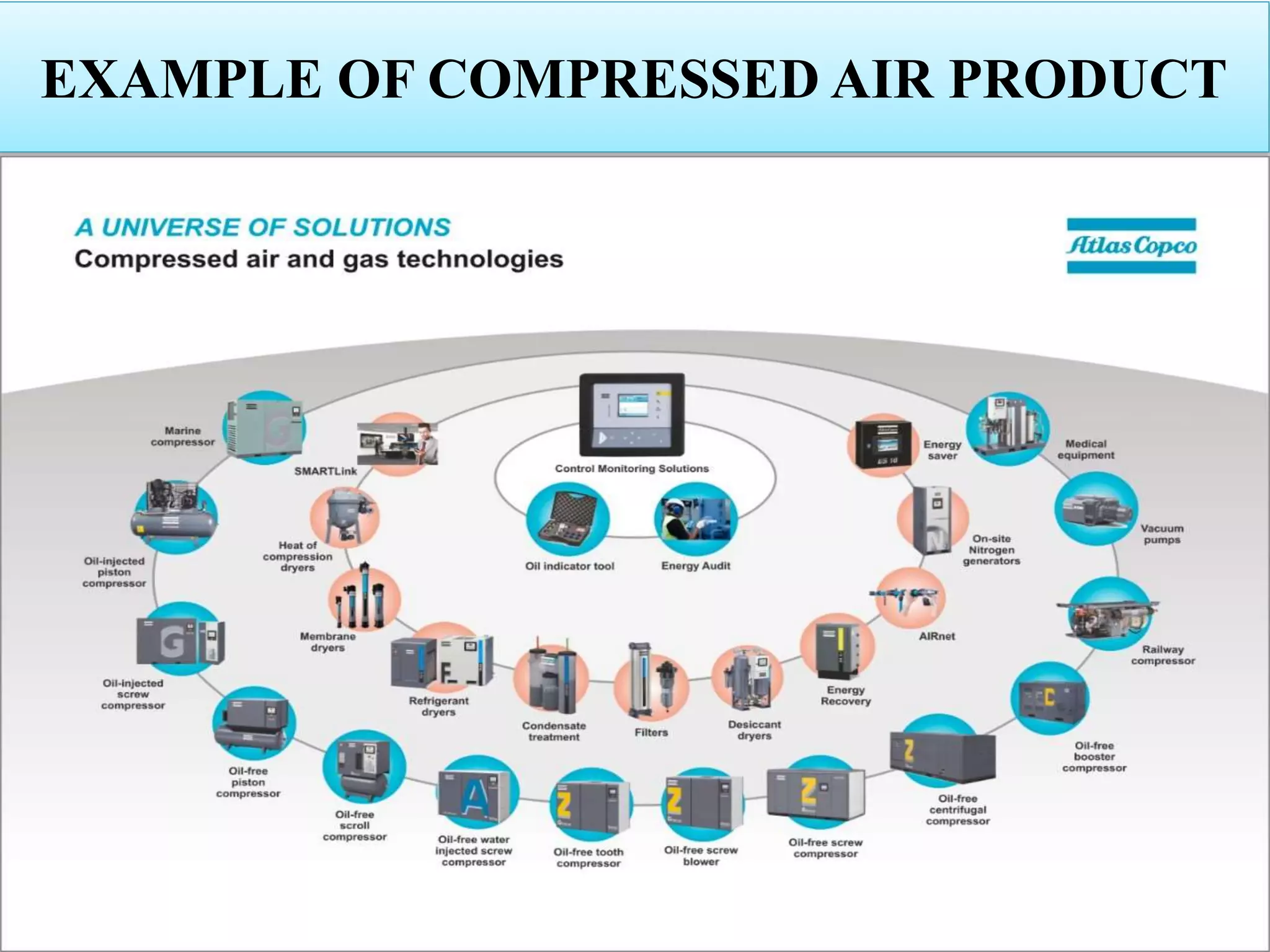
EXAMPLE OF COMPRESSED AIR PRODUCT
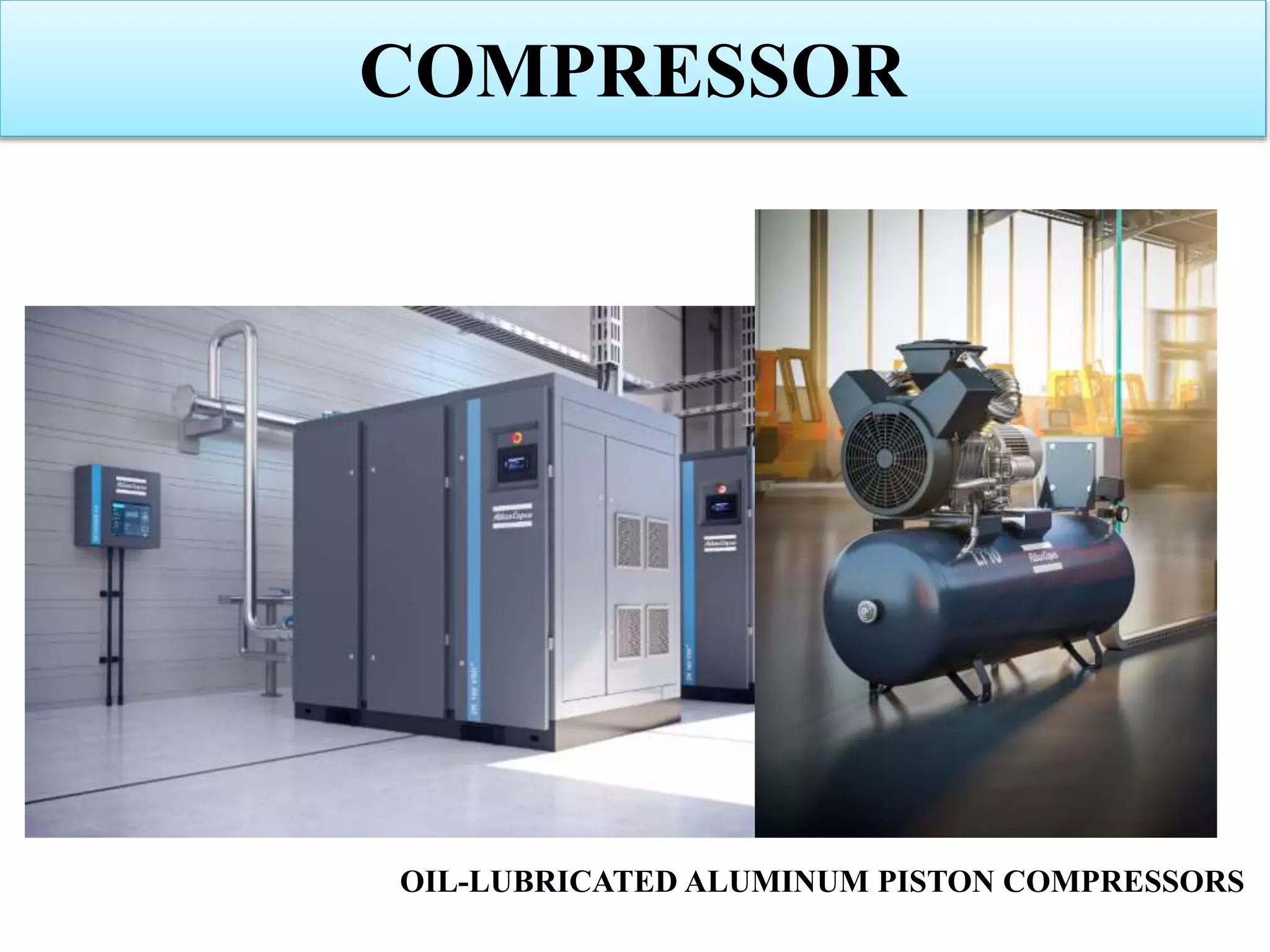
COMPRESSOR
OIL-LUBRICATED ALUMINUM PISTON COMPRESSORS
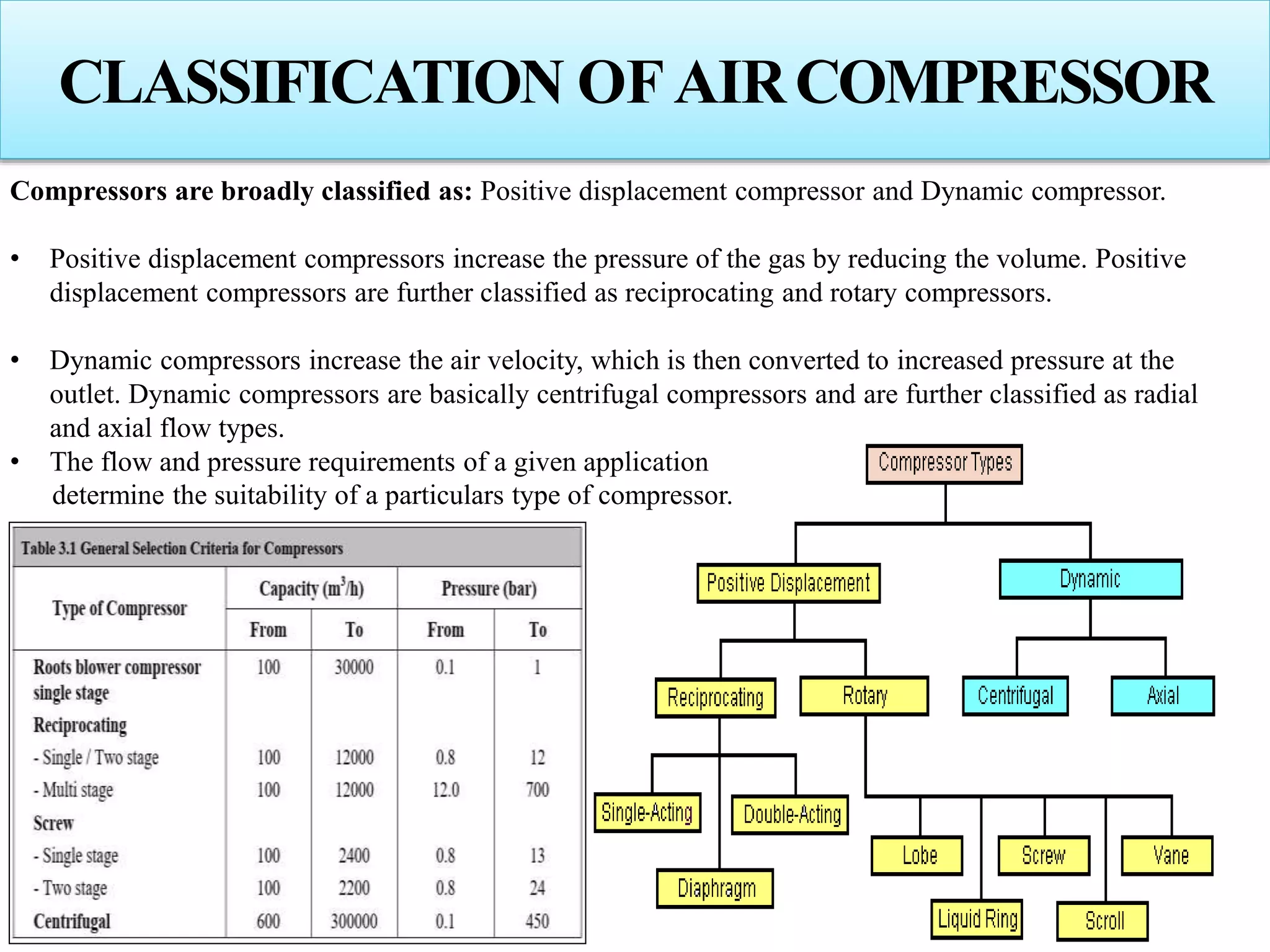
CLASSIFICATION OFAIRCOMPRESSOR
Compressors are broadly classified as: Positive displacement compressor and Dynamic compressor.
• Positive displacement compressors increase the pressure of the gas by reducing the volume. Positive
displacement compressors are further classified as reciprocating and rotary compressors.
• Dynamic compressors increase the air velocity, which is then converted to increased pressure at the
outlet. Dynamic compressors are basically centrifugal compressors and are further classified as radial
and axial flow types.
• The flow and pressure requirements of a given application
determine the suitability of a particulars type of compressor.
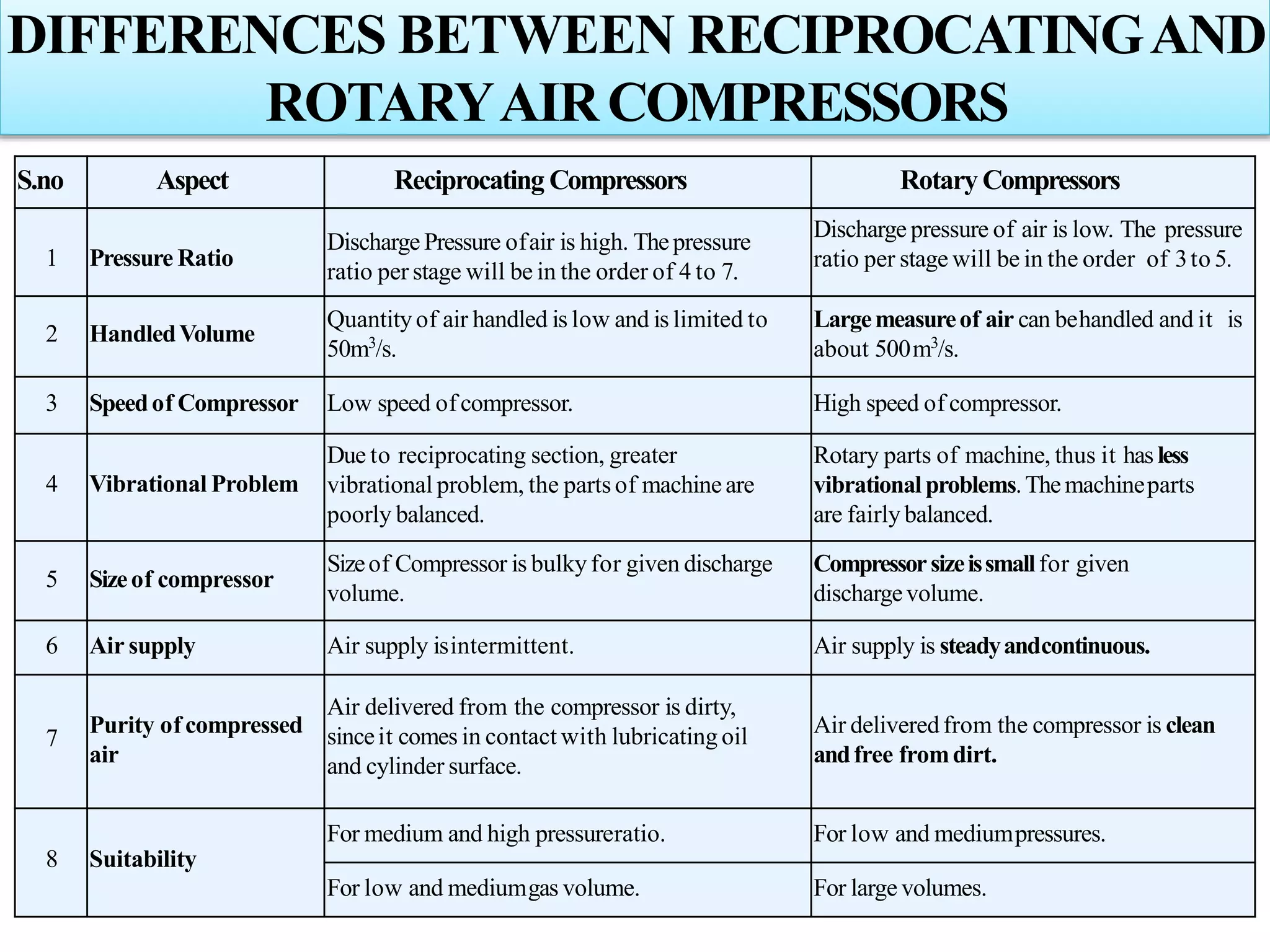
S.no Aspect Reciprocating Compressors Rotary Compressors
1 Pressure Ratio
Discharge Pressure ofair is high. Thepressure
ratio per stage will be in the order of 4 to 7.
Discharge pressure of air is low. The pressure
ratio per stage will be in the order of 3to 5.
2 HandledVolume
Quantityof air handled is low and is limited to
50m3
/s.
Largemeasureof air can behandled and it is
about 500m3
/s.
3 Speedof Compressor Low speed ofcompressor. High speed of compressor.
4 Vibrational Problem
Due to reciprocating section, greater
vibrational problem, the partsof machineare
poorly balanced.
Rotary parts of machine, thus it hasless
vibrationalproblems.Themachineparts
are fairlybalanced.
5 Sizeof compressor
Sizeof Compressor is bulky for given discharge
volume.
Compressorsizeissmallfor given
dischargevolume.
6 Air supply Air supply isintermittent. Air supply is steadyandcontinuous.
7
Purity of compressed
air
Air delivered from the compressor is dirty,
sinceit comes in contact with lubricating oil
and cylinder surface.
Air delivered from the compressor is clean
andfree fromdirt.
8 Suitability
For medium and high pressureratio. For low and mediumpressures.
For low and mediumgas volume. For large volumes.
DIFFERENCES BETWEEN RECIPROCATINGAND
ROTARYAIRCOMPRESSORS
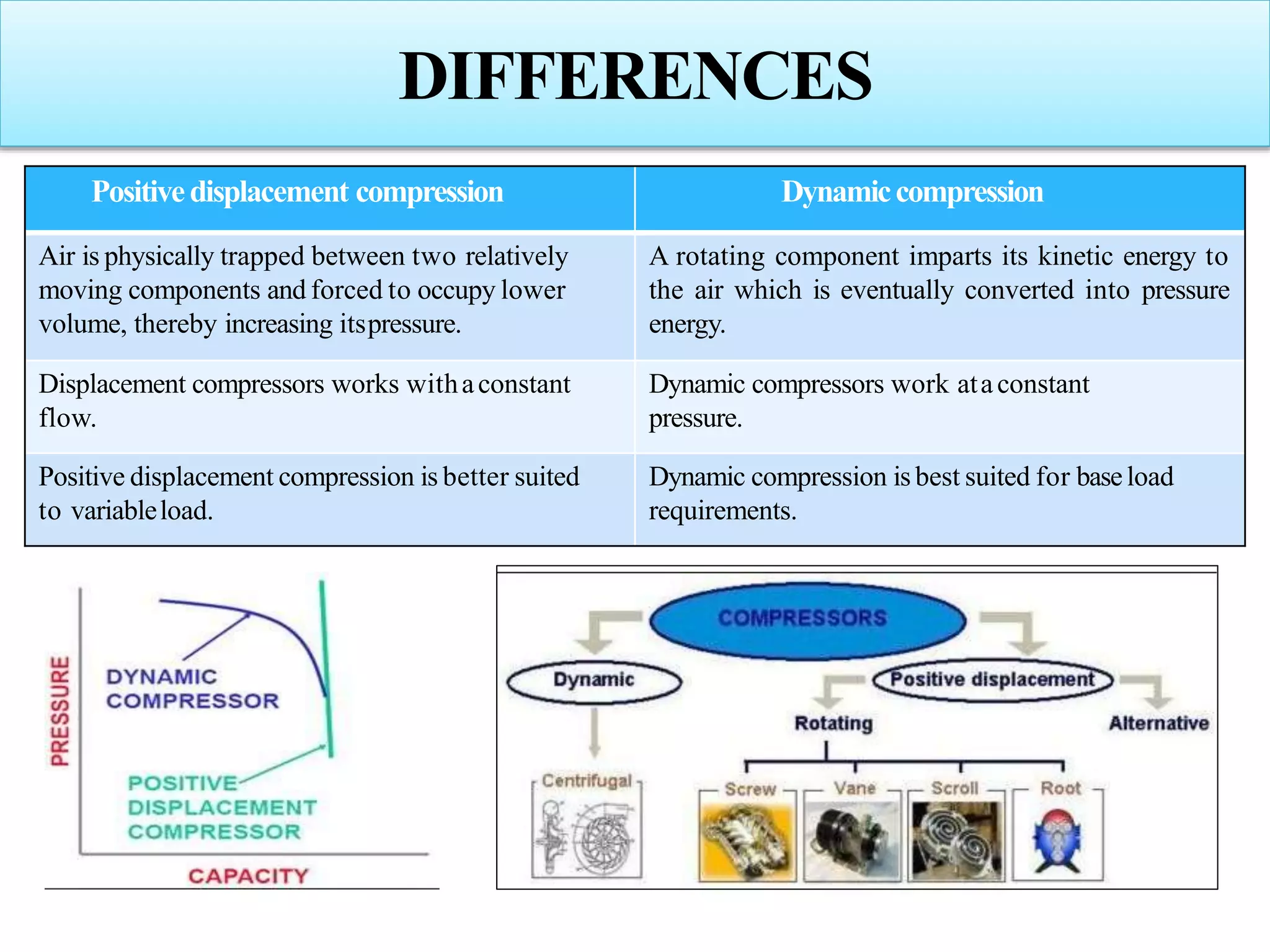
DIFFERENCES
Positivedisplacement compression Dynamiccompression
Air is physically trapped between two relatively
moving components and forced to occupy lower
volume, thereby increasing itspressure.
A rotating component imparts its kinetic energy to
the air which is eventually converted into pressure
energy.
Displacement compressors works withaconstant
flow.
Dynamic compressors work ataconstant
pressure.
Positive displacement compression is better suited
to variableload.
Dynamic compression is best suited for baseload
requirements.
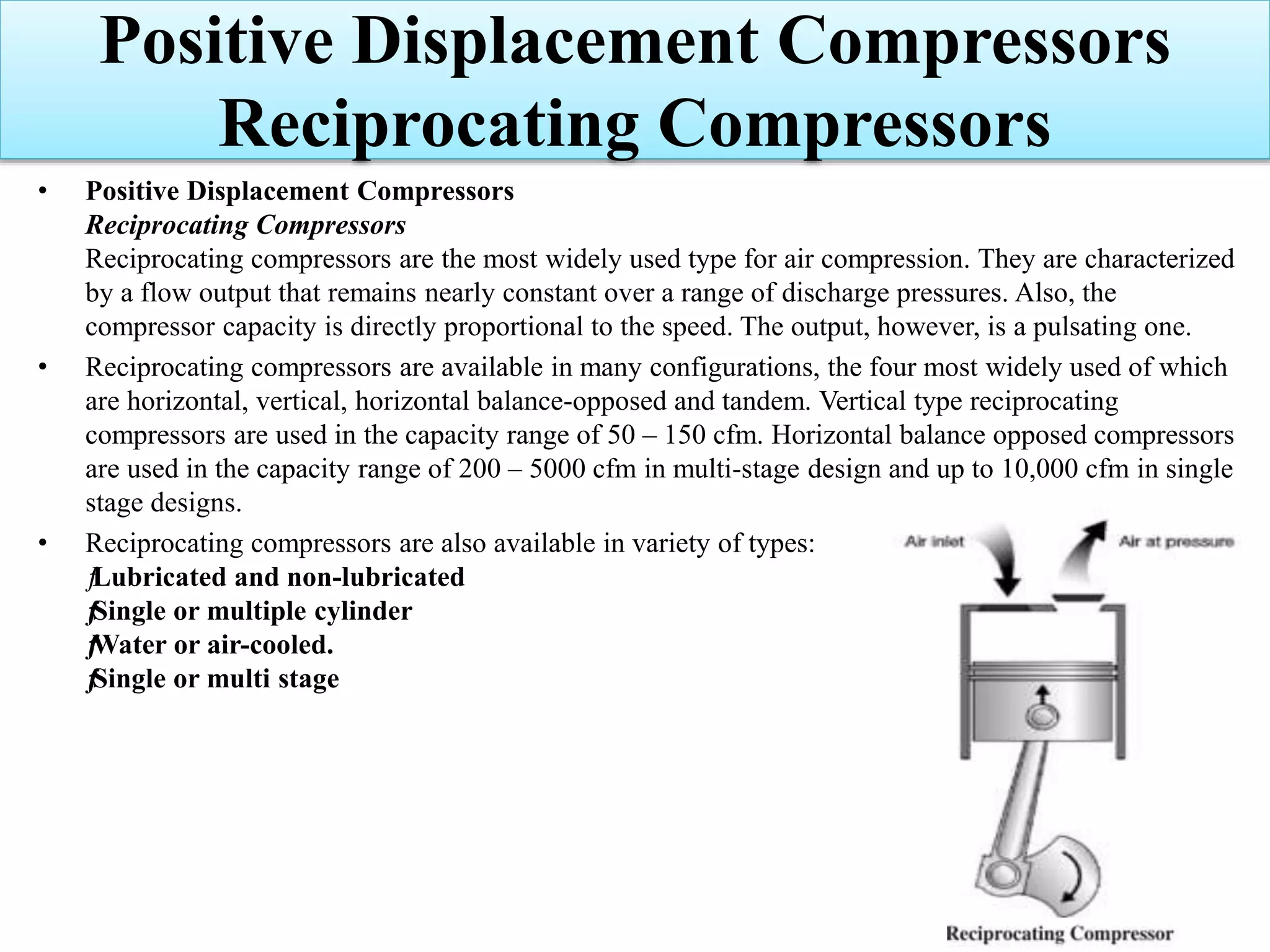
• Positive Displacement Compressors
Reciprocating Compressors
Reciprocating compressors are the most widely used type for air compression. They are characterized
by a flow output that remains nearly constant over a range of discharge pressures. Also, the
compressor capacity is directly proportional to the speed. The output, however, is a pulsating one.
• Reciprocating compressors are available in many configurations, the four most widely used of which
are horizontal, vertical, horizontal balance-opposed and tandem. Vertical type reciprocating
compressors are used in the capacity range of 50 – 150 cfm. Horizontal balance opposed compressors
are used in the capacity range of 200 – 5000 cfm in multi-stage design and up to 10,000 cfm in single
stage designs.
• Reciprocating compressors are also available in variety of types:
ƒLubricated and non-lubricated
ƒSingle or multiple cylinder
ƒWater or air-cooled.
ƒSingle or multi stage
Positive Displacement Compressors
Reciprocating Compressors
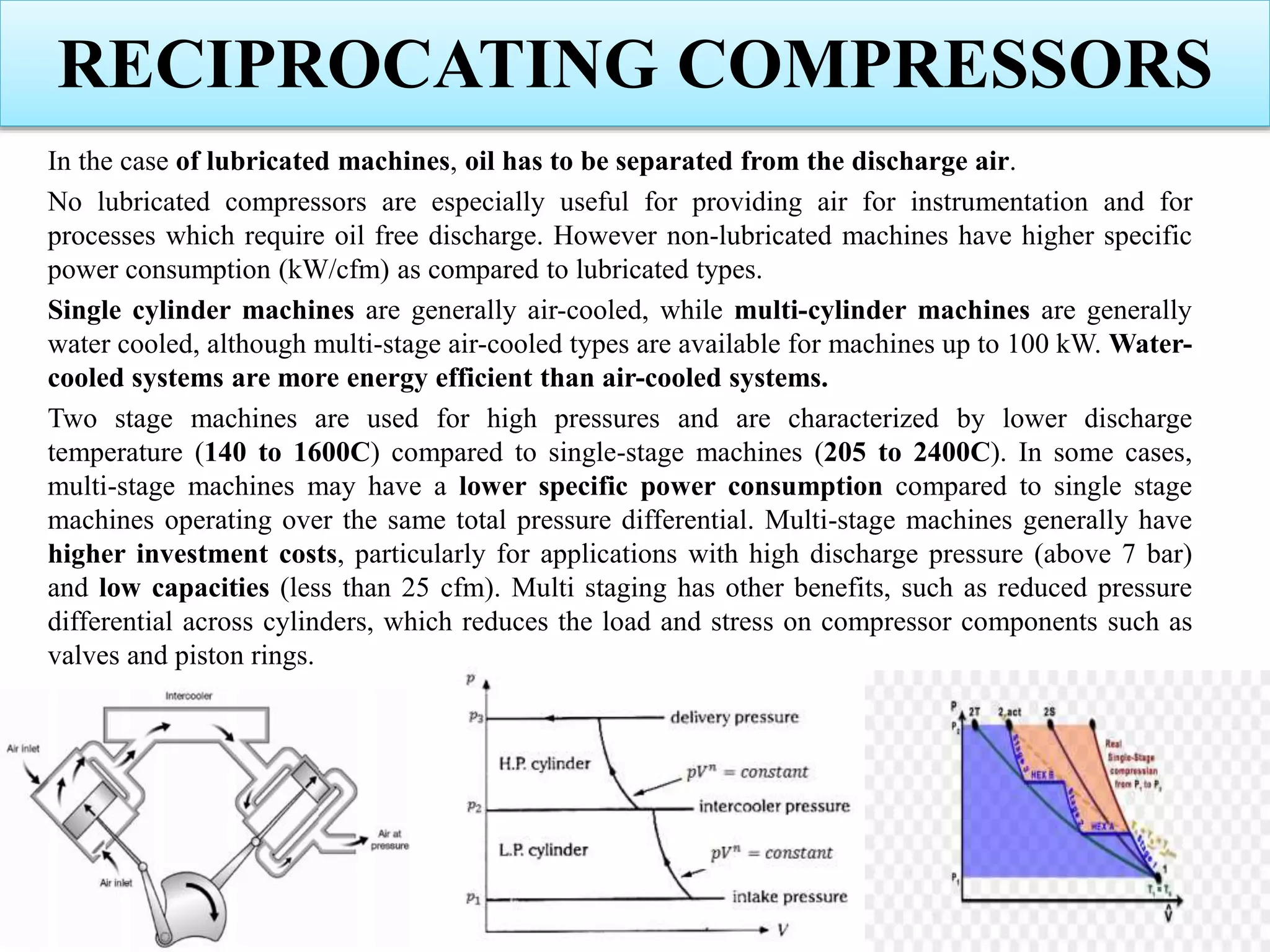
RECIPROCATING COMPRESSORS
In the case of lubricated machines, oil has to be separated from the discharge air.
No lubricated compressors are especially useful for providing air for instrumentation and for
processes which require oil free discharge. However non-lubricated machines have higher specific
power consumption (kW/cfm) as compared to lubricated types.
Single cylinder machines are generally air-cooled, while multi-cylinder machines are generally
water cooled, although multi-stage air-cooled types are available for machines up to 100 kW. Water-
cooled systems are more energy efficient than air-cooled systems.
Two stage machines are used for high pressures and are characterized by lower discharge
temperature (140 to 1600C) compared to single-stage machines (205 to 2400C). In some cases,
multi-stage machines may have a lower specific power consumption compared to single stage
machines operating over the same total pressure differential. Multi-stage machines generally have
higher investment costs, particularly for applications with high discharge pressure (above 7 bar)
and low capacities (less than 25 cfm). Multi staging has other benefits, such as reduced pressure
differential across cylinders, which reduces the load and stress on compressor components such as
valves and piston rings.
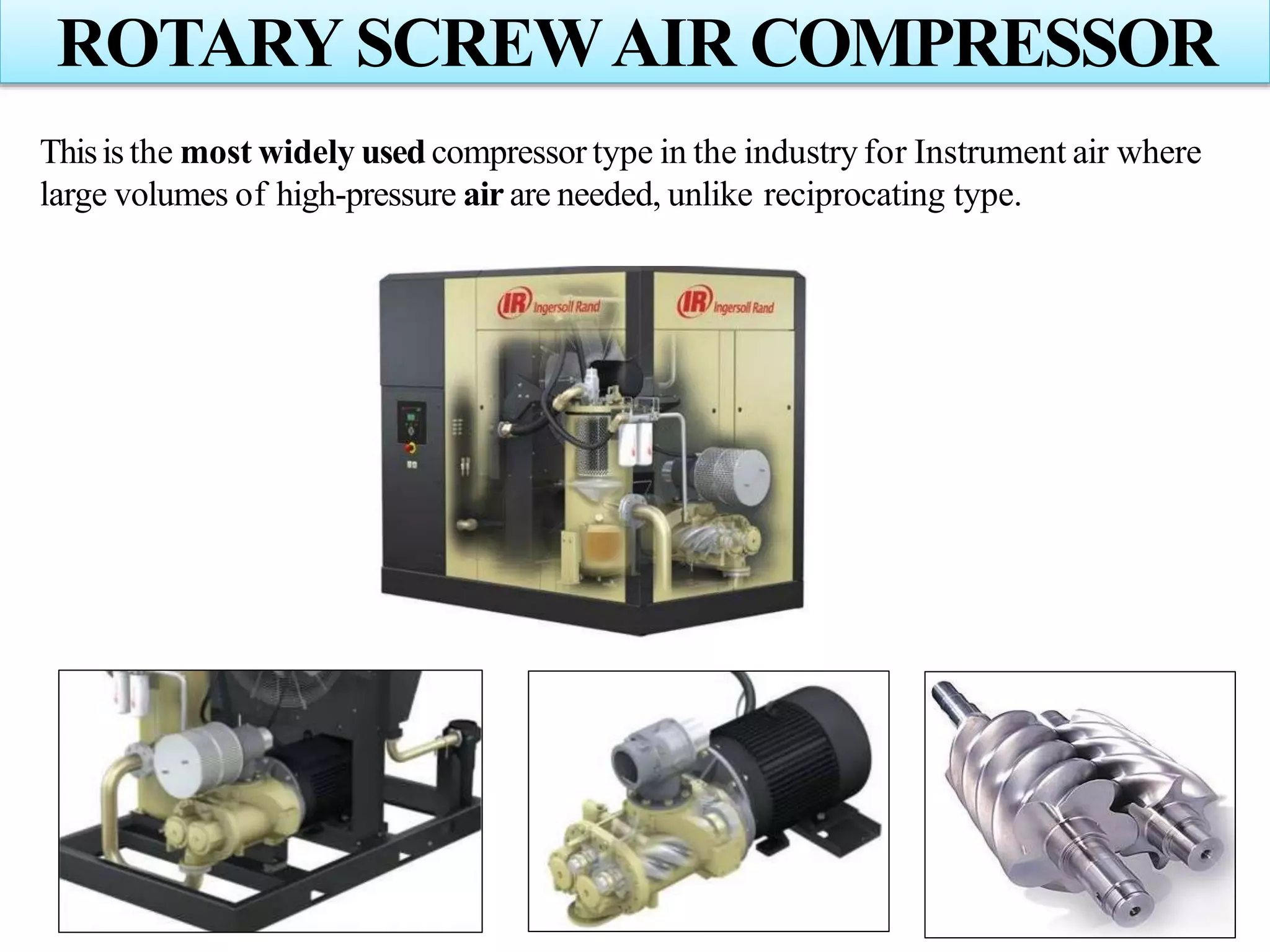
Thisisthe most widely used compressor type in the industry for Instrument air where
large volumes of high-pressure air are needed, unlike reciprocating type.
ROTARY SCREWAIR COMPRESSOR
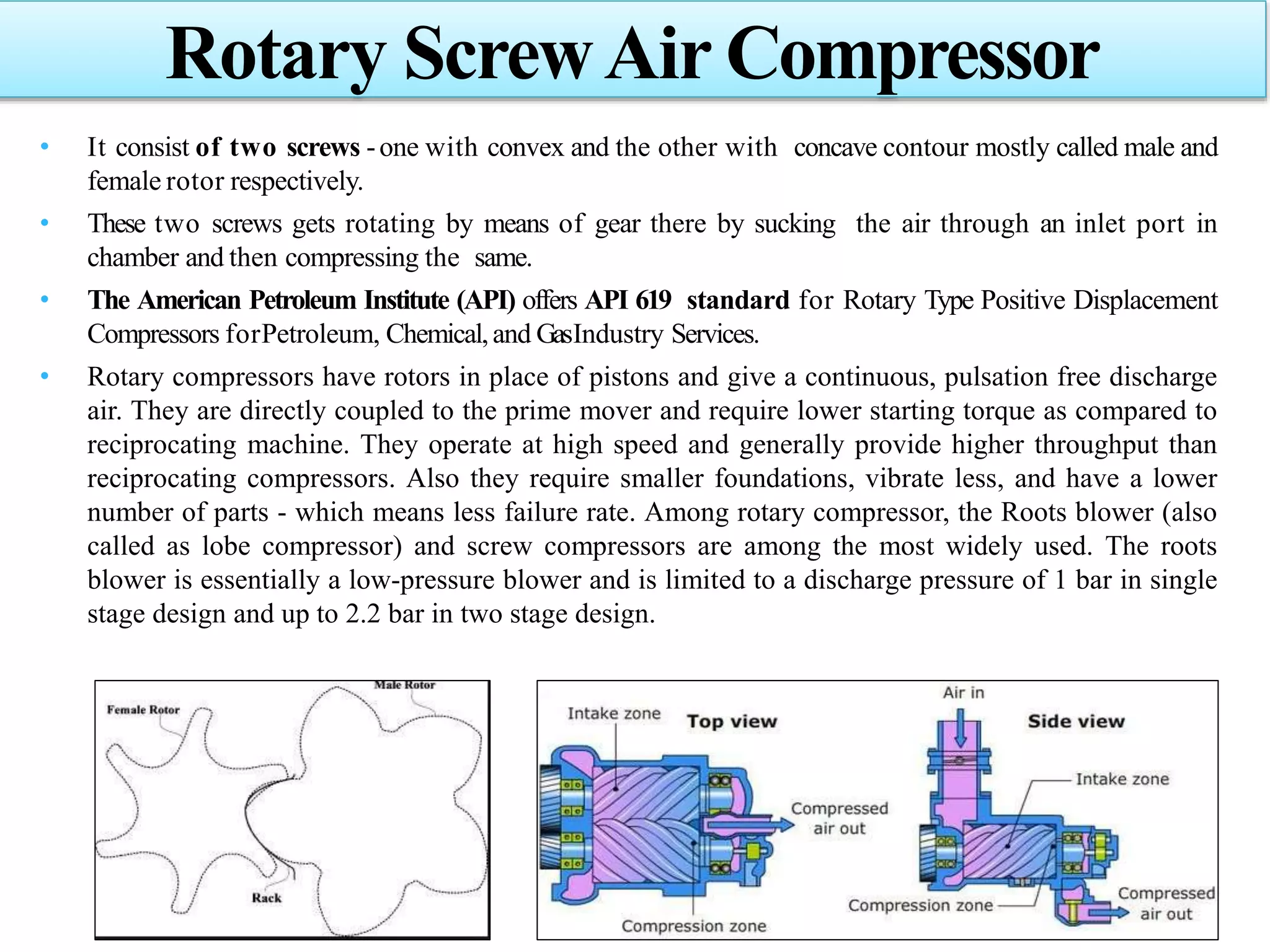
• It consist of two screws -one with convex and the other with concave contour mostly called male and
female rotor respectively.
• These two screws gets rotating by means of gear there by sucking the air through an inlet port in
chamber and then compressing the same.
• The American Petroleum Institute (API) offers API 619 standard for Rotary Type Positive Displacement
Compressors forPetroleum, Chemical,and GasIndustry Services.
• Rotary compressors have rotors in place of pistons and give a continuous, pulsation free discharge
air. They are directly coupled to the prime mover and require lower starting torque as compared to
reciprocating machine. They operate at high speed and generally provide higher throughput than
reciprocating compressors. Also they require smaller foundations, vibrate less, and have a lower
number of parts - which means less failure rate. Among rotary compressor, the Roots blower (also
called as lobe compressor) and screw compressors are among the most widely used. The roots
blower is essentially a low-pressure blower and is limited to a discharge pressure of 1 bar in single
stage design and up to 2.2 bar in two stage design.
Rotary ScrewAir Compressor
Rotary screw compressors are available in oil-free (Dry) and oil-flooded (oil
injected)construction.
1) Oil Floodedor Oil Injected ScrewCompressors
In an oil-injected rotary-screw compressor, oil is injected into the compression
cavities to aid sealing and provide cooling sink for the gas charge. The oil is
separated from the discharge stream, then cooled, filtered andrecycled.
2) Oil Free or DryScrew Compressors
Oil-free compressors are used in applications where entrained oil carry-over is
not acceptable, such asmedical research and semiconductor manufacturing.
Rotary ScrewAir Compressor: Types
Dynamic compressors are mainly centrifugal compressors and operate on
similar principles to centrifugal pump. These compressors have appreciably
different characteristics as compared to reciprocating machines. A small change
in compression ratio produces a marked change in compressor output and
efficiency. Centrifugal machines are better suited for applications requiring very
high capacities, typically above 12,000 cfm.
The centrifugal air compressor depends on transfer of energy from a rotating
impeller to the air. The rotor accomplishes this by changing the momentum and
pressure of the air. This momentum is converted to useful pressure by slowing
the air down in a stationary diffuser.
The centrifugal air compressor is an oil free compressor by design. The oil-
lubricated running gear is separated from the air by shaft seals and atmospheric
vents. The centrifugal is a continuous duty compressor, with few moving parts,
and is particularly suited to high volume applications, especially where oil free
air is required.
Dynamic Compressor
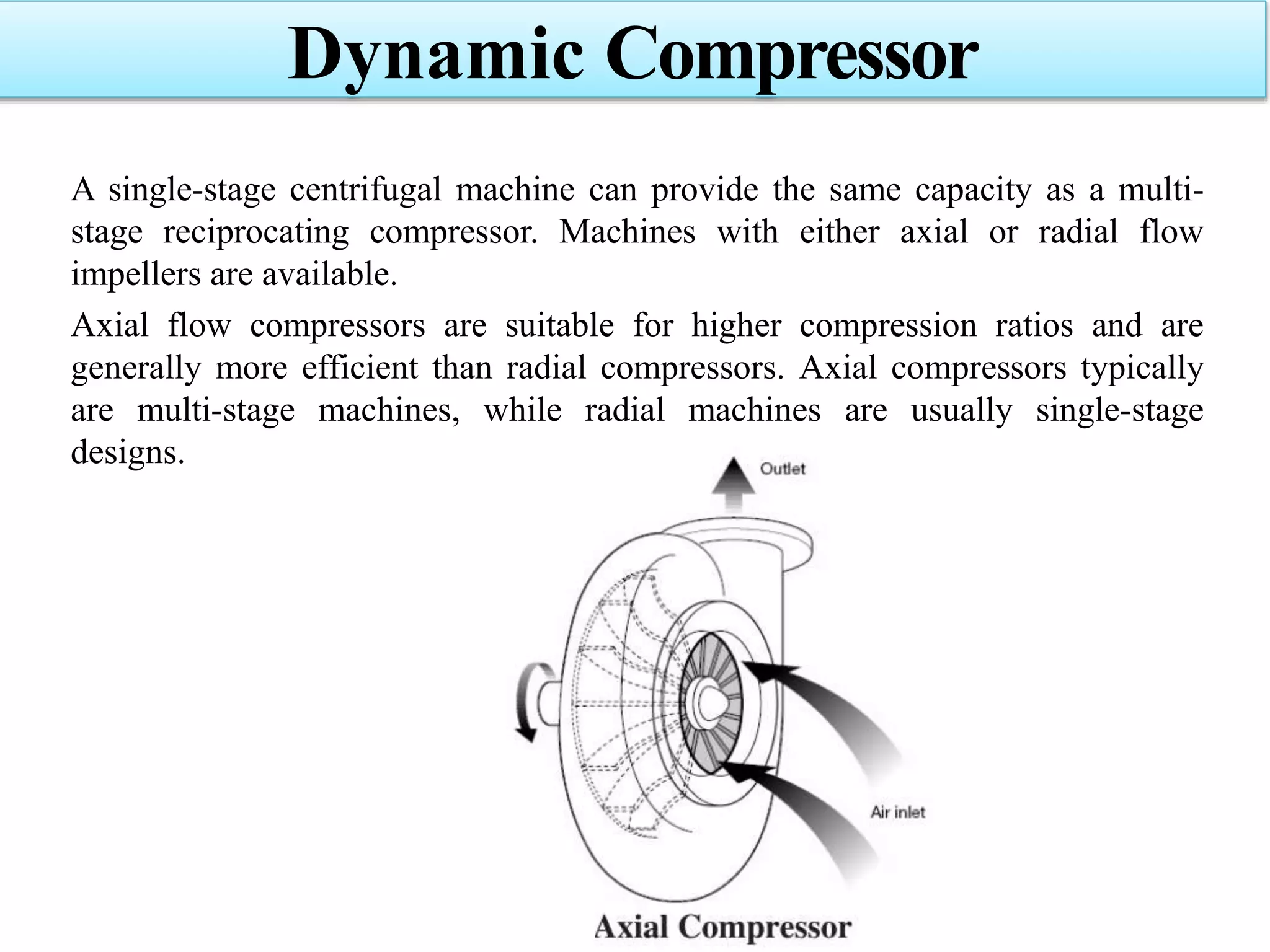
A single-stage centrifugal machine can provide the same capacity as a multi-
stage reciprocating compressor. Machines with either axial or radial flow
impellers are available.
Axial flow compressors are suitable for higher compression ratios and are
generally more efficient than radial compressors. Axial compressors typically
are multi-stage machines, while radial machines are usually single-stage
designs.
Dynamic Compressor
COMPRESSED AIR SYSTEM
COMPONENTS
Compressed air systems consist of following major components: Intake air filters, interstage coolers,
after coolers, air dryers, moisture drain traps, receivers, piping network, filters, regulators and
lubricators.
ƒCompressor:
Air Receiver/Tank: Air receivers are provided as storage and smoothening pulsating air output -
reducing pressure variations from the compressor
Intake Air Filters: Prevent dust from entering compressor; Dust causes sticking valves, scoured
cylinders, excessive wear etc.
Inter-stage Coolers: Reduce the temperature of the air before it enters the next stage to reduce the work
of compression and increase efficiency. They are normally water-cooled.
After Coolers: The objective is to remove the moisture in the air by reducing the temperature in a
water-cooled heat exchanger.
Instrument Air: The instrument air dryers removes the moisture from air and then flow to instrument
air receiver.
Air-Dryers: The remaining traces of moisture after after-cooler are removed using air dryers, as air for
instrument and pneumatic equipment has to be relatively free of any moisture. The moisture is removed
by using adsorbents like silica gel /activated carbon, or refrigerant dryers, or heat of compression dryers.
Moisture Drain Traps: Moisture drain traps are used for removal of moisture in the compressed air.
These traps resemble steam traps. Various types of traps used are manual drain cocks, timer based /
automatic drain valves etc.
• Air Receivers
The air receiver dampens pulsations entering the discharge line from the compressor; serves as a
reservoir for sudden or unusually heavy demands in excess of compressor capacity; prevents too frequent
loading and unloading (short cycling) of the compressor; and separates moisture and oil vapour, allowing
the moisture carried over from the after coolers to precipitate.
The air receiver should be generously sized to give a large cooling surface and even out the pulsation in
delivered air pressure from reciprocating compressor. Simple formulae often quoted for air receiver size
is to take a value equal to one minute’s continuous output of the compressor. However, this should be
considered indicative of the minimum size of receiver.
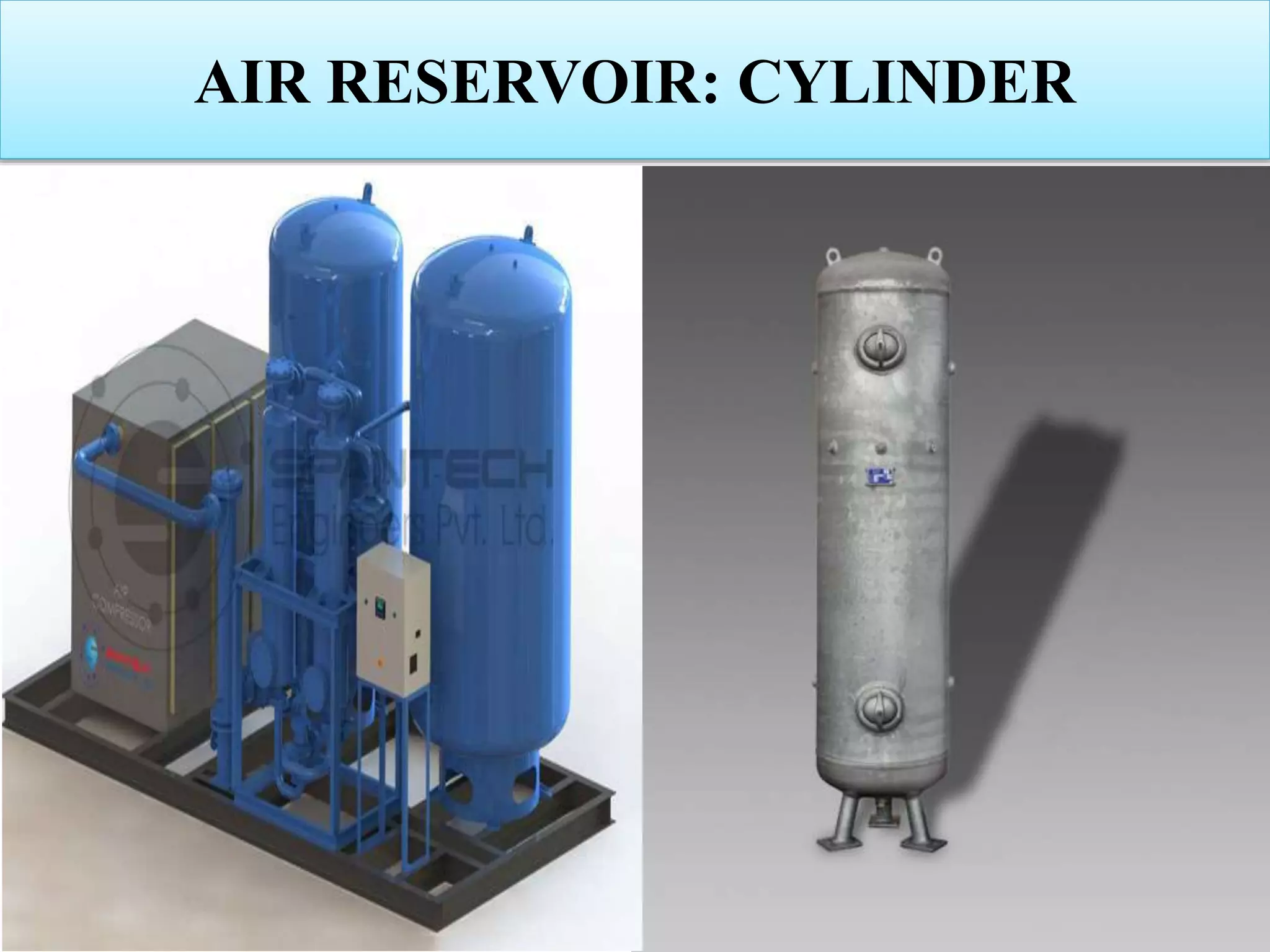
AIR RESERVOIR: CYLINDER
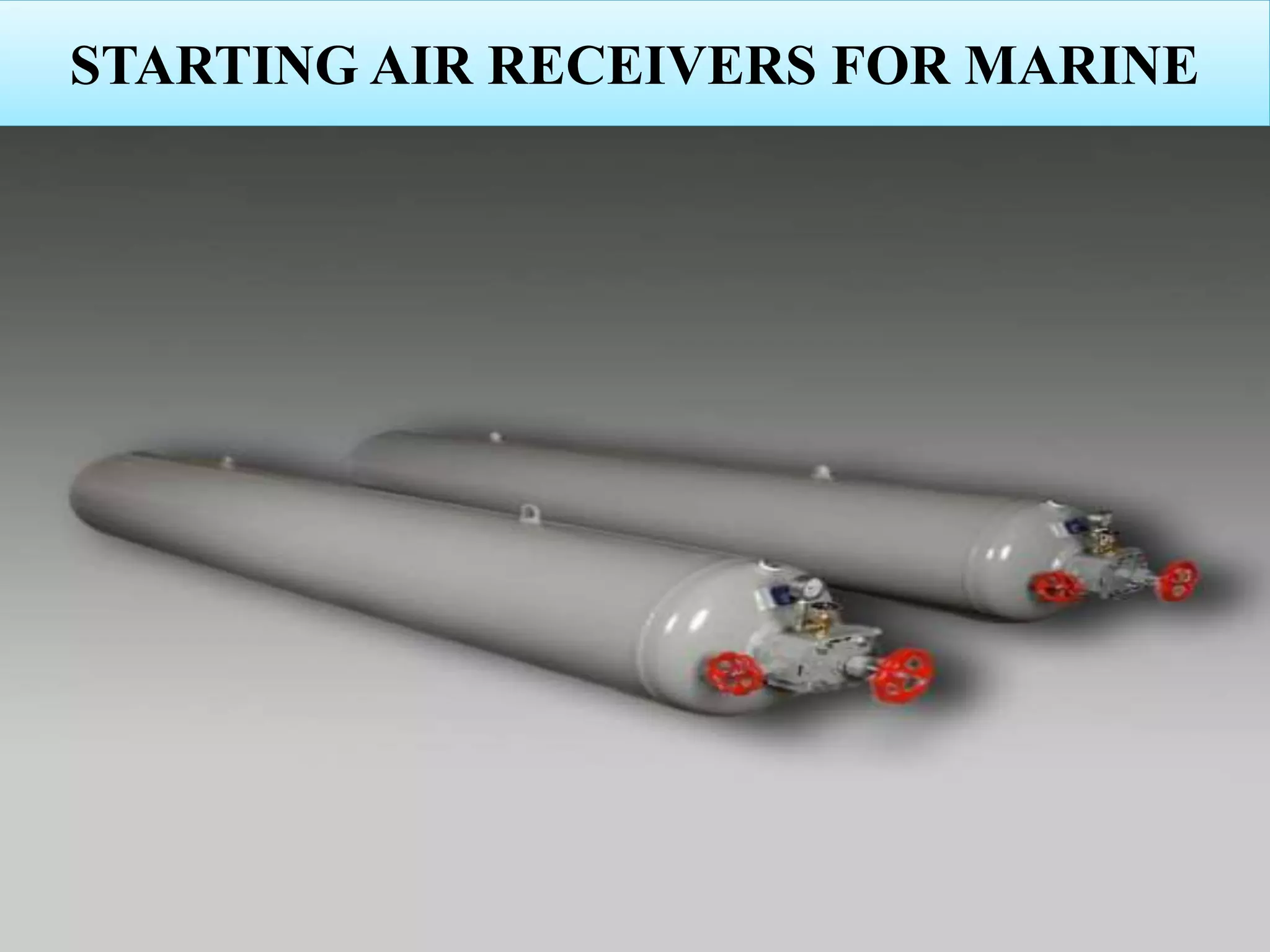
STARTING AIR RECEIVERS FOR MARINE
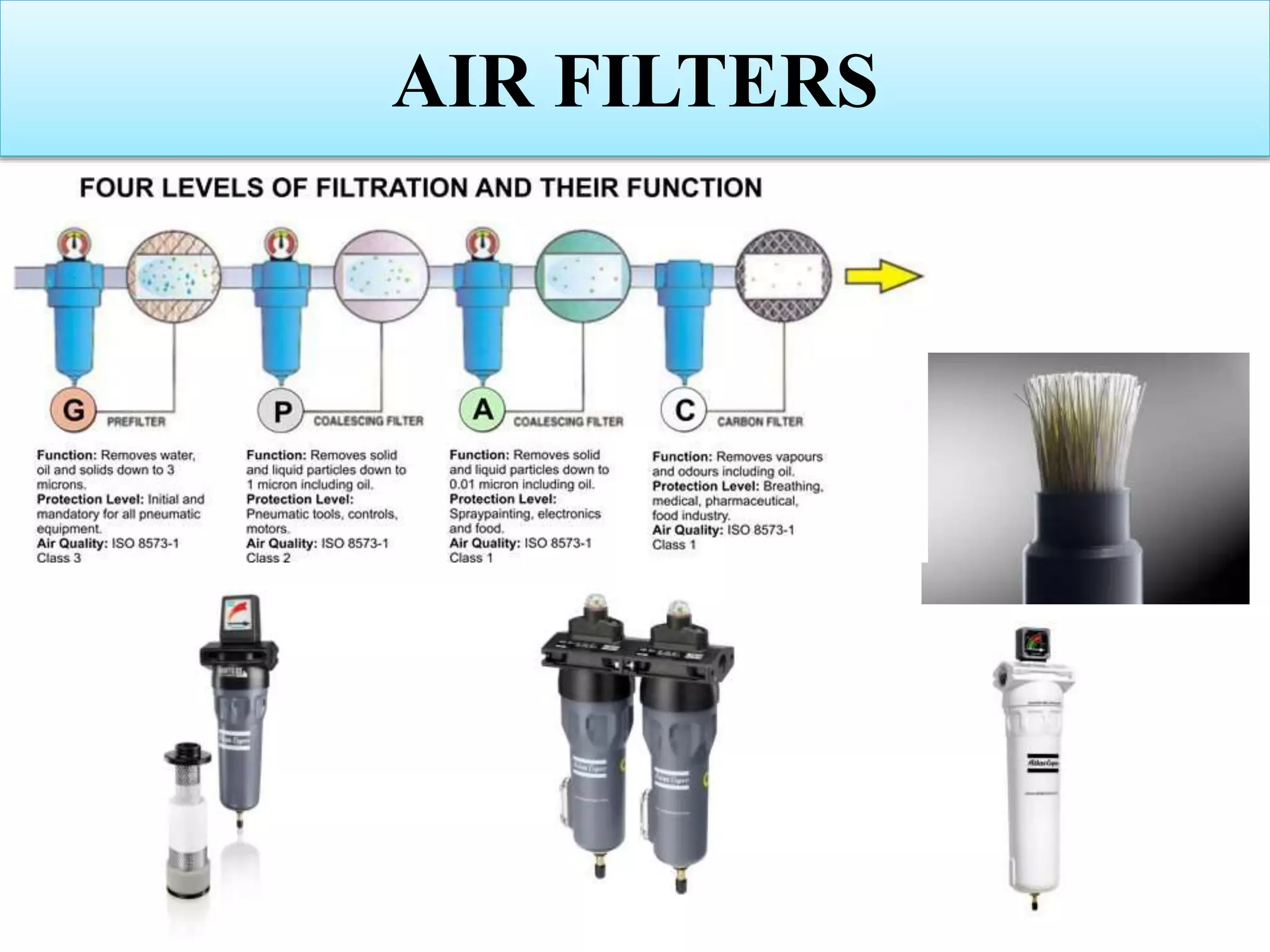
AIR FILTERS
AIR FILTERS
AIR FILTERS
INTER COOLER AND AFTER COOLERS
FOR COMPRESSORS
Inter and After coolers are heat exchangers for cooling the discharge from air
compressor and are an effective means of removing moisture from compressed
air.
After coolers mechanisms can use either air-cooled or water-cooled Intercoolers
are coolers which are provided mainly for Dry type compressors with multi stages.
These are rarely applicable for Oil injected compressor just in case of high pressure
requirement.
After coolers are common for both Dry type and Oil injected type compressor.
Coolers are provided to avoid excessive temperature rise associated with higher
compression ratios and for increased volumetric efficiency.
HD & TD AFTER COOLER
Water-cooled And Air-cooled After Coolers
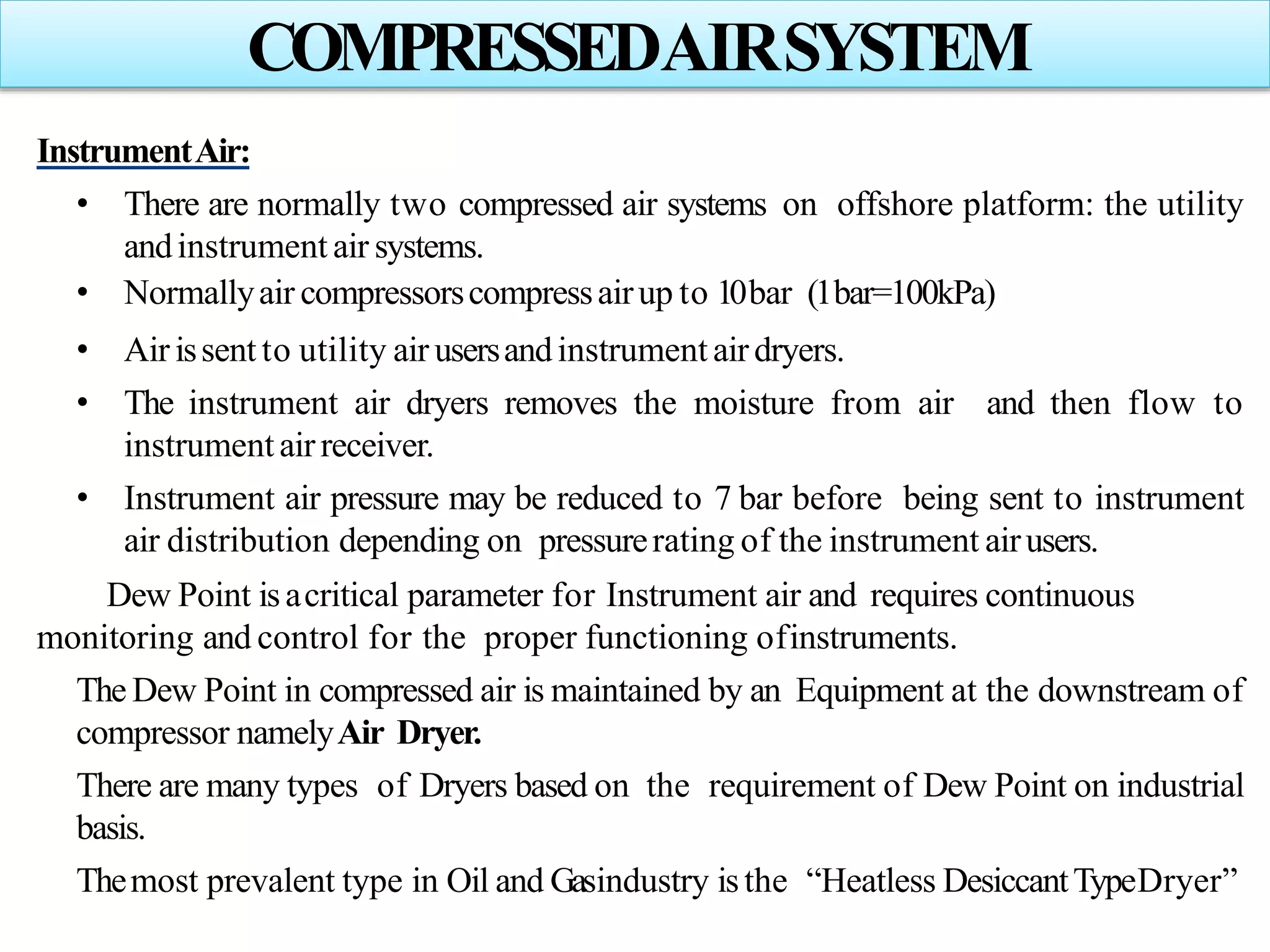
InstrumentAir:
• There are normally two compressed air systems on offshore platform: the utility
andinstrument air systems.
• Normallyair compressorscompressairup to 10bar (1bar=100kPa)
• Air issent to utility air usersandinstrument airdryers.
• The instrument air dryers removes the moisture from air and then flow to
instrumentairreceiver.
• Instrument air pressure may be reduced to 7 bar before being sent to instrument
air distribution depending on pressurerating of the instrument airusers.
Dew Point isacritical parameter for Instrument air and requires continuous
monitoring and control for the proper functioning ofinstruments.
The Dew Point in compressed air is maintained by an Equipment at the downstream of
compressor namelyAir Dryer.
There are many types of Dryers based on the requirement of Dew Point on industrial
basis.
Themost prevalent type in Oil and Gasindustry isthe “Heatless DesiccantTypeDryer”
COMPRESSEDAIRSYSTEM
InstrumentAir:
COMPRESSEDAIRSYSTEM
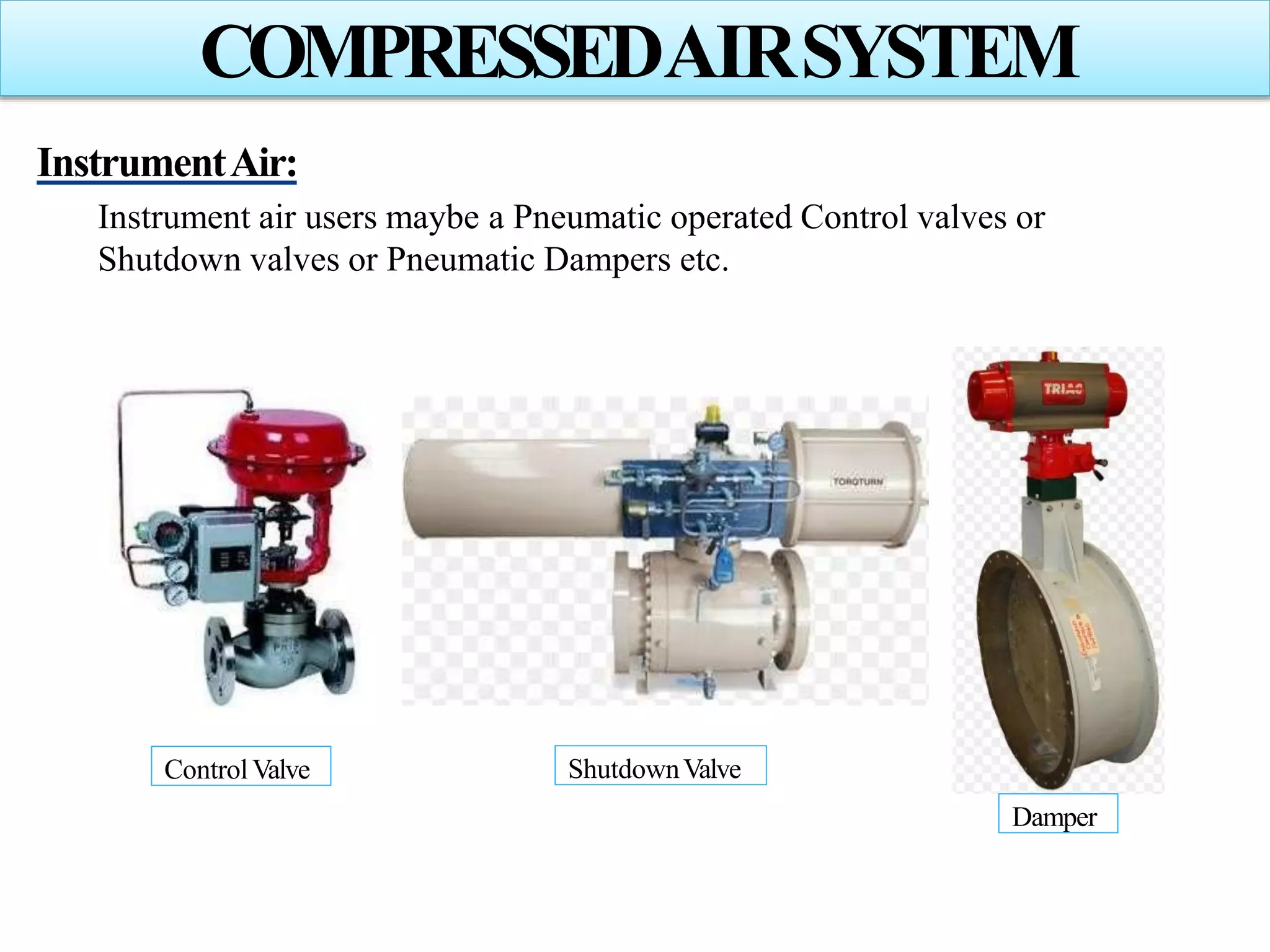
ControlValve ShutdownValve
Damper
Instrument air users maybe a Pneumatic operated Control valves or
Shutdown valves or Pneumatic Dampers etc.
COMPRESSEDAIRSYSTEM
InstrumentAir:
Instrument air needs to be clean and dry, for pneumatic instrumentation. This is important to
say, a control valve positioner where the feedback baffle/nozzle can be plugged off by dirt.
The Quality of air is important to ensure that instrumentation will function properly and
reliably.
The most important parameters in specifying air quality are:
• Dew Point
• Oil Content
• Particulate matter
• Temperature
• Moisture Content
Instrument air quality is defined in standards such as ISO 8573-1 Air Quality Standards and
ISA S7-3
Where Pressure dew point refers to the dew point temperature of a gas under pressure
(higher than atmospheric pressure).
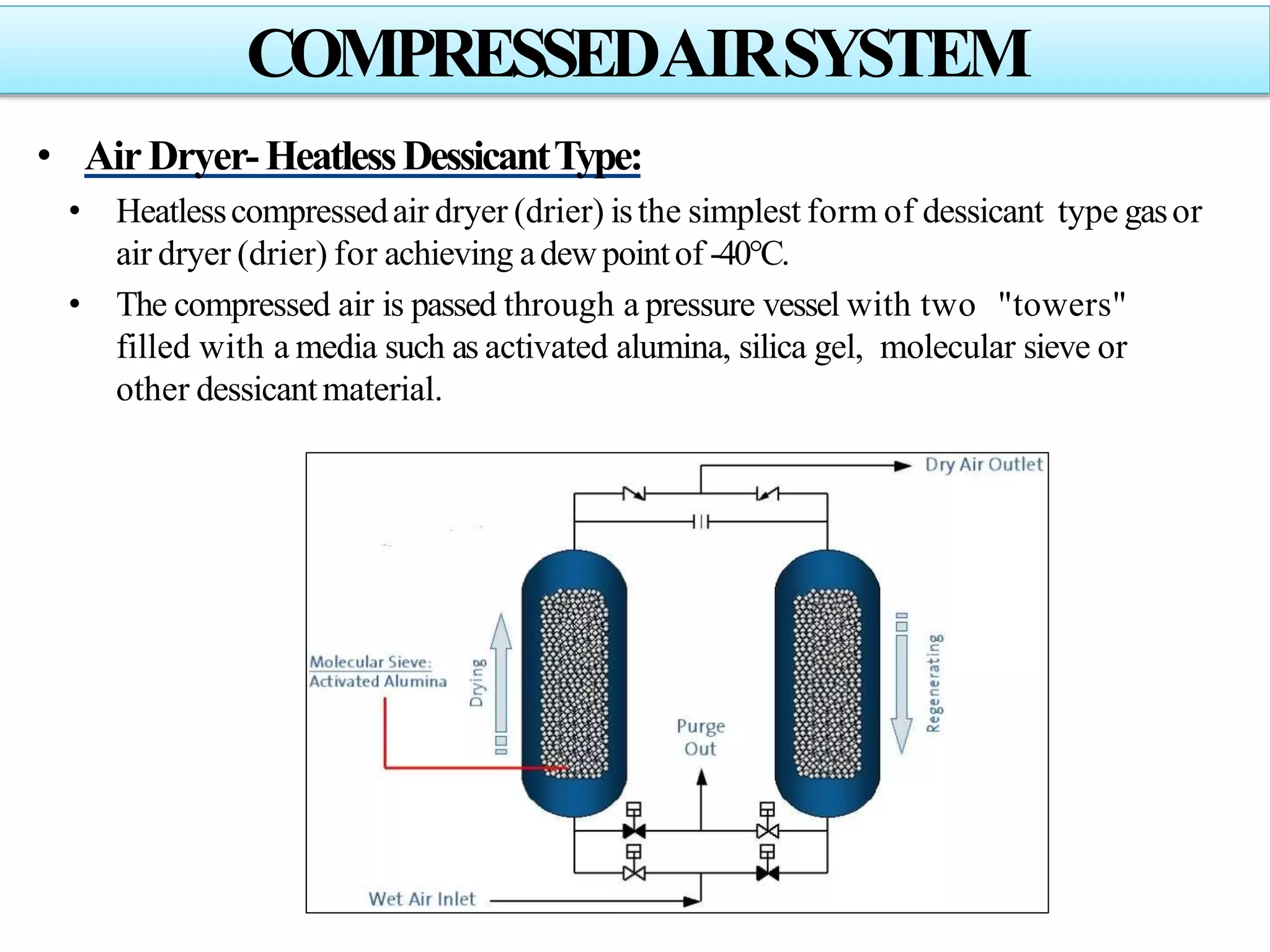
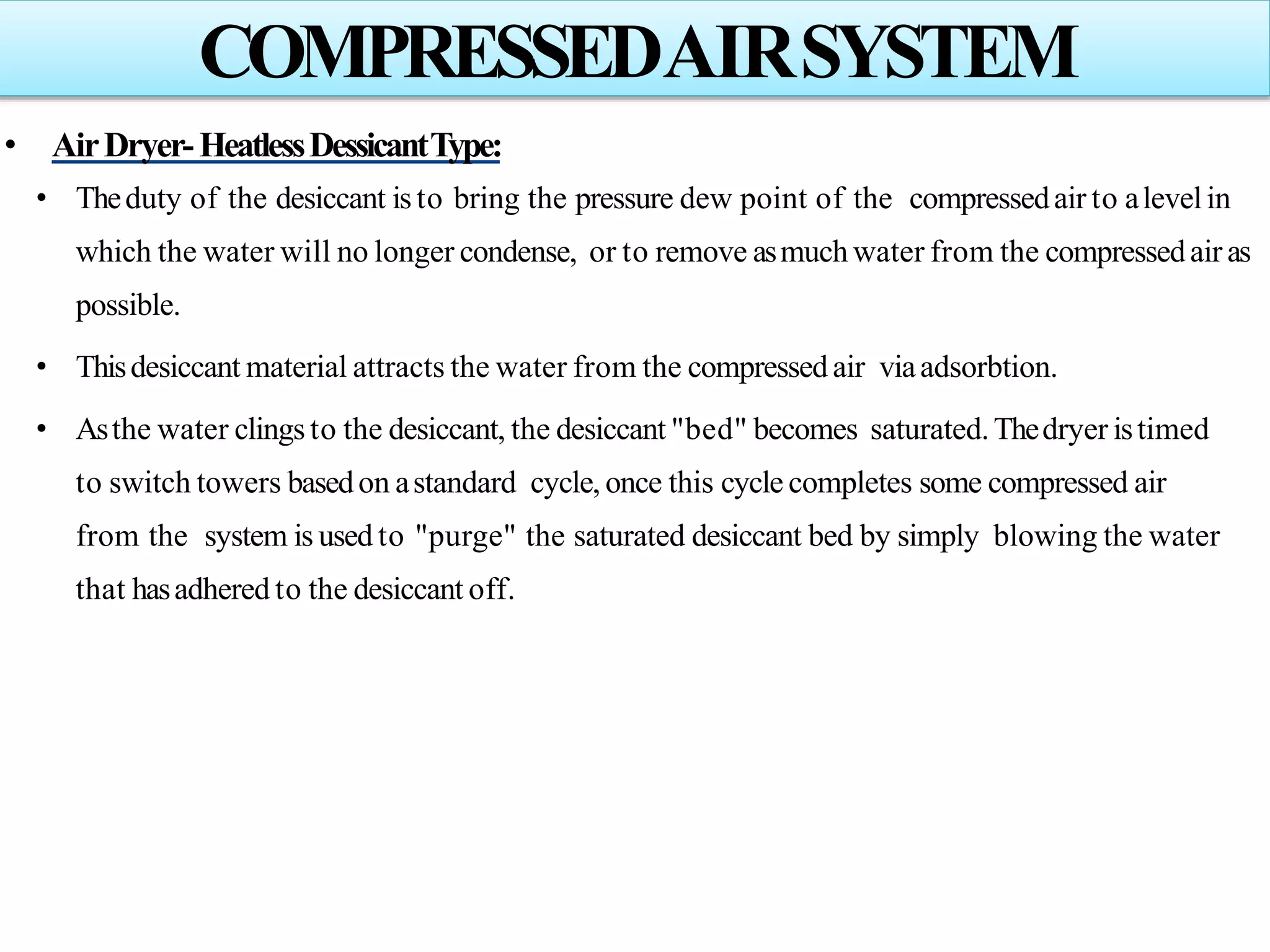
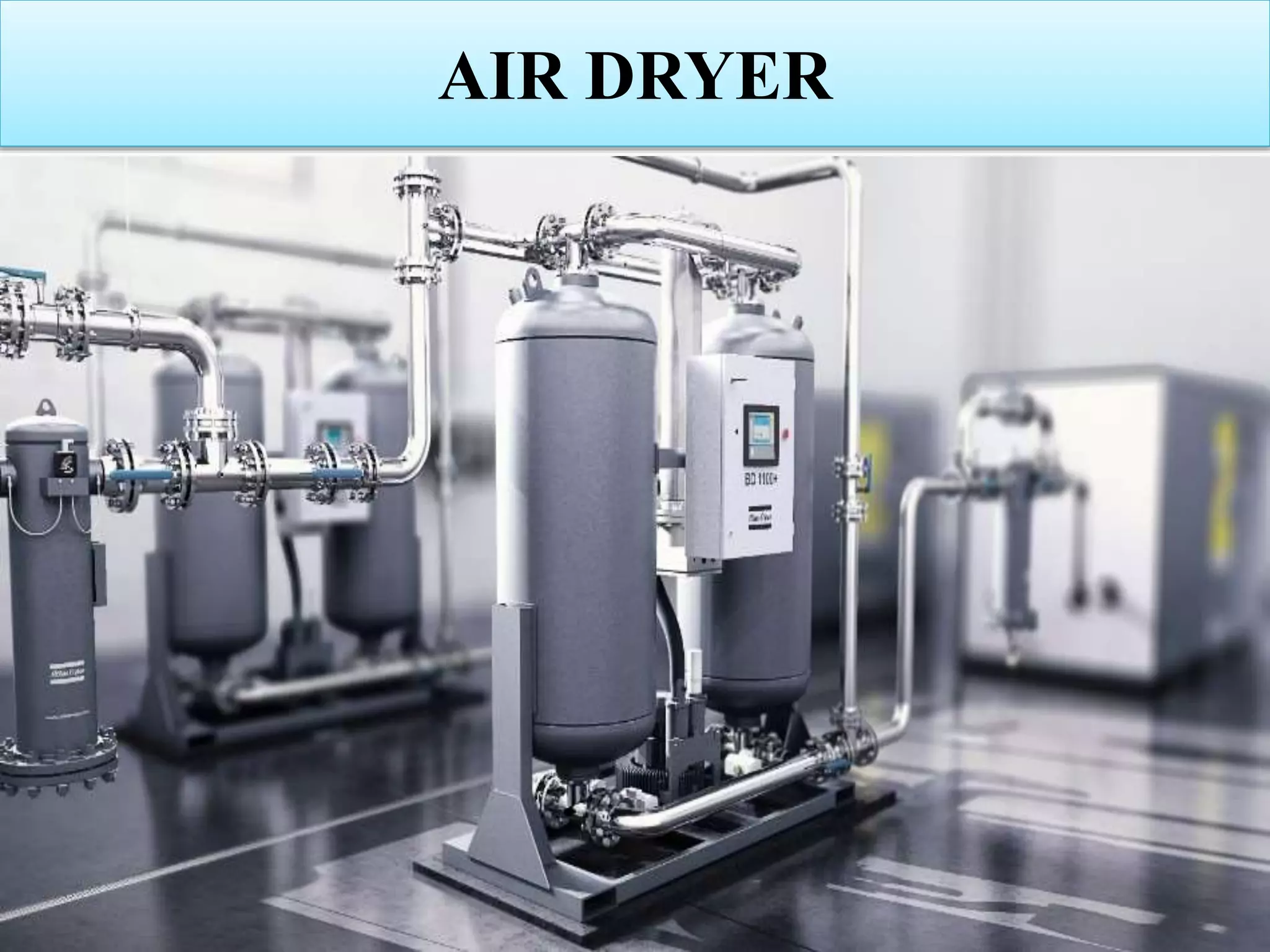
• AirDryer-HeatlessDessicantType:
• Heatlesscompressedair dryer (drier) isthe simplest form of dessicant type gasor
air dryer (drier) for achieving adewpointof -40°C.
• The compressed air is passed through a pressure vessel with two "towers"
filled with a media such as activated alumina, silica gel, molecular sieve or
other dessicantmaterial.
COMPRESSEDAIRSYSTEM
• AirDryer-HeatlessDessicantType:
• Theduty of the desiccant is to bring the pressure dew point of the compressedair to alevelin
which the water will no longer condense, or to remove asmuch water from the compressedair as
possible.
• Thisdesiccant material attracts the water from the compressedair viaadsorbtion.
• Asthe water clingsto the desiccant, the desiccant "bed" becomes saturated.Thedryer istimed
to switch towers basedon astandard cycle, once this cycle completes some compressed air
from the system is used to "purge" the saturated desiccant bed by simply blowing the water
that hasadhered to the desiccant off.
COMPRESSEDAIRSYSTEM
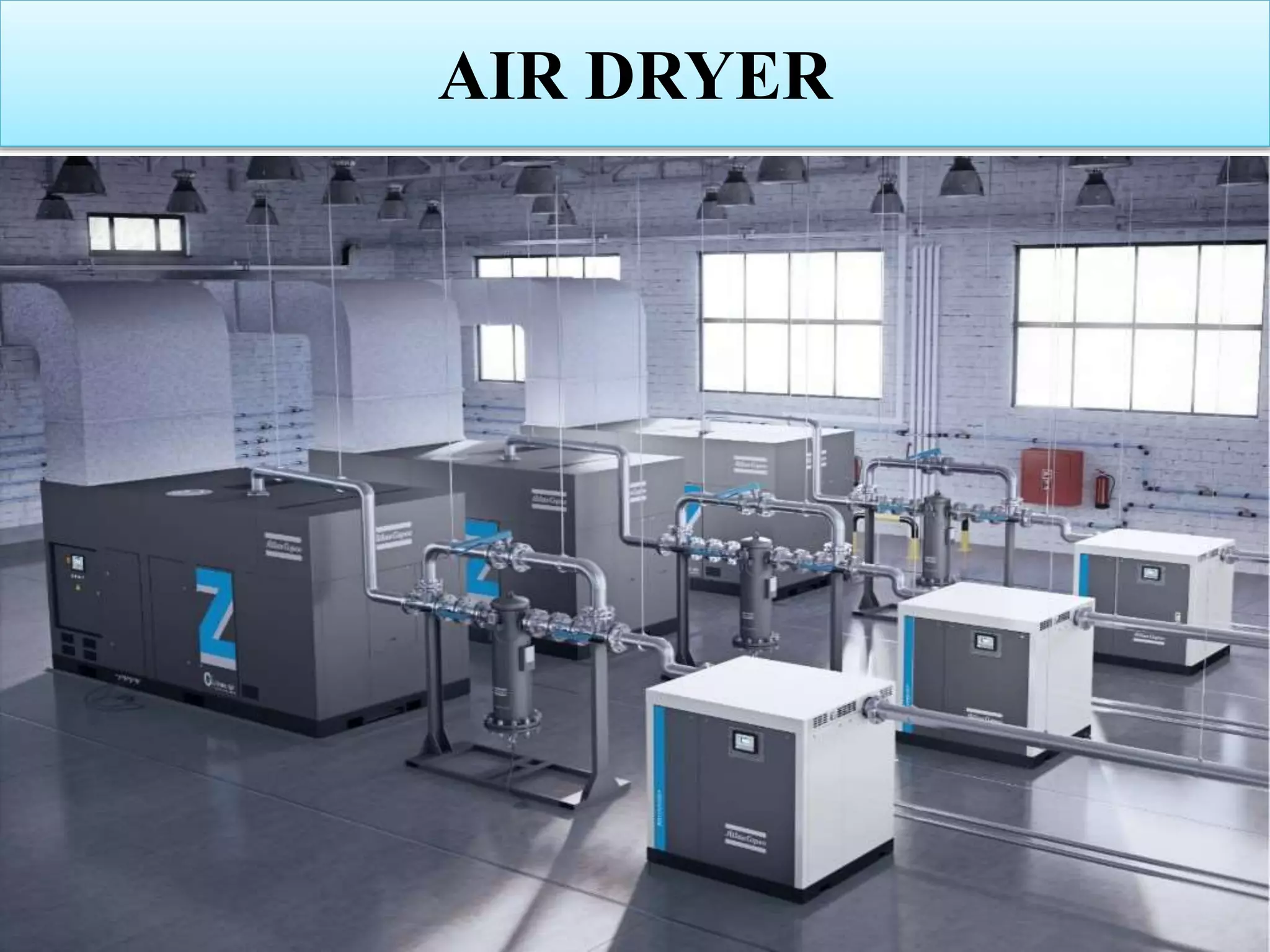
AIR DRYER
AIR DRYER
REFRIGERANT AIR DRYERS
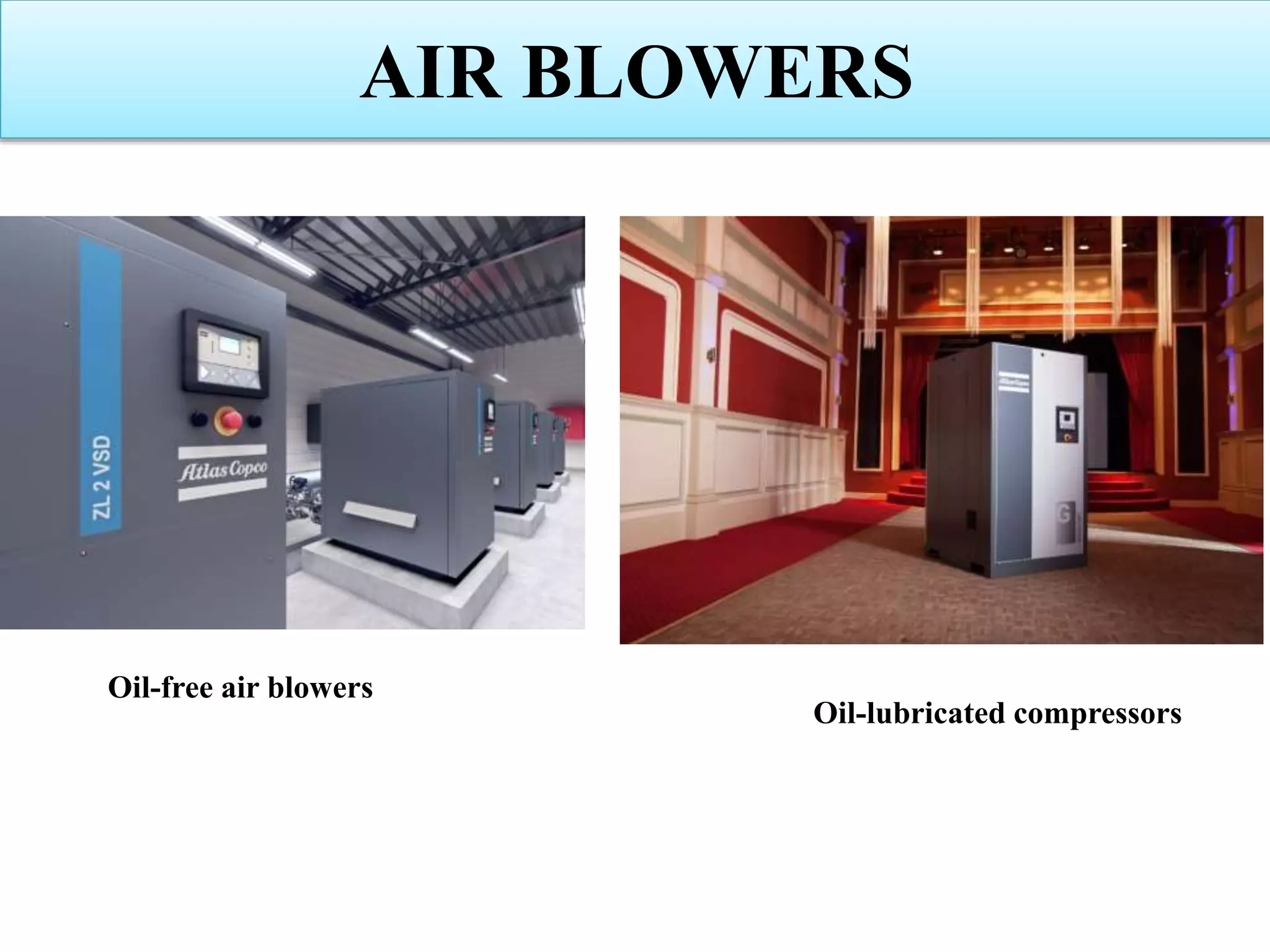
AIR BLOWERS
Oil-lubricated compressors
Oil-free air blowers
Compressor Performance
• Capacity of a Compressor
Capacity of a compressor is the full rated volume of flow of gas compressed
and delivered at conditions of total temperature, total pressure, and composition
prevailing at the compressor inlet. It sometimes means actual flow rate, rather
than rated volume of flow. This also termed as Free Air Delivery (FAD) i.e. air
at atmospheric conditions at any specific location. Because the altitude,
barometer, and temperature may vary at different localities and at different
times, it follows that this term does not mean air under identical or standard
conditions.
• Compressor Efficiency Definitions
Several different measures of compressor efficiency are commonly used:
volumetric efficiency, adiabatic efficiency, isothermal efficiency and
mechanical efficiency. Adiabatic and isothermal efficiencies are computed as
the isothermal or adiabatic power divided by the actual power consumption.
The figure obtained indicates the overall efficiency of compressor and drive
motor.
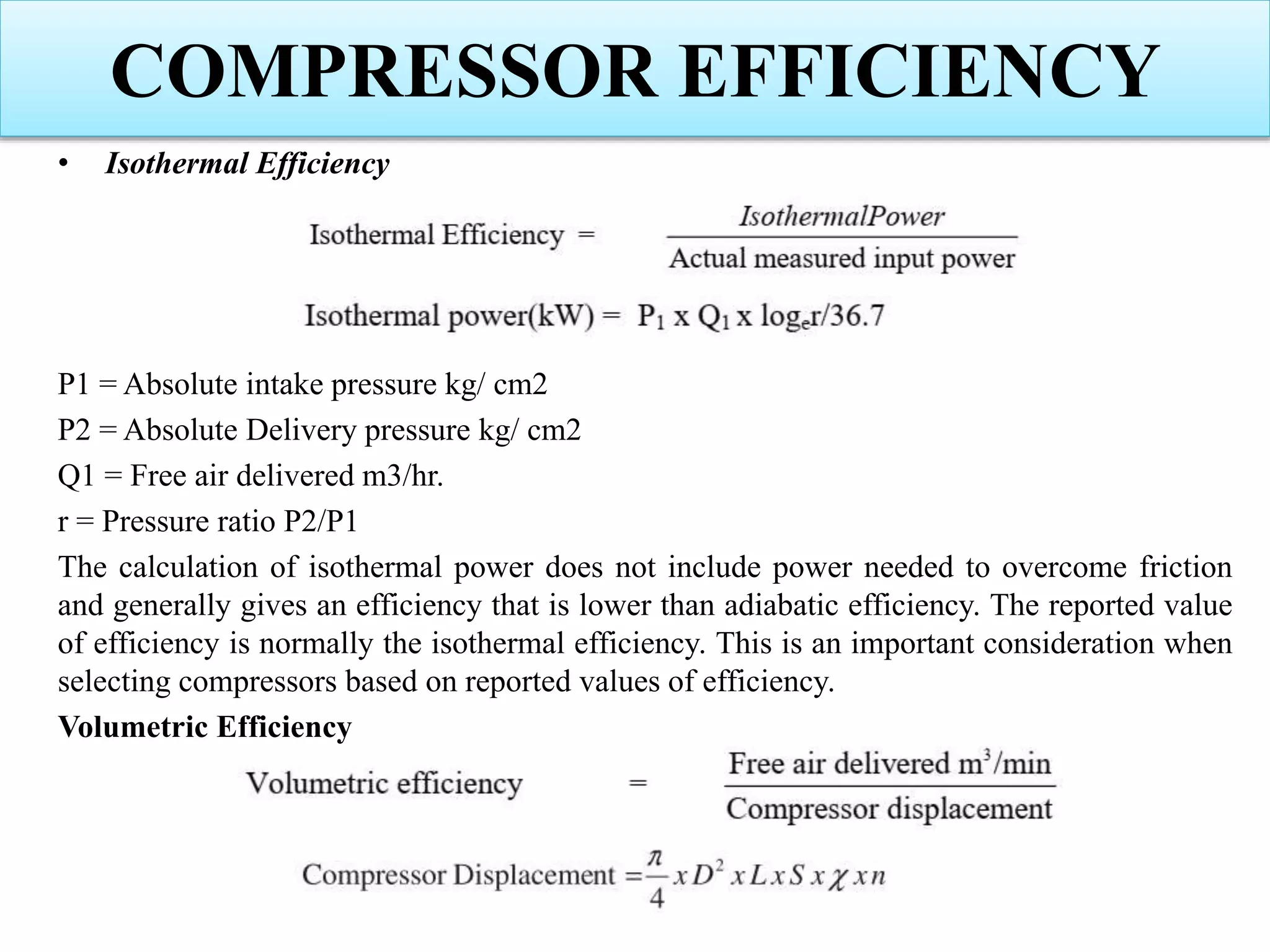
• Isothermal Efficiency
P1 = Absolute intake pressure kg/ cm2
P2 = Absolute Delivery pressure kg/ cm2
Q1 = Free air delivered m3/hr.
r = Pressure ratio P2/P1
The calculation of isothermal power does not include power needed to overcome friction
and generally gives an efficiency that is lower than adiabatic efficiency. The reported value
of efficiency is normally the isothermal efficiency. This is an important consideration when
selecting compressors based on reported values of efficiency.
Volumetric Efficiency
COMPRESSOR EFFICIENCY
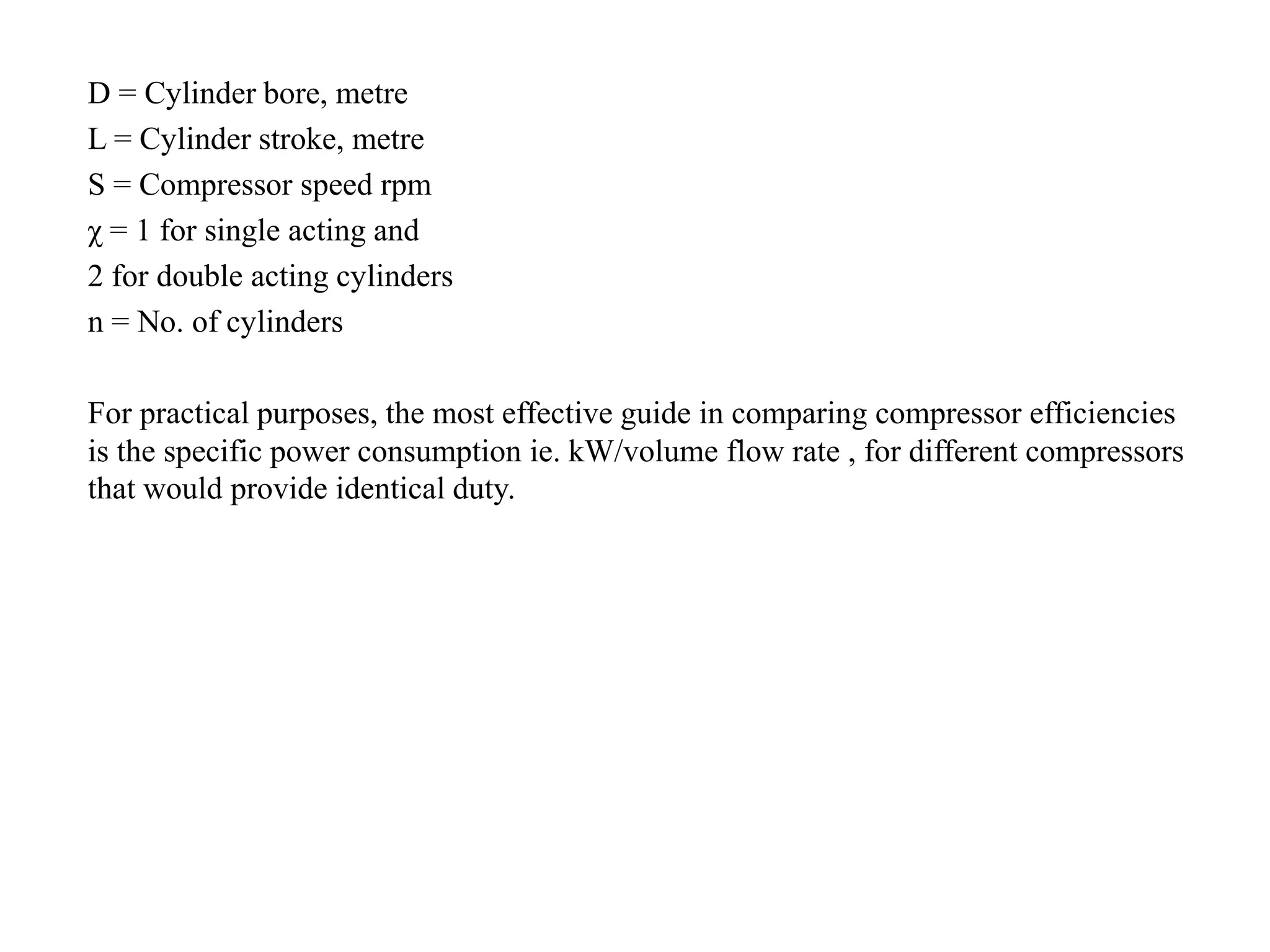
D = Cylinder bore, metre
L = Cylinder stroke, metre
S = Compressor speed rpm
χ = 1 for single acting and
2 for double acting cylinders
n = No. of cylinders
For practical purposes, the most effective guide in comparing compressor efficiencies
is the specific power consumption ie. kW/volume flow rate , for different compressors
that would provide identical duty.
Efficient Operation of Compressed Air
Systems
• Location of Compressors
The location of air compressors and the quality of air drawn by the compressors will have a
significant influence on the amount of energy consumed. Compressor performance as a
breathing machine improves with cool, clean, dry air at intake.
• Cool air intake
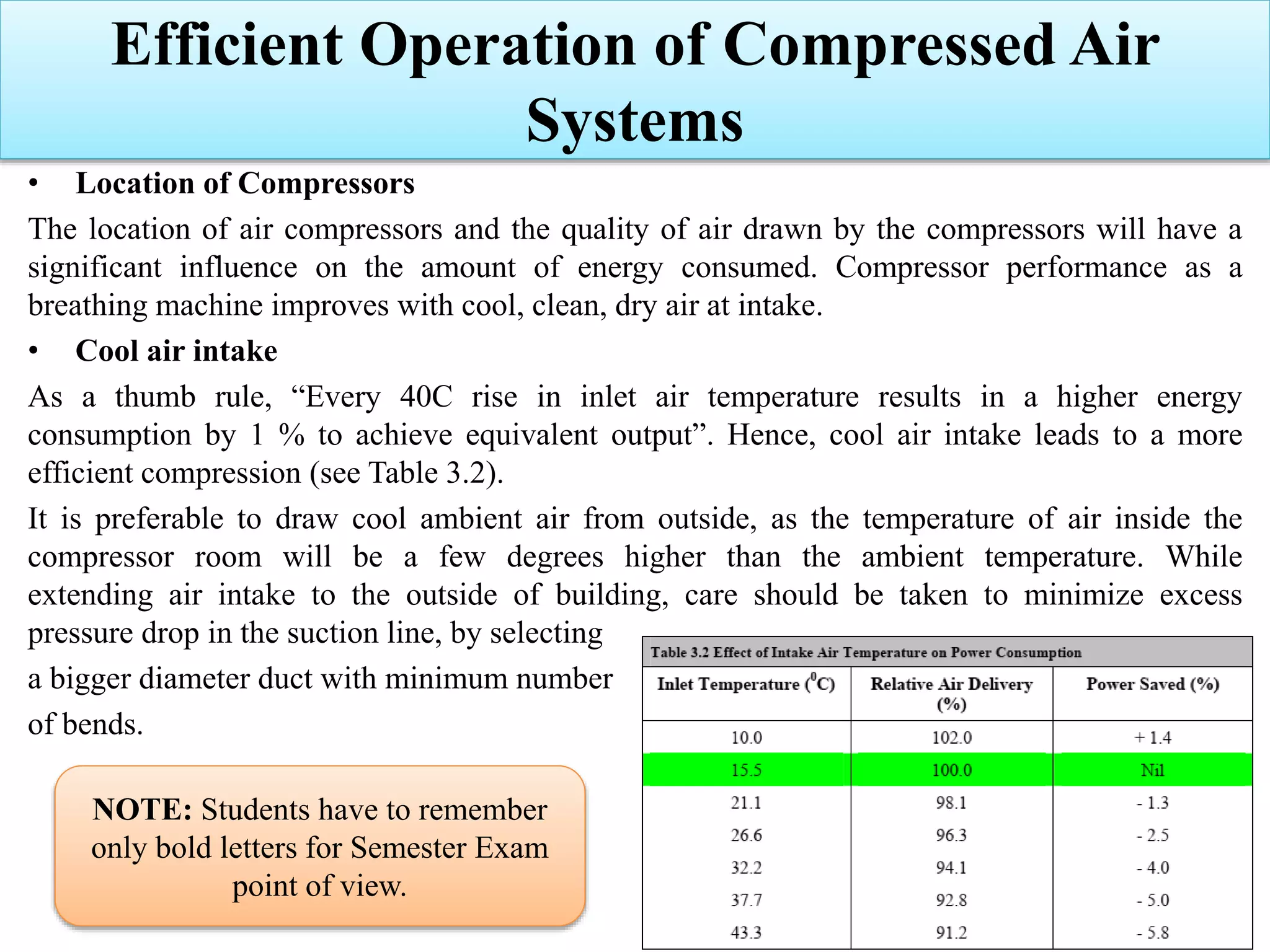
As a thumb rule, “Every 40C rise in inlet air temperature results in a higher energy
consumption by 1 % to achieve equivalent output”. Hence, cool air intake leads to a more
efficient compression (see Table 3.2).
It is preferable to draw cool ambient air from outside, as the temperature of air inside the
compressor room will be a few degrees higher than the ambient temperature. While
extending air intake to the outside of building, care should be taken to minimize excess
pressure drop in the suction line, by selecting
a bigger diameter duct with minimum number
of bends.
NOTE: Students have to remember
only bold letters for Semester Exam
point of view.
• Dust Free Air Intake
Dust in the suction air causes excessive wear of moving parts and results in malfunctioning of the
valves due to abrasion. Suitable air filters should be provided at the suction side. Air filters should have
high dust separation capacity, low-pressure drops and robust design to avoid frequent cleaning and
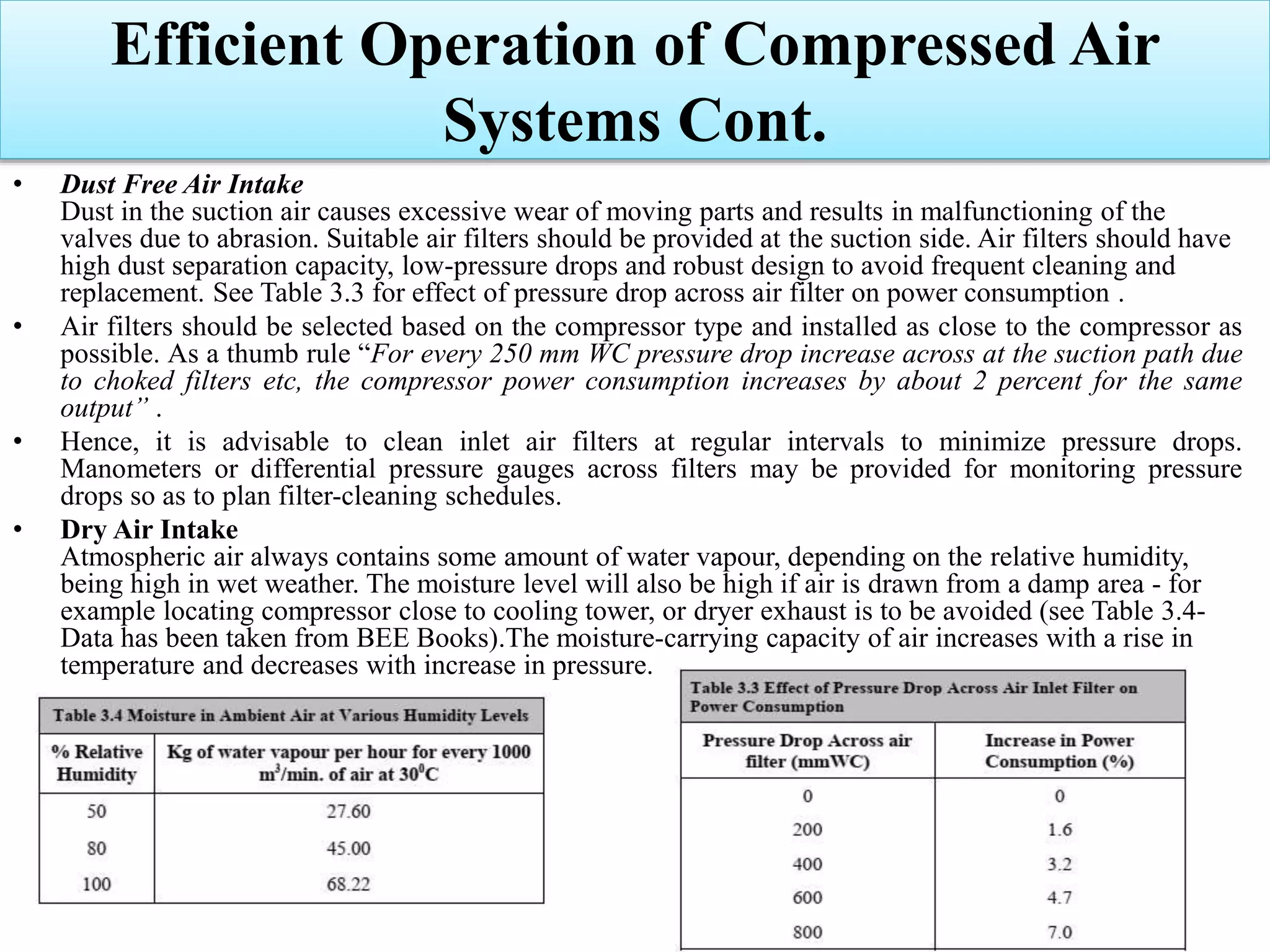
replacement. See Table 3.3 for effect of pressure drop across air filter on power consumption .
• Air filters should be selected based on the compressor type and installed as close to the compressor as
possible. As a thumb rule “For every 250 mm WC pressure drop increase across at the suction path due
to choked filters etc, the compressor power consumption increases by about 2 percent for the same
output” .
• Hence, it is advisable to clean inlet air filters at regular intervals to minimize pressure drops.
Manometers or differential pressure gauges across filters may be provided for monitoring pressure
drops so as to plan filter-cleaning schedules.
• Dry Air Intake
Atmospheric air always contains some amount of water vapour, depending on the relative humidity,
being high in wet weather. The moisture level will also be high if air is drawn from a damp area - for
example locating compressor close to cooling tower, or dryer exhaust is to be avoided (see Table 3.4-
Data has been taken from BEE Books).The moisture-carrying capacity of air increases with a rise in
temperature and decreases with increase in pressure.
Efficient Operation of Compressed Air
Systems Cont.
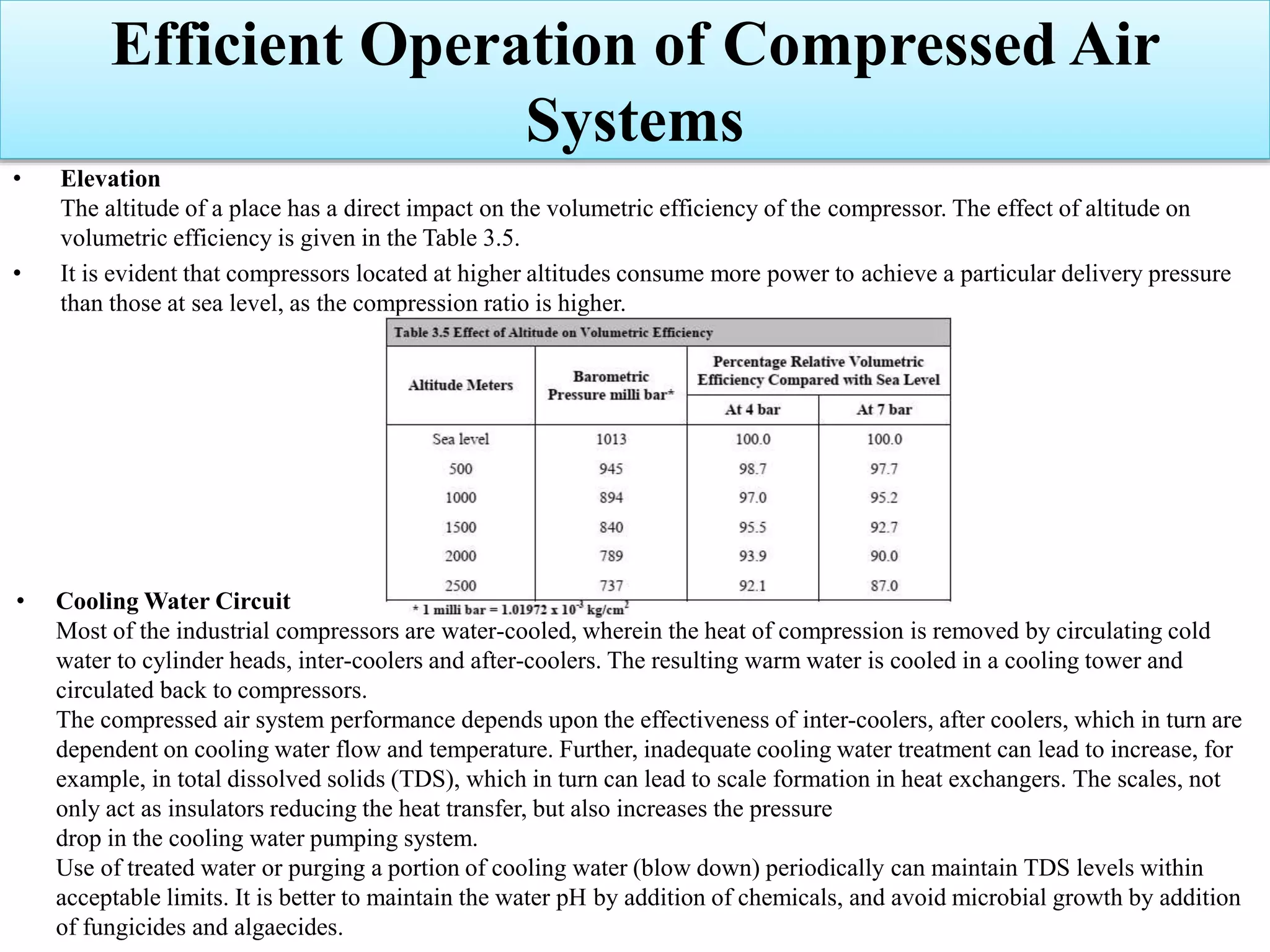
• Elevation
The altitude of a place has a direct impact on the volumetric efficiency of the compressor. The effect of altitude on
volumetric efficiency is given in the Table 3.5.
• It is evident that compressors located at higher altitudes consume more power to achieve a particular delivery pressure
than those at sea level, as the compression ratio is higher.
Efficient Operation of Compressed Air
Systems
• Cooling Water Circuit
Most of the industrial compressors are water-cooled, wherein the heat of compression is removed by circulating cold
water to cylinder heads, inter-coolers and after-coolers. The resulting warm water is cooled in a cooling tower and
circulated back to compressors.
The compressed air system performance depends upon the effectiveness of inter-coolers, after coolers, which in turn are
dependent on cooling water flow and temperature. Further, inadequate cooling water treatment can lead to increase, for
example, in total dissolved solids (TDS), which in turn can lead to scale formation in heat exchangers. The scales, not
only act as insulators reducing the heat transfer, but also increases the pressure
drop in the cooling water pumping system.
Use of treated water or purging a portion of cooling water (blow down) periodically can maintain TDS levels within
acceptable limits. It is better to maintain the water pH by addition of chemicals, and avoid microbial growth by addition
of fungicides and algaecides.
• Efficacy of Inter and After Coolers
Efficacy is an indicator of heat exchange performance- how well intercoolers and after coolers are
performing.
Inter-coolers are provided between successive stages of a multi-stage compressor to reduce the work of
compression (power requirements) - by reducing the specific volume through cooling the air - apart
from moisture separation.
Ideally, the temperature of the inlet air at each stage of a multi-stage machine should be the same as it
was at the first stage. This is referred to as “perfect cooling” or isothermal compression. The cooling
may be imperfect due to reasons described in earlier sections.
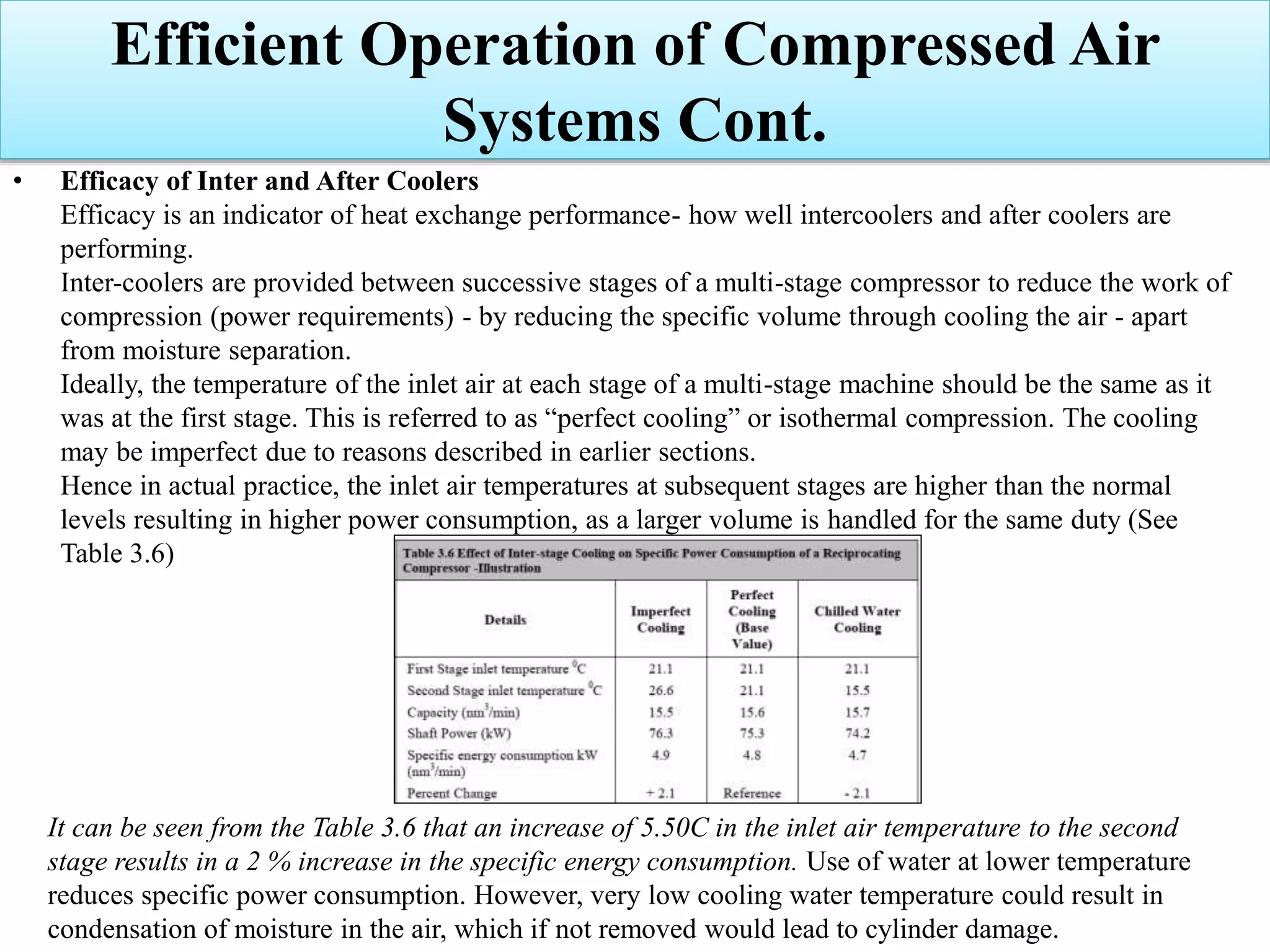
Hence in actual practice, the inlet air temperatures at subsequent stages are higher than the normal
levels resulting in higher power consumption, as a larger volume is handled for the same duty (See
Table 3.6)
It can be seen from the Table 3.6 that an increase of 5.50C in the inlet air temperature to the second
stage results in a 2 % increase in the specific energy consumption. Use of water at lower temperature
reduces specific power consumption. However, very low cooling water temperature could result in
condensation of moisture in the air, which if not removed would lead to cylinder damage.
Efficient Operation of Compressed Air
Systems Cont.
• Pressure Settings:
Compressor operates between pressure ranges called as loading (cut-in) and
unloading (cut out) pressures. For example, a compressor operating between
pressure setting of 6 - 7 kg/cm2 means that the compressor unloads at 7 kg/cm2 and
loads at 6 kg/cm2. Loading and unloading is done using a pressure switch.
For the same capacity, a compressor consumes more power at higher pressures.
They should not be operated above their optimum operating pressures as this not
only wastes energy, but also leads to excessive wear, leading to further energy
wastage The volumetric efficiency of a compressor is also less at higher delivery
pressures.
• Reducing Delivery Pressure:
The possibility of lowering (optimising) the delivery pressure settings should be
explored by careful study of pressure requirements of various equipment, and the
pressure drop in the line between the compressed air generation and utilization
points. Typical power savings through pressure reduction is shown in Table 3.8.
Efficient Operation of Compressed Air
Systems Cont.
The pressure switches must be adjusted such that the compressor cuts-in and cuts-out at optimum levels.
A reduction in the delivery pressure by 1 bar in a compressor would reduce the power consumption by 6 – 10 %.
• Compressor modulation by Optimum Pressure Settings:
Very often in an industry, different types, capacities and makes of compressors are
connected to a common distribution network. In such situations, proper selection of a
right combination of compressors and optimal modulation of different compressors can
conserve energy.
Where more than one compressor feeds a common header, compressors have to be operated in such a way
that the cost of compressed air generation is minimal.
• If all compressors are similar, the pressure setting can be adjusted such that only one compressor handles the
load variation, whereas the others operate more or less at full load.
ƒ
• If compressors are of different sizes, the pressure switch should be set such that only the smallest compressor
is allowed to modulate (vary in flow rate).
ƒ
• If different types of compressors are operated together, unload power consumptions are significant. The
compressor with lowest no load power must be modulated.
ƒ
• In general, the compressor with lower part load power
consumption should be modulated.
ƒ
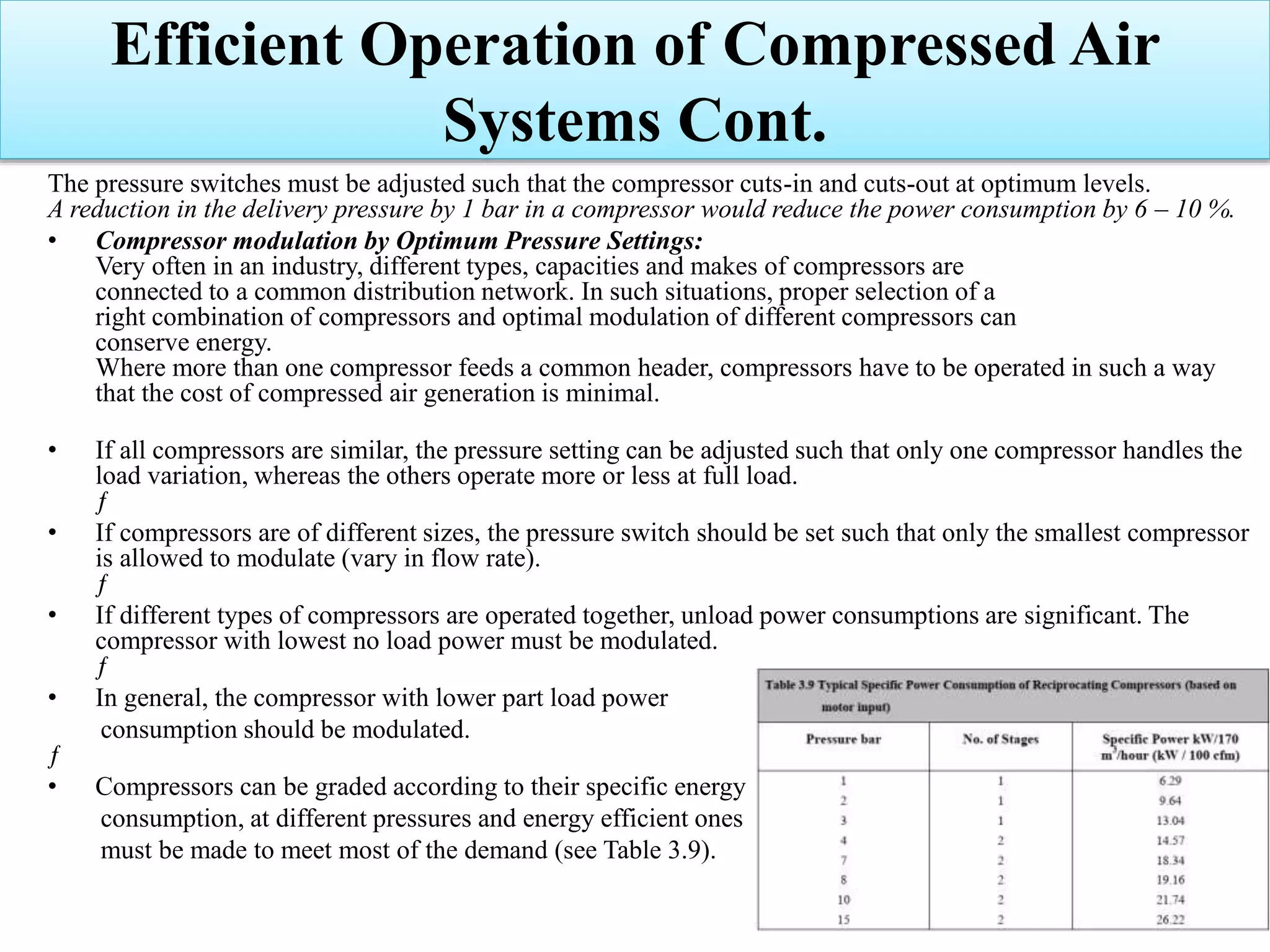
• Compressors can be graded according to their specific energy
consumption, at different pressures and energy efficient ones
must be made to meet most of the demand (see Table 3.9).
Efficient Operation of Compressed Air
Systems Cont.
• Segregating low and high pressure air requirements
If the low-pressure air requirement is considerable, it is advisable to generate low
pressure and high-pressure air separately, and feed to the respective sections instead of
reducing the pressure through pressure reducing valves, which invariably waste energy.
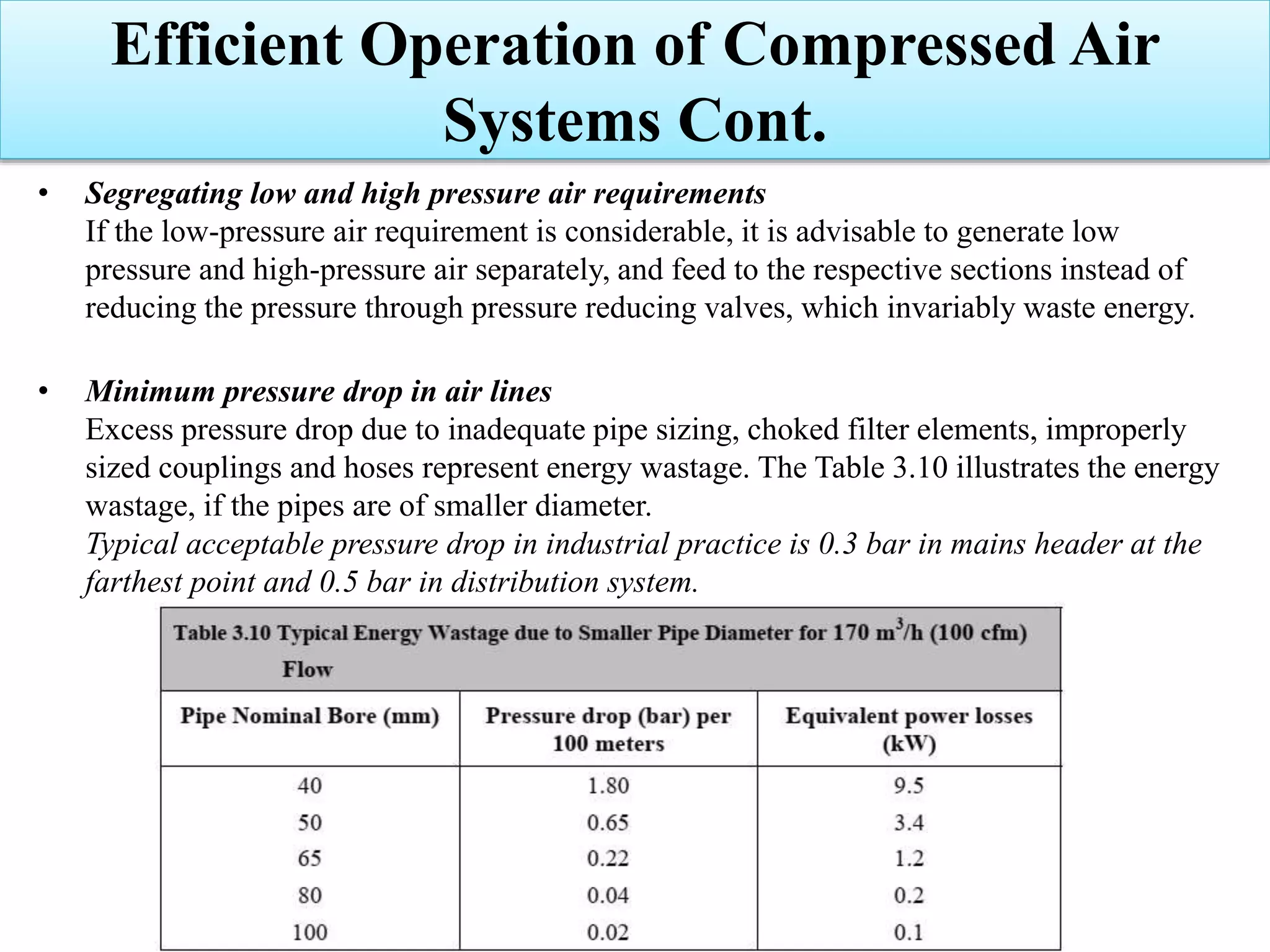
• Minimum pressure drop in air lines
Excess pressure drop due to inadequate pipe sizing, choked filter elements, improperly
sized couplings and hoses represent energy wastage. The Table 3.10 illustrates the energy
wastage, if the pipes are of smaller diameter.
Typical acceptable pressure drop in industrial practice is 0.3 bar in mains header at the
farthest point and 0.5 bar in distribution system.
Efficient Operation of Compressed Air
Systems Cont.
Efficient Operation of Compressed Air
Systems Cont.
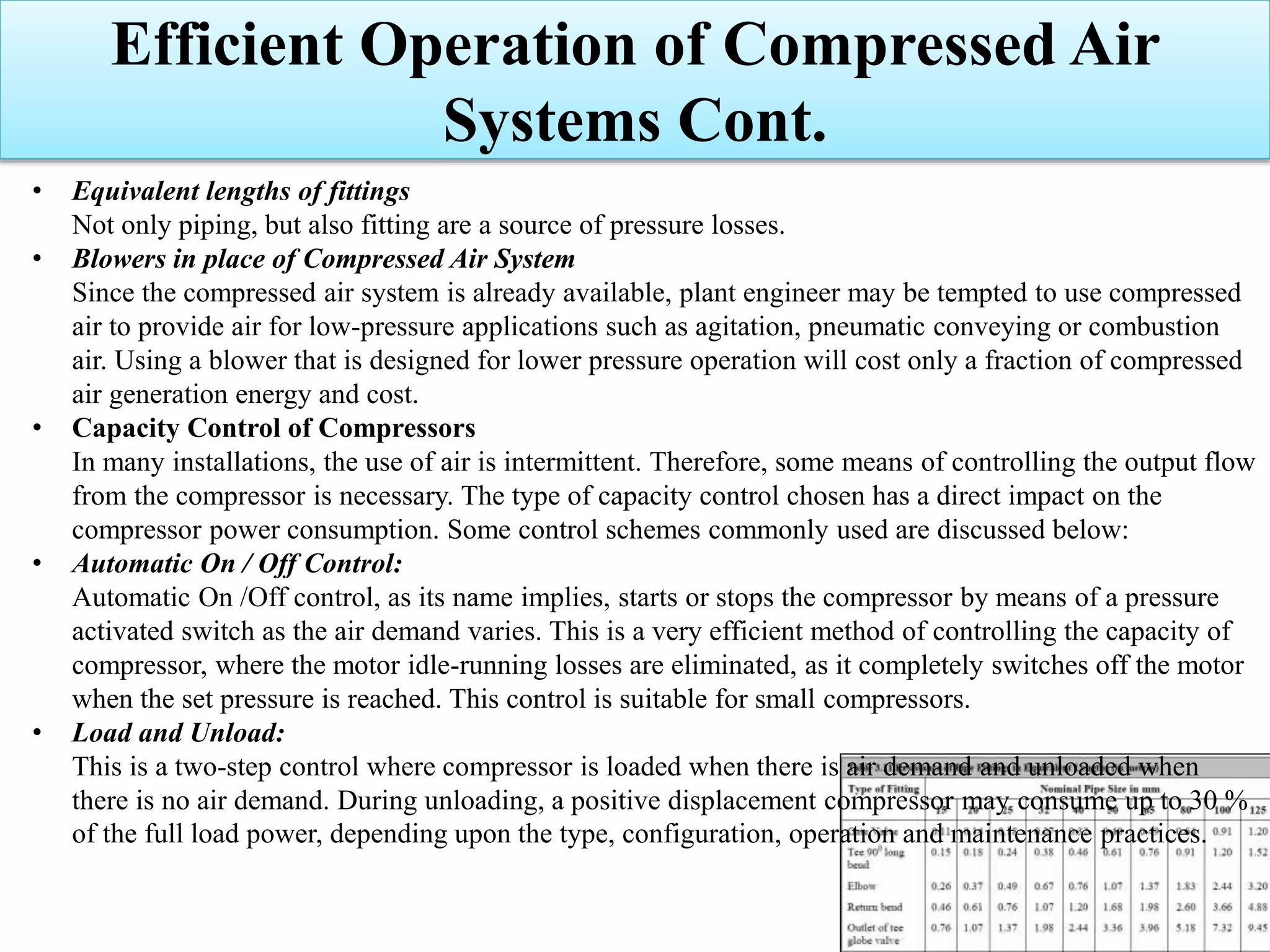
• Equivalent lengths of fittings
Not only piping, but also fitting are a source of pressure losses.
• Blowers in place of Compressed Air System
Since the compressed air system is already available, plant engineer may be tempted to use compressed
air to provide air for low-pressure applications such as agitation, pneumatic conveying or combustion
air. Using a blower that is designed for lower pressure operation will cost only a fraction of compressed
air generation energy and cost.
• Capacity Control of Compressors
In many installations, the use of air is intermittent. Therefore, some means of controlling the output flow
from the compressor is necessary. The type of capacity control chosen has a direct impact on the
compressor power consumption. Some control schemes commonly used are discussed below:
• Automatic On / Off Control:
Automatic On /Off control, as its name implies, starts or stops the compressor by means of a pressure
activated switch as the air demand varies. This is a very efficient method of controlling the capacity of
compressor, where the motor idle-running losses are eliminated, as it completely switches off the motor
when the set pressure is reached. This control is suitable for small compressors.
• Load and Unload:
This is a two-step control where compressor is loaded when there is air demand and unloaded when
there is no air demand. During unloading, a positive displacement compressor may consume up to 30 %
of the full load power, depending upon the type, configuration, operation and maintenance practices.
• Multi-step Control:
Large capacity reciprocating compressors are usually equipped with a multi-step control.
In this type of control, unloading is accomplished in a series of steps, (0%, 25 %, 50 %, 75 % & 100 %)
varying from full load down to no-load (see Table 3.12).
Throttling Control:
The capacity of centrifugal compressors can be controlled using variable inlet guide vanes. However,
another efficient way to match compressor output to meet varying load requirements is by speed control
(see Table 3.13).
At low volumetric flow (below 40 %), vane control may result in lower power input compared to speed
control due to low efficiency of the speed control system. For loads more than 40 %, speed control is
recommended.
Avoiding Misuse of Compressed Air:
Misuse of compressed air for purposes like body cleaning, liquid agitation, floor cleaning, drying,
equipment cooling and other similar uses must be discouraged. Wherever possible, low-pressure air
from a blower should be substituted for compressed air, for example secondary air for combustion in a
boiler / furnace.
The following Table 3.14 gives an idea of savings by stopping use of compressed air by choosing
alternative methods to perform the same task. ƒElectric motors can serve more efficiently than air-driven
rotary devices, wherever applicable. The Table gives the comparison of pneumatic grinders and
electrical grinders.
Efficient Operation of Compressed Air
Systems Cont.
• Loss of air pressure due to friction
The loss of pressure in piping is caused by resistance in pipe fittings and valves, which
dissipates energy by producing turbulence. The piping system will be designed for a
maximum allowable pressure drop of 5 percent from the compressor to the most distant
point of use.
• Piping layout
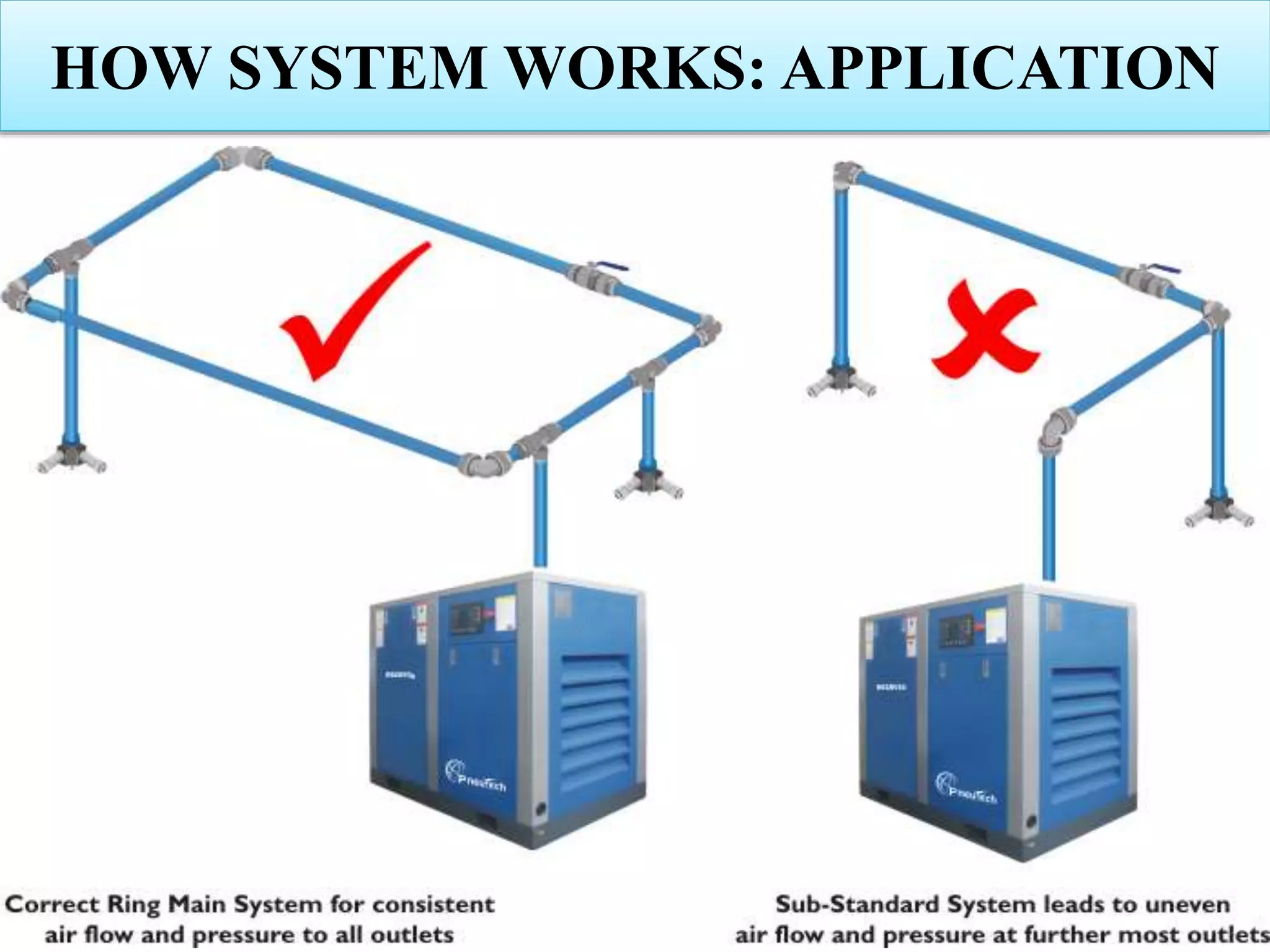
Where possible the piping system should be arranged as a closed loop or “ring main” to
allow for more uniform air distribution to consumption points and to equalize pressure in the
piping. Separate services requiring heavy air consumption and at long distances from the
compressor unit should be supplied by separate main airlines. Pipes are to be installed
parallel with the lines of the building, with main and branch headers sloping down toward a
dead end. Traps will be installed in airlines at all low points and dead ends to remove
condensed moisture. Automatic moisture traps used for this purpose are effective only when
the air has been cooled and the moisture has precipitated. Branch headers from compressed
air mains will be taken off at the top to avoid picking up moisture.
• Capacity Utilisation
In many installations, the use of air is intermittent. This means the compressor will be
operated on low load or no load condition, which increases the specific power consumption
per unit of air generated. Hence, for optimum energy consumption, a proper compressor
capacity control should be selected. The nature of the control device depends on the function
to be regulated. One of the objectives of a good compressed air management system would
be to minimize unloading to the least as unloading consumes up to 30% of full load power.
Efficient Operation of Compressed Air
Systems Cont.
Compressor Capacity Assessment
• Due to ageing of the compressors and inherent inefficiencies in the internal components,
the free air delivered may be less than the design value, despite good maintenance
practices. Sometimes, other factors such as poor maintenance, fouled heat exchanger and
effects of altitude also tend to reduce free air delivery. In order to meet the air demand,
the inefficient compressor may have to run for more time, thus consuming more power
than actually required.
The power wastage depends on the percentage deviation of FAD capacity. For example, a
worn out compressor valve can reduce the compressor capacity by as much as 20 percent. A
periodic assessment of the FAD capacity of each compressor has to be carried out to check its
actual capacity. If the deviations are more than 10 %, corrective measures should be taken to
rectify the same.
The ideal method of compressor capacity assessment is through a nozzle test wherein a
calibrated nozzle is used as a load, to vent out the generated compressed air. Flow is assessed,
based on the air temperature, stabilization pressure, orifice constant. etc.
• Simple method of Capacity Assessment in Shop floor
Isolate the compressor along with its individual receiver being taken for test from main
compressed air system by tightly closing the isolation valve or blanking it, thus closing the
receiver outlet.
Open water drain valve and drain out water fully and empty the receiver and the pipe line.
Make sure that water trap line is tightly closed once again to start the test.
Start the compressor and activate the stopwatch.
Note the time taken to attain the normal operational pressure P2 (in the receiver) from initial
pressure P1
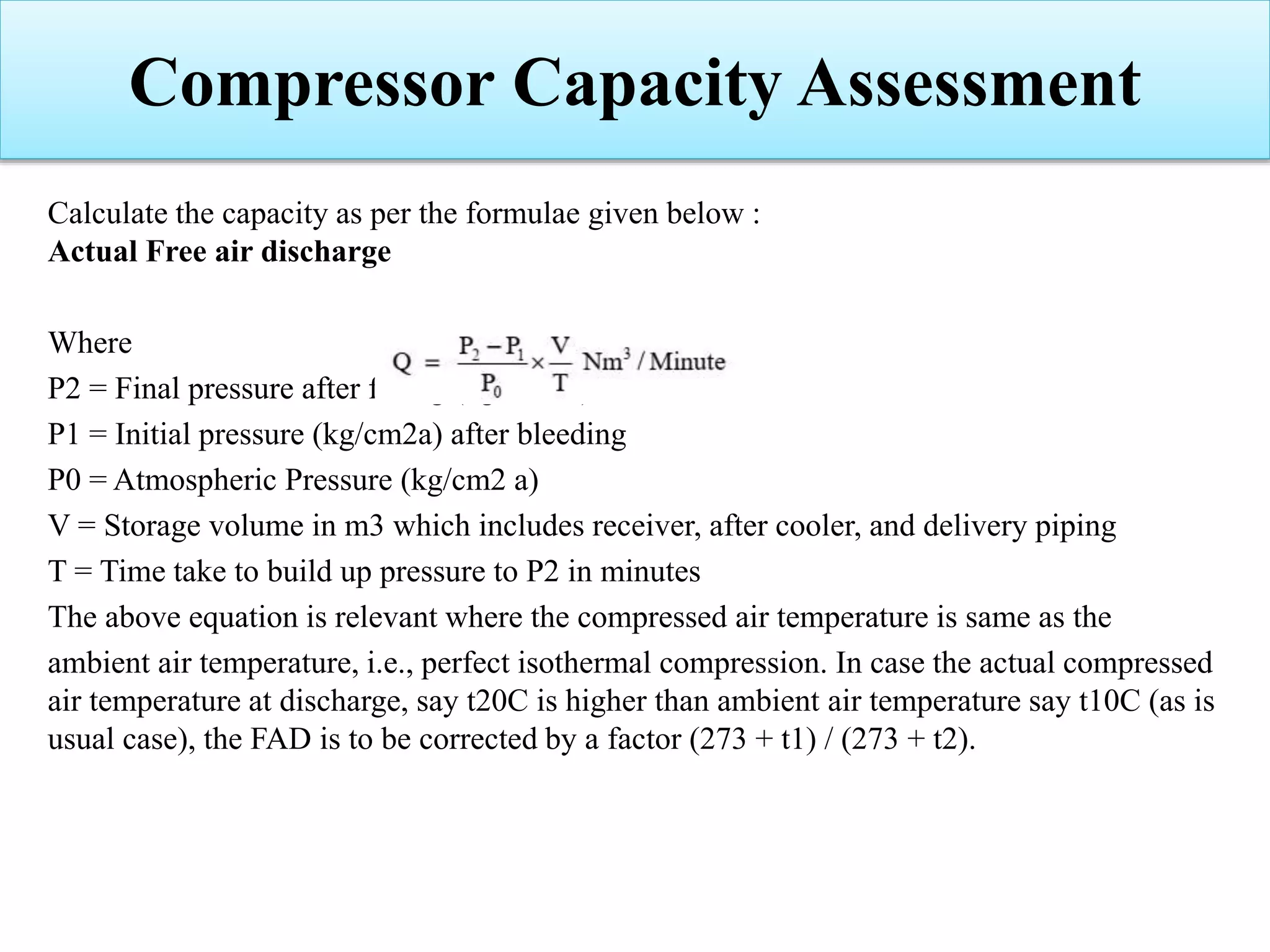
Calculate the capacity as per the formulae given below :
Actual Free air discharge
Where
P2 = Final pressure after filling (kg/cm2 a)
P1 = Initial pressure (kg/cm2a) after bleeding
P0 = Atmospheric Pressure (kg/cm2 a)
V = Storage volume in m3 which includes receiver, after cooler, and delivery piping
T = Time take to build up pressure to P2 in minutes
The above equation is relevant where the compressed air temperature is same as the
ambient air temperature, i.e., perfect isothermal compression. In case the actual compressed
air temperature at discharge, say t20C is higher than ambient air temperature say t10C (as is
usual case), the FAD is to be corrected by a factor (273 + t1) / (273 + t2).
Compressor Capacity Assessment
• Ensure air intake to compressor is not warm and humid by locating compressors in well-ventilated area
or by drawing cold air from outside. Every 40C rise in air inlet temperature will increase power
consumption by 1 percent.
• Clean air-inlet filters regularly. Compressor efficiency will be reduced by 2 percent for every 250 mm
WC pressure drop across the filter.
• Keep compressor valves in good condition by removing and inspecting once every six months. Worn-
out valves can reduce compressor efficiency by as much as 50 percent.
• Install manometers across the filter and monitor the pressure drop as a guide to replacement of element.
• Minimize low-load compressor operation; if air demand is less than 50 percent
of compressor capacity, consider change over to a smaller compressor or
reduce compressor speed appropriately (by reducing motor pulley size) in case
of belt driven compressors.
• Consider the use of regenerative air dryers, which uses the heat of compressed air to remove moisture.
• Fouled inter-coolers reduce compressor efficiency and cause more water condensation in air receivers
and distribution lines resulting in increased corrosion.
• Periodic cleaning of inter-coolers must be ensured.
ƒCompressor free air delivery test (FAD) must be done periodically to check the present operating
capacity against its design capacity and corrective steps must be taken if required.
ƒ
Checklist for Energy Efficiency in
Compressed Air System
• If more than one compressor is feeding to a common header, compressors must be operated in such a way that only one
small compressor should handle the load variations whereas other compressors will operate at full load.
• The possibility of heat recovery from hot compressed air to generate hot air or water for process application must be
economically analysed in case of large compressors.
• Consideration should be given to two-stage or multistage compressor as it consumes less power for the same air output
than a single stage compressor.
• If pressure requirements for processes are widely different (e.g. 3 bar to 7 bar), it is advisable to have two separate
compressed air systems.
• Reduce compressor delivery pressure, wherever possible, to save energy. Provide extra air receivers at points of high
cyclic-air demand which permits operation without extra compressor capacity.
• Retrofit with variable speed drives in big compressors, say over 100 kW, to eliminate the `unloaded’running condition
altogether.
• ƒKeep the minimum possible range between load and unload pressure settings.
• Automatic timer controlled drain traps wastes compressed air every time the valve opens. So frequency of drainage
should be optimized.
• Check air compressor logs regularly for abnormal readings, especially motor current cooling water flow and
temperature, inter-stage and discharge pressures and temperatures and compressor load-cycle.
• Compressed air leakage of 40- 50 percent is not uncommon. Carry out periodic leak tests to estimate the quantity of
leakage.
• Install equipment interlocked solenoid cut-off valves in the air system so that air supply to a machine can be switched
off when not in use.
Compressed Air System
• Present energy prices justify liberal designs of pipeline sizes to reduce pressure drops.
• Compressed air piping layout should be made preferably as a ring main to provide desired pressures for all
users.
• A smaller dedicated compressor can be installed at load point, located far off from the central compressor
house, instead of supplying air through lengthy
pipelines.
• All pneumatic equipment should be properly lubricated, which will reduce friction, prevent wear of seals
and other rubber parts thus preventing energy wastage due to excessive air consumption or leakage.
• Misuse of compressed air such as for body cleaning, agitation, general floor cleaning, and other similar
applications must be discouraged in order to save compressed air and energy.
• Pneumatic equipment should not be operated above the recommended operating pressure as this not only
wastes energy bus can also lead to excessive wear of equipment’s components which leads to further
energy wastage.
• Pneumatic transport can be replaced by mechanical system as the former consumed about 8 times more
energy. Highest possibility of energy savings is by reducing compressed air use.
• Pneumatic tools such as drill and grinders consume about 20 times more energy than motor driven tools.
Hence they have to be used efficiently.
• Wherever possible, they should be replaced with electrically operated tools. Where possible welding is a
good practice and should be preferred over threaded connections.
• On account of high pressure drop, ball or plug or gate valves are preferable over globe valves in
compressed air lines.
Compressed Air System
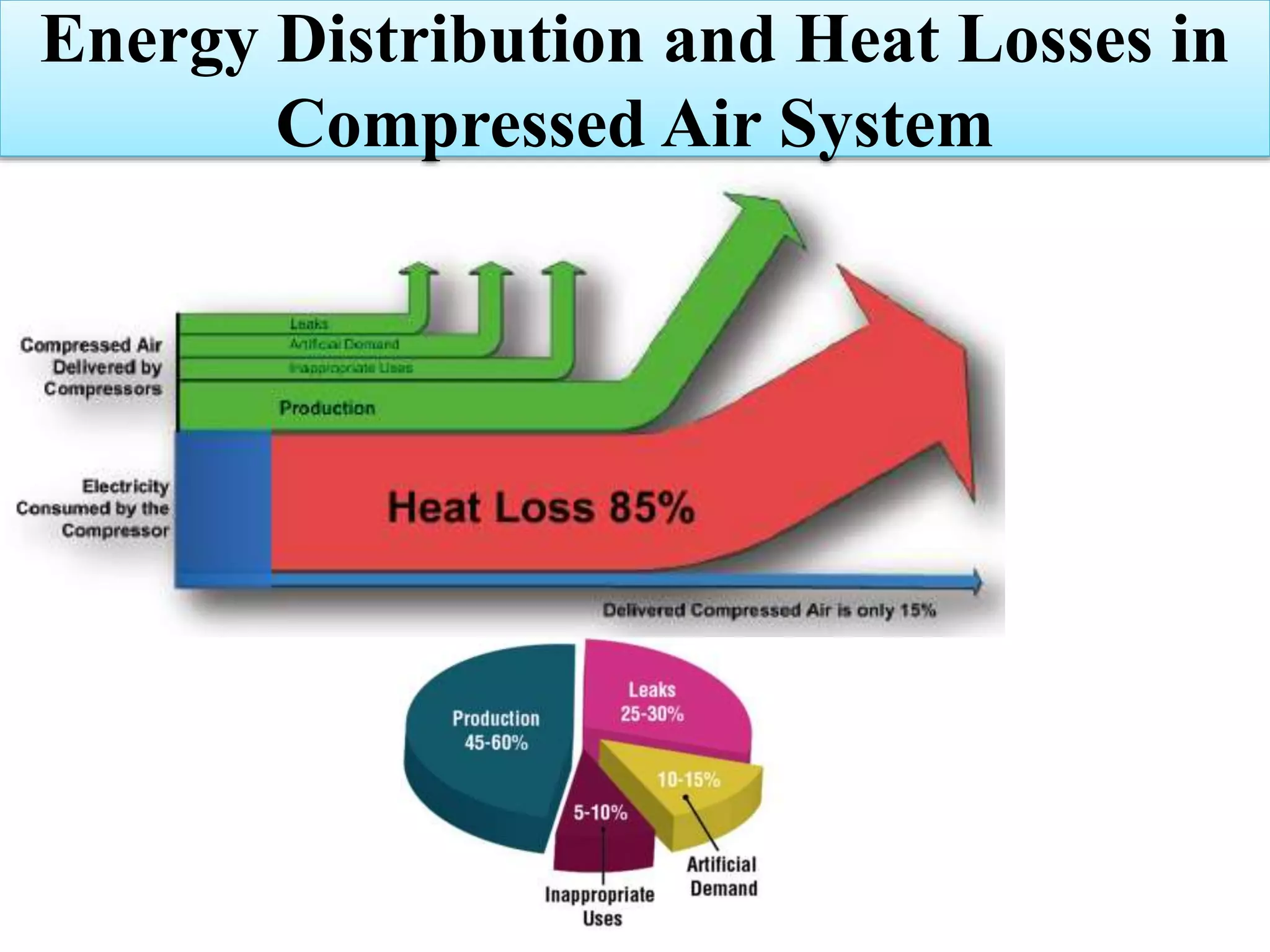
Energy Distribution and Heat Losses in
Compressed Air System
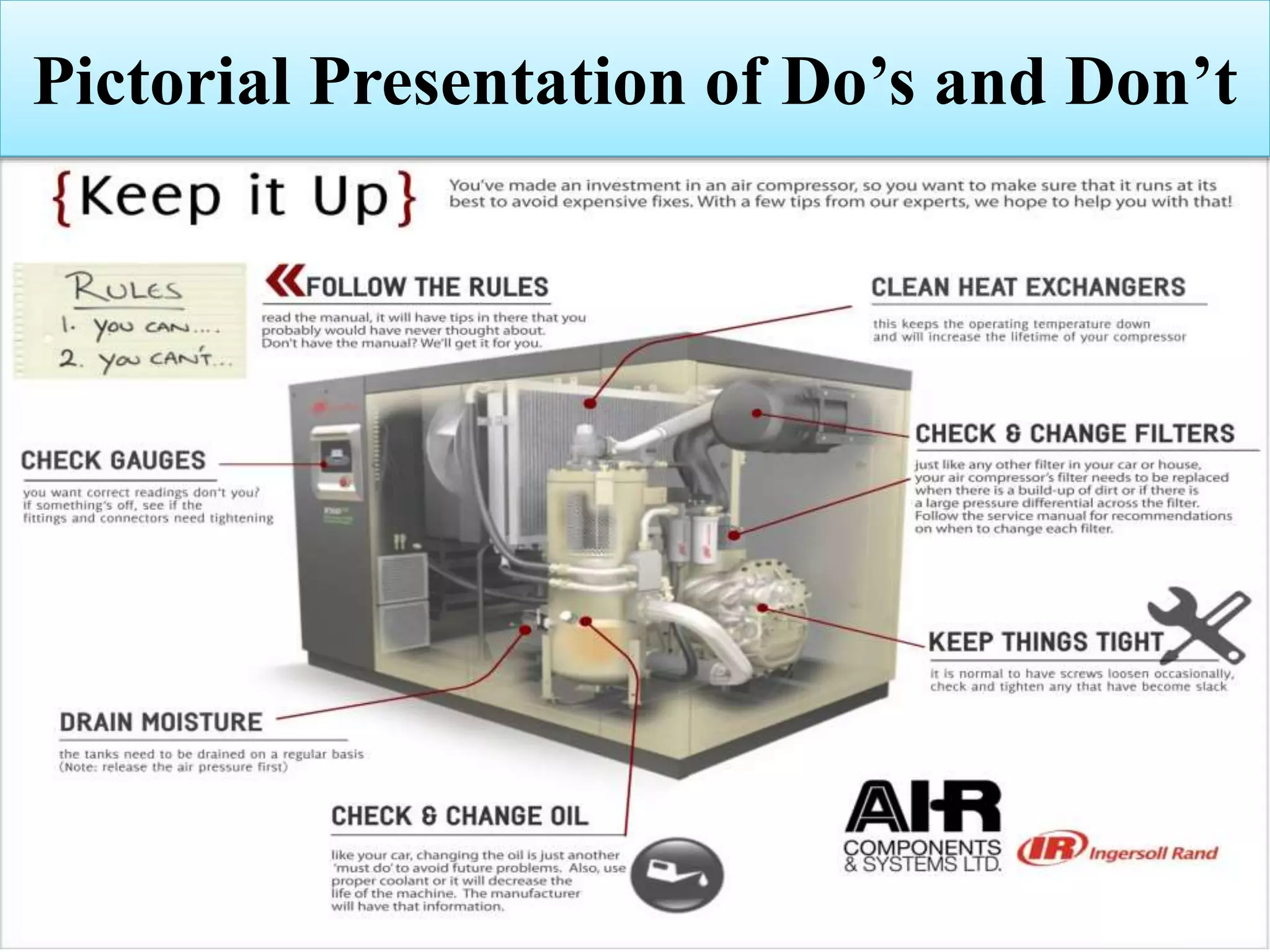
Pictorial Presentation of Do’s and Don’t
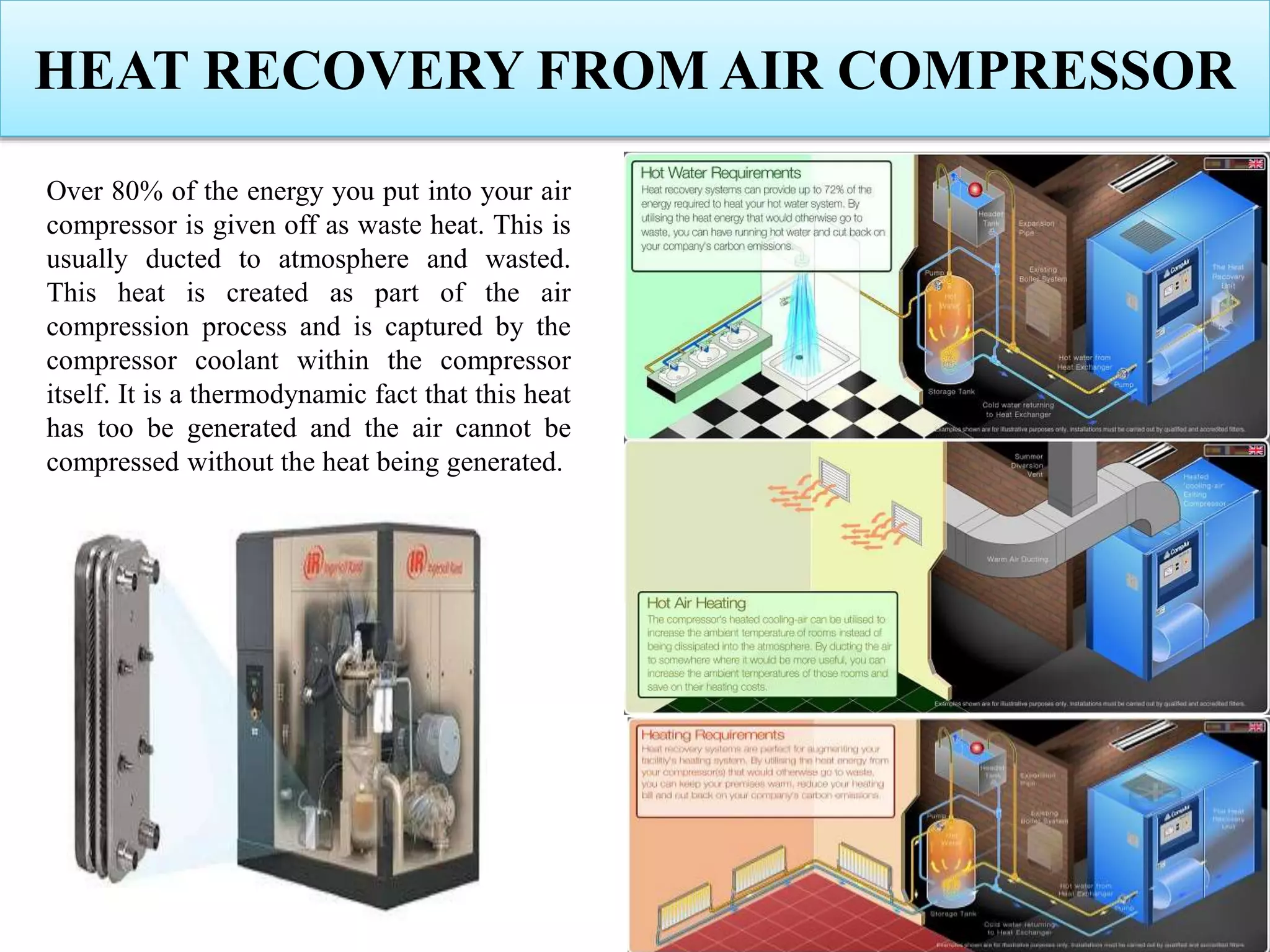
HEAT RECOVERY FROM AIR COMPRESSOR
Over 80% of the energy you put into your air
compressor is given off as waste heat. This is
usually ducted to atmosphere and wasted.
This heat is created as part of the air
compression process and is captured by the
compressor coolant within the compressor
itself. It is a thermodynamic fact that this heat
has too be generated and the air cannot be
compressed without the heat being generated.
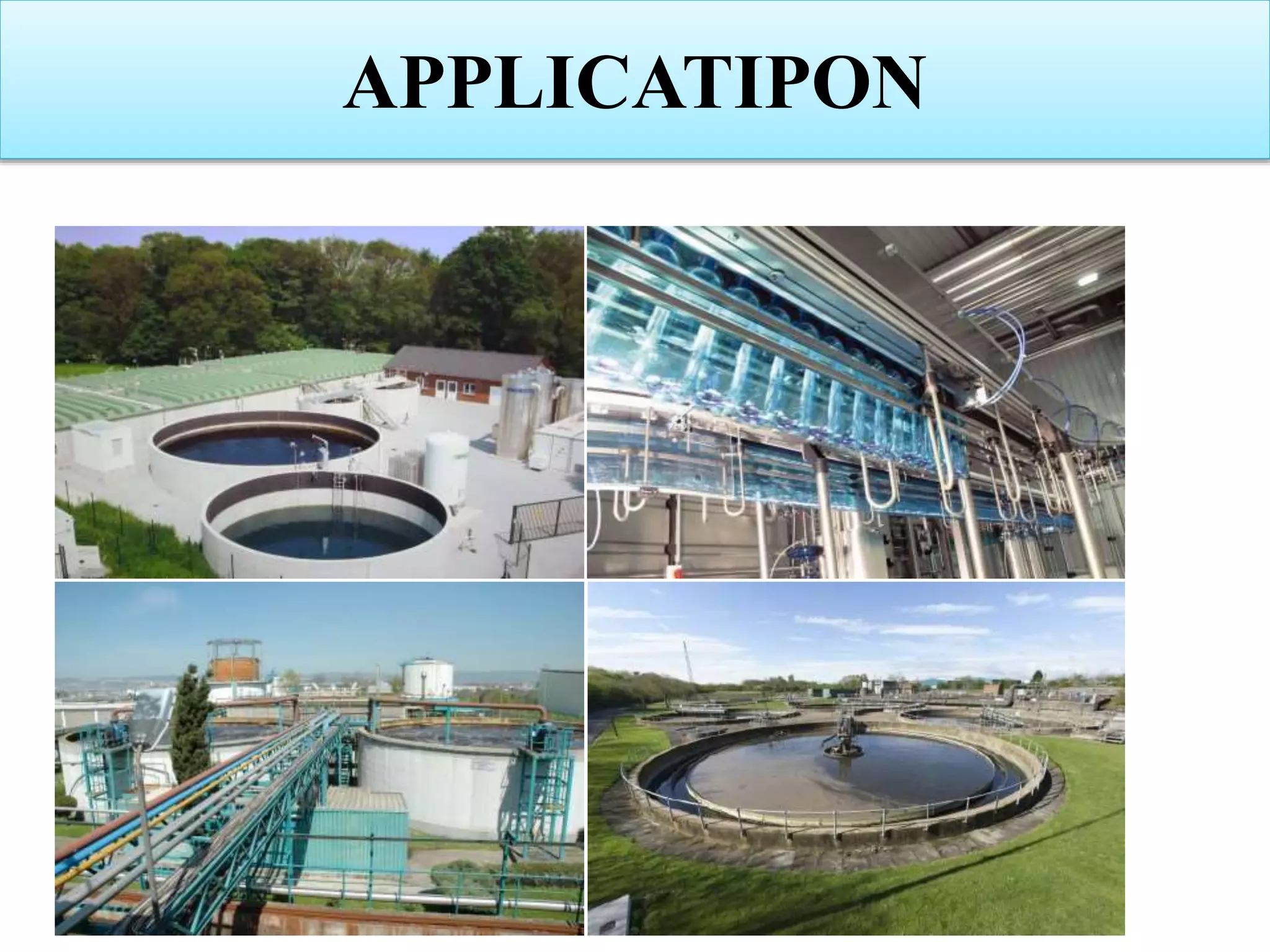
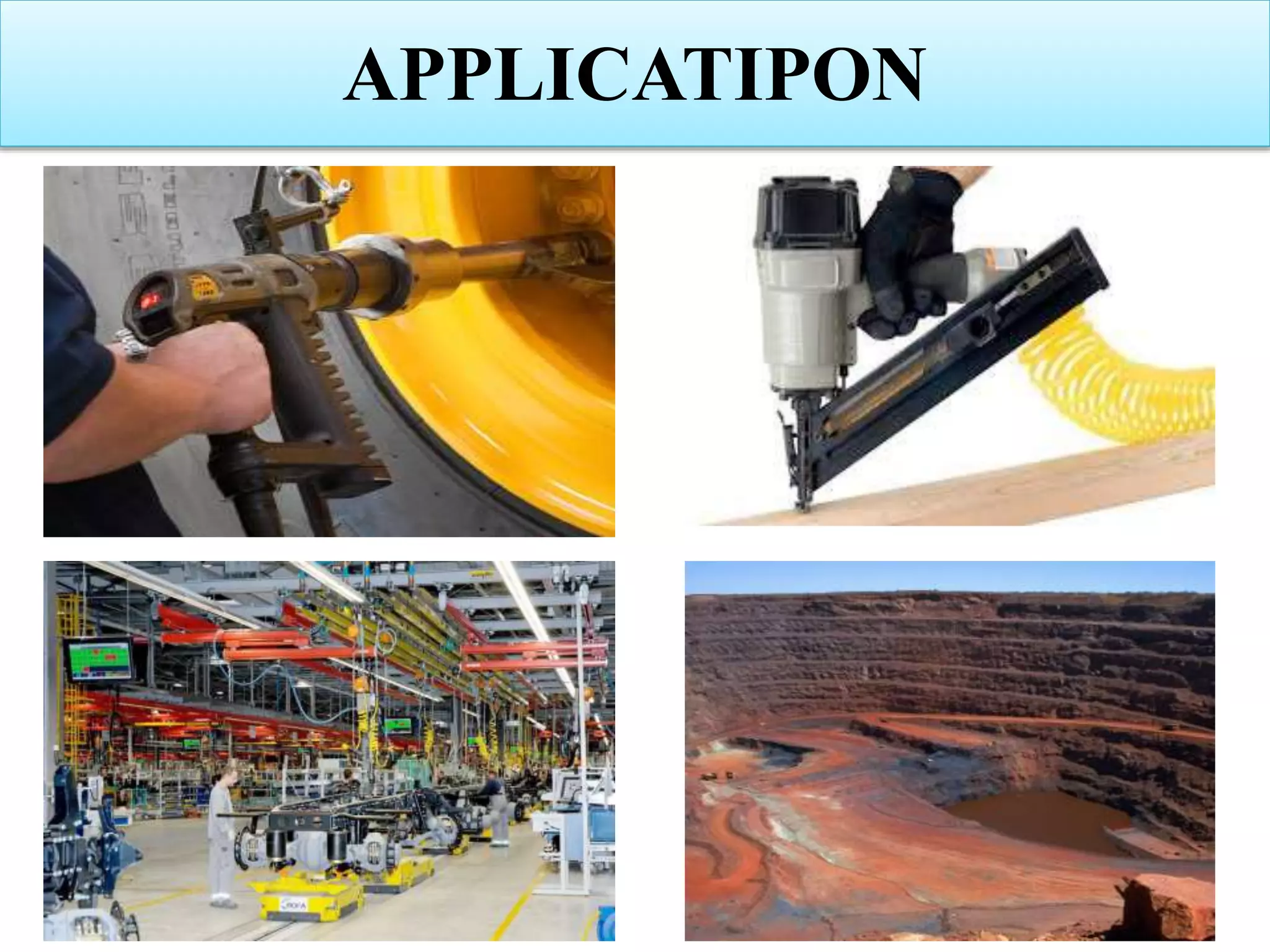
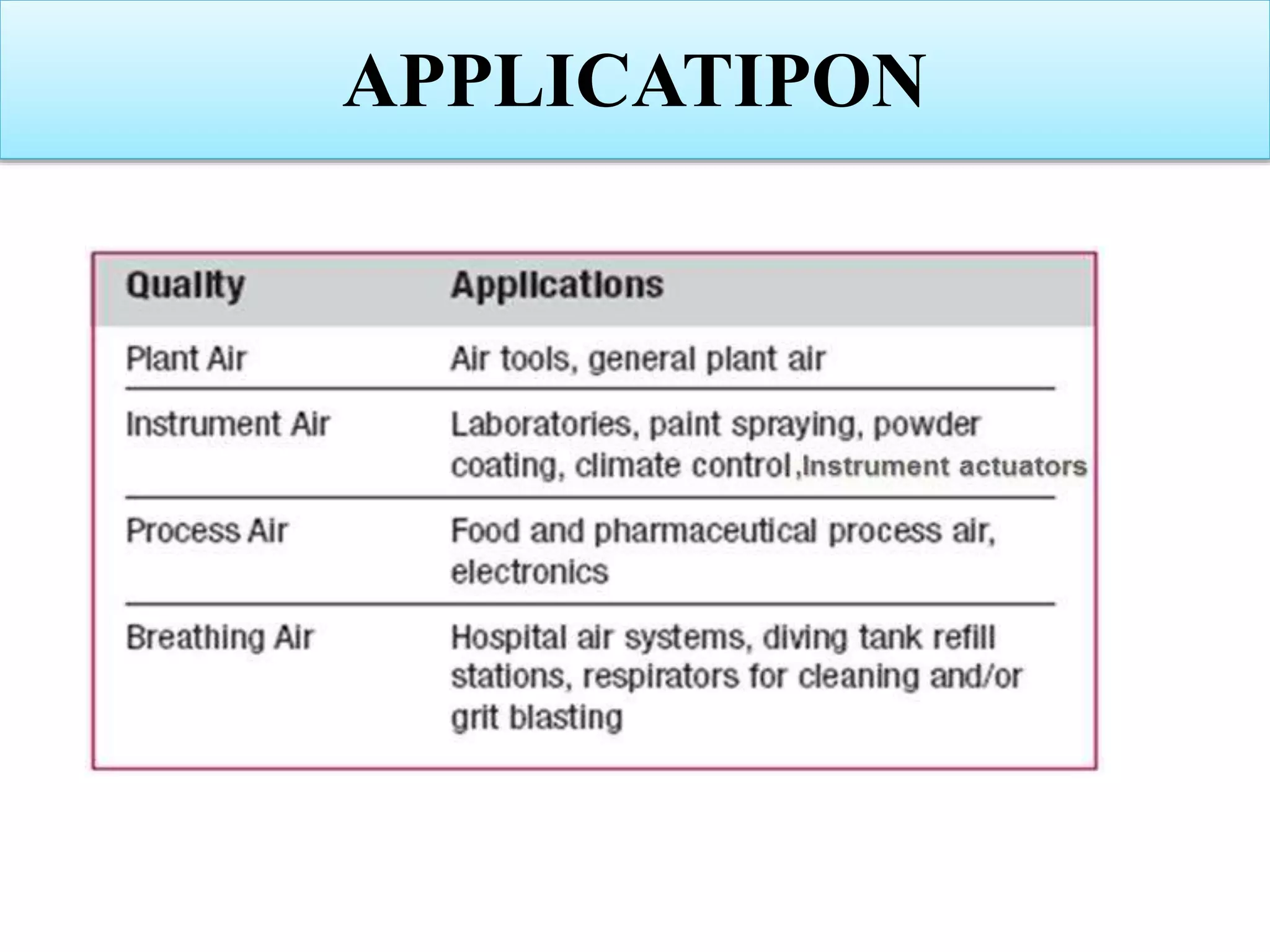
APPLICATIPON
APPLICATIPON
APPLICATIPON
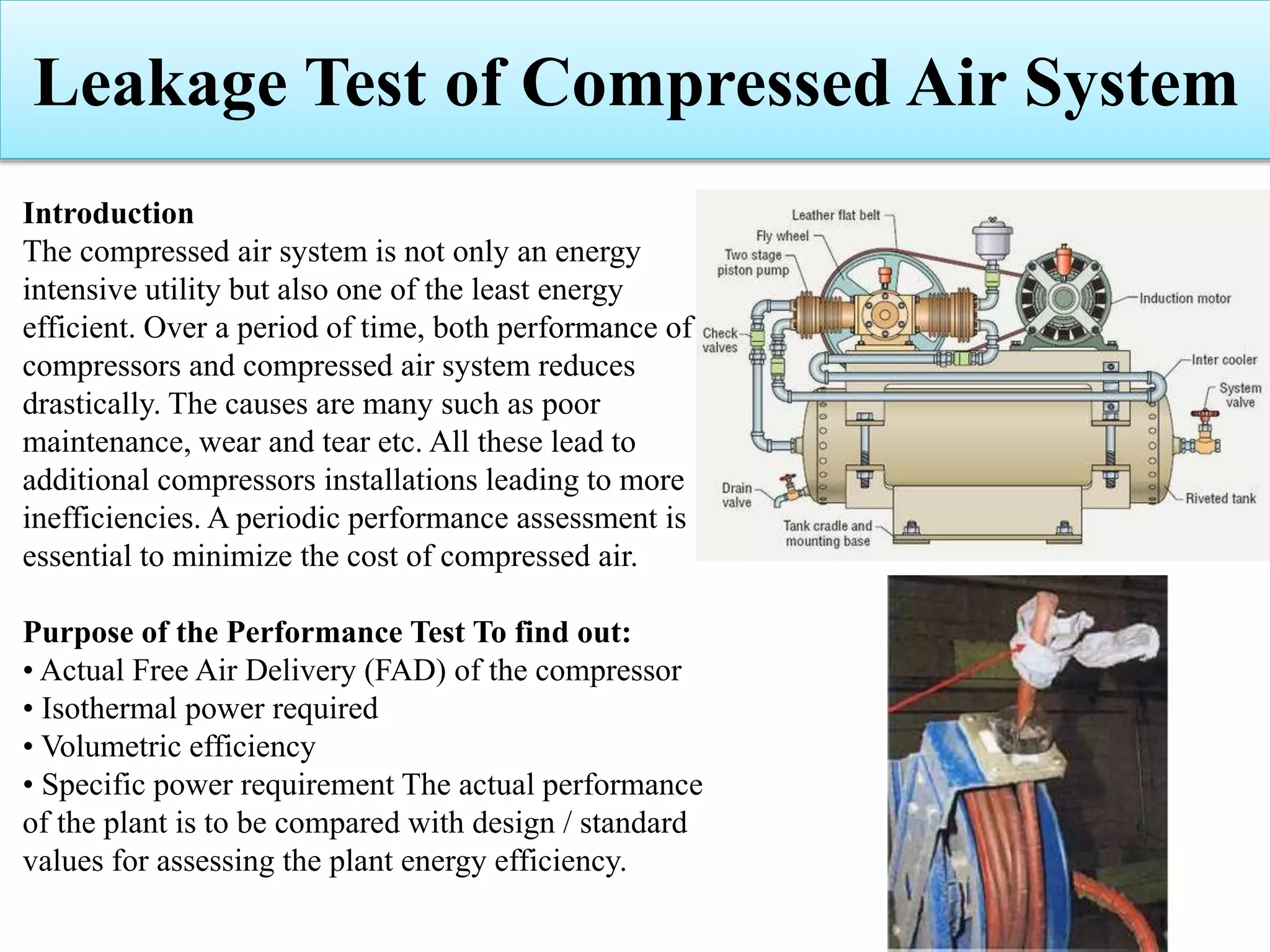
Leakage Test of Compressed Air System
Introduction
The compressed air system is not only an energy
intensive utility but also one of the least energy
efficient. Over a period of time, both performance of
compressors and compressed air system reduces
drastically. The causes are many such as poor
maintenance, wear and tear etc. All these lead to
additional compressors installations leading to more
inefficiencies. A periodic performance assessment is
essential to minimize the cost of compressed air.
Purpose of the Performance Test To find out:
• Actual Free Air Delivery (FAD) of the compressor
• Isothermal power required
• Volumetric efficiency
• Specific power requirement The actual performance
of the plant is to be compared with design / standard
values for assessing the plant energy efficiency.
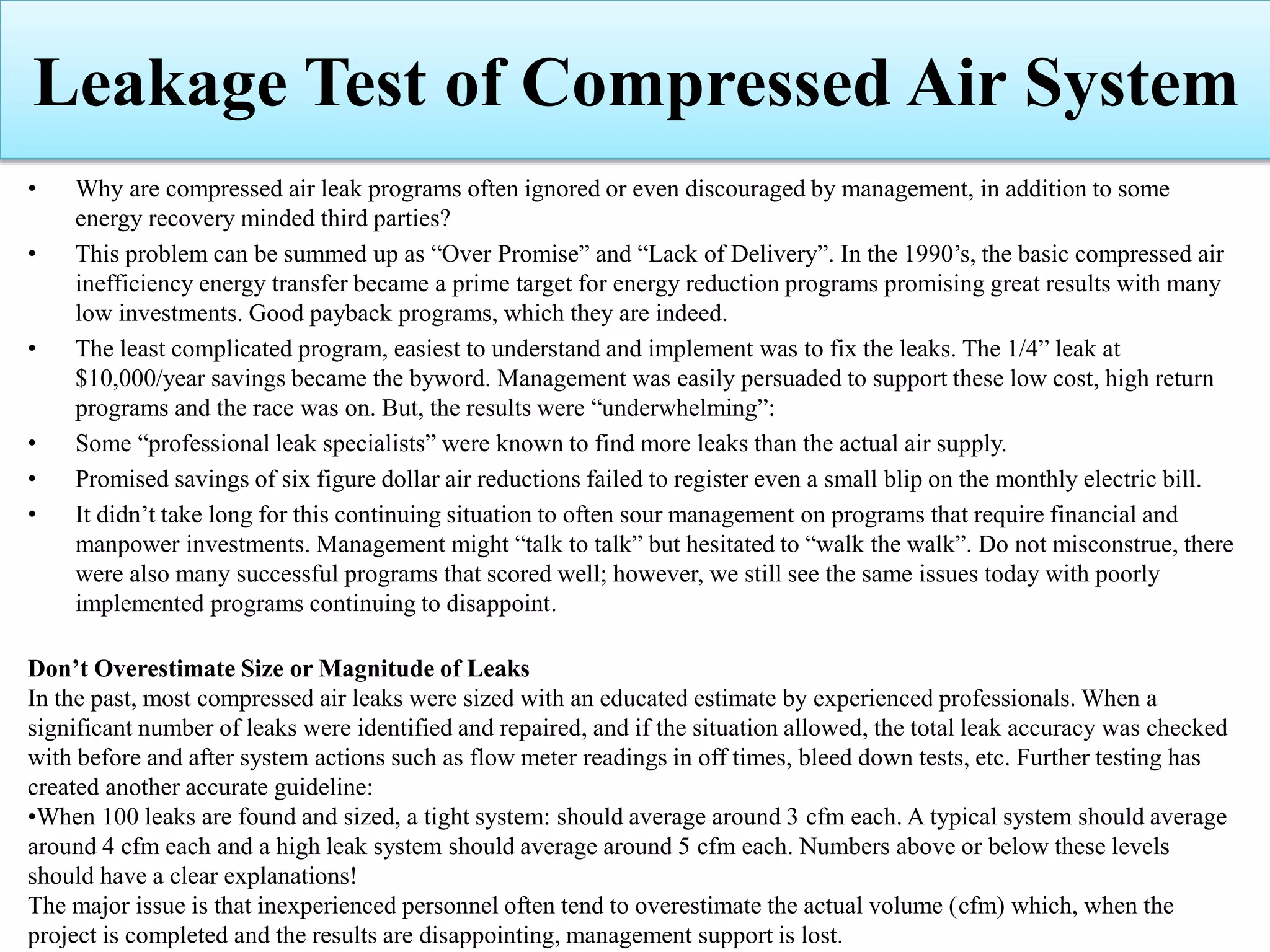
• Why are compressed air leak programs often ignored or even discouraged by management, in addition to some
energy recovery minded third parties?
• This problem can be summed up as “Over Promise” and “Lack of Delivery”. In the 1990’s, the basic compressed air
inefficiency energy transfer became a prime target for energy reduction programs promising great results with many
low investments. Good payback programs, which they are indeed.
• The least complicated program, easiest to understand and implement was to fix the leaks. The 1/4” leak at
$10,000/year savings became the byword. Management was easily persuaded to support these low cost, high return
programs and the race was on. But, the results were “underwhelming”:
• Some “professional leak specialists” were known to find more leaks than the actual air supply.
• Promised savings of six figure dollar air reductions failed to register even a small blip on the monthly electric bill.
• It didn’t take long for this continuing situation to often sour management on programs that require financial and
manpower investments. Management might “talk to talk” but hesitated to “walk the walk”. Do not misconstrue, there
were also many successful programs that scored well; however, we still see the same issues today with poorly
implemented programs continuing to disappoint.
Don’t Overestimate Size or Magnitude of Leaks
In the past, most compressed air leaks were sized with an educated estimate by experienced professionals. When a
significant number of leaks were identified and repaired, and if the situation allowed, the total leak accuracy was checked
with before and after system actions such as flow meter readings in off times, bleed down tests, etc. Further testing has
created another accurate guideline:
•When 100 leaks are found and sized, a tight system: should average around 3 cfm each. A typical system should average
around 4 cfm each and a high leak system should average around 5 cfm each. Numbers above or below these levels
should have a clear explanations!
The major issue is that inexperienced personnel often tend to overestimate the actual volume (cfm) which, when the
project is completed and the results are disappointing, management support is lost.
Leakage Test of Compressed Air System
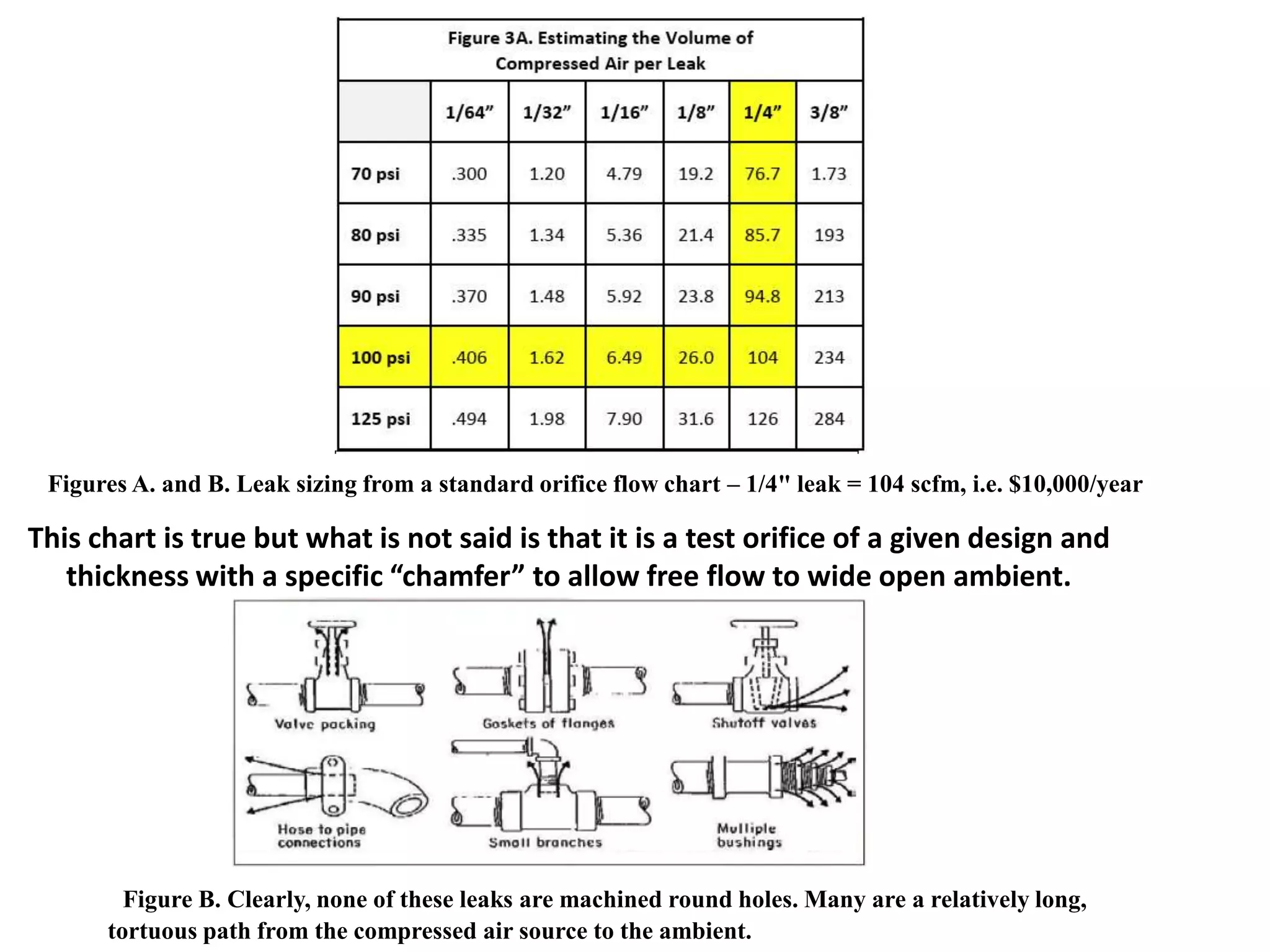
Figures A. and B. Leak sizing from a standard orifice flow chart – 1/4" leak = 104 scfm, i.e. $10,000/year
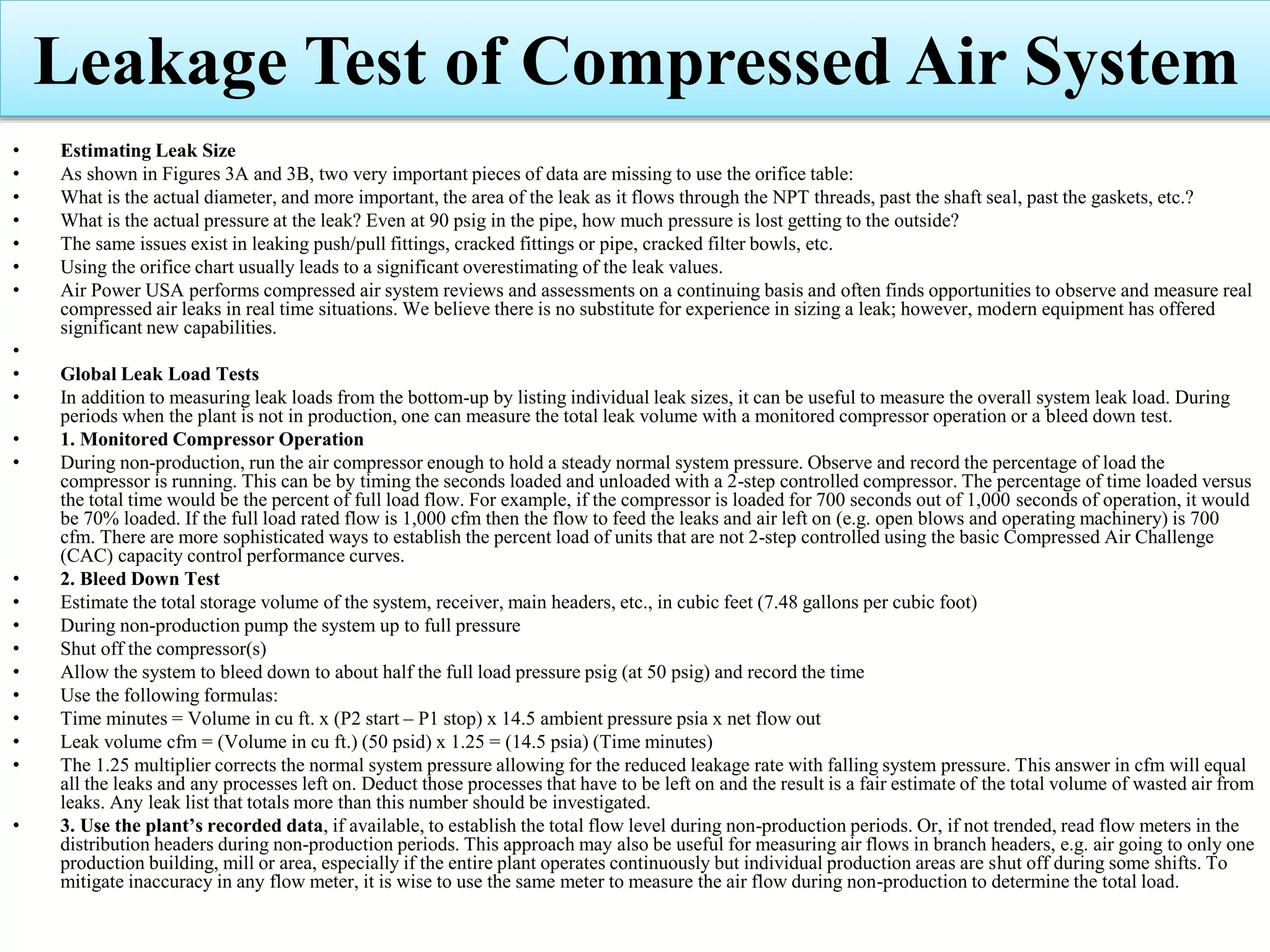
Figure B. Clearly, none of these leaks are machined round holes. Many are a relatively long,
tortuous path from the compressed air source to the ambient.
This chart is true but what is not said is that it is a test orifice of a given design and
thickness with a specific “chamfer” to allow free flow to wide open ambient.
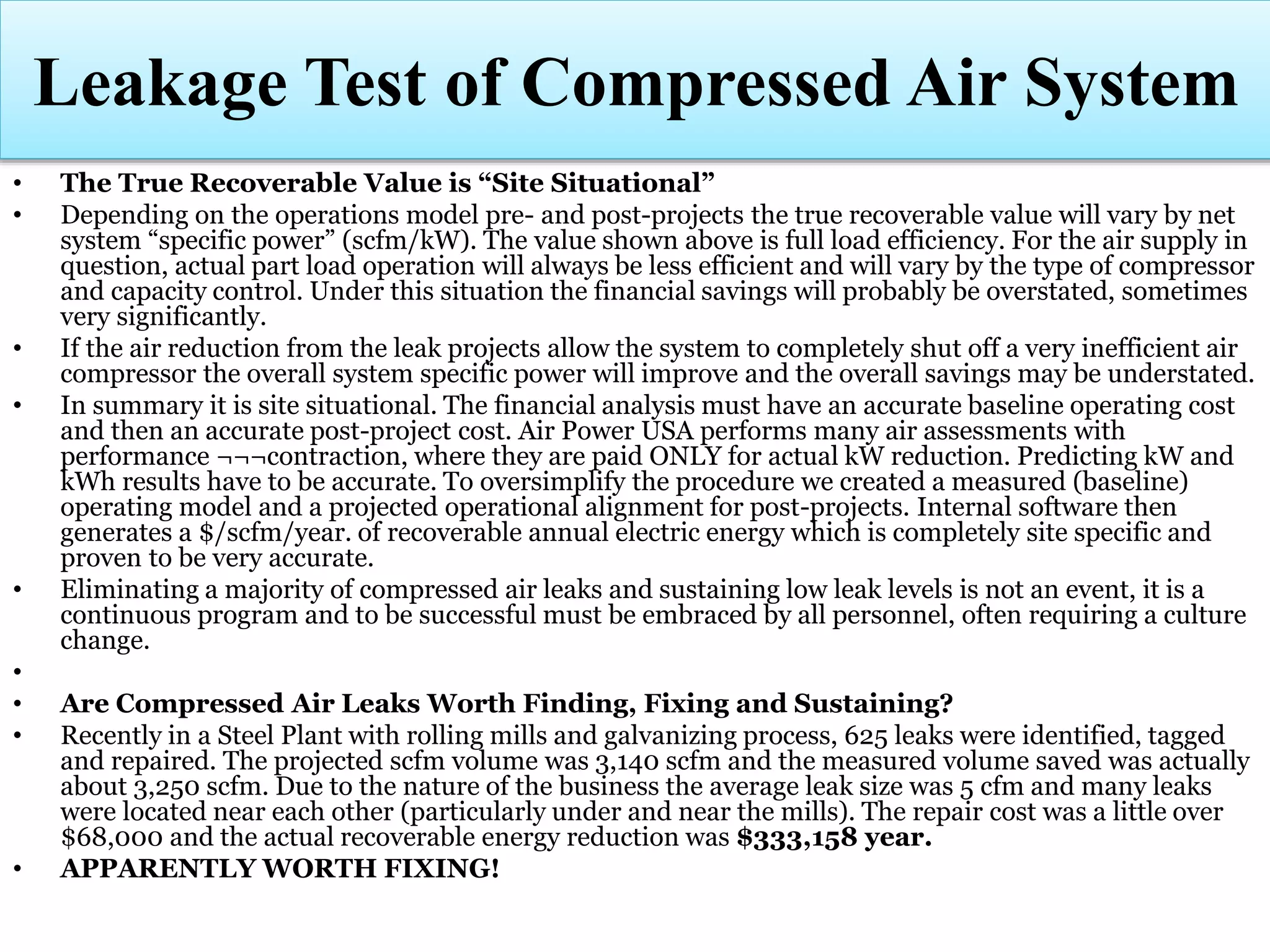
• Estimating Leak Size
• As shown in Figures 3A and 3B, two very important pieces of data are missing to use the orifice table:
• What is the actual diameter, and more important, the area of the leak as it flows through the NPT threads, past the shaft seal, past the gaskets, etc.?
• What is the actual pressure at the leak? Even at 90 psig in the pipe, how much pressure is lost getting to the outside?
• The same issues exist in leaking push/pull fittings, cracked fittings or pipe, cracked filter bowls, etc.
• Using the orifice chart usually leads to a significant overestimating of the leak values.
• Air Power USA performs compressed air system reviews and assessments on a continuing basis and often finds opportunities to observe and measure real
compressed air leaks in real time situations. We believe there is no substitute for experience in sizing a leak; however, modern equipment has offered
significant new capabilities.
•
• Global Leak Load Tests
• In addition to measuring leak loads from the bottom-up by listing individual leak sizes, it can be useful to measure the overall system leak load. During
periods when the plant is not in production, one can measure the total leak volume with a monitored compressor operation or a bleed down test.
• 1. Monitored Compressor Operation
• During non-production, run the air compressor enough to hold a steady normal system pressure. Observe and record the percentage of load the
compressor is running. This can be by timing the seconds loaded and unloaded with a 2-step controlled compressor. The percentage of time loaded versus
the total time would be the percent of full load flow. For example, if the compressor is loaded for 700 seconds out of 1,000 seconds of operation, it would
be 70% loaded. If the full load rated flow is 1,000 cfm then the flow to feed the leaks and air left on (e.g. open blows and operating machinery) is 700
cfm. There are more sophisticated ways to establish the percent load of units that are not 2-step controlled using the basic Compressed Air Challenge
(CAC) capacity control performance curves.
• 2. Bleed Down Test
• Estimate the total storage volume of the system, receiver, main headers, etc., in cubic feet (7.48 gallons per cubic foot)
• During non-production pump the system up to full pressure
• Shut off the compressor(s)
• Allow the system to bleed down to about half the full load pressure psig (at 50 psig) and record the time
• Use the following formulas:
• Time minutes = Volume in cu ft. x (P2 start – P1 stop) x 14.5 ambient pressure psia x net flow out
• Leak volume cfm = (Volume in cu ft.) (50 psid) x 1.25 = (14.5 psia) (Time minutes)
• The 1.25 multiplier corrects the normal system pressure allowing for the reduced leakage rate with falling system pressure. This answer in cfm will equal
all the leaks and any processes left on. Deduct those processes that have to be left on and the result is a fair estimate of the total volume of wasted air from
leaks. Any leak list that totals more than this number should be investigated.
• 3. Use the plant’s recorded data, if available, to establish the total flow level during non-production periods. Or, if not trended, read flow meters in the
distribution headers during non-production periods. This approach may also be useful for measuring air flows in branch headers, e.g. air going to only one
production building, mill or area, especially if the entire plant operates continuously but individual production areas are shut off during some shifts. To
mitigate inaccuracy in any flow meter, it is wise to use the same meter to measure the air flow during non-production to determine the total load.
Leakage Test of Compressed Air System
• The True Recoverable Value is “Site Situational”
• Depending on the operations model pre- and post-projects the true recoverable value will vary by net
system “specific power” (scfm/kW). The value shown above is full load efficiency. For the air supply in
question, actual part load operation will always be less efficient and will vary by the type of compressor
and capacity control. Under this situation the financial savings will probably be overstated, sometimes
very significantly.
• If the air reduction from the leak projects allow the system to completely shut off a very inefficient air
compressor the overall system specific power will improve and the overall savings may be understated.
• In summary it is site situational. The financial analysis must have an accurate baseline operating cost
and then an accurate post-project cost. Air Power USA performs many air assessments with
performance ¬¬¬contraction, where they are paid ONLY for actual kW reduction. Predicting kW and
kWh results have to be accurate. To oversimplify the procedure we created a measured (baseline)
operating model and a projected operational alignment for post-projects. Internal software then
generates a $/scfm/year. of recoverable annual electric energy which is completely site specific and
proven to be very accurate.
• Eliminating a majority of compressed air leaks and sustaining low leak levels is not an event, it is a
continuous program and to be successful must be embraced by all personnel, often requiring a culture
change.
•
• Are Compressed Air Leaks Worth Finding, Fixing and Sustaining?
• Recently in a Steel Plant with rolling mills and galvanizing process, 625 leaks were identified, tagged
and repaired. The projected scfm volume was 3,140 scfm and the measured volume saved was actually
about 3,250 scfm. Due to the nature of the business the average leak size was 5 cfm and many leaks
were located near each other (particularly under and near the mills). The repair cost was a little over
$68,000 and the actual recoverable energy reduction was $333,158 year.
• APPARENTLY WORTH FIXING!
Leakage Test of Compressed Air System
Reciprocating Compressor Mechanical
Running Test
• Reciprocating Compressor Mechanical Running Test
• The API Std. 618 requires that reciprocating compressor to be subjected to the 4 hours unloaded running test
after successful inspection and testing that are done before and during assembly. To perform an unloaded running
test, the reciprocating compressor cylinder valves shall not be installed for the mechanical running test. The
mechanical running test is considered a routine test in the reciprocating compressor testing.
• The test shall be performed based on manufacturer approved test procedure. The compressor is brought to the
rated speed and then runs for 30 minutes to get lube oil temperature, viscosity, bearing temperatures and
vibration amplitudes stabilized. After operating parameter stabilization, the test technician records the parameters
in each 10 or 15 minutes as per requirements.
• The following parameter is recorded periodically in this 4 hours:
• Lube Oil Pressure
• Lube Oil Temperature
• Bearing Temperature
• Lube Oil Viscosity
• Power Consumption
• Rotor Speed
• Vibration
• As per API 618, the power consumption shall not be more than 3% of the rate power value indicated in the
datasheet.
• The API 618 also requires the trip speed shall not be less than 110 % of the rotor rated speed.
• The crankcase vibration is measured in real-time basis in X and Y axises. The cylinder vibration is measured in
X, Y, and Z axises (Horizontal, Vertical, and Axial). The measured values shall be verified aginst acceptance
criteria provided in API 618 or approved test procedure.
• If specified, the lube oil and cooling water consoles also shall be subjected to the 4 hours mechanical running
test as per requirements of API 614.
Reciprocating Compressor Aerodynamic
Performance Test
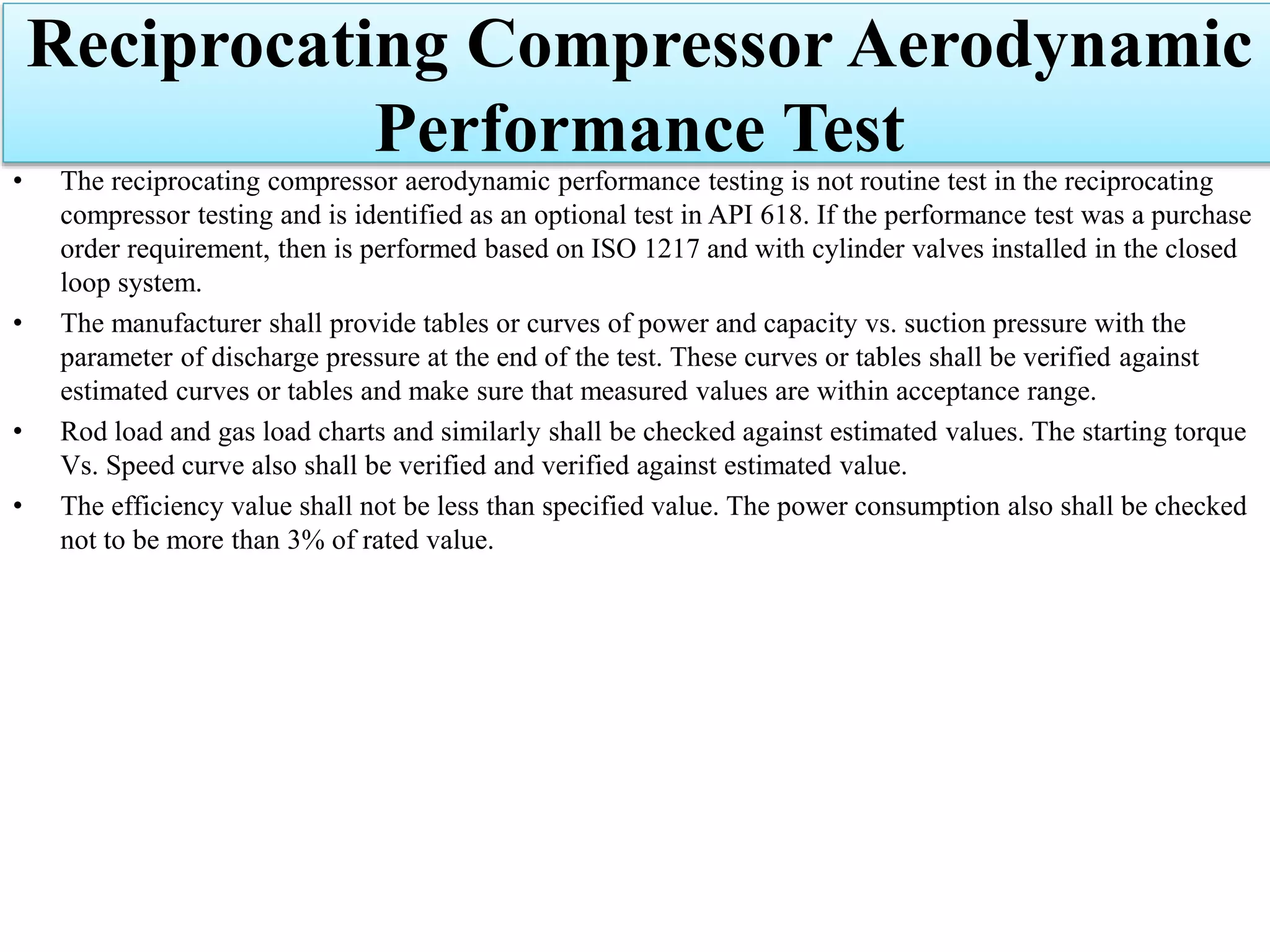
• The reciprocating compressor aerodynamic performance testing is not routine test in the reciprocating
compressor testing and is identified as an optional test in API 618. If the performance test was a purchase
order requirement, then is performed based on ISO 1217 and with cylinder valves installed in the closed
loop system.
• The manufacturer shall provide tables or curves of power and capacity vs. suction pressure with the
parameter of discharge pressure at the end of the test. These curves or tables shall be verified against
estimated curves or tables and make sure that measured values are within acceptance range.
• Rod load and gas load charts and similarly shall be checked against estimated values. The starting torque
Vs. Speed curve also shall be verified and verified against estimated value.
• The efficiency value shall not be less than specified value. The power consumption also shall be checked
not to be more than 3% of rated value.
Reciprocating Compressor Hydrostatic Test
• Reciprocating Compressor Hydrostatic Test
• As per API 618, the cylinder, cooling water jacket and piping system shall be subjected to
the hydrostatic testing. The hydrostatic testing shall be than at 1.5 times maximum allowable
working pressure and the pressure shall be held for minimum 30 minutes.
• The cylinder shall be hydrostatically tested before installation of the cylinder liner. Besides,
cylinder shall be tested with heads, valve covers, clearance pockets, and fasteners being
already installed.
• The filters and pressure vessel generally are manufactured at pressure vessel manufacturers
and are tested there, So, it might not be necessary to subject them to hydrostatic testing at
the compressor manufacturer facility.
• The hydrostatic testing shall be done by calibrated pressure gage, and the preferable range is
two times of the test pressure but in no case shall be less than 1.5 times and more than 4
times of the pressure test.
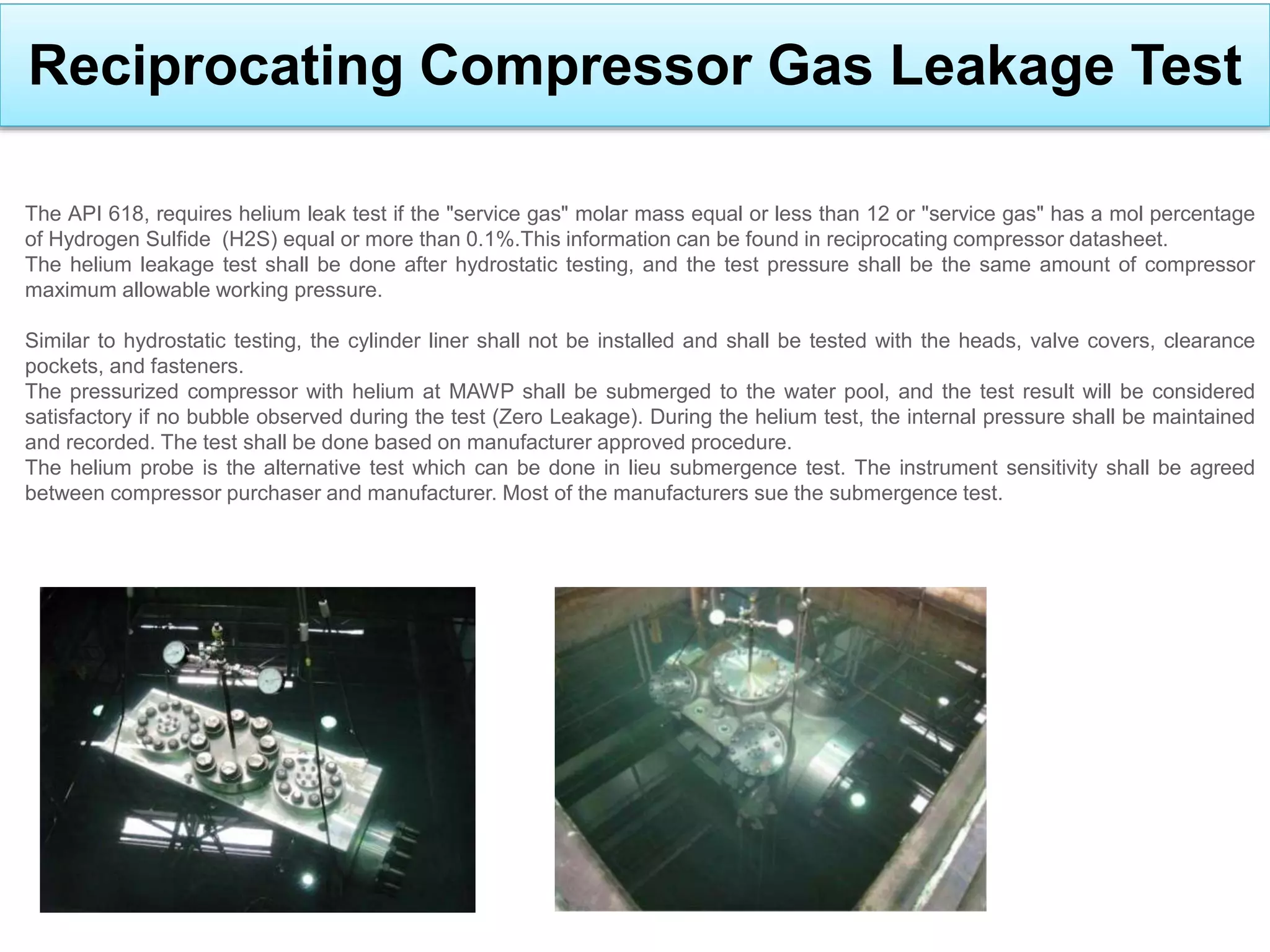
Reciprocating Compressor Gas Leakage Test
The API 618, requires helium leak test if the "service gas" molar mass equal or less than 12 or "service gas" has a mol percentage
of Hydrogen Sulfide (H2S) equal or more than 0.1%.This information can be found in reciprocating compressor datasheet.
The helium leakage test shall be done after hydrostatic testing, and the test pressure shall be the same amount of compressor
maximum allowable working pressure.
Similar to hydrostatic testing, the cylinder liner shall not be installed and shall be tested with the heads, valve covers, clearance
pockets, and fasteners.
The pressurized compressor with helium at MAWP shall be submerged to the water pool, and the test result will be considered
satisfactory if no bubble observed during the test (Zero Leakage). During the helium test, the internal pressure shall be maintained
and recorded. The test shall be done based on manufacturer approved procedure.
The helium probe is the alternative test which can be done in lieu submergence test. The instrument sensitivity shall be agreed
between compressor purchaser and manufacturer. Most of the manufacturers sue the submergence test.
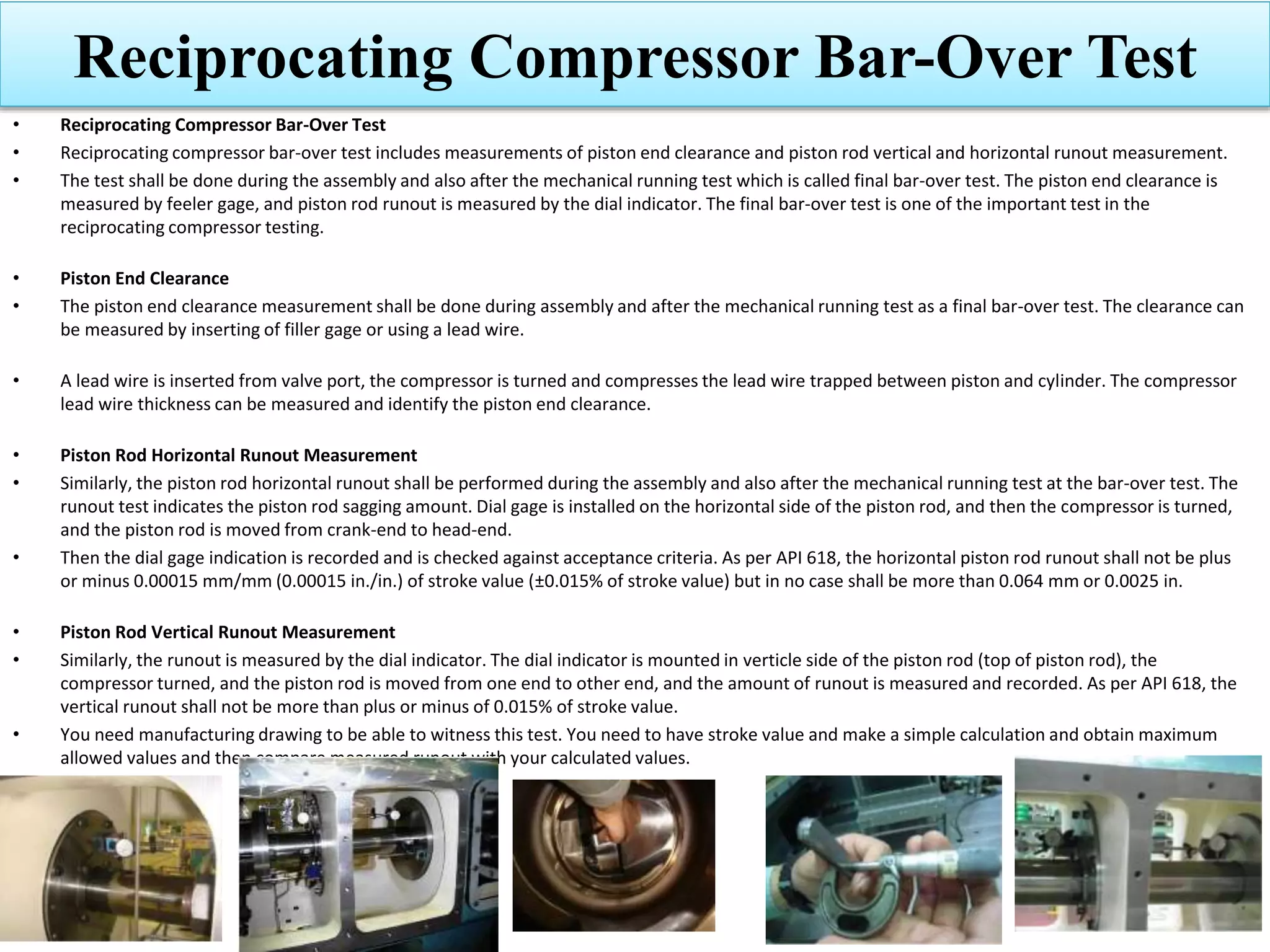
Reciprocating Compressor Bar-Over Test
• Reciprocating Compressor Bar-Over Test
• Reciprocating compressor bar-over test includes measurements of piston end clearance and piston rod vertical and horizontal runout measurement.
• The test shall be done during the assembly and also after the mechanical running test which is called final bar-over test. The piston end clearance is
measured by feeler gage, and piston rod runout is measured by the dial indicator. The final bar-over test is one of the important test in the
reciprocating compressor testing.
• Piston End Clearance
• The piston end clearance measurement shall be done during assembly and after the mechanical running test as a final bar-over test. The clearance can
be measured by inserting of filler gage or using a lead wire.
• A lead wire is inserted from valve port, the compressor is turned and compresses the lead wire trapped between piston and cylinder. The compressor
lead wire thickness can be measured and identify the piston end clearance.
• Piston Rod Horizontal Runout Measurement
• Similarly, the piston rod horizontal runout shall be performed during the assembly and also after the mechanical running test at the bar-over test. The
runout test indicates the piston rod sagging amount. Dial gage is installed on the horizontal side of the piston rod, and then the compressor is turned,
and the piston rod is moved from crank-end to head-end.
• Then the dial gage indication is recorded and is checked against acceptance criteria. As per API 618, the horizontal piston rod runout shall not be plus
or minus 0.00015 mm/mm (0.00015 in./in.) of stroke value (±0.015% of stroke value) but in no case shall be more than 0.064 mm or 0.0025 in.
• Piston Rod Vertical Runout Measurement
• Similarly, the runout is measured by the dial indicator. The dial indicator is mounted in verticle side of the piston rod (top of piston rod), the
compressor turned, and the piston rod is moved from one end to other end, and the amount of runout is measured and recorded. As per API 618, the
vertical runout shall not be more than plus or minus of 0.015% of stroke value.
• You need manufacturing drawing to be able to witness this test. You need to have stroke value and make a simple calculation and obtain maximum
allowed values and then compare measured runout with your calculated values.
Reciprocating Compressor Vibration Analysis and
Testing
• Reciprocating Compressor Vibration Analysis and Testing
• The API 618, requires following vibration limits at compressor skid, cylinder, distance pieces, crankcase and cylinder flange pressure pulsation vibration.
The vibration testing is one of important item in reciprocating compressor testing that is performed in mechanical running test part.
• Vibration Limit @ Compressor Skid
• The manufacturer shall make analysis and determine whether the vibration frequency is going to be less than 10 Hz or higher than 10 Hz. The
manufacturer makes the calculation for vibration that comes from natural frequency of base plate and also significant excitation frequencies.
• If the analysis indicates the vibration frequency is going to be less than 10 Hz, then magnitude of vibration shall not be more than 4 mil 0 to peak value or
8 mil peak to peak value.
• If analysis indicates the vibration frequency is going to be higher than 10 Hz, then magnitude of vibration shall not be more than 4.5 mm/s RMS value
(0.175 in/s RMS)
• As you see, we are using displacement vibration probe (sensor) when vibration frequency is less than 10 Hz and using velocity vibration probe (sensor)
when vibration frequency is higher than 10 Hz.
• The API 618, requires that the reciprocating compressor manufacturer makes necessary calculations and provide the vibration limits for the cylinder,
distance pieces, and crankcase. These amounts normally are indicated in approved mechanical running test procedure. The vibration testing is done in 4
hour mechanical running test.
• The API 618 also requires that cylinder flange pressure pulsation vibration shall not be more than of 7% of average absolute line pressure or 3R%
whichever is lesser. (the R is the stage pressure ratio). The vibration amplitude should be measured by displacement probe (proximitor sensor).
• The standard also provides the piping system vibration limit. The limit is 0.5 mm peak to peak or 20 mil peak to peak when vibration frequency is less
than 10 Hz. The limit is 32mm/s peak to peak or 1.25 in/s peak to peak when vibration frequency is 10 thru 100 Hz.
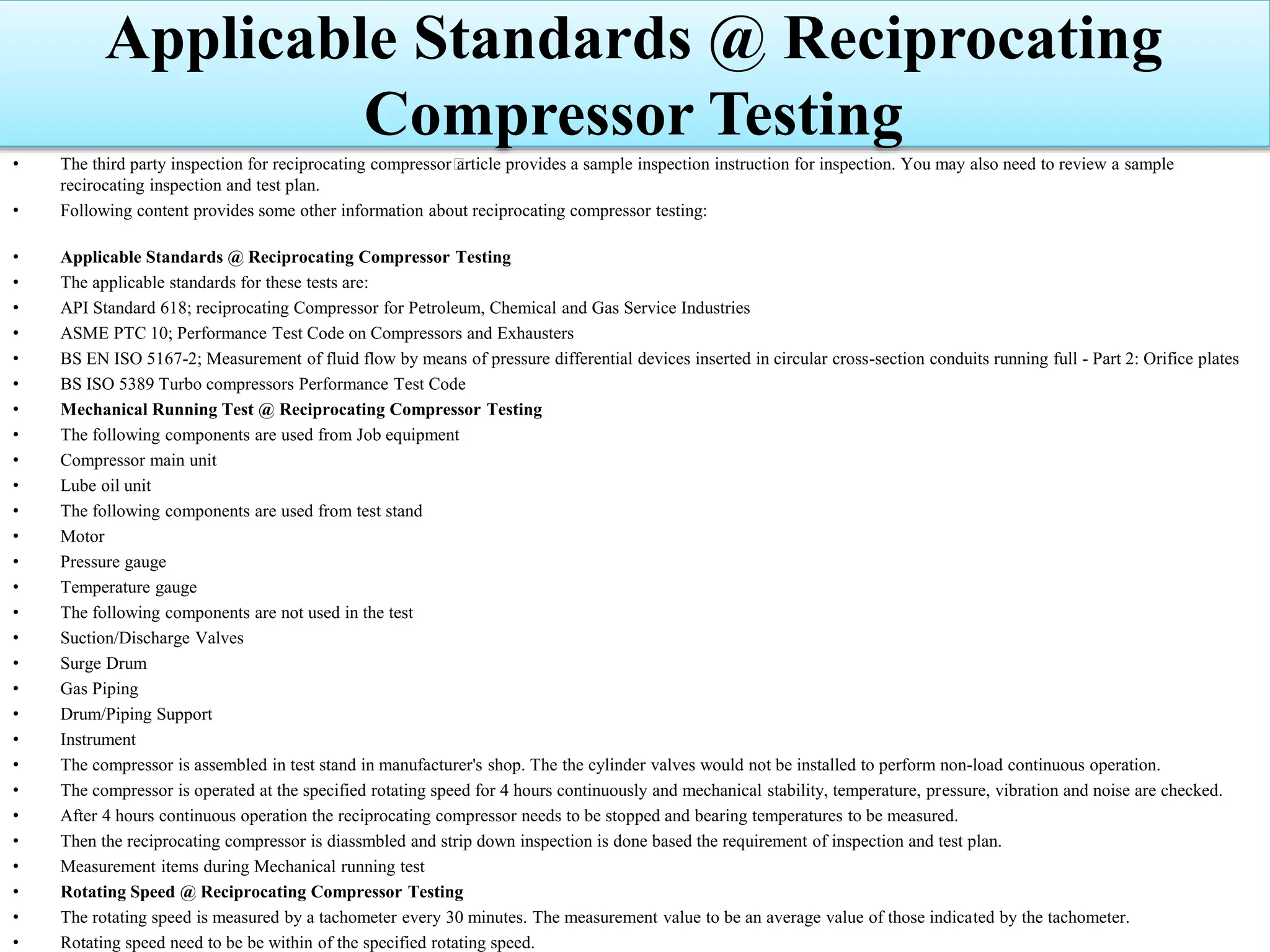
Applicable Standards @ Reciprocating
Compressor Testing
• The third party inspection for reciprocating compressorarticle provides a sample inspection instruction for inspection. You may also need to review a sample
recirocating inspection and test plan.
• Following content provides some other information about reciprocating compressor testing:
• Applicable Standards @ Reciprocating Compressor Testing
• The applicable standards for these tests are:
• API Standard 618; reciprocating Compressor for Petroleum, Chemical and Gas Service Industries
• ASME PTC 10; Performance Test Code on Compressors and Exhausters
• BS EN ISO 5167-2; Measurement of fluid flow by means of pressure differential devices inserted in circular cross-section conduits running full - Part 2: Orifice plates
• BS ISO 5389 Turbo compressors Performance Test Code
• Mechanical Running Test @ Reciprocating Compressor Testing
• The following components are used from Job equipment
• Compressor main unit
• Lube oil unit
• The following components are used from test stand
• Motor
• Pressure gauge
• Temperature gauge
• The following components are not used in the test
• Suction/Discharge Valves
• Surge Drum
• Gas Piping
• Drum/Piping Support
• Instrument
• The compressor is assembled in test stand in manufacturer's shop. The the cylinder valves would not be installed to perform non-load continuous operation.
• The compressor is operated at the specified rotating speed for 4 hours continuously and mechanical stability, temperature, pressure, vibration and noise are checked.
• After 4 hours continuous operation the reciprocating compressor needs to be stopped and bearing temperatures to be measured.
• Then the reciprocating compressor is diassmbled and strip down inspection is done based the requirement of inspection and test plan.
• Measurement items during Mechanical running test
• Rotating Speed @ Reciprocating Compressor Testing
• The rotating speed is measured by a tachometer every 30 minutes. The measurement value to be an average value of those indicated by the tachometer.
• Rotating speed need to be be within of the specified rotating speed.
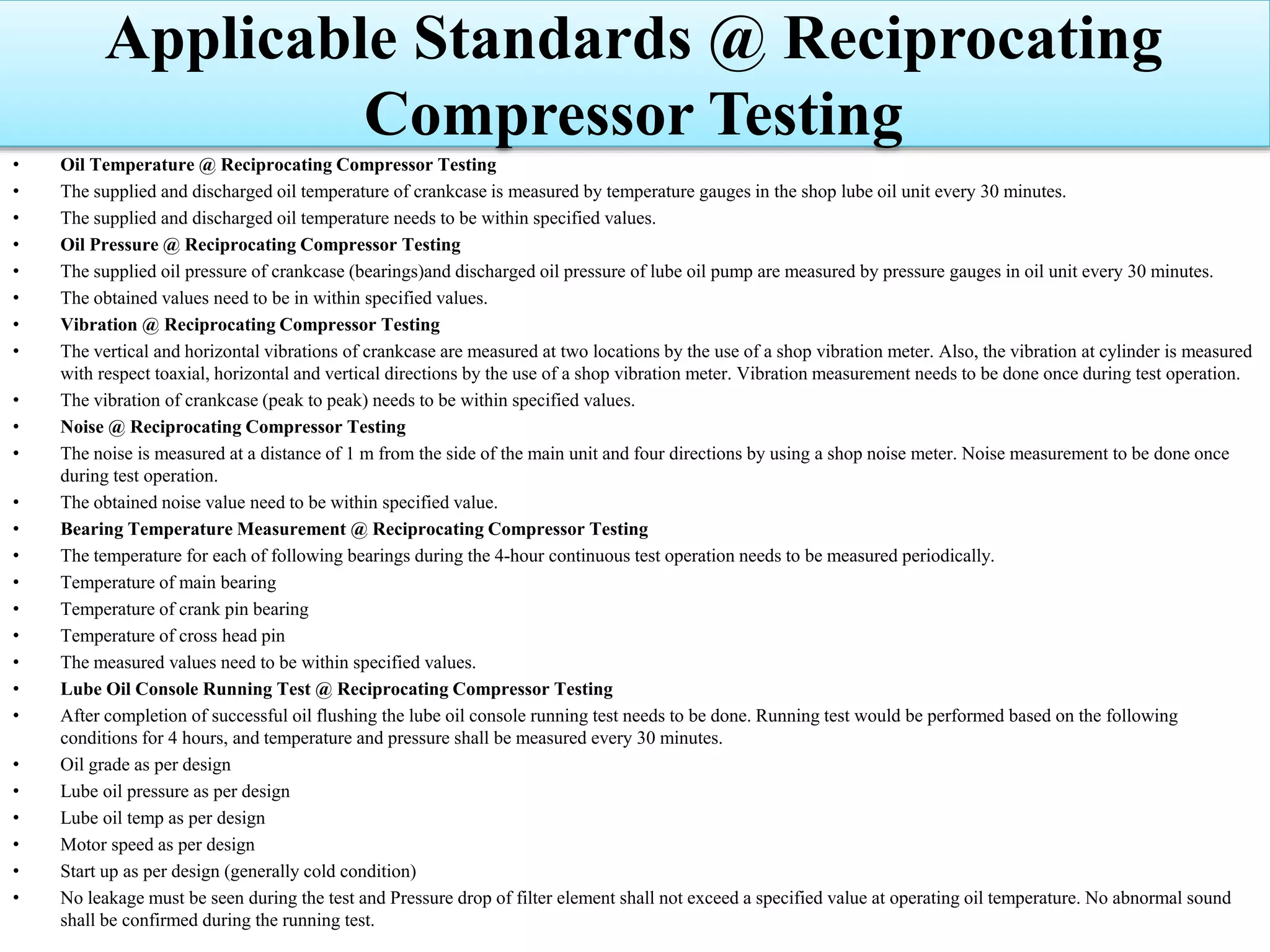
• Oil Temperature @ Reciprocating Compressor Testing
• The supplied and discharged oil temperature of crankcase is measured by temperature gauges in the shop lube oil unit every 30 minutes.
• The supplied and discharged oil temperature needs to be within specified values.
• Oil Pressure @ Reciprocating Compressor Testing
• The supplied oil pressure of crankcase (bearings)and discharged oil pressure of lube oil pump are measured by pressure gauges in oil unit every 30 minutes.
• The obtained values need to be in within specified values.
• Vibration @ Reciprocating Compressor Testing
• The vertical and horizontal vibrations of crankcase are measured at two locations by the use of a shop vibration meter. Also, the vibration at cylinder is measured
with respect toaxial, horizontal and vertical directions by the use of a shop vibration meter. Vibration measurement needs to be done once during test operation.
• The vibration of crankcase (peak to peak) needs to be within specified values.
• Noise @ Reciprocating Compressor Testing
• The noise is measured at a distance of 1 m from the side of the main unit and four directions by using a shop noise meter. Noise measurement to be done once
during test operation.
• The obtained noise value need to be within specified value.
• Bearing Temperature Measurement @ Reciprocating Compressor Testing
• The temperature for each of following bearings during the 4-hour continuous test operation needs to be measured periodically.
• Temperature of main bearing
• Temperature of crank pin bearing
• Temperature of cross head pin
• The measured values need to be within specified values.
• Lube Oil Console Running Test @ Reciprocating Compressor Testing
• After completion of successful oil flushing the lube oil console running test needs to be done. Running test would be performed based on the following
conditions for 4 hours, and temperature and pressure shall be measured every 30 minutes.
• Oil grade as per design
• Lube oil pressure as per design
• Lube oil temp as per design
• Motor speed as per design
• Start up as per design (generally cold condition)
• No leakage must be seen during the test and Pressure drop of filter element shall not exceed a specified value at operating oil temperature. No abnormal sound
shall be confirmed during the running test.
Applicable Standards @ Reciprocating
Compressor Testing
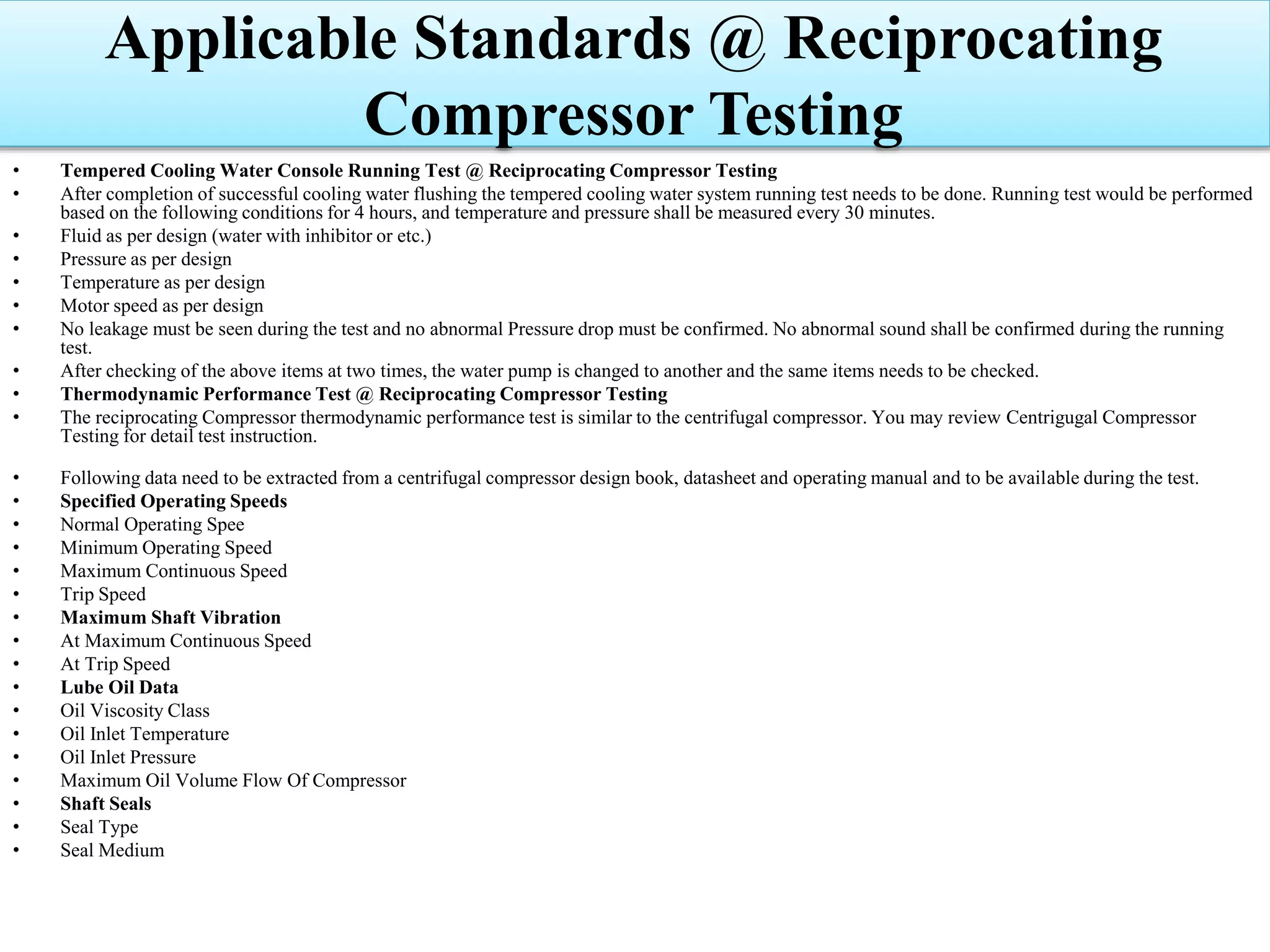
• Tempered Cooling Water Console Running Test @ Reciprocating Compressor Testing
• After completion of successful cooling water flushing the tempered cooling water system running test needs to be done. Running test would be performed
based on the following conditions for 4 hours, and temperature and pressure shall be measured every 30 minutes.
• Fluid as per design (water with inhibitor or etc.)
• Pressure as per design
• Temperature as per design
• Motor speed as per design
• No leakage must be seen during the test and no abnormal Pressure drop must be confirmed. No abnormal sound shall be confirmed during the running
test.
• After checking of the above items at two times, the water pump is changed to another and the same items needs to be checked.
• Thermodynamic Performance Test @ Reciprocating Compressor Testing
• The reciprocating Compressor thermodynamic performance test is similar to the centrifugal compressor. You may review Centrigugal Compressor
Testing for detail test instruction.
• Following data need to be extracted from a centrifugal compressor design book, datasheet and operating manual and to be available during the test.
• Specified Operating Speeds
• Normal Operating Spee
• Minimum Operating Speed
• Maximum Continuous Speed
• Trip Speed
• Maximum Shaft Vibration
• At Maximum Continuous Speed
• At Trip Speed
• Lube Oil Data
• Oil Viscosity Class
• Oil Inlet Temperature
• Oil Inlet Pressure
• Maximum Oil Volume Flow Of Compressor
• Shaft Seals
• Seal Type
• Seal Medium
Applicable Standards @ Reciprocating
Compressor Testing
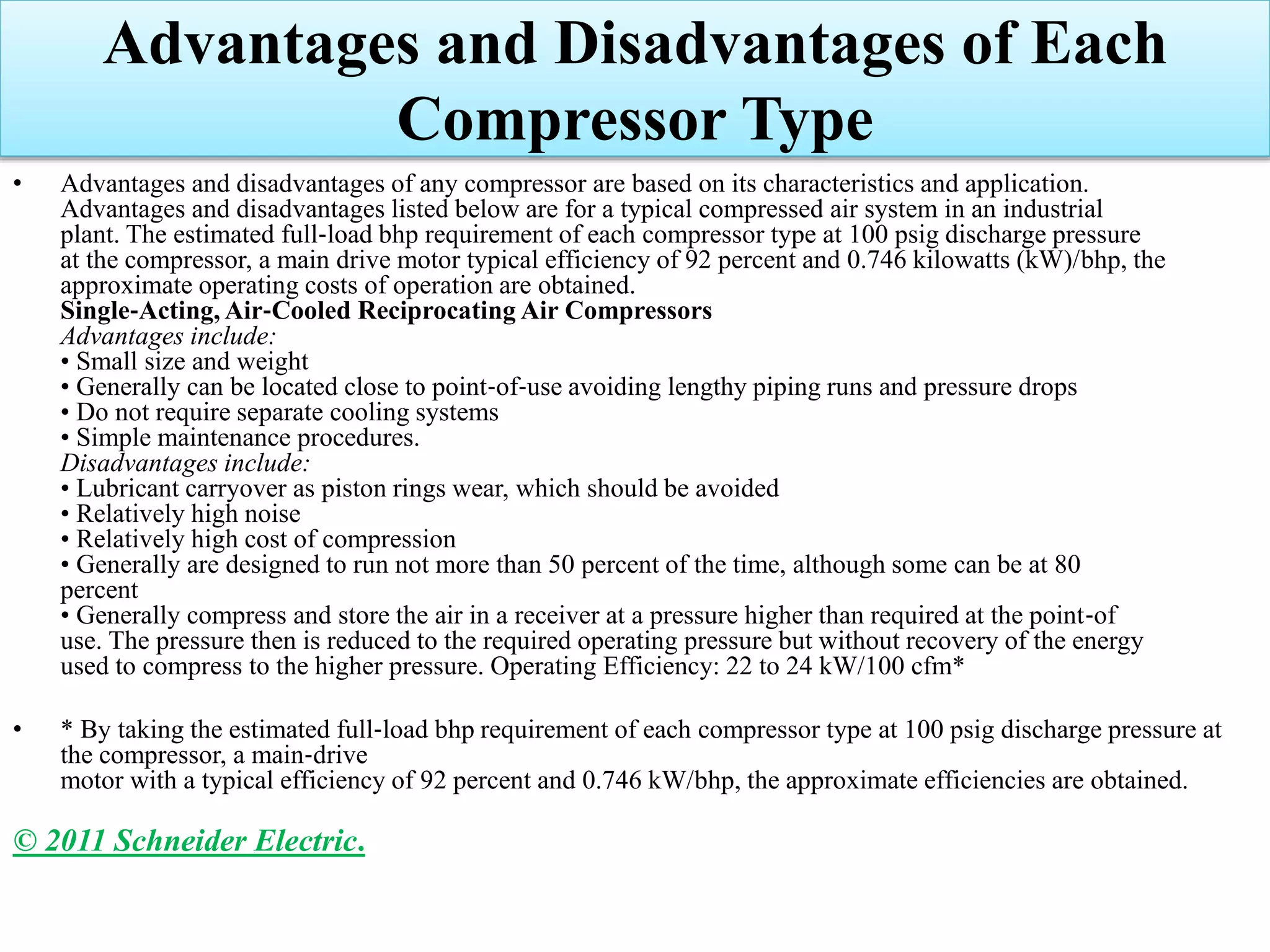
Advantages and Disadvantages of Each
Compressor Type
• Advantages and disadvantages of any compressor are based on its characteristics and application.
Advantages and disadvantages listed below are for a typical compressed air system in an industrial
plant. The estimated full‐load bhp requirement of each compressor type at 100 psig discharge pressure
at the compressor, a main drive motor typical efficiency of 92 percent and 0.746 kilowatts (kW)/bhp, the
approximate operating costs of operation are obtained.
Single‐Acting, Air‐Cooled Reciprocating Air Compressors
Advantages include:
• Small size and weight
• Generally can be located close to point‐of‐use avoiding lengthy piping runs and pressure drops
• Do not require separate cooling systems
• Simple maintenance procedures.
Disadvantages include:
• Lubricant carryover as piston rings wear, which should be avoided
• Relatively high noise
• Relatively high cost of compression
• Generally are designed to run not more than 50 percent of the time, although some can be at 80
percent
• Generally compress and store the air in a receiver at a pressure higher than required at the point‐of
use. The pressure then is reduced to the required operating pressure but without recovery of the energy
used to compress to the higher pressure. Operating Efficiency: 22 to 24 kW/100 cfm*
• * By taking the estimated full‐load bhp requirement of each compressor type at 100 psig discharge pressure at
the compressor, a main‐drive
motor with a typical efficiency of 92 percent and 0.746 kW/bhp, the approximate efficiencies are obtained.
© 2011 Schneider Electric.
• Double‐Acting, Water‐Cooled Reciprocating Air Compressors
Advantages include:
• Efficient compression, particularly with multi‐stage compressors
• Three‐step (0‐50‐100 percent) or five‐step (0‐25‐50‐ 75‐100 percent) capacity controls, allowing
efficient part‐load operation
• Relatively routine maintenance procedures.
Disadvantages include:
• Relatively high first cost compared with equivalent rotary air compressors
• Relatively high space requirements
• Lubricant carryover on lubricant cooled units
Relatively high vibrations require high foundation costs
Seldom sold as complete independent packages
Require flywheel mass to overcome torque and current pulsations in motor driver
• Repair procedures require some training and skills.
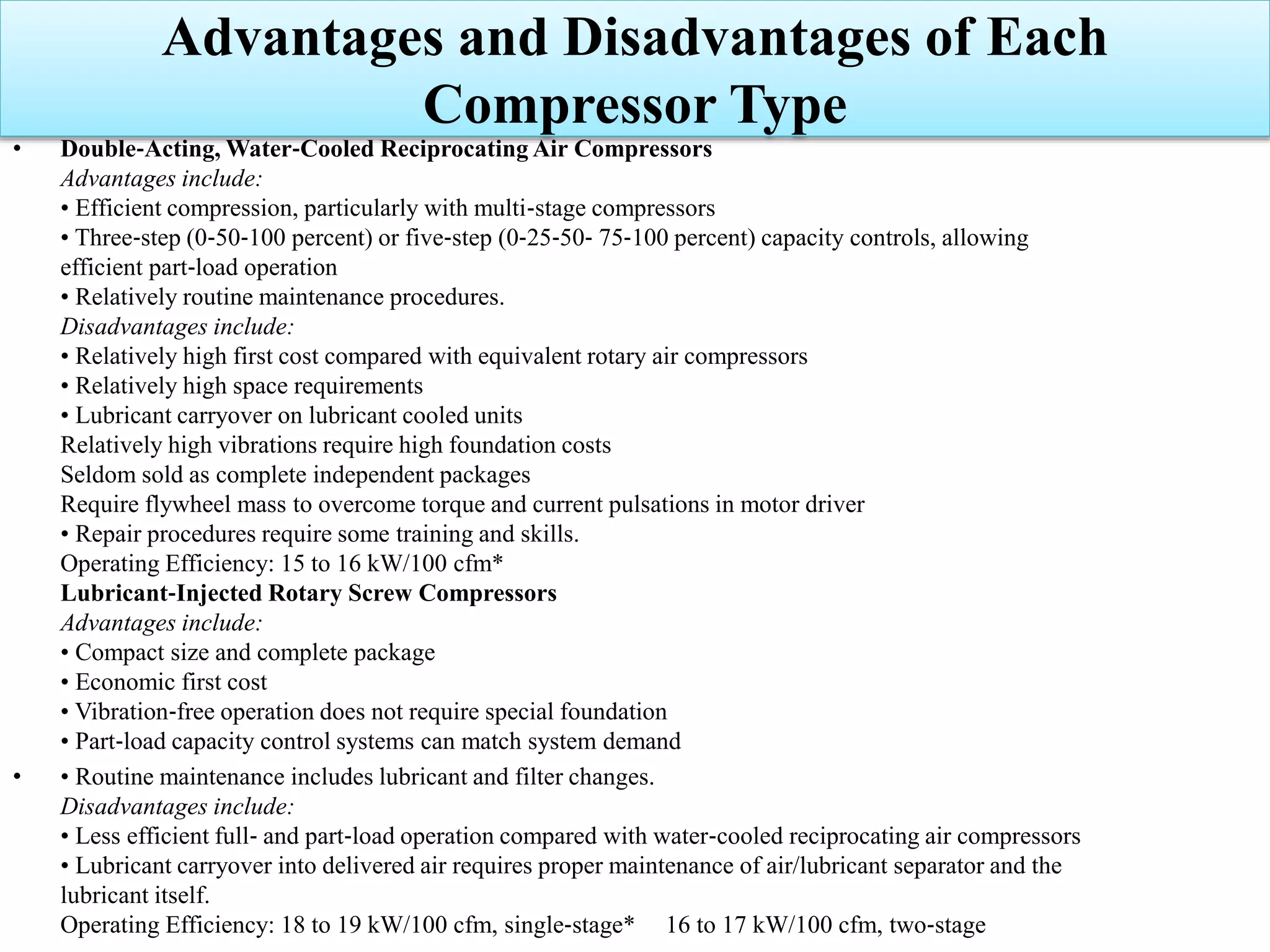
Operating Efficiency: 15 to 16 kW/100 cfm*
Lubricant‐Injected Rotary Screw Compressors
Advantages include:
• Compact size and complete package
• Economic first cost
• Vibration‐free operation does not require special foundation
• Part‐load capacity control systems can match system demand
• • Routine maintenance includes lubricant and filter changes.
Disadvantages include:
• Less efficient full‐ and part‐load operation compared with water‐cooled reciprocating air compressors
• Lubricant carryover into delivered air requires proper maintenance of air/lubricant separator and the
lubricant itself.
Operating Efficiency: 18 to 19 kW/100 cfm, single‐stage* 16 to 17 kW/100 cfm, two‐stage
Advantages and Disadvantages of Each
Compressor Type
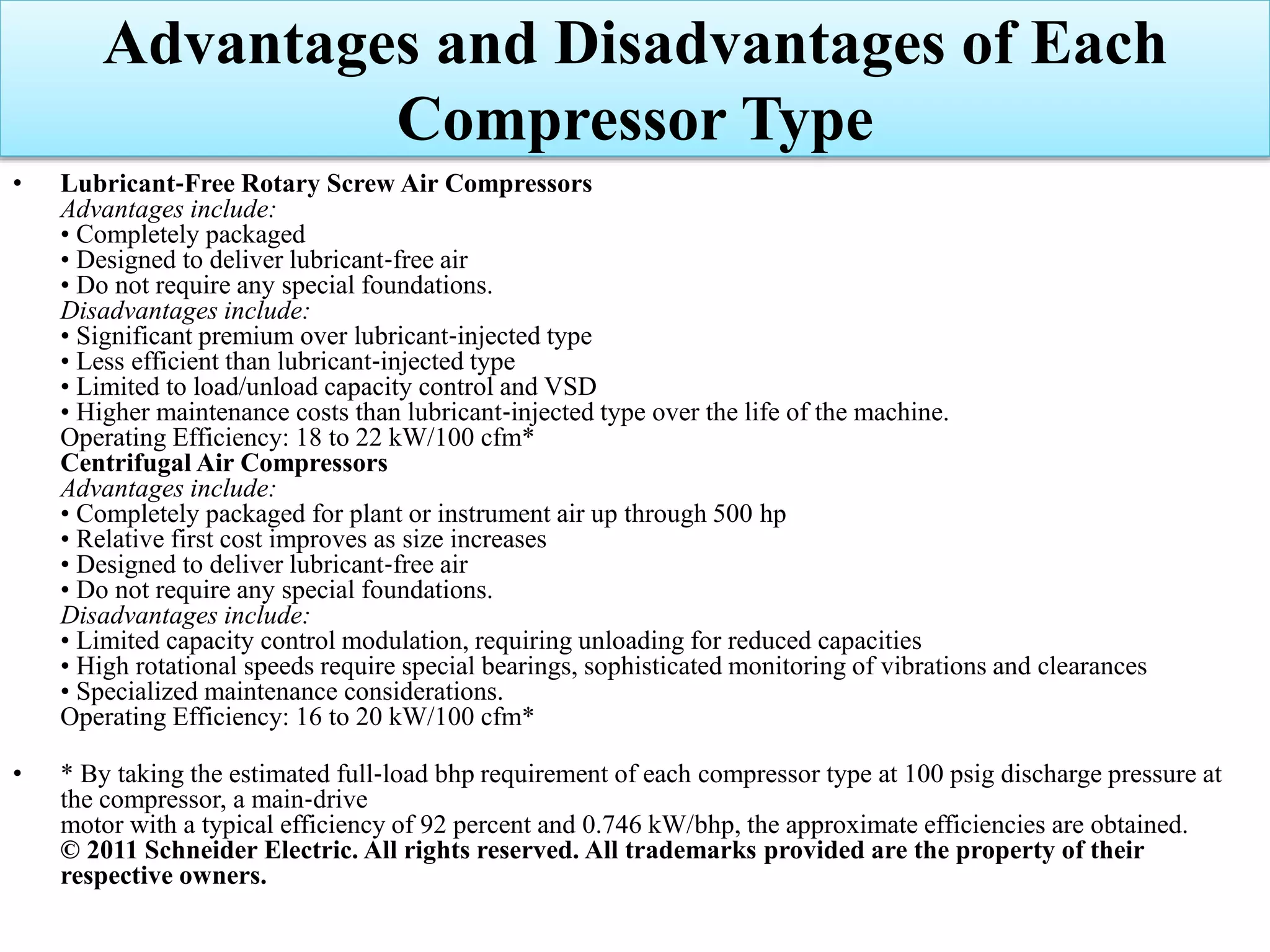
• Lubricant‐Free Rotary Screw Air Compressors
Advantages include:
• Completely packaged
• Designed to deliver lubricant‐free air
• Do not require any special foundations.
Disadvantages include:
• Significant premium over lubricant‐injected type
• Less efficient than lubricant‐injected type
• Limited to load/unload capacity control and VSD
• Higher maintenance costs than lubricant‐injected type over the life of the machine.
Operating Efficiency: 18 to 22 kW/100 cfm*
Centrifugal Air Compressors
Advantages include:
• Completely packaged for plant or instrument air up through 500 hp
• Relative first cost improves as size increases
• Designed to deliver lubricant‐free air
• Do not require any special foundations.
Disadvantages include:
• Limited capacity control modulation, requiring unloading for reduced capacities
• High rotational speeds require special bearings, sophisticated monitoring of vibrations and clearances
• Specialized maintenance considerations.
Operating Efficiency: 16 to 20 kW/100 cfm*
• * By taking the estimated full‐load bhp requirement of each compressor type at 100 psig discharge pressure at
the compressor, a main‐drive
motor with a typical efficiency of 92 percent and 0.746 kW/bhp, the approximate efficiencies are obtained.
© 2011 Schneider Electric. All rights reserved. All trademarks provided are the property of their
respective owners.
Advantages and Disadvantages of Each
Compressor Type
Thank You

Compressed air systems by Varun Pratap Singh

  • 1.
  • 2.
  • 3.
    INTRODUCTION TO AIRCOMPRESSOR: Compressed air is one of the Key utilities across various industrial sectors including Oil andGas.  Atypical instrument air skid package contains multiple compressors with dryers and filtration systems that provide high-quality, dry air for a range of applications from pneumatic controls and actuation of critical valves,to buffer sealinggas.  An air compressor is a mechanical device used to compress air from Low pressure to high pressure.  Compressed air is used in thousands of applications, like manufacturing/ assembly, pharmaceuticals, Power Generation units, Processing units , to perform painting activities, pneumatic pressure testing etc.  It canpower rotary equipment.  Itdrives reciprocating equipment.  Itcan impact, and convey.  It canatomize, spray,sandblast, agitate, and cool.  It can operatecontrols.  Theapplications areendless….
  • 4.
  • 5.
    General Layout ofCompressed Air System
  • 6.
    GENERAL LAYOUT OF COMPRESSEDAIR SYSTEM CONTINUED
  • 7.
    HOW SYSTEM WORKS:APPLICATION
  • 8.
    HOW SYSTEM WORKS:APPLICATION
  • 10.
    HOW SYSTEM WORKS:APPLICATION
  • 11.
    TYPICAL CLEAN DRYCOMPRESSED AIR SYSTEM
  • 12.
  • 13.
  • 14.
    PIPE FITTINGS ANDDISTRIBUTION SYSTEM
  • 15.
    PIPE FITTINGS ANDDISTRIBUTION SYSTEM CONT.
  • 16.
  • 17.
  • 18.
    CLASSIFICATION OFAIRCOMPRESSOR Compressors arebroadly classified as: Positive displacement compressor and Dynamic compressor. • Positive displacement compressors increase the pressure of the gas by reducing the volume. Positive displacement compressors are further classified as reciprocating and rotary compressors. • Dynamic compressors increase the air velocity, which is then converted to increased pressure at the outlet. Dynamic compressors are basically centrifugal compressors and are further classified as radial and axial flow types. • The flow and pressure requirements of a given application determine the suitability of a particulars type of compressor.
  • 19.
    S.no Aspect ReciprocatingCompressors Rotary Compressors 1 Pressure Ratio Discharge Pressure ofair is high. Thepressure ratio per stage will be in the order of 4 to 7. Discharge pressure of air is low. The pressure ratio per stage will be in the order of 3to 5. 2 HandledVolume Quantityof air handled is low and is limited to 50m3 /s. Largemeasureof air can behandled and it is about 500m3 /s. 3 Speedof Compressor Low speed ofcompressor. High speed of compressor. 4 Vibrational Problem Due to reciprocating section, greater vibrational problem, the partsof machineare poorly balanced. Rotary parts of machine, thus it hasless vibrationalproblems.Themachineparts are fairlybalanced. 5 Sizeof compressor Sizeof Compressor is bulky for given discharge volume. Compressorsizeissmallfor given dischargevolume. 6 Air supply Air supply isintermittent. Air supply is steadyandcontinuous. 7 Purity of compressed air Air delivered from the compressor is dirty, sinceit comes in contact with lubricating oil and cylinder surface. Air delivered from the compressor is clean andfree fromdirt. 8 Suitability For medium and high pressureratio. For low and mediumpressures. For low and mediumgas volume. For large volumes. DIFFERENCES BETWEEN RECIPROCATINGAND ROTARYAIRCOMPRESSORS
  • 20.
    DIFFERENCES Positivedisplacement compression Dynamiccompression Airis physically trapped between two relatively moving components and forced to occupy lower volume, thereby increasing itspressure. A rotating component imparts its kinetic energy to the air which is eventually converted into pressure energy. Displacement compressors works withaconstant flow. Dynamic compressors work ataconstant pressure. Positive displacement compression is better suited to variableload. Dynamic compression is best suited for baseload requirements.
  • 21.
    • Positive DisplacementCompressors Reciprocating Compressors Reciprocating compressors are the most widely used type for air compression. They are characterized by a flow output that remains nearly constant over a range of discharge pressures. Also, the compressor capacity is directly proportional to the speed. The output, however, is a pulsating one. • Reciprocating compressors are available in many configurations, the four most widely used of which are horizontal, vertical, horizontal balance-opposed and tandem. Vertical type reciprocating compressors are used in the capacity range of 50 – 150 cfm. Horizontal balance opposed compressors are used in the capacity range of 200 – 5000 cfm in multi-stage design and up to 10,000 cfm in single stage designs. • Reciprocating compressors are also available in variety of types: ƒLubricated and non-lubricated ƒSingle or multiple cylinder ƒWater or air-cooled. ƒSingle or multi stage Positive Displacement Compressors Reciprocating Compressors
  • 22.
    RECIPROCATING COMPRESSORS In thecase of lubricated machines, oil has to be separated from the discharge air. No lubricated compressors are especially useful for providing air for instrumentation and for processes which require oil free discharge. However non-lubricated machines have higher specific power consumption (kW/cfm) as compared to lubricated types. Single cylinder machines are generally air-cooled, while multi-cylinder machines are generally water cooled, although multi-stage air-cooled types are available for machines up to 100 kW. Water- cooled systems are more energy efficient than air-cooled systems. Two stage machines are used for high pressures and are characterized by lower discharge temperature (140 to 1600C) compared to single-stage machines (205 to 2400C). In some cases, multi-stage machines may have a lower specific power consumption compared to single stage machines operating over the same total pressure differential. Multi-stage machines generally have higher investment costs, particularly for applications with high discharge pressure (above 7 bar) and low capacities (less than 25 cfm). Multi staging has other benefits, such as reduced pressure differential across cylinders, which reduces the load and stress on compressor components such as valves and piston rings.
  • 23.
    Thisisthe most widelyused compressor type in the industry for Instrument air where large volumes of high-pressure air are needed, unlike reciprocating type. ROTARY SCREWAIR COMPRESSOR
  • 24.
    • It consistof two screws -one with convex and the other with concave contour mostly called male and female rotor respectively. • These two screws gets rotating by means of gear there by sucking the air through an inlet port in chamber and then compressing the same. • The American Petroleum Institute (API) offers API 619 standard for Rotary Type Positive Displacement Compressors forPetroleum, Chemical,and GasIndustry Services. • Rotary compressors have rotors in place of pistons and give a continuous, pulsation free discharge air. They are directly coupled to the prime mover and require lower starting torque as compared to reciprocating machine. They operate at high speed and generally provide higher throughput than reciprocating compressors. Also they require smaller foundations, vibrate less, and have a lower number of parts - which means less failure rate. Among rotary compressor, the Roots blower (also called as lobe compressor) and screw compressors are among the most widely used. The roots blower is essentially a low-pressure blower and is limited to a discharge pressure of 1 bar in single stage design and up to 2.2 bar in two stage design. Rotary ScrewAir Compressor
  • 25.
    Rotary screw compressorsare available in oil-free (Dry) and oil-flooded (oil injected)construction. 1) Oil Floodedor Oil Injected ScrewCompressors In an oil-injected rotary-screw compressor, oil is injected into the compression cavities to aid sealing and provide cooling sink for the gas charge. The oil is separated from the discharge stream, then cooled, filtered andrecycled. 2) Oil Free or DryScrew Compressors Oil-free compressors are used in applications where entrained oil carry-over is not acceptable, such asmedical research and semiconductor manufacturing. Rotary ScrewAir Compressor: Types
  • 26.
    Dynamic compressors aremainly centrifugal compressors and operate on similar principles to centrifugal pump. These compressors have appreciably different characteristics as compared to reciprocating machines. A small change in compression ratio produces a marked change in compressor output and efficiency. Centrifugal machines are better suited for applications requiring very high capacities, typically above 12,000 cfm. The centrifugal air compressor depends on transfer of energy from a rotating impeller to the air. The rotor accomplishes this by changing the momentum and pressure of the air. This momentum is converted to useful pressure by slowing the air down in a stationary diffuser. The centrifugal air compressor is an oil free compressor by design. The oil- lubricated running gear is separated from the air by shaft seals and atmospheric vents. The centrifugal is a continuous duty compressor, with few moving parts, and is particularly suited to high volume applications, especially where oil free air is required. Dynamic Compressor
  • 27.
    A single-stage centrifugalmachine can provide the same capacity as a multi- stage reciprocating compressor. Machines with either axial or radial flow impellers are available. Axial flow compressors are suitable for higher compression ratios and are generally more efficient than radial compressors. Axial compressors typically are multi-stage machines, while radial machines are usually single-stage designs. Dynamic Compressor
  • 28.
    COMPRESSED AIR SYSTEM COMPONENTS Compressedair systems consist of following major components: Intake air filters, interstage coolers, after coolers, air dryers, moisture drain traps, receivers, piping network, filters, regulators and lubricators. ƒCompressor: Air Receiver/Tank: Air receivers are provided as storage and smoothening pulsating air output - reducing pressure variations from the compressor Intake Air Filters: Prevent dust from entering compressor; Dust causes sticking valves, scoured cylinders, excessive wear etc. Inter-stage Coolers: Reduce the temperature of the air before it enters the next stage to reduce the work of compression and increase efficiency. They are normally water-cooled. After Coolers: The objective is to remove the moisture in the air by reducing the temperature in a water-cooled heat exchanger. Instrument Air: The instrument air dryers removes the moisture from air and then flow to instrument air receiver. Air-Dryers: The remaining traces of moisture after after-cooler are removed using air dryers, as air for instrument and pneumatic equipment has to be relatively free of any moisture. The moisture is removed by using adsorbents like silica gel /activated carbon, or refrigerant dryers, or heat of compression dryers. Moisture Drain Traps: Moisture drain traps are used for removal of moisture in the compressed air. These traps resemble steam traps. Various types of traps used are manual drain cocks, timer based / automatic drain valves etc.
  • 29.
    • Air Receivers Theair receiver dampens pulsations entering the discharge line from the compressor; serves as a reservoir for sudden or unusually heavy demands in excess of compressor capacity; prevents too frequent loading and unloading (short cycling) of the compressor; and separates moisture and oil vapour, allowing the moisture carried over from the after coolers to precipitate. The air receiver should be generously sized to give a large cooling surface and even out the pulsation in delivered air pressure from reciprocating compressor. Simple formulae often quoted for air receiver size is to take a value equal to one minute’s continuous output of the compressor. However, this should be considered indicative of the minimum size of receiver. AIR RESERVOIR: CYLINDER
  • 30.
  • 31.
  • 32.
  • 33.
  • 34.
  • 35.
    INTER COOLER ANDAFTER COOLERS FOR COMPRESSORS Inter and After coolers are heat exchangers for cooling the discharge from air compressor and are an effective means of removing moisture from compressed air. After coolers mechanisms can use either air-cooled or water-cooled Intercoolers are coolers which are provided mainly for Dry type compressors with multi stages. These are rarely applicable for Oil injected compressor just in case of high pressure requirement. After coolers are common for both Dry type and Oil injected type compressor. Coolers are provided to avoid excessive temperature rise associated with higher compression ratios and for increased volumetric efficiency.
  • 36.
    HD & TDAFTER COOLER Water-cooled And Air-cooled After Coolers
  • 37.
    InstrumentAir: • There arenormally two compressed air systems on offshore platform: the utility andinstrument air systems. • Normallyair compressorscompressairup to 10bar (1bar=100kPa) • Air issent to utility air usersandinstrument airdryers. • The instrument air dryers removes the moisture from air and then flow to instrumentairreceiver. • Instrument air pressure may be reduced to 7 bar before being sent to instrument air distribution depending on pressurerating of the instrument airusers. Dew Point isacritical parameter for Instrument air and requires continuous monitoring and control for the proper functioning ofinstruments. The Dew Point in compressed air is maintained by an Equipment at the downstream of compressor namelyAir Dryer. There are many types of Dryers based on the requirement of Dew Point on industrial basis. Themost prevalent type in Oil and Gasindustry isthe “Heatless DesiccantTypeDryer” COMPRESSEDAIRSYSTEM
  • 38.
    InstrumentAir: COMPRESSEDAIRSYSTEM ControlValve ShutdownValve Damper Instrument airusers maybe a Pneumatic operated Control valves or Shutdown valves or Pneumatic Dampers etc.
  • 39.
    COMPRESSEDAIRSYSTEM InstrumentAir: Instrument air needsto be clean and dry, for pneumatic instrumentation. This is important to say, a control valve positioner where the feedback baffle/nozzle can be plugged off by dirt. The Quality of air is important to ensure that instrumentation will function properly and reliably. The most important parameters in specifying air quality are: • Dew Point • Oil Content • Particulate matter • Temperature • Moisture Content Instrument air quality is defined in standards such as ISO 8573-1 Air Quality Standards and ISA S7-3 Where Pressure dew point refers to the dew point temperature of a gas under pressure (higher than atmospheric pressure).
  • 40.
    • AirDryer-HeatlessDessicantType: • Heatlesscompressedairdryer (drier) isthe simplest form of dessicant type gasor air dryer (drier) for achieving adewpointof -40°C. • The compressed air is passed through a pressure vessel with two "towers" filled with a media such as activated alumina, silica gel, molecular sieve or other dessicantmaterial. COMPRESSEDAIRSYSTEM
  • 41.
    • AirDryer-HeatlessDessicantType: • Thedutyof the desiccant is to bring the pressure dew point of the compressedair to alevelin which the water will no longer condense, or to remove asmuch water from the compressedair as possible. • Thisdesiccant material attracts the water from the compressedair viaadsorbtion. • Asthe water clingsto the desiccant, the desiccant "bed" becomes saturated.Thedryer istimed to switch towers basedon astandard cycle, once this cycle completes some compressed air from the system is used to "purge" the saturated desiccant bed by simply blowing the water that hasadhered to the desiccant off. COMPRESSEDAIRSYSTEM
  • 42.
  • 43.
  • 44.
  • 45.
  • 46.
    Compressor Performance • Capacityof a Compressor Capacity of a compressor is the full rated volume of flow of gas compressed and delivered at conditions of total temperature, total pressure, and composition prevailing at the compressor inlet. It sometimes means actual flow rate, rather than rated volume of flow. This also termed as Free Air Delivery (FAD) i.e. air at atmospheric conditions at any specific location. Because the altitude, barometer, and temperature may vary at different localities and at different times, it follows that this term does not mean air under identical or standard conditions. • Compressor Efficiency Definitions Several different measures of compressor efficiency are commonly used: volumetric efficiency, adiabatic efficiency, isothermal efficiency and mechanical efficiency. Adiabatic and isothermal efficiencies are computed as the isothermal or adiabatic power divided by the actual power consumption. The figure obtained indicates the overall efficiency of compressor and drive motor.
  • 47.
    • Isothermal Efficiency P1= Absolute intake pressure kg/ cm2 P2 = Absolute Delivery pressure kg/ cm2 Q1 = Free air delivered m3/hr. r = Pressure ratio P2/P1 The calculation of isothermal power does not include power needed to overcome friction and generally gives an efficiency that is lower than adiabatic efficiency. The reported value of efficiency is normally the isothermal efficiency. This is an important consideration when selecting compressors based on reported values of efficiency. Volumetric Efficiency COMPRESSOR EFFICIENCY
  • 48.
    D = Cylinderbore, metre L = Cylinder stroke, metre S = Compressor speed rpm χ = 1 for single acting and 2 for double acting cylinders n = No. of cylinders For practical purposes, the most effective guide in comparing compressor efficiencies is the specific power consumption ie. kW/volume flow rate , for different compressors that would provide identical duty.
  • 49.
    Efficient Operation ofCompressed Air Systems • Location of Compressors The location of air compressors and the quality of air drawn by the compressors will have a significant influence on the amount of energy consumed. Compressor performance as a breathing machine improves with cool, clean, dry air at intake. • Cool air intake As a thumb rule, “Every 40C rise in inlet air temperature results in a higher energy consumption by 1 % to achieve equivalent output”. Hence, cool air intake leads to a more efficient compression (see Table 3.2). It is preferable to draw cool ambient air from outside, as the temperature of air inside the compressor room will be a few degrees higher than the ambient temperature. While extending air intake to the outside of building, care should be taken to minimize excess pressure drop in the suction line, by selecting a bigger diameter duct with minimum number of bends. NOTE: Students have to remember only bold letters for Semester Exam point of view.
  • 50.
    • Dust FreeAir Intake Dust in the suction air causes excessive wear of moving parts and results in malfunctioning of the valves due to abrasion. Suitable air filters should be provided at the suction side. Air filters should have high dust separation capacity, low-pressure drops and robust design to avoid frequent cleaning and replacement. See Table 3.3 for effect of pressure drop across air filter on power consumption . • Air filters should be selected based on the compressor type and installed as close to the compressor as possible. As a thumb rule “For every 250 mm WC pressure drop increase across at the suction path due to choked filters etc, the compressor power consumption increases by about 2 percent for the same output” . • Hence, it is advisable to clean inlet air filters at regular intervals to minimize pressure drops. Manometers or differential pressure gauges across filters may be provided for monitoring pressure drops so as to plan filter-cleaning schedules. • Dry Air Intake Atmospheric air always contains some amount of water vapour, depending on the relative humidity, being high in wet weather. The moisture level will also be high if air is drawn from a damp area - for example locating compressor close to cooling tower, or dryer exhaust is to be avoided (see Table 3.4- Data has been taken from BEE Books).The moisture-carrying capacity of air increases with a rise in temperature and decreases with increase in pressure. Efficient Operation of Compressed Air Systems Cont.
  • 51.
    • Elevation The altitudeof a place has a direct impact on the volumetric efficiency of the compressor. The effect of altitude on volumetric efficiency is given in the Table 3.5. • It is evident that compressors located at higher altitudes consume more power to achieve a particular delivery pressure than those at sea level, as the compression ratio is higher. Efficient Operation of Compressed Air Systems • Cooling Water Circuit Most of the industrial compressors are water-cooled, wherein the heat of compression is removed by circulating cold water to cylinder heads, inter-coolers and after-coolers. The resulting warm water is cooled in a cooling tower and circulated back to compressors. The compressed air system performance depends upon the effectiveness of inter-coolers, after coolers, which in turn are dependent on cooling water flow and temperature. Further, inadequate cooling water treatment can lead to increase, for example, in total dissolved solids (TDS), which in turn can lead to scale formation in heat exchangers. The scales, not only act as insulators reducing the heat transfer, but also increases the pressure drop in the cooling water pumping system. Use of treated water or purging a portion of cooling water (blow down) periodically can maintain TDS levels within acceptable limits. It is better to maintain the water pH by addition of chemicals, and avoid microbial growth by addition of fungicides and algaecides.
  • 52.
    • Efficacy ofInter and After Coolers Efficacy is an indicator of heat exchange performance- how well intercoolers and after coolers are performing. Inter-coolers are provided between successive stages of a multi-stage compressor to reduce the work of compression (power requirements) - by reducing the specific volume through cooling the air - apart from moisture separation. Ideally, the temperature of the inlet air at each stage of a multi-stage machine should be the same as it was at the first stage. This is referred to as “perfect cooling” or isothermal compression. The cooling may be imperfect due to reasons described in earlier sections. Hence in actual practice, the inlet air temperatures at subsequent stages are higher than the normal levels resulting in higher power consumption, as a larger volume is handled for the same duty (See Table 3.6) It can be seen from the Table 3.6 that an increase of 5.50C in the inlet air temperature to the second stage results in a 2 % increase in the specific energy consumption. Use of water at lower temperature reduces specific power consumption. However, very low cooling water temperature could result in condensation of moisture in the air, which if not removed would lead to cylinder damage. Efficient Operation of Compressed Air Systems Cont.
  • 53.
    • Pressure Settings: Compressoroperates between pressure ranges called as loading (cut-in) and unloading (cut out) pressures. For example, a compressor operating between pressure setting of 6 - 7 kg/cm2 means that the compressor unloads at 7 kg/cm2 and loads at 6 kg/cm2. Loading and unloading is done using a pressure switch. For the same capacity, a compressor consumes more power at higher pressures. They should not be operated above their optimum operating pressures as this not only wastes energy, but also leads to excessive wear, leading to further energy wastage The volumetric efficiency of a compressor is also less at higher delivery pressures. • Reducing Delivery Pressure: The possibility of lowering (optimising) the delivery pressure settings should be explored by careful study of pressure requirements of various equipment, and the pressure drop in the line between the compressed air generation and utilization points. Typical power savings through pressure reduction is shown in Table 3.8. Efficient Operation of Compressed Air Systems Cont.
  • 54.
    The pressure switchesmust be adjusted such that the compressor cuts-in and cuts-out at optimum levels. A reduction in the delivery pressure by 1 bar in a compressor would reduce the power consumption by 6 – 10 %. • Compressor modulation by Optimum Pressure Settings: Very often in an industry, different types, capacities and makes of compressors are connected to a common distribution network. In such situations, proper selection of a right combination of compressors and optimal modulation of different compressors can conserve energy. Where more than one compressor feeds a common header, compressors have to be operated in such a way that the cost of compressed air generation is minimal. • If all compressors are similar, the pressure setting can be adjusted such that only one compressor handles the load variation, whereas the others operate more or less at full load. ƒ • If compressors are of different sizes, the pressure switch should be set such that only the smallest compressor is allowed to modulate (vary in flow rate). ƒ • If different types of compressors are operated together, unload power consumptions are significant. The compressor with lowest no load power must be modulated. ƒ • In general, the compressor with lower part load power consumption should be modulated. ƒ • Compressors can be graded according to their specific energy consumption, at different pressures and energy efficient ones must be made to meet most of the demand (see Table 3.9). Efficient Operation of Compressed Air Systems Cont.
  • 55.
    • Segregating lowand high pressure air requirements If the low-pressure air requirement is considerable, it is advisable to generate low pressure and high-pressure air separately, and feed to the respective sections instead of reducing the pressure through pressure reducing valves, which invariably waste energy. • Minimum pressure drop in air lines Excess pressure drop due to inadequate pipe sizing, choked filter elements, improperly sized couplings and hoses represent energy wastage. The Table 3.10 illustrates the energy wastage, if the pipes are of smaller diameter. Typical acceptable pressure drop in industrial practice is 0.3 bar in mains header at the farthest point and 0.5 bar in distribution system. Efficient Operation of Compressed Air Systems Cont.
  • 56.
    Efficient Operation ofCompressed Air Systems Cont. • Equivalent lengths of fittings Not only piping, but also fitting are a source of pressure losses. • Blowers in place of Compressed Air System Since the compressed air system is already available, plant engineer may be tempted to use compressed air to provide air for low-pressure applications such as agitation, pneumatic conveying or combustion air. Using a blower that is designed for lower pressure operation will cost only a fraction of compressed air generation energy and cost. • Capacity Control of Compressors In many installations, the use of air is intermittent. Therefore, some means of controlling the output flow from the compressor is necessary. The type of capacity control chosen has a direct impact on the compressor power consumption. Some control schemes commonly used are discussed below: • Automatic On / Off Control: Automatic On /Off control, as its name implies, starts or stops the compressor by means of a pressure activated switch as the air demand varies. This is a very efficient method of controlling the capacity of compressor, where the motor idle-running losses are eliminated, as it completely switches off the motor when the set pressure is reached. This control is suitable for small compressors. • Load and Unload: This is a two-step control where compressor is loaded when there is air demand and unloaded when there is no air demand. During unloading, a positive displacement compressor may consume up to 30 % of the full load power, depending upon the type, configuration, operation and maintenance practices.
  • 57.
    • Multi-step Control: Largecapacity reciprocating compressors are usually equipped with a multi-step control. In this type of control, unloading is accomplished in a series of steps, (0%, 25 %, 50 %, 75 % & 100 %) varying from full load down to no-load (see Table 3.12). Throttling Control: The capacity of centrifugal compressors can be controlled using variable inlet guide vanes. However, another efficient way to match compressor output to meet varying load requirements is by speed control (see Table 3.13). At low volumetric flow (below 40 %), vane control may result in lower power input compared to speed control due to low efficiency of the speed control system. For loads more than 40 %, speed control is recommended. Avoiding Misuse of Compressed Air: Misuse of compressed air for purposes like body cleaning, liquid agitation, floor cleaning, drying, equipment cooling and other similar uses must be discouraged. Wherever possible, low-pressure air from a blower should be substituted for compressed air, for example secondary air for combustion in a boiler / furnace. The following Table 3.14 gives an idea of savings by stopping use of compressed air by choosing alternative methods to perform the same task. ƒElectric motors can serve more efficiently than air-driven rotary devices, wherever applicable. The Table gives the comparison of pneumatic grinders and electrical grinders. Efficient Operation of Compressed Air Systems Cont.
  • 58.
    • Loss ofair pressure due to friction The loss of pressure in piping is caused by resistance in pipe fittings and valves, which dissipates energy by producing turbulence. The piping system will be designed for a maximum allowable pressure drop of 5 percent from the compressor to the most distant point of use. • Piping layout Where possible the piping system should be arranged as a closed loop or “ring main” to allow for more uniform air distribution to consumption points and to equalize pressure in the piping. Separate services requiring heavy air consumption and at long distances from the compressor unit should be supplied by separate main airlines. Pipes are to be installed parallel with the lines of the building, with main and branch headers sloping down toward a dead end. Traps will be installed in airlines at all low points and dead ends to remove condensed moisture. Automatic moisture traps used for this purpose are effective only when the air has been cooled and the moisture has precipitated. Branch headers from compressed air mains will be taken off at the top to avoid picking up moisture. • Capacity Utilisation In many installations, the use of air is intermittent. This means the compressor will be operated on low load or no load condition, which increases the specific power consumption per unit of air generated. Hence, for optimum energy consumption, a proper compressor capacity control should be selected. The nature of the control device depends on the function to be regulated. One of the objectives of a good compressed air management system would be to minimize unloading to the least as unloading consumes up to 30% of full load power. Efficient Operation of Compressed Air Systems Cont.
  • 59.
    Compressor Capacity Assessment •Due to ageing of the compressors and inherent inefficiencies in the internal components, the free air delivered may be less than the design value, despite good maintenance practices. Sometimes, other factors such as poor maintenance, fouled heat exchanger and effects of altitude also tend to reduce free air delivery. In order to meet the air demand, the inefficient compressor may have to run for more time, thus consuming more power than actually required. The power wastage depends on the percentage deviation of FAD capacity. For example, a worn out compressor valve can reduce the compressor capacity by as much as 20 percent. A periodic assessment of the FAD capacity of each compressor has to be carried out to check its actual capacity. If the deviations are more than 10 %, corrective measures should be taken to rectify the same. The ideal method of compressor capacity assessment is through a nozzle test wherein a calibrated nozzle is used as a load, to vent out the generated compressed air. Flow is assessed, based on the air temperature, stabilization pressure, orifice constant. etc. • Simple method of Capacity Assessment in Shop floor Isolate the compressor along with its individual receiver being taken for test from main compressed air system by tightly closing the isolation valve or blanking it, thus closing the receiver outlet. Open water drain valve and drain out water fully and empty the receiver and the pipe line. Make sure that water trap line is tightly closed once again to start the test. Start the compressor and activate the stopwatch. Note the time taken to attain the normal operational pressure P2 (in the receiver) from initial pressure P1
  • 60.
    Calculate the capacityas per the formulae given below : Actual Free air discharge Where P2 = Final pressure after filling (kg/cm2 a) P1 = Initial pressure (kg/cm2a) after bleeding P0 = Atmospheric Pressure (kg/cm2 a) V = Storage volume in m3 which includes receiver, after cooler, and delivery piping T = Time take to build up pressure to P2 in minutes The above equation is relevant where the compressed air temperature is same as the ambient air temperature, i.e., perfect isothermal compression. In case the actual compressed air temperature at discharge, say t20C is higher than ambient air temperature say t10C (as is usual case), the FAD is to be corrected by a factor (273 + t1) / (273 + t2). Compressor Capacity Assessment
  • 61.
    • Ensure airintake to compressor is not warm and humid by locating compressors in well-ventilated area or by drawing cold air from outside. Every 40C rise in air inlet temperature will increase power consumption by 1 percent. • Clean air-inlet filters regularly. Compressor efficiency will be reduced by 2 percent for every 250 mm WC pressure drop across the filter. • Keep compressor valves in good condition by removing and inspecting once every six months. Worn- out valves can reduce compressor efficiency by as much as 50 percent. • Install manometers across the filter and monitor the pressure drop as a guide to replacement of element. • Minimize low-load compressor operation; if air demand is less than 50 percent of compressor capacity, consider change over to a smaller compressor or reduce compressor speed appropriately (by reducing motor pulley size) in case of belt driven compressors. • Consider the use of regenerative air dryers, which uses the heat of compressed air to remove moisture. • Fouled inter-coolers reduce compressor efficiency and cause more water condensation in air receivers and distribution lines resulting in increased corrosion. • Periodic cleaning of inter-coolers must be ensured. ƒCompressor free air delivery test (FAD) must be done periodically to check the present operating capacity against its design capacity and corrective steps must be taken if required. ƒ Checklist for Energy Efficiency in Compressed Air System
  • 62.
    • If morethan one compressor is feeding to a common header, compressors must be operated in such a way that only one small compressor should handle the load variations whereas other compressors will operate at full load. • The possibility of heat recovery from hot compressed air to generate hot air or water for process application must be economically analysed in case of large compressors. • Consideration should be given to two-stage or multistage compressor as it consumes less power for the same air output than a single stage compressor. • If pressure requirements for processes are widely different (e.g. 3 bar to 7 bar), it is advisable to have two separate compressed air systems. • Reduce compressor delivery pressure, wherever possible, to save energy. Provide extra air receivers at points of high cyclic-air demand which permits operation without extra compressor capacity. • Retrofit with variable speed drives in big compressors, say over 100 kW, to eliminate the `unloaded’running condition altogether. • ƒKeep the minimum possible range between load and unload pressure settings. • Automatic timer controlled drain traps wastes compressed air every time the valve opens. So frequency of drainage should be optimized. • Check air compressor logs regularly for abnormal readings, especially motor current cooling water flow and temperature, inter-stage and discharge pressures and temperatures and compressor load-cycle. • Compressed air leakage of 40- 50 percent is not uncommon. Carry out periodic leak tests to estimate the quantity of leakage. • Install equipment interlocked solenoid cut-off valves in the air system so that air supply to a machine can be switched off when not in use. Compressed Air System
  • 63.
    • Present energyprices justify liberal designs of pipeline sizes to reduce pressure drops. • Compressed air piping layout should be made preferably as a ring main to provide desired pressures for all users. • A smaller dedicated compressor can be installed at load point, located far off from the central compressor house, instead of supplying air through lengthy pipelines. • All pneumatic equipment should be properly lubricated, which will reduce friction, prevent wear of seals and other rubber parts thus preventing energy wastage due to excessive air consumption or leakage. • Misuse of compressed air such as for body cleaning, agitation, general floor cleaning, and other similar applications must be discouraged in order to save compressed air and energy. • Pneumatic equipment should not be operated above the recommended operating pressure as this not only wastes energy bus can also lead to excessive wear of equipment’s components which leads to further energy wastage. • Pneumatic transport can be replaced by mechanical system as the former consumed about 8 times more energy. Highest possibility of energy savings is by reducing compressed air use. • Pneumatic tools such as drill and grinders consume about 20 times more energy than motor driven tools. Hence they have to be used efficiently. • Wherever possible, they should be replaced with electrically operated tools. Where possible welding is a good practice and should be preferred over threaded connections. • On account of high pressure drop, ball or plug or gate valves are preferable over globe valves in compressed air lines. Compressed Air System
  • 64.
    Energy Distribution andHeat Losses in Compressed Air System
  • 65.
    Pictorial Presentation ofDo’s and Don’t
  • 66.
    HEAT RECOVERY FROMAIR COMPRESSOR Over 80% of the energy you put into your air compressor is given off as waste heat. This is usually ducted to atmosphere and wasted. This heat is created as part of the air compression process and is captured by the compressor coolant within the compressor itself. It is a thermodynamic fact that this heat has too be generated and the air cannot be compressed without the heat being generated.
  • 67.
  • 68.
  • 69.
  • 70.
    Leakage Test ofCompressed Air System Introduction The compressed air system is not only an energy intensive utility but also one of the least energy efficient. Over a period of time, both performance of compressors and compressed air system reduces drastically. The causes are many such as poor maintenance, wear and tear etc. All these lead to additional compressors installations leading to more inefficiencies. A periodic performance assessment is essential to minimize the cost of compressed air. Purpose of the Performance Test To find out: • Actual Free Air Delivery (FAD) of the compressor • Isothermal power required • Volumetric efficiency • Specific power requirement The actual performance of the plant is to be compared with design / standard values for assessing the plant energy efficiency.
  • 71.
    • Why arecompressed air leak programs often ignored or even discouraged by management, in addition to some energy recovery minded third parties? • This problem can be summed up as “Over Promise” and “Lack of Delivery”. In the 1990’s, the basic compressed air inefficiency energy transfer became a prime target for energy reduction programs promising great results with many low investments. Good payback programs, which they are indeed. • The least complicated program, easiest to understand and implement was to fix the leaks. The 1/4” leak at $10,000/year savings became the byword. Management was easily persuaded to support these low cost, high return programs and the race was on. But, the results were “underwhelming”: • Some “professional leak specialists” were known to find more leaks than the actual air supply. • Promised savings of six figure dollar air reductions failed to register even a small blip on the monthly electric bill. • It didn’t take long for this continuing situation to often sour management on programs that require financial and manpower investments. Management might “talk to talk” but hesitated to “walk the walk”. Do not misconstrue, there were also many successful programs that scored well; however, we still see the same issues today with poorly implemented programs continuing to disappoint. Don’t Overestimate Size or Magnitude of Leaks In the past, most compressed air leaks were sized with an educated estimate by experienced professionals. When a significant number of leaks were identified and repaired, and if the situation allowed, the total leak accuracy was checked with before and after system actions such as flow meter readings in off times, bleed down tests, etc. Further testing has created another accurate guideline: •When 100 leaks are found and sized, a tight system: should average around 3 cfm each. A typical system should average around 4 cfm each and a high leak system should average around 5 cfm each. Numbers above or below these levels should have a clear explanations! The major issue is that inexperienced personnel often tend to overestimate the actual volume (cfm) which, when the project is completed and the results are disappointing, management support is lost. Leakage Test of Compressed Air System
  • 72.
    Figures A. andB. Leak sizing from a standard orifice flow chart – 1/4" leak = 104 scfm, i.e. $10,000/year Figure B. Clearly, none of these leaks are machined round holes. Many are a relatively long, tortuous path from the compressed air source to the ambient. This chart is true but what is not said is that it is a test orifice of a given design and thickness with a specific “chamfer” to allow free flow to wide open ambient.
  • 73.
    • Estimating LeakSize • As shown in Figures 3A and 3B, two very important pieces of data are missing to use the orifice table: • What is the actual diameter, and more important, the area of the leak as it flows through the NPT threads, past the shaft seal, past the gaskets, etc.? • What is the actual pressure at the leak? Even at 90 psig in the pipe, how much pressure is lost getting to the outside? • The same issues exist in leaking push/pull fittings, cracked fittings or pipe, cracked filter bowls, etc. • Using the orifice chart usually leads to a significant overestimating of the leak values. • Air Power USA performs compressed air system reviews and assessments on a continuing basis and often finds opportunities to observe and measure real compressed air leaks in real time situations. We believe there is no substitute for experience in sizing a leak; however, modern equipment has offered significant new capabilities. • • Global Leak Load Tests • In addition to measuring leak loads from the bottom-up by listing individual leak sizes, it can be useful to measure the overall system leak load. During periods when the plant is not in production, one can measure the total leak volume with a monitored compressor operation or a bleed down test. • 1. Monitored Compressor Operation • During non-production, run the air compressor enough to hold a steady normal system pressure. Observe and record the percentage of load the compressor is running. This can be by timing the seconds loaded and unloaded with a 2-step controlled compressor. The percentage of time loaded versus the total time would be the percent of full load flow. For example, if the compressor is loaded for 700 seconds out of 1,000 seconds of operation, it would be 70% loaded. If the full load rated flow is 1,000 cfm then the flow to feed the leaks and air left on (e.g. open blows and operating machinery) is 700 cfm. There are more sophisticated ways to establish the percent load of units that are not 2-step controlled using the basic Compressed Air Challenge (CAC) capacity control performance curves. • 2. Bleed Down Test • Estimate the total storage volume of the system, receiver, main headers, etc., in cubic feet (7.48 gallons per cubic foot) • During non-production pump the system up to full pressure • Shut off the compressor(s) • Allow the system to bleed down to about half the full load pressure psig (at 50 psig) and record the time • Use the following formulas: • Time minutes = Volume in cu ft. x (P2 start – P1 stop) x 14.5 ambient pressure psia x net flow out • Leak volume cfm = (Volume in cu ft.) (50 psid) x 1.25 = (14.5 psia) (Time minutes) • The 1.25 multiplier corrects the normal system pressure allowing for the reduced leakage rate with falling system pressure. This answer in cfm will equal all the leaks and any processes left on. Deduct those processes that have to be left on and the result is a fair estimate of the total volume of wasted air from leaks. Any leak list that totals more than this number should be investigated. • 3. Use the plant’s recorded data, if available, to establish the total flow level during non-production periods. Or, if not trended, read flow meters in the distribution headers during non-production periods. This approach may also be useful for measuring air flows in branch headers, e.g. air going to only one production building, mill or area, especially if the entire plant operates continuously but individual production areas are shut off during some shifts. To mitigate inaccuracy in any flow meter, it is wise to use the same meter to measure the air flow during non-production to determine the total load. Leakage Test of Compressed Air System
  • 74.
    • The TrueRecoverable Value is “Site Situational” • Depending on the operations model pre- and post-projects the true recoverable value will vary by net system “specific power” (scfm/kW). The value shown above is full load efficiency. For the air supply in question, actual part load operation will always be less efficient and will vary by the type of compressor and capacity control. Under this situation the financial savings will probably be overstated, sometimes very significantly. • If the air reduction from the leak projects allow the system to completely shut off a very inefficient air compressor the overall system specific power will improve and the overall savings may be understated. • In summary it is site situational. The financial analysis must have an accurate baseline operating cost and then an accurate post-project cost. Air Power USA performs many air assessments with performance ¬¬¬contraction, where they are paid ONLY for actual kW reduction. Predicting kW and kWh results have to be accurate. To oversimplify the procedure we created a measured (baseline) operating model and a projected operational alignment for post-projects. Internal software then generates a $/scfm/year. of recoverable annual electric energy which is completely site specific and proven to be very accurate. • Eliminating a majority of compressed air leaks and sustaining low leak levels is not an event, it is a continuous program and to be successful must be embraced by all personnel, often requiring a culture change. • • Are Compressed Air Leaks Worth Finding, Fixing and Sustaining? • Recently in a Steel Plant with rolling mills and galvanizing process, 625 leaks were identified, tagged and repaired. The projected scfm volume was 3,140 scfm and the measured volume saved was actually about 3,250 scfm. Due to the nature of the business the average leak size was 5 cfm and many leaks were located near each other (particularly under and near the mills). The repair cost was a little over $68,000 and the actual recoverable energy reduction was $333,158 year. • APPARENTLY WORTH FIXING! Leakage Test of Compressed Air System
  • 75.
    Reciprocating Compressor Mechanical RunningTest • Reciprocating Compressor Mechanical Running Test • The API Std. 618 requires that reciprocating compressor to be subjected to the 4 hours unloaded running test after successful inspection and testing that are done before and during assembly. To perform an unloaded running test, the reciprocating compressor cylinder valves shall not be installed for the mechanical running test. The mechanical running test is considered a routine test in the reciprocating compressor testing. • The test shall be performed based on manufacturer approved test procedure. The compressor is brought to the rated speed and then runs for 30 minutes to get lube oil temperature, viscosity, bearing temperatures and vibration amplitudes stabilized. After operating parameter stabilization, the test technician records the parameters in each 10 or 15 minutes as per requirements. • The following parameter is recorded periodically in this 4 hours: • Lube Oil Pressure • Lube Oil Temperature • Bearing Temperature • Lube Oil Viscosity • Power Consumption • Rotor Speed • Vibration • As per API 618, the power consumption shall not be more than 3% of the rate power value indicated in the datasheet. • The API 618 also requires the trip speed shall not be less than 110 % of the rotor rated speed. • The crankcase vibration is measured in real-time basis in X and Y axises. The cylinder vibration is measured in X, Y, and Z axises (Horizontal, Vertical, and Axial). The measured values shall be verified aginst acceptance criteria provided in API 618 or approved test procedure. • If specified, the lube oil and cooling water consoles also shall be subjected to the 4 hours mechanical running test as per requirements of API 614.
  • 76.
    Reciprocating Compressor Aerodynamic PerformanceTest • The reciprocating compressor aerodynamic performance testing is not routine test in the reciprocating compressor testing and is identified as an optional test in API 618. If the performance test was a purchase order requirement, then is performed based on ISO 1217 and with cylinder valves installed in the closed loop system. • The manufacturer shall provide tables or curves of power and capacity vs. suction pressure with the parameter of discharge pressure at the end of the test. These curves or tables shall be verified against estimated curves or tables and make sure that measured values are within acceptance range. • Rod load and gas load charts and similarly shall be checked against estimated values. The starting torque Vs. Speed curve also shall be verified and verified against estimated value. • The efficiency value shall not be less than specified value. The power consumption also shall be checked not to be more than 3% of rated value.
  • 77.
    Reciprocating Compressor HydrostaticTest • Reciprocating Compressor Hydrostatic Test • As per API 618, the cylinder, cooling water jacket and piping system shall be subjected to the hydrostatic testing. The hydrostatic testing shall be than at 1.5 times maximum allowable working pressure and the pressure shall be held for minimum 30 minutes. • The cylinder shall be hydrostatically tested before installation of the cylinder liner. Besides, cylinder shall be tested with heads, valve covers, clearance pockets, and fasteners being already installed. • The filters and pressure vessel generally are manufactured at pressure vessel manufacturers and are tested there, So, it might not be necessary to subject them to hydrostatic testing at the compressor manufacturer facility. • The hydrostatic testing shall be done by calibrated pressure gage, and the preferable range is two times of the test pressure but in no case shall be less than 1.5 times and more than 4 times of the pressure test.
  • 78.
    Reciprocating Compressor GasLeakage Test The API 618, requires helium leak test if the "service gas" molar mass equal or less than 12 or "service gas" has a mol percentage of Hydrogen Sulfide (H2S) equal or more than 0.1%.This information can be found in reciprocating compressor datasheet. The helium leakage test shall be done after hydrostatic testing, and the test pressure shall be the same amount of compressor maximum allowable working pressure. Similar to hydrostatic testing, the cylinder liner shall not be installed and shall be tested with the heads, valve covers, clearance pockets, and fasteners. The pressurized compressor with helium at MAWP shall be submerged to the water pool, and the test result will be considered satisfactory if no bubble observed during the test (Zero Leakage). During the helium test, the internal pressure shall be maintained and recorded. The test shall be done based on manufacturer approved procedure. The helium probe is the alternative test which can be done in lieu submergence test. The instrument sensitivity shall be agreed between compressor purchaser and manufacturer. Most of the manufacturers sue the submergence test.
  • 79.
    Reciprocating Compressor Bar-OverTest • Reciprocating Compressor Bar-Over Test • Reciprocating compressor bar-over test includes measurements of piston end clearance and piston rod vertical and horizontal runout measurement. • The test shall be done during the assembly and also after the mechanical running test which is called final bar-over test. The piston end clearance is measured by feeler gage, and piston rod runout is measured by the dial indicator. The final bar-over test is one of the important test in the reciprocating compressor testing. • Piston End Clearance • The piston end clearance measurement shall be done during assembly and after the mechanical running test as a final bar-over test. The clearance can be measured by inserting of filler gage or using a lead wire. • A lead wire is inserted from valve port, the compressor is turned and compresses the lead wire trapped between piston and cylinder. The compressor lead wire thickness can be measured and identify the piston end clearance. • Piston Rod Horizontal Runout Measurement • Similarly, the piston rod horizontal runout shall be performed during the assembly and also after the mechanical running test at the bar-over test. The runout test indicates the piston rod sagging amount. Dial gage is installed on the horizontal side of the piston rod, and then the compressor is turned, and the piston rod is moved from crank-end to head-end. • Then the dial gage indication is recorded and is checked against acceptance criteria. As per API 618, the horizontal piston rod runout shall not be plus or minus 0.00015 mm/mm (0.00015 in./in.) of stroke value (±0.015% of stroke value) but in no case shall be more than 0.064 mm or 0.0025 in. • Piston Rod Vertical Runout Measurement • Similarly, the runout is measured by the dial indicator. The dial indicator is mounted in verticle side of the piston rod (top of piston rod), the compressor turned, and the piston rod is moved from one end to other end, and the amount of runout is measured and recorded. As per API 618, the vertical runout shall not be more than plus or minus of 0.015% of stroke value. • You need manufacturing drawing to be able to witness this test. You need to have stroke value and make a simple calculation and obtain maximum allowed values and then compare measured runout with your calculated values.
  • 80.
    Reciprocating Compressor VibrationAnalysis and Testing • Reciprocating Compressor Vibration Analysis and Testing • The API 618, requires following vibration limits at compressor skid, cylinder, distance pieces, crankcase and cylinder flange pressure pulsation vibration. The vibration testing is one of important item in reciprocating compressor testing that is performed in mechanical running test part. • Vibration Limit @ Compressor Skid • The manufacturer shall make analysis and determine whether the vibration frequency is going to be less than 10 Hz or higher than 10 Hz. The manufacturer makes the calculation for vibration that comes from natural frequency of base plate and also significant excitation frequencies. • If the analysis indicates the vibration frequency is going to be less than 10 Hz, then magnitude of vibration shall not be more than 4 mil 0 to peak value or 8 mil peak to peak value. • If analysis indicates the vibration frequency is going to be higher than 10 Hz, then magnitude of vibration shall not be more than 4.5 mm/s RMS value (0.175 in/s RMS) • As you see, we are using displacement vibration probe (sensor) when vibration frequency is less than 10 Hz and using velocity vibration probe (sensor) when vibration frequency is higher than 10 Hz. • The API 618, requires that the reciprocating compressor manufacturer makes necessary calculations and provide the vibration limits for the cylinder, distance pieces, and crankcase. These amounts normally are indicated in approved mechanical running test procedure. The vibration testing is done in 4 hour mechanical running test. • The API 618 also requires that cylinder flange pressure pulsation vibration shall not be more than of 7% of average absolute line pressure or 3R% whichever is lesser. (the R is the stage pressure ratio). The vibration amplitude should be measured by displacement probe (proximitor sensor). • The standard also provides the piping system vibration limit. The limit is 0.5 mm peak to peak or 20 mil peak to peak when vibration frequency is less than 10 Hz. The limit is 32mm/s peak to peak or 1.25 in/s peak to peak when vibration frequency is 10 thru 100 Hz.
  • 81.
    Applicable Standards @Reciprocating Compressor Testing • The third party inspection for reciprocating compressorarticle provides a sample inspection instruction for inspection. You may also need to review a sample recirocating inspection and test plan. • Following content provides some other information about reciprocating compressor testing: • Applicable Standards @ Reciprocating Compressor Testing • The applicable standards for these tests are: • API Standard 618; reciprocating Compressor for Petroleum, Chemical and Gas Service Industries • ASME PTC 10; Performance Test Code on Compressors and Exhausters • BS EN ISO 5167-2; Measurement of fluid flow by means of pressure differential devices inserted in circular cross-section conduits running full - Part 2: Orifice plates • BS ISO 5389 Turbo compressors Performance Test Code • Mechanical Running Test @ Reciprocating Compressor Testing • The following components are used from Job equipment • Compressor main unit • Lube oil unit • The following components are used from test stand • Motor • Pressure gauge • Temperature gauge • The following components are not used in the test • Suction/Discharge Valves • Surge Drum • Gas Piping • Drum/Piping Support • Instrument • The compressor is assembled in test stand in manufacturer's shop. The the cylinder valves would not be installed to perform non-load continuous operation. • The compressor is operated at the specified rotating speed for 4 hours continuously and mechanical stability, temperature, pressure, vibration and noise are checked. • After 4 hours continuous operation the reciprocating compressor needs to be stopped and bearing temperatures to be measured. • Then the reciprocating compressor is diassmbled and strip down inspection is done based the requirement of inspection and test plan. • Measurement items during Mechanical running test • Rotating Speed @ Reciprocating Compressor Testing • The rotating speed is measured by a tachometer every 30 minutes. The measurement value to be an average value of those indicated by the tachometer. • Rotating speed need to be be within of the specified rotating speed.
  • 82.
    • Oil Temperature@ Reciprocating Compressor Testing • The supplied and discharged oil temperature of crankcase is measured by temperature gauges in the shop lube oil unit every 30 minutes. • The supplied and discharged oil temperature needs to be within specified values. • Oil Pressure @ Reciprocating Compressor Testing • The supplied oil pressure of crankcase (bearings)and discharged oil pressure of lube oil pump are measured by pressure gauges in oil unit every 30 minutes. • The obtained values need to be in within specified values. • Vibration @ Reciprocating Compressor Testing • The vertical and horizontal vibrations of crankcase are measured at two locations by the use of a shop vibration meter. Also, the vibration at cylinder is measured with respect toaxial, horizontal and vertical directions by the use of a shop vibration meter. Vibration measurement needs to be done once during test operation. • The vibration of crankcase (peak to peak) needs to be within specified values. • Noise @ Reciprocating Compressor Testing • The noise is measured at a distance of 1 m from the side of the main unit and four directions by using a shop noise meter. Noise measurement to be done once during test operation. • The obtained noise value need to be within specified value. • Bearing Temperature Measurement @ Reciprocating Compressor Testing • The temperature for each of following bearings during the 4-hour continuous test operation needs to be measured periodically. • Temperature of main bearing • Temperature of crank pin bearing • Temperature of cross head pin • The measured values need to be within specified values. • Lube Oil Console Running Test @ Reciprocating Compressor Testing • After completion of successful oil flushing the lube oil console running test needs to be done. Running test would be performed based on the following conditions for 4 hours, and temperature and pressure shall be measured every 30 minutes. • Oil grade as per design • Lube oil pressure as per design • Lube oil temp as per design • Motor speed as per design • Start up as per design (generally cold condition) • No leakage must be seen during the test and Pressure drop of filter element shall not exceed a specified value at operating oil temperature. No abnormal sound shall be confirmed during the running test. Applicable Standards @ Reciprocating Compressor Testing
  • 83.
    • Tempered CoolingWater Console Running Test @ Reciprocating Compressor Testing • After completion of successful cooling water flushing the tempered cooling water system running test needs to be done. Running test would be performed based on the following conditions for 4 hours, and temperature and pressure shall be measured every 30 minutes. • Fluid as per design (water with inhibitor or etc.) • Pressure as per design • Temperature as per design • Motor speed as per design • No leakage must be seen during the test and no abnormal Pressure drop must be confirmed. No abnormal sound shall be confirmed during the running test. • After checking of the above items at two times, the water pump is changed to another and the same items needs to be checked. • Thermodynamic Performance Test @ Reciprocating Compressor Testing • The reciprocating Compressor thermodynamic performance test is similar to the centrifugal compressor. You may review Centrigugal Compressor Testing for detail test instruction. • Following data need to be extracted from a centrifugal compressor design book, datasheet and operating manual and to be available during the test. • Specified Operating Speeds • Normal Operating Spee • Minimum Operating Speed • Maximum Continuous Speed • Trip Speed • Maximum Shaft Vibration • At Maximum Continuous Speed • At Trip Speed • Lube Oil Data • Oil Viscosity Class • Oil Inlet Temperature • Oil Inlet Pressure • Maximum Oil Volume Flow Of Compressor • Shaft Seals • Seal Type • Seal Medium Applicable Standards @ Reciprocating Compressor Testing
  • 84.
    Advantages and Disadvantagesof Each Compressor Type • Advantages and disadvantages of any compressor are based on its characteristics and application. Advantages and disadvantages listed below are for a typical compressed air system in an industrial plant. The estimated full‐load bhp requirement of each compressor type at 100 psig discharge pressure at the compressor, a main drive motor typical efficiency of 92 percent and 0.746 kilowatts (kW)/bhp, the approximate operating costs of operation are obtained. Single‐Acting, Air‐Cooled Reciprocating Air Compressors Advantages include: • Small size and weight • Generally can be located close to point‐of‐use avoiding lengthy piping runs and pressure drops • Do not require separate cooling systems • Simple maintenance procedures. Disadvantages include: • Lubricant carryover as piston rings wear, which should be avoided • Relatively high noise • Relatively high cost of compression • Generally are designed to run not more than 50 percent of the time, although some can be at 80 percent • Generally compress and store the air in a receiver at a pressure higher than required at the point‐of use. The pressure then is reduced to the required operating pressure but without recovery of the energy used to compress to the higher pressure. Operating Efficiency: 22 to 24 kW/100 cfm* • * By taking the estimated full‐load bhp requirement of each compressor type at 100 psig discharge pressure at the compressor, a main‐drive motor with a typical efficiency of 92 percent and 0.746 kW/bhp, the approximate efficiencies are obtained. © 2011 Schneider Electric.
  • 85.
    • Double‐Acting, Water‐CooledReciprocating Air Compressors Advantages include: • Efficient compression, particularly with multi‐stage compressors • Three‐step (0‐50‐100 percent) or five‐step (0‐25‐50‐ 75‐100 percent) capacity controls, allowing efficient part‐load operation • Relatively routine maintenance procedures. Disadvantages include: • Relatively high first cost compared with equivalent rotary air compressors • Relatively high space requirements • Lubricant carryover on lubricant cooled units Relatively high vibrations require high foundation costs Seldom sold as complete independent packages Require flywheel mass to overcome torque and current pulsations in motor driver • Repair procedures require some training and skills. Operating Efficiency: 15 to 16 kW/100 cfm* Lubricant‐Injected Rotary Screw Compressors Advantages include: • Compact size and complete package • Economic first cost • Vibration‐free operation does not require special foundation • Part‐load capacity control systems can match system demand • • Routine maintenance includes lubricant and filter changes. Disadvantages include: • Less efficient full‐ and part‐load operation compared with water‐cooled reciprocating air compressors • Lubricant carryover into delivered air requires proper maintenance of air/lubricant separator and the lubricant itself. Operating Efficiency: 18 to 19 kW/100 cfm, single‐stage* 16 to 17 kW/100 cfm, two‐stage Advantages and Disadvantages of Each Compressor Type
  • 86.
    • Lubricant‐Free RotaryScrew Air Compressors Advantages include: • Completely packaged • Designed to deliver lubricant‐free air • Do not require any special foundations. Disadvantages include: • Significant premium over lubricant‐injected type • Less efficient than lubricant‐injected type • Limited to load/unload capacity control and VSD • Higher maintenance costs than lubricant‐injected type over the life of the machine. Operating Efficiency: 18 to 22 kW/100 cfm* Centrifugal Air Compressors Advantages include: • Completely packaged for plant or instrument air up through 500 hp • Relative first cost improves as size increases • Designed to deliver lubricant‐free air • Do not require any special foundations. Disadvantages include: • Limited capacity control modulation, requiring unloading for reduced capacities • High rotational speeds require special bearings, sophisticated monitoring of vibrations and clearances • Specialized maintenance considerations. Operating Efficiency: 16 to 20 kW/100 cfm* • * By taking the estimated full‐load bhp requirement of each compressor type at 100 psig discharge pressure at the compressor, a main‐drive motor with a typical efficiency of 92 percent and 0.746 kW/bhp, the approximate efficiencies are obtained. © 2011 Schneider Electric. All rights reserved. All trademarks provided are the property of their respective owners. Advantages and Disadvantages of Each Compressor Type
  • 87.