History of  Instructional Design Part II EDUU566 Based on Reiser & Dempsey, 2006  & Reiser, 2001 Carla Piper, Ed. D. Course Developer
Constructivism “ An epistemological and ontological conception of what reality, knowledge, the mind, thought, and meaning are”  (Reiser & Dempsey, 2006, p. 46). “ Reality is constructed by individuals and social groups based on their experiences with and interpretations of the world”  (Reiser & Dempsey, 2006, p. 46). Constructivists contrast with Objectivists
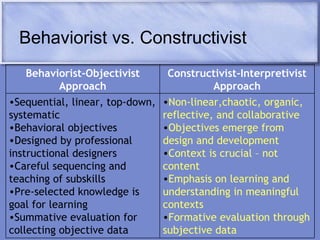
Behaviorist vs. Constructivist Behaviorist-Objectivist Approach Constructivist-Interpretivist Approach Sequential, linear, top-down, systematic Behavioral objectives  Designed by professional instructional designers Careful sequencing and teaching of subskills  Pre-selected knowledge is goal for learning Summative evaluation for collecting objective data Non-linear,chaotic, organic, reflective, and collaborative Objectives emerge from design and development  Context is crucial – not content Emphasis on learning and understanding in meaningful contexts Formative evaluation through subjective data
Positivism and Objectivism Knowledge exists as absolute truth Transfer knowledge from outside to inside the learner Arrange conditions to promote specific goals Teacher directed, learner receiving Goals predetermined Objectives defined Activities, materials, assessment is teacher driven Hand in products for teacher assessment
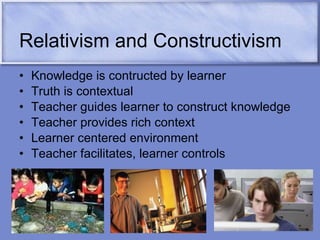
Relativism and Constructivism Knowledge is contructed by learner Truth is contextual Teacher guides learner to construct knowledge Teacher provides rich context Learner centered environment Teacher facilitates, learner controls
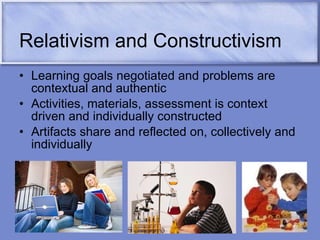
Relativism and Constructivism Learning goals negotiated and problems are contextual and authentic Activities, materials, assessment is context driven and individually constructed Artifacts share and reflected on, collectively and individually
J. L. Bruner – Cognitive Theory Child processes information and builds increasingly complex models of the world Motivation based on intrinsic value, curiosity, and cooperation/reciprocity The way problems are structured must address a child’s intellectual development and maturation Three modes of how things are represented: Enactive - touch, feel, manipulate objects Iconic - images that stand for perceptual events Symbolic representation – language and ideas Constructivist
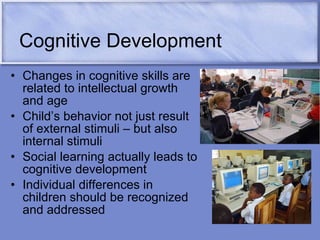
Cognitive Development Changes in cognitive skills are related to intellectual growth and age Child’s behavior not just result of external stimuli – but also internal stimuli Social learning actually leads to cognitive development  Individual differences in children should be recognized and addressed
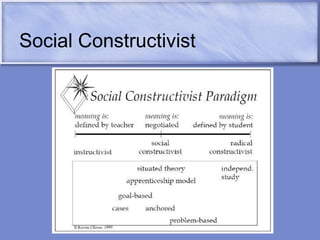
Social Constructivist
Jean Piaget Three Types of Knowledge  Physical, Social, Logical Developmental Concept Learning Assimilation  – what makes sense in child’s environment  Accommodation  – new in context with known Adaptation  – adjusts to the environment and learns the consequences of specific actions Organization  – integrates schemata and develop more complex logic Cognition
Piaget: Stages of Cognitive Development Sensorimotor Stage - Birth to two Objects exist outside of their visual field - object permanence Learn strictly through sensory experience within their environment - KINESTHETIC Pre-operational Stage - Ages 2 - 7 Period of Language Development Egocentrism - only see self perceptions Categorize by single obvious feature
Piaget Stage Theory Concrete Operational Stage  Ages 7 - 12 Develop ability to handle complex logic and make comparisons Hypothesize and reason ONLY about things they’ve experienced themselves Formal Operational Stage –  Age 12 - Adult Abstract thinking ability Offer interpretations and draw conclusions Formulate hypotheses
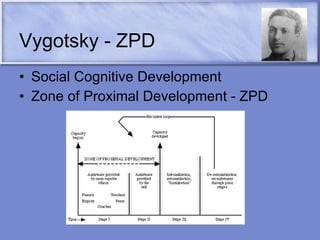
Vygotsky - ZPD Social Cognitive Development Zone of Proximal Development - ZPD
Constructivism in the Classroom Students construct new ideas by incorporating new material into the concepts and thought processes already in place. Allow student thinking to drive lessons Ask thoughtful, open-ended questions Encourage metacognition - thinking about how they are learning Encourage students to interact with each other and YOU – Cooperate and Collaborate. Reflect and Predict!
Four Step Process to Teaching Teacher presents an invitation to learn -  CAPTURE ATTENTION! Teacher gives students opportunity to explore, discover, and create Students propose explanations and solutions Students take action on what they have learned.
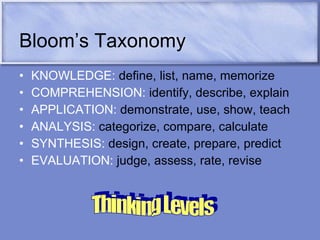
Bloom’s Taxonomy KNOWLEDGE:  define, list, name, memorize COMPREHENSION:  identify, describe, explain APPLICATION:  demonstrate, use, show, teach ANALYSIS:  categorize, compare, calculate SYNTHESIS:  design, create, prepare, predict EVALUATION:  judge, assess, rate, revise Thinking Levels
Ask Students to: Knowledge  - recall information in original form Comprehension  - show understanding  Application  - use learning in a new situation Analysis  - show s/he can see relationships Synthesis  - combine and integrate parts of prior knowledge into a product, plan, or proposal that is new Evaluation  - assess and criticize on basis of standards and criteria
Blooming Questions Knowledge  – Recalling Information Where – What – Who – How many – Point to… Comprehension  – Understanding, Meaning Tell me in your own words – What does it mean? Give me an example, describe, illustrate Application  – Using learning in a new situation What would happen if…?  Would you have done the same…?  How would you solve this problem? In the library, find information about….
Blooming Questions Analysis  – Ability to see parts/relationships What other ways…? Similar/Different (Venn) Interpretation – What kind of person…? What caused the person to react in this way…?  What part was most exciting, sad…? Synthesis  – Parts of information to create original whole What would it be like if…? Design, pretend, use your imagination, write a new ending… Evaluation  – Judgment based on criteria Would you recommend this book to your friend? Why / Why not?  What is the best part... Why?  Which person in the story would you most like to meet? Why / Why not?
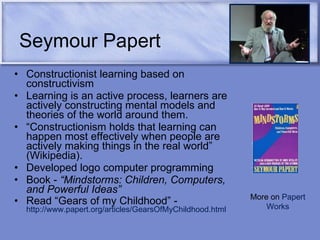
Seymour Papert Constructionist learning based on constructivism  Learning is an active process, learners are actively constructing mental models and theories of the world around them.  “ Constructionism holds that learning can happen most effectively when people are actively making things in the real world” (Wikipedia). Developed logo computer programming Book -  “Mindstorms: Children, Computers, and Powerful Ideas”   Read “Gears of my Childhood” -  http://www.papert.org/articles/GearsOfMyChildhood.html   More on  Papert Works
Constructional Design Theory Individuals are active learners and control their own learning processes Individuals create concrete, tangible evidence (artifacts that reflect understanding) Artifacts are shared collectively and reflected on individually to extend understanding Learning problems and contexts are authentic and focused on solving practical problems. (Reiser, p. 58) Papert
Cognitive Apprentice Modeling   -- involves an expert's carrying out a task so that student can observe and build a conceptual model of the processes that are required to accomplish the task.  Coaching  - consists of observing students while they carry out a task and offering hints, feedback, modeling, reminders, etc.  Articulation  - includes any method of getting students to articulate their knowledge, reasoning, or problem-solving processes.  Reflection  - enables students to compare their own problem-solving processes with those of an expert or another student.  Exploration  - involves pushing students into a mode of problem solving on their own.  http://udel.edu/~jconway/EDST666.htm#cogappr
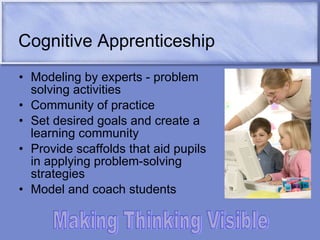
Cognitive Apprenticeship  Modeling by experts - problem solving activities Community of practice Set desired goals and create a learning community Provide scaffolds that aid pupils in applying problem-solving strategies Model and coach students Making Thinking Visible
Cognitive Apprenticeship Establish communication in discussion to talk about real-life problems. Encourage students to make their thinking processes explicit  Students reflect on their own as well as others’ problem-solving approaches. Implement formative assessment that captures the developmental process (portfolio)
ICON Model – Interpretation Construction Observation:  Students make observations of authentic artifacts anchored in authentic situations  Interpretation Construction:  Students construct interpretations of observations and construct arguments for the validity of their interpretations  Contextualization:  Students access background and contextual materials of various sorts to aid interpretation and argumentation  Cognitive Apprenticeship:  Students serve as apprentices to teachers to master observation, interpretation and contextualization  Collaboration:  Students collaborate in observation, interpretation and contextualization  Multiple Interpretations:  Students gain cognitive flexibility by being exposed to multiple interpretations  Multiple Manifestations:  Students gain transferability by seeing multiple manifestations of the same interpretations  ICON Model
Resources Instructional Design Central TIP Theories Wikipedia Instructional Design Models   Reiser, R.A. (2001). History of Instructional Design  (Website) Reiser & Dempsey (2006). Trends and Issues in Instructional Design and Technology. A Journey into Constructivism Piaget’s Constructivism and Papert’s Constructionism: What’s the Difference? Edutopia –  Seymour Papert and Project-based Learning ICON Model Applying Learning Theories to Online Instructional Design Cognitive Apprenticeships

Is db

  • 1.
    History of Instructional Design Part II EDUU566 Based on Reiser & Dempsey, 2006 & Reiser, 2001 Carla Piper, Ed. D. Course Developer
  • 2.
    Constructivism “ Anepistemological and ontological conception of what reality, knowledge, the mind, thought, and meaning are” (Reiser & Dempsey, 2006, p. 46). “ Reality is constructed by individuals and social groups based on their experiences with and interpretations of the world” (Reiser & Dempsey, 2006, p. 46). Constructivists contrast with Objectivists
  • 3.
    Behaviorist vs. ConstructivistBehaviorist-Objectivist Approach Constructivist-Interpretivist Approach Sequential, linear, top-down, systematic Behavioral objectives Designed by professional instructional designers Careful sequencing and teaching of subskills Pre-selected knowledge is goal for learning Summative evaluation for collecting objective data Non-linear,chaotic, organic, reflective, and collaborative Objectives emerge from design and development Context is crucial – not content Emphasis on learning and understanding in meaningful contexts Formative evaluation through subjective data
  • 4.
    Positivism and ObjectivismKnowledge exists as absolute truth Transfer knowledge from outside to inside the learner Arrange conditions to promote specific goals Teacher directed, learner receiving Goals predetermined Objectives defined Activities, materials, assessment is teacher driven Hand in products for teacher assessment
  • 5.
    Relativism and ConstructivismKnowledge is contructed by learner Truth is contextual Teacher guides learner to construct knowledge Teacher provides rich context Learner centered environment Teacher facilitates, learner controls
  • 6.
    Relativism and ConstructivismLearning goals negotiated and problems are contextual and authentic Activities, materials, assessment is context driven and individually constructed Artifacts share and reflected on, collectively and individually
  • 7.
    J. L. Bruner– Cognitive Theory Child processes information and builds increasingly complex models of the world Motivation based on intrinsic value, curiosity, and cooperation/reciprocity The way problems are structured must address a child’s intellectual development and maturation Three modes of how things are represented: Enactive - touch, feel, manipulate objects Iconic - images that stand for perceptual events Symbolic representation – language and ideas Constructivist
  • 8.
    Cognitive Development Changesin cognitive skills are related to intellectual growth and age Child’s behavior not just result of external stimuli – but also internal stimuli Social learning actually leads to cognitive development Individual differences in children should be recognized and addressed
  • 9.
  • 10.
    Jean Piaget ThreeTypes of Knowledge Physical, Social, Logical Developmental Concept Learning Assimilation – what makes sense in child’s environment Accommodation – new in context with known Adaptation – adjusts to the environment and learns the consequences of specific actions Organization – integrates schemata and develop more complex logic Cognition
  • 11.
    Piaget: Stages ofCognitive Development Sensorimotor Stage - Birth to two Objects exist outside of their visual field - object permanence Learn strictly through sensory experience within their environment - KINESTHETIC Pre-operational Stage - Ages 2 - 7 Period of Language Development Egocentrism - only see self perceptions Categorize by single obvious feature
  • 12.
    Piaget Stage TheoryConcrete Operational Stage Ages 7 - 12 Develop ability to handle complex logic and make comparisons Hypothesize and reason ONLY about things they’ve experienced themselves Formal Operational Stage – Age 12 - Adult Abstract thinking ability Offer interpretations and draw conclusions Formulate hypotheses
  • 13.
    Vygotsky - ZPDSocial Cognitive Development Zone of Proximal Development - ZPD
  • 14.
    Constructivism in theClassroom Students construct new ideas by incorporating new material into the concepts and thought processes already in place. Allow student thinking to drive lessons Ask thoughtful, open-ended questions Encourage metacognition - thinking about how they are learning Encourage students to interact with each other and YOU – Cooperate and Collaborate. Reflect and Predict!
  • 15.
    Four Step Processto Teaching Teacher presents an invitation to learn - CAPTURE ATTENTION! Teacher gives students opportunity to explore, discover, and create Students propose explanations and solutions Students take action on what they have learned.
  • 16.
    Bloom’s Taxonomy KNOWLEDGE: define, list, name, memorize COMPREHENSION: identify, describe, explain APPLICATION: demonstrate, use, show, teach ANALYSIS: categorize, compare, calculate SYNTHESIS: design, create, prepare, predict EVALUATION: judge, assess, rate, revise Thinking Levels
  • 17.
    Ask Students to:Knowledge - recall information in original form Comprehension - show understanding Application - use learning in a new situation Analysis - show s/he can see relationships Synthesis - combine and integrate parts of prior knowledge into a product, plan, or proposal that is new Evaluation - assess and criticize on basis of standards and criteria
  • 18.
    Blooming Questions Knowledge – Recalling Information Where – What – Who – How many – Point to… Comprehension – Understanding, Meaning Tell me in your own words – What does it mean? Give me an example, describe, illustrate Application – Using learning in a new situation What would happen if…? Would you have done the same…? How would you solve this problem? In the library, find information about….
  • 19.
    Blooming Questions Analysis – Ability to see parts/relationships What other ways…? Similar/Different (Venn) Interpretation – What kind of person…? What caused the person to react in this way…? What part was most exciting, sad…? Synthesis – Parts of information to create original whole What would it be like if…? Design, pretend, use your imagination, write a new ending… Evaluation – Judgment based on criteria Would you recommend this book to your friend? Why / Why not? What is the best part... Why? Which person in the story would you most like to meet? Why / Why not?
  • 20.
    Seymour Papert Constructionistlearning based on constructivism Learning is an active process, learners are actively constructing mental models and theories of the world around them. “ Constructionism holds that learning can happen most effectively when people are actively making things in the real world” (Wikipedia). Developed logo computer programming Book - “Mindstorms: Children, Computers, and Powerful Ideas” Read “Gears of my Childhood” - http://www.papert.org/articles/GearsOfMyChildhood.html More on Papert Works
  • 21.
    Constructional Design TheoryIndividuals are active learners and control their own learning processes Individuals create concrete, tangible evidence (artifacts that reflect understanding) Artifacts are shared collectively and reflected on individually to extend understanding Learning problems and contexts are authentic and focused on solving practical problems. (Reiser, p. 58) Papert
  • 22.
    Cognitive Apprentice Modeling -- involves an expert's carrying out a task so that student can observe and build a conceptual model of the processes that are required to accomplish the task. Coaching - consists of observing students while they carry out a task and offering hints, feedback, modeling, reminders, etc. Articulation - includes any method of getting students to articulate their knowledge, reasoning, or problem-solving processes. Reflection - enables students to compare their own problem-solving processes with those of an expert or another student. Exploration - involves pushing students into a mode of problem solving on their own. http://udel.edu/~jconway/EDST666.htm#cogappr
  • 23.
    Cognitive Apprenticeship Modeling by experts - problem solving activities Community of practice Set desired goals and create a learning community Provide scaffolds that aid pupils in applying problem-solving strategies Model and coach students Making Thinking Visible
  • 24.
    Cognitive Apprenticeship Establishcommunication in discussion to talk about real-life problems. Encourage students to make their thinking processes explicit Students reflect on their own as well as others’ problem-solving approaches. Implement formative assessment that captures the developmental process (portfolio)
  • 25.
    ICON Model –Interpretation Construction Observation: Students make observations of authentic artifacts anchored in authentic situations Interpretation Construction: Students construct interpretations of observations and construct arguments for the validity of their interpretations Contextualization: Students access background and contextual materials of various sorts to aid interpretation and argumentation Cognitive Apprenticeship: Students serve as apprentices to teachers to master observation, interpretation and contextualization Collaboration: Students collaborate in observation, interpretation and contextualization Multiple Interpretations: Students gain cognitive flexibility by being exposed to multiple interpretations Multiple Manifestations: Students gain transferability by seeing multiple manifestations of the same interpretations ICON Model
  • 26.
    Resources Instructional DesignCentral TIP Theories Wikipedia Instructional Design Models Reiser, R.A. (2001). History of Instructional Design (Website) Reiser & Dempsey (2006). Trends and Issues in Instructional Design and Technology. A Journey into Constructivism Piaget’s Constructivism and Papert’s Constructionism: What’s the Difference? Edutopia – Seymour Papert and Project-based Learning ICON Model Applying Learning Theories to Online Instructional Design Cognitive Apprenticeships