PMP & CAPM
Exam Preparation
  January 17, 2013
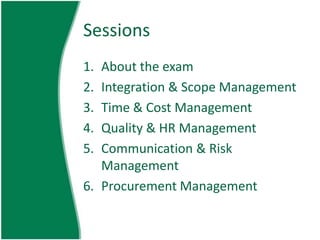
Sessions
1. About the exam
2. Integration & Scope Management
3. Time & Cost Management
4. Quality & HR Management
5. Communication & Risk
   Management
6. Procurement Management
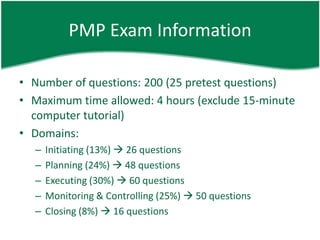
PMP Exam Information

• Number of questions: 200 (25 pretest questions)
• Maximum time allowed: 4 hours (exclude 15-minute
  computer tutorial)
• Domains:
  –   Initiating (13%)  26 questions
  –   Planning (24%)  48 questions
  –   Executing (30%)  60 questions
  –   Monitoring & Controlling (25%)  50 questions
  –   Closing (8%)  16 questions
PMP Exam Information

•   Situational questions
•   Random pretest questions
•   Using formal and informal terminologies
•   Might contain unnecessary information
•   Some questions might not be answerable
•   Tricky questions (tips: always follow PMI
    process)
CAPM Exam Information

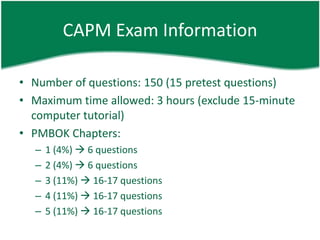
• Number of questions: 150 (15 pretest questions)
• Maximum time allowed: 3 hours (exclude 15-minute
  computer tutorial)
• PMBOK Chapters:
  –   1 (4%)  6 questions
  –   2 (4%)  6 questions
  –   3 (11%)  16-17 questions
  –   4 (11%)  16-17 questions
  –   5 (11%)  16-17 questions
CAPM Exam Information

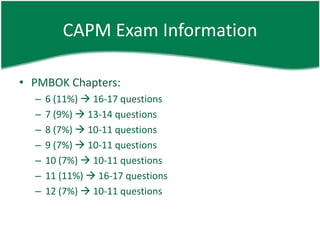
• PMBOK Chapters:
  –   6 (11%)  16-17 questions
  –   7 (9%)  13-14 questions
  –   8 (7%)  10-11 questions
  –   9 (7%)  10-11 questions
  –   10 (7%)  10-11 questions
  –   11 (11%)  16-17 questions
  –   12 (7%)  10-11 questions
CAPM Exam Information

• Entirely based on PMBOK
• Random pretest questions
• Using formal terminologies
Exam Preparation

• Primary book: PMBOK
• Secondary book:
  – PMP in Depth by Dr. Paul Sanghera, PMP
  – Head First PMP
  – Joseph Phillips PMP/CAPM Exam Guide
  – PMP/CAPM Exam Prep by Rita Mulcahy, PMP
  – etc
Exam Preparation

• Online tests simulation:
  – http://www.headfirstlabs.com/PMP/pmp_exam/v
    2/quiz.html

  – http://www.pmstudy.com/PMP-Exam-
    Resources/freeSimulatedTest.asp

  – http://www.simplilearn.com/slportal/test/list.do
Exam Preparation

• Online tests simulation:
  – http://www.edwel.com/pmp-certification-exam-
    prep/pmp-practice-exam#usermessage4a

  – http://pmzilla.com/pmp-simulation-test-free-200-
    questions-4-hour-test

  – http://www.examcentral.net/pmp/practice-exam
Exam Preparation

• Online tests simulation:
  – http://www.oliverlehmann.com/pmp-self-test/75-
    free-questions.htm
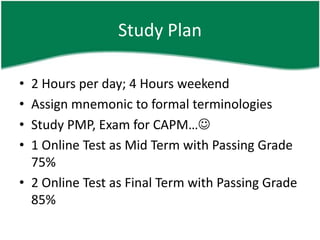
Study Plan

• 2 Hours per day; 4 Hours weekend
• Assign mnemonic to formal terminologies
• Study PMP, Exam for CAPM…
• 1 Online Test as Mid Term with Passing Grade
  75%
• 2 Online Test as Final Term with Passing Grade
  85%
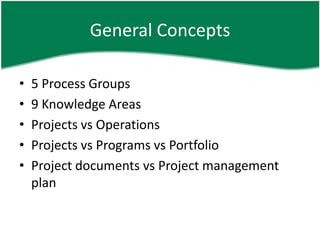
General Concepts

•   5 Process Groups
•   9 Knowledge Areas
•   Projects vs Operations
•   Projects vs Programs vs Portfolio
•   Project documents vs Project management
    plan
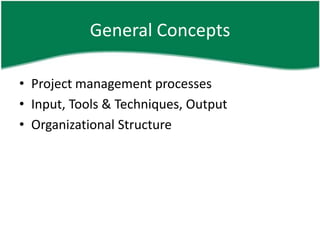
General Concepts

• Project management processes
• Input, Tools & Techniques, Output
• Organizational Structure
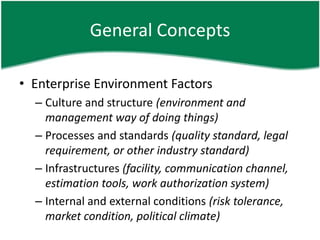
General Concepts

• Enterprise Environment Factors
  – Culture and structure (environment and
    management way of doing things)
  – Processes and standards (quality standard, legal
    requirement, or other industry standard)
  – Infrastructures (facility, communication channel,
    estimation tools, work authorization system)
  – Internal and external conditions (risk tolerance,
    market condition, political climate)
General Concepts

• Organizational Process Assets
  – Standardized processes and procedures
     • HSE policy
     • Project management / ethics policy
     • Quality checklist
  – Standard guidelines
     • Closure guidelines
     • Evaluation criteria
     • Acceptance criteria
General Concepts

• Organizational Process Assets
  – Templates
     • Project documents template
     • Project management plan template
  – Knowledge base
     •   Project files (issues log, change request document, etc)
     •   Historical information / lessons learned
     •   Financial database
     •   Configuration management
General Concepts

• Formula
  – Link to file
Sample Questions

Which of the following are the essential
characteristics that make a group of activities
a project?
A. It takes multiple individuals to perform these
   activities and it creates a new product.
B. The work is managed by a project manager.
C. The group has a plan and a budget.
D. The group has a start date and a finish date, and
   its outcome will be a new product.
Sample Questions

Which of the following is a project?
A. Running a donut shop
B. Building another library in your area
C. Keeping a network up and running in a university
   department
D. Running a warehouse
Sample Questions

Which of the following are the process
groups?
A. Starting, planning, executing, monitoring and
   controlling, and closing
B. Initiating, organizing and preparing, executing,
   monitoring and controlling, and closing
C. Initiating, planning, implementing, monitoring
   and controlling, and closing
D. Initiating, planning, executing, monitoring and
   controlling, and closing
Sample Questions

Which of the following is not a project
management knowledge area?
A.   Project procurement management
B.   Project risk management
C.   Project quality management
D.   Project team management
Sample Questions

Which of the following is the best definition of
progressive elaboration?
A. Taking the project from concept to project
   management plan
B. Taking the project to its completion
C. Continuous effort to improve a plan by working
   out more details as the project progresses
D. Decomposing the project objectives into smaller,
   more manageable work pieces
Sample Questions

In which of the following organizational
structures does the project manager have the
greatest authority?
A.   Functional
B.   Projectized
C.   Matrix
D.   Leveled
Sample Questions

In which of the following organizational
structures does the project manager have the
least authority?
A.   Functional
B.   Projectized
C.   Matrix
D.   Leveled
Sample Questions

Your project depends on two business partners: On The Fly,
Inc. (OTF) and The Sure Thing, Inc. (ST) delivering their
products to you on time. The chances are three out of four
that OTF will make the delivery on time and two out of three
that ST will not make the delivery on time. The probability
that OTF and ST will both deliver on time is equal to:
A. 0.25
B. 0.5
C. 5/7
D. 4/7
Sample Questions

All of the following are true about a project except:
A. Cost is low and stakeholder influence is highest in the
     beginning.
B. Staffing levels and the ability to influence the product
     characteristics are both low at the end of the project.
C. When the project is executing, both cost and
     stakeholders’ influence are at their highest.
D. Uncertainty is at its highest in the beginning of the
     project.
Sample Questions

Both projects and operations share all the following
characteristics except:
A. Performed by individuals
B. Planned, executed, monitored and controlled, and closed
C. Limited by constraints
D. Performed to achieve the strategic objectives of the
    organization
Sample Questions
You are being interviewed by a functional manager who says,
“We have this huge undertaking of launching an online
education website that contains different components, such
as designing the website; developing the content; developing
the administrative system, including registration and
payment; marketing the courses on the website; integrating
different components of the website; and finally going live.
Each component is functionally complex and large enough
that it will be better served under a different management.”
The manager is most likely describing a:
 A. Project
 B. Program
 C. Operation
 D. Portfolio
Sample Questions
Effective project management requires that a project manager
must have the following characteristics:
A. Project management knowledge, ability to apply the
    knowledge effectively to the project at hand, and
    computer expertise
B. Project management knowledge, leadership skills, and
    expertise in the application area of the project
C. Project management knowledge; ability to apply the
    knowledge to the project at hand; and personal style and
    behavior, including personal effectiveness and leadership
D. Project management knowledge, ability to apply the
    knowledge effectively to the project at hand, and project
    management experience
Sample Questions

The role of a project manager is more of a coordinator or an
expediter in organizations with the following structures:
A. Strong matrix and weak matrix
B. Projectized
C. Functional and weak matrix
D. Hierarchical
Sample Questions

The project manager is responsible for achieving project
objectives in an organization with the following structure:
A. Projectized only
B. Strong matrix and projectized only
C. Matrix and projectized only
D. All structures
Sample Questions

You have just joined an organization as a project manager and
are studying the enterprise environmental factors of the
organization to find out how you can leverage them for the
success of your upcoming projects. Enterprise environmental
factors may have what kind of influence on the projects?
 A. Positive only
 B. Negative only
 C. Positive or negative
 D. None

Pmp session 1

  • 1.
    PMP & CAPM ExamPreparation January 17, 2013
  • 2.
    Sessions 1. About theexam 2. Integration & Scope Management 3. Time & Cost Management 4. Quality & HR Management 5. Communication & Risk Management 6. Procurement Management
  • 3.
    PMP Exam Information •Number of questions: 200 (25 pretest questions) • Maximum time allowed: 4 hours (exclude 15-minute computer tutorial) • Domains: – Initiating (13%)  26 questions – Planning (24%)  48 questions – Executing (30%)  60 questions – Monitoring & Controlling (25%)  50 questions – Closing (8%)  16 questions
  • 4.
    PMP Exam Information • Situational questions • Random pretest questions • Using formal and informal terminologies • Might contain unnecessary information • Some questions might not be answerable • Tricky questions (tips: always follow PMI process)
  • 5.
    CAPM Exam Information •Number of questions: 150 (15 pretest questions) • Maximum time allowed: 3 hours (exclude 15-minute computer tutorial) • PMBOK Chapters: – 1 (4%)  6 questions – 2 (4%)  6 questions – 3 (11%)  16-17 questions – 4 (11%)  16-17 questions – 5 (11%)  16-17 questions
  • 6.
    CAPM Exam Information •PMBOK Chapters: – 6 (11%)  16-17 questions – 7 (9%)  13-14 questions – 8 (7%)  10-11 questions – 9 (7%)  10-11 questions – 10 (7%)  10-11 questions – 11 (11%)  16-17 questions – 12 (7%)  10-11 questions
  • 7.
    CAPM Exam Information •Entirely based on PMBOK • Random pretest questions • Using formal terminologies
  • 8.
    Exam Preparation • Primarybook: PMBOK • Secondary book: – PMP in Depth by Dr. Paul Sanghera, PMP – Head First PMP – Joseph Phillips PMP/CAPM Exam Guide – PMP/CAPM Exam Prep by Rita Mulcahy, PMP – etc
  • 9.
    Exam Preparation • Onlinetests simulation: – http://www.headfirstlabs.com/PMP/pmp_exam/v 2/quiz.html – http://www.pmstudy.com/PMP-Exam- Resources/freeSimulatedTest.asp – http://www.simplilearn.com/slportal/test/list.do
  • 10.
    Exam Preparation • Onlinetests simulation: – http://www.edwel.com/pmp-certification-exam- prep/pmp-practice-exam#usermessage4a – http://pmzilla.com/pmp-simulation-test-free-200- questions-4-hour-test – http://www.examcentral.net/pmp/practice-exam
  • 11.
    Exam Preparation • Onlinetests simulation: – http://www.oliverlehmann.com/pmp-self-test/75- free-questions.htm
  • 12.
    Study Plan • 2Hours per day; 4 Hours weekend • Assign mnemonic to formal terminologies • Study PMP, Exam for CAPM… • 1 Online Test as Mid Term with Passing Grade 75% • 2 Online Test as Final Term with Passing Grade 85%
  • 13.
    General Concepts • 5 Process Groups • 9 Knowledge Areas • Projects vs Operations • Projects vs Programs vs Portfolio • Project documents vs Project management plan
  • 14.
    General Concepts • Projectmanagement processes • Input, Tools & Techniques, Output • Organizational Structure
  • 15.
    General Concepts • EnterpriseEnvironment Factors – Culture and structure (environment and management way of doing things) – Processes and standards (quality standard, legal requirement, or other industry standard) – Infrastructures (facility, communication channel, estimation tools, work authorization system) – Internal and external conditions (risk tolerance, market condition, political climate)
  • 16.
    General Concepts • OrganizationalProcess Assets – Standardized processes and procedures • HSE policy • Project management / ethics policy • Quality checklist – Standard guidelines • Closure guidelines • Evaluation criteria • Acceptance criteria
  • 17.
    General Concepts • OrganizationalProcess Assets – Templates • Project documents template • Project management plan template – Knowledge base • Project files (issues log, change request document, etc) • Historical information / lessons learned • Financial database • Configuration management
  • 18.
  • 19.
    Sample Questions Which ofthe following are the essential characteristics that make a group of activities a project? A. It takes multiple individuals to perform these activities and it creates a new product. B. The work is managed by a project manager. C. The group has a plan and a budget. D. The group has a start date and a finish date, and its outcome will be a new product.
  • 20.
    Sample Questions Which ofthe following is a project? A. Running a donut shop B. Building another library in your area C. Keeping a network up and running in a university department D. Running a warehouse
  • 21.
    Sample Questions Which ofthe following are the process groups? A. Starting, planning, executing, monitoring and controlling, and closing B. Initiating, organizing and preparing, executing, monitoring and controlling, and closing C. Initiating, planning, implementing, monitoring and controlling, and closing D. Initiating, planning, executing, monitoring and controlling, and closing
  • 22.
    Sample Questions Which ofthe following is not a project management knowledge area? A. Project procurement management B. Project risk management C. Project quality management D. Project team management
  • 23.
    Sample Questions Which ofthe following is the best definition of progressive elaboration? A. Taking the project from concept to project management plan B. Taking the project to its completion C. Continuous effort to improve a plan by working out more details as the project progresses D. Decomposing the project objectives into smaller, more manageable work pieces
  • 24.
    Sample Questions In whichof the following organizational structures does the project manager have the greatest authority? A. Functional B. Projectized C. Matrix D. Leveled
  • 25.
    Sample Questions In whichof the following organizational structures does the project manager have the least authority? A. Functional B. Projectized C. Matrix D. Leveled
  • 26.
    Sample Questions Your projectdepends on two business partners: On The Fly, Inc. (OTF) and The Sure Thing, Inc. (ST) delivering their products to you on time. The chances are three out of four that OTF will make the delivery on time and two out of three that ST will not make the delivery on time. The probability that OTF and ST will both deliver on time is equal to: A. 0.25 B. 0.5 C. 5/7 D. 4/7
  • 27.
    Sample Questions All ofthe following are true about a project except: A. Cost is low and stakeholder influence is highest in the beginning. B. Staffing levels and the ability to influence the product characteristics are both low at the end of the project. C. When the project is executing, both cost and stakeholders’ influence are at their highest. D. Uncertainty is at its highest in the beginning of the project.
  • 28.
    Sample Questions Both projectsand operations share all the following characteristics except: A. Performed by individuals B. Planned, executed, monitored and controlled, and closed C. Limited by constraints D. Performed to achieve the strategic objectives of the organization
  • 29.
    Sample Questions You arebeing interviewed by a functional manager who says, “We have this huge undertaking of launching an online education website that contains different components, such as designing the website; developing the content; developing the administrative system, including registration and payment; marketing the courses on the website; integrating different components of the website; and finally going live. Each component is functionally complex and large enough that it will be better served under a different management.” The manager is most likely describing a: A. Project B. Program C. Operation D. Portfolio
  • 30.
    Sample Questions Effective projectmanagement requires that a project manager must have the following characteristics: A. Project management knowledge, ability to apply the knowledge effectively to the project at hand, and computer expertise B. Project management knowledge, leadership skills, and expertise in the application area of the project C. Project management knowledge; ability to apply the knowledge to the project at hand; and personal style and behavior, including personal effectiveness and leadership D. Project management knowledge, ability to apply the knowledge effectively to the project at hand, and project management experience
  • 31.
    Sample Questions The roleof a project manager is more of a coordinator or an expediter in organizations with the following structures: A. Strong matrix and weak matrix B. Projectized C. Functional and weak matrix D. Hierarchical
  • 32.
    Sample Questions The projectmanager is responsible for achieving project objectives in an organization with the following structure: A. Projectized only B. Strong matrix and projectized only C. Matrix and projectized only D. All structures
  • 33.
    Sample Questions You havejust joined an organization as a project manager and are studying the enterprise environmental factors of the organization to find out how you can leverage them for the success of your upcoming projects. Enterprise environmental factors may have what kind of influence on the projects? A. Positive only B. Negative only C. Positive or negative D. None

Editor's Notes

  • #14 5 Process Groups: Initiating, Planning, Executing, Monitoring and Controlling, Closing9 Knowledge Area: Integration, Scope, Time, Cost, Quality, HR, Communication, Risk, Procurement