PMP & CAPM
Exam Preparation
  February 5, 2013
Sessions
1. About the exam
2. Integration & Scope Management
3. Time & Cost Management
4. Quality & HR Management
5. Communication & Risk
   Management
6. Procurement Management
Last Session Key point

• Project Integration Management
   – Develop Project Charter
   – Develop Project Management Plan
   – Direct and Manage Project Execution
   – Manage and Control Project Work
   – Perform Integrated Change Control
   – Close Project or Phase
Last Session Key point – cont’d

• Project Scope Management
   – Collect Requirements
   – Define Scope
   – Create WBS
   – Verify Scope
   – Control Scope
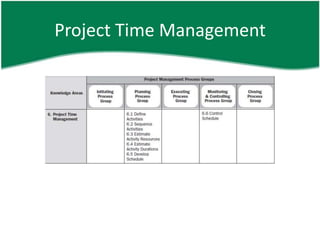
Project Time Management
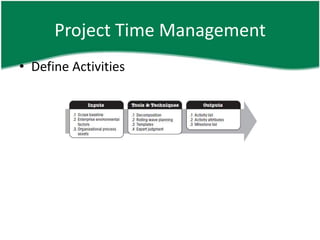
• Define Activities
Project Time Management
• Define Activities – I
  – Scope baseline (project scope statement, WBS,
    WBS Dictionary)
  – EEF
  – OPA
Project Time Management
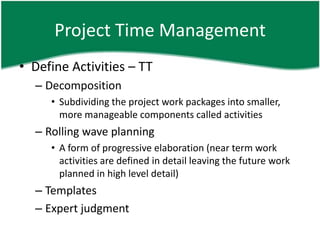
• Define Activities – TT
  – Decomposition
     • Subdividing the project work packages into smaller,
       more manageable components called activities
  – Rolling wave planning
     • A form of progressive elaboration (near term work
       activities are defined in detail leaving the future work
       planned in high level detail)
  – Templates
  – Expert judgment
Project Time Management
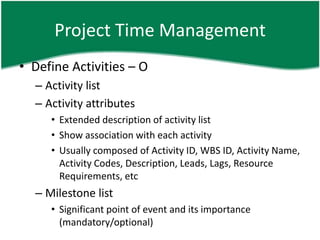
• Define Activities – O
  – Activity list
  – Activity attributes
     • Extended description of activity list
     • Show association with each activity
     • Usually composed of Activity ID, WBS ID, Activity Name,
       Activity Codes, Description, Leads, Lags, Resource
       Requirements, etc
  – Milestone list
     • Significant point of event and its importance
       (mandatory/optional)
Project Time Management
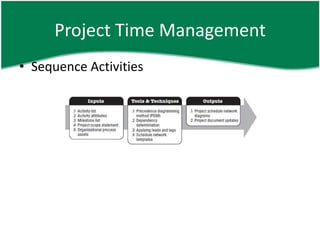
• Sequence Activities
Project Time Management
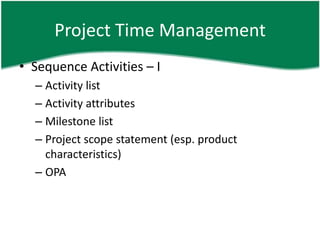
• Sequence Activities – I
  – Activity list
  – Activity attributes
  – Milestone list
  – Project scope statement (esp. product
    characteristics)
  – OPA
Project Time Management
• Sequence Activities – TT
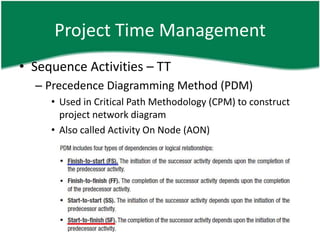
  – Precedence Diagramming Method (PDM)
     • Used in Critical Path Methodology (CPM) to construct
       project network diagram
     • Also called Activity On Node (AON)
Project Time Management
• Sequence Activities – TT (cont’d)
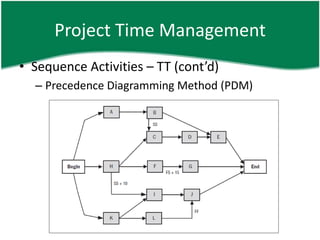
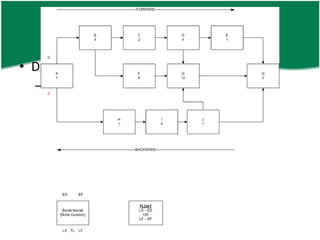
  – Precedence Diagramming Method (PDM)
Project Time Management
• Sequence Activities – TT (cont’d)
  – Dependency Determination
     • Mandatory dependencies
        – Contractually required / inherent in nature of the work
        – Dependencies often involves physical limitations
        – Also called / referred as “Hard Logic”
     • Discretionary dependencies
        – Also called / referred as “Preferred Logic” or “Soft Logic”
        – Established based on best practices (although many
          sequences options are acceptable)
        – Can create subjective total float values
        – Is subject to review / modification / removal when fast-
          tracking method is employed
Project Time Management
• Sequence Activities – TT (cont’d)
  – Dependency Determination
     • External dependencies
        – Usually caused by non-project activities / activities outside the
          project
        – E.g.: development of housing construction is dependent to
          material delivery
        – E.g.: software patching is dependent to the patch availability /
          purchasing confirmation
Project Time Management
• Sequence Activities – TT (cont’d)
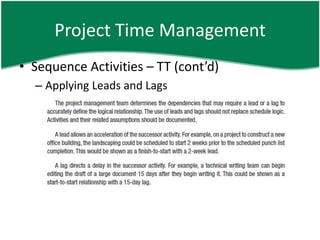
  – Applying Leads and Lags
Project Time Management
• Sequence Activities – TT (cont’d)
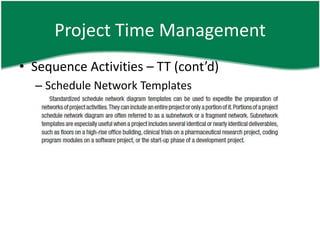
  – Schedule Network Templates
Project Time Management
• Sequence Activities – O
  – Project schedule network diagrams
  – PD U (e.g.: activity list, attributes, risk register)
Project Time Management
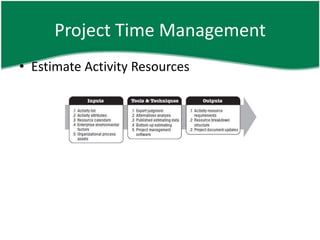
• Estimate Activity Resources
Project Time Management
• Estimate Activity Resources – I
  – Activity list
  – Activity resources
  – Resource calendars
     • Availability, capabilities, skills
  – EEF
  – OPA
Project Time Management
• Estimate Activity Resources – TT
  – Expert judgment
  – Alternative analysis
     •   Level of resource
     •   Resources’ skills / capabilities
     •   Size and type of machines / tools
     •   Make-or-buy decision
  – Published estimating data
     • Rates based on geographical location
     • Delivery rates
Project Time Management
• Estimate Activity Resources – TT (cont’d)
  – Bottom-Up Estimating
     • Used when activities cannot be estimated with a
       reasonable degree of confidence
     • Uses aggregation/grouping of several activities
  – Project Management Software
Project Time Management
• Estimate Activity Resources – O
  – Activity Resources Requirements
  – Resource Breakdown Structure
  – PD U
Project Time Management
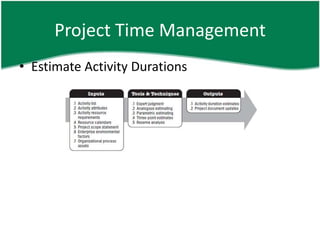
• Estimate Activity Durations
Project Time Management
• Estimate Activity Durations – I
  – Activity list
  – Activity attributes
  – Activity resource requirements
  – Resource calendars
  – Project scope statement (existing conditions,
    information’s availability, reporting periods,
    contractual pre-assignment)
  – EEF
  – OPA
Project Time Management
• Estimate Activity Durations – TT
  – Expert judgment
  – Analogous estimating
     • Uses historical information (the actual duration of
       previous, similar projects)
     • Timeless, costless, accurate-less
     • Usually used when there is limited detail / information
       about the project
Project Time Management
• Estimate Activity Durations – TT (cont’d)
  – Parametric estimating
     • Uses statistical relationship between historical
       information and other variables such as cost, budget,
       and duration
     • A quantitative method (using multiplication)
     • Relatively higher in accuracy (depending on the
       underlying data used for estimation)
Project Time Management
• Estimate Activity Durations – TT (cont’d)
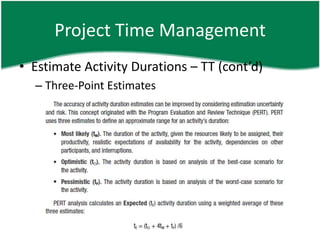
  – Three-Point Estimates
Project Time Management
• Estimate Activity Durations – TT (cont’d)
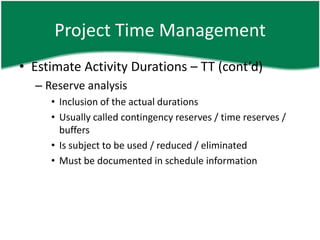
  – Reserve analysis
     • Inclusion of the actual durations
     • Usually called contingency reserves / time reserves /
       buffers
     • Is subject to be used / reduced / eliminated
     • Must be documented in schedule information
Project Time Management
• Estimate Activity Durations – O
  – Activity duration estimates
  – PD U
Project Time Management
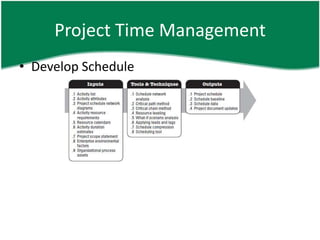
• Develop Schedule
Project Time Management
• Develop Schedule – I
  – Activity list
  – Activity attributes
  – Project schedule network diagrams
  – Activity resource requirements
  – Resource calendars
  – Activity duration estimates
  – Project scope statement (might have certain
    constraints / assumptions that impact schedule
    development)
Project Time Management
• Develop Schedule – I (cont’d)
  – EEF
  – OPA
Project Time Management
• Develop Schedule – TT
  – Schedule network analysis
  – Critical path method
     • Calculates early start, early finish, late start, and late
       finish dates for each activities with disregard to any
       resource limitations by performing forward and
       backward pass analysis through the schedule network
     • Have ZERO float and usually the longest path in the
       network diagram
     • Might be more than 1 critical path in any given network
       diagram
Project Time Management
• Develop Schedule – TT (cont’d)
  – Critical path method
     • Produces “free float”: a certain time length which an
       activity can be delayed without delaying the early date
       of its immediate successor activity within the network
       path
Project Time Management
• Develop Schedule – TT (cont’d)
  – Critical path method
Project Time Management
• Develop Schedule – TT (cont’d)
  – Critical path method
Project Time Management
• Develop Schedule – TT (cont’d)
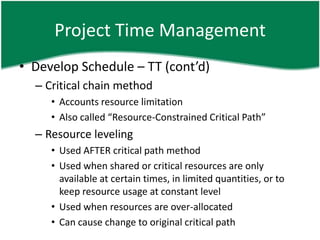
  – Critical chain method
     • Accounts resource limitation
     • Also called “Resource-Constrained Critical Path”
  – Resource leveling
     • Used AFTER critical path method
     • Used when shared or critical resources are only
       available at certain times, in limited quantities, or to
       keep resource usage at constant level
     • Used when resources are over-allocated
     • Can cause change to original critical path
Project Time Management
• Develop Schedule – TT (cont’d)
  – What-If scenario analysis
Project Time Management
• Develop Schedule – TT (cont’d)
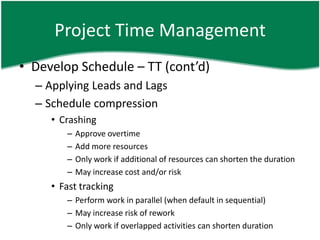
  – Applying Leads and Lags
  – Schedule compression
     • Crashing
        –   Approve overtime
        –   Add more resources
        –   Only work if additional of resources can shorten the duration
        –   May increase cost and/or risk
     • Fast tracking
        – Perform work in parallel (when default in sequential)
        – May increase risk of rework
        – Only work if overlapped activities can shorten duration
Project Time Management
• Develop Schedule – TT (cont’d)
  – Scheduling tool
Project Time Management
• Develop Schedule – O
  – Project schedule
     • Milestone charts
     • Bar charts
     • Project schedule network diagrams
  – Schedule baseline
  – Schedule data (resource requirements, alternative
    schedules, contingency reserves, etc)
  – PD U
Project Time Management
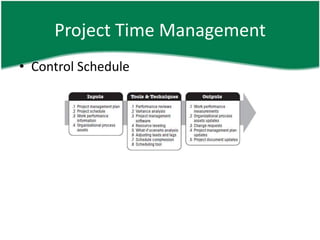
• Control Schedule
Project Time Management
• Control Schedule – I
  – PMP
  – Project schedule
  – WPI
  – OPA
Project Time Management
• Control Schedule – TT
  – Performance reviews
     • Earned value management is applied
     • Difference between buffer needed and the buffer
       remaining can determine whether corrective action is
       necessary
  – Variance analysis
  – Project management software
  – Resource leveling
Project Time Management
• Control Schedule – TT (cont’d)
  – What-If scenario analysis
  – Adjusting leads and lags
  – Schedule compression
  – Scheduling tool
Project Time Management
• Control Schedule – O
  – Work performance measurements
  – OPA U
  – CR
  – PMP U
     • Schedule baseline
     • Schedule management plan
     • Cost baseline
  – PD U
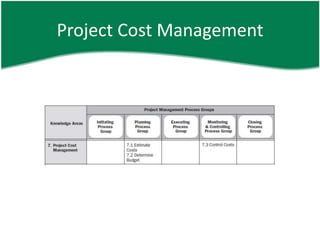
Project Cost Management
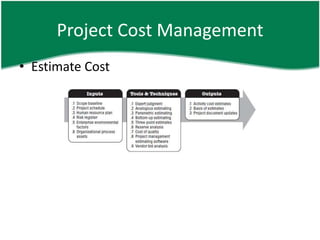
• Estimate Cost
Project Cost Management
• Estimate Cost – I
  – Scope baseline
  – Project schedule
  – HR Plan
  – Risk Register
  – EEF
  – OPA
Project Cost Management
• Estimate Cost – TT
  – Expert judgment
  – Analogous estimating
  – Parametric estimating
  – Bottom-up estimating
  – Three-point estimates
  – Reserve analysis
  – Cost of Quality
Project Cost Management
• Estimate Cost – TT
  – Project management estimating software
  – Vendor bid analysis
Project Cost Management
• Estimate Cost – O
  – Activity cost estimates
     • Labor, material, equipment, services, etc
  – Basis of estimates
     • Documentation of basis of the estimate, assumptions,
       constraints, confidence level, etc
  – PD U
Project Cost Management
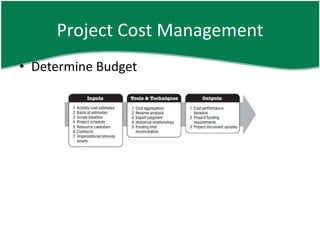
• Determine Budget
Project Cost Management
• Determine Budget – I
  – Activity cost estimates
  – Basis of estimates
  – Scope baseline
  – Project schedule
  – Resource calendars
  – Contracts
  – OPA
Project Cost Management
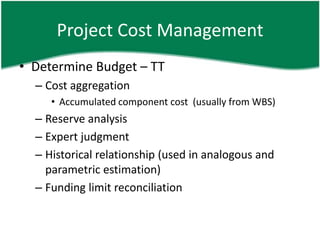
• Determine Budget – TT
  – Cost aggregation
     • Accumulated component cost (usually from WBS)
  – Reserve analysis
  – Expert judgment
  – Historical relationship (used in analogous and
    parametric estimation)
  – Funding limit reconciliation
Project Cost Management
• Determine Budget – O
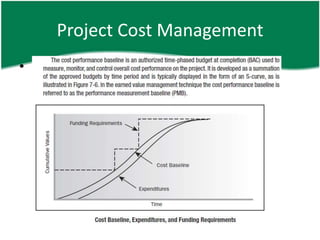
  – Cost performance baseline
Project Cost Management
• Determine Budget – O (cont’d)
  – Project funding requirement
  – PD U
Project Cost Management
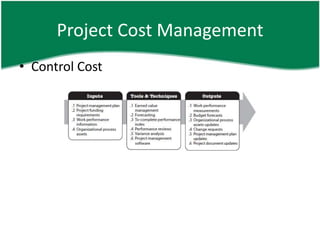
• Control Cost
Project Cost Management
• Control Cost – I
  – PMP
     • Cost performance baseline
     • Cost management plan
  – Project funding requirements
  – WPI
  – OPA
Project Cost Management
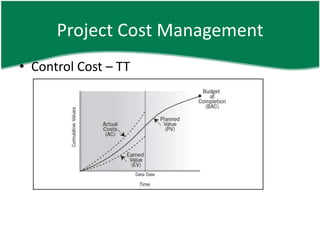
• Control Cost – TT
  – Earned value management (EVM)
     • PV, EV, AC
     • CV= (EV-AC) and SV= (EV-PV)
     • CPI= (EV/AC) and SPI= (EV/PV)
Project Cost Management
• Control Cost – TT (cont’d)
  – Forecasting (link to formula)
     • Estimate At Completion (EAC)
     • Estimate To Complete (ETC)
     • To-Complete Performance Index (TCPI)
  – Performance reviews
     • Trend analysis (improving / deteriorating)
     • Earned value performance (baseline vs. actual)
Project Cost Management
• Control Cost – TT (cont’d)
  – Variance analysis
  – Project management software
Project Cost Management
• Control Cost – O
  – Work performance measurements
  – Budget forecasts
  – OPA U
  – CR
  – PMP U
     • Cost performance baseline
     • Cost management plan
  – PD U
     • Cost estimates
Sample Questions

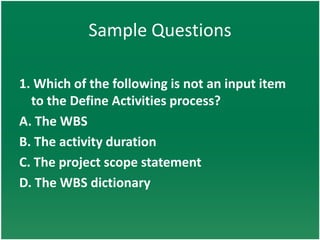
1. Which of the following is not an input item
  to the Define Activities process?
A. The WBS
B. The activity duration
C. The project scope statement
D. The WBS dictionary
Sample Questions

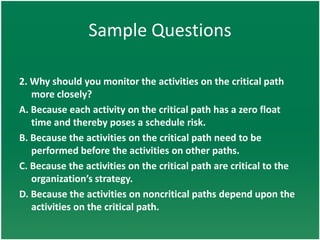
2. Why should you monitor the activities on the critical path
   more closely?
A. Because each activity on the critical path has a zero float
   time and thereby poses a schedule risk.
B. Because the activities on the critical path need to be
   performed before the activities on other paths.
C. Because the activities on the critical path are critical to the
   organization’s strategy.
D. Because the activities on noncritical paths depend upon the
   activities on the critical path.
Sample Questions

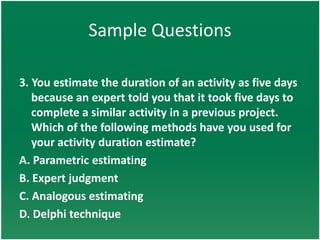
3. You estimate the duration of an activity as five days
   because an expert told you that it took five days to
   complete a similar activity in a previous project.
   Which of the following methods have you used for
   your activity duration estimate?
A. Parametric estimating
B. Expert judgment
C. Analogous estimating
D. Delphi technique
Sample Questions

4. You have developed the schedule for your project, and you’ve called the
    kickoff meeting. A team member who is responsible for an activity
    comes to you and tells you that the activity cannot be performed within
    the allocated time because some pieces were left out during activity
    definition. The revised estimate will add two more days to the activity
    duration, but the activity is not on the critical path. Which of the
    following actions will you take?
A. Go to the team member’s functional manager and find out whether the
    team member’s estimate is correct.
B. Accept the new estimate but do not change the schedule.
C. Accept the new estimate and update the schedule accordingly.
D. Put the new estimate through the integrated change control process.
Sample Questions

5. The amount of time by which an activity can
  be delayed without changing the project
  finish date is called:
A. Float time
B. Lag time
C. Grace time
D. Activity gradient
Sample Questions

6. Which of the following is the most
  commonly used network diagramming
  method?
A. Critical path method (CPM)
B. Critical chain method (CCM)
C. Precedence diagramming method (PDM)
D. Arrow diagramming method (ADM)
Sample Questions

7. What is the crashing technique used for?
A. Network diagramming
B. Duration compression
C. Cost reduction
D. Activity sequencing
Sample Questions

8. Which of the following is a true statement
  about the critical path?
A. Each activity on the critical path has zero
  float time.
B. It controls the project finish date.
C. It controls the project start date.
D. It is the shortest sequence in the network
  diagram.
Sample Questions

9. In your research project on tourism, you must
   collect data before the tourist season ends because
   the project involves interviewing tourists. The data-
   collection activity has which of the following kinds
   of dependency?
A. Mandatory
B. External
C. Internal
D. Discretionary
Sample Questions

10. You know from a network diagram that Activity B
   cannot start until Activity A is finished. Which of the
   following are true?
A. Activities A and B have a start-to-finish
   dependency.
B. Activities A and B have a finish-to-start
   dependency.
C. Activity B has a mandatory dependency on Activity
   A.
D. Activities A and B are on a critical path.
Sample Questions

11. You are the project manager of a project that is running behind
    schedule. The project sponsor is very unhappy at the new finish date
    that you proposed, but he has accepted it. However, you also requested
    extra funds to support the extended time of work, and the sponsor has
    refused to supply more funds and is threatening to cancel the project if
    you cannot finish the project within the planned budget. What are your
    options?
A. Crashing
B. Fast tracking
C. Asking the executive management for a new sponsor
D. Speaking with the customer directly without involving the sponsor to see
whether the customer can increase the budget
Sample Questions

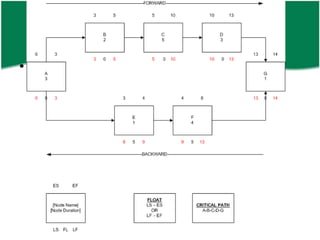
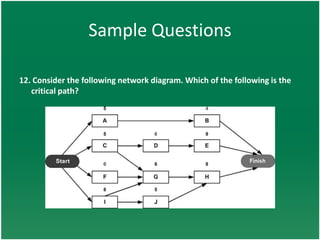
12. Consider the following network diagram. Which of the following is the
   critical path?
Sample Questions

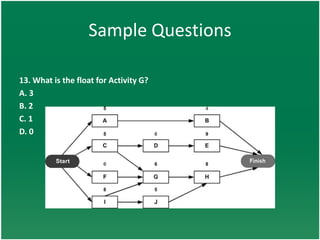
13. What is the float for Activity G?
A. 3
B. 2
C. 1
D. 0
Sample Questions

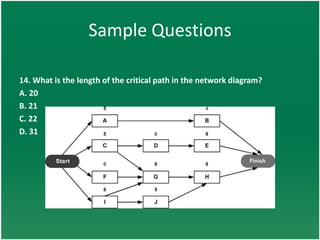
14. What is the length of the critical path in the network diagram?
A. 20
B. 21
C. 22
D. 31
Sample Questions

15. You use a three-point estimate for activity duration
   estimating. An activity has a duration of 9 days for an
   optimistic scenario, 18 days for a pessimistic scenario, and
   12 days for the most likely scenario. Which of the following
   will you take as the duration estimate for this activity if you
   use the PERT analysis?
A. 13 days
B. 12.5 days
C. 12 days
D. 18 days
Sample Questions

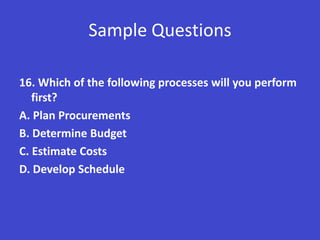
16. Which of the following processes will you perform
   first?
A. Plan Procurements
B. Determine Budget
C. Estimate Costs
D. Develop Schedule
Sample Questions

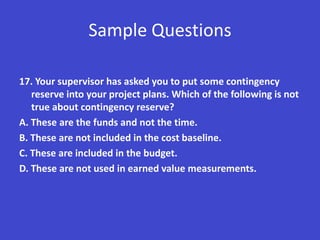
17. Your supervisor has asked you to put some contingency
   reserve into your project plans. Which of the following is not
   true about contingency reserve?
A. These are the funds and not the time.
B. These are not included in the cost baseline.
C. These are included in the budget.
D. These are not used in earned value measurements.
Sample Questions

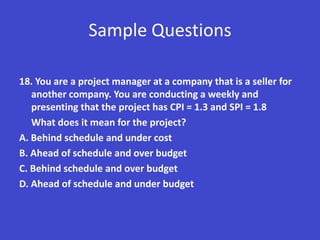
18. You are a project manager at a company that is a seller for
   another company. You are conducting a weekly and
   presenting that the project has CPI = 1.3 and SPI = 1.8
   What does it mean for the project?
A. Behind schedule and under cost
B. Ahead of schedule and over budget
C. Behind schedule and over budget
D. Ahead of schedule and under budget
Sample Questions

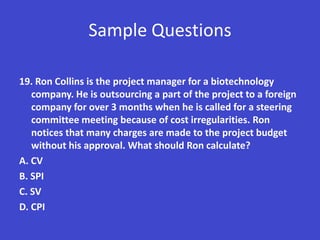
19. Ron Collins is the project manager for a biotechnology
   company. He is outsourcing a part of the project to a foreign
   company for over 3 months when he is called for a steering
   committee meeting because of cost irregularities. Ron
   notices that many charges are made to the project budget
   without his approval. What should Ron calculate?
A. CV
B. SPI
C. SV
D. CPI
Sample Questions

20. Management has asked you to produce a chart
   that depicts the resource needs for all the activities
   in the project. Which of the following charts is
   management referring to?
A. The project organizational chart
B. The WBS
C. The roles and responsibilities chart
D. The responsibility assignment matrix
Sample Questions

21. Which of the following is not an output of the
   Determine Budget process?
A. Cost performance baseline
B. Project funding requirements
C. Project schedule
D. Project document updates
Sample Questions

22. Which of the following is a true statement about
   the estimate cost process?
A. It is created by the human resources department.
B. It is a tool for team development.
C. It is created by the project manager with help from
   project team to produce output of the cost
   management planning efforts.
D. It is provided by the project sponsor.
Sample Questions

23. You are in the process of developing the cost
   baseline for your project. What is the name of this
   process?
A. Determine Budget
B. Develop Cost Baseline
C. Estimate Costs
D. Develop Budget
Sample Questions

24. Your project is in the planning stage. You first want
   to make the cost estimates for the planned project
   activities, and then you want to aggregate those
   costs. Which process will you perform first?
A. Determine Budget
B. Develop Human Resource Plan
C. Estimate Costs
D. Develop Budget
Pmp session 3

  • 1.
    PMP & CAPM ExamPreparation February 5, 2013
  • 2.
    Sessions 1. About theexam 2. Integration & Scope Management 3. Time & Cost Management 4. Quality & HR Management 5. Communication & Risk Management 6. Procurement Management
  • 3.
    Last Session Keypoint • Project Integration Management – Develop Project Charter – Develop Project Management Plan – Direct and Manage Project Execution – Manage and Control Project Work – Perform Integrated Change Control – Close Project or Phase
  • 4.
    Last Session Keypoint – cont’d • Project Scope Management – Collect Requirements – Define Scope – Create WBS – Verify Scope – Control Scope
  • 5.
  • 6.
    Project Time Management •Define Activities
  • 7.
    Project Time Management •Define Activities – I – Scope baseline (project scope statement, WBS, WBS Dictionary) – EEF – OPA
  • 8.
    Project Time Management •Define Activities – TT – Decomposition • Subdividing the project work packages into smaller, more manageable components called activities – Rolling wave planning • A form of progressive elaboration (near term work activities are defined in detail leaving the future work planned in high level detail) – Templates – Expert judgment
  • 9.
    Project Time Management •Define Activities – O – Activity list – Activity attributes • Extended description of activity list • Show association with each activity • Usually composed of Activity ID, WBS ID, Activity Name, Activity Codes, Description, Leads, Lags, Resource Requirements, etc – Milestone list • Significant point of event and its importance (mandatory/optional)
  • 10.
    Project Time Management •Sequence Activities
  • 11.
    Project Time Management •Sequence Activities – I – Activity list – Activity attributes – Milestone list – Project scope statement (esp. product characteristics) – OPA
  • 12.
    Project Time Management •Sequence Activities – TT – Precedence Diagramming Method (PDM) • Used in Critical Path Methodology (CPM) to construct project network diagram • Also called Activity On Node (AON)
  • 13.
    Project Time Management •Sequence Activities – TT (cont’d) – Precedence Diagramming Method (PDM)
  • 14.
    Project Time Management •Sequence Activities – TT (cont’d) – Dependency Determination • Mandatory dependencies – Contractually required / inherent in nature of the work – Dependencies often involves physical limitations – Also called / referred as “Hard Logic” • Discretionary dependencies – Also called / referred as “Preferred Logic” or “Soft Logic” – Established based on best practices (although many sequences options are acceptable) – Can create subjective total float values – Is subject to review / modification / removal when fast- tracking method is employed
  • 15.
    Project Time Management •Sequence Activities – TT (cont’d) – Dependency Determination • External dependencies – Usually caused by non-project activities / activities outside the project – E.g.: development of housing construction is dependent to material delivery – E.g.: software patching is dependent to the patch availability / purchasing confirmation
  • 16.
    Project Time Management •Sequence Activities – TT (cont’d) – Applying Leads and Lags
  • 17.
    Project Time Management •Sequence Activities – TT (cont’d) – Schedule Network Templates
  • 18.
    Project Time Management •Sequence Activities – O – Project schedule network diagrams – PD U (e.g.: activity list, attributes, risk register)
  • 19.
    Project Time Management •Estimate Activity Resources
  • 20.
    Project Time Management •Estimate Activity Resources – I – Activity list – Activity resources – Resource calendars • Availability, capabilities, skills – EEF – OPA
  • 21.
    Project Time Management •Estimate Activity Resources – TT – Expert judgment – Alternative analysis • Level of resource • Resources’ skills / capabilities • Size and type of machines / tools • Make-or-buy decision – Published estimating data • Rates based on geographical location • Delivery rates
  • 22.
    Project Time Management •Estimate Activity Resources – TT (cont’d) – Bottom-Up Estimating • Used when activities cannot be estimated with a reasonable degree of confidence • Uses aggregation/grouping of several activities – Project Management Software
  • 23.
    Project Time Management •Estimate Activity Resources – O – Activity Resources Requirements – Resource Breakdown Structure – PD U
  • 24.
    Project Time Management •Estimate Activity Durations
  • 25.
    Project Time Management •Estimate Activity Durations – I – Activity list – Activity attributes – Activity resource requirements – Resource calendars – Project scope statement (existing conditions, information’s availability, reporting periods, contractual pre-assignment) – EEF – OPA
  • 26.
    Project Time Management •Estimate Activity Durations – TT – Expert judgment – Analogous estimating • Uses historical information (the actual duration of previous, similar projects) • Timeless, costless, accurate-less • Usually used when there is limited detail / information about the project
  • 27.
    Project Time Management •Estimate Activity Durations – TT (cont’d) – Parametric estimating • Uses statistical relationship between historical information and other variables such as cost, budget, and duration • A quantitative method (using multiplication) • Relatively higher in accuracy (depending on the underlying data used for estimation)
  • 28.
    Project Time Management •Estimate Activity Durations – TT (cont’d) – Three-Point Estimates
  • 29.
    Project Time Management •Estimate Activity Durations – TT (cont’d) – Reserve analysis • Inclusion of the actual durations • Usually called contingency reserves / time reserves / buffers • Is subject to be used / reduced / eliminated • Must be documented in schedule information
  • 30.
    Project Time Management •Estimate Activity Durations – O – Activity duration estimates – PD U
  • 31.
  • 32.
    Project Time Management •Develop Schedule – I – Activity list – Activity attributes – Project schedule network diagrams – Activity resource requirements – Resource calendars – Activity duration estimates – Project scope statement (might have certain constraints / assumptions that impact schedule development)
  • 33.
    Project Time Management •Develop Schedule – I (cont’d) – EEF – OPA
  • 34.
    Project Time Management •Develop Schedule – TT – Schedule network analysis – Critical path method • Calculates early start, early finish, late start, and late finish dates for each activities with disregard to any resource limitations by performing forward and backward pass analysis through the schedule network • Have ZERO float and usually the longest path in the network diagram • Might be more than 1 critical path in any given network diagram
  • 35.
    Project Time Management •Develop Schedule – TT (cont’d) – Critical path method • Produces “free float”: a certain time length which an activity can be delayed without delaying the early date of its immediate successor activity within the network path
  • 36.
    Project Time Management •Develop Schedule – TT (cont’d) – Critical path method
  • 37.
    Project Time Management •Develop Schedule – TT (cont’d) – Critical path method
  • 38.
    Project Time Management •Develop Schedule – TT (cont’d) – Critical chain method • Accounts resource limitation • Also called “Resource-Constrained Critical Path” – Resource leveling • Used AFTER critical path method • Used when shared or critical resources are only available at certain times, in limited quantities, or to keep resource usage at constant level • Used when resources are over-allocated • Can cause change to original critical path
  • 39.
    Project Time Management •Develop Schedule – TT (cont’d) – What-If scenario analysis
  • 40.
    Project Time Management •Develop Schedule – TT (cont’d) – Applying Leads and Lags – Schedule compression • Crashing – Approve overtime – Add more resources – Only work if additional of resources can shorten the duration – May increase cost and/or risk • Fast tracking – Perform work in parallel (when default in sequential) – May increase risk of rework – Only work if overlapped activities can shorten duration
  • 41.
    Project Time Management •Develop Schedule – TT (cont’d) – Scheduling tool
  • 42.
    Project Time Management •Develop Schedule – O – Project schedule • Milestone charts • Bar charts • Project schedule network diagrams – Schedule baseline – Schedule data (resource requirements, alternative schedules, contingency reserves, etc) – PD U
  • 43.
  • 44.
    Project Time Management •Control Schedule – I – PMP – Project schedule – WPI – OPA
  • 45.
    Project Time Management •Control Schedule – TT – Performance reviews • Earned value management is applied • Difference between buffer needed and the buffer remaining can determine whether corrective action is necessary – Variance analysis – Project management software – Resource leveling
  • 46.
    Project Time Management •Control Schedule – TT (cont’d) – What-If scenario analysis – Adjusting leads and lags – Schedule compression – Scheduling tool
  • 47.
    Project Time Management •Control Schedule – O – Work performance measurements – OPA U – CR – PMP U • Schedule baseline • Schedule management plan • Cost baseline – PD U
  • 48.
  • 49.
  • 50.
    Project Cost Management •Estimate Cost – I – Scope baseline – Project schedule – HR Plan – Risk Register – EEF – OPA
  • 51.
    Project Cost Management •Estimate Cost – TT – Expert judgment – Analogous estimating – Parametric estimating – Bottom-up estimating – Three-point estimates – Reserve analysis – Cost of Quality
  • 52.
    Project Cost Management •Estimate Cost – TT – Project management estimating software – Vendor bid analysis
  • 53.
    Project Cost Management •Estimate Cost – O – Activity cost estimates • Labor, material, equipment, services, etc – Basis of estimates • Documentation of basis of the estimate, assumptions, constraints, confidence level, etc – PD U
  • 54.
  • 55.
    Project Cost Management •Determine Budget – I – Activity cost estimates – Basis of estimates – Scope baseline – Project schedule – Resource calendars – Contracts – OPA
  • 56.
    Project Cost Management •Determine Budget – TT – Cost aggregation • Accumulated component cost (usually from WBS) – Reserve analysis – Expert judgment – Historical relationship (used in analogous and parametric estimation) – Funding limit reconciliation
  • 57.
    Project Cost Management •Determine Budget – O – Cost performance baseline
  • 58.
    Project Cost Management •Determine Budget – O (cont’d) – Project funding requirement – PD U
  • 59.
  • 60.
    Project Cost Management •Control Cost – I – PMP • Cost performance baseline • Cost management plan – Project funding requirements – WPI – OPA
  • 61.
    Project Cost Management •Control Cost – TT – Earned value management (EVM) • PV, EV, AC • CV= (EV-AC) and SV= (EV-PV) • CPI= (EV/AC) and SPI= (EV/PV)
  • 62.
    Project Cost Management •Control Cost – TT (cont’d) – Forecasting (link to formula) • Estimate At Completion (EAC) • Estimate To Complete (ETC) • To-Complete Performance Index (TCPI) – Performance reviews • Trend analysis (improving / deteriorating) • Earned value performance (baseline vs. actual)
  • 63.
    Project Cost Management •Control Cost – TT (cont’d) – Variance analysis – Project management software
  • 64.
    Project Cost Management •Control Cost – O – Work performance measurements – Budget forecasts – OPA U – CR – PMP U • Cost performance baseline • Cost management plan – PD U • Cost estimates
  • 65.
    Sample Questions 1. Whichof the following is not an input item to the Define Activities process? A. The WBS B. The activity duration C. The project scope statement D. The WBS dictionary
  • 66.
    Sample Questions 2. Whyshould you monitor the activities on the critical path more closely? A. Because each activity on the critical path has a zero float time and thereby poses a schedule risk. B. Because the activities on the critical path need to be performed before the activities on other paths. C. Because the activities on the critical path are critical to the organization’s strategy. D. Because the activities on noncritical paths depend upon the activities on the critical path.
  • 67.
    Sample Questions 3. Youestimate the duration of an activity as five days because an expert told you that it took five days to complete a similar activity in a previous project. Which of the following methods have you used for your activity duration estimate? A. Parametric estimating B. Expert judgment C. Analogous estimating D. Delphi technique
  • 68.
    Sample Questions 4. Youhave developed the schedule for your project, and you’ve called the kickoff meeting. A team member who is responsible for an activity comes to you and tells you that the activity cannot be performed within the allocated time because some pieces were left out during activity definition. The revised estimate will add two more days to the activity duration, but the activity is not on the critical path. Which of the following actions will you take? A. Go to the team member’s functional manager and find out whether the team member’s estimate is correct. B. Accept the new estimate but do not change the schedule. C. Accept the new estimate and update the schedule accordingly. D. Put the new estimate through the integrated change control process.
  • 69.
    Sample Questions 5. Theamount of time by which an activity can be delayed without changing the project finish date is called: A. Float time B. Lag time C. Grace time D. Activity gradient
  • 70.
    Sample Questions 6. Whichof the following is the most commonly used network diagramming method? A. Critical path method (CPM) B. Critical chain method (CCM) C. Precedence diagramming method (PDM) D. Arrow diagramming method (ADM)
  • 71.
    Sample Questions 7. Whatis the crashing technique used for? A. Network diagramming B. Duration compression C. Cost reduction D. Activity sequencing
  • 72.
    Sample Questions 8. Whichof the following is a true statement about the critical path? A. Each activity on the critical path has zero float time. B. It controls the project finish date. C. It controls the project start date. D. It is the shortest sequence in the network diagram.
  • 73.
    Sample Questions 9. Inyour research project on tourism, you must collect data before the tourist season ends because the project involves interviewing tourists. The data- collection activity has which of the following kinds of dependency? A. Mandatory B. External C. Internal D. Discretionary
  • 74.
    Sample Questions 10. Youknow from a network diagram that Activity B cannot start until Activity A is finished. Which of the following are true? A. Activities A and B have a start-to-finish dependency. B. Activities A and B have a finish-to-start dependency. C. Activity B has a mandatory dependency on Activity A. D. Activities A and B are on a critical path.
  • 75.
    Sample Questions 11. Youare the project manager of a project that is running behind schedule. The project sponsor is very unhappy at the new finish date that you proposed, but he has accepted it. However, you also requested extra funds to support the extended time of work, and the sponsor has refused to supply more funds and is threatening to cancel the project if you cannot finish the project within the planned budget. What are your options? A. Crashing B. Fast tracking C. Asking the executive management for a new sponsor D. Speaking with the customer directly without involving the sponsor to see whether the customer can increase the budget
  • 76.
    Sample Questions 12. Considerthe following network diagram. Which of the following is the critical path?
  • 77.
    Sample Questions 13. Whatis the float for Activity G? A. 3 B. 2 C. 1 D. 0
  • 78.
    Sample Questions 14. Whatis the length of the critical path in the network diagram? A. 20 B. 21 C. 22 D. 31
  • 79.
    Sample Questions 15. Youuse a three-point estimate for activity duration estimating. An activity has a duration of 9 days for an optimistic scenario, 18 days for a pessimistic scenario, and 12 days for the most likely scenario. Which of the following will you take as the duration estimate for this activity if you use the PERT analysis? A. 13 days B. 12.5 days C. 12 days D. 18 days
  • 80.
    Sample Questions 16. Whichof the following processes will you perform first? A. Plan Procurements B. Determine Budget C. Estimate Costs D. Develop Schedule
  • 81.
    Sample Questions 17. Yoursupervisor has asked you to put some contingency reserve into your project plans. Which of the following is not true about contingency reserve? A. These are the funds and not the time. B. These are not included in the cost baseline. C. These are included in the budget. D. These are not used in earned value measurements.
  • 82.
    Sample Questions 18. Youare a project manager at a company that is a seller for another company. You are conducting a weekly and presenting that the project has CPI = 1.3 and SPI = 1.8 What does it mean for the project? A. Behind schedule and under cost B. Ahead of schedule and over budget C. Behind schedule and over budget D. Ahead of schedule and under budget
  • 83.
    Sample Questions 19. RonCollins is the project manager for a biotechnology company. He is outsourcing a part of the project to a foreign company for over 3 months when he is called for a steering committee meeting because of cost irregularities. Ron notices that many charges are made to the project budget without his approval. What should Ron calculate? A. CV B. SPI C. SV D. CPI
  • 84.
    Sample Questions 20. Managementhas asked you to produce a chart that depicts the resource needs for all the activities in the project. Which of the following charts is management referring to? A. The project organizational chart B. The WBS C. The roles and responsibilities chart D. The responsibility assignment matrix
  • 85.
    Sample Questions 21. Whichof the following is not an output of the Determine Budget process? A. Cost performance baseline B. Project funding requirements C. Project schedule D. Project document updates
  • 86.
    Sample Questions 22. Whichof the following is a true statement about the estimate cost process? A. It is created by the human resources department. B. It is a tool for team development. C. It is created by the project manager with help from project team to produce output of the cost management planning efforts. D. It is provided by the project sponsor.
  • 87.
    Sample Questions 23. Youare in the process of developing the cost baseline for your project. What is the name of this process? A. Determine Budget B. Develop Cost Baseline C. Estimate Costs D. Develop Budget
  • 88.
    Sample Questions 24. Yourproject is in the planning stage. You first want to make the cost estimates for the planned project activities, and then you want to aggregate those costs. Which process will you perform first? A. Determine Budget B. Develop Human Resource Plan C. Estimate Costs D. Develop Budget