








“EMPHERICAL TESTING OF CAPM”


   “A STUDY ON EMPHERICAL TESTING OF CAPITAL ASSET
                           PRICING MODEL ”
      (Conducted at Asit C. Mehta Investment Intermediates Ltd, Hassan)
       Project report Submitted to the University of Mysore, Mysore.
        In partial fulfillment of the requirement for the award of the
                Degree in Master of Business Administration.


                                     by

                           SHABRIN TAJ ASMA
                            Reg.No.08MB3746

                                   Guide
                            Mr. Subramanya P R


               HARANAHALLI RAMASWAMY
         INSTITUTE OF HIGHER EDUCATION, HASSAN
                          2008-10


HRIHE, HASSAN                                                             Page 1
“EMPHERICAL TESTING OF CAPM”


                          DECLARATION


I hereby declare that this project report entitled “A STUDY ON EMPHERICAL
TESTING OF CAPITAL ASSET PRICING MODEL” AT ASIT C MEHTA
INVESTMENT INTERMEDIATES LTD, HASSAN” has been prepared by me

under the guidance of Mr. P.K. Subramanya Lecturer, Department of
Business Administration, Haranahalli Ramaswamy Institute of Higher
Education, Hassan.

  I further declare that this project report is prepared from the information

collected from the ASIT C MEHTA INVESTMENT INTERMEDIATES LTD and

that the same is purely for academic purpose and that the report has not been

submitted to any other institution of higher learning for the award of any

degree, diploma or other similar title.


Date:                                            SHABRIN TAJ ASMA
Place: Hassan                                      Reg. No. 08MB3746


HRIHE, HASSAN                                                          Page 2
“EMPHERICAL TESTING OF CAPM”


                     ACKNOWLEDGEMENT
     I, express my deep sense of gratitude and sincere thanks to, Mr.

Santhish P Unit manager of Asit C. Mehta Investment and

Interrmediates Ltd, Hassan, who gave me an opportunity to conduct this

Research Project. I state with great pleasure this report would not have been

possible without the wonderful help from various quarters, the list of which

is quite too long.

     I will take this opportunity to express my deep sense of gratitude to Dr.

S R Jayaram, Administrator, HRIHE Hassan for his continuous

encouragement at every stage of the Project.

     I will take this opportunity to express my deep sense of gratitude to

Mr. Subramanya P.R, Lecturer, HRIHE, Hassan for his guidance,

continuous encouragement and valuable suggestions at every stage of the

Project.

     I would also like to extend my deep sense of gratitude to my parents

and all my family members, friends, who have directly or indirectly

supported and helped me in the completion of my project successfully

     Last, but not the least I would like to extend my thanks to all the unseen

hands that have made this project possible.


Date:                                          SHABRIN TAJ ASMA
Place: Hassan                                     Reg.No.08MB3746

HRIHE, HASSAN                                                            Page 3
“EMPHERICAL TESTING OF CAPM”


                            CONTENTS


Sl. No          Particulars                              Page.No
                Executive Summary
Chapter - 1     INTRODUCTION
1.01            Statement of the Problem
1.02            Objective of Study
1.03            Scope of the Study
1.04            Methodology
1.05            Limitations of Study
Chapter - 2     REVIEW OF LITERATURE
Chapter - 3     COMPANY AND INDUSTRY PROFILE
3.01            Industry Profile
3.02            Company Profile
3.03            Organization Structure
3.04            Achievements
3.05            SWOT Analysis
Chapter - 4     DATA COLLECTION AND INTERPRETATION


Chapter - 5     SUMMARY OF FINDINS, SUGGESSIONS AND
                CONCLUSION
                BIBLIOGRAPHY


HRIHE, HASSAN                                                    Page 4
“EMPHERICAL TESTING OF CAPM”


                                                         LIST OF
TABLES
Sl. No                      Particulars                   Page. No
                     Market Return of Nifty
4.01      For   the year- 2005
4.02      For   the year- 2006
4.03      For   the year- 2007
4.04      For   the year- 2008
4.05      For the year- 2009
4.06      Market Return
                  Wipro Technology Limited
4.07      For the year- 2005
4.08      For   the year- 2006
4.09      For   the year- 2007
4.10      For   the year- 2008
4.11      For   the year- 2009
                  Infosys Technology Limited
4.12      For   the year- 2005
4.13      For   the year- 2006
4.14      For   the year- 2007
4.15      For   the year- 2008
4.16      For   the year- 2009
                 HCL Technology Limited
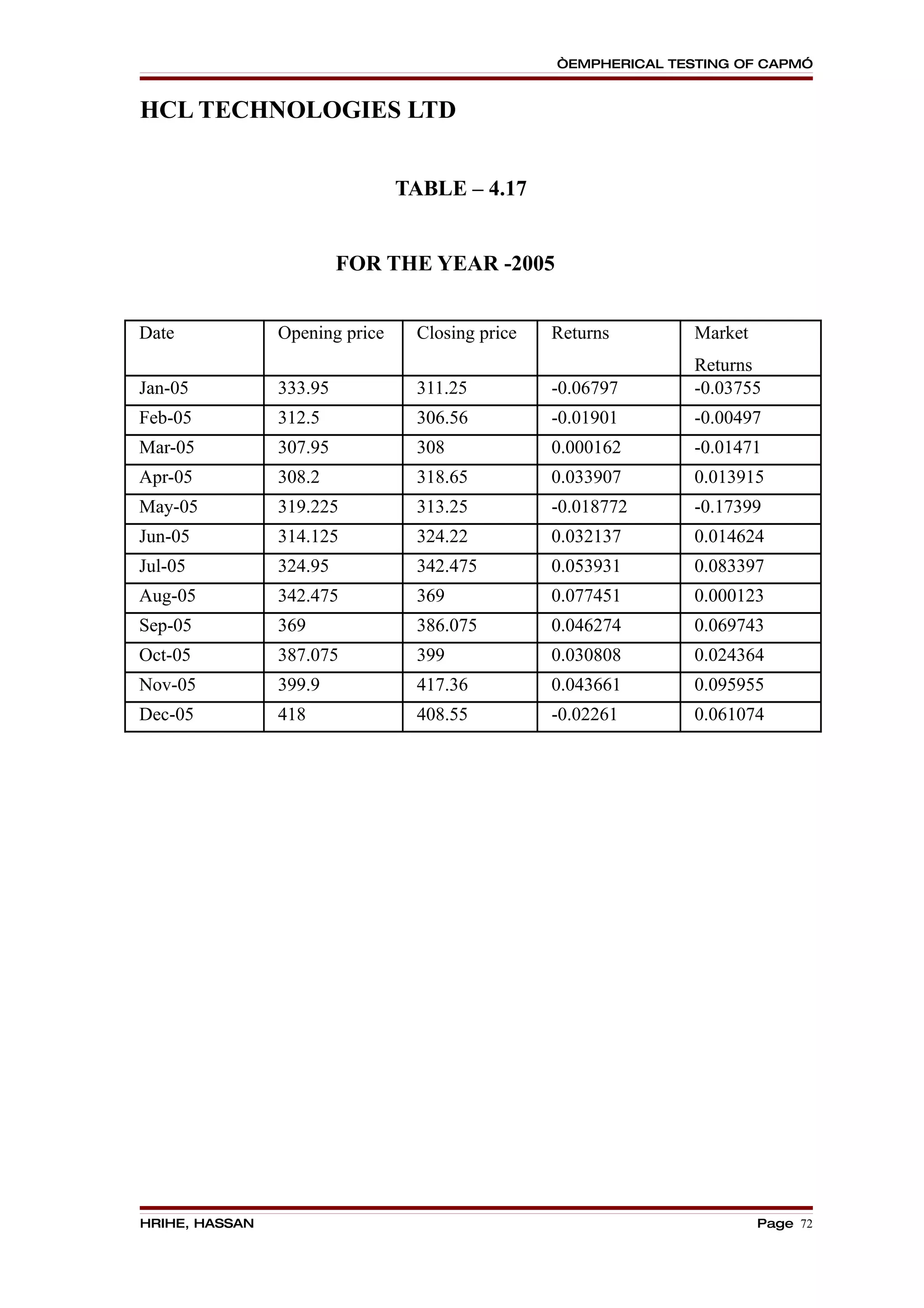
4.17      For the year- 2005
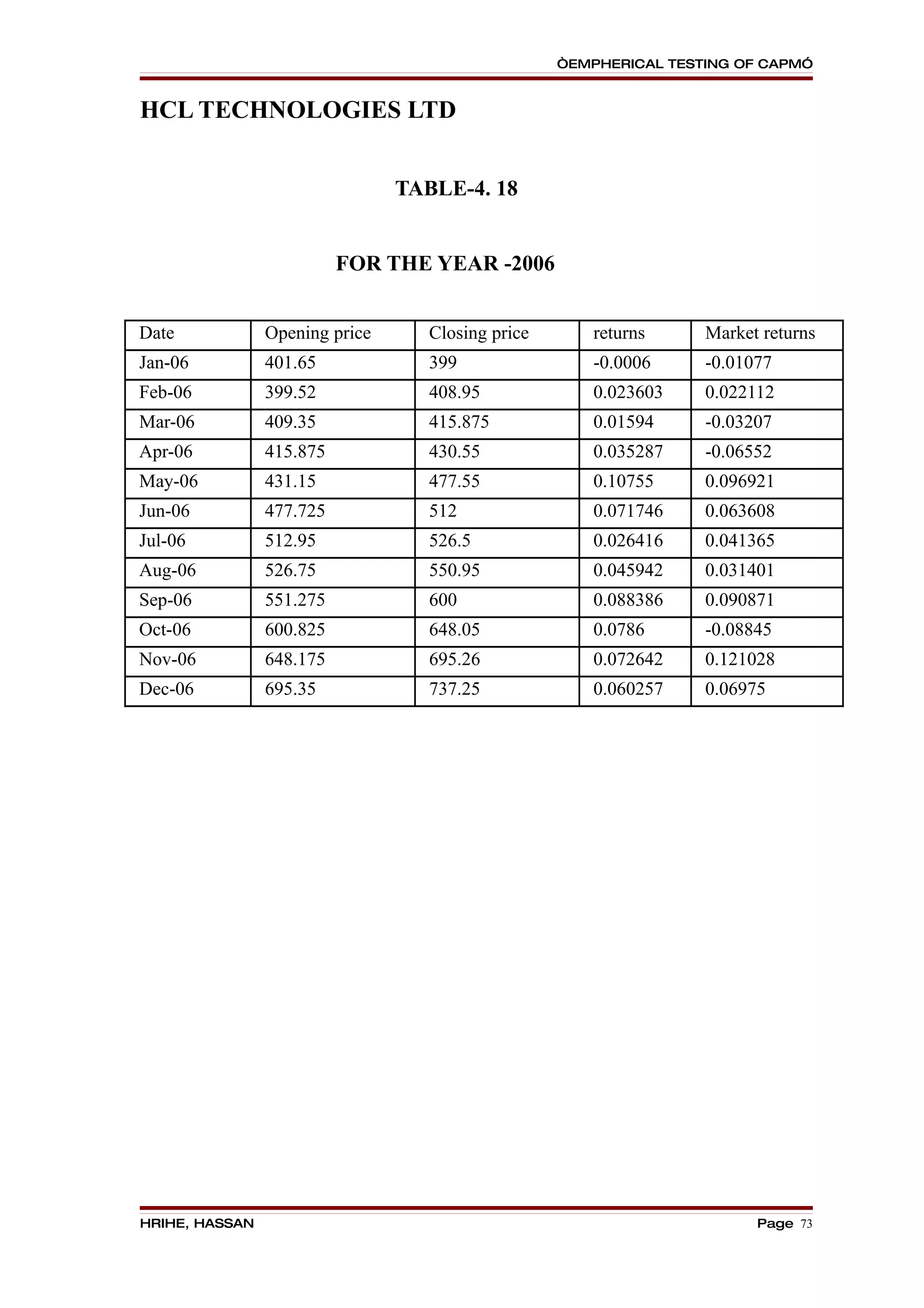
4.18      For the year- 2006
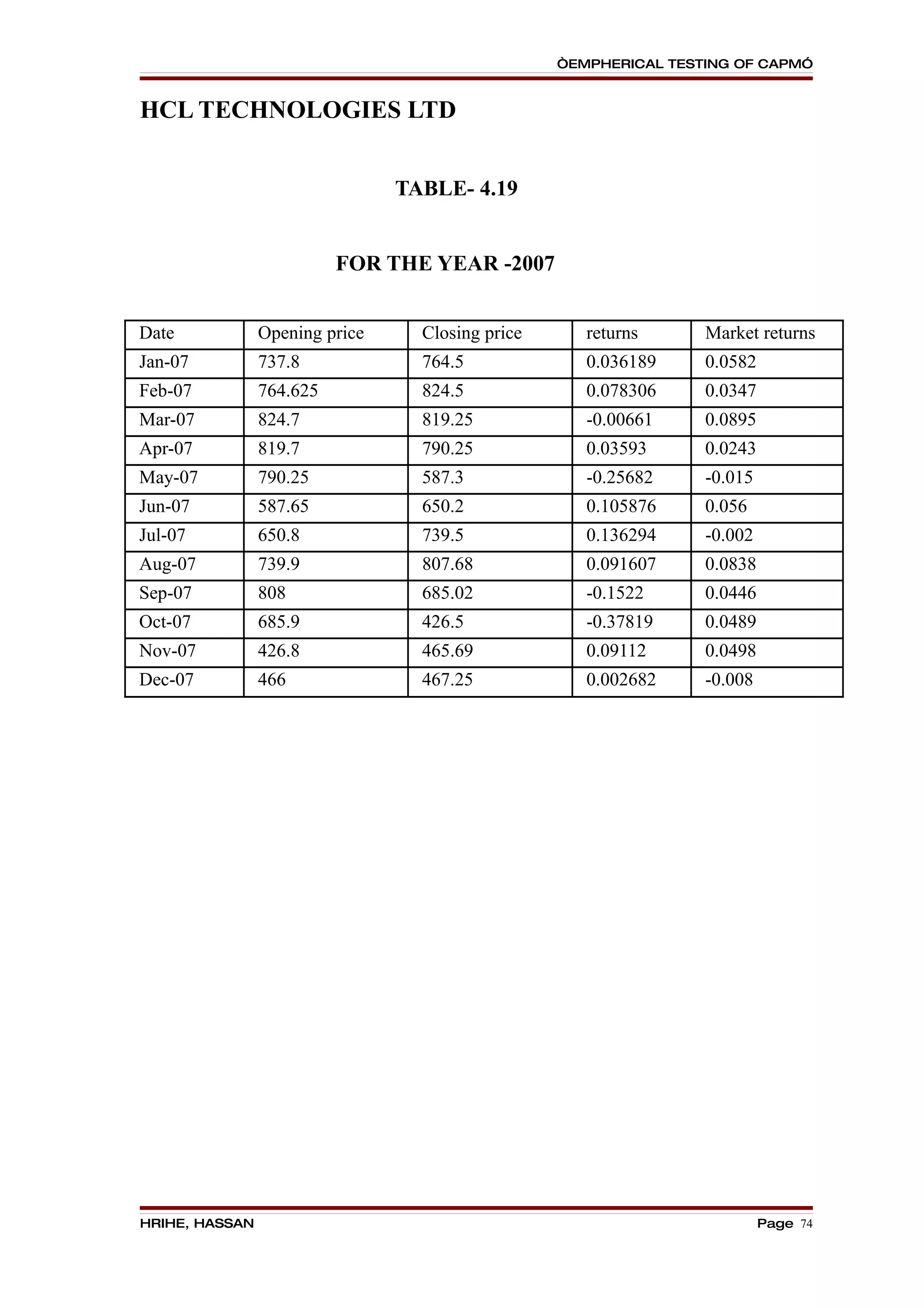
4.19      For the year- 2007
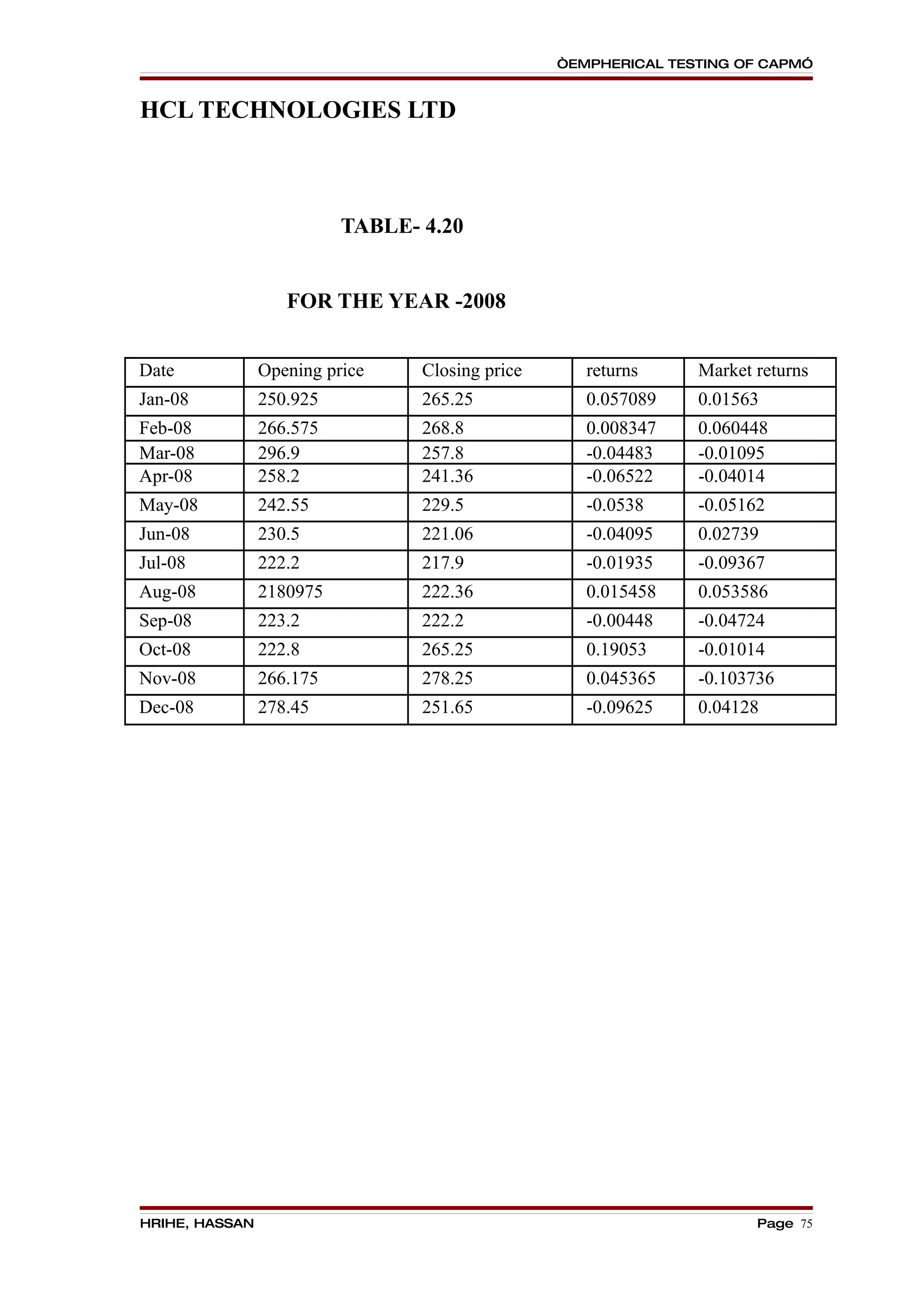
4.20      For the year- 2008
4.21      For the year- 2009
                 Tata Consultancy Service Limited
4.22      For the year- 2005
4.23      For the year- 2006
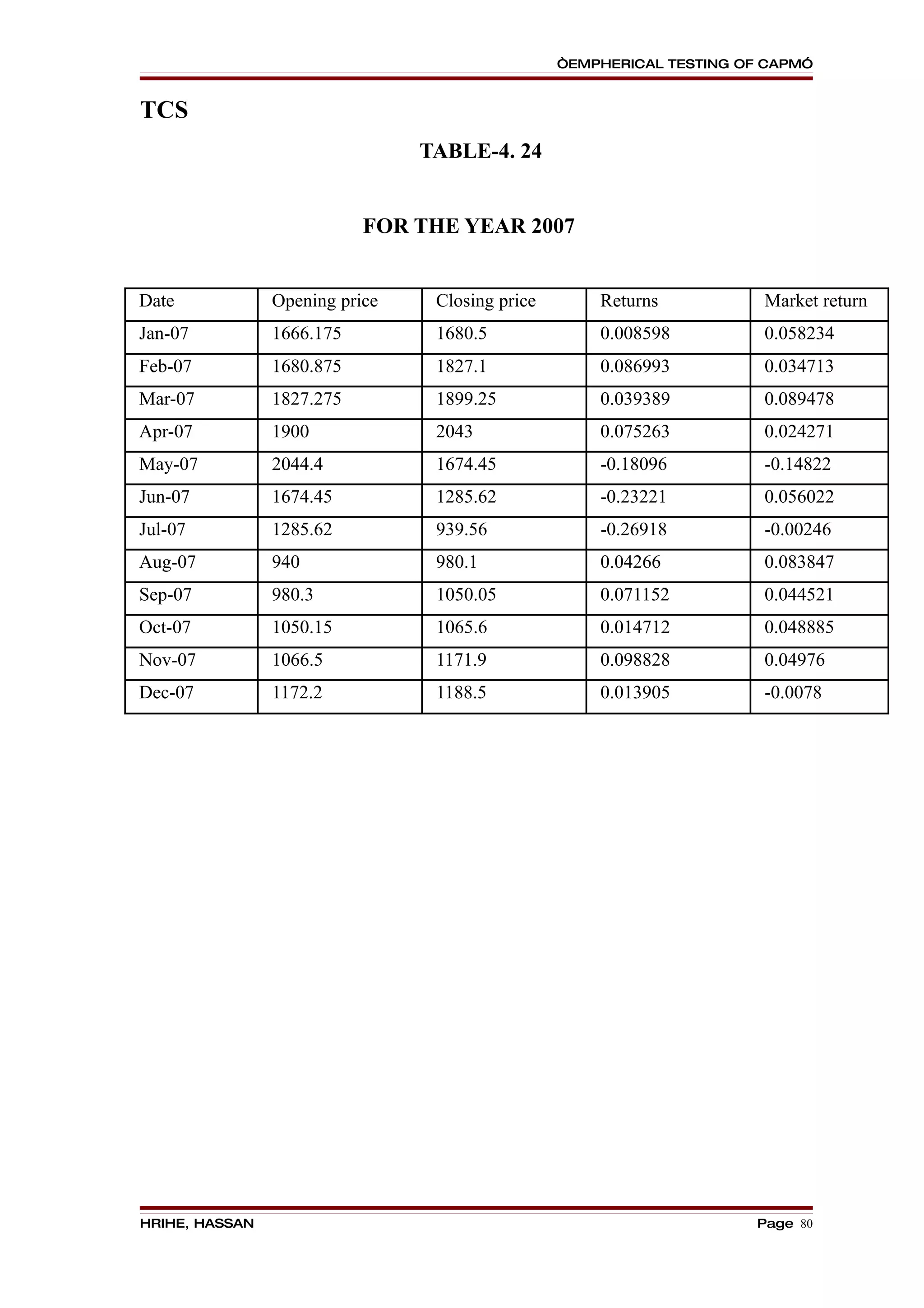
4.24      For the year- 2007

HRIHE, HASSAN                                                        Page 5
“EMPHERICAL TESTING OF CAPM”


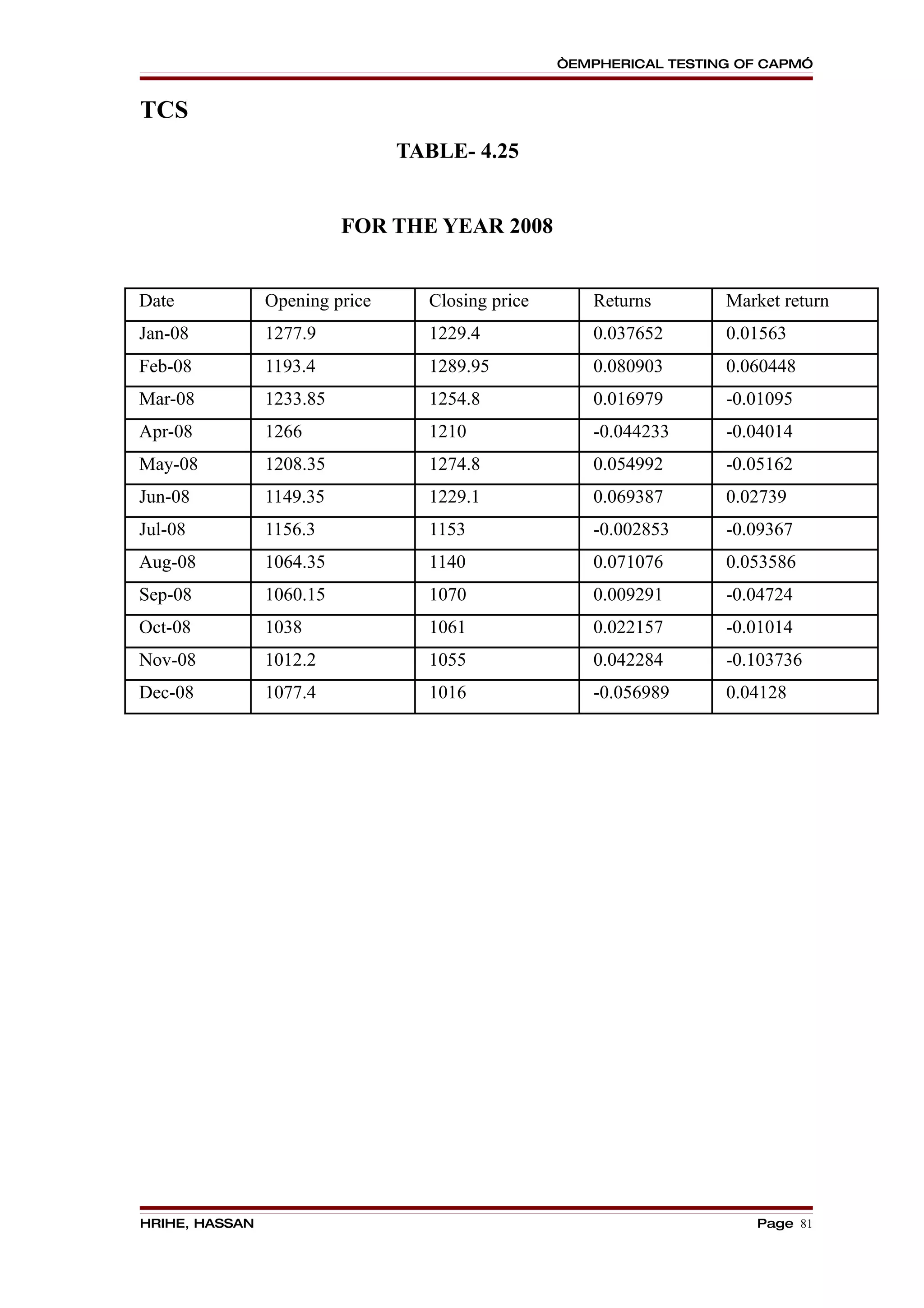
4.25      For the year- 2008
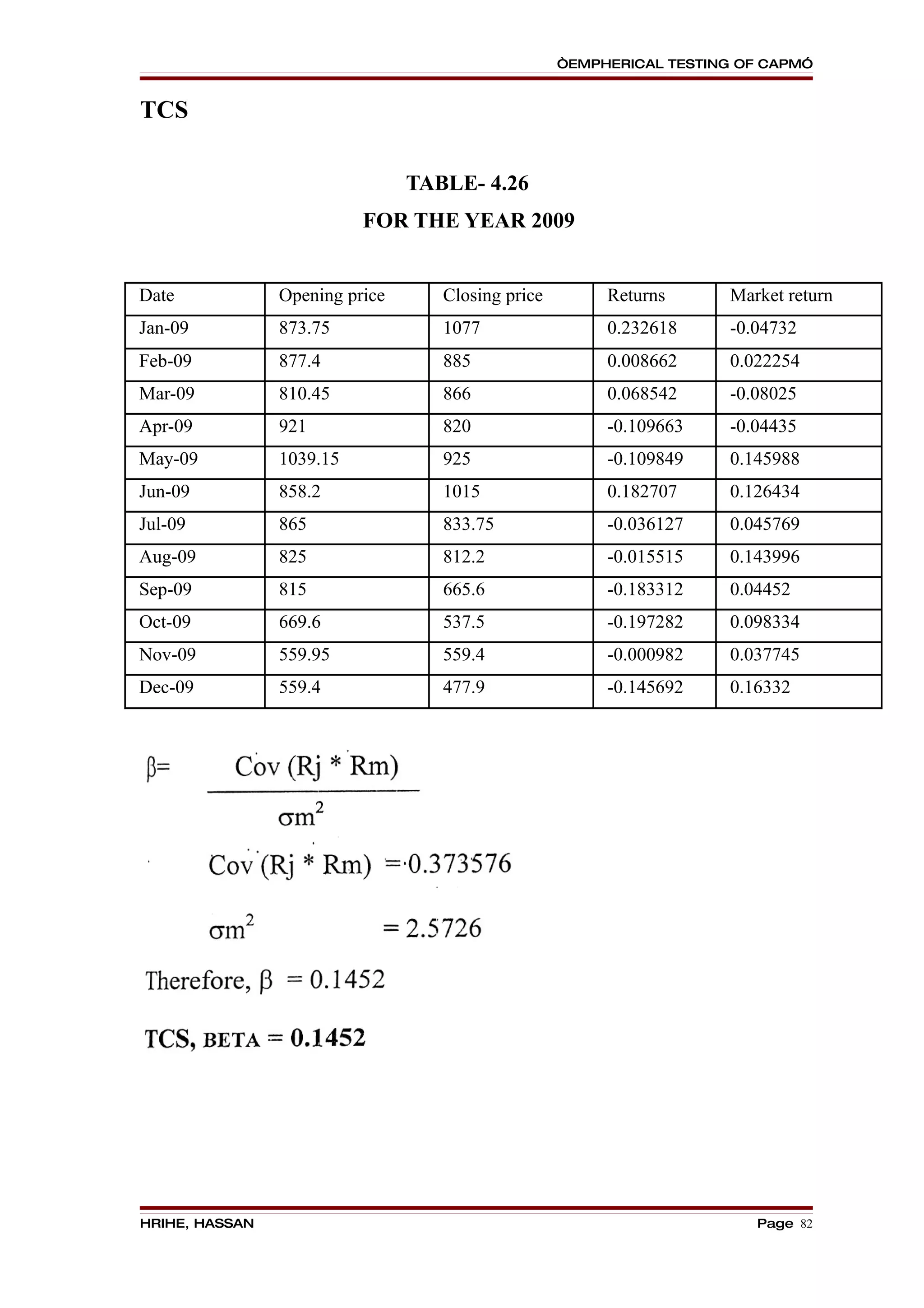
4.26      For the year- 2009


                 LIST OF GRAPHS


Sl.No                     Particulars                      Page. No
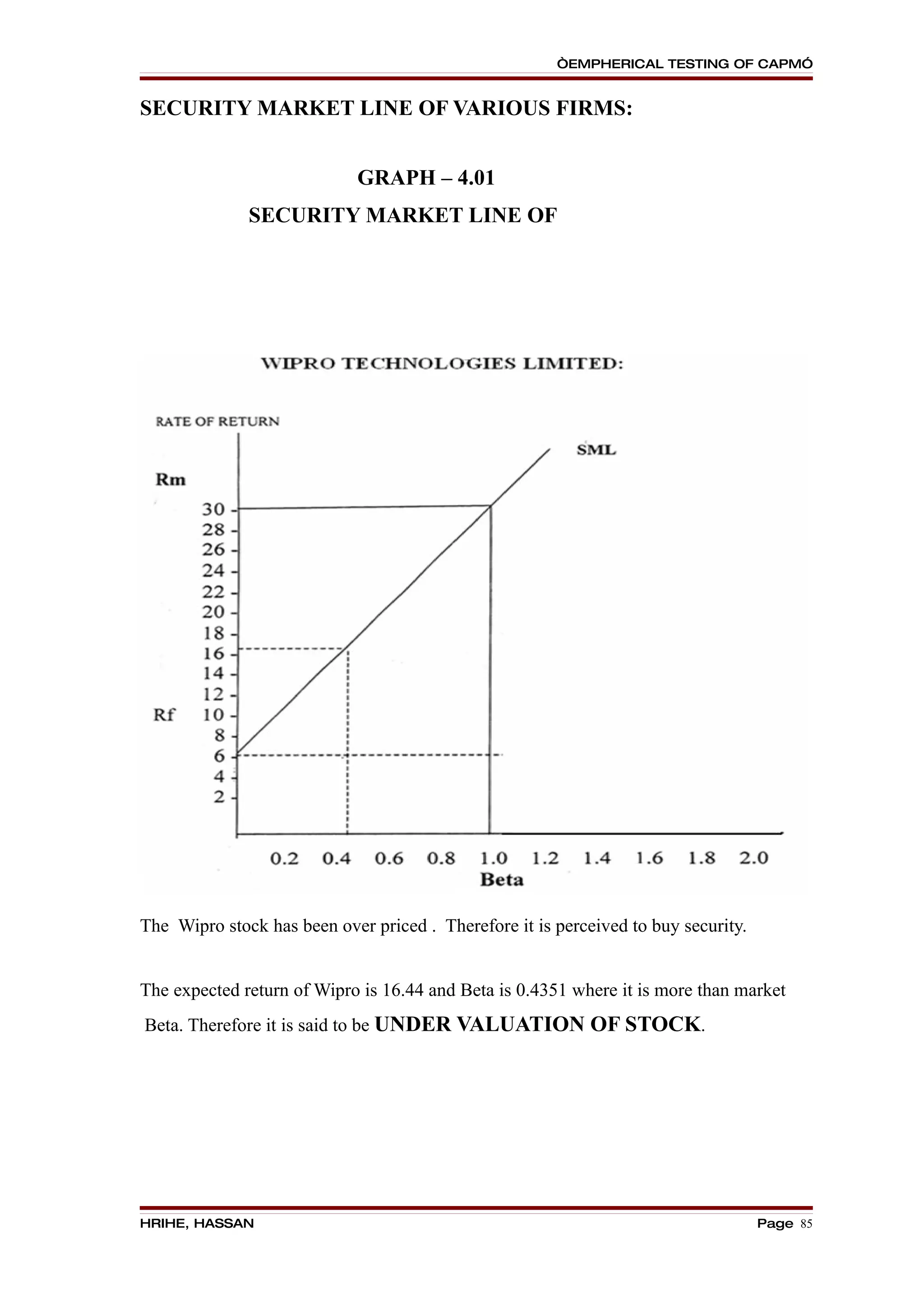
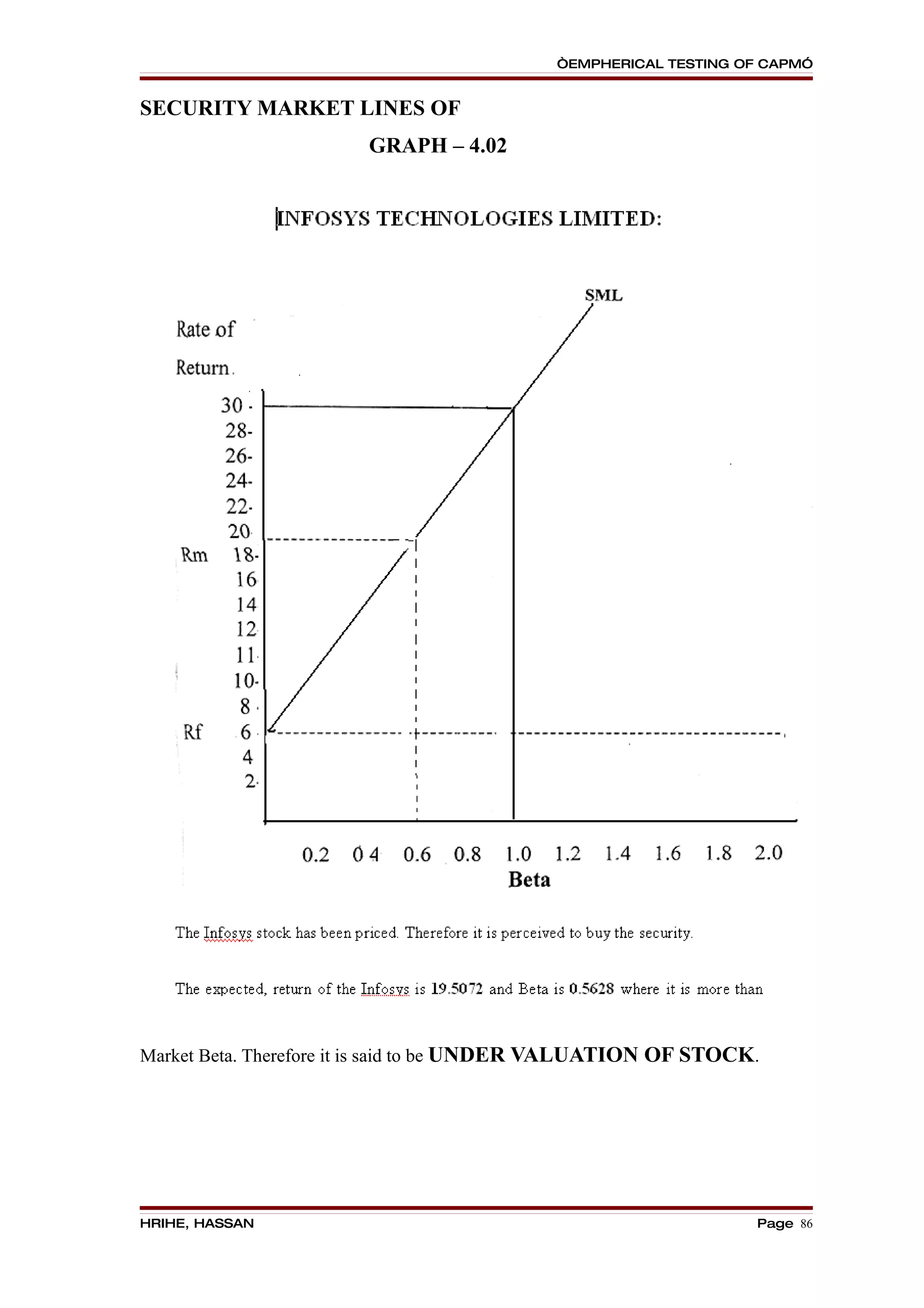
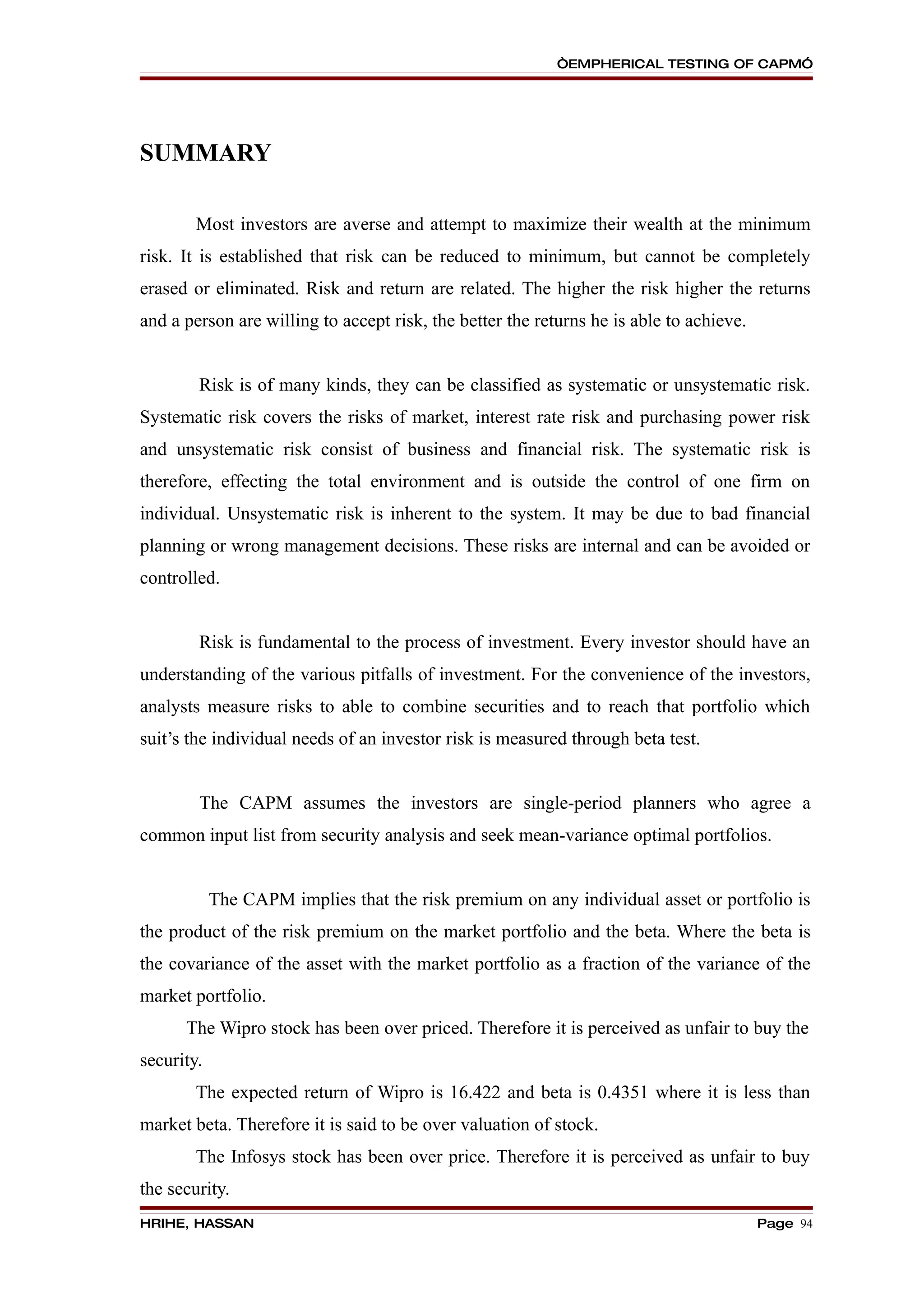
4.01        Wipro Technology limited

4.02.       Infosys Technology limited

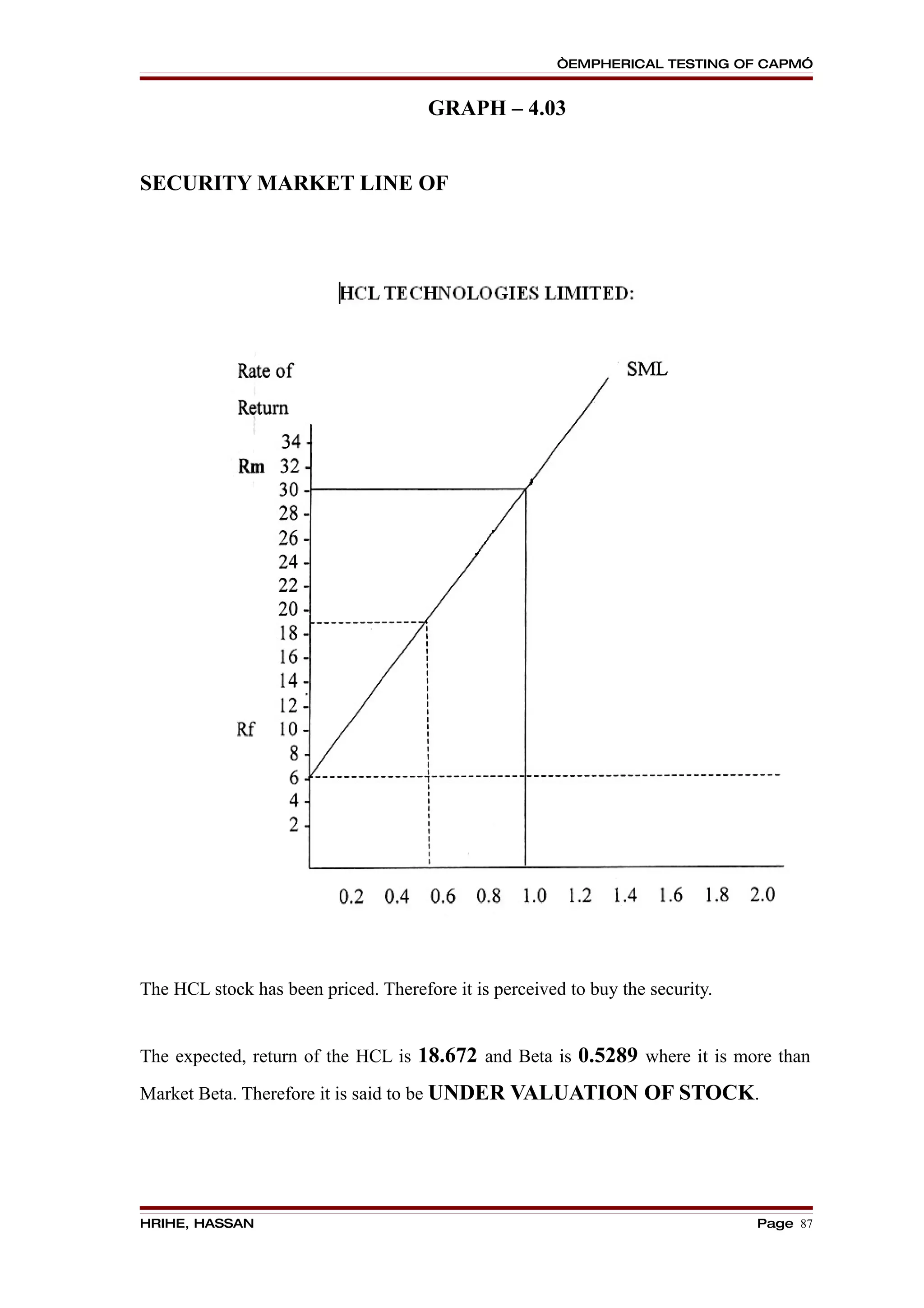
4.03        HCL Technology Limited

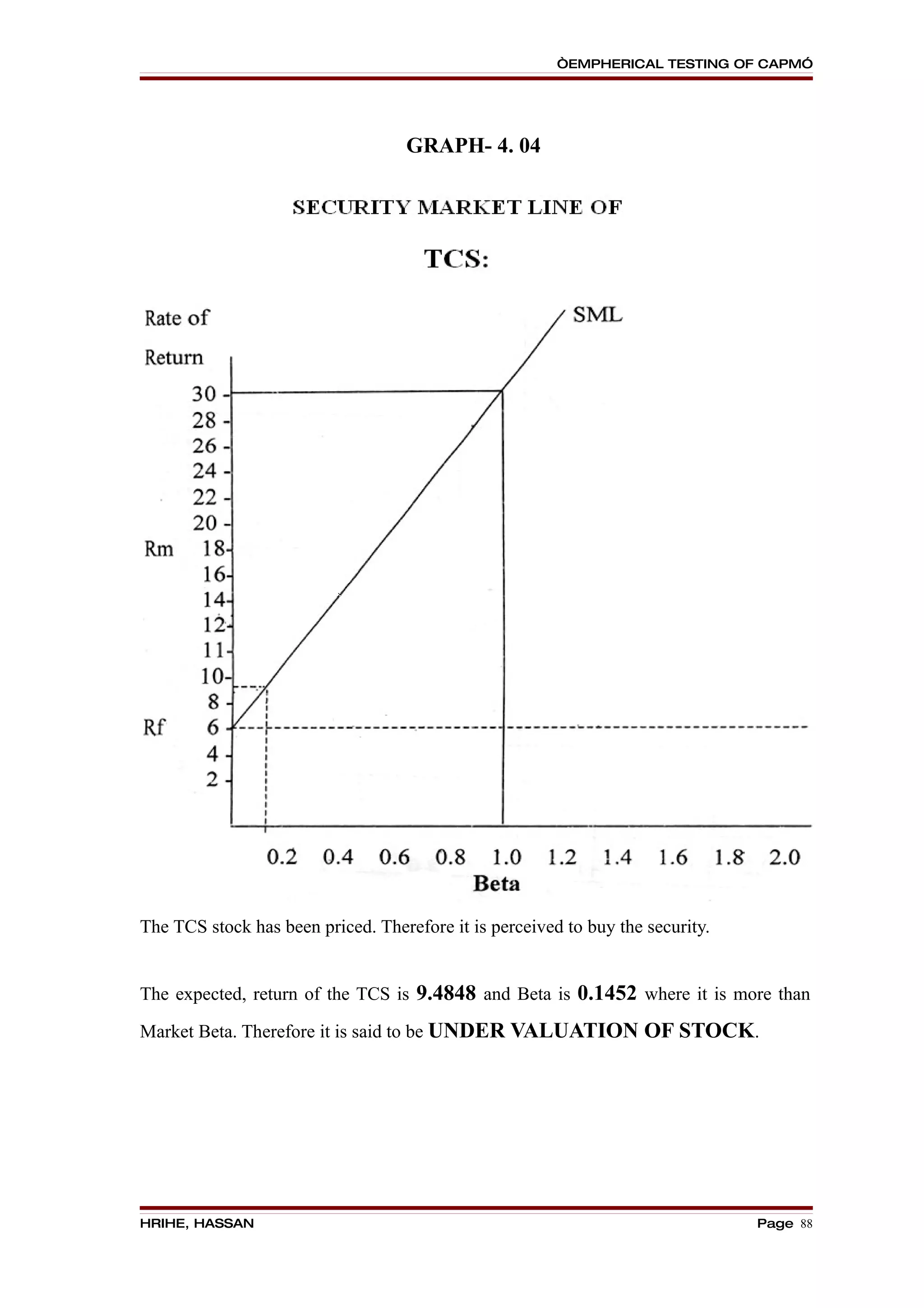
4.04        Tata Consultancy Services Limited


HRIHE, HASSAN                                                         Page 6
“EMPHERICAL TESTING OF CAPM”


                                 CHAPTER – 1
                          INTRODUCTION


1.1 EXECUTIVE SUMMARY:


      A portfolio is a bundle or a combination of individual assets or securities. The
portfolio theory provides a normative approach to investors to make decisions to invest
their wealth in assets or securities under risk. It is based after the assumption that
investors are risk-averse. This implies that investors hold well diversified portfolio

HRIHE, HASSAN                                                                   Page 7
“EMPHERICAL TESTING OF CAPM”


instead of investing their entire wealth in a single or a few assets. One important
conclusion of the portfolio theory is that if the investor of the portfolio theory is that if
the investor holds a well-diversified portfolio of assets then their concerns should be the
expected rate of return and risk of the portfolio, rather than individual assets and the
contribution of individual asset to the portfolio risk. The second assumption of the
portfolio theory is that the returns of assets are normally distributed. This means that the
mean and variance analysis is the foundation of the portfolio decisions. Further, we can
extend the portfolio theory to derive a framework for valuing risk assets. This framework
is referred to as CAPM.
      The CAPM is a model that provides a framework to determine the required rate of
return on an asset and indicates the relationship between return and risk of the asset. The
required rate of return specified by CAPM help in valuing an asset. Once can also
compare the expected return and determine whether the asset is fairly valued. As we
exemplifies the relationship between an asset’s required rate of return.
        Risk is of many kinds, they can be classified as systematic or unsystematic risk.
Systematic risk covers the risks of market, interest rate risk and purchasing power risk
and unsystematic risk consist of business and financial risk. The systematic risk is
therefore, effecting the total environment and is outside the control of one firm on
individual. Unsystematic risk is inherent to the system. It may be due to bad financial
planning or wrong management decisions. These risks are internal and can be avoided or
controlled.


        Risk is fundamental to the process of investment. Every investor should have an
understanding of the various pitfalls of investment. For the convenience of the investors,
analysts measure risks to able to combine securities and to reach that portfolio which
suit’s the individual needs of an investor risk is measured through beta test.


1.2 PROBLEM STATEMENT:
       Earning maximum returns on investments is definitely the motto for any investor.
Selecting stocks however, exclusively on the basis of maximization of return is not
enough. The fact that most investors do not place their available funds in few stocks
promising higher returns suggest that other factors must be considered besides returns in

HRIHE, HASSAN                                                                         Page 8
“EMPHERICAL TESTING OF CAPM”


selection process. Investor wants to maximize expected return subject to their assessment
and capacity to take risk. The risk associated with the holdings is that the return the study
of risk vis-à-vis reruns always holds a great significance, which immensely helps in key
decision-making process than the return that was expected. Hence, the study of risk vis-à-
vis reruns always holds a great significance which immensely helps in key decision-
making process.


        Investors thus need to make decisions as to what securities should be held.
Estimates need to be prepared of the return and risk associated with the securities for a
certain period of time. This is known as security analysis is built around the idea that
investors are concerned with expected return and risk, the two principal properties
inherent in securities.
        Thus the return and risk arid their measurement using Capital Asset Pricing
Model (CAPM) will be the core of to study undertaken. The attachment of the paramount
importance these two principal properties; return and risk, Inherent in securities with the
analysis of any investment decision makes the study significant.


1.2 OBJECTIVE OF STUDY:
    •   To measure the return on securities selected HCL Technologies, Wipro, Infosys,
        and Tata consultancy Services Limited
    •   To measure the systematic risk of the security by using beta as a measure of risk.
    •   To calculate expected rate of expected by investors on security for any level of
        risk.
    •   To evaluate with performance of stock using CAPM model.


HRIHE, HASSAN                                                                         Page 9
“EMPHERICAL TESTING OF CAPM”


1.03 SCOPE OF THE STUDY:
   •   The study is confined to the statistics of the four leading companies in IT
       industries.
   •   The BETA is calculated based on the returns for limited period as share prices for
       the period of 60 months.
   •   Only secondary sources data is used for 'the study, which limits with scope, of the
       research work.
   •   The index selected is Standard & Poor CNX NIFTY changes the index could
       resu1t in discrepancies in the result obtained.
   •   The firms selected for analysis have to be listed on NIFTY (since NIFTY is
       considered as the index).


HRIHE, HASSAN                                                                     Page 10
“EMPHERICAL TESTING OF CAPM”


1.04 METHODOLOGY:


RESEARCH DESIGN:
This study is an empirical one. Empirical research methods are a class of research
methods in which data are collected in order to answer research question.


STUDY DESIGN:
  In this study an attempt has been made to experiment the “Seasonality in Indian
  Stock Market” closing value of S&P Nifty Index as the sample.


TYPES OF DATA:
  Secondary data has been used for the analysis purpose.


HRIHE, HASSAN                                                               Page 11
“EMPHERICAL TESTING OF CAPM”


STUDY TYPE:
     The study type is analytical, quantitative and historical. Analytical because facts
and existing information is used for the analysis, Quantitative as relationship is
examined by expressing variables in measurable terms and also Historical as the
historical information is used for analysis and interpretation.


SAMPLING FRAME:
Sampling frame includes the closing value of S&P Nifty Index. Sample includes
historical closing values of S&P Nifty index value for the period of five years from
3rd March 2005 to 3rd March 2010 Sample Technique.


SAMPLE TECHNIQUE:

The sampling technique used is the convenient sampling. As the name implies, the sample
is selected because they are convenient. S&P CNX Nifty is a benchmark stock index
based on the selected stocks traded at National Stock Exchange (NSE).


DATA GATHERING PROCEDURE:

The major data relevant for this research is secondary data which has been collected from
Bangalore Stock Exchange ( BGSE ).


   DATA AND SAMPLE :

         The study is based on BSE Sensex companies that were part of the index
          from the beginning up to 30th June 2005.

         The list of 66 companies is drawn based on two criteria:-

         The companies selected should have been constituents of BSE Sensex

         Traded for a minimum time of six months in a year during the study period

         The data was collected from the CMIE (Prowess package), BSE, NSE, RBI,
          DCA, SEBI websites, etc.


HRIHE, HASSAN                                                                      Page 12
“EMPHERICAL TESTING OF CAPM”


CONVENIENT SAMPLING
       Selection of Companies: The economy was classified into segments as shown. In
each, of these segments a leading firm as selected. This firm is considered as a
representative of the top performing firms in the segments.


SEGMENT                                              FIRMS
                                                     Wipro Technologies ltd

                                                     Infosys technologies ltd
Information Technologies                             HCL Technologies ltd
                                                     TCS


METHOD OF CALCULATION OF RETURNS-
STEP: 1
       Daily share price of the stock is collected from the website of National stock
exchange.


STEP: 2
       The Daily index Value (NIIFTY) is downloaded from the National Stock
Exchange Website (www.nseindia.com) the composition of NIFTY is subjected to
scrutiny on a periodic basis. Any change in the composition of the NIFTY could impact
all the index value.


STEP: .3
       The Daily return (in percentage terms) of the stock and the index is calculated.


STEP: 4
These daily returns can be annualized in two ways:
(a) Arithmetic mean          (b) Geometric mean
       Geometric method is always a better option since compounding is taken into
account thought returns could be annualized using natural logarithm. The geometric
method of annualizing the return (by compounding) was preferred for its simplicity.


HRIHE, HASSAN                                                                      Page 13
“EMPHERICAL TESTING OF CAPM”


NOTE:
       The data has been analyzed from 1st January 2005 to 31st December 2010(i.e.,
for a period of 5 years). Even stock splits are considered over a period of time.


STEP: 5
       To find Beta Value of the stock is calculated using SPSS software. Beta is the only
measure in the CAPM concept.


STEP: 6
       Expected return calculation needs the risk free rate Rf is treasury bill. So, we have
assumed it as 6%.


STEP: 7
Expected Return by CAP M
E(R) =Rf+ β(Rm- Rf)
Where, Rm = Market Return of NIFTY
β= Beta Value (Return of Scripts and return of index) ,


STEP: 8
       Construction of “security market line” keeping Beta is the only measure scrutiny
market line was constructed for each firm's in order to identify the undervaluation and
over valuation of stock.


STEP: 9
       An detail analysis has been made with various sector stocks that the performance
of the stock could indicate that the expected return forecasted for a stock is more or less
than its "fair" return given its risk and it is also analyzed that this model helps us to make
an educated guess as the expected return on asset that have not yet been traded in the
market place. Although the CAPM does no fully with stand empirical tests. It is widely
used because the insight it offers and because its accuracy suffices for important
application.

HRIHE, HASSAN                                                                         Page 14
“EMPHERICAL TESTING OF CAPM”


1.05 LIMITATIONS
   •   As we consider Beta only, the bonus shares issued is not considered.
   •   The dividends issued on the shares are also not taken into account, since the effect
       on the return on the share would be minimal.
   •   Since the study concentrates on data from 1st January 2001 the effect if the
       change in NIFTY values would not have an impact on the study.


HRIHE, HASSAN                                                                      Page 15
“EMPHERICAL TESTING OF CAPM”


   •   Since the returns the calculated on yearly vise the Risk free Rate (Rf) was
       assumed as 6%, which would not give us a realistic picture of; the expected return.
   •   Since it is an academic exercise it may not have totally practical study.
   •   Unfortunately procedure is not very practical 'since information on investor
       expectation is very sketchy
   •   There may be a variation in calculation because we have tested the CAPM using
       ex post data, than ex ante data.


HRIHE, HASSAN                                                                      Page 16
“EMPHERICAL TESTING OF CAPM”


                             CHAPTER- 2
                REVIEW OF LITERATURE


2.01 AN OVERVIEW OF CAPITAL ASSET PRICING
MODEL CONCEPT
      The capital Asset pricing model is based on two, Parameter portfolio analysis
model developed by Markowitz (1952). This model was simultaneously independently
developed by John Linter (1965), Jan Mossion (1966) and William Sharpe (1964). In

HRIHE, HASSAN                                                               Page 17
“EMPHERICAL TESTING OF CAPM”


equation form the mode can be expressed as follows:


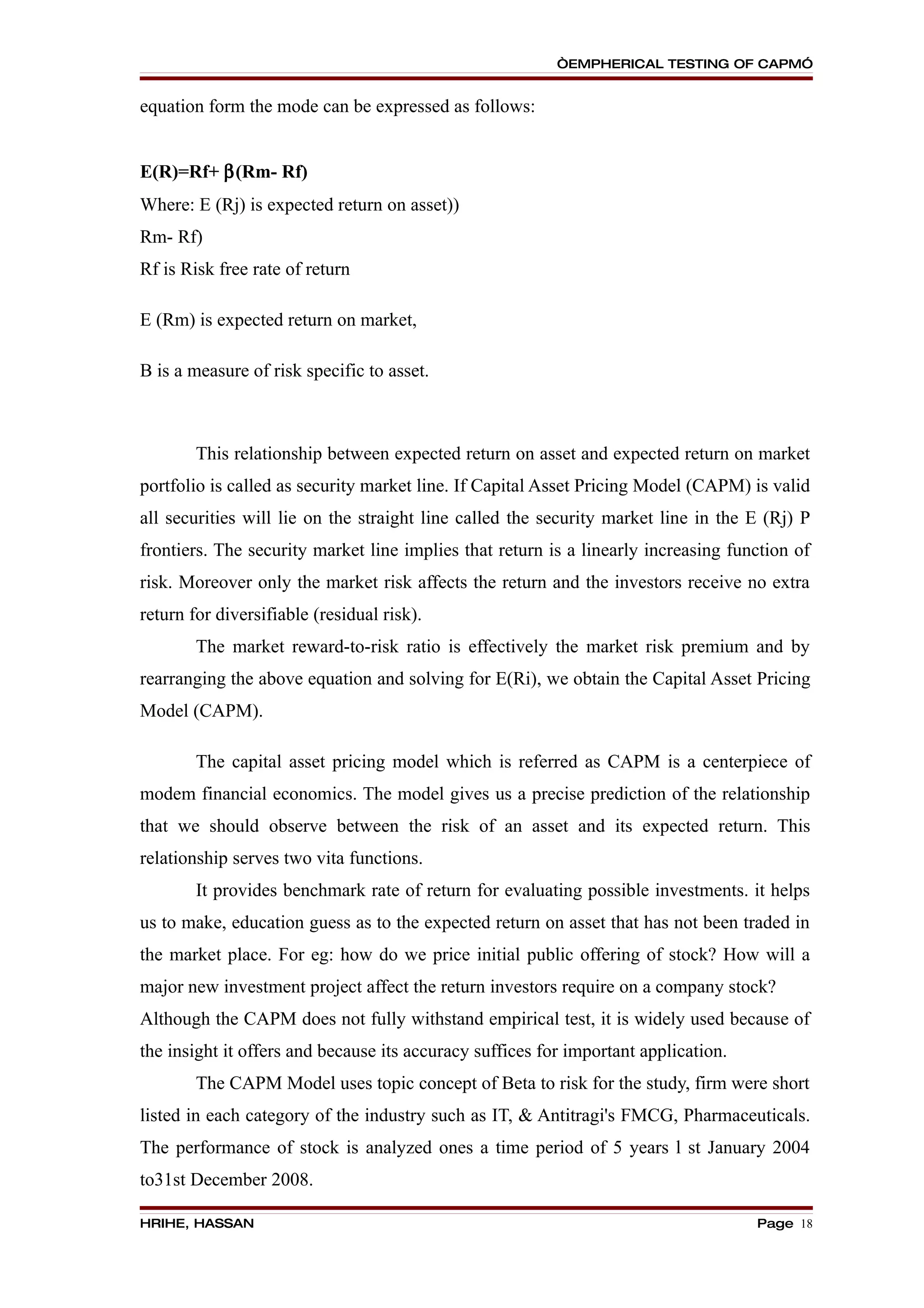
E(R)=Rf+ β(Rm- Rf)
Where: E (Rj) is expected return on asset))
Rm- Rf)
Rf is Risk free rate of return

E (Rm) is expected return on market,

B is a measure of risk specific to asset.


        This relationship between expected return on asset and expected return on market
portfolio is called as security market line. If Capital Asset Pricing Model (CAPM) is valid
all securities will lie on the straight line called the security market line in the E (Rj) P
frontiers. The security market line implies that return is a linearly increasing function of
risk. Moreover only the market risk affects the return and the investors receive no extra
return for diversifiable (residual risk).
        The market reward-to-risk ratio is effectively the market risk premium and by
rearranging the above equation and solving for E(Ri), we obtain the Capital Asset Pricing
Model (CAPM).

        The capital asset pricing model which is referred as CAPM is a centerpiece of
modem financial economics. The model gives us a precise prediction of the relationship
that we should observe between the risk of an asset and its expected return. This
relationship serves two vita functions.
        It provides benchmark rate of return for evaluating possible investments. it helps
us to make, education guess as to the expected return on asset that has not been traded in
the market place. For eg: how do we price initial public offering of stock? How will a
major new investment project affect the return investors require on a company stock?
Although the CAPM does not fully withstand empirical test, it is widely used because of
the insight it offers and because its accuracy suffices for important application.
        The CAPM Model uses topic concept of Beta to risk for the study, firm were short
listed in each category of the industry such as IT, & Antitragi's FMCG, Pharmaceuticals.
The performance of stock is analyzed ones a time period of 5 years l st January 2004
to31st December 2008.

HRIHE, HASSAN                                                                        Page 18
“EMPHERICAL TESTING OF CAPM”


2.02 WHAT IS RISK?
         Risk and uncertainty are in integral part of an investment decision. Technically
'risk' can be defined as a situation where the possible consequences of the decision that is
to be taken are known. Uncertainty is generally defined to apply to situations where the
probabilities cannot be estimated. However, risk and uncertainty are used inter
changeably.
       Risk is composed of the demands that bring in variations in return of income. The
main Forces contributing to risk are Price and interest. Risk is also influenced by external
and internal. External risks are uncontrollable and broadly affect investments. These
external risks are called systematic risk. Risk due to internal environment of a firm or that
affecting a particular industry is referred to as unsystematic risk.


2.03 DEFINING RISK:
       Risk in holding securities is generally associated with the possibility that realized
returns will be less that the returns that were expected in the most basic sense risk is the'
chance and financial loss.
       Forces that contribute to variation is return, in return - price or in dividend
contribute demeans of risks, some influences are external to the firm that cannot be
controlled and affect coverage number of securities and other influences are internal to
time firm and are controlled to a large degree.


2.04 TYPES OF RISK:
1) SYSTEMATIC RISK: Systematic risk is non-diversifiable and is associated with
the securities market as well as the economic, sociological, political and legal
considerations of the prices of all securities in the economy. The affect of all stocks will
move in the same direction. For example, during a boom period prices of all securities
will rise and indicate that the economy is moving towards prosperity.


2) UNSYSTEMATIC RISK: Unsystematic risk is unique to a firm or industry. It
does not affect an average investor. Unsystematic risk is caused by factors like labor
strike, irregular disorganized management policies and, consumer preferences. These
factors are independent of the price mechanism operating in the securities market. The
HRIHE, HASSAN                                                                        Page 19
“EMPHERICAL TESTING OF CAPM”


problems of both systematic and unsystematic risk are inherent in industries dealing with
basic raw-materials as well as in consumer goods industries.


TYPES OF RISK
        Systematic and Unsystematic risks can be further classified. Systematic risk covers
market risk, interest rate and unsystematic risk contains business and financial risk. Every
industry and its shareholders face both systematic and unsystematic risk. The systematic
portion results from overall market influences and the unsystematic portion results from
company and industry influences Systematic and unsystematic risk can be sub-divided
and analyzed separately.


SYSTAMATIC RISK
Market risk, interest rate risk and purchasing power risk are grouped under systematic
risk.
a) MARKET RISK: Market risk triggers off through real events comprising political,
social and economical reasons. The initial decline of 'rise' in market price will create an
emotional instability of investors and cause a fear of loss or create an under confidence,
relating to the possibility of profit. The gain will bring in the activity of active buying of
securities. However, investors are more receive towards decline in prices rather than
increase in prices.
        Investors can try and eliminate market risk by being conservative in farming their
portfolios. They any time their stock purchases and also choose growth stocks only.
These methods will reduce their risk to some degree but as explained earlier, market risk
will not be completely eliminated because falling markets would bring down the prices of
all stocks.


b) INTEREST RATE RISK: Interest rate risk can also be reduced by analyzing the
different kind’s securities available for investment. A government bond or a bond issued
by the financial institution like IDBI is a risk less bond. Even if government bonds give a
slightly lower rate of interest in the long run are better for a conservative investor because
he/she is assured of return. Moreover, government bonds are made more attractive by
additional advantages of tax benefits. Therefore, one way to avert interest rate risk would
be to purchase government securities.


HRIHE, HASSAN                                                                         Page 20
“EMPHERICAL TESTING OF CAPM”


c) PURCHASING POWER RISK: Purchasing power risk is also known as
inflation risk. This risk arises out of change in the prices of goods and services and
technically it cover both inflation and deflation periods. During the last two decades, it
has been seen that inflationary pressures have been continuously affecting the Indian
economy. Therefore, in India, purchasing power risk is associated with inflation and
rising prices in the economy.
       Inflation in India has been either 'cost push' or 'demand pull'. This type of
inflation has been seen when cost pf production rise or when there is a demand for
product but there is no smooth supply' and consequently prices rise. In India, the cost-
push inflation has led to enormous problems as the rise in prices of raw materials has
greatly' increased cost of production. The increases in costs of production have shown a
rising trend in 'wholesale price index and consumer price index'. A rising trend is price
index reflects a price, spiral in the economy.


UNSYSTEMATIC RISK
       Unsystematic Risk is specific to a particular company or an industry.
Unsystematic risk is that portion of total, risk that arises due to the factors which affects
the internal working of the firm. Factors like, management capability, consumer
preferences, labor strikes and stages in product life cycle can affect the firm's variability
in return. Two main sources of systematic risks are" Business Risk and Financial Risk.
Unsystematic risk be eliminated through diversification and proper asset allocation. An
investor gets no reward for taking unneeded unsystematic risk as this risk can be easily
eliminated by diversification.


a) BUSINESS RISK: Business risk is faced by the, firm due to the operating
conditions prevailing within a firm and also the extent to which these conditions affects
the operating income and expected dividend variability of the firm. Business risk can be
divided into two categories Internal and External.
      Internal Business Risk signifies the internal competency or efficiency of the firm to
effectively operate in the environment imposed on it. Every business firm is faced with
internal risks and the degree to which these risk are minimized are reduced depends on
the efficiency of the firm. For example, the firm can minimize the chances of labor
strikes by efficiently managing the management -labor relationship.
       External Business Risk arises from the circumstances imposed by the operating

HRIHE, HASSAN                                                                        Page 21
“EMPHERICAL TESTING OF CAPM”


environment, which are beyond the control of the firm. Every firm faced certain external
risk, which arises as the result of operating in the specific industry. For example sales in
steel and auto industries move in accordance to the businesscyc1e. 'Demographic
considerations also affect the, revenue of a firm also the political policies, which include
monetary and fiscal policies effect are an important part of external business risk.


b) FINANCIAL RISK: The ways and means by which company finances their
activity constitutes Financial Risk. The degree of financial risk can be interred from the
capital structure of a firm. The amount of debt or borrowed capital in the financial
structure signifies interest payment by the firm to the debt holders or preference
shareholders. As a result of which the, earning left for equity shareholders keep varying
depending on the interest and principal, payment Financial, risk can be avoidable to the
extent to which the management has the freedom to decide whether to borrow money or
not. A debt free firm has no financial risk.


c) DIVERSIFICATION OF PORTFOLIO: Unsystematic risk diversifiable risk
can be eliminated though diversification in portfolio. Diversification means dividing the
portfolio into different stocks and not investing the money in one particular stock. This
will provide the investor with better return and better risk management, as this will
distribute the risks. This is due to the fact that the returns on money invested in different
securities indifferent industries are negatively co-related so their risk will rise and fall
without any relation to each other. For example, as investor has bought the stocks of an
umbrella company and company manufacturing sunglasses which are negatively
correlated. So, the fall in return on umbrella, stocks will be offset with the increase of
return in sunglasses stocks during summer. The explanation of the ingredients of
systematic risks show that market interest rate risk and purchasing power risk are the
principal sources of systematic risk in securities the unsystematic rise which affects the
internal environment of a firm or industry although peculiar to a particular industry also
causes variability of returns for a company's stock. The two kinds of unsystematic risks in
a business organization are 'Business Risk and Financial Risk'. The characteristics of
these firms of risks are broadly described.


2.05 RISK MEASUREMENTS:
       Risk of an asset can be measured using statistics, the two statistics being the

HRIHE, HASSAN                                                                          Page 22
“EMPHERICAL TESTING OF CAPM”


standard deviation and the co-efficient of variation that can be used to measure the
variability of asset returns.


2.06 STANDARD DEVIATION
       The most common statistical indicator of an asset risk is the standard deviation,
which measures the dispersion around the expected value. The greater the magnitude of
deviation and the greater the probability of its occurrence, the greater is said to be risk of
the security. Although, many people concerned only with downside risk, or the possibility
of a negative return as these consider only returns below the expected value are
nevertheless the common approach is to view risk as determined by the variability on
either side of the expected value because the greater variability, the less confident one can
be of the outcomes associated with an investment. The expected value of a return R is the
most likely return on 'an asset that is, calc u1ate d as


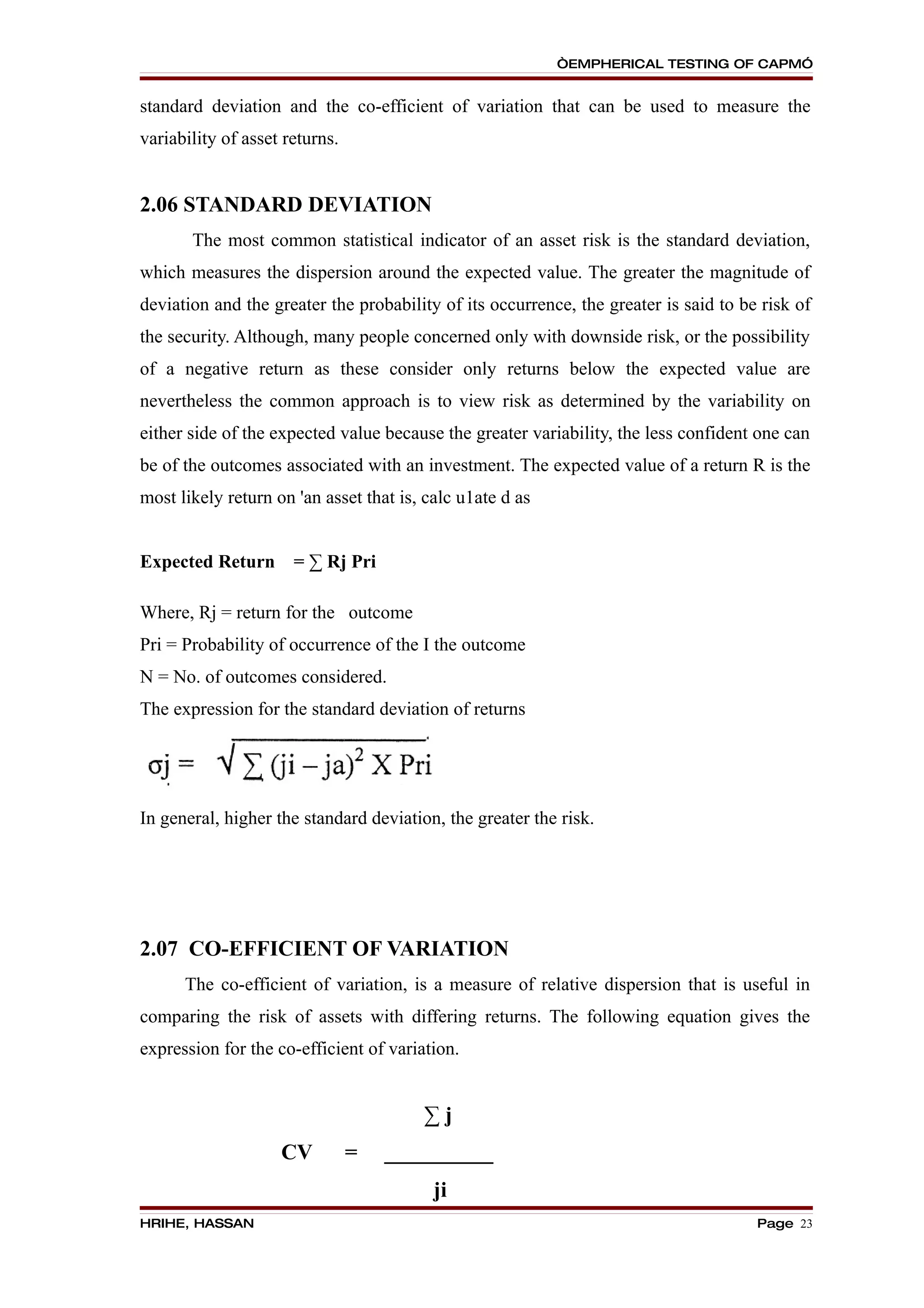
Expected Return       = ∑ Rj Pri

Where, Rj = return for the outcome
Pri = Probability of occurrence of the I the outcome
N = No. of outcomes considered.
The expression for the standard deviation of returns


In general, higher the standard deviation, the greater the risk.


2.07 CO-EFFICIENT OF VARIATION
      The co-efficient of variation, is a measure of relative dispersion that is useful in
comparing the risk of assets with differing returns. The following equation gives the
expression for the co-efficient of variation.


                                        ∑j
                    CV          =   __________
                                          ji
HRIHE, HASSAN                                                                         Page 23
“EMPHERICAL TESTING OF CAPM”


The higher the co-efficient of variation, the greater.
        The real utility of the coefficient of variation come in comparing the risk of assets
that have different expected returns.


2.08 CO-VARIANCE
        While standard deviation is an excellent measure for calculation of risk of
individual stocks, it has its limitations as a measure of a total portfolio. With the
correlation, the covariance approach should also be considered while there ate two or
three stocks on the portfolio. Co-variance can be used to achieve the highest portfolio
expected return for a pre-determined portfolio variance level or the lowest portfolio
return. An individual security' expected return and variance express return and risk for
portfolios of stocks; the expected return is the weighted according to each securities
rupee proportion in the portfolio. Since stocks tend to cover or move together, portfolio
risk cannot expressed for an individual stock. The formula for calculation of co-variance I
and J and the covariance of stocks with beta co-efficient is shown.


2.09 RETURN MEASUREMENT
        The returns incorporate both income and price, change into a total return. Return
across the time or from different securities can be measured and compared using the total
return concept. The total return for a given ,holding period relates all the cash flows
received by an investor during any designated time period to the amount it of money
Inverted in asset. It is defined as


TOTALRETURN=Cash Payment Received + Price Change Over the Period.
                                        Purchase Price of the Asset


        The price change ones the period' is the difference between the beginning (or
purchase) price and the ending price (or sales) price. Symbolically it can be define as


HRIHE, HASSAN                                                                        Page 24
“EMPHERICAL TESTING OF CAPM”


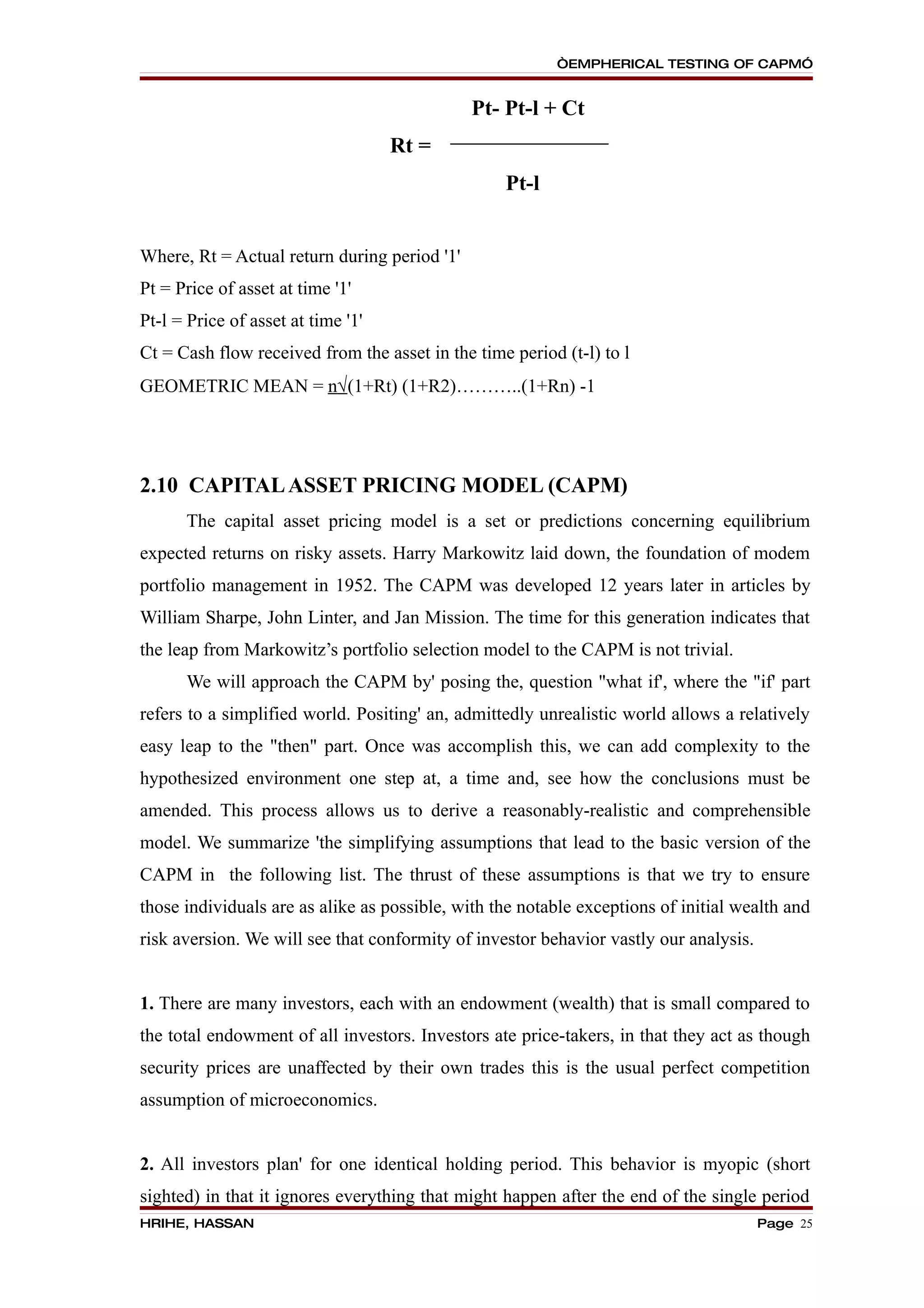
                                              Pt- Pt-l + Ct
                                    Rt =
                                                  Pt-l


Where, Rt = Actual return during period '1'
Pt = Price of asset at time '1'
Pt-l = Price of asset at time '1'
Ct = Cash flow received from the asset in the time period (t-l) to l
GEOMETRIC MEAN = n√(1+Rt) (1+R2)………..(1+Rn) -1


2.10 CAPITAL ASSET PRICING MODEL (CAPM)
      The capital asset pricing model is a set or predictions concerning equilibrium
expected returns on risky assets. Harry Markowitz laid down, the foundation of modem
portfolio management in 1952. The CAPM was developed 12 years later in articles by
William Sharpe, John Linter, and Jan Mission. The time for this generation indicates that
the leap from Markowitz’s portfolio selection model to the CAPM is not trivial.
      We will approach the CAPM by' posing the, question "what if', where the "if' part
refers to a simplified world. Positing' an, admittedly unrealistic world allows a relatively
easy leap to the "then" part. Once was accomplish this, we can add complexity to the
hypothesized environment one step at, a time and, see how the conclusions must be
amended. This process allows us to derive a reasonably-realistic and comprehensible
model. We summarize 'the simplifying assumptions that lead to the basic version of the
CAPM in the following list. The thrust of these assumptions is that we try to ensure
those individuals are as alike as possible, with the notable exceptions of initial wealth and
risk aversion. We will see that conformity of investor behavior vastly our analysis.


1. There are many investors, each with an endowment (wealth) that is small compared to
the total endowment of all investors. Investors ate price-takers, in that they act as though
security prices are unaffected by their own trades this is the usual perfect competition
assumption of microeconomics.


2. All investors plan' for one identical holding period. This behavior is myopic (short
sighted) in that it ignores everything that might happen after the end of the single period
HRIHE, HASSAN                                                                          Page 25
“EMPHERICAL TESTING OF CAPM”


horizon myopic behavior is in genera, suboptimal.


3. Investments are limited to a universe of publicly traded financial assets, such as stocks
and bonds, and too risk-free borrowing by lending arrangements. This assumption rules
out investment in non-traded assets such as education (human capital), private enterprises
and governmentally funded assets such as town halls and internationally airports. It is
assume also that investor's may borrow or lend any amount at a fixed, risk-free rate.


4. Investors pay no taxes on returns and no transaction costs (commissions and service
charges) on trades in securities. In reality of course, we know that, investors are in
different, tax brackets and that this may govern the type of assets in which they invest for
example, fax implications may differ depending on whether the income is from interest,
dividends, and capital gains. Furthermore, actual trading is costly, and commissions and
fees depend on the size of the trade and the good standing of the individual investor.


5. All investors are rational mean-variance optimizers, meaning that they all use the
Markowitz portfolio selection model.


6. All investors analyze securities in the same way and share the same economic view of
the world. The result is identical estimates of the probability distribution of future cash
flows from investing in the available securities that is for any stock of security prices,
they all derive the same input list to feed into the Markowitz model. Given a set of
security prices and the risk-free interest rate, all investors’ use the same expected returns
d covariance matrix of security returns to generate the, unique optimal risky portfolio.
This assumption is, often referred to as homogeneous expectations or beliefs.


CAPITAL ASSET PRICING MODEL
Formula

HRIHE, HASSAN                                                                        Page 26
“EMPHERICAL TESTING OF CAPM”


E (Ri) =Rf+ β (E (Rm) - Rf) ,


      Where,E (Ri) is expected return on Asset,
       Rf is Risk free rate of return
       E (Rm) is expected Return on Market
       β is a measure of risk specific to asset.
                 The performance of stock is evaluated by the Actual Returns experienced
versus the Expected Returns. The capital Asset pricing model issued to identify the
expected return. The CAP - Model uses the concept of, Beta to Risk adjust the
performance of the market ones and above the risk free rate of return.


2.11 BETA ESTIMATION:
       The, most important part of the equation is B or Beta. It is used to describe the
relationship between the stock return and, market index's returns. If the regression line is
at an exact 45 degree angle beta will be equal to 1.0. A 1% change in market index shows
it is on the average accompanied by a 1%, change in the stock of the vertical axis. The
percentage changes in the prices of the stock are regressed against the percentage changes
in the price of a market index. Usually in the S & P CNX NIFTY price index, ** Beta
may be positive or negative. Usually betas are found to be positive. We rarely find a'
negative beta, which reflects a movement, contrary to the market. 4:5 beta, indicates that
the market index change of 1 % was whatever the market index rose or fell by 1 %, the
stock could rise and fall by 1.5%. Beta is referred to a systematic risk to the market, and a
+ E is the unsystematic risk. Beta is a useful price of information both for individual
stock as well as portfolios but as a measure of risk, it is better used in the analysis of
portfolios. Also beta measures satisfactorily for diversified efficient portfolios but
inefficient portfolios. For the presence it may be said that beta is a satisfactory measure
for portfolios, because risk other than that reflected by beta is diversified. Beta has
certain limitation within which it must be considered. While calculating past betas, the
length of time will affect beta size. When estimating future betas, the market expected
return should also be estimated. If high beta is accurately predicted and the market also
goes up predicted the relationship will work. On the contrary, high beta estimation and
low market or downward market will show that beta will drop much faster than the
market. Finally its shortcoming as a measure for individual stock as already explained
should be realized while' calculating stock.

HRIHE, HASSAN                                                                        Page 27
“EMPHERICAL TESTING OF CAPM”


ADVANTAGES OF BETA
       To followers of CAPM, beta is a useful measure. A stock's price variability is
important to consider when assessing risk. Indeed, if you think about risk as the
possibility of a stock losing its value, beta has appeal as a proxy for risk. Intuitively, it
makes plenty of sense. Think of an early stage technology stock with a price that bounces
up and down more than the market. It's hard not to think that stock will be riskier than,
say a safe-haven utility industry stock with a low beta. Besides, beta offers a clear,
quantifiable measure, which makes it easy to work with Sure, there are variations on beta
depending on things such as the market index used and the time period measured, but
broadly speaking, the notion of beta is fairly straight forward to understand. It's a
convenient measure that can be used to calculate the costs of equity used in a valuation
method that discounts cash flows.


DISADVANTAGES OF BETA
       However, if you are investing in a stock's fundamentals. Beta has plenty of
shortcomings. For starters beta doesn't incorporate new information. Consider the
electrical utility company American Electric Power (AEP). Historically, AEP has been
considered a defensive stock with a low beta. But when it entered the merchant energy
business and assumed high debt levels, AEP's historic beta no longer captured the
substantial risks the company took on. At the same time many technology stocks such as,
Google, are so new to the market they have insufficient price history to establish a
reliable beta. Another troubling factor is that past price movements are very poor
predictors of the future. Betas are merely rear-view mirrors, reflecting very little of what
lies ahead. Furthermore, the beta measure on a single stock tends to flip around over
time, which makes it unreliable. Granted, for traders looking to buy and sell stocks within
short periods, beta is a fairly good risk metric. But for investors with long-term horizons,
it's less useful.


HRIHE, HASSAN                                                                        Page 28
“EMPHERICAL TESTING OF CAPM”


                  CHAPTER – 3

                COMPANY PROFILE


HRIHE, HASSAN                                Page 29
“EMPHERICAL TESTING OF CAPM”


3.01 INDUSTRY SCENARIO:


A. INTRODUCTION:

 Basically, Securities markets provide a channel for allocation of savings by an individual
or an organization to those who have a productive need for them. So, a security market
can be said a location where the savers meet the real investors who need the fund. The
savers and investors are constrained by the economy’s abilities to invest and save
respectively which thus helps market in enhancing savings and investment in the
economy. Stock Market is therefore affected by the dynamics of the economic, political,
cultural and environmental activities within the country and rest of the world.


   A stock market is a public market for the trading of company stock and derivatives at
an agreed price; these are securities listed on a stock exchange as well as those only
traded privately. The size of the world stock market was estimated at about $36.6 trillion
                                           [1]
US at the beginning of October 2008.             The total world derivatives market has been
                                                             [2]
estimated at about $791 trillion face or nominal value,            11 times the size of the entire
                 [3]
world economy.         The value of the derivatives market, because it is stated in terms of
notional values, cannot be directly compared to a stock or a fixed income security, which
traditionally refers to an actual value. Moreover, the vast majority of derivatives 'cancel'
each other out (i.e., a derivative 'bet' on an event occurring is offset by a comparable
derivative 'bet' on the event not occurring.). Many such relatively illiquid securities are
valued as marked to model, rather than an actual market price.


B. BRIEF HISTORY:


HRIHE, HASSAN                                                                             Page 30
“EMPHERICAL TESTING OF CAPM”


Indian Share Market is the oldest Asian stock market incorporated in 1875. The name of
the first share trading association in India was Native Share and Stock Broker'Association
which later came to be known as Bombay Stock Exchange. This association started with
318 members.

The Bombay Stock Exchange is known as the oldest exchange in Asia. It traces its history
to the 1850s, when stockbrokers would gather under banyan trees in front of Mumbai's
Town Hall. The location of these meetings changed many times, as the number of brokers
constantly increased. The group eventually moved to Dallas Street in 1874 and in 1875
became an official organization known as 'The Native Share & Stock Brokers
Association'. In 1956, the BSE became the first stock exchange to be recognized by the
Indian Government under the Securities Contracts Regulation Act.

The Bombay Stock Exchange developed the BSE Sensex in 1986, giving the BSE a
means to measure overall performance of the exchange. In 2000 the BSE used this index
to open its derivatives market, trading Sensex futures contracts. The development of
Sensex options along with equity derivatives followed in 2001 and 2002, expanding the
BSE's trading platform.

Today, BSE is the world's number 1 exchange in terms of the number of listed companies
and the world's 5th in transaction numbers. The market capitalization as on December 31,
2007 stood at USD 1.79 trillion . An investor can choose from more than 4,700 listed
companies, which for easy reference, are classified into A, B, S, T and Z groups.

The BSE Index, SENSEX, is India's first stock market index that enjoys an iconic stature,
and is tracked worldwide. It is an index of 30 stocks representing 12 major sectors. The
SENSEX is constructed on a 'free-float' methodology, and is sensitive to market
sentiments and market realities. Apart from the SENSEX, BSE offers 21 indices,
including 12 sect oral indices.

Three segments of the NSE trading platform were established one after another. The
Wholesale Debt Market (WDM) commenced operations in June 1994 and the Capital
Market (CM) segment was opened at the end of 1994. Finally, the Futures and Options
segment began operating in 2000. Today the NSE takes the 14th position in the top 40
futures exchanges in the world.

In 1996, the National Stock Exchange of India launched S&P CNX Nifty and CNX Junior
Indices that make up 100 most liquid stocks in India. CNX Nifty is a diversified index of
HRIHE, HASSAN                                                                       Page 31
“EMPHERICAL TESTING OF CAPM”


50 stocks from 25 different economy sectors. The Indices are owned and managed by
India Index Services and Products Ltd (IISL) that has a consulting and licensing
agreement with Standard & Poor's.

In 1998, the National Stock Exchange of India launched its web-site and was the first
exchange in India that started trading stock on the Internet in 2000. The NSE has also
proved its leadership in the Indian financial market by gaining many awards such as 'Best
IT Usage Award' by Computer Society in India (in 1996 and 1997) and CHIP Web Award
by CHIP magazine (1999).


The past decade has been quite remarkable for the Securities market in India with the
boom in the economy fuelled by better banking system. It has grown exponentially and
the market has also witnessed fundamental institutional changes. There have also been
significant improvements in efficiency, transparency and safety.

However global economic activity decelerated towards the end of the calendar year
resulting in investment concerns on account of the sub-prime crisis in the US and other
developed nations. Naturally the effects of this slowdown spilled over into developing
economies also and we are looking ahead with some degree of concern over the prospects
in the near future.
In recent days economic collapsed in variation of the foreign investors fund main effect of
the Indian economy in 2008-2009 the Bombay Stock Exchange (BSE) the sensex was
13,400 in the month of 8th July 2009. In other side National Stock Exchange (NSE) 3,974
is in the same month of 2009.
Since the markets has taken up word moment from 9th July 2009 from the low of 3,974 to
4,578 on 24th July 2009 due to the Sharpe recovery in global economy as well as the 1 st
quarter Results of all major company which has been announced better than expectations,
Hence Indian markets are one of the fastest emerging markets in world and attracted by
many Foreign intuitional investors.


C. THE REGULATORY AUTHORITY: SEBI The rise in number of investors
    was also leading to an increase in malpractices on part of the companies, brokers,
    merchant bankers, investment consultants and various other agencies involved in new
    issues. This led to erosion of investor confidence. The Government and the stock
    exchanges Realizing this, Securities Exchange Board of India (SEBI) was constituted
HRIHE, HASSAN                                                                      Page 32
“EMPHERICAL TESTING OF CAPM”


    were helpless as the existing legal framework was just not enough. by the
    Government of India in 1992


THE MAJOR FUNCTIONS OF SEBI:

    To promote fair dealings by the issuers of securities and ensure a market place
       where funds can be raised at relatively low costs.

    To provide protection to the investors and safeguard their rights and interests such
       that there is steady flow of savings into the market.

      Registration and regulation of stock brokers, sub-brokers, registrar to all issue,
       merchant bankers, underwriters, portfolio managers and such other intermediaries
       who are associated with securities market

    Prohibit insider trading in securities.

    To regulate and develop a code of conduct and fair practices by the intermediaries
       involved in the stock market etc.


Outlook 2009-10
The Indian markets traded in a very narrow range during April amidst mixed cues coming
from global and domestic markets. While the markets were hurt by the sovereign debt
default concerns of Greece and SECs allegations against Goldman Sachs, it found some
comfort from good set of FY 2009-2010earnings numbers declared by India Inc...
India’s industrial output, as measured by the Index of Industrial Production (IIP), grew
by 15.1% as against an annual gain of 16.7% in January 2010, and17.6% in December
2009. Industrial production grew by a mere 0.2% in the same month last year.
Manufacturing output rose by 16% as against a mere 0.2% in February 2009, while
Mining production was at 12.2% versus (-) 0.2% in the year-ago period. Electricity sector
output expanded by 6.7%compared to just 0.7% in the same month a year Consumer
Durables production expanded by 29.9%in February 2010 as against 6% in the same
period in 2009. Output in Capital Goods grew by 44.4% in February 2010 as against
11.8% for the same month of 2009. The growth rate in Basic Goods category stood at
8.4% versus a contraction of 0.1% in the year-ago period. Intermediate Goods' output rose
by15.6% in the month under review versus (-) 3% in the year-ago period. As many as 14
HRIHE, HASSAN                                                                        Page 33
“EMPHERICAL TESTING OF CAPM”


out of the 17 industry groups showed a positive growth during February 2010 compared
to the corresponding month of the previous year.


3.02 COMPANY PROFILE:


Company History & Background
Asit C. Mehta Investment Intermediates Ltd. (ACMIIL) was established in the year 1986
with a view to offer a one-stop solution to Indian entities for their needs in financial
services. Over the last two decades it has achieved the distinction of being amongst the
most trusted and reputed brokerage houses in India. It provides a complete bouquet of
products in equity, debt, commodities, forex, depository, derivatives and allied services in
HRIHE, HASSAN                                                                       Page 34
“EMPHERICAL TESTING OF CAPM”


India.
Asit C. Mehta Investment Intermediates Ltd. (ACMIIL) is the most trusted and reputed
brokerage house for providing investment-related services in the capital market and
money market and depository services in India.
The company is jointly promoted by noted stock market professionals, Mr. Asit C. Mehta
and Mrs. Deena A. Mehta, and is a part of the Mumbai-based Nucleus Group of
Companies. The other group companies are engaged in IT and IT related services such as
development of databases, back-office applications for banks, corporate document
management solutions and geographical information systems (GIS).

ACMIIL has pan-India presence through its branches, business associates, and marketing
agents. You can also become a part of this growing business and assist us in increasing
investor base, spreading investor education, and providing capital market services to
clients.


VISION, MISSION & QUALITY:
Envisioned to be the “Trusted Financial Intermediary”, the group has etched out a very
specific corporate purpose – “To reach appropriate financial products, services and
solutions to every Indian entity.”


PURPOSE
To reach appropriate financial products, services and solutions to every Indian entity.


Our Belief
     That every household can, should, and will need to participate in the financial
           markets directly or indirectly to protect their financial interests
     That regulatory/legal compliance ensures economic sustainability.
     That transparency and fairness are the cornerstones of all dealings.
     That knowledge rather than capital is the key driver of this business.
     That product, process, and technology led innovations are necessary preconditions
           for continuously adding value for all our constituents.


THE FIRSTS TO OUR CREDIT:

HRIHE, HASSAN                                                                       Page 35
“EMPHERICAL TESTING OF CAPM”


    First limited liability Company to acquire membership on Bombay Stock
       Exchange.
    First multiple seat holder and multiple exchange members.
    First to achieve the ISO quality certification for business processes.
    First to receive a CRISIL grading for quality of operations and services.
    Company Managing Director Mrs. Deena Mehta was the first lady to be elected to
       the governing board of the Stock Exchange Mumbai and first and only lady to be
       the President of Stock Exchange, Mumbai.


Values, Relationship…core to our business

We are currently expanding our business in the retail and institutional segments on the
domestic and overseas (NRI/FII) fronts. We have select positions open for marketing,
sales, research, back office operations, and business development activities.

At Asit C. Mehta, we aim to select a candidate whose goals are aligned with ours.
Knowledge about the product, a conceptual understanding of the financial markets, a
thirst to innovate, desire to grow within the company, meticulousness towards the task on
hand, an ability to design and follow process are all qualities valued in the company.

We foster a culture that rewards talent, initiative, hard work, and accountability and
nurtures teamwork.

Shareholders
Asit C Mehta Investment Intermediates Ltd. (ACMIIL) is incorporated as a publicly held
limited liability company in India under the Indian Companies Act, 1956. The company
was incorporated in the year 1993 under the new enabling provisions for limited liability
stock broking companies framed by the Government to encourage limited liability
company in this area. ACMIIL was first such company on the Bombay Stock Exchange.


Currently, the company is mostly held by its founder shareholders as follows:

      Mr.Asit C Mehta

      Mrs.Deena Asit Mehta

      Mr.Kirit H Vora


HRIHE, HASSAN                                                                       Page 36
“EMPHERICAL TESTING OF CAPM”


      Nucleus Net soft & GIS (India) Ltd.


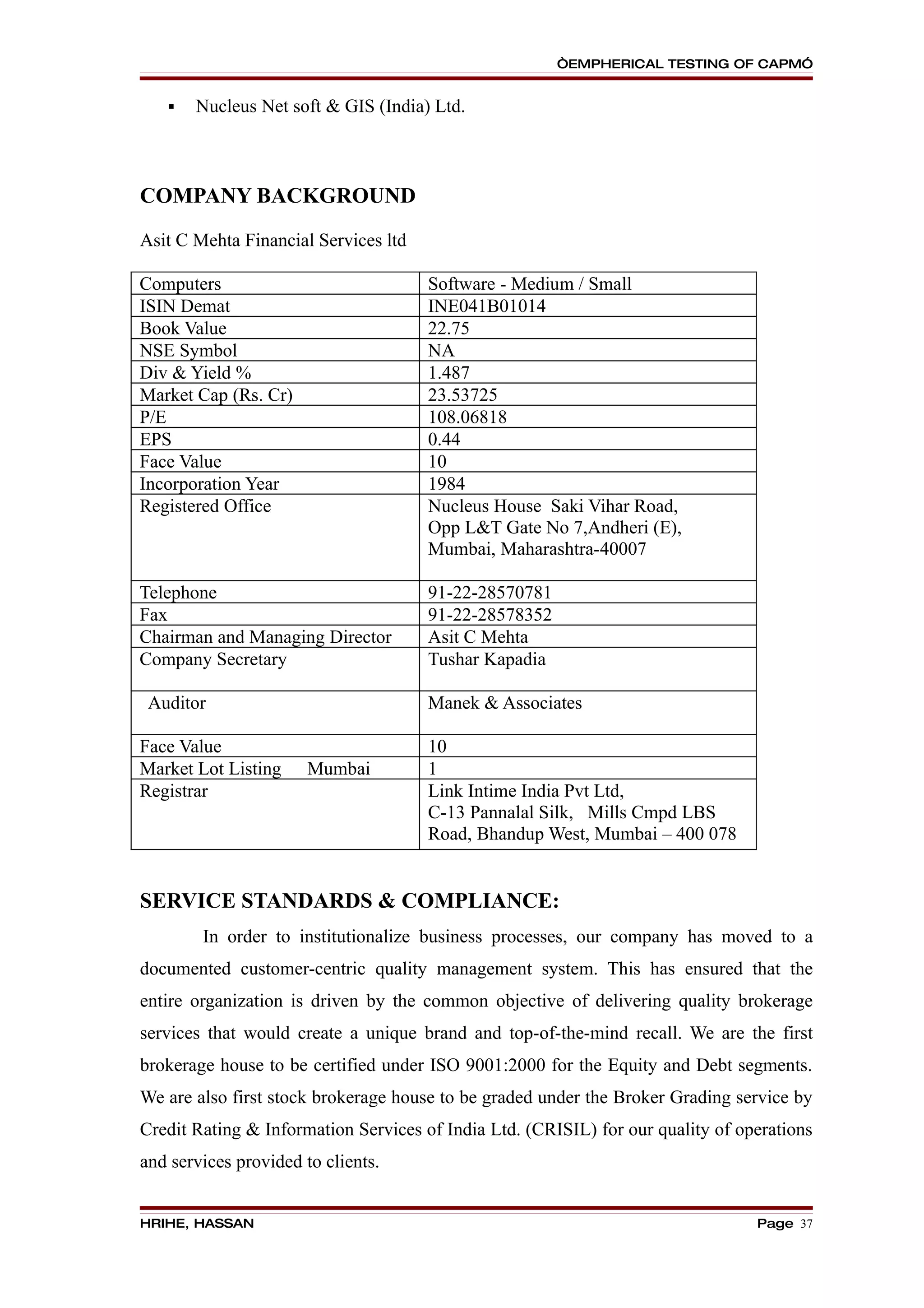
COMPANY BACKGROUND

Asit C Mehta Financial Services ltd

Computers                             Software - Medium / Small
ISIN Demat                            INE041B01014
Book Value                            22.75
NSE Symbol                            NA
Div & Yield %                         1.487
Market Cap (Rs. Cr)                   23.53725
P/E                                   108.06818
EPS                                   0.44
Face Value                            10
Incorporation Year                    1984
Registered Office                     Nucleus House Saki Vihar Road,
                                      Opp L&T Gate No 7,Andheri (E),
                                      Mumbai, Maharashtra-40007

Telephone                             91-22-28570781
Fax                                   91-22-28578352
Chairman and Managing Director        Asit C Mehta
Company Secretary                     Tushar Kapadia

 Auditor                              Manek & Associates

Face Value                            10
Market Lot Listing     Mumbai         1
Registrar                             Link Intime India Pvt Ltd,
                                      C-13 Pannalal Silk, Mills Cmpd LBS
                                      Road, Bhandup West, Mumbai – 400 078


SERVICE STANDARDS & COMPLIANCE:
        In order to institutionalize business processes, our company has moved to a
documented customer-centric quality management system. This has ensured that the
entire organization is driven by the common objective of delivering quality brokerage
services that would create a unique brand and top-of-the-mind recall. We are the first
brokerage house to be certified under ISO 9001:2000 for the Equity and Debt segments.
We are also first stock brokerage house to be graded under the Broker Grading service by
Credit Rating & Information Services of India Ltd. (CRISIL) for our quality of operations
and services provided to clients.


HRIHE, HASSAN                                                                    Page 37
“EMPHERICAL TESTING OF CAPM”


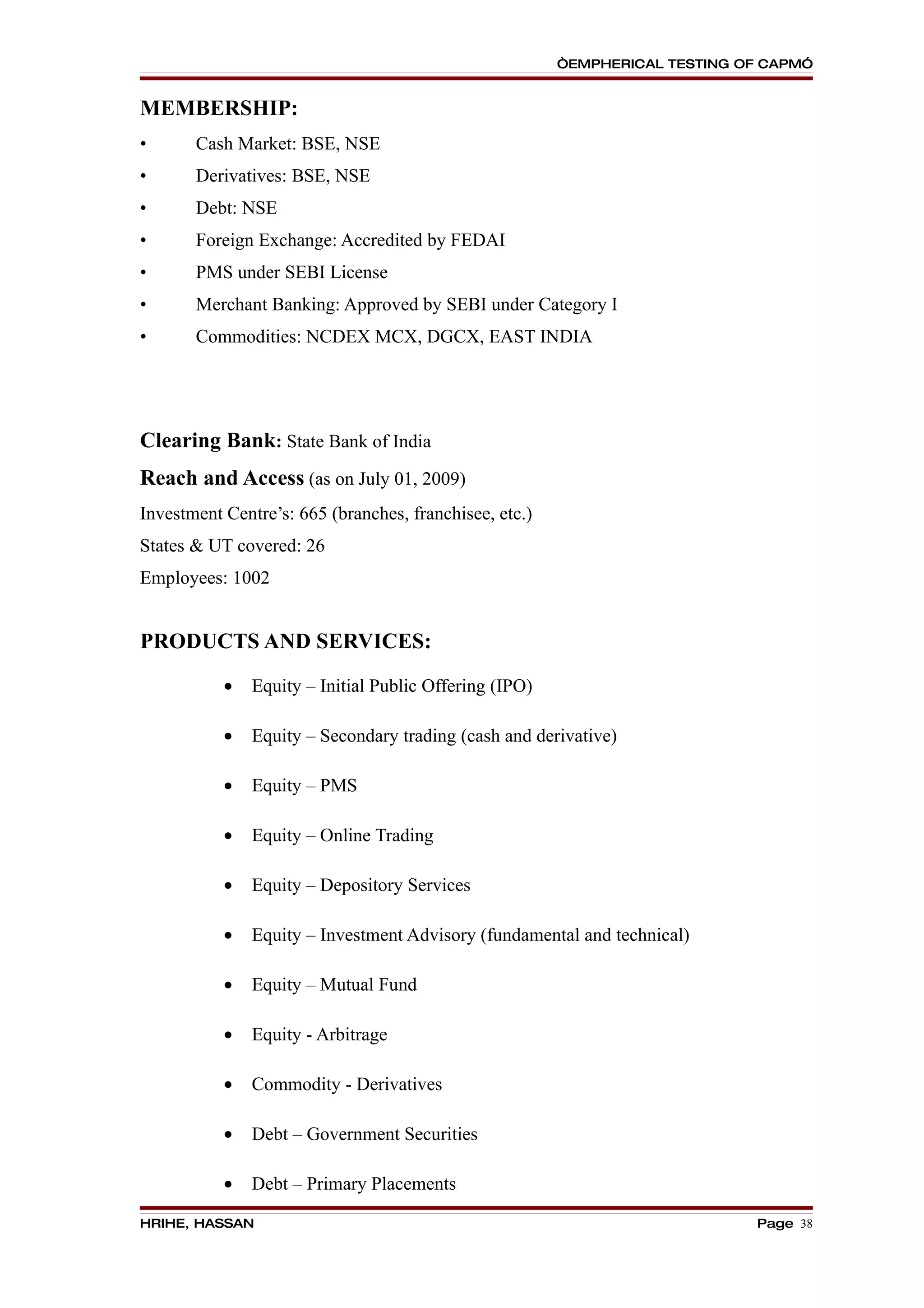
MEMBERSHIP:
•      Cash Market: BSE, NSE
•      Derivatives: BSE, NSE
•      Debt: NSE
•      Foreign Exchange: Accredited by FEDAI
•      PMS under SEBI License
•      Merchant Banking: Approved by SEBI under Category I
•      Commodities: NCDEX MCX, DGCX, EAST INDIA


Clearing Bank: State Bank of India
Reach and Access (as on July 01, 2009)
Investment Centre’s: 665 (branches, franchisee, etc.)
States & UT covered: 26
Employees: 1002


PRODUCTS AND SERVICES:

           •   Equity – Initial Public Offering (IPO)

           •   Equity – Secondary trading (cash and derivative)

           •   Equity – PMS

           •   Equity – Online Trading

           •   Equity – Depository Services

           •   Equity – Investment Advisory (fundamental and technical)

           •   Equity – Mutual Fund

           •   Equity - Arbitrage

           •   Commodity - Derivatives

           •   Debt – Government Securities

           •   Debt – Primary Placements

HRIHE, HASSAN                                                                Page 38
“EMPHERICAL TESTING OF CAPM”


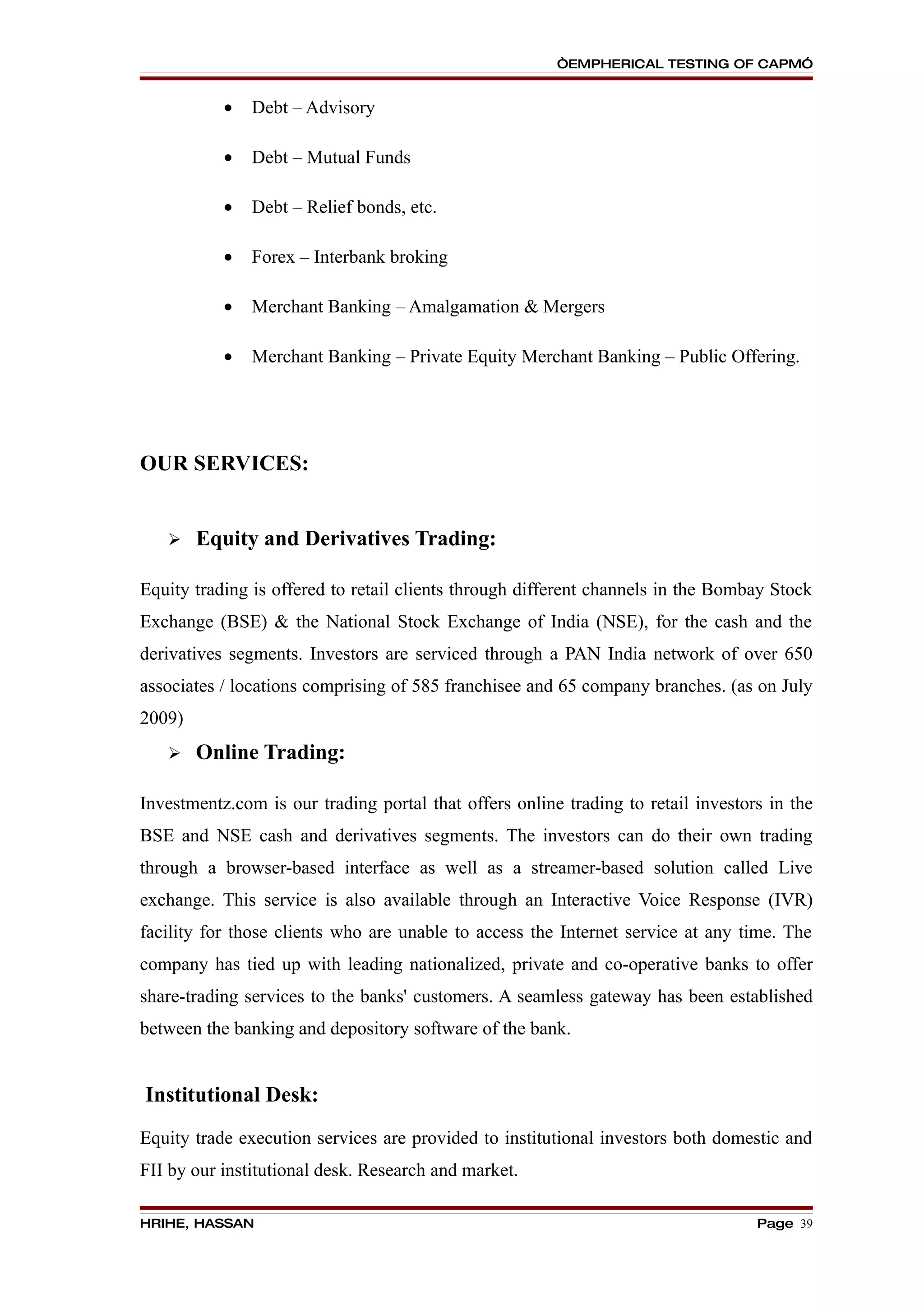
           •   Debt – Advisory

           •   Debt – Mutual Funds

           •   Debt – Relief bonds, etc.

           •   Forex – Interbank broking

           •   Merchant Banking – Amalgamation & Mergers

           •   Merchant Banking – Private Equity Merchant Banking – Public Offering.


OUR SERVICES:


       Equity and Derivatives Trading:

Equity trading is offered to retail clients through different channels in the Bombay Stock
Exchange (BSE) & the National Stock Exchange of India (NSE), for the cash and the
derivatives segments. Investors are serviced through a PAN India network of over 650
associates / locations comprising of 585 franchisee and 65 company branches. (as on July
2009)
       Online Trading:

Investmentz.com is our trading portal that offers online trading to retail investors in the
BSE and NSE cash and derivatives segments. The investors can do their own trading
through a browser-based interface as well as a streamer-based solution called Live
exchange. This service is also available through an Interactive Voice Response (IVR)
facility for those clients who are unable to access the Internet service at any time. The
company has tied up with leading nationalized, private and co-operative banks to offer
share-trading services to the banks' customers. A seamless gateway has been established
between the banking and depository software of the bank.


Institutional Desk:
Equity trade execution services are provided to institutional investors both domestic and
FII by our institutional desk. Research and market.

HRIHE, HASSAN                                                                      Page 39
“EMPHERICAL TESTING OF CAPM”


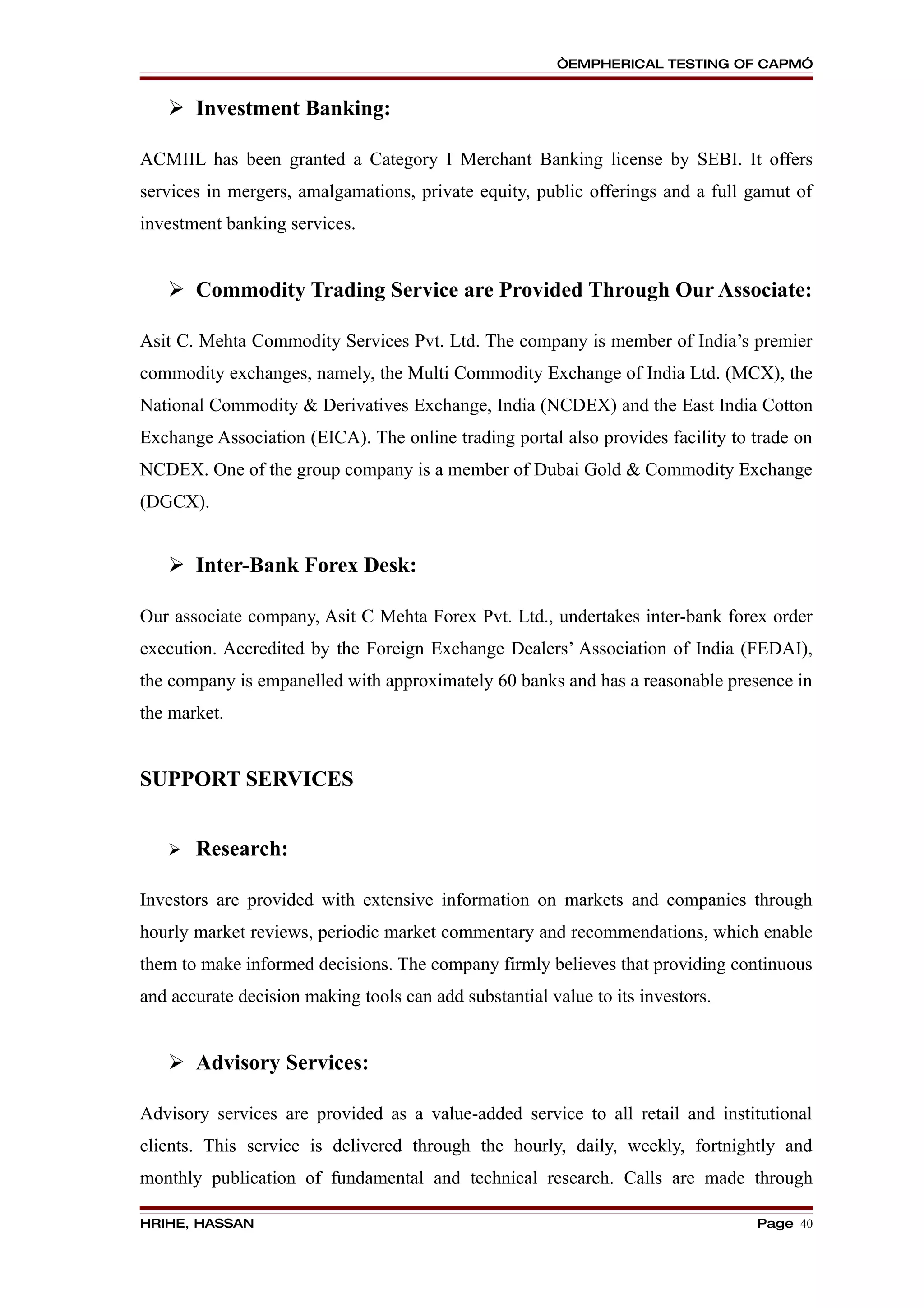
    Investment Banking:

ACMIIL has been granted a Category I Merchant Banking license by SEBI. It offers
services in mergers, amalgamations, private equity, public offerings and a full gamut of
investment banking services.


    Commodity Trading Service are Provided Through Our Associate:

Asit C. Mehta Commodity Services Pvt. Ltd. The company is member of India’s premier
commodity exchanges, namely, the Multi Commodity Exchange of India Ltd. (MCX), the
National Commodity & Derivatives Exchange, India (NCDEX) and the East India Cotton
Exchange Association (EICA). The online trading portal also provides facility to trade on
NCDEX. One of the group company is a member of Dubai Gold & Commodity Exchange
(DGCX).


    Inter-Bank Forex Desk:

Our associate company, Asit C Mehta Forex Pvt. Ltd., undertakes inter-bank forex order
execution. Accredited by the Foreign Exchange Dealers’ Association of India (FEDAI),
the company is empanelled with approximately 60 banks and has a reasonable presence in
the market.


SUPPORT SERVICES


      Research:

Investors are provided with extensive information on markets and companies through
hourly market reviews, periodic market commentary and recommendations, which enable
them to make informed decisions. The company firmly believes that providing continuous
and accurate decision making tools can add substantial value to its investors.


    Advisory Services:

Advisory services are provided as a value-added service to all retail and institutional
clients. This service is delivered through the hourly, daily, weekly, fortnightly and
monthly publication of fundamental and technical research. Calls are made through

HRIHE, HASSAN                                                                    Page 40
“EMPHERICAL TESTING OF CAPM”


broadcast services on our private VSAT network, SMS and e-mail.


     Accounts Information:

Accounts information to the retail clients is provided through access on our website. This
assists clients in knowing details about their trading accounts and their resultant
obligations through various reports like Bill, Contract, Financial Ledger, Transaction
Register, Stock Register, Portfolio Tracker, Stock holding position, etc. E-contracts are
generated for investors giving trade details.


OTHER SERVICES:


 Price Ticker


ACMIIL,      in   association    with   Capital   Market     Publications,   presents    the
equity/derivative/commodity price ticker for easy desktop access to capital market
information. The prices reflected are generally delayed by five minutes, and any
additional delay (if any) depends on the user’s connectivity and computer system
configuration. You can customize the ticker as per your individual needs.


   Alertz


As our registered client, Investmentz.com provides you with ‘Alertz’ facility on your
email SMS and assists you in your investment decision, thus enriching your capital
market investment experience through us.
Investmentz.com’s Alertz service keeps you informed about stock prices through email
and SMS. You may activate the Email Alertz service and track your selected
stocks/indices without monitoring the trading terminal during market hours. It is now
very easy to track the prices of your selected stocks without deviating from normal
activities .The SMS Alertz service is available for trade confirmation, fund pay-in and
pay-out, market views/calls, etc, to clients who actively use our trade execution services.
As general information, Investmentz.com does not guarantee any accuracy of generation,
databases, and delivery timings, and does not make any claims of any nature in this
matter The critical components to avail the Alertz service are:

HRIHE, HASSAN                                                                       Page 41
“EMPHERICAL TESTING OF CAPM”


a) Internet connectivity / bandwidth speed at your end,
b) Information feed available from the exchange,
c) Computing speed of the Alertz, and
d) Speed of your Internet Service provider (ISP) and/or domain provider and/or Telecom
service provider (TSP).


 Advice Me

To service general retail investor and assistance them in systematic creation of wealth, we
could try to provide you with some basic / brief investment idea on stock of your interest.
You could ask us an investment question related to a particular stock or sector and we
would see that brief research (fundamental / technical) input could be provided on that
stock or sector.
Whatever may be our research input on your inquiry, still the final investment decision
would need to be taken by you as you know your investment profile & habits, risk
appetite, income – cash flow, person / family / social obligation, etc.


Potential Growth Areas:
India is amongst the least affected countries in the 2008 global meltdown. May 2009
general election in the country provided a fairly stable government. We see great potential
for the country in general and financial market in particular in the years to come. Investor
participation, product innovations, volume growth is likely to be in exponential
proportion.
Our company is well poised to build a great institution in India to service the Indian and
global investors for their financial services needs The company has created a strong
organization driven by processes to handle multifold volume growth.


Do not disturb:
To service our clients and aide them in wealth creation process, we at Asit C Mehta
Investment Interrmediates Ltd. keep on sending information about our products and
services, information related to capital market investment, etc. This information might be
sent / conveyed to you via letter, newsletter, email, phone; SMS, etc. based on our
assumption that you would need this information and benefit you in your wealth creation

HRIHE, HASSAN                                                                         Page 42
“EMPHERICAL TESTING OF CAPM”


process. But, at times, you might need privacy and wish us not to contact you for such
information. We would take the precaution and see not to disturb you by excluding your
contact details from our marketing list. Kindly provide your details so as to not disturb
you.


Message Board:
Welcome to our new website! We are pleased to announce some exciting new features, an
improved user-friendly design and services to benefit our esteemed customers. We have
also taken steps to ensure faster loading of pages.
 User-friendly design:

No part of the website is more than three clicks away. This ensures speedy access to
whatever information you may need.


 Easy Trading:

We have two options for trading: Quick Trade and Regular Trade. Quick Trade enables
you to transact in any share quickly by presenting only the most relevant information.
Regular Trade gives you full information about the share, enabling you to take an
informed decision.
 New features:

We've added some exciting new features like Advise Me and Online Purchase of Mutual
Funds and IPOs.


Knowledge Center:
Investor Education and Empowerment is essential for inculcating correct investment
habits. We undertake various initiatives to educate investors and enable them to make
informed investment decisions based on their investment profiles, risk appetites, and
return expectations. Three important parts of our Investor Education and Awareness
Program are: Market Wisdom series, Video broadcasts of Investment Education Topics,
and the Nucleus Investmentz newsletter. We also conduct activities such as seminars,
exhibitions, etc.


   Investor Education Topics
HRIHE, HASSAN                                                                        Page 43
“EMPHERICAL TESTING OF CAPM”


We have been conducting the Investor Education and Awareness program via video
broadcasts through our own network (branches and business associates), which is spread
over 600 locations across 25 states and union territories in India. Speakers with industry
expertise participate in video broadcasts from our head office in Mumbai, which is
accessible from any of our branches across the country.
The last session was on February 21, 2009; our expert in-house fundamental and technical
research team conducted an investor education program on crude oil market outlook.


   Nucleus Investments.

For the past seven years, we have been publishing a fortnightly newsletter, Nucleus
Investmentz. It includes analyses of current financial topics, insights on investment-
relevant topics, and performance score cards of various mutual funds. This is available in
English, Hindi & Gujarati.


Benefits of Trading With Us:


     Focus on wealth creation for the investors.


     Client Level Risk Management.


     Auto Pay-in / Payout of securities.


     Transfer of payout directly to the designated customer bank account.
.
     Account & Portfolio information through Internet 24x7, 365 days.


     Strong foundation of Technology, Compliance and Transparency First corporate member
       of the Bombay Stock Exchange Proven track record for the last 25 years in the stock
       broking industry First broking house to gain the ISO 9001:2000 certification Presence in
       23 states and 650 locations.


HRIHE, HASSAN                                                                           Page 44
“EMPHERICAL TESTING OF CAPM”


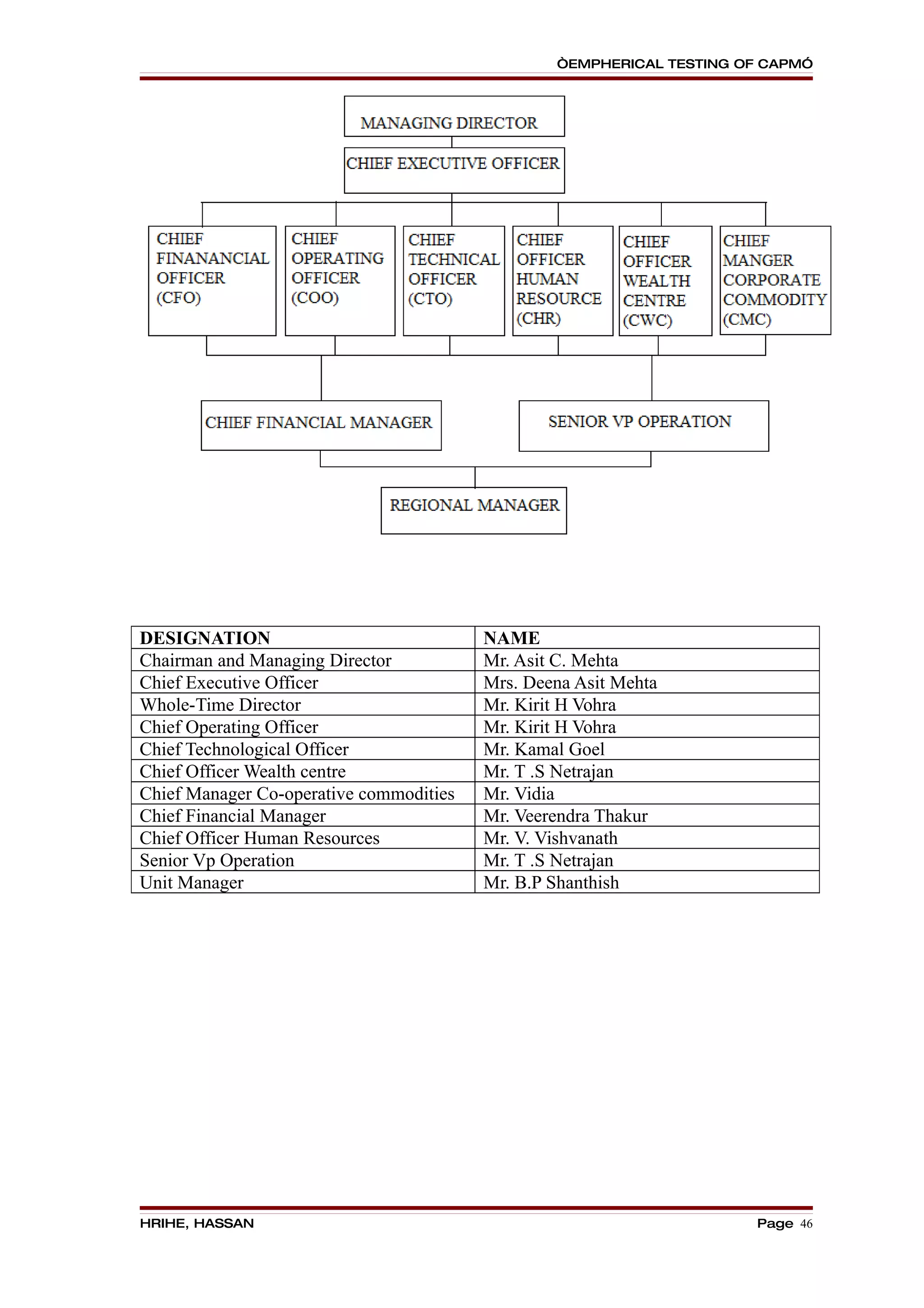
3.03 ORGANISATION STRUCTURE:


HRIHE, HASSAN                                       Page 45
“EMPHERICAL TESTING OF CAPM”


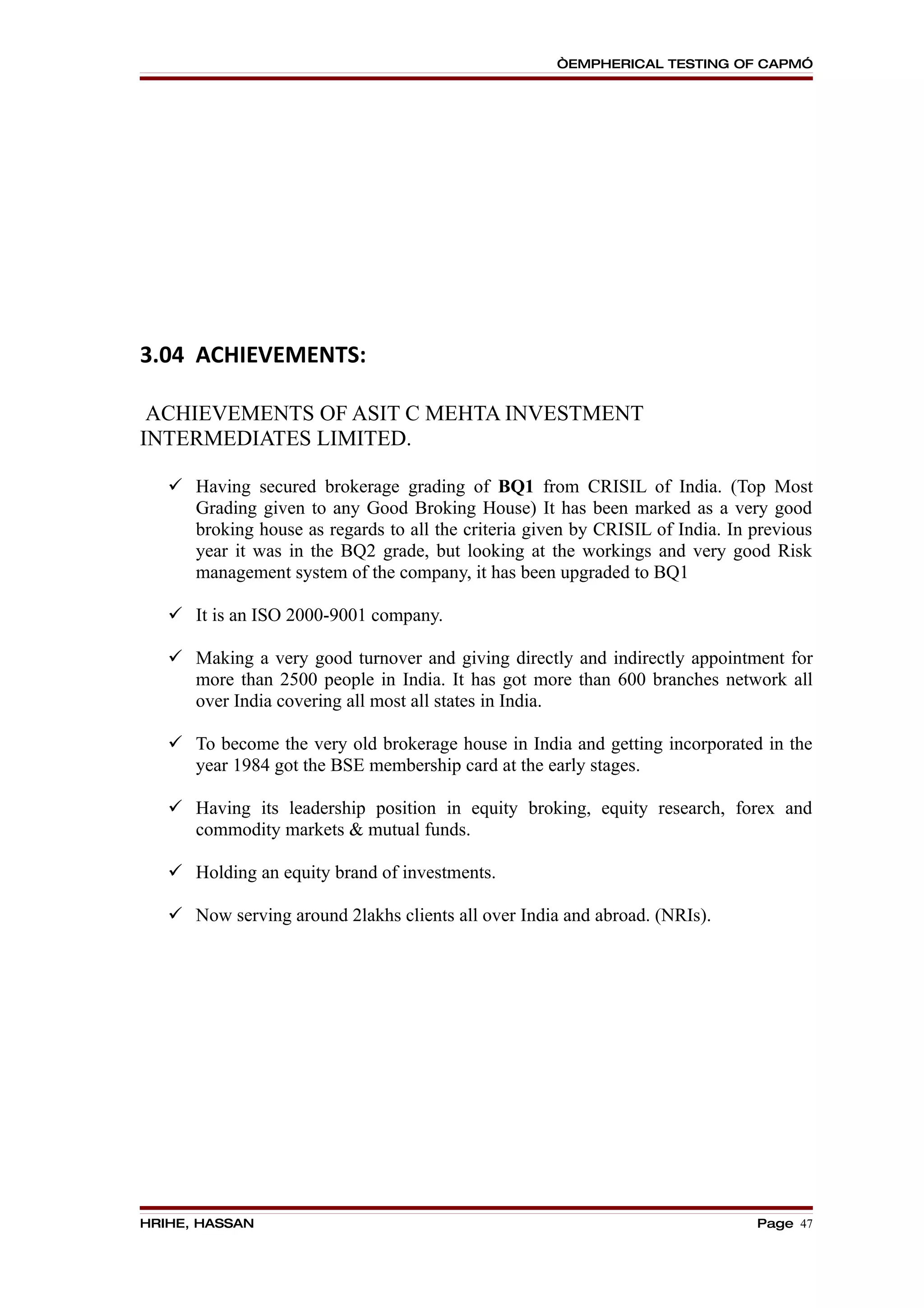
DESIGNATION                              NAME
Chairman and Managing Director           Mr. Asit C. Mehta
Chief Executive Officer                  Mrs. Deena Asit Mehta
Whole-Time Director                      Mr. Kirit H Vohra
Chief Operating Officer                  Mr. Kirit H Vohra
Chief Technological Officer              Mr. Kamal Goel
Chief Officer Wealth centre              Mr. T .S Netrajan
Chief Manager Co-operative commodities   Mr. Vidia
Chief Financial Manager                  Mr. Veerendra Thakur
Chief Officer Human Resources            Mr. V. Vishvanath
Senior Vp Operation                      Mr. T .S Netrajan
Unit Manager                             Mr. B.P Shanthish


HRIHE, HASSAN                                                         Page 46
“EMPHERICAL TESTING OF CAPM”


3.04 ACHIEVEMENTS:

 ACHIEVEMENTS OF ASIT C MEHTA INVESTMENT
INTERMEDIATES LIMITED.

    Having secured brokerage grading of BQ1 from CRISIL of India. (Top Most
     Grading given to any Good Broking House) It has been marked as a very good
     broking house as regards to all the criteria given by CRISIL of India. In previous
     year it was in the BQ2 grade, but looking at the workings and very good Risk
     management system of the company, it has been upgraded to BQ1

    It is an ISO 2000-9001 company.

    Making a very good turnover and giving directly and indirectly appointment for
     more than 2500 people in India. It has got more than 600 branches network all
     over India covering all most all states in India.

    To become the very old brokerage house in India and getting incorporated in the
     year 1984 got the BSE membership card at the early stages.

    Having its leadership position in equity broking, equity research, forex and
     commodity markets & mutual funds.

    Holding an equity brand of investments.

    Now serving around 2lakhs clients all over India and abroad. (NRIs).


HRIHE, HASSAN                                                                  Page 47
“EMPHERICAL TESTING OF CAPM”


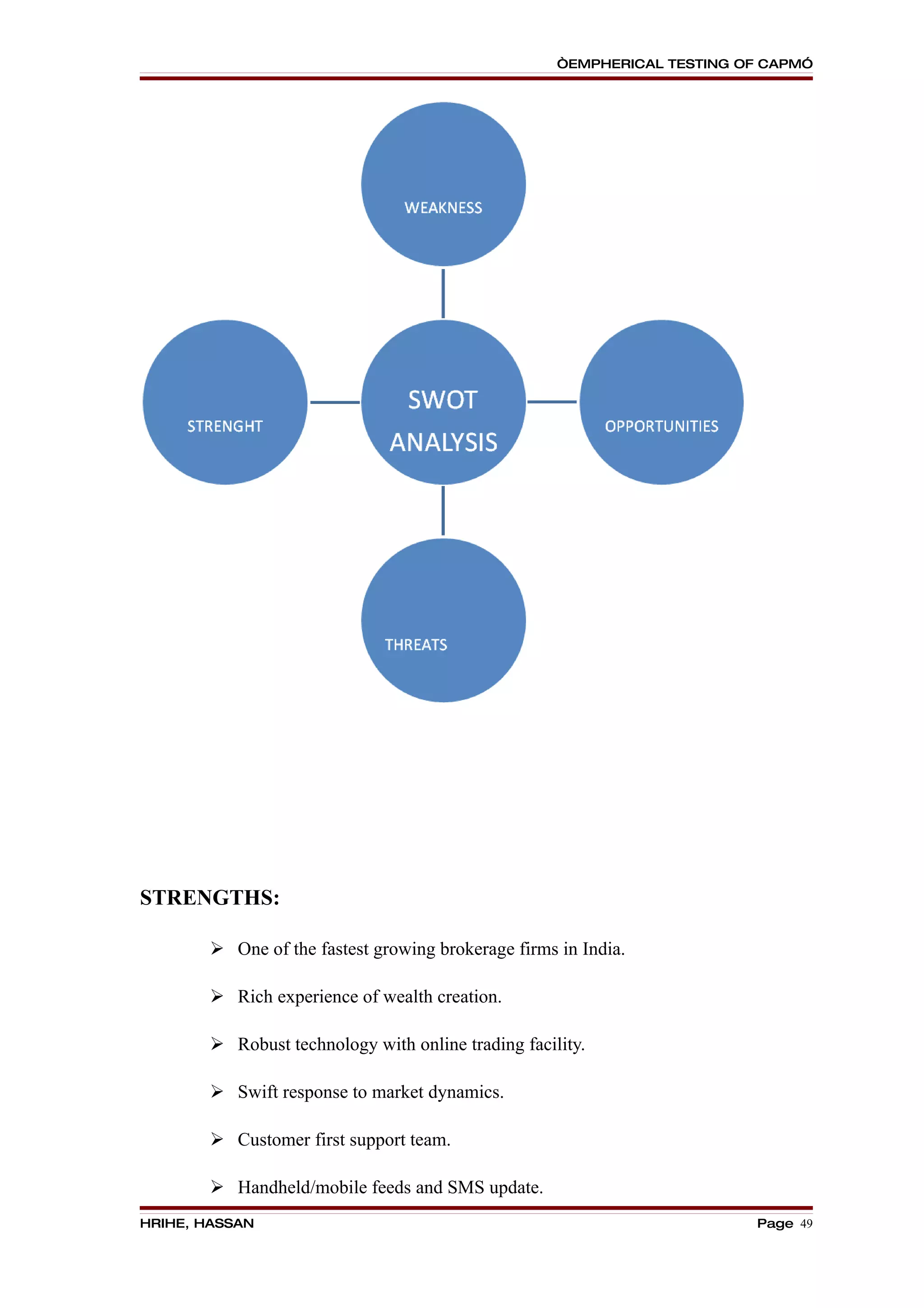
3.05 SWOT ANALYSIS:


SWOT analysis refers to; analyzing the strength, weakness, opportunity and threat of the
organization SWOT is a compound of two factors namely external factors and Internal
factors. Strengths and weaknesses are the internal factors controlled by the technical and
personnel departments. Opportunities and threats are the       external    factors, which
cannot be   controlled   by     the    company. External         factors   may    include
political     factors, Socio –Cultural factors, Technical factors, demography, and
Environmental factors.


HRIHE, HASSAN                                                                     Page 48
“EMPHERICAL TESTING OF CAPM”


STRENGTHS:

        One of the fastest growing brokerage firms in India.

        Rich experience of wealth creation.

        Robust technology with online trading facility.

        Swift response to market dynamics.

        Customer first support team.

        Handheld/mobile feeds and SMS update.
HRIHE, HASSAN                                                            Page 49
“EMPHERICAL TESTING OF CAPM”


         It has well experienced staff and good infrastructure.

WEAKNESS:
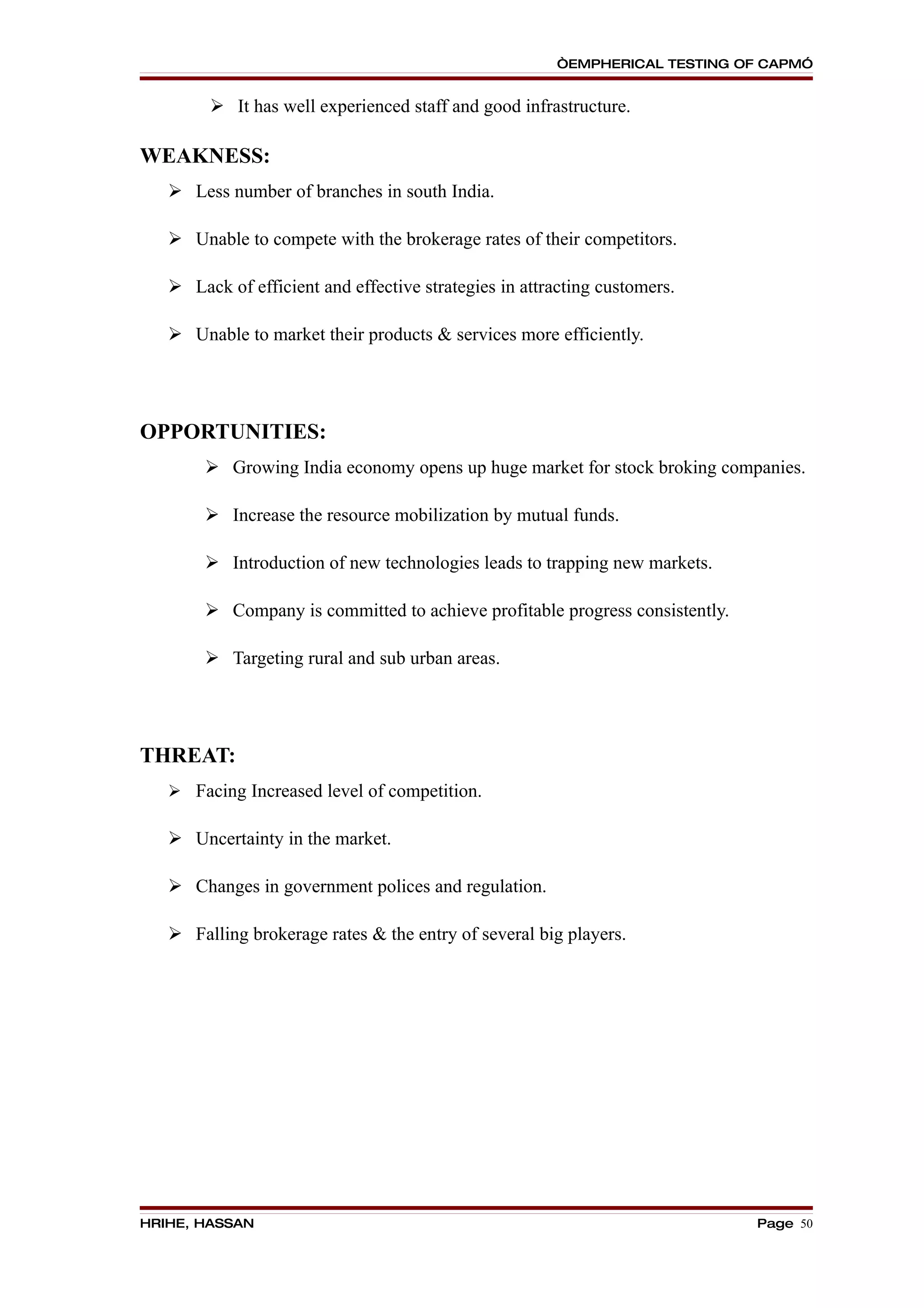
    Less number of branches in south India.

    Unable to compete with the brokerage rates of their competitors.

    Lack of efficient and effective strategies in attracting customers.

    Unable to market their products & services more efficiently.


OPPORTUNITIES:
         Growing India economy opens up huge market for stock broking companies.

         Increase the resource mobilization by mutual funds.

         Introduction of new technologies leads to trapping new markets.

         Company is committed to achieve profitable progress consistently.

         Targeting rural and sub urban areas.


THREAT:
    Facing Increased level of competition.

    Uncertainty in the market.

    Changes in government polices and regulation.

    Falling brokerage rates & the entry of several big players.


HRIHE, HASSAN                                                                 Page 50
“EMPHERICAL TESTING OF CAPM”


HRIHE, HASSAN                        Page 51
“EMPHERICAL TESTING OF CAPM”


                   CHAPTER-4
                DATA ANALYSIS AND
                 INTERPRETATION


CALUCLATION OF MARKET RETURN OF NIFTY


                       TABLE – 4.01

                   FOR THE YEAR 2005


HRIHE, HASSAN                                              Page 52
“EMPHERICAL TESTING OF CAPM”


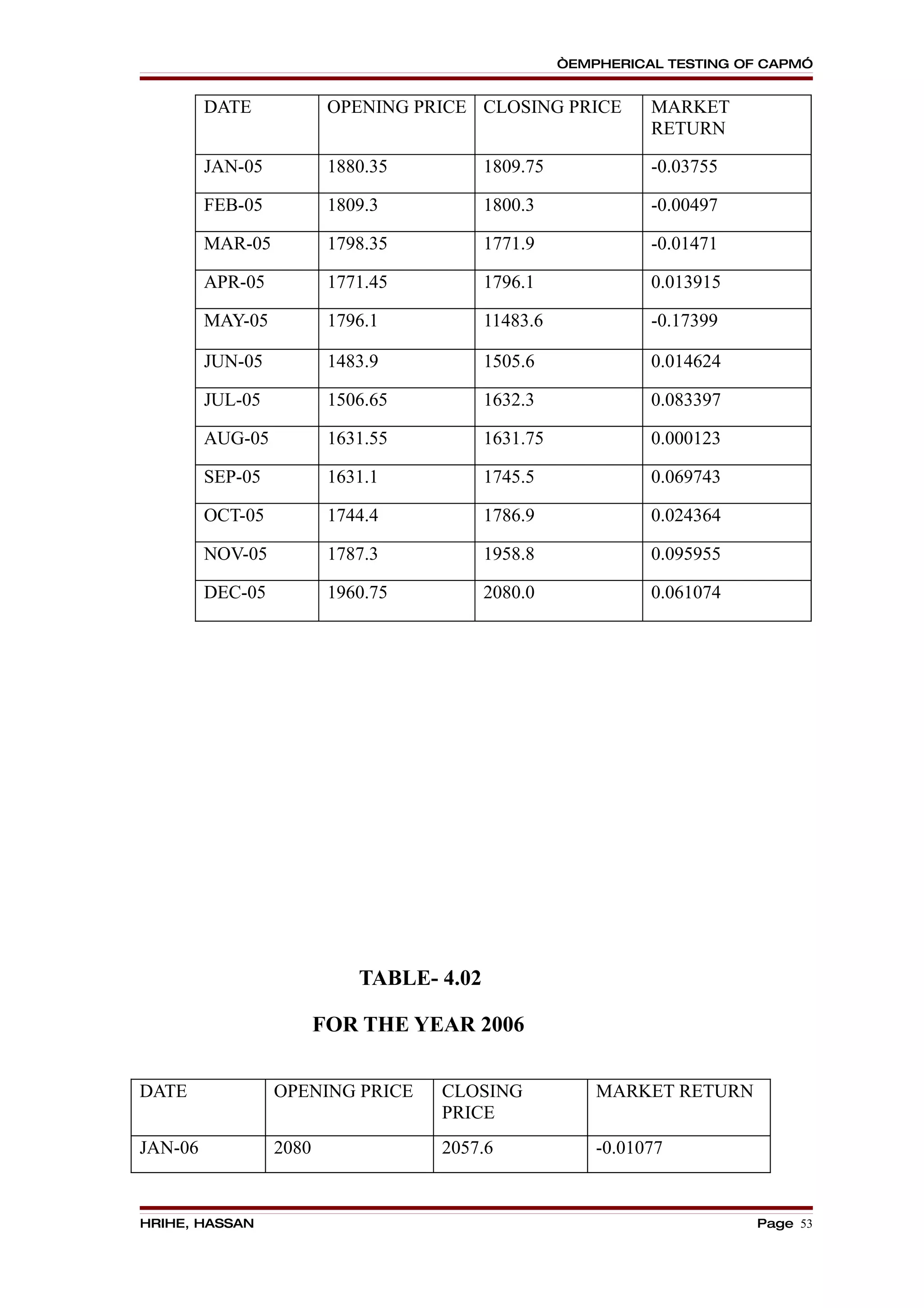
         DATE             OPENING PRICE CLOSING PRICE          MARKET
                                                               RETURN

         JAN-05           1880.35          1809.75             -0.03755

         FEB-05           1809.3           1800.3              -0.00497

         MAR-05           1798.35          1771.9              -0.01471

         APR-05           1771.45          1796.1              0.013915

         MAY-05           1796.1           11483.6             -0.17399

         JUN-05           1483.9           1505.6              0.014624

         JUL-05           1506.65          1632.3              0.083397

         AUG-05           1631.55          1631.75             0.000123

         SEP-05           1631.1           1745.5              0.069743

         OCT-05           1744.4           1786.9              0.024364

         NOV-05           1787.3           1958.8              0.095955

         DEC-05           1960.75          2080.0              0.061074


                             TABLE- 4.02

                         FOR THE YEAR 2006


DATE              OPENING PRICE     CLOSING              MARKET RETURN
                                    PRICE
JAN-06            2080              2057.6               -0.01077


HRIHE, HASSAN                                                             Page 53
“EMPHERICAL TESTING OF CAPM”


FEB-06          2057.75   2103.25       0.022112
MAR-06          2103.1    2035.65       -0.03207
APR-06          2035.9    1902.5        -0.06552
MAY-06          1903.1    2087.55       0.096921

JUN-06          2087.8    2220.6        0.063608
JUL-06          2220.45   2312.3        0.041365
AUG-06          2312.5    2384.65       0.031401
SEP-06          2384.7    2601.4        0.090871
OCT-06          2601      2370.95       -0.08845
NOV-06          2366.8    2653.25       0.121028
DEC-06          2651.6    2836.55       0.06975


HRIHE, HASSAN                                            Page 54
“EMPHERICAL TESTING OF CAPM”


                      TABLE – 4.03

                 FOR THE YEAR 2007

DATE        OPENING        CLOSING   MARKET RETURN
            PRICE          PRICE

JAN-07      2835.95        3001.1    0.058234

FEB-07      2971.55        3074.7    0.034713

MAR-07      3123.1         3402.55   0.089478

APR-07      3473.3         3557.6    0.024271

MAY-07      3605.45        3071.05   -0.14822

JUN-07      2962.25        3128.2    0.056022

JUL-07      3150.95        3143.2    -0.00246

AUG-07      3149.8         3413.2    0.083847

SEP-07      3435.15        3588.4    0.044612

OCT-07      3569.6         3744.1    0.048885

NOV-07      3767.05        3954.5    0.04976

DEC-07      3997.6         3966.4    -0.0078


HRIHE, HASSAN                                             Page 55
“EMPHERICAL TESTING OF CAPM”


                              TABLE -4.04


                          FOR THE YEAR 2008


DATE            OPENING PRICE     CLOSING PRICE    MARKET RETURN


JAN-08          1058.85           1075.4           0.01563

FEB-08          1076.95           1142.05          0.060448

MAR-08          1142.05           1129.55          -0.01095

APR-08-08       1129.85           1084.5           -0.04014

MAY-08          1084.8            1028.8           -0.05162

JUN-08          1029.25           1057.8           0.02739

JUL-08          1058              958.9            -0.09367

AUG-08          959.2             101.6            0.053586

SEP-08          1010.9            963.15           -0.04724

OCT-08          961.15            951.4            -0.01014

NOV-08          951.45            1050.15          -0.103736

DEC-08          1050.15           1093.5           0.04128


HRIHE, HASSAN                                                      Page 56
“EMPHERICAL TESTING OF CAPM”


                        TABLE -4 .05

                    FOR THE YEAR 2009


DATE        OPENING PRICE      CLOSING PRICE     MARKET RETURN


JAN-09      1093.6             1041.85           -0.04732

FEB-09      1040.25            1063.4            0.022254

MAR-09      1063.55            978.2             -0.08025

APR-09      977.4              934.05            -0.04435

MAY-09      930.9              1066.8            0.145988

JUN-09      1006.85            1134.15           0.126434

JUL-09      1133.95            1185.85           0.045769

AUG-09      1185.8             1356.55           0.143996

SEP-09      1356.7             1417.1            0.04452

OCT-09      1416.6             1555.9            0.098334

NOV-09      1556.5             1615.25           0.037745

DEC-09      1615.85            1879.75           0.16332


HRIHE, HASSAN                                                       Page 57
“EMPHERICAL TESTING OF CAPM”


                   TABLE – 4.06

                MARKET RETURNS


YEAR              RETURN               RETURN+1


2005              0.106443            1.106443

2006              0.363726            1.363726

2007              0.3986              1.3986

2008              0.032724            1.032724

2009              0.718864            1.718864


          RETURN = 1.3023 – 1

Therefore Expected Return On Market is = 30.23 or 30%


HRIHE, HASSAN                                                         Page 58
“EMPHERICAL TESTING OF CAPM”


OVERVIEW OF WIPRO TECHNOLOGIES LTD:

       An INDUSTRY (from Latin industries, "diligent, industrious") is the
manufacturing of a good or service within a category.[1] Although industry is a broad term
for any kind of economic production, in economics and urban planning industry is a
synonym for the secondary sector, which is a type of economic activity involved in the
manufacturing of raw materials into goods and products.[1]
       There are four key industrial economic sectors: the primary sector, largely raw
material extraction industries such as mining and farming; the secondary sector,
involving refining, construction, and manufacturing; the tertiary sector, which deals with
services (such as law and medicine) and distribution of manufactured goods; and the
quaternary sector, a relatively new type of knowledge industry focusing on technological
research, design and development such as computer programming, and biochemistry. A
fifth quandary sector has been proposed encompassing nonprofit activities. The economy
is also broadly separated into public sector and private sector, with industry generally
categorized as private. Industries are also any business or manufacturing.
       Industry in the sense of manufacturing became a key sector of production and
labor in European and North American countries during the Industrial Revolution, which
upset previous mercantile and feudal economies through many successive rapid advances
in technology, such as the steel and coal production. It is aided by technological
advances, and has continued to develop into new types and sectors to this day. Industrial
countries then assumed a capitalist economic policy. Railroads and steam-powered ships
began speedily establishing links with previously unreachable world markets, enabling
private companies to develop to then-unheard of size and wealth. Following the Industrial
Revolution, perhaps a third of the world's economic output is derived from manufacturing
industries—more than agriculture's share.
Many developed countries (for example the UK, the U.S., and Canada) and many
developing/semi-developed countries (People's Republic of China, India etc.) depend
significantly on industry. Industries, the countries they reside in, and the economies of
those countries are interlinked in a complex web of interdependence.


HRIHE, HASSAN                                                                     Page 59
“EMPHERICAL TESTING OF CAPM”


WIPRO TECHNOLOGIES LTD

                           TABLE – 4.07


                   FOR THE YEAR 2005


Date            Opening price   Closing price   Returns        Market returns
Jan-05          1752            1588.8          -0.110274      -0.03755
Feb-05          1558.8          1454.44         -0.066949      -0.00497
Mar-05          1480            1361.2          -0.080270      -0.01471
Apr-05          1358            1545.85         0.138328       0.013915
May-05          1600            1523.7          -0.047687      -0.17399
Jun-05          1541.65         532.1           -0.6548450     0.014624
Jul-05          534             546.85          0.024064       0.083397
Aug-05          548             578.5           0.055657       0.000123
Sep-05          577             596.8           0.034315       0.069743
Oct-05          600             657.5           0.095833       0.024364
Nov-05          660             766.4           0.277333       0.095955
Dec-05          766             748.8           -0.022454      0.061074


HRIHE, HASSAN                                                         Page 60
“EMPHERICAL TESTING OF CAPM”


WIPRO TECHNOLOGIES LTD


                                TABLE – 4.08
                        FOR THE YEAR 2006


Date            Opening price     Closing price   returns        Market returns
Jan-06          377.5             352.67          -0.065775      -0.01077
Feb-06          355               349.75          -0.014789      0.022112
Mar-06          350               335.98          -0.040057      -0.03207
Apr-6           337               315.4           -0.064095      -0.06552
May-6           319.5             357.88          0.120125       0.096921
Jun-06          358.5             383.15          0.068759       0.063608
Jul-06          375               368.17          -0.018213      0.041365
Aug-06          365               364.65          -0.000959      0.031401
Sep-06          369               371.45          0.00664        0.090871
Oct-06          375.2             364.6           -0.028252      -0.08845
Nov-06          369               423.25          0.147019       0.121028
Dec-06          424.8             463.35          0.090749       0.06975


HRIHE, HASSAN                                                              Page 61
“EMPHERICAL TESTING OF CAPM”


WIPRO TECHNOLOGIES LTD


                         TABLE – 4.09


                   FOR THE YEAR 2007


Date            Opening price   Closing price   returns        Market returns
Jan-07          462             529.7           0.146537       0.058234
Feb-07          530             520.2           -0.018491      0.034713
Mar-07          520             559.7           0.076346       0.089478
Apr-07          565             538.55          -0.046814      0.024271
May-7           545             449.7           -0.174862      -0.01482
Jun-07          452             513.35          0.13573        0.056022
Jul-07          517.4           490.5           -0.051991      -0.00246
Aug-07          490             518.65          0.058469       0.083847
Sep-07          519             524.9           0.011368       0.044612
Oct-07          524.9           538.3           0.025529       0.048885
Nov-07          541             599.9           0.108872       0.04976
Dec-07          604.95          605.9           0.00157        -0.0078


HRIHE, HASSAN                                                            Page 62
“EMPHERICAL TESTING OF CAPM”


WIPRO TECHNOLOGIES LTD

                            TABLE- 4.10


                         FOR THE YEAR 2008


Date            Opening price   Closing price   returns        Market returns
Jan-08          603             613.25          0.016001       0.01563
Feb-08          624.8           562.4           -0.099872      0.060448
Mar-08          577.7           559.4           -0.031677      -0.01095
Apr-08          559.6           571.6           0.021444       -0.04014
May-08          635             543.7           -0.143780      -0.05162
Jun-08          548.4           518.45          -0.054613      0.02739
Jul-08          515             497.35          -0.034272      -0.09367
Aug-08          491.1           482.35          -0.017817      0.053586
Sep-08          486             460.25          0.055948       -0.04724
Oct-08          462             507.15          0.097727       -0.01014
Nov-08          509.95          460.65          -0.220492      -0.103736
Dec-08          465             525.65          0.130430       0.04128


HRIHE, HASSAN                                                            Page 63
“EMPHERICAL TESTING OF CAPM”


WIPRO TECHNOLOGIES LTD

                                TABLE- 4.11


                         FOR THE YEAR 2009


Date            Opening price    Closing price   returns        Market returns
Jan-09          529.05           422.75          -0.200926      -0.04732
Feb-09          430.05           437.05          0.016277       0.022254
Mar-09          429.85           432.1           0.005234       -0.08025
Apr-09          430              488.75          0.136628       -0.04435
May-09          490              509.25          0.039286       0.145988
Jun-09          509.25           439.95          -0.136082      0.126434
Jul-09          438              415.4           -0.051598      0.045769
Aug-09          410              432.4           0.054634       0.143996
Sep-09          430              339.9           -0.209535      0.04452
Oct-09          321.6            272.65          -0.152208      0.098334
Nov-09          284              242.65          -0.145598      0.037745
Dec-09          235.55           233.4           -0.009128      0.16332


   OVERVIEWS OF INFOSYS TECHNOLOGIESLTD:


HRIHE, HASSAN                                                             Page 64
“EMPHERICAL TESTING OF CAPM”


       Infosys Technologies Ltd. (NASDAQ: INFY) was started in 1981 by seven people
with US$ 250. Today, we are a global leader in the "next generation" of IT and consulting
with revenues of over US$ 4 billion.

       Infosys defines designs and delivers technology-enabled business solutions that
help Global 2000 companies win in a Flat World. Infosys also provides a complete range
of services by leveraging our domain and business expertise and strategic alliances with
leading technology providers.

       Infosys' offerings span business and technology consulting, application services,
systems integration, product engineering, custom software development, maintenance, re-
engineering, independent testing and validation services, IT infrastructure services and
business process outsourcing

       Infosys pioneered the Global Delivery Model (GDM), which emerged as a
disruptive force in the industry leading to the rise of offshore outsourcing. The GDM is
based on the principle of taking work to the location where the best talent is available,
where it makes the best economic sense, with the least amount of acceptable risk.

       Infosys has a global footprint with over 50 offices and development centers in
India, China, Australia, the Czech Republic, Poland, the UK, Canada and Japan. Infosys
has over 103,000 employees.

       Infosys takes pride in building strategic long-term client relationships. Over 97%
of our revenues come from existing customers.


HRIHE, HASSAN                                                                       Page 65
“EMPHERICAL TESTING OF CAPM”


INFOSYS TECHNOLOGIES LTD


                                TABLE -4.12


                         FOR THE YEAR 2005


Date            Opening price     Closing price   Returns        Market
                                                                 Returns
Jan-05          5598              5212.8          -0.069         -0.0375
Feb-05          5240              5062.5          -0.034         -0.005
Mar-05          5098              4938.2          -0.031         -0.0147
Apr-05          4951.1            5146.2          0.0394         0.031392
May-05          5071.1            5200.9          0.0256         -0.174
Jun-05          5201.6            5524.1          0.062          0.01462
Jul-05          1395              1553.5          0.1136         0.0834
Aug-05          1550              1575.5          0.0165         0.00012
Sep-05          1575              1695.5          0.0765         0.06974
Oct-05          1735              1096.4          0.0988         0.02436
Nov-05          1908              2149.2          0.1264         0.09596
Dec-05          2150              2091.7          -0.027         0.06107


HRIHE, HASSAN                                                              Page 66
“EMPHERICAL TESTING OF CAPM”


INFOSYS TECHNOLOGIES LTD


                         TABLE -4. 13


                   FOR THE YEAR 2006


Date            Opening price   Closing price   Returns        Market
                                                               Returns
Jan-06          2119            2608.7          0.2311         -0.108
Feb-06          2070            2240.1          0.0822         0.0221
Mar-06          2240            2257.2          0.0077         -0.032
Apr-06          2259.6          1886.8          -0.165         -0.066
May-06          1987            2250.5          0.1326         0.0969
Jun-06          2255            2358.3          0.0458         0.0636
Jul-06          2345            2268.5          -0.033         0.0414
Aug-06          2202            2376.1          0.0791         0.0314
Sep-06          2402.1          2515.3          0.0471         0.0909
Oct-06          2525            2522            -0.001         -0.088
Nov-06          2550            2684.5          0.0527         0.121
Dec-06          2690            2996.9          0.1141         0.0698


HRIHE, HASSAN                                                            Page 67
“EMPHERICAL TESTING OF CAPM”


INFOSYS TECHNOLOGIES LTD


                          TABLE – 4.14


                    FOR THE YEAR 2007


Date            Opening price   Closing price   Returns        Market
                                                               Returns
Jan-07          1503.5          1440.2          -0.042         0.0582
Feb-07          1443            1425.3          -0.012         0.0347
Mar-07          1409.5          1490.7          0.0576         0.0895
Apr-07          1500            1588.7          0.0591         0.0243
May-07          1588.5          1454.9          -0.084         -0.015
Jun-07          1474.5          1539.5          0.0441         0.056
Jul-07          1542.5          1655.6          0.0733         -0.002
Aug-07          1650            1806.4          0.0948         0.0838
Sep-07          1810            1849.7          0.0219         0.0446
Oct-07          1875            2095.5          0.1176         0.0489
Nov-07          2096            2179.7          0.0399         0.0498
Dec-07          2189            2241.5          0.024          -0.008


HRIHE, HASSAN                                                            Page 68
“EMPHERICAL TESTING OF CAPM”


INFOSYS TECHNOLOGIES LTD


                            TABLE- 4.15


                         FOR THE YEAR 2008


Date            Opening price   Closing price   Returns        Market
                                                               Returns
Jan-08          4097            3877.7          -0.0535269     0.01563
Feb-08          3951.2          3533.3          -0.105765      0.060448
Mar-08          3510            3748.6          0.067977       -0.01095
Apr-08          3784            3684.1          -0.026414      -0.04014
May-08          3720            3388.6          -0.089086      -0.05162
Jun-08          3419            3280.5          -0.040524      0.02739
Jul-08          3300            3033.4          -0.080788      -0.09367
Aug-08          3060            3604.4          0.177908       0.053586
Sep-08          3645.3          3406.5          -0.065523      -0.04724
Oct-08          3388            3796.9          0.120691       -0.01014
Nov-08          3800            45558.3         0.199539       -0.103736
Dec-08          4584            4773.3          0.014296       0.04128


INFOSYS TECHNOLOGIES LTD
HRIHE, HASSAN                                                            Page 69
“EMPHERICAL TESTING OF CAPM”


                           TABLE – 4.16


                       FOR THE YEAR 2009


Date            Opening price   Closing price   Returns        Market
                                                               Returns
Jan-09          4780            4300.2          -0.1           -0.04732
Feb-09          4220.3          4285.4          0.0154         0.022254
Mar-09          4306.2          4052.9          -0.059         -0.08025
Apr-09          4015            2786.6          -0.0306        -0.04435
Mar-09          2818.7          2674.2          -0.059         0.145988
Jun-09          2750            3274            0.0191         0.126434
Jul-09          3276.3          3602.2          0.0995         0.045769
Aug-09          3650            3925.9          0.0756         0.143996
Sep-09          4000            4528.1          0.132          0.04452
Oct-09          4499            4738.7          0.0533         0.098334
Nov-09          4755            4929            0.036          0.037745
Dec-09          4960            5564.7          0.1219         0.16332


OVERVIEW OF HCL THECHNOLOGIES LTD


HRIHE, HASSAN                                                            Page 70
“EMPHERICAL TESTING OF CAPM”


       HCL Technologies is a leading global IT services company, working with clients
in the areas that impact and redefine the core of their businesses. Since its inception into
the global landscape after its IPO in 1999, HCL focuses on 'transformational outsourcing',
underlined by innovation and value creation, and offers integrated portfolio of services
including software-led IT solutions, remote infrastructure management, engineering and
R&D services and BPO. HCL leverages its extensive global offshore infrastructure and
network of offices in 20 countries to provide holistic, multi-service delivery in key
industry verticals including Financial Services, Manufacturing, Aerospace & Defense,
Telecom, Retail & CPG, Life Sciences & Healthcare, Media & Entertainment, Travel,
Transportation & Logistics, Automotive, Government, Energy & Utilities. HCL takes
pride in its philosophy of 'Employee First' which empowers our 54,026 transformers to
create a real value for the customers. HCL Technologies, along with its subsidiaries, had
consolidated revenues of US$ 2.0 billion (Rs. 9,842 crores), as on 31st March 2009. For
more information, please visit http://www.hcltech.com/

       HCL is a $5 billion leading global Technology and IT Enterprise that comprises
two companies listed in India - HCL Technologies & HCL Info systems. Founded in
1976, HCL is one of India's original IT garage start-ups, a pioneer of modern computing,
and a global transformational enterprise today. Its range of offerings spans Product
Engineering, Custom & Package Applications, BPO, IT Infrastructure Services, IT
Hardware, Systems Integration, and distribution of ICT products across a wide range of
focused industry verticals. The HCL team comprises over 60,000 professionals of diverse
nationalities, who operate from 23 countries including over 500 points of presence in
India. HCL has global partnerships with several leading Fortune 1000 firms, including
leading IT and Technology firms. For more information, please visit


HRIHE, HASSAN                                                                       Page 71
“EMPHERICAL TESTING OF CAPM”


HCL TECHNOLOGIES LTD


                                TABLE – 4.17


                         FOR THE YEAR -2005


Date            Opening price    Closing price   Returns        Market
                                                                Returns
Jan-05          333.95           311.25          -0.06797       -0.03755
Feb-05          312.5            306.56          -0.01901       -0.00497
Mar-05          307.95           308             0.000162       -0.01471
Apr-05          308.2            318.65          0.033907       0.013915
May-05          319.225          313.25          -0.018772      -0.17399
Jun-05          314.125          324.22          0.032137       0.014624
Jul-05          324.95           342.475         0.053931       0.083397
Aug-05          342.475          369             0.077451       0.000123
Sep-05          369              386.075         0.046274       0.069743
Oct-05          387.075          399             0.030808       0.024364
Nov-05          399.9            417.36          0.043661       0.095955
Dec-05          418              408.55          -0.02261       0.061074


HRIHE, HASSAN                                                            Page 72
“EMPHERICAL TESTING OF CAPM”


HCL TECHNOLOGIES LTD


                                TABLE-4. 18


                          FOR THE YEAR -2006


Date            Opening price      Closing price      returns      Market returns
Jan-06          401.65             399                -0.0006      -0.01077
Feb-06          399.52             408.95             0.023603     0.022112
Mar-06          409.35             415.875            0.01594      -0.03207
Apr-06          415.875            430.55             0.035287     -0.06552
May-06          431.15             477.55             0.10755      0.096921
Jun-06          477.725            512                0.071746     0.063608
Jul-06          512.95             526.5              0.026416     0.041365
Aug-06          526.75             550.95             0.045942     0.031401
Sep-06          551.275            600                0.088386     0.090871
Oct-06          600.825            648.05             0.0786       -0.08845
Nov-06          648.175            695.26             0.072642     0.121028
Dec-06          695.35             737.25             0.060257     0.06975


HRIHE, HASSAN                                                            Page 73
“EMPHERICAL TESTING OF CAPM”


HCL TECHNOLOGIES LTD


                                TABLE- 4.19


                          FOR THE YEAR -2007


Date            Opening price     Closing price      returns      Market returns
Jan-07          737.8             764.5              0.036189     0.0582
Feb-07          764.625           824.5              0.078306     0.0347
Mar-07          824.7             819.25             -0.00661     0.0895
Apr-07          819.7             790.25             0.03593      0.0243
May-07          790.25            587.3              -0.25682     -0.015
Jun-07          587.65            650.2              0.105876     0.056
Jul-07          650.8             739.5              0.136294     -0.002
Aug-07          739.9             807.68             0.091607     0.0838
Sep-07          808               685.02             -0.1522      0.0446
Oct-07          685.9             426.5              -0.37819     0.0489
Nov-07          426.8             465.69             0.09112      0.0498
Dec-07          466               467.25             0.002682     -0.008


HRIHE, HASSAN                                                              Page 74
“EMPHERICAL TESTING OF CAPM”


HCL TECHNOLOGIES LTD


                          TABLE- 4.20


                   FOR THE YEAR -2008


Date            Opening price    Closing price      returns     Market returns
Jan-08          250.925          265.25             0.057089    0.01563
Feb-08          266.575          268.8              0.008347    0.060448
Mar-08          296.9            257.8              -0.04483    -0.01095
Apr-08          258.2            241.36             -0.06522    -0.04014
May-08          242.55           229.5              -0.0538     -0.05162
Jun-08          230.5            221.06             -0.04095    0.02739
Jul-08          222.2            217.9              -0.01935    -0.09367
Aug-08          2180975          222.36             0.015458    0.053586
Sep-08          223.2            222.2              -0.00448    -0.04724
Oct-08          222.8            265.25             0.19053     -0.01014
Nov-08          266.175          278.25             0.045365    -0.103736
Dec-08          278.45           251.65             -0.09625    0.04128


HRIHE, HASSAN                                                          Page 75
“EMPHERICAL TESTING OF CAPM”


HCL TECHNOLOGIES LTD

                                TABLE-4. 21


                          FOR THE YEAR -2009


Date            Opening price       Closing price       returns     Market returns
Jan-09          257.75              224.675             -0.11108    -0.04732
Feb-09          224.675             195.2               -0.13119    0.022254
Mar-09          195.775             169                 -0.13676    -0.08025
Apr-09          170.125             171.25              0.006613    -0.04435
May-09          171.725             182.4               0.062163    0.145988
Jun-09          182.425             196.85              0.079074    0.126434
Jul-09          197.55              222.625             0.12693     0.045769
Aug-09          222.625             248.2               0.114879    0.143996
Sep-09          248.4               287.65              0.158011    0.04452
Oct-09          288.25              343.2               0.190633    0.098334
Nov-09          343.55              361                 0.050793    0.037745
Dec-09          362.1               333.95              -0.07774    0.16332


HCL LTD., BETA = 0.5289


OVERVIEW OF TATA CONSULTANCY SERVICES LTD:
HRIHE, HASSAN                                                            Page 76
“EMPHERICAL TESTING OF CAPM”


Established in 1968, TCS is India's largest IT enterprise and Asia's largest independent;' II
software and services organization with over 62Q clients in over 55 countries


ABOUT THE COMPANY
        TCS (Tata Consultancy Services Limited), with over 48,700 consultants, is the
world's I. leading information technology consulting, services, business process'
outsourcing and engineering services organization that envisioned pioneered the adoption
of the flexible, global business practices that today enable companies to operate more I
efficiently and produce more value. TCS achieved this by creating and perfecting a
unique method of global deployment and delivery of high quality, high value services and
products ip IT consulting and business. process outsourcing., Known as the "Global
Delivery Model," this strategic service delivery concept has reshaped the IT 'services
industry. rcs' total revenue in. the year ending on March 31,2005 was over $2.24 billion.:


        TCS' dedicated Knowledge Management practice group offers the best - in-class
I Consulting, Implementation Migration and Maintenance and support service Its unique
approach to KM consulting and. implementation addresses the issues of people, processes
and technology in a holistic way to achieve a high degree of collaboration and efficiency
in the customer's workplace.


ABOUT THE PARTNERSHIP
       In an effort to further leverage its span of industry and technology expertise, TCS
has joined forces with Documented, for its, superior technology in the Knowledge'
Management/Enterprise Content Management domain, to deliver the best-of-class
solutions in the areas of Docup1ent management and workflow systems, Web content
management systems, and collaborative applications. .


HRIHE, HASSAN                                                                        Page 77
“EMPHERICAL TESTING OF CAPM”


TCS


                            TABLE- 4.22


                     FOR THE YEAR 2005


Date            Opening price   Closing price   Returns           Market
                                                                  Returns
Jan-05          --              --              --                --
Feb-05          --              --              --                --
Mar-05          --              --              --                --
Apr-05          --              --              --                --
May-05          --              --              --                --
Jun-05          --              --              --                --
Jul-05          --              --              --                --
Aug-05          987.95          1006.3          0.018574          0.000123
Sep-05          1007.45         1101            0.092858          0.069743
Oct-05          1101.3          1222            0.109598          0.024364
Nov-05          1222.275        1299.2          0.062936          0.095955
Dec-05          1299.525        1326.5          0.020758          0.061074


HRIHE, HASSAN                                                                Page 78
“EMPHERICAL TESTING OF CAPM”


TCS

                                TABLE-4. 23


                           FOR THE YEAR 2006


Date            Opening price     Closing price       RETURNS           MARKET
                                                                        RETURN
Jan-06          1326.925          1348                0.015883          -0.01077
Feb-06          1348.4            1394.1              0.033892          0.022112
Mar-06          1394.275          1288.2              -0.07608          -0.03207
Apr-06          1288.6            1232                -0.04392          -0.06553
May-06          1232.1            1327.5              0.077429          0.096921
Jun-06          1328              1311.5              -0.01242          0.063608
Jul-06          1311.625          1329.2              0.013399          0.041365
Aug-06          1329.225          1450                0.090861          0.031401
Sep-06          1450.25           1448.25             -0.00138          0.090871
Oct-06          1448.65           1463.25             0.010078          -0.08845
Nov-06          1463.95           1625.52             0.110366          0.121028
Dec-06          1625.725          1666.02             0.024786          0.06975


HRIHE, HASSAN                                                          Page 79
“EMPHERICAL TESTING OF CAPM”


TCS
                                TABLE-4. 24


                           FOR THE YEAR 2007


Date            Opening price    Closing price       Returns           Market return
Jan-07          1666.175         1680.5              0.008598          0.058234
Feb-07          1680.875         1827.1              0.086993          0.034713
Mar-07          1827.275         1899.25             0.039389          0.089478
Apr-07          1900             2043                0.075263          0.024271
May-07          2044.4           1674.45             -0.18096          -0.14822
Jun-07          1674.45          1285.62             -0.23221          0.056022
Jul-07          1285.62          939.56              -0.26918          -0.00246
Aug-07          940              980.1               0.04266           0.083847
Sep-07          980.3            1050.05             0.071152          0.044521
Oct-07          1050.15          1065.6              0.014712          0.048885
Nov-07          1066.5           1171.9              0.098828          0.04976
Dec-07          1172.2           1188.5              0.013905          -0.0078


HRIHE, HASSAN                                                         Page 80
“EMPHERICAL TESTING OF CAPM”


TCS
                                TABLE- 4.25


                          FOR THE YEAR 2008


Date            Opening price     Closing price      Returns        Market return
Jan-08          1277.9            1229.4             0.037652       0.01563
Feb-08          1193.4            1289.95            0.080903       0.060448
Mar-08          1233.85           1254.8             0.016979       -0.01095
Apr-08          1266              1210               -0.044233      -0.04014
May-08          1208.35           1274.8             0.054992       -0.05162
Jun-08          1149.35           1229.1             0.069387       0.02739
Jul-08          1156.3            1153               -0.002853      -0.09367
Aug-08          1064.35           1140               0.071076       0.053586
Sep-08          1060.15           1070               0.009291       -0.04724
Oct-08          1038              1061               0.022157       -0.01014
Nov-08          1012.2            1055               0.042284       -0.103736
Dec-08          1077.4            1016               -0.056989      0.04128


HRIHE, HASSAN                                                          Page 81
“EMPHERICAL TESTING OF CAPM”


TCS

                                TABLE- 4.26
                          FOR THE YEAR 2009


Date            Opening price      Closing price        Returns      Market return
Jan-09          873.75             1077                 0.232618     -0.04732
Feb-09          877.4              885                  0.008662     0.022254
Mar-09          810.45             866                  0.068542     -0.08025
Apr-09          921                820                  -0.109663    -0.04435
May-09          1039.15            925                  -0.109849    0.145988
Jun-09          858.2              1015                 0.182707     0.126434
Jul-09          865                833.75               -0.036127    0.045769
Aug-09          825                812.2                -0.015515    0.143996
Sep-09          815                665.6                -0.183312    0.04452
Oct-09          669.6              537.5                -0.197282    0.098334
Nov-09          559.95             559.4                -0.000982    0.037745
Dec-09          559.4              477.9                -0.145692    0.16332


HRIHE, HASSAN                                                           Page 82
“EMPHERICAL TESTING OF CAPM”


  CALCULATIONS OF EXPECTED RETURN:


  Rj   = Rf + β ∗ [E(Rm) - Rf]
  Rf = 6%
  E(Rm) = 30%


  A)      WIPRO TECHNOLOGIES LIMITED:


  Rj   = Rf + β ∗ [E(Rm) - Rf]
       = 6 + 0.4351 ∗ [30-6]
       = 6 + 0.4351 ∗ [ 24]
       = 6 + 10.4424
       = 16.4424
  Therefore, Wipro Expected Return = 16.4424


  B)      INFOSYS TECHNOLOGIES LTD:


  Rj   = Rf + β ∗ [E(Rm) - Rf]
       = 6 + 0.5628 ∗ [30-6]
       = 6 + 0.5628 ∗ [ 24]
       = 6 + 13.5072
       = 19.5072
  Therefore, Infosys Expected Return = 19.5702


C) HCL TECHNOLOGIES LTD:


  Rj   = Rf + β ∗ [E(Rm) - Rf]
       = 6 + 0.5289 ∗ [30-6]
       = 6 + 0.5289 ∗ [ 24]
       = 6 + 12.672
       = 18.672
  Therefore, HCL TECH Expected return = 18.67

  HRIHE, HASSAN                                                       Page 83
“EMPHERICAL TESTING OF CAPM”


D) TCS:


  Rj   = Rf + β ∗ [E(Rm) - Rf]
       = 6 + 0.1452 ∗ [30-6]
       = 6 + 0.1452 ∗ [ 24]
       = 6 + 12.672
       = 9.4848
  Therefore, TCS Expected Return = 9.4848


  HRIHE, HASSAN                                                  Page 84
“EMPHERICAL TESTING OF CAPM”


SECURITY MARKET LINE OF VARIOUS FIRMS:


                             GRAPH – 4.01
              SECURITY MARKET LINE OF


The Wipro stock has been over priced . Therefore it is perceived to buy security.


The expected return of Wipro is 16.44 and Beta is 0.4351 where it is more than market
Beta. Therefore it is said to be UNDER VALUATION OF STOCK.


HRIHE, HASSAN                                                                       Page 85
“EMPHERICAL TESTING OF CAPM”


SECURITY MARKET LINES OF
                        GRAPH – 4.02


Market Beta. Therefore it is said to be UNDER VALUATION OF STOCK.


HRIHE, HASSAN                                                   Page 86
“EMPHERICAL TESTING OF CAPM”


                                      GRAPH – 4.03


SECURITY MARKET LINE OF


The HCL stock has been priced. Therefore it is perceived to buy the security.


The expected, return of the HCL is 18.672 and Beta is 0.5289 where it is more than

Market Beta. Therefore it is said to be UNDER VALUATION OF STOCK.


HRIHE, HASSAN                                                                   Page 87
“EMPHERICAL TESTING OF CAPM”


                                   GRAPH- 4. 04


The TCS stock has been priced. Therefore it is perceived to buy the security.


The expected, return of the TCS is 9.4848 and Beta is 0.1452 where it is more than

Market Beta. Therefore it is said to be UNDER VALUATION OF STOCK.


HRIHE, HASSAN                                                                   Page 88
“EMPHERICAL TESTING OF CAPM”


INTERPRETATION:


A] WIPRO TECHNOLOGIES LTD :


      The data has been analysed by using Beta, Expected return, Security Market Line.
The Beta and Expected Return has been calculated on for 1st January And by taking of 12
months. The analysis has been done by taking exchange rate as independent variable and
company share price for 12 months. In the similar way, index is taken as independent
variable and its impact on exchange rate for 12 months.
       From the above data Wipro Technologies Ltd, The stock has been over priced in
2005-2009. Therefore it is perceived as unfair to buy the security.
      The expected return on Wipro technologies is 16.422 and the beta is 0.4351 , where
it is less than the market beta, therefore it is said to be “OVER VALUATION OF
STOCK”.
       The Wipro stock has been priced. Therefore it is perceived by the security. The
expected return of the Wipro is 16.422 and the beta is 0.4351, where it is more than the
market beta, therefore it is said to be “ UNDER VALUATION OF STOCK”.


B] INFOSYS TECHNOLOGIES LTD:


      The data has been analysed by using Beta, Expected return, Security Market Line.
The Beta and Expected Return has been calculated on for 1st January And by taking of 12
months. The analysis has been done by taking exchange rate as independent variable and
company share price for 12 months. In the similar way, index is taken as independent
variable and its impact on exchange rate for 12 months.
            From the above data of Infosys Technologies ltd, it is clear that, in the of
2005-2009 , the stock has been over priced. Therefore it is perceived as unfair to buy the
security.
      The expected return on Infosys       technologies is 19.5072 and the beta is 0.5628 ,
where it is less than the market beta, therefore it is said to be “OVER VALUATION OF
STOCK”.
      The Infosys      stock has been priced. Therefore it is perceived by the security. The
expected return of the Infosys     is 19.5072 and the beta is 0.5628, where it is more than

HRIHE, HASSAN                                                                       Page 89
“EMPHERICAL TESTING OF CAPM”


the market beta, therefore it is said to be “ UNDER VALUATION OF STOCK”.


C] HCL TECHNOLOGIES LTD:


      The data has been analysed by using Beta, Expected return, Security Market Line.
The Beta and Expected Return has been calculated on for 1st January And by taking of
12 months. The analysis has been done by taking exchange rate as independent variable
and company share price for 12 months. In the similar way, index is taken as independent
variable and its impact on exchange rate for 12 months.


     From the above data of HCL Technologies ltd, it is clear that, in the of 2005-2009 ,
the stock has been over priced. Therefore it is perceived as unfair to buy the security.
      The expected return on HCL technologies is 18.672 and the beta is 0.5289, where
it is less than the market beta, therefore it is said to be “OVER VALUATION OF
STOCK”.
        The HCL stock has been priced. Therefore it is perceived by the security. The
expected return of the HCL is 18.672 and the beta is 0.5289, where it is more than the
market beta, therefore it is said to be “ UNDER VALUATION OF STOCK”.


D] TATA CONSULTANCY SERVICE LTD:


      The data has been analysed by using Beta, Expected return, Security Market Line.
The Beta and Expected Return has been calculated on for 1st January And by taking of
12 months. The analysis has been done by taking exchange rate as independent variable
and company share price for 12 months. In the similar way, index is taken as independent
variable and its impact on exchange rate for 12 months.
      From the above data of TCS ltd, it is clear that, in the of 2005-2009 , the stock has
been over priced. Therefore it is perceived as unfair to buy the security.
      The expected return on TCS is 9.4848 and the beta is 0.1452, where it is less than
the market beta, therefore it is said to be “OVER VALUATION OF STOCK”.

HRIHE, HASSAN                                                                        Page 90
“EMPHERICAL TESTING OF CAPM”


        The TCS stock has been priced. Therefore it is perceived by the security. The
expected return of the TCS is 9.4848 and the beta is 0.1452 , where it is more than the
market beta, therefore it is said to be “ UNDER VALUATION OF STOCK”.


FINDINGS:
              FORMULA USED FOR CALCUTIONS


CALCULATION OF EXPECTED RETURN:
Rj    = Rf + β ∗ [E(Rm) - Rf]


CALCULATION OF BETA


            COV (RJ ∗ RM)
     β=     _______________
                  σM2


Beta is calculated by using SPSS Software


Firms                             Expected Return             Beta
Wipro Technologies ltd            16.4424                     0.4351
Infosys Technologies ltd          19.5072                     0.5628

HCL Technologies ltd              18.672                      0.5289
TCS                               9.4848                      0.1452


AGGRESSIVE COMPANY                          DEFENSIVE COMPANY


HRIHE, HASSAN                                                                  Page 91
“EMPHERICAL TESTING OF CAPM”


                Wipro Technologies ltd
                Infosys Technologies ltd
                HCL Technologies ltd
                TCS


HRIHE, HASSAN                                 Page 92
“EMPHERICAL TESTING OF CAPM”


                   CHAPTER – 5
                SUMMARY OF FINDING
SUGGESTION
                AND CONCLUSION


HRIHE, HASSAN                                Page 93
“EMPHERICAL TESTING OF CAPM”


SUMMARY

        Most investors are averse and attempt to maximize their wealth at the minimum
risk. It is established that risk can be reduced to minimum, but cannot be completely
erased or eliminated. Risk and return are related. The higher the risk higher the returns
and a person are willing to accept risk, the better the returns he is able to achieve.


        Risk is of many kinds, they can be classified as systematic or unsystematic risk.
Systematic risk covers the risks of market, interest rate risk and purchasing power risk
and unsystematic risk consist of business and financial risk. The systematic risk is
therefore, effecting the total environment and is outside the control of one firm on
individual. Unsystematic risk is inherent to the system. It may be due to bad financial
planning or wrong management decisions. These risks are internal and can be avoided or
controlled.


        Risk is fundamental to the process of investment. Every investor should have an
understanding of the various pitfalls of investment. For the convenience of the investors,
analysts measure risks to able to combine securities and to reach that portfolio which
suit’s the individual needs of an investor risk is measured through beta test.


        The CAPM assumes the investors are single-period planners who agree a
common input list from security analysis and seek mean-variance optimal portfolios.


            The CAPM implies that the risk premium on any individual asset or portfolio is
the product of the risk premium on the market portfolio and the beta. Where the beta is
the covariance of the asset with the market portfolio as a fraction of the variance of the
market portfolio.
      The Wipro stock has been over priced. Therefore it is perceived as unfair to buy the
security.
        The expected return of Wipro is 16.422 and beta is 0.4351 where it is less than
market beta. Therefore it is said to be over valuation of stock.
        The Infosys stock has been over price. Therefore it is perceived as unfair to buy
the security.
HRIHE, HASSAN                                                                            Page 94
“EMPHERICAL TESTING OF CAPM”


        The expected return of Infosys is 19.5072 and beta is 0.5628 where it is less than
market beta. Therefore it is said to be over valuation of stock.
        The HCL TECH stock has been over priced. Therefore it is perceived as unfair to
buy the security.
        The expected return of HCL TECH is 18.6272 and beta is 0.5289 where it is less
than market beta. Therefore it is said to be over valuation of stock.
        The TCS stock has been over priced. Therefore it is perceived as unfair to buy the
security.
        The expected return of TCS is 9.4848 and beta is 0.1452 where it is less than
market beta. Therefore it is said to be over valuation of stocks.


HRIHE, HASSAN                                                                     Page 95
“EMPHERICAL TESTING OF CAPM”


      SUGGESTIONS

    Investors can eliminate some risks - such as the risk that workers will strike or,
      that a Firm boss will quit, by diversifying across many regions and sectors.


    Some risks, such as that of a global recession, cannot be eliminated through
      diversification. So even a basket of all of the stocks in a stock market will still be
      risky.


    People must be rewarded for investing in such a risky basked by earning returns
      above those that they can get on safer assets, such as Treasury, bills.


    The rewards on a specific, investment depend, only on the extent to which it
      affects the market basket's risk.

    Conveniently, that contribution to the market basket's risk can be captured by a
      single measure, - dubbed "beta" - which expresses the relationship between the
      investment's risk and the markets.


    The Capital asset Pricing Model considers only Beta as the deciding factor in
      evaluating the efficiency of the security. But in real world of investment, other
      factors also influence the level of return and the risk of the security, as Tax rate,
      Inflation, Size of the firm, Price earning ratio etc:


    Thus, the investor should not value any security merely by considering only the
      Beta factor of the security. He should analyze the overall economic factors, which
      affect the rate of return and the risk involved.


HRIHE, HASSAN                                                                        Page 96
“EMPHERICAL TESTING OF CAPM”


CONCLUSION

       The model, known as the “Capital Asset Pricing model”, or CAPM, has come to
dominate modern finance. Almost any manager who wants to defend a project be it a
brand, a factory or a corporate merger - must justify his decision partly based on the
CAPM. The reasons are that the model tells a firm how to calculate the return that its
investor demands. If shareholders are to benefit, the returns from project must clear this
“hurdle rate “.


       Beta is what makes the CAPM so powerful. Although an investment may face
many risks, diversified investors should are only about those that are related to the market
basket. Beta not only tells managers how to measure those risks, but it also allows them
to translate them directly into a hurdle rate. If the future profits from a project will not
exceed that rate, it is not worth shareholders money.


       The diagram shows how the CAPM works. Safe investment, such as treasury
bills, have a beta is zero. Riskier investment should earn a premium over the risk-free
rate, which increases with beta. Those risks roughly match the markets have a beta of
one, by definition, and should earn the market return.


       But there is one small problem with CAPM financial economists have found that
beta is not much use for explains these returns quite well.


       That measure is the ratio of a firm’s book value (the value of its assets at the time

HRIHE, HASSAN                                                                       Page 97
“EMPHERICAL TESTING OF CAPM”


they entered in the balance sheet) to its market value. Several studies have found that, on
average, companies that have high book-to-market ratios tend to earn excess returns over
long periods, even after adjusting for that the are associated with beta.


        The discovery of the book-to-market effect has sparked a fierce debate among
financial economists. All of them agree that some risks ought to carry greater rewards.
But they are now deeply divided over how risk should be measured. Some argue that
since investors are rational, the book-to market effect must be capturing an extra risk
factor. They, conclude therefore, that manager should incorporate the book-to- market
effect into their hurdle rates they have labelled this alternative hurdle rate the “New
Estimator of Expected Return”, or NEER.


       Other financial economist, however dispute this approach. Since there is no
obvious extra risk associated with a high book-to-market ratio, they say investors must be
mistaken. Put simply they are under pricing high book-to-market stocks, causing them to
earn abnormally high returns. If managers of the such firms try to exceed those inflated
hurdle rates, they will forgo many profitable investment. With economists now at odds,
what is a conscientious manager to do?


HRIHE, HASSAN                                                                      Page 98
“EMPHERICAL TESTING OF CAPM”


BIBLIOGRAPHY


TEXT BOOK:
   Security Analysis and Portfolio Management
          -Donald E. Fischer
          -Ronald J. Jordan
   Security Analysis and Portfolio Management
          -Punithavathy Pandian
   Security Analysis and Portfolio Management- S.Kevin
   Investment Management – V.K. Bhalla
   Financial Management - I M Pandey
    WEB SITES:
       www.nseindia.com
       www.financeyahoo.com
       www. amfliindia.com
       www.investmentz.com
       www.google.com
       www.bseindia.com
       www.nseindia.com
       www.rbi.org.in


HRIHE, HASSAN                                                           Page 99
“EMPHERICAL TESTING OF CAPM”


HRIHE, HASSAN                        Page 100

A study on empherical testing of capital asset pricing model

  • 1.
    “EMPHERICAL TESTING OFCAPM” “A STUDY ON EMPHERICAL TESTING OF CAPITAL ASSET PRICING MODEL ” (Conducted at Asit C. Mehta Investment Intermediates Ltd, Hassan) Project report Submitted to the University of Mysore, Mysore. In partial fulfillment of the requirement for the award of the Degree in Master of Business Administration. by SHABRIN TAJ ASMA Reg.No.08MB3746 Guide Mr. Subramanya P R HARANAHALLI RAMASWAMY INSTITUTE OF HIGHER EDUCATION, HASSAN 2008-10 HRIHE, HASSAN Page 1
  • 2.
    “EMPHERICAL TESTING OFCAPM” DECLARATION I hereby declare that this project report entitled “A STUDY ON EMPHERICAL TESTING OF CAPITAL ASSET PRICING MODEL” AT ASIT C MEHTA INVESTMENT INTERMEDIATES LTD, HASSAN” has been prepared by me under the guidance of Mr. P.K. Subramanya Lecturer, Department of Business Administration, Haranahalli Ramaswamy Institute of Higher Education, Hassan. I further declare that this project report is prepared from the information collected from the ASIT C MEHTA INVESTMENT INTERMEDIATES LTD and that the same is purely for academic purpose and that the report has not been submitted to any other institution of higher learning for the award of any degree, diploma or other similar title. Date: SHABRIN TAJ ASMA Place: Hassan Reg. No. 08MB3746 HRIHE, HASSAN Page 2
  • 3.
    “EMPHERICAL TESTING OFCAPM” ACKNOWLEDGEMENT I, express my deep sense of gratitude and sincere thanks to, Mr. Santhish P Unit manager of Asit C. Mehta Investment and Interrmediates Ltd, Hassan, who gave me an opportunity to conduct this Research Project. I state with great pleasure this report would not have been possible without the wonderful help from various quarters, the list of which is quite too long. I will take this opportunity to express my deep sense of gratitude to Dr. S R Jayaram, Administrator, HRIHE Hassan for his continuous encouragement at every stage of the Project. I will take this opportunity to express my deep sense of gratitude to Mr. Subramanya P.R, Lecturer, HRIHE, Hassan for his guidance, continuous encouragement and valuable suggestions at every stage of the Project. I would also like to extend my deep sense of gratitude to my parents and all my family members, friends, who have directly or indirectly supported and helped me in the completion of my project successfully Last, but not the least I would like to extend my thanks to all the unseen hands that have made this project possible. Date: SHABRIN TAJ ASMA Place: Hassan Reg.No.08MB3746 HRIHE, HASSAN Page 3
  • 4.
    “EMPHERICAL TESTING OFCAPM” CONTENTS Sl. No Particulars Page.No Executive Summary Chapter - 1 INTRODUCTION 1.01 Statement of the Problem 1.02 Objective of Study 1.03 Scope of the Study 1.04 Methodology 1.05 Limitations of Study Chapter - 2 REVIEW OF LITERATURE Chapter - 3 COMPANY AND INDUSTRY PROFILE 3.01 Industry Profile 3.02 Company Profile 3.03 Organization Structure 3.04 Achievements 3.05 SWOT Analysis Chapter - 4 DATA COLLECTION AND INTERPRETATION Chapter - 5 SUMMARY OF FINDINS, SUGGESSIONS AND CONCLUSION BIBLIOGRAPHY HRIHE, HASSAN Page 4
  • 5.
    “EMPHERICAL TESTING OFCAPM” LIST OF TABLES Sl. No Particulars Page. No Market Return of Nifty 4.01 For the year- 2005 4.02 For the year- 2006 4.03 For the year- 2007 4.04 For the year- 2008 4.05 For the year- 2009 4.06 Market Return Wipro Technology Limited 4.07 For the year- 2005 4.08 For the year- 2006 4.09 For the year- 2007 4.10 For the year- 2008 4.11 For the year- 2009 Infosys Technology Limited 4.12 For the year- 2005 4.13 For the year- 2006 4.14 For the year- 2007 4.15 For the year- 2008 4.16 For the year- 2009 HCL Technology Limited 4.17 For the year- 2005 4.18 For the year- 2006 4.19 For the year- 2007 4.20 For the year- 2008 4.21 For the year- 2009 Tata Consultancy Service Limited 4.22 For the year- 2005 4.23 For the year- 2006 4.24 For the year- 2007 HRIHE, HASSAN Page 5
  • 6.
    “EMPHERICAL TESTING OFCAPM” 4.25 For the year- 2008 4.26 For the year- 2009 LIST OF GRAPHS Sl.No Particulars Page. No 4.01 Wipro Technology limited 4.02. Infosys Technology limited 4.03 HCL Technology Limited 4.04 Tata Consultancy Services Limited HRIHE, HASSAN Page 6
  • 7.
    “EMPHERICAL TESTING OFCAPM” CHAPTER – 1 INTRODUCTION 1.1 EXECUTIVE SUMMARY: A portfolio is a bundle or a combination of individual assets or securities. The portfolio theory provides a normative approach to investors to make decisions to invest their wealth in assets or securities under risk. It is based after the assumption that investors are risk-averse. This implies that investors hold well diversified portfolio HRIHE, HASSAN Page 7
  • 8.
    “EMPHERICAL TESTING OFCAPM” instead of investing their entire wealth in a single or a few assets. One important conclusion of the portfolio theory is that if the investor of the portfolio theory is that if the investor holds a well-diversified portfolio of assets then their concerns should be the expected rate of return and risk of the portfolio, rather than individual assets and the contribution of individual asset to the portfolio risk. The second assumption of the portfolio theory is that the returns of assets are normally distributed. This means that the mean and variance analysis is the foundation of the portfolio decisions. Further, we can extend the portfolio theory to derive a framework for valuing risk assets. This framework is referred to as CAPM. The CAPM is a model that provides a framework to determine the required rate of return on an asset and indicates the relationship between return and risk of the asset. The required rate of return specified by CAPM help in valuing an asset. Once can also compare the expected return and determine whether the asset is fairly valued. As we exemplifies the relationship between an asset’s required rate of return. Risk is of many kinds, they can be classified as systematic or unsystematic risk. Systematic risk covers the risks of market, interest rate risk and purchasing power risk and unsystematic risk consist of business and financial risk. The systematic risk is therefore, effecting the total environment and is outside the control of one firm on individual. Unsystematic risk is inherent to the system. It may be due to bad financial planning or wrong management decisions. These risks are internal and can be avoided or controlled. Risk is fundamental to the process of investment. Every investor should have an understanding of the various pitfalls of investment. For the convenience of the investors, analysts measure risks to able to combine securities and to reach that portfolio which suit’s the individual needs of an investor risk is measured through beta test. 1.2 PROBLEM STATEMENT: Earning maximum returns on investments is definitely the motto for any investor. Selecting stocks however, exclusively on the basis of maximization of return is not enough. The fact that most investors do not place their available funds in few stocks promising higher returns suggest that other factors must be considered besides returns in HRIHE, HASSAN Page 8
  • 9.
    “EMPHERICAL TESTING OFCAPM” selection process. Investor wants to maximize expected return subject to their assessment and capacity to take risk. The risk associated with the holdings is that the return the study of risk vis-à-vis reruns always holds a great significance, which immensely helps in key decision-making process than the return that was expected. Hence, the study of risk vis-à- vis reruns always holds a great significance which immensely helps in key decision- making process. Investors thus need to make decisions as to what securities should be held. Estimates need to be prepared of the return and risk associated with the securities for a certain period of time. This is known as security analysis is built around the idea that investors are concerned with expected return and risk, the two principal properties inherent in securities. Thus the return and risk arid their measurement using Capital Asset Pricing Model (CAPM) will be the core of to study undertaken. The attachment of the paramount importance these two principal properties; return and risk, Inherent in securities with the analysis of any investment decision makes the study significant. 1.2 OBJECTIVE OF STUDY: • To measure the return on securities selected HCL Technologies, Wipro, Infosys, and Tata consultancy Services Limited • To measure the systematic risk of the security by using beta as a measure of risk. • To calculate expected rate of expected by investors on security for any level of risk. • To evaluate with performance of stock using CAPM model. HRIHE, HASSAN Page 9
  • 10.
    “EMPHERICAL TESTING OFCAPM” 1.03 SCOPE OF THE STUDY: • The study is confined to the statistics of the four leading companies in IT industries. • The BETA is calculated based on the returns for limited period as share prices for the period of 60 months. • Only secondary sources data is used for 'the study, which limits with scope, of the research work. • The index selected is Standard & Poor CNX NIFTY changes the index could resu1t in discrepancies in the result obtained. • The firms selected for analysis have to be listed on NIFTY (since NIFTY is considered as the index). HRIHE, HASSAN Page 10
  • 11.
    “EMPHERICAL TESTING OFCAPM” 1.04 METHODOLOGY: RESEARCH DESIGN: This study is an empirical one. Empirical research methods are a class of research methods in which data are collected in order to answer research question. STUDY DESIGN: In this study an attempt has been made to experiment the “Seasonality in Indian Stock Market” closing value of S&P Nifty Index as the sample. TYPES OF DATA: Secondary data has been used for the analysis purpose. HRIHE, HASSAN Page 11
  • 12.
    “EMPHERICAL TESTING OFCAPM” STUDY TYPE: The study type is analytical, quantitative and historical. Analytical because facts and existing information is used for the analysis, Quantitative as relationship is examined by expressing variables in measurable terms and also Historical as the historical information is used for analysis and interpretation. SAMPLING FRAME: Sampling frame includes the closing value of S&P Nifty Index. Sample includes historical closing values of S&P Nifty index value for the period of five years from 3rd March 2005 to 3rd March 2010 Sample Technique. SAMPLE TECHNIQUE: The sampling technique used is the convenient sampling. As the name implies, the sample is selected because they are convenient. S&P CNX Nifty is a benchmark stock index based on the selected stocks traded at National Stock Exchange (NSE). DATA GATHERING PROCEDURE: The major data relevant for this research is secondary data which has been collected from Bangalore Stock Exchange ( BGSE ). DATA AND SAMPLE :  The study is based on BSE Sensex companies that were part of the index from the beginning up to 30th June 2005.  The list of 66 companies is drawn based on two criteria:-  The companies selected should have been constituents of BSE Sensex  Traded for a minimum time of six months in a year during the study period  The data was collected from the CMIE (Prowess package), BSE, NSE, RBI, DCA, SEBI websites, etc. HRIHE, HASSAN Page 12
  • 13.
    “EMPHERICAL TESTING OFCAPM” CONVENIENT SAMPLING Selection of Companies: The economy was classified into segments as shown. In each, of these segments a leading firm as selected. This firm is considered as a representative of the top performing firms in the segments. SEGMENT FIRMS Wipro Technologies ltd Infosys technologies ltd Information Technologies HCL Technologies ltd TCS METHOD OF CALCULATION OF RETURNS- STEP: 1 Daily share price of the stock is collected from the website of National stock exchange. STEP: 2 The Daily index Value (NIIFTY) is downloaded from the National Stock Exchange Website (www.nseindia.com) the composition of NIFTY is subjected to scrutiny on a periodic basis. Any change in the composition of the NIFTY could impact all the index value. STEP: .3 The Daily return (in percentage terms) of the stock and the index is calculated. STEP: 4 These daily returns can be annualized in two ways: (a) Arithmetic mean (b) Geometric mean Geometric method is always a better option since compounding is taken into account thought returns could be annualized using natural logarithm. The geometric method of annualizing the return (by compounding) was preferred for its simplicity. HRIHE, HASSAN Page 13
  • 14.
    “EMPHERICAL TESTING OFCAPM” NOTE: The data has been analyzed from 1st January 2005 to 31st December 2010(i.e., for a period of 5 years). Even stock splits are considered over a period of time. STEP: 5 To find Beta Value of the stock is calculated using SPSS software. Beta is the only measure in the CAPM concept. STEP: 6 Expected return calculation needs the risk free rate Rf is treasury bill. So, we have assumed it as 6%. STEP: 7 Expected Return by CAP M E(R) =Rf+ β(Rm- Rf) Where, Rm = Market Return of NIFTY β= Beta Value (Return of Scripts and return of index) , STEP: 8 Construction of “security market line” keeping Beta is the only measure scrutiny market line was constructed for each firm's in order to identify the undervaluation and over valuation of stock. STEP: 9 An detail analysis has been made with various sector stocks that the performance of the stock could indicate that the expected return forecasted for a stock is more or less than its "fair" return given its risk and it is also analyzed that this model helps us to make an educated guess as the expected return on asset that have not yet been traded in the market place. Although the CAPM does no fully with stand empirical tests. It is widely used because the insight it offers and because its accuracy suffices for important application. HRIHE, HASSAN Page 14
  • 15.
    “EMPHERICAL TESTING OFCAPM” 1.05 LIMITATIONS • As we consider Beta only, the bonus shares issued is not considered. • The dividends issued on the shares are also not taken into account, since the effect on the return on the share would be minimal. • Since the study concentrates on data from 1st January 2001 the effect if the change in NIFTY values would not have an impact on the study. HRIHE, HASSAN Page 15
  • 16.
    “EMPHERICAL TESTING OFCAPM” • Since the returns the calculated on yearly vise the Risk free Rate (Rf) was assumed as 6%, which would not give us a realistic picture of; the expected return. • Since it is an academic exercise it may not have totally practical study. • Unfortunately procedure is not very practical 'since information on investor expectation is very sketchy • There may be a variation in calculation because we have tested the CAPM using ex post data, than ex ante data. HRIHE, HASSAN Page 16
  • 17.
    “EMPHERICAL TESTING OFCAPM” CHAPTER- 2 REVIEW OF LITERATURE 2.01 AN OVERVIEW OF CAPITAL ASSET PRICING MODEL CONCEPT The capital Asset pricing model is based on two, Parameter portfolio analysis model developed by Markowitz (1952). This model was simultaneously independently developed by John Linter (1965), Jan Mossion (1966) and William Sharpe (1964). In HRIHE, HASSAN Page 17
  • 18.
    “EMPHERICAL TESTING OFCAPM” equation form the mode can be expressed as follows: E(R)=Rf+ β(Rm- Rf) Where: E (Rj) is expected return on asset)) Rm- Rf) Rf is Risk free rate of return E (Rm) is expected return on market, B is a measure of risk specific to asset. This relationship between expected return on asset and expected return on market portfolio is called as security market line. If Capital Asset Pricing Model (CAPM) is valid all securities will lie on the straight line called the security market line in the E (Rj) P frontiers. The security market line implies that return is a linearly increasing function of risk. Moreover only the market risk affects the return and the investors receive no extra return for diversifiable (residual risk). The market reward-to-risk ratio is effectively the market risk premium and by rearranging the above equation and solving for E(Ri), we obtain the Capital Asset Pricing Model (CAPM). The capital asset pricing model which is referred as CAPM is a centerpiece of modem financial economics. The model gives us a precise prediction of the relationship that we should observe between the risk of an asset and its expected return. This relationship serves two vita functions. It provides benchmark rate of return for evaluating possible investments. it helps us to make, education guess as to the expected return on asset that has not been traded in the market place. For eg: how do we price initial public offering of stock? How will a major new investment project affect the return investors require on a company stock? Although the CAPM does not fully withstand empirical test, it is widely used because of the insight it offers and because its accuracy suffices for important application. The CAPM Model uses topic concept of Beta to risk for the study, firm were short listed in each category of the industry such as IT, & Antitragi's FMCG, Pharmaceuticals. The performance of stock is analyzed ones a time period of 5 years l st January 2004 to31st December 2008. HRIHE, HASSAN Page 18
  • 19.
    “EMPHERICAL TESTING OFCAPM” 2.02 WHAT IS RISK? Risk and uncertainty are in integral part of an investment decision. Technically 'risk' can be defined as a situation where the possible consequences of the decision that is to be taken are known. Uncertainty is generally defined to apply to situations where the probabilities cannot be estimated. However, risk and uncertainty are used inter changeably. Risk is composed of the demands that bring in variations in return of income. The main Forces contributing to risk are Price and interest. Risk is also influenced by external and internal. External risks are uncontrollable and broadly affect investments. These external risks are called systematic risk. Risk due to internal environment of a firm or that affecting a particular industry is referred to as unsystematic risk. 2.03 DEFINING RISK: Risk in holding securities is generally associated with the possibility that realized returns will be less that the returns that were expected in the most basic sense risk is the' chance and financial loss. Forces that contribute to variation is return, in return - price or in dividend contribute demeans of risks, some influences are external to the firm that cannot be controlled and affect coverage number of securities and other influences are internal to time firm and are controlled to a large degree. 2.04 TYPES OF RISK: 1) SYSTEMATIC RISK: Systematic risk is non-diversifiable and is associated with the securities market as well as the economic, sociological, political and legal considerations of the prices of all securities in the economy. The affect of all stocks will move in the same direction. For example, during a boom period prices of all securities will rise and indicate that the economy is moving towards prosperity. 2) UNSYSTEMATIC RISK: Unsystematic risk is unique to a firm or industry. It does not affect an average investor. Unsystematic risk is caused by factors like labor strike, irregular disorganized management policies and, consumer preferences. These factors are independent of the price mechanism operating in the securities market. The HRIHE, HASSAN Page 19
  • 20.
    “EMPHERICAL TESTING OFCAPM” problems of both systematic and unsystematic risk are inherent in industries dealing with basic raw-materials as well as in consumer goods industries. TYPES OF RISK Systematic and Unsystematic risks can be further classified. Systematic risk covers market risk, interest rate and unsystematic risk contains business and financial risk. Every industry and its shareholders face both systematic and unsystematic risk. The systematic portion results from overall market influences and the unsystematic portion results from company and industry influences Systematic and unsystematic risk can be sub-divided and analyzed separately. SYSTAMATIC RISK Market risk, interest rate risk and purchasing power risk are grouped under systematic risk. a) MARKET RISK: Market risk triggers off through real events comprising political, social and economical reasons. The initial decline of 'rise' in market price will create an emotional instability of investors and cause a fear of loss or create an under confidence, relating to the possibility of profit. The gain will bring in the activity of active buying of securities. However, investors are more receive towards decline in prices rather than increase in prices. Investors can try and eliminate market risk by being conservative in farming their portfolios. They any time their stock purchases and also choose growth stocks only. These methods will reduce their risk to some degree but as explained earlier, market risk will not be completely eliminated because falling markets would bring down the prices of all stocks. b) INTEREST RATE RISK: Interest rate risk can also be reduced by analyzing the different kind’s securities available for investment. A government bond or a bond issued by the financial institution like IDBI is a risk less bond. Even if government bonds give a slightly lower rate of interest in the long run are better for a conservative investor because he/she is assured of return. Moreover, government bonds are made more attractive by additional advantages of tax benefits. Therefore, one way to avert interest rate risk would be to purchase government securities. HRIHE, HASSAN Page 20
  • 21.
    “EMPHERICAL TESTING OFCAPM” c) PURCHASING POWER RISK: Purchasing power risk is also known as inflation risk. This risk arises out of change in the prices of goods and services and technically it cover both inflation and deflation periods. During the last two decades, it has been seen that inflationary pressures have been continuously affecting the Indian economy. Therefore, in India, purchasing power risk is associated with inflation and rising prices in the economy. Inflation in India has been either 'cost push' or 'demand pull'. This type of inflation has been seen when cost pf production rise or when there is a demand for product but there is no smooth supply' and consequently prices rise. In India, the cost- push inflation has led to enormous problems as the rise in prices of raw materials has greatly' increased cost of production. The increases in costs of production have shown a rising trend in 'wholesale price index and consumer price index'. A rising trend is price index reflects a price, spiral in the economy. UNSYSTEMATIC RISK Unsystematic Risk is specific to a particular company or an industry. Unsystematic risk is that portion of total, risk that arises due to the factors which affects the internal working of the firm. Factors like, management capability, consumer preferences, labor strikes and stages in product life cycle can affect the firm's variability in return. Two main sources of systematic risks are" Business Risk and Financial Risk. Unsystematic risk be eliminated through diversification and proper asset allocation. An investor gets no reward for taking unneeded unsystematic risk as this risk can be easily eliminated by diversification. a) BUSINESS RISK: Business risk is faced by the, firm due to the operating conditions prevailing within a firm and also the extent to which these conditions affects the operating income and expected dividend variability of the firm. Business risk can be divided into two categories Internal and External. Internal Business Risk signifies the internal competency or efficiency of the firm to effectively operate in the environment imposed on it. Every business firm is faced with internal risks and the degree to which these risk are minimized are reduced depends on the efficiency of the firm. For example, the firm can minimize the chances of labor strikes by efficiently managing the management -labor relationship. External Business Risk arises from the circumstances imposed by the operating HRIHE, HASSAN Page 21
  • 22.
    “EMPHERICAL TESTING OFCAPM” environment, which are beyond the control of the firm. Every firm faced certain external risk, which arises as the result of operating in the specific industry. For example sales in steel and auto industries move in accordance to the businesscyc1e. 'Demographic considerations also affect the, revenue of a firm also the political policies, which include monetary and fiscal policies effect are an important part of external business risk. b) FINANCIAL RISK: The ways and means by which company finances their activity constitutes Financial Risk. The degree of financial risk can be interred from the capital structure of a firm. The amount of debt or borrowed capital in the financial structure signifies interest payment by the firm to the debt holders or preference shareholders. As a result of which the, earning left for equity shareholders keep varying depending on the interest and principal, payment Financial, risk can be avoidable to the extent to which the management has the freedom to decide whether to borrow money or not. A debt free firm has no financial risk. c) DIVERSIFICATION OF PORTFOLIO: Unsystematic risk diversifiable risk can be eliminated though diversification in portfolio. Diversification means dividing the portfolio into different stocks and not investing the money in one particular stock. This will provide the investor with better return and better risk management, as this will distribute the risks. This is due to the fact that the returns on money invested in different securities indifferent industries are negatively co-related so their risk will rise and fall without any relation to each other. For example, as investor has bought the stocks of an umbrella company and company manufacturing sunglasses which are negatively correlated. So, the fall in return on umbrella, stocks will be offset with the increase of return in sunglasses stocks during summer. The explanation of the ingredients of systematic risks show that market interest rate risk and purchasing power risk are the principal sources of systematic risk in securities the unsystematic rise which affects the internal environment of a firm or industry although peculiar to a particular industry also causes variability of returns for a company's stock. The two kinds of unsystematic risks in a business organization are 'Business Risk and Financial Risk'. The characteristics of these firms of risks are broadly described. 2.05 RISK MEASUREMENTS: Risk of an asset can be measured using statistics, the two statistics being the HRIHE, HASSAN Page 22
  • 23.
    “EMPHERICAL TESTING OFCAPM” standard deviation and the co-efficient of variation that can be used to measure the variability of asset returns. 2.06 STANDARD DEVIATION The most common statistical indicator of an asset risk is the standard deviation, which measures the dispersion around the expected value. The greater the magnitude of deviation and the greater the probability of its occurrence, the greater is said to be risk of the security. Although, many people concerned only with downside risk, or the possibility of a negative return as these consider only returns below the expected value are nevertheless the common approach is to view risk as determined by the variability on either side of the expected value because the greater variability, the less confident one can be of the outcomes associated with an investment. The expected value of a return R is the most likely return on 'an asset that is, calc u1ate d as Expected Return = ∑ Rj Pri Where, Rj = return for the outcome Pri = Probability of occurrence of the I the outcome N = No. of outcomes considered. The expression for the standard deviation of returns In general, higher the standard deviation, the greater the risk. 2.07 CO-EFFICIENT OF VARIATION The co-efficient of variation, is a measure of relative dispersion that is useful in comparing the risk of assets with differing returns. The following equation gives the expression for the co-efficient of variation. ∑j CV = __________ ji HRIHE, HASSAN Page 23
  • 24.
    “EMPHERICAL TESTING OFCAPM” The higher the co-efficient of variation, the greater. The real utility of the coefficient of variation come in comparing the risk of assets that have different expected returns. 2.08 CO-VARIANCE While standard deviation is an excellent measure for calculation of risk of individual stocks, it has its limitations as a measure of a total portfolio. With the correlation, the covariance approach should also be considered while there ate two or three stocks on the portfolio. Co-variance can be used to achieve the highest portfolio expected return for a pre-determined portfolio variance level or the lowest portfolio return. An individual security' expected return and variance express return and risk for portfolios of stocks; the expected return is the weighted according to each securities rupee proportion in the portfolio. Since stocks tend to cover or move together, portfolio risk cannot expressed for an individual stock. The formula for calculation of co-variance I and J and the covariance of stocks with beta co-efficient is shown. 2.09 RETURN MEASUREMENT The returns incorporate both income and price, change into a total return. Return across the time or from different securities can be measured and compared using the total return concept. The total return for a given ,holding period relates all the cash flows received by an investor during any designated time period to the amount it of money Inverted in asset. It is defined as TOTALRETURN=Cash Payment Received + Price Change Over the Period. Purchase Price of the Asset The price change ones the period' is the difference between the beginning (or purchase) price and the ending price (or sales) price. Symbolically it can be define as HRIHE, HASSAN Page 24
  • 25.
    “EMPHERICAL TESTING OFCAPM” Pt- Pt-l + Ct Rt = Pt-l Where, Rt = Actual return during period '1' Pt = Price of asset at time '1' Pt-l = Price of asset at time '1' Ct = Cash flow received from the asset in the time period (t-l) to l GEOMETRIC MEAN = n√(1+Rt) (1+R2)………..(1+Rn) -1 2.10 CAPITAL ASSET PRICING MODEL (CAPM) The capital asset pricing model is a set or predictions concerning equilibrium expected returns on risky assets. Harry Markowitz laid down, the foundation of modem portfolio management in 1952. The CAPM was developed 12 years later in articles by William Sharpe, John Linter, and Jan Mission. The time for this generation indicates that the leap from Markowitz’s portfolio selection model to the CAPM is not trivial. We will approach the CAPM by' posing the, question "what if', where the "if' part refers to a simplified world. Positing' an, admittedly unrealistic world allows a relatively easy leap to the "then" part. Once was accomplish this, we can add complexity to the hypothesized environment one step at, a time and, see how the conclusions must be amended. This process allows us to derive a reasonably-realistic and comprehensible model. We summarize 'the simplifying assumptions that lead to the basic version of the CAPM in the following list. The thrust of these assumptions is that we try to ensure those individuals are as alike as possible, with the notable exceptions of initial wealth and risk aversion. We will see that conformity of investor behavior vastly our analysis. 1. There are many investors, each with an endowment (wealth) that is small compared to the total endowment of all investors. Investors ate price-takers, in that they act as though security prices are unaffected by their own trades this is the usual perfect competition assumption of microeconomics. 2. All investors plan' for one identical holding period. This behavior is myopic (short sighted) in that it ignores everything that might happen after the end of the single period HRIHE, HASSAN Page 25
  • 26.
    “EMPHERICAL TESTING OFCAPM” horizon myopic behavior is in genera, suboptimal. 3. Investments are limited to a universe of publicly traded financial assets, such as stocks and bonds, and too risk-free borrowing by lending arrangements. This assumption rules out investment in non-traded assets such as education (human capital), private enterprises and governmentally funded assets such as town halls and internationally airports. It is assume also that investor's may borrow or lend any amount at a fixed, risk-free rate. 4. Investors pay no taxes on returns and no transaction costs (commissions and service charges) on trades in securities. In reality of course, we know that, investors are in different, tax brackets and that this may govern the type of assets in which they invest for example, fax implications may differ depending on whether the income is from interest, dividends, and capital gains. Furthermore, actual trading is costly, and commissions and fees depend on the size of the trade and the good standing of the individual investor. 5. All investors are rational mean-variance optimizers, meaning that they all use the Markowitz portfolio selection model. 6. All investors analyze securities in the same way and share the same economic view of the world. The result is identical estimates of the probability distribution of future cash flows from investing in the available securities that is for any stock of security prices, they all derive the same input list to feed into the Markowitz model. Given a set of security prices and the risk-free interest rate, all investors’ use the same expected returns d covariance matrix of security returns to generate the, unique optimal risky portfolio. This assumption is, often referred to as homogeneous expectations or beliefs. CAPITAL ASSET PRICING MODEL Formula HRIHE, HASSAN Page 26
  • 27.
    “EMPHERICAL TESTING OFCAPM” E (Ri) =Rf+ β (E (Rm) - Rf) , Where,E (Ri) is expected return on Asset, Rf is Risk free rate of return E (Rm) is expected Return on Market β is a measure of risk specific to asset. The performance of stock is evaluated by the Actual Returns experienced versus the Expected Returns. The capital Asset pricing model issued to identify the expected return. The CAP - Model uses the concept of, Beta to Risk adjust the performance of the market ones and above the risk free rate of return. 2.11 BETA ESTIMATION: The, most important part of the equation is B or Beta. It is used to describe the relationship between the stock return and, market index's returns. If the regression line is at an exact 45 degree angle beta will be equal to 1.0. A 1% change in market index shows it is on the average accompanied by a 1%, change in the stock of the vertical axis. The percentage changes in the prices of the stock are regressed against the percentage changes in the price of a market index. Usually in the S & P CNX NIFTY price index, ** Beta may be positive or negative. Usually betas are found to be positive. We rarely find a' negative beta, which reflects a movement, contrary to the market. 4:5 beta, indicates that the market index change of 1 % was whatever the market index rose or fell by 1 %, the stock could rise and fall by 1.5%. Beta is referred to a systematic risk to the market, and a + E is the unsystematic risk. Beta is a useful price of information both for individual stock as well as portfolios but as a measure of risk, it is better used in the analysis of portfolios. Also beta measures satisfactorily for diversified efficient portfolios but inefficient portfolios. For the presence it may be said that beta is a satisfactory measure for portfolios, because risk other than that reflected by beta is diversified. Beta has certain limitation within which it must be considered. While calculating past betas, the length of time will affect beta size. When estimating future betas, the market expected return should also be estimated. If high beta is accurately predicted and the market also goes up predicted the relationship will work. On the contrary, high beta estimation and low market or downward market will show that beta will drop much faster than the market. Finally its shortcoming as a measure for individual stock as already explained should be realized while' calculating stock. HRIHE, HASSAN Page 27
  • 28.
    “EMPHERICAL TESTING OFCAPM” ADVANTAGES OF BETA To followers of CAPM, beta is a useful measure. A stock's price variability is important to consider when assessing risk. Indeed, if you think about risk as the possibility of a stock losing its value, beta has appeal as a proxy for risk. Intuitively, it makes plenty of sense. Think of an early stage technology stock with a price that bounces up and down more than the market. It's hard not to think that stock will be riskier than, say a safe-haven utility industry stock with a low beta. Besides, beta offers a clear, quantifiable measure, which makes it easy to work with Sure, there are variations on beta depending on things such as the market index used and the time period measured, but broadly speaking, the notion of beta is fairly straight forward to understand. It's a convenient measure that can be used to calculate the costs of equity used in a valuation method that discounts cash flows. DISADVANTAGES OF BETA However, if you are investing in a stock's fundamentals. Beta has plenty of shortcomings. For starters beta doesn't incorporate new information. Consider the electrical utility company American Electric Power (AEP). Historically, AEP has been considered a defensive stock with a low beta. But when it entered the merchant energy business and assumed high debt levels, AEP's historic beta no longer captured the substantial risks the company took on. At the same time many technology stocks such as, Google, are so new to the market they have insufficient price history to establish a reliable beta. Another troubling factor is that past price movements are very poor predictors of the future. Betas are merely rear-view mirrors, reflecting very little of what lies ahead. Furthermore, the beta measure on a single stock tends to flip around over time, which makes it unreliable. Granted, for traders looking to buy and sell stocks within short periods, beta is a fairly good risk metric. But for investors with long-term horizons, it's less useful. HRIHE, HASSAN Page 28
  • 29.
    “EMPHERICAL TESTING OFCAPM” CHAPTER – 3 COMPANY PROFILE HRIHE, HASSAN Page 29
  • 30.
    “EMPHERICAL TESTING OFCAPM” 3.01 INDUSTRY SCENARIO: A. INTRODUCTION: Basically, Securities markets provide a channel for allocation of savings by an individual or an organization to those who have a productive need for them. So, a security market can be said a location where the savers meet the real investors who need the fund. The savers and investors are constrained by the economy’s abilities to invest and save respectively which thus helps market in enhancing savings and investment in the economy. Stock Market is therefore affected by the dynamics of the economic, political, cultural and environmental activities within the country and rest of the world. A stock market is a public market for the trading of company stock and derivatives at an agreed price; these are securities listed on a stock exchange as well as those only traded privately. The size of the world stock market was estimated at about $36.6 trillion [1] US at the beginning of October 2008. The total world derivatives market has been [2] estimated at about $791 trillion face or nominal value, 11 times the size of the entire [3] world economy. The value of the derivatives market, because it is stated in terms of notional values, cannot be directly compared to a stock or a fixed income security, which traditionally refers to an actual value. Moreover, the vast majority of derivatives 'cancel' each other out (i.e., a derivative 'bet' on an event occurring is offset by a comparable derivative 'bet' on the event not occurring.). Many such relatively illiquid securities are valued as marked to model, rather than an actual market price. B. BRIEF HISTORY: HRIHE, HASSAN Page 30
  • 31.
    “EMPHERICAL TESTING OFCAPM” Indian Share Market is the oldest Asian stock market incorporated in 1875. The name of the first share trading association in India was Native Share and Stock Broker'Association which later came to be known as Bombay Stock Exchange. This association started with 318 members. The Bombay Stock Exchange is known as the oldest exchange in Asia. It traces its history to the 1850s, when stockbrokers would gather under banyan trees in front of Mumbai's Town Hall. The location of these meetings changed many times, as the number of brokers constantly increased. The group eventually moved to Dallas Street in 1874 and in 1875 became an official organization known as 'The Native Share & Stock Brokers Association'. In 1956, the BSE became the first stock exchange to be recognized by the Indian Government under the Securities Contracts Regulation Act. The Bombay Stock Exchange developed the BSE Sensex in 1986, giving the BSE a means to measure overall performance of the exchange. In 2000 the BSE used this index to open its derivatives market, trading Sensex futures contracts. The development of Sensex options along with equity derivatives followed in 2001 and 2002, expanding the BSE's trading platform. Today, BSE is the world's number 1 exchange in terms of the number of listed companies and the world's 5th in transaction numbers. The market capitalization as on December 31, 2007 stood at USD 1.79 trillion . An investor can choose from more than 4,700 listed companies, which for easy reference, are classified into A, B, S, T and Z groups. The BSE Index, SENSEX, is India's first stock market index that enjoys an iconic stature, and is tracked worldwide. It is an index of 30 stocks representing 12 major sectors. The SENSEX is constructed on a 'free-float' methodology, and is sensitive to market sentiments and market realities. Apart from the SENSEX, BSE offers 21 indices, including 12 sect oral indices. Three segments of the NSE trading platform were established one after another. The Wholesale Debt Market (WDM) commenced operations in June 1994 and the Capital Market (CM) segment was opened at the end of 1994. Finally, the Futures and Options segment began operating in 2000. Today the NSE takes the 14th position in the top 40 futures exchanges in the world. In 1996, the National Stock Exchange of India launched S&P CNX Nifty and CNX Junior Indices that make up 100 most liquid stocks in India. CNX Nifty is a diversified index of HRIHE, HASSAN Page 31
  • 32.
    “EMPHERICAL TESTING OFCAPM” 50 stocks from 25 different economy sectors. The Indices are owned and managed by India Index Services and Products Ltd (IISL) that has a consulting and licensing agreement with Standard & Poor's. In 1998, the National Stock Exchange of India launched its web-site and was the first exchange in India that started trading stock on the Internet in 2000. The NSE has also proved its leadership in the Indian financial market by gaining many awards such as 'Best IT Usage Award' by Computer Society in India (in 1996 and 1997) and CHIP Web Award by CHIP magazine (1999). The past decade has been quite remarkable for the Securities market in India with the boom in the economy fuelled by better banking system. It has grown exponentially and the market has also witnessed fundamental institutional changes. There have also been significant improvements in efficiency, transparency and safety. However global economic activity decelerated towards the end of the calendar year resulting in investment concerns on account of the sub-prime crisis in the US and other developed nations. Naturally the effects of this slowdown spilled over into developing economies also and we are looking ahead with some degree of concern over the prospects in the near future. In recent days economic collapsed in variation of the foreign investors fund main effect of the Indian economy in 2008-2009 the Bombay Stock Exchange (BSE) the sensex was 13,400 in the month of 8th July 2009. In other side National Stock Exchange (NSE) 3,974 is in the same month of 2009. Since the markets has taken up word moment from 9th July 2009 from the low of 3,974 to 4,578 on 24th July 2009 due to the Sharpe recovery in global economy as well as the 1 st quarter Results of all major company which has been announced better than expectations, Hence Indian markets are one of the fastest emerging markets in world and attracted by many Foreign intuitional investors. C. THE REGULATORY AUTHORITY: SEBI The rise in number of investors was also leading to an increase in malpractices on part of the companies, brokers, merchant bankers, investment consultants and various other agencies involved in new issues. This led to erosion of investor confidence. The Government and the stock exchanges Realizing this, Securities Exchange Board of India (SEBI) was constituted HRIHE, HASSAN Page 32
  • 33.
    “EMPHERICAL TESTING OFCAPM” were helpless as the existing legal framework was just not enough. by the Government of India in 1992 THE MAJOR FUNCTIONS OF SEBI:  To promote fair dealings by the issuers of securities and ensure a market place where funds can be raised at relatively low costs.  To provide protection to the investors and safeguard their rights and interests such that there is steady flow of savings into the market.  Registration and regulation of stock brokers, sub-brokers, registrar to all issue, merchant bankers, underwriters, portfolio managers and such other intermediaries who are associated with securities market  Prohibit insider trading in securities.  To regulate and develop a code of conduct and fair practices by the intermediaries involved in the stock market etc. Outlook 2009-10 The Indian markets traded in a very narrow range during April amidst mixed cues coming from global and domestic markets. While the markets were hurt by the sovereign debt default concerns of Greece and SECs allegations against Goldman Sachs, it found some comfort from good set of FY 2009-2010earnings numbers declared by India Inc... India’s industrial output, as measured by the Index of Industrial Production (IIP), grew by 15.1% as against an annual gain of 16.7% in January 2010, and17.6% in December 2009. Industrial production grew by a mere 0.2% in the same month last year. Manufacturing output rose by 16% as against a mere 0.2% in February 2009, while Mining production was at 12.2% versus (-) 0.2% in the year-ago period. Electricity sector output expanded by 6.7%compared to just 0.7% in the same month a year Consumer Durables production expanded by 29.9%in February 2010 as against 6% in the same period in 2009. Output in Capital Goods grew by 44.4% in February 2010 as against 11.8% for the same month of 2009. The growth rate in Basic Goods category stood at 8.4% versus a contraction of 0.1% in the year-ago period. Intermediate Goods' output rose by15.6% in the month under review versus (-) 3% in the year-ago period. As many as 14 HRIHE, HASSAN Page 33
  • 34.
    “EMPHERICAL TESTING OFCAPM” out of the 17 industry groups showed a positive growth during February 2010 compared to the corresponding month of the previous year. 3.02 COMPANY PROFILE: Company History & Background Asit C. Mehta Investment Intermediates Ltd. (ACMIIL) was established in the year 1986 with a view to offer a one-stop solution to Indian entities for their needs in financial services. Over the last two decades it has achieved the distinction of being amongst the most trusted and reputed brokerage houses in India. It provides a complete bouquet of products in equity, debt, commodities, forex, depository, derivatives and allied services in HRIHE, HASSAN Page 34
  • 35.
    “EMPHERICAL TESTING OFCAPM” India. Asit C. Mehta Investment Intermediates Ltd. (ACMIIL) is the most trusted and reputed brokerage house for providing investment-related services in the capital market and money market and depository services in India. The company is jointly promoted by noted stock market professionals, Mr. Asit C. Mehta and Mrs. Deena A. Mehta, and is a part of the Mumbai-based Nucleus Group of Companies. The other group companies are engaged in IT and IT related services such as development of databases, back-office applications for banks, corporate document management solutions and geographical information systems (GIS). ACMIIL has pan-India presence through its branches, business associates, and marketing agents. You can also become a part of this growing business and assist us in increasing investor base, spreading investor education, and providing capital market services to clients. VISION, MISSION & QUALITY: Envisioned to be the “Trusted Financial Intermediary”, the group has etched out a very specific corporate purpose – “To reach appropriate financial products, services and solutions to every Indian entity.” PURPOSE To reach appropriate financial products, services and solutions to every Indian entity. Our Belief  That every household can, should, and will need to participate in the financial markets directly or indirectly to protect their financial interests  That regulatory/legal compliance ensures economic sustainability.  That transparency and fairness are the cornerstones of all dealings.  That knowledge rather than capital is the key driver of this business.  That product, process, and technology led innovations are necessary preconditions for continuously adding value for all our constituents. THE FIRSTS TO OUR CREDIT: HRIHE, HASSAN Page 35
  • 36.
    “EMPHERICAL TESTING OFCAPM”  First limited liability Company to acquire membership on Bombay Stock Exchange.  First multiple seat holder and multiple exchange members.  First to achieve the ISO quality certification for business processes.  First to receive a CRISIL grading for quality of operations and services.  Company Managing Director Mrs. Deena Mehta was the first lady to be elected to the governing board of the Stock Exchange Mumbai and first and only lady to be the President of Stock Exchange, Mumbai. Values, Relationship…core to our business We are currently expanding our business in the retail and institutional segments on the domestic and overseas (NRI/FII) fronts. We have select positions open for marketing, sales, research, back office operations, and business development activities. At Asit C. Mehta, we aim to select a candidate whose goals are aligned with ours. Knowledge about the product, a conceptual understanding of the financial markets, a thirst to innovate, desire to grow within the company, meticulousness towards the task on hand, an ability to design and follow process are all qualities valued in the company. We foster a culture that rewards talent, initiative, hard work, and accountability and nurtures teamwork. Shareholders Asit C Mehta Investment Intermediates Ltd. (ACMIIL) is incorporated as a publicly held limited liability company in India under the Indian Companies Act, 1956. The company was incorporated in the year 1993 under the new enabling provisions for limited liability stock broking companies framed by the Government to encourage limited liability company in this area. ACMIIL was first such company on the Bombay Stock Exchange. Currently, the company is mostly held by its founder shareholders as follows:  Mr.Asit C Mehta  Mrs.Deena Asit Mehta  Mr.Kirit H Vora HRIHE, HASSAN Page 36
  • 37.
    “EMPHERICAL TESTING OFCAPM”  Nucleus Net soft & GIS (India) Ltd. COMPANY BACKGROUND Asit C Mehta Financial Services ltd Computers Software - Medium / Small ISIN Demat INE041B01014 Book Value 22.75 NSE Symbol NA Div & Yield % 1.487 Market Cap (Rs. Cr) 23.53725 P/E 108.06818 EPS 0.44 Face Value 10 Incorporation Year 1984 Registered Office Nucleus House Saki Vihar Road, Opp L&T Gate No 7,Andheri (E), Mumbai, Maharashtra-40007 Telephone 91-22-28570781 Fax 91-22-28578352 Chairman and Managing Director Asit C Mehta Company Secretary Tushar Kapadia Auditor Manek & Associates Face Value 10 Market Lot Listing Mumbai 1 Registrar Link Intime India Pvt Ltd, C-13 Pannalal Silk, Mills Cmpd LBS Road, Bhandup West, Mumbai – 400 078 SERVICE STANDARDS & COMPLIANCE: In order to institutionalize business processes, our company has moved to a documented customer-centric quality management system. This has ensured that the entire organization is driven by the common objective of delivering quality brokerage services that would create a unique brand and top-of-the-mind recall. We are the first brokerage house to be certified under ISO 9001:2000 for the Equity and Debt segments. We are also first stock brokerage house to be graded under the Broker Grading service by Credit Rating & Information Services of India Ltd. (CRISIL) for our quality of operations and services provided to clients. HRIHE, HASSAN Page 37
  • 38.
    “EMPHERICAL TESTING OFCAPM” MEMBERSHIP: • Cash Market: BSE, NSE • Derivatives: BSE, NSE • Debt: NSE • Foreign Exchange: Accredited by FEDAI • PMS under SEBI License • Merchant Banking: Approved by SEBI under Category I • Commodities: NCDEX MCX, DGCX, EAST INDIA Clearing Bank: State Bank of India Reach and Access (as on July 01, 2009) Investment Centre’s: 665 (branches, franchisee, etc.) States & UT covered: 26 Employees: 1002 PRODUCTS AND SERVICES: • Equity – Initial Public Offering (IPO) • Equity – Secondary trading (cash and derivative) • Equity – PMS • Equity – Online Trading • Equity – Depository Services • Equity – Investment Advisory (fundamental and technical) • Equity – Mutual Fund • Equity - Arbitrage • Commodity - Derivatives • Debt – Government Securities • Debt – Primary Placements HRIHE, HASSAN Page 38
  • 39.
    “EMPHERICAL TESTING OFCAPM” • Debt – Advisory • Debt – Mutual Funds • Debt – Relief bonds, etc. • Forex – Interbank broking • Merchant Banking – Amalgamation & Mergers • Merchant Banking – Private Equity Merchant Banking – Public Offering. OUR SERVICES:  Equity and Derivatives Trading: Equity trading is offered to retail clients through different channels in the Bombay Stock Exchange (BSE) & the National Stock Exchange of India (NSE), for the cash and the derivatives segments. Investors are serviced through a PAN India network of over 650 associates / locations comprising of 585 franchisee and 65 company branches. (as on July 2009)  Online Trading: Investmentz.com is our trading portal that offers online trading to retail investors in the BSE and NSE cash and derivatives segments. The investors can do their own trading through a browser-based interface as well as a streamer-based solution called Live exchange. This service is also available through an Interactive Voice Response (IVR) facility for those clients who are unable to access the Internet service at any time. The company has tied up with leading nationalized, private and co-operative banks to offer share-trading services to the banks' customers. A seamless gateway has been established between the banking and depository software of the bank. Institutional Desk: Equity trade execution services are provided to institutional investors both domestic and FII by our institutional desk. Research and market. HRIHE, HASSAN Page 39
  • 40.
    “EMPHERICAL TESTING OFCAPM”  Investment Banking: ACMIIL has been granted a Category I Merchant Banking license by SEBI. It offers services in mergers, amalgamations, private equity, public offerings and a full gamut of investment banking services.  Commodity Trading Service are Provided Through Our Associate: Asit C. Mehta Commodity Services Pvt. Ltd. The company is member of India’s premier commodity exchanges, namely, the Multi Commodity Exchange of India Ltd. (MCX), the National Commodity & Derivatives Exchange, India (NCDEX) and the East India Cotton Exchange Association (EICA). The online trading portal also provides facility to trade on NCDEX. One of the group company is a member of Dubai Gold & Commodity Exchange (DGCX).  Inter-Bank Forex Desk: Our associate company, Asit C Mehta Forex Pvt. Ltd., undertakes inter-bank forex order execution. Accredited by the Foreign Exchange Dealers’ Association of India (FEDAI), the company is empanelled with approximately 60 banks and has a reasonable presence in the market. SUPPORT SERVICES  Research: Investors are provided with extensive information on markets and companies through hourly market reviews, periodic market commentary and recommendations, which enable them to make informed decisions. The company firmly believes that providing continuous and accurate decision making tools can add substantial value to its investors.  Advisory Services: Advisory services are provided as a value-added service to all retail and institutional clients. This service is delivered through the hourly, daily, weekly, fortnightly and monthly publication of fundamental and technical research. Calls are made through HRIHE, HASSAN Page 40
  • 41.
    “EMPHERICAL TESTING OFCAPM” broadcast services on our private VSAT network, SMS and e-mail.  Accounts Information: Accounts information to the retail clients is provided through access on our website. This assists clients in knowing details about their trading accounts and their resultant obligations through various reports like Bill, Contract, Financial Ledger, Transaction Register, Stock Register, Portfolio Tracker, Stock holding position, etc. E-contracts are generated for investors giving trade details. OTHER SERVICES:  Price Ticker ACMIIL, in association with Capital Market Publications, presents the equity/derivative/commodity price ticker for easy desktop access to capital market information. The prices reflected are generally delayed by five minutes, and any additional delay (if any) depends on the user’s connectivity and computer system configuration. You can customize the ticker as per your individual needs.  Alertz As our registered client, Investmentz.com provides you with ‘Alertz’ facility on your email SMS and assists you in your investment decision, thus enriching your capital market investment experience through us. Investmentz.com’s Alertz service keeps you informed about stock prices through email and SMS. You may activate the Email Alertz service and track your selected stocks/indices without monitoring the trading terminal during market hours. It is now very easy to track the prices of your selected stocks without deviating from normal activities .The SMS Alertz service is available for trade confirmation, fund pay-in and pay-out, market views/calls, etc, to clients who actively use our trade execution services. As general information, Investmentz.com does not guarantee any accuracy of generation, databases, and delivery timings, and does not make any claims of any nature in this matter The critical components to avail the Alertz service are: HRIHE, HASSAN Page 41
  • 42.
    “EMPHERICAL TESTING OFCAPM” a) Internet connectivity / bandwidth speed at your end, b) Information feed available from the exchange, c) Computing speed of the Alertz, and d) Speed of your Internet Service provider (ISP) and/or domain provider and/or Telecom service provider (TSP).  Advice Me To service general retail investor and assistance them in systematic creation of wealth, we could try to provide you with some basic / brief investment idea on stock of your interest. You could ask us an investment question related to a particular stock or sector and we would see that brief research (fundamental / technical) input could be provided on that stock or sector. Whatever may be our research input on your inquiry, still the final investment decision would need to be taken by you as you know your investment profile & habits, risk appetite, income – cash flow, person / family / social obligation, etc. Potential Growth Areas: India is amongst the least affected countries in the 2008 global meltdown. May 2009 general election in the country provided a fairly stable government. We see great potential for the country in general and financial market in particular in the years to come. Investor participation, product innovations, volume growth is likely to be in exponential proportion. Our company is well poised to build a great institution in India to service the Indian and global investors for their financial services needs The company has created a strong organization driven by processes to handle multifold volume growth. Do not disturb: To service our clients and aide them in wealth creation process, we at Asit C Mehta Investment Interrmediates Ltd. keep on sending information about our products and services, information related to capital market investment, etc. This information might be sent / conveyed to you via letter, newsletter, email, phone; SMS, etc. based on our assumption that you would need this information and benefit you in your wealth creation HRIHE, HASSAN Page 42
  • 43.
    “EMPHERICAL TESTING OFCAPM” process. But, at times, you might need privacy and wish us not to contact you for such information. We would take the precaution and see not to disturb you by excluding your contact details from our marketing list. Kindly provide your details so as to not disturb you. Message Board: Welcome to our new website! We are pleased to announce some exciting new features, an improved user-friendly design and services to benefit our esteemed customers. We have also taken steps to ensure faster loading of pages.  User-friendly design: No part of the website is more than three clicks away. This ensures speedy access to whatever information you may need.  Easy Trading: We have two options for trading: Quick Trade and Regular Trade. Quick Trade enables you to transact in any share quickly by presenting only the most relevant information. Regular Trade gives you full information about the share, enabling you to take an informed decision.  New features: We've added some exciting new features like Advise Me and Online Purchase of Mutual Funds and IPOs. Knowledge Center: Investor Education and Empowerment is essential for inculcating correct investment habits. We undertake various initiatives to educate investors and enable them to make informed investment decisions based on their investment profiles, risk appetites, and return expectations. Three important parts of our Investor Education and Awareness Program are: Market Wisdom series, Video broadcasts of Investment Education Topics, and the Nucleus Investmentz newsletter. We also conduct activities such as seminars, exhibitions, etc.  Investor Education Topics HRIHE, HASSAN Page 43
  • 44.
    “EMPHERICAL TESTING OFCAPM” We have been conducting the Investor Education and Awareness program via video broadcasts through our own network (branches and business associates), which is spread over 600 locations across 25 states and union territories in India. Speakers with industry expertise participate in video broadcasts from our head office in Mumbai, which is accessible from any of our branches across the country. The last session was on February 21, 2009; our expert in-house fundamental and technical research team conducted an investor education program on crude oil market outlook.  Nucleus Investments. For the past seven years, we have been publishing a fortnightly newsletter, Nucleus Investmentz. It includes analyses of current financial topics, insights on investment- relevant topics, and performance score cards of various mutual funds. This is available in English, Hindi & Gujarati. Benefits of Trading With Us:  Focus on wealth creation for the investors.  Client Level Risk Management.  Auto Pay-in / Payout of securities.  Transfer of payout directly to the designated customer bank account. .  Account & Portfolio information through Internet 24x7, 365 days.  Strong foundation of Technology, Compliance and Transparency First corporate member of the Bombay Stock Exchange Proven track record for the last 25 years in the stock broking industry First broking house to gain the ISO 9001:2000 certification Presence in 23 states and 650 locations. HRIHE, HASSAN Page 44
  • 45.
    “EMPHERICAL TESTING OFCAPM” 3.03 ORGANISATION STRUCTURE: HRIHE, HASSAN Page 45
  • 46.
    “EMPHERICAL TESTING OFCAPM” DESIGNATION NAME Chairman and Managing Director Mr. Asit C. Mehta Chief Executive Officer Mrs. Deena Asit Mehta Whole-Time Director Mr. Kirit H Vohra Chief Operating Officer Mr. Kirit H Vohra Chief Technological Officer Mr. Kamal Goel Chief Officer Wealth centre Mr. T .S Netrajan Chief Manager Co-operative commodities Mr. Vidia Chief Financial Manager Mr. Veerendra Thakur Chief Officer Human Resources Mr. V. Vishvanath Senior Vp Operation Mr. T .S Netrajan Unit Manager Mr. B.P Shanthish HRIHE, HASSAN Page 46
  • 47.
    “EMPHERICAL TESTING OFCAPM” 3.04 ACHIEVEMENTS: ACHIEVEMENTS OF ASIT C MEHTA INVESTMENT INTERMEDIATES LIMITED.  Having secured brokerage grading of BQ1 from CRISIL of India. (Top Most Grading given to any Good Broking House) It has been marked as a very good broking house as regards to all the criteria given by CRISIL of India. In previous year it was in the BQ2 grade, but looking at the workings and very good Risk management system of the company, it has been upgraded to BQ1  It is an ISO 2000-9001 company.  Making a very good turnover and giving directly and indirectly appointment for more than 2500 people in India. It has got more than 600 branches network all over India covering all most all states in India.  To become the very old brokerage house in India and getting incorporated in the year 1984 got the BSE membership card at the early stages.  Having its leadership position in equity broking, equity research, forex and commodity markets & mutual funds.  Holding an equity brand of investments.  Now serving around 2lakhs clients all over India and abroad. (NRIs). HRIHE, HASSAN Page 47
  • 48.
    “EMPHERICAL TESTING OFCAPM” 3.05 SWOT ANALYSIS: SWOT analysis refers to; analyzing the strength, weakness, opportunity and threat of the organization SWOT is a compound of two factors namely external factors and Internal factors. Strengths and weaknesses are the internal factors controlled by the technical and personnel departments. Opportunities and threats are the external factors, which cannot be controlled by the company. External factors may include political factors, Socio –Cultural factors, Technical factors, demography, and Environmental factors. HRIHE, HASSAN Page 48
  • 49.
    “EMPHERICAL TESTING OFCAPM” STRENGTHS:  One of the fastest growing brokerage firms in India.  Rich experience of wealth creation.  Robust technology with online trading facility.  Swift response to market dynamics.  Customer first support team.  Handheld/mobile feeds and SMS update. HRIHE, HASSAN Page 49
  • 50.
    “EMPHERICAL TESTING OFCAPM”  It has well experienced staff and good infrastructure. WEAKNESS:  Less number of branches in south India.  Unable to compete with the brokerage rates of their competitors.  Lack of efficient and effective strategies in attracting customers.  Unable to market their products & services more efficiently. OPPORTUNITIES:  Growing India economy opens up huge market for stock broking companies.  Increase the resource mobilization by mutual funds.  Introduction of new technologies leads to trapping new markets.  Company is committed to achieve profitable progress consistently.  Targeting rural and sub urban areas. THREAT:  Facing Increased level of competition.  Uncertainty in the market.  Changes in government polices and regulation.  Falling brokerage rates & the entry of several big players. HRIHE, HASSAN Page 50
  • 51.
    “EMPHERICAL TESTING OFCAPM” HRIHE, HASSAN Page 51
  • 52.
    “EMPHERICAL TESTING OFCAPM” CHAPTER-4 DATA ANALYSIS AND INTERPRETATION CALUCLATION OF MARKET RETURN OF NIFTY TABLE – 4.01 FOR THE YEAR 2005 HRIHE, HASSAN Page 52
  • 53.
    “EMPHERICAL TESTING OFCAPM” DATE OPENING PRICE CLOSING PRICE MARKET RETURN JAN-05 1880.35 1809.75 -0.03755 FEB-05 1809.3 1800.3 -0.00497 MAR-05 1798.35 1771.9 -0.01471 APR-05 1771.45 1796.1 0.013915 MAY-05 1796.1 11483.6 -0.17399 JUN-05 1483.9 1505.6 0.014624 JUL-05 1506.65 1632.3 0.083397 AUG-05 1631.55 1631.75 0.000123 SEP-05 1631.1 1745.5 0.069743 OCT-05 1744.4 1786.9 0.024364 NOV-05 1787.3 1958.8 0.095955 DEC-05 1960.75 2080.0 0.061074 TABLE- 4.02 FOR THE YEAR 2006 DATE OPENING PRICE CLOSING MARKET RETURN PRICE JAN-06 2080 2057.6 -0.01077 HRIHE, HASSAN Page 53
  • 54.
    “EMPHERICAL TESTING OFCAPM” FEB-06 2057.75 2103.25 0.022112 MAR-06 2103.1 2035.65 -0.03207 APR-06 2035.9 1902.5 -0.06552 MAY-06 1903.1 2087.55 0.096921 JUN-06 2087.8 2220.6 0.063608 JUL-06 2220.45 2312.3 0.041365 AUG-06 2312.5 2384.65 0.031401 SEP-06 2384.7 2601.4 0.090871 OCT-06 2601 2370.95 -0.08845 NOV-06 2366.8 2653.25 0.121028 DEC-06 2651.6 2836.55 0.06975 HRIHE, HASSAN Page 54
  • 55.
    “EMPHERICAL TESTING OFCAPM” TABLE – 4.03 FOR THE YEAR 2007 DATE OPENING CLOSING MARKET RETURN PRICE PRICE JAN-07 2835.95 3001.1 0.058234 FEB-07 2971.55 3074.7 0.034713 MAR-07 3123.1 3402.55 0.089478 APR-07 3473.3 3557.6 0.024271 MAY-07 3605.45 3071.05 -0.14822 JUN-07 2962.25 3128.2 0.056022 JUL-07 3150.95 3143.2 -0.00246 AUG-07 3149.8 3413.2 0.083847 SEP-07 3435.15 3588.4 0.044612 OCT-07 3569.6 3744.1 0.048885 NOV-07 3767.05 3954.5 0.04976 DEC-07 3997.6 3966.4 -0.0078 HRIHE, HASSAN Page 55
  • 56.
    “EMPHERICAL TESTING OFCAPM” TABLE -4.04 FOR THE YEAR 2008 DATE OPENING PRICE CLOSING PRICE MARKET RETURN JAN-08 1058.85 1075.4 0.01563 FEB-08 1076.95 1142.05 0.060448 MAR-08 1142.05 1129.55 -0.01095 APR-08-08 1129.85 1084.5 -0.04014 MAY-08 1084.8 1028.8 -0.05162 JUN-08 1029.25 1057.8 0.02739 JUL-08 1058 958.9 -0.09367 AUG-08 959.2 101.6 0.053586 SEP-08 1010.9 963.15 -0.04724 OCT-08 961.15 951.4 -0.01014 NOV-08 951.45 1050.15 -0.103736 DEC-08 1050.15 1093.5 0.04128 HRIHE, HASSAN Page 56
  • 57.
    “EMPHERICAL TESTING OFCAPM” TABLE -4 .05 FOR THE YEAR 2009 DATE OPENING PRICE CLOSING PRICE MARKET RETURN JAN-09 1093.6 1041.85 -0.04732 FEB-09 1040.25 1063.4 0.022254 MAR-09 1063.55 978.2 -0.08025 APR-09 977.4 934.05 -0.04435 MAY-09 930.9 1066.8 0.145988 JUN-09 1006.85 1134.15 0.126434 JUL-09 1133.95 1185.85 0.045769 AUG-09 1185.8 1356.55 0.143996 SEP-09 1356.7 1417.1 0.04452 OCT-09 1416.6 1555.9 0.098334 NOV-09 1556.5 1615.25 0.037745 DEC-09 1615.85 1879.75 0.16332 HRIHE, HASSAN Page 57
  • 58.
    “EMPHERICAL TESTING OFCAPM” TABLE – 4.06 MARKET RETURNS YEAR RETURN RETURN+1 2005 0.106443 1.106443 2006 0.363726 1.363726 2007 0.3986 1.3986 2008 0.032724 1.032724 2009 0.718864 1.718864 RETURN = 1.3023 – 1 Therefore Expected Return On Market is = 30.23 or 30% HRIHE, HASSAN Page 58
  • 59.
    “EMPHERICAL TESTING OFCAPM” OVERVIEW OF WIPRO TECHNOLOGIES LTD: An INDUSTRY (from Latin industries, "diligent, industrious") is the manufacturing of a good or service within a category.[1] Although industry is a broad term for any kind of economic production, in economics and urban planning industry is a synonym for the secondary sector, which is a type of economic activity involved in the manufacturing of raw materials into goods and products.[1] There are four key industrial economic sectors: the primary sector, largely raw material extraction industries such as mining and farming; the secondary sector, involving refining, construction, and manufacturing; the tertiary sector, which deals with services (such as law and medicine) and distribution of manufactured goods; and the quaternary sector, a relatively new type of knowledge industry focusing on technological research, design and development such as computer programming, and biochemistry. A fifth quandary sector has been proposed encompassing nonprofit activities. The economy is also broadly separated into public sector and private sector, with industry generally categorized as private. Industries are also any business or manufacturing. Industry in the sense of manufacturing became a key sector of production and labor in European and North American countries during the Industrial Revolution, which upset previous mercantile and feudal economies through many successive rapid advances in technology, such as the steel and coal production. It is aided by technological advances, and has continued to develop into new types and sectors to this day. Industrial countries then assumed a capitalist economic policy. Railroads and steam-powered ships began speedily establishing links with previously unreachable world markets, enabling private companies to develop to then-unheard of size and wealth. Following the Industrial Revolution, perhaps a third of the world's economic output is derived from manufacturing industries—more than agriculture's share. Many developed countries (for example the UK, the U.S., and Canada) and many developing/semi-developed countries (People's Republic of China, India etc.) depend significantly on industry. Industries, the countries they reside in, and the economies of those countries are interlinked in a complex web of interdependence. HRIHE, HASSAN Page 59
  • 60.
    “EMPHERICAL TESTING OFCAPM” WIPRO TECHNOLOGIES LTD TABLE – 4.07 FOR THE YEAR 2005 Date Opening price Closing price Returns Market returns Jan-05 1752 1588.8 -0.110274 -0.03755 Feb-05 1558.8 1454.44 -0.066949 -0.00497 Mar-05 1480 1361.2 -0.080270 -0.01471 Apr-05 1358 1545.85 0.138328 0.013915 May-05 1600 1523.7 -0.047687 -0.17399 Jun-05 1541.65 532.1 -0.6548450 0.014624 Jul-05 534 546.85 0.024064 0.083397 Aug-05 548 578.5 0.055657 0.000123 Sep-05 577 596.8 0.034315 0.069743 Oct-05 600 657.5 0.095833 0.024364 Nov-05 660 766.4 0.277333 0.095955 Dec-05 766 748.8 -0.022454 0.061074 HRIHE, HASSAN Page 60
  • 61.
    “EMPHERICAL TESTING OFCAPM” WIPRO TECHNOLOGIES LTD TABLE – 4.08 FOR THE YEAR 2006 Date Opening price Closing price returns Market returns Jan-06 377.5 352.67 -0.065775 -0.01077 Feb-06 355 349.75 -0.014789 0.022112 Mar-06 350 335.98 -0.040057 -0.03207 Apr-6 337 315.4 -0.064095 -0.06552 May-6 319.5 357.88 0.120125 0.096921 Jun-06 358.5 383.15 0.068759 0.063608 Jul-06 375 368.17 -0.018213 0.041365 Aug-06 365 364.65 -0.000959 0.031401 Sep-06 369 371.45 0.00664 0.090871 Oct-06 375.2 364.6 -0.028252 -0.08845 Nov-06 369 423.25 0.147019 0.121028 Dec-06 424.8 463.35 0.090749 0.06975 HRIHE, HASSAN Page 61
  • 62.
    “EMPHERICAL TESTING OFCAPM” WIPRO TECHNOLOGIES LTD TABLE – 4.09 FOR THE YEAR 2007 Date Opening price Closing price returns Market returns Jan-07 462 529.7 0.146537 0.058234 Feb-07 530 520.2 -0.018491 0.034713 Mar-07 520 559.7 0.076346 0.089478 Apr-07 565 538.55 -0.046814 0.024271 May-7 545 449.7 -0.174862 -0.01482 Jun-07 452 513.35 0.13573 0.056022 Jul-07 517.4 490.5 -0.051991 -0.00246 Aug-07 490 518.65 0.058469 0.083847 Sep-07 519 524.9 0.011368 0.044612 Oct-07 524.9 538.3 0.025529 0.048885 Nov-07 541 599.9 0.108872 0.04976 Dec-07 604.95 605.9 0.00157 -0.0078 HRIHE, HASSAN Page 62
  • 63.
    “EMPHERICAL TESTING OFCAPM” WIPRO TECHNOLOGIES LTD TABLE- 4.10 FOR THE YEAR 2008 Date Opening price Closing price returns Market returns Jan-08 603 613.25 0.016001 0.01563 Feb-08 624.8 562.4 -0.099872 0.060448 Mar-08 577.7 559.4 -0.031677 -0.01095 Apr-08 559.6 571.6 0.021444 -0.04014 May-08 635 543.7 -0.143780 -0.05162 Jun-08 548.4 518.45 -0.054613 0.02739 Jul-08 515 497.35 -0.034272 -0.09367 Aug-08 491.1 482.35 -0.017817 0.053586 Sep-08 486 460.25 0.055948 -0.04724 Oct-08 462 507.15 0.097727 -0.01014 Nov-08 509.95 460.65 -0.220492 -0.103736 Dec-08 465 525.65 0.130430 0.04128 HRIHE, HASSAN Page 63
  • 64.
    “EMPHERICAL TESTING OFCAPM” WIPRO TECHNOLOGIES LTD TABLE- 4.11 FOR THE YEAR 2009 Date Opening price Closing price returns Market returns Jan-09 529.05 422.75 -0.200926 -0.04732 Feb-09 430.05 437.05 0.016277 0.022254 Mar-09 429.85 432.1 0.005234 -0.08025 Apr-09 430 488.75 0.136628 -0.04435 May-09 490 509.25 0.039286 0.145988 Jun-09 509.25 439.95 -0.136082 0.126434 Jul-09 438 415.4 -0.051598 0.045769 Aug-09 410 432.4 0.054634 0.143996 Sep-09 430 339.9 -0.209535 0.04452 Oct-09 321.6 272.65 -0.152208 0.098334 Nov-09 284 242.65 -0.145598 0.037745 Dec-09 235.55 233.4 -0.009128 0.16332 OVERVIEWS OF INFOSYS TECHNOLOGIESLTD: HRIHE, HASSAN Page 64
  • 65.
    “EMPHERICAL TESTING OFCAPM” Infosys Technologies Ltd. (NASDAQ: INFY) was started in 1981 by seven people with US$ 250. Today, we are a global leader in the "next generation" of IT and consulting with revenues of over US$ 4 billion. Infosys defines designs and delivers technology-enabled business solutions that help Global 2000 companies win in a Flat World. Infosys also provides a complete range of services by leveraging our domain and business expertise and strategic alliances with leading technology providers. Infosys' offerings span business and technology consulting, application services, systems integration, product engineering, custom software development, maintenance, re- engineering, independent testing and validation services, IT infrastructure services and business process outsourcing Infosys pioneered the Global Delivery Model (GDM), which emerged as a disruptive force in the industry leading to the rise of offshore outsourcing. The GDM is based on the principle of taking work to the location where the best talent is available, where it makes the best economic sense, with the least amount of acceptable risk. Infosys has a global footprint with over 50 offices and development centers in India, China, Australia, the Czech Republic, Poland, the UK, Canada and Japan. Infosys has over 103,000 employees. Infosys takes pride in building strategic long-term client relationships. Over 97% of our revenues come from existing customers. HRIHE, HASSAN Page 65
  • 66.
    “EMPHERICAL TESTING OFCAPM” INFOSYS TECHNOLOGIES LTD TABLE -4.12 FOR THE YEAR 2005 Date Opening price Closing price Returns Market Returns Jan-05 5598 5212.8 -0.069 -0.0375 Feb-05 5240 5062.5 -0.034 -0.005 Mar-05 5098 4938.2 -0.031 -0.0147 Apr-05 4951.1 5146.2 0.0394 0.031392 May-05 5071.1 5200.9 0.0256 -0.174 Jun-05 5201.6 5524.1 0.062 0.01462 Jul-05 1395 1553.5 0.1136 0.0834 Aug-05 1550 1575.5 0.0165 0.00012 Sep-05 1575 1695.5 0.0765 0.06974 Oct-05 1735 1096.4 0.0988 0.02436 Nov-05 1908 2149.2 0.1264 0.09596 Dec-05 2150 2091.7 -0.027 0.06107 HRIHE, HASSAN Page 66
  • 67.
    “EMPHERICAL TESTING OFCAPM” INFOSYS TECHNOLOGIES LTD TABLE -4. 13 FOR THE YEAR 2006 Date Opening price Closing price Returns Market Returns Jan-06 2119 2608.7 0.2311 -0.108 Feb-06 2070 2240.1 0.0822 0.0221 Mar-06 2240 2257.2 0.0077 -0.032 Apr-06 2259.6 1886.8 -0.165 -0.066 May-06 1987 2250.5 0.1326 0.0969 Jun-06 2255 2358.3 0.0458 0.0636 Jul-06 2345 2268.5 -0.033 0.0414 Aug-06 2202 2376.1 0.0791 0.0314 Sep-06 2402.1 2515.3 0.0471 0.0909 Oct-06 2525 2522 -0.001 -0.088 Nov-06 2550 2684.5 0.0527 0.121 Dec-06 2690 2996.9 0.1141 0.0698 HRIHE, HASSAN Page 67
  • 68.
    “EMPHERICAL TESTING OFCAPM” INFOSYS TECHNOLOGIES LTD TABLE – 4.14 FOR THE YEAR 2007 Date Opening price Closing price Returns Market Returns Jan-07 1503.5 1440.2 -0.042 0.0582 Feb-07 1443 1425.3 -0.012 0.0347 Mar-07 1409.5 1490.7 0.0576 0.0895 Apr-07 1500 1588.7 0.0591 0.0243 May-07 1588.5 1454.9 -0.084 -0.015 Jun-07 1474.5 1539.5 0.0441 0.056 Jul-07 1542.5 1655.6 0.0733 -0.002 Aug-07 1650 1806.4 0.0948 0.0838 Sep-07 1810 1849.7 0.0219 0.0446 Oct-07 1875 2095.5 0.1176 0.0489 Nov-07 2096 2179.7 0.0399 0.0498 Dec-07 2189 2241.5 0.024 -0.008 HRIHE, HASSAN Page 68
  • 69.
    “EMPHERICAL TESTING OFCAPM” INFOSYS TECHNOLOGIES LTD TABLE- 4.15 FOR THE YEAR 2008 Date Opening price Closing price Returns Market Returns Jan-08 4097 3877.7 -0.0535269 0.01563 Feb-08 3951.2 3533.3 -0.105765 0.060448 Mar-08 3510 3748.6 0.067977 -0.01095 Apr-08 3784 3684.1 -0.026414 -0.04014 May-08 3720 3388.6 -0.089086 -0.05162 Jun-08 3419 3280.5 -0.040524 0.02739 Jul-08 3300 3033.4 -0.080788 -0.09367 Aug-08 3060 3604.4 0.177908 0.053586 Sep-08 3645.3 3406.5 -0.065523 -0.04724 Oct-08 3388 3796.9 0.120691 -0.01014 Nov-08 3800 45558.3 0.199539 -0.103736 Dec-08 4584 4773.3 0.014296 0.04128 INFOSYS TECHNOLOGIES LTD HRIHE, HASSAN Page 69
  • 70.
    “EMPHERICAL TESTING OFCAPM” TABLE – 4.16 FOR THE YEAR 2009 Date Opening price Closing price Returns Market Returns Jan-09 4780 4300.2 -0.1 -0.04732 Feb-09 4220.3 4285.4 0.0154 0.022254 Mar-09 4306.2 4052.9 -0.059 -0.08025 Apr-09 4015 2786.6 -0.0306 -0.04435 Mar-09 2818.7 2674.2 -0.059 0.145988 Jun-09 2750 3274 0.0191 0.126434 Jul-09 3276.3 3602.2 0.0995 0.045769 Aug-09 3650 3925.9 0.0756 0.143996 Sep-09 4000 4528.1 0.132 0.04452 Oct-09 4499 4738.7 0.0533 0.098334 Nov-09 4755 4929 0.036 0.037745 Dec-09 4960 5564.7 0.1219 0.16332 OVERVIEW OF HCL THECHNOLOGIES LTD HRIHE, HASSAN Page 70
  • 71.
    “EMPHERICAL TESTING OFCAPM” HCL Technologies is a leading global IT services company, working with clients in the areas that impact and redefine the core of their businesses. Since its inception into the global landscape after its IPO in 1999, HCL focuses on 'transformational outsourcing', underlined by innovation and value creation, and offers integrated portfolio of services including software-led IT solutions, remote infrastructure management, engineering and R&D services and BPO. HCL leverages its extensive global offshore infrastructure and network of offices in 20 countries to provide holistic, multi-service delivery in key industry verticals including Financial Services, Manufacturing, Aerospace & Defense, Telecom, Retail & CPG, Life Sciences & Healthcare, Media & Entertainment, Travel, Transportation & Logistics, Automotive, Government, Energy & Utilities. HCL takes pride in its philosophy of 'Employee First' which empowers our 54,026 transformers to create a real value for the customers. HCL Technologies, along with its subsidiaries, had consolidated revenues of US$ 2.0 billion (Rs. 9,842 crores), as on 31st March 2009. For more information, please visit http://www.hcltech.com/ HCL is a $5 billion leading global Technology and IT Enterprise that comprises two companies listed in India - HCL Technologies & HCL Info systems. Founded in 1976, HCL is one of India's original IT garage start-ups, a pioneer of modern computing, and a global transformational enterprise today. Its range of offerings spans Product Engineering, Custom & Package Applications, BPO, IT Infrastructure Services, IT Hardware, Systems Integration, and distribution of ICT products across a wide range of focused industry verticals. The HCL team comprises over 60,000 professionals of diverse nationalities, who operate from 23 countries including over 500 points of presence in India. HCL has global partnerships with several leading Fortune 1000 firms, including leading IT and Technology firms. For more information, please visit HRIHE, HASSAN Page 71
  • 72.
    “EMPHERICAL TESTING OFCAPM” HCL TECHNOLOGIES LTD TABLE – 4.17 FOR THE YEAR -2005 Date Opening price Closing price Returns Market Returns Jan-05 333.95 311.25 -0.06797 -0.03755 Feb-05 312.5 306.56 -0.01901 -0.00497 Mar-05 307.95 308 0.000162 -0.01471 Apr-05 308.2 318.65 0.033907 0.013915 May-05 319.225 313.25 -0.018772 -0.17399 Jun-05 314.125 324.22 0.032137 0.014624 Jul-05 324.95 342.475 0.053931 0.083397 Aug-05 342.475 369 0.077451 0.000123 Sep-05 369 386.075 0.046274 0.069743 Oct-05 387.075 399 0.030808 0.024364 Nov-05 399.9 417.36 0.043661 0.095955 Dec-05 418 408.55 -0.02261 0.061074 HRIHE, HASSAN Page 72
  • 73.
    “EMPHERICAL TESTING OFCAPM” HCL TECHNOLOGIES LTD TABLE-4. 18 FOR THE YEAR -2006 Date Opening price Closing price returns Market returns Jan-06 401.65 399 -0.0006 -0.01077 Feb-06 399.52 408.95 0.023603 0.022112 Mar-06 409.35 415.875 0.01594 -0.03207 Apr-06 415.875 430.55 0.035287 -0.06552 May-06 431.15 477.55 0.10755 0.096921 Jun-06 477.725 512 0.071746 0.063608 Jul-06 512.95 526.5 0.026416 0.041365 Aug-06 526.75 550.95 0.045942 0.031401 Sep-06 551.275 600 0.088386 0.090871 Oct-06 600.825 648.05 0.0786 -0.08845 Nov-06 648.175 695.26 0.072642 0.121028 Dec-06 695.35 737.25 0.060257 0.06975 HRIHE, HASSAN Page 73
  • 74.
    “EMPHERICAL TESTING OFCAPM” HCL TECHNOLOGIES LTD TABLE- 4.19 FOR THE YEAR -2007 Date Opening price Closing price returns Market returns Jan-07 737.8 764.5 0.036189 0.0582 Feb-07 764.625 824.5 0.078306 0.0347 Mar-07 824.7 819.25 -0.00661 0.0895 Apr-07 819.7 790.25 0.03593 0.0243 May-07 790.25 587.3 -0.25682 -0.015 Jun-07 587.65 650.2 0.105876 0.056 Jul-07 650.8 739.5 0.136294 -0.002 Aug-07 739.9 807.68 0.091607 0.0838 Sep-07 808 685.02 -0.1522 0.0446 Oct-07 685.9 426.5 -0.37819 0.0489 Nov-07 426.8 465.69 0.09112 0.0498 Dec-07 466 467.25 0.002682 -0.008 HRIHE, HASSAN Page 74
  • 75.
    “EMPHERICAL TESTING OFCAPM” HCL TECHNOLOGIES LTD TABLE- 4.20 FOR THE YEAR -2008 Date Opening price Closing price returns Market returns Jan-08 250.925 265.25 0.057089 0.01563 Feb-08 266.575 268.8 0.008347 0.060448 Mar-08 296.9 257.8 -0.04483 -0.01095 Apr-08 258.2 241.36 -0.06522 -0.04014 May-08 242.55 229.5 -0.0538 -0.05162 Jun-08 230.5 221.06 -0.04095 0.02739 Jul-08 222.2 217.9 -0.01935 -0.09367 Aug-08 2180975 222.36 0.015458 0.053586 Sep-08 223.2 222.2 -0.00448 -0.04724 Oct-08 222.8 265.25 0.19053 -0.01014 Nov-08 266.175 278.25 0.045365 -0.103736 Dec-08 278.45 251.65 -0.09625 0.04128 HRIHE, HASSAN Page 75
  • 76.
    “EMPHERICAL TESTING OFCAPM” HCL TECHNOLOGIES LTD TABLE-4. 21 FOR THE YEAR -2009 Date Opening price Closing price returns Market returns Jan-09 257.75 224.675 -0.11108 -0.04732 Feb-09 224.675 195.2 -0.13119 0.022254 Mar-09 195.775 169 -0.13676 -0.08025 Apr-09 170.125 171.25 0.006613 -0.04435 May-09 171.725 182.4 0.062163 0.145988 Jun-09 182.425 196.85 0.079074 0.126434 Jul-09 197.55 222.625 0.12693 0.045769 Aug-09 222.625 248.2 0.114879 0.143996 Sep-09 248.4 287.65 0.158011 0.04452 Oct-09 288.25 343.2 0.190633 0.098334 Nov-09 343.55 361 0.050793 0.037745 Dec-09 362.1 333.95 -0.07774 0.16332 HCL LTD., BETA = 0.5289 OVERVIEW OF TATA CONSULTANCY SERVICES LTD: HRIHE, HASSAN Page 76
  • 77.
    “EMPHERICAL TESTING OFCAPM” Established in 1968, TCS is India's largest IT enterprise and Asia's largest independent;' II software and services organization with over 62Q clients in over 55 countries ABOUT THE COMPANY TCS (Tata Consultancy Services Limited), with over 48,700 consultants, is the world's I. leading information technology consulting, services, business process' outsourcing and engineering services organization that envisioned pioneered the adoption of the flexible, global business practices that today enable companies to operate more I efficiently and produce more value. TCS achieved this by creating and perfecting a unique method of global deployment and delivery of high quality, high value services and products ip IT consulting and business. process outsourcing., Known as the "Global Delivery Model," this strategic service delivery concept has reshaped the IT 'services industry. rcs' total revenue in. the year ending on March 31,2005 was over $2.24 billion.: TCS' dedicated Knowledge Management practice group offers the best - in-class I Consulting, Implementation Migration and Maintenance and support service Its unique approach to KM consulting and. implementation addresses the issues of people, processes and technology in a holistic way to achieve a high degree of collaboration and efficiency in the customer's workplace. ABOUT THE PARTNERSHIP In an effort to further leverage its span of industry and technology expertise, TCS has joined forces with Documented, for its, superior technology in the Knowledge' Management/Enterprise Content Management domain, to deliver the best-of-class solutions in the areas of Docup1ent management and workflow systems, Web content management systems, and collaborative applications. . HRIHE, HASSAN Page 77
  • 78.
    “EMPHERICAL TESTING OFCAPM” TCS TABLE- 4.22 FOR THE YEAR 2005 Date Opening price Closing price Returns Market Returns Jan-05 -- -- -- -- Feb-05 -- -- -- -- Mar-05 -- -- -- -- Apr-05 -- -- -- -- May-05 -- -- -- -- Jun-05 -- -- -- -- Jul-05 -- -- -- -- Aug-05 987.95 1006.3 0.018574 0.000123 Sep-05 1007.45 1101 0.092858 0.069743 Oct-05 1101.3 1222 0.109598 0.024364 Nov-05 1222.275 1299.2 0.062936 0.095955 Dec-05 1299.525 1326.5 0.020758 0.061074 HRIHE, HASSAN Page 78
  • 79.
    “EMPHERICAL TESTING OFCAPM” TCS TABLE-4. 23 FOR THE YEAR 2006 Date Opening price Closing price RETURNS MARKET RETURN Jan-06 1326.925 1348 0.015883 -0.01077 Feb-06 1348.4 1394.1 0.033892 0.022112 Mar-06 1394.275 1288.2 -0.07608 -0.03207 Apr-06 1288.6 1232 -0.04392 -0.06553 May-06 1232.1 1327.5 0.077429 0.096921 Jun-06 1328 1311.5 -0.01242 0.063608 Jul-06 1311.625 1329.2 0.013399 0.041365 Aug-06 1329.225 1450 0.090861 0.031401 Sep-06 1450.25 1448.25 -0.00138 0.090871 Oct-06 1448.65 1463.25 0.010078 -0.08845 Nov-06 1463.95 1625.52 0.110366 0.121028 Dec-06 1625.725 1666.02 0.024786 0.06975 HRIHE, HASSAN Page 79
  • 80.
    “EMPHERICAL TESTING OFCAPM” TCS TABLE-4. 24 FOR THE YEAR 2007 Date Opening price Closing price Returns Market return Jan-07 1666.175 1680.5 0.008598 0.058234 Feb-07 1680.875 1827.1 0.086993 0.034713 Mar-07 1827.275 1899.25 0.039389 0.089478 Apr-07 1900 2043 0.075263 0.024271 May-07 2044.4 1674.45 -0.18096 -0.14822 Jun-07 1674.45 1285.62 -0.23221 0.056022 Jul-07 1285.62 939.56 -0.26918 -0.00246 Aug-07 940 980.1 0.04266 0.083847 Sep-07 980.3 1050.05 0.071152 0.044521 Oct-07 1050.15 1065.6 0.014712 0.048885 Nov-07 1066.5 1171.9 0.098828 0.04976 Dec-07 1172.2 1188.5 0.013905 -0.0078 HRIHE, HASSAN Page 80
  • 81.
    “EMPHERICAL TESTING OFCAPM” TCS TABLE- 4.25 FOR THE YEAR 2008 Date Opening price Closing price Returns Market return Jan-08 1277.9 1229.4 0.037652 0.01563 Feb-08 1193.4 1289.95 0.080903 0.060448 Mar-08 1233.85 1254.8 0.016979 -0.01095 Apr-08 1266 1210 -0.044233 -0.04014 May-08 1208.35 1274.8 0.054992 -0.05162 Jun-08 1149.35 1229.1 0.069387 0.02739 Jul-08 1156.3 1153 -0.002853 -0.09367 Aug-08 1064.35 1140 0.071076 0.053586 Sep-08 1060.15 1070 0.009291 -0.04724 Oct-08 1038 1061 0.022157 -0.01014 Nov-08 1012.2 1055 0.042284 -0.103736 Dec-08 1077.4 1016 -0.056989 0.04128 HRIHE, HASSAN Page 81
  • 82.
    “EMPHERICAL TESTING OFCAPM” TCS TABLE- 4.26 FOR THE YEAR 2009 Date Opening price Closing price Returns Market return Jan-09 873.75 1077 0.232618 -0.04732 Feb-09 877.4 885 0.008662 0.022254 Mar-09 810.45 866 0.068542 -0.08025 Apr-09 921 820 -0.109663 -0.04435 May-09 1039.15 925 -0.109849 0.145988 Jun-09 858.2 1015 0.182707 0.126434 Jul-09 865 833.75 -0.036127 0.045769 Aug-09 825 812.2 -0.015515 0.143996 Sep-09 815 665.6 -0.183312 0.04452 Oct-09 669.6 537.5 -0.197282 0.098334 Nov-09 559.95 559.4 -0.000982 0.037745 Dec-09 559.4 477.9 -0.145692 0.16332 HRIHE, HASSAN Page 82
  • 83.
    “EMPHERICAL TESTING OFCAPM” CALCULATIONS OF EXPECTED RETURN: Rj = Rf + β ∗ [E(Rm) - Rf] Rf = 6% E(Rm) = 30% A) WIPRO TECHNOLOGIES LIMITED: Rj = Rf + β ∗ [E(Rm) - Rf] = 6 + 0.4351 ∗ [30-6] = 6 + 0.4351 ∗ [ 24] = 6 + 10.4424 = 16.4424 Therefore, Wipro Expected Return = 16.4424 B) INFOSYS TECHNOLOGIES LTD: Rj = Rf + β ∗ [E(Rm) - Rf] = 6 + 0.5628 ∗ [30-6] = 6 + 0.5628 ∗ [ 24] = 6 + 13.5072 = 19.5072 Therefore, Infosys Expected Return = 19.5702 C) HCL TECHNOLOGIES LTD: Rj = Rf + β ∗ [E(Rm) - Rf] = 6 + 0.5289 ∗ [30-6] = 6 + 0.5289 ∗ [ 24] = 6 + 12.672 = 18.672 Therefore, HCL TECH Expected return = 18.67 HRIHE, HASSAN Page 83
  • 84.
    “EMPHERICAL TESTING OFCAPM” D) TCS: Rj = Rf + β ∗ [E(Rm) - Rf] = 6 + 0.1452 ∗ [30-6] = 6 + 0.1452 ∗ [ 24] = 6 + 12.672 = 9.4848 Therefore, TCS Expected Return = 9.4848 HRIHE, HASSAN Page 84
  • 85.
    “EMPHERICAL TESTING OFCAPM” SECURITY MARKET LINE OF VARIOUS FIRMS: GRAPH – 4.01 SECURITY MARKET LINE OF The Wipro stock has been over priced . Therefore it is perceived to buy security. The expected return of Wipro is 16.44 and Beta is 0.4351 where it is more than market Beta. Therefore it is said to be UNDER VALUATION OF STOCK. HRIHE, HASSAN Page 85
  • 86.
    “EMPHERICAL TESTING OFCAPM” SECURITY MARKET LINES OF GRAPH – 4.02 Market Beta. Therefore it is said to be UNDER VALUATION OF STOCK. HRIHE, HASSAN Page 86
  • 87.
    “EMPHERICAL TESTING OFCAPM” GRAPH – 4.03 SECURITY MARKET LINE OF The HCL stock has been priced. Therefore it is perceived to buy the security. The expected, return of the HCL is 18.672 and Beta is 0.5289 where it is more than Market Beta. Therefore it is said to be UNDER VALUATION OF STOCK. HRIHE, HASSAN Page 87
  • 88.
    “EMPHERICAL TESTING OFCAPM” GRAPH- 4. 04 The TCS stock has been priced. Therefore it is perceived to buy the security. The expected, return of the TCS is 9.4848 and Beta is 0.1452 where it is more than Market Beta. Therefore it is said to be UNDER VALUATION OF STOCK. HRIHE, HASSAN Page 88
  • 89.
    “EMPHERICAL TESTING OFCAPM” INTERPRETATION: A] WIPRO TECHNOLOGIES LTD : The data has been analysed by using Beta, Expected return, Security Market Line. The Beta and Expected Return has been calculated on for 1st January And by taking of 12 months. The analysis has been done by taking exchange rate as independent variable and company share price for 12 months. In the similar way, index is taken as independent variable and its impact on exchange rate for 12 months. From the above data Wipro Technologies Ltd, The stock has been over priced in 2005-2009. Therefore it is perceived as unfair to buy the security. The expected return on Wipro technologies is 16.422 and the beta is 0.4351 , where it is less than the market beta, therefore it is said to be “OVER VALUATION OF STOCK”. The Wipro stock has been priced. Therefore it is perceived by the security. The expected return of the Wipro is 16.422 and the beta is 0.4351, where it is more than the market beta, therefore it is said to be “ UNDER VALUATION OF STOCK”. B] INFOSYS TECHNOLOGIES LTD: The data has been analysed by using Beta, Expected return, Security Market Line. The Beta and Expected Return has been calculated on for 1st January And by taking of 12 months. The analysis has been done by taking exchange rate as independent variable and company share price for 12 months. In the similar way, index is taken as independent variable and its impact on exchange rate for 12 months. From the above data of Infosys Technologies ltd, it is clear that, in the of 2005-2009 , the stock has been over priced. Therefore it is perceived as unfair to buy the security. The expected return on Infosys technologies is 19.5072 and the beta is 0.5628 , where it is less than the market beta, therefore it is said to be “OVER VALUATION OF STOCK”. The Infosys stock has been priced. Therefore it is perceived by the security. The expected return of the Infosys is 19.5072 and the beta is 0.5628, where it is more than HRIHE, HASSAN Page 89
  • 90.
    “EMPHERICAL TESTING OFCAPM” the market beta, therefore it is said to be “ UNDER VALUATION OF STOCK”. C] HCL TECHNOLOGIES LTD: The data has been analysed by using Beta, Expected return, Security Market Line. The Beta and Expected Return has been calculated on for 1st January And by taking of 12 months. The analysis has been done by taking exchange rate as independent variable and company share price for 12 months. In the similar way, index is taken as independent variable and its impact on exchange rate for 12 months. From the above data of HCL Technologies ltd, it is clear that, in the of 2005-2009 , the stock has been over priced. Therefore it is perceived as unfair to buy the security. The expected return on HCL technologies is 18.672 and the beta is 0.5289, where it is less than the market beta, therefore it is said to be “OVER VALUATION OF STOCK”. The HCL stock has been priced. Therefore it is perceived by the security. The expected return of the HCL is 18.672 and the beta is 0.5289, where it is more than the market beta, therefore it is said to be “ UNDER VALUATION OF STOCK”. D] TATA CONSULTANCY SERVICE LTD: The data has been analysed by using Beta, Expected return, Security Market Line. The Beta and Expected Return has been calculated on for 1st January And by taking of 12 months. The analysis has been done by taking exchange rate as independent variable and company share price for 12 months. In the similar way, index is taken as independent variable and its impact on exchange rate for 12 months. From the above data of TCS ltd, it is clear that, in the of 2005-2009 , the stock has been over priced. Therefore it is perceived as unfair to buy the security. The expected return on TCS is 9.4848 and the beta is 0.1452, where it is less than the market beta, therefore it is said to be “OVER VALUATION OF STOCK”. HRIHE, HASSAN Page 90
  • 91.
    “EMPHERICAL TESTING OFCAPM” The TCS stock has been priced. Therefore it is perceived by the security. The expected return of the TCS is 9.4848 and the beta is 0.1452 , where it is more than the market beta, therefore it is said to be “ UNDER VALUATION OF STOCK”. FINDINGS: FORMULA USED FOR CALCUTIONS CALCULATION OF EXPECTED RETURN: Rj = Rf + β ∗ [E(Rm) - Rf] CALCULATION OF BETA COV (RJ ∗ RM) β= _______________ σM2 Beta is calculated by using SPSS Software Firms Expected Return Beta Wipro Technologies ltd 16.4424 0.4351 Infosys Technologies ltd 19.5072 0.5628 HCL Technologies ltd 18.672 0.5289 TCS 9.4848 0.1452 AGGRESSIVE COMPANY DEFENSIVE COMPANY HRIHE, HASSAN Page 91
  • 92.
    “EMPHERICAL TESTING OFCAPM” Wipro Technologies ltd Infosys Technologies ltd HCL Technologies ltd TCS HRIHE, HASSAN Page 92
  • 93.
    “EMPHERICAL TESTING OFCAPM” CHAPTER – 5 SUMMARY OF FINDING SUGGESTION AND CONCLUSION HRIHE, HASSAN Page 93
  • 94.
    “EMPHERICAL TESTING OFCAPM” SUMMARY Most investors are averse and attempt to maximize their wealth at the minimum risk. It is established that risk can be reduced to minimum, but cannot be completely erased or eliminated. Risk and return are related. The higher the risk higher the returns and a person are willing to accept risk, the better the returns he is able to achieve. Risk is of many kinds, they can be classified as systematic or unsystematic risk. Systematic risk covers the risks of market, interest rate risk and purchasing power risk and unsystematic risk consist of business and financial risk. The systematic risk is therefore, effecting the total environment and is outside the control of one firm on individual. Unsystematic risk is inherent to the system. It may be due to bad financial planning or wrong management decisions. These risks are internal and can be avoided or controlled. Risk is fundamental to the process of investment. Every investor should have an understanding of the various pitfalls of investment. For the convenience of the investors, analysts measure risks to able to combine securities and to reach that portfolio which suit’s the individual needs of an investor risk is measured through beta test. The CAPM assumes the investors are single-period planners who agree a common input list from security analysis and seek mean-variance optimal portfolios. The CAPM implies that the risk premium on any individual asset or portfolio is the product of the risk premium on the market portfolio and the beta. Where the beta is the covariance of the asset with the market portfolio as a fraction of the variance of the market portfolio. The Wipro stock has been over priced. Therefore it is perceived as unfair to buy the security. The expected return of Wipro is 16.422 and beta is 0.4351 where it is less than market beta. Therefore it is said to be over valuation of stock. The Infosys stock has been over price. Therefore it is perceived as unfair to buy the security. HRIHE, HASSAN Page 94
  • 95.
    “EMPHERICAL TESTING OFCAPM” The expected return of Infosys is 19.5072 and beta is 0.5628 where it is less than market beta. Therefore it is said to be over valuation of stock. The HCL TECH stock has been over priced. Therefore it is perceived as unfair to buy the security. The expected return of HCL TECH is 18.6272 and beta is 0.5289 where it is less than market beta. Therefore it is said to be over valuation of stock. The TCS stock has been over priced. Therefore it is perceived as unfair to buy the security. The expected return of TCS is 9.4848 and beta is 0.1452 where it is less than market beta. Therefore it is said to be over valuation of stocks. HRIHE, HASSAN Page 95
  • 96.
    “EMPHERICAL TESTING OFCAPM” SUGGESTIONS  Investors can eliminate some risks - such as the risk that workers will strike or, that a Firm boss will quit, by diversifying across many regions and sectors.  Some risks, such as that of a global recession, cannot be eliminated through diversification. So even a basket of all of the stocks in a stock market will still be risky.  People must be rewarded for investing in such a risky basked by earning returns above those that they can get on safer assets, such as Treasury, bills.  The rewards on a specific, investment depend, only on the extent to which it affects the market basket's risk.  Conveniently, that contribution to the market basket's risk can be captured by a single measure, - dubbed "beta" - which expresses the relationship between the investment's risk and the markets.  The Capital asset Pricing Model considers only Beta as the deciding factor in evaluating the efficiency of the security. But in real world of investment, other factors also influence the level of return and the risk of the security, as Tax rate, Inflation, Size of the firm, Price earning ratio etc:  Thus, the investor should not value any security merely by considering only the Beta factor of the security. He should analyze the overall economic factors, which affect the rate of return and the risk involved. HRIHE, HASSAN Page 96
  • 97.
    “EMPHERICAL TESTING OFCAPM” CONCLUSION The model, known as the “Capital Asset Pricing model”, or CAPM, has come to dominate modern finance. Almost any manager who wants to defend a project be it a brand, a factory or a corporate merger - must justify his decision partly based on the CAPM. The reasons are that the model tells a firm how to calculate the return that its investor demands. If shareholders are to benefit, the returns from project must clear this “hurdle rate “. Beta is what makes the CAPM so powerful. Although an investment may face many risks, diversified investors should are only about those that are related to the market basket. Beta not only tells managers how to measure those risks, but it also allows them to translate them directly into a hurdle rate. If the future profits from a project will not exceed that rate, it is not worth shareholders money. The diagram shows how the CAPM works. Safe investment, such as treasury bills, have a beta is zero. Riskier investment should earn a premium over the risk-free rate, which increases with beta. Those risks roughly match the markets have a beta of one, by definition, and should earn the market return. But there is one small problem with CAPM financial economists have found that beta is not much use for explains these returns quite well. That measure is the ratio of a firm’s book value (the value of its assets at the time HRIHE, HASSAN Page 97
  • 98.
    “EMPHERICAL TESTING OFCAPM” they entered in the balance sheet) to its market value. Several studies have found that, on average, companies that have high book-to-market ratios tend to earn excess returns over long periods, even after adjusting for that the are associated with beta. The discovery of the book-to-market effect has sparked a fierce debate among financial economists. All of them agree that some risks ought to carry greater rewards. But they are now deeply divided over how risk should be measured. Some argue that since investors are rational, the book-to market effect must be capturing an extra risk factor. They, conclude therefore, that manager should incorporate the book-to- market effect into their hurdle rates they have labelled this alternative hurdle rate the “New Estimator of Expected Return”, or NEER. Other financial economist, however dispute this approach. Since there is no obvious extra risk associated with a high book-to-market ratio, they say investors must be mistaken. Put simply they are under pricing high book-to-market stocks, causing them to earn abnormally high returns. If managers of the such firms try to exceed those inflated hurdle rates, they will forgo many profitable investment. With economists now at odds, what is a conscientious manager to do? HRIHE, HASSAN Page 98
  • 99.
    “EMPHERICAL TESTING OFCAPM” BIBLIOGRAPHY TEXT BOOK: Security Analysis and Portfolio Management -Donald E. Fischer -Ronald J. Jordan Security Analysis and Portfolio Management -Punithavathy Pandian Security Analysis and Portfolio Management- S.Kevin Investment Management – V.K. Bhalla Financial Management - I M Pandey WEB SITES: www.nseindia.com www.financeyahoo.com www. amfliindia.com www.investmentz.com www.google.com www.bseindia.com www.nseindia.com www.rbi.org.in HRIHE, HASSAN Page 99
  • 100.
    “EMPHERICAL TESTING OFCAPM” HRIHE, HASSAN Page 100