Test Bank for Project Management The Managerial Process, 5th Edition: Larson
Test Bank for Project Management The Managerial Process, 5th Edition: Larson
Test Bank for Project Management The Managerial Process, 5th Edition: Larson
Test Bank for Project Management The Managerial Process, 5th Edition: Larson
Test Bank for Project Management The Managerial Process, 5th Edition: Larson
1.
Test Bank forProject Management The Managerial
Process, 5th Edition: Larson download
https://testbankmall.com/product/test-bank-for-project-
management-the-managerial-process-5th-edition-larson/
Visit testbankmall.com today to download the complete set of
test bank or solution manual
2.
We believe theseproducts will be a great fit for you. Click
the link to download now, or visit testbankmall.com
to discover even more!
Solution Manual for Project Management The Managerial
Process 5th Edition by Larson
https://testbankmall.com/product/solution-manual-for-project-
management-the-managerial-process-5th-edition-by-larson/
Project Management The Managerial Process Larson 6th
Edition Solutions Manual
https://testbankmall.com/product/project-management-the-managerial-
process-larson-6th-edition-solutions-manual/
Test Bank for Project Management The Managerial Process
with MS Project 6th Edition Erik Larson
https://testbankmall.com/product/test-bank-for-project-management-the-
managerial-process-with-ms-project-6th-edition-erik-larson/
Test Bank for Cengage Advantage Books Essentials of the
Legal Environment Today, 5th Edition
https://testbankmall.com/product/test-bank-for-cengage-advantage-
books-essentials-of-the-legal-environment-today-5th-edition/
3.
Foundations of FinancialManagement Block 15th Edition
Test Bank
https://testbankmall.com/product/foundations-of-financial-management-
block-15th-edition-test-bank/
Test Bank for Human Biology 15th Edition Sylvia Mader and
Michael Windelspecht
https://testbankmall.com/product/test-bank-for-human-biology-15th-
edition-sylvia-mader-and-michael-windelspecht/
Solution Manual for Managing Human Resources, 17th
Edition, Scott Snell, Shad Morris, George W. Bohlander
https://testbankmall.com/product/solution-manual-for-managing-human-
resources-17th-edition-scott-snell-shad-morris-george-w-bohlander/
Abnormal Child Psychology Mash 6th Edition Test Bank
https://testbankmall.com/product/abnormal-child-psychology-mash-6th-
edition-test-bank/
Solution Manual for Discrete Mathematics for Computer
Scientists Cliff L Stein, Robert Drysdale, Kenneth Bogart
https://testbankmall.com/product/solution-manual-for-discrete-
mathematics-for-computer-scientists-cliff-l-stein-robert-drysdale-
kenneth-bogart/
4.
Test Bank forFundamental Orthopedic Management for the
Physical Therapist Assistant 4th Edition by Manske
https://testbankmall.com/product/test-bank-for-fundamental-orthopedic-
management-for-the-physical-therapist-assistant-4th-edition-by-manske/
5.
Chapter 01 -Modern Project Management
1-2
4. Which of the following activities is not considered a project?
A. Developing a new software program
B. Designing a space station
C. Preparing the site for the Olympic Games
D. Production of automobile tires
E. Developing a new advertising program
6.
Chapter 01 -Modern Project Management
1-3
5. From among the following activities, which is the best example of a project?
A. Processing insurance claims
B. Producing automobiles
C. Writing a term paper
D. Completing a college degree
E. All of these are good examples of projects
6. Which of the following constraints is not typically found in managing projects?
A. Time
B. People
C. Cost
D. Performance
E. Both B and D are not typical constraints
7. Which of the following choices is not one of the stages of a project life cycle?
A. Conceptualizing
B. Defining
C. Planning
D. Executing
E. Delivering
8. In which of the following stages are project objectives established, teams formed, and
major responsibilities assigned?
A. Conceptualizing
B. Defining
C. Planning
D. Executing
E. Delivering
7.
Chapter 01 -Modern Project Management
1-4
9. In which of the following stages is a major portion of the physical and mental project work
performed?
A. Conceptualizing
B. Defining
C. Planning
D. Executing
E. Delivering
10. In which of the following stages are you more likely to find status reports, many changes,
and the creation of forecasts?
A. Conceptualizing
B. Defining
C. Planning
D. Executing
E. Delivering
11. Which of the following characteristics is not typical of a project manager?
A. Managing a temporary activity
B. Possesses in-depth technical knowledge
C. Managing a non-repetitive activity
D. Manages independently of the formal organization
E. Provides a direct link to the customer
12. Which of the following choices is not one of the driving forces behind the increasing
demand for project management?
A. Compression of the product life cycle
B. Knowledge explosion
C. Development of third world and closed economies
D. More emphasis on the product and less on the customer
E. Corporate downsizing
8.
Chapter 01 -Modern Project Management
1-5
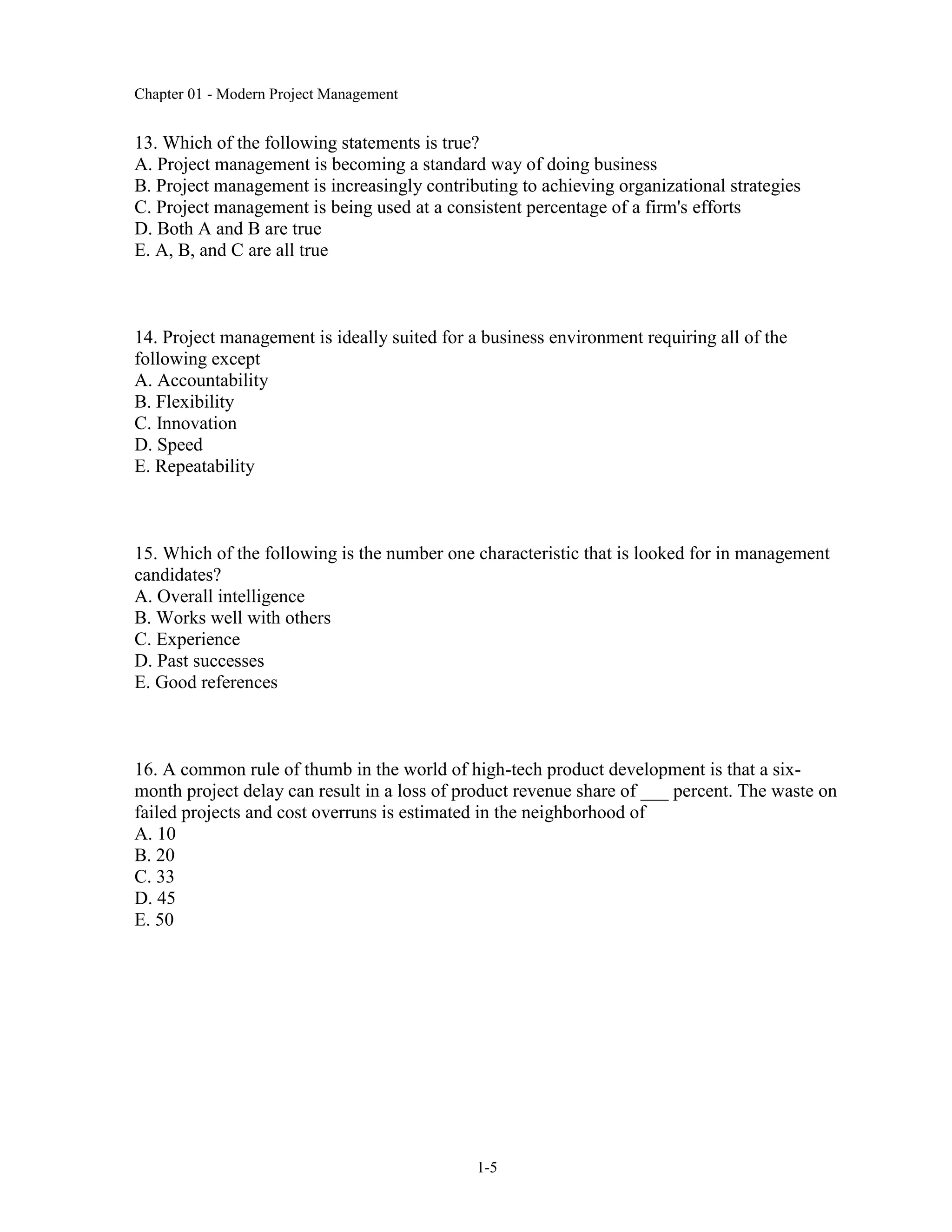
13. Which of the following statements is true?
A. Project management is becoming a standard way of doing business
B. Project management is increasingly contributing to achieving organizational strategies
C. Project management is being used at a consistent percentage of a firm's efforts
D. Both A and B are true
E. A, B, and C are all true
14. Project management is ideally suited for a business environment requiring all of the
following except
A. Accountability
B. Flexibility
C. Innovation
D. Speed
E. Repeatability
15. Which of the following is the number one characteristic that is looked for in management
candidates?
A. Overall intelligence
B. Works well with others
C. Experience
D. Past successes
E. Good references
16. A common rule of thumb in the world of high-tech product development is that a six-
month project delay can result in a loss of product revenue share of ___ percent. The waste on
failed projects and cost overruns is estimated in the neighborhood of
A. 10
B. 20
C. 33
D. 45
E. 50
9.
Chapter 01 -Modern Project Management
1-6
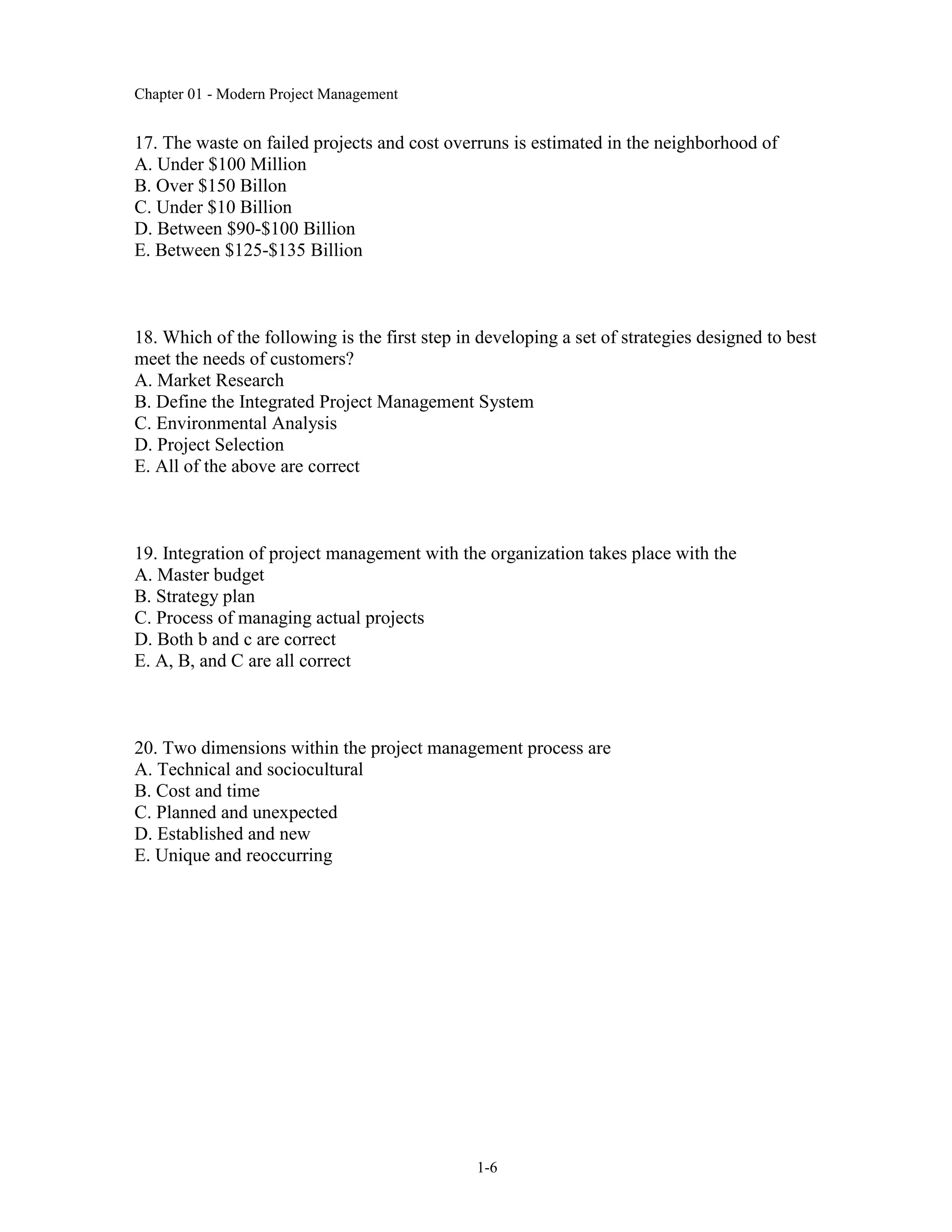
17. The waste on failed projects and cost overruns is estimated in the neighborhood of
A. Under $100 Million
B. Over $150 Billon
C. Under $10 Billion
D. Between $90-$100 Billion
E. Between $125-$135 Billion
18. Which of the following is the first step in developing a set of strategies designed to best
meet the needs of customers?
A. Market Research
B. Define the Integrated Project Management System
C. Environmental Analysis
D. Project Selection
E. All of the above are correct
19. Integration of project management with the organization takes place with the
A. Master budget
B. Strategy plan
C. Process of managing actual projects
D. Both b and c are correct
E. A, B, and C are all correct
20. Two dimensions within the project management process are
A. Technical and sociocultural
B. Cost and time
C. Planned and unexpected
D. Established and new
E. Unique and reoccurring
10.
Chapter 01 -Modern Project Management
1-7
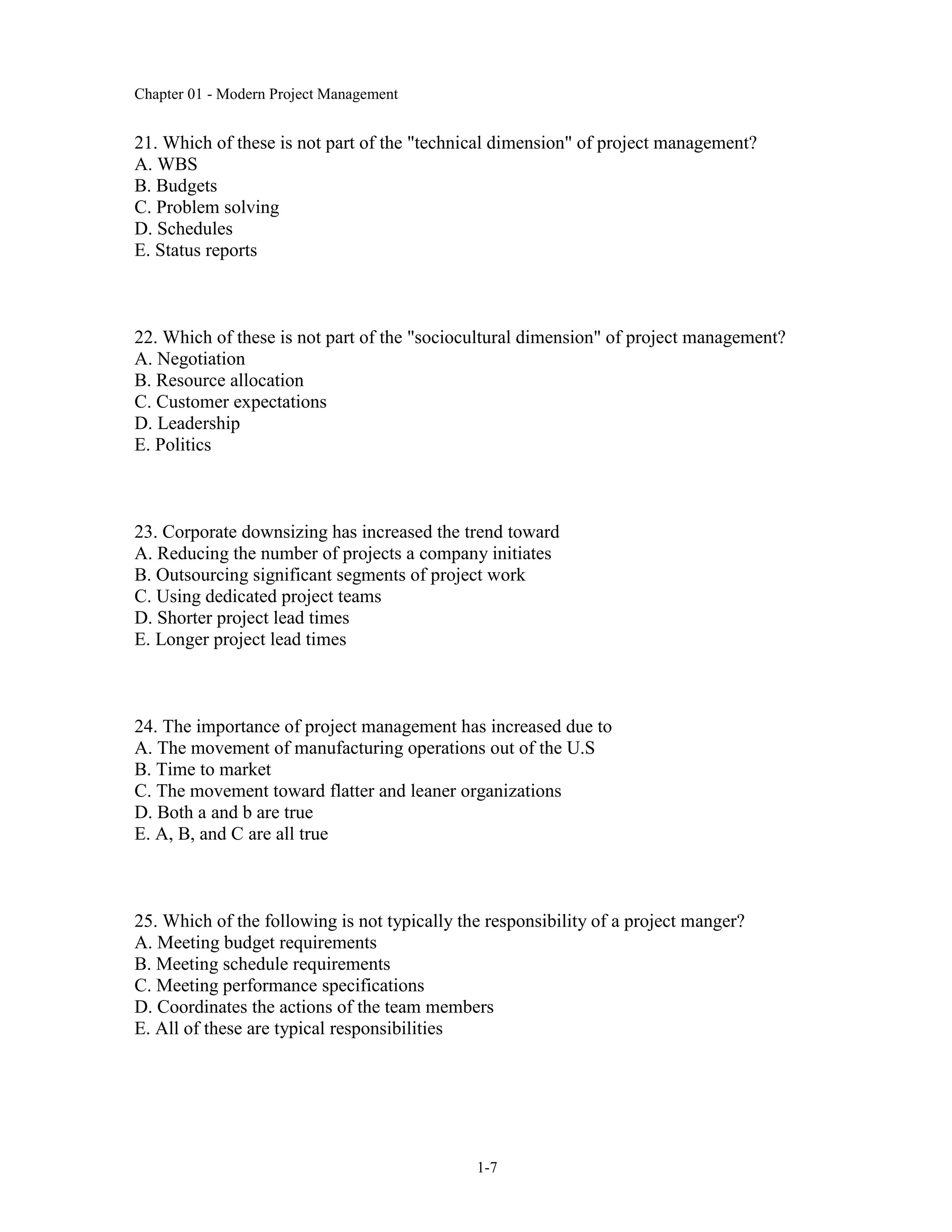
21. Which of these is not part of the "technical dimension" of project management?
A. WBS
B. Budgets
C. Problem solving
D. Schedules
E. Status reports
22. Which of these is not part of the "sociocultural dimension" of project management?
A. Negotiation
B. Resource allocation
C. Customer expectations
D. Leadership
E. Politics
23. Corporate downsizing has increased the trend toward
A. Reducing the number of projects a company initiates
B. Outsourcing significant segments of project work
C. Using dedicated project teams
D. Shorter project lead times
E. Longer project lead times
24. The importance of project management has increased due to
A. The movement of manufacturing operations out of the U.S
B. Time to market
C. The movement toward flatter and leaner organizations
D. Both a and b are true
E. A, B, and C are all true
25. Which of the following is not typically the responsibility of a project manger?
A. Meeting budget requirements
B. Meeting schedule requirements
C. Meeting performance specifications
D. Coordinates the actions of the team members
E. All of these are typical responsibilities
11.
Chapter 01 -Modern Project Management
1-8
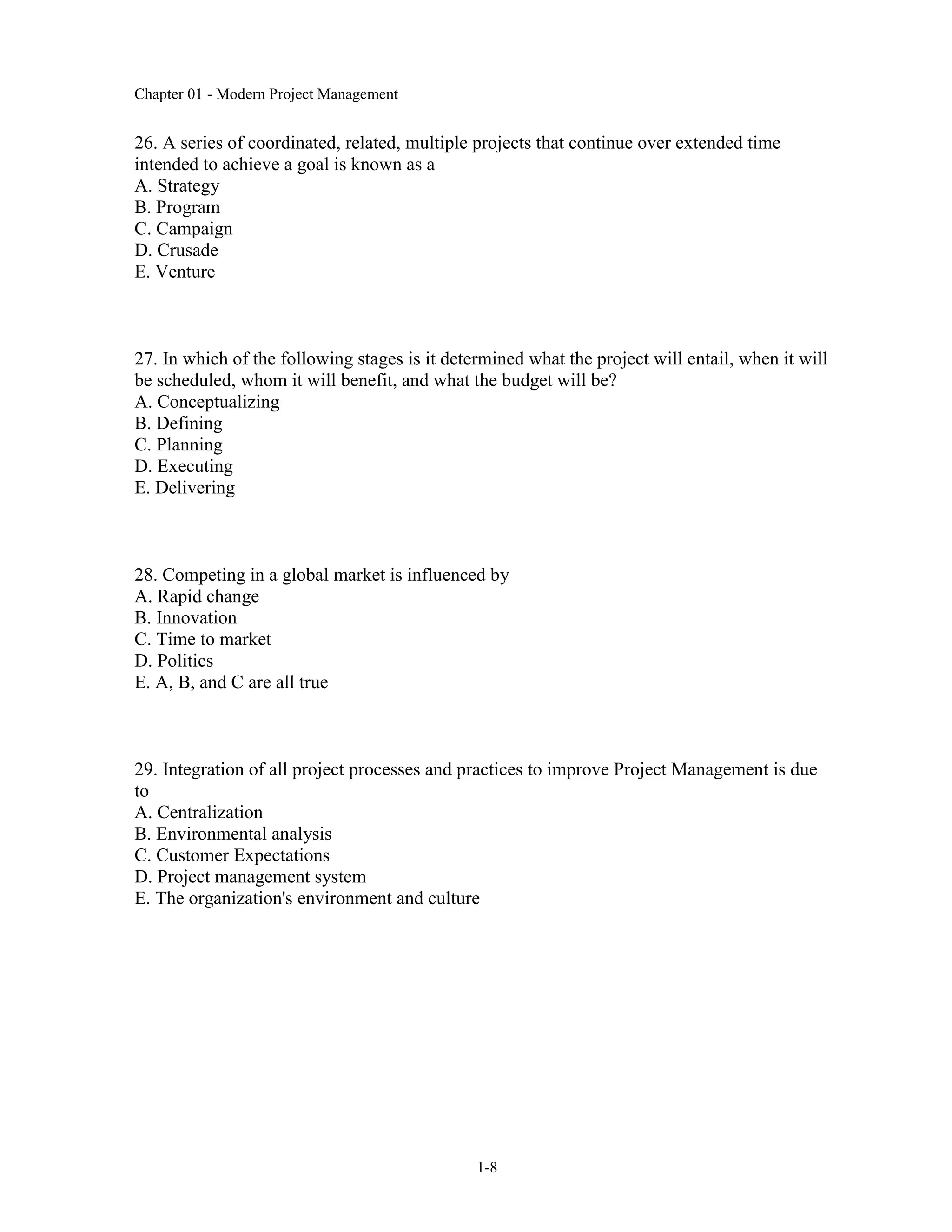
26. A series of coordinated, related, multiple projects that continue over extended time
intended to achieve a goal is known as a
A. Strategy
B. Program
C. Campaign
D. Crusade
E. Venture
27. In which of the following stages is it determined what the project will entail, when it will
be scheduled, whom it will benefit, and what the budget will be?
A. Conceptualizing
B. Defining
C. Planning
D. Executing
E. Delivering
28. Competing in a global market is influenced by
A. Rapid change
B. Innovation
C. Time to market
D. Politics
E. A, B, and C are all true
29. Integration of all project processes and practices to improve Project Management is due
to
A. Centralization
B. Environmental analysis
C. Customer Expectations
D. Project management system
E. The organization's environment and culture
12.
Chapter 01 -Modern Project Management
1-9
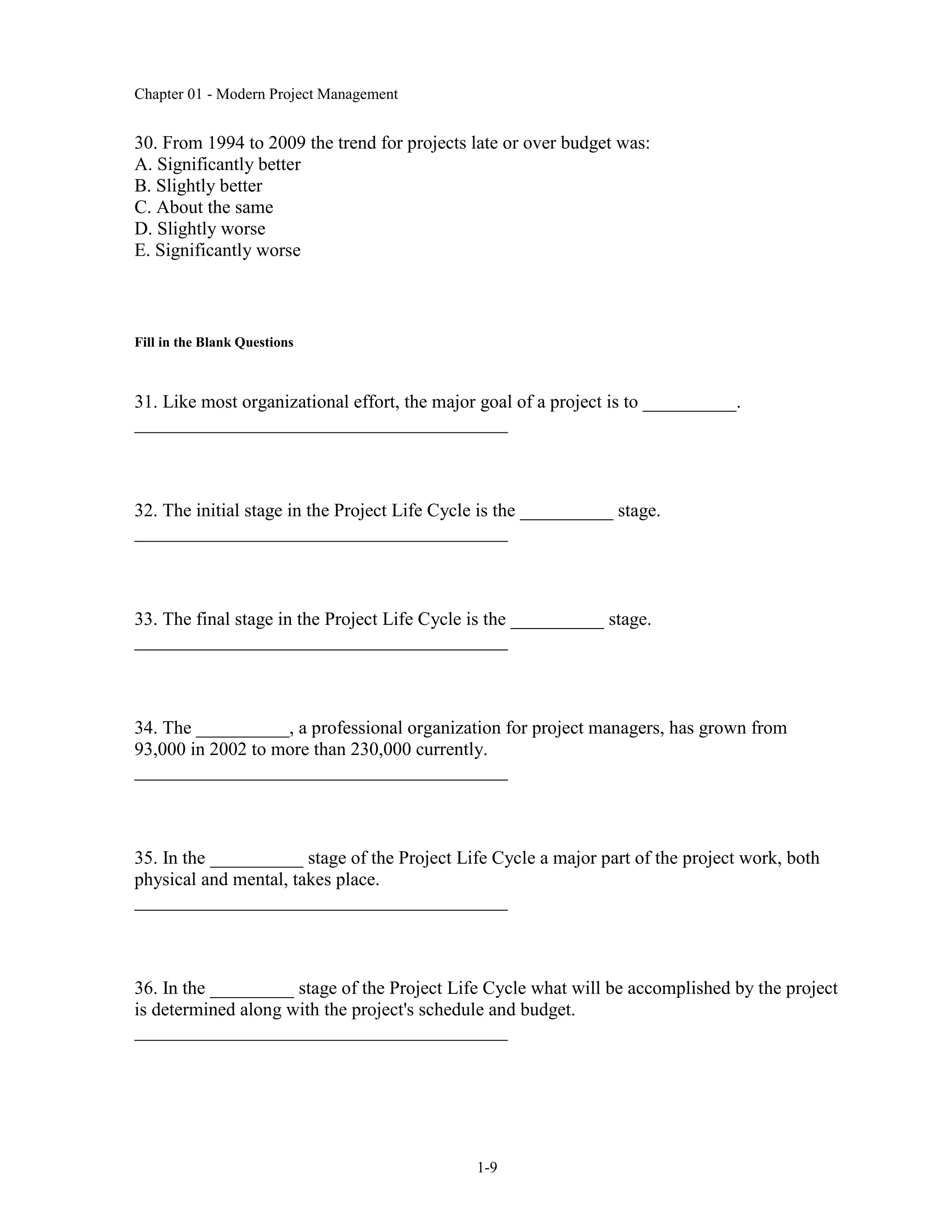
30. From 1994 to 2009 the trend for projects late or over budget was:
A. Significantly better
B. Slightly better
C. About the same
D. Slightly worse
E. Significantly worse
Fill in the Blank Questions
31. Like most organizational effort, the major goal of a project is to __________.
________________________________________
32. The initial stage in the Project Life Cycle is the __________ stage.
________________________________________
33. The final stage in the Project Life Cycle is the __________ stage.
________________________________________
34. The __________, a professional organization for project managers, has grown from
93,000 in 2002 to more than 230,000 currently.
________________________________________
35. In the __________ stage of the Project Life Cycle a major part of the project work, both
physical and mental, takes place.
________________________________________
36. In the _________ stage of the Project Life Cycle what will be accomplished by the project
is determined along with the project's schedule and budget.
________________________________________
13.
Chapter 01 -Modern Project Management
1-10
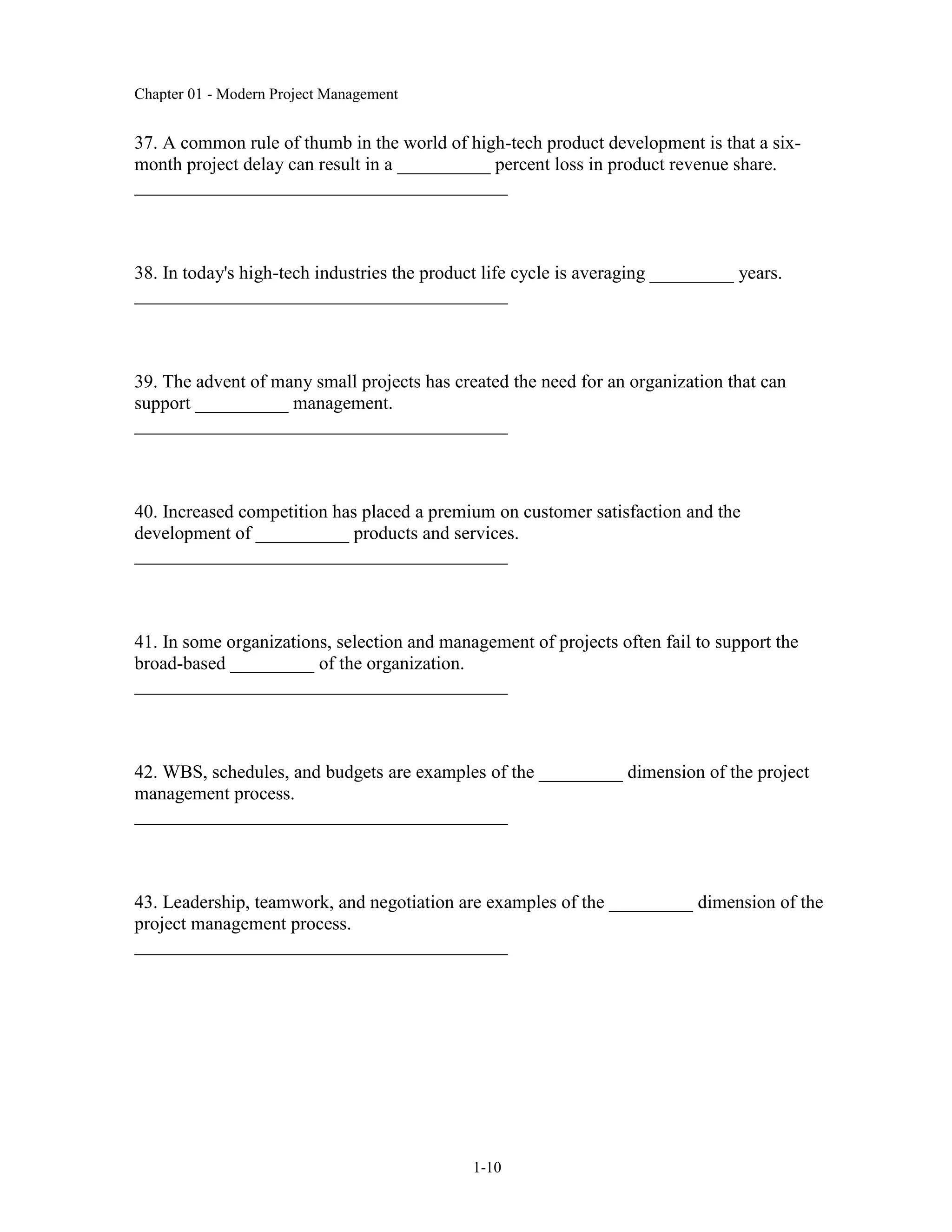
37. A common rule of thumb in the world of high-tech product development is that a six-
month project delay can result in a __________ percent loss in product revenue share.
________________________________________
38. In today's high-tech industries the product life cycle is averaging _________ years.
________________________________________
39. The advent of many small projects has created the need for an organization that can
support __________ management.
________________________________________
40. Increased competition has placed a premium on customer satisfaction and the
development of __________ products and services.
________________________________________
41. In some organizations, selection and management of projects often fail to support the
broad-based _________ of the organization.
________________________________________
42. WBS, schedules, and budgets are examples of the _________ dimension of the project
management process.
________________________________________
43. Leadership, teamwork, and negotiation are examples of the _________ dimension of the
project management process.
________________________________________
14.
Chapter 01 -Modern Project Management
1-11
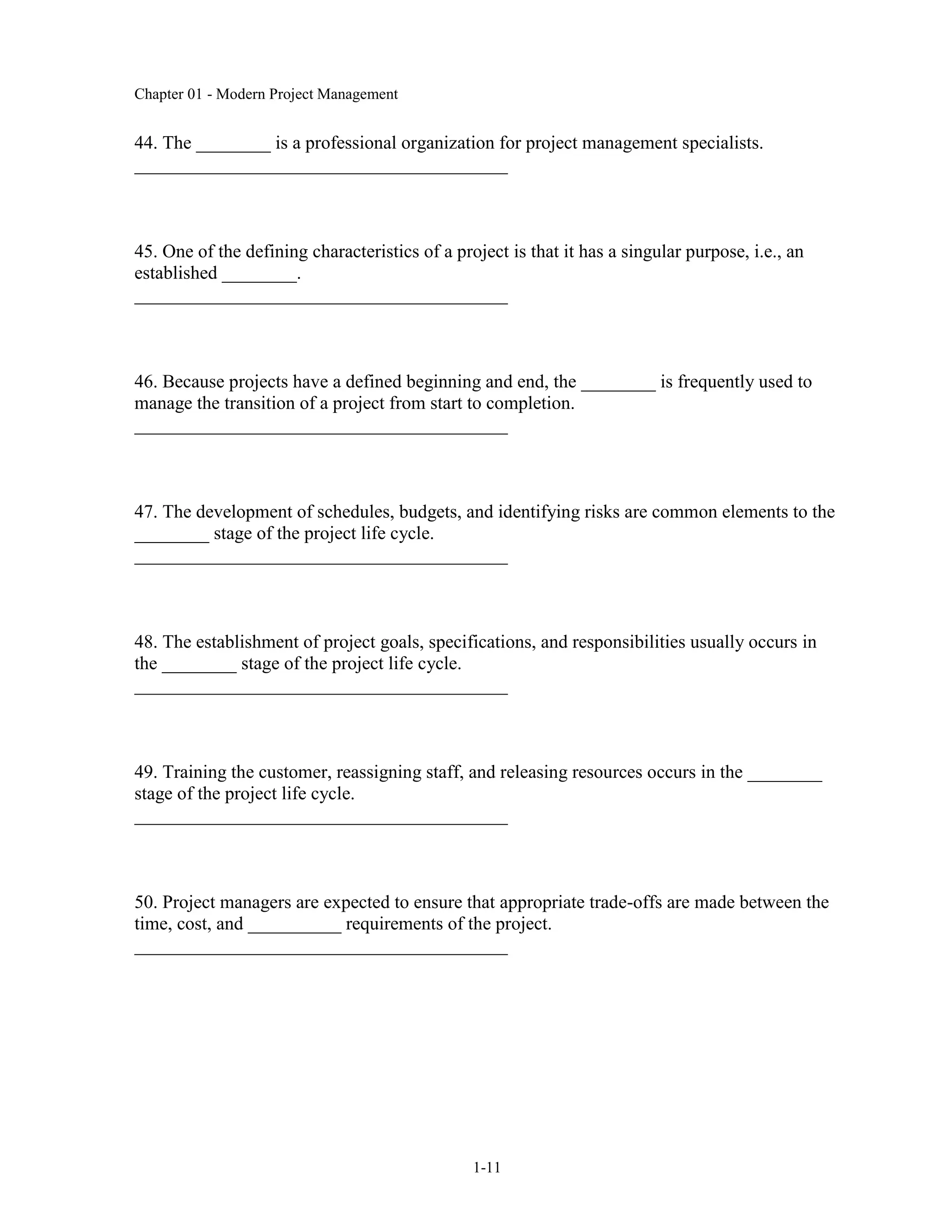
44. The ________ is a professional organization for project management specialists.
________________________________________
45. One of the defining characteristics of a project is that it has a singular purpose, i.e., an
established ________.
________________________________________
46. Because projects have a defined beginning and end, the ________ is frequently used to
manage the transition of a project from start to completion.
________________________________________
47. The development of schedules, budgets, and identifying risks are common elements to the
________ stage of the project life cycle.
________________________________________
48. The establishment of project goals, specifications, and responsibilities usually occurs in
the ________ stage of the project life cycle.
________________________________________
49. Training the customer, reassigning staff, and releasing resources occurs in the ________
stage of the project life cycle.
________________________________________
50. Project managers are expected to ensure that appropriate trade-offs are made between the
time, cost, and __________ requirements of the project.
________________________________________
15.
Chapter 01 -Modern Project Management
1-12
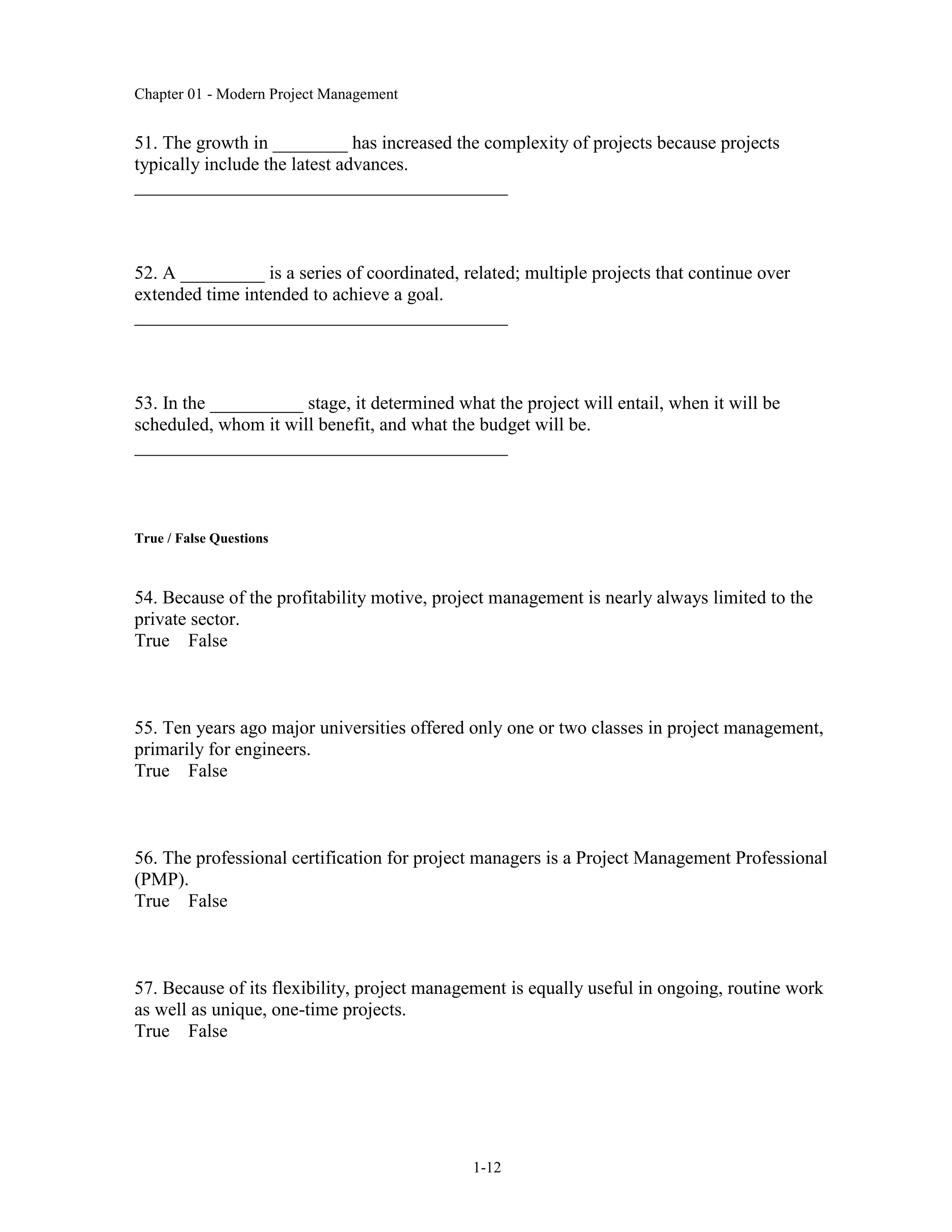
51. The growth in ________ has increased the complexity of projects because projects
typically include the latest advances.
________________________________________
52. A _________ is a series of coordinated, related; multiple projects that continue over
extended time intended to achieve a goal.
________________________________________
53. In the __________ stage, it determined what the project will entail, when it will be
scheduled, whom it will benefit, and what the budget will be.
________________________________________
True / False Questions
54. Because of the profitability motive, project management is nearly always limited to the
private sector.
True False
55. Ten years ago major universities offered only one or two classes in project management,
primarily for engineers.
True False
56. The professional certification for project managers is a Project Management Professional
(PMP).
True False
57. Because of its flexibility, project management is equally useful in ongoing, routine work
as well as unique, one-time projects.
True False
16.
Chapter 01 -Modern Project Management
1-13
58. One of the defining characteristics of project management is that the projects are not
confined to a single department but involve several departments and professionals.
True False
59. One of the characteristics that separate project management from other endeavors of the
organization is that there are specific time, cost, and performance requirements.
True False
60. The singular purpose of a project is often lacking in daily organizational life in which
workers perform repetitive operations each day.
True False
61. Since a construction company builds many buildings the projects after the first building do
not fit the definition of a project.
True False
62. The first stage in the Project Life Cycle is the Concept stage.
True False
63. A major portion of the project work, both physical and mental, takes place during the
Production stage of the Project Life Cycle.
True False
64. In practice, the amount of work accomplished in each stage of the Project Life Cycle will
vary greatly depending on the department or work group.
True False
This ebook isfor the use of anyone anywhere in the United States
and most other parts of the world at no cost and with almost no
restrictions whatsoever. You may copy it, give it away or re-use it
under the terms of the Project Gutenberg License included with this
ebook or online at www.gutenberg.org. If you are not located in the
United States, you will have to check the laws of the country where
you are located before using this eBook.
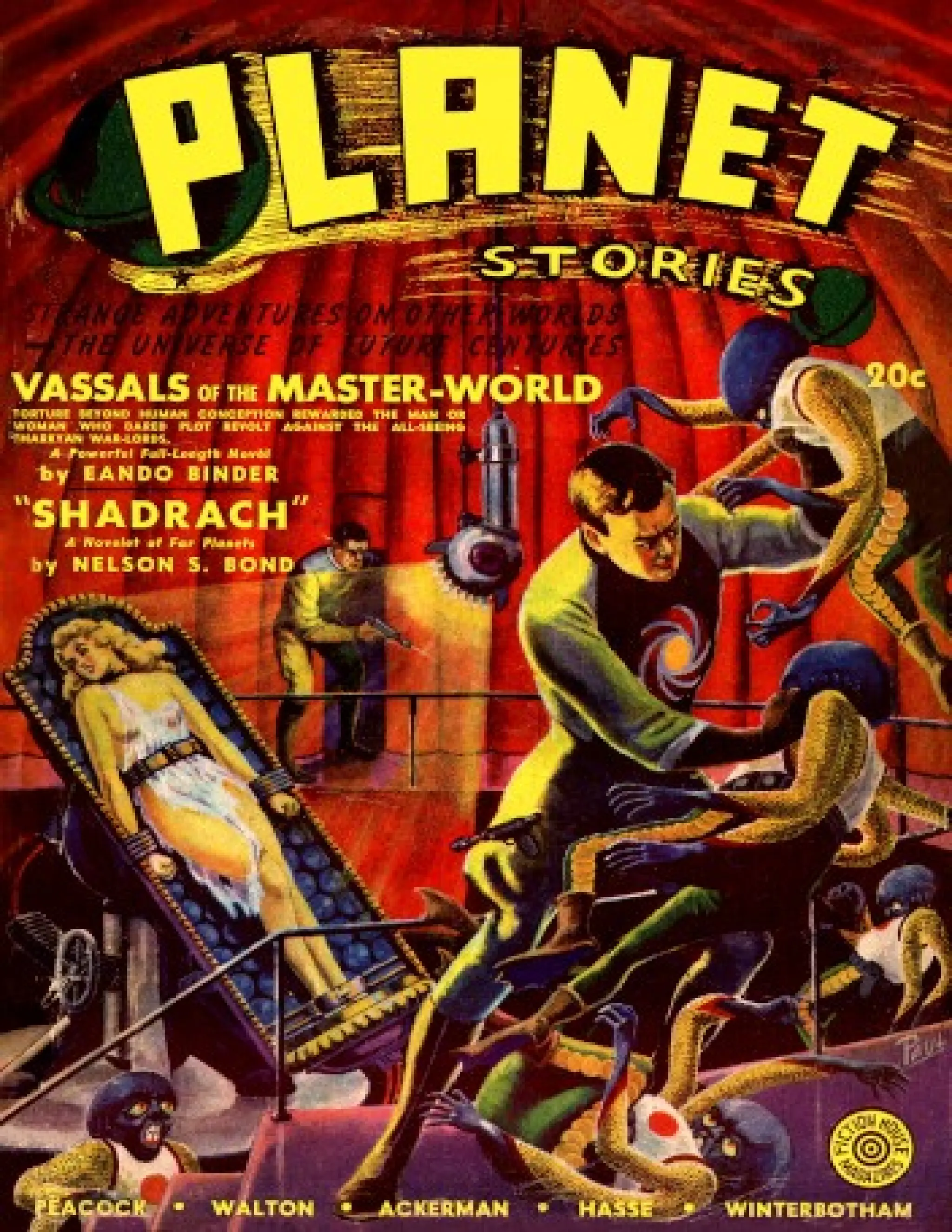
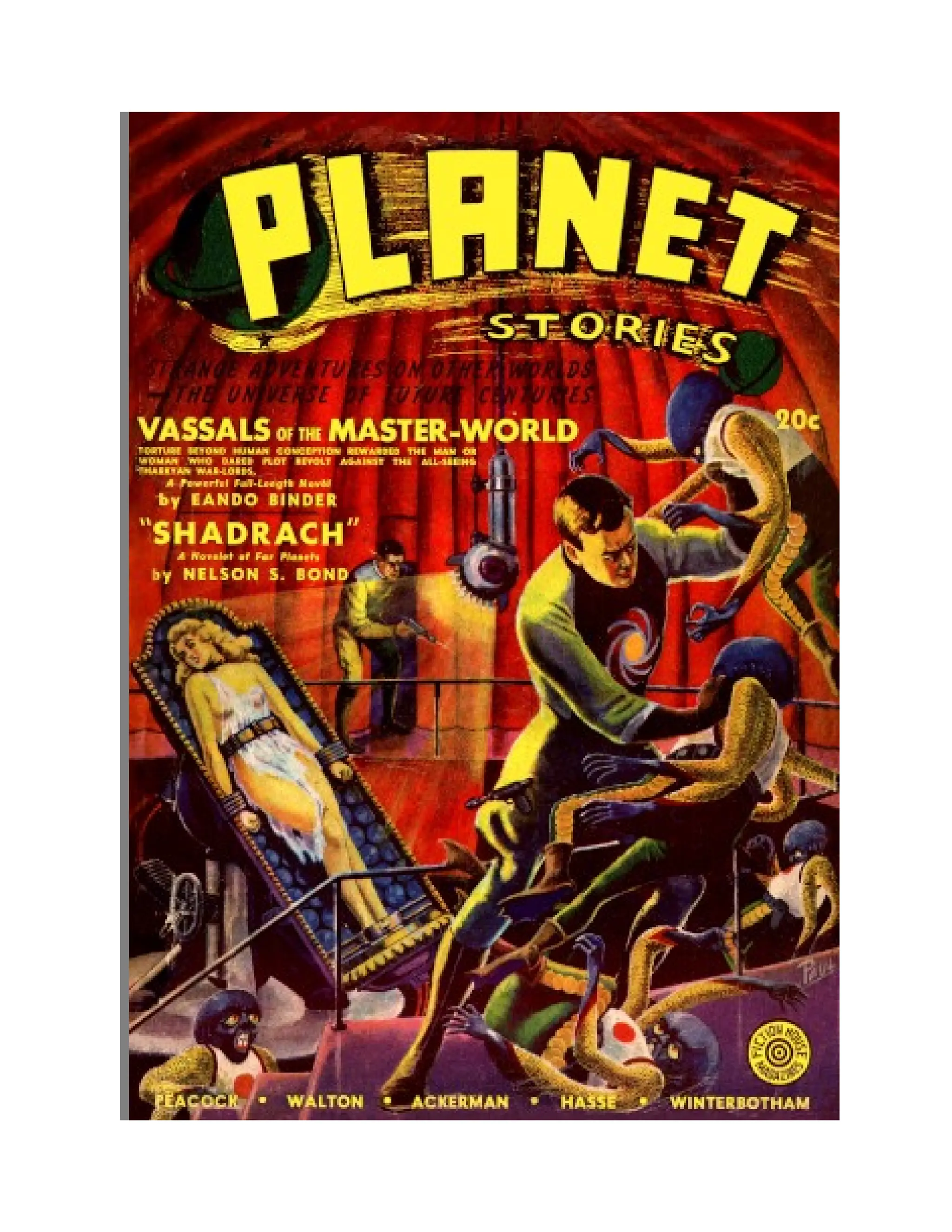
Title: South to Propontis
Author: Henry Andrew Ackermann
Illustrator: Angus Dun
Release date: April 26, 2020 [eBook #61942]
Most recently updated: October 17, 2024
Language: English
Credits: Produced by Greg Weeks, Mary Meehan and the Online
Distributed Proofreading Team at http://www.pgdp.net
*** START OF THE PROJECT GUTENBERG EBOOK SOUTH TO
PROPONTIS ***
By HENRY ANDREWACKERMANN
To the South lay Propontis, capital of
Mars. But between it and the homesick
Earth-youth stretched a burning desert—lair
of the deadly Avis Gladiator!
[Transcriber's Note: This etext was produced from
Planet Stories Fall 1941.
Extensive research did not uncover any evidence that
the U.S. copyright on this publication was renewed.]
26.
It wasn't thegrim thought that he would be dead in a few moments
that filled the mind of Don Moffat so much as the bitter realization
that a sixteen-year-old suspicion had been confirmed too late.
Across the small room a mad light burned in the blood-shot eyes of
his uncle. In spite of the raw liquor he had drunk, the grimy paw
that held the old electronic gun was steady.
Beyond the battered hut's open door heat-blasted desert pulsated as
a tiny sun beat savagely down on the arid, sterile wastes from the
inferno's distant rim.
It was that southern rim, a mere uneven thread of rust, to which
Don had raised his eyes so many times that day, his heart light with
the thought that he was going to Propontis. And from Propontis to a
greener world beyond—a world he had dreamed of one day seeing;
a world where water wasn't priceless. Earth!
Just entering his twenties, he had spent his life on the Martian
wastelands, a motherless kid who had trailed a diamond-mad father
over the wilderness of sand and rock.
Don had been seven when they struck the Suzie lode. There were
plenty of the rough stones, and his father sent for the boy's uncle
and his own brother. Together they were to mine and share alike.
Shortly after his uncle had arrived Don found his father with a
charred hole in his heart, bleaching on the sand. Uncle Fred had
cursed at him when he wept. Later, though, the man explained that
it must have been one of the native Martians. Don believed him
then, but as he grew and came to know his uncle, he began to
doubt.
That morning Uncle Fred had abruptly announced that they were
through, that the last gem had been mined from the Suzie lode. But
there were many diamonds in the plastic boxes, enough to satisfy
any man. They would pack their Iguana, Gecko, and make ready for
the long trek.
27.
So Don hadstowed the saddle-bags and water-tanks. Gecko was
ready and waiting outside. Don's last act was to gather his own
scanty belongings. He was in the hut alone when Uncle Fred came
in. Don raised his eyes to find himself staring into the belled muzzle
of the electronic gun.
"Desert brat," said Uncle Fred thickly. "I'll blow you so wide open
that there won't be a square meal left for a Wirler!"
And now Don knew that he was to die by the same hand that had
killed his father. And Fred was through with him. The boy had helped
to mine the gems, but his uncle had never intended that he should
live to share them. That was why Uncle Fred had been drinking all
day—to bolster up his courage to do deliberate murder. He raised
the gun an inch. Don saw his finger tighten on the trigger. He closed
his eyes, knowing that it would be all over in a moment.
The paper-thin walls of the hut vibrated with the thunderous crash
of an electronic pistol. Donald's jaw went slack. For a paralyzing
second he could only gape at his uncle. The man had uttered a
choking cry, his fingers loosening the gun. Then he pitched to the
floor in a limp heap.
In the open doorway stood a bullet-headed, brown-eyed man,
holding a still-glowing electronic pistol. Over his shoulder peered a
bearded, thick-lipped companion.
Bullet-head shifted his gaze to the boy.
"Glad we showed up?" he asked, grinning.
"Sure am. Thanks," said Don, eying the two men closely. They
weren't settlers nor native-born sons of settlers. For the strangers
walked with difficulty. They had yet to learn the gliding stride that
was second nature to Don. And their complexions had never been
won on Mars.
28.
"You must beDon," said Bullet-Head.
"Right," said Don shortly. "What's your tag?"
"Call me Pete. I heard about you from your uncle last time he was in
Strada." Strada was the diamond center of Mars, Don knew. His
uncle had been there a month ago with some specimens. There
were only three kinds of people in Strada, the boy thought; business
men, police and thieves. Hastily he ruled out the first two. His uncle
must have told too much about his pay-load. These men had
decided to cash in before it had reached a civilized city.
Pete's brown eyes wrinkled. "Right, son," he said amiably. "We're
here for the diamonds. Consider yourself lucky to be alive. Now just
keep your mouth shut and pack that lizard of yours. We're going to
Propontis."
Don didn't ask any more questions. While he was filling the water
tanks from their stores he thought with desperate clarity and speed.
They were city men—earthmen, and could have hoofed it all the
way. He knew how an Iguana could go sullen and completely
intractable if it were mishandled; that, he guessed, was what had
happened to the outlaw's pack-lizards. From the thin crust of sand
on their boots the boy guessed that they hadn't had to walk more
than a few miles.
Don turned, and caught a glance that the two outlaws exchanged.
In that look the boy read an answer to any other question in his
mind. Don knew then that he had escaped death at his uncle's
hands only to face it eventually from these two.
Pete eyed him quizzically. "Let's get going," said the outlaw. "We'll
put some distance between us and this shack before we camp for
the night."
The boy gave Gecko a friendly whack on the tail. The lizard cocked a
lazy eye and ambled off, the rest following.
Behind him Don could hear the two men talking in low undertones.
Only one snatch of conversstion was clear. "Dumb Martian!" Pete
29.
had grunted, andhis friend had snickered agreement.
The boy smiled to himself. Yes, he thought, he was a dumb Martian.
What chance had he had to learn in a land where everything
withered under the scorching sun, and where only ugly venomous
creatures survived? True, he had read his father's old books, but he
had only half understood them. They were mostly treatises on
practical mining and engineering, the rest unreal blood-and-thunder
tales of life in the space lanes.
Two hours later Pete called a halt. He never took his eyes off Don as
preparations were made for the night camp. His companion cooked
a meal out of tins; the outlaws ate most of it and flung the scraps to
the boy.
"Brought plenty of water?" asked Pete, tilting a canteen.
Don nodded.
"That's good. Because if we run short you'll be the first to do
without. When's the soonest we can expect to get to Propontis?"
"Four days," said Don shortly.
Pete raised his brows. "That long?" he asked. "We'd better bunk for
the night." He pulled out his sleeping bag and dropped it on the bare
sand. Don smiled grimly. That was no way to live on the desert, he
knew. The boy burrowed down until he struck the red layer of sand
that retained the day's heat. There he spread his sleeping-bag and
crawled carefully in after taking off his heavy sand-shoes. With his
free arms he banked the red sand over his legs before unfolding the
top flap.
"Kid!" called out Pete.
"Yes?" said Don, stopping short in his preparations.
"I thought I'd tell you—I have my blaster under my pillow. And I'm a
light sleeper. Get that?"
"Yes," said Don coolly. He went on with his bedding. The boy had no
intention at all of running away. The desert was his friend, but the
30.
most implacable enemythat these city men could hope to find.
Whether or not Pete slept lightly Don didn't know. He awoke snug
and warm when dawn was striping the wastelands with rosy hues.
As he looked into the horizon he knew that the day would be a
blistering one.
The outlaws awoke stiff and lame, barely able to crawl out of their
sleeping-bags and not even knowing that they had made the
mistake of sleeping on the hard-packing top layer of sand.
By the time they had started and eaten a meager breakfast the
outlaws had swilled down a full quart of water apiece. Don wisely
contented himself with the moisture to be found in the green food
he had packed.
As the full glare of the sun began to strike the scorching sands the
two Earthmen began to lag. Don slowed his gait for them. They
called for water often; so often that at last he was forced to remind
them that they were drinking too much.
Pete glared at him out of his red-rimmed eyes, false geniality gone.
"Brat!" he snarled. "You'd like to see us die of thirst, wouldn't you?"
Don didn't answer, and silently gave them water whenever they
called for it. By noon both men were suffering from the choking
heat. In the early afternoon Pete called a halt, coughing dryly.
"We're stopping here," he said hoarsely, raising a limp arm at an
outcropping of rock that shelved over a stretch of sand, casting a
jet-black shadow. The boy did not speak, but he knew that these
rock formations were little less than refractory furnaces,
concentrating in one innocuous spot the terrible radiations of the
desert sun. Pete coughed again, his smooth skin paling. Suddenly a
sort of sympathy came over the boy.
31.
"Look," he said,tossing a bit of vegetation under the rock. It crisped
and blackened. The outlaws stared, first at the cinder and then at
Don. Pete's face twitched with strain as he spoke: "Smart kid?
Maybe you're too smart for us!" His hand fell to his belt, where he
wore his bell-mouthed electronic pistol.
The other of the two laid a hand on his arm. "Cut that out," he said
slowly. Then, turning to Don, "Thanks, kid." Stolidly he spread out
his sleeping-bag and squatted down on it to await the night. Pete
sprawled face-down, breathing heavily till the darkness fell. Then
Don, who had bedded down Gecko the Iguana, and the other slid
him into the sleeping-bag.
Before he put up the flap of his own bag Don turned to the silent
outlaw and said: "Half a tank of water left. Ought to hold out if we're
easy on it. There's a water-hole ahead—there was once, I mean.
Maybe it isn't dried up. But it's the wrong season."
"Right," said the outlaw.
Nothing more was said that night.
In the morning, after packing, Don measured out the remaining
water into three canteens. He gave one to each of the outlaws and
put his own on Gecko's back.
The heat was worse than the day before. By noon Gecko was
voluntarily picking up speed, the spines on his horny back moving
first one way and then the other. Don knew the signs. The lizard
sensed water ahead.
"We can't be sure," Don shortly told the Earthmen. "It might not be
drinking water—for us."
Thirty minutes later they came upon it, a small patch of rust-red
mud and slime. One of the outlaws groaned.
"Dried up," whispered Pete dully.
Don said nothing. There was some coarse growth that the pack-
lizard began to eat. The boy was glad of that. He had begun to
32.
worry about Gecko,but now the Iguana would be good for a longer
trek than the one before them.
Pete was on his knees, clawing at the mud. The other watched him
for a moment, then looked at Don inquiringly, who shook his head.
"He'll only poison himself," said the boy.
The outlaw took his companion by the collar, hoisted him to his feet.
"Take this," he said slowly, offering his canteen. "That mud's deadly."
Pete took the canteen and tilted it, swallowing convulsively. His
companion pulled away the precious container. "That's enough," he
said. "It has to last."
A wild curse ripped from Pete's lips. He snatched back the canteen
and drew his gun. In a voice that was hard to recognize as human,
he rasped: "Stand back—you an' the brat!"
His finger whitened on the trigger of the blaster.
And then there sounded about them a curiously soft, derisive
hooting, seemingly from every point of the horizon. Pete stared
wildly about him. There had risen from the sand, it seemed, ghostly
shapes—tall, spindly creatures holding recognizable blowguns
against their lips. The outlaw's gun lowered, and he looked at Don.
"Native Martians," said the boy. "Don't shoot—they know how to use
those blowguns. They might not harm us." There was no time to say
more, for the weird creatures had noiselessly advanced on them,
holding spread before them what seemed to be heavy draperies.
Don hadn't even to wonder before one of the things was clapped
over his head. He felt himself being picked up and carried.
Part of the time consumed by the enforced journey he dozed fitfully,
but while he was awake he thought with strange clarity and
precision, dreaming of the other greener world he had hoped to see.
33.
The boy wasalmost stifled under the heavy folds of the blanket
when, after hours of travel, the Martians removed it.
Free of the torment, he drew a deep breath, blinking his eyes as he
looked about him. The first thing he saw were the two Earthmen
peering dazedly about them, their eyes not yet accustomed to the
sudden change of light.
And when Don looked beyond the outlaws he gasped in stunned
astonishment. Fronting them were the ruins of an old city!
That, he thought, must have been why they had been covered with
the blankets. The Martians wanted to keep the location of the place
a secret.
It seemed to the wondering boy that giants had played here a while.
He saw great statues, perhaps of forgotten gods, misshapen things
with cruel faces, tumbled over on one side. He saw vast paving-
stones, hewn from solid rock, thrust up from their bed of sand,
standing at all angles, cracked and split. He saw great buildings,
strong as fortresses, fallen into ruins. In one place that must have
been a public square a tide of sand broke in still waves about the
base of a truncated pyramid.
"Where are we?" choked Pete, the first of the three to recover from
the shock. He stared about blankly. "It's like a city of the dead," he
whispered hoarsely.
"You're right," Don told him. "It is a city of the dead. An ancient,
long deserted city of the Martians, the ancestors of the degenerates
who hold us captive. This band uses it as their base from which they
launch raiding parties."
Don had no time to say more. The Martians goaded their captives
ahead of them down streets that had once echoed to the tread of a
thousand feet. The humans picking through squares where
multitudes had shouted saw no other living thing but a shimmering
green lizard that basked on a fallen god. There was no sound but
that of the ever-creeping sands. The old people were gone leaving
34.
only ghosts, andthe hand of Time in its unhurried way had long
since set about the task of wiping out all trace of their existence.
The party turned suddenly around the jutting corner of an immense
white stone edifice. Then Don saw something that took his breath
away.
Before him was a great towering structure, a temple judging by the
cryptic signs that adorned its face. Before the temple was a sunken
triangular amphitheater of shining yellow stuff. A glance told Don
that the great pit was made of shining bars and heavy slabs of hand-
hammered and hand-polished metal.
Don wondered why the outlaws were eying the sunken pit so
intently. Since he had been raised on Mars, Don had never heard of
gold.
But it was the birds perched on the top ledge of the amphitheater
that caught Donald's attention as he neared the temple.
There were hundreds of them—Wirlers with plump bodies and
pinkish eyes, iridescent Zloth poking busily with their long, sharp
beaks, spotted Cotasi standing in somber dignity, and everywhere
huge black Sominas. Don paused. These birds made him cold in his
stomach.
"What are those?" asked Pete, his smooth face uneasy.
"Birds native to Mars," said the boy. "But I've never seen them in
such numbers." The Martians and their prisoners halted before a
small, square stone building.
Pete was singled out by one of the gangling creatures, and yanked
inside the little structure. The other outlaw was forced in after him.
Don watched with a strange feeling of detachment as the two
vanished into the building. It was the heat, the withering heat, that
caused that. It sapped all the strength from one's body and left him
feeling slow and dim-witted.
As he stood there he noticed belatedly something he had been
looking at all the while but had not really noticed. It was a small
35.
clump of stuntedtrees, growing a few paces back from the edge of
the amphitheater. Their crooked branches were overladen with the
globes of some bright red fruit.
A sudden impulse came on him. He could just touch one of the
limbs. A moment later one of the red fruit was in his pocket. He
forgot about the thing as soon as he saw Pete and his guards
emerge from the building. "What happened?" the boy asked.
The outlaw coughed dryly. "They showed me some kind of machine
—motor—something. I don't know what they wanted." He grinned
feebly. A moment later the man backed away in alarm as one of
their captors approached him. Deliberately the Martians flung the
contents of a clay gourd into the outlaw's face. The Martian laughed,
a hollow, croaking boom that sounded like sacrilege in that city of
the dead. He gave some order in his gobbling tongue, and two
Martians unceremoniously shoved the weakly struggling Earthman
into the deep pit of the amphitheater.
The Martians looked on stolidly as the outlaw raved and cursed,
berating them. Then, suddenly, the air above the pit seemed to blast
wide open. A shrieking, unhuman sound beat at the ears of the boy;
he jerked his arms up to shield his face. For the hundreds of birds
clustered grimly about the city were in flight—necks outstretched,
eyes glittering, feathered bullets.
Pete screamed faintly and fell to the ground shielding himself. Then
he was overwhelmed by the dark, whirring mass.
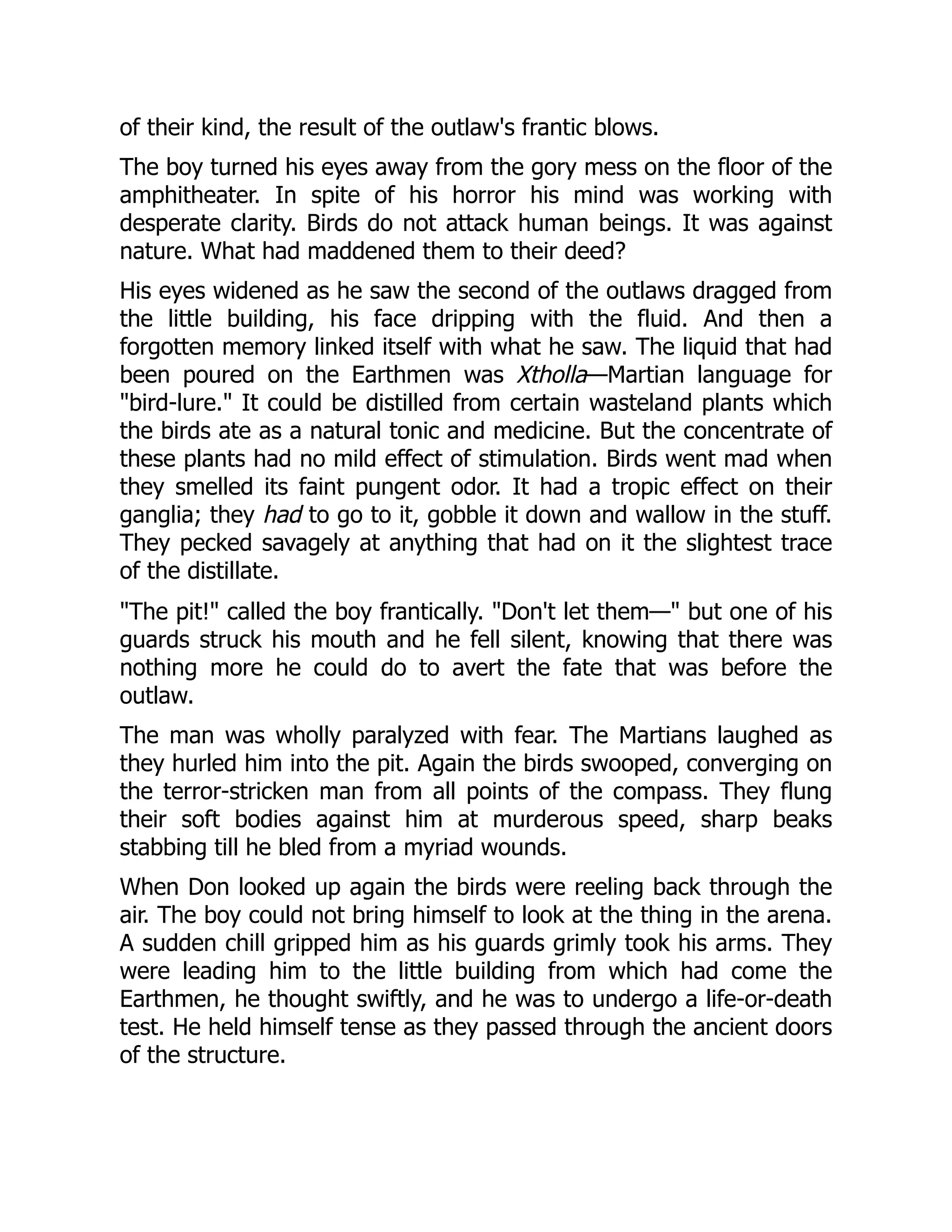
The birds had gone berserk. They drove straight for the man's face,
hundreds of them. His flailing arms smashed against their soft
bodies, batting them out of the air, crushing them to the ground, but
hundreds more took their places, pecking at him with frenzied
beaks, uttering harsh, discordant cries.
36.
It had allhappened so quickly that it caught Don off guard. It was
incredible—birds attacking a human being! He jerked forward.
Immediately Martians rushed to the aid of his guards. His young
muscles strained to break their grip, but in their hands he was
powerless. Agonized, he watched Pete die, a swaying, staggering
figure seen dimly through a heaving whir of wings and stabbing
beaks.
Finally it was over and the birds, flying heavily, reeled through the
air to their old posts, leaving behind them a hundred dead and dying
37.
of their kind,the result of the outlaw's frantic blows.
The boy turned his eyes away from the gory mess on the floor of the
amphitheater. In spite of his horror his mind was working with
desperate clarity. Birds do not attack human beings. It was against
nature. What had maddened them to their deed?
His eyes widened as he saw the second of the outlaws dragged from
the little building, his face dripping with the fluid. And then a
forgotten memory linked itself with what he saw. The liquid that had
been poured on the Earthmen was Xtholla—Martian language for
"bird-lure." It could be distilled from certain wasteland plants which
the birds ate as a natural tonic and medicine. But the concentrate of
these plants had no mild effect of stimulation. Birds went mad when
they smelled its faint pungent odor. It had a tropic effect on their
ganglia; they had to go to it, gobble it down and wallow in the stuff.
They pecked savagely at anything that had on it the slightest trace
of the distillate.
"The pit!" called the boy frantically. "Don't let them—" but one of his
guards struck his mouth and he fell silent, knowing that there was
nothing more he could do to avert the fate that was before the
outlaw.
The man was wholly paralyzed with fear. The Martians laughed as
they hurled him into the pit. Again the birds swooped, converging on
the terror-stricken man from all points of the compass. They flung
their soft bodies against him at murderous speed, sharp beaks
stabbing till he bled from a myriad wounds.
When Don looked up again the birds were reeling back through the
air. The boy could not bring himself to look at the thing in the arena.
A sudden chill gripped him as his guards grimly took his arms. They
were leading him to the little building from which had come the
Earthmen, he thought swiftly, and he was to undergo a life-or-death
test. He held himself tense as they passed through the ancient doors
of the structure.
38.
The walls, hesaw, were studded with tubes that had not lit for
untold millennia; machinery of bizarre design covered the floor. The
boy jumped as a Martian touched his arm. The gangling travesty on
humanity pointed grimly at a device that alone of the machinery
seemed to have been dusted off and wiped with oil.
It was a small motor. The motionless belts and brushes seemed
oddly familiar to the boy. Then he had it! He had seen pictures of
just such motors in one of the old books of his father. But what did
the Martians expect him to do? Obviously the natives wanted him to
start their machine but how could he? He had none of the sources
from which electricity was derived—no steam, no water-power, as
they called it on his father's planet.
As Don glanced at the open door and saw the crowd of demoniac
faces framed in its portals, he knew what fate awaited him if he
failed. The same ruthless sentence that had been executed on the
outlaw Earthmen would fall on him.
The eyes of his guard became dull and deadly as he saw Don did
nothing to the motor.
Then the idea came. Feverishly the boy went to work, racking his
brains for all the details in that old book, "Electricity for the Practical
Miner." He remembered the title clearly, and ground his knuckles into
his eyes to bring before them the simple diagrams that he once had
learned.
Hesitantly he salvaged from a pile of scrap in one corner of the room
two metal plates and lengths of wire. One, he fervently prayed, was
copper and the other zinc. But he could not be sure. The boy
clumsily connected the two terminal wires of the motor, one to each
of the plates.
Then he did what seemed a foolish thing. He took the globe of red
fruit from his pocket and sliced it neatly into thin layers. Don laid the
dripping slices atop the copper plate, and then, his heart cold as ice,
laid the zinc plate atop the fruit.
39.
*** END OFTHE PROJECT GUTENBERG EBOOK SOUTH TO
PROPONTIS ***
Updated editions will replace the previous one—the old editions will
be renamed.
Creating the works from print editions not protected by U.S.
copyright law means that no one owns a United States copyright in
these works, so the Foundation (and you!) can copy and distribute it
in the United States without permission and without paying
copyright royalties. Special rules, set forth in the General Terms of
Use part of this license, apply to copying and distributing Project
Gutenberg™ electronic works to protect the PROJECT GUTENBERG™
concept and trademark. Project Gutenberg is a registered trademark,
and may not be used if you charge for an eBook, except by following
the terms of the trademark license, including paying royalties for use
of the Project Gutenberg trademark. If you do not charge anything
for copies of this eBook, complying with the trademark license is
very easy. You may use this eBook for nearly any purpose such as
creation of derivative works, reports, performances and research.
Project Gutenberg eBooks may be modified and printed and given
away—you may do practically ANYTHING in the United States with
eBooks not protected by U.S. copyright law. Redistribution is subject
to the trademark license, especially commercial redistribution.
START: FULL LICENSE
PLEASE READ THISBEFORE YOU DISTRIBUTE OR USE THIS WORK
To protect the Project Gutenberg™ mission of promoting the free
distribution of electronic works, by using or distributing this work (or
any other work associated in any way with the phrase “Project
Gutenberg”), you agree to comply with all the terms of the Full
Project Gutenberg™ License available with this file or online at
www.gutenberg.org/license.
Section 1. General Terms of Use and
Redistributing Project Gutenberg™
electronic works
1.A. By reading or using any part of this Project Gutenberg™
electronic work, you indicate that you have read, understand, agree
to and accept all the terms of this license and intellectual property
(trademark/copyright) agreement. If you do not agree to abide by all
the terms of this agreement, you must cease using and return or
destroy all copies of Project Gutenberg™ electronic works in your
possession. If you paid a fee for obtaining a copy of or access to a
Project Gutenberg™ electronic work and you do not agree to be
bound by the terms of this agreement, you may obtain a refund
from the person or entity to whom you paid the fee as set forth in
paragraph 1.E.8.
1.B. “Project Gutenberg” is a registered trademark. It may only be
used on or associated in any way with an electronic work by people
who agree to be bound by the terms of this agreement. There are a
few things that you can do with most Project Gutenberg™ electronic
works even without complying with the full terms of this agreement.
See paragraph 1.C below. There are a lot of things you can do with
Project Gutenberg™ electronic works if you follow the terms of this
agreement and help preserve free future access to Project
Gutenberg™ electronic works. See paragraph 1.E below.
42.
1.C. The ProjectGutenberg Literary Archive Foundation (“the
Foundation” or PGLAF), owns a compilation copyright in the
collection of Project Gutenberg™ electronic works. Nearly all the
individual works in the collection are in the public domain in the
United States. If an individual work is unprotected by copyright law
in the United States and you are located in the United States, we do
not claim a right to prevent you from copying, distributing,
performing, displaying or creating derivative works based on the
work as long as all references to Project Gutenberg are removed. Of
course, we hope that you will support the Project Gutenberg™
mission of promoting free access to electronic works by freely
sharing Project Gutenberg™ works in compliance with the terms of
this agreement for keeping the Project Gutenberg™ name associated
with the work. You can easily comply with the terms of this
agreement by keeping this work in the same format with its attached
full Project Gutenberg™ License when you share it without charge
with others.
1.D. The copyright laws of the place where you are located also
govern what you can do with this work. Copyright laws in most
countries are in a constant state of change. If you are outside the
United States, check the laws of your country in addition to the
terms of this agreement before downloading, copying, displaying,
performing, distributing or creating derivative works based on this
work or any other Project Gutenberg™ work. The Foundation makes
no representations concerning the copyright status of any work in
any country other than the United States.
1.E. Unless you have removed all references to Project Gutenberg:
1.E.1. The following sentence, with active links to, or other
immediate access to, the full Project Gutenberg™ License must
appear prominently whenever any copy of a Project Gutenberg™
work (any work on which the phrase “Project Gutenberg” appears,
or with which the phrase “Project Gutenberg” is associated) is
accessed, displayed, performed, viewed, copied or distributed:
43.
This eBook isfor the use of anyone anywhere in the United
States and most other parts of the world at no cost and with
almost no restrictions whatsoever. You may copy it, give it away
or re-use it under the terms of the Project Gutenberg License
included with this eBook or online at www.gutenberg.org. If you
are not located in the United States, you will have to check the
laws of the country where you are located before using this
eBook.
1.E.2. If an individual Project Gutenberg™ electronic work is derived
from texts not protected by U.S. copyright law (does not contain a
notice indicating that it is posted with permission of the copyright
holder), the work can be copied and distributed to anyone in the
United States without paying any fees or charges. If you are
redistributing or providing access to a work with the phrase “Project
Gutenberg” associated with or appearing on the work, you must
comply either with the requirements of paragraphs 1.E.1 through
1.E.7 or obtain permission for the use of the work and the Project
Gutenberg™ trademark as set forth in paragraphs 1.E.8 or 1.E.9.
1.E.3. If an individual Project Gutenberg™ electronic work is posted
with the permission of the copyright holder, your use and distribution
must comply with both paragraphs 1.E.1 through 1.E.7 and any
additional terms imposed by the copyright holder. Additional terms
will be linked to the Project Gutenberg™ License for all works posted
with the permission of the copyright holder found at the beginning
of this work.
1.E.4. Do not unlink or detach or remove the full Project
Gutenberg™ License terms from this work, or any files containing a
part of this work or any other work associated with Project
Gutenberg™.
1.E.5. Do not copy, display, perform, distribute or redistribute this
electronic work, or any part of this electronic work, without
prominently displaying the sentence set forth in paragraph 1.E.1
44.
with active linksor immediate access to the full terms of the Project
Gutenberg™ License.
1.E.6. You may convert to and distribute this work in any binary,
compressed, marked up, nonproprietary or proprietary form,
including any word processing or hypertext form. However, if you
provide access to or distribute copies of a Project Gutenberg™ work
in a format other than “Plain Vanilla ASCII” or other format used in
the official version posted on the official Project Gutenberg™ website
(www.gutenberg.org), you must, at no additional cost, fee or
expense to the user, provide a copy, a means of exporting a copy, or
a means of obtaining a copy upon request, of the work in its original
“Plain Vanilla ASCII” or other form. Any alternate format must
include the full Project Gutenberg™ License as specified in
paragraph 1.E.1.
1.E.7. Do not charge a fee for access to, viewing, displaying,
performing, copying or distributing any Project Gutenberg™ works
unless you comply with paragraph 1.E.8 or 1.E.9.
1.E.8. You may charge a reasonable fee for copies of or providing
access to or distributing Project Gutenberg™ electronic works
provided that:
• You pay a royalty fee of 20% of the gross profits you derive
from the use of Project Gutenberg™ works calculated using the
method you already use to calculate your applicable taxes. The
fee is owed to the owner of the Project Gutenberg™ trademark,
but he has agreed to donate royalties under this paragraph to
the Project Gutenberg Literary Archive Foundation. Royalty
payments must be paid within 60 days following each date on
which you prepare (or are legally required to prepare) your
periodic tax returns. Royalty payments should be clearly marked
as such and sent to the Project Gutenberg Literary Archive
Foundation at the address specified in Section 4, “Information
45.
Welcome to ourwebsite – the perfect destination for book lovers and
knowledge seekers. We believe that every book holds a new world,
offering opportunities for learning, discovery, and personal growth.
That’s why we are dedicated to bringing you a diverse collection of
books, ranging from classic literature and specialized publications to
self-development guides and children's books.
More than just a book-buying platform, we strive to be a bridge
connecting you with timeless cultural and intellectual values. With an
elegant, user-friendly interface and a smart search system, you can
quickly find the books that best suit your interests. Additionally,
our special promotions and home delivery services help you save time
and fully enjoy the joy of reading.
Join us on a journey of knowledge exploration, passion nurturing, and
personal growth every day!
testbankmall.com







![This ebook is for the use of anyone anywhere in the United States
and most other parts of the world at no cost and with almost no
restrictions whatsoever. You may copy it, give it away or re-use it
under the terms of the Project Gutenberg License included with this
ebook or online at www.gutenberg.org. If you are not located in the
United States, you will have to check the laws of the country where
you are located before using this eBook.
Title: South to Propontis
Author: Henry Andrew Ackermann
Illustrator: Angus Dun
Release date: April 26, 2020 [eBook #61942]
Most recently updated: October 17, 2024
Language: English
Credits: Produced by Greg Weeks, Mary Meehan and the Online
Distributed Proofreading Team at http://www.pgdp.net
*** START OF THE PROJECT GUTENBERG EBOOK SOUTH TO
PROPONTIS ***](https://image.slidesharecdn.com/1377-250627185739-5136aa02/75/Test-Bank-for-Project-Management-The-Managerial-Process-5th-Edition-Larson-22-2048.jpg)


![By HENRY ANDREW ACKERMANN
To the South lay Propontis, capital of
Mars. But between it and the homesick
Earth-youth stretched a burning desert—lair
of the deadly Avis Gladiator!
[Transcriber's Note: This etext was produced from
Planet Stories Fall 1941.
Extensive research did not uncover any evidence that
the U.S. copyright on this publication was renewed.]](https://image.slidesharecdn.com/1377-250627185739-5136aa02/75/Test-Bank-for-Project-Management-The-Managerial-Process-5th-Edition-Larson-25-2048.jpg)