Landforms Change
Due to Forces inside the Earth
And
Forces outside the Earth
LANDFORMS ASSOCIATED WITH
PLATE BOUNDARY ACTIVITY
Forces Inside the
Earth
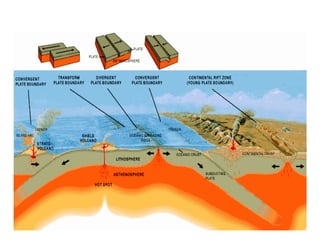
Convergent
Divergent
Earth Movements and Resultant
Landforms
 Believed that the Earth's crust is broken into
parts or sections called plates.
 Plates consist of sial ( forming continents)
floating on the denser sima ( forming ocean
beds ).
 Earth movements ( ie forces operating inside
the Earth's crust ) cause these plates to move
away from each other or move towards each
other
 The lithospheric plates ‘ float’ on asthenosphere
& are moved by convectional currents of magma
Earth Movements and Resultant
Landforms
 Conventional currents are driven by heat
energy release by radioactivity (radioactivity
decay) in mantle. They drag and move plates
above them
 Such movements are not regular & not
constant through time
 Plate movements cause changes ( called
tectonic processes) & instability along plate
boundaries , hence they are unstable zones
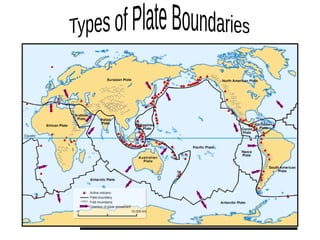
1. Divergent plate movement at
constructive plate boundary:
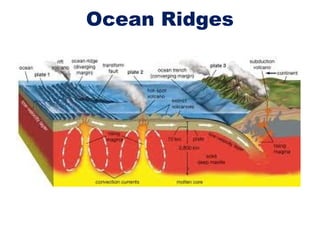
When plates move apart, hot molten
materials wells up from Earth's interior to
form a new ocean floor with mid-oceanic
ridges.
E.g. : the Mid Atlantic oceanic ridge is formed
when the American plates on the west and
the Eurasian plate & African plate on the
east move apart
3 forms of plate movements &
boundaries
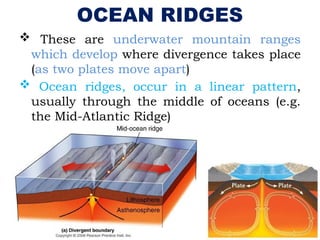
OCEAN RIDGES
 These are underwater mountain ranges
which develop where divergence takes place
(as two plates move apart)
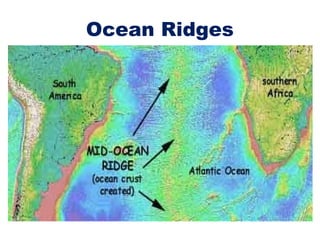
 Ocean ridges, occur in a linear pattern,
usually through the middle of oceans (e.g.
the Mid-Atlantic Ridge)
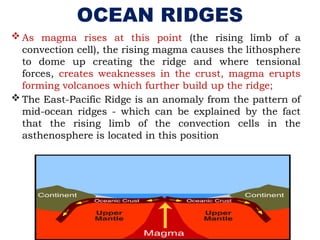
OCEAN RIDGES
 As magma rises at this point (the rising limb of a
convection cell), the rising magma causes the lithosphere
to dome up creating the ridge and where tensional
forces, creates weaknesses in the crust, magma erupts
forming volcanoes which further build up the ridge;
 The East-Pacific Ridge is an anomaly from the pattern of
mid-ocean ridges - which can be explained by the fact
that the rising limb of the convection cells in the
asthenosphere is located in this position
Ocean Ridges
Ocean Ridges
2. Convergent plate movement at
destructive plate boundary:
When plate move towards each other:
 they may slip past each other & create a
tear fault, accompanied by earthquakes
but little volcanic activity
 they may collide and :
–when 2 oceanic plate edges sink,
plates edges are bent into a deep
trench called the subduction zone.
3 forms of plate movements &
boundaries
 Portions of lithosphere are dragged into
asthenosphere and melt or become
metamorphosed. Eventually, new magma
may be pushed through fractures to form
volcanic islands
 When oceanic plates sinks beneath
continental plate, it is pushed under
because it is denser.
 Lithosphere materials from oceanic
crust are subducted in the trench
while continental border is fractured,
folded & uplifted.
 Magma rises from the subduction zone
through fractures. Thus, a mountain
system accompanied by volcanic activity
can be found on the continental edge
parallel to the ocean trench.
 Other processes include faulting &
earthquakes
 Resultant major landforms include
oceanic trenches like the Chile-Peru
Trench, fold mountains like the Andes,
volcanoes like Mt St Helens ( USA) &
volcanic island arcs like the Japan islands
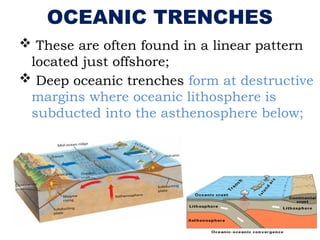
OCEANIC TRENCHES
 These are often found in a linear pattern
located just offshore;
 Deep oceanic trenches form at destructive
margins where oceanic lithosphere is
subducted into the asthenosphere below;
OCEANIC TRENCHES
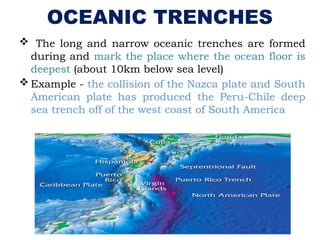
 The long and narrow oceanic trenches are formed
during and mark the place where the ocean floor is
deepest (about 10km below sea level)
 Example - the collision of the Nazca plate and South
American plate has produced the Peru-Chile deep
sea trench off of the west coast of South America
Ocean Trenches
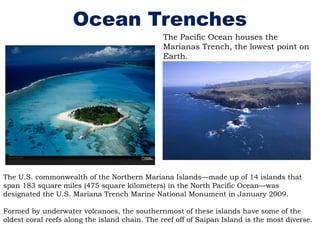
The U.S. commonwealth of the Northern Mariana Islands—made up of 14 islands that
span 183 square miles (475 square kilometers) in the North Pacific Ocean—was
designated the U.S. Mariana Trench Marine National Monument in January 2009.
Formed by underwater volcanoes, the southernmost of these islands have some of the
oldest coral reefs along the island chain. The reef off of Saipan Island is the most diverse.
The Pacific Ocean houses the
Marianas Trench, the lowest point on
Earth.
When both continental plates collide,
neither tends to sink because their densities
are similar.
 Instead, continental lithosphere buckles & is
uplifted.
 Fold mountain ranges are formed
 e.g. : the Himalayas are formed when Indian plate
collided with Eurasian plate & Alps was formed
when African plate drifted towards Eurasian plate
 Little volcanic activity occur because rocks from
the lithosphere do not sink deep into the
asthenosphere.
 Earthquakes, faulting & folding are common.
FOLD MOUNTAINS
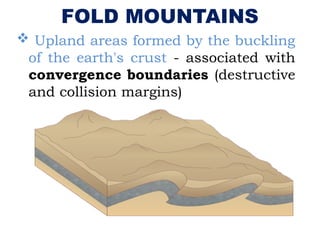
 Upland areas formed by the buckling
of the earth's crust - associated with
convergence boundaries (destructive
and collision margins)
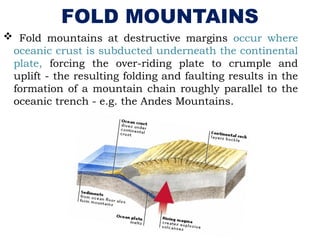
 Fold mountains at destructive margins occur where
oceanic crust is subducted underneath the continental
plate, forcing the over-riding plate to crumple and
uplift - the resulting folding and faulting results in the
formation of a mountain chain roughly parallel to the
oceanic trench - e.g. the Andes Mountains.
FOLD MOUNTAINS
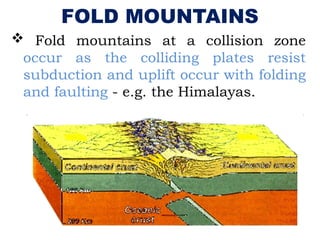
 Fold mountains at a collision zone
occur as the colliding plates resist
subduction and uplift occur with folding
and faulting - e.g. the Himalayas.
FOLD MOUNTAINS
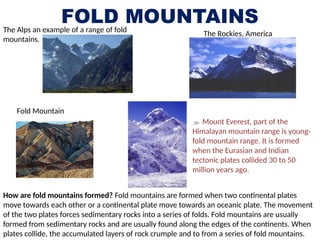
The Alps an example of a range of fold
mountains.
The Rockies, America
How are fold mountains formed? Fold mountains are formed when two continental plates
move towards each other or a continental plate move towards an oceanic plate. The movement
of the two plates forces sedimentary rocks into a series of folds. Fold mountains are usually
formed from sedimentary rocks and are usually found along the edges of the continents. When
plates collide, the accumulated layers of rock crumple and to from a series of fold mountains.
 Mount Everest, part of the
Himalayan mountain range is young-
fold mountain range. It is formed
when the Eurasian and Indian
tectonic plates collided 30 to 50
million years ago.
Fold Mountain
FOLD MOUNTAINS
ISLAND ARCS
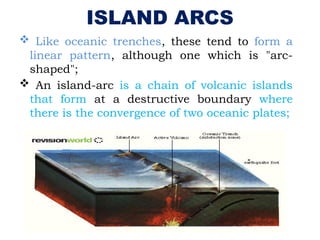
 Like oceanic trenches, these tend to form a
linear pattern, although one which is "arc-
shaped";
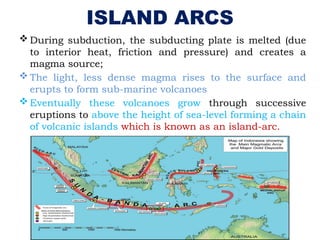
 An island-arc is a chain of volcanic islands
that form at a destructive boundary where
there is the convergence of two oceanic plates;
ISLAND ARCS
 During subduction, the subducting plate is melted (due
to interior heat, friction and pressure) and creates a
magma source;
 The light, less dense magma rises to the surface and
erupts to form sub-marine volcanoes
 Eventually these volcanoes grow through successive
eruptions to above the height of sea-level forming a chain
of volcanic islands which is known as an island-arc.
Island Arcs
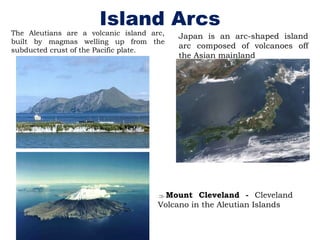
The Aleutians are a volcanic island arc,
built by magmas welling up from the
subducted crust of the Pacific plate.
Japan is an arc-shaped island
arc composed of volcanoes off
the Asian mainland
Mount Cleveland - Cleveland
Volcano in the Aleutian Islands
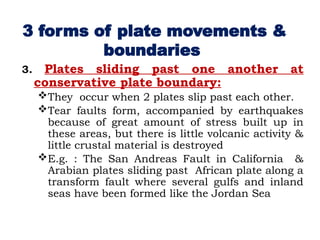
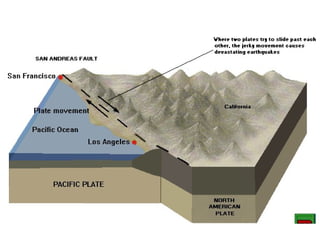
3. Plates sliding past one another at
conservative plate boundary:
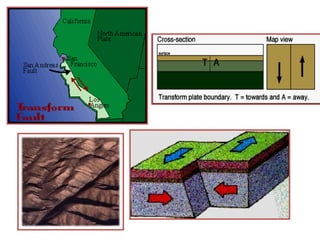
They occur when 2 plates slip past each other.
Tear faults form, accompanied by earthquakes
because of great amount of stress built up in
these areas, but there is little volcanic activity &
little crustal material is destroyed
E.g. : The San Andreas Fault in California &
Arabian plates sliding past African plate along a
transform fault where several gulfs and inland
seas have been formed like the Jordan Sea
3 forms of plate movements &
boundaries
#4 Landforms_Change.pptxsssssssssssssssss

#4 Landforms_Change.pptxsssssssssssssssss

  • 1.
    Landforms Change Due toForces inside the Earth And Forces outside the Earth
  • 2.
    LANDFORMS ASSOCIATED WITH PLATEBOUNDARY ACTIVITY Forces Inside the Earth
  • 4.
  • 5.
    Earth Movements andResultant Landforms  Believed that the Earth's crust is broken into parts or sections called plates.  Plates consist of sial ( forming continents) floating on the denser sima ( forming ocean beds ).  Earth movements ( ie forces operating inside the Earth's crust ) cause these plates to move away from each other or move towards each other  The lithospheric plates ‘ float’ on asthenosphere & are moved by convectional currents of magma
  • 6.
    Earth Movements andResultant Landforms  Conventional currents are driven by heat energy release by radioactivity (radioactivity decay) in mantle. They drag and move plates above them  Such movements are not regular & not constant through time  Plate movements cause changes ( called tectonic processes) & instability along plate boundaries , hence they are unstable zones
  • 7.
    1. Divergent platemovement at constructive plate boundary: When plates move apart, hot molten materials wells up from Earth's interior to form a new ocean floor with mid-oceanic ridges. E.g. : the Mid Atlantic oceanic ridge is formed when the American plates on the west and the Eurasian plate & African plate on the east move apart 3 forms of plate movements & boundaries
  • 8.
    OCEAN RIDGES  Theseare underwater mountain ranges which develop where divergence takes place (as two plates move apart)  Ocean ridges, occur in a linear pattern, usually through the middle of oceans (e.g. the Mid-Atlantic Ridge)
  • 9.
    OCEAN RIDGES  Asmagma rises at this point (the rising limb of a convection cell), the rising magma causes the lithosphere to dome up creating the ridge and where tensional forces, creates weaknesses in the crust, magma erupts forming volcanoes which further build up the ridge;  The East-Pacific Ridge is an anomaly from the pattern of mid-ocean ridges - which can be explained by the fact that the rising limb of the convection cells in the asthenosphere is located in this position
  • 10.
  • 11.
  • 12.
    2. Convergent platemovement at destructive plate boundary: When plate move towards each other:  they may slip past each other & create a tear fault, accompanied by earthquakes but little volcanic activity  they may collide and : –when 2 oceanic plate edges sink, plates edges are bent into a deep trench called the subduction zone. 3 forms of plate movements & boundaries
  • 13.
     Portions oflithosphere are dragged into asthenosphere and melt or become metamorphosed. Eventually, new magma may be pushed through fractures to form volcanic islands  When oceanic plates sinks beneath continental plate, it is pushed under because it is denser.  Lithosphere materials from oceanic crust are subducted in the trench while continental border is fractured, folded & uplifted.
  • 14.
     Magma risesfrom the subduction zone through fractures. Thus, a mountain system accompanied by volcanic activity can be found on the continental edge parallel to the ocean trench.  Other processes include faulting & earthquakes  Resultant major landforms include oceanic trenches like the Chile-Peru Trench, fold mountains like the Andes, volcanoes like Mt St Helens ( USA) & volcanic island arcs like the Japan islands
  • 15.
    OCEANIC TRENCHES  Theseare often found in a linear pattern located just offshore;  Deep oceanic trenches form at destructive margins where oceanic lithosphere is subducted into the asthenosphere below;
  • 16.
    OCEANIC TRENCHES  Thelong and narrow oceanic trenches are formed during and mark the place where the ocean floor is deepest (about 10km below sea level)  Example - the collision of the Nazca plate and South American plate has produced the Peru-Chile deep sea trench off of the west coast of South America
  • 17.
    Ocean Trenches The U.S.commonwealth of the Northern Mariana Islands—made up of 14 islands that span 183 square miles (475 square kilometers) in the North Pacific Ocean—was designated the U.S. Mariana Trench Marine National Monument in January 2009. Formed by underwater volcanoes, the southernmost of these islands have some of the oldest coral reefs along the island chain. The reef off of Saipan Island is the most diverse. The Pacific Ocean houses the Marianas Trench, the lowest point on Earth.
  • 18.
    When both continentalplates collide, neither tends to sink because their densities are similar.  Instead, continental lithosphere buckles & is uplifted.  Fold mountain ranges are formed  e.g. : the Himalayas are formed when Indian plate collided with Eurasian plate & Alps was formed when African plate drifted towards Eurasian plate  Little volcanic activity occur because rocks from the lithosphere do not sink deep into the asthenosphere.  Earthquakes, faulting & folding are common.
  • 19.
    FOLD MOUNTAINS  Uplandareas formed by the buckling of the earth's crust - associated with convergence boundaries (destructive and collision margins)
  • 20.
     Fold mountainsat destructive margins occur where oceanic crust is subducted underneath the continental plate, forcing the over-riding plate to crumple and uplift - the resulting folding and faulting results in the formation of a mountain chain roughly parallel to the oceanic trench - e.g. the Andes Mountains. FOLD MOUNTAINS
  • 21.
     Fold mountainsat a collision zone occur as the colliding plates resist subduction and uplift occur with folding and faulting - e.g. the Himalayas. FOLD MOUNTAINS
  • 22.
    The Alps anexample of a range of fold mountains. The Rockies, America How are fold mountains formed? Fold mountains are formed when two continental plates move towards each other or a continental plate move towards an oceanic plate. The movement of the two plates forces sedimentary rocks into a series of folds. Fold mountains are usually formed from sedimentary rocks and are usually found along the edges of the continents. When plates collide, the accumulated layers of rock crumple and to from a series of fold mountains.  Mount Everest, part of the Himalayan mountain range is young- fold mountain range. It is formed when the Eurasian and Indian tectonic plates collided 30 to 50 million years ago. Fold Mountain FOLD MOUNTAINS
  • 23.
    ISLAND ARCS  Likeoceanic trenches, these tend to form a linear pattern, although one which is "arc- shaped";  An island-arc is a chain of volcanic islands that form at a destructive boundary where there is the convergence of two oceanic plates;
  • 24.
    ISLAND ARCS  Duringsubduction, the subducting plate is melted (due to interior heat, friction and pressure) and creates a magma source;  The light, less dense magma rises to the surface and erupts to form sub-marine volcanoes  Eventually these volcanoes grow through successive eruptions to above the height of sea-level forming a chain of volcanic islands which is known as an island-arc.
  • 25.
    Island Arcs The Aleutiansare a volcanic island arc, built by magmas welling up from the subducted crust of the Pacific plate. Japan is an arc-shaped island arc composed of volcanoes off the Asian mainland Mount Cleveland - Cleveland Volcano in the Aleutian Islands
  • 26.
    3. Plates slidingpast one another at conservative plate boundary: They occur when 2 plates slip past each other. Tear faults form, accompanied by earthquakes because of great amount of stress built up in these areas, but there is little volcanic activity & little crustal material is destroyed E.g. : The San Andreas Fault in California & Arabian plates sliding past African plate along a transform fault where several gulfs and inland seas have been formed like the Jordan Sea 3 forms of plate movements & boundaries