Plate Tectonics
Notes
When I think of
plate tectonics, I
think of...
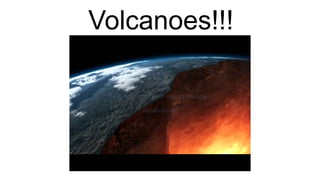
Volcanoes!!!
Let’s go back
into history!
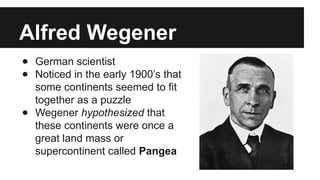
Alfred Wegener
● German scientist
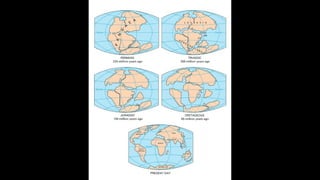
● Noticed in the early 1900’s that
some continents seemed to fit
together as a puzzle
● Wegener hypothesized that
these continents were once a
great land mass or
supercontinent called Pangea
Theory of Plate Tectonics
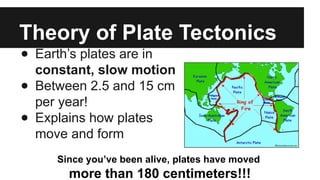
● Earth’s plates are in
constant, slow motion
● Between 2.5 and 15 cm
per year!
● Explains how plates
move and form
Since you’ve been alive, plates have moved
more than 180 centimeters!!!
Theory of Plate Tectonics continued...
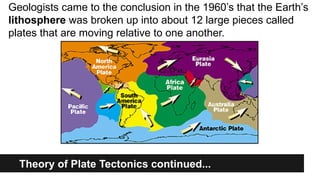
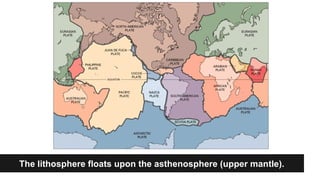
Geologists came to the conclusion in the 1960’s that the Earth’s
lithosphere was broken up into about 12 large pieces called
plates that are moving relative to one another.
The lithosphere floats upon the asthenosphere (upper mantle).
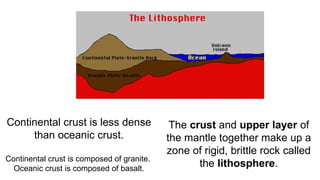
The crust and upper layer of
the mantle together make up a
zone of rigid, brittle rock called
the lithosphere.
Continental crust is less dense
than oceanic crust.
Continental crust is composed of granite.
Oceanic crust is composed of basalt.
Plate Movement
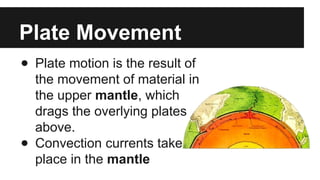
● Plate motion is the result of
the movement of material in
the upper mantle, which
drags the overlying plates
above.
● Convection currents take
place in the mantle
Convection Currents
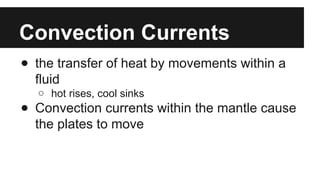
● the transfer of heat by movements within a
fluid
○ hot rises, cool sinks
● Convection currents within the mantle cause
the plates to move
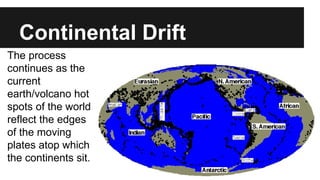
Continental Drift
The process
continues as the
current
earth/volcano hot
spots of the world
reflect the edges
of the moving
plates atop which
the continents sit.
Plate Boundary Rap
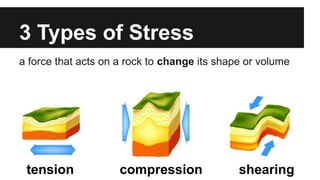
3 Types of Stress
a force that acts on a rock to change its shape or volume
tension compression shearing
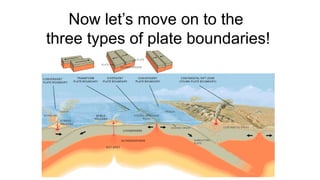
Now let’s move on to the
three types of plate boundaries!
Plate Boundaries
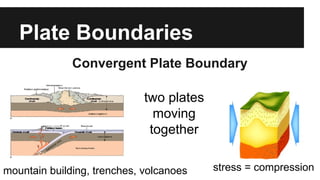
Convergent Plate Boundary
two plates
moving
together
stress = compression
mountain building, trenches, volcanoes
Subduction Zone
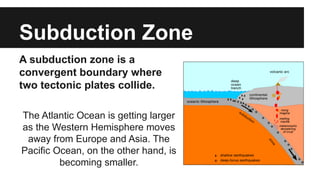
A subduction zone is a
convergent boundary where
two tectonic plates collide.
The Atlantic Ocean is getting larger
as the Western Hemisphere moves
away from Europe and Asia. The
Pacific Ocean, on the other hand, is
becoming smaller.
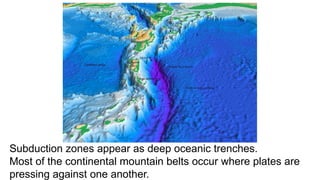
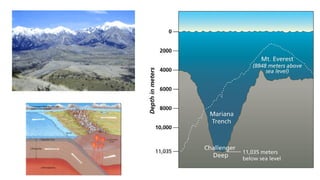
Subduction zones appear as deep oceanic trenches.
Most of the continental mountain belts occur where plates are
pressing against one another.
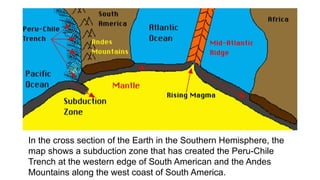
In the cross section of the Earth in the Southern Hemisphere, the
map shows a subduction zone that has created the Peru-Chile
Trench at the western edge of South American and the Andes
Mountains along the west coast of South America.
CONVERGENT
COLLIDE
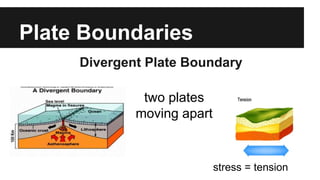
Plate Boundaries
Divergent Plate Boundary
two plates
moving apart
stress = tension
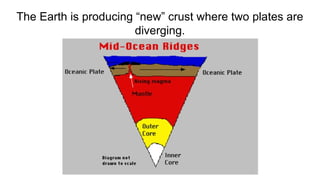
The Earth is producing “new” crust where two plates are
diverging.
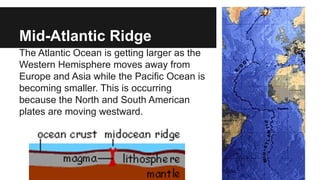
Mid-Atlantic Ridge
The Atlantic Ocean is getting larger as the
Western Hemisphere moves away from
Europe and Asia while the Pacific Ocean is
becoming smaller. This is occurring
because the North and South American
plates are moving westward.
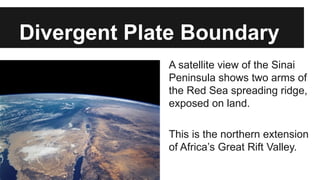
A satellite view of the Sinai
Peninsula shows two arms of
the Red Sea spreading ridge,
exposed on land.
This is the northern extension
of Africa’s Great Rift Valley.
Divergent Plate Boundary
DIVERGENT
DIVIDE
Plate Boundaries
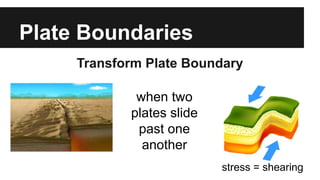
Transform Plate Boundary
when two
plates slide
past one
another
stress = shearing
Meeting of the Plates
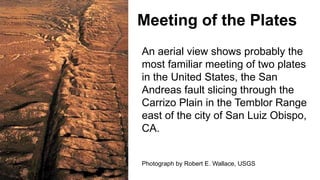
An aerial view shows probably the
most familiar meeting of two plates
in the United States, the San
Andreas fault slicing through the
Carrizo Plain in the Temblor Range
east of the city of San Luiz Obispo,
CA.
Photograph by Robert E. Wallace, USGS
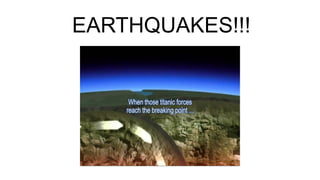
EARTHQUAKES!!!
TRANSFORM
TECTONIC PLATES
SLIDE
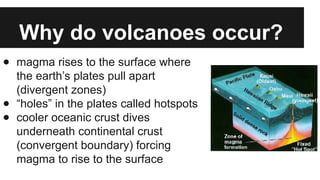
Why do volcanoes occur?
● magma rises to the surface where
the earth’s plates pull apart
(divergent zones)
● “holes” in the plates called hotspots
● cooler oceanic crust dives
underneath continental crust
(convergent boundary) forcing
magma to rise to the surface
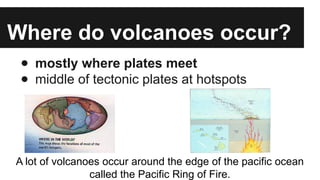
Where do volcanoes occur?
● mostly where plates meet
● middle of tectonic plates at hotspots
A lot of volcanoes occur around the edge of the pacific ocean
called the Pacific Ring of Fire.
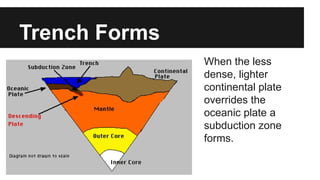
Trench Forms
When the less
dense, lighter
continental plate
overrides the
oceanic plate a
subduction zone
forms.
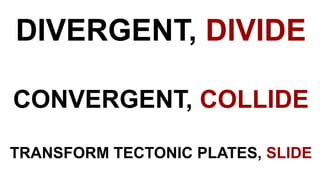
DIVERGENT, DIVIDE
CONVERGENT, COLLIDE
TRANSFORM TECTONIC PLATES, SLIDE
Plate Boundary Rap
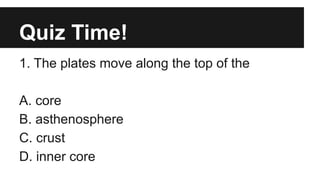
Quiz Time!
1. The plates move along the top of the
A. core
B. asthenosphere
C. crust
D. inner core
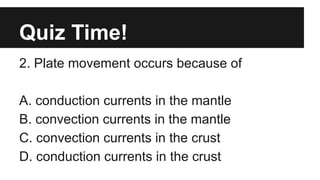
Quiz Time!
2. Plate movement occurs because of
A. conduction currents in the mantle
B. convection currents in the mantle
C. convection currents in the crust
D. conduction currents in the crust
Quiz Time!
3. Earth’s lithosphere is broken into a number
of large pieces called…
A. faults
B. volcanoes
C. plates
D. folds
Quiz Time!
4. Plate boundary where new crust is being
formed
A. convergent
B. divergent
C. transform
Quiz Time!
5. Two plates sliding next to each other
A. convergent
B. divergent
C. transform
Quiz Time!
6. Where mountain building occurs
A. convergent
B. divergent
C. transform
Quiz Time!
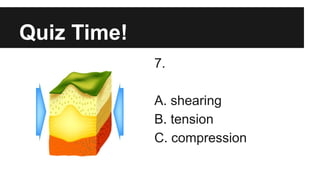
7.
A. shearing
B. tension
C. compression
Quiz Time!
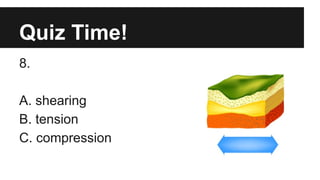
8.
A. shearing
B. tension
C. compression
Quiz Time!
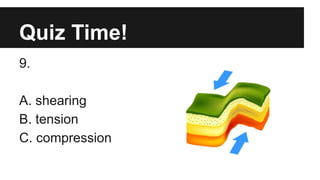
9.
A. shearing
B. tension
C. compression
Quiz Time!
10. Subduction occurs at a
A. transform plate boundary
B. convergent plate boundary
C. divergent plate boundary

Plate Tectonics 201fEFWEFWEfwefwEFeaf9.pptx

  • 1.
  • 2.
    When I thinkof plate tectonics, I think of...
  • 3.
  • 4.
  • 5.
    Alfred Wegener ● Germanscientist ● Noticed in the early 1900’s that some continents seemed to fit together as a puzzle ● Wegener hypothesized that these continents were once a great land mass or supercontinent called Pangea
  • 8.
    Theory of PlateTectonics ● Earth’s plates are in constant, slow motion ● Between 2.5 and 15 cm per year! ● Explains how plates move and form Since you’ve been alive, plates have moved more than 180 centimeters!!!
  • 9.
    Theory of PlateTectonics continued... Geologists came to the conclusion in the 1960’s that the Earth’s lithosphere was broken up into about 12 large pieces called plates that are moving relative to one another.
  • 10.
    The lithosphere floatsupon the asthenosphere (upper mantle).
  • 11.
    The crust andupper layer of the mantle together make up a zone of rigid, brittle rock called the lithosphere. Continental crust is less dense than oceanic crust. Continental crust is composed of granite. Oceanic crust is composed of basalt.
  • 12.
    Plate Movement ● Platemotion is the result of the movement of material in the upper mantle, which drags the overlying plates above. ● Convection currents take place in the mantle
  • 13.
    Convection Currents ● thetransfer of heat by movements within a fluid ○ hot rises, cool sinks ● Convection currents within the mantle cause the plates to move
  • 14.
    Continental Drift The process continuesas the current earth/volcano hot spots of the world reflect the edges of the moving plates atop which the continents sit.
  • 15.
  • 16.
    3 Types ofStress a force that acts on a rock to change its shape or volume tension compression shearing
  • 17.
    Now let’s moveon to the three types of plate boundaries!
  • 18.
    Plate Boundaries Convergent PlateBoundary two plates moving together stress = compression mountain building, trenches, volcanoes
  • 19.
    Subduction Zone A subductionzone is a convergent boundary where two tectonic plates collide. The Atlantic Ocean is getting larger as the Western Hemisphere moves away from Europe and Asia. The Pacific Ocean, on the other hand, is becoming smaller.
  • 20.
    Subduction zones appearas deep oceanic trenches. Most of the continental mountain belts occur where plates are pressing against one another.
  • 21.
    In the crosssection of the Earth in the Southern Hemisphere, the map shows a subduction zone that has created the Peru-Chile Trench at the western edge of South American and the Andes Mountains along the west coast of South America.
  • 23.
  • 24.
    Plate Boundaries Divergent PlateBoundary two plates moving apart stress = tension
  • 25.
    The Earth isproducing “new” crust where two plates are diverging.
  • 26.
    Mid-Atlantic Ridge The AtlanticOcean is getting larger as the Western Hemisphere moves away from Europe and Asia while the Pacific Ocean is becoming smaller. This is occurring because the North and South American plates are moving westward.
  • 27.
    A satellite viewof the Sinai Peninsula shows two arms of the Red Sea spreading ridge, exposed on land. This is the northern extension of Africa’s Great Rift Valley. Divergent Plate Boundary
  • 28.
  • 29.
    Plate Boundaries Transform PlateBoundary when two plates slide past one another stress = shearing
  • 30.
    Meeting of thePlates An aerial view shows probably the most familiar meeting of two plates in the United States, the San Andreas fault slicing through the Carrizo Plain in the Temblor Range east of the city of San Luiz Obispo, CA. Photograph by Robert E. Wallace, USGS
  • 31.
  • 32.
  • 33.
    Why do volcanoesoccur? ● magma rises to the surface where the earth’s plates pull apart (divergent zones) ● “holes” in the plates called hotspots ● cooler oceanic crust dives underneath continental crust (convergent boundary) forcing magma to rise to the surface
  • 34.
    Where do volcanoesoccur? ● mostly where plates meet ● middle of tectonic plates at hotspots A lot of volcanoes occur around the edge of the pacific ocean called the Pacific Ring of Fire.
  • 35.
    Trench Forms When theless dense, lighter continental plate overrides the oceanic plate a subduction zone forms.
  • 36.
  • 37.
  • 38.
    Quiz Time! 1. Theplates move along the top of the A. core B. asthenosphere C. crust D. inner core
  • 39.
    Quiz Time! 2. Platemovement occurs because of A. conduction currents in the mantle B. convection currents in the mantle C. convection currents in the crust D. conduction currents in the crust
  • 40.
    Quiz Time! 3. Earth’slithosphere is broken into a number of large pieces called… A. faults B. volcanoes C. plates D. folds
  • 41.
    Quiz Time! 4. Plateboundary where new crust is being formed A. convergent B. divergent C. transform
  • 42.
    Quiz Time! 5. Twoplates sliding next to each other A. convergent B. divergent C. transform

  • 43.
    Quiz Time! 6. Wheremountain building occurs A. convergent B. divergent C. transform
  • 44.
    Quiz Time! 7. A. shearing B.tension C. compression
  • 45.
    Quiz Time! 8. A. shearing B.tension C. compression
  • 46.
    Quiz Time! 9. A. shearing B.tension C. compression
  • 47.
    Quiz Time! 10. Subductionoccurs at a A. transform plate boundary B. convergent plate boundary C. divergent plate boundary
Editor's Notes

  • #1 Fill in the Blank Notes https://docs.google.com/document/d/1cRsXgQkGNjt2Us1gr0km422duA8y8TfEzkC7Amj03xM/edit Nearpod Notes
  • #11 The continental crust is composed mostly of granite which allows them to ride on the denser oceanic plates of volcanic basalt.