Chapter 2 – RocksChapter 2 – Rocks
Rock typesRock types
 Rocks have many different physicalRocks have many different physical
characteristics. Some are different colour,characteristics. Some are different colour,
weight etc. We divide them into groupsweight etc. We divide them into groups
according to how they were formed.according to how they were formed.
 1. Igneous Rocks.1. Igneous Rocks.
 2. Sedimentary Rocks.2. Sedimentary Rocks.
 3. Metamorphic Rocks.3. Metamorphic Rocks.
Igneous RockIgneous Rock
 These are rocks that were formed whenThese are rocks that were formed when
hot, molten volcanic material (lava) cooledhot, molten volcanic material (lava) cooled
down and became solid.down and became solid.
 Examples – Granite and Basalt.Examples – Granite and Basalt.
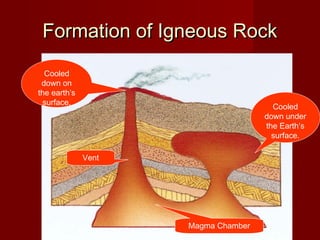
Formation of Igneous RockFormation of Igneous Rock
Cooled
down under
the Earth’s
surface.
Cooled
down on
the earth’s
surface.
Magma Chamber
Vent
Igneous Rocks.Igneous Rocks.
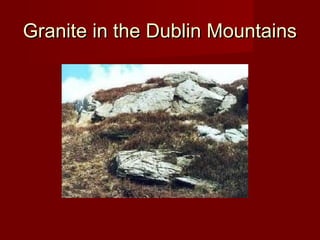
 GraniteGranite..
 Hard rock.Hard rock.
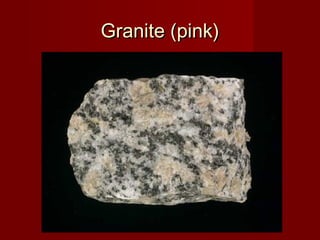
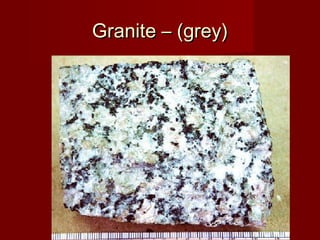
 Multi-coloured, pink, greyMulti-coloured, pink, grey
with crystals of mica orwith crystals of mica or
quartz.quartz.
 Formed when magmaFormed when magma
cooled deep within thecooled deep within the
earth;s crust.earth;s crust.
 Cooled slowly so largeCooled slowly so large
crystals formed.crystals formed.
 Found in the WicklowFound in the Wicklow
Mountains.Mountains.
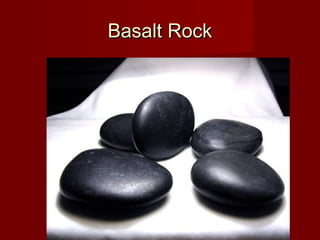
 Basalt.Basalt.
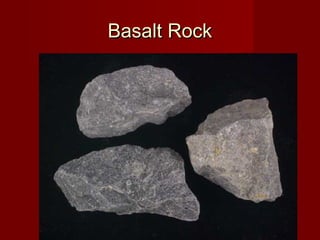
 Heavy rock.Heavy rock.
 Black in colour.Black in colour.
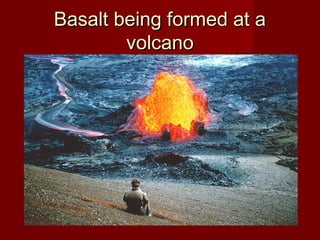
 Formed when lava cooledFormed when lava cooled
on the earth’s surface.on the earth’s surface.
 Cooled quickly so noCooled quickly so no
crystals formed.crystals formed.
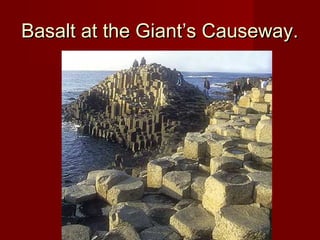
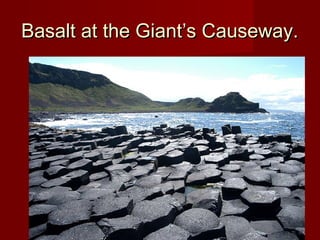
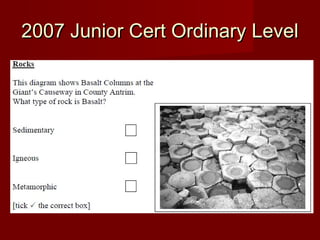
 Found at the Giant’sFound at the Giant’s
Causeway.Causeway.
Granite (pink)Granite (pink)
Granite – (grey)Granite – (grey)
Basalt RockBasalt Rock
Basalt being formed at aBasalt being formed at a
volcanovolcano
Basalt at the Giant’s Causeway.Basalt at the Giant’s Causeway.
Granite in the Dublin MountainsGranite in the Dublin Mountains
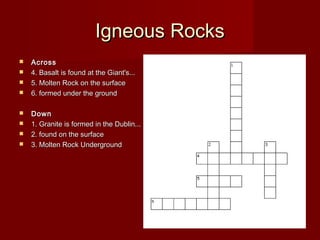
Igneous RocksIgneous Rocks
 AcrossAcross
 4. Basalt is found at the Giant's...4. Basalt is found at the Giant's...
 5. Molten Rock on the surface5. Molten Rock on the surface
 6. formed under the ground6. formed under the ground
 DownDown
 1. Granite is formed in the Dublin...1. Granite is formed in the Dublin...
 2. found on the surface2. found on the surface
 3. Molten Rock Underground3. Molten Rock Underground
2007 Junior Cert Ordinary Level2007 Junior Cert Ordinary Level
Sedimentary Rocks.Sedimentary Rocks.
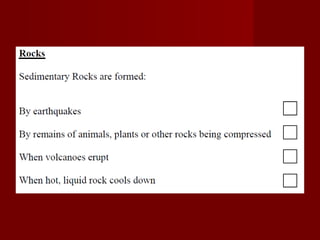
 These are rocks that were formed from theThese are rocks that were formed from the
compressed remains of plants, animalscompressed remains of plants, animals
and other rocks.and other rocks.
 Examples – Limestone, Sandstone andExamples – Limestone, Sandstone and
Coal.Coal.
Sedimentary Rocks.Sedimentary Rocks.
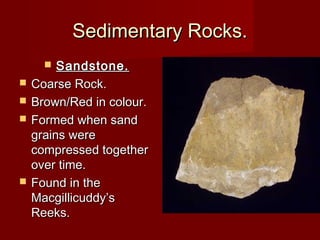
 Sandstone.Sandstone.
 Coarse Rock.Coarse Rock.
 Brown/Red in colour.Brown/Red in colour.
 Formed when sandFormed when sand
grains weregrains were
compressed togethercompressed together
over time.over time.
 Found in theFound in the
Macgillicuddy’sMacgillicuddy’s
Reeks.Reeks.
Sedimentary rock – Limestone.Sedimentary rock – Limestone.
 OriginOrigin ––
Made from the compressed remains ofMade from the compressed remains of
fish and other sea creatures. When theyfish and other sea creatures. When they
die their skeletons fall to the sea floordie their skeletons fall to the sea floor
where they become cemented together towhere they become cemented together to
form solid rock.form solid rock.
Characteristics of Limestone.Characteristics of Limestone.
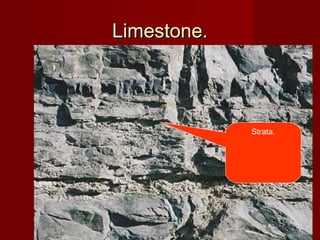
 Laid down in horizontal layers orLaid down in horizontal layers or strata.strata.
 The division between the layers are calledThe division between the layers are called
bedding planesbedding planes..
 Vertical joints calledVertical joints called jointsjoints occur in limestone.occur in limestone.
 Limestone isLimestone is permeablepermeable which means waterwhich means water
can pass through it.can pass through it.
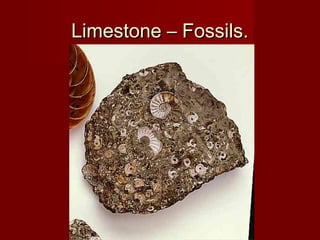
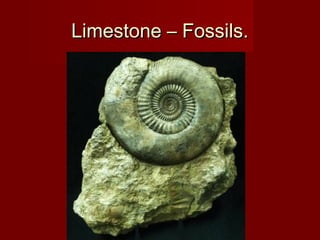
 Contains manyContains many fossils.fossils.
 Can beCan be weatheredweathered easily.easily.
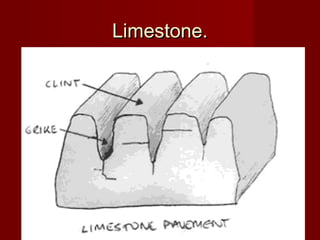
Limestone.Limestone.
Strata.
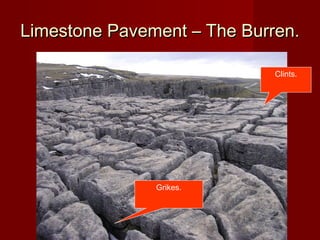
Limestone Pavement – The Burren.Limestone Pavement – The Burren.
Clints.
Grikes.
Limestone – Fossils.Limestone – Fossils.
Uses of Limestone.Uses of Limestone.
 Cement for the building industry.Cement for the building industry.
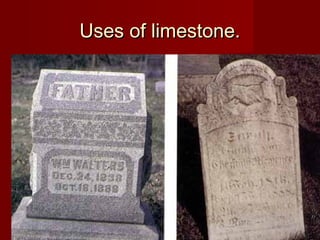
 Headstones in graveyards.Headstones in graveyards.
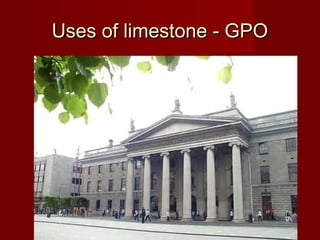
 Blocks of limestone to make buildings.Blocks of limestone to make buildings.
 Limestone chippings for road surfaces.Limestone chippings for road surfaces.
 Ground up limestone is used by farmers toGround up limestone is used by farmers to
fertilise the soil.fertilise the soil.
Uses of limestone.Uses of limestone.
Uses of limestone - GPOUses of limestone - GPO
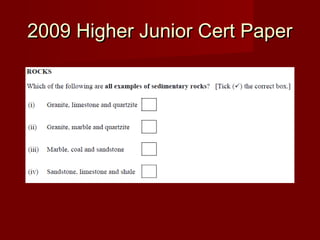
2009 Higher Junior Cert Paper2009 Higher Junior Cert Paper
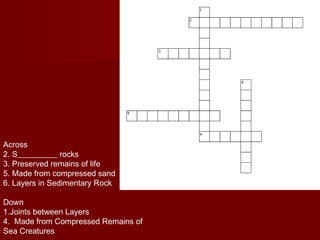
Across
2. S__________ rocks
3. Preserved remains of life
5. Made from compressed sand
6. Layers in Sedimentary Rock
Down
1.Joints between Layers
4. Made from Compressed Remains of
Sea Creatures
Metamorphic Rocks.Metamorphic Rocks.
 These are rocks that were once IgneousThese are rocks that were once Igneous
or Sedimentary which changed due toor Sedimentary which changed due to
great heat or pressure over time.great heat or pressure over time.
 Examples – Marble and Quartzite.Examples – Marble and Quartzite.
Metamorphic Rocks.Metamorphic Rocks.
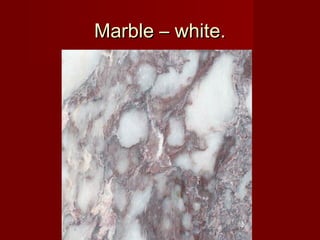
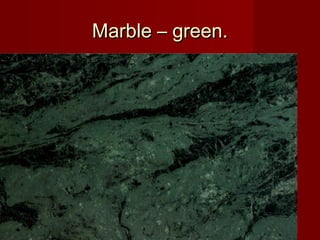
 Marble.Marble.
 Hard rock withHard rock with
crystals.crystals.
 Varies in colour –Varies in colour –
white, red , green orwhite, red , green or
black.black.
 Limestone changesLimestone changes
into Marble.into Marble.
 Quartzite.Quartzite.
 Hard rock.Hard rock.
 Light coloured.Light coloured.
 Found at the Hill ofFound at the Hill of
Howth and the GreatHowth and the Great
Sugar Loaf.Sugar Loaf.
 Sandstone changesSandstone changes
to Quartzite.to Quartzite.
Marble – white.Marble – white.
Marble – green.Marble – green.
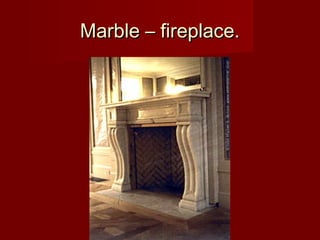
Marble – fireplace.Marble – fireplace.
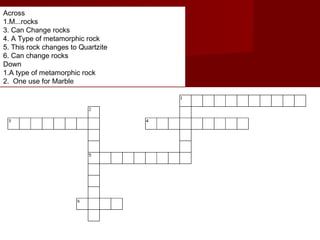
Across
1.M...rocks
3. Can Change rocks
4. A Type of metamorphic rock
5. This rock changes to Quartzite
6. Can change rocks
Down
1.A type of metamorphic rock
2. One use for Marble
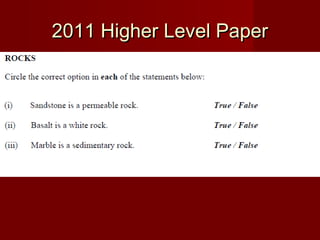
2011 Higher Level Paper2011 Higher Level Paper
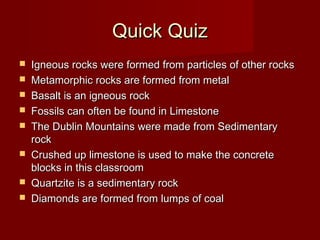
Quick QuizQuick Quiz
 Igneous rocks were formed from particles of other rocksIgneous rocks were formed from particles of other rocks
 Metamorphic rocks are formed from metalMetamorphic rocks are formed from metal
 Basalt is an igneous rockBasalt is an igneous rock
 Fossils can often be found in LimestoneFossils can often be found in Limestone
 The Dublin Mountains were made from SedimentaryThe Dublin Mountains were made from Sedimentary
rockrock
 Crushed up limestone is used to make the concreteCrushed up limestone is used to make the concrete
blocks in this classroomblocks in this classroom
 Quartzite is a sedimentary rockQuartzite is a sedimentary rock
 Diamonds are formed from lumps of coalDiamonds are formed from lumps of coal
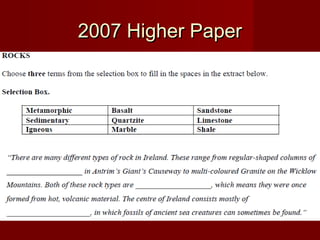
2007 Higher Paper2007 Higher Paper
Extracting rocks.Extracting rocks.
 Rocks provide us with many naturalRocks provide us with many natural
resources – energy resources and buildingresources – energy resources and building
materials.materials.
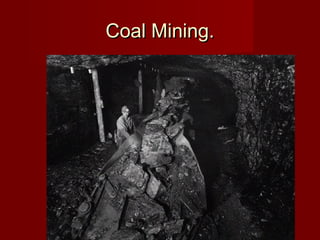
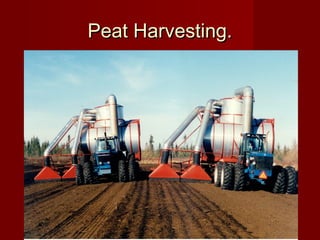
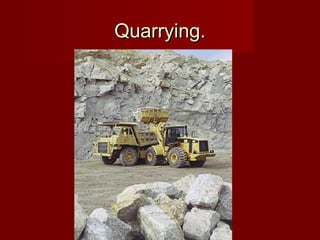
 Rock based energy resources includeRock based energy resources include
coal, oil, gas and peat.coal, oil, gas and peat.
 These are extracted by mining andThese are extracted by mining and
quarrying.quarrying.
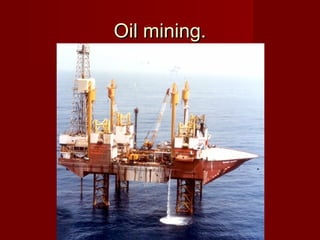
Oil mining.Oil mining.
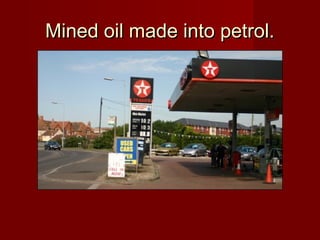
Mined oil made into petrol.Mined oil made into petrol.
Coal Mining.Coal Mining.
Peat Harvesting.Peat Harvesting.
Quarrying.Quarrying.
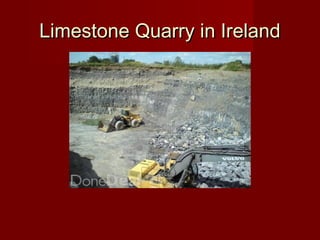
Limestone Quarry in IrelandLimestone Quarry in Ireland
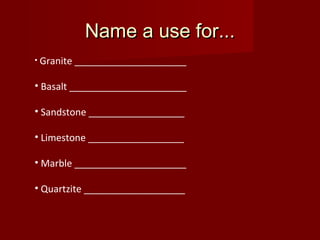
Name a use for...Name a use for...
• Granite _____________________
• Basalt ______________________
• Sandstone __________________
• Limestone __________________
• Marble _____________________
• Quartzite ___________________
Quarries – for and againstQuarries – for and against
Imagine a quarry is going to be built beside your home. Can you think of 3
reasons why people would be in favour of it and 3 reasons why they would
be against it?
In Favour Against
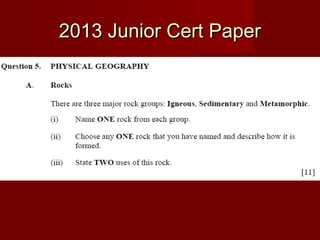
2013 Junior Cert Paper2013 Junior Cert Paper
Rocks

Rocks

  • 1.
    Chapter 2 –RocksChapter 2 – Rocks
  • 2.
    Rock typesRock types Rocks have many different physicalRocks have many different physical characteristics. Some are different colour,characteristics. Some are different colour, weight etc. We divide them into groupsweight etc. We divide them into groups according to how they were formed.according to how they were formed.  1. Igneous Rocks.1. Igneous Rocks.  2. Sedimentary Rocks.2. Sedimentary Rocks.  3. Metamorphic Rocks.3. Metamorphic Rocks.
  • 3.
    Igneous RockIgneous Rock These are rocks that were formed whenThese are rocks that were formed when hot, molten volcanic material (lava) cooledhot, molten volcanic material (lava) cooled down and became solid.down and became solid.  Examples – Granite and Basalt.Examples – Granite and Basalt.
  • 4.
    Formation of IgneousRockFormation of Igneous Rock Cooled down under the Earth’s surface. Cooled down on the earth’s surface. Magma Chamber Vent
  • 5.
    Igneous Rocks.Igneous Rocks. GraniteGranite..  Hard rock.Hard rock.  Multi-coloured, pink, greyMulti-coloured, pink, grey with crystals of mica orwith crystals of mica or quartz.quartz.  Formed when magmaFormed when magma cooled deep within thecooled deep within the earth;s crust.earth;s crust.  Cooled slowly so largeCooled slowly so large crystals formed.crystals formed.  Found in the WicklowFound in the Wicklow Mountains.Mountains.  Basalt.Basalt.  Heavy rock.Heavy rock.  Black in colour.Black in colour.  Formed when lava cooledFormed when lava cooled on the earth’s surface.on the earth’s surface.  Cooled quickly so noCooled quickly so no crystals formed.crystals formed.  Found at the Giant’sFound at the Giant’s Causeway.Causeway.
  • 6.
  • 7.
  • 8.
  • 9.
  • 10.
    Basalt being formedat aBasalt being formed at a volcanovolcano
  • 11.
    Basalt at theGiant’s Causeway.Basalt at the Giant’s Causeway.
  • 12.
    Basalt at theGiant’s Causeway.Basalt at the Giant’s Causeway.
  • 13.
    Granite in theDublin MountainsGranite in the Dublin Mountains
  • 15.
    Igneous RocksIgneous Rocks AcrossAcross  4. Basalt is found at the Giant's...4. Basalt is found at the Giant's...  5. Molten Rock on the surface5. Molten Rock on the surface  6. formed under the ground6. formed under the ground  DownDown  1. Granite is formed in the Dublin...1. Granite is formed in the Dublin...  2. found on the surface2. found on the surface  3. Molten Rock Underground3. Molten Rock Underground
  • 16.
    2007 Junior CertOrdinary Level2007 Junior Cert Ordinary Level
  • 17.
    Sedimentary Rocks.Sedimentary Rocks. These are rocks that were formed from theThese are rocks that were formed from the compressed remains of plants, animalscompressed remains of plants, animals and other rocks.and other rocks.  Examples – Limestone, Sandstone andExamples – Limestone, Sandstone and Coal.Coal.
  • 19.
    Sedimentary Rocks.Sedimentary Rocks. Sandstone.Sandstone.  Coarse Rock.Coarse Rock.  Brown/Red in colour.Brown/Red in colour.  Formed when sandFormed when sand grains weregrains were compressed togethercompressed together over time.over time.  Found in theFound in the Macgillicuddy’sMacgillicuddy’s Reeks.Reeks.
  • 20.
    Sedimentary rock –Limestone.Sedimentary rock – Limestone.  OriginOrigin –– Made from the compressed remains ofMade from the compressed remains of fish and other sea creatures. When theyfish and other sea creatures. When they die their skeletons fall to the sea floordie their skeletons fall to the sea floor where they become cemented together towhere they become cemented together to form solid rock.form solid rock.
  • 21.
    Characteristics of Limestone.Characteristicsof Limestone.  Laid down in horizontal layers orLaid down in horizontal layers or strata.strata.  The division between the layers are calledThe division between the layers are called bedding planesbedding planes..  Vertical joints calledVertical joints called jointsjoints occur in limestone.occur in limestone.  Limestone isLimestone is permeablepermeable which means waterwhich means water can pass through it.can pass through it.  Contains manyContains many fossils.fossils.  Can beCan be weatheredweathered easily.easily.
  • 22.
  • 23.
  • 24.
    Limestone Pavement –The Burren.Limestone Pavement – The Burren. Clints. Grikes.
  • 25.
  • 26.
  • 27.
    Uses of Limestone.Usesof Limestone.  Cement for the building industry.Cement for the building industry.  Headstones in graveyards.Headstones in graveyards.  Blocks of limestone to make buildings.Blocks of limestone to make buildings.  Limestone chippings for road surfaces.Limestone chippings for road surfaces.  Ground up limestone is used by farmers toGround up limestone is used by farmers to fertilise the soil.fertilise the soil.
  • 28.
  • 29.
    Uses of limestone- GPOUses of limestone - GPO
  • 30.
    2009 Higher JuniorCert Paper2009 Higher Junior Cert Paper
  • 31.
    Across 2. S__________ rocks 3.Preserved remains of life 5. Made from compressed sand 6. Layers in Sedimentary Rock Down 1.Joints between Layers 4. Made from Compressed Remains of Sea Creatures
  • 32.
    Metamorphic Rocks.Metamorphic Rocks. These are rocks that were once IgneousThese are rocks that were once Igneous or Sedimentary which changed due toor Sedimentary which changed due to great heat or pressure over time.great heat or pressure over time.  Examples – Marble and Quartzite.Examples – Marble and Quartzite.
  • 33.
    Metamorphic Rocks.Metamorphic Rocks. Marble.Marble.  Hard rock withHard rock with crystals.crystals.  Varies in colour –Varies in colour – white, red , green orwhite, red , green or black.black.  Limestone changesLimestone changes into Marble.into Marble.  Quartzite.Quartzite.  Hard rock.Hard rock.  Light coloured.Light coloured.  Found at the Hill ofFound at the Hill of Howth and the GreatHowth and the Great Sugar Loaf.Sugar Loaf.  Sandstone changesSandstone changes to Quartzite.to Quartzite.
  • 34.
  • 35.
  • 36.
  • 37.
    Across 1.M...rocks 3. Can Changerocks 4. A Type of metamorphic rock 5. This rock changes to Quartzite 6. Can change rocks Down 1.A type of metamorphic rock 2. One use for Marble
  • 38.
    2011 Higher LevelPaper2011 Higher Level Paper
  • 39.
    Quick QuizQuick Quiz Igneous rocks were formed from particles of other rocksIgneous rocks were formed from particles of other rocks  Metamorphic rocks are formed from metalMetamorphic rocks are formed from metal  Basalt is an igneous rockBasalt is an igneous rock  Fossils can often be found in LimestoneFossils can often be found in Limestone  The Dublin Mountains were made from SedimentaryThe Dublin Mountains were made from Sedimentary rockrock  Crushed up limestone is used to make the concreteCrushed up limestone is used to make the concrete blocks in this classroomblocks in this classroom  Quartzite is a sedimentary rockQuartzite is a sedimentary rock  Diamonds are formed from lumps of coalDiamonds are formed from lumps of coal
  • 40.
  • 41.
    Extracting rocks.Extracting rocks. Rocks provide us with many naturalRocks provide us with many natural resources – energy resources and buildingresources – energy resources and building materials.materials.  Rock based energy resources includeRock based energy resources include coal, oil, gas and peat.coal, oil, gas and peat.  These are extracted by mining andThese are extracted by mining and quarrying.quarrying.
  • 42.
  • 43.
    Mined oil madeinto petrol.Mined oil made into petrol.
  • 44.
  • 45.
  • 46.
  • 47.
    Limestone Quarry inIrelandLimestone Quarry in Ireland
  • 48.
    Name a usefor...Name a use for... • Granite _____________________ • Basalt ______________________ • Sandstone __________________ • Limestone __________________ • Marble _____________________ • Quartzite ___________________
  • 49.
    Quarries – forand againstQuarries – for and against Imagine a quarry is going to be built beside your home. Can you think of 3 reasons why people would be in favour of it and 3 reasons why they would be against it? In Favour Against
  • 50.
    2013 Junior CertPaper2013 Junior Cert Paper