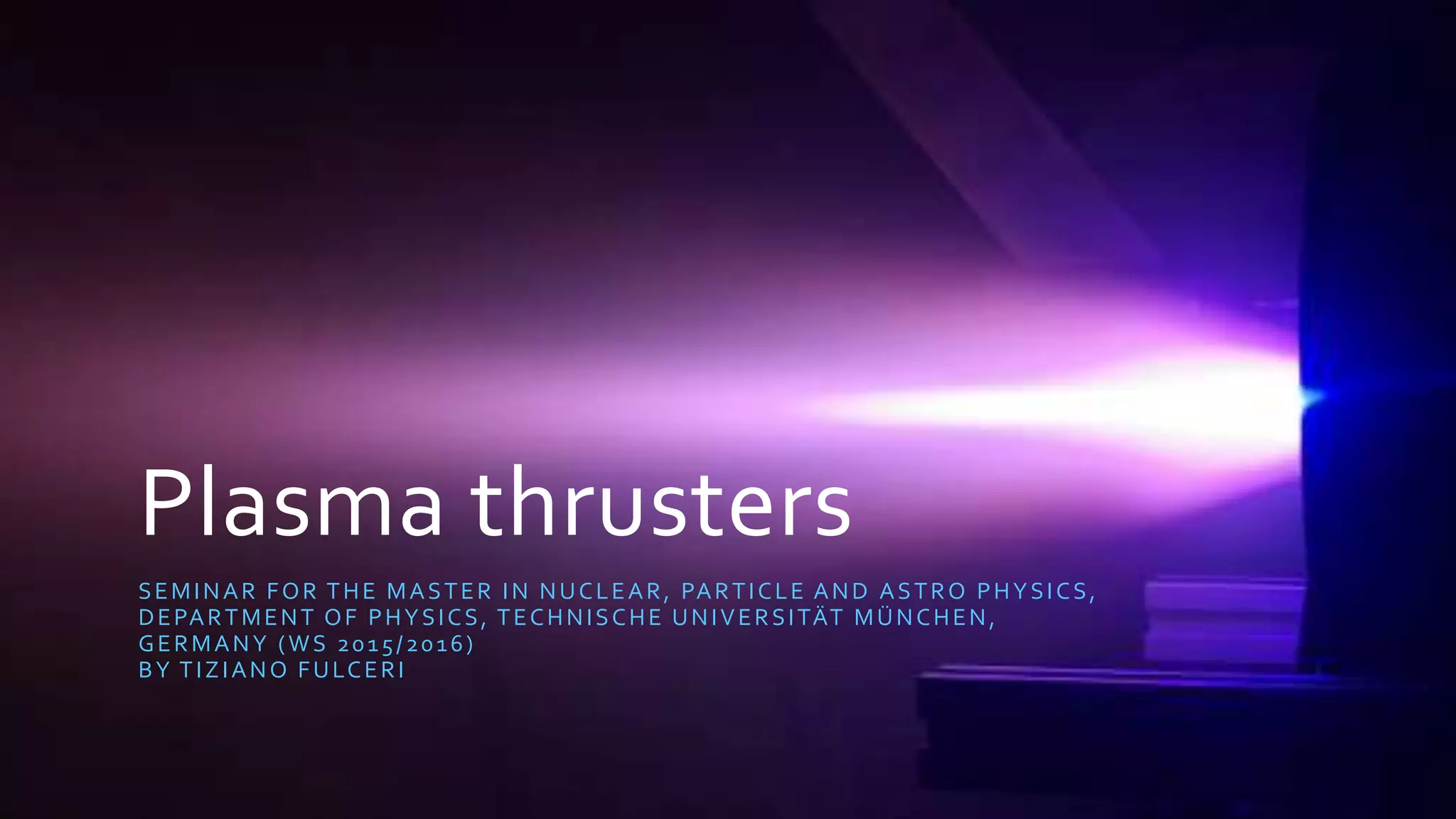
Plasma thrusters
SEMINAR FOR THE MASTER IN NUCLEAR, PARTICLE AND ASTRO PHYSICS,
DEPARTMENT OF PHYSICS, TECHNISCHE UNIVERSITÄT MÜNCHEN,
GERMANY (WS 2015/2016)
BY TIZIANO FULCERI
Structure of the seminar
• Motivation
• Rocket principle and momentum equation
• Power, thrust, specific impulse
• Case analysis:Constant power and thrust, prescribed mission time
• Plasma thrusters as a subset of electric propulsion systems
• Physics of plasma propulsion
• HET (Hall EffectThruster)
• MPD (Magnetoplasmadynamic)Thruster
• VASIMR (Variable Specific Impulse Magnetoplasma Rocket)
• ELFThruster (Electrodeless Lorentz ForceThruster)
• Conclusions and prospects
• References
Motivation
Plasma thrusters are researched and developed as a solution for the
following fields of application:
• Precise trajectory corrections for satellites and/or probes
• In-space robotic probe propulsion (example ESA SMART-1)
• In-space manned spacecraft propulsion to Mars (proposed)
• Propulsion in outer Solar System (beyond Jupiter’s orbit)
All of which require (or will require) high fuel efficiency (see later: Isp),
long lifespan, and a small thruster mass.
Rocket principle and momentum equation
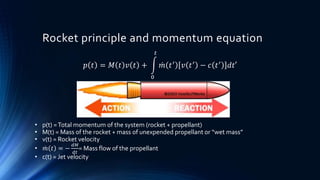
𝑝 𝑡 = 𝑀 𝑡 𝑣 𝑡 +
0
𝑡
𝑚 𝑡′ 𝑣 𝑡′ − 𝑐 𝑡′ 𝑑𝑡′
• p(t) =Total momentum of the system (rocket + propellant)
• M(t) = Mass of the rocket + mass of unexpended propellant or “wet mass”
• v(t) = Rocket velocity
• 𝑚 𝑡 = −
𝑑𝑀
𝑑𝑡
= Mass flow of the propellant
• c(t) = Jet velocity
Thrust, Power, Specific Impulse
𝑝 𝑡 = 𝑀 𝑡 𝑣 𝑡 +
0
𝑡
𝑚 𝑡′ 𝑣 𝑡′ − 𝑐 𝑡′ 𝑑𝑡′
𝑑𝑝
𝑑𝑡
= 0 ⇒ 𝑀
𝑑𝑣
𝑑𝑡
+ 𝑣
𝑑𝑀
𝑑𝑡
+ 𝑚 𝑣 − 𝑐 = 0;
𝑚 ≡ −
𝑑𝑀
𝑑𝑡
;
⇒ 𝑀
𝑑𝑣
𝑑𝑡
= 𝑐
𝑑𝑀
𝑑𝑡
⇒ 𝑀
𝑑𝑣
𝑑𝑡
= −𝑐 𝑚
Thrust: 𝐹 = 𝑐 𝑚 [𝑁]
Calculating the thrust (accelerating force on the rocket structure) in a vacuum:
Total momentum change of the system (rocket + propellant) must be zero:
Thrust, Power, Specific Impulse
𝐸 𝑘 =
1
2
𝑀𝑣2 +
0
𝑡
1
2
𝑚 𝑡′ 𝑣 𝑡′ − 𝑐 𝑡′ 2 𝑑𝑡′
𝑑𝐸 𝑘
𝑑𝑡
= 𝑀𝑣
𝑑𝑣
𝑑𝑡
+
1
2
𝑣2
𝑑𝑀
𝑑𝑡
+
1
2
𝑚 𝑣2 + 𝑐2 − 2𝑣𝑐 ;
𝑀𝑣
𝑑𝑣
𝑑𝑡
= 𝑐 𝑚𝑣;
𝑑𝑀
𝑑𝑡
= − 𝑚;
⇒
𝑑𝐸 𝑘
𝑑𝑡
=
1
2
𝑚𝑐2
Kinetic power:
𝑑𝐸 𝑘
𝑑𝑡
=
1
2
𝑚𝑐2
𝐽𝑠−1
𝑜𝑟 [𝑊]
From the kinetic energy of the total system (rocket + propellant), we can calculate
the kinetic energy per unit time (kinetic power) of the exhaust jet:
Thrust, Power, Specific Impulse
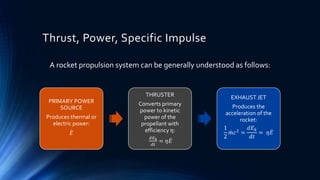
PRIMARY POWER
SOURCE
Produces thermal or
electric power:
𝐸
THRUSTER
Converts primary
power to kinetic
power of the
propellant with
efficiency η:
𝑑𝐸 𝑘
𝑑𝑡
= 𝜂 𝐸
EXHAUST JET
Produces the
acceleration of the
rocket:
1
2
𝑚𝑐2
=
𝑑𝐸 𝑘
𝑑𝑡
= 𝜂 𝐸
A rocket propulsion system can be generally understood as follows:
Thrust, Power, Specific Impulse
Until now we have the following quantities:
• Thrust: 𝐹 = 𝑐 𝑚
• Kinetic power:
𝑑𝐸 𝑘
𝑑𝑡
=
1
2
𝑚𝑐
We can define another useful quantity, specific impulse, which measures
how much momentum is produced per unit mass (or weight) of expended
propellant:
• 𝐼𝑠𝑝1 =
𝐹
𝑚𝑔
=
𝑐 𝑚
𝑚𝑔
=
Δ𝑝
∆𝑚𝑔
=
𝑐
𝑔
[𝑠]
• 𝐼𝑠𝑝2 =
𝐹
𝑚
=
Δ𝑝
∆𝑚
= 𝑐 𝑚𝑠−1
Where 𝑔 = 9.81 𝑚𝑠−2 is the standard gravitational acceleration at sea
level.
The two definitions are interchangeable: 𝐼𝑠𝑝2 = 𝑔𝐼𝑠𝑝1
Case analysis: Constant power and thrust,
prescribed mission time
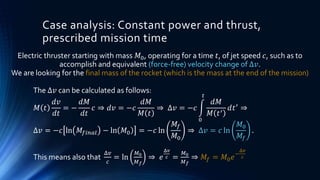
The Δ𝑣 can be calculated as follows:
𝑀 𝑡
𝑑𝑣
𝑑𝑡
= −
𝑑𝑀
𝑑𝑡
𝑐 ⇒ 𝑑𝑣 = −𝑐
𝑑𝑀
𝑀 𝑡
⇒ Δ𝑣 = −𝑐
0
𝑡
𝑑𝑀
𝑀 𝑡′
𝑑𝑡′
⇒
Δ𝑣 = −𝑐 ln 𝑀𝑓𝑖𝑛𝑎𝑙 − ln 𝑀0 = −𝑐 ln
𝑀𝑓
𝑀0
⇒ Δ𝑣 = 𝑐 ln
𝑀0
𝑀𝑓
.
This means also that
Δ𝑣
𝑐
= ln
𝑀0
𝑀 𝑓
⇒ 𝑒
Δ𝑣
𝑐 =
𝑀0
𝑀 𝑓
⇒ 𝑀𝑓 = 𝑀0 𝑒−
Δ𝑣
𝑐
Electric thruster starting with mass 𝑀0, operating for a time 𝑡, of jet speed 𝑐, such as to
accomplish and equivalent (force-free) velocity change of Δ𝑣.
We are looking for the final mass of the rocket (which is the mass at the end of the mission)
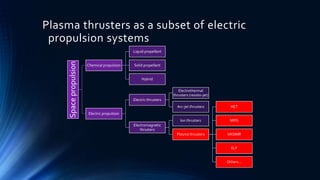
Plasma thrusters as a subset of electric
propulsion systems
Spacepropulsion
Chemical propulsion
Liquid propellant
Solid propellant
Hybrid
Electric propulsion
Electric thrusters
Electrothermal
thrusters (resisto-jet)
Arc-jet thrusters
Electromagnetic
thrusters
Ion thrusters
Plasma thrusters
HET
MPD
VASIMR
ELF
Others…
Physics of Plasma Propulsion
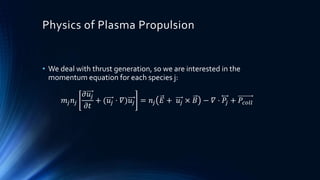
• We deal with thrust generation, so we are interested in the
momentum equation for each species j:
𝑚𝑗 𝑛𝑗
𝜕𝑢𝑗
𝜕𝑡
+ (𝑢𝑗 ⋅ 𝛻)𝑢𝑗 = 𝑛𝑗 𝐸 + 𝑢𝑗 × 𝐵 − 𝛻 ⋅ 𝑃𝑗 + 𝑃𝑐𝑜𝑙𝑙
Physics of Plasma Propulsion
• For further analysis of the possible accelerating processes we make the
following assumptions:
• Only two fluids: ions and electrons
• Most important assumption: the working fluid (propellant) is an electrically conducting
medium which remains quasi-neutral 𝑛 𝑒 − 𝑛𝑖 ≪ 𝑛 𝑒 ≈ 𝑛𝑖 = 𝑛
• The collision terms will therefore describe collisions between ions and electrons:
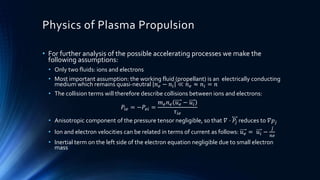
𝑃𝑖𝑒 = −𝑃𝑒𝑖 =
𝑚 𝑒 𝑛 𝑒 𝑢 𝑒 − 𝑢𝑖
𝜏𝑖𝑒
• Anisotropic component of the pressure tensor negligible, so that 𝛻 ⋅ 𝑃𝑗 reduces to 𝛻𝑝𝑗
• Ion and electron velocities can be related in terms of current as follows: 𝑢 𝑒 = 𝑢𝑖 −
𝑗
𝑛𝑒
• Inertial term on the left side of the electron equation negligible due to small electron
mass
Physics of Plasma Propulsion
• Useful definitions:
• Conductivity: 𝜎 =
1
𝜂
=
𝑛𝑒2
𝑚 𝑒
𝜏 𝑒𝑖
• Hall parameter: 𝛽 = 𝜔 𝑒 𝜏 𝑒
• Electron cyclotron frequency: 𝜔 𝑒 =
𝑒𝐵
𝑚 𝑒
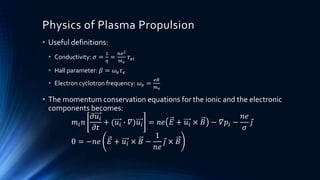
• The momentum conservation equations for the ionic and the electronic
components becomes:
𝑚𝑖 𝑛
𝜕𝑢𝑖
𝜕𝑡
+ (𝑢𝑖 ∙ 𝛻)𝑢𝑖 = 𝑛𝑒 𝐸 + 𝑢𝑖 × 𝐵 − 𝛻𝑝𝑖 −
𝑛𝑒
𝜎
𝑗
0 = −𝑛𝑒 𝐸 + 𝑢𝑖 × 𝐵 −
1
𝑛𝑒
𝑗 × 𝐵
Physics of Plasma Propulsion
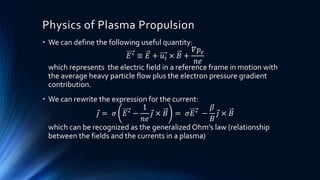
• We can define the following useful quantity:
𝐸∗ ≡ 𝐸 + 𝑢𝑖 × 𝐵 +
𝛻𝑝 𝑒
𝑛𝑒
which represents the electric field in a reference frame in motion with
the average heavy particle flow plus the electron pressure gradient
contribution.
• We can rewrite the expression for the current:
𝑗 = 𝜎 𝐸∗ −
1
𝑛𝑒
𝑗 × 𝐵 = 𝜎𝐸∗ −
𝛽
𝐵
𝑗 × 𝐵
which can be recognized as the generalized Ohm’s law (relationship
between the fields and the currents in a plasma)
Physics of Plasma Propulsion
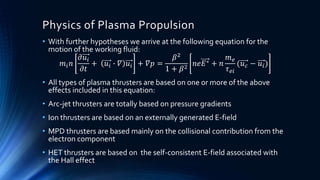
• With further hypotheses we arrive at the following equation for the
motion of the working fluid:
𝑚𝑖 𝑛
𝜕𝑢𝑖
𝜕𝑡
+ 𝑢𝑖 ∙ 𝛻 𝑢𝑖 + 𝛻𝑝 =
𝛽2
1 + 𝛽2
𝑛𝑒𝐸∗ + 𝑛
𝑚 𝑒
𝜏 𝑒𝑖
(𝑢 𝑐 − 𝑢𝑖)
• All types of plasma thrusters are based on one or more of the above
effects included in this equation:
• Arc-jet thrusters are totally based on pressure gradients
• Ion thrusters are based on an externally generated E-field
• MPD thrusters are based mainly on the collisional contribution from the
electron component
• HET thrusters are based on the self-consistent E-field associated with
the Hall effect
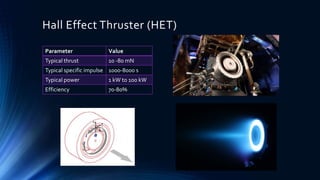
Hall Effect Thruster (HET)
Parameter Value
Typical thrust 10 -80 mN
Typical specific impulse 1000-8000 s
Typical power 1 kW to 100 kW
Efficiency 70-80%
Hall Effect Thruster (HET)
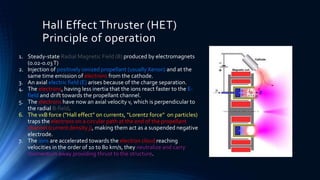
Principle of operation
1. Steady-state Radial Magnetic Field (B) produced by electromagnets
(0.02-0.03T)
2. Injection of positively ionized propellant (usually Xenon) and at the
same time emission of electrons from the cathode.
3. An axial electric field (E) arises because of the charge separation.
4. The electrons, having less inertia that the ions react faster to the E-
field and drift towards the propellant channel.
5. The electrons have now an axial velocity v, which is perpendicular to
the radial B-field.
6. The vxB force (“Hall effect” on currents, “Lorentz force” on particles)
traps the electrons on a circular path at the end of the propellant
channel (current density j), making them act as a suspended negative
electrode.
7. The ions are accelerated towards the electron cloud reaching
velocities in the order of 10 to 80 km/s, they neutralize and carry
momentum away providing thrust to the structure.
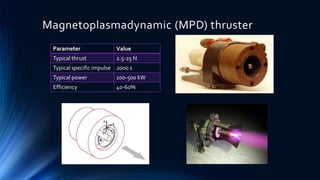
Magnetoplasmadynamic (MPD) thruster
Parameter Value
Typical thrust 2.5-25 N
Typical specific impulse 2000 s
Typical power 100-500 kW
Efficiency 40-60%
Magnetoplasmadynamic (MPD) thruster
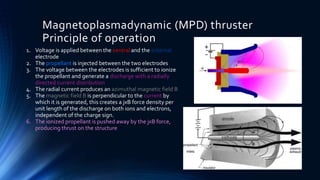
Principle of operation
1. Voltage is applied between the central and the external
electrode
2. The propellant is injected between the two electrodes
3. The voltage between the electrodes is sufficient to ionize
the propellant and generate a discharge with a radially
directed current distribution
4. The radial current produces an azimuthal magnetic field B
5. The magnetic field B is perpendicular to the current by
which it is generated, this creates a jxB force density per
unit length of the discharge on both ions and electrons,
independent of the charge sign.
6. The ionized propellant is pushed away by the jxB force,
producing thrust on the structure
Variable Specific Impulse Magnetoplasma Rocket
(VASIMR)
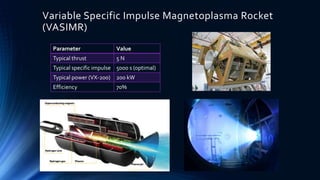
Parameter Value
Typical thrust 5 N
Typical specific impulse 5000 s (optimal)
Typical power (VX-200) 200 kW
Efficiency 70%
Variable Specific Impulse Magnetoplasma Rocket
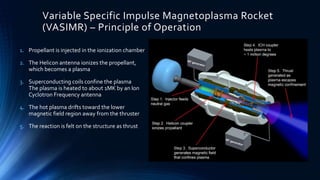
(VASIMR) – Principle of Operation
1. Propellant is injected in the ionization chamber
2. The Helicon antenna ionizes the propellant,
which becomes a plasma
3. Superconducting coils confine the plasma
The plasma is heated to about 1MK by an Ion
Cyclotron Frequency antenna
4. The hot plasma drifts toward the lower
magnetic field region away from the thruster
5. The reaction is felt on the structure as thrust
Electrodeless Lorentz Force (ELF) Thruster
Parameter Value
Typical thrust 1N (pulsed)
Typical specific impulse 1000-6000 s
Typical power 50kW (pulsed)
Efficiency >50%
Electrodeless Lorentz Force (ELF) Thruster
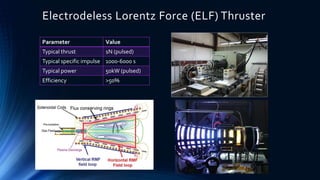
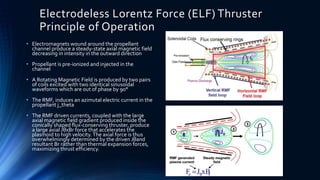
Principle of Operation
• Electromagnets wound around the propellant
channel produce a steady-state axial magnetic field
decreasing in intensity in the outward direction
• Propellant is pre-ionized and injected in the
channel
• A Rotating Magnetic Field is produced by two pairs
of coils excited with two identical sinusoidal
waveforms which are out of phase by 90°
• The RMF, induces an azimutal electric current in the
propellant j_theta
• The RMF driven currents, coupled with the large
axial magnetic field gradient produced inside the
conically shaped flux-conserving thruster, produce
a large axial JθxBr force that accelerates the
plasmoid to high velocity.The axial force is thus
overwhelmingly determined by the driven Jθand
resultant Br rather than thermal expansion forces,
maximizing thrust efficiency.
Conclusions and prospects
• Plasma thrusters are a promising research field
• Some plasma thruster types already demonstrated their utility
• There is a wide range of methods, configurations and mechanisms to
accelerate a plasma propellant (we did not cover all of them)
• In the near future we should expect an increased interest in this kind
of technology
• The physics of this systems is not very well understood: this is an
opportunity for both applied and theoretical physics
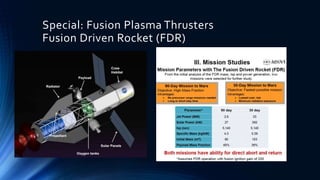
Special: Fusion Plasma Thrusters
Fusion Driven Rocket (FDR)
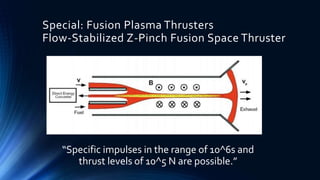
Special: Fusion Plasma Thrusters
Flow-Stabilized Z-Pinch Fusion Space Thruster
“Specific impulses in the range of 10^6s and
thrust levels of 10^5 N are possible.”
References
• Lecture notes from the 2004 MIT course «Rocket Propulsion» by Prof. Manuel Martinez-Sanchez
• «Rocket and Spacecraft Propulsion» byTurner, Martin J. L. Chapters 2 and 6
• «MagnetoplasmadynamicThrusters» fact sheet from NASA’s website
(http://www.nasa.gov/centers/glenn/about/fs22grc.html)
• «An analysis of current propulsion systems»
(http://currentpropulsionsystems.weebly.com/electromagnetic-propulsion-systems.html)
• «Fundamental scaling law for electric propulsion concepts» by M.Andreucci, L.Biagioni,
S.Marcuccio, F.Paganucci - Alta S.p.a., Pisa, Italy
• «DevelopmentToward a Spaceflight CapableVASIMR Engine and SEP Applications» by J.P. Squire,
M.D.Carter, F.R. Chang Diaz, M.Giambusso,A.V.Ilin, C.S.Olsen – AdAstra Rocket Company,
Webster,Texas, USA and E.A.Bering, III – University of Houston, Houston,Texas, USA
• «Pulsed Plasmoid Propulsion:The ELFThruster» J.Slough and D.Kirtley – MSNW, Redmond,WA,
USA
• “The Fusion Driven Rocket” PI: J.Slough,A.Pancotti et. al.
• “Advanced Space Propulsion Based on the Flow-Stabilized Z-Pinch Fusion Concept” U.Shumlak
et. al. – Aerospace & Energetics Research Program, University ofWashington, Seattle,WA, USA
(https://www.aa.washington.edu/research/ZaP/research/plasmaOverview)
Pictures
• http://www.popsci.com/technology/article/2010-10/123000-mph-plasma-
engine-could-finally-take-astronauts-mars
• http://www.engadget.com/2015/04/01/how-ion-thruster-technology-will-
power-future-nasa-missions/
• http://htx.pppl.gov/ht.html
• Title picture: http://www.irs.uni-
stuttgart.de/forschung/elektrische_raumfahrtantriebe/triebwerke/mpd-
tw/fremdfeldbeschl-tw/mpd-afmpd.html
• Index picture: http://web.stanford.edu/group/pdl/
• Alta Space (now part of Sitael) website: www.alta-space.com
• Ad Astra website: http://www.adastrarocket.com/aarc/
• MSNW space propulsion website: http://msnwllc.com/space-propulsion

Plasma thrusters PP

  • 1.
    Plasma thrusters SEMINAR FORTHE MASTER IN NUCLEAR, PARTICLE AND ASTRO PHYSICS, DEPARTMENT OF PHYSICS, TECHNISCHE UNIVERSITÄT MÜNCHEN, GERMANY (WS 2015/2016) BY TIZIANO FULCERI
  • 2.
    Structure of theseminar • Motivation • Rocket principle and momentum equation • Power, thrust, specific impulse • Case analysis:Constant power and thrust, prescribed mission time • Plasma thrusters as a subset of electric propulsion systems • Physics of plasma propulsion • HET (Hall EffectThruster) • MPD (Magnetoplasmadynamic)Thruster • VASIMR (Variable Specific Impulse Magnetoplasma Rocket) • ELFThruster (Electrodeless Lorentz ForceThruster) • Conclusions and prospects • References
  • 3.
    Motivation Plasma thrusters areresearched and developed as a solution for the following fields of application: • Precise trajectory corrections for satellites and/or probes • In-space robotic probe propulsion (example ESA SMART-1) • In-space manned spacecraft propulsion to Mars (proposed) • Propulsion in outer Solar System (beyond Jupiter’s orbit) All of which require (or will require) high fuel efficiency (see later: Isp), long lifespan, and a small thruster mass.
  • 4.
    Rocket principle andmomentum equation 𝑝 𝑡 = 𝑀 𝑡 𝑣 𝑡 + 0 𝑡 𝑚 𝑡′ 𝑣 𝑡′ − 𝑐 𝑡′ 𝑑𝑡′ • p(t) =Total momentum of the system (rocket + propellant) • M(t) = Mass of the rocket + mass of unexpended propellant or “wet mass” • v(t) = Rocket velocity • 𝑚 𝑡 = − 𝑑𝑀 𝑑𝑡 = Mass flow of the propellant • c(t) = Jet velocity
  • 5.
    Thrust, Power, SpecificImpulse 𝑝 𝑡 = 𝑀 𝑡 𝑣 𝑡 + 0 𝑡 𝑚 𝑡′ 𝑣 𝑡′ − 𝑐 𝑡′ 𝑑𝑡′ 𝑑𝑝 𝑑𝑡 = 0 ⇒ 𝑀 𝑑𝑣 𝑑𝑡 + 𝑣 𝑑𝑀 𝑑𝑡 + 𝑚 𝑣 − 𝑐 = 0; 𝑚 ≡ − 𝑑𝑀 𝑑𝑡 ; ⇒ 𝑀 𝑑𝑣 𝑑𝑡 = 𝑐 𝑑𝑀 𝑑𝑡 ⇒ 𝑀 𝑑𝑣 𝑑𝑡 = −𝑐 𝑚 Thrust: 𝐹 = 𝑐 𝑚 [𝑁] Calculating the thrust (accelerating force on the rocket structure) in a vacuum: Total momentum change of the system (rocket + propellant) must be zero:
  • 6.
    Thrust, Power, SpecificImpulse 𝐸 𝑘 = 1 2 𝑀𝑣2 + 0 𝑡 1 2 𝑚 𝑡′ 𝑣 𝑡′ − 𝑐 𝑡′ 2 𝑑𝑡′ 𝑑𝐸 𝑘 𝑑𝑡 = 𝑀𝑣 𝑑𝑣 𝑑𝑡 + 1 2 𝑣2 𝑑𝑀 𝑑𝑡 + 1 2 𝑚 𝑣2 + 𝑐2 − 2𝑣𝑐 ; 𝑀𝑣 𝑑𝑣 𝑑𝑡 = 𝑐 𝑚𝑣; 𝑑𝑀 𝑑𝑡 = − 𝑚; ⇒ 𝑑𝐸 𝑘 𝑑𝑡 = 1 2 𝑚𝑐2 Kinetic power: 𝑑𝐸 𝑘 𝑑𝑡 = 1 2 𝑚𝑐2 𝐽𝑠−1 𝑜𝑟 [𝑊] From the kinetic energy of the total system (rocket + propellant), we can calculate the kinetic energy per unit time (kinetic power) of the exhaust jet:
  • 7.
    Thrust, Power, SpecificImpulse PRIMARY POWER SOURCE Produces thermal or electric power: 𝐸 THRUSTER Converts primary power to kinetic power of the propellant with efficiency η: 𝑑𝐸 𝑘 𝑑𝑡 = 𝜂 𝐸 EXHAUST JET Produces the acceleration of the rocket: 1 2 𝑚𝑐2 = 𝑑𝐸 𝑘 𝑑𝑡 = 𝜂 𝐸 A rocket propulsion system can be generally understood as follows:
  • 8.
    Thrust, Power, SpecificImpulse Until now we have the following quantities: • Thrust: 𝐹 = 𝑐 𝑚 • Kinetic power: 𝑑𝐸 𝑘 𝑑𝑡 = 1 2 𝑚𝑐 We can define another useful quantity, specific impulse, which measures how much momentum is produced per unit mass (or weight) of expended propellant: • 𝐼𝑠𝑝1 = 𝐹 𝑚𝑔 = 𝑐 𝑚 𝑚𝑔 = Δ𝑝 ∆𝑚𝑔 = 𝑐 𝑔 [𝑠] • 𝐼𝑠𝑝2 = 𝐹 𝑚 = Δ𝑝 ∆𝑚 = 𝑐 𝑚𝑠−1 Where 𝑔 = 9.81 𝑚𝑠−2 is the standard gravitational acceleration at sea level. The two definitions are interchangeable: 𝐼𝑠𝑝2 = 𝑔𝐼𝑠𝑝1
  • 9.
    Case analysis: Constantpower and thrust, prescribed mission time The Δ𝑣 can be calculated as follows: 𝑀 𝑡 𝑑𝑣 𝑑𝑡 = − 𝑑𝑀 𝑑𝑡 𝑐 ⇒ 𝑑𝑣 = −𝑐 𝑑𝑀 𝑀 𝑡 ⇒ Δ𝑣 = −𝑐 0 𝑡 𝑑𝑀 𝑀 𝑡′ 𝑑𝑡′ ⇒ Δ𝑣 = −𝑐 ln 𝑀𝑓𝑖𝑛𝑎𝑙 − ln 𝑀0 = −𝑐 ln 𝑀𝑓 𝑀0 ⇒ Δ𝑣 = 𝑐 ln 𝑀0 𝑀𝑓 . This means also that Δ𝑣 𝑐 = ln 𝑀0 𝑀 𝑓 ⇒ 𝑒 Δ𝑣 𝑐 = 𝑀0 𝑀 𝑓 ⇒ 𝑀𝑓 = 𝑀0 𝑒− Δ𝑣 𝑐 Electric thruster starting with mass 𝑀0, operating for a time 𝑡, of jet speed 𝑐, such as to accomplish and equivalent (force-free) velocity change of Δ𝑣. We are looking for the final mass of the rocket (which is the mass at the end of the mission)
  • 10.
    Plasma thrusters asa subset of electric propulsion systems Spacepropulsion Chemical propulsion Liquid propellant Solid propellant Hybrid Electric propulsion Electric thrusters Electrothermal thrusters (resisto-jet) Arc-jet thrusters Electromagnetic thrusters Ion thrusters Plasma thrusters HET MPD VASIMR ELF Others…
  • 11.
    Physics of PlasmaPropulsion • We deal with thrust generation, so we are interested in the momentum equation for each species j: 𝑚𝑗 𝑛𝑗 𝜕𝑢𝑗 𝜕𝑡 + (𝑢𝑗 ⋅ 𝛻)𝑢𝑗 = 𝑛𝑗 𝐸 + 𝑢𝑗 × 𝐵 − 𝛻 ⋅ 𝑃𝑗 + 𝑃𝑐𝑜𝑙𝑙
  • 12.
    Physics of PlasmaPropulsion • For further analysis of the possible accelerating processes we make the following assumptions: • Only two fluids: ions and electrons • Most important assumption: the working fluid (propellant) is an electrically conducting medium which remains quasi-neutral 𝑛 𝑒 − 𝑛𝑖 ≪ 𝑛 𝑒 ≈ 𝑛𝑖 = 𝑛 • The collision terms will therefore describe collisions between ions and electrons: 𝑃𝑖𝑒 = −𝑃𝑒𝑖 = 𝑚 𝑒 𝑛 𝑒 𝑢 𝑒 − 𝑢𝑖 𝜏𝑖𝑒 • Anisotropic component of the pressure tensor negligible, so that 𝛻 ⋅ 𝑃𝑗 reduces to 𝛻𝑝𝑗 • Ion and electron velocities can be related in terms of current as follows: 𝑢 𝑒 = 𝑢𝑖 − 𝑗 𝑛𝑒 • Inertial term on the left side of the electron equation negligible due to small electron mass
  • 13.
    Physics of PlasmaPropulsion • Useful definitions: • Conductivity: 𝜎 = 1 𝜂 = 𝑛𝑒2 𝑚 𝑒 𝜏 𝑒𝑖 • Hall parameter: 𝛽 = 𝜔 𝑒 𝜏 𝑒 • Electron cyclotron frequency: 𝜔 𝑒 = 𝑒𝐵 𝑚 𝑒 • The momentum conservation equations for the ionic and the electronic components becomes: 𝑚𝑖 𝑛 𝜕𝑢𝑖 𝜕𝑡 + (𝑢𝑖 ∙ 𝛻)𝑢𝑖 = 𝑛𝑒 𝐸 + 𝑢𝑖 × 𝐵 − 𝛻𝑝𝑖 − 𝑛𝑒 𝜎 𝑗 0 = −𝑛𝑒 𝐸 + 𝑢𝑖 × 𝐵 − 1 𝑛𝑒 𝑗 × 𝐵
  • 14.
    Physics of PlasmaPropulsion • We can define the following useful quantity: 𝐸∗ ≡ 𝐸 + 𝑢𝑖 × 𝐵 + 𝛻𝑝 𝑒 𝑛𝑒 which represents the electric field in a reference frame in motion with the average heavy particle flow plus the electron pressure gradient contribution. • We can rewrite the expression for the current: 𝑗 = 𝜎 𝐸∗ − 1 𝑛𝑒 𝑗 × 𝐵 = 𝜎𝐸∗ − 𝛽 𝐵 𝑗 × 𝐵 which can be recognized as the generalized Ohm’s law (relationship between the fields and the currents in a plasma)
  • 15.
    Physics of PlasmaPropulsion • With further hypotheses we arrive at the following equation for the motion of the working fluid: 𝑚𝑖 𝑛 𝜕𝑢𝑖 𝜕𝑡 + 𝑢𝑖 ∙ 𝛻 𝑢𝑖 + 𝛻𝑝 = 𝛽2 1 + 𝛽2 𝑛𝑒𝐸∗ + 𝑛 𝑚 𝑒 𝜏 𝑒𝑖 (𝑢 𝑐 − 𝑢𝑖) • All types of plasma thrusters are based on one or more of the above effects included in this equation: • Arc-jet thrusters are totally based on pressure gradients • Ion thrusters are based on an externally generated E-field • MPD thrusters are based mainly on the collisional contribution from the electron component • HET thrusters are based on the self-consistent E-field associated with the Hall effect
  • 16.
    Hall Effect Thruster(HET) Parameter Value Typical thrust 10 -80 mN Typical specific impulse 1000-8000 s Typical power 1 kW to 100 kW Efficiency 70-80%
  • 17.
    Hall Effect Thruster(HET) Principle of operation 1. Steady-state Radial Magnetic Field (B) produced by electromagnets (0.02-0.03T) 2. Injection of positively ionized propellant (usually Xenon) and at the same time emission of electrons from the cathode. 3. An axial electric field (E) arises because of the charge separation. 4. The electrons, having less inertia that the ions react faster to the E- field and drift towards the propellant channel. 5. The electrons have now an axial velocity v, which is perpendicular to the radial B-field. 6. The vxB force (“Hall effect” on currents, “Lorentz force” on particles) traps the electrons on a circular path at the end of the propellant channel (current density j), making them act as a suspended negative electrode. 7. The ions are accelerated towards the electron cloud reaching velocities in the order of 10 to 80 km/s, they neutralize and carry momentum away providing thrust to the structure.
  • 18.
    Magnetoplasmadynamic (MPD) thruster ParameterValue Typical thrust 2.5-25 N Typical specific impulse 2000 s Typical power 100-500 kW Efficiency 40-60%
  • 19.
    Magnetoplasmadynamic (MPD) thruster Principleof operation 1. Voltage is applied between the central and the external electrode 2. The propellant is injected between the two electrodes 3. The voltage between the electrodes is sufficient to ionize the propellant and generate a discharge with a radially directed current distribution 4. The radial current produces an azimuthal magnetic field B 5. The magnetic field B is perpendicular to the current by which it is generated, this creates a jxB force density per unit length of the discharge on both ions and electrons, independent of the charge sign. 6. The ionized propellant is pushed away by the jxB force, producing thrust on the structure
  • 20.
    Variable Specific ImpulseMagnetoplasma Rocket (VASIMR) Parameter Value Typical thrust 5 N Typical specific impulse 5000 s (optimal) Typical power (VX-200) 200 kW Efficiency 70%
  • 21.
    Variable Specific ImpulseMagnetoplasma Rocket (VASIMR) – Principle of Operation 1. Propellant is injected in the ionization chamber 2. The Helicon antenna ionizes the propellant, which becomes a plasma 3. Superconducting coils confine the plasma The plasma is heated to about 1MK by an Ion Cyclotron Frequency antenna 4. The hot plasma drifts toward the lower magnetic field region away from the thruster 5. The reaction is felt on the structure as thrust
  • 22.
    Electrodeless Lorentz Force(ELF) Thruster Parameter Value Typical thrust 1N (pulsed) Typical specific impulse 1000-6000 s Typical power 50kW (pulsed) Efficiency >50%
  • 23.
    Electrodeless Lorentz Force(ELF) Thruster Principle of Operation • Electromagnets wound around the propellant channel produce a steady-state axial magnetic field decreasing in intensity in the outward direction • Propellant is pre-ionized and injected in the channel • A Rotating Magnetic Field is produced by two pairs of coils excited with two identical sinusoidal waveforms which are out of phase by 90° • The RMF, induces an azimutal electric current in the propellant j_theta • The RMF driven currents, coupled with the large axial magnetic field gradient produced inside the conically shaped flux-conserving thruster, produce a large axial JθxBr force that accelerates the plasmoid to high velocity.The axial force is thus overwhelmingly determined by the driven Jθand resultant Br rather than thermal expansion forces, maximizing thrust efficiency.
  • 24.
    Conclusions and prospects •Plasma thrusters are a promising research field • Some plasma thruster types already demonstrated their utility • There is a wide range of methods, configurations and mechanisms to accelerate a plasma propellant (we did not cover all of them) • In the near future we should expect an increased interest in this kind of technology • The physics of this systems is not very well understood: this is an opportunity for both applied and theoretical physics
  • 25.
    Special: Fusion PlasmaThrusters Fusion Driven Rocket (FDR)
  • 26.
    Special: Fusion PlasmaThrusters Flow-Stabilized Z-Pinch Fusion Space Thruster “Specific impulses in the range of 10^6s and thrust levels of 10^5 N are possible.”
  • 27.
    References • Lecture notesfrom the 2004 MIT course «Rocket Propulsion» by Prof. Manuel Martinez-Sanchez • «Rocket and Spacecraft Propulsion» byTurner, Martin J. L. Chapters 2 and 6 • «MagnetoplasmadynamicThrusters» fact sheet from NASA’s website (http://www.nasa.gov/centers/glenn/about/fs22grc.html) • «An analysis of current propulsion systems» (http://currentpropulsionsystems.weebly.com/electromagnetic-propulsion-systems.html) • «Fundamental scaling law for electric propulsion concepts» by M.Andreucci, L.Biagioni, S.Marcuccio, F.Paganucci - Alta S.p.a., Pisa, Italy • «DevelopmentToward a Spaceflight CapableVASIMR Engine and SEP Applications» by J.P. Squire, M.D.Carter, F.R. Chang Diaz, M.Giambusso,A.V.Ilin, C.S.Olsen – AdAstra Rocket Company, Webster,Texas, USA and E.A.Bering, III – University of Houston, Houston,Texas, USA • «Pulsed Plasmoid Propulsion:The ELFThruster» J.Slough and D.Kirtley – MSNW, Redmond,WA, USA • “The Fusion Driven Rocket” PI: J.Slough,A.Pancotti et. al. • “Advanced Space Propulsion Based on the Flow-Stabilized Z-Pinch Fusion Concept” U.Shumlak et. al. – Aerospace & Energetics Research Program, University ofWashington, Seattle,WA, USA (https://www.aa.washington.edu/research/ZaP/research/plasmaOverview)
  • 28.
    Pictures • http://www.popsci.com/technology/article/2010-10/123000-mph-plasma- engine-could-finally-take-astronauts-mars • http://www.engadget.com/2015/04/01/how-ion-thruster-technology-will- power-future-nasa-missions/ •http://htx.pppl.gov/ht.html • Title picture: http://www.irs.uni- stuttgart.de/forschung/elektrische_raumfahrtantriebe/triebwerke/mpd- tw/fremdfeldbeschl-tw/mpd-afmpd.html • Index picture: http://web.stanford.edu/group/pdl/ • Alta Space (now part of Sitael) website: www.alta-space.com • Ad Astra website: http://www.adastrarocket.com/aarc/ • MSNW space propulsion website: http://msnwllc.com/space-propulsion