PLASMA PROPELLED ROCKET ENGINE
Dept. of Mech. Engg, KLE Dr. MSSCET, Belagavi. Page 1
List of Figure
Figure No. Description Page No.
Fig 4.1 Velocity comparison 6
Fig 5.1 Ion Thruster 9
Fig 5.2 Hall Thruster 11
Fig 5.3 Magnetoplasmadynamic Thruster 13
PLASMA PROPELLED ROCKET ENGINE
Dept. of Mech. Engg, KLE Dr. MSSCET, Belagavi. Page 2
Chapter 1
Introduction
Rocket is a device that provides thrust to a vehicle by accelerating some matter (the
propellant) and exhausting it from the rocket. Most significant difference between rocket
and air breathing engines is that rocket carries all its own propellant.
From the early 19th century onwards science have been trying to launch satellites into outer
space with the help of rockets. But the success rate of these missions was very low due to
lack of technologies and the huge cost involved. Also most fuels get expended in the initial
stage of operation which is not practical for deep-space mission’s explorations because they
would require huge quantities of fuel. Gravitation boost is also required.
The mission conducted by NASA which took off in September 2007, is powered by a kind
of space propulsion technology that is starting to take center stage for long-distance
missions- a plasma rocket engine. Such engines, now being developed in several advanced
forms, generate thrust by electrically producing and manipulating ionized gas propellants
rather than by burning liquid or solid chemical fuels, as conventional rockets do.
NASA Jet Propulsion Laboratory selected a plasma engine as the probe’s rocket system
because it is highly efficient, requiring only one tenth of the fuel that a chemical rocket
motor would have needed to reach the asteroid belt. If project planners had chosen to install
a traditional engine, the, vehicle would have been able to reach the required destination.
The benefits afforded by plasma engines become most striking in light of the drawbacks of
conventional rockets. When people imagine a ship streaking through the dark void toward
a distant planet, they usually envision it trailing a long, fiery plume from its nozzles. Yet
the truth is altogether different: expeditions to the outer solar system have been mostly
rocket less affairs, motor would typically have no fuel left for braking. Such a probe would
need the ability to reach its rocket so that it could slow enough to achieve orbit around its
target and thus conduct extended scientific observations.
PLASMA PROPELLED ROCKET ENGINE
Dept. of Mech. Engg, KLE Dr. MSSCET, Belagavi. Page 3
1.1 Literature Survey
Konstantin E. Tsiolkovsky on the year (1903) derives the ―rocket equation, which is
widely used to calculate fuel consumption for space missions. In 1911 he speculates that
electric fields could accelerate charged particles to produce rocket thrust. Then after that,
during (1954) Ernst Stuhlingera Russian scientist figures out how to optimize the
performance of the electric ion rocket engine. Work by researchers in the Soviet Union,
Europe and the U.S. leads to the first published description of the Hall thruster, a more
powerful class of plasma rocket.
NASA’s Jet Propulsion Laboratory’s Deep Space 1 in the year (1999) demonstrates the
first use of an ion engine as the main propulsion system on a spacecraft that escapes Earth’s
gravitation from orbit.
Tony Schooner(2000) studied performance and the plasma created by a pulsed magnet
plasma dynamic thruster for small satellite application to understand better the ablation and
plasma propagation processes occurring during the short-time discharge. The results can
be applied to improve the quality of the thruster in terms of efficiency and to tune the
propulsion system to the needs required by the satellite mission.
The word from Houston is that Ad Astra Rocket Co., which has been developing the
VASIMR concept, has been making progress with its 200-kw plasma rocket engine
prototype. VASIMR (Variable Specific Impulse Magneto plasma Rocket) offers constant
power throttling (CPT), which would allow it to vary its exhaust for thrust and specific
impulse while maintaining a constant power level. A (2015) flight prototype is in the works,
a VASIMR drive that could reach an exhaust velocity of up to 500 kilometers per second,
corresponding to a specific impulse of 50,000 seconds, which translates into an Alpha
Centauri crossing in 2200 years.
PLASMA PROPELLED ROCKET ENGINE
Dept. of Mech. Engg, KLE Dr. MSSCET, Belagavi. Page 4
Chapter 2
History
The fall of 2012 marks humankind's 55th year as a space-faring society. Our world changed
irreversibly on October 4, 1957, when the Soviet Union successfully launched Sputnik I,
the world's first artificial satellite. Sputnik I was about the size of a basketball, weighed
only 183 pounds and took about 98 minutes to orbit the Earth. This marked the start of the
Space Age and the US-USSR space race that ultimately led to the piloted Moon landings
between 1969 and 1972. Some 30 years after humans last walked on the Moon, access to
space has become almost routine. We now have a space station the size of an airliner
constantly inhabited with a three person crew and have sent space probes to every planet in
our solar system except Pluto. We see wondrous images of distant planets, quasars and
galaxies from our orbiting space telescopes.
While the list of wondrous stories associated with space travel is almost endless, it is hard
to imagine that a little over 100 years ago, no human had flown even one foot off the ground
in a powered vehicle. In fact, scientists of the day debated whether space travel would even
be possible since, as some argued, "There was no air for the rocket motor propellant to push
against to impart thrust." We now realize as Sir Isaac Newton did centuries earlier how
specious this argument was.
As early as the first decade of the 20th century, rocket pioneers speculated about using
electricity to power spacecraft. But the late Ernst Stuhlingera member of Wernher von
Braun’s legendary team of German rocket scientists that spearheaded the U.S. space
program-finally turned the concept into a practical technology in the mid-1950s. A few
years’ later, engineers at the NASA Glenn Research Center (then known as Lewis) built
the first operating electric rocket. That engine made a suborbital flight in 1964 onboard
Space Electric Rocket Test 1, operating for half an hour before the craft fell back to Earth.
In the meantime, researchers in the former Soviet Union worked independently on concepts
for electric rockets.
PLASMA PROPELLED ROCKET ENGINE
Dept. of Mech. Engg, KLE Dr. MSSCET, Belagavi. Page 5
Chapter 3
Rocket Equation
Space missions are characterized by the kinetic energy (velocity) a vehicle must achieve to
reach a destination. For example, an object must reach a velocity of roughly 8 km/s (18,000
mph) to reach Earth orbit. If an object is to escape from the Earth's gravitational influence
and enter interplanetary space (e.g., for a trip to Mars), the object must be accelerated to a
velocity of at least 11 km/s (25,000 mph). Therefore, when NASA sends probes to deep
space, these vehicles must be accelerated to velocities in excess of 11km/s.
Today, large rockets are used to propel probes to these speeds. However, the faster the
desired speed of the probe (e.g., to reach a distant planet such as Pluto in a "reasonable"
amount of time), the smaller the probe must be. To understand the reason behind this, one
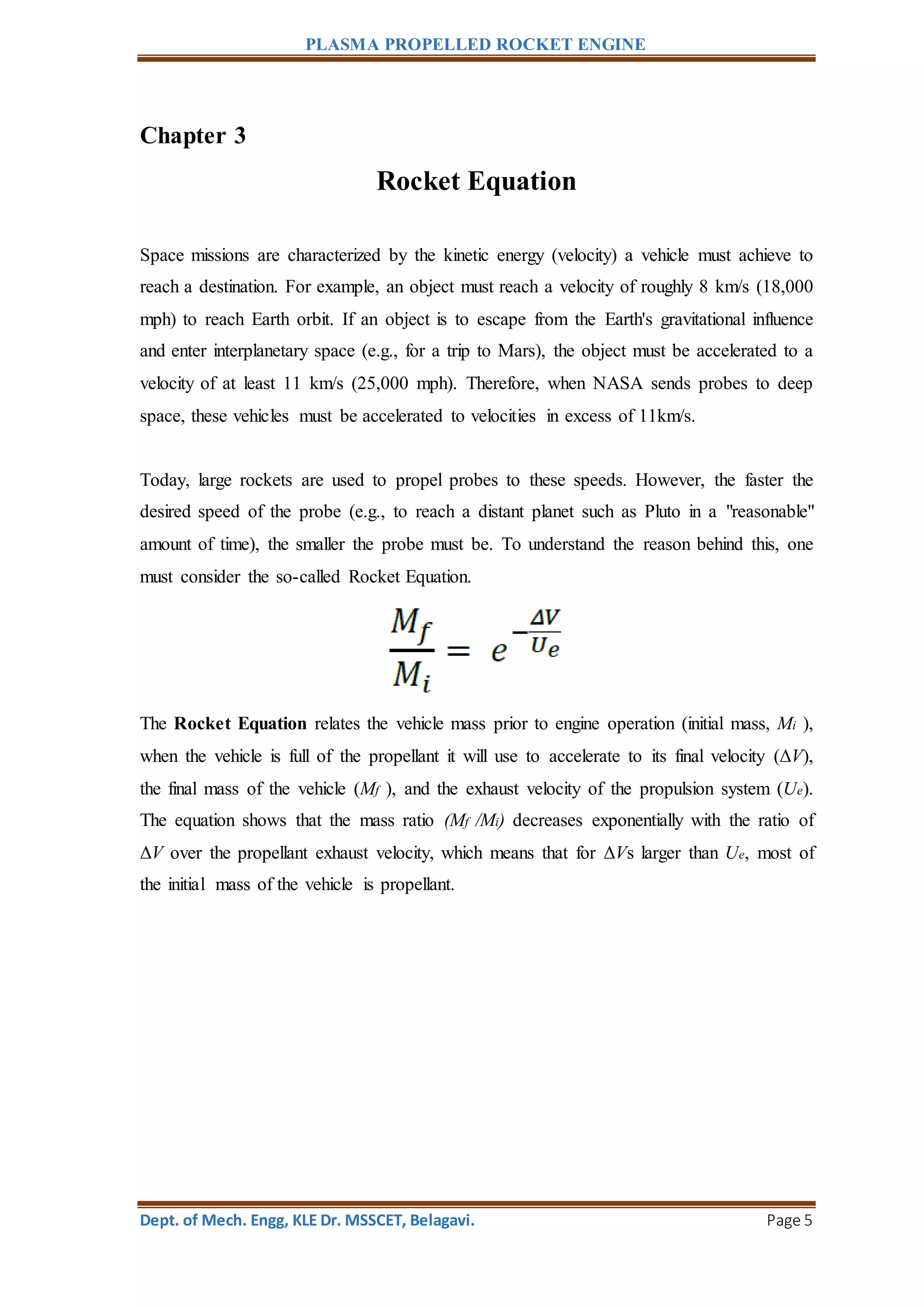
must consider the so-called Rocket Equation.
The Rocket Equation relates the vehicle mass prior to engine operation (initial mass, Mi ),
when the vehicle is full of the propellant it will use to accelerate to its final velocity (ΔV),
the final mass of the vehicle (Mf ), and the exhaust velocity of the propulsion system (Ue).
The equation shows that the mass ratio (Mf /Mi) decreases exponentially with the ratio of
ΔV over the propellant exhaust velocity, which means that for ΔVs larger than Ue, most of
the initial mass of the vehicle is propellant.
PLASMA PROPELLED ROCKET ENGINE
Dept. of Mech. Engg, KLE Dr. MSSCET, Belagavi. Page 6
Chapter 4
Comparison of Electric and Chemical Rockets
$10,000 is roughly what it costs to send a pound (0.45 kilogram) of payload Earth orbit
with conventional rocket boosters. This high price tag is one reason engineers go to great
lengths to shave as much mass from spacecraft as is feasible. The fuel and its storage tank
are the heaviest parts of a vehicle powered by a chemical rocket.
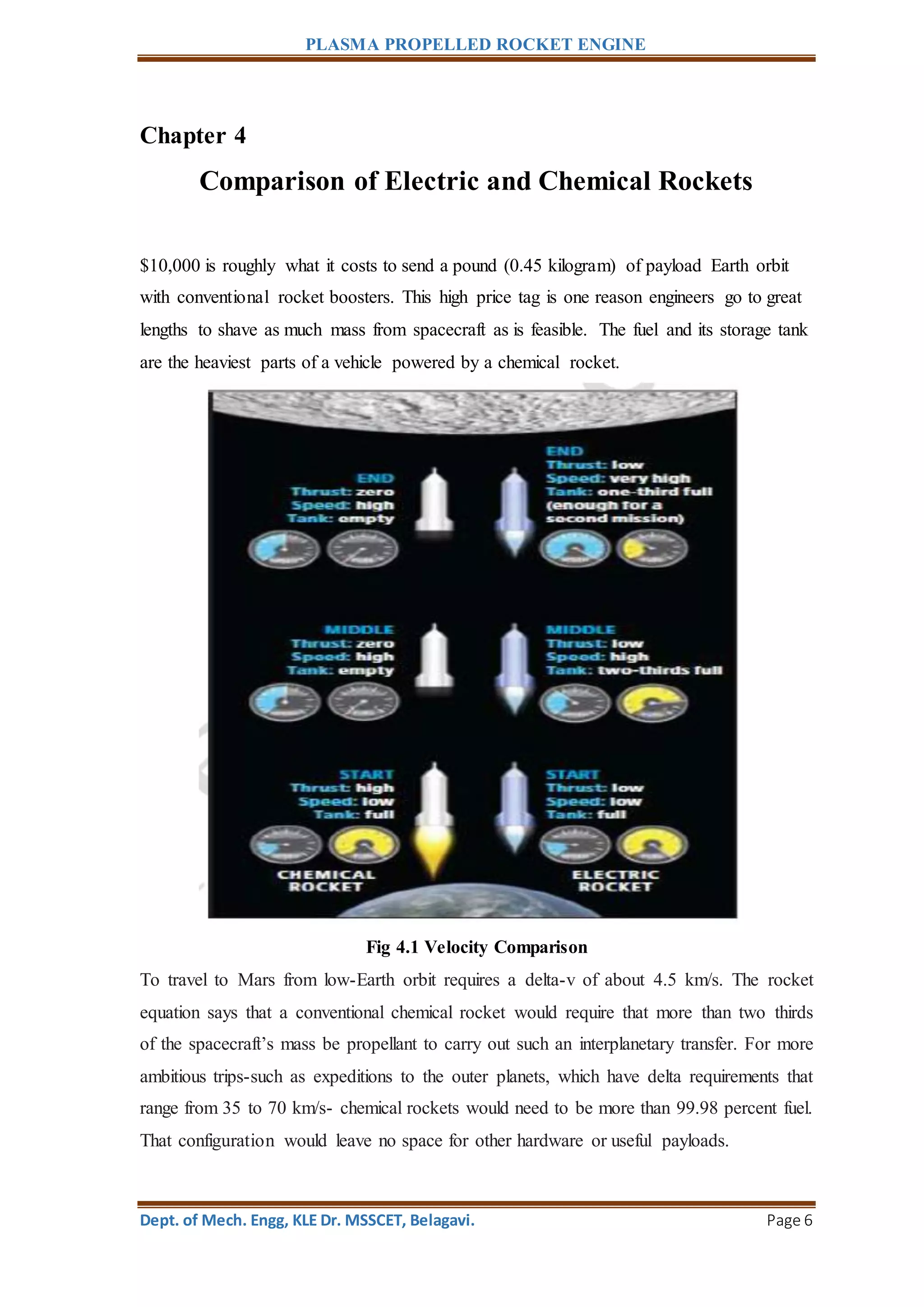
Fig 4.1 Velocity Comparison
To travel to Mars from low-Earth orbit requires a delta-v of about 4.5 km/s. The rocket
equation says that a conventional chemical rocket would require that more than two thirds
of the spacecraft’s mass be propellant to carry out such an interplanetary transfer. For more
ambitious trips-such as expeditions to the outer planets, which have delta requirements that
range from 35 to 70 km/s- chemical rockets would need to be more than 99.98 percent fuel.
That configuration would leave no space for other hardware or useful payloads.
PLASMA PROPELLED ROCKET ENGINE
Dept. of Mech. Engg, KLE Dr. MSSCET, Belagavi. Page 7
Chapter 5
Plasma Propulsion
A plasma propulsion engine is a type of Ion thruster which uses plasma in some or all parts
of the thrust generation process. Even though less powerful than conventional rocket
engines, plasma engines are able to operate at higher efficiencies and for longer periods of
time. Plasma engines are better suited for long distance interplanetary space travel mission.
Plasma propulsion systems, in contrast, offer much greater exhaust speeds. Instead of
burning chemical fuel to generate thrust, the plasma engine accelerates plasmas-clouds of
electrically charged atoms or molecules to very high velocities. Plasma is produced by
adding energy to a gas, for instance, by radiating it with lasers, microwaves or radio-
frequency waves or by subjecting it to strong electric fields. The extra energy liberates
electrons from the atoms or molecules of the gas, leaving the latter with a positive charge
and the former free to move freely in the gas, which makes the ionized gas a better electrical
conductor than copper metal.
Because plasmas contain charged particles, whose motion is strongly affected by electric
and magnetic fields, application of electric or electromagnetic fields to plasma can
accelerate its constituents and send them out the back of a vehicle as thrust-producing
exhaust. The necessary fields can be generated by electrodes and magnets, using induction
by external antennas or wire coils, or by driving electric currents through the plasma.
The electric power for creating and accelerating the plasmas typically comes from solar
panels that collect energy from the sun. But deep-space vehicles going past Mars must rely
on nuclear power sources, because solar energy gets too weak at long distances from the
sun. Today’s small robotic probes use thermoelectric devices heated by the decay of a
nuclear isotope, but the more ambitious missions of the future would need nuclear fission
(or even fusion) reactors. Any nuclear reactor would be activated only after the vessel
reached a stable orbit at a safe distance from Earth. Its fuel would be secured in an inert
state during lift off. Three kinds of plasma propulsion systems have matured enough to be
employed on long distance missions.
PLASMA PROPELLED ROCKET ENGINE
Dept. of Mech. Engg, KLE Dr. MSSCET, Belagavi. Page 8
5.1 Ion Drive
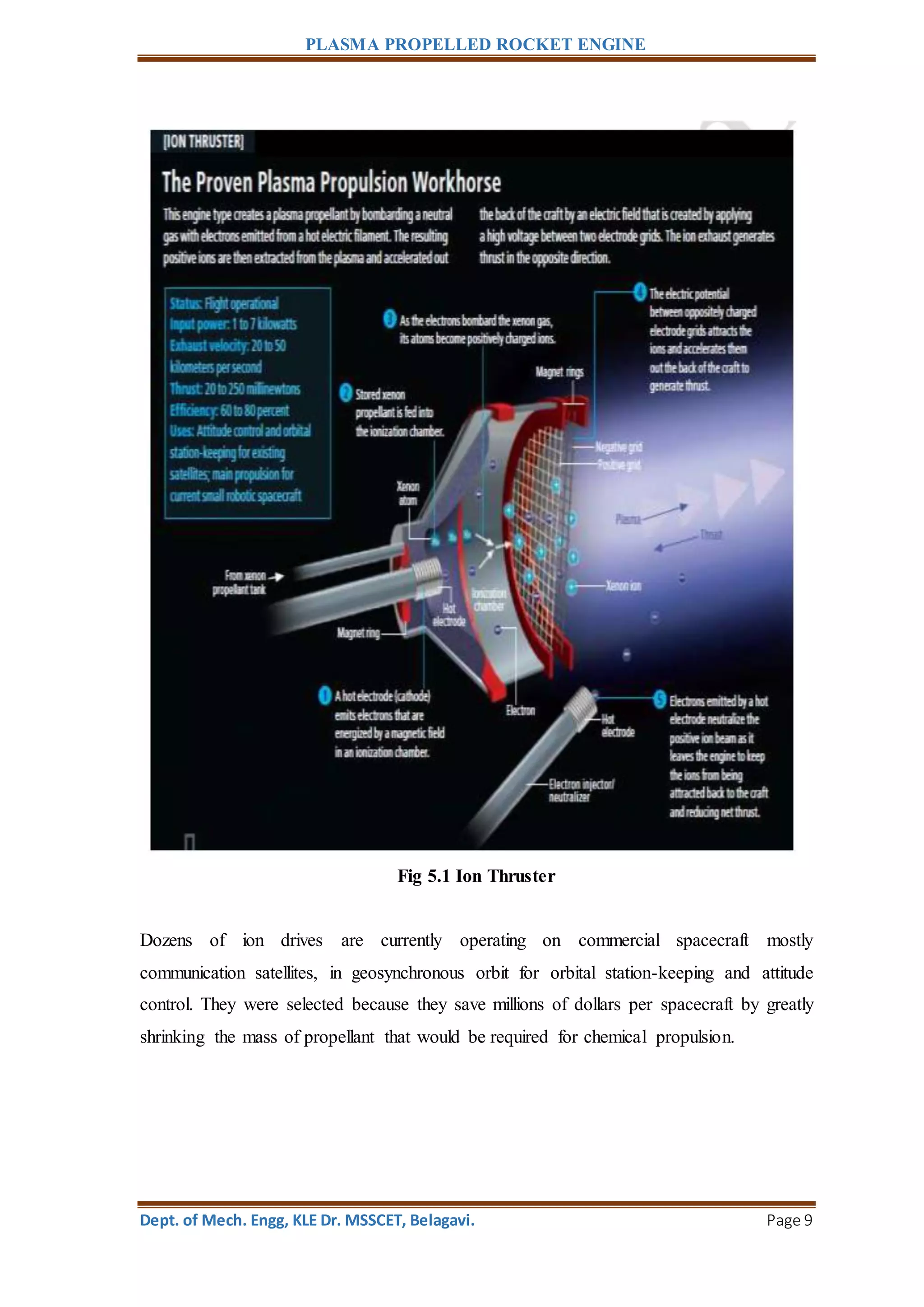
An ion thruster is a form of electric propulsion used for spacecraft propulsion that creates
thrust by accelerating ions. Ion thrusters are categorized by how they accelerate the ions,
using either electrostatic or electromagnetic force. Electrostatic ion thrusters use the
Coulomb force and accelerate the ions in the direction of the electric field. Electromagnetic
ion thrusters use the Lorentz force to accelerate the ions. The term "ion thruster" by itself
us ally denotes the electrostatic or gridded ion thrusters.
In its most common incarnation, the ion engine gets its power from the photovoltaic panels.
Gridded electrostatic ion thrusters commonly utilize xenon gas. This gas has no charge and
is ionized by bombarding it with energetic electrons. These electrons can be provided from
a hot cathode filament and when accelerated in the electrical field of the cathode, fall to the
anode. Alternatively, the electrons can be accelerated by the oscillating electric field
induced by an alternating magnetic field of a coil, which results in a self-sustaining
discharge and omits any cathode (radiofrequency ion thruster).
The positively charged ions are extracted by an extraction system consisting of 2 or 3 multi-
aperture grids. After entering the grid system via the plasma sheath the ions are accelerated
due to the potential difference between the first and second grid (named screen and
accelerator grid) to the final ion energy of typically 1-2 keV, thereby generating the thrust.
Ion thrusters emit a beam of positive charged xenon ions only. To avoid charging-up the
spacecraft, another cathode is placed near the engine, which emits electrons (basically the
electron current is the same as the ion current) into the ion beam. This also prevents the
beam of ions from returning to the spacecraft and thereby cancelling the thrust.
PLASMA PROPELLED ROCKET ENGINE
Dept. of Mech. Engg, KLE Dr. MSSCET, Belagavi. Page 9
Fig 5.1 Ion Thruster
Dozens of ion drives are currently operating on commercial spacecraft mostly
communication satellites, in geosynchronous orbit for orbital station-keeping and attitude
control. They were selected because they save millions of dollars per spacecraft by greatly
shrinking the mass of propellant that would be required for chemical propulsion.
PLASMA PROPELLED ROCKET ENGINE
Dept. of Mech. Engg, KLE Dr. MSSCET, Belagavi. Page 10
5.2 Hall Thruster
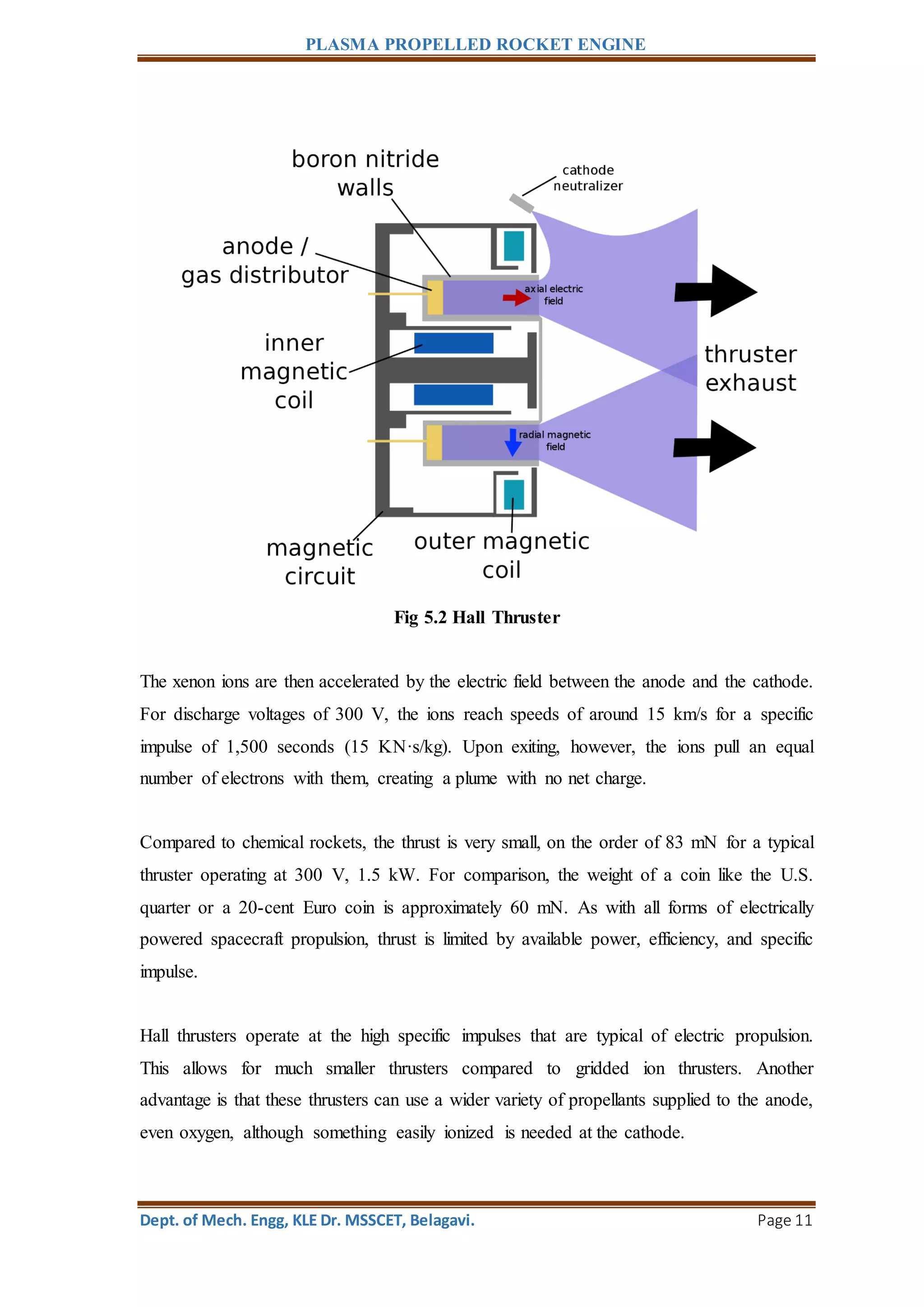
The essential working principle of the Hall thruster is that it uses an electrostatic potential
to accelerate ions up to high speeds. In a Hall thruster the attractive negative charge is
provided by electron plasma at the open end of the thruster instead of a grid.
A radial magnetic field of a hundred gauss (about 100–300 G, 0.01–0.03 T) is used to
confine the electrons, where the combination of the radial magnetic field and axial electric
field cause the electrons to drift azimuthally, forming the Hall current from which the
device gets its name.
An electric potential between 150 and 800 volts is applied between the anode and cathode.
The central spike forms one pole of an electromagnet and is surrounded by an annular space
and around that is the other pole of the electromagnet, with a radial magnetic field in
between.
The propellant, such as xenon gas, is fed through the anode, which has numerous small
holes in it to act as a gas distributor. Xenon propellant is used because of its high atomic
weight and low ionization potential. As the neutral xenon atoms diffuse into the channel of
the thruster, they are ionized by collisions with high energy circulating electrons (typically
10–40 eV, or about 10% of the discharge voltage). Once ionized, the xenon ions typically
have a charge of +1, though a small fraction (~20%) is +2.
PLASMA PROPELLED ROCKET ENGINE
Dept. of Mech. Engg, KLE Dr. MSSCET, Belagavi. Page 11
Fig 5.2 Hall Thruster
The xenon ions are then accelerated by the electric field between the anode and the cathode.
For discharge voltages of 300 V, the ions reach speeds of around 15 km/s for a specific
impulse of 1,500 seconds (15 KN·s/kg). Upon exiting, however, the ions pull an equal
number of electrons with them, creating a plume with no net charge.
Compared to chemical rockets, the thrust is very small, on the order of 83 mN for a typical
thruster operating at 300 V, 1.5 kW. For comparison, the weight of a coin like the U.S.
quarter or a 20-cent Euro coin is approximately 60 mN. As with all forms of electrically
powered spacecraft propulsion, thrust is limited by available power, efficiency, and specific
impulse.
Hall thrusters operate at the high specific impulses that are typical of electric propulsion.
This allows for much smaller thrusters compared to gridded ion thrusters. Another
advantage is that these thrusters can use a wider variety of propellants supplied to the anode,
even oxygen, although something easily ionized is needed at the cathode.
PLASMA PROPELLED ROCKET ENGINE
Dept. of Mech. Engg, KLE Dr. MSSCET, Belagavi. Page 12
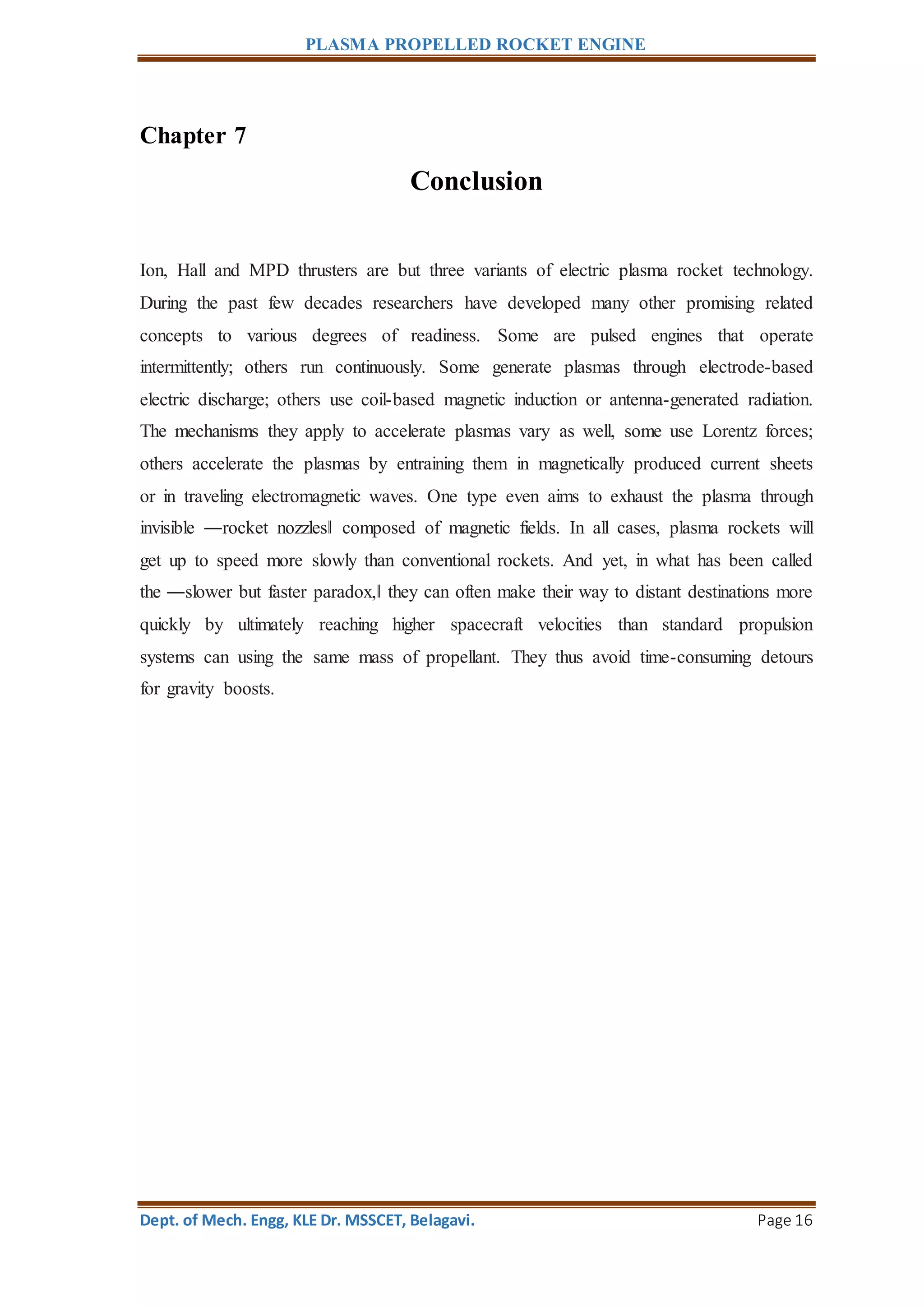
5.3 Magnetoplasmadynamic Thruster
The Magnetoplasmadynamic (MPD) thruster (MPDT) is a form of electrically powered
spacecraft propulsion which uses the Lorentz force (the force on a charged particle by an
electromagnetic field) to generate thrust. It is sometimes referred to as Lorentz Force
Accelerator (LFA) or (mostly in Japan) MPD arc jet.
Generally, a gaseous fuel is ionized and fed into an acceleration chamber, where the
magnetic and electrical fields are created using a power source. The particles are then
propelled by the Lorentz force resulting from the interaction between the current flowing
through the plasma and the magnetic field (which is either externally applied, or induced
by the current) out through the exhaust chamber.
Unlike chemical propulsion, there is no combustion of fuel. As with other electric
propulsion variations, both specific impulse and thrust increase with power input, while
thrust per watt drops.
There are two main types of MPD thrusters, applied-field and self-field. Applied-field
thrusters have magnetic rings surrounding the exhaust chamber to produce the magnetic
field, while self-field thrusters have a cathode extending through the middle of the chamber.
Applied fields are necessary at lower power levels, where self-field configurations are too
weak. Various propellants such as xenon, neon, argon, hydrogen, hydrazine, and lithium
have been used, with lithium generally being the best performer.
An MPDT consists of a central cathode sitting within a larger cylindrical anode. A gas,
typically lithium, is pumped into the annular space between the cathode and the anode.
There it is ionized by an electric current flowing radially from the cathode to the anode.
This current induces an azimuthal magnetic field (one that encircles the central cathode),
which interacts with the same current that induced it to generate the thrust-producing
Lorentz force.
PLASMA PROPELLED ROCKET ENGINE
Dept. of Mech. Engg, KLE Dr. MSSCET, Belagavi. Page 13
Fig 5.3 Magnetoplasmadynamic Thruster
A single MPD engine about the size of an average household pail can process about a
million watts of electric power from a solar or nuclear source into thrust (enough to energize
more than 10,000 standard light bulbs), which is substantially larger than the maximum
power limits of ion or Hall thrusters of the same size. An MPDT can produce exhaust
velocities from 15 to 60 km/s.
This design also offers the advantage of throttling; its exhaust speed and thrust can be easily
adjusted by varying the electric current level or the flow rate of the propellant. Throttling
allows a mission planner to alter a spacecraft’s engine thrust and exhaust velocity as needed
to optimize its trajectory.
In theory, MPD thrusters could produce extremely high specific impulses (Isp) with an
exhaust velocity of up to and beyond 110,000 m/s, triple the value of current xenon-based
PLASMA PROPELLED ROCKET ENGINE
Dept. of Mech. Engg, KLE Dr. MSSCET, Belagavi. Page 14
ion thrusters, and about 20 times better than liquid rockets. MPD technology also has the
potential for thrust levels of up to 200 newton (N) by far the highest for any form of electric
propulsion, and nearly as high as many interplanetary chemical rockets. This would allow
use of electric propulsion on missions which require quick delta-v maneuvers (such as
capturing into orbit around another planet), but with many times greater fuel efficiency.
Due to imperfect acceleration and phenomena like late-time ablation and particulate
emission, pulsed MPD thrusters often suffer from low thrust efficiency. A better
understanding of the ablation processes, especially the ionization, might yield valuable
information to improve the propulsion system in terms of efficiency, thus enabling more
payloads on the satellite. To investigate the phenomena occurring within the plasma during
the discharge and the influence of the thruster properties, high-speed camera observations
were used.
PLASMA PROPELLED ROCKET ENGINE
Dept. of Mech. Engg, KLE Dr. MSSCET, Belagavi. Page 15
Chapter 6
Latest Developments
Much as the fabled slow and steady tortoise beats out the intermittently sprinting hare, in
the marathon flights that will become increasingly common in the present era of deep-space
exploration. So far the most advanced designs could impart a delta-v of 100 km/s—much
too slow to take a spacecraft to the far-off stars but plenty enough to visit the outer planets
in a reasonable amount of time.
One particularly exciting deep space mission that has been proposed would return samples
from Saturn’s largest moon, Titan, which space scientists believe has an atmosphere that is
very similar to Earth’s eons ago. A sample from Titan’s surface would offer researchers a
rare chance to search for signs of chemical precursors to life. The mission would be
impossible with chemical propulsion. And with no in course propulsion, the journey would
require multiple planetary gravity assists, adding more than three years to the total trip time.
A probe fitted with the little plasma engine that would be able to do the job in a significantly
shorter period.
PLASMA PROPELLED ROCKET ENGINE
Dept. of Mech. Engg, KLE Dr. MSSCET, Belagavi. Page 16
Chapter 7
Conclusion
Ion, Hall and MPD thrusters are but three variants of electric plasma rocket technology.
During the past few decades researchers have developed many other promising related
concepts to various degrees of readiness. Some are pulsed engines that operate
intermittently; others run continuously. Some generate plasmas through electrode-based
electric discharge; others use coil-based magnetic induction or antenna-generated radiation.
The mechanisms they apply to accelerate plasmas vary as well, some use Lorentz forces;
others accelerate the plasmas by entraining them in magnetically produced current sheets
or in traveling electromagnetic waves. One type even aims to exhaust the plasma through
invisible ―rocket nozzles‖ composed of magnetic fields. In all cases, plasma rockets will
get up to speed more slowly than conventional rockets. And yet, in what has been called
the ―slower but faster paradox,‖ they can often make their way to distant destinations more
quickly by ultimately reaching higher spacecraft velocities than standard propulsion
systems can using the same mass of propellant. They thus avoid time-consuming detours
for gravity boosts.
PLASMA PROPELLED ROCKET ENGINE
Dept. of Mech. Engg, KLE Dr. MSSCET, Belagavi. Page 17
References
[1] DanM. Goebel and Ira Katz. Wiley, -“Fundamentals of Electric
Propulsion: Ion and Hall Thrusters.” 2008, pg. 124-131.
[2] http://www.nasa.gov
[3] http://www.princeton.edu/~achaney/Magnetoplasmadynamic_thruster
[4] https://en.wikipedia.org/wiki/Ion_thruster

A Seminar on Plasma Propelled Rocket Engine

  • 1.
    PLASMA PROPELLED ROCKETENGINE Dept. of Mech. Engg, KLE Dr. MSSCET, Belagavi. Page 1 List of Figure Figure No. Description Page No. Fig 4.1 Velocity comparison 6 Fig 5.1 Ion Thruster 9 Fig 5.2 Hall Thruster 11 Fig 5.3 Magnetoplasmadynamic Thruster 13
  • 2.
    PLASMA PROPELLED ROCKETENGINE Dept. of Mech. Engg, KLE Dr. MSSCET, Belagavi. Page 2 Chapter 1 Introduction Rocket is a device that provides thrust to a vehicle by accelerating some matter (the propellant) and exhausting it from the rocket. Most significant difference between rocket and air breathing engines is that rocket carries all its own propellant. From the early 19th century onwards science have been trying to launch satellites into outer space with the help of rockets. But the success rate of these missions was very low due to lack of technologies and the huge cost involved. Also most fuels get expended in the initial stage of operation which is not practical for deep-space mission’s explorations because they would require huge quantities of fuel. Gravitation boost is also required. The mission conducted by NASA which took off in September 2007, is powered by a kind of space propulsion technology that is starting to take center stage for long-distance missions- a plasma rocket engine. Such engines, now being developed in several advanced forms, generate thrust by electrically producing and manipulating ionized gas propellants rather than by burning liquid or solid chemical fuels, as conventional rockets do. NASA Jet Propulsion Laboratory selected a plasma engine as the probe’s rocket system because it is highly efficient, requiring only one tenth of the fuel that a chemical rocket motor would have needed to reach the asteroid belt. If project planners had chosen to install a traditional engine, the, vehicle would have been able to reach the required destination. The benefits afforded by plasma engines become most striking in light of the drawbacks of conventional rockets. When people imagine a ship streaking through the dark void toward a distant planet, they usually envision it trailing a long, fiery plume from its nozzles. Yet the truth is altogether different: expeditions to the outer solar system have been mostly rocket less affairs, motor would typically have no fuel left for braking. Such a probe would need the ability to reach its rocket so that it could slow enough to achieve orbit around its target and thus conduct extended scientific observations.
  • 3.
    PLASMA PROPELLED ROCKETENGINE Dept. of Mech. Engg, KLE Dr. MSSCET, Belagavi. Page 3 1.1 Literature Survey Konstantin E. Tsiolkovsky on the year (1903) derives the ―rocket equation, which is widely used to calculate fuel consumption for space missions. In 1911 he speculates that electric fields could accelerate charged particles to produce rocket thrust. Then after that, during (1954) Ernst Stuhlingera Russian scientist figures out how to optimize the performance of the electric ion rocket engine. Work by researchers in the Soviet Union, Europe and the U.S. leads to the first published description of the Hall thruster, a more powerful class of plasma rocket. NASA’s Jet Propulsion Laboratory’s Deep Space 1 in the year (1999) demonstrates the first use of an ion engine as the main propulsion system on a spacecraft that escapes Earth’s gravitation from orbit. Tony Schooner(2000) studied performance and the plasma created by a pulsed magnet plasma dynamic thruster for small satellite application to understand better the ablation and plasma propagation processes occurring during the short-time discharge. The results can be applied to improve the quality of the thruster in terms of efficiency and to tune the propulsion system to the needs required by the satellite mission. The word from Houston is that Ad Astra Rocket Co., which has been developing the VASIMR concept, has been making progress with its 200-kw plasma rocket engine prototype. VASIMR (Variable Specific Impulse Magneto plasma Rocket) offers constant power throttling (CPT), which would allow it to vary its exhaust for thrust and specific impulse while maintaining a constant power level. A (2015) flight prototype is in the works, a VASIMR drive that could reach an exhaust velocity of up to 500 kilometers per second, corresponding to a specific impulse of 50,000 seconds, which translates into an Alpha Centauri crossing in 2200 years.
  • 4.
    PLASMA PROPELLED ROCKETENGINE Dept. of Mech. Engg, KLE Dr. MSSCET, Belagavi. Page 4 Chapter 2 History The fall of 2012 marks humankind's 55th year as a space-faring society. Our world changed irreversibly on October 4, 1957, when the Soviet Union successfully launched Sputnik I, the world's first artificial satellite. Sputnik I was about the size of a basketball, weighed only 183 pounds and took about 98 minutes to orbit the Earth. This marked the start of the Space Age and the US-USSR space race that ultimately led to the piloted Moon landings between 1969 and 1972. Some 30 years after humans last walked on the Moon, access to space has become almost routine. We now have a space station the size of an airliner constantly inhabited with a three person crew and have sent space probes to every planet in our solar system except Pluto. We see wondrous images of distant planets, quasars and galaxies from our orbiting space telescopes. While the list of wondrous stories associated with space travel is almost endless, it is hard to imagine that a little over 100 years ago, no human had flown even one foot off the ground in a powered vehicle. In fact, scientists of the day debated whether space travel would even be possible since, as some argued, "There was no air for the rocket motor propellant to push against to impart thrust." We now realize as Sir Isaac Newton did centuries earlier how specious this argument was. As early as the first decade of the 20th century, rocket pioneers speculated about using electricity to power spacecraft. But the late Ernst Stuhlingera member of Wernher von Braun’s legendary team of German rocket scientists that spearheaded the U.S. space program-finally turned the concept into a practical technology in the mid-1950s. A few years’ later, engineers at the NASA Glenn Research Center (then known as Lewis) built the first operating electric rocket. That engine made a suborbital flight in 1964 onboard Space Electric Rocket Test 1, operating for half an hour before the craft fell back to Earth. In the meantime, researchers in the former Soviet Union worked independently on concepts for electric rockets.
  • 5.
    PLASMA PROPELLED ROCKETENGINE Dept. of Mech. Engg, KLE Dr. MSSCET, Belagavi. Page 5 Chapter 3 Rocket Equation Space missions are characterized by the kinetic energy (velocity) a vehicle must achieve to reach a destination. For example, an object must reach a velocity of roughly 8 km/s (18,000 mph) to reach Earth orbit. If an object is to escape from the Earth's gravitational influence and enter interplanetary space (e.g., for a trip to Mars), the object must be accelerated to a velocity of at least 11 km/s (25,000 mph). Therefore, when NASA sends probes to deep space, these vehicles must be accelerated to velocities in excess of 11km/s. Today, large rockets are used to propel probes to these speeds. However, the faster the desired speed of the probe (e.g., to reach a distant planet such as Pluto in a "reasonable" amount of time), the smaller the probe must be. To understand the reason behind this, one must consider the so-called Rocket Equation. The Rocket Equation relates the vehicle mass prior to engine operation (initial mass, Mi ), when the vehicle is full of the propellant it will use to accelerate to its final velocity (ΔV), the final mass of the vehicle (Mf ), and the exhaust velocity of the propulsion system (Ue). The equation shows that the mass ratio (Mf /Mi) decreases exponentially with the ratio of ΔV over the propellant exhaust velocity, which means that for ΔVs larger than Ue, most of the initial mass of the vehicle is propellant.
  • 6.
    PLASMA PROPELLED ROCKETENGINE Dept. of Mech. Engg, KLE Dr. MSSCET, Belagavi. Page 6 Chapter 4 Comparison of Electric and Chemical Rockets $10,000 is roughly what it costs to send a pound (0.45 kilogram) of payload Earth orbit with conventional rocket boosters. This high price tag is one reason engineers go to great lengths to shave as much mass from spacecraft as is feasible. The fuel and its storage tank are the heaviest parts of a vehicle powered by a chemical rocket. Fig 4.1 Velocity Comparison To travel to Mars from low-Earth orbit requires a delta-v of about 4.5 km/s. The rocket equation says that a conventional chemical rocket would require that more than two thirds of the spacecraft’s mass be propellant to carry out such an interplanetary transfer. For more ambitious trips-such as expeditions to the outer planets, which have delta requirements that range from 35 to 70 km/s- chemical rockets would need to be more than 99.98 percent fuel. That configuration would leave no space for other hardware or useful payloads.
  • 7.
    PLASMA PROPELLED ROCKETENGINE Dept. of Mech. Engg, KLE Dr. MSSCET, Belagavi. Page 7 Chapter 5 Plasma Propulsion A plasma propulsion engine is a type of Ion thruster which uses plasma in some or all parts of the thrust generation process. Even though less powerful than conventional rocket engines, plasma engines are able to operate at higher efficiencies and for longer periods of time. Plasma engines are better suited for long distance interplanetary space travel mission. Plasma propulsion systems, in contrast, offer much greater exhaust speeds. Instead of burning chemical fuel to generate thrust, the plasma engine accelerates plasmas-clouds of electrically charged atoms or molecules to very high velocities. Plasma is produced by adding energy to a gas, for instance, by radiating it with lasers, microwaves or radio- frequency waves or by subjecting it to strong electric fields. The extra energy liberates electrons from the atoms or molecules of the gas, leaving the latter with a positive charge and the former free to move freely in the gas, which makes the ionized gas a better electrical conductor than copper metal. Because plasmas contain charged particles, whose motion is strongly affected by electric and magnetic fields, application of electric or electromagnetic fields to plasma can accelerate its constituents and send them out the back of a vehicle as thrust-producing exhaust. The necessary fields can be generated by electrodes and magnets, using induction by external antennas or wire coils, or by driving electric currents through the plasma. The electric power for creating and accelerating the plasmas typically comes from solar panels that collect energy from the sun. But deep-space vehicles going past Mars must rely on nuclear power sources, because solar energy gets too weak at long distances from the sun. Today’s small robotic probes use thermoelectric devices heated by the decay of a nuclear isotope, but the more ambitious missions of the future would need nuclear fission (or even fusion) reactors. Any nuclear reactor would be activated only after the vessel reached a stable orbit at a safe distance from Earth. Its fuel would be secured in an inert state during lift off. Three kinds of plasma propulsion systems have matured enough to be employed on long distance missions.
  • 8.
    PLASMA PROPELLED ROCKETENGINE Dept. of Mech. Engg, KLE Dr. MSSCET, Belagavi. Page 8 5.1 Ion Drive An ion thruster is a form of electric propulsion used for spacecraft propulsion that creates thrust by accelerating ions. Ion thrusters are categorized by how they accelerate the ions, using either electrostatic or electromagnetic force. Electrostatic ion thrusters use the Coulomb force and accelerate the ions in the direction of the electric field. Electromagnetic ion thrusters use the Lorentz force to accelerate the ions. The term "ion thruster" by itself us ally denotes the electrostatic or gridded ion thrusters. In its most common incarnation, the ion engine gets its power from the photovoltaic panels. Gridded electrostatic ion thrusters commonly utilize xenon gas. This gas has no charge and is ionized by bombarding it with energetic electrons. These electrons can be provided from a hot cathode filament and when accelerated in the electrical field of the cathode, fall to the anode. Alternatively, the electrons can be accelerated by the oscillating electric field induced by an alternating magnetic field of a coil, which results in a self-sustaining discharge and omits any cathode (radiofrequency ion thruster). The positively charged ions are extracted by an extraction system consisting of 2 or 3 multi- aperture grids. After entering the grid system via the plasma sheath the ions are accelerated due to the potential difference between the first and second grid (named screen and accelerator grid) to the final ion energy of typically 1-2 keV, thereby generating the thrust. Ion thrusters emit a beam of positive charged xenon ions only. To avoid charging-up the spacecraft, another cathode is placed near the engine, which emits electrons (basically the electron current is the same as the ion current) into the ion beam. This also prevents the beam of ions from returning to the spacecraft and thereby cancelling the thrust.
  • 9.
    PLASMA PROPELLED ROCKETENGINE Dept. of Mech. Engg, KLE Dr. MSSCET, Belagavi. Page 9 Fig 5.1 Ion Thruster Dozens of ion drives are currently operating on commercial spacecraft mostly communication satellites, in geosynchronous orbit for orbital station-keeping and attitude control. They were selected because they save millions of dollars per spacecraft by greatly shrinking the mass of propellant that would be required for chemical propulsion.
  • 10.
    PLASMA PROPELLED ROCKETENGINE Dept. of Mech. Engg, KLE Dr. MSSCET, Belagavi. Page 10 5.2 Hall Thruster The essential working principle of the Hall thruster is that it uses an electrostatic potential to accelerate ions up to high speeds. In a Hall thruster the attractive negative charge is provided by electron plasma at the open end of the thruster instead of a grid. A radial magnetic field of a hundred gauss (about 100–300 G, 0.01–0.03 T) is used to confine the electrons, where the combination of the radial magnetic field and axial electric field cause the electrons to drift azimuthally, forming the Hall current from which the device gets its name. An electric potential between 150 and 800 volts is applied between the anode and cathode. The central spike forms one pole of an electromagnet and is surrounded by an annular space and around that is the other pole of the electromagnet, with a radial magnetic field in between. The propellant, such as xenon gas, is fed through the anode, which has numerous small holes in it to act as a gas distributor. Xenon propellant is used because of its high atomic weight and low ionization potential. As the neutral xenon atoms diffuse into the channel of the thruster, they are ionized by collisions with high energy circulating electrons (typically 10–40 eV, or about 10% of the discharge voltage). Once ionized, the xenon ions typically have a charge of +1, though a small fraction (~20%) is +2.
  • 11.
    PLASMA PROPELLED ROCKETENGINE Dept. of Mech. Engg, KLE Dr. MSSCET, Belagavi. Page 11 Fig 5.2 Hall Thruster The xenon ions are then accelerated by the electric field between the anode and the cathode. For discharge voltages of 300 V, the ions reach speeds of around 15 km/s for a specific impulse of 1,500 seconds (15 KN·s/kg). Upon exiting, however, the ions pull an equal number of electrons with them, creating a plume with no net charge. Compared to chemical rockets, the thrust is very small, on the order of 83 mN for a typical thruster operating at 300 V, 1.5 kW. For comparison, the weight of a coin like the U.S. quarter or a 20-cent Euro coin is approximately 60 mN. As with all forms of electrically powered spacecraft propulsion, thrust is limited by available power, efficiency, and specific impulse. Hall thrusters operate at the high specific impulses that are typical of electric propulsion. This allows for much smaller thrusters compared to gridded ion thrusters. Another advantage is that these thrusters can use a wider variety of propellants supplied to the anode, even oxygen, although something easily ionized is needed at the cathode.
  • 12.
    PLASMA PROPELLED ROCKETENGINE Dept. of Mech. Engg, KLE Dr. MSSCET, Belagavi. Page 12 5.3 Magnetoplasmadynamic Thruster The Magnetoplasmadynamic (MPD) thruster (MPDT) is a form of electrically powered spacecraft propulsion which uses the Lorentz force (the force on a charged particle by an electromagnetic field) to generate thrust. It is sometimes referred to as Lorentz Force Accelerator (LFA) or (mostly in Japan) MPD arc jet. Generally, a gaseous fuel is ionized and fed into an acceleration chamber, where the magnetic and electrical fields are created using a power source. The particles are then propelled by the Lorentz force resulting from the interaction between the current flowing through the plasma and the magnetic field (which is either externally applied, or induced by the current) out through the exhaust chamber. Unlike chemical propulsion, there is no combustion of fuel. As with other electric propulsion variations, both specific impulse and thrust increase with power input, while thrust per watt drops. There are two main types of MPD thrusters, applied-field and self-field. Applied-field thrusters have magnetic rings surrounding the exhaust chamber to produce the magnetic field, while self-field thrusters have a cathode extending through the middle of the chamber. Applied fields are necessary at lower power levels, where self-field configurations are too weak. Various propellants such as xenon, neon, argon, hydrogen, hydrazine, and lithium have been used, with lithium generally being the best performer. An MPDT consists of a central cathode sitting within a larger cylindrical anode. A gas, typically lithium, is pumped into the annular space between the cathode and the anode. There it is ionized by an electric current flowing radially from the cathode to the anode. This current induces an azimuthal magnetic field (one that encircles the central cathode), which interacts with the same current that induced it to generate the thrust-producing Lorentz force.
  • 13.
    PLASMA PROPELLED ROCKETENGINE Dept. of Mech. Engg, KLE Dr. MSSCET, Belagavi. Page 13 Fig 5.3 Magnetoplasmadynamic Thruster A single MPD engine about the size of an average household pail can process about a million watts of electric power from a solar or nuclear source into thrust (enough to energize more than 10,000 standard light bulbs), which is substantially larger than the maximum power limits of ion or Hall thrusters of the same size. An MPDT can produce exhaust velocities from 15 to 60 km/s. This design also offers the advantage of throttling; its exhaust speed and thrust can be easily adjusted by varying the electric current level or the flow rate of the propellant. Throttling allows a mission planner to alter a spacecraft’s engine thrust and exhaust velocity as needed to optimize its trajectory. In theory, MPD thrusters could produce extremely high specific impulses (Isp) with an exhaust velocity of up to and beyond 110,000 m/s, triple the value of current xenon-based
  • 14.
    PLASMA PROPELLED ROCKETENGINE Dept. of Mech. Engg, KLE Dr. MSSCET, Belagavi. Page 14 ion thrusters, and about 20 times better than liquid rockets. MPD technology also has the potential for thrust levels of up to 200 newton (N) by far the highest for any form of electric propulsion, and nearly as high as many interplanetary chemical rockets. This would allow use of electric propulsion on missions which require quick delta-v maneuvers (such as capturing into orbit around another planet), but with many times greater fuel efficiency. Due to imperfect acceleration and phenomena like late-time ablation and particulate emission, pulsed MPD thrusters often suffer from low thrust efficiency. A better understanding of the ablation processes, especially the ionization, might yield valuable information to improve the propulsion system in terms of efficiency, thus enabling more payloads on the satellite. To investigate the phenomena occurring within the plasma during the discharge and the influence of the thruster properties, high-speed camera observations were used.
  • 15.
    PLASMA PROPELLED ROCKETENGINE Dept. of Mech. Engg, KLE Dr. MSSCET, Belagavi. Page 15 Chapter 6 Latest Developments Much as the fabled slow and steady tortoise beats out the intermittently sprinting hare, in the marathon flights that will become increasingly common in the present era of deep-space exploration. So far the most advanced designs could impart a delta-v of 100 km/s—much too slow to take a spacecraft to the far-off stars but plenty enough to visit the outer planets in a reasonable amount of time. One particularly exciting deep space mission that has been proposed would return samples from Saturn’s largest moon, Titan, which space scientists believe has an atmosphere that is very similar to Earth’s eons ago. A sample from Titan’s surface would offer researchers a rare chance to search for signs of chemical precursors to life. The mission would be impossible with chemical propulsion. And with no in course propulsion, the journey would require multiple planetary gravity assists, adding more than three years to the total trip time. A probe fitted with the little plasma engine that would be able to do the job in a significantly shorter period.
  • 16.
    PLASMA PROPELLED ROCKETENGINE Dept. of Mech. Engg, KLE Dr. MSSCET, Belagavi. Page 16 Chapter 7 Conclusion Ion, Hall and MPD thrusters are but three variants of electric plasma rocket technology. During the past few decades researchers have developed many other promising related concepts to various degrees of readiness. Some are pulsed engines that operate intermittently; others run continuously. Some generate plasmas through electrode-based electric discharge; others use coil-based magnetic induction or antenna-generated radiation. The mechanisms they apply to accelerate plasmas vary as well, some use Lorentz forces; others accelerate the plasmas by entraining them in magnetically produced current sheets or in traveling electromagnetic waves. One type even aims to exhaust the plasma through invisible ―rocket nozzles‖ composed of magnetic fields. In all cases, plasma rockets will get up to speed more slowly than conventional rockets. And yet, in what has been called the ―slower but faster paradox,‖ they can often make their way to distant destinations more quickly by ultimately reaching higher spacecraft velocities than standard propulsion systems can using the same mass of propellant. They thus avoid time-consuming detours for gravity boosts.
  • 17.
    PLASMA PROPELLED ROCKETENGINE Dept. of Mech. Engg, KLE Dr. MSSCET, Belagavi. Page 17 References [1] DanM. Goebel and Ira Katz. Wiley, -“Fundamentals of Electric Propulsion: Ion and Hall Thrusters.” 2008, pg. 124-131. [2] http://www.nasa.gov [3] http://www.princeton.edu/~achaney/Magnetoplasmadynamic_thruster [4] https://en.wikipedia.org/wiki/Ion_thruster