SUBMITTED TO:
DEPT. OF ELECTRICAL &
ELECTRONICS ENGINEERING
A PRESENTATION ON-
ELECTRIC PROPULSION SYSTEMS
SUBMITTED BY:
LAKSHYA AGRAWAL
REG.NO- 1602060013
SECTION : EEE 1
DATE : 18th february
2020
1
OVERVIEW
 Overview of conventional engines and power systems used
in various sectors involving movement of goods or people.
 History of Electric Propulsion Systems (EP) and
their evolution taking place in various sectors at different
times.
 Basic definitions and broad classification and sub-
categorization of EPs.
 Electric Propulsion Mover Systems.
 Features of electric propulsion mover systems.
 Electric Propulsion Thruster Systems.
 Features of electric propulsion thruster systems.
 Conclusions on development & growth in the Electric
Propulsion System market.
2
CONVENTIONAL
ENGINES AND
POWER
GENERATION
SYSTEMS USED
IN VARIOUS
SECTORS.
 Conventional fuel systems like petrol,
oil, and diesel engines.
 Steam turbine power systems.
 Gas and classical chemical combustion
systems.
 Combined power generation systems.
3
CONVENTIONAL FUEL
SYSTEMS
• Very large weight when compared
compared to others.
• High speed Fuel Engine
provides hgh fraction losses
in operation perticularly at partial
loads.
• They show high fuel consumption
at partial loads.
• High and medium speed
engine must be coupled to
a gearbox.
STEAM TURBINE POWER
SYSTEMS
• Fuel consumption is considerably
higher.
• It is a quiet low efficiency engine.
• Turbines must run at high speed
for best efficiency, so a high ratio
raduction gear is essential to
obtain an economical propeller
speed.
CLASSICAL GAS &
CHEMICAL CUMBUSTION
SYSTEMS
• The burn rate of chemical fuels
are near to uncontrollable and so
they burn very fast.
• Requires large area and space
for the inlet air system.
• The thrust provided is just so high
that it some times leads
to deviation of path of the vehicle.
vehicle.
COMBINED POWER
GENERATION SYSTEMS
• The combined power generation
involves high complexity in
managing.
• Normally occupies large
machinery space.
4
History & Evolution of Electric Propulsion Systems
• In1828, early type electric motor invented by Ányos Jedlik and a small model car powered by his new motor was
creatd.
• In1834, Vermont blacksmith Thomas Davenport built a same contraption which operated on a short, circular,
electrified track.
• In1839 a small Russian ferry was built which was propelled by an electric motor fed by a storage battery.
• By1860s with the invention of the lead–acid battery rechargeable batteries came became viable means for storing
electricity on board a vehicle,
• On 8 October 1883, Gaston Tissandier made the first electrically-powered airship.
• Interest in motor vehicles increased in the late 1890s and early 1900s(GOLDEN AGE). Electric battery-powered taxis
became available at the end of the 19th century. In London, Walter Bersey designed a fleet of such cabs
and introduced them to the streets of London in 1897.They were soon nicknamed "Hummingbirds" due to the
idiosyncratic humming noise they made.
• After the success in beginning of the 20th century, the electric system began to lose its position in the automobile
market.By the 1920s an improved road infrastructure required vehicles with a greater range.Worldwide discoveries
of large petroleum reserves made fuel-powered engines cheaper to operate over long distances. Electric cars
remained limited to urban use by their slow speed and low range same was the situation in the marine shipping
industry where diesel engines were being used extinsively, and fueled vehicles were now able to travel farther and
faster than equivalent electrics.
• Same was the time wright flyer engine became the first successful flying engine.
• By the end of 1950s there is found revival of the EP industry which was the consequence of the major development5
PROPULSION SYSTEM:
A propulsion system is a machine that produces thrust to push an object forward. On vehicles, thrust is usually
generated through some application of Newton's third law of action and reaction. A gas, or working fluid, is
accelerated by the engine and the reaction to this acceleration produces a force on the engine.
ELECTRIC PROPULSION SYSTEM:
Electric propulsion is a generic name encompassing all of the ways of accelerating a vehicle using electrical
power in a direct or indirect way.
CLASSIFICATION
ELECTRIC PROPULSION MOVER
SYSTEMS
• HYBRID ELECTRIC PROPULSION
• TURBO ELECTRIC PROPULSION
• ELECTRIC PROPULSION
ELECTRIC PROPULSION THRUSTER
SYSTEM
• ELECTROSTATIC PROPULSION
• ELECTROTHERMAL PROPULSION
• ELECTROMAGNETIC
PROPULSION
6
ELECTRIC PROPULSION MOVER SYSTEMS
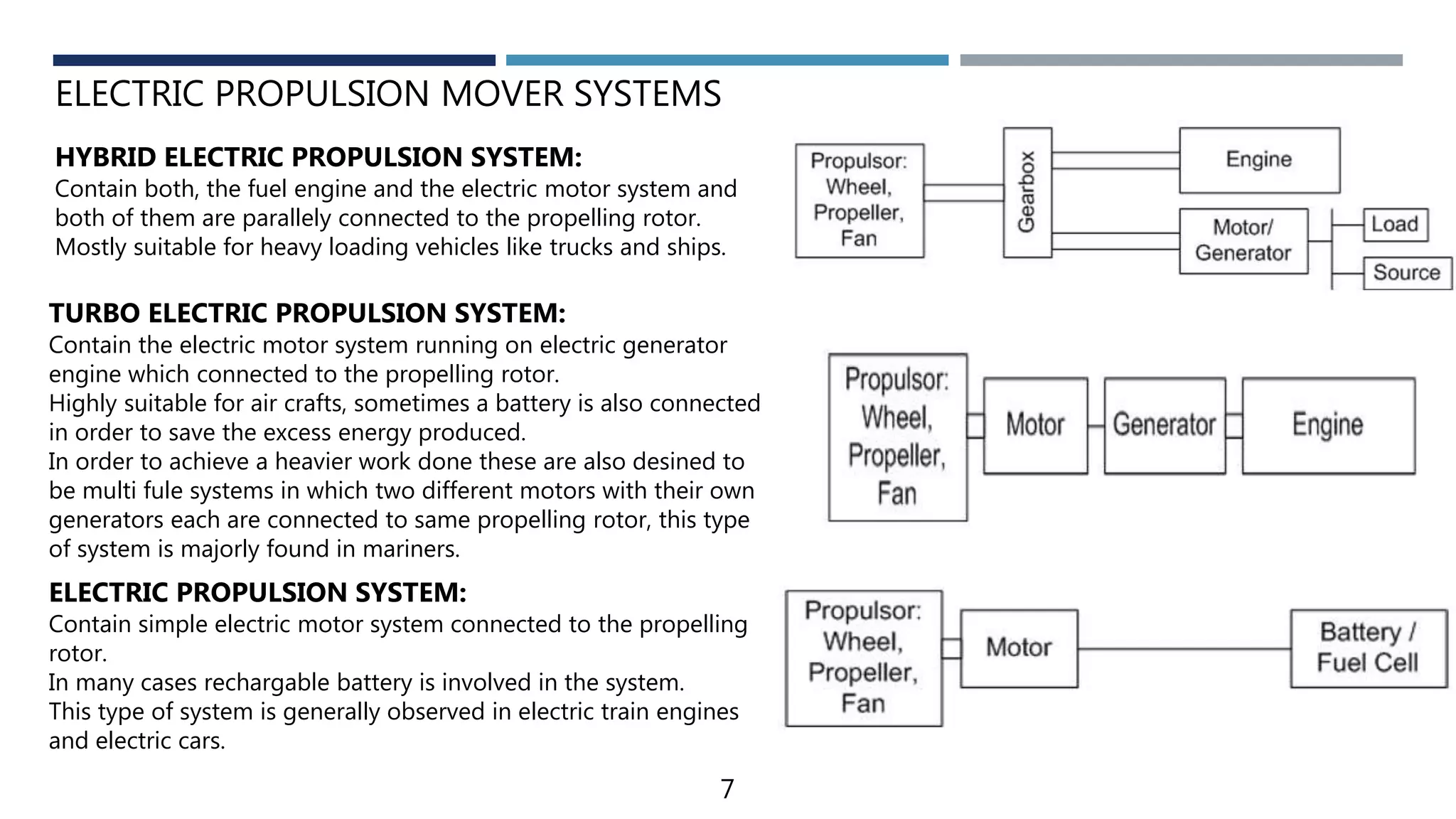
HYBRID ELECTRIC PROPULSION SYSTEM:
Contain both, the fuel engine and the electric motor system and
both of them are parallely connected to the propelling rotor.
Mostly suitable for heavy loading vehicles like trucks and ships.
TURBO ELECTRIC PROPULSION SYSTEM:
Contain the electric motor system running on electric generator
engine which connected to the propelling rotor.
Highly suitable for air crafts, sometimes a battery is also connected
in order to save the excess energy produced.
In order to achieve a heavier work done these are also desined to
be multi fule systems in which two different motors with their own
generators each are connected to same propelling rotor, this type
of system is majorly found in mariners.
ELECTRIC PROPULSION SYSTEM:
Contain simple electric motor system connected to the propelling
rotor.
In many cases rechargable battery is involved in the system.
This type of system is generally observed in electric train engines
and electric cars.
7
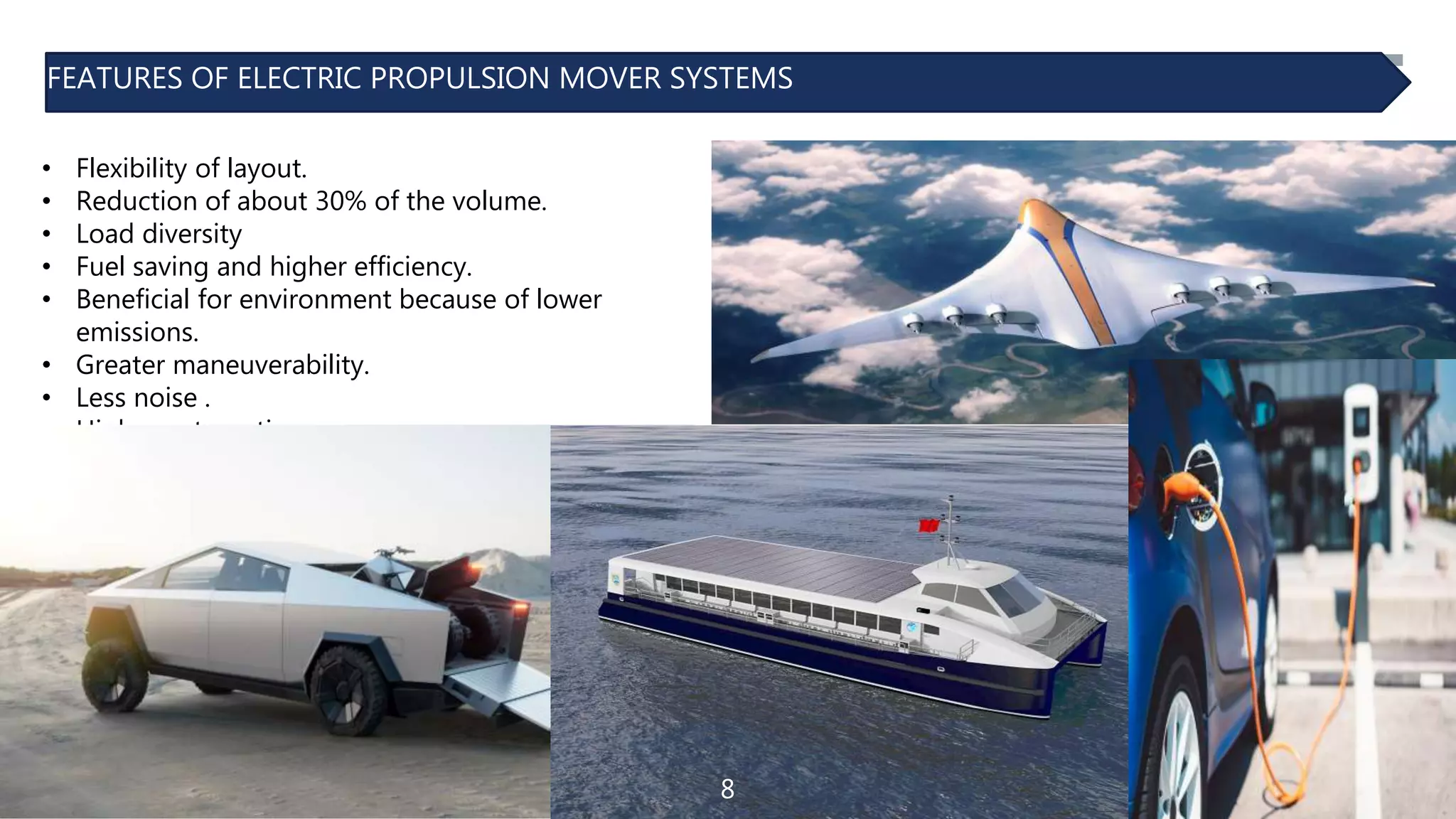
FEATURES OF ELECTRIC PROPULSION MOVER SYSTEMS
• Flexibility of layout.
• Reduction of about 30% of the volume.
• Load diversity
• Fuel saving and higher efficiency.
• Beneficial for environment because of lower
emissions.
• Greater maneuverability.
• Less noise .
• Higher automation.
8
ELECTROSTATIC PROPULSION SYSTEM
This system accomplishes the limitations of electrothermal rockets.
•An ion source to produce a stream of positively charged particles.
•A negatively charged grid electrode to electrostatically accelerate
the ions.
•An electron source to neutralize the accelerated ions.
Thus there is no physical nozzle or pressure chamber.
ELECTROTHERMAL PROPULSION SYSTEM
Similar to chemical thermal rockets.
Electric resistance heating, in the resistojet, arc jet, or by
passing radio frequency (RF) electromagnetic waves through
the propellant.
Fairly high F at reasonably high Isp, but thermal limitations
are the same as in chemical thermal rocket engines.
ELECTROMAGNETIC PROPULSION SYSTEM
This system passes a large current through a small amount of gas to
ionize the propellant.
• Once ionized, plasma is accelerated by electromagnetic body
force called Lorentz force I.e. F=j x B
• The magnetic field is either induced by current itself, applied
externally via an electromagnet or both.
• While gas-phase propellants like hydrogen and lithium (vaporized)
are used, solid propellants can also be used in these accelerators.
ELECTRIC PROPULSION THRUSTER
SYSTEMS
9
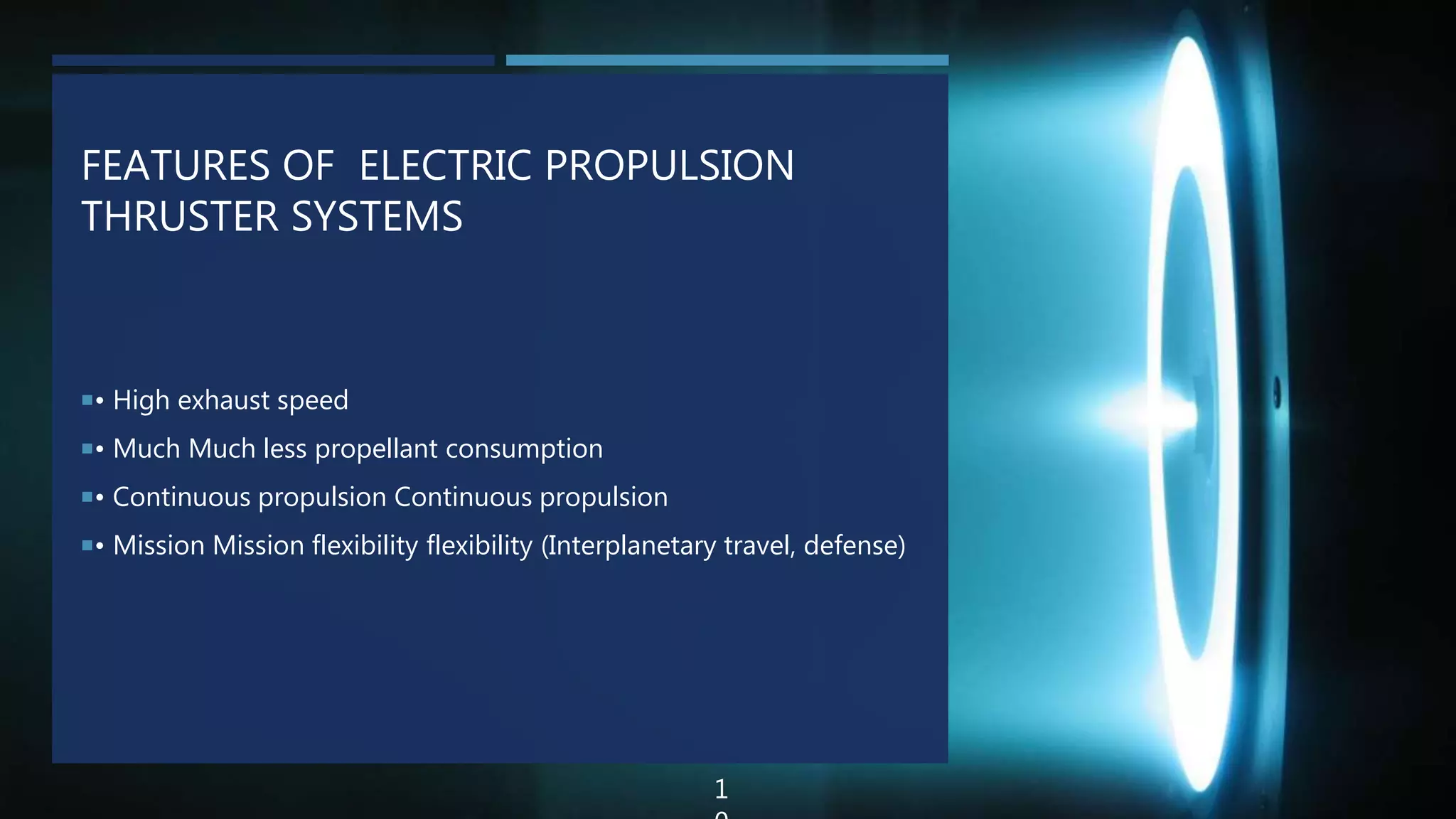
FEATURES OF ELECTRIC PROPULSION
THRUSTER SYSTEMS
• High exhaust speed
• Much Much less propellant consumption
• Continuous propulsion Continuous propulsion
• Mission Mission flexibility flexibility (Interplanetary travel, defense)
1
CONCLUSIONS ON DEVELOPMENT &
GROWTH IN THE ELECTRIC PROPULSION
SYSTEM MARKET
 The development in air and space aviation industry currently has
lead the EP industry to grow at almost two times the global GDP.
 The EV industry has already caught its rate after it got
introduced in the developing subcontinents like the middle east
and south asian countries.
 There were nearly 200 new electric aircrafts that were under
development by the end 2019 of which about 50% were actually
not commercial aircrafts but flying cars.
 Global Electric Propulsion System market will register a 24.3%
CAGR in terms of revenue, reach US$ 630 million by 2023, from
US$ 170 million in 2017.
 Thus the sector is full or magical possiblities for better future of
man kind and will definitely add a whole new dimension to the
human life and the rest of the world.
1
THANK YOU
1

Electric Propulsion Systems

  • 1.
    SUBMITTED TO: DEPT. OFELECTRICAL & ELECTRONICS ENGINEERING A PRESENTATION ON- ELECTRIC PROPULSION SYSTEMS SUBMITTED BY: LAKSHYA AGRAWAL REG.NO- 1602060013 SECTION : EEE 1 DATE : 18th february 2020 1
  • 2.
    OVERVIEW  Overview ofconventional engines and power systems used in various sectors involving movement of goods or people.  History of Electric Propulsion Systems (EP) and their evolution taking place in various sectors at different times.  Basic definitions and broad classification and sub- categorization of EPs.  Electric Propulsion Mover Systems.  Features of electric propulsion mover systems.  Electric Propulsion Thruster Systems.  Features of electric propulsion thruster systems.  Conclusions on development & growth in the Electric Propulsion System market. 2
  • 3.
    CONVENTIONAL ENGINES AND POWER GENERATION SYSTEMS USED INVARIOUS SECTORS.  Conventional fuel systems like petrol, oil, and diesel engines.  Steam turbine power systems.  Gas and classical chemical combustion systems.  Combined power generation systems. 3
  • 4.
    CONVENTIONAL FUEL SYSTEMS • Verylarge weight when compared compared to others. • High speed Fuel Engine provides hgh fraction losses in operation perticularly at partial loads. • They show high fuel consumption at partial loads. • High and medium speed engine must be coupled to a gearbox. STEAM TURBINE POWER SYSTEMS • Fuel consumption is considerably higher. • It is a quiet low efficiency engine. • Turbines must run at high speed for best efficiency, so a high ratio raduction gear is essential to obtain an economical propeller speed. CLASSICAL GAS & CHEMICAL CUMBUSTION SYSTEMS • The burn rate of chemical fuels are near to uncontrollable and so they burn very fast. • Requires large area and space for the inlet air system. • The thrust provided is just so high that it some times leads to deviation of path of the vehicle. vehicle. COMBINED POWER GENERATION SYSTEMS • The combined power generation involves high complexity in managing. • Normally occupies large machinery space. 4
  • 5.
    History & Evolutionof Electric Propulsion Systems • In1828, early type electric motor invented by Ányos Jedlik and a small model car powered by his new motor was creatd. • In1834, Vermont blacksmith Thomas Davenport built a same contraption which operated on a short, circular, electrified track. • In1839 a small Russian ferry was built which was propelled by an electric motor fed by a storage battery. • By1860s with the invention of the lead–acid battery rechargeable batteries came became viable means for storing electricity on board a vehicle, • On 8 October 1883, Gaston Tissandier made the first electrically-powered airship. • Interest in motor vehicles increased in the late 1890s and early 1900s(GOLDEN AGE). Electric battery-powered taxis became available at the end of the 19th century. In London, Walter Bersey designed a fleet of such cabs and introduced them to the streets of London in 1897.They were soon nicknamed "Hummingbirds" due to the idiosyncratic humming noise they made. • After the success in beginning of the 20th century, the electric system began to lose its position in the automobile market.By the 1920s an improved road infrastructure required vehicles with a greater range.Worldwide discoveries of large petroleum reserves made fuel-powered engines cheaper to operate over long distances. Electric cars remained limited to urban use by their slow speed and low range same was the situation in the marine shipping industry where diesel engines were being used extinsively, and fueled vehicles were now able to travel farther and faster than equivalent electrics. • Same was the time wright flyer engine became the first successful flying engine. • By the end of 1950s there is found revival of the EP industry which was the consequence of the major development5
  • 6.
    PROPULSION SYSTEM: A propulsionsystem is a machine that produces thrust to push an object forward. On vehicles, thrust is usually generated through some application of Newton's third law of action and reaction. A gas, or working fluid, is accelerated by the engine and the reaction to this acceleration produces a force on the engine. ELECTRIC PROPULSION SYSTEM: Electric propulsion is a generic name encompassing all of the ways of accelerating a vehicle using electrical power in a direct or indirect way. CLASSIFICATION ELECTRIC PROPULSION MOVER SYSTEMS • HYBRID ELECTRIC PROPULSION • TURBO ELECTRIC PROPULSION • ELECTRIC PROPULSION ELECTRIC PROPULSION THRUSTER SYSTEM • ELECTROSTATIC PROPULSION • ELECTROTHERMAL PROPULSION • ELECTROMAGNETIC PROPULSION 6
  • 7.
    ELECTRIC PROPULSION MOVERSYSTEMS HYBRID ELECTRIC PROPULSION SYSTEM: Contain both, the fuel engine and the electric motor system and both of them are parallely connected to the propelling rotor. Mostly suitable for heavy loading vehicles like trucks and ships. TURBO ELECTRIC PROPULSION SYSTEM: Contain the electric motor system running on electric generator engine which connected to the propelling rotor. Highly suitable for air crafts, sometimes a battery is also connected in order to save the excess energy produced. In order to achieve a heavier work done these are also desined to be multi fule systems in which two different motors with their own generators each are connected to same propelling rotor, this type of system is majorly found in mariners. ELECTRIC PROPULSION SYSTEM: Contain simple electric motor system connected to the propelling rotor. In many cases rechargable battery is involved in the system. This type of system is generally observed in electric train engines and electric cars. 7
  • 8.
    FEATURES OF ELECTRICPROPULSION MOVER SYSTEMS • Flexibility of layout. • Reduction of about 30% of the volume. • Load diversity • Fuel saving and higher efficiency. • Beneficial for environment because of lower emissions. • Greater maneuverability. • Less noise . • Higher automation. 8
  • 9.
    ELECTROSTATIC PROPULSION SYSTEM Thissystem accomplishes the limitations of electrothermal rockets. •An ion source to produce a stream of positively charged particles. •A negatively charged grid electrode to electrostatically accelerate the ions. •An electron source to neutralize the accelerated ions. Thus there is no physical nozzle or pressure chamber. ELECTROTHERMAL PROPULSION SYSTEM Similar to chemical thermal rockets. Electric resistance heating, in the resistojet, arc jet, or by passing radio frequency (RF) electromagnetic waves through the propellant. Fairly high F at reasonably high Isp, but thermal limitations are the same as in chemical thermal rocket engines. ELECTROMAGNETIC PROPULSION SYSTEM This system passes a large current through a small amount of gas to ionize the propellant. • Once ionized, plasma is accelerated by electromagnetic body force called Lorentz force I.e. F=j x B • The magnetic field is either induced by current itself, applied externally via an electromagnet or both. • While gas-phase propellants like hydrogen and lithium (vaporized) are used, solid propellants can also be used in these accelerators. ELECTRIC PROPULSION THRUSTER SYSTEMS 9
  • 10.
    FEATURES OF ELECTRICPROPULSION THRUSTER SYSTEMS • High exhaust speed • Much Much less propellant consumption • Continuous propulsion Continuous propulsion • Mission Mission flexibility flexibility (Interplanetary travel, defense) 1
  • 11.
    CONCLUSIONS ON DEVELOPMENT& GROWTH IN THE ELECTRIC PROPULSION SYSTEM MARKET  The development in air and space aviation industry currently has lead the EP industry to grow at almost two times the global GDP.  The EV industry has already caught its rate after it got introduced in the developing subcontinents like the middle east and south asian countries.  There were nearly 200 new electric aircrafts that were under development by the end 2019 of which about 50% were actually not commercial aircrafts but flying cars.  Global Electric Propulsion System market will register a 24.3% CAGR in terms of revenue, reach US$ 630 million by 2023, from US$ 170 million in 2017.  Thus the sector is full or magical possiblities for better future of man kind and will definitely add a whole new dimension to the human life and the rest of the world. 1
  • 12.