Electric Propulsion for Future Space
Missions
Part I
Bryan Palaszewski
Digital Learning Network
NASA Glenn Research Center
at Lewis Field
Introduction
• Why electric propulsion?
– Types
– Applications
• Some history
• Future missions and vehicles
• A very cool future
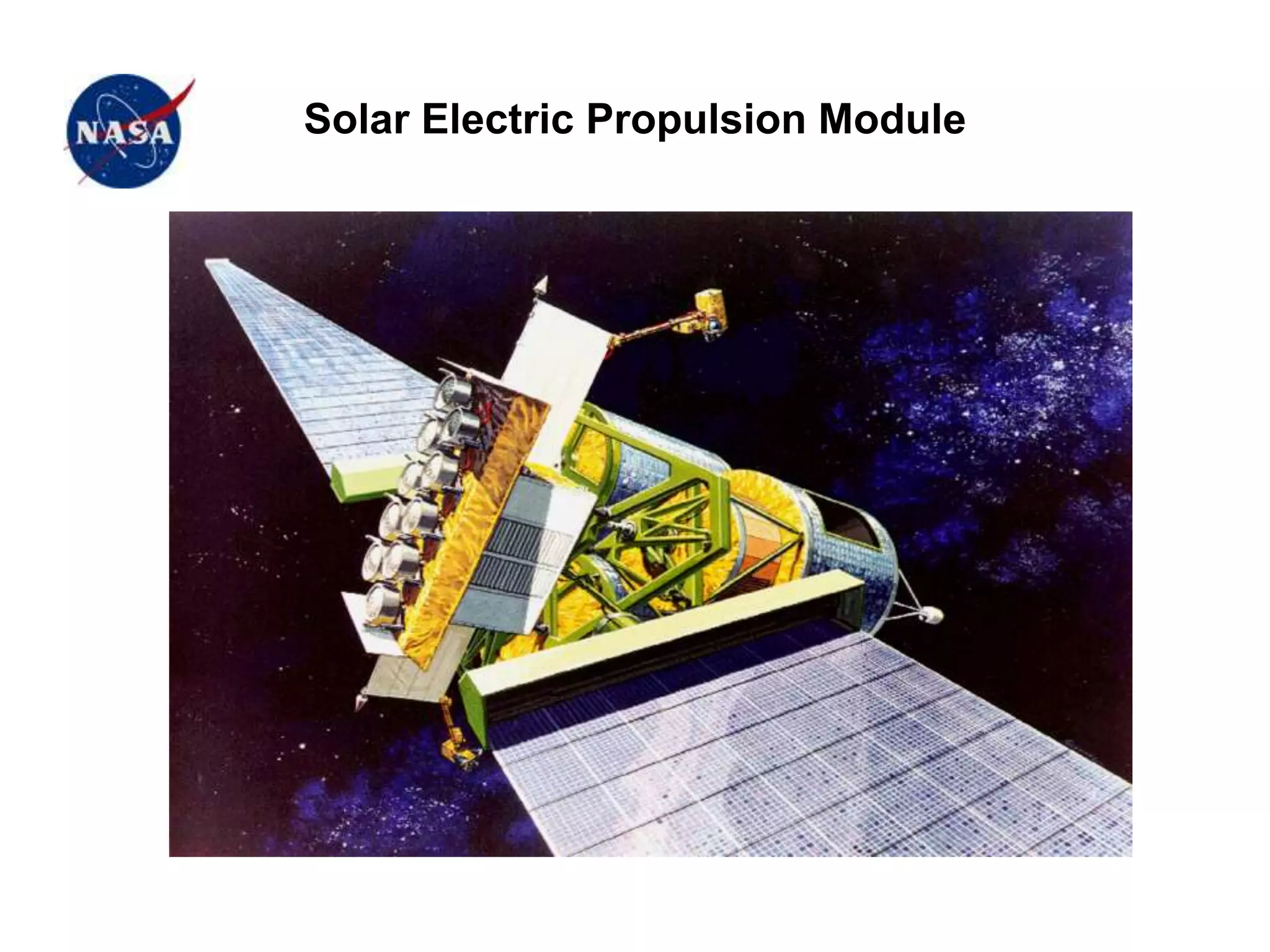
Solar Electric Propulsion Module
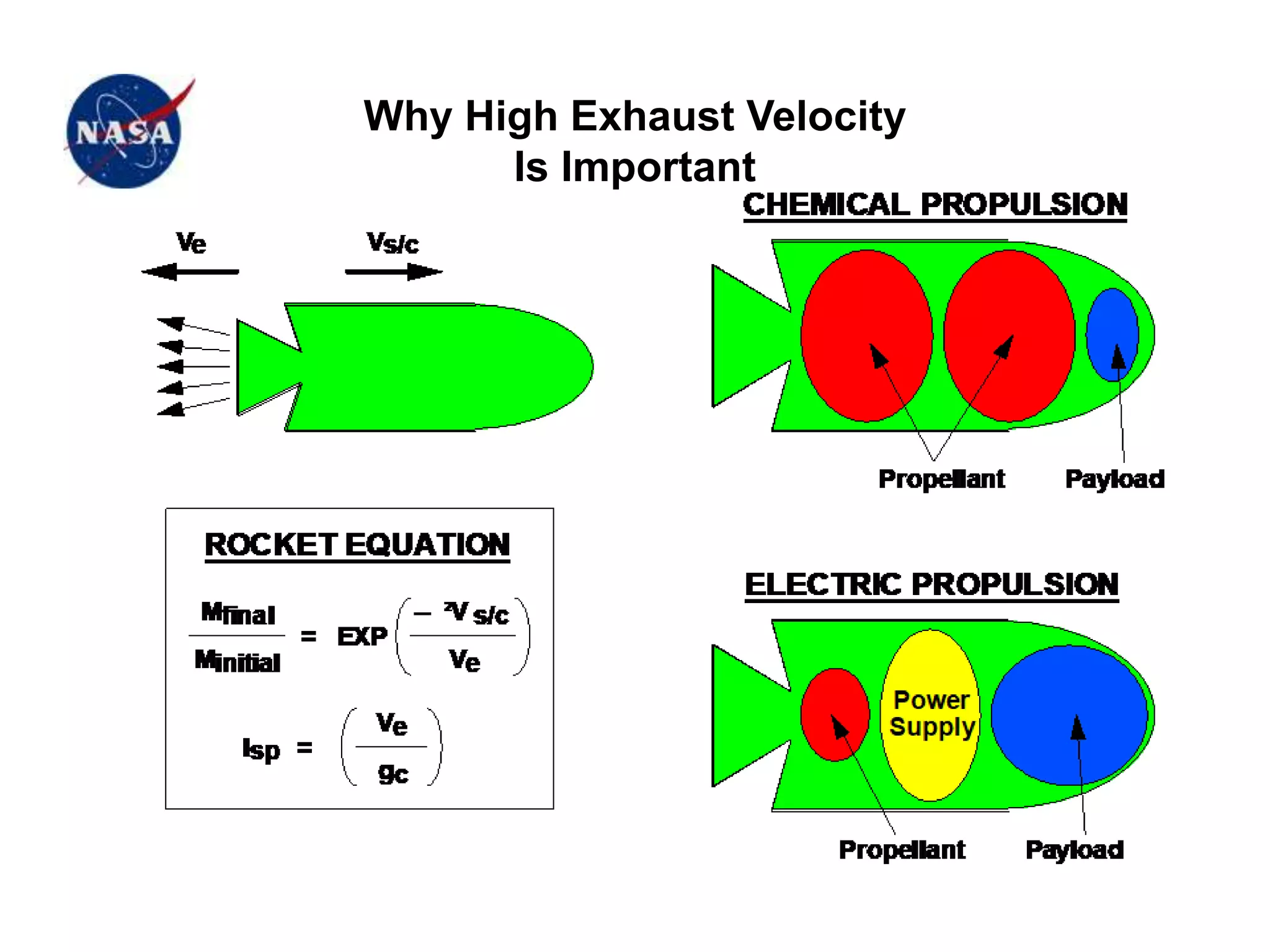
Why High Exhaust Velocity
Is Important
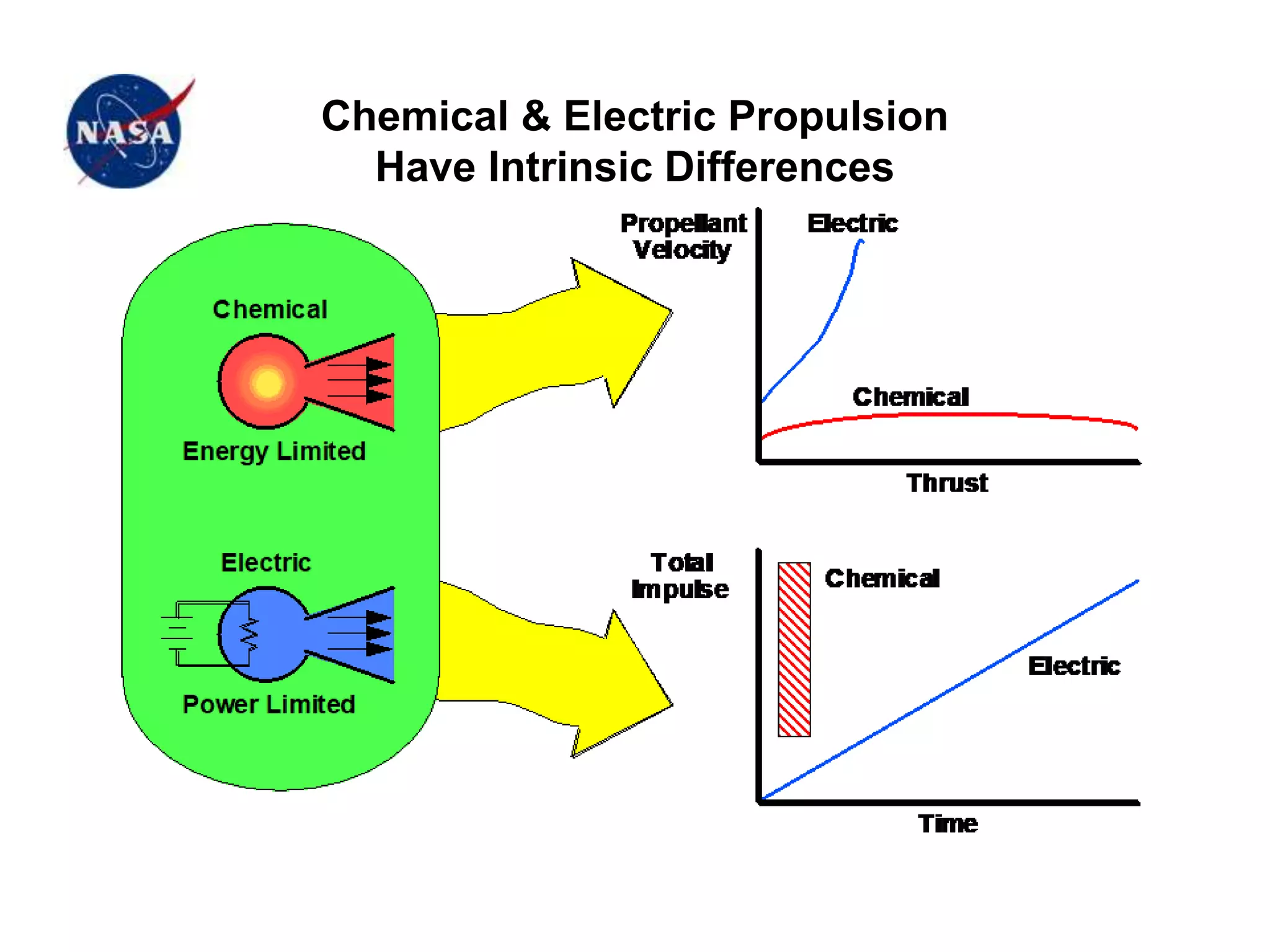
Chemical & Electric Propulsion
Have Intrinsic Differences
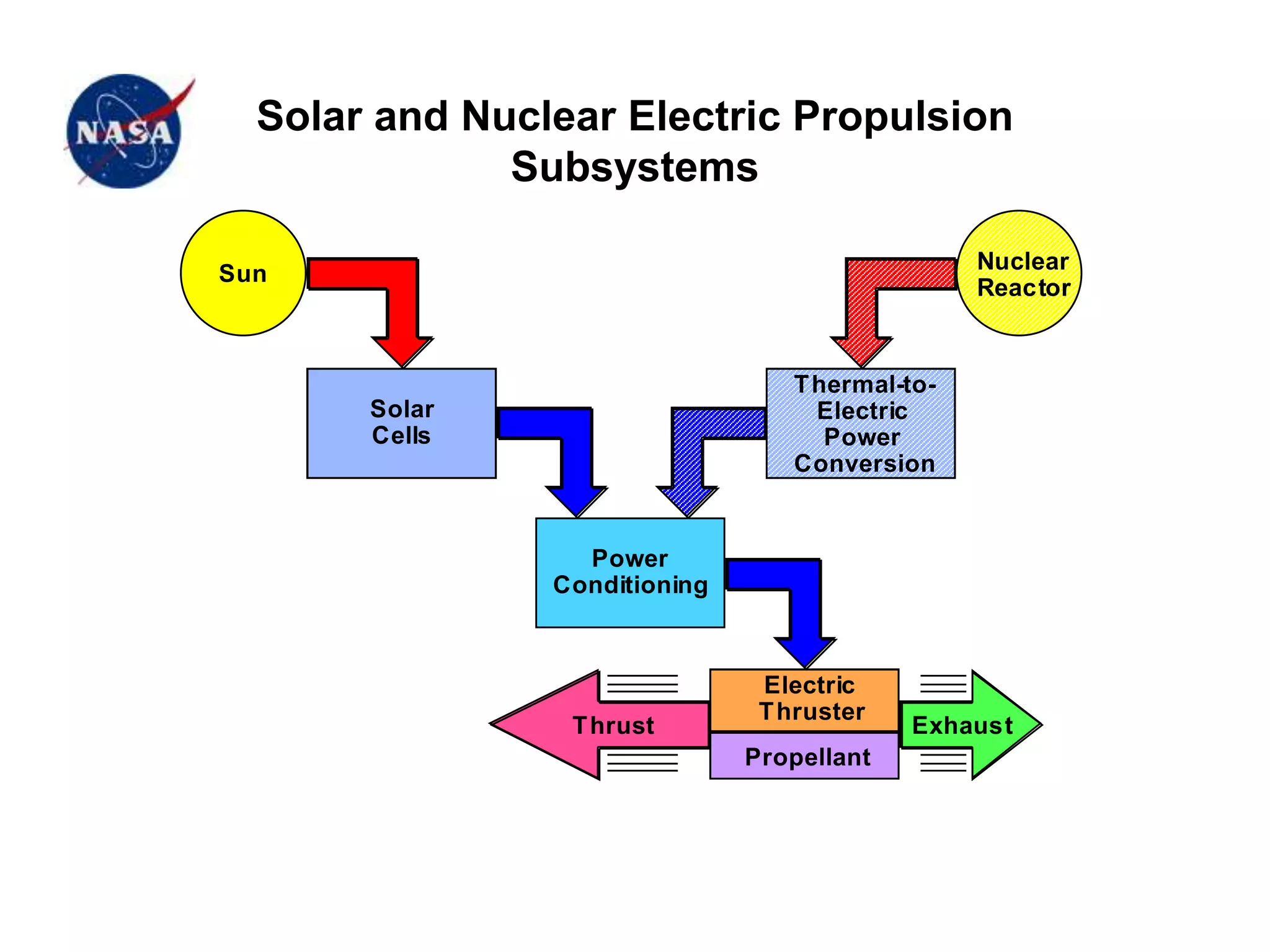
Solar and Nuclear Electric Propulsion
Subsystems
Power
Conditioning
Solar
Cells
Thrust
Electric
Thruster
Propellant
Exhaust
Sun
Thermal-to-
Electric
Power
Conversion
Nuclear
Reactor
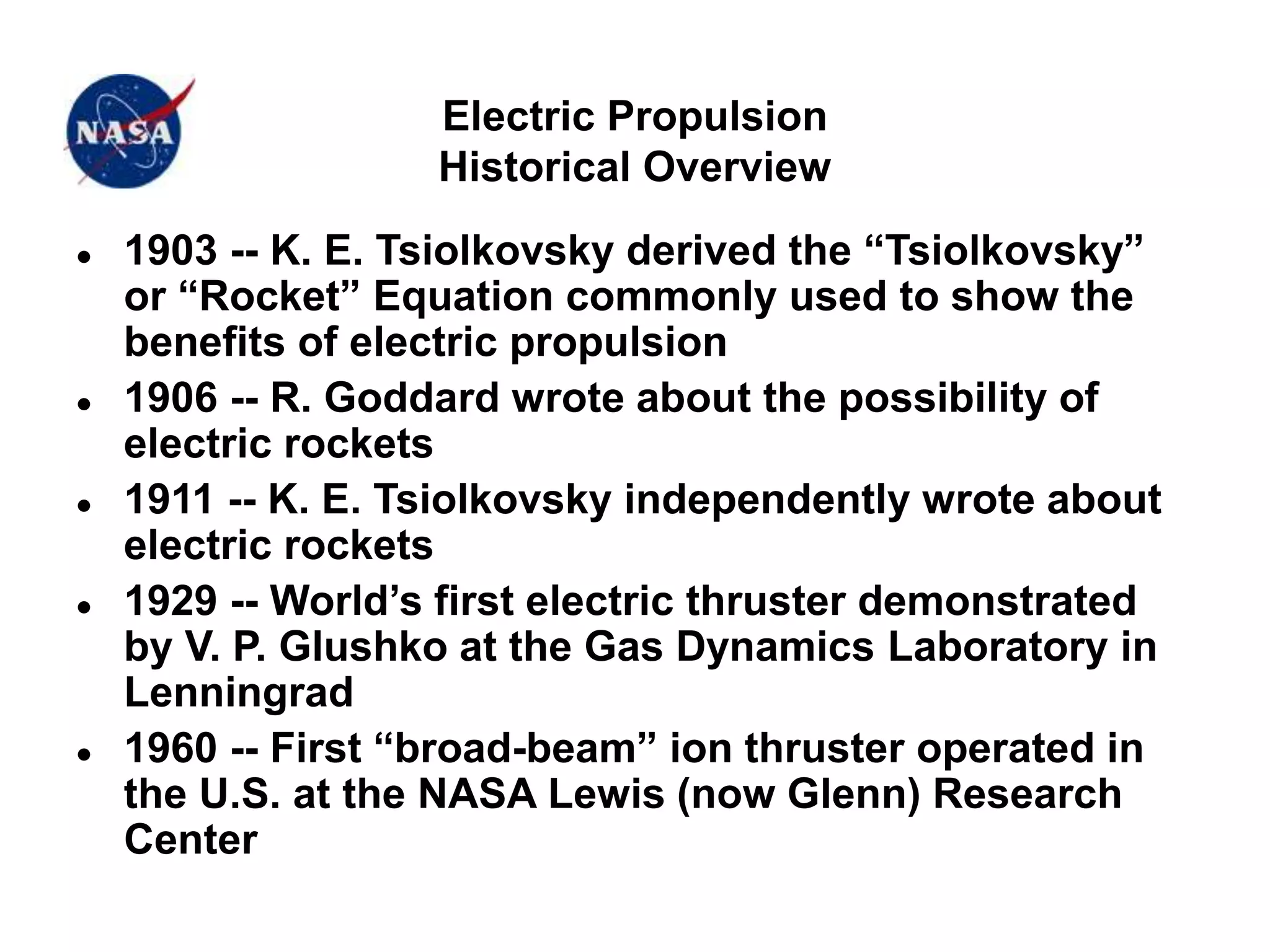
Electric Propulsion
Historical Overview
 1903 -- K. E. Tsiolkovsky derived the “Tsiolkovsky”
or “Rocket” Equation commonly used to show the
benefits of electric propulsion
 1906 -- R. Goddard wrote about the possibility of
electric rockets
 1911 -- K. E. Tsiolkovsky independently wrote about
electric rockets
 1929 -- World’s first electric thruster demonstrated
by V. P. Glushko at the Gas Dynamics Laboratory in
Lenningrad
 1960 -- First “broad-beam” ion thruster operated in
the U.S. at the NASA Lewis (now Glenn) Research
Center
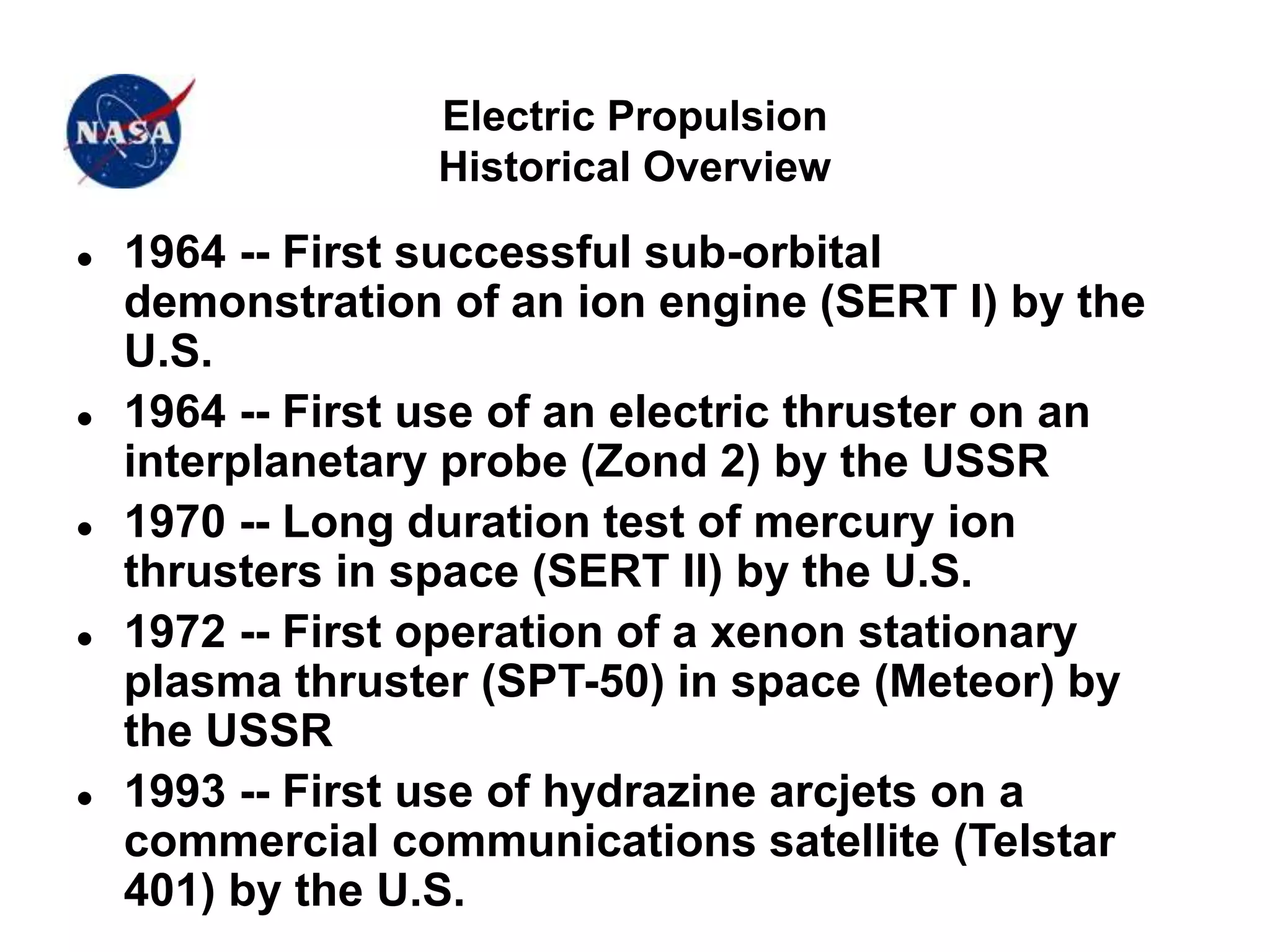
Electric Propulsion
Historical Overview
 1964 -- First successful sub-orbital
demonstration of an ion engine (SERT I) by the
U.S.
 1964 -- First use of an electric thruster on an
interplanetary probe (Zond 2) by the USSR
 1970 -- Long duration test of mercury ion
thrusters in space (SERT II) by the U.S.
 1972 -- First operation of a xenon stationary
plasma thruster (SPT-50) in space (Meteor) by
the USSR
 1993 -- First use of hydrazine arcjets on a
commercial communications satellite (Telstar
401) by the U.S.
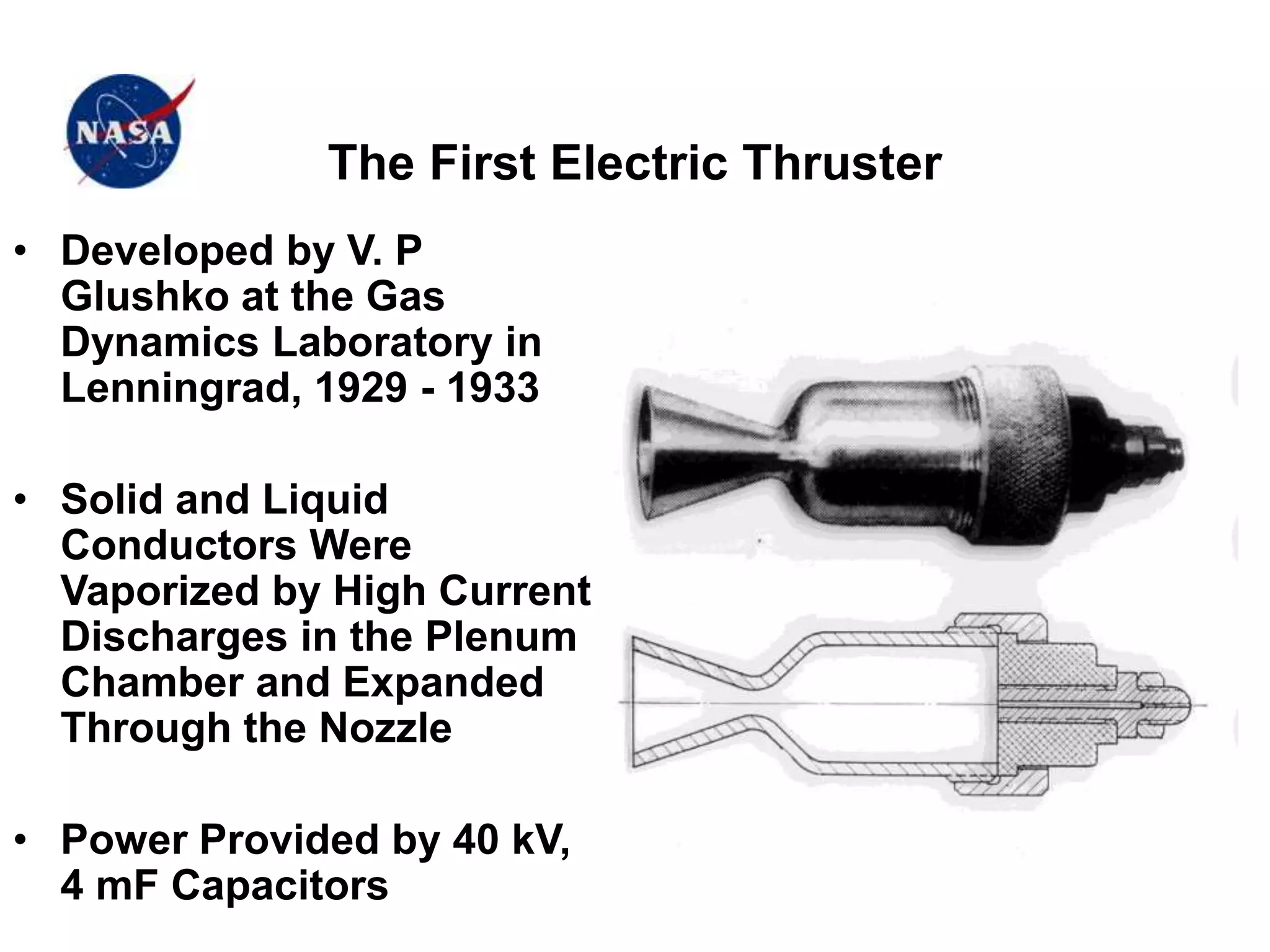
The First Electric Thruster
• Developed by V. P
Glushko at the Gas
Dynamics Laboratory in
Lenningrad, 1929 - 1933
• Solid and Liquid
Conductors Were
Vaporized by High Current
Discharges in the Plenum
Chamber and Expanded
Through the Nozzle
• Power Provided by 40 kV,
4 mF Capacitors
Types Of Electric Thrusters
• Electrostatic
– Ion
– Hall
• Electrothermal
– Arcjet
– Resistojet
• Electromagnetic
– Magneto plasma dynamic (MPD)
– Many others
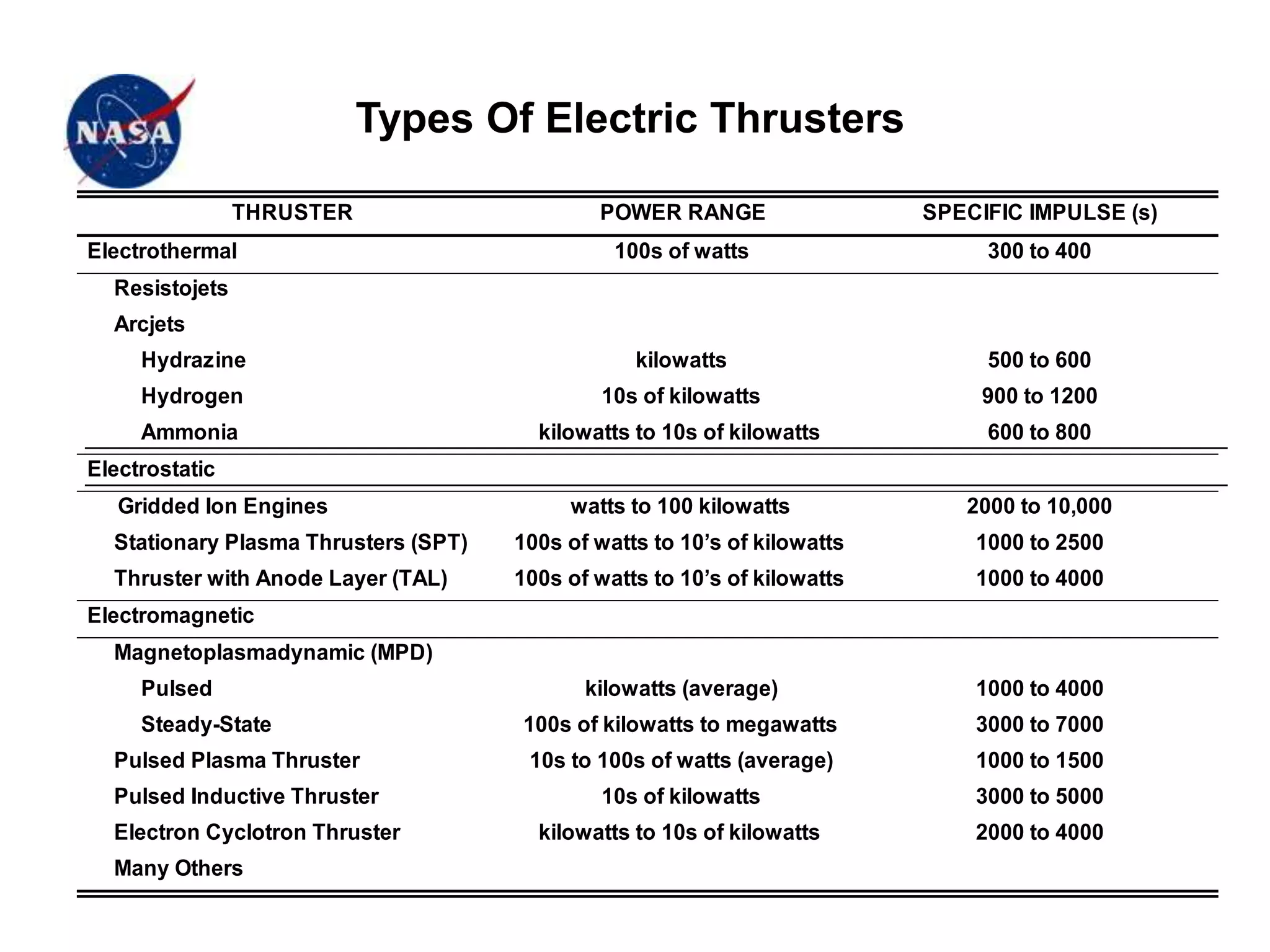
Types Of Electric Thrusters
THRUSTER POWER RANGE SPECIFIC IMPULSE (s)
Electrothermal 100s of watts 300 to 400
Resistojets
Arcjets
Hydrazine kilowatts 500 to 600
Hydrogen 10s of kilowatts 900 to 1200
Ammonia kilowatts to 10s of kilowatts 600 to 800
Electrostatic
Gridded Ion Engines watts to 100 kilowatts 2000 to 10,000
Stationary Plasma Thrusters (SPT) 100s of watts to 10’s of kilowatts 1000 to 2500
Thruster with Anode Layer (TAL) 100s of watts to 10’s of kilowatts 1000 to 4000
Electromagnetic
Magnetoplasmadynamic (MPD)
Pulsed kilowatts (average) 1000 to 4000
Steady-State 100s of kilowatts to megawatts 3000 to 7000
Pulsed Plasma Thruster 10s to 100s of watts (average) 1000 to 1500
Pulsed Inductive Thruster 10s of kilowatts 3000 to 5000
Electron Cyclotron Thruster kilowatts to 10s of kilowatts 2000 to 4000
Many Others
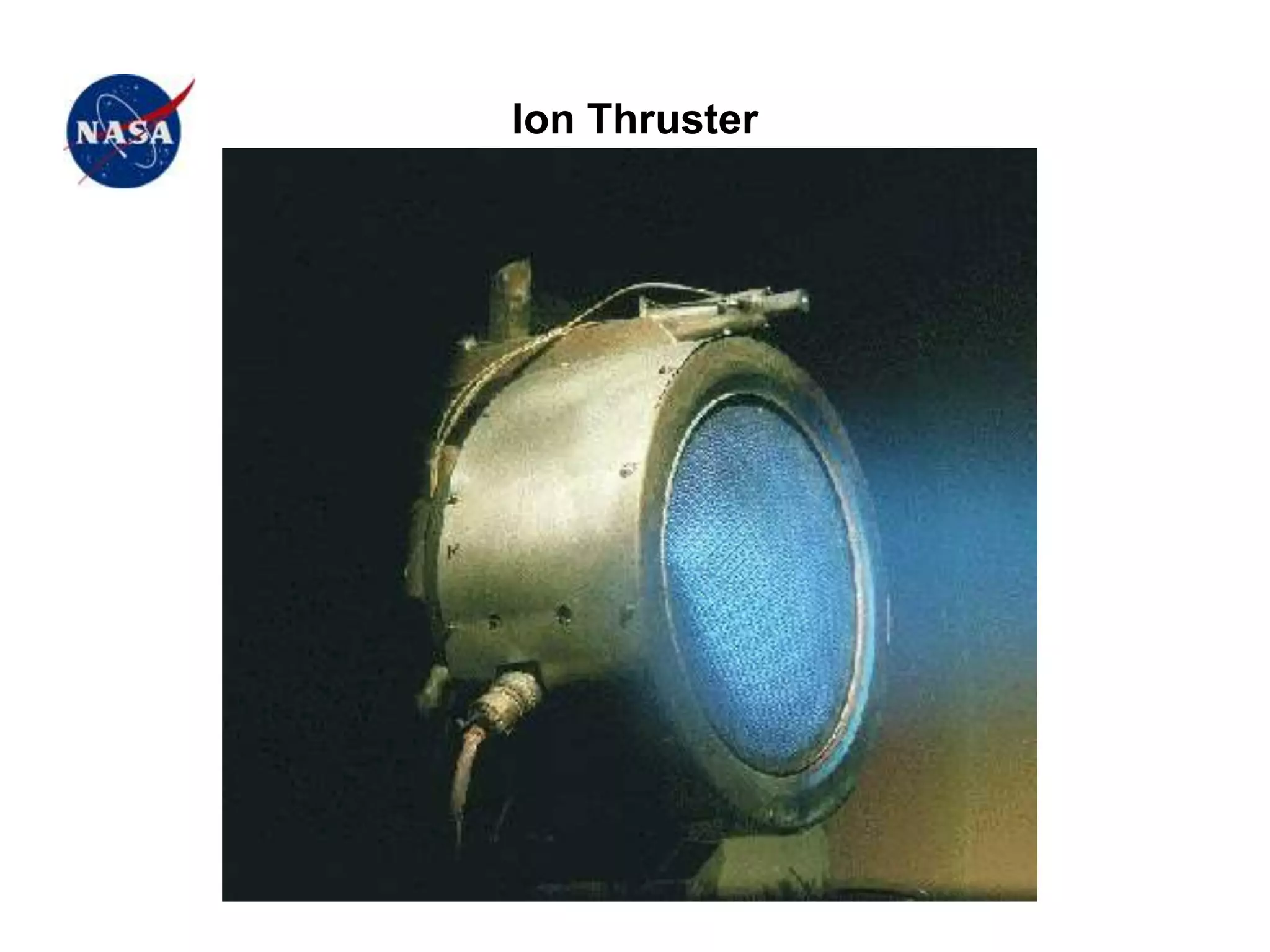
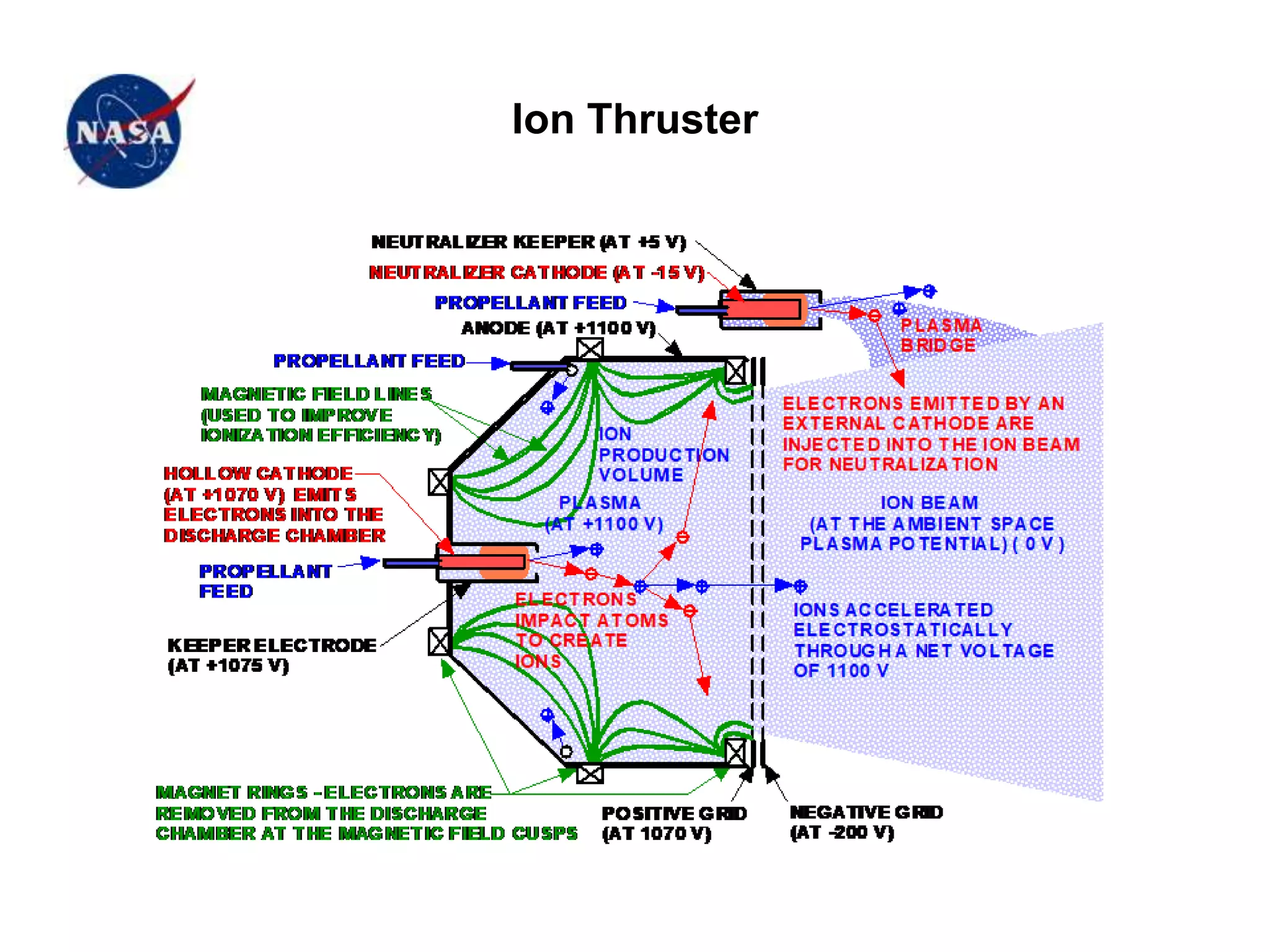
Ion Thruster
Ion Thruster
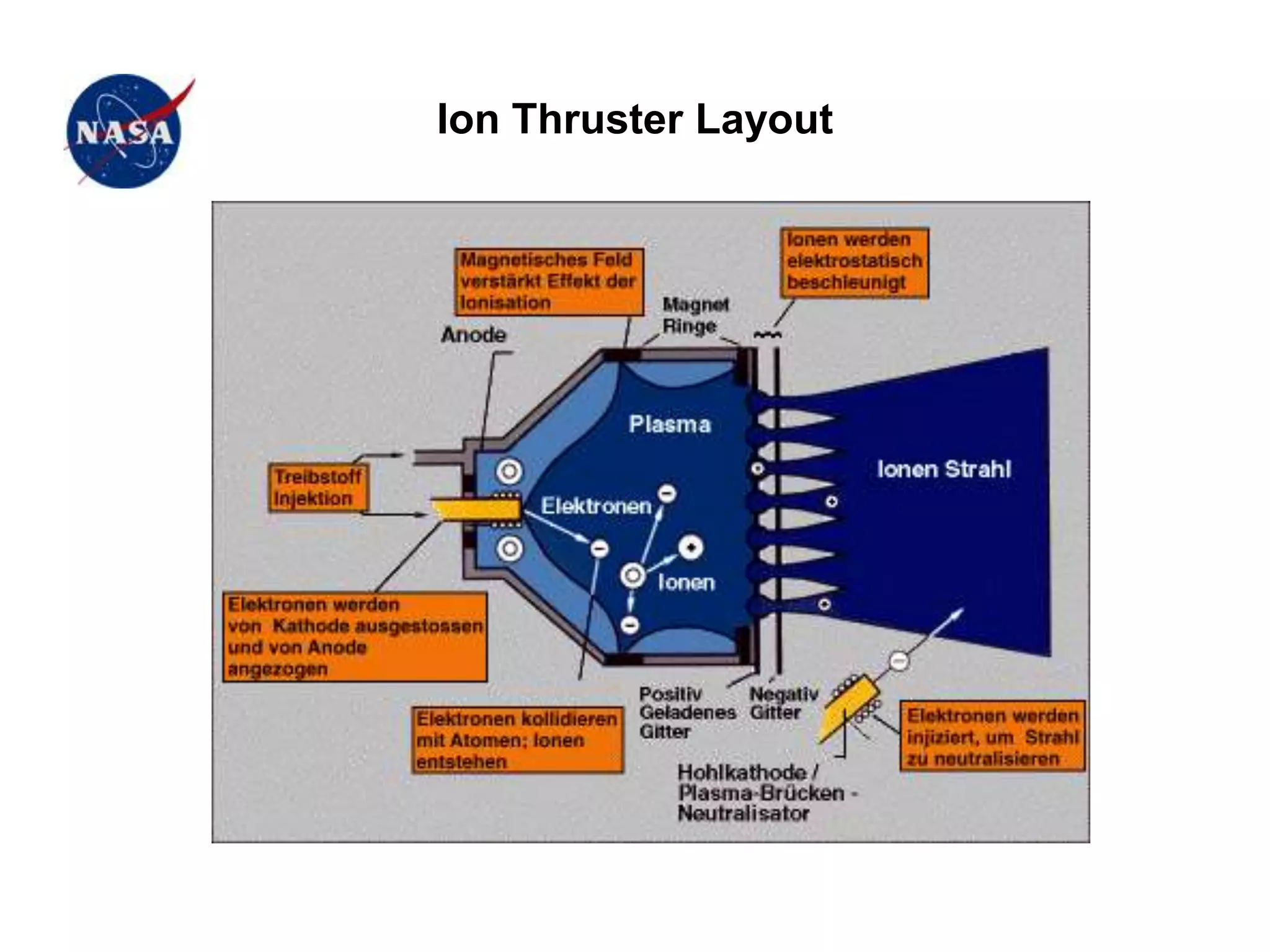
Ion Thruster Layout
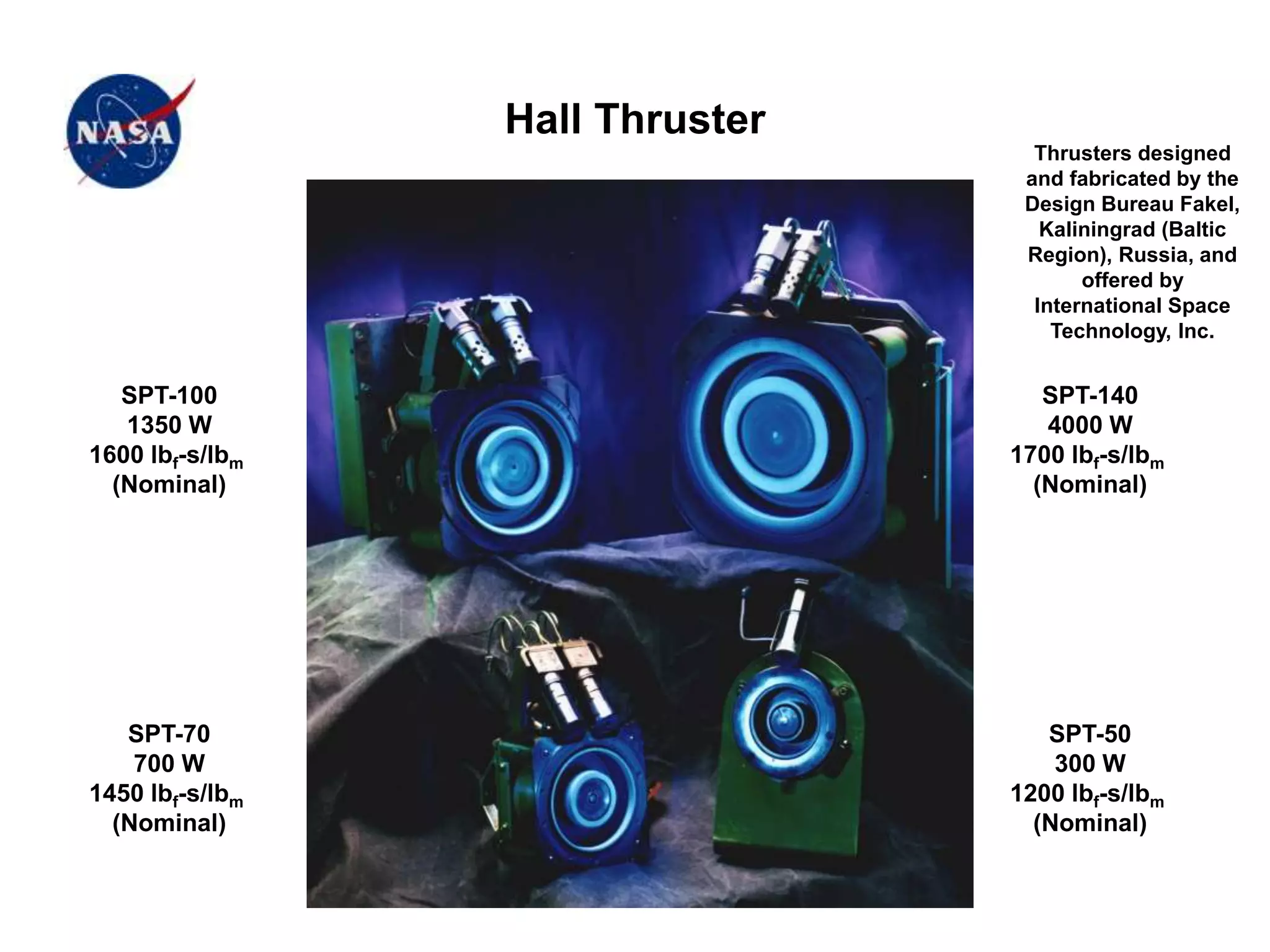
Hall Thruster
SPT-100
1350 W
1600 lbf-s/lbm
(Nominal)
SPT-70
700 W
1450 lbf-s/lbm
(Nominal)
SPT-140
4000 W
1700 lbf-s/lbm
(Nominal)
SPT-50
300 W
1200 lbf-s/lbm
(Nominal)
Thrusters designed
and fabricated by the
Design Bureau Fakel,
Kaliningrad (Baltic
Region), Russia, and
offered by
International Space
Technology, Inc.
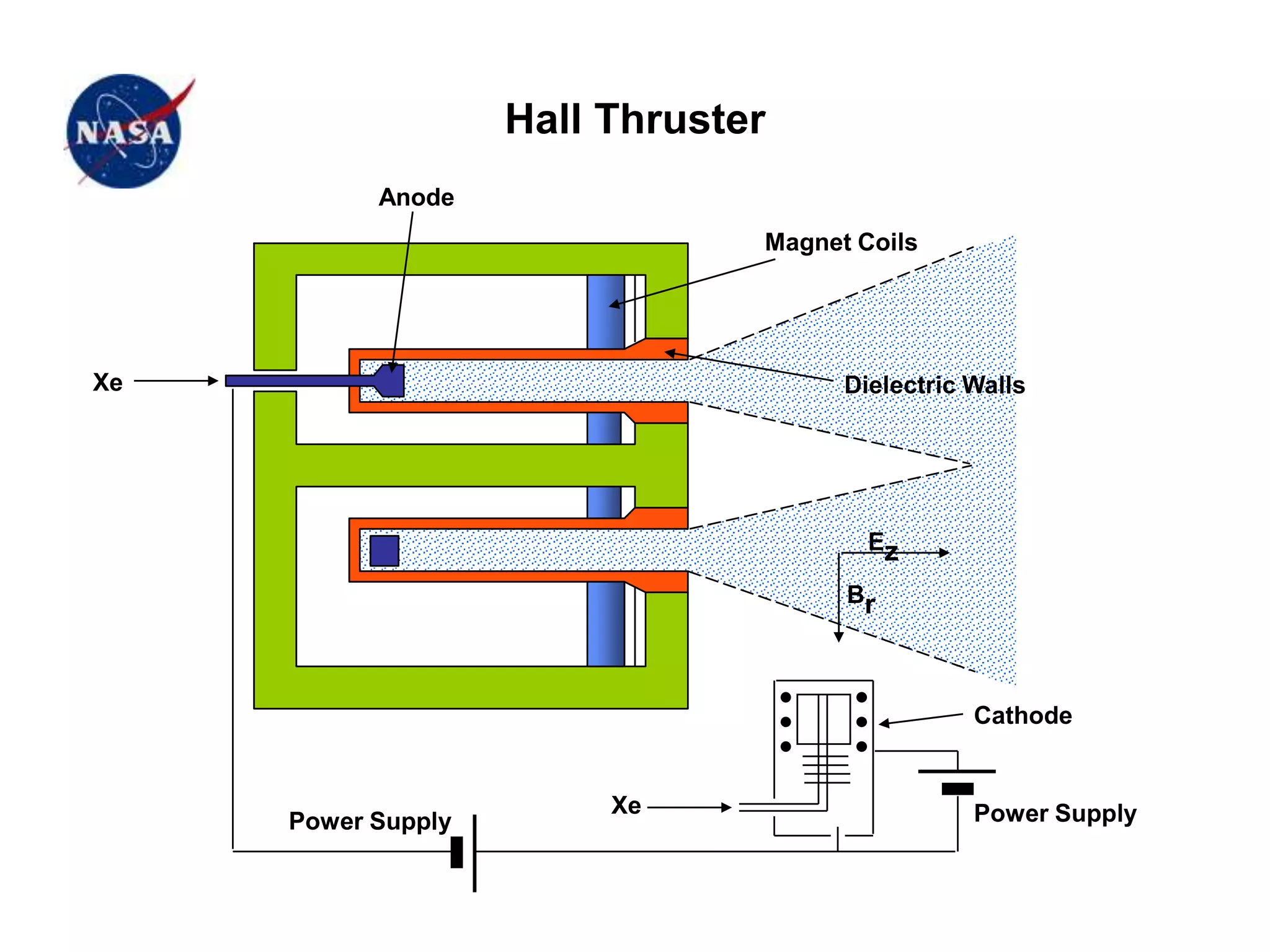
Hall Thruster
Magnet Coils
Dielectric Walls
Cathode
Power Supply
Power Supply
Xe
Xe
Anode
Ez
Br
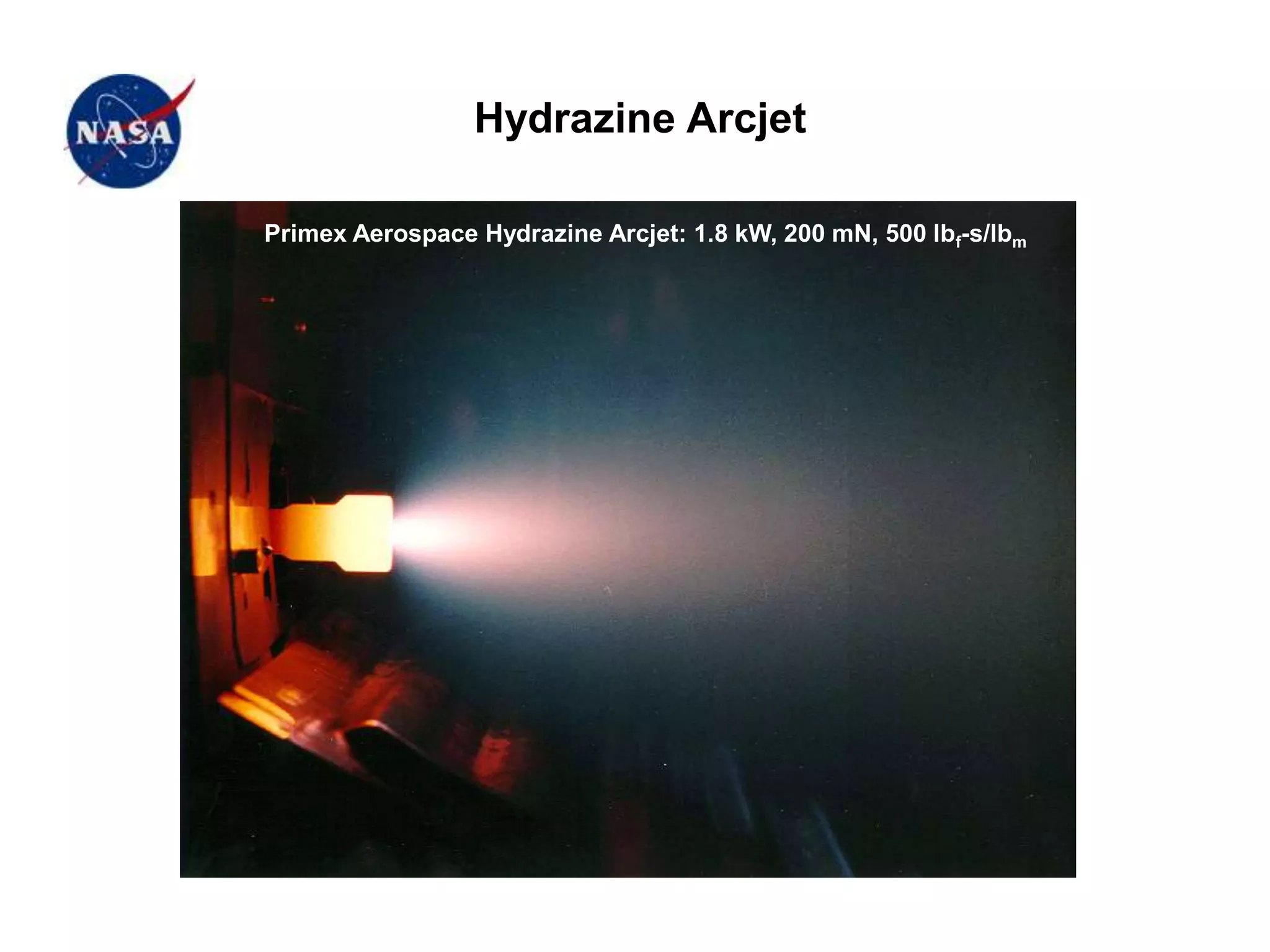
Hydrazine Arcjet
Primex Aerospace Hydrazine Arcjet: 1.8 kW, 200 mN, 500 lbf-s/lbm
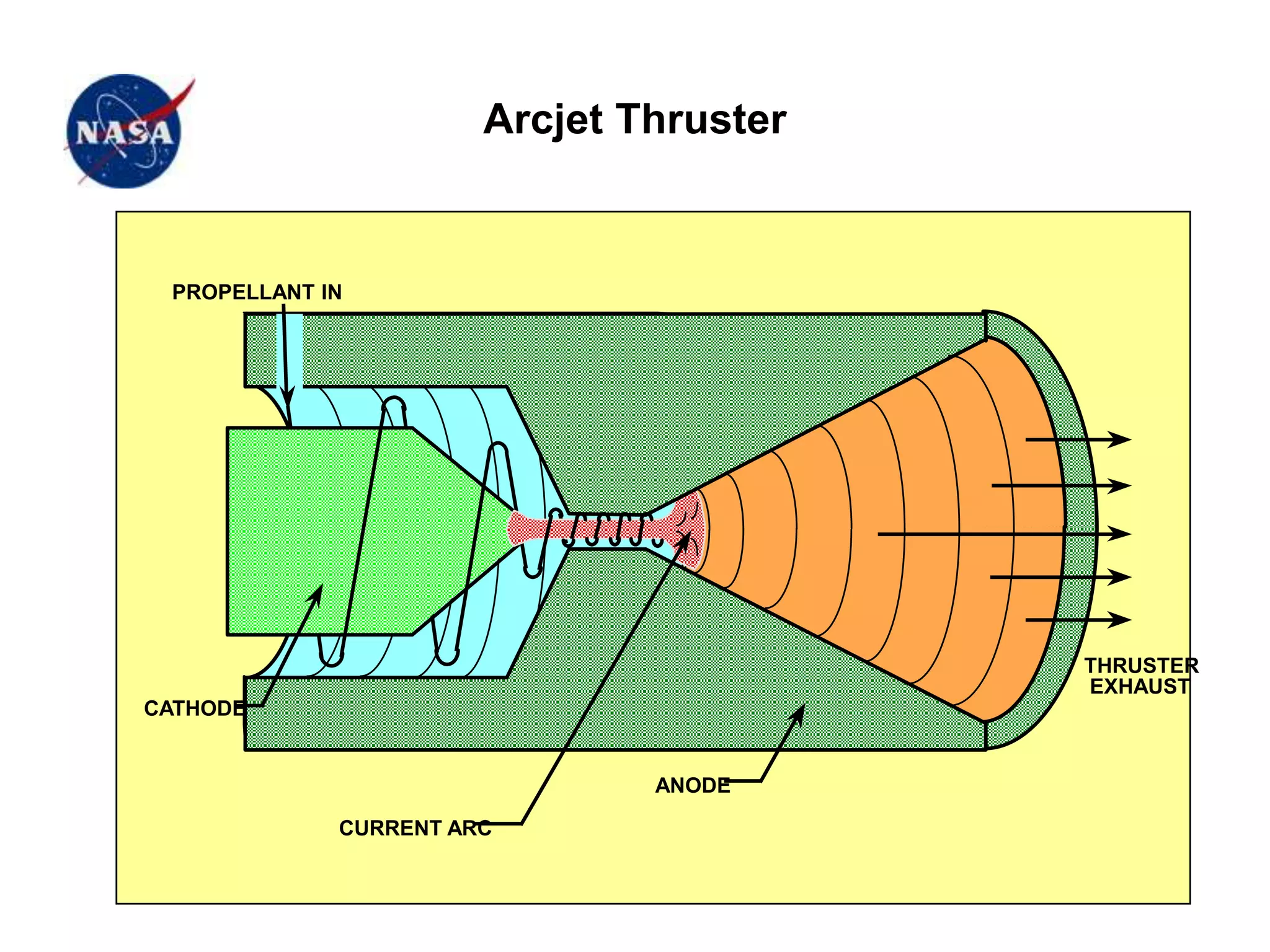
Arcjet Thruster
CATHODE
ANODE
CURRENT ARC
PROPELLANT IN
THRUSTER
EXHAUST
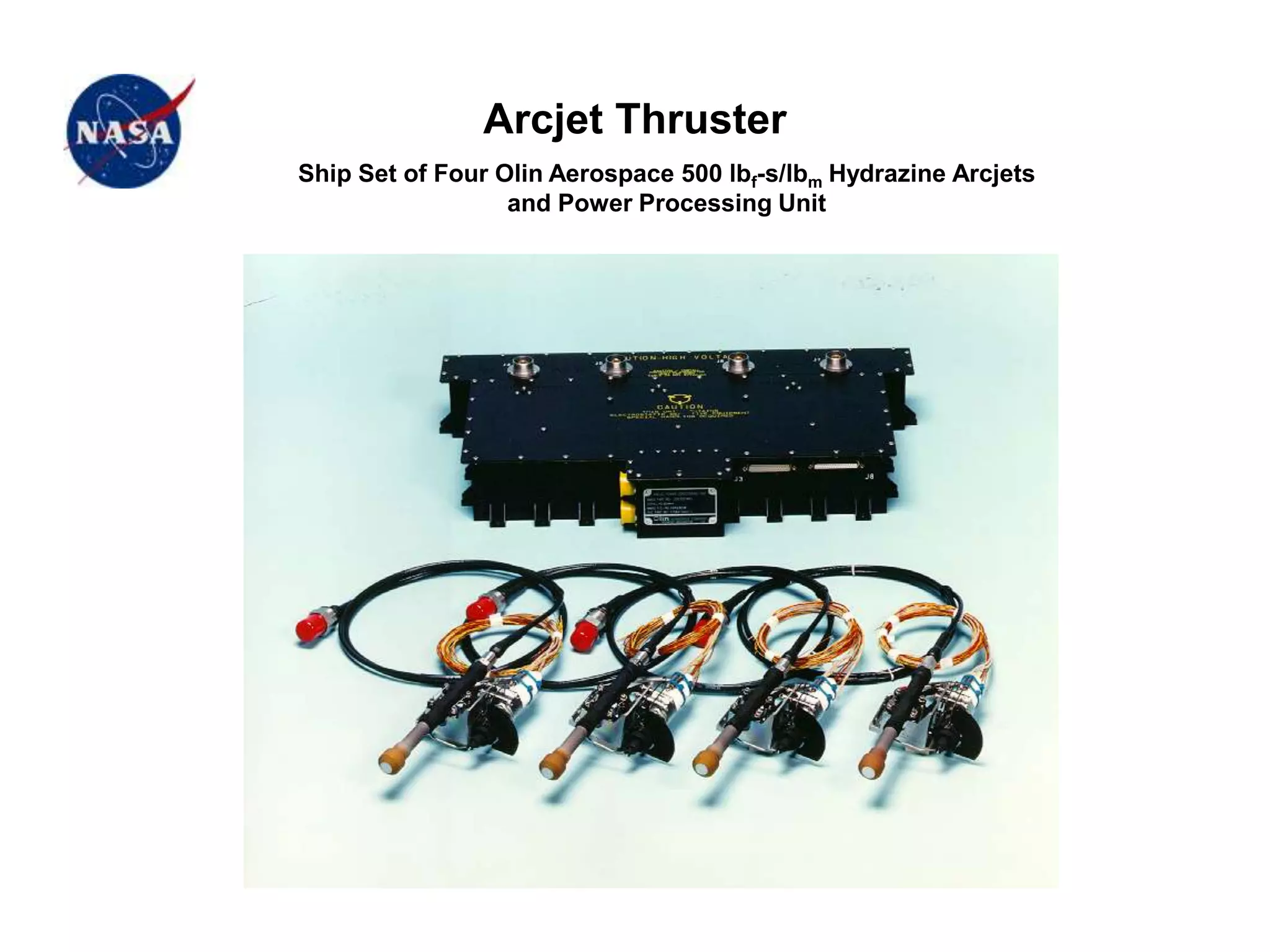
Arcjet Thruster
Ship Set of Four Olin Aerospace 500 lbf-s/lbm Hydrazine Arcjets
and Power Processing Unit
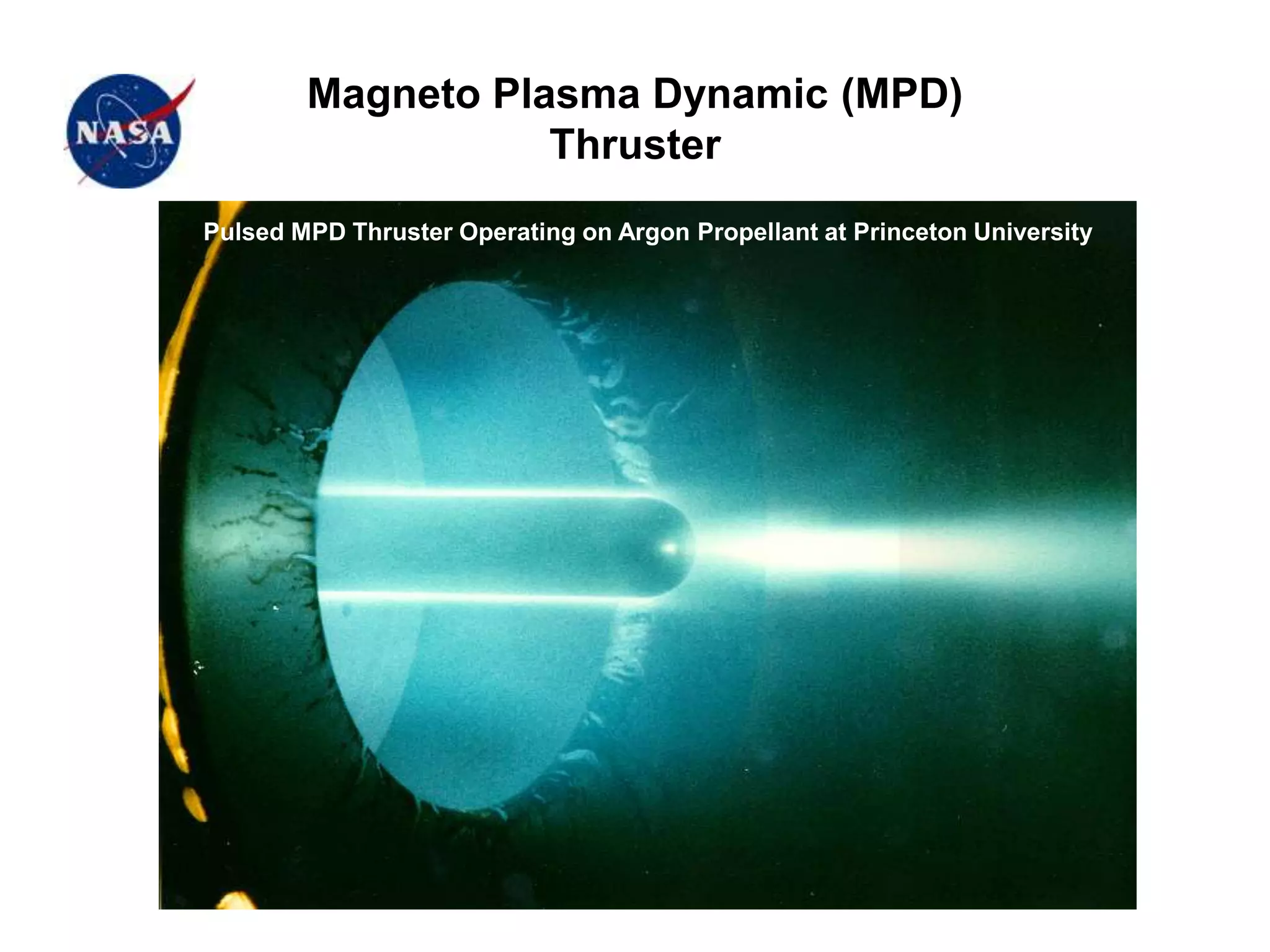
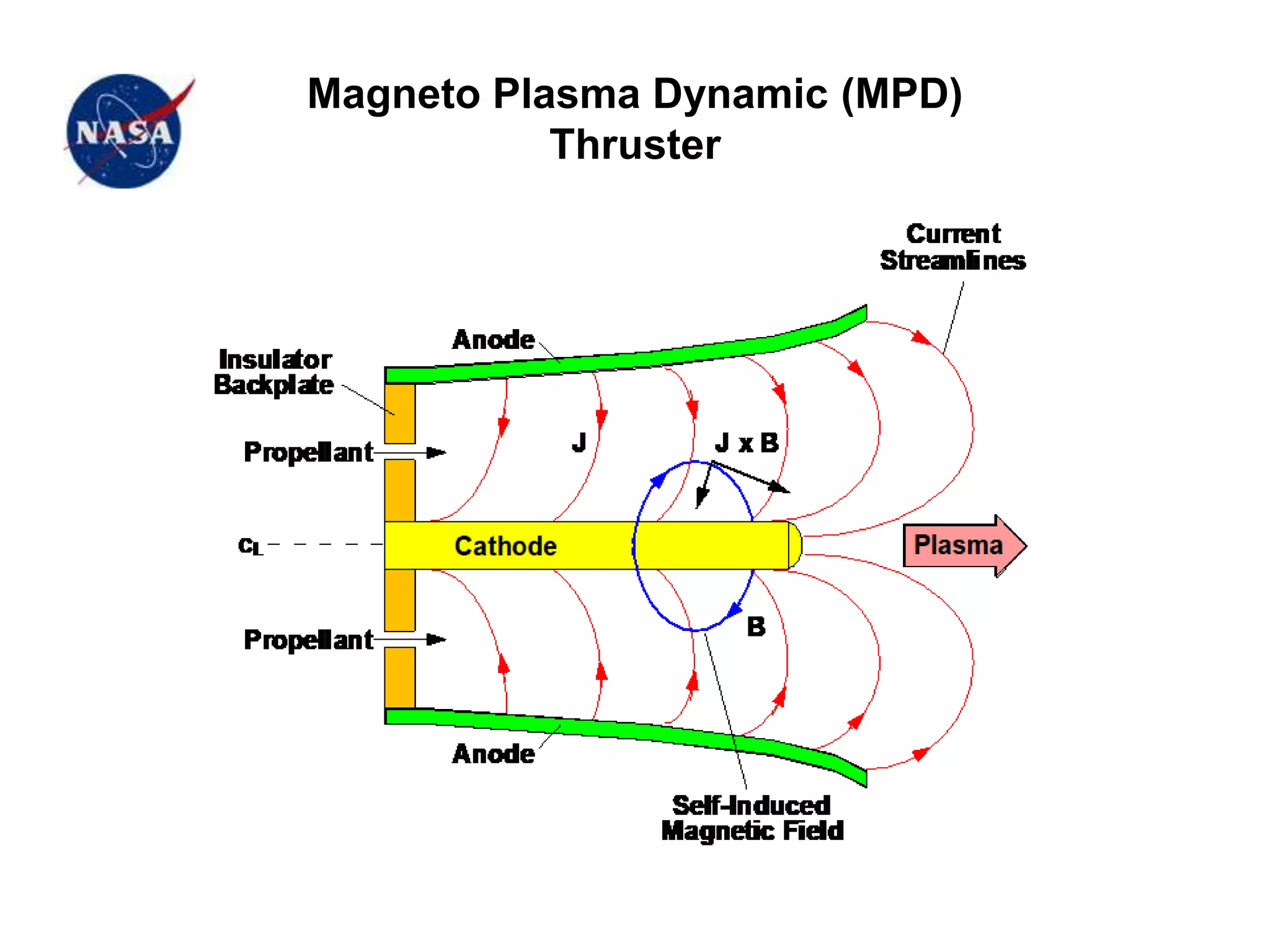
Magneto Plasma Dynamic (MPD)
Thruster
Pulsed MPD Thruster Operating on Argon Propellant at Princeton University
Magneto Plasma Dynamic (MPD)
Thruster
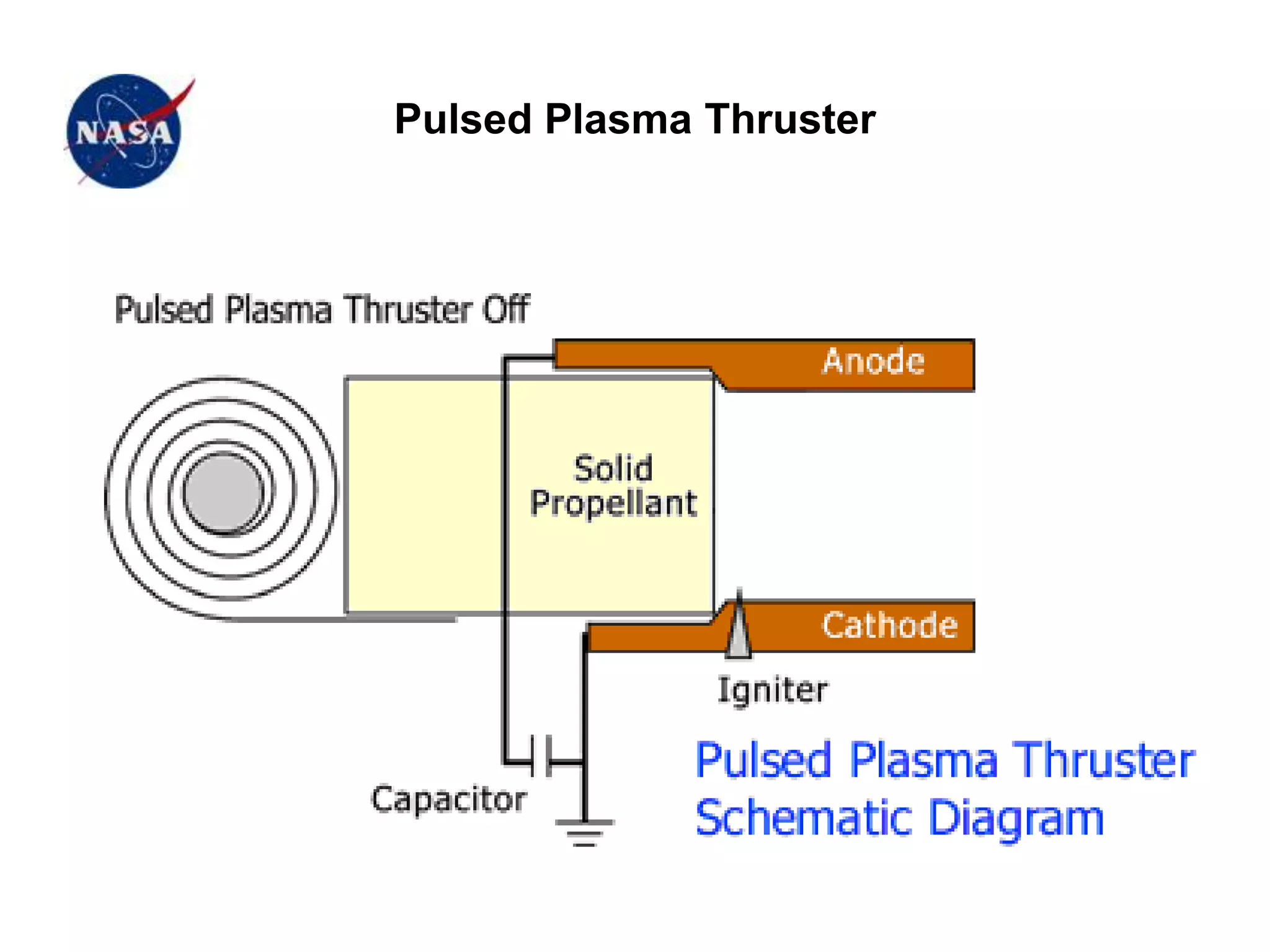
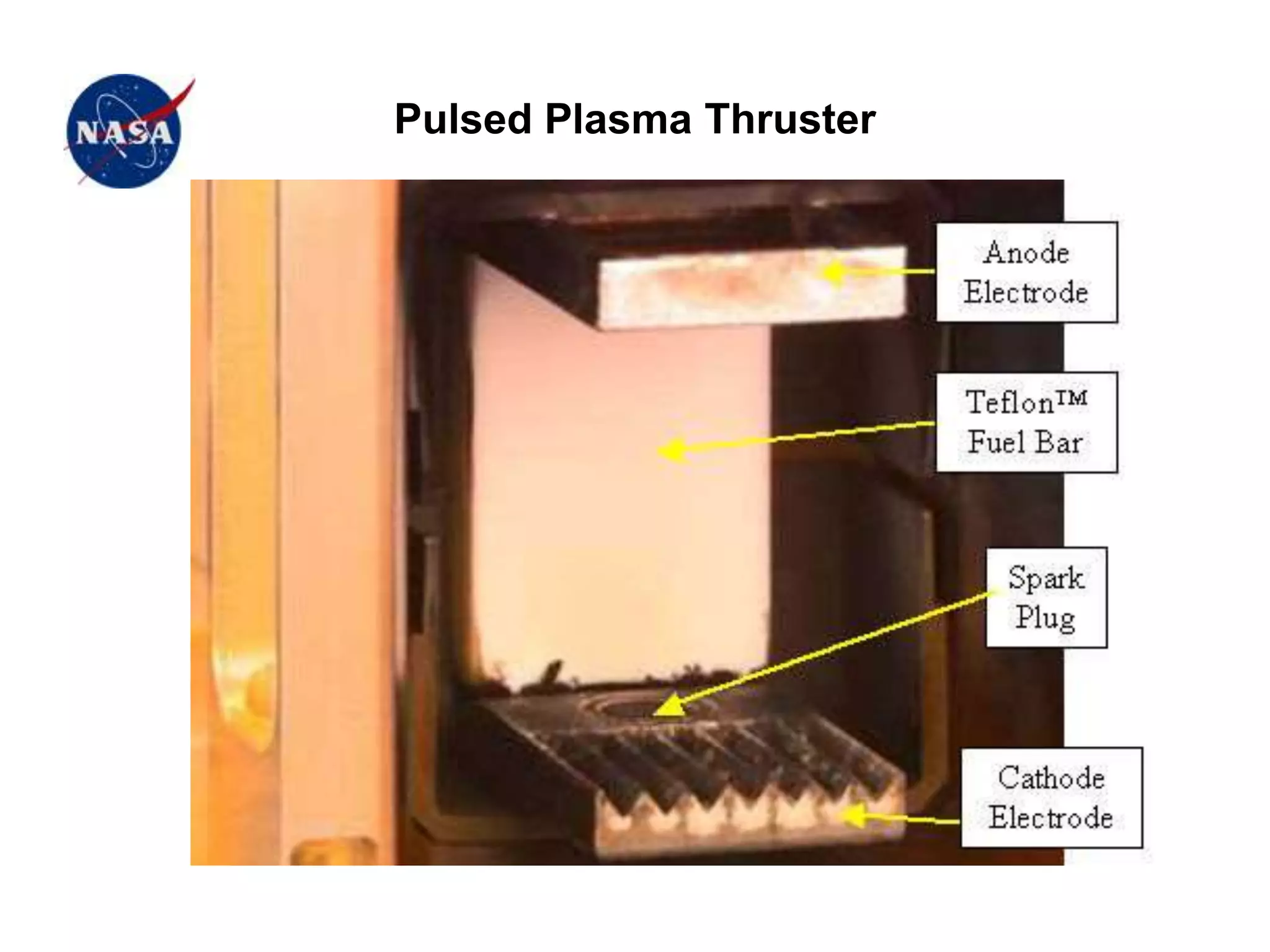
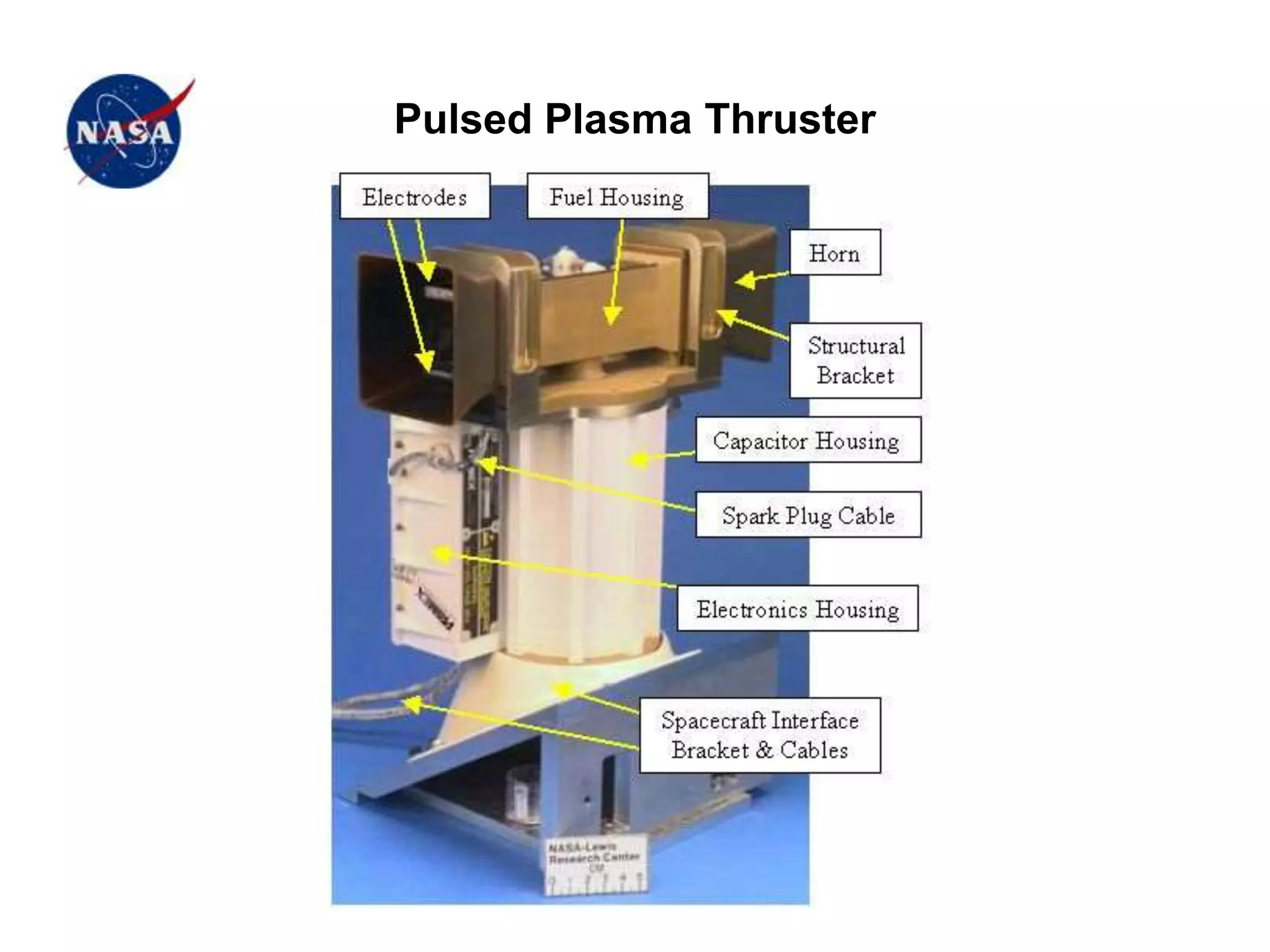
Pulsed Plasma Thruster
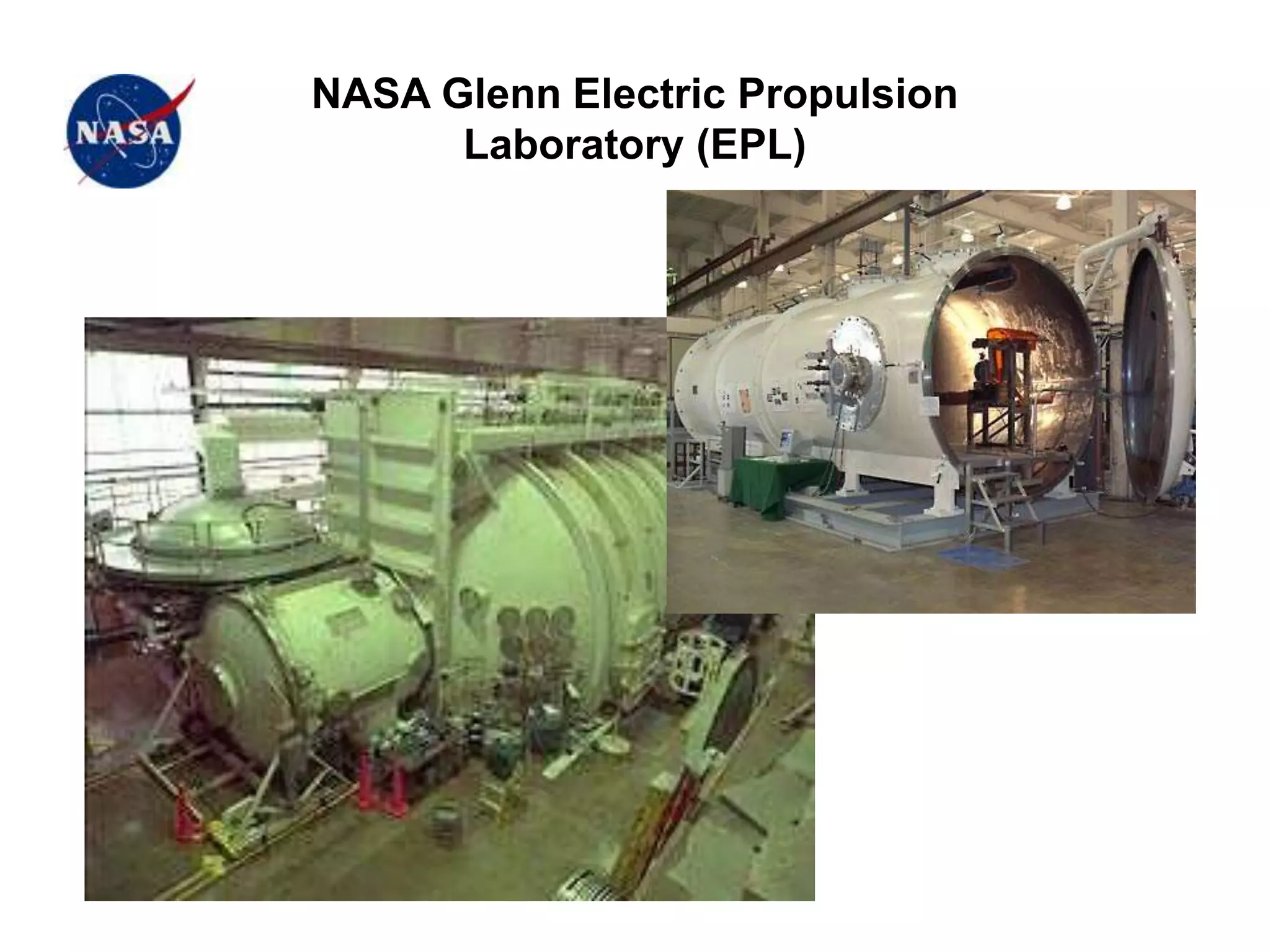
NASA Glenn Electric Propulsion
Laboratory (EPL)
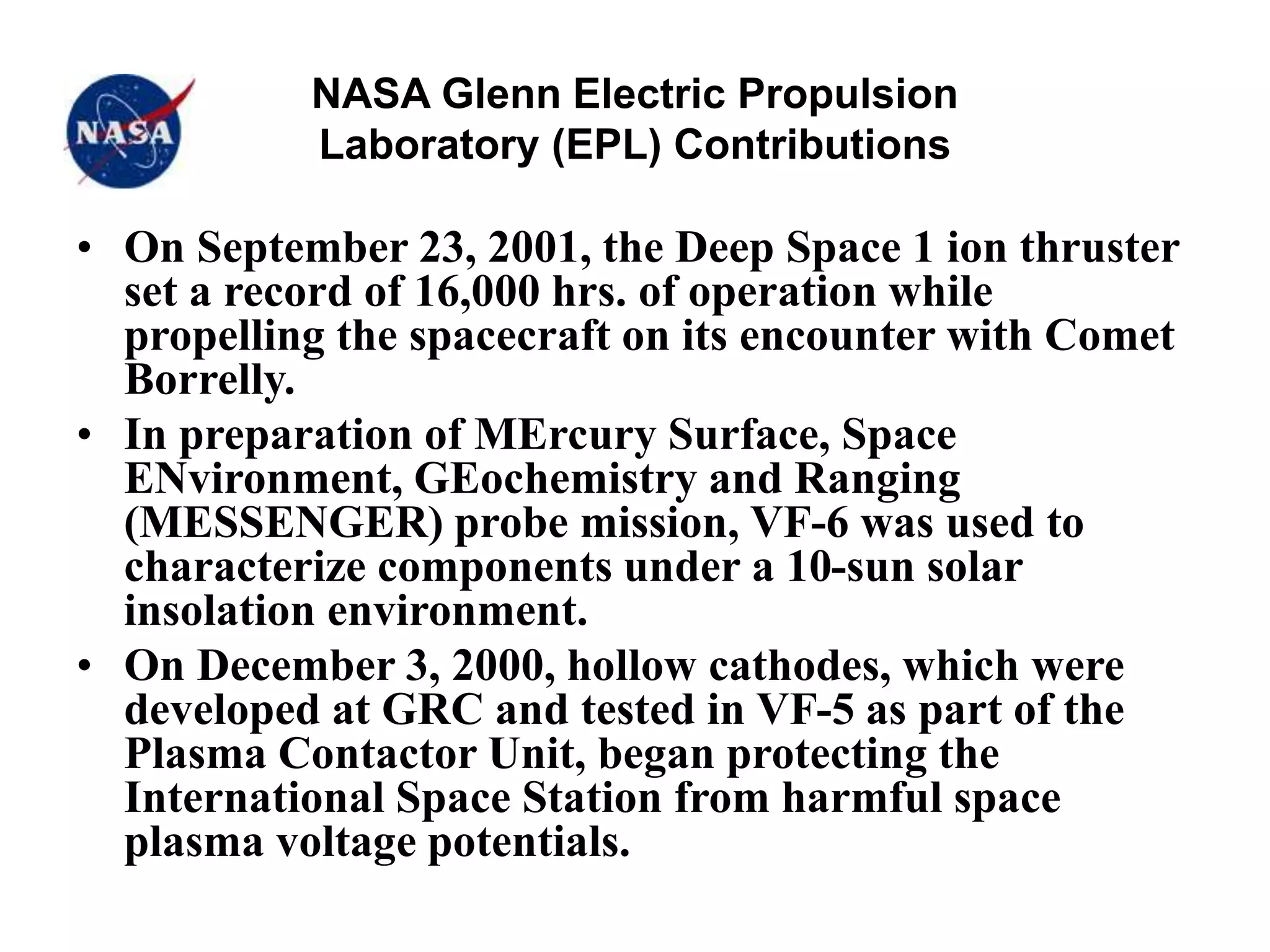
NASA Glenn Electric Propulsion
Laboratory (EPL) Contributions
• On September 23, 2001, the Deep Space 1 ion thruster
set a record of 16,000 hrs. of operation while
propelling the spacecraft on its encounter with Comet
Borrelly.
• In preparation of MErcury Surface, Space
ENvironment, GEochemistry and Ranging
(MESSENGER) probe mission, VF-6 was used to
characterize components under a 10-sun solar
insolation environment.
• On December 3, 2000, hollow cathodes, which were
developed at GRC and tested in VF-5 as part of the
Plasma Contactor Unit, began protecting the
International Space Station from harmful space
plasma voltage potentials.
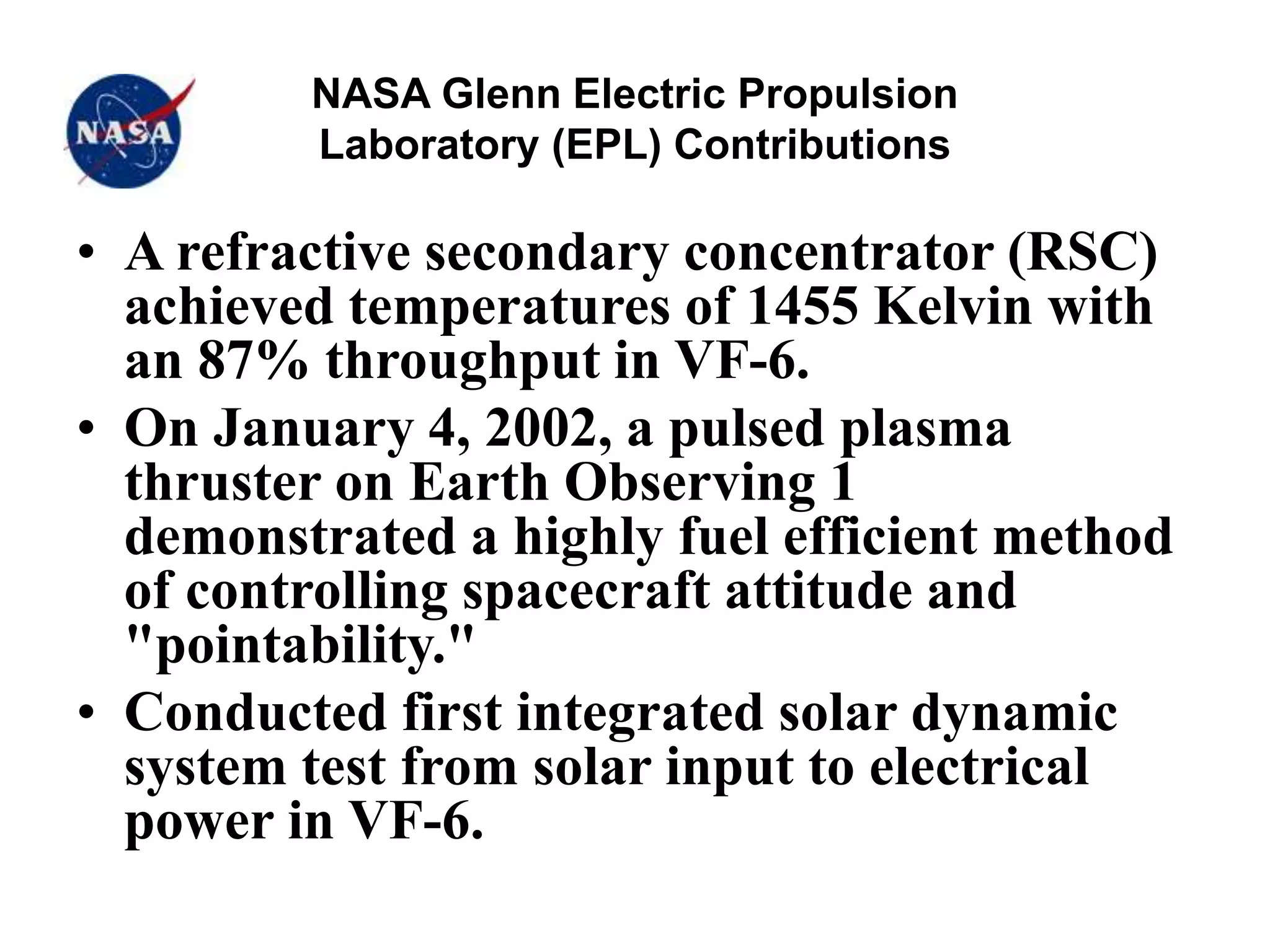
NASA Glenn Electric Propulsion
Laboratory (EPL) Contributions
• A refractive secondary concentrator (RSC)
achieved temperatures of 1455 Kelvin with
an 87% throughput in VF-6.
• On January 4, 2002, a pulsed plasma
thruster on Earth Observing 1
demonstrated a highly fuel efficient method
of controlling spacecraft attitude and
"pointability."
• Conducted first integrated solar dynamic
system test from solar input to electrical
power in VF-6.
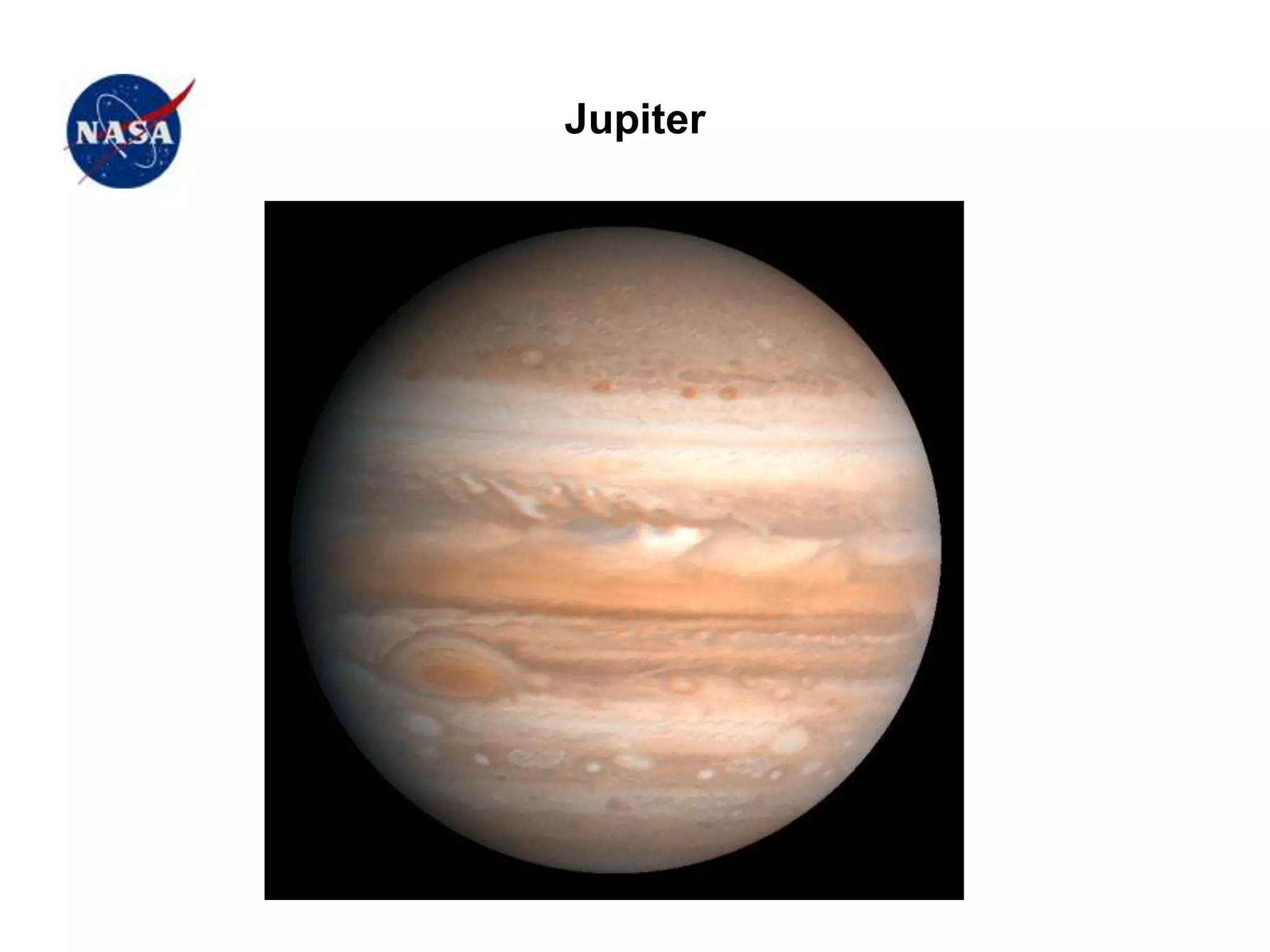
Jupiter
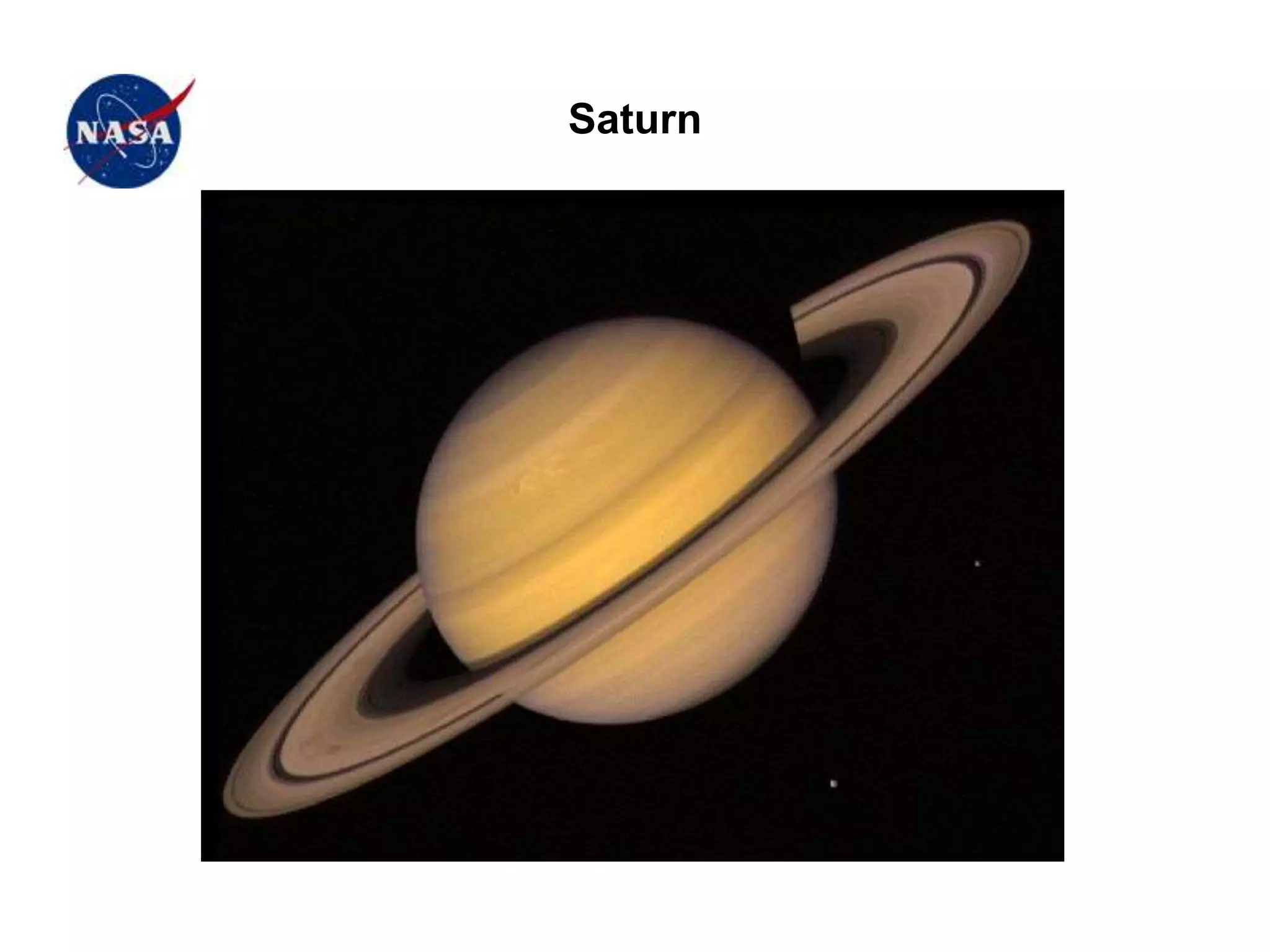
Saturn
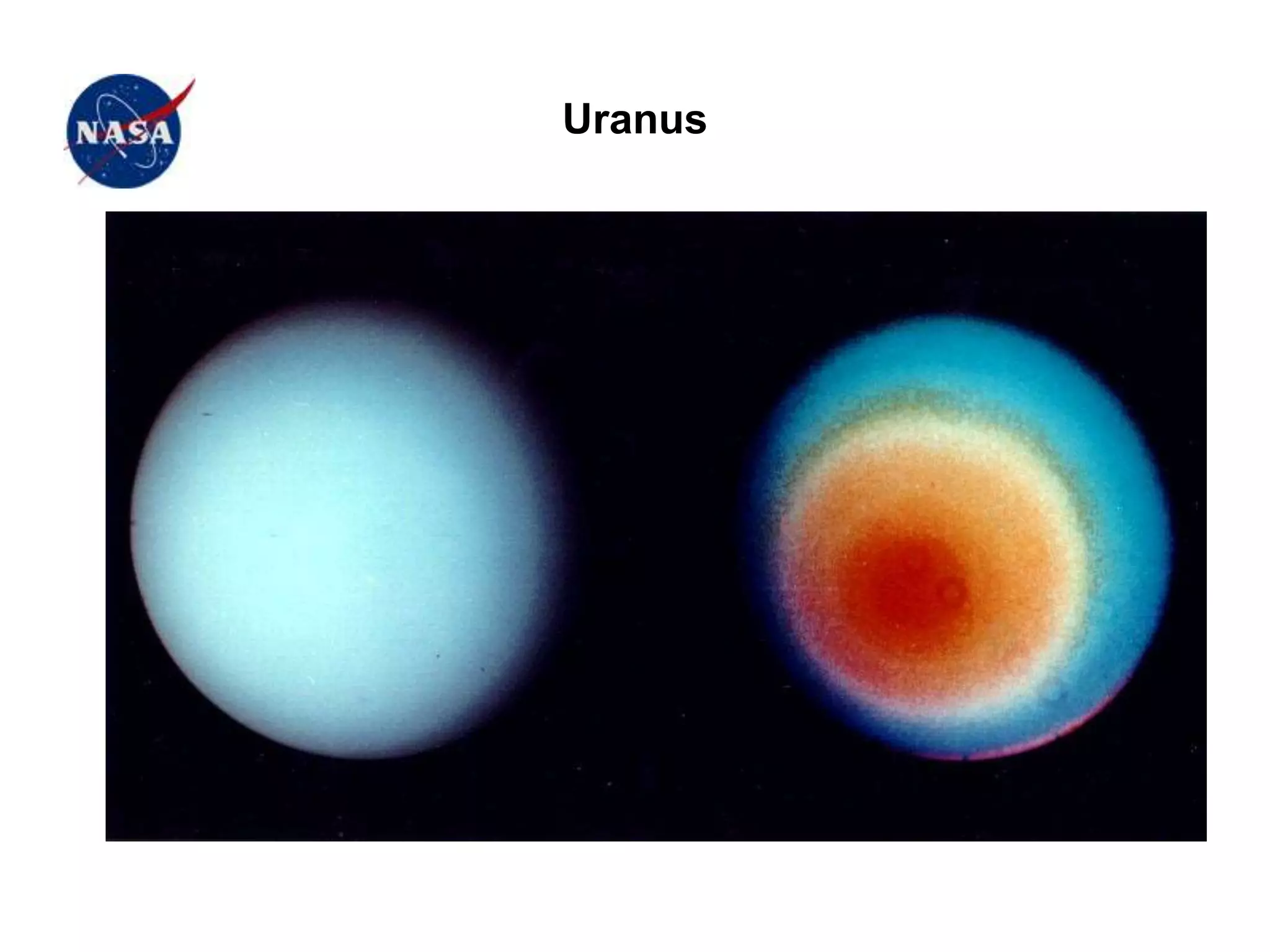
Uranus
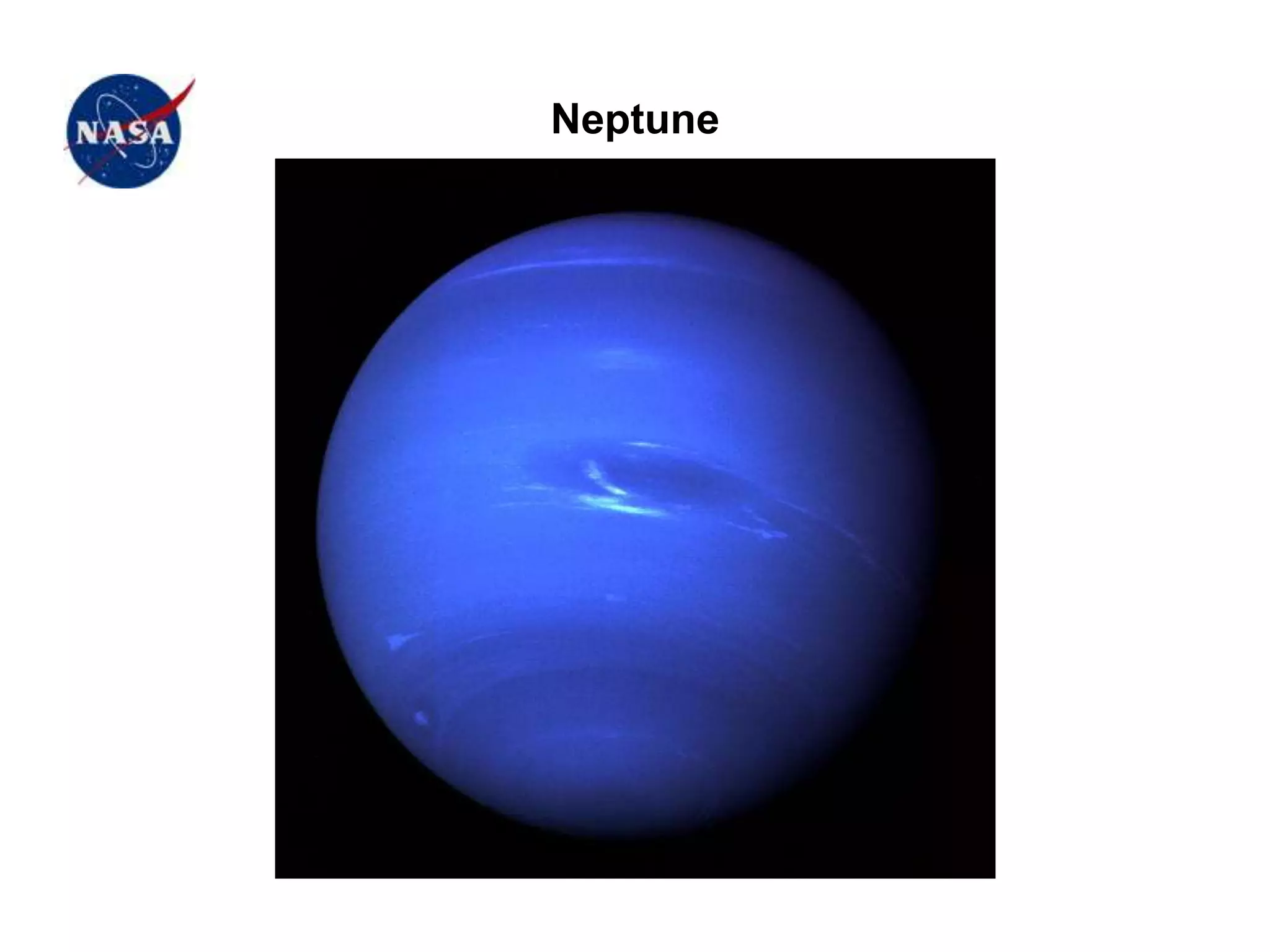
Neptune
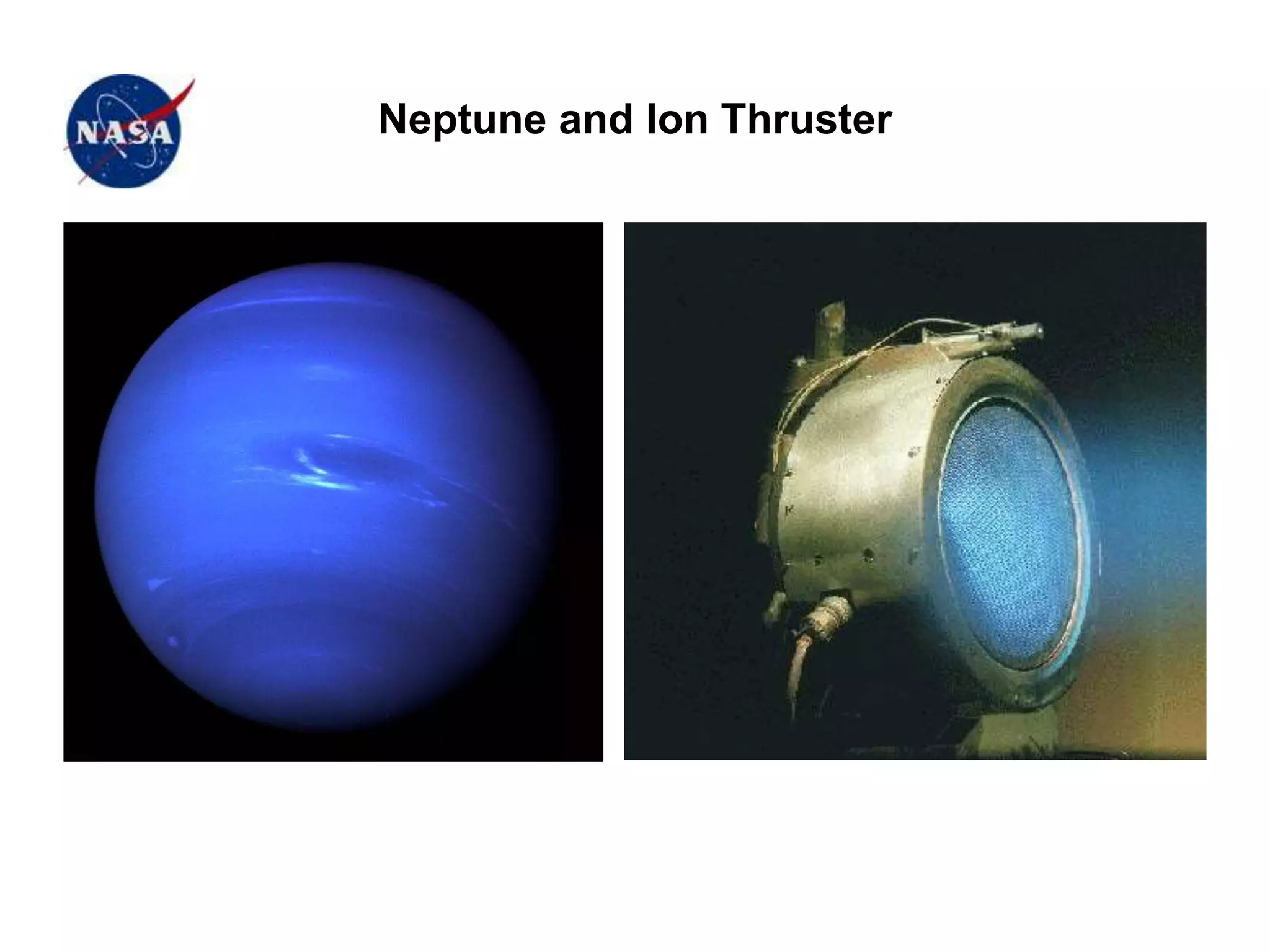
Neptune and Ion Thruster
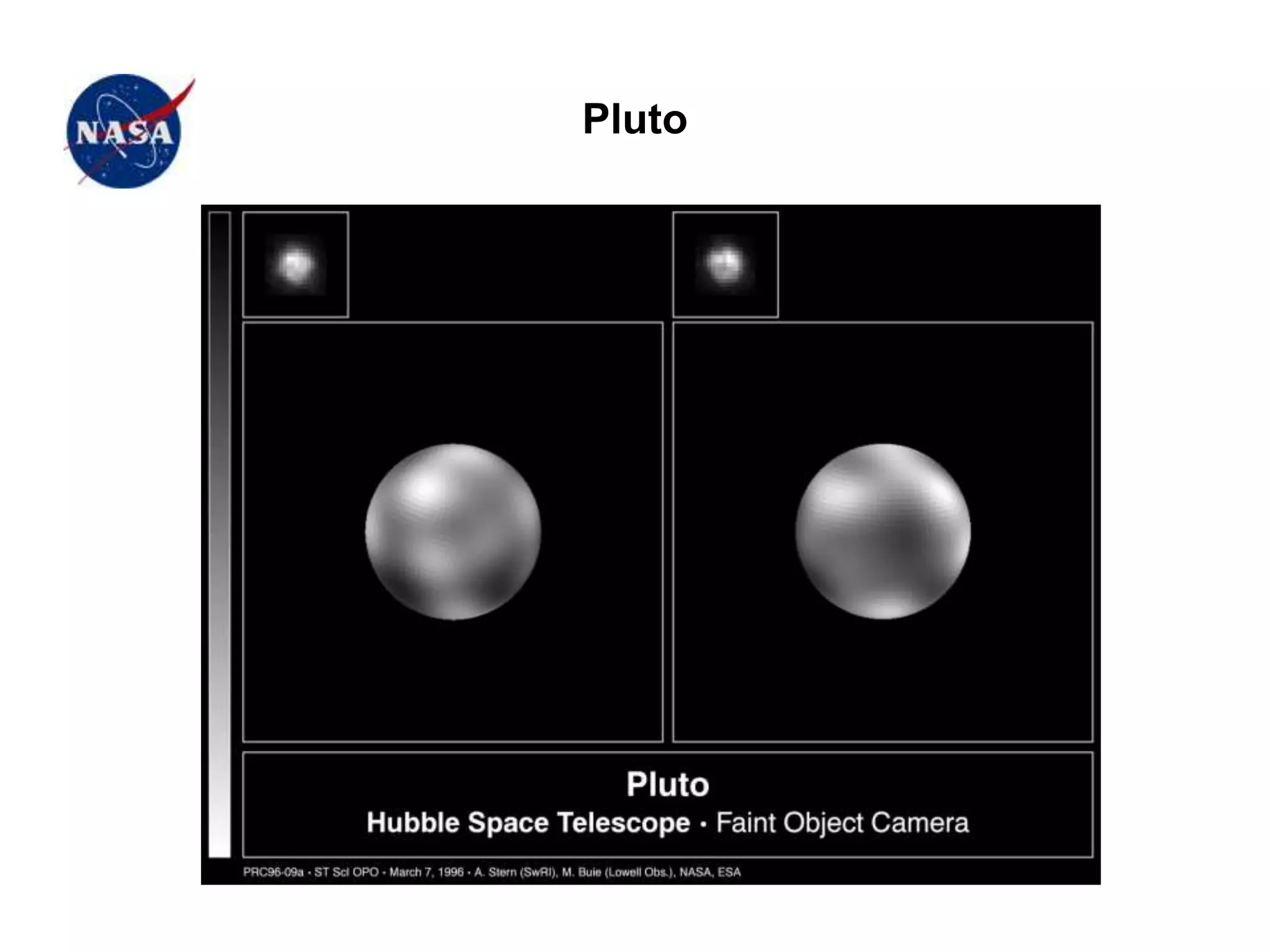
Pluto
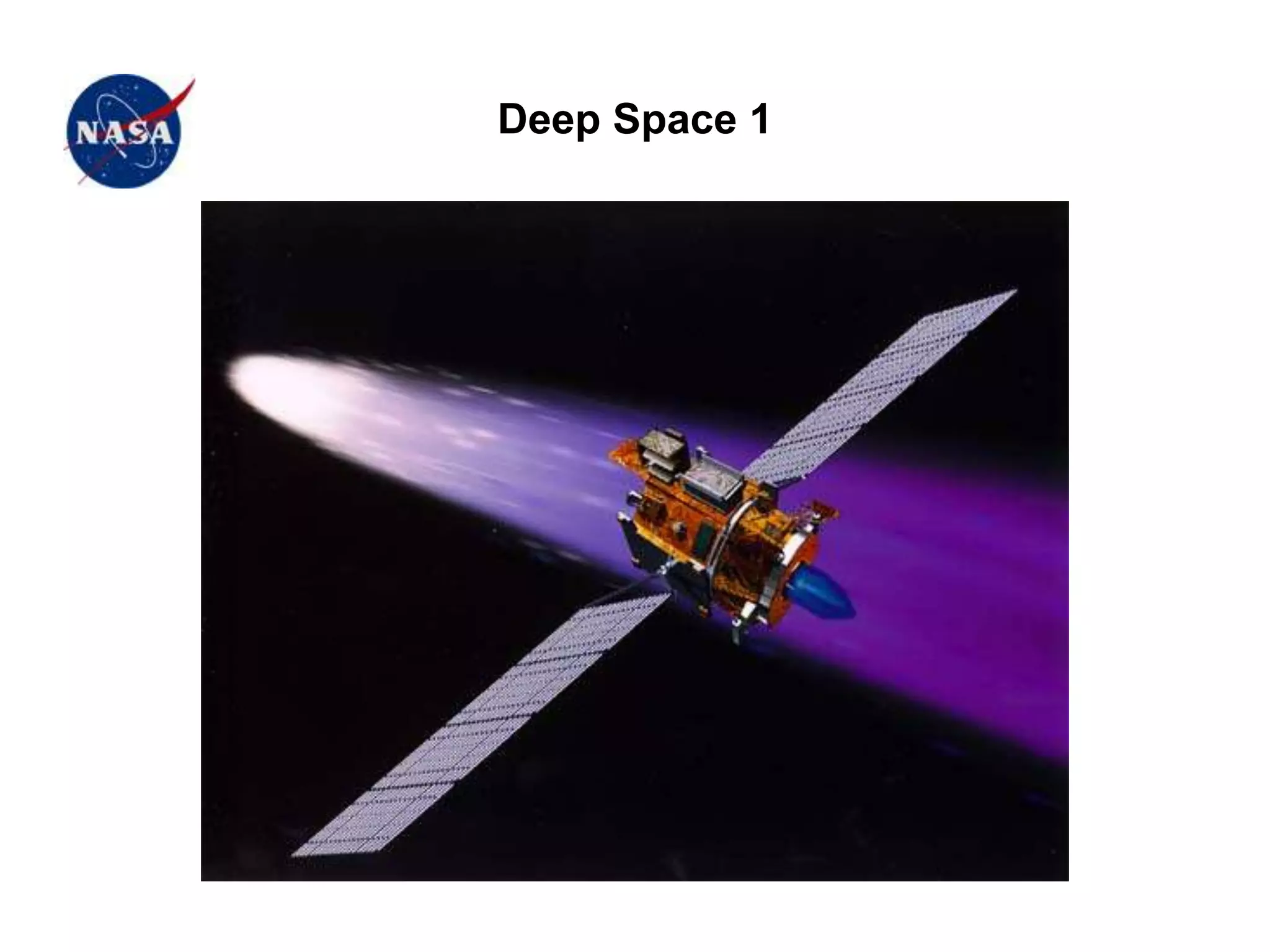
Deep Space 1
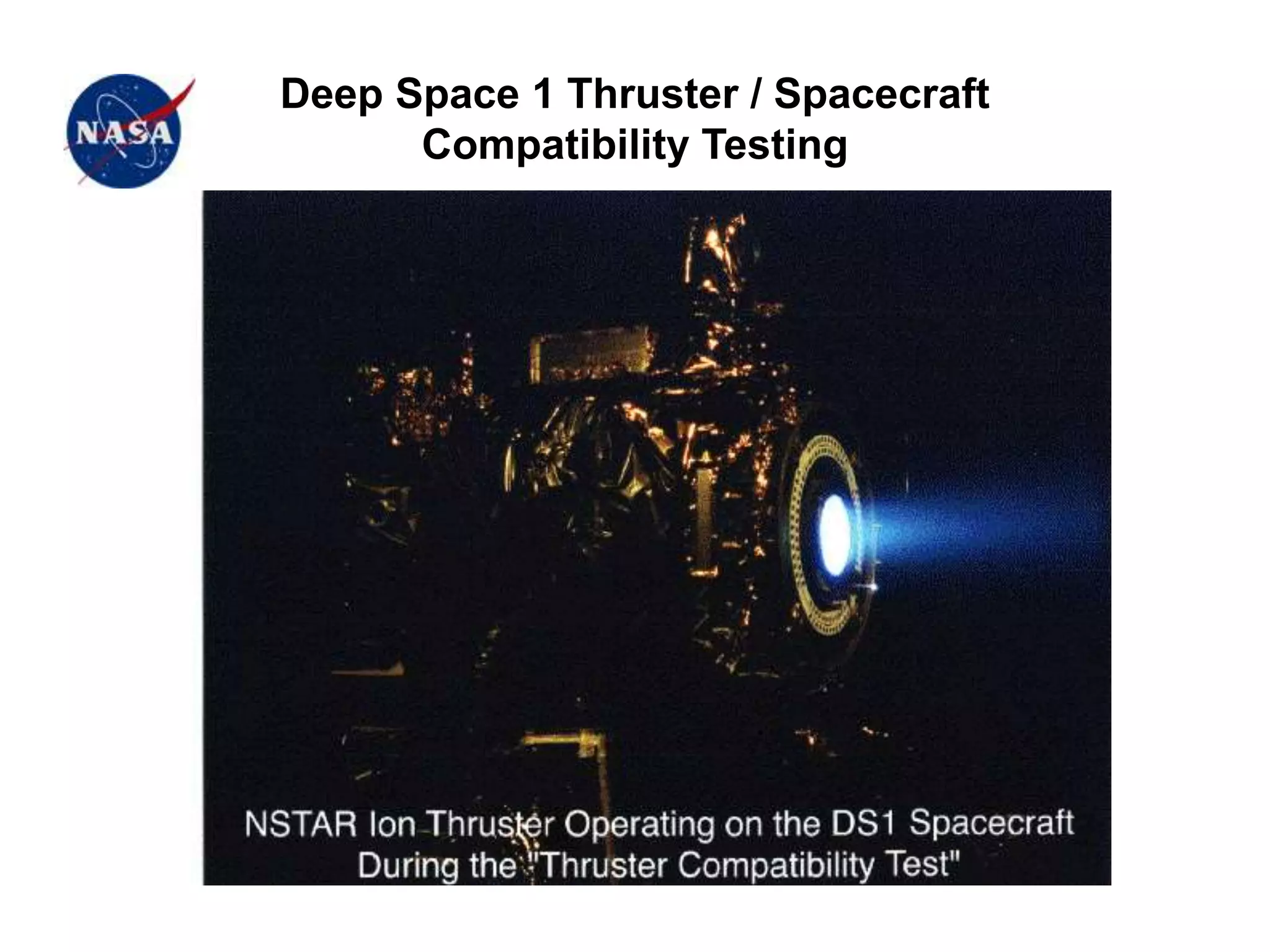
Deep Space 1 Thruster / Spacecraft
Compatibility Testing
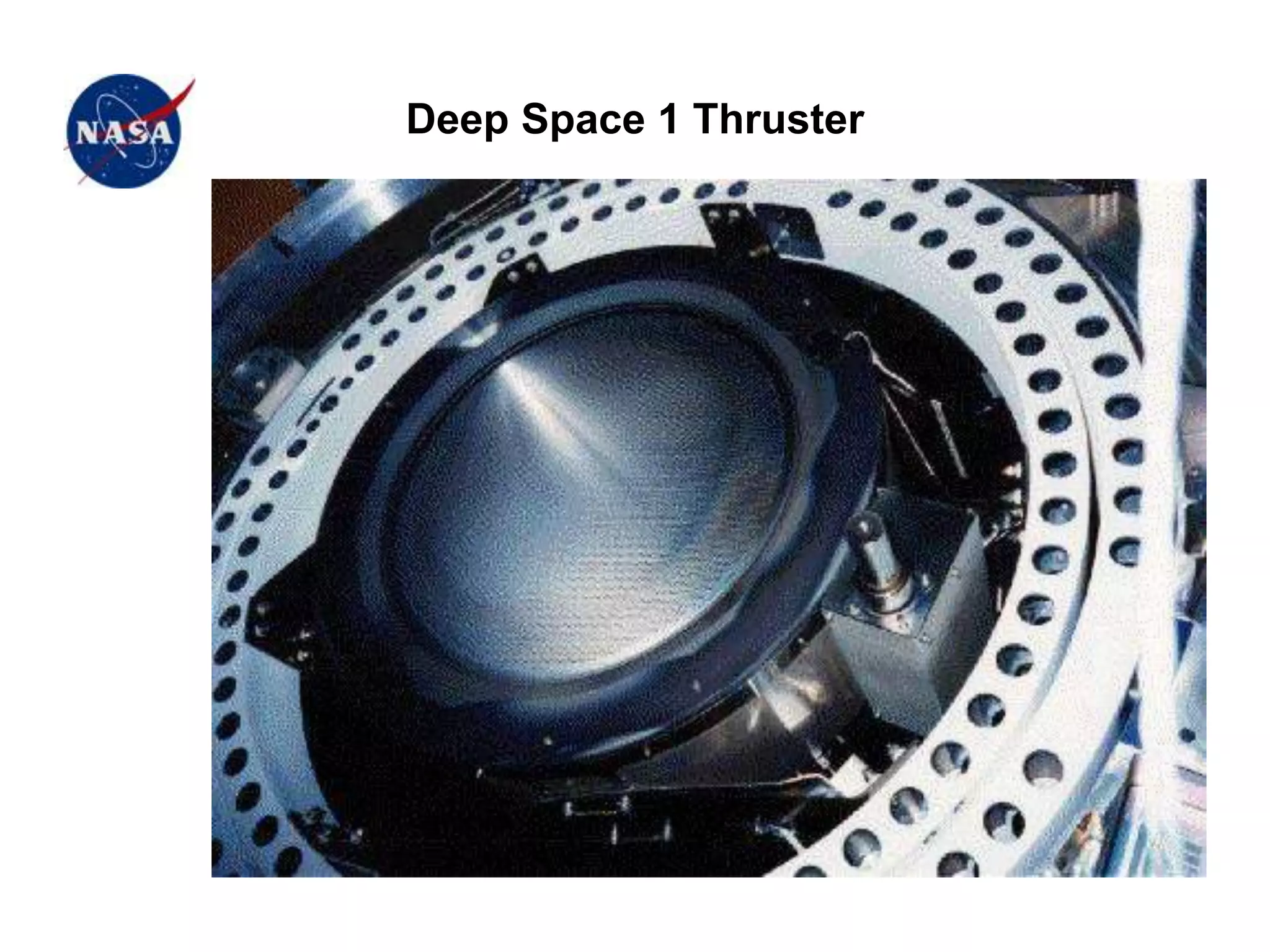
Deep Space 1 Thruster
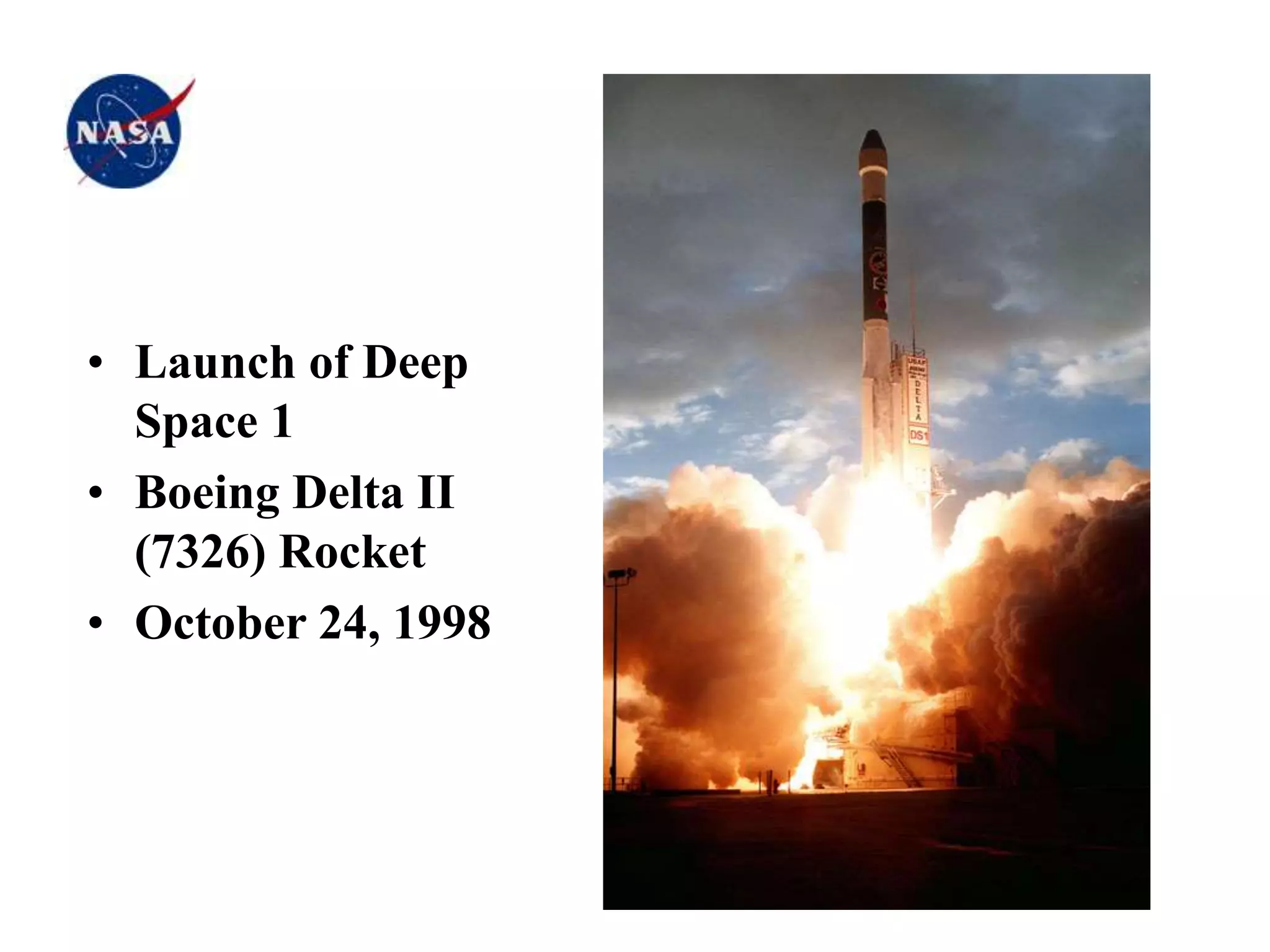
• Launch of Deep
Space 1
• Boeing Delta II
(7326) Rocket
• October 24, 1998
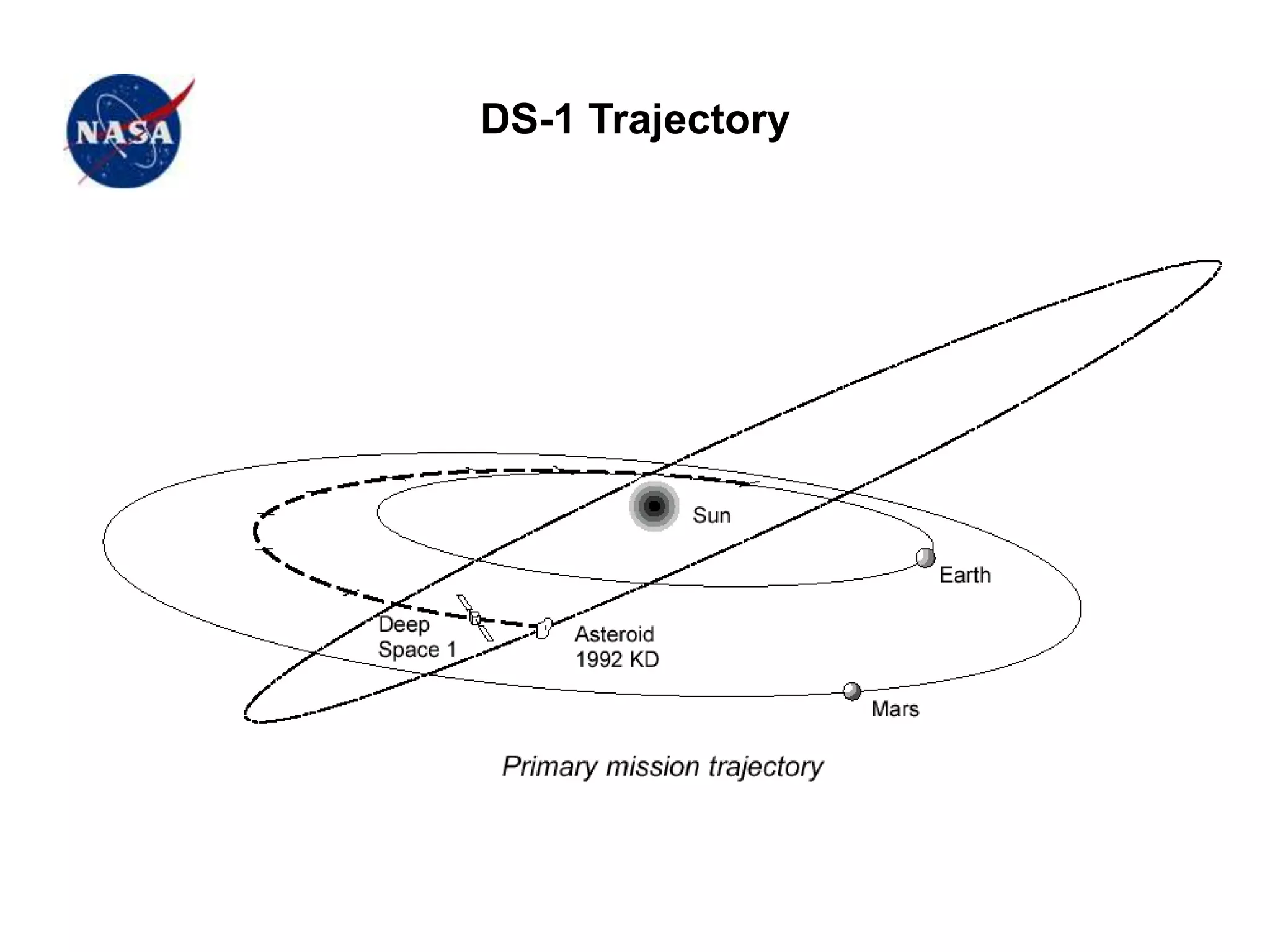
DS-1 Trajectory
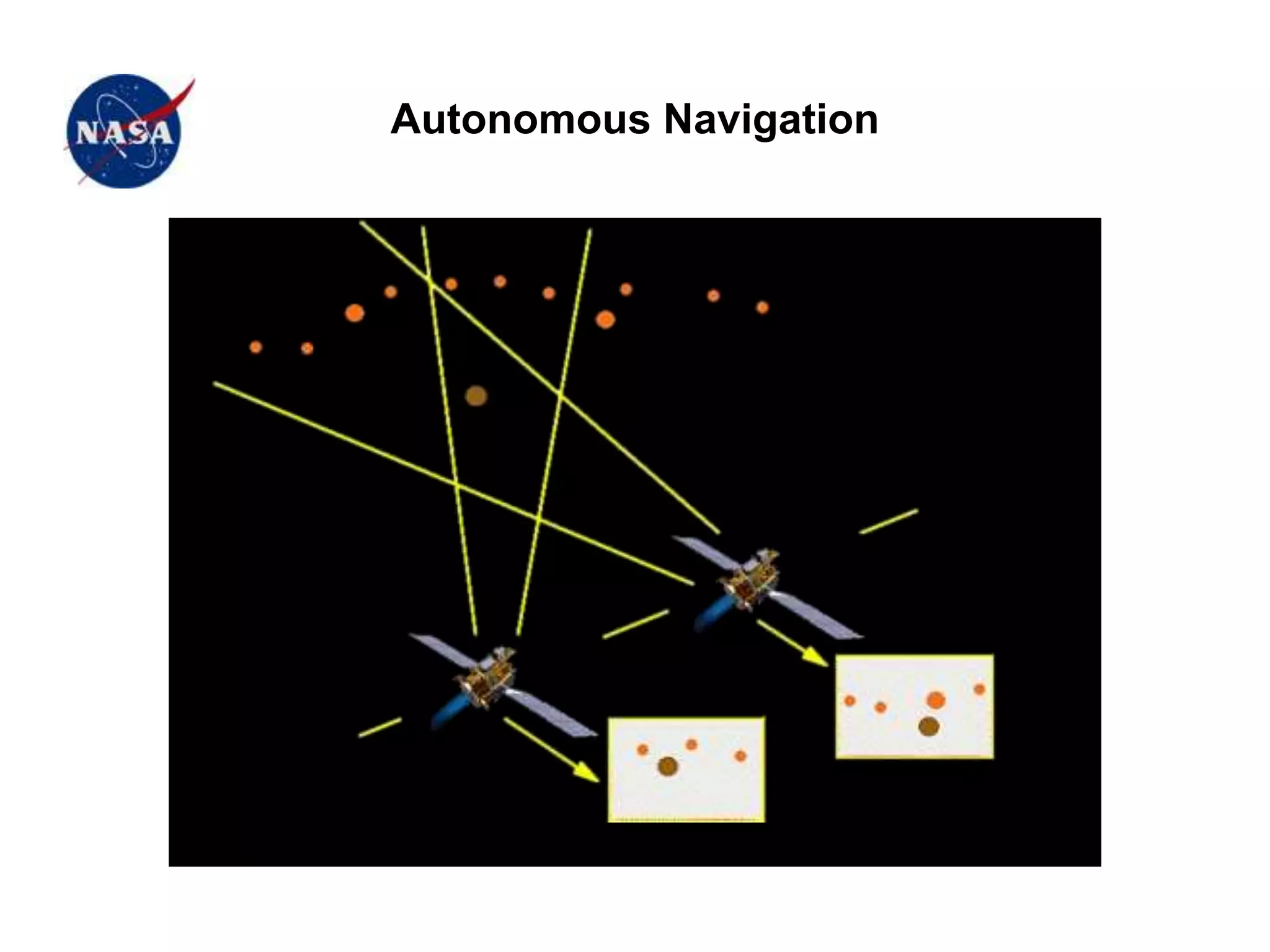
Autonomous Navigation
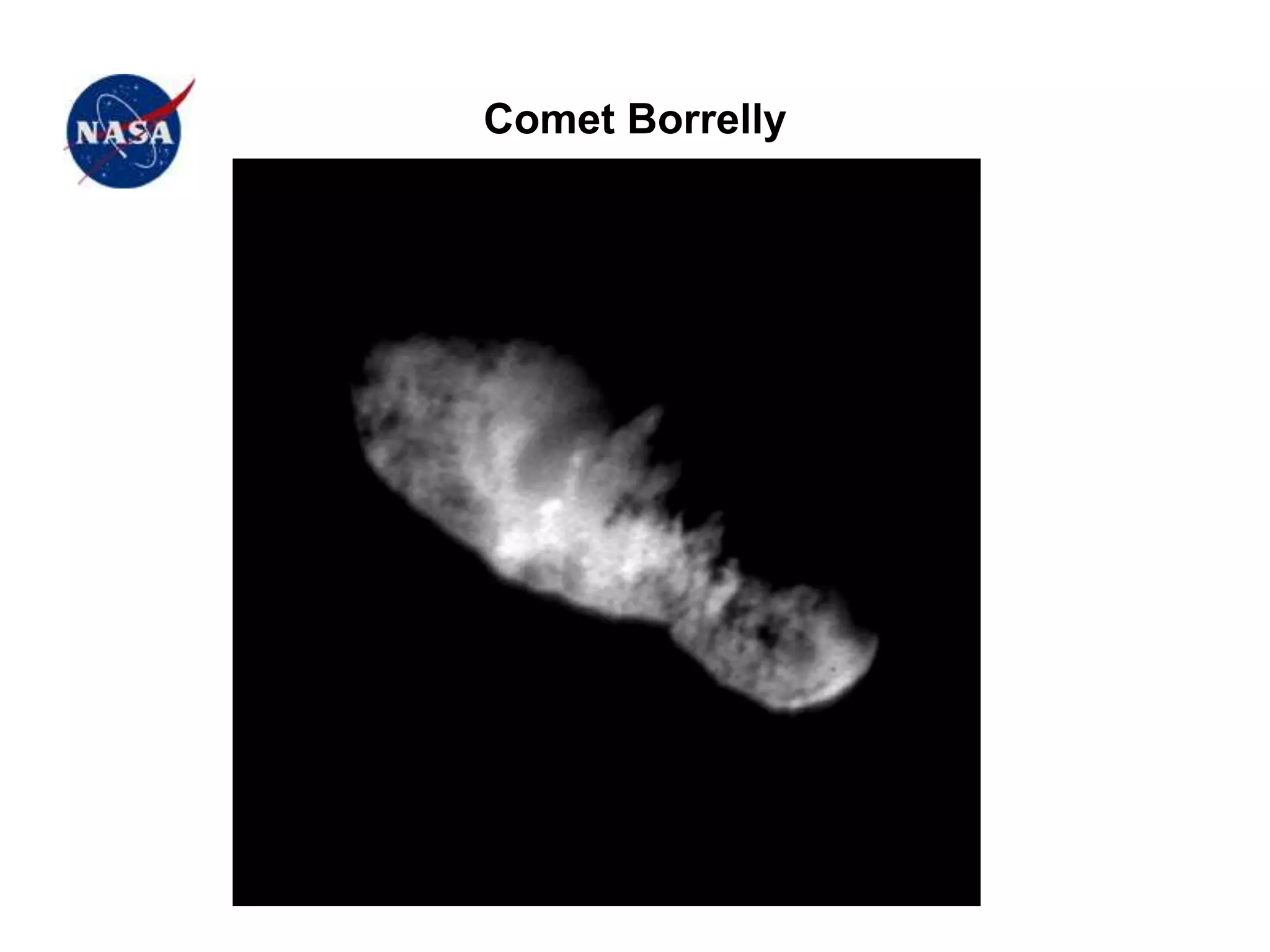
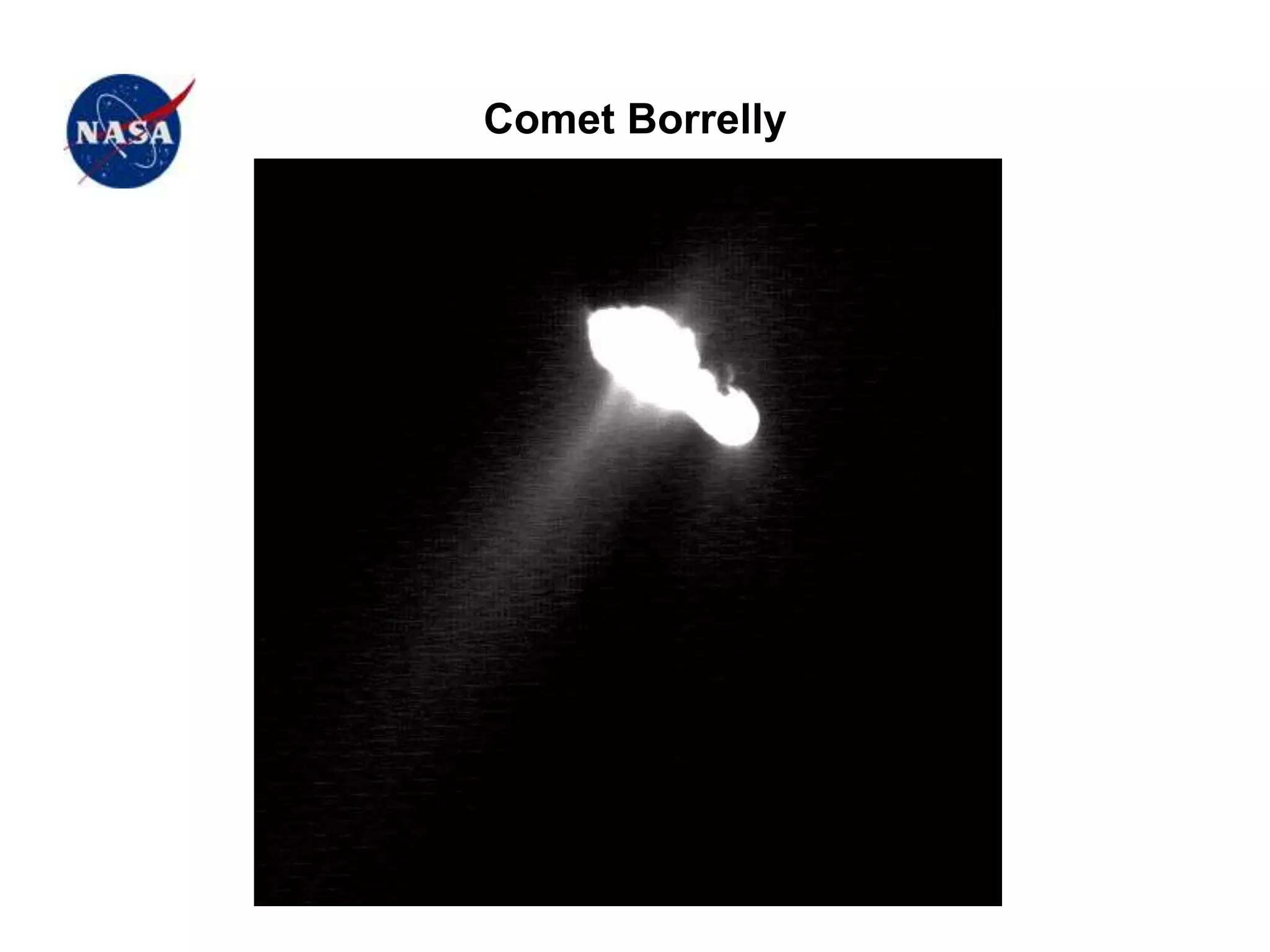
Comet Borrelly
Comet Borrelly

Ion propulsion 1.ppt

  • 1.
    Electric Propulsion forFuture Space Missions Part I Bryan Palaszewski Digital Learning Network NASA Glenn Research Center at Lewis Field
  • 2.
    Introduction • Why electricpropulsion? – Types – Applications • Some history • Future missions and vehicles • A very cool future
  • 3.
  • 4.
    Why High ExhaustVelocity Is Important
  • 5.
    Chemical & ElectricPropulsion Have Intrinsic Differences
  • 6.
    Solar and NuclearElectric Propulsion Subsystems Power Conditioning Solar Cells Thrust Electric Thruster Propellant Exhaust Sun Thermal-to- Electric Power Conversion Nuclear Reactor
  • 7.
    Electric Propulsion Historical Overview 1903 -- K. E. Tsiolkovsky derived the “Tsiolkovsky” or “Rocket” Equation commonly used to show the benefits of electric propulsion  1906 -- R. Goddard wrote about the possibility of electric rockets  1911 -- K. E. Tsiolkovsky independently wrote about electric rockets  1929 -- World’s first electric thruster demonstrated by V. P. Glushko at the Gas Dynamics Laboratory in Lenningrad  1960 -- First “broad-beam” ion thruster operated in the U.S. at the NASA Lewis (now Glenn) Research Center
  • 8.
    Electric Propulsion Historical Overview 1964 -- First successful sub-orbital demonstration of an ion engine (SERT I) by the U.S.  1964 -- First use of an electric thruster on an interplanetary probe (Zond 2) by the USSR  1970 -- Long duration test of mercury ion thrusters in space (SERT II) by the U.S.  1972 -- First operation of a xenon stationary plasma thruster (SPT-50) in space (Meteor) by the USSR  1993 -- First use of hydrazine arcjets on a commercial communications satellite (Telstar 401) by the U.S.
  • 9.
    The First ElectricThruster • Developed by V. P Glushko at the Gas Dynamics Laboratory in Lenningrad, 1929 - 1933 • Solid and Liquid Conductors Were Vaporized by High Current Discharges in the Plenum Chamber and Expanded Through the Nozzle • Power Provided by 40 kV, 4 mF Capacitors
  • 10.
    Types Of ElectricThrusters • Electrostatic – Ion – Hall • Electrothermal – Arcjet – Resistojet • Electromagnetic – Magneto plasma dynamic (MPD) – Many others
  • 11.
    Types Of ElectricThrusters THRUSTER POWER RANGE SPECIFIC IMPULSE (s) Electrothermal 100s of watts 300 to 400 Resistojets Arcjets Hydrazine kilowatts 500 to 600 Hydrogen 10s of kilowatts 900 to 1200 Ammonia kilowatts to 10s of kilowatts 600 to 800 Electrostatic Gridded Ion Engines watts to 100 kilowatts 2000 to 10,000 Stationary Plasma Thrusters (SPT) 100s of watts to 10’s of kilowatts 1000 to 2500 Thruster with Anode Layer (TAL) 100s of watts to 10’s of kilowatts 1000 to 4000 Electromagnetic Magnetoplasmadynamic (MPD) Pulsed kilowatts (average) 1000 to 4000 Steady-State 100s of kilowatts to megawatts 3000 to 7000 Pulsed Plasma Thruster 10s to 100s of watts (average) 1000 to 1500 Pulsed Inductive Thruster 10s of kilowatts 3000 to 5000 Electron Cyclotron Thruster kilowatts to 10s of kilowatts 2000 to 4000 Many Others
  • 12.
  • 13.
  • 14.
  • 15.
    Hall Thruster SPT-100 1350 W 1600lbf-s/lbm (Nominal) SPT-70 700 W 1450 lbf-s/lbm (Nominal) SPT-140 4000 W 1700 lbf-s/lbm (Nominal) SPT-50 300 W 1200 lbf-s/lbm (Nominal) Thrusters designed and fabricated by the Design Bureau Fakel, Kaliningrad (Baltic Region), Russia, and offered by International Space Technology, Inc.
  • 16.
    Hall Thruster Magnet Coils DielectricWalls Cathode Power Supply Power Supply Xe Xe Anode Ez Br
  • 17.
    Hydrazine Arcjet Primex AerospaceHydrazine Arcjet: 1.8 kW, 200 mN, 500 lbf-s/lbm
  • 18.
  • 19.
    Arcjet Thruster Ship Setof Four Olin Aerospace 500 lbf-s/lbm Hydrazine Arcjets and Power Processing Unit
  • 20.
    Magneto Plasma Dynamic(MPD) Thruster Pulsed MPD Thruster Operating on Argon Propellant at Princeton University
  • 21.
    Magneto Plasma Dynamic(MPD) Thruster
  • 22.
  • 23.
  • 24.
  • 25.
    NASA Glenn ElectricPropulsion Laboratory (EPL)
  • 26.
    NASA Glenn ElectricPropulsion Laboratory (EPL) Contributions • On September 23, 2001, the Deep Space 1 ion thruster set a record of 16,000 hrs. of operation while propelling the spacecraft on its encounter with Comet Borrelly. • In preparation of MErcury Surface, Space ENvironment, GEochemistry and Ranging (MESSENGER) probe mission, VF-6 was used to characterize components under a 10-sun solar insolation environment. • On December 3, 2000, hollow cathodes, which were developed at GRC and tested in VF-5 as part of the Plasma Contactor Unit, began protecting the International Space Station from harmful space plasma voltage potentials.
  • 27.
    NASA Glenn ElectricPropulsion Laboratory (EPL) Contributions • A refractive secondary concentrator (RSC) achieved temperatures of 1455 Kelvin with an 87% throughput in VF-6. • On January 4, 2002, a pulsed plasma thruster on Earth Observing 1 demonstrated a highly fuel efficient method of controlling spacecraft attitude and "pointability." • Conducted first integrated solar dynamic system test from solar input to electrical power in VF-6.
  • 28.
  • 29.
  • 30.
  • 31.
  • 32.
  • 33.
  • 34.
  • 35.
    Deep Space 1Thruster / Spacecraft Compatibility Testing
  • 36.
    Deep Space 1Thruster
  • 37.
    • Launch ofDeep Space 1 • Boeing Delta II (7326) Rocket • October 24, 1998
  • 38.
  • 39.
  • 40.
  • 41.