PLASMA PROTEINS
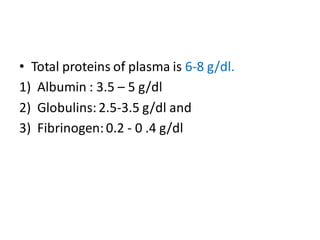
• Total proteins of plasma is 6-8 g/dl.
1) Albumin : 3.5 – 5 g/dl
2) Globulins:2.5-3.5 g/dl and
3) Fibrinogen:0.2 - 0 .4 g/dl
Synthesis of Plasma Proteins
▪ All the albumin and fibrinogen are synthesized by the
liver onl
▪ Similarly 50 to 80% of the globulin is formed in the liver
▪ The remainder of the globulins are formed almost
entirely in the lymphoid tissues.
▪ The A/G ratio can be altered in the liver disease.
Separation of plasma proteins
1. Salting out
2. Cohn's fractionation and
3. Electrophoresis
Electrophoresis
Functions of plasma proteins
• Transport function
• Nutritive function
• Buffering action
• Colloidal osmotic pressure
• Antiproteases
• Blood coagulation
• Hormones
• Immunity
• Involvement in inflammatory responses
ALBUMIN
• Albumin is a globular protein with 585 amino acid residues
accounting for approximately 50% of plasma protein
• Albumin is synthesized exclusively by the liver.
Functions of albumins
Albumin plays a predominant role in:
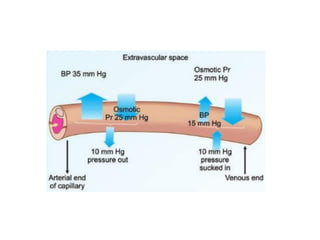
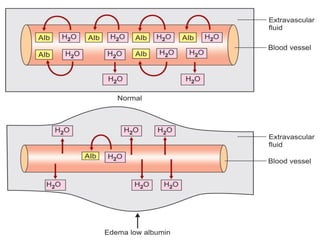
▪ Maintenance of colloid osmotic pressure of plasma.
▪ Transport of metabolites which are poorly soluble in
water :
▪ Fatty acids
▪ Bilirubin
▪ Calcium
▪ Certain steroid hormones
▪ Copper
▪ Some of the plasma tryptophan
▪ A variety of drugs, like sulfonamides, penicillin
G, dicumarol, aspirin, and digoxin
• Buffering function: albumin has maximum buffering
capacity
• Nutritive function : Degradation of albumin provide
essential amino acids during malnutrition.
Clinical significance
Hypoalbuminaemia: Malnutrition, nephrotic syndrome, cirrhosis of
liver
Hyperalbuminaemia: Acute dehydration have no clinical significance.
Analbuminaemia (less than 1gm/l , normal= 3.5 to 6gm/dl):
Analbuminaemia is a rare hereditary abnormalities there may be no
symptoms or signs not even edema due to compensatory increase in
plasma globulin concentration.
Acute phase proteins
• The level of these proteins increases within 1-
5 days after an inflammation , trauma or
surgery.
• Examples :CRP,apha1-
antitrypsin,haptoglobin,ceruloplasmin etc.
Immunoglobulins (Ig)
• The immunoglobulins are γ -globulins, called
antibodies.
• Constitute about 20% of all the plasma proteins
• produced by plasma cells and by lymphocytes in
response to a variety of antigen.
Schematic structure of immunoglobulin G.
▪ The basic immunoglobulin is Y shaped consist of four
polypeptide chains:
– two H and
– two L chains
▪ The four chains are linked by disulfide bond
▪ L chain may be either of two types, Kappa (қ) or
Lambda (λ) but not both
▪ The heavy chains may be of five types and are
designated by Greek letter:
– alpha (α)
– gamma (γ),
– delta (δ),
– mu (μ) and
– epsilon (ε)
▪ Immunoglobulins are named as per their heavy chain
type as IgA, IgG, IgD, IgM and IgE
▪ The L and H chains are subdivided into variable ( towards
the carboxyl terminal end) and constant ( towards the
amino terminal end) regions.
▪ L chain consists of one variable (VL) and one constant
(CL) domain or region.
▪ Most H-chains consist of one variable (VH) and three
constant (CH-1, CH-2, and CH-3) domains.
▪ The hinge region between the CH-1 and CH-2 domains
confers flexibility and allows both Fab arms to move
independently , thus helping them to bind to antigenic site
Light chain type
• Light chain may be either of two types, Kappa (k) or
Lambda (l) but not both.
• In a given immunoglobulin either 2k or 2 l but not the
mixture of kappa and lambda
• Most abundant light chain in human is k
▪ Enzyme (papain) digestion splits the
immunoglobulin molecule into two fragments
1. Fab: Fragment for antigen binding. Located in
variable region.
2. Fc: Crystallisable fragment or fragment for
complement binding
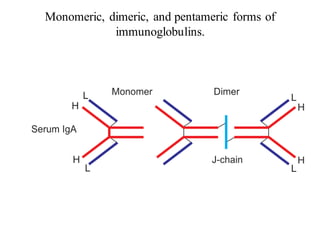
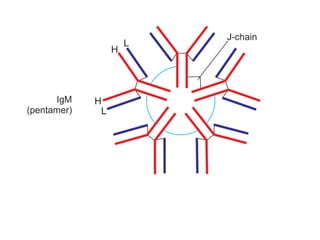
Monomeric, dimeric, and pentameric forms of
immunoglobulins.
Classes of immuoglobulins
1. IgG
2. IgA
3. IgM
4. IgD
5. IgE
IgG
• It constitutes 75-80% of total
immunoglobulins
• Major antibody in secondary immune
response
• Subclasses of IgG
• Crosses the placenta
• Opsonises bacteria
IgA
• Second most abundant Ig
• Present in body secretions like colostrum,
saliva,tears , respiratory ,intestinal and genital
tract secretions.
• It prevents attachment of microorganisms to
mucous surfaces.
• It occurs as a monomer or dimer joined by a j
chain.
IgM
• Pentamer
• First antibody produced when an antigen
enters organism.
• It is most efficient Ig in agglutination
complement activation.
IgD
• It’s a monomer
• Present in very low concentration
• Present on the surface of B lymphocytes.
• Exact function is not known.
IgE
• Monomer
• It mediates allergic reactions , hypersensitivity
and anaphylaxis.
• It stimulates the mast cells to release
histamine.

Plasma proteins.pdf

  • 1.
  • 3.
    • Total proteinsof plasma is 6-8 g/dl. 1) Albumin : 3.5 – 5 g/dl 2) Globulins:2.5-3.5 g/dl and 3) Fibrinogen:0.2 - 0 .4 g/dl
  • 4.
    Synthesis of PlasmaProteins ▪ All the albumin and fibrinogen are synthesized by the liver onl ▪ Similarly 50 to 80% of the globulin is formed in the liver ▪ The remainder of the globulins are formed almost entirely in the lymphoid tissues. ▪ The A/G ratio can be altered in the liver disease.
  • 5.
    Separation of plasmaproteins 1. Salting out 2. Cohn's fractionation and 3. Electrophoresis
  • 6.
  • 7.
    Functions of plasmaproteins • Transport function • Nutritive function • Buffering action • Colloidal osmotic pressure • Antiproteases • Blood coagulation • Hormones • Immunity • Involvement in inflammatory responses
  • 8.
    ALBUMIN • Albumin isa globular protein with 585 amino acid residues accounting for approximately 50% of plasma protein • Albumin is synthesized exclusively by the liver. Functions of albumins Albumin plays a predominant role in: ▪ Maintenance of colloid osmotic pressure of plasma.
  • 11.
    ▪ Transport ofmetabolites which are poorly soluble in water : ▪ Fatty acids ▪ Bilirubin ▪ Calcium ▪ Certain steroid hormones ▪ Copper ▪ Some of the plasma tryptophan ▪ A variety of drugs, like sulfonamides, penicillin G, dicumarol, aspirin, and digoxin
  • 12.
    • Buffering function:albumin has maximum buffering capacity • Nutritive function : Degradation of albumin provide essential amino acids during malnutrition.
  • 13.
    Clinical significance Hypoalbuminaemia: Malnutrition,nephrotic syndrome, cirrhosis of liver Hyperalbuminaemia: Acute dehydration have no clinical significance. Analbuminaemia (less than 1gm/l , normal= 3.5 to 6gm/dl): Analbuminaemia is a rare hereditary abnormalities there may be no symptoms or signs not even edema due to compensatory increase in plasma globulin concentration.
  • 14.
    Acute phase proteins •The level of these proteins increases within 1- 5 days after an inflammation , trauma or surgery. • Examples :CRP,apha1- antitrypsin,haptoglobin,ceruloplasmin etc.
  • 15.
    Immunoglobulins (Ig) • Theimmunoglobulins are γ -globulins, called antibodies. • Constitute about 20% of all the plasma proteins • produced by plasma cells and by lymphocytes in response to a variety of antigen.
  • 16.
    Schematic structure ofimmunoglobulin G.
  • 17.
    ▪ The basicimmunoglobulin is Y shaped consist of four polypeptide chains: – two H and – two L chains ▪ The four chains are linked by disulfide bond ▪ L chain may be either of two types, Kappa (қ) or Lambda (λ) but not both
  • 18.
    ▪ The heavychains may be of five types and are designated by Greek letter: – alpha (α) – gamma (γ), – delta (δ), – mu (μ) and – epsilon (ε) ▪ Immunoglobulins are named as per their heavy chain type as IgA, IgG, IgD, IgM and IgE
  • 19.
    ▪ The Land H chains are subdivided into variable ( towards the carboxyl terminal end) and constant ( towards the amino terminal end) regions. ▪ L chain consists of one variable (VL) and one constant (CL) domain or region. ▪ Most H-chains consist of one variable (VH) and three constant (CH-1, CH-2, and CH-3) domains.
  • 20.
    ▪ The hingeregion between the CH-1 and CH-2 domains confers flexibility and allows both Fab arms to move independently , thus helping them to bind to antigenic site
  • 21.
    Light chain type •Light chain may be either of two types, Kappa (k) or Lambda (l) but not both. • In a given immunoglobulin either 2k or 2 l but not the mixture of kappa and lambda • Most abundant light chain in human is k
  • 22.
    ▪ Enzyme (papain)digestion splits the immunoglobulin molecule into two fragments 1. Fab: Fragment for antigen binding. Located in variable region. 2. Fc: Crystallisable fragment or fragment for complement binding
  • 23.
    Monomeric, dimeric, andpentameric forms of immunoglobulins.
  • 26.
    Classes of immuoglobulins 1.IgG 2. IgA 3. IgM 4. IgD 5. IgE
  • 27.
    IgG • It constitutes75-80% of total immunoglobulins • Major antibody in secondary immune response • Subclasses of IgG • Crosses the placenta • Opsonises bacteria
  • 28.
    IgA • Second mostabundant Ig • Present in body secretions like colostrum, saliva,tears , respiratory ,intestinal and genital tract secretions. • It prevents attachment of microorganisms to mucous surfaces. • It occurs as a monomer or dimer joined by a j chain.
  • 29.
    IgM • Pentamer • Firstantibody produced when an antigen enters organism. • It is most efficient Ig in agglutination complement activation.
  • 30.
    IgD • It’s amonomer • Present in very low concentration • Present on the surface of B lymphocytes. • Exact function is not known.
  • 31.
    IgE • Monomer • Itmediates allergic reactions , hypersensitivity and anaphylaxis. • It stimulates the mast cells to release histamine.