‫بسم ال الرحمن الرحيم‬

‫]البقرة :23[‬
The
Blood
By : Aya Atef Ez El-
Introduction
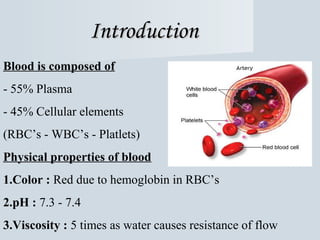
Blood is composed of
- 55% Plasma
- 45% Cellular elements
(RBC’s - WBC’s - Platlets)
Physical properties of blood
1.Color : Red due to hemoglobin in RBC’s
2.pH : 7.3 - 7.4
3.Viscosity : 5 times as water causes resistance of flow
4.Specific gravity:1.060 (of plasma =1.030 &
RBC’s =1.090)
5.Osmotic pressure: 5100-5500 mmHg

Function of blood
1. Act as transport medium
(O2 - CO2 - absorbed food)
2. Defensive function
(WBCs attack foreign organisms)
3. Homeostatic function
(regulation of .water content .temperature .pressure .pH )
Blood volume
Blood volume = 5 liters = 80 ml/kg
(3L Plasma . 2L RBC’s)
Blood vol. represents 80% of body weight
The distribution of blood
55% in veins
7% in heart
15% in arteries
18% in pulmonary system
5% in capillaries
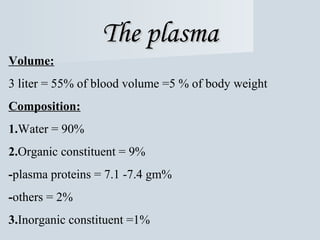
The plasma
Volume:
3 liter = 55% of blood volume =5 % of body weight
Composition:
1.Water = 90%
2.Organic constituent = 9%
-plasma proteins = 7.1 -7.4 gm%
-others = 2%
3.Inorganic constituent =1%
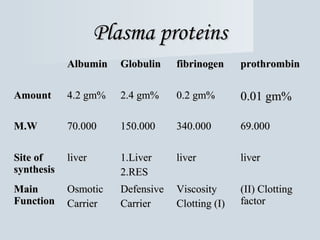
Plasma proteins
Albumin

Globulin

fibrinogen

prothrombin

Amount

4.2 gm%

2.4 gm%

0.2 gm%

0.01 gm%

M.W

70.000

150.000

340.000

69.000

Site of
synthesis

liver

1.Liver
2.RES

liver

liver

Main
Function

Osmotic
Carrier

Defensive
Carrier

Viscosity
Clotting (I)

(II) Clotting
factor
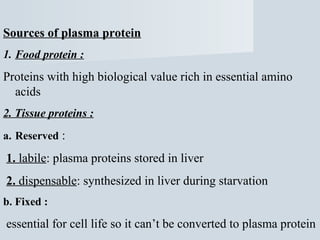
Sources of plasma protein
1. Food protein :

Proteins with high biological value rich in essential amino
acids
2. Tissue proteins :
a. Reserved :

1. labile: plasma proteins stored in liver
2. dispensable: synthesized in liver during starvation
b. Fixed :

essential for cell life so it can’t be converted to plasma protein
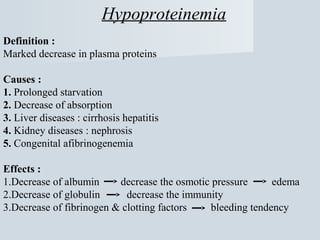
Hypoproteinemia
Definition :
Marked decrease in plasma proteins
Causes :
1. Prolonged starvation
2. Decrease of absorption
3. Liver diseases : cirrhosis hepatitis
4. Kidney diseases : nephrosis
5. Congenital afibrinogenemia
Effects :
1.Decrease of albumin
decrease the osmotic pressure
edema
2.Decrease of globulin
decrease the immunity
3.Decrease of fibrinogen & clotting factors
bleeding tendency
Albumin / Globulin ratio
A/G ratio = 1.2 – 1.7
It decreases in case of
1.Liver diseases as hepatitis ( synthesis of albumin)
2.Kidney diseases as nephrosis ( loss of albumin)
3.Infection ( gamma globulin as a defense mechanism)
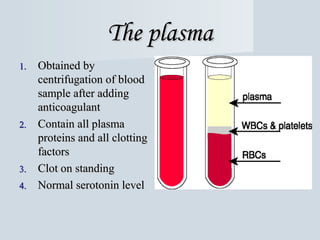
The plasma
Obtained by
centrifugation of blood
sample after adding
anticoagulant
2. Contain all plasma
proteins and all clotting
factors
3. Clot on standing
4. Normal serotonin level
1.
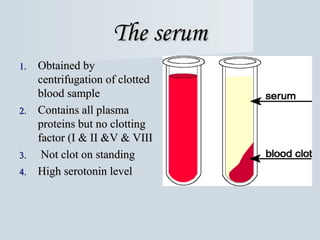
The serum
Obtained by
centrifugation of clotted
blood sample
2. Contains all plasma
proteins but no clotting
factor (I & II &V & VIII
3.
Not clot on standing
4. High serotonin level
1.
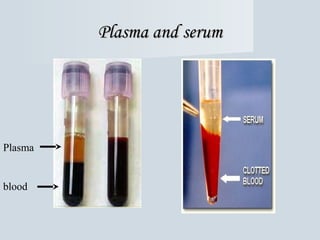
Plasma and serum

Plasma

blood
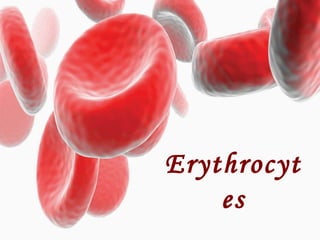
Erythrocyt
es
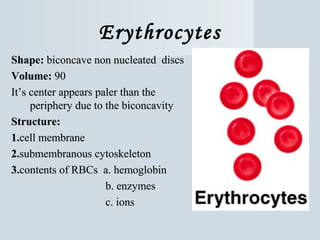
Erythrocytes
Shape: biconcave non nucleated discs
Volume: 90
It’s center appears paler than the
periphery due to the biconcavity
Structure:
1.cell membrane
2.submembranous cytoskeleton
3.contents of RBCs a. hemoglobin
b. enzymes
c. ions
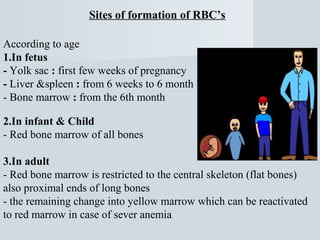
Sites of formation of RBC’s
According to age
1.In fetus
- Yolk sac : first few weeks of pregnancy
- Liver &spleen : from 6 weeks to 6 month
- Bone marrow : from the 6th month
2.In infant & Child
- Red bone marrow of all bones
3.In adult
- Red bone marrow is restricted to the central skeleton (flat bones)
also proximal ends of long bones
- the remaining change into yellow marrow which can be reactivated
to red marrow in case of sever anemia
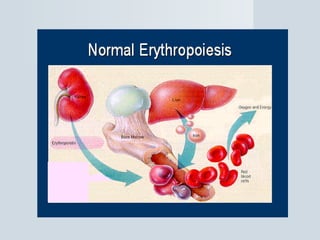
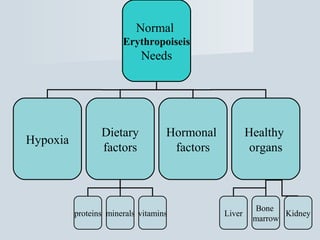
Normal
Erythropoiseis

Needs

Hypoxia

Dietary
factors

Hormonal
factors

proteins minerals vitamins

Healthy
organs

Liver

Bone
Kidney
marrow
Factors affecting Erythropoiesis

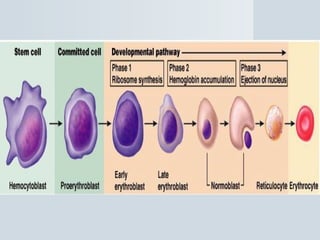
(erythro = RBC, poiesis = to make) = the process of RBC formation

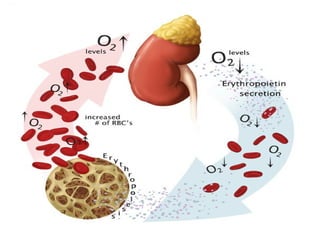
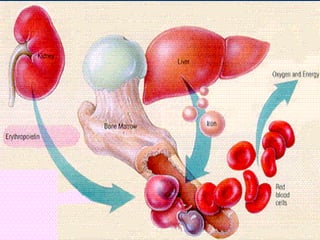
1- hypoxia
the low levels of oxygen in the blood stimulate the secretion of a
hormone called erythropoietin from kidney and liver which then
travels to the red bone marrow to stimulate the marrow to begin RBC
production.

2-ditary factors
A. Proteins
Proteins of high biological value
B. Minerals
1.Iron
• needed for the synthesize of Hb & myoglobin
• found in meat , liver and green vegetables
• requirement 10 mg/day for adult male
• loss in stool , sweat and exfoliated skin
-In the upper part of small intestine the ferrous combine with
apotransferrin to form transferrin that is absorbed by intestinal
epithelium to be stored under need
-When iron content in blood decreases it is released to be used in
bone marrow to form Hb of RBCs
-In liver and other tissues transferrin release its iron to combine with
apoferritin to store iron in form of ferritin
- When body needs iron the tissue ferritin release its iron in blood to
be carried as transferrin to the body where it is needed
2.Copper
•Catalyze the oxidation of ferrous iron into ferric state
•Carried by plasma protein
3.Cobalt
•Stimulate erythropoietin release from the kidney

C. Vitamins
1-Vitamin b12
•Needed for maturation of RBCs & DNA synthesis
•Present in diet as protein bound complex
•Requirement is 1-2 Mg/day
•Stored in liver (1-5 mg)
•Deficiency of vit. B12 causes megaloblastic pernicious anemia
2-folic acid
•Is water soluble vitamin essential for maturation of RBCs & DNA
synthesis
•Present in green vegetables ,fruits ,liver and meat
•Absorbed in small intestine and changed into active folinic acid
•Deficiency causes megaloblastic anemia

3-vitamin C
•Needed for reduction of ferric to ferrous and help maturation of RBCs

4-vitamin B complex
•Needed for normal erythropoiesis
3- Hormonal factors
1. Erythropoietin hormone from kidney and liver
1. Androgens: stimulate erythropoietin production from kidney
2. Thyroid hormone: stimulates bone marrow and Stimulates general
metabolism increase o2 consumption &decrease o2 supply causing
hypoxia to stimulate erythropoiesis
3. Glucocorticoids: acts as thyroid
4. Pituitary hormones: as growth hormone stimulate bone marrow
1. Haemopoietic growth factors : secreted by lymphocytes stimulate
bone marrow
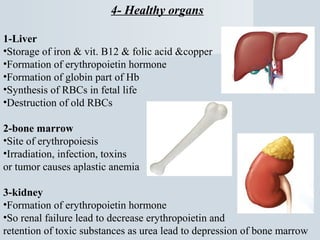
4- Healthy organs
1-Liver
•Storage of iron & vit. B12 & folic acid &copper
•Formation of erythropoietin hormone
•Formation of globin part of Hb
•Synthesis of RBCs in fetal life
•Destruction of old RBCs
2-bone marrow
•Site of erythropoiesis
•Irradiation, infection, toxins
or tumor causes aplastic anemia
3-kidney
•Formation of erythropoietin hormone
•So renal failure lead to decrease erythropoietin and
retention of toxic substances as urea lead to depression of bone marrow
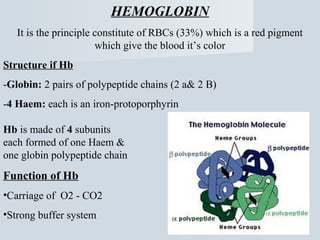
HEMOGLOBIN
It is the principle constitute of RBCs (33%) which is a red pigment
which give the blood it’s color
Structure if Hb
-Globin: 2 pairs of polypeptide chains (2 a& 2 B)
-4 Haem: each is an iron-protoporphyrin
Hb is made of 4 subunits
each formed of one Haem &
one globin polypeptide chain

Function of Hb
•Carriage of O2 - CO2
•Strong buffer system
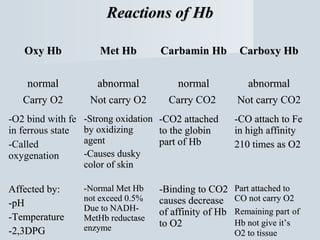
Reactions of Hb
Oxy Hb

Met Hb

Carbamin Hb

Carboxy Hb

normal
Carry O2

abnormal
Not carry O2

normal
Carry CO2

abnormal
Not carry CO2

-O2 bind with fe
in ferrous state
-Called
oxygenation

-Strong oxidation -CO2 attached
by oxidizing
to the globin
agent
part of Hb
-Causes dusky
color of skin

-CO attach to Fe
in high affinity
210 times as O2

Affected by:
-pH
-Temperature
-2,3DPG

-Normal Met Hb
not exceed 0.5%
Due to NADHMetHb reductase
enzyme

Part attached to
CO not carry O2
Remaining part of
Hb not give it’s
O2 to tissue

-Binding to CO2
causes decrease
of affinity of Hb
to O2
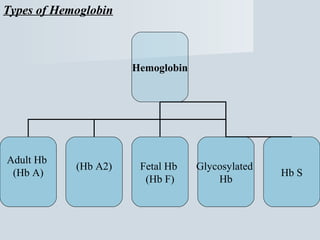
Types of Hemoglobin

Hemoglobin

Adult Hb
(Hb A)

(Hb A2)

Fetal Hb
(Hb F)

Glycosylated
Hb

Hb S
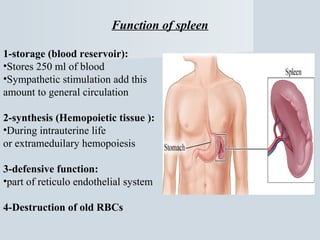
Function of spleen
1-storage (blood reservoir):
•Stores 250 ml of blood
•Sympathetic stimulation add this
amount to general circulation
2-synthesis (Hemopoietic tissue ):
•During intrauterine life
or extrameduilary hemopoiesis
3-defensive function:
•part of reticulo endothelial system
4-Destruction of old RBCs
Destruction of RBCs :
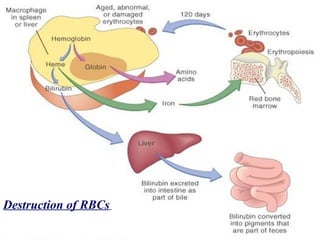
•Lifespan of RBCs = 120 days
•Old RBCs removed from blood by phagocytic cells in narrow
capillaries of RES (spleen) and Hb released
1- Globin: used in protein synthesis in liver
2- iron part of Haem: stored as ferritin in liver
3-protoprophyrin part of Haem: used in bile pigments (Bilirubin)
which is conjugated in liver then excreted in bile
Destruction of RBCs
Blood
Group
s
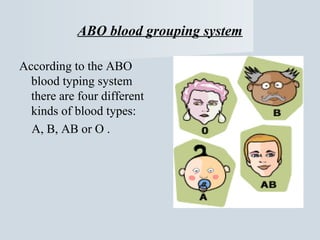
ABO blood grouping system
According to the ABO
blood typing system
there are four different
kinds of blood types:
A, B, AB or O .
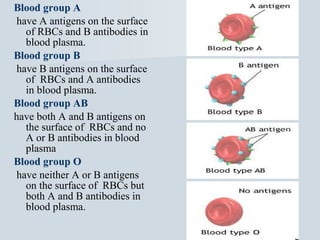
Blood group A
have A antigens on the surface
of RBCs and B antibodies in
blood plasma.
Blood group B
have B antigens on the surface
of RBCs and A antibodies
in blood plasma.
Blood group AB
have both A and B antigens on
the surface of RBCs and no
A or B antibodies in blood
plasma
Blood group O
have neither A or B antigens
on the surface of RBCs but
both A and B antibodies in
blood plasma.
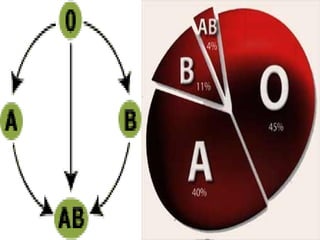
Blood transfusion



Universal Donor
Group O
– Carries no A or B
antigens
– Packed and
processed units have
little antibody




Universal Recipient
Group AB
– Patient has no antiA or anti-B present
– antibodies may be
present
The Rhesus (Rh) factor
•According to presence of Rh agglutinogen on RBCs membrane
1- Rh +ve = 85 % (have D-antigen may be DD or Dd)
2- Rh –ve = 15% (no D-antigen genotype is dd)
•D-antigen is the most important Rh-antigen
•Normally the plasma doesn’t have anti D-agglutinin
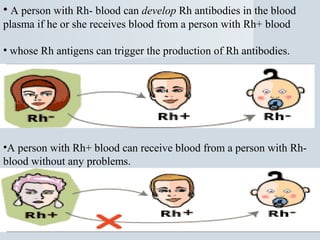
• A person with Rh- blood can develop Rh antibodies in the blood
plasma if he or she receives blood from a person with Rh+ blood
• whose Rh antigens can trigger the production of Rh antibodies.

•A person with Rh+ blood can receive blood from a person with Rhblood without any problems.
Blood Overview PPT

Blood Overview PPT

  • 1.
    ‫بسم ال الرحمنالرحيم‬ ‫]البقرة :23[‬
  • 2.
  • 3.
    Introduction Blood is composedof - 55% Plasma - 45% Cellular elements (RBC’s - WBC’s - Platlets) Physical properties of blood 1.Color : Red due to hemoglobin in RBC’s 2.pH : 7.3 - 7.4 3.Viscosity : 5 times as water causes resistance of flow
  • 4.
    4.Specific gravity:1.060 (ofplasma =1.030 & RBC’s =1.090) 5.Osmotic pressure: 5100-5500 mmHg Function of blood 1. Act as transport medium (O2 - CO2 - absorbed food) 2. Defensive function (WBCs attack foreign organisms) 3. Homeostatic function (regulation of .water content .temperature .pressure .pH )
  • 5.
    Blood volume Blood volume= 5 liters = 80 ml/kg (3L Plasma . 2L RBC’s) Blood vol. represents 80% of body weight The distribution of blood 55% in veins 7% in heart 15% in arteries 18% in pulmonary system 5% in capillaries
  • 6.
    The plasma Volume: 3 liter= 55% of blood volume =5 % of body weight Composition: 1.Water = 90% 2.Organic constituent = 9% -plasma proteins = 7.1 -7.4 gm% -others = 2% 3.Inorganic constituent =1%
  • 7.
    Plasma proteins Albumin Globulin fibrinogen prothrombin Amount 4.2 gm% 2.4gm% 0.2 gm% 0.01 gm% M.W 70.000 150.000 340.000 69.000 Site of synthesis liver 1.Liver 2.RES liver liver Main Function Osmotic Carrier Defensive Carrier Viscosity Clotting (I) (II) Clotting factor
  • 8.
    Sources of plasmaprotein 1. Food protein : Proteins with high biological value rich in essential amino acids 2. Tissue proteins : a. Reserved : 1. labile: plasma proteins stored in liver 2. dispensable: synthesized in liver during starvation b. Fixed : essential for cell life so it can’t be converted to plasma protein
  • 9.
    Hypoproteinemia Definition : Marked decreasein plasma proteins Causes : 1. Prolonged starvation 2. Decrease of absorption 3. Liver diseases : cirrhosis hepatitis 4. Kidney diseases : nephrosis 5. Congenital afibrinogenemia Effects : 1.Decrease of albumin decrease the osmotic pressure edema 2.Decrease of globulin decrease the immunity 3.Decrease of fibrinogen & clotting factors bleeding tendency
  • 10.
    Albumin / Globulinratio A/G ratio = 1.2 – 1.7 It decreases in case of 1.Liver diseases as hepatitis ( synthesis of albumin) 2.Kidney diseases as nephrosis ( loss of albumin) 3.Infection ( gamma globulin as a defense mechanism)
  • 11.
    The plasma Obtained by centrifugationof blood sample after adding anticoagulant 2. Contain all plasma proteins and all clotting factors 3. Clot on standing 4. Normal serotonin level 1.
  • 12.
    The serum Obtained by centrifugationof clotted blood sample 2. Contains all plasma proteins but no clotting factor (I & II &V & VIII 3. Not clot on standing 4. High serotonin level 1.
  • 13.
  • 14.
  • 15.
    Erythrocytes Shape: biconcave nonnucleated discs Volume: 90 It’s center appears paler than the periphery due to the biconcavity Structure: 1.cell membrane 2.submembranous cytoskeleton 3.contents of RBCs a. hemoglobin b. enzymes c. ions
  • 16.
    Sites of formationof RBC’s According to age 1.In fetus - Yolk sac : first few weeks of pregnancy - Liver &spleen : from 6 weeks to 6 month - Bone marrow : from the 6th month 2.In infant & Child - Red bone marrow of all bones 3.In adult - Red bone marrow is restricted to the central skeleton (flat bones) also proximal ends of long bones - the remaining change into yellow marrow which can be reactivated to red marrow in case of sever anemia
  • 19.
  • 20.
    Factors affecting Erythropoiesis (erythro= RBC, poiesis = to make) = the process of RBC formation 1- hypoxia the low levels of oxygen in the blood stimulate the secretion of a hormone called erythropoietin from kidney and liver which then travels to the red bone marrow to stimulate the marrow to begin RBC production. 2-ditary factors A. Proteins Proteins of high biological value
  • 22.
    B. Minerals 1.Iron • neededfor the synthesize of Hb & myoglobin • found in meat , liver and green vegetables • requirement 10 mg/day for adult male • loss in stool , sweat and exfoliated skin -In the upper part of small intestine the ferrous combine with apotransferrin to form transferrin that is absorbed by intestinal epithelium to be stored under need -When iron content in blood decreases it is released to be used in bone marrow to form Hb of RBCs -In liver and other tissues transferrin release its iron to combine with apoferritin to store iron in form of ferritin - When body needs iron the tissue ferritin release its iron in blood to be carried as transferrin to the body where it is needed
  • 23.
    2.Copper •Catalyze the oxidationof ferrous iron into ferric state •Carried by plasma protein 3.Cobalt •Stimulate erythropoietin release from the kidney C. Vitamins 1-Vitamin b12 •Needed for maturation of RBCs & DNA synthesis •Present in diet as protein bound complex •Requirement is 1-2 Mg/day •Stored in liver (1-5 mg) •Deficiency of vit. B12 causes megaloblastic pernicious anemia
  • 24.
    2-folic acid •Is watersoluble vitamin essential for maturation of RBCs & DNA synthesis •Present in green vegetables ,fruits ,liver and meat •Absorbed in small intestine and changed into active folinic acid •Deficiency causes megaloblastic anemia 3-vitamin C •Needed for reduction of ferric to ferrous and help maturation of RBCs 4-vitamin B complex •Needed for normal erythropoiesis
  • 25.
    3- Hormonal factors 1.Erythropoietin hormone from kidney and liver 1. Androgens: stimulate erythropoietin production from kidney 2. Thyroid hormone: stimulates bone marrow and Stimulates general metabolism increase o2 consumption &decrease o2 supply causing hypoxia to stimulate erythropoiesis 3. Glucocorticoids: acts as thyroid 4. Pituitary hormones: as growth hormone stimulate bone marrow 1. Haemopoietic growth factors : secreted by lymphocytes stimulate bone marrow
  • 26.
    4- Healthy organs 1-Liver •Storageof iron & vit. B12 & folic acid &copper •Formation of erythropoietin hormone •Formation of globin part of Hb •Synthesis of RBCs in fetal life •Destruction of old RBCs 2-bone marrow •Site of erythropoiesis •Irradiation, infection, toxins or tumor causes aplastic anemia 3-kidney •Formation of erythropoietin hormone •So renal failure lead to decrease erythropoietin and retention of toxic substances as urea lead to depression of bone marrow
  • 28.
    HEMOGLOBIN It is theprinciple constitute of RBCs (33%) which is a red pigment which give the blood it’s color Structure if Hb -Globin: 2 pairs of polypeptide chains (2 a& 2 B) -4 Haem: each is an iron-protoporphyrin Hb is made of 4 subunits each formed of one Haem & one globin polypeptide chain Function of Hb •Carriage of O2 - CO2 •Strong buffer system
  • 29.
    Reactions of Hb OxyHb Met Hb Carbamin Hb Carboxy Hb normal Carry O2 abnormal Not carry O2 normal Carry CO2 abnormal Not carry CO2 -O2 bind with fe in ferrous state -Called oxygenation -Strong oxidation -CO2 attached by oxidizing to the globin agent part of Hb -Causes dusky color of skin -CO attach to Fe in high affinity 210 times as O2 Affected by: -pH -Temperature -2,3DPG -Normal Met Hb not exceed 0.5% Due to NADHMetHb reductase enzyme Part attached to CO not carry O2 Remaining part of Hb not give it’s O2 to tissue -Binding to CO2 causes decrease of affinity of Hb to O2
  • 30.
    Types of Hemoglobin Hemoglobin AdultHb (Hb A) (Hb A2) Fetal Hb (Hb F) Glycosylated Hb Hb S
  • 31.
    Function of spleen 1-storage(blood reservoir): •Stores 250 ml of blood •Sympathetic stimulation add this amount to general circulation 2-synthesis (Hemopoietic tissue ): •During intrauterine life or extrameduilary hemopoiesis 3-defensive function: •part of reticulo endothelial system 4-Destruction of old RBCs
  • 32.
    Destruction of RBCs: •Lifespan of RBCs = 120 days •Old RBCs removed from blood by phagocytic cells in narrow capillaries of RES (spleen) and Hb released 1- Globin: used in protein synthesis in liver 2- iron part of Haem: stored as ferritin in liver 3-protoprophyrin part of Haem: used in bile pigments (Bilirubin) which is conjugated in liver then excreted in bile
  • 33.
  • 34.
  • 35.
    ABO blood groupingsystem According to the ABO blood typing system there are four different kinds of blood types: A, B, AB or O .
  • 36.
    Blood group A haveA antigens on the surface of RBCs and B antibodies in blood plasma. Blood group B have B antigens on the surface of RBCs and A antibodies in blood plasma. Blood group AB have both A and B antigens on the surface of RBCs and no A or B antibodies in blood plasma Blood group O have neither A or B antigens on the surface of RBCs but both A and B antibodies in blood plasma.
  • 37.
    Blood transfusion   Universal Donor GroupO – Carries no A or B antigens – Packed and processed units have little antibody   Universal Recipient Group AB – Patient has no antiA or anti-B present – antibodies may be present
  • 39.
    The Rhesus (Rh)factor •According to presence of Rh agglutinogen on RBCs membrane 1- Rh +ve = 85 % (have D-antigen may be DD or Dd) 2- Rh –ve = 15% (no D-antigen genotype is dd) •D-antigen is the most important Rh-antigen •Normally the plasma doesn’t have anti D-agglutinin
  • 40.
    • A personwith Rh- blood can develop Rh antibodies in the blood plasma if he or she receives blood from a person with Rh+ blood • whose Rh antigens can trigger the production of Rh antibodies. •A person with Rh+ blood can receive blood from a person with Rhblood without any problems.