Plasma cell Dyscrasias/Paraproteinemia
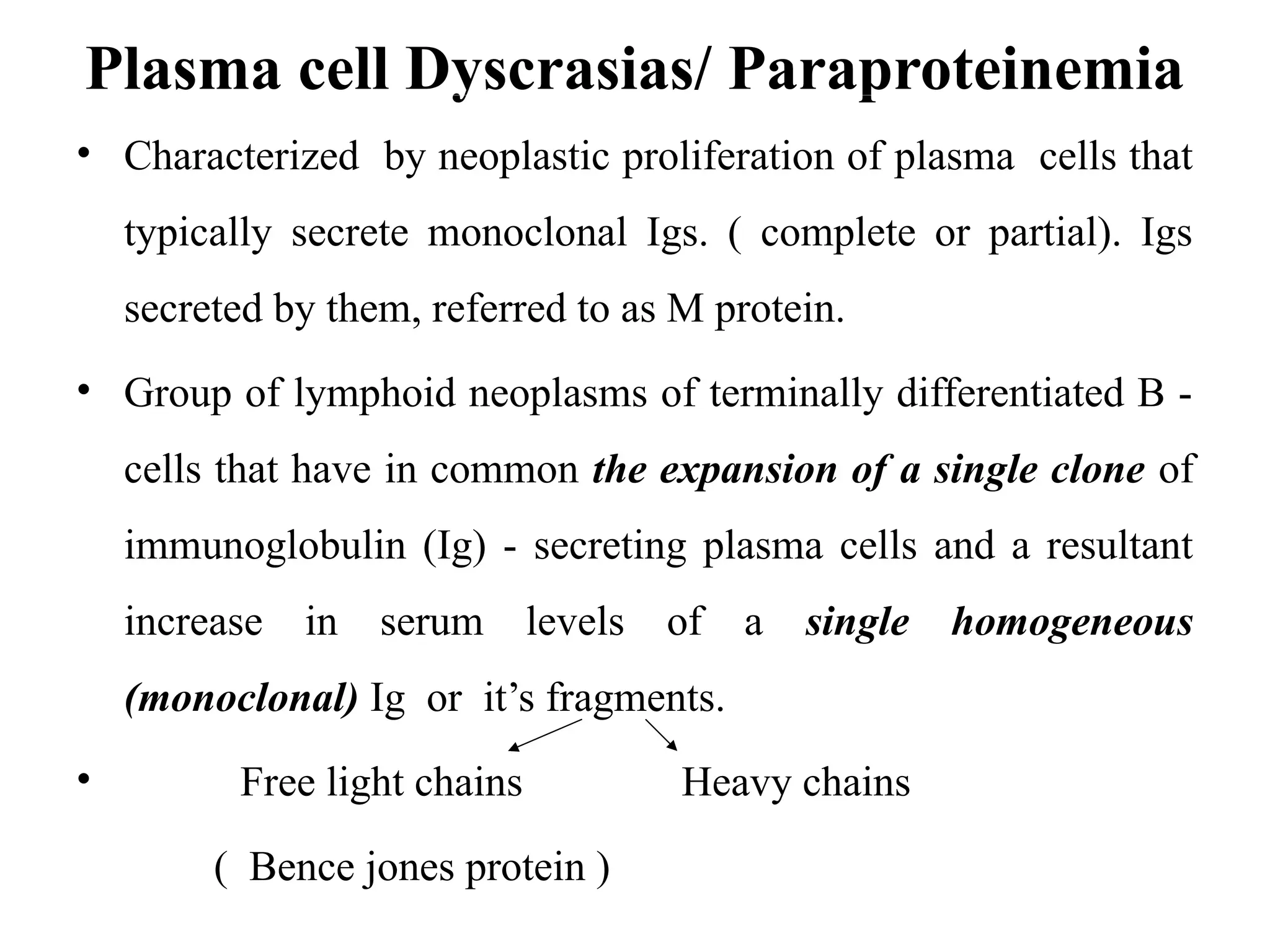
• Characterized by neoplastic proliferation of plasma cells that
typically secrete monoclonal Igs. ( complete or partial). Igs
secreted by them, referred to as M protein.
• Group of lymphoid neoplasms of terminally differentiated B -
cells that have in common the expansion of a single clone of
immunoglobulin (Ig) - secreting plasma cells and a resultant
increase in serum levels of a single homogeneous
(monoclonal) Ig or it’s fragments.
• Free light chains Heavy chains
( Bence jones protein )
4.
• Plasma celldyscrasias can be benign or malgnant (more
often).
• 15 % of all malignant white cell diseases.
• 1 % of all cancer deaths.
5.
M-component can alsobe detected in –
• LYMPHOID NEOPLASMS – CLL, some T and B cell neoplasms
• NON-LYMPHOID NEOPLASMS – CML, Breast Ca, Colon Ca
• NON NEOPLASTIC CONDITIONS – Cirrhosis, Sarcoidosis,
Gaucher’s disease, Parasitic infection
• AUTOIMMUNE DISEASES – RA, Myasthenia gravis, Cold
agglutinin disease
• SKIN DISEASES – Lichen myxedematous, Necrobiotic
xanthogranuloma
Etiology
• Unknown
• VariousPredisposing Factors
• Ionizing radiation
• Chromosomal translocation
(11; 14) commonest
Other 13q 14 deletion
17p 13 deletion
• Over expression of MYC or Ras gene
• Mutation in P53 & Rb-1 gene
• Exposure to metals (Nickel)
• Benzene & Petroleum product
• Silicon, Wood and Leather Industries
• Infection of marrow macrophages
with human herpes virus 8 .
11.
Type of MonoclonalParaproteins Percentage
IgG ………………………… ............................. 52
IgA …………………………………………… 21
IgD …………………………………………… 2
IgE …………………………………………….<0.01
L chains ( K or L) only ……………………. .... 11
H chain (G or A) only …………………….. …. <1
2 or more monoclonal paraproteins ………… <1
No monoclonal paraprotein ………………. … 1
IgM …………………………………………….. . 12
12.
Pathophysiological effects ofparaproteins
Raised serum globulin level
Hypoalbuminemia
Hyponatremia
Dilutional anemia
Raised ESR
Rouleux formation in RBC
Hyperviscosity
Interference with Platelet function
Interference with Coagulation pathway
Proteinuria
Renal failure
Amyloidosis
Cryoglobulinemia
13.
Investigations in anysuspected Monoclonal Gammopathy should
include to accurately classify the disorder:
• Complete Blood Count ( look for anemia)
• Comprehensive Metabolic Panel
– Look for renal insufficiency, hypercalcemia and subtle clues
like decreased anion gap .
– Total protein and albumin level. Determine Globulin component.
Too low globulin ( < 2gm%) or Elevated Globulin ( > 3.5gm%) is
concerning : Determine if Polyclonal vs. Monoclonal. Evaluate
further with :
» Quantitative Immunoglobulins : Increase in all components
usually, polyclonal. Increase in single component with
reciprocal decrease of uninvolved globulin usually may
suggest monoclonal .
Investigations
14.
» Serum ProteinElectrophoresis with immunofixation if
monoclonal gammopathy is suspected.
» 24Hr-Urine protein electrophoresis with urine
immunofixation ( Serum Free Light Chain assay (κ/λ
ratio) may be used in place of UPEP}
» Bone marrow biopsy to evaluate % plasma cells if there
is monoclonal protein or abnormal UPEP or Light chain
assay or if strong clinical picture of myeloma.
» Skeletal survey if monoclonal gammopathy has been
established ( Bone scans are usually, negative in MM)
» Beta-2 microglobulin and Albumin for staging and
prognosis in MM ( once diagnosis is made).
15.
Serum Protein
Electrophoresis
Serum ProteinElectrophoresis :
• Serum is placed on special
paper treated with agarose gel
and exposed to an electric
current. This separates the
serum protein components
into five classifications by size
and electrical charge : serum
albumin, alpha-1 globulins,
alpha-2 globulins, beta
globulins, and gamma
globulins.
• Immunoglobulins ( IgG, IgM,
IgA) usually migrate to gamma
region but may sometimes
extend to beta region.
• SPEP should always be
performed in combination with
serum immunofixation in order
to determine clonality
SPEP showing Polyclonal
Gammopathy
•Shows a broad based
peak in gamma
region .
• Seen in chronic
infections,
inflammation,
connective tissue
disease,
lymphoproliferative
disease.
18.
n
• More sensitivethan SPEP
• Immunofixation is performed when
SPEP shows a sharp “peak” or a plasma
cell disorder is suspected despite a
normal SPEP
• Immunofixation always done to confirm
the presence of M-Protein and to
determine the type (IgM or IgG etc
and the light chain restriction : k or λ)
• Why do both SPEP and IF ? Why not
just IF in initial diagnosis ?
• Unlike SPEP, immunofixation does
not give an estimate of the size of
the M protein (ie, its serum
concentration), and thus should be
done in conjunction with
electrophoresis.
• Most commonage group > 50 yrs.
• M>F
All three criteria must be met
• Presence of a serum or urinary monoclonal protein
• Presence of 10 percent or more clonal plasma cells in the
bone marrow or a plasmacytoma
• Presence of end organ damage felt related to the plasma
cell dyscrasia, such as: CRAB : Hypercalcemia (calcium >
11.5gm%), Renal Insufficiency, Anemia (Hgb < 10gm%)
or Lytic bone lesions
Multiple Myeloma
23.
Pathogenesis
Marrow stromal cellssecrete IL-6
Activation of JAK STAT pathway Activation of RAS- MAP kinase pathway
Activation of growth factors
Inhibition of apoptosis activity
Proliferation of Plasma cell
Secrete/ express various cytokines.ie
TNFα, MIP-1α, SDF-1, IL-1β
↑ proliferation & differentiation of osteoclasts
Bone resorption and destruction
Secrete/ express IL-3, TGF β &HGF
Inhibition of osteoblastic activity
Bone Lesions :
Conventionalradiographs (Skeletal Survey) abnormal in 80% of
patients who present with multiple myeloma
26.
Round lesions filledwith a soft reddish material are
indicative of foci of myeloma in this section of vertebral bone.
27.
The skull demonstratesthe characteristic rounded
"punched out" lesions of multiple myeloma.
29.
PLASMABLAST
• Diffuse chromatinpattern
• Nucleus >10 μm
• Nucleolus greater than 2 μm
• Concentrically placed nucleus
with little or no hof
30.
Plasma Cell
Plasma cells:
• Terminally differentiated B-
cells
• Not normally found in
peripheral blood .
• Account for less than 3.5%
of nucleated cells in the
bone marrow
• Oval cells with low N:C
ratio. Cytoplasm is
basophilic blue. Nucleus
(30-40% of the cell) is oval
or round and typically
placed eccentrically (to one
side) of the cell. .
31.
RUSSELL BODIES
• Globules(2-3 μm) of accumulated
immunoglobulins in the cytoplasm of
plasma cells
• Usually round
• May be found in normal bone marrow
• 1st described by William Russell
32.
MOTT CELLS/MORULA
CELLS
•Plasma cellscrowded
with Russell bodies
• An obstruction
blocks the release of
Golgi secretions
• These cells can be
found in any case of
chronic plasmacytosis
BONE MARROW
At lowpower, the abnormal plasma cells of
multiple myeloma fill the marrow.
36.
BONE MARROW
At highpower, the plasma cells of multiple myeloma
here are very similar to normal plasma cells, but they
may also be poorly differentiated.
37.
PATTERNS OF BONEMARROW
INVOLVEMENT IN MYELOMA
• Interstitial
• Focal
• Mixed
• Diffuse
38.
MM & SkeletalComplications
~ 80% of patients with
multiple myeloma will have
evidence of skeletal
involvement on skeletal survey
– Vertebrae: 65%
– Ribs: 45%
– Skull: 40%
– Shoulders: 40%
– Pelvis: 30%
– Long bones: 25%
Dimopoulos M, et al. Leukemia. 2009:1-
Renal Insufficiency :
Serumcreatinine increased in > 50% at diagnosis
Creatinine >2g/dL in 20% of patients
Renal failure may be presenting manifestation
Major Causes :
– Myeloma cast nephropathy
– Hypercalcemia
– Amyloidosis
– Radiocontrast dye in a patient with myeloma
Spinal Cord Compression: An Oncological Emergency
Spinal cord compression occurs in 5 % of patients with
multiple myeloma ( plasmacytoma or pathological fracture
related)
Managed with urgent:
1. Corticosteroids
2.Neurosurgical intervention (laminectomy or
anterior decompression in pathological #) +
radiation therapy to preserve neurological function
3. Radiation therapy alone ( plasmacytoma)
44.
Deletion 17p andAbnormalities associated with chromosome 13 carry
a particularly unfavorable prognosis & respond poorly to therapy
45.
Multiple Myeloma
Staging :
InternationalStaging System :
Stage I — B2M <3.5 mg/L and serum albumin ≥3.5 g/dL
Stage II — neither stage I nor stage III
Stage III — B2M ≥5.5 mg/L
Median overall survival for patients with ISS stages I, II,
and III are 62, 44, and 29 months
46.
Treatment Decisions :
•Indications for treatment : presence of any of CRAB ( bone lesions
can be diffuse osteopenia alone)
• Risk Stratification :
• FISH for detection of t(4;14), t(14;16), and del17p13
• Conventional cytogenetics (karyotyping) for detection of del 13
or hypodiploidy
• The presence of any of the above markers defines high risk
myeloma, which encompasses the 25 percent of MM patients
who have a median survival of approximately two years or less
despite standard treatment
47.
Clinical Features
• Bonepain : Pathological fracture
• Hypercalcemia : confusion, constipation, vomiting.
• Anemia
• Recurrent infections with bacteria such as S. aureus,
S. pneumoniae, and E. coli, resulting from the marked
suppression of normal humoral immunity.
• Renal insufficiency
• Bleeding manifestations
• Amyloidosis – resulting in macroglossia
48.
Major criteria
>30% bone marrow plasma cells
M protein level -Serum IgG > 3.5g/dl or IgA> 2g/dl
Urinary κ or λ > 1g/24 hours
Biopsy - proven plasmacytoma
Minor criteria
10% to 30% bone marrow plasma cells
Monoclonal protein present but less than above
Decreased normal immunoglobulin levels
Lytic bone lesions
Diagnosis : One major and one minor criteria or
Three minor criteria including 1 and 2
DURIE & SALMON DIAGNOSTIC CRITERIA
2. Bradshaw’s Test:
» Layer few ml of urine on to few ml of conc.
Hydrochloric acid.
» BJ proteins is precipitated by acid giving a
white ring at junction.
» Screening test
» Should confirm by heating test
» If Bence-Jones proteins present, this test will
give positive even after diluting the urine
51.
3. Osgood andHaskin Test :
» Add 0.5 ml of 50% acetic acid & 1.5 ml of
saturated sodium chloride solution to 2.5 ml
of urine.
» A ppt at room temp. appear on adding salt
solution is strongly in favour of Bence-Jones
proteins.
» Heat the mixture, note the temp at which
any change occur.
» If BJ proteins present ppt increase in amount
at 40o
c , redissolve on boiling.
» Albumin & globulin usually appear only on
heating, and boiling has no effect on the
amount of the precipitate.
52.
IMMUNOHISTOCHEMISTRY IN
PLASMA CELLDYSCRASIAS
• • Assessment of quantity of plasma cells on
• bone marrow sections
• • Identification of a monoclonal plasma cell
• proliferation
• • Distinction of myeloma from other
• neoplasms
Monoclonal Gammopathy ofUndetermined
Significance (MGUS)
• Asymptomatic monoclonal gammopathy,more common type.
• Denotes presence of an M-protein in a patient without a
plasma cell or lymphoproliferative disorder i.e; Undetermined
Significance
• Precursor lesion with a tendency to evolve to multiple
myeloma.
• No treatment required .
• 1/4 with stable levels of M-spike,1/4 M-spike increases but
does not show criteria for myeloma,1/4 develop into
myeloma,1/4 die of other causes.
55.
• Incidence ofMGUS increases with age :
• 1% of adults
• 3% of adults over age 70 years
• 11% of adults over age 80 years
• 14% of adults over age 90 years
• Significance : Can progress to monoclonal Disease
IgG or IgA MGUS IgM
MGUS
56.
DIAGNOSTIC CRITERIA FORMGUS
• <10% Plasma cell in bone marrow.
• M protein present, stable range.
• levels of M protein/M-spike: IgG < 3g, IgA < 2g
,LC<1g/day in the serum.
• Normal immunoglobulins - normal levels
• No Bence-Jones proteinuria
• No anemia
• No Renal failure
• No lytic bone lesion & hypercalcemia(CRAB)
• Normal β2 microglobulin level
57.
• Predictors ofProgression :
• Size of the M-protein at the time of recognition of MGUS -
most important predictor of progression
• IgM & IgA monoclonal proteins have a greater risk of
progression than an IgG M-protein.
• Risk of progression does not go away with time!
– Risk of progression 1% per year
– CUMULATIVE RISK
• 10% at 10 years, 25% at 25 years from diagnosis
• So, Management :
MGUS - Progression
58.
Smoldering multiple myeloma
•M protein present, stable
• levels of M protein: IgG ≥ 3,0g, IgA ≥ 2g, LC
≥ 1g/day
• normal immunoglobulins - normal levels
• marrow plasmacytosis ≥ 10%
• complete blood count - normal
• no lytic bone lesions
• no signs of disease ( SPEP, CBC, Creatinine and
calcium every 3 to 4 month and Skeletal Survey
annually to pick up asymptomatic bone lesions)
59.
INDOLENT MYELOMA
• Mcomponent: IgG <7g/dl, IgA <5g/dl
• Rare bone lesions (< 3 lytic lesions),
without compression fractures
• Normal hemoglobin, serum calcium and
creatinine
• No infections
60.
NON-SECRETORY MYELOMA
• <1%of Myelomas
• • No serum or urine monoclonal protein
• • Renal failure and hypercalcemia are
• generally lacking
• • Immunostaining for a monoclonal protein on
bone marrow sections may establish the
diagnosis
• • Rarely there is no monoclonal protein
synthesized
• • Must rule out IgD and IgE myeloma
61.
WHO Criteria
• Monoclonalgammopathy of undetermined significance a
– Serum monoclonal protein (<3 g/dl)
– Bone marrow <10% plasma cells
– No anemia, renal failure, or hypercalcemia (CRAB)
• Smoldering multiple myeloma a
– Serum monoclonal protein (=3 g/dl) or =10% marrow plasma cells or aggregates
on biopsy, or both
– No anemia, renal failure, or hypercalcemia attributable to myeloma
• Multiple myeloma
– Monoclonal protein present in serum or urine
– =10% marrow plasma cells on biopsy or histologic evidence of plasmacytoma
• Plus one or more of the following:
– Anemia
– Lytic lesions or osteoporosis and =30% plasma cells in marrow
– Bone marrow plasma cell labeling index =1%
– Renal insufficiency
– Hypercalcemia
62.
Solitary Plasmacytoma
Localized plasmacell tumor
• Absence of a plasma cell infiltrate in random marrow biopsies
• No evidence of other bone lesions by radiographic examination
• Absence of renal failure, hypercalcemia or anemia
63.
• Plasma celltumors that arise outside the bone marrow
and no features of Multiple Myeloma
• Most Common Primary Sites - Head and Neck
region: Upper air passages and oropharynx (May
involve draining lymph nodes.
• Less Common Sites – Lymph nodes (primary), salivary
glands, spleen, liver, etc.
• 25% have small monoclonal spike
• Rare dissemination, rarer evolution to myeloma
• Management :
• If completely
resected during
biopsy, no further
therapy
• If incompletely
resected, radiation
therapy locally
Extramedullary Plasmacytoma
Plasma Cell
Leukemia
• >2X 10⁹/L plasma cells in
blood ( seen on peripheral
smear)
• Younger age
• Higher incidence of
organomegaly and
lymphadenopathy
• More extensive bone
marrow infiltration
• Renal failure more common
• Less bone pain, fewer lytic
lesions
• Poor response to therapy
Peripheral smear showing
Plasma cells
67.
• Monoclonal gammopathy- IgM type
• Lymphoplasmacytic lymphoma
• Median age at diagnosis - 60 yrs
• Presentation :
• Hyperviscosity syndrome (15%) : visual impairment,
neurologic manifestations
• Bleeding ( Acquired VWD)
• Cryoglobulinaemia
• Organomegaly, lymphadenopathy + (20%-40%)
• Autoimmune hemolysis - common
• Bone marrow involvement 90%
• Lytic bone lesions 2%
• Hypercalcemia 4%
Waldenstrom’s Macroglobulinemia
68.
• Management :
–Asymptomatic patients not treated until symptoms develop
– If Hyperviscocity features urgent Plasmapheresis
– Symptomatic WM : Rituximab based therapy
69.
• Refers toa variety of conditions in which amyloid proteins
are abnormally deposited in organs and/or tissues. A protein
is described as amyloid if, due to an alteration in its
secondary structure, it takes on a particular aggregated
insoluble form similar to the beta-pleated sheet
FEATURES OF AMYLOIDOSIS :
– 89% have M protein, 70% lambda
• 72%serum
• 73% urine
– M protein - 7% pts have >3 gm/ dl
– Hypogammaglobulinemia - 20%
– Median BM plasma cells are 7% ( less than 10%)
– Myeloma : 20% of patients have MM
Amyloidosis
70.
• Symptoms arerelated to Organ involvement. Arrhythmias in
cardiac amyloidosis, Renal failure, When the amyloid fibrils
and oligomers get to the skin they can cause skin lesions and
petechiae. One of the most classic feature is macroglossia
71.
Evaluate for amyloidosisin patients with a monoclonal protein
in serum or urine plus:
• Nephrotic syndrome or renal insufficiency
• Congestive heart failure
• Peripheral neuropathy
• Carpal tunnel syndrome
• Hepatomegaly
• Idiopathic malabsorption
– Diagnostic Criteria:
– Tissue biopsy showing typical morphology
– Apple green birefringence under polarized light
after Congo Red staining
– Typical fibrillar ultrastructure
– Diagnostic methods and Sensitivity
» Bone marrow examination 56%
» Abdominal fat aspiration 80%
» Combined BM & fat aspirate 89%
Heavy chain disease
•Neoplastic proliferation of B cells producing only heavy
chains.
• Depending upon the type of heavy chains , these are 3 types
– α heavy chain disease : commonest type , show
predilection for intestine and respiratory tract lymphoid
tissue
– µ heavy chain disease : Rarest,
– γ heavy chain disese: ( Franklin disease)
77.
α Heavy chaindisease
• The most common type of heavy chain disease
• Younger patients, Mediterranean area
• Serum electrophoresis: a broad band in the α2-β region
• Hypogammaglobulinemia and decreased level of albumin
• Immunoelectrophoresis: alpha chains but no light chains
• No BJ protein
• Peripheral blood: normal
• BM: slight/moderate increase in plasma cells
• Respiratory lymphoplasmacytosis
• Lymphoma of the small intestine, severe malabsorption
syndrome
78.
γ Heavy chaindisease
• The second most common type
• Lymphadenopathy
• Hepatosplenomegaly in some cases
• Often normal pr electrophoresis: in serum electrophoresis: the
M-band in the gamma or beta regions, M-band reveals more in
immunoelectrophoresis
• Urine electrophoresis mimics the serum
immunoelectrophoresis
• IgA and IgM are not decreased
• Probability of: lymphocytosis, pancytopenia, atypical
lymphocytes, eosinophilia, and plasma cells
• BM: lymphoplasmacytosis, eosinophils goes up
• The disease may end up to lymphoma
79.
µ Heavy chaindisease
• Parallel with CLL
• Pr electrophoresis: normal or small spike in the beta region
• Immunoelectrophoresis: monoclonal M-band
• BJ Proteinuria, Kappa light chain
• BM: mimic CLL: 70 to 80% lymphocytes, few plasma cells
• Amyloidosis and osteoporosis
80.
δ Heavy chaindisease
• Very rare disease
• Similar to Multiple myeloma
• In serum electrophoresis:
– M band in the β-γ region
– No BJ protein
– BM: plasmacytosis, osteolytic lesions
81.
THANK YOU
What isKahler’s Disease?
It’s Multiple myeloma.
Kahler’s disease is named after an
Austrian doctor called Otto Kahler
who first investigated and described
MM
Editor's Notes
#13 The idea behind Upep with Immunofixation in addition to SPEP is that sometimes, a complete monoclonal protein ( complete intact immunoglobulin) may not detected in the blood but you may have light chain excretion in the urine ( bence jones proteinuria) which can be missed if UPEP is not done. Light chains only get excreted when their production goes beyond renal threshold – so, serum Free light chain assay will be always abnormal
#15 Albumin + globulin . Globulin = alpha, beta and gamma. Immunoglobulins are gamma globulins….theyt migrate to gamma area
#18 SPEP is a useful screening test however, an M-protein may be overlooked or an apparent M-protein may actually represent a polyclonal increase in immunoglobulins or a nonimmunoglobulin.
Immunofixation will detect a serum M-protein at a concentration of at least 0.02 g/dL and a urine M-protein at a concentration of ≥0.004 g/dL.
Only in initial diagnosis - When following patients with multiple myeloma, MGUS, or a related disorder, once the presence of a monoclonal protein and its type are initially confirmed by immunofixation, it is not necessary to repeat immunofixation unless needed to document complete response to therapy. Patients can usually be followed with electrophoresis of serum (SPEP) or urine (UPEP) proteins.
#22 HENCE, BOTH SPEP AND UPEP ARE IMP IN MM DIAGNOSIS. UPEP CAN BE REPLACED BY SERUM FLC ASSAY IN INITIAL DIAGNOSIS BUT NOT IN FOLLOW UP OF MM
Note: no specific level of M-protein is used as a cutoff value since approximately 40 percent of patients with symptomatic MM will have an M-protein of less than 3 g/dL. Also note that, in true non-secretory MM (approximately 3 percent of MM), an M protein will not be detectable in the serum or urine
Note: approximately 4 percent of patients may have fewer than 10 percent bone marrow plasma cells since marrow involvement may be focal, rather than diffuse. Repeat bone marrow biopsy should be considered in such patients. A diagnosis of MM can be made, if other diagnostic criteria are fulfilled, after histopathologic confirmation of a soft tissue or bony plasmacytoma.
#25 HENCE, BOTH SPEP AND UPEP ARE IMP IN MM DIAGNOSIS. UPEP CAN BE REPLACED BY SERUM FLC ASSAY IN INITIAL DIAGNOSIS BUT NOT IN FOLLOW UP OF MM
#38 Approximately 80% of patients with multiple myeloma have some evidence of skeletal involvement. Most lesions are typically found within the axial skeleton and are all osteolytic. Although the majority of this skeletal involvement will be observed on skeletal survey, further diagnostic testing can look for areas of focal lesions. Some of the areas that may also reveal lytic lesions include the vertebrae (65%), the ribs (45%), the skull (40%), the shoulders (40%), the pelvis (30%), and the long bones (25%). The picture on the slide illustrates a pathologic fracture associated with 2 significant lytic lesions.
#40 HENCE, BOTH SPEP AND UPEP ARE IMP IN MM DIAGNOSIS. UPEP CAN BE REPLACED BY SERUM FLC ASSAY IN INITIAL DIAGNOSIS BUT NOT IN FOLLOW UP OF MM
#41 HENCE, BOTH SPEP AND UPEP ARE IMP IN MM DIAGNOSIS. UPEP CAN BE REPLACED BY SERUM FLC ASSAY IN INITIAL DIAGNOSIS BUT NOT IN FOLLOW UP OF MM
#42 Fig 1. The characteristic appearance of light chain deposition disease by light microscopy is that of a nodular glomerulosclerosis, which strongly resembles diabetic nephropathy, as in this case (periodic acid-Schiff stain; original magnification x400).
Fig 5. Glomerular capillary loop, mesangial staining, and linear tubular staining are characteristic of light chain deposition disease. Either kappa or lambda light chain paraprotein may cause light chain deposition disease, although kappa more commonly is the culprit (antibody to kappa light chain, immunofluorescence; original magnification x200).
Fig 3. Close-up of intratubular refractile casts with surrounding syncytial giant cell reaction with chronic tubulointerstitial nephritis and fibrosis, characteristic of myeloma cast nephropathy (PAS stain; original magnification x400).
Fig 7. When the Congo red stain is viewed under polarized light, areas of amyloid show apple green birefringence. In this case, amyloid deposits are seen in the mesangial areas, the capillary loops, and in vessels (Congo red stain; original magnification x100).
#43 HENCE, BOTH SPEP AND UPEP ARE IMP IN MM DIAGNOSIS. UPEP CAN BE REPLACED BY SERUM FLC ASSAY IN INITIAL DIAGNOSIS BUT NOT IN FOLLOW UP OF MM
#57 Remember to call it MGUS m-protein must be less than 3gm%. If it larger, it is no longer MGUS . So, periodic monitoring is important , usually on yearly basis, if initial m-protein is large, may monitor at shorter intervals– during monitoring, if any increase in size > 3 , BM biopsy may be needed to rule our malignant plasma cell disorder!!
#67 Hyperviscosity features : Blurred vision, headaches, dizziness, paresthesias, retinal vein engorgement and flame-shaped hemorrhages, papilledema, stupor and com