Cytogenetic Analysis in
Hematological Malignancies
Hwei-Fang Tien, National Taiwan
University Hospital
Cytogenetics in Hematological Malignancies
• Most patients with hematological malignancies
have clonal chromosomal abnormalities.
• Some recurrent chromosomal abnormalities are
tumor- and even subtype-specific, so are good
for diagnosis and classification.
• The pattern of chromosomal aberrations may
predict treatment response and clinical
outcome and is good for risk stratification.
• Genes located at the breakpoints of the recurrent
abnormalities play an important role in the
process of tumorigenesis and can be the target of
treatment.
Purpose of Cytogenetic Study in
Hematological malignancies
1. Diagnosis and classification
2. Risk stratification
3. Selection of proper treatment
4. Follow-up of the response
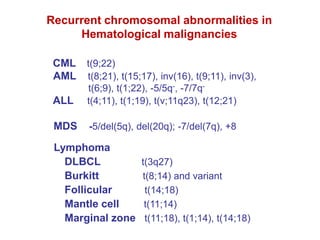
Recurrent chromosomal abnormalities in
Hematological malignancies
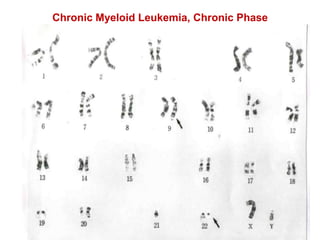
CML t(9;22)
AML t(8;21), t(15;17), inv(16), t(9;11), inv(3),
t(6;9), t(1;22), -5/5q-, -7/7q-
ALL t(4;11), t(1;19), t(v;11q23), t(12;21)
MDS -5/del(5q), del(20q); -7/del(7q), +8
Lymphoma
DLBCL t(3q27)
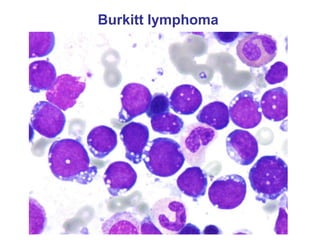
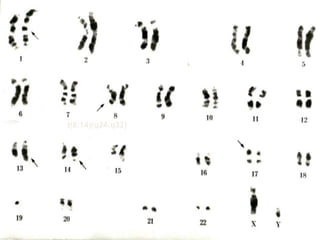
Burkitt t(8;14) and variant
Follicular t(14;18)
Mantle cell t(11;14)
Marginal zone t(11;18), t(1;14), t(14;18)
Case Demonstration
Diagnosis
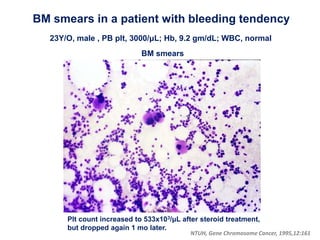
BM smears in a patient with bleeding tendency
NTUH, Gene Chromosome Cancer, 1995,12:161
23Y/O, male , PB plt, 3000/μL; Hb, 9.2 gm/dL; WBC, normal
Plt count increased to 533x103/μL after steroid treatment,
but dropped again 1 mo later.
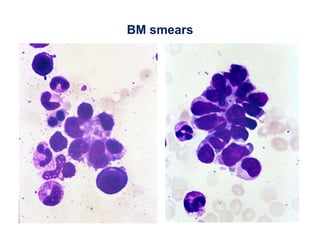
BM smears
BM smears
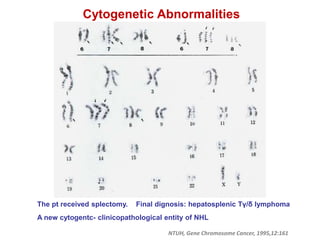
Cytogenetic Abnormalities
NTUH, Gene Chromosome Cancer, 1995,12:161
The pt received splectomy. Final dignosis: hepatosplenic Tγ/δ lymphoma
A new cytogentc- clinicopathological entity of NHL
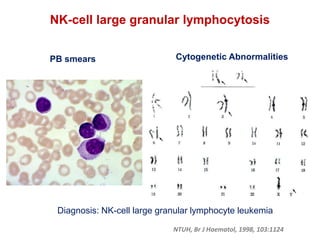
NK-cell large granular lymphocytosis
NTUH, Br J Haematol, 1998, 103:1124
Cytogenetic Abnormalities
Diagnosis: NK-cell large granular lymphocyte leukemia
PB smears
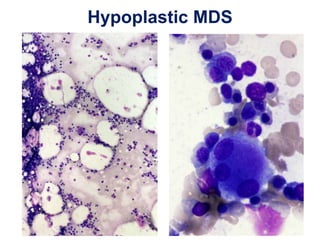
Differential diagnosis of hypoplastic MDS with AA
BM smears
Name: 林X榮,
46, XY, -7 [20]
Chromosomal abnormality
Diagnosis: hypoplastic MDS
NTUH, Leukemia, 2008, 22:544
Case Demonstration
For Lymphoma Staging
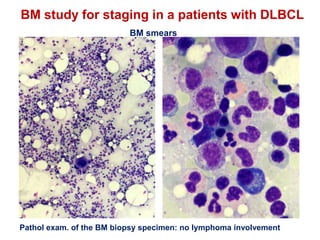
BM study for staging in a patients with DLBCL
Pathol exam. of the BM biopsy specimen: no lymphoma involvement
BM smears
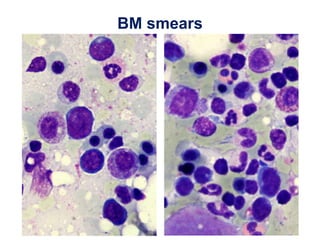
BM smears
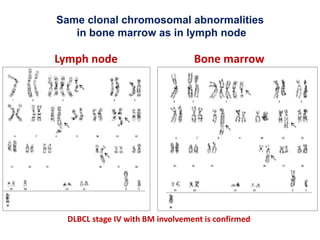
Same clonal chromosomal abnormalities
in bone marrow as in lymph node
Lymph node Bone marrow
DLBCL stage IV with BM involvement is confirmed
Risk Stratification
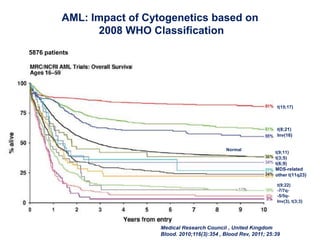
AML: Impact of Cytogenetics based on
2008 WHO Classification
Medical Research Council , United Kingdom
Blood. 2010;116(3):354 , Blood Rev, 2011; 25:39
t(9;22)
-7/7q-
-5/5q-
Inv(3), t(3;3)
t(9;11)
t(3;5)
t(6;9)
MDS-related
other t(11q23)
t(15;17)
t(8;21)
Inv(16)
5876 patients
Normal
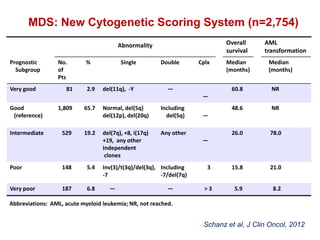
MDS: New Cytogenetic Scoring System (n=2,754)
Abnormality Overall
survival
AML
transformation
Prognostic
Subgroup
No.
of
Pts
% Single Double Cplx Median
(months)
Median
(months)
Very good 81 2.9 del(11q), -Y ―
―
60.8 NR
Good
(reference)
1,809 65.7 Normal, del(5q)
del(12p), del(20q)
Including
del(5q) ―
48.6 NR
Intermediate 529 19.2 del(7q), +8, i(17q)
+19, any other
Independent
clones
Any other
―
26.0 78.0
Poor 148 5.4 Inv(3)/t(3q)/del(3q),
-7
Including
-7/del(7q)
3 15.8 21.0
Very poor 187 6.8 ― ― > 3 5.9 8.2
Abbreviations: AML, acute myeloid leukemia; NR, not reached.
Schanz et al, J Clin Oncol, 2012
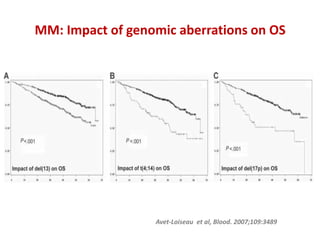
MM: Impact of genomic aberrations on OS
Avet-Loiseau et al, Blood. 2007;109:3489
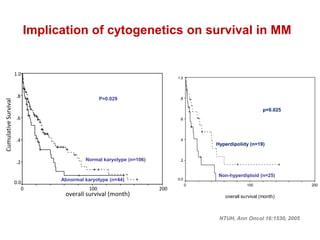
Implication of cytogenetics on survival in MM
overall survival (month)
2001000
CumulativeSurvival
1.0
.8
.6
.4
.2
0.0
Hyperdipolidy (n=19)
Non-hyperdiploid (n=25)
p=0.025
overall survival (month)
2001000
CumulativeSurvival
1.0
.8
.6
.4
.2
0.0
Normal karyotype (n=106)
Abnormal karyotype (n=44)
P=0.029
NTUH, Ann Oncol 16:1530, 2005
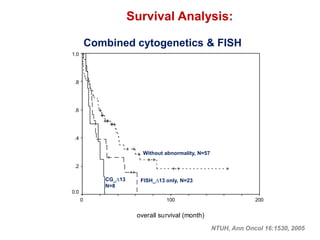
overall survival (month)
2001000
1.0
.8
.6
.4
.2
0.0
FISH_∆13 only, N=23
Without abnormality, N=57
p=0.013
CG_∆13
N=8
Survival Analysis:
Combined cytogenetics & FISH
NTUH, Ann Oncol 16:1530, 2005
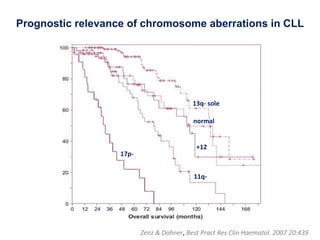
Prognostic relevance of chromosome aberrations in CLL
Zenz & Dohner, Best Pract Res Clin Haematol. 2007 20:439
17p-
11q-
+12
13q- sole
normal
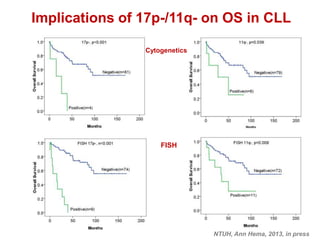
Implications of 17p-/11q- on OS in CLL
Cytogenetics
FISH
NTUH, Ann Hema, 2013, in press
Follow Up the Clinical Course
Chronic Myeloid Leukemia, Chronic Phase
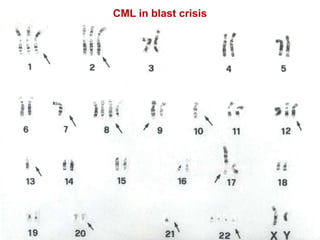
CML in blast crisis
Indication of Cytogenetic Study
• Unknown cause of cytopenia
• Fever of unknown origin
• WHO classification of AML and ALL
• MDS diagnosis and classification (IPSS, IPSS-R)
• Lymphoma diagnosis, classification and staging
work up
• Risk stratification of CLL and MM
• Follow-up of treatment response
台灣藍鵲( Formosan Blue Magpie )
Cytogenetics in Hematological Malignancies
• Most patients with hematological malignancies
have clonal chromosomal abnormalities.
• Some recurrent chromosomal abnormalities are
tumor- and even subtype-specific, so are good
for diagnosis and classification.
• The pattern of chromosomal aberrations may
predict treatment response and clinical outcome
and is good for risk stratification.
• Genes located at the breakpoints of the
recurrent abnormalities play an integral role in
the process of tumorigenesis.
Burkitt lymphoma
t(8:14)(q24:q32)
Relationship between Chromosomal
Alterations and Pathogenesis of Cancer
Nonrandom nature of chromosomal alterations in cancer
CML : t(9;22)
AML : t(8;21), t(15;17), inv(16)
ALL : t(4;11), t(1;19)
Lymphoma : t(8;14), t(14;18), t(11;14)
Constitutional chromosomal deletions predispose to
the development of cancer
13q14 deletion  retinoblastoma
11p13 or 11p15  Wilms’ tumor
Hypoplastic MDS

Cytogenetic Analysis in Hematological Malignancies

  • 1.
    Cytogenetic Analysis in HematologicalMalignancies Hwei-Fang Tien, National Taiwan University Hospital
  • 2.
    Cytogenetics in HematologicalMalignancies • Most patients with hematological malignancies have clonal chromosomal abnormalities. • Some recurrent chromosomal abnormalities are tumor- and even subtype-specific, so are good for diagnosis and classification. • The pattern of chromosomal aberrations may predict treatment response and clinical outcome and is good for risk stratification. • Genes located at the breakpoints of the recurrent abnormalities play an important role in the process of tumorigenesis and can be the target of treatment.
  • 3.
    Purpose of CytogeneticStudy in Hematological malignancies 1. Diagnosis and classification 2. Risk stratification 3. Selection of proper treatment 4. Follow-up of the response
  • 4.
    Recurrent chromosomal abnormalitiesin Hematological malignancies CML t(9;22) AML t(8;21), t(15;17), inv(16), t(9;11), inv(3), t(6;9), t(1;22), -5/5q-, -7/7q- ALL t(4;11), t(1;19), t(v;11q23), t(12;21) MDS -5/del(5q), del(20q); -7/del(7q), +8 Lymphoma DLBCL t(3q27) Burkitt t(8;14) and variant Follicular t(14;18) Mantle cell t(11;14) Marginal zone t(11;18), t(1;14), t(14;18)
  • 5.
  • 6.
    BM smears ina patient with bleeding tendency NTUH, Gene Chromosome Cancer, 1995,12:161 23Y/O, male , PB plt, 3000/μL; Hb, 9.2 gm/dL; WBC, normal Plt count increased to 533x103/μL after steroid treatment, but dropped again 1 mo later. BM smears
  • 7.
  • 8.
    Cytogenetic Abnormalities NTUH, GeneChromosome Cancer, 1995,12:161 The pt received splectomy. Final dignosis: hepatosplenic Tγ/δ lymphoma A new cytogentc- clinicopathological entity of NHL
  • 9.
    NK-cell large granularlymphocytosis NTUH, Br J Haematol, 1998, 103:1124 Cytogenetic Abnormalities Diagnosis: NK-cell large granular lymphocyte leukemia PB smears
  • 10.
    Differential diagnosis ofhypoplastic MDS with AA BM smears
  • 11.
    Name: 林X榮, 46, XY,-7 [20] Chromosomal abnormality Diagnosis: hypoplastic MDS NTUH, Leukemia, 2008, 22:544
  • 12.
  • 13.
    BM study forstaging in a patients with DLBCL Pathol exam. of the BM biopsy specimen: no lymphoma involvement BM smears
  • 14.
  • 15.
    Same clonal chromosomalabnormalities in bone marrow as in lymph node Lymph node Bone marrow DLBCL stage IV with BM involvement is confirmed
  • 16.
  • 17.
    AML: Impact ofCytogenetics based on 2008 WHO Classification Medical Research Council , United Kingdom Blood. 2010;116(3):354 , Blood Rev, 2011; 25:39 t(9;22) -7/7q- -5/5q- Inv(3), t(3;3) t(9;11) t(3;5) t(6;9) MDS-related other t(11q23) t(15;17) t(8;21) Inv(16) 5876 patients Normal
  • 18.
    MDS: New CytogeneticScoring System (n=2,754) Abnormality Overall survival AML transformation Prognostic Subgroup No. of Pts % Single Double Cplx Median (months) Median (months) Very good 81 2.9 del(11q), -Y ― ― 60.8 NR Good (reference) 1,809 65.7 Normal, del(5q) del(12p), del(20q) Including del(5q) ― 48.6 NR Intermediate 529 19.2 del(7q), +8, i(17q) +19, any other Independent clones Any other ― 26.0 78.0 Poor 148 5.4 Inv(3)/t(3q)/del(3q), -7 Including -7/del(7q) 3 15.8 21.0 Very poor 187 6.8 ― ― > 3 5.9 8.2 Abbreviations: AML, acute myeloid leukemia; NR, not reached. Schanz et al, J Clin Oncol, 2012
  • 19.
    MM: Impact ofgenomic aberrations on OS Avet-Loiseau et al, Blood. 2007;109:3489
  • 20.
    Implication of cytogeneticson survival in MM overall survival (month) 2001000 CumulativeSurvival 1.0 .8 .6 .4 .2 0.0 Hyperdipolidy (n=19) Non-hyperdiploid (n=25) p=0.025 overall survival (month) 2001000 CumulativeSurvival 1.0 .8 .6 .4 .2 0.0 Normal karyotype (n=106) Abnormal karyotype (n=44) P=0.029 NTUH, Ann Oncol 16:1530, 2005
  • 21.
    overall survival (month) 2001000 1.0 .8 .6 .4 .2 0.0 FISH_∆13only, N=23 Without abnormality, N=57 p=0.013 CG_∆13 N=8 Survival Analysis: Combined cytogenetics & FISH NTUH, Ann Oncol 16:1530, 2005
  • 22.
    Prognostic relevance ofchromosome aberrations in CLL Zenz & Dohner, Best Pract Res Clin Haematol. 2007 20:439 17p- 11q- +12 13q- sole normal
  • 23.
    Implications of 17p-/11q-on OS in CLL Cytogenetics FISH NTUH, Ann Hema, 2013, in press
  • 24.
    Follow Up theClinical Course
  • 25.
  • 26.
  • 27.
    Indication of CytogeneticStudy • Unknown cause of cytopenia • Fever of unknown origin • WHO classification of AML and ALL • MDS diagnosis and classification (IPSS, IPSS-R) • Lymphoma diagnosis, classification and staging work up • Risk stratification of CLL and MM • Follow-up of treatment response
  • 28.
  • 29.
    Cytogenetics in HematologicalMalignancies • Most patients with hematological malignancies have clonal chromosomal abnormalities. • Some recurrent chromosomal abnormalities are tumor- and even subtype-specific, so are good for diagnosis and classification. • The pattern of chromosomal aberrations may predict treatment response and clinical outcome and is good for risk stratification. • Genes located at the breakpoints of the recurrent abnormalities play an integral role in the process of tumorigenesis.
  • 30.
  • 31.
  • 32.
    Relationship between Chromosomal Alterationsand Pathogenesis of Cancer Nonrandom nature of chromosomal alterations in cancer CML : t(9;22) AML : t(8;21), t(15;17), inv(16) ALL : t(4;11), t(1;19) Lymphoma : t(8;14), t(14;18), t(11;14) Constitutional chromosomal deletions predispose to the development of cancer 13q14 deletion  retinoblastoma 11p13 or 11p15  Wilms’ tumor
  • 33.