FOSSILIZATION & GEOLOGICAL TIME-
SCALE OF FOSSILS
Presented by
Parmar Nirali M.
M.Sc. Sem:- 1 (Botany)
Paper No:- CBO- 402
CONTENTS
Fossilization process
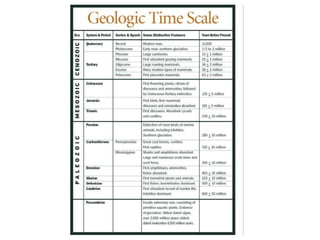
Introduction of geological time scale
History and nomenclature of the time
scale
Naming of geological periods, eras and
epochs.
Pre- Cambrion Era
Paleozoic Era
Mesozoic Era
Cenozoic Era
Fossilization is the process by which
a plant & animals becomes a fossil.
This process is extremely rare & only
a small fraction of the plants &
animals that have lived in the past
600 million years are preserved as
fossils.
Those plants & animals that do
become fossils generally undergo,
with some exceptions, serial key
steps.
First, the soft tissue that exists during
life decays leaving behind only the
"Hard parts" (bone, shell, teeth).
 Second, hard parts may be
transported & broken. This causes the
fossilized remains to be incomplete
representation of the living animal.
It is much more common to find a
fragment of shell or bone then it is to
find a complete skeleton.
 Third & most important, hard tissues become
buried & altered. In most cases this involves
destroying the original material from which the
hard parts were made as minerals are slowly
dissolved & replaced by new ones often times a
hard part is dissolved without being replaced
by new material , leaving behind only an
impression or mold of the original animal.
 If this mold is filled with sediment that is later
cemented into rock it will make a cast of the
original animal.
 These fossilization scenarios are a few of many
possible processes that turn living organisms
into rock - like material.
INTRODUCTION
Geological range- The interval between the
first occurrence of a fossils species in the
geological record.
The geological time scale (GTS) is a system
of chronological dating that relates
geological strata to time , and is used by
geologist, paleontogists, and other Earth
scientist to describe the timing &
relationships of events that have occurred
during Earth's history.
HISTORY & NOMENCLATURE OF THE
TIME SCALE
 In Ancient Greece, Aristotle observed that fossils of seashells
from rocks resembled seashells found on beaches- he
inferred that the fossils had once formed part of living
animals , and reasoned that the position of land and sea had
changed over long periods of time.information
 Geologic units from the same time but different parts of the
world often look different and contain different fossils, so the
same period was historically given different names in
different locales.
NAMING OF GEOLOGIC
PERIODS, ERAS AND EPOCHS
 The Cambrian and the ordoician and silurian,
named after ancient welsh tribes, were
periods defined using stratigraphic sequences
from Wales.
 The Devonian was named for the English
country of Devon, and the name
carboniferous was simply an adaptation of the
coal measures, the old British geologists term
for the same set of strata.
 The Permian was named after perm.
 The Triassic was named in 1834 by a
German geologists from other countries.
 The Jurassic was named by a fresh
geologist alexandre Brogniart for the
extensive marine limestone exposures of
the jura mountains .
The Cretaceous as a separate period
was first defined by belgian geologist.
Philips scale helped standardize the
use of terms like Paleozoic which he
extended to cover a larger period
than it had in previous usage, and
Mesozoic which he inventd.
REFERENCES
 Botany for degree students gymnosperms-
Vasishta P C (2005)
 https:// en.m. wikipedia.org
 https://www.slideshare.net
Thank you

Fossilization

  • 1.
    FOSSILIZATION & GEOLOGICALTIME- SCALE OF FOSSILS Presented by Parmar Nirali M. M.Sc. Sem:- 1 (Botany) Paper No:- CBO- 402
  • 2.
    CONTENTS Fossilization process Introduction ofgeological time scale History and nomenclature of the time scale Naming of geological periods, eras and epochs. Pre- Cambrion Era Paleozoic Era Mesozoic Era Cenozoic Era
  • 3.
    Fossilization is theprocess by which a plant & animals becomes a fossil. This process is extremely rare & only a small fraction of the plants & animals that have lived in the past 600 million years are preserved as fossils. Those plants & animals that do become fossils generally undergo, with some exceptions, serial key steps.
  • 4.
    First, the softtissue that exists during life decays leaving behind only the "Hard parts" (bone, shell, teeth).  Second, hard parts may be transported & broken. This causes the fossilized remains to be incomplete representation of the living animal. It is much more common to find a fragment of shell or bone then it is to find a complete skeleton.
  • 6.
     Third &most important, hard tissues become buried & altered. In most cases this involves destroying the original material from which the hard parts were made as minerals are slowly dissolved & replaced by new ones often times a hard part is dissolved without being replaced by new material , leaving behind only an impression or mold of the original animal.  If this mold is filled with sediment that is later cemented into rock it will make a cast of the original animal.  These fossilization scenarios are a few of many possible processes that turn living organisms into rock - like material.
  • 7.
    INTRODUCTION Geological range- Theinterval between the first occurrence of a fossils species in the geological record. The geological time scale (GTS) is a system of chronological dating that relates geological strata to time , and is used by geologist, paleontogists, and other Earth scientist to describe the timing & relationships of events that have occurred during Earth's history.
  • 8.
    HISTORY & NOMENCLATUREOF THE TIME SCALE  In Ancient Greece, Aristotle observed that fossils of seashells from rocks resembled seashells found on beaches- he inferred that the fossils had once formed part of living animals , and reasoned that the position of land and sea had changed over long periods of time.information  Geologic units from the same time but different parts of the world often look different and contain different fossils, so the same period was historically given different names in different locales.
  • 9.
    NAMING OF GEOLOGIC PERIODS,ERAS AND EPOCHS  The Cambrian and the ordoician and silurian, named after ancient welsh tribes, were periods defined using stratigraphic sequences from Wales.  The Devonian was named for the English country of Devon, and the name carboniferous was simply an adaptation of the coal measures, the old British geologists term for the same set of strata.
  • 10.
     The Permianwas named after perm.  The Triassic was named in 1834 by a German geologists from other countries.  The Jurassic was named by a fresh geologist alexandre Brogniart for the extensive marine limestone exposures of the jura mountains .
  • 11.
    The Cretaceous asa separate period was first defined by belgian geologist. Philips scale helped standardize the use of terms like Paleozoic which he extended to cover a larger period than it had in previous usage, and Mesozoic which he inventd.
  • 13.
    REFERENCES  Botany fordegree students gymnosperms- Vasishta P C (2005)  https:// en.m. wikipedia.org  https://www.slideshare.net
  • 14.