Atherosclerosis is degenerative. It isn’t
acquired during adulthood.
Risk factors (characteristics, symptoms, or
signs present in a disease-free person that
are statistically associated with a greater
chance of developing a disease) include
smoking, high blood pressure, diabetes, high
cholesterol levels, obesity, “type A”
personality, sedentary lifestyle, and a family
history.
Most of these can be modified by changing diet
and other habits or can be controlled by
taking medications. However, other risk
factors are unmodifiable (beyond our
control), including genetic predisposition
(family history of disease at an early age),
age, and gender.
For example, adult males are more likely than
adult females to develop the disease; after
age 70 the risks are roughly equal. Smoking
is undoubtedly the number-one risk factor
doubling the risk of morbidity and mortality.
-consist of an inner core of triglycerides and
other lipids and an outer shell of proteins,
phospholipids, and cholesterol.
 Low-density lipoproteins (LDL)- transport
cholesterol from the liver to body cells for
use in cell membrane repair and the
production of steroid hormones and bile
salts.
 High-density lipoproteins (HDL)- remove
excess cholesterol from body cells and
transport it to the liver for elimination.
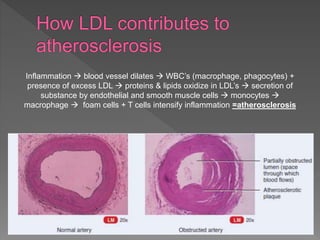
Inflammation  blood vessel dilates  WBC’s (macrophage, phagocytes) +
presence of excess LDL  proteins & lipids oxidize in LDL’s  secretion of
substance by endothelial and smooth muscle cells  monocytes 
macrophage  foam cells + T cells intensify inflammation =atherosclerosis
-food rich in fiber
-healthy environment
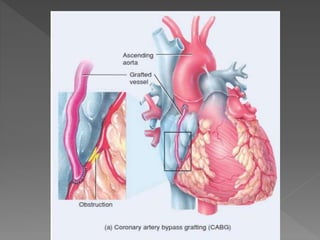
 Coronary artery bypass grafting (CABG)
-is a surgical procedure in which a blood
vessel from another part of the body is
attached (“grafted”) to a coronary artery to
bypass an area of blockage. A piece of the
grafted blood vessel is sutured between the
aorta and the unblocked portion of the
coronary artery.
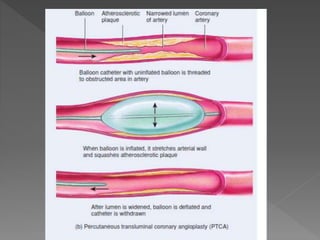
 Percutaneous transluminal coronary
angioplasty (PTCA) -a balloon catheter is
inserted into an artery of an arm or leg and
gently guided into a coronary artery. Next,
the catheter is advanced to the point of
obstruction, and a balloonlike device is
inflated with air to squash the plaque against
the blood vessel wall.
 Restenosis may be due to damage from the
procedure itself, for PTCA may damage the
arterial wall, leading to platelet activation,
proliferation of smooth muscle fibers, and
plaque formation.
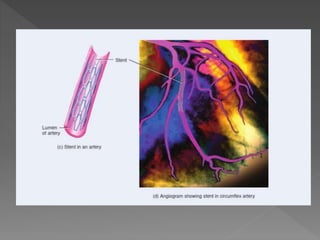
 A stent is a metallic, fine wire tube that is
permanently placed in an artery to keep the
artery patent (open), permitting blood to
circulate
Atherosclerosis

Atherosclerosis

  • 2.
    Atherosclerosis is degenerative.It isn’t acquired during adulthood.
  • 3.
    Risk factors (characteristics,symptoms, or signs present in a disease-free person that are statistically associated with a greater chance of developing a disease) include smoking, high blood pressure, diabetes, high cholesterol levels, obesity, “type A” personality, sedentary lifestyle, and a family history.
  • 4.
    Most of thesecan be modified by changing diet and other habits or can be controlled by taking medications. However, other risk factors are unmodifiable (beyond our control), including genetic predisposition (family history of disease at an early age), age, and gender.
  • 5.
    For example, adultmales are more likely than adult females to develop the disease; after age 70 the risks are roughly equal. Smoking is undoubtedly the number-one risk factor doubling the risk of morbidity and mortality.
  • 6.
    -consist of aninner core of triglycerides and other lipids and an outer shell of proteins, phospholipids, and cholesterol.  Low-density lipoproteins (LDL)- transport cholesterol from the liver to body cells for use in cell membrane repair and the production of steroid hormones and bile salts.
  • 7.
     High-density lipoproteins(HDL)- remove excess cholesterol from body cells and transport it to the liver for elimination.
  • 8.
    Inflammation  bloodvessel dilates  WBC’s (macrophage, phagocytes) + presence of excess LDL  proteins & lipids oxidize in LDL’s  secretion of substance by endothelial and smooth muscle cells  monocytes  macrophage  foam cells + T cells intensify inflammation =atherosclerosis
  • 9.
    -food rich infiber -healthy environment
  • 10.
     Coronary arterybypass grafting (CABG) -is a surgical procedure in which a blood vessel from another part of the body is attached (“grafted”) to a coronary artery to bypass an area of blockage. A piece of the grafted blood vessel is sutured between the aorta and the unblocked portion of the coronary artery.
  • 12.
     Percutaneous transluminalcoronary angioplasty (PTCA) -a balloon catheter is inserted into an artery of an arm or leg and gently guided into a coronary artery. Next, the catheter is advanced to the point of obstruction, and a balloonlike device is inflated with air to squash the plaque against the blood vessel wall.
  • 14.
     Restenosis maybe due to damage from the procedure itself, for PTCA may damage the arterial wall, leading to platelet activation, proliferation of smooth muscle fibers, and plaque formation.  A stent is a metallic, fine wire tube that is permanently placed in an artery to keep the artery patent (open), permitting blood to circulate

Editor's Notes

  • #7 Insoluble fats bind to lipoproteins to become soluble