STS Biology - Unit 8 Illinois Renewable Resource Corn and Soybeans Plants
I. Plant Kingdom A. Characteristics 1. Autotrophic - photosynthetic 2. Multicellular 3. Eukaryotic Without plants, there would be no animals Used for food, homes, other products (medicines, coffee) B. Aquatic vs. Land Plants 1. Aquatic plants = algae No true roots No seeds No waterproofing of leaf-like structures No need for rigid stems
Land Plants Need to be protected from drying out and methods to transport materials Early land plants were  non-vascular  and live in very moist environments Mosses and liverworts Vascular  plants have transport tissue Xylem  – thick, dead tissue which moves  water   UP  from roots to leaves Phloem  – living tissue, transports FOOD (sugar) in both directions Ferns were the first vascular plants
I. Plant Kingdom B. Aquatic vs. Land Plants 2. Land plants = corn, soybeans Need protection from drying out Leaves  with waxy coatings, photosynthesis Stems  for support Seeds  that can be dormant Roots  to absorb water, nutrients Vascular tissue  –   Xylem –  thick, dead, transports water up from roots Phloem –  living, transports sugar
Seed Plants Cycads, ginkos, pines, spruce Extinct Monocot Dicot Seed Ferns 1 st  seed plants Gymnosperms “ naked” seed Conifer: gametes in cones, not fruits Angiosperms Flowering plants Oaks, corn, tulips Seed(s) contained in fruits Male cone Female cone
I. Plant Kingdom D.  Advantages of Seed Plants 1.  Can live on land (more sun for photosynthesis) 2.  Seeds to nourish and protect embryo 3.  Do not need water to reproduce; need pollinators 4.  Have roots, stems and leaves for efficient water and nutrient transfer 5.  Vascular system to move water / nutrients greater distance
II. Plant Morphology A. Seeds 1. Types  Monocots  = one cotyledon Dicots  = two cotyledons 2.  Parts of Seeds Cotyledons - seed leaves Embryo - new plant Hypo cotyl = part of plant  below  cotyledons, becomes the lower stem  Epi cotyl = part of plant  above  cotyledons, becomes upper stem and leaves Radicle  = becomes roots
 
 
II. Plant Morphology B. Comparing  Monocots and Dicots Vascular bundles scattered Vascular bundles in a ring Stem Arranged in 3’s Arranged in 4’s or 5’s Flowers parallel Branched Leaves fibrous Taproot Roots 1 cotyledon 2 cotyledons Seeds Monocot Dicot Plant Part
Monocots & Dicots  UP 50
II. Plant Morphology C.  Leaves  -  food production, photosynthesis 1.  Epidermis  = single layer of cells, covered by waxy cuticle, prevents water loss Stomata = openings in the lower epidermis Guard cells = open and close the stoma 2.  Mesophyll  = specialized layer of leaf Contains many chloroplasts Palisade layer  = tall, closely packed cells – site of most photosynthesis Spongy layer  = loosely packed cells, many air spaces to allow CO 2  into the leaf and oxygen (O 2 ) of of the leaf
Leaf Structure
Stomates
 
 
Roots Functions Absorb water and nutrients from soil Food storage (ie: carrots) Anchoring the plant Structure Xylem  and  phloem Epidermis  – thin layer that absorbs water and nutrients Cortex  – food storage Meristematic Tissue  – only site of mitosis, found at tips of roots and shoots
Vascular Bundles in Roots Dicot roots have xylem in an “X” in the center of the root Monocot roots have vascular bundles in a circular pattern  Dicot Root Monocot Root
XYLEM PHLOEM
Stems Function Support plant, hold leaves up to the sun Transport food and water Arrangement of vascular bundles Dicots – arranged in a ring Monocots – scattered throughout
Stems Dicot Stem Monocot Stem
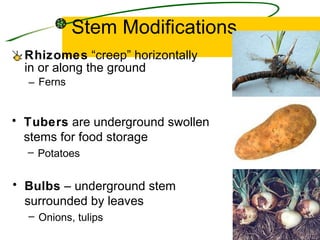
Stem Modifications Rhizomes  “creep” horizontally in or along the ground Ferns Tubers  are underground swollen stems for food storage Potatoes Bulbs  – underground stem surrounded by leaves Onions, tulips
Flowers Reproductive structures of angiosperms Sepals  are the outermost layer which encloses a bud and protects the developing flower Petals  are just inside sepals, fragrance and color attracts pollinators The  receptacle  is where sepals, petals, and sex organs attach
Flowers (cont.) Sta men  - male sex organ Anthers  produce pollen Filaments  hold the anther up for pollinators or wind Pistil  (aka carpel) – female sex organ The  stigma  is the sticky end where pollen lands The  style  is the “neck” which connects the stigma to the ovary The  ovary  contains ovules, when mature the ovary becomes a fruit
 
Flower Anatomy Filament Stamen Anther Pistil Style Stigma Petal Ovary Ovule Receptacle Sepal
Pollination Pollen transfers from anther to stigma Self-pollination  – pollen fertilizes the ovule of the  same  plant Cross-pollination  – pollen fertilizes ovules of  another  plant, thus increasing genetic variation
Cross Pollination Methods Wind Pollination Inefficient, high pollen production  Flowers (if present) are small and not colorful
Cross Pollination Methods Vector pollination  uses animals to carry pollen between plants More efficient, less pollen produced Plants attract pollinators by: Colorful petals Fragrance Nectar production
Coevolution Two species evolve in response to changes in one another
Bee Pollination
Butterfly Pollination
Bat Pollination
Moth Pollination
Seed Dispersal Wind scatters seeds Maple trees, dandelions Animal dispersal occurs when barbs stick to animal fur Burdock plant Animals eat and digest fruits, seeds are excreted
Fertilization Pollen lands on stigma Pollen tube grows into the style Sperm and egg unite forming and zygote
Double Fertilization Two sperm enter the ovary The 1 st  sperm fertilizes the egg resulting in a zygote (2N) The 2 nd  sperm fertilizes the polar nuclei forming the endosperm (3N) http://bcs.whfreeman.com/thelifewire/content/chp39/3902001.html
Corn Facts… Corn is the most widely produced feed grain in the United States, accounting for more than 90 percent of total value and production of feed grains.  Almost 80 million acres of land were planted to corn in 2003, with the majority of the crop grown in the Heartland region.  Most of the crop is used as the main energy ingredient in livestock feed.  Corn is also processed into a multitude of food and industrial products including starch, sweeteners, corn oil, beverage and industrial alcohol, and  fuel ethanol .  The United States is a major player in the world corn trade market, with approximately 20 percent of the corn crop exported to other countries.  ERS analyzes events in the domestic and global corn markets that influence supply, demand, trade, and prices.
Soybean Facts… The United States is the world's leading producer and exporter of soybeans, and soybeans are  second highest in value  among U.S.-produced crops.  ERS economists provide current market analysis, research, and data on production, consumption, prices, and international trade for soybeans, other oilseeds, and their byproducts.
Area Planted and Harvested by State and United States, 2004 Corn  :  Soybeans   :Planted : Harvested  : Planted : Harvested -------------------------------------------------------------   1,000 Acres IL :  11,700 11,550  9,900 9,850 IN:  5,700   5,500  5,500  5,430 IA:  12,700  12,300  10,200   10,150 KS: 3,100   2,750  2,800 2,700 MI: 2,200  1,950 2,000 1,990 MN: 7,500  6,900 7,300 7,200 MO: 2,950 2,850 5,000 4,940 NE: 8,300 7,900 4,800 4,750 ND: 1,800 1,500 3,750 3,670 OH: 3,350   3,100 4,450 4,420 PA: 1,400 900 400  395 SD: 4,650    4,100 4,150 4,090 TX: 1,800 1,600 290 275 WI: 3,650 2,750 1,600 1,550 US: 80,968  73,311 75,065  73,990 ----------------------------------- Updated from the June 2004 "Acreage" report.   USDA
corn products corn bran   corn flour   corn germ   corn gluten   corn gluten meal   corn grits   corn meal   corn oil   corn protein   corn starch   corn straw   corn syrup   masa   sweetcorn   soybean products miso   natto   soy protein   soy sauce   soybean meal   soybean oil   soybeans   soymilk   tempeh   tofu   Products
Ethanol Production Capacity Ranked by State (Largest to Smallest Production Capacity as of December 2004) Sources:   Renewable Fuels Association , Washington, DC.  Nebraska Energy Office, Lincoln, NE. This table was updated on December 6, 2004.  Typically, there is one month between updates. Rank State Ethanol Production Capacity (Million Gallons Per Year) 1 Iowa 1,171.5 2 Illinois 816.0 3 Minnesota 533.1 4 Nebraska 515.0 5 South Dakota 422.0 6 Wisconsin 212.0 7 Kansas 144.5 8 Missouri 100.0 9 Indiana 95.0 10 Tennessee 65.0 11 Michigan 45.0 12 North Dakota 33.5 13 Texas 30.0 14 Kentucky 24.0 15 New Mexico 15.0 16 California 6.4 17 Wyoming 5.0 18 Idaho 4.0 18 Ohio 4.0 19 Colorado 1.5 20 Washington 0.7 United States Total 4,243.2
Total Energy Consumption Ranked by State 2000 (Highest to Lowest Rank)   Sources:   State Energy Data Report.   Energy Information Administration, Office of Energy Markets and End Use, U.S. Department of Energy, Washington, DC.  Nebraska Energy Office, Lincoln, NE. This table was updated on  March 24, 2004.   Typically, there are two years between updates.         Rank State Energy Consumption (Trillion Btu) 1 Texas 11,588.6 2 California 8,518.7 3 Pennsylvania 4,779.9 4 New York 4,620.0 5 Illinois 4,417.9 6 Ohio 4,001.8 7 Louisiana 3,965.2 8 Florida 3,943.8 9 Michigan 3,121.9 10 Indiana 2,777.6 11 Georgia 2,769.9 12 New Jersey 2,706.6 13 North Carolina 2,501.9 14 Virginia 2,303.6 15 Washington 2,173.8 16 Tennessee 2,025.9 17 Alabama 1,977.3 18 Kentucky 1,868.2 19 Wisconsin 1,799.7 20 Massachusetts 1,722.8 51 Vermont 164.6 United States Total 98,216.2
Corn and Soybean Info… Corn and soybeans are the #1 and #2 most commonly grown crop plants in Illinois. Illinois is currently #2 in the United States in corn and soybean production. Corn is a monocot, soybeans are a dicot. Soybeans are legumes and form a dense underground network of roots and Rhizobium, fixing nitrogen and adding organic matter to the soil. Corn is a heavy nitrogen feeder, soybeans add nitrogen to the soil. Corn is a source of mostly carbohydrates, soybeans mostly oil and protein. UP p. 8
Corn and Soybean Info… Corn needs a lot of fertilizer and pesticides, soybeans, no fertilizer and only few pesticides. Soybeans can lose 33% of their leaves before yield decreases.  Corn yields are reduced with much less damage. Although the price of a bushel of soybeans is near double that of corn, there may be 3 times as many bushels of corn per acre harvested. Farmers often soak soybeans seeds in Rhizobium before planting (called inoculating seed) Corn, Soybean, Soybean Meal, and Soybean Oil futures are traded at the Chicago Board of Trade. 37% of all jobs in the Chicago area are related to agriculture. UP p. 8
Agriculture Problem  – humans are using up valuable farm land for homes, business… Corn and soybeans are  renewable resources  (they can be recreated in our lifetime) We can use these to make… Ethanol, plastics, foods,  Important – these are also  biodegradeable
Symbiotic relationship between  Rhizobium Bacteria  and legumes (bean plants) Mutualistic: Bacteria get home and protection Soybeans get nitrogen (fertilizer) Nitrogen Cycle
Nitrogen Fixation
Agriculture Crop Rotation  –  Corn plants use up the nitrogen in the soil If farmers keep corn crops on same field year after year ( monoculture ) then they will have to fertilize (add nitrogen) the soil to produce a good yield. But…if farmers plant crops on different fields (rotate crops) it would be cheaper. …WHY? Soybeans (with the help of Rhizobium) replenish available nitrogen in the soil.

Plants

  • 1.
    STS Biology -Unit 8 Illinois Renewable Resource Corn and Soybeans Plants
  • 2.
    I. Plant KingdomA. Characteristics 1. Autotrophic - photosynthetic 2. Multicellular 3. Eukaryotic Without plants, there would be no animals Used for food, homes, other products (medicines, coffee) B. Aquatic vs. Land Plants 1. Aquatic plants = algae No true roots No seeds No waterproofing of leaf-like structures No need for rigid stems
  • 3.
    Land Plants Needto be protected from drying out and methods to transport materials Early land plants were non-vascular and live in very moist environments Mosses and liverworts Vascular plants have transport tissue Xylem – thick, dead tissue which moves water UP from roots to leaves Phloem – living tissue, transports FOOD (sugar) in both directions Ferns were the first vascular plants
  • 4.
    I. Plant KingdomB. Aquatic vs. Land Plants 2. Land plants = corn, soybeans Need protection from drying out Leaves with waxy coatings, photosynthesis Stems for support Seeds that can be dormant Roots to absorb water, nutrients Vascular tissue – Xylem – thick, dead, transports water up from roots Phloem – living, transports sugar
  • 5.
    Seed Plants Cycads,ginkos, pines, spruce Extinct Monocot Dicot Seed Ferns 1 st seed plants Gymnosperms “ naked” seed Conifer: gametes in cones, not fruits Angiosperms Flowering plants Oaks, corn, tulips Seed(s) contained in fruits Male cone Female cone
  • 6.
    I. Plant KingdomD. Advantages of Seed Plants 1. Can live on land (more sun for photosynthesis) 2. Seeds to nourish and protect embryo 3. Do not need water to reproduce; need pollinators 4. Have roots, stems and leaves for efficient water and nutrient transfer 5. Vascular system to move water / nutrients greater distance
  • 7.
    II. Plant MorphologyA. Seeds 1. Types Monocots = one cotyledon Dicots = two cotyledons 2. Parts of Seeds Cotyledons - seed leaves Embryo - new plant Hypo cotyl = part of plant below cotyledons, becomes the lower stem Epi cotyl = part of plant above cotyledons, becomes upper stem and leaves Radicle = becomes roots
  • 8.
  • 9.
  • 10.
    II. Plant MorphologyB. Comparing Monocots and Dicots Vascular bundles scattered Vascular bundles in a ring Stem Arranged in 3’s Arranged in 4’s or 5’s Flowers parallel Branched Leaves fibrous Taproot Roots 1 cotyledon 2 cotyledons Seeds Monocot Dicot Plant Part
  • 11.
  • 12.
    II. Plant MorphologyC. Leaves - food production, photosynthesis 1. Epidermis = single layer of cells, covered by waxy cuticle, prevents water loss Stomata = openings in the lower epidermis Guard cells = open and close the stoma 2. Mesophyll = specialized layer of leaf Contains many chloroplasts Palisade layer = tall, closely packed cells – site of most photosynthesis Spongy layer = loosely packed cells, many air spaces to allow CO 2 into the leaf and oxygen (O 2 ) of of the leaf
  • 13.
  • 14.
  • 15.
  • 16.
  • 17.
    Roots Functions Absorbwater and nutrients from soil Food storage (ie: carrots) Anchoring the plant Structure Xylem and phloem Epidermis – thin layer that absorbs water and nutrients Cortex – food storage Meristematic Tissue – only site of mitosis, found at tips of roots and shoots
  • 18.
    Vascular Bundles inRoots Dicot roots have xylem in an “X” in the center of the root Monocot roots have vascular bundles in a circular pattern Dicot Root Monocot Root
  • 19.
  • 20.
    Stems Function Supportplant, hold leaves up to the sun Transport food and water Arrangement of vascular bundles Dicots – arranged in a ring Monocots – scattered throughout
  • 21.
    Stems Dicot StemMonocot Stem
  • 22.
    Stem Modifications Rhizomes “creep” horizontally in or along the ground Ferns Tubers are underground swollen stems for food storage Potatoes Bulbs – underground stem surrounded by leaves Onions, tulips
  • 23.
    Flowers Reproductive structuresof angiosperms Sepals are the outermost layer which encloses a bud and protects the developing flower Petals are just inside sepals, fragrance and color attracts pollinators The receptacle is where sepals, petals, and sex organs attach
  • 24.
    Flowers (cont.) Stamen - male sex organ Anthers produce pollen Filaments hold the anther up for pollinators or wind Pistil (aka carpel) – female sex organ The stigma is the sticky end where pollen lands The style is the “neck” which connects the stigma to the ovary The ovary contains ovules, when mature the ovary becomes a fruit
  • 25.
  • 26.
    Flower Anatomy FilamentStamen Anther Pistil Style Stigma Petal Ovary Ovule Receptacle Sepal
  • 27.
    Pollination Pollen transfersfrom anther to stigma Self-pollination – pollen fertilizes the ovule of the same plant Cross-pollination – pollen fertilizes ovules of another plant, thus increasing genetic variation
  • 28.
    Cross Pollination MethodsWind Pollination Inefficient, high pollen production Flowers (if present) are small and not colorful
  • 29.
    Cross Pollination MethodsVector pollination uses animals to carry pollen between plants More efficient, less pollen produced Plants attract pollinators by: Colorful petals Fragrance Nectar production
  • 30.
    Coevolution Two speciesevolve in response to changes in one another
  • 31.
  • 32.
  • 33.
  • 34.
  • 35.
    Seed Dispersal Windscatters seeds Maple trees, dandelions Animal dispersal occurs when barbs stick to animal fur Burdock plant Animals eat and digest fruits, seeds are excreted
  • 36.
    Fertilization Pollen landson stigma Pollen tube grows into the style Sperm and egg unite forming and zygote
  • 37.
    Double Fertilization Twosperm enter the ovary The 1 st sperm fertilizes the egg resulting in a zygote (2N) The 2 nd sperm fertilizes the polar nuclei forming the endosperm (3N) http://bcs.whfreeman.com/thelifewire/content/chp39/3902001.html
  • 38.
    Corn Facts… Cornis the most widely produced feed grain in the United States, accounting for more than 90 percent of total value and production of feed grains. Almost 80 million acres of land were planted to corn in 2003, with the majority of the crop grown in the Heartland region. Most of the crop is used as the main energy ingredient in livestock feed. Corn is also processed into a multitude of food and industrial products including starch, sweeteners, corn oil, beverage and industrial alcohol, and fuel ethanol . The United States is a major player in the world corn trade market, with approximately 20 percent of the corn crop exported to other countries. ERS analyzes events in the domestic and global corn markets that influence supply, demand, trade, and prices.
  • 39.
    Soybean Facts… TheUnited States is the world's leading producer and exporter of soybeans, and soybeans are second highest in value among U.S.-produced crops. ERS economists provide current market analysis, research, and data on production, consumption, prices, and international trade for soybeans, other oilseeds, and their byproducts.
  • 40.
    Area Planted andHarvested by State and United States, 2004 Corn : Soybeans :Planted : Harvested : Planted : Harvested ------------------------------------------------------------- 1,000 Acres IL : 11,700 11,550 9,900 9,850 IN: 5,700 5,500 5,500 5,430 IA: 12,700 12,300 10,200 10,150 KS: 3,100 2,750 2,800 2,700 MI: 2,200 1,950 2,000 1,990 MN: 7,500 6,900 7,300 7,200 MO: 2,950 2,850 5,000 4,940 NE: 8,300 7,900 4,800 4,750 ND: 1,800 1,500 3,750 3,670 OH: 3,350 3,100 4,450 4,420 PA: 1,400 900 400 395 SD: 4,650 4,100 4,150 4,090 TX: 1,800 1,600 290 275 WI: 3,650 2,750 1,600 1,550 US: 80,968 73,311 75,065 73,990 ----------------------------------- Updated from the June 2004 "Acreage" report. USDA
  • 41.
    corn products cornbran corn flour corn germ corn gluten corn gluten meal corn grits corn meal corn oil corn protein corn starch corn straw corn syrup masa sweetcorn soybean products miso natto soy protein soy sauce soybean meal soybean oil soybeans soymilk tempeh tofu Products
  • 42.
    Ethanol Production CapacityRanked by State (Largest to Smallest Production Capacity as of December 2004) Sources:  Renewable Fuels Association , Washington, DC.  Nebraska Energy Office, Lincoln, NE. This table was updated on December 6, 2004.  Typically, there is one month between updates. Rank State Ethanol Production Capacity (Million Gallons Per Year) 1 Iowa 1,171.5 2 Illinois 816.0 3 Minnesota 533.1 4 Nebraska 515.0 5 South Dakota 422.0 6 Wisconsin 212.0 7 Kansas 144.5 8 Missouri 100.0 9 Indiana 95.0 10 Tennessee 65.0 11 Michigan 45.0 12 North Dakota 33.5 13 Texas 30.0 14 Kentucky 24.0 15 New Mexico 15.0 16 California 6.4 17 Wyoming 5.0 18 Idaho 4.0 18 Ohio 4.0 19 Colorado 1.5 20 Washington 0.7 United States Total 4,243.2
  • 43.
    Total Energy ConsumptionRanked by State 2000 (Highest to Lowest Rank) Sources:  State Energy Data Report.   Energy Information Administration, Office of Energy Markets and End Use, U.S. Department of Energy, Washington, DC.  Nebraska Energy Office, Lincoln, NE. This table was updated on March 24, 2004.   Typically, there are two years between updates.       Rank State Energy Consumption (Trillion Btu) 1 Texas 11,588.6 2 California 8,518.7 3 Pennsylvania 4,779.9 4 New York 4,620.0 5 Illinois 4,417.9 6 Ohio 4,001.8 7 Louisiana 3,965.2 8 Florida 3,943.8 9 Michigan 3,121.9 10 Indiana 2,777.6 11 Georgia 2,769.9 12 New Jersey 2,706.6 13 North Carolina 2,501.9 14 Virginia 2,303.6 15 Washington 2,173.8 16 Tennessee 2,025.9 17 Alabama 1,977.3 18 Kentucky 1,868.2 19 Wisconsin 1,799.7 20 Massachusetts 1,722.8 51 Vermont 164.6 United States Total 98,216.2
  • 44.
    Corn and SoybeanInfo… Corn and soybeans are the #1 and #2 most commonly grown crop plants in Illinois. Illinois is currently #2 in the United States in corn and soybean production. Corn is a monocot, soybeans are a dicot. Soybeans are legumes and form a dense underground network of roots and Rhizobium, fixing nitrogen and adding organic matter to the soil. Corn is a heavy nitrogen feeder, soybeans add nitrogen to the soil. Corn is a source of mostly carbohydrates, soybeans mostly oil and protein. UP p. 8
  • 45.
    Corn and SoybeanInfo… Corn needs a lot of fertilizer and pesticides, soybeans, no fertilizer and only few pesticides. Soybeans can lose 33% of their leaves before yield decreases. Corn yields are reduced with much less damage. Although the price of a bushel of soybeans is near double that of corn, there may be 3 times as many bushels of corn per acre harvested. Farmers often soak soybeans seeds in Rhizobium before planting (called inoculating seed) Corn, Soybean, Soybean Meal, and Soybean Oil futures are traded at the Chicago Board of Trade. 37% of all jobs in the Chicago area are related to agriculture. UP p. 8
  • 46.
    Agriculture Problem – humans are using up valuable farm land for homes, business… Corn and soybeans are renewable resources (they can be recreated in our lifetime) We can use these to make… Ethanol, plastics, foods, Important – these are also biodegradeable
  • 47.
    Symbiotic relationship between Rhizobium Bacteria and legumes (bean plants) Mutualistic: Bacteria get home and protection Soybeans get nitrogen (fertilizer) Nitrogen Cycle
  • 48.
  • 49.
    Agriculture Crop Rotation – Corn plants use up the nitrogen in the soil If farmers keep corn crops on same field year after year ( monoculture ) then they will have to fertilize (add nitrogen) the soil to produce a good yield. But…if farmers plant crops on different fields (rotate crops) it would be cheaper. …WHY? Soybeans (with the help of Rhizobium) replenish available nitrogen in the soil.