aving seed 
South Dakota Extension Fact Sheet 911 
February 2002 
by 
Rhoda Burrows 
Extension Horticulturist 
Horticulture, Forestry, Landscape 
and Parks Department 
or thousands of years, people have saved seed from their plants 
to grow the following year. While many of us prefer the conve-nience 
and reliability of commercial seed, others would like to 
harvest their own seed in order to save money, to keep plants not 
easily available from other sources, or just for the intrinsic value of 
self-sufficiency. Besides, watching plants grow from the seed you 
collected can be not only educational, but fun! 
What plants can I save seed from? 
Seed from almost any kind of plant can be saved and grown; however, 
seed from annuals (plants that flower in the same year that they were 
planted) are usually the easiest, and least likely to need specialized 
treatments. Common annuals include vegetables such as peas, beans, 
tomatoes, peppers, squash, melons, and broccoli, and flowers such as 
marigolds, zinnias, snapdragons, and petunias. 
Sometimes saved seed produces plants 
that are different from the plant it was 
saved from. Why does this happen? 
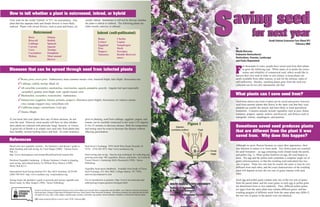
Although we grow flowers because we enjoy their appearance, their 
true function in nature is to form seeds. Two flower parts are essential 
for seed formation – an egg-containing ovule (found inside the pistil), 
and pollen (fig. 1). When pollen fertilizes an egg, the seed begins to 
form. The egg and the pollen each contribute a complete single set of 
genes (chromosomes), so that the resulting seed (and plant) has two 
sets of genes. These two sets may be exactly the same or may be very 
different from each other, and the exact characteristics of the resulting 
plant will depend on how the two sets of genes interact with each 
other. 
Each egg and pollen grain contain only one of the two sets of genes 
from the parent plant, and the exact genes in each egg or pollen grain 
are determined more or less randomly. Thus, different pollen grains 
(or eggs) from the same plant may contain different genes, and the 
resulting progeny of different seeds from the same plant may differ if 
the two sets of genes in the parent were not identical. 
Stamen 
(contains pollen) Pistil 
Ovule 
(egg) 
F 
How to tell whether a plant is outcrossed, inbred, or hybrid 
Beets Onions 
Broccoli Radish 
Cabbage Spinach 
Carrots Squash 
Corn Turnips 
Cucumbers Pumpkins 
Melons Most annual 
flowers 
usually inbred. Sometimes it will not be obvious whether 
the plant is inbred or outbred. The following plants are 
either mostly outcross or inbreed. 
Diseases that can be spread through seed from infected plants 
✓Beans, peas, sweet peas: Anthracnose; bean common mosaic virus; bacterial blight; halo blight; rhizoctonia rots 
✓Cabbage, radish, turnip: Black rot 
✓All cucurbits (cucumber, muskmelon, watermelon, squash, pumpkin, gourd): Angular leaf spot (especially 
cucumber); gummy stem blight; scab; squash mosaic virus 
✓Muskmelon, cucumber, watermelon: Anthracnose 
✓Solanaceous (eggplant, tomato, petunia, pepper): Alternaria (early blight); rhizoctonia rot; tobacco mosaic 
virus; tomato ringspot virus; verticillium wilt 
✓California poppy; nasturtiums: Leaf spot 
✓Zinnia: Blight 
If you know that your plants have any of these diseases, do not 
save the seed. However, most people will have no idea whether 
their plants are infected with particular fungi, bacteria, or viruses. 
A good rule of thumb is to simply save seed only from plants that 
have healthy, normal-looking leaves and fruit. As extra insurance, 
References 
Breed your own vegetable varieties: the Gardener’s and farmer’s guide to 
plant breeding and seed saving, by Carol Deppe (2000). Chelsea Green 
Pub. Co. 
http://www.chelseagreen.com/Garden/BreedYourOwnContents.htm 
Heirloom Vegetable Gardening: A Master Gardener’s Guide to planting, 
seed saving, and cultural history, by William Woys Weaver (1999). 
Henry Holt & Co. 
International Seed Saving Institute P.O. Box 4619, Ketchum, ID 83340 
(208)-788-4363 http://www.seedsave.org issi@seedsave.org 
Saving Seeds, the gardener’s guide to growing and storing vegetable and 
flower seeds, by Marc Rogers (1990). Storey Publishing 
prior to planting, seed from cabbage, eggplant, pepper, and 
tomato can be carefully immersed in hot water (122 degrees 
F) for 25 minutes to decrease disease. Both the temperature 
and timing must be exact to decrease the disease without 
affecting germination. 
Seed Saver’s Exchange 3076 North Winn Road, Decorah, IA 
52101 (319)-382-5872 http://www.seedsavers.org 
Seed sowing and saving: Step-by-step techniques for collecting and 
growing more than 100 vegetables, flowers, and herbs, by Carole B. 
Turner (Storey’s Gardening Skills Illustrated) (1998). Storey 
Publishing 
Vegetable Seed-savers handbook. Available from Seeds of Texas 
Seed Exchange, P.O. Box 9882, College Station, TX 77842, 
jackrowe@compuserve.com 
For an introduction to genetics: http://www2.mc.maricopa.edu/ 
anthropology/origins/genetics/introgene.html 
Issued in furtherance of Cooperative Extension work, Acts of May 8 and June 30, 1914, in cooperation with the USDA. Larry Tidemann, Director of Extension, 
Associate Dean, College of Agriculture & Biological Sciences, South Dakota State University, Brookings. Educational programs and materials offered with-out 
regard for race, color, creed, religion, national origin, ancestry, citizenship, age, gender, sexual orientation, disability, or Vietnam Era Veteran status. 
5000 copies printed by CES at a cost of ? each. FS 911. February 2002. 
Beans Clarkia 
Lettuce Lupine 
Eggplant Snapdragon 
Peas Stock 
Peppers Sweetpea 
Tomatoes Double-flowered 
asters 
First, look for the words "hybrid" or "F1" on seed packets. Any 
plant that has separate male and female flowers is most likely 
outbred. Plants with closed flowers, such as peas and beans, are 
Outcrossed Inbred (self-pollinated) 
Figure 1 
for next year 
S 
SOUTH DAKOTA STATE UNIVERSITY 
College of Agriculture 
& Biological Sciences 
Cooperative Extension Service / USDA
Inbred, outcrossed, and hybrid plants 
In inbred plants, the eggs are fertilized 
with pollen from the same plant. Another 
term for this is self-pollination. The 
progeny will each have two identical (or 
nearly so) sets of genes, exact copies of 
their parents, and will thus appear very 
similar to each other. Most peas and 
beans are inbred. Since seed from a self-pollinated 
plant will produce plants very 
like the plant it was produced on, these 
kinds of plants are ideal for seed saving. 
Outcrossed plants require pollen from a 
different plant to fertilize the egg (also 
called cross-pollination). Some outcros-sing 
species have the female and male 
parts in separate flowers (corn or squash) 
or even separate plants (asparagus). 
Others have both parts in the same 
flower, but the egg will accept pollen 
only from another flower or plant. 
Apples are an example of this – that is 
why a separate pollinator tree is needed 
to obtain fruit. 
The two sets of genes in progeny of out-crossed 
plants tend to have a lot of varia-tion, 
so that the outcome of crossing is 
less predictable, somewhat like the varia-tion 
between siblings in a human family. 
Seed from outcrossed plants will not neces-sarily 
come true; do not save seed from 
these plants if you want to be certain that 
the plants will be exactly the same as their 
parents. However, if you have grown only 
one variety (and your neighbors have grown 
the same variety or are far enough away to 
avoid wind- or insect- cross pollination), 
you can still save the seed. 
Hybrids result from crossing two different 
inbred lines. All of the first generation of 
plants from this cross will contain the exact 
same two sets of genes (one from each line) 
and thus will be identical to each other. 
This first generation is what you buy in a 
seed packet marked "Hybrid" or "F1". 
However, the next generation (the plants 
that will grow from seed produced from 
plants grown from "F1" seed) will contain 
a random mixture of genes, resulting in 
plants that may have a whole range of 
desirable and undesirable characteristics. 
(See below for further explanation). Do not 
save seed from F1 or hybrid plants if you 
want to be certain that the plants grown 
from the seed will be the same as their 
parents. 
✔Inbred plants 
✔Outcrossed plants 
✔Hybrid plants 
How to harvest and save seed 
2a. Selecting plants 
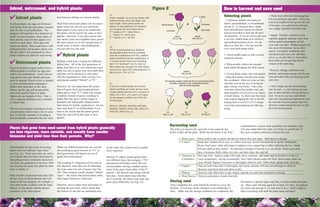
In this example, we cross two plants with 
different flower color, leaf shape, and 
stem length. These parent plants are 
inbred, so each plant has two identical 
sets of genes for each characteristic: 
P = purple or W = white flower 
L = long or S = short stem 
N = narrow or F = fat leaf 
Plants that grow from seed saved from hybrid plants generally 
are less vigorous, more variable, and usually have smaller 
blossoms and yield less than their parents. Why? 
Hybrid plants are the result of crossing 
plants from two different "pure lines" 
(see Fig. 2a). These pure lines are each a 
set of plants that have been developed by 
inbreeding to have consistent characteris-tics 
from one generation to the next. Both 
sets of genes in a pure line plant are iden-tical, 
or nearly so. 
Plant breeders experiment until they find 
the two lines of inbred parents that will 
result in the best progeny, for example, a 
cross that results in plants with the large 
flowers of one parent, and the disease 
resistance of the other parent. 
When two different pure lines are crossed, 
the resulting progeny (known as "F1" or 
first generation) will inherit one set of 
genes from each parent. 
The resulting F1 offspring will be more or 
less identical, since they are all inheriting 
the exact same two sets of genes (see Fig. 
2b). These progeny usually display "hybrid 
vigor" – the reason that hybrid plants often 
have larger flowers or yield more. 
However, since it takes time and money to 
develop the pure lines, and to insure that 
the flowers of one line are pollinated only 
by the other line, hybrid seed is usually 
more expensive. 
Because F1 plants contain genes from 
two different lines, their progeny ("F2" 
generation) will behave more like out-crossed 
plants, having a random assort-ment 
of the genes from either of the F1 
parents – the desired ones along with the 
bad ones. Some plants may look like 
the F1 hybrids, but others may look and 
grow quite differently (see Fig. 2c). 
✓ Determine whether your plants are 
hybrid, open-pollinated, or self-pollinated 
(see pg. 4). As discussed above, plants 
from self-pollinated (inbred) non-hybrid 
seed are most likely to look like the previ-ous 
generation. If you are curious and want 
to see how variable plants from hybrid or 
open-pollinated parents can be, you can 
always try them also. You may even dis-cover 
some good unique plants. 
✓ Choose healthy plants in order to avoid 
seed-borne diseases. 
✓ When possible, observe the potential 
parent plants throughout the whole season. 
✓ To keep things simple, start with annuals 
– plants that produce seed the same season 
they are planted. Most root crops are bien-nials 
(the roots are the way of storing the 
plant’s energy over winter). These must 
overwinter before they produce seed, and 
many biennials will not survive our winters 
in South Dakota. To obtain seed from these 
crops requires digging the roots in the fall, 
keeping them in cool (32 to 45 F) storage 
over winter, and replanting the following 
spring. 
✓ Plants from within the following groups 
will cross-pollinate each other. Unless you 
(and close neighbors) have grown only one 
of the types, you could end up with some 
very strange vegetables from their seed: 
• Squash: Zucchini, crookneck, acorn, 
vegetable spaghetti, butternut, white bush 
scallop squash and pumpkins will all 
cross with each other. Hubbard squash will 
also cross with butternut, but not other 
squash. Cucumbers, muskmelon, and 
watermelon each cross only with them-selves, 
so you don’t have to worry about 
them unless you are growing several 
varieties of the same thing. 
• Broccoli, cabbage, cauliflower, kale, 
kohlrabi, and brussels sprouts will all cross 
with each other if they are blooming at the 
same time. 
✓ Don’t simply save the last remaining 
fruit for seed – i.e. don’t harvest all your 
peas or beans and leave the last picking as 
seed. If you do, you may inadvertently 
select for a late-growing characteristic, and 
the seed may be poorer quality than seed 
allowed to mature during the early or mid-dle 
of the harvest period. 
Narrow leaves Fat leaves 
+ 
The resulting progeny might look like any of the above plants 
(inbreds or hybrids), or any combination of them. 
The trick is to harvest the seed after it has matured, but 
before it falls off the plant. While the list below is far from 
comprehensive, it gives some guidelines for common crops. 
You may adapt them for crops not listed, or consult one of 
the more complete references listed at the end. 
Once completely dry, seed should be stored in a cool, dry 
location. If you have room, storing in your refrigerator is 
ideal. Make sure the storage containers are completely dry. 
Envelopes or ziplock bags work fine, as well as baby-food jars, 
etc. Most seed will stay good for at least 3-4 years. Exceptions 
are onion and parsnip (1 yr) and corn (2 yrs.). Don’t forget to 
label everything with both the plant name and date!! 
2b. 
All the resulting plants are identical, 
having light purple flowers (resulting 
from the combination of P+W), medium 
stems (resulting from the combination of 
L+S) and narrow leaves (we’ll pretend 
that N is “dominant” over F). Each of 
these plants has one gene for each charac-teristic 
from each of the inbred parents, so 
they all have: PW, LS, FN. 
2c. 
If any two of these plants are crossed, 
almost anything can result, because each 
of these plants (known as F1) can pass on 
either a P or W, L or S, and F or N gene. 
So the progeny could be any of the fol-lowing 
types: 
PPLLFF, PPLSFF, PPLSNN, PPLSNF, 
PPSSNF, PPSSNF, PWLLDD, PWLLFF, 
PWLSFF, PWLLFN, etc. 
White 
Long stem 
Short stem 
Inbred 
PP, LL, NN 
Inbred 
WW, SS, FF 
+ 
Hybrid 
PW, LS, FN 
F2 
WW, LL, NF 
F2 
PW, LS, FF 
F2 
PP, SS, FF 
Here are three examples: 
Purple 
Harvesting seed 
Storing seed 
Figure 2 
✓ Beans, peas Allow pods to dry on plant, but harvest before they split open. Shell prior to storage. 
✓ Lettuce Seeds don’t mature all at once, so collect seed over several time periods by gently shaking the 
flower head (once white tufts begin to appear) over a paper bag or other collecting device. Seeds 
will turn dark as they mature. An alternative method of harvest is to cut off the whole seed stalk 
once it becomes fluffy white, let it dry, and then shake the seed off. 
✓ Tomatoes & Pick ripe fruit. Squeeze pulp with seeds into a container, add water and let ferment 2-4 days at 
Cucumbers room temperature, stirring occasionally. Non-viable (dead) seeds will float. When seeds settle out, 
pour off pulp. Repeat if necessary to thoroughly clean the seed. When clean, spread seeds out to dry. 
✓ Peppers Harvest seed when fruit is thoroughly ripe (most varieties will turn red and begin to shrivel). 
Remove seed from fruit and allow to dry. 
✓ Melons Seed are ripe when fruit is ripe; simply separate out and rinse seed prior to drying. 
✓ Most flowers Harvest seed pods or heads when dry.

Saving Seed for Next Year ~ South Dakota State University

  • 1.
    aving seed SouthDakota Extension Fact Sheet 911 February 2002 by Rhoda Burrows Extension Horticulturist Horticulture, Forestry, Landscape and Parks Department or thousands of years, people have saved seed from their plants to grow the following year. While many of us prefer the conve-nience and reliability of commercial seed, others would like to harvest their own seed in order to save money, to keep plants not easily available from other sources, or just for the intrinsic value of self-sufficiency. Besides, watching plants grow from the seed you collected can be not only educational, but fun! What plants can I save seed from? Seed from almost any kind of plant can be saved and grown; however, seed from annuals (plants that flower in the same year that they were planted) are usually the easiest, and least likely to need specialized treatments. Common annuals include vegetables such as peas, beans, tomatoes, peppers, squash, melons, and broccoli, and flowers such as marigolds, zinnias, snapdragons, and petunias. Sometimes saved seed produces plants that are different from the plant it was saved from. Why does this happen? Although we grow flowers because we enjoy their appearance, their true function in nature is to form seeds. Two flower parts are essential for seed formation – an egg-containing ovule (found inside the pistil), and pollen (fig. 1). When pollen fertilizes an egg, the seed begins to form. The egg and the pollen each contribute a complete single set of genes (chromosomes), so that the resulting seed (and plant) has two sets of genes. These two sets may be exactly the same or may be very different from each other, and the exact characteristics of the resulting plant will depend on how the two sets of genes interact with each other. Each egg and pollen grain contain only one of the two sets of genes from the parent plant, and the exact genes in each egg or pollen grain are determined more or less randomly. Thus, different pollen grains (or eggs) from the same plant may contain different genes, and the resulting progeny of different seeds from the same plant may differ if the two sets of genes in the parent were not identical. Stamen (contains pollen) Pistil Ovule (egg) F How to tell whether a plant is outcrossed, inbred, or hybrid Beets Onions Broccoli Radish Cabbage Spinach Carrots Squash Corn Turnips Cucumbers Pumpkins Melons Most annual flowers usually inbred. Sometimes it will not be obvious whether the plant is inbred or outbred. The following plants are either mostly outcross or inbreed. Diseases that can be spread through seed from infected plants ✓Beans, peas, sweet peas: Anthracnose; bean common mosaic virus; bacterial blight; halo blight; rhizoctonia rots ✓Cabbage, radish, turnip: Black rot ✓All cucurbits (cucumber, muskmelon, watermelon, squash, pumpkin, gourd): Angular leaf spot (especially cucumber); gummy stem blight; scab; squash mosaic virus ✓Muskmelon, cucumber, watermelon: Anthracnose ✓Solanaceous (eggplant, tomato, petunia, pepper): Alternaria (early blight); rhizoctonia rot; tobacco mosaic virus; tomato ringspot virus; verticillium wilt ✓California poppy; nasturtiums: Leaf spot ✓Zinnia: Blight If you know that your plants have any of these diseases, do not save the seed. However, most people will have no idea whether their plants are infected with particular fungi, bacteria, or viruses. A good rule of thumb is to simply save seed only from plants that have healthy, normal-looking leaves and fruit. As extra insurance, References Breed your own vegetable varieties: the Gardener’s and farmer’s guide to plant breeding and seed saving, by Carol Deppe (2000). Chelsea Green Pub. Co. http://www.chelseagreen.com/Garden/BreedYourOwnContents.htm Heirloom Vegetable Gardening: A Master Gardener’s Guide to planting, seed saving, and cultural history, by William Woys Weaver (1999). Henry Holt & Co. International Seed Saving Institute P.O. Box 4619, Ketchum, ID 83340 (208)-788-4363 http://www.seedsave.org issi@seedsave.org Saving Seeds, the gardener’s guide to growing and storing vegetable and flower seeds, by Marc Rogers (1990). Storey Publishing prior to planting, seed from cabbage, eggplant, pepper, and tomato can be carefully immersed in hot water (122 degrees F) for 25 minutes to decrease disease. Both the temperature and timing must be exact to decrease the disease without affecting germination. Seed Saver’s Exchange 3076 North Winn Road, Decorah, IA 52101 (319)-382-5872 http://www.seedsavers.org Seed sowing and saving: Step-by-step techniques for collecting and growing more than 100 vegetables, flowers, and herbs, by Carole B. Turner (Storey’s Gardening Skills Illustrated) (1998). Storey Publishing Vegetable Seed-savers handbook. Available from Seeds of Texas Seed Exchange, P.O. Box 9882, College Station, TX 77842, jackrowe@compuserve.com For an introduction to genetics: http://www2.mc.maricopa.edu/ anthropology/origins/genetics/introgene.html Issued in furtherance of Cooperative Extension work, Acts of May 8 and June 30, 1914, in cooperation with the USDA. Larry Tidemann, Director of Extension, Associate Dean, College of Agriculture & Biological Sciences, South Dakota State University, Brookings. Educational programs and materials offered with-out regard for race, color, creed, religion, national origin, ancestry, citizenship, age, gender, sexual orientation, disability, or Vietnam Era Veteran status. 5000 copies printed by CES at a cost of ? each. FS 911. February 2002. Beans Clarkia Lettuce Lupine Eggplant Snapdragon Peas Stock Peppers Sweetpea Tomatoes Double-flowered asters First, look for the words "hybrid" or "F1" on seed packets. Any plant that has separate male and female flowers is most likely outbred. Plants with closed flowers, such as peas and beans, are Outcrossed Inbred (self-pollinated) Figure 1 for next year S SOUTH DAKOTA STATE UNIVERSITY College of Agriculture & Biological Sciences Cooperative Extension Service / USDA
  • 2.
    Inbred, outcrossed, andhybrid plants In inbred plants, the eggs are fertilized with pollen from the same plant. Another term for this is self-pollination. The progeny will each have two identical (or nearly so) sets of genes, exact copies of their parents, and will thus appear very similar to each other. Most peas and beans are inbred. Since seed from a self-pollinated plant will produce plants very like the plant it was produced on, these kinds of plants are ideal for seed saving. Outcrossed plants require pollen from a different plant to fertilize the egg (also called cross-pollination). Some outcros-sing species have the female and male parts in separate flowers (corn or squash) or even separate plants (asparagus). Others have both parts in the same flower, but the egg will accept pollen only from another flower or plant. Apples are an example of this – that is why a separate pollinator tree is needed to obtain fruit. The two sets of genes in progeny of out-crossed plants tend to have a lot of varia-tion, so that the outcome of crossing is less predictable, somewhat like the varia-tion between siblings in a human family. Seed from outcrossed plants will not neces-sarily come true; do not save seed from these plants if you want to be certain that the plants will be exactly the same as their parents. However, if you have grown only one variety (and your neighbors have grown the same variety or are far enough away to avoid wind- or insect- cross pollination), you can still save the seed. Hybrids result from crossing two different inbred lines. All of the first generation of plants from this cross will contain the exact same two sets of genes (one from each line) and thus will be identical to each other. This first generation is what you buy in a seed packet marked "Hybrid" or "F1". However, the next generation (the plants that will grow from seed produced from plants grown from "F1" seed) will contain a random mixture of genes, resulting in plants that may have a whole range of desirable and undesirable characteristics. (See below for further explanation). Do not save seed from F1 or hybrid plants if you want to be certain that the plants grown from the seed will be the same as their parents. ✔Inbred plants ✔Outcrossed plants ✔Hybrid plants How to harvest and save seed 2a. Selecting plants In this example, we cross two plants with different flower color, leaf shape, and stem length. These parent plants are inbred, so each plant has two identical sets of genes for each characteristic: P = purple or W = white flower L = long or S = short stem N = narrow or F = fat leaf Plants that grow from seed saved from hybrid plants generally are less vigorous, more variable, and usually have smaller blossoms and yield less than their parents. Why? Hybrid plants are the result of crossing plants from two different "pure lines" (see Fig. 2a). These pure lines are each a set of plants that have been developed by inbreeding to have consistent characteris-tics from one generation to the next. Both sets of genes in a pure line plant are iden-tical, or nearly so. Plant breeders experiment until they find the two lines of inbred parents that will result in the best progeny, for example, a cross that results in plants with the large flowers of one parent, and the disease resistance of the other parent. When two different pure lines are crossed, the resulting progeny (known as "F1" or first generation) will inherit one set of genes from each parent. The resulting F1 offspring will be more or less identical, since they are all inheriting the exact same two sets of genes (see Fig. 2b). These progeny usually display "hybrid vigor" – the reason that hybrid plants often have larger flowers or yield more. However, since it takes time and money to develop the pure lines, and to insure that the flowers of one line are pollinated only by the other line, hybrid seed is usually more expensive. Because F1 plants contain genes from two different lines, their progeny ("F2" generation) will behave more like out-crossed plants, having a random assort-ment of the genes from either of the F1 parents – the desired ones along with the bad ones. Some plants may look like the F1 hybrids, but others may look and grow quite differently (see Fig. 2c). ✓ Determine whether your plants are hybrid, open-pollinated, or self-pollinated (see pg. 4). As discussed above, plants from self-pollinated (inbred) non-hybrid seed are most likely to look like the previ-ous generation. If you are curious and want to see how variable plants from hybrid or open-pollinated parents can be, you can always try them also. You may even dis-cover some good unique plants. ✓ Choose healthy plants in order to avoid seed-borne diseases. ✓ When possible, observe the potential parent plants throughout the whole season. ✓ To keep things simple, start with annuals – plants that produce seed the same season they are planted. Most root crops are bien-nials (the roots are the way of storing the plant’s energy over winter). These must overwinter before they produce seed, and many biennials will not survive our winters in South Dakota. To obtain seed from these crops requires digging the roots in the fall, keeping them in cool (32 to 45 F) storage over winter, and replanting the following spring. ✓ Plants from within the following groups will cross-pollinate each other. Unless you (and close neighbors) have grown only one of the types, you could end up with some very strange vegetables from their seed: • Squash: Zucchini, crookneck, acorn, vegetable spaghetti, butternut, white bush scallop squash and pumpkins will all cross with each other. Hubbard squash will also cross with butternut, but not other squash. Cucumbers, muskmelon, and watermelon each cross only with them-selves, so you don’t have to worry about them unless you are growing several varieties of the same thing. • Broccoli, cabbage, cauliflower, kale, kohlrabi, and brussels sprouts will all cross with each other if they are blooming at the same time. ✓ Don’t simply save the last remaining fruit for seed – i.e. don’t harvest all your peas or beans and leave the last picking as seed. If you do, you may inadvertently select for a late-growing characteristic, and the seed may be poorer quality than seed allowed to mature during the early or mid-dle of the harvest period. Narrow leaves Fat leaves + The resulting progeny might look like any of the above plants (inbreds or hybrids), or any combination of them. The trick is to harvest the seed after it has matured, but before it falls off the plant. While the list below is far from comprehensive, it gives some guidelines for common crops. You may adapt them for crops not listed, or consult one of the more complete references listed at the end. Once completely dry, seed should be stored in a cool, dry location. If you have room, storing in your refrigerator is ideal. Make sure the storage containers are completely dry. Envelopes or ziplock bags work fine, as well as baby-food jars, etc. Most seed will stay good for at least 3-4 years. Exceptions are onion and parsnip (1 yr) and corn (2 yrs.). Don’t forget to label everything with both the plant name and date!! 2b. All the resulting plants are identical, having light purple flowers (resulting from the combination of P+W), medium stems (resulting from the combination of L+S) and narrow leaves (we’ll pretend that N is “dominant” over F). Each of these plants has one gene for each charac-teristic from each of the inbred parents, so they all have: PW, LS, FN. 2c. If any two of these plants are crossed, almost anything can result, because each of these plants (known as F1) can pass on either a P or W, L or S, and F or N gene. So the progeny could be any of the fol-lowing types: PPLLFF, PPLSFF, PPLSNN, PPLSNF, PPSSNF, PPSSNF, PWLLDD, PWLLFF, PWLSFF, PWLLFN, etc. White Long stem Short stem Inbred PP, LL, NN Inbred WW, SS, FF + Hybrid PW, LS, FN F2 WW, LL, NF F2 PW, LS, FF F2 PP, SS, FF Here are three examples: Purple Harvesting seed Storing seed Figure 2 ✓ Beans, peas Allow pods to dry on plant, but harvest before they split open. Shell prior to storage. ✓ Lettuce Seeds don’t mature all at once, so collect seed over several time periods by gently shaking the flower head (once white tufts begin to appear) over a paper bag or other collecting device. Seeds will turn dark as they mature. An alternative method of harvest is to cut off the whole seed stalk once it becomes fluffy white, let it dry, and then shake the seed off. ✓ Tomatoes & Pick ripe fruit. Squeeze pulp with seeds into a container, add water and let ferment 2-4 days at Cucumbers room temperature, stirring occasionally. Non-viable (dead) seeds will float. When seeds settle out, pour off pulp. Repeat if necessary to thoroughly clean the seed. When clean, spread seeds out to dry. ✓ Peppers Harvest seed when fruit is thoroughly ripe (most varieties will turn red and begin to shrivel). Remove seed from fruit and allow to dry. ✓ Melons Seed are ripe when fruit is ripe; simply separate out and rinse seed prior to drying. ✓ Most flowers Harvest seed pods or heads when dry.