STS Biology - Unit 11 Energy Flow, Photosynthesis, and Respiration
Ā 
How do atoms combine to provide living things with energy?
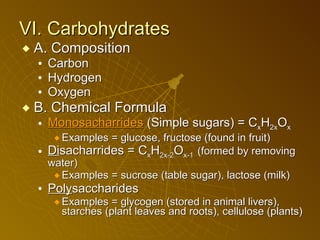
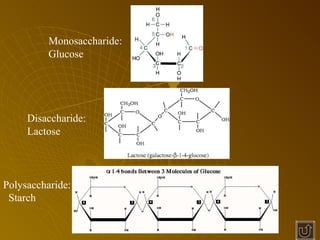
VI. Carbohydrates A. Composition Carbon Hydrogen Oxygen B. Chemical Formula Mono sacharrides  (Simple sugars) = C x H 2x O x Examples = glucose, fructose (found in fruit) Di sacharrides = C x H 2x-2 O x-1  (formed by removing water) Examples = sucrose (table sugar), lactose (milk) Poly saccharides Examples = glycogen (stored in animal livers), starches (plant leaves and roots), cellulose (plants)
Monosaccharide: Glucose Disaccharide: Lactose Polysaccharide:  Starch
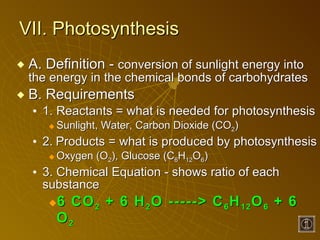
VII. Photosynthesis A. Definition -  conversion of sunlight energy into the energy in the chemical bonds of carbohydrates B. Requirements  1. Reactants = what is needed for photosynthesis Sunlight, Water, Carbon Dioxide (CO 2 ) 2.   Products = what is produced by photosynthesis Oxygen (O 2 ), Glucose (C 6 H 12 O 6 ) 3. Chemical Equation - shows ratio of each substance 6 CO 2  + 6 H 2 O -----> C 6 H 12 O 6  + 6 O 2
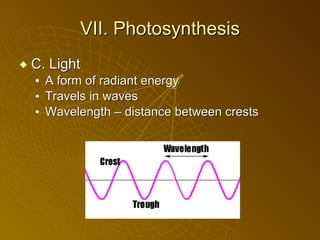
VII. Photosynthesis C. Light A form of radiant energy Travels in waves Wavelength – distance between crests
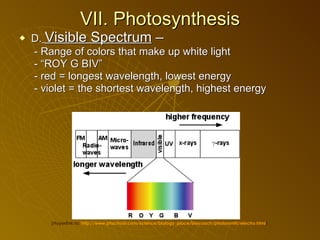
VII. Photosynthesis D.   Visible Spectrum  –    - Range of colors that make up white light   - ā€œROY G BIVā€   - red = longest wavelength, lowest energy   - violet = the shortest wavelength, highest energy (Hyperlink to:  http://www.phschool.com/science/biology_place/biocoach/photosynth/electro.html )
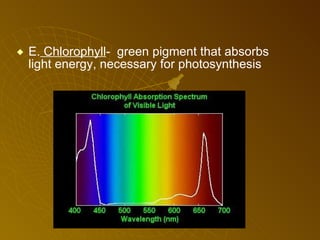
E.  Chlorophyll - Ā  green pigment that absorbs light energy, necessary for photosynthesis
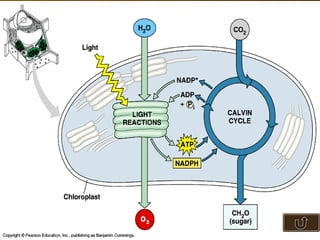
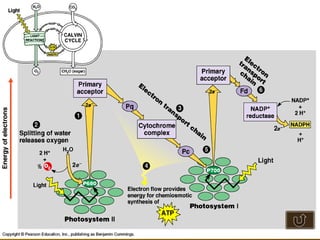
VII. Photosynthesis F.  Process: 2 Parts 1.  Light Reaction Reactants = H 2 O, sunlight, ADP,P,NADP +   Products = ATP, NADPH (energy carriers),O 2   Water is split to make hydrogen ions and O 2   Sunlight is absorbed by chlorophyll and energizes an electron The electron loses energy  step by step  to form ATP Hydrogen ions are trapped to form NADPH
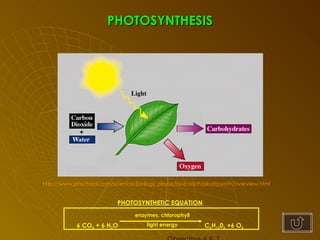
PHOTOSYNTHESIS PHOTOSYNTHETIC EQUATION 6 CO 2  + 6 H 2 O C 6 H 12 0 6  +6 O 2   Objective 6 & 7 ( http://www.phschool.com/science/biology_place/biocoach/photosynth/overview.html )  enzymes, chlorophyll light energy
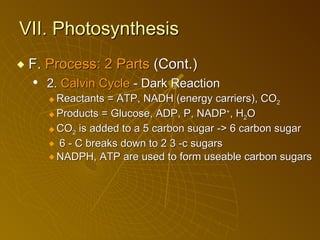
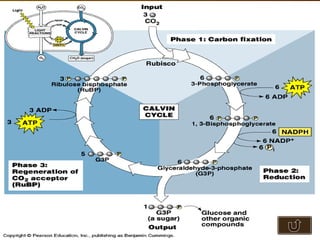
VII. Photosynthesis F.  Process: 2 Parts  (Cont.) 2.  Calvin Cycle  - Dark Reaction Reactants = ATP, NADH (energy carriers), CO 2 Products = Glucose, ADP, P, NADP + , H 2 O CO 2  is added to a 5 carbon sugar -> 6 carbon sugar 6 - C breaks down to 2 3 -c sugars NADPH, ATP are used to form useable carbon sugars
Ā 
VII. PHOTOSYNTHESIS Virtual Tour of Photosynthesis by: Forest Biology Virginia Tech  ( http://www.fw.vt.edu/dendro/forestbiology/photosynthesis.swf )  Harvesting Light Animation Essential Cell Biology, 2 nd  Edition  ( http://www.sumanasinc.com/webcontent/anisamples/majorsbiology/harvestinglight.swf )
Ā 
Ā 
How do compounds break down to provide living things with energy?
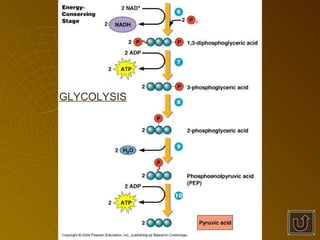
VIII.  Glycolysis  / Respiration A. Glycolysis 1. Definition = breaking down of glucose 2.  Process 2 ATP is added to glucose (makes molecule unstable) Glucose breaks into two  3-carbon molecules As 3-carbon breaks down into pyruvic acid 4-ATP and 2 NADH  are released Pyruvic acid then can be used in Respiration or Fermentation NET GAIN : 2 ATP
GLYCOLYSIS
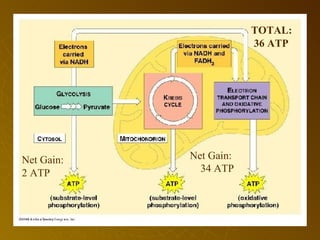
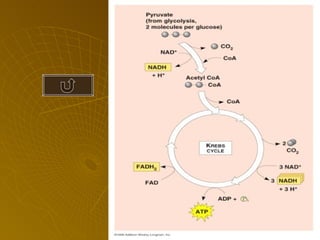
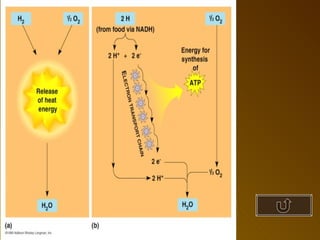
VIII. Glycolysis / Respiration B. Respiration 1. Definition = process involving oxygen and breaks down food to release energy (ATP) 2.  Process Pyruvic acid crosses the mitochondrion membrane and then changes into a 2-carbon molecule, acetyl Co-A. CO 2  is then released Acetyl Co-A enters the Krebs cycle where 9 reactions take place producing NADH, FADH, GTP and CO 2   NADH, FADH go to the electron transport chain GTP is converted into ATP Electron transport chain  turns NADH, FADH into ATP Oxygen is the final electron acceptor - making water
Net Gain: 2 ATP Net Gain:  34 ATP TOTAL: 36 ATP
Ā 
Ā 
Self-quiz Compare the energy flow in photosynthesis to the energy flow in cellular respiration.
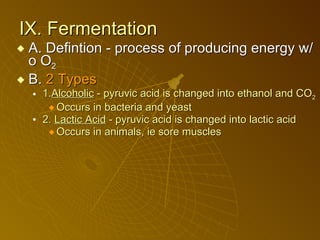
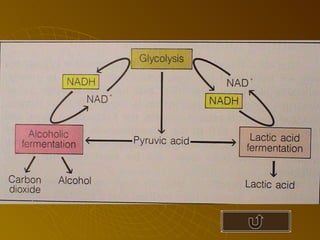
IX. Fermentation A. Defintion - process of producing energy w/o O 2  B.  2 Types 1. Alcoholic  - pyruvic acid is changed into ethanol and CO 2 Occurs in bacteria and yeast 2.  Lactic Acid  - pyruvic acid is changed into lactic acid  Occurs in animals, ie sore muscles
Ā 
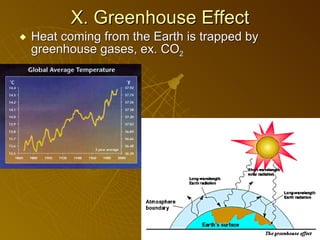
X. Greenhouse Effect Heat coming from the Earth is trapped by greenhouse gases, ex. CO 2

Sts photosynthesis

  • 1.
    STS Biology -Unit 11 Energy Flow, Photosynthesis, and Respiration
  • 2.
  • 3.
    How do atomscombine to provide living things with energy?
  • 4.
    VI. Carbohydrates A.Composition Carbon Hydrogen Oxygen B. Chemical Formula Mono sacharrides (Simple sugars) = C x H 2x O x Examples = glucose, fructose (found in fruit) Di sacharrides = C x H 2x-2 O x-1 (formed by removing water) Examples = sucrose (table sugar), lactose (milk) Poly saccharides Examples = glycogen (stored in animal livers), starches (plant leaves and roots), cellulose (plants)
  • 5.
    Monosaccharide: Glucose Disaccharide:Lactose Polysaccharide: Starch
  • 6.
    VII. Photosynthesis A.Definition - conversion of sunlight energy into the energy in the chemical bonds of carbohydrates B. Requirements 1. Reactants = what is needed for photosynthesis Sunlight, Water, Carbon Dioxide (CO 2 ) 2. Products = what is produced by photosynthesis Oxygen (O 2 ), Glucose (C 6 H 12 O 6 ) 3. Chemical Equation - shows ratio of each substance 6 CO 2 + 6 H 2 O -----> C 6 H 12 O 6 + 6 O 2
  • 7.
    VII. Photosynthesis C.Light A form of radiant energy Travels in waves Wavelength – distance between crests
  • 8.
    VII. Photosynthesis D. Visible Spectrum – - Range of colors that make up white light - ā€œROY G BIVā€ - red = longest wavelength, lowest energy - violet = the shortest wavelength, highest energy (Hyperlink to: http://www.phschool.com/science/biology_place/biocoach/photosynth/electro.html )
  • 9.
    E. Chlorophyll- Ā  green pigment that absorbs light energy, necessary for photosynthesis
  • 10.
    VII. Photosynthesis F. Process: 2 Parts 1. Light Reaction Reactants = H 2 O, sunlight, ADP,P,NADP + Products = ATP, NADPH (energy carriers),O 2 Water is split to make hydrogen ions and O 2 Sunlight is absorbed by chlorophyll and energizes an electron The electron loses energy step by step to form ATP Hydrogen ions are trapped to form NADPH
  • 11.
    PHOTOSYNTHESIS PHOTOSYNTHETIC EQUATION6 CO 2 + 6 H 2 O C 6 H 12 0 6 +6 O 2 Objective 6 & 7 ( http://www.phschool.com/science/biology_place/biocoach/photosynth/overview.html ) enzymes, chlorophyll light energy
  • 12.
    VII. Photosynthesis F. Process: 2 Parts (Cont.) 2. Calvin Cycle - Dark Reaction Reactants = ATP, NADH (energy carriers), CO 2 Products = Glucose, ADP, P, NADP + , H 2 O CO 2 is added to a 5 carbon sugar -> 6 carbon sugar 6 - C breaks down to 2 3 -c sugars NADPH, ATP are used to form useable carbon sugars
  • 13.
  • 14.
    VII. PHOTOSYNTHESIS VirtualTour of Photosynthesis by: Forest Biology Virginia Tech ( http://www.fw.vt.edu/dendro/forestbiology/photosynthesis.swf ) Harvesting Light Animation Essential Cell Biology, 2 nd Edition ( http://www.sumanasinc.com/webcontent/anisamples/majorsbiology/harvestinglight.swf )
  • 15.
  • 16.
  • 17.
    How do compoundsbreak down to provide living things with energy?
  • 18.
    VIII. Glycolysis / Respiration A. Glycolysis 1. Definition = breaking down of glucose 2. Process 2 ATP is added to glucose (makes molecule unstable) Glucose breaks into two 3-carbon molecules As 3-carbon breaks down into pyruvic acid 4-ATP and 2 NADH are released Pyruvic acid then can be used in Respiration or Fermentation NET GAIN : 2 ATP
  • 19.
  • 20.
    VIII. Glycolysis /Respiration B. Respiration 1. Definition = process involving oxygen and breaks down food to release energy (ATP) 2. Process Pyruvic acid crosses the mitochondrion membrane and then changes into a 2-carbon molecule, acetyl Co-A. CO 2 is then released Acetyl Co-A enters the Krebs cycle where 9 reactions take place producing NADH, FADH, GTP and CO 2 NADH, FADH go to the electron transport chain GTP is converted into ATP Electron transport chain turns NADH, FADH into ATP Oxygen is the final electron acceptor - making water
  • 21.
    Net Gain: 2ATP Net Gain: 34 ATP TOTAL: 36 ATP
  • 22.
  • 23.
  • 24.
    Self-quiz Compare theenergy flow in photosynthesis to the energy flow in cellular respiration.
  • 25.
    IX. Fermentation A.Defintion - process of producing energy w/o O 2 B. 2 Types 1. Alcoholic - pyruvic acid is changed into ethanol and CO 2 Occurs in bacteria and yeast 2. Lactic Acid - pyruvic acid is changed into lactic acid Occurs in animals, ie sore muscles
  • 26.
  • 27.
    X. Greenhouse EffectHeat coming from the Earth is trapped by greenhouse gases, ex. CO 2