Agronomy Research ManagerPioneer Hi-Bred International, Inc.Greg.luce@pioneer.comGreg Luce
  What are the main factors impacting crop yields in the Midwest?	Weather: Too much or too little rain.  Hot night time temps.Fertility:  Especially in soybeans.  Soybeans responds to P & K greater than most give credit. Lack of pushing the parameters. Soybeans are not given then attention that corn is, especially fertility. example: 60 bu/of soybeans uses more K than 200 bu/of corn.
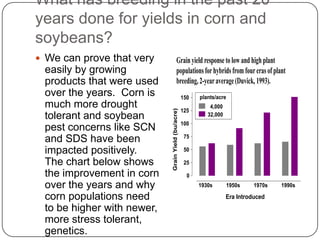
What has breeding in the past 20 years done for yields in corn and soybeans?We can prove that very easily by growing products that were used over the years.  Corn is much more drought tolerant and soybean pest concerns like SCN and SDS have been impacted positively.  The chart below shows the improvement in corn over the years and why corn populations need to be higher with newer, more stress tolerant, genetics.
Do you think that 150 bushel beans and 400 bushel corn is obtainable? Yes.  I’ve been there and seen it at Kip Cullers farm and I’ve never seen soybeans look like they do there.  I think that corn has the potential of 500 bushel an acre and soybeans at 250 bushels an acre.I have worked with farmers and the key to high yields is trying knew things and the willingness to learn.
Have you conducted any research toward high yields?I’ve worked closely with Kip Cullers and other growers in Missouri that are shooting for high yields.  One of the keys is a willingness to try new things.  Also, being willing to look at something that has been tried but perhaps not in combination with other factors.  Some of Kip’s key factors are: Irrigation frequency, solid fertility base, good soil drainage and tilthe, high yielding genetics, protecting yields with insecticides and fungicides. Also, I’ve worked with the University of Missouri on high yield corn and soybean tests and seen some very interesting results.  In 2007, Tim Reinbott at the Univ. of Mo applied some of Kip’s practices to a soybean block and got 87 bu/a on the intensely managed block vs about 40-45 bu/a on the standard non-irrigated block.
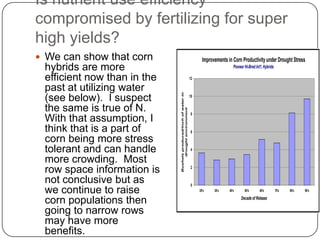
Is nutrient use efficiency compromised by fertilizing for super high yields?We can show that corn hybrids are more efficient now than in the past at utilizing water (see below).  I suspect the same is true of N.  With that assumption, I think that is a part of corn being more stress tolerant and can handle more crowding.  Most row space information is not conclusive but as we continue to raise corn populations then going to narrow rows may have more benefits.
What is the maximum N uptake (lbs/day) in contest winning corn fields.I don’t know that.  I’ve seen some extremely high yields with a surprisingly low N rate but I think N in soybeans has more potential, maybe not economical on a big scale but for achieving maximum yield.  One thing many contest corn winners have had in common is animal manure.  The slow release and stability of nitrogen from organic forms is an asset.I’ve been and seen  Kip Cullers farm and I’ve never seen soybeans look like they do there.  Kip has beans that yield nearly 15o bushel an acre. So I think the potential for soybeans has not been reached yet.

Greg Luce

  • 1.
    Agronomy Research ManagerPioneerHi-Bred International, Inc.Greg.luce@pioneer.comGreg Luce
  • 2.
      What are themain factors impacting crop yields in the Midwest? Weather: Too much or too little rain. Hot night time temps.Fertility: Especially in soybeans. Soybeans responds to P & K greater than most give credit. Lack of pushing the parameters. Soybeans are not given then attention that corn is, especially fertility. example: 60 bu/of soybeans uses more K than 200 bu/of corn.
  • 3.
    What has breedingin the past 20 years done for yields in corn and soybeans?We can prove that very easily by growing products that were used over the years. Corn is much more drought tolerant and soybean pest concerns like SCN and SDS have been impacted positively. The chart below shows the improvement in corn over the years and why corn populations need to be higher with newer, more stress tolerant, genetics.
  • 4.
    Do you thinkthat 150 bushel beans and 400 bushel corn is obtainable? Yes. I’ve been there and seen it at Kip Cullers farm and I’ve never seen soybeans look like they do there. I think that corn has the potential of 500 bushel an acre and soybeans at 250 bushels an acre.I have worked with farmers and the key to high yields is trying knew things and the willingness to learn.
  • 5.
    Have you conductedany research toward high yields?I’ve worked closely with Kip Cullers and other growers in Missouri that are shooting for high yields. One of the keys is a willingness to try new things. Also, being willing to look at something that has been tried but perhaps not in combination with other factors. Some of Kip’s key factors are: Irrigation frequency, solid fertility base, good soil drainage and tilthe, high yielding genetics, protecting yields with insecticides and fungicides. Also, I’ve worked with the University of Missouri on high yield corn and soybean tests and seen some very interesting results. In 2007, Tim Reinbott at the Univ. of Mo applied some of Kip’s practices to a soybean block and got 87 bu/a on the intensely managed block vs about 40-45 bu/a on the standard non-irrigated block.
  • 6.
    Is nutrient useefficiency compromised by fertilizing for super high yields?We can show that corn hybrids are more efficient now than in the past at utilizing water (see below). I suspect the same is true of N. With that assumption, I think that is a part of corn being more stress tolerant and can handle more crowding. Most row space information is not conclusive but as we continue to raise corn populations then going to narrow rows may have more benefits.
  • 7.
    What is themaximum N uptake (lbs/day) in contest winning corn fields.I don’t know that. I’ve seen some extremely high yields with a surprisingly low N rate but I think N in soybeans has more potential, maybe not economical on a big scale but for achieving maximum yield. One thing many contest corn winners have had in common is animal manure. The slow release and stability of nitrogen from organic forms is an asset.I’ve been and seen Kip Cullers farm and I’ve never seen soybeans look like they do there. Kip has beans that yield nearly 15o bushel an acre. So I think the potential for soybeans has not been reached yet.