AP Biology - Core Concept Cheat Sheet

17: Plant Form
Key Concepts

Plant Tissue and Cell Types

• Primary Cell Wall: Cell wall of parenchyma and
meristems; Contains cellulose, hemicellulose and pectin, all
polysaccharides; Function: protection, shaping cells
• Secondary Cell Wall: Cell wall of sclerenchyma,
collenchyma and xylem; Have secondary deposits of
lignified cellulose; Provide mechanical strength to the
tissue.
• Plasmodesmata: A structure connecting two neighboring
cells for cell-cell communication.
• Pits: Holes on cell wall to allow cell-cell communication. A
pit may or may not contain a plasmodesmata.
• Fibrous root: Roots branching and re-branching, most
grass species have this type of roots
• Tap root: Main root growing downward, the primary root,
grows much larger than the secondary roots. Most of the
trees have this type of root.
• Apical Meristem: A type of embryonic tissue in plants
consisting of unspecialized meristematic cells and found
in tips of roots and shoots
• Lateral meristem: Meristem tissues found in stems or
roots for growing laterally (thicker).
• Bud: A bud is an undeveloped shoot and normally occurs in
the axil of a leaf or at the tip of the stem. Once formed, a
bud may remain for some time in a dormant condition, or it
may form a shoot immediately.

Plant Body
Root
o Usually under the ground
• Function
o Anchor plants to soil
o Absorb and transduct
nutrients
• Types
o Major types: fibrous root
and tap root
o Modified roots have various
functions such as food
storage

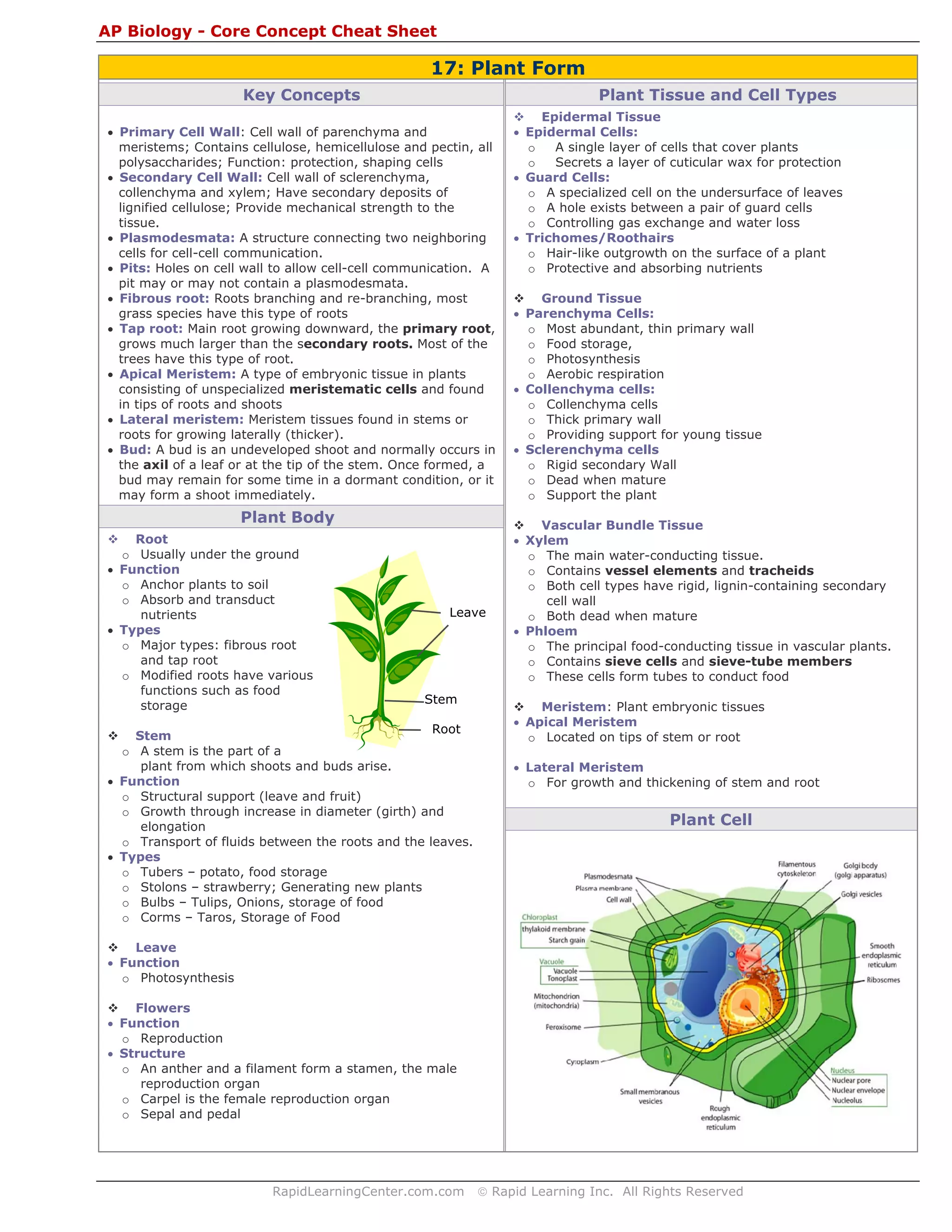
Leave

Stem
Root

Stem
o A stem is the part of a
plant from which shoots and buds arise.
• Function
o Structural support (leave and fruit)
o Growth through increase in diameter (girth) and
elongation
o Transport of fluids between the roots and the leaves.
• Types
o Tubers – potato, food storage
o Stolons – strawberry; Generating new plants
o Bulbs – Tulips, Onions, storage of food
o Corms – Taros, Storage of Food

Epidermal Tissue
• Epidermal Cells:
o
A single layer of cells that cover plants
o
Secrets a layer of cuticular wax for protection
• Guard Cells:
o A specialized cell on the undersurface of leaves
o A hole exists between a pair of guard cells
o Controlling gas exchange and water loss
• Trichomes/Roothairs
o Hair-like outgrowth on the surface of a plant
o Protective and absorbing nutrients
Ground Tissue
• Parenchyma Cells:
o Most abundant, thin primary wall
o Food storage,
o Photosynthesis
o Aerobic respiration
• Collenchyma cells:
o Collenchyma cells
o Thick primary wall
o Providing support for young tissue
• Sclerenchyma cells
o Rigid secondary Wall
o Dead when mature
o Support the plant
Vascular Bundle Tissue
• Xylem
o The main water-conducting tissue.
o Contains vessel elements and tracheids
o Both cell types have rigid, lignin-containing secondary
cell wall
o Both dead when mature
• Phloem
o The principal food-conducting tissue in vascular plants.
o Contains sieve cells and sieve-tube members
o These cells form tubes to conduct food
Meristem: Plant embryonic tissues
• Apical Meristem
o Located on tips of stem or root
• Lateral Meristem
o For growth and thickening of stem and root

Plant Cell

Leave
• Function
o Photosynthesis
Flowers
• Function
o Reproduction
• Structure
o An anther and a filament form a stamen, the male
reproduction organ
o Carpel is the female reproduction organ
o Sepal and pedal

RapidLearningCenter.com.com

© Rapid Learning Inc. All Rights Reserved

Plant structure cheat sheet ap bio

  • 1.
    AP Biology -Core Concept Cheat Sheet 17: Plant Form Key Concepts Plant Tissue and Cell Types • Primary Cell Wall: Cell wall of parenchyma and meristems; Contains cellulose, hemicellulose and pectin, all polysaccharides; Function: protection, shaping cells • Secondary Cell Wall: Cell wall of sclerenchyma, collenchyma and xylem; Have secondary deposits of lignified cellulose; Provide mechanical strength to the tissue. • Plasmodesmata: A structure connecting two neighboring cells for cell-cell communication. • Pits: Holes on cell wall to allow cell-cell communication. A pit may or may not contain a plasmodesmata. • Fibrous root: Roots branching and re-branching, most grass species have this type of roots • Tap root: Main root growing downward, the primary root, grows much larger than the secondary roots. Most of the trees have this type of root. • Apical Meristem: A type of embryonic tissue in plants consisting of unspecialized meristematic cells and found in tips of roots and shoots • Lateral meristem: Meristem tissues found in stems or roots for growing laterally (thicker). • Bud: A bud is an undeveloped shoot and normally occurs in the axil of a leaf or at the tip of the stem. Once formed, a bud may remain for some time in a dormant condition, or it may form a shoot immediately. Plant Body Root o Usually under the ground • Function o Anchor plants to soil o Absorb and transduct nutrients • Types o Major types: fibrous root and tap root o Modified roots have various functions such as food storage Leave Stem Root Stem o A stem is the part of a plant from which shoots and buds arise. • Function o Structural support (leave and fruit) o Growth through increase in diameter (girth) and elongation o Transport of fluids between the roots and the leaves. • Types o Tubers – potato, food storage o Stolons – strawberry; Generating new plants o Bulbs – Tulips, Onions, storage of food o Corms – Taros, Storage of Food Epidermal Tissue • Epidermal Cells: o A single layer of cells that cover plants o Secrets a layer of cuticular wax for protection • Guard Cells: o A specialized cell on the undersurface of leaves o A hole exists between a pair of guard cells o Controlling gas exchange and water loss • Trichomes/Roothairs o Hair-like outgrowth on the surface of a plant o Protective and absorbing nutrients Ground Tissue • Parenchyma Cells: o Most abundant, thin primary wall o Food storage, o Photosynthesis o Aerobic respiration • Collenchyma cells: o Collenchyma cells o Thick primary wall o Providing support for young tissue • Sclerenchyma cells o Rigid secondary Wall o Dead when mature o Support the plant Vascular Bundle Tissue • Xylem o The main water-conducting tissue. o Contains vessel elements and tracheids o Both cell types have rigid, lignin-containing secondary cell wall o Both dead when mature • Phloem o The principal food-conducting tissue in vascular plants. o Contains sieve cells and sieve-tube members o These cells form tubes to conduct food Meristem: Plant embryonic tissues • Apical Meristem o Located on tips of stem or root • Lateral Meristem o For growth and thickening of stem and root Plant Cell Leave • Function o Photosynthesis Flowers • Function o Reproduction • Structure o An anther and a filament form a stamen, the male reproduction organ o Carpel is the female reproduction organ o Sepal and pedal RapidLearningCenter.com.com © Rapid Learning Inc. All Rights Reserved