RapidLearningCenter.com.com © Rapid Learning Inc. All Rights Reserved
AP Biology - Core Concept Cheat Sheet
19: Animal Form
Animal Tissues
Four major types
■ Each type is made up of same type of cells
• Muscular Tissue
■ Skeletal muscle: consists of filaments of myosin and
actin with alternating banding
■ Smooth: Lack the banding, also consists of actin and
myosin
■ Cardiac muscle: striated
muscle found only in the
heart. For heart beating.
• Nervous Tissue
■ Neurons
■ A cell body: contains the
nucleus, mitochondria and
other organelles
■ An axon: Long fibers that
carry signals away from the
cell body
■ Many dendrites: receive
information from another cell
and transmit the message to
the cell body
■ Glial Cells:
■ Nonconducting cells that serve as support cells in the
nervous system and help to protect neurons
• Connective Tissue
■ Loose Connective Tissue, e.g., adipose tissue
■ Fibrous Connective Tissue, e.g.,tendons
Special types
■ Cartilage
■ Bone
■ Blood
Functions
■ Binding
■ Supporting
■ Protecting
■ Forming blood
■ Storing fats
■ Filling space
• Epithelial Tissue
• Cell Shape: three types
■ Squamous epithelium is flattened cells.
■ Cuboidal epithelium is cube-shaped cells.
■ Columnar epithelium consists of elongated cells.
• Cell layer: three types
■ Simple epithelium has only a single cell layer.
■ Stratified epithelium has more than one layer of
cells
■ Pseudostratified epithelium is a single layer of cells
so shaped that they appear at first glance to form
two layers.
• Functions
■ Movement of materials in, out, or around the body.
■ Protection of the internal environment against the
external environment.
■ Secretion of a product.
11 Organ Systems
• Muscular system:
■ All skeleton-attached muscles
■ For movement and body temperature regulation
• Digestive System
■ Mouth, Esophagus, Stomach, Small intestine, Liver,
Pancreas, Gallbladder, Colon (large intestine), Rectum,
and Anus
■ Food ingest and digestion.
• Respiratory System
■ Nose, Pharynx, Larynx,Trachea, Bronchi, and Lung
■ Exchange gas between body and environment
• Cardiovascular System
■ Blood vessels, Blood and Heart.
-- Arteries: from heart
-- Veins: to heart
-- Capillaries: from arteries to veins
■ Transport oxygen, carbon dioxide, chemical signals etc
• Lymphatic System
■ Central lymphoid tissue
-- Bone Marrow: produce all cells in immune system
-- Thymus: T cell maturation
■ Peripheral lymphoid tissue
-- Lymph nodes
-- Lymphatic sinuses, blood vessels, parenchyma
Spleen
-- Mucosa-associated lymphoid tissue
■ Function is defense
• Excretory System
■ Liver, Skin and Urinary System
■ Removes organic wastes; maintaining fluid levels
• Endocrine System
■ Composed of all glands in body
■ Hormone secretion
• Reproductive System
■ Male: testicles, Duct system (epididimys, vas deferens),
Accessory gland (seminal vesecle, prostate), and Penis.
■ Female: Fallopian tubes Ovaries , Uterus Vagina,
Accessory glands, and External genital organs.
■ Function: reproduction
• Nervous System
■ Central nervous system (brain and spinal cord) and
peripheral nervous system
■ Sense the environment and process the signal,
coordinate muscle movement
• Skeletal System
■ Bones
■ Support for the body, producing blood and immune cells,
support muscle movement and store minerals.
• Skin System
■ Skin, hair, nail, and skin-associated glands
■ Protection, exchange and secretion
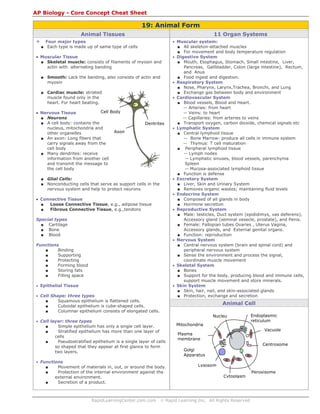
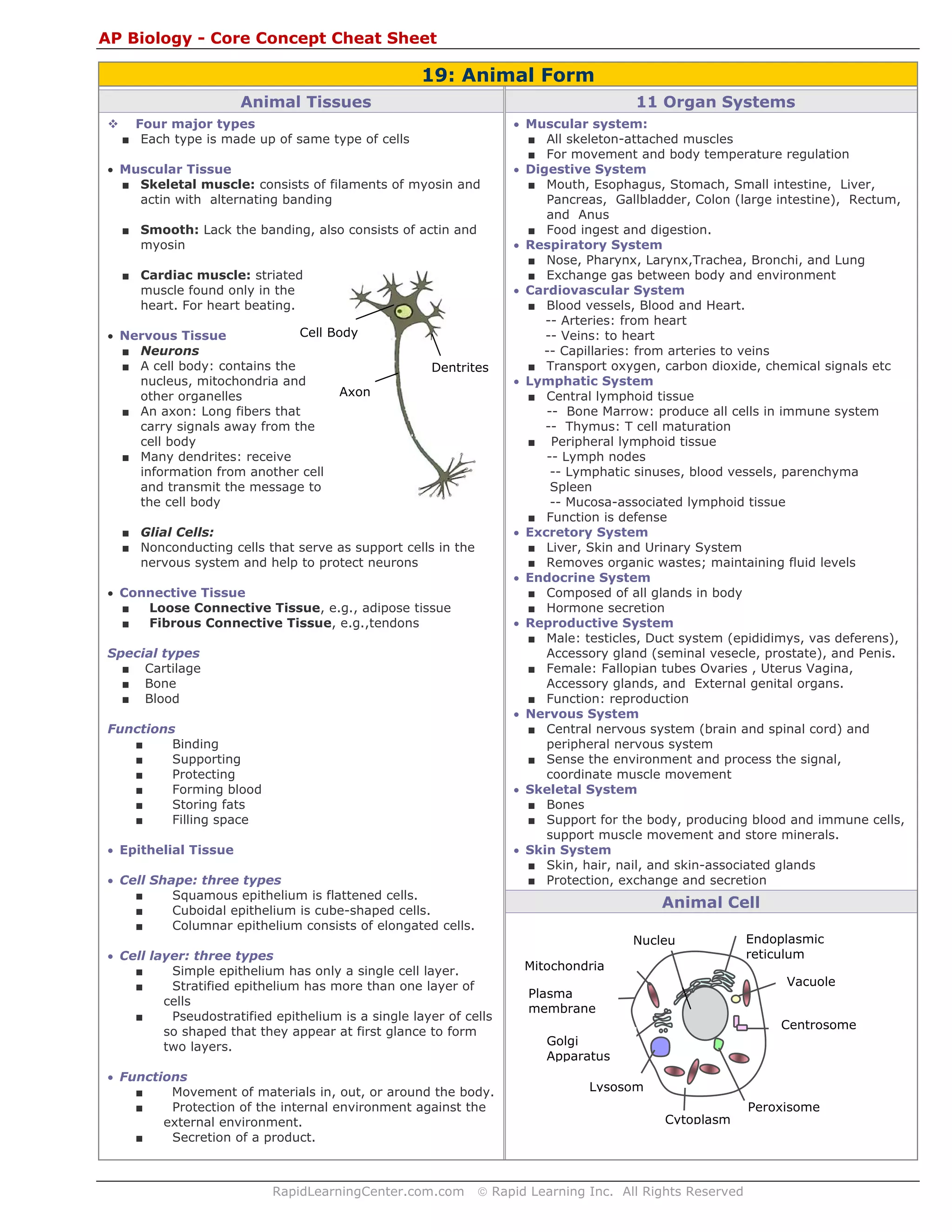
Animal Cell
Cell Body
Axon
Dentrites
Endoplasmic
reticulum
Vacuole
Centrosome
Nucleu
Lysosom
Mitochondria
Golgi
Apparatus
Plasma
membrane
Cytoplasm
Peroxisome

Animal form cheat sheet

  • 1.
    RapidLearningCenter.com.com © RapidLearning Inc. All Rights Reserved AP Biology - Core Concept Cheat Sheet 19: Animal Form Animal Tissues Four major types ■ Each type is made up of same type of cells • Muscular Tissue ■ Skeletal muscle: consists of filaments of myosin and actin with alternating banding ■ Smooth: Lack the banding, also consists of actin and myosin ■ Cardiac muscle: striated muscle found only in the heart. For heart beating. • Nervous Tissue ■ Neurons ■ A cell body: contains the nucleus, mitochondria and other organelles ■ An axon: Long fibers that carry signals away from the cell body ■ Many dendrites: receive information from another cell and transmit the message to the cell body ■ Glial Cells: ■ Nonconducting cells that serve as support cells in the nervous system and help to protect neurons • Connective Tissue ■ Loose Connective Tissue, e.g., adipose tissue ■ Fibrous Connective Tissue, e.g.,tendons Special types ■ Cartilage ■ Bone ■ Blood Functions ■ Binding ■ Supporting ■ Protecting ■ Forming blood ■ Storing fats ■ Filling space • Epithelial Tissue • Cell Shape: three types ■ Squamous epithelium is flattened cells. ■ Cuboidal epithelium is cube-shaped cells. ■ Columnar epithelium consists of elongated cells. • Cell layer: three types ■ Simple epithelium has only a single cell layer. ■ Stratified epithelium has more than one layer of cells ■ Pseudostratified epithelium is a single layer of cells so shaped that they appear at first glance to form two layers. • Functions ■ Movement of materials in, out, or around the body. ■ Protection of the internal environment against the external environment. ■ Secretion of a product. 11 Organ Systems • Muscular system: ■ All skeleton-attached muscles ■ For movement and body temperature regulation • Digestive System ■ Mouth, Esophagus, Stomach, Small intestine, Liver, Pancreas, Gallbladder, Colon (large intestine), Rectum, and Anus ■ Food ingest and digestion. • Respiratory System ■ Nose, Pharynx, Larynx,Trachea, Bronchi, and Lung ■ Exchange gas between body and environment • Cardiovascular System ■ Blood vessels, Blood and Heart. -- Arteries: from heart -- Veins: to heart -- Capillaries: from arteries to veins ■ Transport oxygen, carbon dioxide, chemical signals etc • Lymphatic System ■ Central lymphoid tissue -- Bone Marrow: produce all cells in immune system -- Thymus: T cell maturation ■ Peripheral lymphoid tissue -- Lymph nodes -- Lymphatic sinuses, blood vessels, parenchyma Spleen -- Mucosa-associated lymphoid tissue ■ Function is defense • Excretory System ■ Liver, Skin and Urinary System ■ Removes organic wastes; maintaining fluid levels • Endocrine System ■ Composed of all glands in body ■ Hormone secretion • Reproductive System ■ Male: testicles, Duct system (epididimys, vas deferens), Accessory gland (seminal vesecle, prostate), and Penis. ■ Female: Fallopian tubes Ovaries , Uterus Vagina, Accessory glands, and External genital organs. ■ Function: reproduction • Nervous System ■ Central nervous system (brain and spinal cord) and peripheral nervous system ■ Sense the environment and process the signal, coordinate muscle movement • Skeletal System ■ Bones ■ Support for the body, producing blood and immune cells, support muscle movement and store minerals. • Skin System ■ Skin, hair, nail, and skin-associated glands ■ Protection, exchange and secretion Animal Cell Cell Body Axon Dentrites Endoplasmic reticulum Vacuole Centrosome Nucleu Lysosom Mitochondria Golgi Apparatus Plasma membrane Cytoplasm Peroxisome