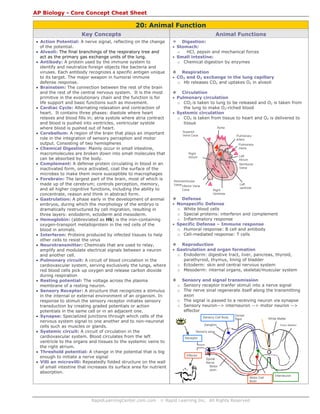
RapidLearningCenter.com.com © Rapid Learning Inc. All Rights Reserved
AP Biology - Core Concept Cheat Sheet
20: Animal Function
Key Concepts
• Action Potential: A nerve signal, reflecting on the change
of the potential.
• Alveoli: The final branchings of the respiratory tree and
act as the primary gas exchange units of the lung.
• Antibody: A protein used by the immune system to
identify and neutralize foreign objects like bacteria and
viruses. Each antibody recognizes a specific antigen unique
to its target. The major weapon in humoral immune
defense response.
• Brainstem: The connection between the rest of the brain
and the rest of the central nervous system. It is the most
primitive in the evolutionary chain and the function is for
life support and basic functions such as movement.
• Cardiac Cycle: Alternating relaxation and contraction of
heart. It contains three phases: diastole where heart
relaxes and blood fills in; atria systole where atria contract
and blood is pushed into ventricles, ventricular systole
where blood is pushed out of heart.
• Cerebellum: A region of the brain that plays an important
role in the integration of sensory perception and motor
output. Consisting of two hemispheres
• Chemical Digestion: Mainly occur in small intestine,
macromolecules are broken down into small molecules that
can be absorbed by the body.
• Complement: A defense protein circulating in blood in an
inactivated form, once activated, coat the surface of the
microbes to make them more susceptible to macrophages
• Forebrain: The largest part of the brain, most of which is
made up of the cerebrum; controls perception, memory,
and all higher cognitive functions, including the ability to
concentrate, reason and think in abstract form.
• Gastrulation: A phase early in the development of animal
embryos, during which the morphology of the embryo is
dramatically restructured by cell migration, resulting in
three layers: endoderm, ectoderm and mesoderm.
• Hemoglobin: (abbreviated as Hb) is the iron-containing
oxygen-transport metalloprotein in the red cells of the
blood in animals.
• Interferon: Proteins produced by infected tissues to help
other cells to resist the virus
• Neurotransmitter: Chemicals that are used to relay,
amplify and modulate electrical signals between a neuron
and another cell.
• Pulmonary circuit: A circuit of blood circulation in the
cardiovascular system, serving exclusively the lungs, where
red blood cells pick up oxygen and release carbon dioxide
during respiration
• Resting potential: The voltage across the plasma
membrane of a resting neuron.
• Sensory Receptor: A structure that recognizes a stimulus
in the internal or external environment of an organism. In
response to stimuli the sensory receptor initiates sensory
transduction by creating graded potentials or action
potentials in the same cell or in an adjacent one.
• Synapse: Specialized junctions through which cells of the
nervous system signal to one another and to non-neuronal
cells such as muscles or glands.
• Systemic circuit: A circuit of circulation in the
cardiovascular system. Blood circulates from the left
ventricle to the organs and tissues to the systemic veins to
the right atrium.
• Threshold potential: A change in the potential that is big
enough to initiate a nerve signal
• Villi an microvilli: Repeatedly folded structure on the wall
of small intestine that increases its surface area for nutrient
absorption.
Animal Functions
Digestion:
• Stomach:
o HCl, pepsin and mechanical forces
• Small intestine:
o Chemical digestion by enzymes
Respiration
• CO2 and O2 exchange in the lung capillary
o Hb releases CO2 and uptakes O2 in alveoli
Circulation
• Pulmonary circulation
o CO2 is taken to lung to be released and O2 is taken from
the lung to make O2-riched blood
• Systemic circulation
o CO2 is taken from tissue to heart and O2 is delivered to
tissue
Defense
• Nonspecific Defense
o White blood cells
o Special proteins: interferon and complement
o Inflammatory response
• Specific Defense – Immune response
o Humoral response: B cell and antibody
o Cell-mediated response: T cells
Reproduction
• Gastrulation and organ formation
o Endoderm: digestive tract, liver, pancreas, thyroid,
parathyroid, thymus, lining of bladder
o Ectoderm: skin and central nervous system
o Mesoderm: internal organs, skeletal/muscular system
Sensory and signal transmission
o Sensory receptor tranfer stimuli into a nerve signal
o The nerve sinal regenerate itself along the transmitting
axon
o The signal is passed to a receiving neuron via synapse
o Sensory neuron--> interneuron --> motor neuron -->
effector
Ganglion
Sensory Cell Body
Dorsal
Root White Matter
Gray Matter
Motor Cell
Body
Interneuron
Sensory axon
Motor
axon
Receptor
Effector
Spinal
Nerve
Right
Ventricle
Left
ventricle
Left
Atrium
Right
Atrium
Superior
Vena Cava
Inferior Vena
Cava
Atrioventricular
Valve
Aorta
Pulmonary
artery
Pulmonary
Veins
Semilunar
Valve

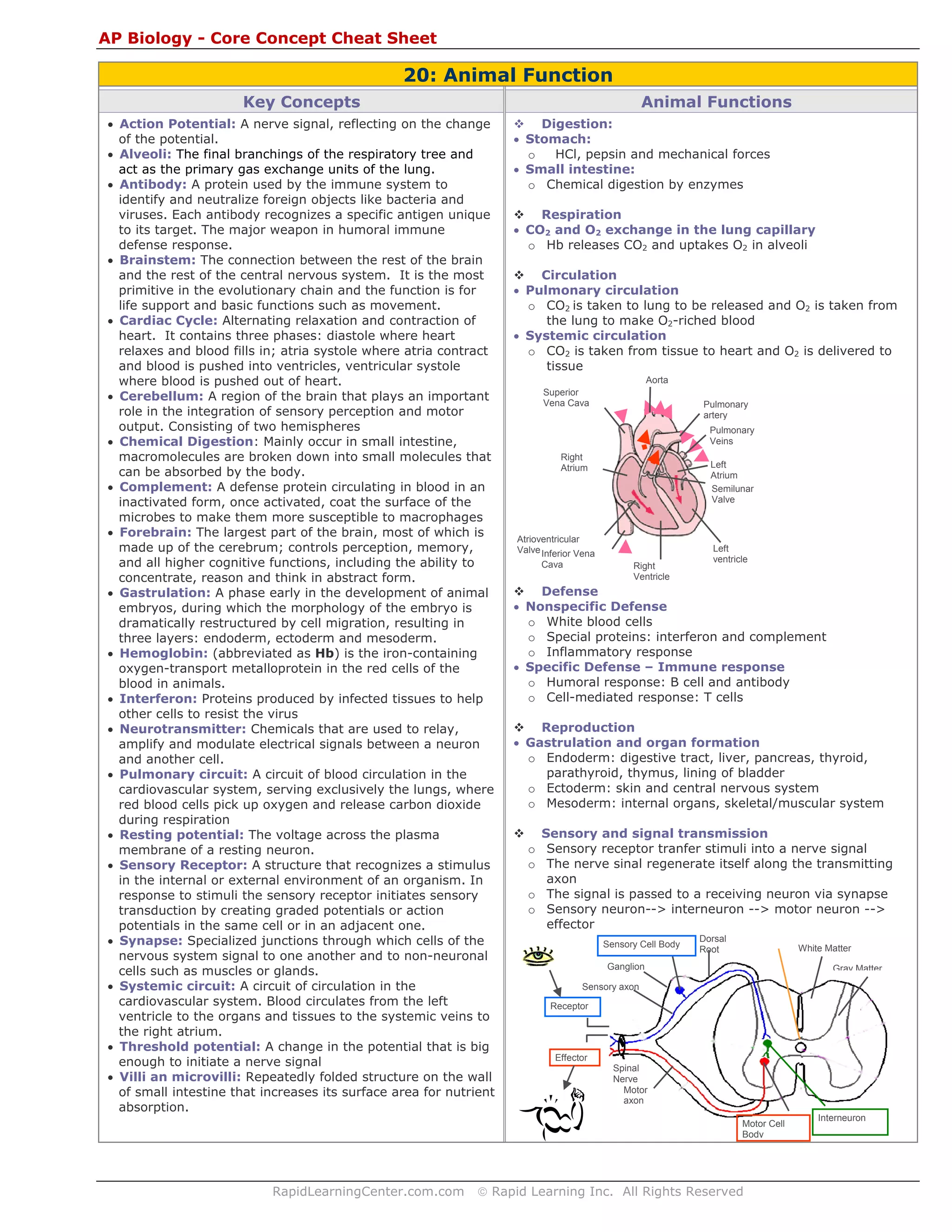
Animal function cheat sheet

  • 1.
    RapidLearningCenter.com.com © RapidLearning Inc. All Rights Reserved AP Biology - Core Concept Cheat Sheet 20: Animal Function Key Concepts • Action Potential: A nerve signal, reflecting on the change of the potential. • Alveoli: The final branchings of the respiratory tree and act as the primary gas exchange units of the lung. • Antibody: A protein used by the immune system to identify and neutralize foreign objects like bacteria and viruses. Each antibody recognizes a specific antigen unique to its target. The major weapon in humoral immune defense response. • Brainstem: The connection between the rest of the brain and the rest of the central nervous system. It is the most primitive in the evolutionary chain and the function is for life support and basic functions such as movement. • Cardiac Cycle: Alternating relaxation and contraction of heart. It contains three phases: diastole where heart relaxes and blood fills in; atria systole where atria contract and blood is pushed into ventricles, ventricular systole where blood is pushed out of heart. • Cerebellum: A region of the brain that plays an important role in the integration of sensory perception and motor output. Consisting of two hemispheres • Chemical Digestion: Mainly occur in small intestine, macromolecules are broken down into small molecules that can be absorbed by the body. • Complement: A defense protein circulating in blood in an inactivated form, once activated, coat the surface of the microbes to make them more susceptible to macrophages • Forebrain: The largest part of the brain, most of which is made up of the cerebrum; controls perception, memory, and all higher cognitive functions, including the ability to concentrate, reason and think in abstract form. • Gastrulation: A phase early in the development of animal embryos, during which the morphology of the embryo is dramatically restructured by cell migration, resulting in three layers: endoderm, ectoderm and mesoderm. • Hemoglobin: (abbreviated as Hb) is the iron-containing oxygen-transport metalloprotein in the red cells of the blood in animals. • Interferon: Proteins produced by infected tissues to help other cells to resist the virus • Neurotransmitter: Chemicals that are used to relay, amplify and modulate electrical signals between a neuron and another cell. • Pulmonary circuit: A circuit of blood circulation in the cardiovascular system, serving exclusively the lungs, where red blood cells pick up oxygen and release carbon dioxide during respiration • Resting potential: The voltage across the plasma membrane of a resting neuron. • Sensory Receptor: A structure that recognizes a stimulus in the internal or external environment of an organism. In response to stimuli the sensory receptor initiates sensory transduction by creating graded potentials or action potentials in the same cell or in an adjacent one. • Synapse: Specialized junctions through which cells of the nervous system signal to one another and to non-neuronal cells such as muscles or glands. • Systemic circuit: A circuit of circulation in the cardiovascular system. Blood circulates from the left ventricle to the organs and tissues to the systemic veins to the right atrium. • Threshold potential: A change in the potential that is big enough to initiate a nerve signal • Villi an microvilli: Repeatedly folded structure on the wall of small intestine that increases its surface area for nutrient absorption. Animal Functions Digestion: • Stomach: o HCl, pepsin and mechanical forces • Small intestine: o Chemical digestion by enzymes Respiration • CO2 and O2 exchange in the lung capillary o Hb releases CO2 and uptakes O2 in alveoli Circulation • Pulmonary circulation o CO2 is taken to lung to be released and O2 is taken from the lung to make O2-riched blood • Systemic circulation o CO2 is taken from tissue to heart and O2 is delivered to tissue Defense • Nonspecific Defense o White blood cells o Special proteins: interferon and complement o Inflammatory response • Specific Defense – Immune response o Humoral response: B cell and antibody o Cell-mediated response: T cells Reproduction • Gastrulation and organ formation o Endoderm: digestive tract, liver, pancreas, thyroid, parathyroid, thymus, lining of bladder o Ectoderm: skin and central nervous system o Mesoderm: internal organs, skeletal/muscular system Sensory and signal transmission o Sensory receptor tranfer stimuli into a nerve signal o The nerve sinal regenerate itself along the transmitting axon o The signal is passed to a receiving neuron via synapse o Sensory neuron--> interneuron --> motor neuron --> effector Ganglion Sensory Cell Body Dorsal Root White Matter Gray Matter Motor Cell Body Interneuron Sensory axon Motor axon Receptor Effector Spinal Nerve Right Ventricle Left ventricle Left Atrium Right Atrium Superior Vena Cava Inferior Vena Cava Atrioventricular Valve Aorta Pulmonary artery Pulmonary Veins Semilunar Valve