1
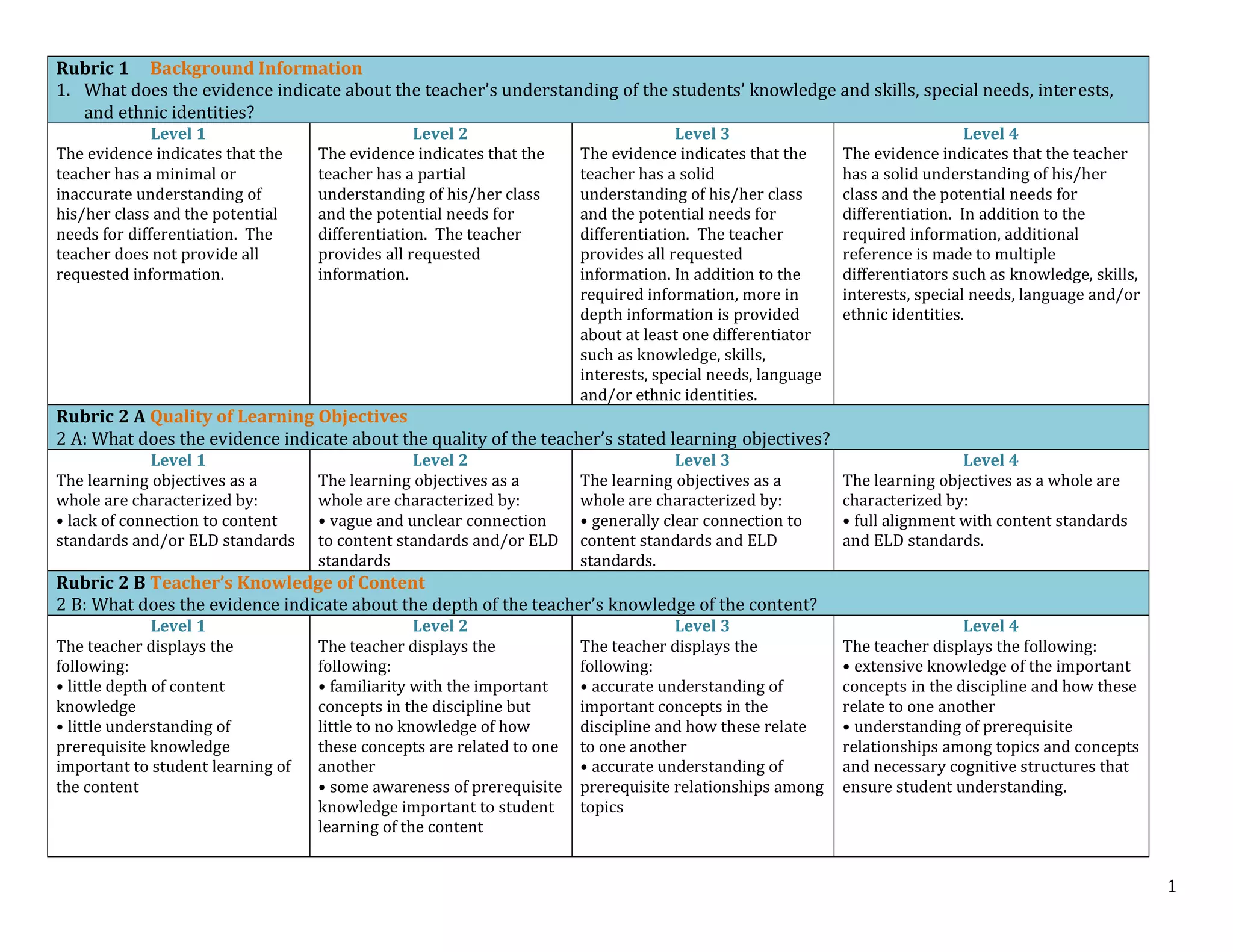
Rubric 1 Background Information
1. What does the evidence indicate about the teacher’s understanding of the students’ knowledge and skills, special needs, interests,
and ethnic identities?
Level 1
The evidence indicates that the
teacher has a minimal or
inaccurate understanding of
his/her class and the potential
needs for differentiation. The
teacher does not provide all
requested information.
Level 2
The evidence indicates that the
teacher has a partial
understanding of his/her class
and the potential needs for
differentiation. The teacher
provides all requested
information.
Level 3
The evidence indicates that the
teacher has a solid
understanding of his/her class
and the potential needs for
differentiation. The teacher
provides all requested
information. In addition to the
required information, more in
depth information is provided
about at least one differentiator
such as knowledge, skills,
interests, special needs, language
and/or ethnic identities.
Level 4
The evidence indicates that the teacher
has a solid understanding of his/her
class and the potential needs for
differentiation. In addition to the
required information, additional
reference is made to multiple
differentiators such as knowledge, skills,
interests, special needs, language and/or
ethnic identities.
Rubric 2 A Quality of Learning Objectives
2 A: What does the evidence indicate about the quality of the teacher’s stated learning objectives?
Level 1
The learning objectives as a
whole are characterized by:
• lack of connection to content
standards and/or ELD standards
Level 2
The learning objectives as a
whole are characterized by:
• vague and unclear connection
to content standards and/or ELD
standards
Level 3
The learning objectives as a
whole are characterized by:
• generally clear connection to
content standards and ELD
standards.
Level 4
The learning objectives as a whole are
characterized by:
• full alignment with content standards
and ELD standards.
Rubric 2 B Teacher’s Knowledge of Content
2 B: What does the evidence indicate about the depth of the teacher’s knowledge of the content?
Level 1
The teacher displays the
following:
• little depth of content
knowledge
• little understanding of
prerequisite knowledge
important to student learning of
the content
Level 2
The teacher displays the
following:
• familiarity with the important
concepts in the discipline but
little to no knowledge of how
these concepts are related to one
another
• some awareness of prerequisite
knowledge important to student
learning of the content
Level 3
The teacher displays the
following:
• accurate understanding of
important concepts in the
discipline and how these relate
to one another
• accurate understanding of
prerequisite relationships among
topics
Level 4
The teacher displays the following:
• extensive knowledge of the important
concepts in the discipline and how these
relate to one another
• understanding of prerequisite
relationships among topics and concepts
and necessary cognitive structures that
ensure student understanding.
2
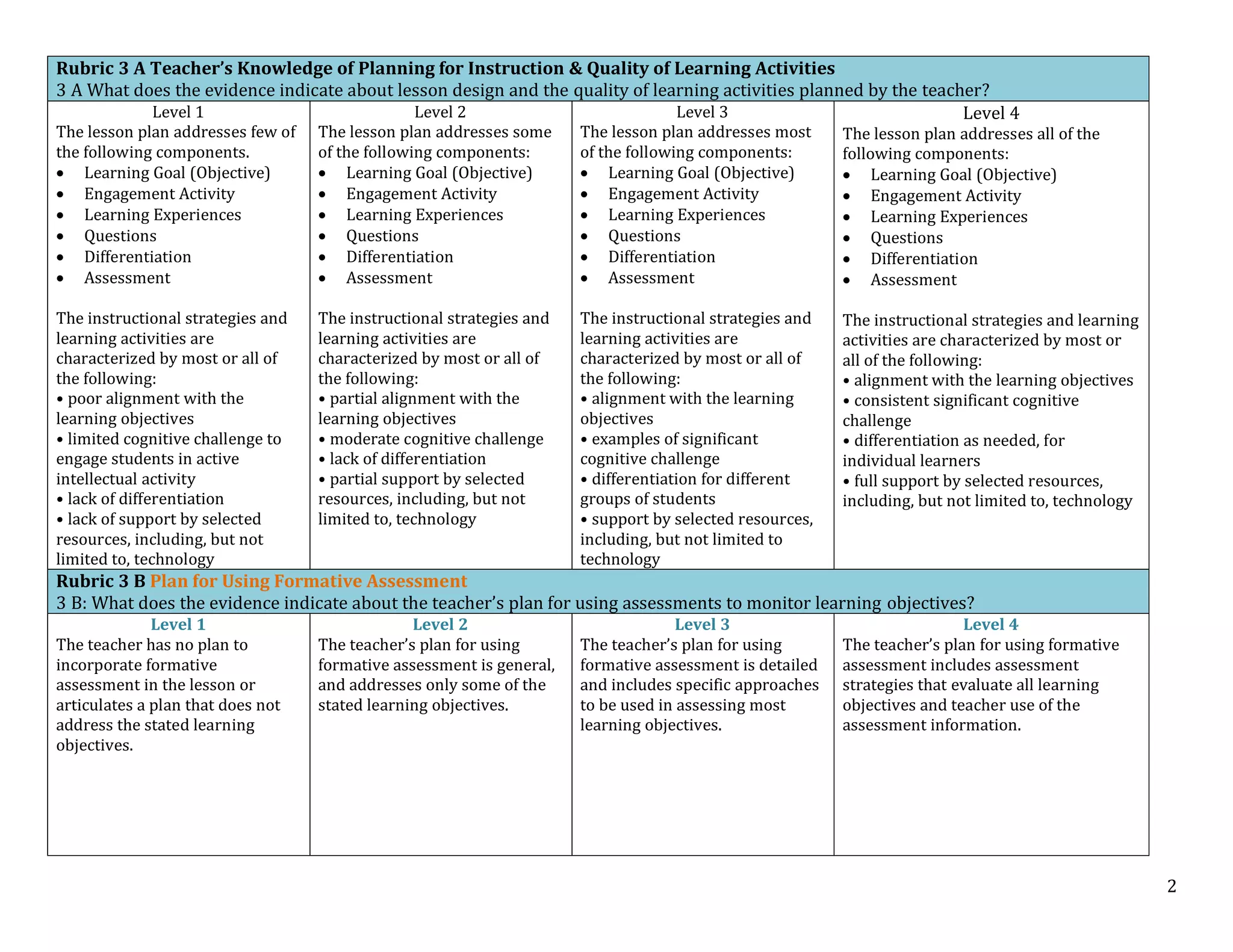
Rubric 3 A Teacher’s Knowledge of Planning for Instruction & Quality of Learning Activities
3 A What does the evidence indicate about lesson design and the quality of learning activities planned by the teacher?
Level 1
The lesson plan addresses few of
the following components.
• Learning Goal (Objective)
• Engagement Activity
• Learning Experiences
• Questions
• Differentiation
• Assessment
The instructional strategies and
learning activities are
characterized by most or all of
the following:
• poor alignment with the
learning objectives
• limited cognitive challenge to
engage students in active
intellectual activity
• lack of differentiation
• lack of support by selected
resources, including, but not
limited to, technology
Level 2
The lesson plan addresses some
of the following components:
• Learning Goal (Objective)
• Engagement Activity
• Learning Experiences
• Questions
• Differentiation
• Assessment
The instructional strategies and
learning activities are
characterized by most or all of
the following:
• partial alignment with the
learning objectives
• moderate cognitive challenge
• lack of differentiation
• partial support by selected
resources, including, but not
limited to, technology
Level 3
The lesson plan addresses most
of the following components:
• Learning Goal (Objective)
• Engagement Activity
• Learning Experiences
• Questions
• Differentiation
• Assessment
The instructional strategies and
learning activities are
characterized by most or all of
the following:
• alignment with the learning
objectives
• examples of significant
cognitive challenge
• differentiation for different
groups of students
• support by selected resources,
including, but not limited to
technology
Level 4
The lesson plan addresses all of the
following components:
• Learning Goal (Objective)
• Engagement Activity
• Learning Experiences
• Questions
• Differentiation
• Assessment
The instructional strategies and learning
activities are characterized by most or
all of the following:
• alignment with the learning objectives
• consistent significant cognitive
challenge
• differentiation as needed, for
individual learners
• full support by selected resources,
including, but not limited to, technology
Rubric 3 B Plan for Using Formative Assessment
3 B: What does the evidence indicate about the teacher’s plan for using assessments to monitor learning objectives?
Level 1
The teacher has no plan to
incorporate formative
assessment in the lesson or
articulates a plan that does not
address the stated learning
objectives.
Level 2
The teacher’s plan for using
formative assessment is general,
and addresses only some of the
stated learning objectives.
Level 3
The teacher’s plan for using
formative assessment is detailed
and includes specific approaches
to be used in assessing most
learning objectives.
Level 4
The teacher’s plan for using formative
assessment includes assessment
strategies that evaluate all learning
objectives and teacher use of the
assessment information.
3
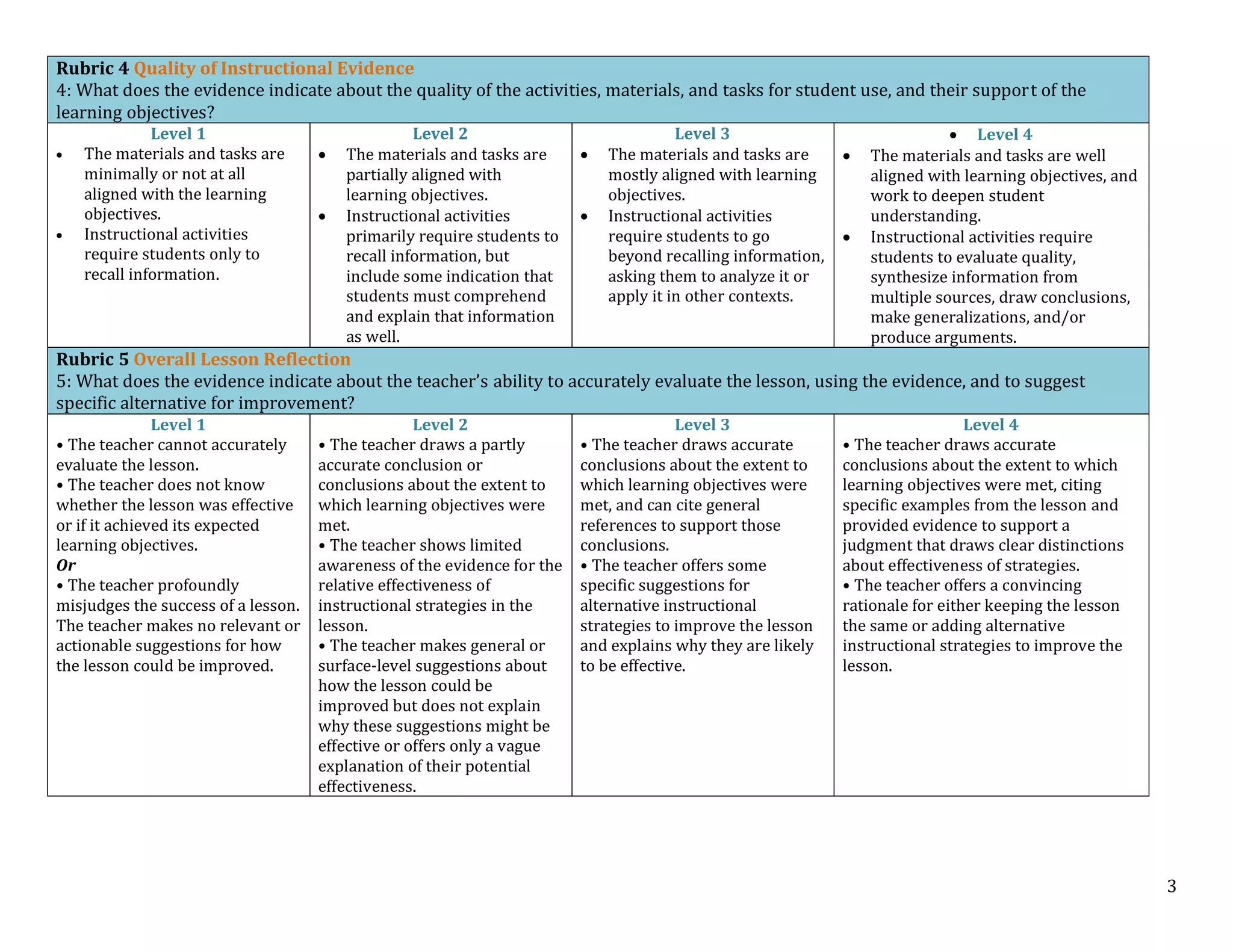
Rubric 4 Quality of Instructional Evidence
4: What does the evidence indicate about the quality of the activities, materials, and tasks for student use, and their support of the
learning objectives?
Level 1
• The materials and tasks are
minimally or not at all
aligned with the learning
objectives.
• Instructional activities
require students only to
recall information.
Level 2
• The materials and tasks are
partially aligned with
learning objectives.
• Instructional activities
primarily require students to
recall information, but
include some indication that
students must comprehend
and explain that information
as well.
Level 3
• The materials and tasks are
mostly aligned with learning
objectives.
• Instructional activities
require students to go
beyond recalling information,
asking them to analyze it or
apply it in other contexts.
• Level 4
• The materials and tasks are well
aligned with learning objectives, and
work to deepen student
understanding.
• Instructional activities require
students to evaluate quality,
synthesize information from
multiple sources, draw conclusions,
make generalizations, and/or
produce arguments.
Rubric 5 Overall Lesson Reflection
5: What does the evidence indicate about the teacher’s ability to accurately evaluate the lesson, using the evidence, and to suggest
specific alternative for improvement?
Level 1
• The teacher cannot accurately
evaluate the lesson.
• The teacher does not know
whether the lesson was effective
or if it achieved its expected
learning objectives.
Or
• The teacher profoundly
misjudges the success of a lesson.
The teacher makes no relevant or
actionable suggestions for how
the lesson could be improved.
Level 2
• The teacher draws a partly
accurate conclusion or
conclusions about the extent to
which learning objectives were
met.
• The teacher shows limited
awareness of the evidence for the
relative effectiveness of
instructional strategies in the
lesson.
• The teacher makes general or
surface-level suggestions about
how the lesson could be
improved but does not explain
why these suggestions might be
effective or offers only a vague
explanation of their potential
effectiveness.
Level 3
• The teacher draws accurate
conclusions about the extent to
which learning objectives were
met, and can cite general
references to support those
conclusions.
• The teacher offers some
specific suggestions for
alternative instructional
strategies to improve the lesson
and explains why they are likely
to be effective.
Level 4
• The teacher draws accurate
conclusions about the extent to which
learning objectives were met, citing
specific examples from the lesson and
provided evidence to support a
judgment that draws clear distinctions
about effectiveness of strategies.
• The teacher offers a convincing
rationale for either keeping the lesson
the same or adding alternative
instructional strategies to improve the
lesson.

Midterm capstone rubric spring 2017

  • 1.
    1 Rubric 1 BackgroundInformation 1. What does the evidence indicate about the teacher’s understanding of the students’ knowledge and skills, special needs, interests, and ethnic identities? Level 1 The evidence indicates that the teacher has a minimal or inaccurate understanding of his/her class and the potential needs for differentiation. The teacher does not provide all requested information. Level 2 The evidence indicates that the teacher has a partial understanding of his/her class and the potential needs for differentiation. The teacher provides all requested information. Level 3 The evidence indicates that the teacher has a solid understanding of his/her class and the potential needs for differentiation. The teacher provides all requested information. In addition to the required information, more in depth information is provided about at least one differentiator such as knowledge, skills, interests, special needs, language and/or ethnic identities. Level 4 The evidence indicates that the teacher has a solid understanding of his/her class and the potential needs for differentiation. In addition to the required information, additional reference is made to multiple differentiators such as knowledge, skills, interests, special needs, language and/or ethnic identities. Rubric 2 A Quality of Learning Objectives 2 A: What does the evidence indicate about the quality of the teacher’s stated learning objectives? Level 1 The learning objectives as a whole are characterized by: • lack of connection to content standards and/or ELD standards Level 2 The learning objectives as a whole are characterized by: • vague and unclear connection to content standards and/or ELD standards Level 3 The learning objectives as a whole are characterized by: • generally clear connection to content standards and ELD standards. Level 4 The learning objectives as a whole are characterized by: • full alignment with content standards and ELD standards. Rubric 2 B Teacher’s Knowledge of Content 2 B: What does the evidence indicate about the depth of the teacher’s knowledge of the content? Level 1 The teacher displays the following: • little depth of content knowledge • little understanding of prerequisite knowledge important to student learning of the content Level 2 The teacher displays the following: • familiarity with the important concepts in the discipline but little to no knowledge of how these concepts are related to one another • some awareness of prerequisite knowledge important to student learning of the content Level 3 The teacher displays the following: • accurate understanding of important concepts in the discipline and how these relate to one another • accurate understanding of prerequisite relationships among topics Level 4 The teacher displays the following: • extensive knowledge of the important concepts in the discipline and how these relate to one another • understanding of prerequisite relationships among topics and concepts and necessary cognitive structures that ensure student understanding.
  • 2.
    2 Rubric 3 ATeacher’s Knowledge of Planning for Instruction & Quality of Learning Activities 3 A What does the evidence indicate about lesson design and the quality of learning activities planned by the teacher? Level 1 The lesson plan addresses few of the following components. • Learning Goal (Objective) • Engagement Activity • Learning Experiences • Questions • Differentiation • Assessment The instructional strategies and learning activities are characterized by most or all of the following: • poor alignment with the learning objectives • limited cognitive challenge to engage students in active intellectual activity • lack of differentiation • lack of support by selected resources, including, but not limited to, technology Level 2 The lesson plan addresses some of the following components: • Learning Goal (Objective) • Engagement Activity • Learning Experiences • Questions • Differentiation • Assessment The instructional strategies and learning activities are characterized by most or all of the following: • partial alignment with the learning objectives • moderate cognitive challenge • lack of differentiation • partial support by selected resources, including, but not limited to, technology Level 3 The lesson plan addresses most of the following components: • Learning Goal (Objective) • Engagement Activity • Learning Experiences • Questions • Differentiation • Assessment The instructional strategies and learning activities are characterized by most or all of the following: • alignment with the learning objectives • examples of significant cognitive challenge • differentiation for different groups of students • support by selected resources, including, but not limited to technology Level 4 The lesson plan addresses all of the following components: • Learning Goal (Objective) • Engagement Activity • Learning Experiences • Questions • Differentiation • Assessment The instructional strategies and learning activities are characterized by most or all of the following: • alignment with the learning objectives • consistent significant cognitive challenge • differentiation as needed, for individual learners • full support by selected resources, including, but not limited to, technology Rubric 3 B Plan for Using Formative Assessment 3 B: What does the evidence indicate about the teacher’s plan for using assessments to monitor learning objectives? Level 1 The teacher has no plan to incorporate formative assessment in the lesson or articulates a plan that does not address the stated learning objectives. Level 2 The teacher’s plan for using formative assessment is general, and addresses only some of the stated learning objectives. Level 3 The teacher’s plan for using formative assessment is detailed and includes specific approaches to be used in assessing most learning objectives. Level 4 The teacher’s plan for using formative assessment includes assessment strategies that evaluate all learning objectives and teacher use of the assessment information.
  • 3.
    3 Rubric 4 Qualityof Instructional Evidence 4: What does the evidence indicate about the quality of the activities, materials, and tasks for student use, and their support of the learning objectives? Level 1 • The materials and tasks are minimally or not at all aligned with the learning objectives. • Instructional activities require students only to recall information. Level 2 • The materials and tasks are partially aligned with learning objectives. • Instructional activities primarily require students to recall information, but include some indication that students must comprehend and explain that information as well. Level 3 • The materials and tasks are mostly aligned with learning objectives. • Instructional activities require students to go beyond recalling information, asking them to analyze it or apply it in other contexts. • Level 4 • The materials and tasks are well aligned with learning objectives, and work to deepen student understanding. • Instructional activities require students to evaluate quality, synthesize information from multiple sources, draw conclusions, make generalizations, and/or produce arguments. Rubric 5 Overall Lesson Reflection 5: What does the evidence indicate about the teacher’s ability to accurately evaluate the lesson, using the evidence, and to suggest specific alternative for improvement? Level 1 • The teacher cannot accurately evaluate the lesson. • The teacher does not know whether the lesson was effective or if it achieved its expected learning objectives. Or • The teacher profoundly misjudges the success of a lesson. The teacher makes no relevant or actionable suggestions for how the lesson could be improved. Level 2 • The teacher draws a partly accurate conclusion or conclusions about the extent to which learning objectives were met. • The teacher shows limited awareness of the evidence for the relative effectiveness of instructional strategies in the lesson. • The teacher makes general or surface-level suggestions about how the lesson could be improved but does not explain why these suggestions might be effective or offers only a vague explanation of their potential effectiveness. Level 3 • The teacher draws accurate conclusions about the extent to which learning objectives were met, and can cite general references to support those conclusions. • The teacher offers some specific suggestions for alternative instructional strategies to improve the lesson and explains why they are likely to be effective. Level 4 • The teacher draws accurate conclusions about the extent to which learning objectives were met, citing specific examples from the lesson and provided evidence to support a judgment that draws clear distinctions about effectiveness of strategies. • The teacher offers a convincing rationale for either keeping the lesson the same or adding alternative instructional strategies to improve the lesson.