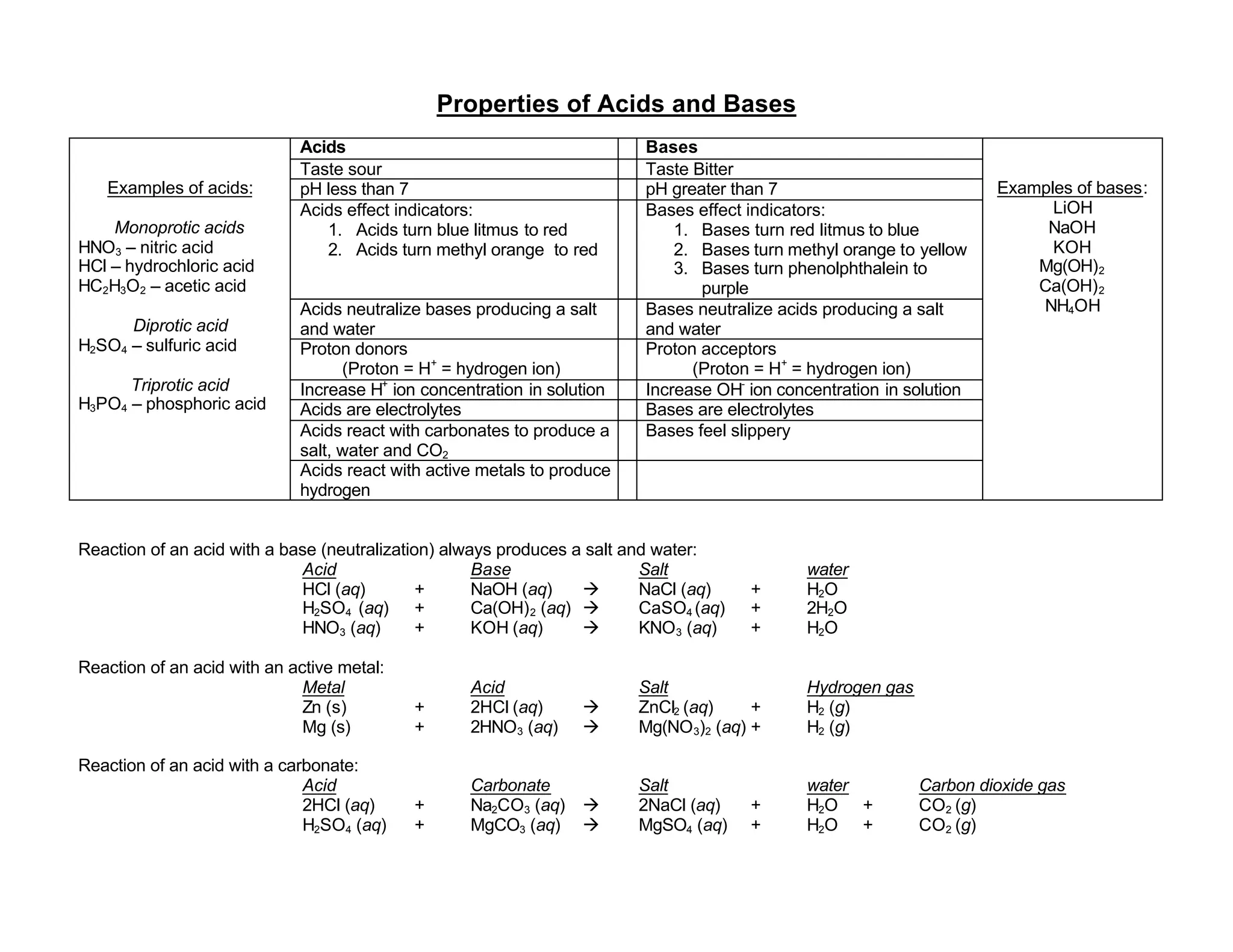
Properties of Acids and Bases
Acids Bases
Taste sour Taste Bitter
pH less than 7 pH greater than 7
Acids effect indicators:
1. Acids turn blue litmus to red
2. Acids turn methyl orange to red
Bases effect indicators:
1. Bases turn red litmus to blue
2. Bases turn methyl orange to yellow
3. Bases turn phenolphthalein to
purple
Acids neutralize bases producing a salt
and water
Bases neutralize acids producing a salt
and water
Proton donors
(Proton = H+
= hydrogen ion)
Proton acceptors
(Proton = H+
= hydrogen ion)
Increase H+
ion concentration in solution Increase OH-
ion concentration in solution
Acids are electrolytes Bases are electrolytes
Acids react with carbonates to produce a
salt, water and CO2
Bases feel slippery
Examples of acids:
Monoprotic acids
HNO3 – nitric acid
HCl – hydrochloric acid
HC2H3O2 – acetic acid
Diprotic acid
H2SO4 – sulfuric acid
Triprotic acid
H3PO4 – phosphoric acid
Acids react with active metals to produce
hydrogen
Examples of bases:
LiOH
NaOH
KOH
Mg(OH)2
Ca(OH)2
NH4OH
Reaction of an acid with a base (neutralization) always produces a salt and water:
Acid Base Salt water
HCl (aq) + NaOH (aq) à NaCl (aq) + H2O
H2SO4 (aq) + Ca(OH)2 (aq) à CaSO4 (aq) + 2H2O
HNO3 (aq) + KOH (aq) à KNO3 (aq) + H2O
Reaction of an acid with an active metal:
Metal Acid Salt Hydrogen gas
Zn (s) + 2HCl (aq) à ZnCl2 (aq) + H2 (g)
Mg (s) + 2HNO3 (aq) à Mg(NO3)2 (aq) + H2 (g)
Reaction of an acid with a carbonate:
Acid Carbonate Salt water Carbon dioxide gas
2HCl (aq) + Na2CO3 (aq) à 2NaCl (aq) + H2O + CO2 (g)
H2SO4 (aq) + MgCO3 (aq) à MgSO4 (aq) + H2O + CO2 (g)

Properties of acids; bases

  • 1.
    Properties of Acidsand Bases Acids Bases Taste sour Taste Bitter pH less than 7 pH greater than 7 Acids effect indicators: 1. Acids turn blue litmus to red 2. Acids turn methyl orange to red Bases effect indicators: 1. Bases turn red litmus to blue 2. Bases turn methyl orange to yellow 3. Bases turn phenolphthalein to purple Acids neutralize bases producing a salt and water Bases neutralize acids producing a salt and water Proton donors (Proton = H+ = hydrogen ion) Proton acceptors (Proton = H+ = hydrogen ion) Increase H+ ion concentration in solution Increase OH- ion concentration in solution Acids are electrolytes Bases are electrolytes Acids react with carbonates to produce a salt, water and CO2 Bases feel slippery Examples of acids: Monoprotic acids HNO3 – nitric acid HCl – hydrochloric acid HC2H3O2 – acetic acid Diprotic acid H2SO4 – sulfuric acid Triprotic acid H3PO4 – phosphoric acid Acids react with active metals to produce hydrogen Examples of bases: LiOH NaOH KOH Mg(OH)2 Ca(OH)2 NH4OH Reaction of an acid with a base (neutralization) always produces a salt and water: Acid Base Salt water HCl (aq) + NaOH (aq) à NaCl (aq) + H2O H2SO4 (aq) + Ca(OH)2 (aq) à CaSO4 (aq) + 2H2O HNO3 (aq) + KOH (aq) à KNO3 (aq) + H2O Reaction of an acid with an active metal: Metal Acid Salt Hydrogen gas Zn (s) + 2HCl (aq) à ZnCl2 (aq) + H2 (g) Mg (s) + 2HNO3 (aq) à Mg(NO3)2 (aq) + H2 (g) Reaction of an acid with a carbonate: Acid Carbonate Salt water Carbon dioxide gas 2HCl (aq) + Na2CO3 (aq) à 2NaCl (aq) + H2O + CO2 (g) H2SO4 (aq) + MgCO3 (aq) à MgSO4 (aq) + H2O + CO2 (g)