AP Physics - Core Concept Cheat Sheet 
06: Newton’s Laws 
Key Physics Terms 
• Vector: A quantity that represents magnitude (size) 
and direction. It is usually represented with an arrow to 
indicate the appropriate direction. They may or may 
not be drawn to scale. 
• Resultant: the result of adding two or more vectors; 
vector sum. 
• Vector Component: The perpendicular parts into 
which a vector can be separated and that act in 
different directions from the vector. 
• Vector Addition: The process of combining vectors; 
added tip to tail. 
• Velocity: The distance an object travels per unit of 
time including its direction of motion. 
• Static Equilibrium: A motionless state where all the 
forces acting on an object yield a net force of zero. 
• Dynamic Equilibrium: A condition of constant 
motion, zero acceleration where all the forces acting on 
an object yield a net force of zero. 
• Friction Force: A force that acts to resist motion of 
objects that are in contact. 
• Normal Force: Support force that acts perpendicular 
to a surface. If the surface is horizontal, this force 
balances the weight of the object. 
• Force: A vector quantity that tends to accelerate an 
object; a push or a pull. 
• Net Force, Fnet: A combination of all the forces that 
act on an object. 
Variables Used 
• d = distance 
• t = time 
• v = velocity (usually average velocity or constant 
velocity) 
• a = acceleration 
• F = force 
• Ff =frictional force 
• FN =normal force 
• Δ = change in 
• Θ = angle 
• m = mass 
• μ = coefficient of friction 
• W = weight 
Key Formulas 
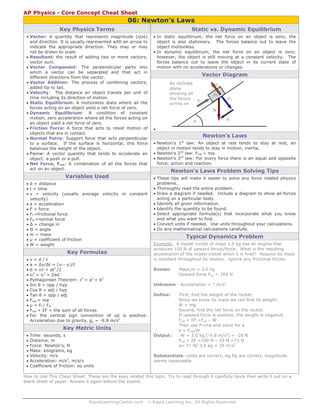
FN 
m 
θ 
F┴ 
F║ 
W 
Ff 
An inclined 
plane 
showing all 
the forces 
acting on 
RapidLearningCenter.com © Rapid Learning Inc. All Rights Reserved 
• v = d / t 
• a = Δv/Δt = (vf - vi)/t 
• d = vit + at2 /2 
• vf 
2 = vi 
2 + 2ad 
• Pythagorean Theorem: c2 = a2 + b2 
• Sin θ = opp / hyp 
• Cos θ = adj / hyp 
• Tan θ = opp / adj 
• Fnet = ma 
• μ = Ff / FN 
• Fnet = ΣF = the sum of all forces 
• For the vertical sign convention of up is positive: 
Acceleration due to gravity, g, = -9.8 m/s2 
Key Metric Units 
• Time: seconds, s 
• Distance, m 
• Force: Newton’s, N 
• Mass: kilograms, kg 
• Velocity: m/s 
• Acceleration: m/s2, m/s/s 
• Coefficient of friction: no units 
Static vs. Dynamic Equilibrium 
• In static equilibrium, the net force on an object is zero; the 
object is also stationary. The forces balance out to leave the 
object motionless. 
• In dynamic equilibrium, the net force on an object is zero; 
however, the object is still moving at a constant velocity. The 
forces balance out to leave the object in its current state of 
motion with no accelerations or changes. 
Vector Diagram 
• 
Newton’s Laws 
• Newton’s 1st law: An object at rest tends to stay at rest, an 
object in motion tends to stay in motion; inertia. 
• Newton’s 2nd law: Fnet = ma. 
• Newton’s 3rd law: For every force there is an equal and opposite 
force; action and reaction. 
Newton’s Laws Problem Solving Tips 
• These tips will make it easier to solve any force related physics 
problems. 
• Thoroughly read the entire problem. 
• Draw a diagram if needed. Include a diagram to show all forces 
acting on a particular body. 
• Identify all given information. 
• Identify the quantity to be found. 
• Select appropriate formula(s) that incorporate what you know 
and what you want to find. 
• Convert units if needed. Use units throughout your calculations. 
• Do any mathematical calculations carefully. 
Typical Dynamics Problem 
Example: A model rocket of mass 3.0 kg has an engine that 
produces 100 N of upward thrust/force. What is the resulting 
acceleration of the model rocket when it is fired? Assume its mass 
is constant throughout its motion. Ignore any frictional forces. 
Known: Mass,m = 3.0 kg 
Upward force Fup = 100 N 
Unknown: Acceleration = ? m/s2 
Define: First, find the weight of the rocket: 
Since we know its mass we can find its weight. 
W = mg 
Second, find the net force on the rocket: 
If upward force is positive, the weight is negative. 
Fnet = ΣF =Fup – W 
Then use F=ma and solve for a 
a = Fnet/m 
Output: W = 3.0 kg (-9.8 m/s2) = -29 N 
Fnet = ΣF =100 N – 29 N =71 N 
a= 71 N/ 3.0 kg = 24 m/s2 
Substantiate: Units are correct, sig fig are correct, magnitude 
seems reasonable. 
How to Use This Cheat Sheet: These are the keys related this topic. Try to read through it carefully twice then write it out on a 
blank sheet of paper. Review it again before the exams.

Newton's Laws Cheat sheet

  • 1.
    AP Physics -Core Concept Cheat Sheet 06: Newton’s Laws Key Physics Terms • Vector: A quantity that represents magnitude (size) and direction. It is usually represented with an arrow to indicate the appropriate direction. They may or may not be drawn to scale. • Resultant: the result of adding two or more vectors; vector sum. • Vector Component: The perpendicular parts into which a vector can be separated and that act in different directions from the vector. • Vector Addition: The process of combining vectors; added tip to tail. • Velocity: The distance an object travels per unit of time including its direction of motion. • Static Equilibrium: A motionless state where all the forces acting on an object yield a net force of zero. • Dynamic Equilibrium: A condition of constant motion, zero acceleration where all the forces acting on an object yield a net force of zero. • Friction Force: A force that acts to resist motion of objects that are in contact. • Normal Force: Support force that acts perpendicular to a surface. If the surface is horizontal, this force balances the weight of the object. • Force: A vector quantity that tends to accelerate an object; a push or a pull. • Net Force, Fnet: A combination of all the forces that act on an object. Variables Used • d = distance • t = time • v = velocity (usually average velocity or constant velocity) • a = acceleration • F = force • Ff =frictional force • FN =normal force • Δ = change in • Θ = angle • m = mass • μ = coefficient of friction • W = weight Key Formulas FN m θ F┴ F║ W Ff An inclined plane showing all the forces acting on RapidLearningCenter.com © Rapid Learning Inc. All Rights Reserved • v = d / t • a = Δv/Δt = (vf - vi)/t • d = vit + at2 /2 • vf 2 = vi 2 + 2ad • Pythagorean Theorem: c2 = a2 + b2 • Sin θ = opp / hyp • Cos θ = adj / hyp • Tan θ = opp / adj • Fnet = ma • μ = Ff / FN • Fnet = ΣF = the sum of all forces • For the vertical sign convention of up is positive: Acceleration due to gravity, g, = -9.8 m/s2 Key Metric Units • Time: seconds, s • Distance, m • Force: Newton’s, N • Mass: kilograms, kg • Velocity: m/s • Acceleration: m/s2, m/s/s • Coefficient of friction: no units Static vs. Dynamic Equilibrium • In static equilibrium, the net force on an object is zero; the object is also stationary. The forces balance out to leave the object motionless. • In dynamic equilibrium, the net force on an object is zero; however, the object is still moving at a constant velocity. The forces balance out to leave the object in its current state of motion with no accelerations or changes. Vector Diagram • Newton’s Laws • Newton’s 1st law: An object at rest tends to stay at rest, an object in motion tends to stay in motion; inertia. • Newton’s 2nd law: Fnet = ma. • Newton’s 3rd law: For every force there is an equal and opposite force; action and reaction. Newton’s Laws Problem Solving Tips • These tips will make it easier to solve any force related physics problems. • Thoroughly read the entire problem. • Draw a diagram if needed. Include a diagram to show all forces acting on a particular body. • Identify all given information. • Identify the quantity to be found. • Select appropriate formula(s) that incorporate what you know and what you want to find. • Convert units if needed. Use units throughout your calculations. • Do any mathematical calculations carefully. Typical Dynamics Problem Example: A model rocket of mass 3.0 kg has an engine that produces 100 N of upward thrust/force. What is the resulting acceleration of the model rocket when it is fired? Assume its mass is constant throughout its motion. Ignore any frictional forces. Known: Mass,m = 3.0 kg Upward force Fup = 100 N Unknown: Acceleration = ? m/s2 Define: First, find the weight of the rocket: Since we know its mass we can find its weight. W = mg Second, find the net force on the rocket: If upward force is positive, the weight is negative. Fnet = ΣF =Fup – W Then use F=ma and solve for a a = Fnet/m Output: W = 3.0 kg (-9.8 m/s2) = -29 N Fnet = ΣF =100 N – 29 N =71 N a= 71 N/ 3.0 kg = 24 m/s2 Substantiate: Units are correct, sig fig are correct, magnitude seems reasonable. How to Use This Cheat Sheet: These are the keys related this topic. Try to read through it carefully twice then write it out on a blank sheet of paper. Review it again before the exams.