Facility –Location & Layout

N.K.Agarwal
Plant Location
• Location of facilities involves commitment of
resources to a long range plan
• Need for selection of location
– Business newly started
– Existing business has outgrown the capacity of the original
facilities
– Volume of business or extent of market needs establishing
of branches
– Lease expires and the landlord does not renew the lease
– Other social or economic reasons e.g. Inadequate labour
supply, shifting of markets etc
Plant Location
• Proper selection of location for the plant ensures
– An easy and regular supply of
• Raw materials
• Labour force
– Efficient plant layout
– Proper utilisation of plant production capacity & related cost of
production
• Resulting into smooth and efficient working of the organisation
Steps in plant location
• National decision (within or outside the country)
–
–
–
–
–

Political stability
Export & import policy
Currency and exchange rate
Cultural & economic peculiarities
Natural environment

• Selection of the region
–
–
–
–
–
–
–

Availability of raw materials
Nearness to market
Availability of power
Transport facilities
Suitability of climate
Government policy
Competition among states
Steps in plant location
• Selection of locality or community
–
–
–
–
–
–
–
–

Availability of labour
Civic amenities for workers
Existence of complementary & competing industries
Finance & research facilities
Availibility of water and fire fighting services
Local taxes & restrictions
Momentum of an early start
Personal factors

• Selection of exact site
– Soil, size & topography
– Disposal of waste
Off shore location
• Availibility of relatively cheaper labour appears to be
a lure to many manufacturers to establish plants in
foreign countries
• However, lower productivity of the labour can be a
contradicting factor
• Effect of capital productivity needs to be considered
also
• Many other costs like cost of materials, fuel, power,
equipment, credit, transportation, taxation etc have to
be also considered for striking a balance between the
various costs for the most economic decision
Plant Layout
• A floor plan for determining and arranging the
desired machinery and equipment of a plant
• It permits
–The quickest flow of materials in processing the product
•From the receipt of the raw materials to the shipment of
the finished product
–At the lowest cost, and
–With the least amount of handling
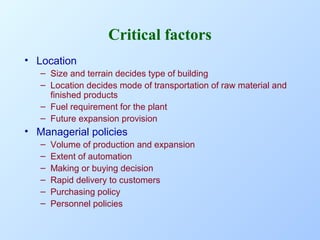
Critical factors
• Materials
– Type, availability, provision for storage and movement

• Product
– Type i.e. Heavy,light, wet operation (cement), market
demand (decision on machinery type)

• Workers
– Male, female (special needs), facilities

• Machinery
– Fixed or mobile position of men, machinery, job to decide
machinery layout-depending on type, volume of production
Critical factors
• Location
– Size and terrain decides type of building
– Location decides mode of transportation of raw material and
finished products
– Fuel requirement for the plant
– Future expansion provision

• Managerial policies
–
–
–
–
–
–

Volume of production and expansion
Extent of automation
Making or buying decision
Rapid delivery to customers
Purchasing policy
Personnel policies
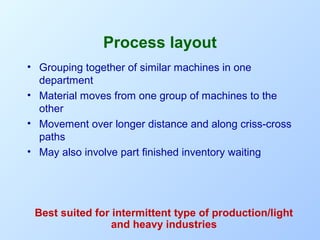
Process layout
• Grouping together of similar machines in one
department
• Material moves from one group of machines to the
other
• Movement over longer distance and along criss-cross
paths
• May also involve part finished inventory waiting

Best suited for intermittent type of production/light
and heavy industries
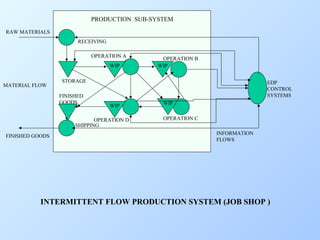
PRODUCTION SUB-SYSTEM
RAW MATERIALS
RECEIVING
OPERATION A
WIP

MATERIAL FLOW

STORAGE
FINISHED
GOODS

EDP
CONTROL
SYSTEMS
WIP

OPERATION D
SHIPPING
FINISHED GOODS

OPERATION B
WIP

WIP
OPERATION C
INFORMATION
FLOWS

INTERMITTENT FLOW PRODUCTION SYSTEM (JOB SHOP )
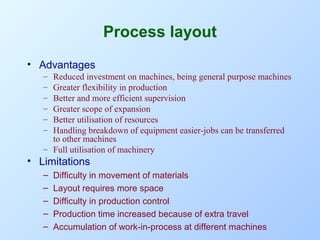
Process layout
• Advantages
–
–
–
–
–
–

Reduced investment on machines, being general purpose machines
Greater flexibility in production
Better and more efficient supervision
Greater scope of expansion
Better utilisation of resources
Handling breakdown of equipment easier-jobs can be transferred
to other machines
– Full utilisation of machinery

• Limitations
–
–
–
–
–

Difficulty in movement of materials
Layout requires more space
Difficulty in production control
Production time increased because of extra travel
Accumulation of work-in-process at different machines
Product layout
• Machines arranged in a line depending upon sequence of
operations
• Material moves in a line from the first machine to the
finished product on the last machine.
• Investment higher as compared to process layout

Better suited for standardised products on a mass
scale production. Ex chemicals,paper
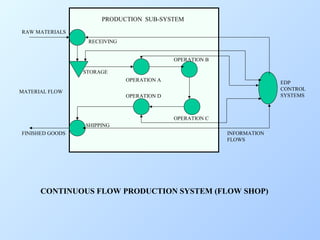
PRODUCTION SUB-SYSTEM
RAW MATERIALS
RECEIVING
OPERATION B
STORAGE
OPERATION A
MATERIAL FLOW

EDP
CONTROL
SYSTEMS

OPERATION D

OPERATION C
SHIPPING
FINISHED GOODS

INFORMATION
FLOWS

CONTINUOUS FLOW PRODUCTION SYSTEM (FLOW SHOP)
Product layout
• Advantages
–
–
–
–
–
–
–

•

Reduction in material handling cost due to mechanisation
Layout avoids production bottlenecks
Economy in manufacturing time
Better production control
Requires less floor area per unit of production
Work-in-progress in reduced
Early detection of mistakes

Limitations
–
–
–
–
–

Layout inflexible
Layout expensive
Difficulty in supervision
Expansion is difficult
Any breakdown along the line can disrupt total production
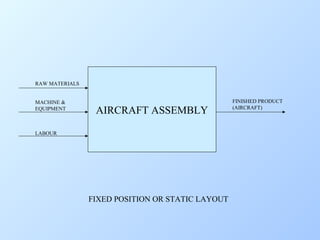
Fixed position layout
• Movement of men & machinery to the product
• Product remains stationary
– Cost of moving product is high,being bulky
• Advantages
– Men/machinery can be moved for a wide variety of operations
producing different products

•

Worker identifies himself with the product & takes pride when
the work is completed
• Investment on layout is small
• High cost & difficulty in transporting a bulky job avoided

Best suited for bulky & heavy products
ex.Ships, aero planes etc.
RAW MATERIALS
MACHINE &
EQUIPMENT

AIRCRAFT ASSEMBLY

LABOUR

FIXED POSITION OR STATIC LAYOUT

FINISHED PRODUCT
(AIRCRAFT)
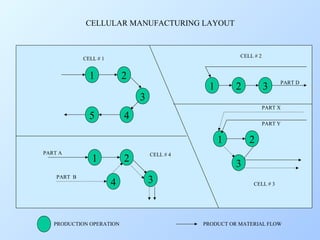
Cellular manufacturing (CM) layout
• Grouping of machines into cells
• Cells function somewhat like product layout within a
larger shop or process layout
• Each cell in the cm formed to produce a single part /
a few parts
– All with common characteristics which usually requires
similar machines and settings

• Flow of parts within the cell can take many forms
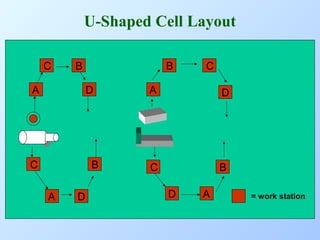
U-Shaped Cell Layout
C

B

A

B
D

C

B
A

D

C

A

D

C

B
D

A

= work station
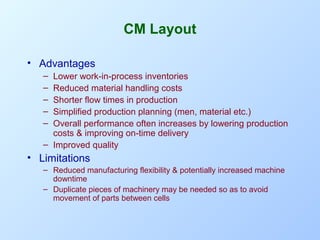
CM Layout
• Advantages
–
–
–
–
–

Lower work-in-process inventories
Reduced material handling costs
Shorter flow times in production
Simplified production planning (men, material etc.)
Overall performance often increases by lowering production
costs & improving on-time delivery
– Improved quality

• Limitations
– Reduced manufacturing flexibility & potentially increased machine
downtime
– Duplicate pieces of machinery may be needed so as to avoid
movement of parts between cells
Combined layout
• Combination of product & process layout with an
emphasis on either
• Generally adopted in industry
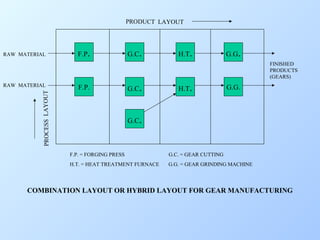
• In fabrication plants including assembly, fabrication
tends to employ process layout while assembly areas
employ product layout
• It is the layout that produces the desired volumes of
products at least total cost
PRODUCT LAYOUT

RAW MATERIAL

F.P.

G.C.

H.T.

G.G.
FINISHED
PRODUCTS
(GEARS)

PROCESS LAYOUT

RAW MATERIAL

F.P.

G.C.

H.T.

G.G.

G.C.

F.P. = FORGING PRESS

G.C. = GEAR CUTTING

H.T. = HEAT TREATMENT FURNACE

G.G. = GEAR GRINDING MACHINE

COMBINATION LAYOUT OR HYBRID LAYOUT FOR GEAR MANUFACTURING
Service facility layout
• Generally, as in manufacturing
– Line layout preferred in high volume, standardised products
• Fast food service
– Process layout preferred in service operations also
• General offices, banks, general hospitals, municipal offices
etc.
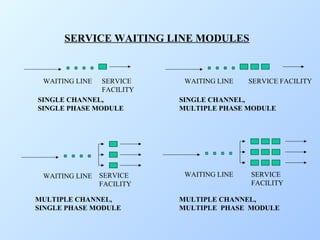
SERVICE WAITING LINE MODULES

WAITING LINE

SERVICE
FACILITY
SINGLE CHANNEL,
SINGLE PHASE MODULE

WAITING LINE

SERVICE
FACILITY

MULTIPLE CHANNEL,
SINGLE PHASE MODULE

WAITING LINE

SERVICE FACILITY

SINGLE CHANNEL,
MULTIPLE PHASE MODULE

WAITING LINE

SERVICE
FACILITY

MULTIPLE CHANNEL,
MULTIPLE PHASE MODULE
Plant Layouts
• Plant layout has to provide for other facilities also
–
–
–
–
–
–

Location for receiving and shipping departments
Storage
Inspection
Maintenance
Employee facilities
Others, as applicable to various plants
•
•
•
•

Power generators
Water treatment plants
Oil tankers
Compressed air, Chilled water plants etc.
Layout Planning-Methodology
•
•
•
•

Travel chart method
Load-distance analysis method
Systematic layout planning method
Analysing layouts with computers
– ALDEP(Automated Layout Designing Programme)
– CORELAP (COmputerised RElationship Layout Planning)
– CRAFT (Computerised Relative Allocation of Facilities
Technique)
References
• Production &Operations Management: Aswathappa
/ Bhat
• Modern Production / Operations Management:
Buffa / Sarin
Thank you
LOCATION THEORIES
• PRIMARY FACTORS
– INDUSTRIAL UNITS MATERIAL ORIENTED IF
THEIR MATERIAL TRANSPORTATION COST TO
THE UNIT IS HIGHER
– INDUSTRIAL UNITS MARKET ORIENTED WHEN
COST OF TRANSPORTING FINISHED PRODUCTS
TO MARKETS IS HIGHER
– CENTRES FLUSH WITH CHEAP AND SKILLED
LABOUR PULL INDUSTRIES TOWARDS THEM
LOCATION THEORIES
• SECONDARY FACTORS
– SOME OF THESE ATTRACT INDUSTRIES TO
CERTAIN AREAS FROM DIFFERENT PLACES
• CALLED AGGLOMERATING FACTORS

– WHEREAS SOME OTHERS CONTRIBUTE TO
THEIR DISPERSAL FROM ORIGINAL PLACES
• CALLED DEGGLOMERATING FACTORS
CRITICAL FACTORS
• TYPE OF INDUSTRY
– SYNTHETIC
• CONSTITUENT ELEMENTS COMBINING TO MAKE THE
FINAL PRODUCT E.G. CHEMICAL INDUSTRY

– ANALYTICAL
• CONVERSION OF RAW MATERIALS INTO VARIOUS
ELEMENTS E.G. PETROLEUM INDUSTRY

– CONDITIONING
• CHANGING IN SHAPE / FORM OR PHYSICAL PROPERTIES
E.G. FOUNDARY, METAL WORKING INDUSTRY

– EXTRACTIVE
• INVOLVING SEPARATION OF ONE ELEMENT FROM THE
OTHER E.G. METAL FROM IRON ORE

– EACH OF ABOVE FURTHER CLASSIFIED INTO
• INTERMITTENT INDUSTRIES
• CONTINUOUS INDUSTRIES
PRODUCT LAYOUT
• IMPORTANT CONSIDERATIONS
– ALL MACHINES PLACED AT POINTS DEMANDED BY
SEQUENCE OF OPERATION
– NO CROSSING OVER OF ONE LINE WITH THE OTHER
– MATERIALS MAY BE FED WHERE THEY ARE
REQUIRED FOR ASSEMBLY BUT NOT NECESSARILY
ALL AT ONE POINT
– ALL OPERATIONS INCLUDING ASSEMBLY, TESTING
AND PACKING INCLUDED IN THE LINE
PROCESS LAYOUT
• IMPORTANT CONSIDERATIONS
– DISTANCE BETWEEN DEPARTMENTS AS SMALL AS
POSSIBLE
– DEPARTMENTS TO BE LOCATED AS PER SEQUENCE
OF OPERATION
– CONVENIENCE FOR INSPECTION AS WELL AS
SUPERVISION
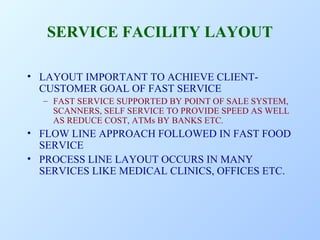
SERVICE FACILITY LAYOUT
• LAYOUT IMPORTANT TO ACHIEVE CLIENTCUSTOMER GOAL OF FAST SERVICE
– FAST SERVICE SUPPORTED BY POINT OF SALE SYSTEM,
SCANNERS, SELF SERVICE TO PROVIDE SPEED AS WELL
AS REDUCE COST, ATMs BY BANKS ETC.

• FLOW LINE APPROACH FOLLOWED IN FAST FOOD
SERVICE
• PROCESS LINE LAYOUT OCCURS IN MANY
SERVICES LIKE MEDICAL CLINICS, OFFICES ETC.
CELLULAR MANUFACTURING LAYOUT

CELL # 2

CELL # 1

1

2

1

3
5

2

4

PART B

1

2
4

PRODUCTION OPERATION

PART D

PART X
PART Y

1
PART A

3

CELL # 4

3

2
3
CELL # 3

PRODUCT OR MATERIAL FLOW
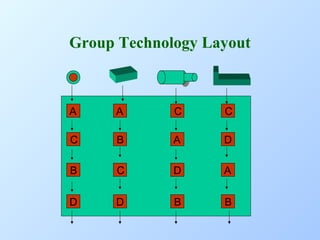
Group Technology Layout

A

A

C

C

C

B

A

D

B

C

D

A

D

D

B

B
Layout planning
• Need for future revisions caused due to expansions,
technological advances, improved layouts etc
• Major criteria for selecting and designing layouts
– Material handling cost
• Material handling costs minimised by using mechanised material
handling equipments

– Worker effectiveness
• Good layout provides workers with a satisfying job and permits
them to work more effectively at the highest skill level
• Good communication system and well placed supporting activity
locations important

Om lect 04_a(r0-aug08)_facility location & layout_mms_sies

  • 1.
    Facility –Location &Layout N.K.Agarwal
  • 2.
    Plant Location • Locationof facilities involves commitment of resources to a long range plan • Need for selection of location – Business newly started – Existing business has outgrown the capacity of the original facilities – Volume of business or extent of market needs establishing of branches – Lease expires and the landlord does not renew the lease – Other social or economic reasons e.g. Inadequate labour supply, shifting of markets etc
  • 3.
    Plant Location • Properselection of location for the plant ensures – An easy and regular supply of • Raw materials • Labour force – Efficient plant layout – Proper utilisation of plant production capacity & related cost of production • Resulting into smooth and efficient working of the organisation
  • 4.
    Steps in plantlocation • National decision (within or outside the country) – – – – – Political stability Export & import policy Currency and exchange rate Cultural & economic peculiarities Natural environment • Selection of the region – – – – – – – Availability of raw materials Nearness to market Availability of power Transport facilities Suitability of climate Government policy Competition among states
  • 5.
    Steps in plantlocation • Selection of locality or community – – – – – – – – Availability of labour Civic amenities for workers Existence of complementary & competing industries Finance & research facilities Availibility of water and fire fighting services Local taxes & restrictions Momentum of an early start Personal factors • Selection of exact site – Soil, size & topography – Disposal of waste
  • 6.
    Off shore location •Availibility of relatively cheaper labour appears to be a lure to many manufacturers to establish plants in foreign countries • However, lower productivity of the labour can be a contradicting factor • Effect of capital productivity needs to be considered also • Many other costs like cost of materials, fuel, power, equipment, credit, transportation, taxation etc have to be also considered for striking a balance between the various costs for the most economic decision
  • 7.
    Plant Layout • Afloor plan for determining and arranging the desired machinery and equipment of a plant • It permits –The quickest flow of materials in processing the product •From the receipt of the raw materials to the shipment of the finished product –At the lowest cost, and –With the least amount of handling
  • 8.
    Critical factors • Materials –Type, availability, provision for storage and movement • Product – Type i.e. Heavy,light, wet operation (cement), market demand (decision on machinery type) • Workers – Male, female (special needs), facilities • Machinery – Fixed or mobile position of men, machinery, job to decide machinery layout-depending on type, volume of production
  • 9.
    Critical factors • Location –Size and terrain decides type of building – Location decides mode of transportation of raw material and finished products – Fuel requirement for the plant – Future expansion provision • Managerial policies – – – – – – Volume of production and expansion Extent of automation Making or buying decision Rapid delivery to customers Purchasing policy Personnel policies
  • 10.
    Process layout • Groupingtogether of similar machines in one department • Material moves from one group of machines to the other • Movement over longer distance and along criss-cross paths • May also involve part finished inventory waiting Best suited for intermittent type of production/light and heavy industries
  • 11.
    PRODUCTION SUB-SYSTEM RAW MATERIALS RECEIVING OPERATIONA WIP MATERIAL FLOW STORAGE FINISHED GOODS EDP CONTROL SYSTEMS WIP OPERATION D SHIPPING FINISHED GOODS OPERATION B WIP WIP OPERATION C INFORMATION FLOWS INTERMITTENT FLOW PRODUCTION SYSTEM (JOB SHOP )
  • 12.
    Process layout • Advantages – – – – – – Reducedinvestment on machines, being general purpose machines Greater flexibility in production Better and more efficient supervision Greater scope of expansion Better utilisation of resources Handling breakdown of equipment easier-jobs can be transferred to other machines – Full utilisation of machinery • Limitations – – – – – Difficulty in movement of materials Layout requires more space Difficulty in production control Production time increased because of extra travel Accumulation of work-in-process at different machines
  • 13.
    Product layout • Machinesarranged in a line depending upon sequence of operations • Material moves in a line from the first machine to the finished product on the last machine. • Investment higher as compared to process layout Better suited for standardised products on a mass scale production. Ex chemicals,paper
  • 14.
    PRODUCTION SUB-SYSTEM RAW MATERIALS RECEIVING OPERATIONB STORAGE OPERATION A MATERIAL FLOW EDP CONTROL SYSTEMS OPERATION D OPERATION C SHIPPING FINISHED GOODS INFORMATION FLOWS CONTINUOUS FLOW PRODUCTION SYSTEM (FLOW SHOP)
  • 15.
    Product layout • Advantages – – – – – – – • Reductionin material handling cost due to mechanisation Layout avoids production bottlenecks Economy in manufacturing time Better production control Requires less floor area per unit of production Work-in-progress in reduced Early detection of mistakes Limitations – – – – – Layout inflexible Layout expensive Difficulty in supervision Expansion is difficult Any breakdown along the line can disrupt total production
  • 16.
    Fixed position layout •Movement of men & machinery to the product • Product remains stationary – Cost of moving product is high,being bulky • Advantages – Men/machinery can be moved for a wide variety of operations producing different products • Worker identifies himself with the product & takes pride when the work is completed • Investment on layout is small • High cost & difficulty in transporting a bulky job avoided Best suited for bulky & heavy products ex.Ships, aero planes etc.
  • 17.
    RAW MATERIALS MACHINE & EQUIPMENT AIRCRAFTASSEMBLY LABOUR FIXED POSITION OR STATIC LAYOUT FINISHED PRODUCT (AIRCRAFT)
  • 18.
    Cellular manufacturing (CM)layout • Grouping of machines into cells • Cells function somewhat like product layout within a larger shop or process layout • Each cell in the cm formed to produce a single part / a few parts – All with common characteristics which usually requires similar machines and settings • Flow of parts within the cell can take many forms
  • 19.
  • 20.
    CM Layout • Advantages – – – – – Lowerwork-in-process inventories Reduced material handling costs Shorter flow times in production Simplified production planning (men, material etc.) Overall performance often increases by lowering production costs & improving on-time delivery – Improved quality • Limitations – Reduced manufacturing flexibility & potentially increased machine downtime – Duplicate pieces of machinery may be needed so as to avoid movement of parts between cells
  • 21.
    Combined layout • Combinationof product & process layout with an emphasis on either • Generally adopted in industry • In fabrication plants including assembly, fabrication tends to employ process layout while assembly areas employ product layout • It is the layout that produces the desired volumes of products at least total cost
  • 22.
    PRODUCT LAYOUT RAW MATERIAL F.P. G.C. H.T. G.G. FINISHED PRODUCTS (GEARS) PROCESSLAYOUT RAW MATERIAL F.P. G.C. H.T. G.G. G.C. F.P. = FORGING PRESS G.C. = GEAR CUTTING H.T. = HEAT TREATMENT FURNACE G.G. = GEAR GRINDING MACHINE COMBINATION LAYOUT OR HYBRID LAYOUT FOR GEAR MANUFACTURING
  • 23.
    Service facility layout •Generally, as in manufacturing – Line layout preferred in high volume, standardised products • Fast food service – Process layout preferred in service operations also • General offices, banks, general hospitals, municipal offices etc.
  • 24.
    SERVICE WAITING LINEMODULES WAITING LINE SERVICE FACILITY SINGLE CHANNEL, SINGLE PHASE MODULE WAITING LINE SERVICE FACILITY MULTIPLE CHANNEL, SINGLE PHASE MODULE WAITING LINE SERVICE FACILITY SINGLE CHANNEL, MULTIPLE PHASE MODULE WAITING LINE SERVICE FACILITY MULTIPLE CHANNEL, MULTIPLE PHASE MODULE
  • 25.
    Plant Layouts • Plantlayout has to provide for other facilities also – – – – – – Location for receiving and shipping departments Storage Inspection Maintenance Employee facilities Others, as applicable to various plants • • • • Power generators Water treatment plants Oil tankers Compressed air, Chilled water plants etc.
  • 26.
    Layout Planning-Methodology • • • • Travel chartmethod Load-distance analysis method Systematic layout planning method Analysing layouts with computers – ALDEP(Automated Layout Designing Programme) – CORELAP (COmputerised RElationship Layout Planning) – CRAFT (Computerised Relative Allocation of Facilities Technique)
  • 27.
    References • Production &OperationsManagement: Aswathappa / Bhat • Modern Production / Operations Management: Buffa / Sarin
  • 28.
  • 30.
    LOCATION THEORIES • PRIMARYFACTORS – INDUSTRIAL UNITS MATERIAL ORIENTED IF THEIR MATERIAL TRANSPORTATION COST TO THE UNIT IS HIGHER – INDUSTRIAL UNITS MARKET ORIENTED WHEN COST OF TRANSPORTING FINISHED PRODUCTS TO MARKETS IS HIGHER – CENTRES FLUSH WITH CHEAP AND SKILLED LABOUR PULL INDUSTRIES TOWARDS THEM
  • 31.
    LOCATION THEORIES • SECONDARYFACTORS – SOME OF THESE ATTRACT INDUSTRIES TO CERTAIN AREAS FROM DIFFERENT PLACES • CALLED AGGLOMERATING FACTORS – WHEREAS SOME OTHERS CONTRIBUTE TO THEIR DISPERSAL FROM ORIGINAL PLACES • CALLED DEGGLOMERATING FACTORS
  • 32.
    CRITICAL FACTORS • TYPEOF INDUSTRY – SYNTHETIC • CONSTITUENT ELEMENTS COMBINING TO MAKE THE FINAL PRODUCT E.G. CHEMICAL INDUSTRY – ANALYTICAL • CONVERSION OF RAW MATERIALS INTO VARIOUS ELEMENTS E.G. PETROLEUM INDUSTRY – CONDITIONING • CHANGING IN SHAPE / FORM OR PHYSICAL PROPERTIES E.G. FOUNDARY, METAL WORKING INDUSTRY – EXTRACTIVE • INVOLVING SEPARATION OF ONE ELEMENT FROM THE OTHER E.G. METAL FROM IRON ORE – EACH OF ABOVE FURTHER CLASSIFIED INTO • INTERMITTENT INDUSTRIES • CONTINUOUS INDUSTRIES
  • 33.
    PRODUCT LAYOUT • IMPORTANTCONSIDERATIONS – ALL MACHINES PLACED AT POINTS DEMANDED BY SEQUENCE OF OPERATION – NO CROSSING OVER OF ONE LINE WITH THE OTHER – MATERIALS MAY BE FED WHERE THEY ARE REQUIRED FOR ASSEMBLY BUT NOT NECESSARILY ALL AT ONE POINT – ALL OPERATIONS INCLUDING ASSEMBLY, TESTING AND PACKING INCLUDED IN THE LINE
  • 34.
    PROCESS LAYOUT • IMPORTANTCONSIDERATIONS – DISTANCE BETWEEN DEPARTMENTS AS SMALL AS POSSIBLE – DEPARTMENTS TO BE LOCATED AS PER SEQUENCE OF OPERATION – CONVENIENCE FOR INSPECTION AS WELL AS SUPERVISION
  • 35.
    SERVICE FACILITY LAYOUT •LAYOUT IMPORTANT TO ACHIEVE CLIENTCUSTOMER GOAL OF FAST SERVICE – FAST SERVICE SUPPORTED BY POINT OF SALE SYSTEM, SCANNERS, SELF SERVICE TO PROVIDE SPEED AS WELL AS REDUCE COST, ATMs BY BANKS ETC. • FLOW LINE APPROACH FOLLOWED IN FAST FOOD SERVICE • PROCESS LINE LAYOUT OCCURS IN MANY SERVICES LIKE MEDICAL CLINICS, OFFICES ETC.
  • 36.
    CELLULAR MANUFACTURING LAYOUT CELL# 2 CELL # 1 1 2 1 3 5 2 4 PART B 1 2 4 PRODUCTION OPERATION PART D PART X PART Y 1 PART A 3 CELL # 4 3 2 3 CELL # 3 PRODUCT OR MATERIAL FLOW
  • 37.
  • 38.
    Layout planning • Needfor future revisions caused due to expansions, technological advances, improved layouts etc • Major criteria for selecting and designing layouts – Material handling cost • Material handling costs minimised by using mechanised material handling equipments – Worker effectiveness • Good layout provides workers with a satisfying job and permits them to work more effectively at the highest skill level • Good communication system and well placed supporting activity locations important