By: abhishek kumar
Assistant professor
N.M.S.N.DASS PG
COLLEGE BADAUN
UNIT 3
⦁ Plant location refers to the choice of region and
the selection of a particular site for setting up a
business or factory.
⦁ But the choice is made only after considering
cost and benefits of different alternative sites. It
is a strategic decision that cannot be changed
once taken. If at all changed only at considerable
loss, the location should be selected as per its
own requirements and circumstances. Each
individual plant is a case in itself.
⦁ Businessman should try to make an attempt for
optimum or ideal location.
⦁ Plant layout refers to the arrangement of
physical facilities such as machinery,
equipment, furniture etc. within the factory
building in such a manner so as to have
quickest flow of material at the lowest cost
and with the least amount of handling in
processing the product from the receipt of
material to the shipment of the finished
product.
⦁ According to Riggs, “the overall objective of
plant layout is to design a physical
arrangement that most economically meets
the required output – quantity and quality.”
⦁ According to J. L. Zundi, “Plant layout ideally
involves allocation of space and arrangement
of equipment in such a manner that overall
operating costs are minimized.
⦁ Proper and efficient utilization of available floor space
⦁ To ensure that work proceeds from one point to
another point without any delay
⦁ Provide enough production capacity.
⦁ Reduce material handling costs
⦁ Reduce hazards to personnel
⦁ Utilise labour efficiently
⦁ Increase employee morale
⦁ Reduce accidents
⦁ Provide for volume and product flexibility
⦁ Provide ease of supervision and control
⦁ Provide for employee safety and health
⦁ Allow ease of maintenance
⦁ Allow high machine or equipment utilization
⦁ Improve productivity
In case of manufacturing unit, plant layout may
be of four types:
⦁ Product or line layout
⦁ Process or functional layout
⦁ Fixed position or location layout
⦁ Combined or group layout
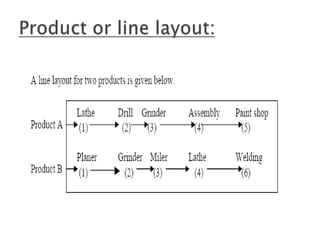
⦁ Under this, machines and equipments are arranged in one line
depending upon the sequence of operations required for the
product.
⦁ The raw material moves very fast from one workstation to other
stations with a minimum work in progress storage and material
handling.
⦁ The grouping of machines should be done keeping in mind the
following general principles.
⦁ All the machine tools or other items of equipments must be
placed at the point demanded by the sequence of operations
⦁ There should no points where one line crossed another line.
🞂 Materials may be fed where they are required for assembly but
not necessarily at one point.
⦁ All the operations including assembly, testing packing must be
included in the line
⦁ In this type of layout machines of a similar type are
arranged together at one place. E.g. Machines
performing drilling operations are arranged in the
drilling department, machines performing casting
operations be grouped in the casting department.
Therefore the machines are installed in the plants,
which follow the process layout.
⦁ Hence, such layouts typically have drilling department,
milling department, welding department, heating
department and painting department etc. The process
or functional layout is followed from historical period.
⦁ The work, which has to be done, is allocated to the
machines according to loading schedules with the
object of ensuring that each machine is fully loaded.
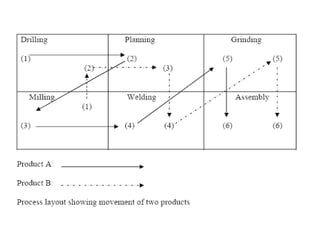
Process layout is shown in the following diagram.
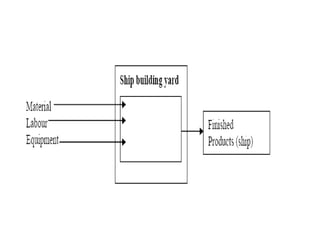
⦁ In this type of layout, the major product
being produced is fixed at one location.
Equipment labour and components are
moved to that location.
⦁ All facilities are brought and arranged around
one work center. This type of layout is not
relevant for small scale entrepreneur. The
following figure shows a fixed position layout
regarding shipbuilding.
⦁ Certain manufacturing units may require all three
processes namely intermittent process (job
shops), the continuous process (mass production
shops) and the representative process combined
process [i.e. miscellaneous shops].
⦁ In most of industries, only a product layout or
process layout or fixed location layout does not
exist. Thus, in manufacturing concerns where
several products are produced in repeated
numbers with no likelihood of continuous
production, combined layout is followed.
production management unit 3.pdf

production management unit 3.pdf

  • 1.
    By: abhishek kumar Assistantprofessor N.M.S.N.DASS PG COLLEGE BADAUN UNIT 3
  • 2.
    ⦁ Plant locationrefers to the choice of region and the selection of a particular site for setting up a business or factory. ⦁ But the choice is made only after considering cost and benefits of different alternative sites. It is a strategic decision that cannot be changed once taken. If at all changed only at considerable loss, the location should be selected as per its own requirements and circumstances. Each individual plant is a case in itself. ⦁ Businessman should try to make an attempt for optimum or ideal location.
  • 13.
    ⦁ Plant layoutrefers to the arrangement of physical facilities such as machinery, equipment, furniture etc. within the factory building in such a manner so as to have quickest flow of material at the lowest cost and with the least amount of handling in processing the product from the receipt of material to the shipment of the finished product.
  • 14.
    ⦁ According toRiggs, “the overall objective of plant layout is to design a physical arrangement that most economically meets the required output – quantity and quality.” ⦁ According to J. L. Zundi, “Plant layout ideally involves allocation of space and arrangement of equipment in such a manner that overall operating costs are minimized.
  • 15.
    ⦁ Proper andefficient utilization of available floor space ⦁ To ensure that work proceeds from one point to another point without any delay ⦁ Provide enough production capacity. ⦁ Reduce material handling costs ⦁ Reduce hazards to personnel ⦁ Utilise labour efficiently ⦁ Increase employee morale ⦁ Reduce accidents ⦁ Provide for volume and product flexibility ⦁ Provide ease of supervision and control ⦁ Provide for employee safety and health ⦁ Allow ease of maintenance ⦁ Allow high machine or equipment utilization ⦁ Improve productivity
  • 16.
    In case ofmanufacturing unit, plant layout may be of four types: ⦁ Product or line layout ⦁ Process or functional layout ⦁ Fixed position or location layout ⦁ Combined or group layout
  • 17.
    ⦁ Under this,machines and equipments are arranged in one line depending upon the sequence of operations required for the product. ⦁ The raw material moves very fast from one workstation to other stations with a minimum work in progress storage and material handling. ⦁ The grouping of machines should be done keeping in mind the following general principles. ⦁ All the machine tools or other items of equipments must be placed at the point demanded by the sequence of operations ⦁ There should no points where one line crossed another line. 🞂 Materials may be fed where they are required for assembly but not necessarily at one point. ⦁ All the operations including assembly, testing packing must be included in the line
  • 19.
    ⦁ In thistype of layout machines of a similar type are arranged together at one place. E.g. Machines performing drilling operations are arranged in the drilling department, machines performing casting operations be grouped in the casting department. Therefore the machines are installed in the plants, which follow the process layout. ⦁ Hence, such layouts typically have drilling department, milling department, welding department, heating department and painting department etc. The process or functional layout is followed from historical period. ⦁ The work, which has to be done, is allocated to the machines according to loading schedules with the object of ensuring that each machine is fully loaded. Process layout is shown in the following diagram.
  • 21.
    ⦁ In thistype of layout, the major product being produced is fixed at one location. Equipment labour and components are moved to that location. ⦁ All facilities are brought and arranged around one work center. This type of layout is not relevant for small scale entrepreneur. The following figure shows a fixed position layout regarding shipbuilding.
  • 23.
    ⦁ Certain manufacturingunits may require all three processes namely intermittent process (job shops), the continuous process (mass production shops) and the representative process combined process [i.e. miscellaneous shops]. ⦁ In most of industries, only a product layout or process layout or fixed location layout does not exist. Thus, in manufacturing concerns where several products are produced in repeated numbers with no likelihood of continuous production, combined layout is followed.