Plant Structure By: Geonyzl  L. Alviola
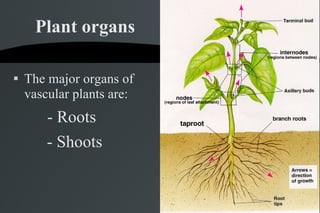
Plant organs The major organs of vascular plants are: - Roots - Shoots
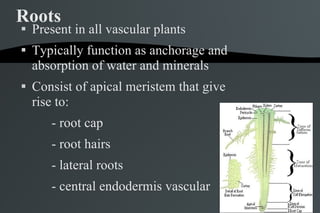
Roots Present in all vascular plants Typically function as anchorage and  absorption of water and minerals Consist of apical meristem that give rise to:  - root cap - root hairs - lateral roots - central endodermis vascular
 
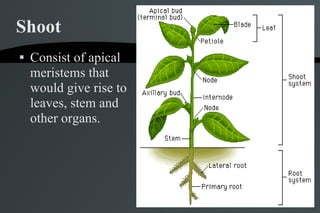
Shoot Consist of apical meristems that would give rise to leaves, stem and other organs.
Stem A cylindrical organ that bears the  leaves Typically function for  conduction of water and minerals Support and elevation of some leaves and reproductive structures
Leaf Organ of the shoot that is dorsiventrally flattened Usually function for : - transpiration - photosynthesis Derived from leaf primordia Vascular plants, have many vascular  bundles while mosses, the gametophytic leaves contains costa.
Buds Are immature shoot system Located in the  axils of the leaves But may grow lateral vegetative branches  Or  reprodutive structure
Plant reproductive organs In non-vascular plants - sporangium – the basic spore-forming
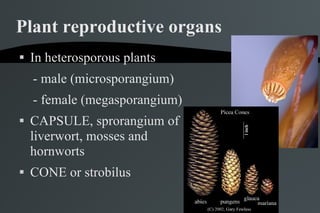
Plant reproductive organs In heterosporous plants - male (microsporangium)‏ - female (megasporangium)‏ CAPSULE, sprorangium of liverwort, mosses and hornworts CONE or strobilus
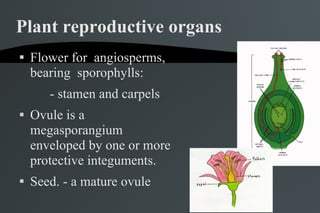
Plant reproductive organs Flower for  angiosperms, bearing  sporophylls: - stamen and carpels Ovule is a megasporangium enveloped by one or more protective integuments. Seed. - a mature ovule
Plant Habit Refers to the general form of a plant: 1. herb 2. liana 3. vine 4. shrub 5. tree
Definition of  terms Annual  – a plant  that  completes its  cycle in one  year (during  which time it  germinates, flowers, produces seeds and dies)‏ example :  sunflower Biennial  – a plant that  requires two growing seasons to  complete its cycle. During the  first  year it  builds up food reserves, which are  used during the  second year in the  production of flowers and  seeds example : carrot
Perennial  – a plant that lives for a  number of  years. Woody have permanent aerial form which  continue to  grow  year after year. Examples : Mango tree, Talisay tree  Ephemeral  – an annual plant that complete its life cycle in less than one  growing  season. Examples: weeds , desert plants (completing their life cycle in a  short period following rain)‏
Herb  A plant  in which any aboveground shoots, whether vegetative or reproductive. Short in  height
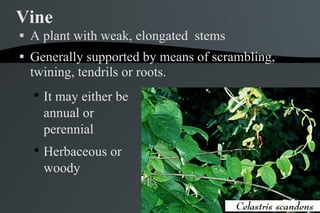
Vine  A plant with weak, elongated  stems Generally supported by means of scrambling, twining, tendrils or roots. It may either be annual or perennial Herbaceous or woody
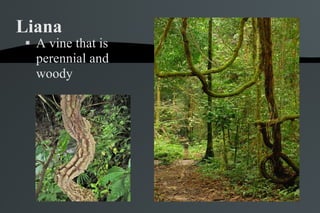
Liana A vine that is perennial and woody
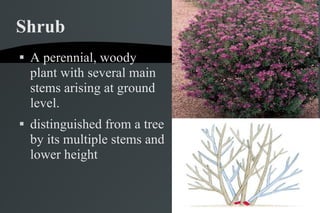
Shrub A perennial, woody plant with several main stems arising at ground level. distinguished from a tree by its multiple stems and lower height
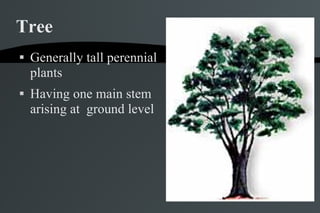
Tree Generally tall perennial plants Having one main stem arising at  ground level
Plant Habit Refers to the general  environment where the plant is  growing : - terrestrial - emersed - aquatic - floating - epiphytic - emergent - saxicolous
Terrestrial
Aquatic (emersed)‏ Occuring underwater (the whole body)‏
Aquatic (Floating)‏ Occuring at the water  surface. Duck weed
Aquatic (Emergent)‏ Having roots or stems anchored to the  substrate under water  and  aerial shoots  growing above water.
cattail
Epiphytic Growing on another plant

Plant And Structures

  • 1.
    Plant Structure By:Geonyzl L. Alviola
  • 2.
    Plant organs Themajor organs of vascular plants are: - Roots - Shoots
  • 3.
    Roots Present inall vascular plants Typically function as anchorage and absorption of water and minerals Consist of apical meristem that give rise to: - root cap - root hairs - lateral roots - central endodermis vascular
  • 4.
  • 5.
    Shoot Consist ofapical meristems that would give rise to leaves, stem and other organs.
  • 6.
    Stem A cylindricalorgan that bears the leaves Typically function for conduction of water and minerals Support and elevation of some leaves and reproductive structures
  • 7.
    Leaf Organ ofthe shoot that is dorsiventrally flattened Usually function for : - transpiration - photosynthesis Derived from leaf primordia Vascular plants, have many vascular bundles while mosses, the gametophytic leaves contains costa.
  • 8.
    Buds Are immatureshoot system Located in the axils of the leaves But may grow lateral vegetative branches Or reprodutive structure
  • 9.
    Plant reproductive organsIn non-vascular plants - sporangium – the basic spore-forming
  • 10.
    Plant reproductive organsIn heterosporous plants - male (microsporangium)‏ - female (megasporangium)‏ CAPSULE, sprorangium of liverwort, mosses and hornworts CONE or strobilus
  • 11.
    Plant reproductive organsFlower for angiosperms, bearing sporophylls: - stamen and carpels Ovule is a megasporangium enveloped by one or more protective integuments. Seed. - a mature ovule
  • 12.
    Plant Habit Refersto the general form of a plant: 1. herb 2. liana 3. vine 4. shrub 5. tree
  • 13.
    Definition of terms Annual – a plant that completes its cycle in one year (during which time it germinates, flowers, produces seeds and dies)‏ example : sunflower Biennial – a plant that requires two growing seasons to complete its cycle. During the first year it builds up food reserves, which are used during the second year in the production of flowers and seeds example : carrot
  • 14.
    Perennial –a plant that lives for a number of years. Woody have permanent aerial form which continue to grow year after year. Examples : Mango tree, Talisay tree Ephemeral – an annual plant that complete its life cycle in less than one growing season. Examples: weeds , desert plants (completing their life cycle in a short period following rain)‏
  • 15.
    Herb Aplant in which any aboveground shoots, whether vegetative or reproductive. Short in height
  • 16.
    Vine Aplant with weak, elongated stems Generally supported by means of scrambling, twining, tendrils or roots. It may either be annual or perennial Herbaceous or woody
  • 17.
    Liana A vinethat is perennial and woody
  • 18.
    Shrub A perennial,woody plant with several main stems arising at ground level. distinguished from a tree by its multiple stems and lower height
  • 19.
    Tree Generally tallperennial plants Having one main stem arising at ground level
  • 20.
    Plant Habit Refersto the general environment where the plant is growing : - terrestrial - emersed - aquatic - floating - epiphytic - emergent - saxicolous
  • 21.
  • 22.
    Aquatic (emersed)‏ Occuringunderwater (the whole body)‏
  • 23.
    Aquatic (Floating)‏ Occuringat the water surface. Duck weed
  • 24.
    Aquatic (Emergent)‏ Havingroots or stems anchored to the substrate under water and aerial shoots growing above water.
  • 25.
  • 26.
    Epiphytic Growing onanother plant