HOSPITAL PLANNING   DR.N.C.DAS
HOSPITAL PLANNING TEAM Hospital planning starts with constitution of a planning team. The Hospital Administration  Specialists from various clinical branches  Nursing Advisor  Civil and Electrical Engineers  Representative of local body  Senior Architect
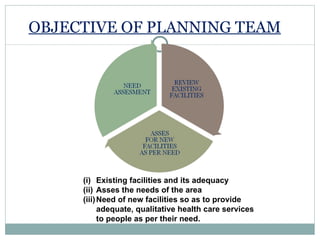
OBJECTIVE OF PLANNING TEAM Existing facilities and its adequacy Asses the needs of the area  Need of new facilities so as to provide adequate, qualitative health care services to people as per their need.
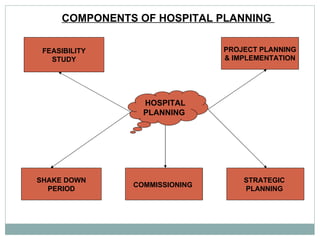
COMPONENTS OF HOSPITAL PLANNING  HOSPITAL PLANNING  FEASIBILITY STUDY PROJECT PLANNING & IMPLEMENTATION SHAKE DOWN PERIOD COMMISSIONING   STRATEGIC  PLANNING
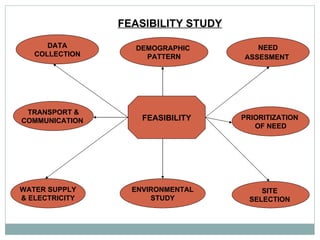
FEASIBILITY STUDY FEASIBILITY DATA COLLECTION NEED ASSESMENT   TRANSPORT & COMMUNICATION  WATER SUPPLY & ELECTRICITY DEMOGRAPHIC  PATTERN ENVIRONMENTAL STUDY PRIORITIZATION  OF NEED SITE  SELECTION
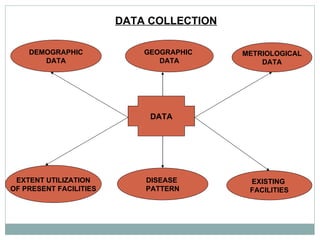
DATA COLLECTION  DATA DEMOGRAPHIC DATA EXTENT UTILIZATION OF PRESENT FACILITIES GEOGRAPHIC  DATA DISEASE  PATTERN METRIOLOGICAL DATA EXISTING  FACILITIES
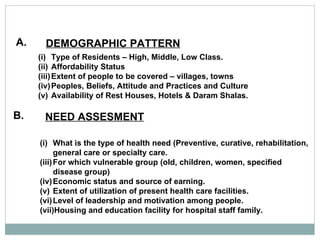
DEMOGRAPHIC PATTERN   A. Type of Residents – High, Middle, Low Class. Affordability Status  Extent of people to be covered – villages, towns  Peoples, Beliefs, Attitude and Practices and Culture  Availability of Rest Houses, Hotels & Daram Shalas. B. What is the type of health need (Preventive, curative, rehabilitation,  general care or specialty care. For which vulnerable group (old, children, women, specified disease group) Economic status and source of earning. Extent of utilization of present health care facilities.  Level of leadership and motivation among people.  Housing and education facility for hospital staff family.  NEED ASSESMENT
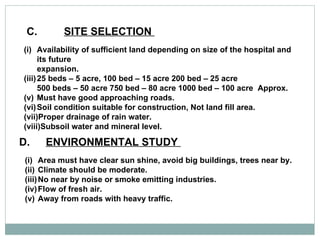
C. SITE SELECTION  Availability of sufficient land depending on size of the hospital and its future expansion. 25 beds – 5 acre, 100 bed – 15 acre 200 bed – 25 acre 500 beds – 50 acre 750 bed – 80 acre 1000 bed – 100 acre  Approx. Must have good approaching roads.  Soil condition suitable for construction, Not land fill area.  Proper drainage of rain water.  Subsoil water and mineral level.  D. ENVIRONMENTAL STUDY  (i) Area must have clear sun shine, avoid big buildings, trees near by.  Climate should be moderate.  No near by noise or smoke emitting industries.  Flow of fresh air.  Away from roads with heavy traffic.
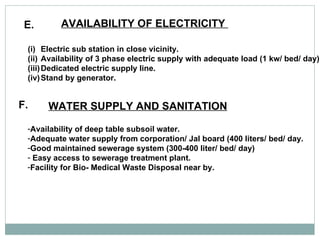
E. AVAILABILITY OF ELECTRICITY  Electric sub station in close vicinity. Availability of 3 phase electric supply with adequate load (1 kw/ bed/ day) Dedicated electric supply line.  Stand by generator.  F. WATER SUPPLY AND SANITATION   Availability of deep table subsoil water.  Adequate water supply from corporation/ Jal board (400 liters/ bed/ day. Good maintained sewerage system (300-400 liter/ bed/ day) Easy access to sewerage treatment plant.  Facility for Bio- Medical Waste Disposal near by.
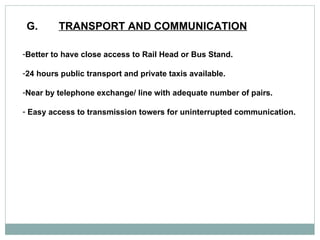
G. TRANSPORT AND COMMUNICATION   Better to have close access to Rail Head or Bus Stand. 24 hours public transport and private taxis available.  Near by telephone exchange/ line with adequate number of pairs.  Easy access to transmission towers for uninterrupted communication.
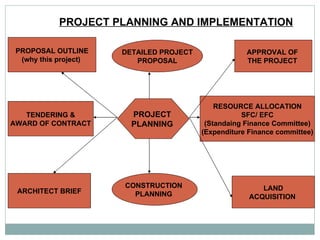
PROJECT PLANNING AND IMPLEMENTATION   PROJECT  PLANNING  PROPOSAL OUTLINE (why this project)  TENDERING & AWARD OF CONTRACT ARCHITECT BRIEF APPROVAL OF  THE PROJECT  RESOURCE ALLOCATION SFC/ EFC (Standaing Finance Committee) (Expenditure Finance committee) LAND ACQUISITION  DETAILED PROJECT PROPOSAL CONSTRUCTION  PLANNING
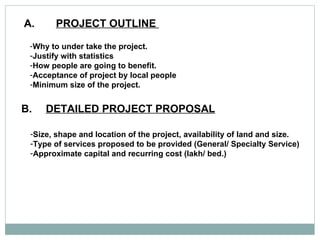
A. PROJECT OUTLINE  Why to under take the project. Justify with statistics How people are going to benefit.  Acceptance of project by local people Minimum size of the project.  B. DETAILED PROJECT PROPOSAL   Size, shape and location of the project, availability of land and size.  Type of services proposed to be provided (General/ Specialty Service) Approximate capital and recurring cost (lakh/ bed.)
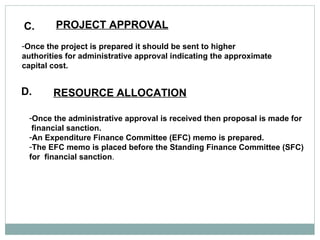
C. PROJECT APPROVAL   Once the project is prepared it should be sent to higher authorities for administrative approval indicating the approximate capital cost.  D. RESOURCE ALLOCATION   Once the administrative approval is received then proposal is made for financial sanction.  An Expenditure Finance Committee (EFC) memo is prepared.  The EFC memo is placed before the Standing Finance Committee (SFC) for  financial sanction .
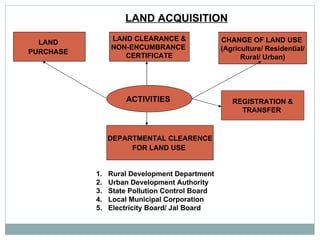
LAND ACQUISITION   ACTIVITIES  LAND  PURCHASE   LAND CLEARANCE & NON-ENCUMBRANCE  CERTIFICATE CHANGE OF LAND USE  (Agriculture/ Residential/ Rural/ Urban) REGISTRATION & TRANSFER  DEPARTMENTAL CLEARENCE FOR LAND USE   Rural Development Department  Urban Development Authority  State Pollution Control Board  Local Municipal Corporation  Electricity Board/ Jal Board
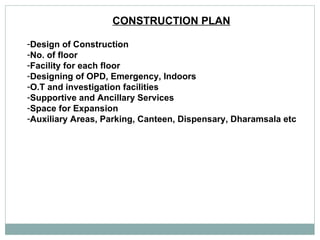
CONSTRUCTION PLAN   Design of Construction  No. of floor  Facility for each floor  Designing of OPD, Emergency, Indoors O.T and investigation facilities  Supportive and Ancillary Services  Space for Expansion  Auxiliary Areas, Parking, Canteen, Dispensary, Dharamsala etc
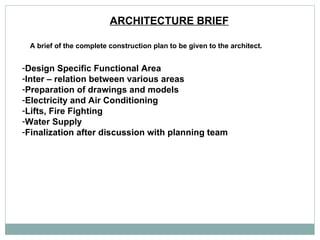
ARCHITECTURE BRIEF   A brief of the complete construction plan to be given to the architect.  Design Specific Functional Area  Inter – relation between various areas  Preparation of drawings and models  Electricity and Air Conditioning  Lifts, Fire Fighting  Water Supply  Finalization after discussion with planning team
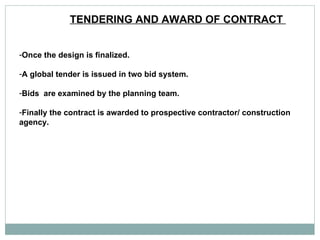
TENDERING AND AWARD OF CONTRACT  Once the design is finalized.  A global tender is issued in two bid system.  Bids  are examined by the planning team.  Finally the contract is awarded to prospective contractor/ construction agency.
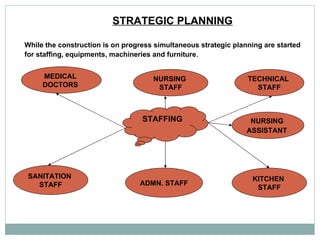
STRATEGIC PLANNING   While the construction is on progress simultaneous strategic planning are started  for staffing, equipments, machineries and furniture .  STAFFING MEDICAL  DOCTORS  SANITATION  STAFF NURSING  STAFF ADMN. STAFF TECHNICAL  STAFF NURSING  ASSISTANT   KITCHEN  STAFF
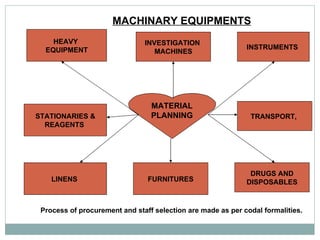
MACHINARY EQUIPMENTS   MATERIAL PLANNING HEAVY  EQUIPMENT STATIONARIES & REAGENTS  LINENS  INSTRUMENTS  TRANSPORT,  DRUGS AND DISPOSABLES FURNITURES INVESTIGATION  MACHINES Process of procurement and staff selection are made as per codal formalities.
COMMISSIONING   Once the construction is completed  Installation of air conditions, lifts Equipments and Machinery Recruitment of Staff The hospital is commissioned  Advertisement is made in paper  Publicity in local area  Date of inauguration is finalized
SHAKE DOWN PERIOD   After the commissioning of hospital Some time is taken for functional integration of different units, services, staff,  patient and community. This period is called shake–down period . Machine are tested  Staff recruited and trained  Standard operating procedures are made  Maintenance service is put in place  Materials, linen and stationary procured  Then starts the routine and regular functioning of the hospital.
HOSPITAL ADMINISTRATION MADE EASY http//hospiad.blogspot.com An effort solely to help students and aspirants in their attempt to become a successful Hospital Administrator. hospi ad DR. N. C. DAS

Planning for New Hospital

  • 1.
  • 2.
    HOSPITAL PLANNING TEAMHospital planning starts with constitution of a planning team. The Hospital Administration Specialists from various clinical branches Nursing Advisor Civil and Electrical Engineers Representative of local body Senior Architect
  • 3.
    OBJECTIVE OF PLANNINGTEAM Existing facilities and its adequacy Asses the needs of the area Need of new facilities so as to provide adequate, qualitative health care services to people as per their need.
  • 4.
    COMPONENTS OF HOSPITALPLANNING HOSPITAL PLANNING FEASIBILITY STUDY PROJECT PLANNING & IMPLEMENTATION SHAKE DOWN PERIOD COMMISSIONING STRATEGIC PLANNING
  • 5.
    FEASIBILITY STUDY FEASIBILITYDATA COLLECTION NEED ASSESMENT TRANSPORT & COMMUNICATION WATER SUPPLY & ELECTRICITY DEMOGRAPHIC PATTERN ENVIRONMENTAL STUDY PRIORITIZATION OF NEED SITE SELECTION
  • 6.
    DATA COLLECTION DATA DEMOGRAPHIC DATA EXTENT UTILIZATION OF PRESENT FACILITIES GEOGRAPHIC DATA DISEASE PATTERN METRIOLOGICAL DATA EXISTING FACILITIES
  • 7.
    DEMOGRAPHIC PATTERN A. Type of Residents – High, Middle, Low Class. Affordability Status Extent of people to be covered – villages, towns Peoples, Beliefs, Attitude and Practices and Culture Availability of Rest Houses, Hotels & Daram Shalas. B. What is the type of health need (Preventive, curative, rehabilitation, general care or specialty care. For which vulnerable group (old, children, women, specified disease group) Economic status and source of earning. Extent of utilization of present health care facilities. Level of leadership and motivation among people. Housing and education facility for hospital staff family. NEED ASSESMENT
  • 8.
    C. SITE SELECTION Availability of sufficient land depending on size of the hospital and its future expansion. 25 beds – 5 acre, 100 bed – 15 acre 200 bed – 25 acre 500 beds – 50 acre 750 bed – 80 acre 1000 bed – 100 acre Approx. Must have good approaching roads. Soil condition suitable for construction, Not land fill area. Proper drainage of rain water. Subsoil water and mineral level. D. ENVIRONMENTAL STUDY (i) Area must have clear sun shine, avoid big buildings, trees near by. Climate should be moderate. No near by noise or smoke emitting industries. Flow of fresh air. Away from roads with heavy traffic.
  • 9.
    E. AVAILABILITY OFELECTRICITY Electric sub station in close vicinity. Availability of 3 phase electric supply with adequate load (1 kw/ bed/ day) Dedicated electric supply line. Stand by generator. F. WATER SUPPLY AND SANITATION Availability of deep table subsoil water. Adequate water supply from corporation/ Jal board (400 liters/ bed/ day. Good maintained sewerage system (300-400 liter/ bed/ day) Easy access to sewerage treatment plant. Facility for Bio- Medical Waste Disposal near by.
  • 10.
    G. TRANSPORT ANDCOMMUNICATION Better to have close access to Rail Head or Bus Stand. 24 hours public transport and private taxis available. Near by telephone exchange/ line with adequate number of pairs. Easy access to transmission towers for uninterrupted communication.
  • 11.
    PROJECT PLANNING ANDIMPLEMENTATION PROJECT PLANNING PROPOSAL OUTLINE (why this project) TENDERING & AWARD OF CONTRACT ARCHITECT BRIEF APPROVAL OF THE PROJECT RESOURCE ALLOCATION SFC/ EFC (Standaing Finance Committee) (Expenditure Finance committee) LAND ACQUISITION DETAILED PROJECT PROPOSAL CONSTRUCTION PLANNING
  • 12.
    A. PROJECT OUTLINE Why to under take the project. Justify with statistics How people are going to benefit. Acceptance of project by local people Minimum size of the project. B. DETAILED PROJECT PROPOSAL Size, shape and location of the project, availability of land and size. Type of services proposed to be provided (General/ Specialty Service) Approximate capital and recurring cost (lakh/ bed.)
  • 13.
    C. PROJECT APPROVAL Once the project is prepared it should be sent to higher authorities for administrative approval indicating the approximate capital cost. D. RESOURCE ALLOCATION Once the administrative approval is received then proposal is made for financial sanction. An Expenditure Finance Committee (EFC) memo is prepared. The EFC memo is placed before the Standing Finance Committee (SFC) for financial sanction .
  • 14.
    LAND ACQUISITION ACTIVITIES LAND PURCHASE LAND CLEARANCE & NON-ENCUMBRANCE CERTIFICATE CHANGE OF LAND USE (Agriculture/ Residential/ Rural/ Urban) REGISTRATION & TRANSFER DEPARTMENTAL CLEARENCE FOR LAND USE Rural Development Department Urban Development Authority State Pollution Control Board Local Municipal Corporation Electricity Board/ Jal Board
  • 15.
    CONSTRUCTION PLAN Design of Construction No. of floor Facility for each floor Designing of OPD, Emergency, Indoors O.T and investigation facilities Supportive and Ancillary Services Space for Expansion Auxiliary Areas, Parking, Canteen, Dispensary, Dharamsala etc
  • 16.
    ARCHITECTURE BRIEF A brief of the complete construction plan to be given to the architect. Design Specific Functional Area Inter – relation between various areas Preparation of drawings and models Electricity and Air Conditioning Lifts, Fire Fighting Water Supply Finalization after discussion with planning team
  • 17.
    TENDERING AND AWARDOF CONTRACT Once the design is finalized. A global tender is issued in two bid system. Bids are examined by the planning team. Finally the contract is awarded to prospective contractor/ construction agency.
  • 18.
    STRATEGIC PLANNING While the construction is on progress simultaneous strategic planning are started for staffing, equipments, machineries and furniture . STAFFING MEDICAL DOCTORS SANITATION STAFF NURSING STAFF ADMN. STAFF TECHNICAL STAFF NURSING ASSISTANT KITCHEN STAFF
  • 19.
    MACHINARY EQUIPMENTS MATERIAL PLANNING HEAVY EQUIPMENT STATIONARIES & REAGENTS LINENS INSTRUMENTS TRANSPORT, DRUGS AND DISPOSABLES FURNITURES INVESTIGATION MACHINES Process of procurement and staff selection are made as per codal formalities.
  • 20.
    COMMISSIONING Once the construction is completed Installation of air conditions, lifts Equipments and Machinery Recruitment of Staff The hospital is commissioned Advertisement is made in paper Publicity in local area Date of inauguration is finalized
  • 21.
    SHAKE DOWN PERIOD After the commissioning of hospital Some time is taken for functional integration of different units, services, staff, patient and community. This period is called shake–down period . Machine are tested Staff recruited and trained Standard operating procedures are made Maintenance service is put in place Materials, linen and stationary procured Then starts the routine and regular functioning of the hospital.
  • 22.
    HOSPITAL ADMINISTRATION MADEEASY http//hospiad.blogspot.com An effort solely to help students and aspirants in their attempt to become a successful Hospital Administrator. hospi ad DR. N. C. DAS