Name   Roll No. Amit Anekar 01 Sachin Bhuwalka 02 Mohammed Abid Bijnori 03 Pravin Borghare 04 Vishal Chavan 05 Date of presentation: 07.04.2011 Presentation on Long Term Finance
A loan is the purchase of the present use of money with the promise to repay the amount in the future according to a pre-arranged schedule and at a specified rate of interest.  A  monetary loan  that has to be repaid in regular payments over a set period of time is referred to as a  term loan.
Bank  term loans  are very a common kind of  lending . An  unfixed interest rate  is usually involved in a term loan that will add additional balance to be repaid. Term loans are generally provided as  working capital  for acquiring income producing  assets  (machinery, equipment, inventory) that generate the  cash flows  for repayment of the loan. The repayment of the loans and facilities is normally fixed on case to case basis depending on projected cash flow of the borrower.
Term loans are also a source of long term debt. In India, they are generally obtained for financing large expansion, modernisation or diversification projects.  Term loans can be given on an individual basis but are often used for small business loans. The ability to repay over a long period of time is attractive for new or expanding enterprises, as the  assumption  is that they will increase their profit over time
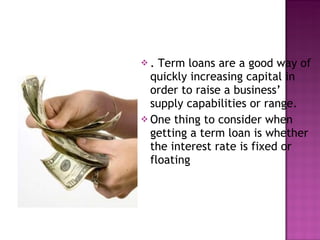
. Term loans are a good way of quickly increasing capital in order to raise a business’ supply capabilities or range. One thing to consider when getting a term loan is whether the interest rate is fixed or floating
Time to maturity Repayment Schedule. Interest. Security.
Type of debt financing FI provides rupee term loan and foreign currency term loan Mainly for investment in fixed assets Also for getting technical know-how, preliminary expenses and margin money for working capital Foreign currency term loan for import of plant and machinery Assets which are financial with term loan is the prime security
Other assets of the firm can be collateral Repayable in equal half yearly or quarterly installment Interest rate charged is as per credit risk of the project Incase of default of payment penal interest is charged
Fixed rate  - enjoy the peace of mind of fixed monthly repayments Variable rate  - linked to base rates (Rates can rise or fall)  Repayment holidays  - improve your cashflow by making no loan repayments or repaying only interest for a fixed term after drawing down your loan
Repayment style  - choose from capital and interest, capital only or interest only  Repayment frequency  - pick the frequency that suits you from monthly, quarterly, half yearly and yearly  Staged drawdown  - save on interest costs and enjoy lower initial payments  Make one-off repayments  - use surplus cash to reduce interest charges and benefit your business Flexibility
Individuals can have a term loan but they are usually used for  small business loans . It is an attractive loan for new or expanding enterprises, as they have huge time to repay the loan amount and it is assumed that they will increase their profit over time. For raising a business’ supply capabilities or range, term loans are a good way of increasing capital in a short span of time
Submission of loan application with project report Project report  - particulars of the firm - particulars of the project - cost of the project - means of financing - marketing and selling arrangement - profitability and cash flow - government consent
Initial processing of loan application - additional information may be added Detailed appraisal of proposed project - marketing, technical, financial, managerial and economic appraisal Issue of letter of sanction Acceptance of terms and conditions by the borrower  - by passing appropriate resolutions
Execution of loan agreement - FI sends the draft agreement to the borrower which is to be signed and stamped by the borrower Creation of charge over security - creation of mortgage, deposit of title deeds and hypothecation of movable property
Disbursement of loans borrower is required to submit following information - physical progress of project - financial status of project - contribution made by promoters - projected fund flow statement - compliance of statutory  requirements Based on such information disbursement of loan amount is decided
Monitoring of loans - it is done at 2 stage - implementation stage & operational stage Implementation stage - regular reports from promoters - periodic site visit - progress report submitted by nominee director Operational stage - quarterly progress report - periodic site visit - progress report submitted by nominee director
long-term. Intermediate term loan Short-term loans
Long-term loans usually mature in one to seven years, but can be longer for real estate or equipment.  These loans are used for major business expenses such as vehicles, purchasing facilities, construction and furnishings.  They also can be used to carry a business through a depressed cycle.
.Length of Term Time to Grow:  Structure Interest Cost Challenging to Get Approved Limited Financial Options
Term loans finance the purchase of furniture, fixtures, vehicles, and plant and office equipment.  Maturity generally runs more than one year but less than five.  Consumer loans for autos, boats, and home repairs and remodeling are also of intermediate term
Short-term loans , typically lines of credit, working capital loans, or accounts receivable loans, usually reach maturity within one year or less A short term business loan is an option for an established business that has a strong support and patronage
do not usually require collateral  allow quick application that makes the funds available in several days or even hours  require little paperwork  provide you with money when you feel a sudden unexpected need  With short term loans you do not burden yourself with long term obligations  Short term loans are available from various lenders that's why it's possible to find short term loans that fit your budget and lenders that offer you better conditions
usually more expansive. not secured by collateral the lender raises interest rates to cover the risk  Before giving you short term loans the lender is likely to investigate into your credit history and if it is excellent you will be offered short term loans with lower interest rates
Purchase of Fixed Assets  Switching of Higher Interest Loans  Mortgage Term Loan
Commercial banks offer a wide range of corporate financial services that address the specific needs of private enterprise. They provide deposit, loan and trading facilities but will not service investment activities in financial markets. The list of  specialized financial institutions in India  mainly includes,  IFCI, IDBI Bank,  Export-Import Bank Of India, Board for Industrial & Financial Reconstruction, Small Industries Development Bank of India, National Housing Bank. They are government undertakings established with a view to offer financial as well as technical assistance to the Indian industries.
The Reserve Bank of India (RBI) has told banks to focus on lending for the short and medium term rather than lock themselves in long-term loans  RBI told banks that since the average liability on the books of banks was in the range of one to two years, they would be better positioned to lend projects for short to medium term, will help banks in improving their asset-liability mismatches all categories of loans should be priced only with reference to the base rate
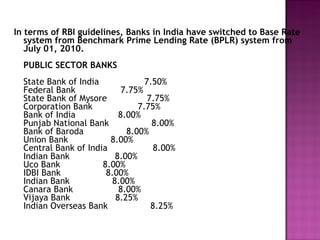
In terms of RBI guidelines, Banks in India have switched to Base Rate system from Benchmark Prime Lending Rate (BPLR) system from July 01, 2010.  PUBLIC SECTOR BANKS State Bank of India                 7.50%  Federal Bank                 7.75%  State Bank of Mysore               7.75%  Corporation Bank                 7.75%  Bank of India                8.00%  Punjab National Bank                8.00%  Bank of Baroda                8.00%  Union Bank                8.00%  Central Bank of India                 8.00%  Indian Bank                 8.00%  Uco Bank                8.00%  IDBI Bank                 8.00%  Indian Bank                8.00%  Canara Bank                 8.00%  Vijaya Bank                 8.25%  Indian Overseas Bank                8.25%
PRIVATE SECTOR BANKS HDFC Bank                 7.25%  ICICI Bank                 7.50%  DCB                 7.75%  Dhanlaxmi Bank                7.00%  Bank of Rajasthan                 8.00%  Karur Vysya Bank                 8.50%
 

Term loan finance main ppt

  • 1.
    Name Roll No. Amit Anekar 01 Sachin Bhuwalka 02 Mohammed Abid Bijnori 03 Pravin Borghare 04 Vishal Chavan 05 Date of presentation: 07.04.2011 Presentation on Long Term Finance
  • 2.
    A loan isthe purchase of the present use of money with the promise to repay the amount in the future according to a pre-arranged schedule and at a specified rate of interest. A monetary loan that has to be repaid in regular payments over a set period of time is referred to as a term loan.
  • 3.
    Bank termloans are very a common kind of lending . An unfixed interest rate is usually involved in a term loan that will add additional balance to be repaid. Term loans are generally provided as working capital for acquiring income producing assets (machinery, equipment, inventory) that generate the cash flows for repayment of the loan. The repayment of the loans and facilities is normally fixed on case to case basis depending on projected cash flow of the borrower.
  • 4.
    Term loans arealso a source of long term debt. In India, they are generally obtained for financing large expansion, modernisation or diversification projects. Term loans can be given on an individual basis but are often used for small business loans. The ability to repay over a long period of time is attractive for new or expanding enterprises, as the assumption is that they will increase their profit over time
  • 5.
    . Term loansare a good way of quickly increasing capital in order to raise a business’ supply capabilities or range. One thing to consider when getting a term loan is whether the interest rate is fixed or floating
  • 6.
    Time to maturityRepayment Schedule. Interest. Security.
  • 7.
    Type of debtfinancing FI provides rupee term loan and foreign currency term loan Mainly for investment in fixed assets Also for getting technical know-how, preliminary expenses and margin money for working capital Foreign currency term loan for import of plant and machinery Assets which are financial with term loan is the prime security
  • 8.
    Other assets ofthe firm can be collateral Repayable in equal half yearly or quarterly installment Interest rate charged is as per credit risk of the project Incase of default of payment penal interest is charged
  • 9.
    Fixed rate - enjoy the peace of mind of fixed monthly repayments Variable rate - linked to base rates (Rates can rise or fall) Repayment holidays - improve your cashflow by making no loan repayments or repaying only interest for a fixed term after drawing down your loan
  • 10.
    Repayment style - choose from capital and interest, capital only or interest only Repayment frequency - pick the frequency that suits you from monthly, quarterly, half yearly and yearly Staged drawdown - save on interest costs and enjoy lower initial payments Make one-off repayments - use surplus cash to reduce interest charges and benefit your business Flexibility
  • 11.
    Individuals can havea term loan but they are usually used for small business loans . It is an attractive loan for new or expanding enterprises, as they have huge time to repay the loan amount and it is assumed that they will increase their profit over time. For raising a business’ supply capabilities or range, term loans are a good way of increasing capital in a short span of time
  • 12.
    Submission of loanapplication with project report Project report - particulars of the firm - particulars of the project - cost of the project - means of financing - marketing and selling arrangement - profitability and cash flow - government consent
  • 13.
    Initial processing ofloan application - additional information may be added Detailed appraisal of proposed project - marketing, technical, financial, managerial and economic appraisal Issue of letter of sanction Acceptance of terms and conditions by the borrower - by passing appropriate resolutions
  • 14.
    Execution of loanagreement - FI sends the draft agreement to the borrower which is to be signed and stamped by the borrower Creation of charge over security - creation of mortgage, deposit of title deeds and hypothecation of movable property
  • 15.
    Disbursement of loansborrower is required to submit following information - physical progress of project - financial status of project - contribution made by promoters - projected fund flow statement - compliance of statutory requirements Based on such information disbursement of loan amount is decided
  • 16.
    Monitoring of loans- it is done at 2 stage - implementation stage & operational stage Implementation stage - regular reports from promoters - periodic site visit - progress report submitted by nominee director Operational stage - quarterly progress report - periodic site visit - progress report submitted by nominee director
  • 17.
    long-term. Intermediate termloan Short-term loans
  • 18.
    Long-term loans usuallymature in one to seven years, but can be longer for real estate or equipment. These loans are used for major business expenses such as vehicles, purchasing facilities, construction and furnishings. They also can be used to carry a business through a depressed cycle.
  • 19.
    .Length of TermTime to Grow: Structure Interest Cost Challenging to Get Approved Limited Financial Options
  • 20.
    Term loans financethe purchase of furniture, fixtures, vehicles, and plant and office equipment. Maturity generally runs more than one year but less than five. Consumer loans for autos, boats, and home repairs and remodeling are also of intermediate term
  • 21.
    Short-term loans ,typically lines of credit, working capital loans, or accounts receivable loans, usually reach maturity within one year or less A short term business loan is an option for an established business that has a strong support and patronage
  • 22.
    do not usuallyrequire collateral allow quick application that makes the funds available in several days or even hours require little paperwork provide you with money when you feel a sudden unexpected need With short term loans you do not burden yourself with long term obligations Short term loans are available from various lenders that's why it's possible to find short term loans that fit your budget and lenders that offer you better conditions
  • 23.
    usually more expansive.not secured by collateral the lender raises interest rates to cover the risk Before giving you short term loans the lender is likely to investigate into your credit history and if it is excellent you will be offered short term loans with lower interest rates
  • 24.
    Purchase of FixedAssets Switching of Higher Interest Loans Mortgage Term Loan
  • 25.
    Commercial banks offera wide range of corporate financial services that address the specific needs of private enterprise. They provide deposit, loan and trading facilities but will not service investment activities in financial markets. The list of specialized financial institutions in India mainly includes, IFCI, IDBI Bank, Export-Import Bank Of India, Board for Industrial & Financial Reconstruction, Small Industries Development Bank of India, National Housing Bank. They are government undertakings established with a view to offer financial as well as technical assistance to the Indian industries.
  • 26.
    The Reserve Bankof India (RBI) has told banks to focus on lending for the short and medium term rather than lock themselves in long-term loans RBI told banks that since the average liability on the books of banks was in the range of one to two years, they would be better positioned to lend projects for short to medium term, will help banks in improving their asset-liability mismatches all categories of loans should be priced only with reference to the base rate
  • 27.
    In terms ofRBI guidelines, Banks in India have switched to Base Rate system from Benchmark Prime Lending Rate (BPLR) system from July 01, 2010. PUBLIC SECTOR BANKS State Bank of India                 7.50% Federal Bank                 7.75% State Bank of Mysore               7.75% Corporation Bank                 7.75% Bank of India                8.00% Punjab National Bank                8.00% Bank of Baroda                8.00% Union Bank                8.00% Central Bank of India                 8.00% Indian Bank                 8.00% Uco Bank                8.00% IDBI Bank                 8.00% Indian Bank                8.00% Canara Bank                 8.00% Vijaya Bank                 8.25% Indian Overseas Bank                8.25%
  • 28.
    PRIVATE SECTOR BANKSHDFC Bank                 7.25% ICICI Bank                 7.50% DCB                 7.75% Dhanlaxmi Bank                7.00% Bank of Rajasthan                 8.00% Karur Vysya Bank                 8.50%
  • 29.