Presented To:
Dr.Deelip Natekar
Principal
S.I.O.N.S BGK
Presented By:
Naveen Jyothi
MSc(N)II year
S.I.O.N.S BGK
The word organization may convey at least
2 meanings:
 Firstly it may refer to the activity of
management in arranging people, tasks
and resources in the most orderly and
efficient manner.
 Secondly it may also name the
arrangement itself, the outcome of the
organizing activity.
Organization is “a group
of people working
together and with each
other towards the
achievement of the
common goals‟.
 A hospital is responsible
to render an essential
service. In fulfilling this
responsibility, hospital
planning should be
guided by certain
universally
acknowledged principles.
• Provide quality care
– Quality medical services & enhancing patient
satisfaction
• Provide maximum comfort
– Comfort in terms of safety, security, convenience &
privacy
– Avoiding slippery floors, direct sunlight etc.
• Enhance staff satisfaction
– Staff motivation & safe working environment
• Patient relatives & visitors convenience
– Comfortable stay, safe environments etc
• Maintenance & cost of services
 Hospitals in general are
classified into two categories
depending upon the agencies
which finance them:
1. Government or public
hospitals
2. Non-government hospitals
• Preventive
– Concerned with health promotion
– Participated with community/peripheral health
care delivery systems
• Curative
– Patient care
– Includes health education
• Training
– Continuing and on the job training
• Research
– Health related researches
• Protection
– Protection from unwanted & unnecessary
disturbances in order to help speedy recovery
• Separation
– Separation of dissimilar activities
• Control
– Control over the untoward incidents
• Circulation
– Proper integration of departments
here
the imagination or idea of the originator
takes into a practical shape.
once the idea is
developed, the entrepreneur, discuss
project, and then finds support groups to
join hands and complete the project.
: a group
should be formalized called as a hospital trust, which must
be registered under the society's act or companies act. The
originator is the chairman and others are members who are
assigned different tasks.
 A detailed work out as to how much capital will be required
for establishing the hospital.
1. Meteorological information: temperature, rainfall,
humidity
2. Geographical information: existing road and rail
communications, susceptibility to quakes/floods, building
height restrictions due to proximity of airports.
3. Miscellaneous availability: trained manpower, water,
sewage disposal.
 Bed planning
 Hospital size
 Land requirements
 Public utilities
 Approval of plan by the local authorities.
There are two types of circulation in the hospital:
 Internal circulation: the circulation space involves
corridors, stairways and lifts. Corridors with less than 8
ft. Width are not desirable in hospitals and protective
corner beading is a necessity in hospital corridors.
 External circulation: only one entrance to the hospital
for vehicular traffic from the main road is desirable. the
entrance and exit points should be wide enough to take
two lanes of traffic, one entry for clarity of all visiting
traffic and one exit for security from administrative
viewpoint.
 The hospital which demands more land involving extra
costs and installation of services, roads, water supply,
sewage etc. One car parking space per 2 beds is
desirable in metropolitan towns, lesser in smaller urban
areas while much less in semi-urban and rural areas.
Separate parking for 3-wheelers and scooters,
employees and staff parking areas separate from public
parking should be considered.
Departments
which come in close contact with the public (e.g. outpatient
department, emergency and casualty) should be isolated from
the main in patient areas and allotted areas closer to the main
entrance.
 The supportive services like X-ray and laboratory services
need to be located near the OPD‟s. From the main entrance
should be main inpatient zone consisting of ICU, wards, OT
and delivery suit. The other supportive and clinic-
administrative department in the hospital consists of hospital
stores, kitchen and dietary department, pharmacy etc. these
departments should be preferably grouped around a service
core area.
in very
hot climate buildings need to be cooled in summer by
artificial means.The building should be open, and
oriented in such a way that even a slight breeze can
pass through the building to cool its insides.
 Another way is to keep thick walls and small
windows where the thick walls absorb the heat during
day and dissipates during night, and small windows
minimize the amount of radiated heat entering the
building.
Hospital equipment covers a broad range
of items necessary for functioning of all services. the universal
application of equipment in the hospital can be classified as
 Physical plant: it includes lifts, refrigeration and air-conditioning,
incinerators, boilers, kitchen equipments, mechanical laundry, central
oxygen etc.
 Hospital furniture and appliances: beds, stretchers, trolleys, bedside
lockers, movable screens, operation tables, instrument trolleys etc.
 General purpose furniture and appliances: it includes office
machines (typewriters, calculators, filing system, and computers),
office furniture, crockery and cutlery.
 Therapeutic and diagnostic equipments: it includes equipments for
general use (BP instruments, suction machines, glassware washers etc.)
and equipment interacting with patients during diagnostic and
therapeutic procedures (defibrillators, X-ray machines etc.)
• Administration division.
• Outpatients’ division, includes;
• Outpatient clinics.
• Pharmacy.
• Emergency reception.
• Diagnostic services division, includes;
• Laboratories.
• Radiology (diagnostic).
• Therapeutic services division, includes;
• Physical Therapy.
• Radiology (therapeutic).
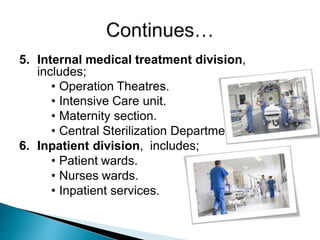
5. Internal medical treatment division,
includes;
• Operation Theatres.
• Intensive Care unit.
• Maternity section.
• Central Sterilization Department.
6. Inpatient division, includes;
• Patient wards.
• Nurses wards.
• Inpatient services.
7. General service division, includes;
• Kitchen.
• Laundry.
• Storages.
• Workshops.
• Mechanical services.
• Mortuary.
• Security.
• Parking.
• Landscaping.
• Patient rooms
– Private/semi private or multi-bed general
wards
– Safe and aesthetic
– Contain space for equipments, staffs &
various needs of the patients
• Nurse station
– Designed to observe the patients
• Work area
– Space for materials necessary for patient care
• Facilities & space required:
– Examination & treatment room with wash basin
– Cupboard for clean linen
– Baskets for soiled linen
– Waste baskets
– Equipment storage rooms (For IV stands)
– Lockers for staff
– Space for storing stretchers and wheel chairs
– Staff toilets
– Small laboratory
– Telephone
Planning and organization of the OPD:
 Location: it should be easily accessible to those who come for
outside, and should be a separate wing for OPD attached to the
hospital accessible from the main entrance to the hospital with
direct approach from the main road.
 Space: the space requirement will depend upon the land
available and location of the hospital. Generally 0.66-1 sq ft area
per annual outpatient attendance should be provided for OPD. If
there are 3 lakhs visit in a year, the total space requirement for
OPD will be 2- 3 lakh sq ft or 4.5-6.8 acres.
 Size: the size of OPD depends upon the volume of attendance,
clinics provided and extent of facilities like blood bank,
emergency department.
 FUNCTIONAL ZONE: this zone is mainly used by
the patients attending the OPD, attendants and
relatives. This area includes parking area, entrance
hall, waiting space, enquiry and registration, and
medical social services.
 ADMINISTRATIVE ZONE: this zone is required
in a large hospital to plan, organize, supervise,
evaluate and co-ordinate the facilities being provided.
the various functional units of this zone are
◦ Office of the OPD in-charge
◦ Administrative control nurses station
◦ Cash counters
◦ Medical record room
 DIAGNOSTIC AND SUPPORTIVE ZONE: the various
functional units in this area are:
◦ Clinical laboratory
◦ Imaging section
 AMBULATORY ZONE: This is a zone where the patients
come in direct contact with the doctors and paramedical staff
for consultancies, advice and treatment. it includes units like:
◦ Clinics for various medical disciplines
◦ Pharmacy
◦ Treatment room
◦ Minor OT
 STAFF ZONE: this zone is used exclusively by the staff
members only. It includes duty rooms, stores, housekeeping
and conference room.
Functional management:
 OPD timings: it is recommended that OPD shall work 6 days
in a week with facilities of morning and evening clinics. The
morning timings is usually from 8am-12 pm, whereas the
evening hours shall be from 3pm to 5 pm, and specialty clinics
from 2 pm to 4pm. overcrowding and waiting time of the
patients and relatives must be minimized.
 Records: a unit record system combining both in-patients
record and continuous out patient record is recommended.
 Public relations: public complaints can be minimized and
defused through public relations, the entire staff of OPD
including public relations persons should act as agents.
 Facilities in OPD:
The waiting lines should have enough furniture so that
patients don't have to stand in queues but can sit
comfortably.
The general procedure and rules should be painted on
boards or walls for the public.
The registration area should be easily recognized and
reachable.
Health education messages can be promoted through TV-
VCR system, closed circuit TV and also to reduce the
boredom of the waiting patients and their relatives in OPD.
 Specific wards: these include patients
admitted for specific care due to illness or
social reasons. It includes:
◦ Emergency ward
◦ Intensive care unit
◦ Intensive coronary care unit
◦ Nursery
◦ Special septic nursery
◦ Burns ward
◦ Post operative ward
◦ Post natal ward
 Physical facilities: it includes
◦ Size of ward: size of the ward depends on- types of patient (an
area of 100- 120 sq ft/bed is required and smaller rooms of 2-4
beds are preferable), requirement of ward staff (a small ward will
have same requirement throughout the day, helped by a head
nurse and a clerk for administrative and clerical responsibilities)
◦ Patient housing area: this is an area where patients are kept for
treatment.
 The area per bed within the ward is 80 sq ft/bed but in acute
ward it is 100 sq ft/bed
 Space left between two rows of bed is 5 ft. distance between
two beds is 31/2 to 4 ft.
 Clearance between wall and side of bed is 2ft.
 Length of bed is 6’6, width of the bed is 3.
 Nursing station/duty room: it should be located at such a place that the
time taken by a nurse for moving from one place to another is limited.
Centralize location is desirable.
 Treatment room: the room is meant for examination of patients and
should be equipped with examination table, spotlight, dressing material,
hand washing facility etc.
 Clean work room: it is a working room for staff nurses in nursing unit,
contains work benches for preparation of trays, care of materials,
equipments and supplies etc.
 Pantry: it is a place where the dishes are cleaned, washed and stored.
 Unit store: it is meant for storing the supplies and linens.
 Sanitary area: it includes baths and toilets, dirty utility room, store for
sweepers etc.
 Auxiliary areas: this section includes duty room for doctors, clinical side
room, seminar room, attendant room, locker room for staff.
 The primary
objective of a ward
design is to facilitate
the nurse to hear and
see everything in the
ward and patients
can easily call the
nurse when need
help.
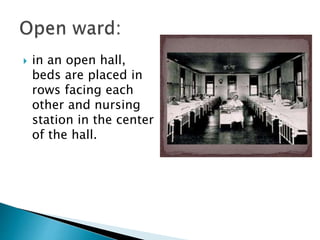
 in an open hall,
beds are placed in
rows facing each
other and nursing
station in the center
of the hall.
 in this design, 3-4
beds are placed
parallel to the
windows in open
bays separated
from each other by
low partition.
 side beds are placed in each bay
separated from nurse's station
with its standby services by a
common corridor.
 It has been accepted as most
suitable and workable
conditions, two unilateral rig's
wards are on either side of a
central nursing station.
Organisation

Organisation

  • 1.
    Presented To: Dr.Deelip Natekar Principal S.I.O.N.SBGK Presented By: Naveen Jyothi MSc(N)II year S.I.O.N.S BGK
  • 3.
    The word organizationmay convey at least 2 meanings:  Firstly it may refer to the activity of management in arranging people, tasks and resources in the most orderly and efficient manner.  Secondly it may also name the arrangement itself, the outcome of the organizing activity.
  • 4.
    Organization is “agroup of people working together and with each other towards the achievement of the common goals‟.
  • 6.
     A hospitalis responsible to render an essential service. In fulfilling this responsibility, hospital planning should be guided by certain universally acknowledged principles.
  • 7.
    • Provide qualitycare – Quality medical services & enhancing patient satisfaction • Provide maximum comfort – Comfort in terms of safety, security, convenience & privacy – Avoiding slippery floors, direct sunlight etc. • Enhance staff satisfaction – Staff motivation & safe working environment • Patient relatives & visitors convenience – Comfortable stay, safe environments etc • Maintenance & cost of services
  • 8.
     Hospitals ingeneral are classified into two categories depending upon the agencies which finance them: 1. Government or public hospitals 2. Non-government hospitals
  • 10.
    • Preventive – Concernedwith health promotion – Participated with community/peripheral health care delivery systems • Curative – Patient care – Includes health education • Training – Continuing and on the job training • Research – Health related researches
  • 11.
    • Protection – Protectionfrom unwanted & unnecessary disturbances in order to help speedy recovery • Separation – Separation of dissimilar activities • Control – Control over the untoward incidents • Circulation – Proper integration of departments
  • 13.
    here the imagination oridea of the originator takes into a practical shape. once the idea is developed, the entrepreneur, discuss project, and then finds support groups to join hands and complete the project.
  • 14.
    : a group shouldbe formalized called as a hospital trust, which must be registered under the society's act or companies act. The originator is the chairman and others are members who are assigned different tasks.  A detailed work out as to how much capital will be required for establishing the hospital. 1. Meteorological information: temperature, rainfall, humidity 2. Geographical information: existing road and rail communications, susceptibility to quakes/floods, building height restrictions due to proximity of airports. 3. Miscellaneous availability: trained manpower, water, sewage disposal.
  • 15.
     Bed planning Hospital size  Land requirements  Public utilities  Approval of plan by the local authorities.
  • 16.
    There are twotypes of circulation in the hospital:  Internal circulation: the circulation space involves corridors, stairways and lifts. Corridors with less than 8 ft. Width are not desirable in hospitals and protective corner beading is a necessity in hospital corridors.  External circulation: only one entrance to the hospital for vehicular traffic from the main road is desirable. the entrance and exit points should be wide enough to take two lanes of traffic, one entry for clarity of all visiting traffic and one exit for security from administrative viewpoint.
  • 17.
     The hospitalwhich demands more land involving extra costs and installation of services, roads, water supply, sewage etc. One car parking space per 2 beds is desirable in metropolitan towns, lesser in smaller urban areas while much less in semi-urban and rural areas. Separate parking for 3-wheelers and scooters, employees and staff parking areas separate from public parking should be considered.
  • 18.
    Departments which come inclose contact with the public (e.g. outpatient department, emergency and casualty) should be isolated from the main in patient areas and allotted areas closer to the main entrance.  The supportive services like X-ray and laboratory services need to be located near the OPD‟s. From the main entrance should be main inpatient zone consisting of ICU, wards, OT and delivery suit. The other supportive and clinic- administrative department in the hospital consists of hospital stores, kitchen and dietary department, pharmacy etc. these departments should be preferably grouped around a service core area.
  • 19.
    in very hot climatebuildings need to be cooled in summer by artificial means.The building should be open, and oriented in such a way that even a slight breeze can pass through the building to cool its insides.  Another way is to keep thick walls and small windows where the thick walls absorb the heat during day and dissipates during night, and small windows minimize the amount of radiated heat entering the building.
  • 20.
    Hospital equipment coversa broad range of items necessary for functioning of all services. the universal application of equipment in the hospital can be classified as  Physical plant: it includes lifts, refrigeration and air-conditioning, incinerators, boilers, kitchen equipments, mechanical laundry, central oxygen etc.  Hospital furniture and appliances: beds, stretchers, trolleys, bedside lockers, movable screens, operation tables, instrument trolleys etc.  General purpose furniture and appliances: it includes office machines (typewriters, calculators, filing system, and computers), office furniture, crockery and cutlery.  Therapeutic and diagnostic equipments: it includes equipments for general use (BP instruments, suction machines, glassware washers etc.) and equipment interacting with patients during diagnostic and therapeutic procedures (defibrillators, X-ray machines etc.)
  • 23.
    • Administration division. •Outpatients’ division, includes; • Outpatient clinics. • Pharmacy. • Emergency reception. • Diagnostic services division, includes; • Laboratories. • Radiology (diagnostic). • Therapeutic services division, includes; • Physical Therapy. • Radiology (therapeutic).
  • 24.
    5. Internal medicaltreatment division, includes; • Operation Theatres. • Intensive Care unit. • Maternity section. • Central Sterilization Department. 6. Inpatient division, includes; • Patient wards. • Nurses wards. • Inpatient services.
  • 25.
    7. General servicedivision, includes; • Kitchen. • Laundry. • Storages. • Workshops. • Mechanical services. • Mortuary. • Security. • Parking. • Landscaping.
  • 26.
    • Patient rooms –Private/semi private or multi-bed general wards – Safe and aesthetic – Contain space for equipments, staffs & various needs of the patients • Nurse station – Designed to observe the patients • Work area – Space for materials necessary for patient care
  • 27.
    • Facilities &space required: – Examination & treatment room with wash basin – Cupboard for clean linen – Baskets for soiled linen – Waste baskets – Equipment storage rooms (For IV stands) – Lockers for staff – Space for storing stretchers and wheel chairs – Staff toilets – Small laboratory – Telephone
  • 28.
    Planning and organizationof the OPD:  Location: it should be easily accessible to those who come for outside, and should be a separate wing for OPD attached to the hospital accessible from the main entrance to the hospital with direct approach from the main road.  Space: the space requirement will depend upon the land available and location of the hospital. Generally 0.66-1 sq ft area per annual outpatient attendance should be provided for OPD. If there are 3 lakhs visit in a year, the total space requirement for OPD will be 2- 3 lakh sq ft or 4.5-6.8 acres.  Size: the size of OPD depends upon the volume of attendance, clinics provided and extent of facilities like blood bank, emergency department.
  • 29.
     FUNCTIONAL ZONE:this zone is mainly used by the patients attending the OPD, attendants and relatives. This area includes parking area, entrance hall, waiting space, enquiry and registration, and medical social services.  ADMINISTRATIVE ZONE: this zone is required in a large hospital to plan, organize, supervise, evaluate and co-ordinate the facilities being provided. the various functional units of this zone are ◦ Office of the OPD in-charge ◦ Administrative control nurses station ◦ Cash counters ◦ Medical record room
  • 30.
     DIAGNOSTIC ANDSUPPORTIVE ZONE: the various functional units in this area are: ◦ Clinical laboratory ◦ Imaging section  AMBULATORY ZONE: This is a zone where the patients come in direct contact with the doctors and paramedical staff for consultancies, advice and treatment. it includes units like: ◦ Clinics for various medical disciplines ◦ Pharmacy ◦ Treatment room ◦ Minor OT  STAFF ZONE: this zone is used exclusively by the staff members only. It includes duty rooms, stores, housekeeping and conference room.
  • 31.
    Functional management:  OPDtimings: it is recommended that OPD shall work 6 days in a week with facilities of morning and evening clinics. The morning timings is usually from 8am-12 pm, whereas the evening hours shall be from 3pm to 5 pm, and specialty clinics from 2 pm to 4pm. overcrowding and waiting time of the patients and relatives must be minimized.  Records: a unit record system combining both in-patients record and continuous out patient record is recommended.  Public relations: public complaints can be minimized and defused through public relations, the entire staff of OPD including public relations persons should act as agents.
  • 32.
     Facilities inOPD: The waiting lines should have enough furniture so that patients don't have to stand in queues but can sit comfortably. The general procedure and rules should be painted on boards or walls for the public. The registration area should be easily recognized and reachable. Health education messages can be promoted through TV- VCR system, closed circuit TV and also to reduce the boredom of the waiting patients and their relatives in OPD.
  • 34.
     Specific wards:these include patients admitted for specific care due to illness or social reasons. It includes: ◦ Emergency ward ◦ Intensive care unit ◦ Intensive coronary care unit ◦ Nursery ◦ Special septic nursery ◦ Burns ward ◦ Post operative ward ◦ Post natal ward
  • 35.
     Physical facilities:it includes ◦ Size of ward: size of the ward depends on- types of patient (an area of 100- 120 sq ft/bed is required and smaller rooms of 2-4 beds are preferable), requirement of ward staff (a small ward will have same requirement throughout the day, helped by a head nurse and a clerk for administrative and clerical responsibilities) ◦ Patient housing area: this is an area where patients are kept for treatment.  The area per bed within the ward is 80 sq ft/bed but in acute ward it is 100 sq ft/bed  Space left between two rows of bed is 5 ft. distance between two beds is 31/2 to 4 ft.  Clearance between wall and side of bed is 2ft.  Length of bed is 6’6, width of the bed is 3.
  • 37.
     Nursing station/dutyroom: it should be located at such a place that the time taken by a nurse for moving from one place to another is limited. Centralize location is desirable.  Treatment room: the room is meant for examination of patients and should be equipped with examination table, spotlight, dressing material, hand washing facility etc.  Clean work room: it is a working room for staff nurses in nursing unit, contains work benches for preparation of trays, care of materials, equipments and supplies etc.  Pantry: it is a place where the dishes are cleaned, washed and stored.  Unit store: it is meant for storing the supplies and linens.  Sanitary area: it includes baths and toilets, dirty utility room, store for sweepers etc.  Auxiliary areas: this section includes duty room for doctors, clinical side room, seminar room, attendant room, locker room for staff.
  • 38.
     The primary objectiveof a ward design is to facilitate the nurse to hear and see everything in the ward and patients can easily call the nurse when need help.
  • 39.
     in anopen hall, beds are placed in rows facing each other and nursing station in the center of the hall.
  • 40.
     in thisdesign, 3-4 beds are placed parallel to the windows in open bays separated from each other by low partition.
  • 41.
     side bedsare placed in each bay separated from nurse's station with its standby services by a common corridor.
  • 42.
     It hasbeen accepted as most suitable and workable conditions, two unilateral rig's wards are on either side of a central nursing station.